“There is a danger in being persuaded before one understands.” — Thomas Wilson
Anyone we could marry would, of course, be a little wrong for us. It is wise to be appropriately pessimistic here. Perfection is not on the cards. Unhappiness is a constant. Nevertheless, one encounters some couples of such primal, grinding mismatch, such deep-seated incompatibility, that one has to conclude that something else is at play beyond the normal disappointments and tensions of every long-term relationship: some people simply shouldn’t be together.

© Getty
How do the errors happen? With appalling ease and regularity. Given that marrying the wrong person is about the single easiest and also costliest mistake any of us can make (and one which places an enormous burden on the state, employers and the next generation), it is extraordinary, and almost criminal, that the issue of marrying intelligently is not more systematically addressed at a national and personal level, as road safety or smoking are.
It’s all the sadder because in truth, the reasons why people make the wrong choices are easy to lay out and unsurprising in their structure. They tend to fall into some of the following basic categories.
One: We don’t understand ourselves

© Rex/Agatha A. Nitecka
When first looking out for a partner, the requirements we come up with are coloured by a beautiful non-specific sentimental vagueness: we’ll say we really want to find someone who is ‘kind’ or ‘fun to be with’, ‘attractive’ or ‘up for adventure…’
It isn’t that such desires are wrong, they are just not remotely precise enough in their understanding of what we in particular are going to require in order to stand a chance of being happy – or, more accurately, not consistently miserable.
All of us are crazy in very particular ways. We’re distinctively neurotic, unbalanced and immature, but don’t know quite the details because no one ever encourages us too hard to find them out. An urgent, primary task of any lover is therefore to get a handle on the specific ways in which they are mad. They have to get up to speed on their individual neuroses. They have to grasp where these have come from, what they make them do – and most importantly, what sort of people either provoke or assuage them. A good partnership is not so much one between two healthy people (there aren’t many of these on the planet), it’s one between two demented people who have had the skill or luck to find a non-threatening conscious accommodation between their relative insanities.
The very idea that we might not be too difficult as people should set off alarm bells in any prospective partner. The question is just where the problems will lie: perhaps we have a latent tendency to get furious when someone disagrees with us, or we can only relax when we are working, or we’re a bit tricky around intimacy after sex, or we’ve never been so good at explaining what’s going on when we’re worried. It’s these sort of issues that – over decades – create catastrophes and that we therefore need to know about way ahead of time, in order to look out for people who are optimally designed to withstand them. A standard question on any early dinner date should be quite simply: ‘And how are you mad?’

© Getty/Ernst Haas
The problem is that knowledge of our own neuroses is not at all easy to come by. It can take years and situations we have had no experience of. Prior to marriage, we’re rarely involved in dynamics that properly hold up a mirror to our disturbances. Whenever more casual relationships threaten to reveal the ‘difficult’ side of our natures, we tend to blame the partner – and call it a day. As for our friends, they predictably don’t care enough about us to have any motive to probe our real selves. They only want a nice evening out. Therefore, we end up blind to the awkward sides of our natures. On our own, when we’re furious, we don’t shout, as there’s no one there to listen – and therefore we overlook the true, worrying strength of our capacity for fury. Or we work all the time without grasping, because there’s no one calling us to come for dinner, how we manically use work to gain a sense of control over life – and how we might cause hell if anyone tried to stop us. At night, all we’re aware of is how sweet it would be to cuddle with someone, but we have no opportunity to face up to the intimacy-avoiding side of us that would start to make us cold and strange if ever it felt we were too deeply committed to someone. One of the greatest privileges of being on one’s own is the flattering illusion that one is, in truth, really quite an easy person to live with.
With such a poor level of understanding of our characters, no wonder we aren’t in any position to know who we should be looking out for.
Two: We don’t understand other people
This problem is compounded because other people are stuck at the same low level of self-knowledge as we are. However well-meaning they might be, they too are in no position to grasp, let alone inform us, of what is wrong with them.
Naturally, we make a stab at trying to know them. We go and visit their families, perhaps the place they first went to school. We look at photos, we meet their friends. All this contributes to a sense we’ve done our homework. But it’s like a novice pilot assuming they can fly after sending a paper plane successfully around the room.

© Getty
In a wiser society, prospective partners would put each other through detailed psychological questionnaires and send themselves off to be assessed at length by teams of psychologists. By 2100, this will no longer sound like a joke. The mystery will be why it took humanity so long to get to this point.
We need to know the intimate functioning of the psyche of the person we’re planning to marry. We need to know their attitudes to, or stance on, authority, humiliation, introspection, sexual intimacy, projection, money, children, aging, fidelity and a hundred things besides. This knowledge won’t be available via a standard chat.
In the absence of all this, we are led – in large part – by what they look like. There seems to be so much information to be gleaned from their eyes, nose, shape of forehead, distribution of freckles, smiles… But this is about as wise as thinking that a photograph of the outside of a power station can tell us everything we need to know about nuclear fission.
We ‘project’ a range of perfections into the beloved on the basis of only a little evidence. In elaborating a whole personality from a few small – but hugely evocative – details, we are doing for the inner character of a person what our eyes naturally do with the sketch of a face.

We don’t see this as a picture of someone who has no nostrils, eight strands of hair and no eyelashes. Without even noticing that we are doing it, we fill in the missing parts. Our brains are primed to take tiny visual hints and construct entire figures from them – and we do the same when it comes to the character of our prospective spouse. We are – much more than we give ourselves credit for, and to our great cost – inveterate artists of elaboration.
The level of knowledge we need for a marriage to work is higher than our society is prepared to countenance, recognise and accommodate for – and therefore our social practices around getting married are deeply wrong.
Three: We aren’t used to being happy
We believe we seek happiness in love, but it’s not quite as simple. What at times it seems we actually seek is familiarity – which may well complicate any plans we might have for happiness.
We recreate in adult relationships some of the feelings we knew in childhood. It was as children that we first came to know and understand what love meant. But unfortunately, the lessons we picked up may not have been straightforward. The love we knew as children may have come entwined with other, less pleasant dynamics: being controlled, feeling humiliated, being abandoned, never communicating, in short: suffering.
As adults, we may then reject certain healthy candidates whom we encounter, not because they are wrong, but precisely because they are too well-balanced (too mature, too understanding, too reliable), and this rightness feels unfamiliar and alien, almost oppressive. We head instead to candidates whom our unconscious is drawn to, not because they will please us, but because they will frustrate us in familiar ways.
We marry the wrong people because the right ones feel wrong – undeserved; because we have no experience of health, because we don’t ultimately associate being loved with feeling satisfied.
Four: Being single is so awful
One is never in a good frame of mind to choose a partner rationally when remaining single is unbearable. We have to be utterly at peace with the prospect of many years of solitude in order to have any chance of forming a good relationship. Or we’ll love no longer being single rather more than we love the partner who spared us being so.
Unfortunately, after a certain age, society makes singlehood dangerously unpleasant. Communal life starts to wither, couples are too threatened by the independence of the single to invite them around very often, one starts to feel a freak when going to the cinema alone. Sex is hard to come by as well. For all the new gadgets and supposed freedoms of modernity, it can be very hard to get laid – and expecting to do so regularly with new people is bound to end in disappointment after 30.

© Rex
Far better to rearrange society so that it resembles a university or a kibbutz – with communal eating, shared facilities, constant parties and free sexual mingling… That way, anyone who did decide marriage was for them would be sure they were doing it for the positives of coupledom rather than as an escape from the negatives of singlehood.
When sex was only available within marriage, people recognised that this led people to marry for the wrong reasons: to obtain something that was artificially restricted in society as a whole. People are free to make much better choices about who they marry now they’re not simply responding to a desperate desire for sex.
But we retain shortages in other areas. When company is only properly available in couples, people will pair up just to spare themselves loneliness. It’s time to liberate ‘companionship’ from the shackles of coupledom, and make it as widely and as easily available as sexual liberators wanted sex to be.
Five: Instinct has too much prestige

Back in the olden days, marriage was a rational business; all to do with matching your bit of land with theirs. It was cold, ruthless and disconnected from the happiness of the protagonists. We are still traumatised by this.
What replaced the marriage of reason was the marriage of instinct, the Romantic marriage. It dictated that how one felt about someone should be the only guide to marriage. If one felt ‘in love’, that was enough. No more questions asked. Feeling was triumphant. Outsiders could only applaud the feeling’s arrival, respecting it as one might the visitation of a divine spirit. Parents might be aghast, but they had to suppose that only the couple could ever know. We have for three hundred years been in collective reaction against thousands of years of very unhelpful interference based on prejudice, snobbery and lack of imagination.

© Getty
So pedantic and cautious was the old ‘marriage of reason’ that one of the features of the marriage of feeling is its belief that one shouldn’t think too much about why one is marrying. To analyse the decision feels ‘un-Romantic’. To write out charts of pros and cons seems absurd and cold. The most Romantic thing one can do is just to propose quickly and suddenly, perhaps after only a few weeks, in a rush of enthusiasm – without any chance to do the horrible ‘reasoning’ that guaranteed misery to people for thousands of years previously. The recklessness at play seems a sign that the marriage can work, precisely because the old kind of ‘safety’ was such a danger to one’s happiness.
Six: We don’t go to Schools of Love

© Getty
The time has come for a third kind of marriage. The marriage of psychology. One where one doesn’t marry for land, or for ‘the feeling’ alone, but only when ‘the feeling’ has been properly submitted to examination and brought under the aegis of a mature awareness of one’s own and the other’s psychology.
Presently, we marry without any information. We almost never read books specifically on the subject, we never spend more than a short time with children, we don’t rigorously interrogate other married couples or speak with any sincerity to divorced ones. We go into it without any insightful reasons as to why marriages fail – beyond what we presume to be the idiocy or lack of imagination of their protagonists.
In the age of the marriage of reason, one might have considered the following criteria when marrying:
- who are their parents
- how much land do they have
- how culturally similar are they
In the Romantic age, one might have looked out for the following signs to determine rightness:
- one can’t stop thinking of a lover
- one is sexually obsessed
- one thinks they are amazing
- one longs to talk to them all the time
We need a new set of criteria. We should wonder:
- how are they mad
- how can one raise children with them
- how can one develop together
- how can one remain friends

Seven: We want to freeze happiness
We have a desperate and fateful urge to try to make nice things permanent. We want to own the car we like, we want to live in the country we enjoyed as a tourist. And we want to marry the person we are having a terrific time with.
We imagine that marriage is a guarantor of the happiness we’re enjoying with someone. It will make permanent what might otherwise be fleeting. It will help us to bottle our joy – the joy we felt when the thought of proposing first came to us: we were in Venice, on the lagoon, in a motorboat, with the evening sun throwing gold flakes across the sea, the prospect of dinner in a little fish restaurant, our beloved in a cashmere jumper in our arms… We got married to make this feeling permanent.
Unfortunately, there is no causal necessary connection between marriage and this sort of feeling. The feeling was produced by Venice, a time of day, a lack of work, an excitement at dinner, a two month acquaintance with someone… none of which ‘marriage’ increases or guarantees.
Marriage doesn’t freeze the moment at all. That moment was dependent on the fact that you had only known each other for a bit, that you weren’t working, that you were staying in a beautiful hotel near the Grand Canal, that you’d had a pleasant afternoon in the Guggenheim museum, that you’d just had a chocolate gelato…
Getting married has no power to keep a relationship at this beautiful stage. It is not in command of the ingredients of our happiness at that point. In fact, marriage will decisively move the relationship on to another, very different moment: to a suburban house, a long commute, two small children. The only ingredient in common is the partner. And that might have been the wrong ingredient to bottle.
The Impressionist painters of the nineteenth century had an implicit philosophy of transience that points us in a wiser direction. They accepted the transience of happiness as an inherent feature of existence and could in turn help us to grow more at peace with it. Sisley’s painting of a winter scene in France focuses on a set of attractive but utterly fugitive things. Towards dusk, the sun nearly breaks through the landscape. For a little time, the glow of the sky makes the bare branches less severe. The snow and the grey walls have a quiet harmony; the cold seems manageable, almost exciting. In a few minutes, night will close in.
 Alfred Sisley, The Watering Place at Marly-le-Roi, 1875
Impressionism is interested in the fact that the things we love most change, are only around a very short time and then disappear. It celebrates the sort of happiness that lasts a few minutes, rather than years. In this painting, the snow looks lovely; but it will melt. The sky is beautiful at this moment, but it is about to go dark. This style of art cultivates a skill that extends far beyond art itself: a skill at accepting and attending to short-lived moments of satisfaction.
The peaks of life tend to be brief. Happiness doesn’t come in year-long blocks. With the Impressionists to guide us, we should be ready to appreciate isolated moments of everyday paradise whenever they come our way, without making the mistake of thinking them permanent; without the need to turn them into a ‘marriage’.
Eight: We believe we are special
The statistics are not encouraging. Everyone has before them plenty of examples of terrible marriages. They’ve seen their friends try it and come unstuck. They know perfectly well that – in general – marriages face immense challenges. And yet we do not easily apply this insight to our own case. Without specifically formulating it, we assume that this is a rule that applies to other people.
That’s because a raw statistical chance of one in two of failing at marriage seems wholly acceptable, given that – when one is in love – one feels one has already beaten far more extraordinary odds. The beloved feels like around one in a million. With such a winning streak, the gamble of marrying a person seem entirely containable.
We silently exclude ourselves from the generalisation. We’re not to be blamed for this. But we could benefit from being encouraged to see ourselves as exposed to the general fate.
Nine: We want to stop thinking about Love
Before we get married, we are likely to have had many years of turbulence in our love lives. We have tried to get together with people who didn’t like us, we’ve started and broken up unions, we’ve gone out for endless parties, in the hope of meeting someone, and known excitement and bitter disappointments.
No wonder if, at a certain point, we have enough of all that. Part of the reason we feel like getting married is to interrupt the all-consuming grip that love has over our psyches. We are exhausted by the melodramas and thrills that go nowhere. We are restless for other challenges. We hope that marriage can conclusively end love’s painful rule over our lives.

It can’t and won’t: there is as much doubt, hope, fear, rejection and betrayal in a marriage as there is in single life. It’s only from the outside that a marriage looks peaceful, uneventful and nicely boring.
****
Preparing us for marriage is, ideally, an educational task that falls on culture as a whole. We have stopped believing in dynastic marriages. We are starting to see the drawbacks of Romantic marriages. Now comes the time for psychological marriages.

Remember last month, when the Kindle version of Off to Be the Wizard was on sale on Amazon, but only in the US? Well, now it’s the UK’s turn!
As always, thanks for using my Amazon Affiliate links (US, UK, Canada).

Adam Victor BrandizziA imagem do botão vermelho é um excelente complement.


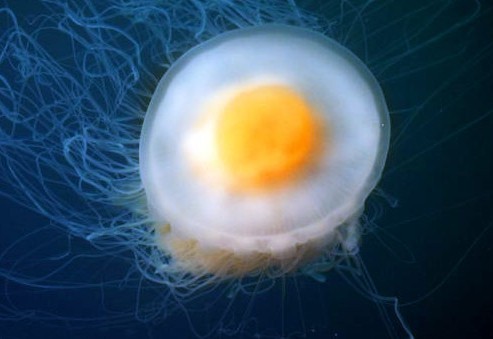
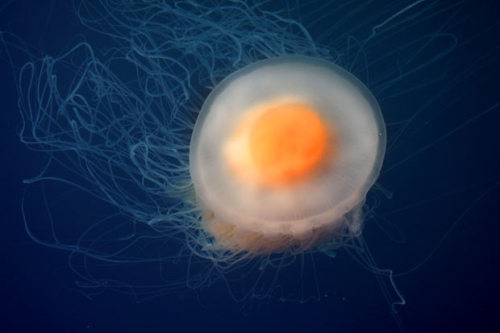



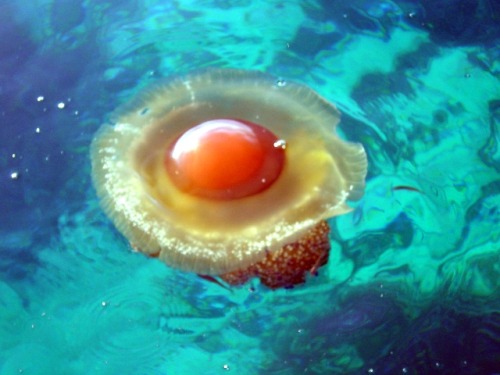
crumbFried Egg Jellyfish Are Kind of Adorable – & That’s No Yolk.
There are two species that hold the whimsical title of “Fried Egg Jellyfish”: Phacellophora camtschatica and Cotylorhiza tuberculata though the two are quite different from each other in all aspects beside appearance.Phacellophora camtschatica is a huge jelly that prefers colder waters. It’s bell can reach up to 2 ft across and its dozens of tentacles reach over 20 ft long! If you don’t think this floating egg creature looks very menacing, you’d be right. It has a very weak sting and many small crustaceans take advantage of the jelly by riding on its bell (breakfast to go…?) while snatching up extra food.
Cotylorhiza tuberculata is a much smaller jellyfish that hangs out in warmer waters. It only reaches about 35 cm in diameter, so don’t go for this Fried Egg Jelly if you want a big breakfast. Unlike most jellyfish, C. tuberculata can swim on its own, without relying on the currents for movement. It’s sting (if you can even call it that) is so feeble that it has very little to no effect on humans at all. I mean, it does look like a breakfast food, after all… how powerful could it be?

Throwback Thursday
Adam Victor BrandizziHá mais coisas pousando em outras coisas do que eu imaginava.
Discover the cosmos! Each day a different image or photograph of our fascinating universe is featured, along with a brief explanation written by a professional astronomer.
2015 January 16

Explanation: Delivered by Saturn-bound Cassini, ESA's Huygens probe touched down on the ringed planet's largest moon Titan, ten years ago on January 14, 2005. These panels show fisheye images made during its slow descent by parachute through Titan's dense atmosphere. Taken by the probe's descent imager/spectral radiometer instrument they range in altitude from 6 kilometers (upper left) to 0.2 kilometers (lower right) above the moon's surprisingly Earth-like surface of dark channels, floodplains, and bright ridges. But at temperatures near -290 degrees F (-180 degrees C), the liquids flowing across Titan's surface are methane and ethane, hydrocarbons rather than water. After making the most distant landing for a spacecraft from Earth, Huygens transmitted data for more than an hour. The Huygens data and a decade of exploration by Cassini have shown Titan to be a tantalizing world hosting a complex chemistry of organic compounds, dynamic landforms, lakes, seas, and a possible subsurface ocean of liquid water.
Tomorrow's picture: the Moon would be this big < | Archive | Submissions | Search | Calendar | RSS | Education | About APOD | Discuss | >
Authors & editors:
Robert Nemiroff
(MTU) &
Jerry Bonnell (UMCP)
NASA Official: Phillip Newman
Specific rights apply.
NASA Web
Privacy Policy and Important Notices
A service of:
ASD at
NASA /
GSFC
& Michigan Tech. U.
 You may recall the story last
month of a family threatened by the authorities for letting their
kids walk outside. Here's the latest from the mom, Danielle
Meitiv, who is hoping the rest of the media takes note. I hope so,
too.
You may recall the story last
month of a family threatened by the authorities for letting their
kids walk outside. Here's the latest from the mom, Danielle
Meitiv, who is hoping the rest of the media takes note. I hope so,
too.
Meitiv explains via email:
Dear Reason: On Monday, a Montgomery County child protective services worker went to my children's school and interviewed them without my knowledge or consent. Why?
Because last month we'd let them walk home from the park by themselves. It's a mile away. They are 6 and 10. We live in suburban Maryland. Let me recap the story and then tell you where we're at.
On a Saturday afternoon in December, my husband, Alexander, gave our kids permission to walk home from the local playground. I was out of town at the time. When they'd walked about halfway, a Montgomery County Police patrol car pulled up. A "helpful" neighbor had called 911 to report unaccompanied children walking outside. Our kids were brought home in a police cruiser.
At the door the police officer asked to see my husband's ID, but did not explain why. When he refused, she called for backup.
A total of six patrol cars showed up.
Alexander then agreed to get his ID and went to go upstairs. The officer said—in front of the kids—that if he came down with anything else, "shots would be fired." She proceeded to follow him upstairs, and when he said she had no right to do so without a warrant, she insisted that she did.
Our 10 yr. old called me crying and saying that the police were there and that Daddy was going to be arrested. Alexander stepped outside to continue the conversation away from the kids. When he disagreed with one of the officers about the dangers that walking alone posed to children, she asked him: "Don't you realize how dangerous the world is? Don't you watch TV?" They took notes and left.
Two hours later a CPS worker arrived with a “temporary safety plan,” which she told my husband to sign. It stated that he would not leave the children unsupervised at any time before Monday morning, when someone from their office could contact him. He refused to sign it. She informed him that if he didn’t, she would instruct the police to take the children away immediately. He signed.
We were then contacted by a CPS social worker named W. Don Thorne who made an appointment for us to come to his office on Friday, Jan. 9. A little while later he called back saying that he needed to come to us, so that he could see our house. We told him we would meet with him at his office, not our home. He said he would speak with his supervisor and call us back.
On Monday, Mr. Thorne showed up at our door unannounced, accompanied by a police officer. He insisted that he had the right to come into our house without a warrant. I said that I was invoking my Fourth Amendment rights against unwarranted search, and would not let him in, but repeated my willingness to go to his office to answer questions. Then I noticed that he had a visitor’s sticker from my children’s elementary school on his jacket. Had he been to my children's school to interview them?!
He didn't answer that question and they quickly left. I have since learned that he visited my children’s school and spoke to my children without my knowledge or consent.
We do not know what actions CPS will take next.
We are frightened and confused. We are good parents, educated professionals, and our children are happy, healthy, well-adjusted, and academically successful.
As difficult as it is for us to believe, all of these events occurred as the result of allowing our children to walk along public streets in the middle of the afternoon without our supervision.
My husband grew up in the former Soviet Union. Now he wonders if we have to just go along with whatever the authorities want us to do. I keep reminding him that we have RIGHTS in this country and that neither the police nor the bureaucrats can arbitrarily dismiss them.
Read more from Reason on the Meitiv family's problems with CPS here.

Hey! New comic. (it may appear incomplete on rss readers, be sure to click to read the full story)
JULIANA COISSI, DE SÃO PAULO
A imagem de cabeças separadas de corpos em meio a uma poça de sangue, cena gravada em rebelião de dezembro de 2013, circulou pelo mundo e revelou a barbárie nas prisões do Brasil.
O vídeo com o assassinato de três presos pelos próprios colegas apresentou o horror em Pedrinhas, complexo penitenciário do Maranhão onde 60 detentos morreram somente naquele ano.
Novas mortes, superlotação, rebeliões e fugas em massa ainda são cenas comuns no sistema carcerário.
O governo Roseana Sarney (PMDB) encerra 2014 sem resolver o caos em Pedrinhas. Os novos presídios no interior, prometidos para desafogar o sistema, ainda não foram entregues.
O novo governador, Flavio Dino (PC do B), assumiu neste mês com a promessa de abrir concurso para funcionários do presídio, concluir as unidades em obras e humanizar o cumprimento das penas.
Quem visita Pedrinhas hoje tem a sensação de estar em um filme que se repete. “A situação é desumana, um ambiente insalubre, de um fedor insuportável”, descreve a deputada estadual Eliziane Gama (PPS).
Também em visita no mês passado, o futuro secretário da pasta que gere os presídios, Murilo de Oliveira, encontrou ratos, lixo acumulado, rede de esgoto estourada e excesso de detentos.
Em 2014, foram 199 fugitivos no complexo, que abriga 2.500 presos. Uma das ações foi cinematográfica: um caminhão rompeu o muro do presídio e 36 presos escaparam, após troca de tiros.
A superlotação persiste como ingrediente para motins. Seis das oito unidades de Pedrinhas têm presos acima da capacidade. No CDP, palco da decapitação gravada em vídeo, há 528 homens para um espaço onde cabem 402.
VÍTIMAS
O inspetor penitenciário Isaac William Giusti foi o penúltimo dos 19 mortos de Pedrinhas em 2014. Ele foi baleado pelos presos enquanto tentava conter uma rebelião, em setembro passado.
Nos 23 dias em que ele permaneceu em coma, seu pai, Adhemar Giusti, 67, tentava encontrar vestígios de vida naquele corpo imóvel.
“Eu levantava a pálpebra dele, e a gente tinha impressão de que ele estava olhando a gente”. Giusti morreu horas depois de completar 38 anos.
Fora dos muros, a capital, São Luís, sofreu os efeitos da disputa de facções criminosas que dominam Pedrinhas. Em setembro, 17 veículos foram incendiados em três dias.
Os ataques não cessaram mesmo após a morte da menina Ana Clara, 6. Em janeiro, a garota morreu depois de ter 95% do corpo queimado em um um dos atentados a ônibus.
A mãe e a irmã de Ana Clara sobreviveram. Há um mês elas reencontraram Marcio Rony Nunes, 38, chamado de herói por entrar no ônibus em chamas para salvar as três.
REENCONTRO
O reencontro de Juliane Santos, 23, com o estivador Marcio Rony Nunes ocorreu em meio a lágrimas e agradecimentos.
Juliane estava com as filhas Ana Clara, 6, e Lorrane Beatriz, um ano e cinco meses, quando Márcio atravessou o ônibus em chamas para socorrê-las.
Os quatro sofreram queimaduras. O caso mais grave foi o de Ana Clara, que, com 95% do corpo atingido, não resistiu e morreu.
Começava para Nunes uma luta pela sobrevivência. As chamas tomaram quase todo seu corpo, e o levou a iniciar um longo tratamento em Goiânia.
Ele passou meses coberto com uma máscara no rosto e uma malha compressora envolvendo tronco e membros.
A cada troca de curativo, Marcio perdia sangue e padecia. “Passei três meses sentindo dor dia e noite”.
No final de novembro, o elogio informal que recebeu, de herói, foi formalizado. Marcio recebeu um capacete e uma medalha de honra ao mérito dos bombeiros de São Luís.
“No começo não gostava [do elogio de herói], mas tanta gente ficou falando que comecei a me acostumar”.
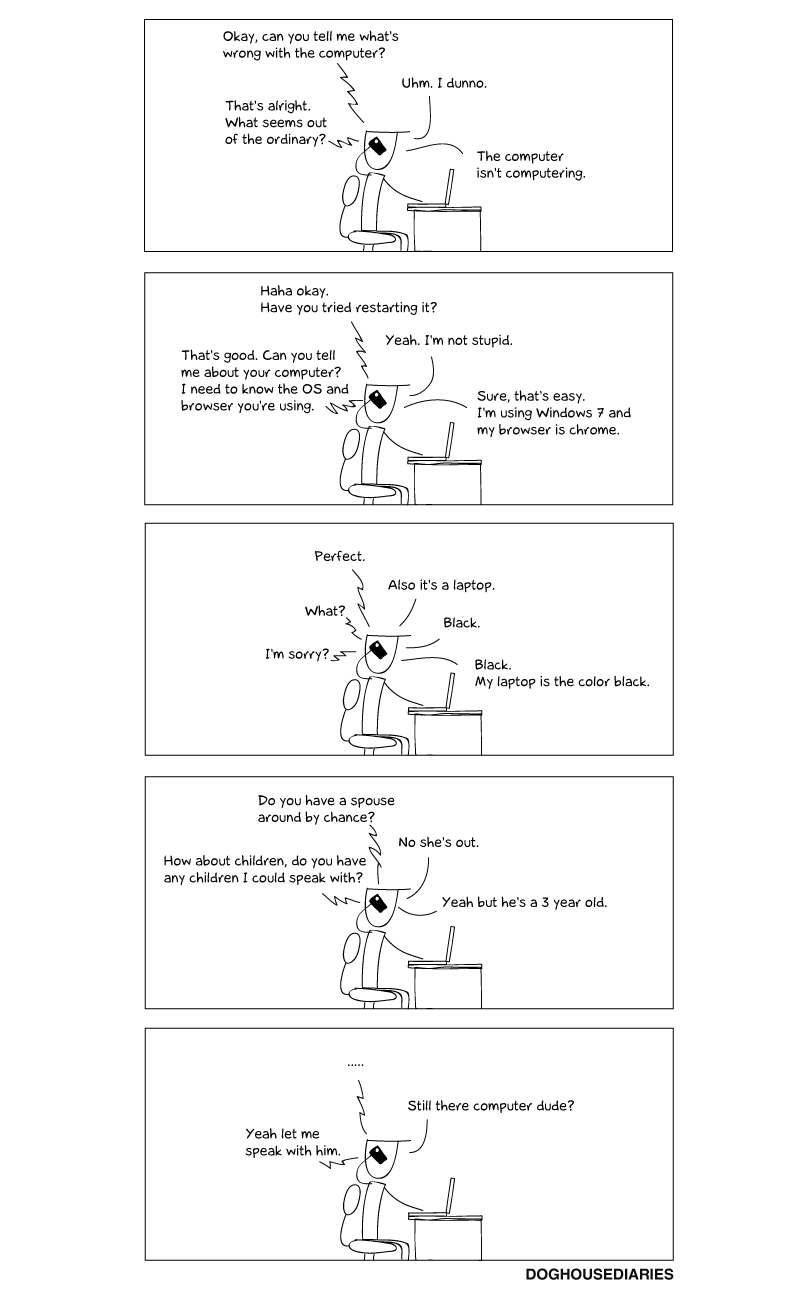
I have a feeling there's a lot of tech support workers out there cringing a little at my portrayal of the kinds of questions they'd ask.
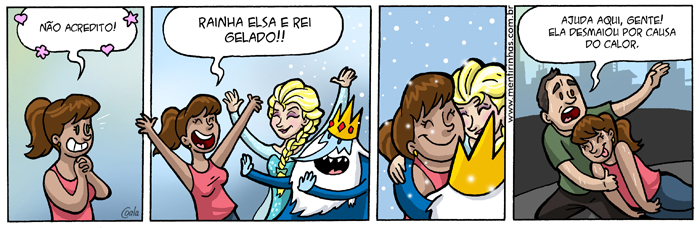
Usar a geladeira como estação de trabalho. Quem nunca?
O post Mentirinhas #757 apareceu primeiro em Mentirinhas.

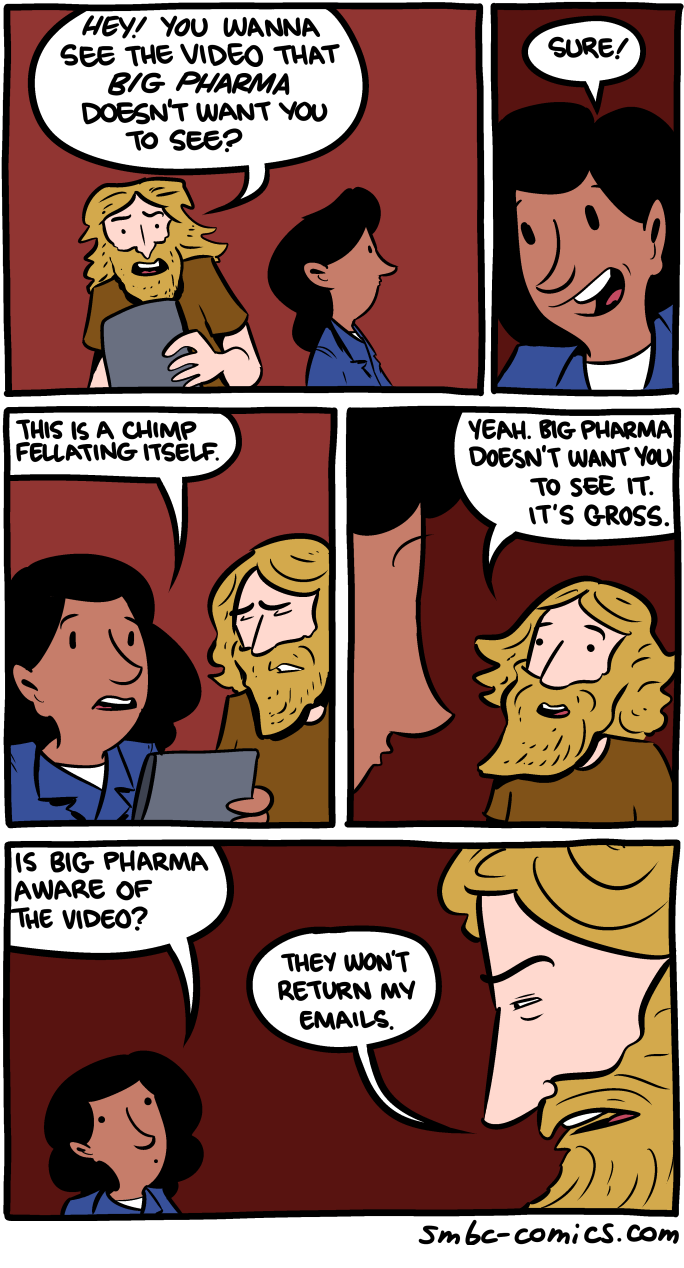


 Expanded from