He is one of the new(ish) thinkers on the rise, here is his latest piece. Excerpt:
For most of the past decade, anti-billionaire language was a niche product. Democratic emails invoked billionaires in the mid-single digits through 2017 and 2018, spiked briefly to around 14 percent during the Warren and Sanders primary surge in 2019, and then settled back down—through the entire Biden presidency, the billionaire appeared in roughly one of every twenty to twenty-five Democratic fundraising emails, barely more than in Republican ones.
Then came January 2025. In the weeks after an inauguration that seated tech CEOs in the front row and the dizzying drama of Elon Musk’s ill-fated DOGE experiment, billionaire mentions in Democratic emails quadrupled, peaking above 20 percent of all emails sent and holding around 15 percent ever since. Anti-billionaire fundraising tactics are now a mainstay of Democratic messaging.
Yes, billionaire derangement syndrome is now a thing. As a side note, I was told that Andrew is the son of the great economist Robert E. Hall of Stanford.
Elon Musk’s Deparment of Goverment Efficiency (DOGE) didn’t achieve much, which is understandable since it didn’t have any real power or authority.
Moreover, given Trump’s unwillingness to deal with the massive long-run problems for programs such as Social Security and Medicare, DOGE was effectively precluded from making suggestions for genuine entitlement reform.
So it’s hardly a surprise that the U.S. government is still stumbling in the wrong direction.
But DOGE nonetheless provided value by highlighting counter-productive spending (and I wish it had gone after more targets, as explained here, here, here, here, and here).
That being said, it probably did result in an actual reduction in foreign-aid spending by the U.S. Agency for International Development (USAID).
Consider, for example, a recent column in New York Times by Nicholas Kristof. He wants readers to think that Elon Musk is responsible for unnecessary deaths.
Here are some excerpts.
A Boston University researcher estimated that the aid cuts have cost more than 750,000 lives worldwide. A study published in the Lancet, the British medical journal, forecast that at present rates, the aid defunding will cost 9.4 million lives by 2030. These figures may not be accurate; we just don’t have solid mortality data, and the aid cuts have also reduced data collection. What I can say after visiting numerous impoverished villages is that aid cuts are unquestionably costing the lives of many children. …Until Trump’s second term, American aid cost just 23 cents for every $100 of gross national income and saved a life approximately once every 10 seconds. Seems like a bargain to me. …It’s reasonable to ask how much we should spend or how we should reform the system. But why would anyone begrudge $2 bed nets or $4 malaria vaccines to save children’s lives? So let me offer a challenge to Musk: Come with me on a reporting trip to South Sudan or Somalia or Mozambique. Meet starving children whose lives can be easily saved. Hold them. Look into their eyes. Talk to their terrified moms.
I have a couple of thoughts on this controversy.
First, I don’t necessarily trust the numbers being put forth by advocates of foreign aid.
Consider this data from South Africa, which conflicts with the numbers shared by Nicholas Kristof.
For purposes of today’s column, however, I’m going to accept the premise that USAID cuts do lead to preventable deaths. In part because I think it’s true (though probably greatly exaggerated), and in part because this raises some important issues that should be addressed.
I’ll start with this tweet, which was my late-night response to a tweet from my former colleague, Jessica Riedl.
For today’s column, I want to be more methodical.
And I’ll start with some of the numbers from Mr. Kristof’s column. He wrote that “American aid cost just 23 cents for every $100 of gross national income and saved a life approximately once every 10 seconds.”
Assuming he was using 2025 numbers, GDP was about $30.8 trillion, which implies that one life was saved for every $22.4 thousand allocated to foreign aid. Assuming you believe his numbers, of course.
I’m skeptical, but my approach today (as I already wrote) it to accept these numbers because I want to make a bigger point.
If it is true that a preventable death is averted for every $22.4 thousand of aid spending, and if this makes Elon Musk somehow responsible for thousands and thousands of unnecessary deaths, then what about Ivy League Universities, who collectively are sitting on endowments approaching $200 billion.
Are Harvard, Yale, et al, causing hundreds of thousands of deaths by not liquidating those funds and donating to charities for poor nations?
Or what about Jeff Bezos’ ex-wife, MacKenzie Scott, who has donated more than $26 billion to mostly left-leaning non-profits over the past few years. Is she guilty of causing deaths in poor nations because she didn’t direct all the money to fighting malaria or providing vaccines?
Some folks on Twitter/X have singled out former President Barack Obama.
How many lives could have been saved if he didn’t buy multiple mansions and instead donated the money to help poor nations?
Someone else made the same point about his $850 million presidential library.
I’ll close by stating that Elon Musk isn’t responsible for needless deaths in developing nations. And neither are Ivy League universities, MacKenzie Scott, or Barack Obama.
I’ll even give a free pass to my left-leaning friends, who could be liquidating their six-figure and seven-figure 401(k)s and other investments in order to save poor children in poor nations.
That’s because the real villains are the bad and incompetent governments in those countries. Here’s a map from the Fraser Institute’s Economic Freedom of the World. Every orange-colored nation has very bad economic policy and every red-colored country has utterly terrible economic policy.
For the fifth column in this series (earlier editions available here, here, here, and here), let’s start with this video of Professor Joseph Rauh explaining why the proposed wealth tax in California is economic lunacy.
This is a first-rate indictment of the proposed class-warfare initiative, and Rauh makes some excellent points. Here are five arguments that resonated with me.
Rauh, along with Benjamin Jaros, also criticized the wealth tax in a column for the New York Times.
Here are some excerpts.
…the 5 percent wealth tax on California’s ballot this year may sound like a harmless way to raise money, a proposal only billionaires would dislike. …A quick look at the math underpinning the proposal, which would tax the accumulated assets of ultrawealthy Californians, shows that the first net wealth tax in modern U.S. history would provide the state little and endanger its economic core. Other countries have made the same mistake Californians are being tempted to commit. In 1990, 12 industrialized countries levied a wealth tax. By 2025, nine countries had repealed theirs — including Denmark, Sweden, Germany, the Netherlands and France. These nations discovered that wealth taxes are hard to implement, cause wealthy people to move and take their money elsewhere and raise far less tax revenue than promised.
Rauh and Jaros have crunched the numbers.
What they found is that the tax likely will lead to less tax revenue.
We looked at 212 California billionaires the tax would target, and we estimate that the proposed wealth tax would raise just $40 billion for the state — not the $100 billion its backers claim. Several of California’s highest-profile billionaires, including the Google co-founders Sergey Brin and Larry Page, left California before Dec. 31, 2025. …Driving out some of the state’s most successful residents will have grave consequences. Every billionaire that left the state also took with them a stream of income tax revenue that would have grown over time and continued indefinitely. The billionaire flight is likely to be worse than what European nations saw, because moving out of state is easier than relocating to a new country. …This is why the state’s nonpartisan Legislative Analyst’s Office warned that the measure would cause a “likely ongoing decrease in state income tax revenues.” We calculated how much: Factoring in the loss of the income taxes that California’s departing billionaires would have paid, our best estimate suggests that the wealth tax would leave California worse off by about $25 billion.
Some readers may want to dismiss the Rauh/Jaros analysis as meaningless theory.
That strikes me as absurd since we’ve already seen lots of ultra-successful taxpayers leave the state (and we also have years of evidence of regular businesses and individuals moving to lower-tax jurisdictions).
But let’s look at a report from the Wall Street Journal that gives them some additional real-world evidence. Here are some key passages.
As wealthy Californians flee the state, deep-pocketed buyers are taking refuge in Nevada, which is starting to rival Florida as a tax haven for the elite. Amid surging demand for prime Tahoe property in Nevada, a recent string of megadeals reflects the premium buyers are willing to pay for a lower tax bill—and the widening price gap between the two sides of the lake. …In December 2025, just after the tax was proposed, Google co-founder Sergey Brin paid $42 million for a lakefront home in Crystal Bay, Nev., property records show. The same month, a 210-acre estate in Zephyr Cove, Nev., sold for $80 million to an undisclosed buyer. Then in March, an entity tied to venture capitalist Steve Jurvetson shattered the Nevada and Tahoe records with the $125 million purchase of an estate in Incline Village, Nev. …In the Tahoe area, Nevada homes typically carry a roughly 20% premium over similar California properties, Dietz said, and the delta is far wider for the priciest homes. “A $20 million property on the California side will be $40 million to $50 million on the Nevada side, that’s how dramatic the spread is,” he said. …the Nevada side of Lake Tahoe has notched at least 27 deals above $20 million since 2008, more than double the 11 on the California side… Like Florida, Nevada has no corporate tax, individual-income tax or capital-gains tax. By comparison, California’s top individual income-tax rate is 13.3%, and its top corporate tax rate is 8.84%, according to the think tank Tax Foundation. Both states have property taxes—0.5% effective property tax rate in Nevada compared with 0.7% in California.
Please note the quote about “A $20 million property on the California side will be $40 million to $50 million on the Nevada side.” Rich people are willing to pay twice as much in Nevada for a house in Nevada because the fiscal savings (no state income tax and no danger of a state wealth tax) are enormous.
I’ll close today’s column by illustrating why Rauh is right to warn that the proposed wealth tax won’t just be a one-time money grab.
As the tweet illustrates, the California proposal is the camel’s nose under the tent.
If the tax is enacted, the class-warfare crowd will instantly take steps to make it permanent. And they’ll take steps so that it hits a lot more people other than billionaires.
One of the big supporters of this class-warfare scheme is Congressman Ro Khanna.
If you don’t believe me, maybe you’ll believe him.
Here are some very relevant excerpts from something he just wrote.
There are more billionaires in my district and the surrounding area than almost any other Member of Congress. …California legislators have proposed a state tax to target similar excessive wealth. A proposition on the November ballot would levy a one-time 5 percent tax on the wealth of the state’s 250 billionaires. …I am backing it. …And the tax should not stop at billionaires, it must reach centimillionaires. The tax has to reach all fortunes $50 million and up, and one already does. Every year it has been introduced, I have cosponsored the Ultra-Millionaire Tax Act. It starts at $50 million: 2 percent a year on wealth above that line… Supporters are right to call the fight in California the reverse Proposition 13 of our generation….This is that revolt in reverse: instead of capping taxes on property, we are taxing the extreme wealth at the top.
He’s mixing two proposals (the state initiative and his legislation for a national wealth tax) in his analysis, but the message is clear.
He and his fellow travelers want permanent wealth taxes and billionaires won’t be the only targets.
P.S. Sadly, there’s no risk of me ever having enough assets to be directly affected by either state or national wealth taxes. But all of us will be indirectly harmed, as explained here, here, here, here, and here.
There were some utterly reprehensible heads of state in the 20th century, with Stalin, Mao, Hitler. and Pol Pot surely being among the worst of the worst.
But what if we remove mass-murdering dictators from the list and look at democratically elected politicians. Who would win the prize for doing the most damage to a country?
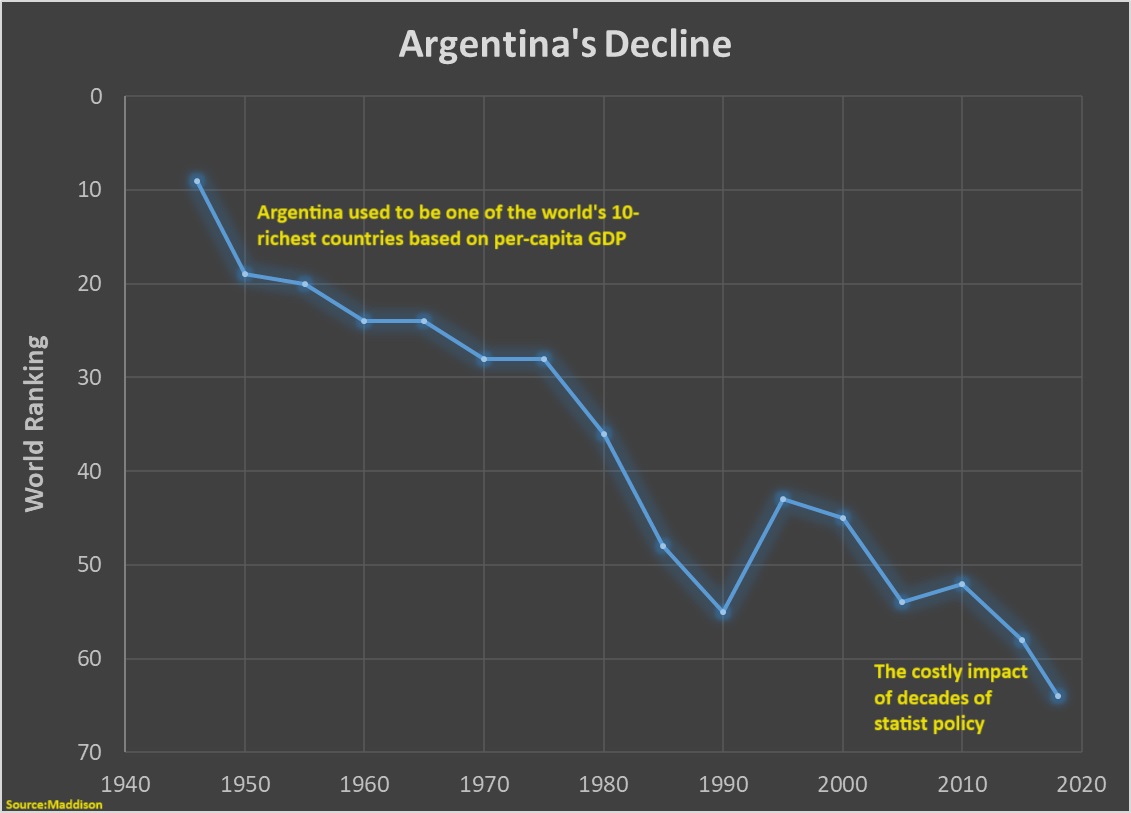
I’m tempted to be American-centric and pick someone like Woodrow Wilson or FDR, but I think Argentina’s Juan Perón did far more long-run damage to his country.
Indeed, Perónism did so much damage that Argentina was ranked as being the world’s worst-performing economy over a 100-year period.
For today’s column, let’s summarize Perón’s awful policies. And the best place to start is an article by Marcos Falcone in the Independent Review.
Here are some excerpts. He starts by summarizing Argentina’s period of prosperity.
…by the early twentieth century Argentina was seen as an advanced country to which millions of migrants moved. In just forty years, Argentina’s population had multiplied by four, trade flows by twelve… As millions of immigrants came, critics complained that Argentine salaries were merely equivalent to those of Germany and only higher than most of Europe, with the exception of England… Before the Great Depression, Argentina was growing faster than the United States, Canada, and Australia… To be riche comme un Argentin (as rich as an Argentine) was a compliment among the French.
But then Perón came to power and quickly expanded the size and scope of government.
From the moment Perón institutionalized his thinking into a party, Argentine politics would never be the same. Indeed, the PJ would govern not just from 1946 to 1955 (as the Partido Peronista), but then again from 1973 to 1976, 1989 to 1999, 2002 to 2015, and 2019 to 2023. …Perón and his party sought to (and effectively did) create a nationalist authoritarian state. In terms of nationalism, he decided to confiscate several foreign-owned businesses, such as railway and phone companies, and he created state-owned industrial companies. His government also nationalized foreign trade, thus appropriating landowners’ resources. …Perón’s goal was to build a corporatist welfare system; therefore, he did not just empower organized labor but also placed the state as a legal referee in all negotiations between union leaders and businesses. Corporatism had been gaining ground from the 1930s, but it was Perón who institutionalized state-regulated interactions between private actors. …Perón also vastly increased public spending, thereby running extensive fiscal deficits. He also implemented currency controls and offered negative interest rates in real terms… In the first three years of the Perón administration, public spending increased by 60 percent…, which meant it had risen to 45 percent of GDP by 1949… inflation quickly became a problem, particularly as fiscal revenue fell and it became clear to everyone that wealth was at the government’s disposal, which virtually eliminated productive private investment. …there was no GDP per capita growth between 1947 and 1955…and the result was an inflationary crisis and a recession.
The economy became such as mess that there was a military coup and Perón lived in exile.
But his policies remained. People and businesses had been lured into dependency because of handouts, protectionism, subsidies, etc, with the net result that Argentina was a corporatist economy. Or, as the author explains, a fascist economy.
In terms of economics, an answer to the question of what is wrong with Peronism should point to the fact that it does not work for the people and, more important, that it has been the deciding factor that has triggered the country’s economic decline. …The main goal of this essay has been to bring the political, economic, and cultural aspects of fascism together to explain Argentina’s economic decline. The explanation is not just corporatism, the welfare state, an unbalanced budget, a cult of personality, or even authoritarianism: It is a unique combination of all of these elements that Peronism, the Argentine variant of fascism, has imposed upon the country.
A 2015 article in Forbes made similar points about the awful impact of Peronism.
He was president three times: from 1946 – 1951, 1952 – 1955, and 1973 – 1974. Of the three presidencies, Perón’s first was the most relevant in terms of the fundamental changes to the Argentine economy and society that resulted from his governmental actions. Yet a significant portion of the funding of his economic reforms and social programs was concealed from the Argentine people. Today, almost 70 years from the first systematic inflationary policies implemented by Perón and after four changes in Argentina’s currency, inflation and concealment are still alive. …fascist corporatism…aims at organizing society into corporations or associations of persons with a common economic interest that are subordinated to the state. …A cornerstone of fascism is economic nationalism. …the government usually restricts foreign imports… Perón engaged in a massive program of expenditures aimed at nationalizing industries and public services, extending health and welfare benefits… The nationalist economic view of Perón’s government manifested itself as well in the 1949 reform of the constitution, which assigned to the state direct control over foreign trade, ownership of all minerals and energy resources, and ownership of public service enterprises. …Lastly, Perón had absolute control over the central bank and therefore the opportunity to create money to fund government deficits. In this way, Perón institutionalized fraud in Argentina as his government used the central bank, an institution created by law, to expand money supply, generate inflation, and thereby steal resources from the private sector of the economy.
Let’s cite one more study, this one authored by two Argentinian academics, Carlos Newland and Emilio Ocampo
This paper summarizes the key tenets of Peron’s economic ideas, which have guided his economic policies and those of his successors since 1946: emphasis on industrialization, trade and financial autarchy, and active State planning and intervention, particularly in the allocation of credit and the distribution of income among factors of production. These policies had a persistent, decisive and negative impact on the evolution of the Argentine economy. Peronism introduced path-dependence on inflation, deficit and stagnation. …According to New York Times columnist Roger Cohen… “Argentina invented its own political philosophy: a strange mishmash of nationalism, romanticism, fascism, socialism, backwardness, progressiveness, militarism, eroticism, fantasy, musical, mournfulness, irresponsibility and repression. The name it gave all this was Peronism. It has proved impossible to shake”. …Although it recognized the Marxist notion of class struggle, as in Mussolini’s fascism, it rejected the annihilation of the private sector proposed by communism. Instead, it proposed that the Government (Perón), the State (public officials) and the “organized community” would determine a fair distribution of income among workers and businessmen. Basically government had to regulate market forces when demand or consumption exceeded supply by imposing price control or rationing. …Between 1946 and 1955 Perón closed the economy to foreign competition and intensified state intervention. The measures he took during his presidency included the nationalization of the railways and utilities, as well as some industrial and shipping companies. In the banking sector, he eliminated Central Bank independence, created new public financial institutions to finance industrial development, allocated credit on a discretionary basis to benefit mostly the urban industrial sector and nationalized deposits as well as mortgage credit. Foreign trade was put under the control of IAPI, a state monopoly which was presided by the president of the Central Bank. The Peronist regime also increased government bureaucracy. Between 1943 and 1955, the number of public employees doubled while population grew by only 25%. Public expenditures grew 60% between 1946 and 1955. Compared with the rest of Latin America, by the end of the period Argentina had the largest public sector.
As already noted, most of these terrible policies were continued after Perón was forced out of office.
Indeed, they largely remained (and, in many cases, were made worse) all the way until Javier Milei’s election in late 2023.
I’ll close by sharing this tweet, which accurately summarizes what is wrong with Peronism.
By the way, I don’t know the source for the “8 times greater” claim. So that may be an exaggeration.
But the Maddison data definitely show Argentina being close to Switzerland after World War II and then falling far behind over the next several decades.
Government-run systems often (not always) do a perfectly fine job setting a broken arm or administering a long-standing, well-known medication. They do much less well when it comes to developing, financing, and delivering a new immunological approach to fighting cancer, personalized to your individual genome at a cost of hundreds of thousands of dollars. In our rapidly arriving biomedical future, innovation capacity will matter above all else. And though they may not see it today, the people with the most life ahead of them will reap nearly all of the benefits of a dynamic system, or suffer the consequences of a paralytic one.
Thirty years ago, it was often debated whether the Canadian or British healthcare systems were better than what we have in the U.S. After all, they offered a kind of guaranteed access to health services. The details could differ, but often the healthcare had no upfront price or only a low user fee. In America, in contrast, healthcare was more expensive, there were many millions of uninsured people, and dealing with sometimes rapacious insurers and hospitals could involve significant emotional trauma.
But over time the British and Canadian systems look worse and worse. The queues and rationing have increased, as giving healthcare away for free makes it hard to satisfy demands in a timely manner. In Canada, for instance, the median wait time has risen from 9.3 weeks in the early 1990s to 28.6 weeks today. In the British National Health Service, only 65.3 percent of patients start treatment within 18 weeks.
Worse yet, both of those systems are undercapitalized. In Britain, healthcare is badly understaffed and underfunded. Yet the country already has high taxes, high debt, and slow economic growth, so it is not clear where the new money will come from to recapitalize the system.
And this sentence:
This entire dynamic will be intensified as the pace of medical innovation picks up.
In total, around eight percent of the land in America’s major coastal cities was underwater in the 1890s and has since been reclaimed. This includes the land under several major airports, like Newark, Logan, and SFO, as well as neighborhoods like the Financial District in San Francisco, the Back Bay in Boston, and Camden in Philadelphia. Some cities, like Boston and Charleston, have doubled in size by reclaiming land.
Today, reclamation should be more common than ever. Land values in some cities are thirty times what they were in 1950, and high-tide flooding is four to eight times as frequent. Reclamation could extend and protect our coastal cities as it has for centuries. But rather than reclaim more land, we have virtually ceased to reclaim any at all. Since the completion of Battery Park City in 1976, there has not been a single major urban land reclamation project in the United States and only a handful of port expansions.
…Reclamation stopped abruptly in the 1970s when a wave of environmental regulations made it enormously expensive to reshape the landscape. And it halted at the same time in every other country that passed similar laws.
The Howard County Police Department posted a video of a Maryland man, Jalen Godard, who called them to report that his truck had been stolen on June 25.
Sen. Chris Murphy has finally found a constituency that truly gets him. Robots and automated systems around the country likely whirled and beeped with approval as he introduced the Senate version of the Living Wage for All Act. At a time when workers are being replaced at record numbers due to the cheaper labor of automated systems and AI programs, Murphy moved to price out millions of more workers by increasing their costs.
The bill would increase the federal minimum wage from $7.25 to $25 per hour — a 245 percent increase — over 12 years. The far-left senator is following the lead of states like California, where Democrats dramatically cut jobs through such wage increases.
Murphy went on NBC to insist that he is “not a democratic socialist” but then attacked capitalism:
“[T]he Democratic Party has been historically way too timid in taking on corporate power. I think we have to understand that people do not believe that this version of capitalism has worked. And frankly, it hasn’t worked. … This version of capitalism isn’t working. Now, I make the argument in the book that we should embrace, you know, what I call a common good capitalism.”
He then added:
“And by the way, we can afford it. It’s not like we can’t pay a $25 minimum wage; we just choose not to because we’ve become okay with dozens and dozens of people in this country making hundreds of billions of dollars.”
It is not clear who the “we” is. While securing a law degree, Murphy has never run a business and has spent his life as a politician, spending other people’s money.
I previously wrote about wage hikes and the predictable loss of jobs that followed.
Democratic politicians from New York to California are pushing for a $30 minimum hourly wage for workers. Newsom, Los Angeles Mayor Karen Bass, and Democratic legislators in California herald their mandatory increases as providing a “living wage” for workers. In Los Angeles, a law requires hourly wages in the hotel and airport industries to rise by $2.50 each year until they reach $30 in 2028.
There is no question that workers are struggling with the high cost of living in California. But blindly raising taxes and minimum wages will exacerbate these problems, not eliminate them.
A recent report by researchers at the University of California-Santa Cruz found evidence of precisely what many economists had warned about in the state’s mandatory wage floors. Stephen Owen, an economics lecturer, explained that they found “a plethora of negative outcomes, such as higher menu prices for consumers, reductions in employee working hours, widespread elimination of overtime, and loss of benefits for employees.”
In other words, faced with mandated higher labor costs, businesses shrank their labor forces and raised their prices.
None of this is a surprise. Yet even amid such findings, Democrats are doubling down. They believe that because they claim to be the champions of the working class, it does not matter how many people they put out of work.
It is not just workers feeling the brunt of such economically ill-considered measures. In California, a two-person meal can run about $30 due to higher labor costs being passed on to consumers. It is only a matter of time before robots replace these workers.
What is ironic is that the Democrats are hitting the most vulnerable members of the labor force with these minimum wage increases. In my book, “Rage and the Republic,” I discussed not only the economic changes unfolding due to AI and robotics but also the expected political miscalculations that are most likely to fuel job losses and wasteful spending. This is one of them.
As discussed in the book, certain industries are already likely to convert to automation due to increasing labor costs:
“For any wealth-maximizing, rational actor in the marketplace, the choice is obvious and inescapable. There is little reason for a restaurant to employ workers to make Happy Meals when they can be done by robotics without healthcare, wage issues, or scheduling conflicts. The very premise of McDonald’s is to produce the same meals in the exactly the same way from restaurant to restaurant. That is precisely what robotics do. They will make fries in exactly the same fashion over and over again without variation.”
Faced with this threat to the labor force, Murphy and others are moving to do the one thing to accelerate and expand the job losses by increasing the cost of human labor.
Ironically, giving the advantage to the robotic workforce could still work in favor of the growing socialist movement in the party. With more workers out of jobs, more will look to the government for support and a guaranteed income. That will further increase the role of the state. Of course, to expand what Zohran Mamdani called “the warmth of collectivism,” millions of human workers will have to be put out in the cold as an overpriced labor force. Citizens will then become what I have called a “kept population,” which could have a disastrous impact on the role of citizens in our unique Republic.
What is clear is that Murphy will prove to be the greatest friend a robot has ever had in Congress.
1. Far from retarding the abolition of slavery, the Revolution actually accelerated it. Its triumph gave a big boost to Enlightenment liberalism, which inspired the First Emancipation in the US (the abolition of slavery in the North that became the first large-scale emancipation of slaves in modern history), and boosted antislavery movements in Europe, as well.
2. Had the Revolution been defeated, Enlightenment liberal ideology would have been dealt a setback in Britain and France, too. That would have set back antislavery movements there, as well. It is no accident that many antislavery leaders in Europe were also sympathizers with the American Revolution. The Marquis de Lafayette was just one of the most famous examples of European liberals who actively backed both.
3. The West Indian slaveowner lobby in Parliament was strong enough to block abolition of slavery until 1833. Had Britain also been saddled with the much larger proslavery lobby of the American South, it would have taken far longer. Especially when you combine the impact of the larger slavery lobby with the force of point 2 above.
I will not double indent, all of what follows is from economic historian Daniel Gallardo Albarrán of the Netherlands:
“…you posted a link to an article on how Europe became the world champion of heat deaths.
Something that the article did not cover, which I find particularly outrageous is that Europe used to be at the forefront of reducing deaths due to extreme temperatures in the early 20th century, but then AC came in and the US took the lead. To flesh this out a bit, let’s consider some recent research on this field, including my own, that is comparable to the article by Barreca et al. referenced in the post, the following points are important:
Summers became increasingly deadly during the 19th century as a result of urbanization and overcrowding. They were incredibly deadly, mostly, for infants who died in disproportionate amounts due to gastrointestinal diseases. Children and adults died as well from heatstrokes and the like, but their relative importance in the death statistics was rather small
The turning point in Europe happened in the 1900s and 1910s.
For instance, in Germany summers began being less deadly after ca. 1905, as a result of investments in water provision, healthcare and infant care. (See my own paper on this in the EHES Working Paper Series, no. 290)
In England the turning point is somewhere around WWI (see Hanlon et al., 2021, JEH), possibly due to improvements in the disease environment.
In the United States, before the arrival of AC, summer diarrheal disease that largely affected infants would only go down much later during the 1920s and 1930s (see Anderson et al., 2022, EEH). A few decades after European cities had progressed substantially in this regard…
This reversal does not get much attention in accounts of current differences in the deadliness of extreme temperatures. This is unfortunate because from an early-20th century perspective, it was far from obvious at the time that this would happen. But the lack of willingness to adopt the arrival of a very useful technology (AC) was something that we (Europeans) have brought onto ourselves over many decades, and this is largely independent from recent phenomena such as rising global temperatures, inequality trends, etc. This is simply inefficient governance and lack of attention to a problem that takes the lives of many.”
For many of us who were raised in liberal, Democratic families, the infusion of socialist, anti-free-speech, and anti-Semitic elements into the party has been alarming. The party was always in favor of social welfare programs but remained ardently committed to free markets and free speech. Now, we have CNN anchors openly questioning whether candidates are too Jewish-looking for the Democratic base as socialists sweep away establishment candidates. A recent poll reaffirmed that trend with a vast majority of Democrats saying that they are prepared to support the socialists.
A recent Economist/YouGov survey asked respondents, “Would you ever vote for a candidate who identified as a “Democratic Socialist?”
While 85 percent of Republicans and 40 percent of independents said that they would not vote for socialists, 62 percent of Democrats said that they would. Among self-described liberals, the percent of support for socialism soars to 73 percent.
For Kamala Harris supporters, 64 percent would support socialists.
Even more alarming is the preference of Democrats for socialism over capitalism. Some 34 percent choose socialism while only 22 percent choose capitalism. Overall, 58 percent of Democrats view socialism in general “favorably.”
It is not surprising that socialist Sen. Bernie Sanders went on YouTube this week to proclaim that “we are on the verge of the political revolution” that they have long sought to fundamentally change our system.
“Much of the anti-capitalist movement is composed of young people who have never lived under a socialist or communist government. Popular politicians like Representative Alexandria Ocasio-Cortez (D-NY) have made socialism chic, alongside wealthy celebrity adherents such as Lawrence O’Donnell, Susan Sarandon, Michael Moore, and Sarah Silverman. There is a superficiality to many in this movement of wealthy celebrities wearing socialism on their designer sleeves. In one of the most glaring disconnects, Ocasio-Cortez attended the ritzy Met Gala (where tickets cost tens of thousands of dollars) wearing a designer dress with ‘Tax the Rich’ in large letters. It perfectly captured America’s armchair socialists, a commitment that often seems more performative than philosophical.”
Democratic establishment figures are maneuvering to stay ahead of the mob, many offering the far left the Supreme Court as bona fide. Others are staying silent as anti-Semitic figures fill their ranks.
Some politicians are struggling to curry support with the growing socialist movement. Rep. Dan Goldman, who inherited a massive fortune as a trust baby, unwisely promised to help subsidize his campaign from his family fortune. With the addition of three homes, Goldman looked like the Richie Rich of the Democratic Party and lost by over 30 points.
Others are trying to downplay their wealth, from Rep. Ro Khanna, who reportedly has half a billion dollars from his wife’s inheritance, to Gov. Jay Robert “J.B.” Pritzker, who also inherited his fortune. Pritzker assured the mob that he is a different kind of billionaire, pointing at Trump billionaires as the rightful targets (not him with $4.3 billion).
Notably, votes for socialists are not coming from blue-collar workers but from young, college-educated voters. These younger voters never experienced or watched the collapse of socialist systems in the last century. For them, the promise of the Mamdani’s “warmth of collectivism.”
Jonathan Turley is a law professor and the New York Times best-selling author of “Rage and the Republic: The Unfinished Story of the American Revolution.”
The health service now has to spend more money settling maternity-malpractice claims than it does on actually providing maternity care. Many Brits can neither obtain an appointment with a publicly funded dentist nor afford a private one; in a 2023 survey, one in 10 reported doing DIY dental work, in extreme cases extracting their own teeth or gluing broken crowns back together.
Incomes can be shockingly low: Junior doctors recently went on strike for the 15th time in three years over their salaries, which start at just £38,800; the median salary for British civil servants is £35,680. In April, amid the Iran conflict, the Daily Mail pounced on Prime Minister Keir Starmer for vacationing in Valencia, Spain, at what the tabloid described as a luxury hotel, costing £200 a night.
Americans are likely to come away a bit smug, especially as Independence Day approaches and Europeans are enjoying our giant stadiums and central air conditioning. Look deeper, however, and Britain’s story becomes more uncomfortable. Does this sound familiar?
Recent plans to transform the country have rested in no small part on High Speed 2, a superfast rail line intended to connect London with Birmingham, Leeds, and Manchester. But since HS2 was proposed, in 2009, its costs have tripled, to more than £100 billion. It is the most expensive rail line in the world. (A special structure to protect a rare bat species near the rail line in Buckinghamshire required 8,000 permits and was built at a cost of £216 million.) The most important sections of the proposed route have been lopped off. The rump line—going from Birmingham, Britain’s second-largest city, to not-quite-central London—may be finished by 2040…. HS2 has been delayed for so long that two swiftly built towers near the terminus now themselves look derelict and in need of demolition.
…Building infrastructure, or much of anything else, has become all but impossible in the United Kingdom. In addition to having the world’s most expensive (not yet built) train line, Britain also hosts the world’s most expensive (not yet built) nuclear-power plant, Hinkley Point C. Its environmental-impact assessment ran 31,401 pages; the plant will feature a £700 million “fish disco,” which will pulse sounds underwater to deter animals from its intake pipes.
Upon closer inspection, the United States looks a lot less like a shining city on a hill and a lot more like a declining Great Britain, appendaged with one or two dynamic sectors, most notably AI. The similarities are especially obvious in the retrograde solutions Britain has lumbered into, namely attacking immigrants and trade—Brexit being the equivalent of a high tariff regime. Nations in decline, like people, tend to lash out at others rather than deal with their real problems. Needless to say, neither immigrants nor trade explain Britain’s—or California’s—inability to build high-speed rail or other infrastructure.
It is discomforting to watch the birthplace of the Industrial Revolution, individual rights, and free speech—the nation that once built the railways, the steam engines, the factories that remade the world—lose the capacity to build much of anything, or even to tolerate people speaking their minds. In parallel, instead of dealing with our real problems—almost all of our creation—the right gets literally hysterical over symbolic culture-war questions like birthright citizenship, while the left nominates candidates with Marxist-Leninist sympathies. The abundance and progress movements are some of the few shining lights. It’s not too late. But Great Britain is a warning.
Norway abolished its rent control in 1982, and the economist Are Oust realized the newspapers had been quietly recording the whole experiment. He collected housing classifieds from Oslo’s Aftenposten from 1970 to 2008 and watched the market turn inside out.
Under rent control, Oslo’s listings pages looked nothing like a housing market. It was tenants who advertised, pleading their qualities to landlords — “housing wanted” ads outnumbered “housing for rent.” Ten to fifteen percent of those ads were placed by the tenant’s employer, vouching for them the way a bank vouches for a borrower. Tenants offered babysitting, gardening, snow-shoveling, and janitorial work on the side to sweeten the deal. Landlords, for their part, could demand a tenant of a particular gender, age, occupation, region of origin — some ads specified “strong Christian beliefs.” Deposits commonly ran to 50 or 60 months’ rent, occasionally 100 or more: tenants effectively lent the landlord the equity of the flat, interest free. And only about 20 percent of “for rent” ads dared print the rent, much of which would have been illegal.
Then the ceiling lifted. Within a few years the page flipped: landlords advertised to tenants, roughly 80 percent of listings printed an asking rent, the mega-deposits vanished, and the demands for snow-shoveling Christians of specified gender dwindled to nothing. The price went back to doing the rationing — so nothing else had to.
In 2019 and 2023, I shared studies that measured economic freedom in metropolitan areas.
However, is good policy associated with better outcomes?
Today, let’s look at a new report from WalletHub. This publication assembles a wide range of data (education, public safety, poverty, debt, etc) and then ranks cities based not on policy (think of policies as inputs), but instead grades them on overall performance (akin to the outputs of governance).
Based on that approach, here’s a map showing the best-run cities. As you can see, the top-5 cities are in Utah, New Hampshire, and Idaho. And if you broaden the list to look at the 30-best cities, they’re overwhelmingly in regions more associated with economic rationality – the South, Midwest, and Mountain West.
Interestingly (perhaps surprisingly), no Texas cities made the top 30.
Here’s a table showing the top-10 cities. Congrats to Provo.
And here are the 10-worst cities.
As you can see, the left-wing basket cases are well-represented. And, to answer the question in the title of today’s column, the worst of the worst is San Francisco.
For what it’s worth, I think San Francisco will improve over the next few years. And I also think New York City (thanks to its economically illiterate mayor), will take over the bottom position. Though Chicago will provide a lot of competition.
A cache of internal emails obtained from within the US National Institutes of Health has exposed years of strategic planning for future pandemics involving governments, foundations, international organisations, and pharmaceutical companies.
The documents, stretching back to at least 2016, show that Dr Francis Collins, Director of the NIH from 2009 to 2021, was at the centre of these efforts.
In that role, he oversaw the allocation of the agency’s substantial research budget, which ran into tens of billions of dollars annually.
The emails reveal Collins working closely with the Gates Foundation, Wellcome Trust, World Bank, World Economic Forum, the African Academy of Sciences, and major pharmaceutical companies to strengthen research infrastructure, regulatory readiness, and international coordination well before Covid appeared.
For the public, the Covid response was presented as an unexpected crisis. Governments appeared to be making difficult decisions while navigating profound uncertainty.
But these emails tell a different story.
Many of the same organisations that later shaped the Covid response had already spent years building capacity, influence, and institutional power under Collins’ leadership.
Billions of dollars flowed through the sprawling network. Careers were built around it, reputations depended on it, and political and financial interests became invested in its success.
By the time Covid arrived, much of the framework was already in place.
Building the Machinery
The planning gained momentum after the 2014-16 Ebola outbreak highlighted gaps in global preparedness. Vaccines took too long to develop, trials were hard to organise, and funding was fragmented.
The response, according to the emails, was to build permanent capacity in advance rather than react after the fact.
One major outcome was the launch of the Coalition for Epidemic Preparedness Innovations (CEPI) in 2017 at the World Economic Forum (WEF), which hosts an annual gathering of globalist elites in Davos, Switzerland.
CEPI focused on vaccines against emerging infectious diseases and became a key part of pandemic planning alongside the NIH and major foundations.
During Covid, CEPI became one of the major funders of vaccine development, investing hundreds of millions of dollars in multiple vaccine platforms that eventually led to vaccines from companies such as Moderna.
The internal documents show there was particular focus on expanding research capacity in Africa, a region long criticised for weak regulatory oversight and less stringent enforcement of clinical trial standards.
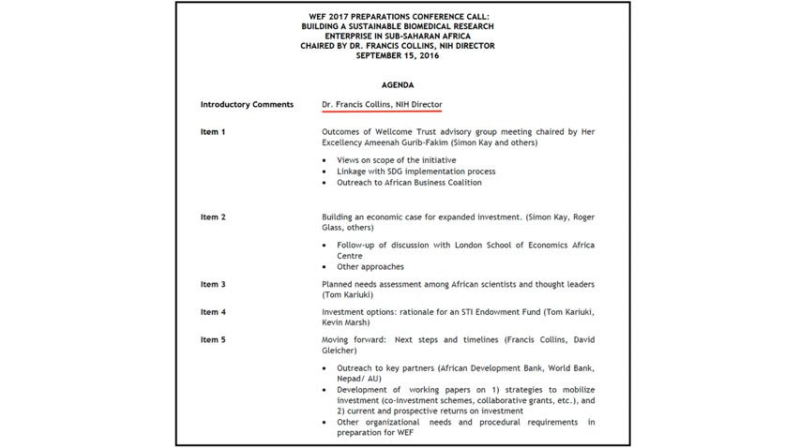
Collins chaired a 2017 WEF meeting on building a sustainable biomedical research enterprise in Sub-Saharan Africa.
The call brought together senior figures from the Wellcome Trust and other partners to advance plans for major new investment, including a proposed $10 billion African science, technology and innovation fund.
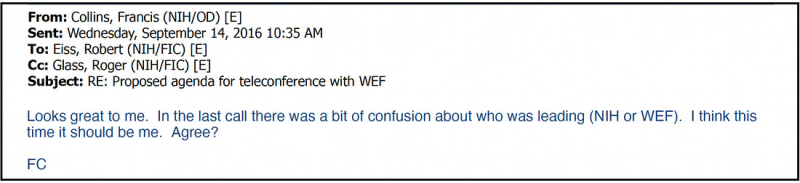
Collins appeared keen to ensure there was no confusion about who was in charge. After one teleconference with the WEF he wrote to his NIH colleagues:
“In the last call there was a bit of confusion about who was leading (NIH or WEF). I think this time it should be me. Agree?”
By 2018, senior pharmaceutical executives were discussing long-term investments in infrastructure designed to endure well beyond any single outbreak.
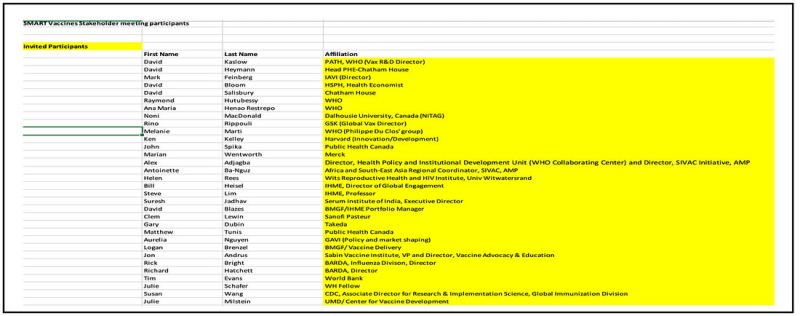
One project focused on SMART Vaccines, a decision-support tool designed to help governments and funders systematically prioritise vaccine candidates and guide investment decisions ahead of future outbreaks.
Workshops for the project brought together a who’s who of global health institutions, government agencies, philanthropic foundations, vaccine manufacturers, and international organisations.
The language of the initiative emphasised “consensus-building” and “public-private partnerships,” to keep major organisations and stakeholders in lockstep—many of whom would later play influential roles during Covid.
By 2019, the core elements of modern pandemic preparedness were already in place.
Covid Emerges
When Covid emerged in early 2020, many of these organisations stepped directly into the roles they had spent years preparing for.
CEPI directed major vaccine funding. The Gates Foundation supported financing and distribution efforts. The World Bank mobilised resources. The WHO coordinated international guidance, and so on.
In turn, societies were locked down, people were ordered to wear face masks, and told to wait for vaccines.
In October 2020, three epidemiologists—Jay Bhattacharya, Sunetra Gupta, and Martin Kulldorff—authored the Great Barrington Declaration, arguing against broad lockdowns and favouring more targeted protections for vulnerable populations.
The declaration effectively challenged the centralised, top-down model that Collins and his network had spent years building.
Collins responded by leveraging the authority of the NIH to marginalise dissenting scientists and called for a “quick and devastating published takedown” of the Declaration and its authors.
Taken together, these emails show that Covid was not the beginning of the story. It was the moment years of planning, investment, and institution-building were set in motion.
That system influenced how resources were allocated, which policies were pursued, and how dissent was managed.
Years later, we are still living with the unintended consequences of those decisions.
Behind closed doors at the World Economic Forum in Davos in January 2016, senior figures from the Gates Foundation and the World Bank proposed a new approach to pandemic preparedness: large-scale simulations modelled on military war games.
Newly obtained internal emails show how the idea — referred to as “Germ Games” — gained rapid momentum and drew in the US National Institutes of Health (NIH).
A Potential Land Mine
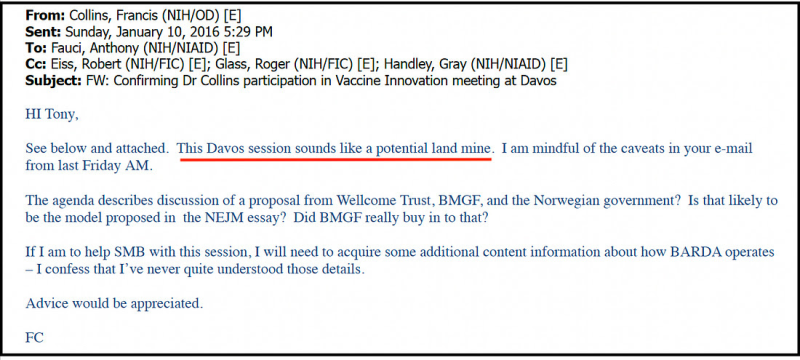
On January 10, 2016, as then-NIH Director Francis Collins prepared to attend the World Economic Forum's annual meeting in Davos, he emailed an advance copy of his schedule to Anthony Fauci, one of his closest advisers.
One session, in particular, caught his attention.
“This Davos session sounds like a potential land mine,” Collins wrote.
The meeting, titled “Vaccine Innovation for Pandemic Preparedness,” brought together executives from GSK, Merck, and Johnson & Johnson, along with representatives from the Gates Foundation and the Wellcome Trust.
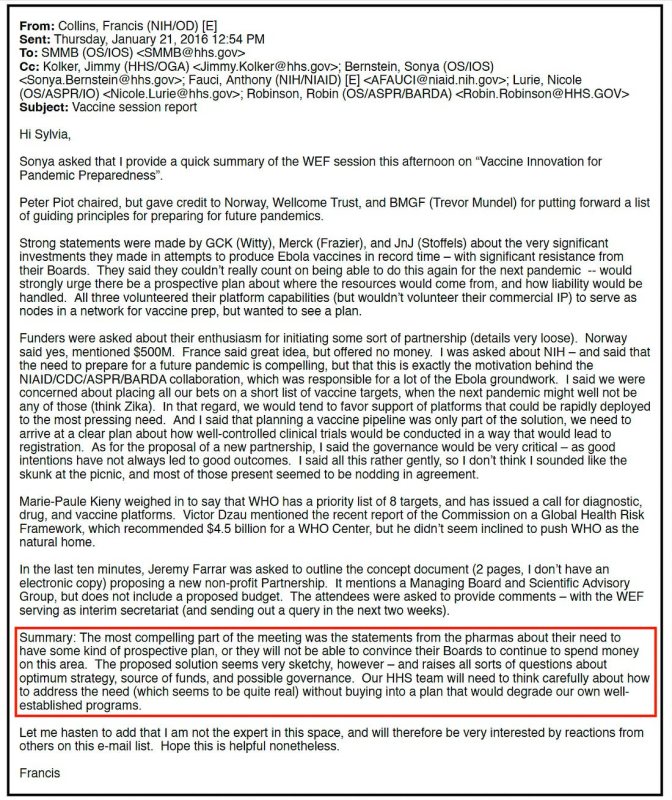
According to Collins’ report to Health and Human Services Secretary Sylvia Burwell, the pharmaceutical companies were blunt about the conditions for their participation — they could not commit to rapidly developing vaccines for every future outbreak unless governments first resolved who would pay and how liability would be handled.
The companies said they were willing to contribute their vaccine platforms but would not share their commercial intellectual property.
Collins described the emerging proposal as “very sketchy” and warned that it raised serious questions about governance, funding, and strategy. He cautioned against any plan that would undermine existing US programmes.
The Birth of “Germ Games”
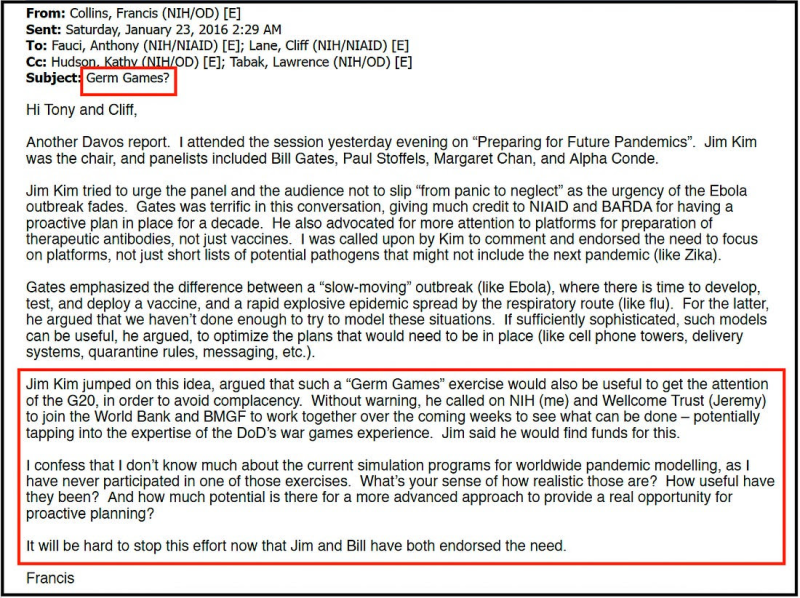
A separate session on preparing for future pandemics proved even more consequential. Chaired by World Bank President Jim Yong Kim, the discussion included Bill Gates.
Gates argued that the world was poorly prepared for a fast-spreading respiratory virus and that more sophisticated simulations could strengthen planning around logistics, communications, quarantine measures, public messaging, and vaccine deployment.
Kim seized on the idea. According to Collins’ email, the World Bank president proposed creating “Germ Games” — exercises explicitly modelled on military war games — persuade G20 leaders to invest in pandemic preparedness and avoid complacency once Ebola memories faded.
Kim suggested “tapping into the expertise” of the US Department of Defense, whose war games experience tested command structures, decision-making, and crisis response under pressure.
He publicly called on the NIH, the World Bank, the Gates Foundation and the Wellcome Trust to develop the concept together, saying he would “find funds for this.”
Writing to Fauci afterwards, Collins acknowledged that the proposal had quickly gained influential backing. With both the Gates Foundation and the World Bank endorsing the initiative, he wrote, it would be “hard to stop this effort now.”
Collins admitted that large-scale pandemic simulations fell outside his expertise and asked Fauci for his assessment.
Fauci’s Reply
Fauci responded that the US government already had considerable experience running simulated “bioterror attacks.”
He explained that the Department of Health and Human Services, the Department of Defense, and the Department of Homeland Security had conducted extensive "Table Top" exercises—simulated crisis scenarios in which officials rehearsed responses to biological threats, including aerosolised anthrax, multi-release smallpox, and influenza pandemics.
“This may not be ‘exactly’ what [Bill] Gates, [Jeremy] Farrar and [Jim Yong] Kim were referring to,” Fauci wrote, “but it would be pretty close.”
He also suggested involving Nicole Lurie, then Assistant Secretary for Preparedness and Response, noting her previous experience at the RAND Corporation.
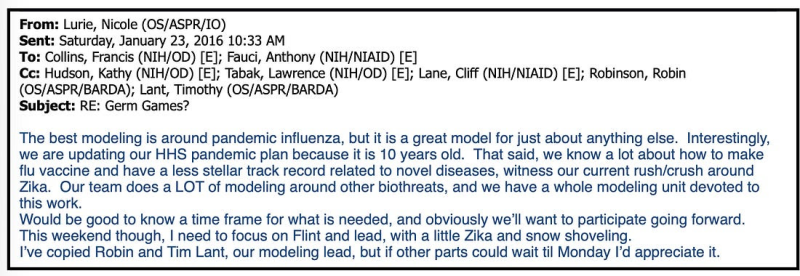
Collins quickly looped Lurie and BARDA Director Robin Robinson into the discussion, asking whether support from the World Bank and the Gates Foundation could help upgrade existing US modelling and preparedness work.
Lurie replied that HHS was already updating its pandemic influenza plan and had an entire team conducting regular modelling for a range of biological threats, including H7N9, MERS, Ebola and Zika.
From “Germ Games” to Global Agenda
The “Germ Games” concept did not remain a one-off idea.
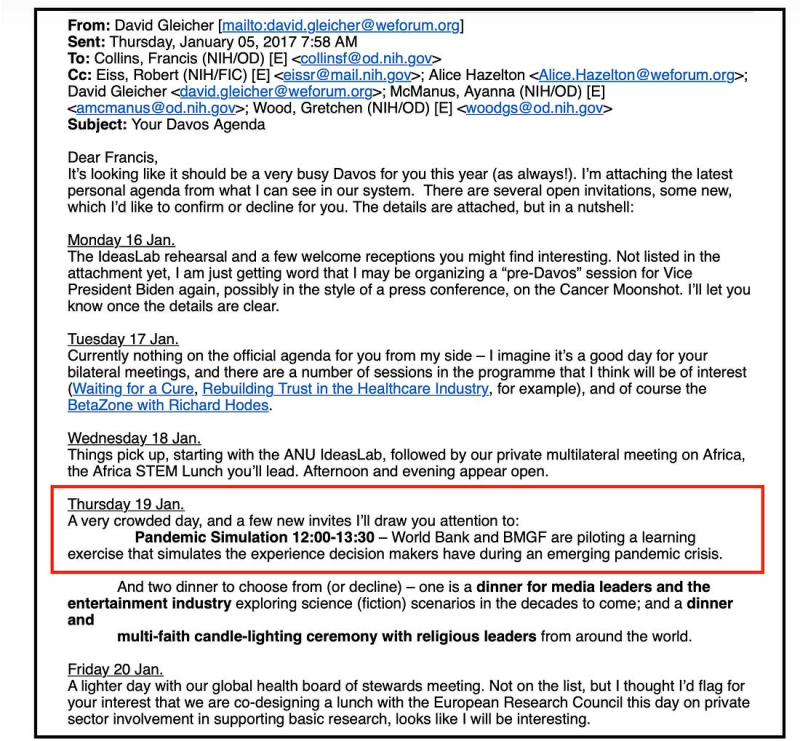
A year later, Collins returned to Davos for the 2017 World Economic Forum meeting.
His schedule included a pilot pandemic simulation organised by the World Bank and the Gates Foundation. The exercise was designed to place senior decision-makers inside a simulated pandemic crisis, using the kind of scenario-based role-playing employed in military war games.
The same approach was later reflected in Event 201, a high-profile simulation of a “fictional coronavirus pandemic” held in October 2019 by the Johns Hopkins Centre for Health Security in partnership with the WEF and the Gates Foundation.
That exercise brought together business leaders, government officials and public health experts to role-play responses to a “hypothetical” pandemic, using the same structured, scenario-based decision-making discussed at Davos three years earlier.
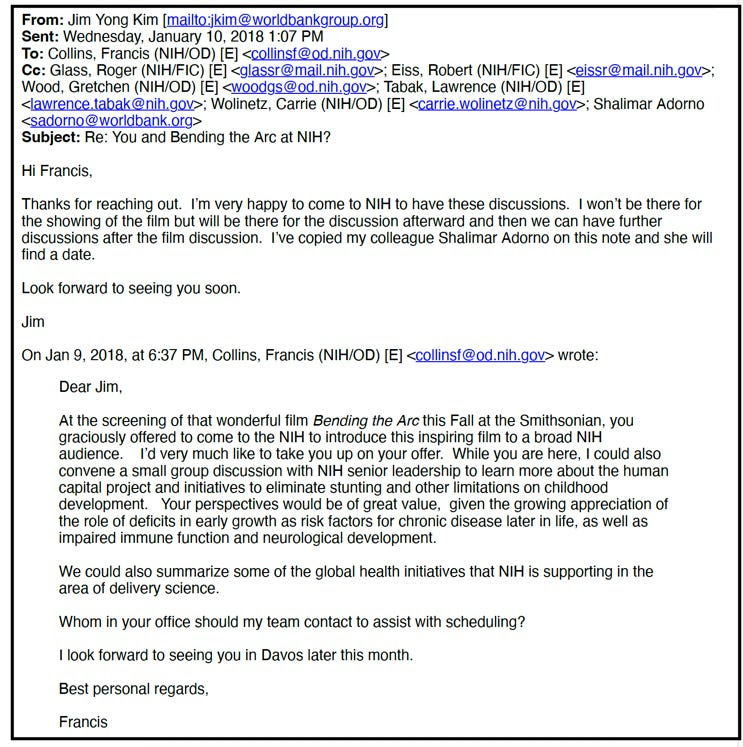
In early 2018, Collins invited Jim Yong Kim to the NIH.
While the public event was a screening of the documentary Bending the Arc, internal planning documents show that officials arranged a closed-door roundtable with Collins, Fauci, and nearly every NIH institute director.
The agenda covered pandemic preparedness, airborne threats and deeper collaboration between the NIH and the World Bank.
Collectively, these internal documents show how, from 2016 onwards, pandemic preparedness was increasingly shaped by military planning concepts and biodefence thinking.
What began as discussions at Davos evolved into a sustained international effort to embed simulation-based, war-game-style approaches into global health security — approaches that would later become central to the response to Covid-19.
Writing in the QJE, Derenoncourt, Kim, Kuhn, & Schularick argue that today’s black-white wealth gap can be explained by differences in initial conditions from over a hundred and fifty years ago, i.e. slavery. But there is an important, and glaring objection: in the age of immigration (1850–1924) millions of whites immigrated to the United States with essentially no wealth and yet they caught up to the “heritage” whites quite quickly and indeed today are richer than heritage whites.
Persistent racial wealth inequality in the United States is often attributed to the intergenerational transmission of historical wealth disparities. However, inferring the determinants of long-run inequality from group-level data is complicated by the arrival of 30 million Europeans during the Age of Mass Migration (1850–1924), who are by construction included in average white wealth despite having no direct claim to the wealth accumulated by earlier Americans. This paper accounts for this compositional change in the white population by documenting wealth dynamics among European immigrants and their descendants. Cash-on-arrival data show that immigrants began with substantial wealth deficits relative to the native-born. Yet by the late twentieth century, these deficits had closed, as indicated by comparisons between the descendants of later-arriving Southern and Eastern Europeans and those of longer-established Northwestern Europeans. This pattern implies rapid intraracial wealth convergence, in contrast to the slower convergence observed across racial groups. A stylized model shows that these differences can be largely accounted for by income. These findings demonstrate that large wealth disparities do not mechanically persist when groups have access to comparable economic opportunities.
If initial conditions don’t explain the wealth gap then the most likely explanation is an income and/or savings gaps. I am reminded of an earlier politically incorrect paper of the year by Nathaniel Hilger and see also my review of his book The Parent Trap.
Here is historical footage from the German Federal Archives showing the Rhine River during a severe drought in 1949.
Months of persistent drought caused the Rhine River’s water levels to drop to historic lows, exposing wide sandbars and rocky riverbeds that hadn’t been seen in decades.
The low water level made the river incredibly difficult for ships to navigate. In the ports of the Lower Rhine, cargo ships and barges had to lighten their loads by half just to safely pass through the narrowing shipping channels.
Water level gauges along the river stood 1 to 2 meters above the actual water surface because they were never designed for a drought this severe. Shoreline ferry ramps became steep and difficult to traverse. Standard boats anchored along the banks were left completely grounded on the dry riverbed.
Rhine 1921
The severe drought of 1949 officially surpassed the previous historic dryness records set in 1921:
Dresden 1904
Also back in July, 1904, the Elbe River at Dresden saw its lowest level since 1811:
It’s time to declare victory against climate stupidity and move on.
Well, the definition of victory here is about as fuzzy as that for the Iran war. Here is a summary of why Climate Etc. is being euthanized:
Major progress has been made in the climate debate and the political climate has changed
My interests have evolved in other directions
The logistics and cost of keeping the blog running are substantial.
State of the Climate Wars
There have been some decisive battles in the past two years, notably President Trump’s election, the DOE Climate Report, and widespread acknowledgement that RCP8.5 is an implausible emissions scenario. As a result, many news agencies have dropped or substantially reduced their climate desk, we don’t hear about climate change so much in the media (particularly as related to extreme weather events). Also, we can’t underestimate the impact of substantially reduced funding for climate-related NGOs, with USAID and other funds drying up.
The leaders of the climate alarmism movement have not conceded defeat but have done much whining, notably over President Trump and the RCP8.5 scenario. They are still trying to discredit the authors of the DOE Report. Triggered by the DOE Report, they have mostly stopped flogging the warming/extreme weather link, although there is a hardcore group that is committed to extreme event attribution as a mechanism to support litigation against fossil fuel companies. With the demise of the extreme weather link, the climate alarmists are now focused on climate “tipping points,” which simply doesn’t resonate with the public (extreme weather events were much more alarming).
But most importantly, the whole issue has lost its political relevance. During the past several months we have watched the entire world panic over loss of access to Middle Eastern oil, and major concerns raised about the need for massively more electricity to support data centers. Putting a tourniquet around our energy supply in the name of eliminating CO2 emissions is a much worse idea now than it was even a few years ago, and that seems to be widely recognized (even in Europe). Most tellingly, the World Economic Forum (WEF) has dropped climate change as an issue, now focusing on AI (and health).
We are perhaps at an inflection point; one can only hope that the climate enterprise will redirect its efforts away from flogging the CO2 climate control knob mantra and towards understanding regional climate variability, particularly as influenced by natural variability, to support efforts at reducing vulnerability to weather extremes. And figure out how to better work with nature to support our needs for food, water, energy.
JC moving on
When I was planning my retirement for Georgia Tech, I viewed Climate Etc. as a hedge against becoming bored in my retirement. Ha! Seems that it is impossible for me to become bored, too many interesting things to do and to learn about and to ponder.
After publishing my book Climate Uncertainty and Risk, and co-authoring the DOE Climate Report (I have prepared revisions to my sections, who knows when this will ever be published), I frankly don’t have much more to say on the topic of the climate wars. I have no interest in battling with the likes of Michael Mann, Andrew Dessler, et al. (does anybody still care what they have to say?)
Apart from the climate wars, I remain very interested in the fascinating and complex climate system, I erratically consume new research as I come across it (which can be pretty random sometimes). But most of climate science has become BORING . . . too much mega-modeling and politicking, and not enough thinking. In any event, I no longer have an interest in writing for the public on these topics.
My professional interests are more focused on extreme weather on timescales from hours to a year, which is the focus of my company Climate Forecast Applications Network (CFAN), along with decision making under uncertainty and risk science. It’s a fascinating time for weather forecasting, and CFAN is deeply immersed on the new opportunities afforded by AI. I write reports on a range of related topics, which are sent to CFAN’s clients (they are not made public). I continue to do consulting on climate-related topics, supporting litigation and developing regional, decadal scale scenarios to support risk assessment for specific client needs.
I’be been pretty quiet on twitter (I can’t bring myself to call it X) for the last several months, maybe I should step up my commentary there — I still have alot to say, and short comments responding to a paper or news item is about the right level of effort at this point.
Now that my granddaughter is in high school (yes she is very interested in science), I have been paying more attention to what is going on at the universities, which I abandoned in disgust almost a decade ago.
Personally, after a big downsize and moving into a much smaller and simpler place, Peter and I are focused on our new dog Lucy, after our previous dogs Bruno and Rosie succumbed to old age. And establishing the garden at our new place.
A peaceful life with family and friends, exploring the world and its new developments from my laptop, and having a blast with AI.
Blog logistics and costs
Climate Etc. is a really old blog in terms of blog years – since 2010. Since then, WordPress has modernized and upgraded. Hacking/security has become a growing issue. The way that Climate Etc. was originally set up is fairly obsolete. Starting in 2022, the blog started having technical issues. WordPress required new plugins for the website to operate in the way that I had been using it. Not sure how many of you noticed, but there have been 2 major blog crashes, and periodically things would stop working such as commenting.
I found a company that would trouble shoot the blog, fix as needed, deal with all the WordPress cr@p and security issues. In looking at my account, over the past 4 years there have been 19 tickets opened, for a total cost of $16K. Now, could I have found someone trustworthy and capable to take care of the blog that would have been cheaper? Maybe, but I’ve frankly just lost interest.
I have set up an account on Substack; if I am ever motivated to resume blogging, that is where I will be. I can also make extended posts on twitter (X) although that is more awkward for anything at all technical. Anything newsworthy that I write I will send to WUWT.
But frankly, beyond this current post I’m not seeing any blogging or other public writing in my future.
Eulogy
Climate Etc. isn’t dead yet, but it is in hospice, and all life support is being removed (I’m not paying any more $$ to support the blog). We’ll see how long the patches, etc. that I’ve already paid for will keep the site accessible.
An experiment that started in 2010 in the wake of ClimateGate, Climate Etc. has exceeded my wildest expectations. It has been one of the highlights of my career, and I am endlessly grateful to all of you who have participated here (especially guest bloggers) and to the new friends and colleagues that I have found from the blog. My book Climate Uncertainty and Risk is a culmination of the topics that we have explored on the blog, and is the legacy of this blog.
While writing this post, I have reminisced about the denizens and “characters” that have come and gone on this blog. An amazing cross section of people with diverse expertises from many different parts of the world.
My deepest thanks to all of the guest posters and commenters that have contributed to making Climate Etc. a vibrant, stimulating and occasionally influential place. My very best wishes to each of you.
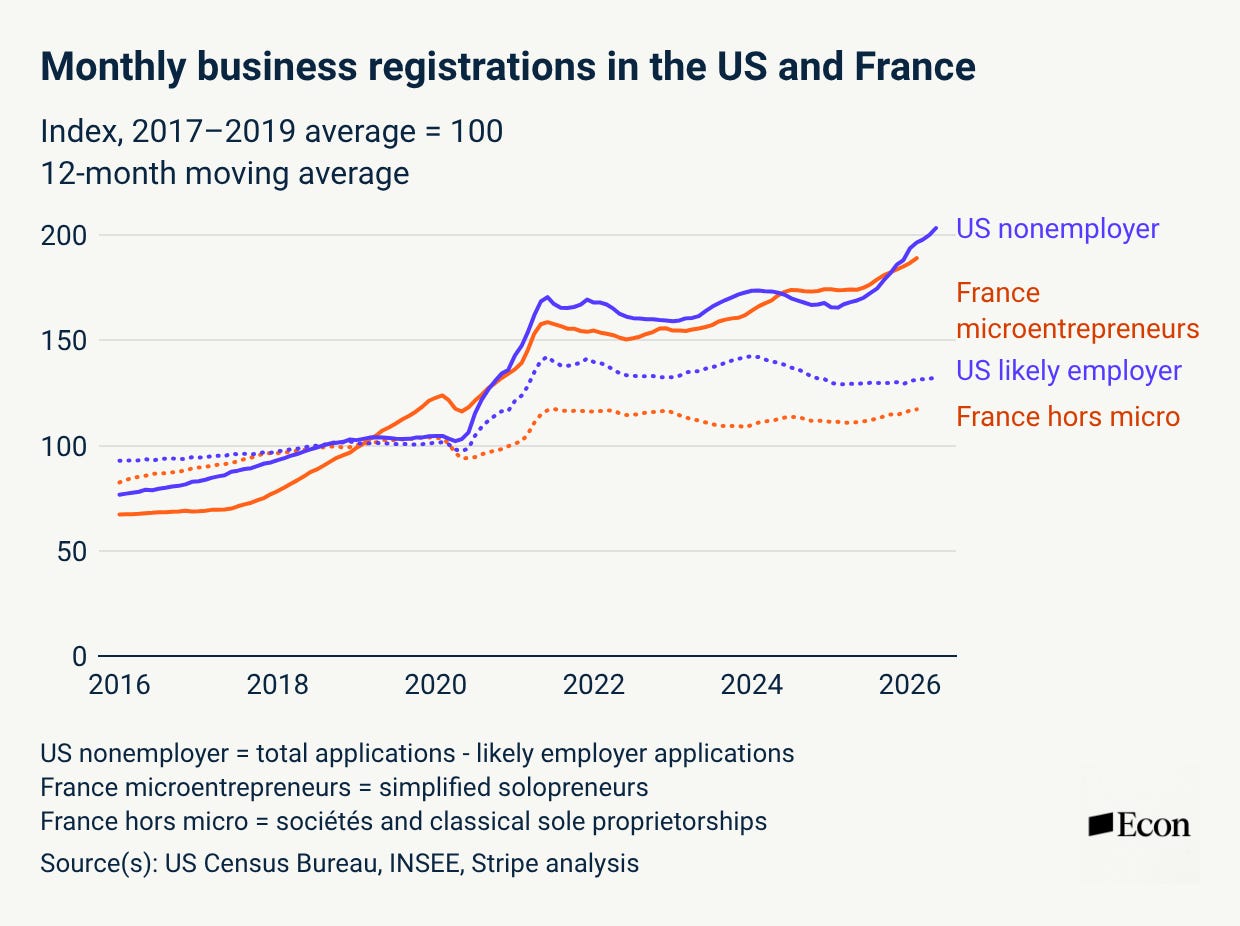
Business formation first jumped in 2020 as the pandemic reorganized work, shopping and logistics. After the pandemic ended, business formation leveled off, but it did not return to its old path. It remained historically high. Moreover, in the past 18 months or so business formation has surged again. Registered Agents Inc tracks new Articles of Organization or Incorporation filed in the 50 states and they report:
Every month in 2026 has set a new formation record, including March, which stands as the highest single-month total in the history of the Business Formation Report. Through May, 2.9 million new businesses have been formed nationwide, the strongest five-month start on record.
Stripe Economics agrees and calls this the age of the solopreneur. Among businesses using Stripe, recent cohorts are reaching serious transaction volumes faster than earlier cohorts.
The share of businesses (not just solopreneurs) reaching $1 million in cumulative revenue within a year after going live on Stripe was roughly 30% higher for the 2025 cohort as it was for the 2023 cohort, and it was roughly 3x higher for the 2025 cohort than the 2019 cohort.
Furthermore, the trend is not just in the United States. France, where, as the story goes, they have no word for entrepreneur, has also seen business creation reach record levels, driven heavily by micro-entrepreneurs.
The most likely explanation is the devolution of power. A single person armed with Stripe, Shopify, cloud software, automated bookkeeping, and now AI can do what once required a small staff. Dynamism had been on a long secular decline, but we may now be seeing the early stages of an experimental economy—one in which far more people can test ideas, reach customers, and launch firms, some of which will grow very large, very fast.
Homeowners are being forced to tear out air conditioning from their properties under Net Zero laws that prioritise "passive cooling" and only permit "active cooling" as a "last resort".
It is literally 30 degrees Celsius (86 degrees Fahrenheit) as I type this, and if you were an alien from Pluto listening to central German radio you’d have to conclude that these temperatures are at the very limits of human survivability. (It’s substantially warmer further west, but the hysteria is the same everywhere.) Meteorologists are running short of death doom colours to depict the dire state of our temperature emergency …
Meanwhile, in what has become a fixed seasonal ritual, German public health authorities and state media have begun circulating lunatic emergency advice for how to stay cool in this life-threatening heat situation.
Their pointers:
Open windows only at night, early in the morning, and late in the evening.
Otherwise close all windows and draw all curtains so you can be both uncomfortably warm and profoundly depressed.
Safely ensconced in your stuffy dark apartment, unplug all electrical devices, including your internet router, because these can emit heat even in “standby mode.”
Also roll up all of your carpets to stop them from storing heat.
Hang up wet laundry in your dark apartment to cool the air via evaporation, but do not hang up too much wet laundry or the air will become excessively humid which is even worse.
The one electronic device you might possibly consider plugging in, is a fan, to cool your skin. To enhance the cooling effect, put a bucket of all the ice that you have emptied from your unplugged freezer in front of the fan.
What you should not plug in, is any kind of portable air conditioning unit, because the Federal Environmental Agency believes that they will actually make your room warmer when the exhaust air finds its way back into your apartment.
This is the modern German government in a nutshell: “The heat is going to kill you, stay inside with the windows closed and the curtains drawn and do all this other weird, crazy and unheard-of stuff to escape the murderous heat, but whatever you do, don’t do the one thing that will actually substantially reduce interior temperatures, because reasons.”