(Crank the speakers to hear the hoomin.) I guess this look from Ruthie means “no.”
This video had Nothing To Do With Arbroath.
Filed under: Uncategorized Tagged: Impending Doom, puppeh


(Crank the speakers to hear the hoomin.) I guess this look from Ruthie means “no.”
This video had Nothing To Do With Arbroath.
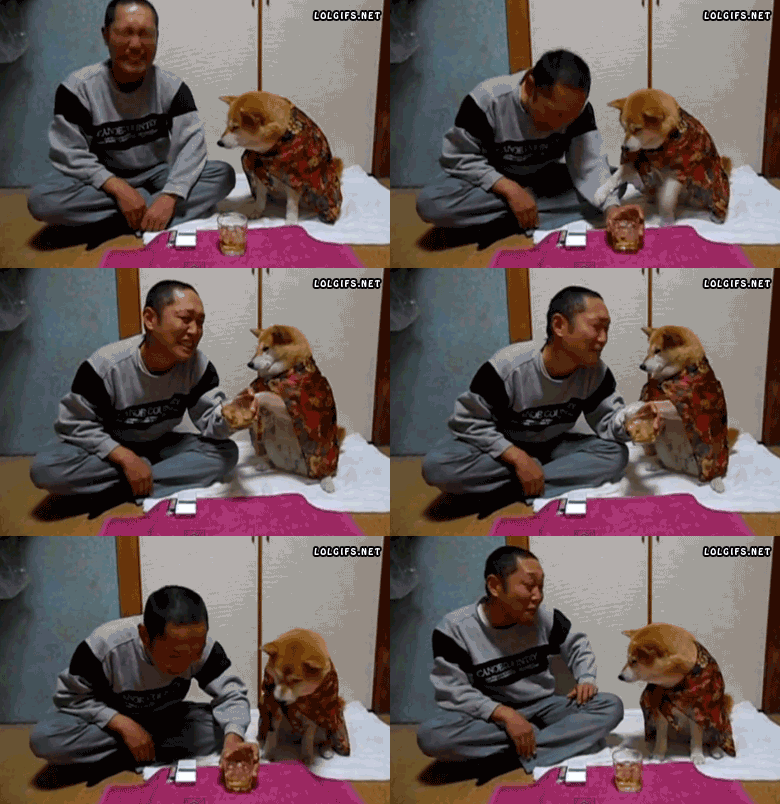
Shiba Inu Prevents Owner From Drinking Alcohol

Submitted by: Unknown
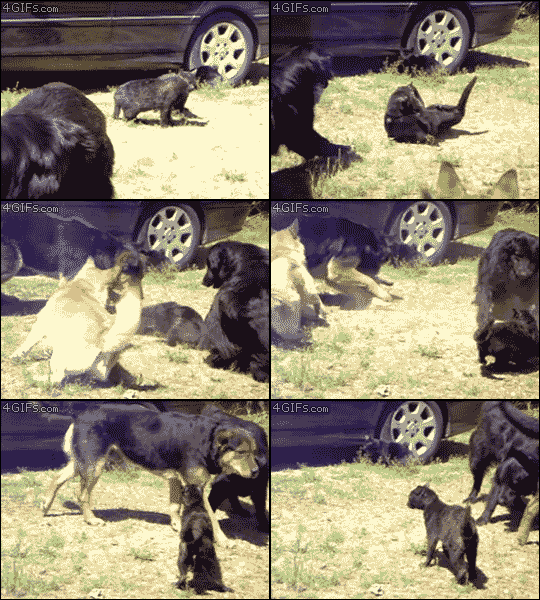
Did a bunch of dogs breakup a fight between two cats? Am I seeing this right??
Having none of that shit today.
“Ay man, y’all chill the fuck out. Y’all fucking up the party.”
I CAN’T BELIEVE WHAT I’M SEEING
Pack animals like dogs don’t tolerate dissent in their group because it weakens the pack’s social structure… There are similar clips on youtube of them breaking up rabbit and rooster fights… They don’t care what species you are, they just want you to CUT THAT SHIT OUT.
They don’t differentiate species because dogs think everything else is just a weird dog.
Most of us freak out at the mere sight of a bug — let alone a photo! But there’s something about biologist Sam Droege’s pictures of insects that has hundreds of thousands of people marveling at them. Sam’s photostream offers viewers a detailed and rare look at bees; comparing these little, hairy creatures to mesmerizing works of art.
Sam Droege is the head of the U.S. Geological Survey’s Bee Inventory and Monitoring Laboratory in Maryland and for the past seven years he’s been photographing bees and other insects. The purpose is to create online reference catalogs to help researchers identify the thousands of bee species across North America.
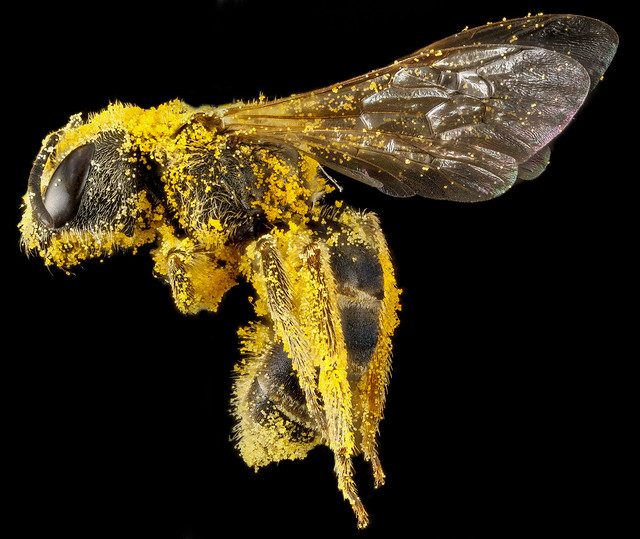

“We have to take a lot of pictures because many of these species vary only by very subtle characteristics,” Sam explains. “For some it might be the tiny pits on the surface of the top of the bee, and others it might be the pits within the pits. It’s important to take as many pictures as possible allowing our specialists to look at anything they might be interested in.”
For years, Sam and his team took pictures using simple point-and-shoot cameras. The level of detail, however, was extremely limiting.
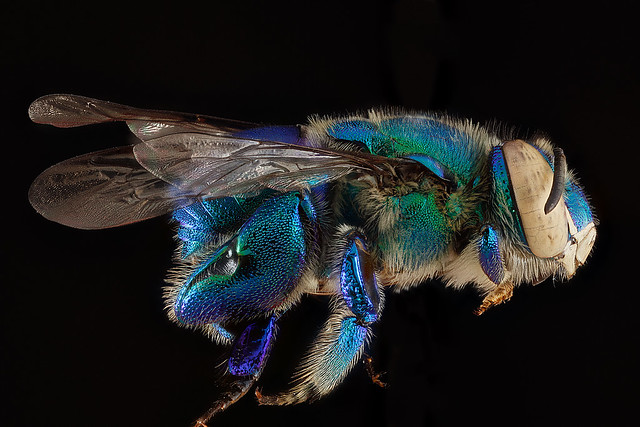
“We were taking pictures of bees through microscopes,” Sam says. “We literally attached cameras to microscopes, often with plumbing fixtures. But in the end, we were disappointed with the number of pixels and the amount of resolution of the photos. After a while, we largely stopped pictures through microscopes because the quality wasn’t up to our standards.”
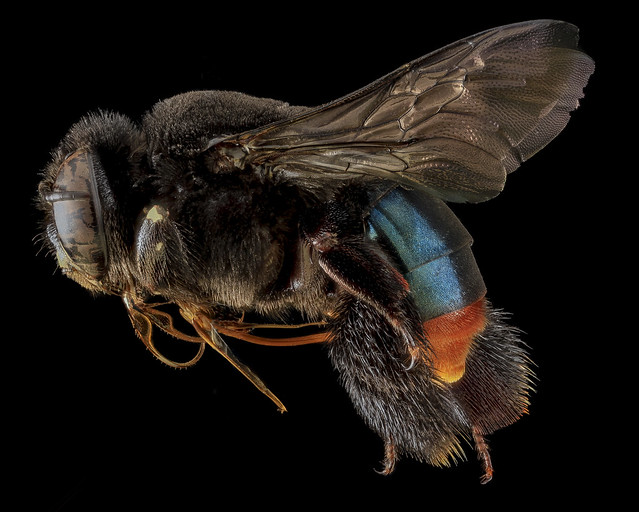
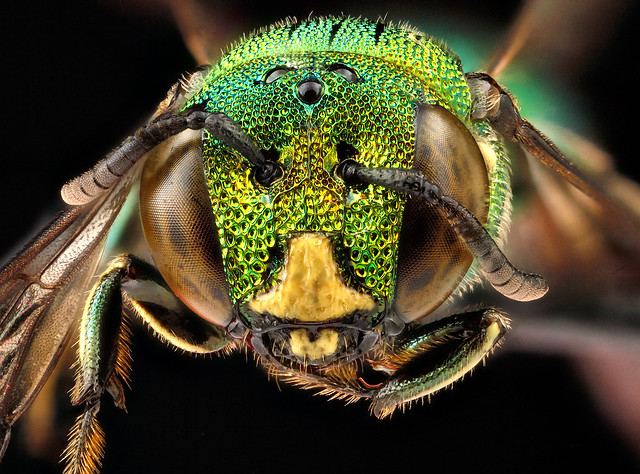
But all that changed in 2010 when Sam’s team was approached by the U.S. Army. They had developed techniques using macro photography to take photos of insect infestations from foreign bases (Iraq, Afghanistan, etc.). Macro photography allowed the army to get high-quality pictures that, in turn, helped them to identify these insects and treat those affected. When Sam first saw these photos, the level of detail blew his mind.
“The army’s novelty here was the portraiture,” Sam admits. “It was the solid, black background, the off-centeredness, the flash, just everything helped provide a portrait of a bee, rather than a documentation of a bee.”
It was from that point onwards, Sam and his team adopted and modified this technique and resumed photographing their specimens.
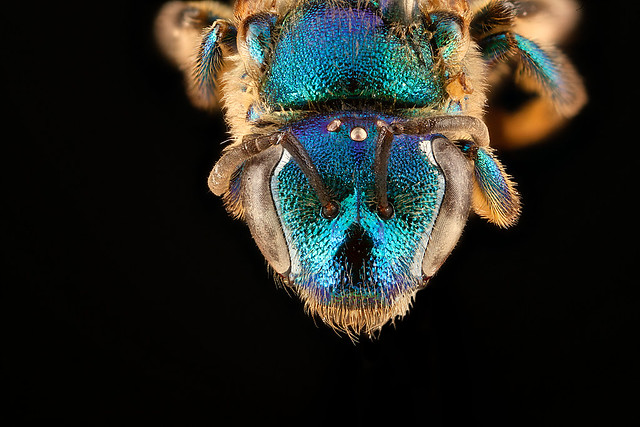
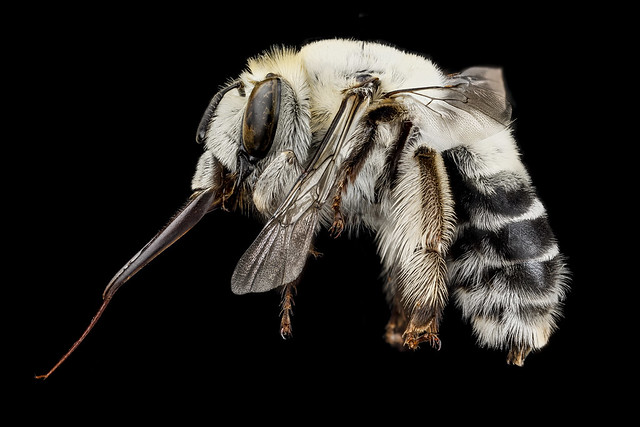
To capture the bees with such detail, Sam and his team take several different shots of the (already dead) insect and combine them together to form one image using a special software. This software creates detailed macro images which can be blown up to five feet by eight feet without pixelating.
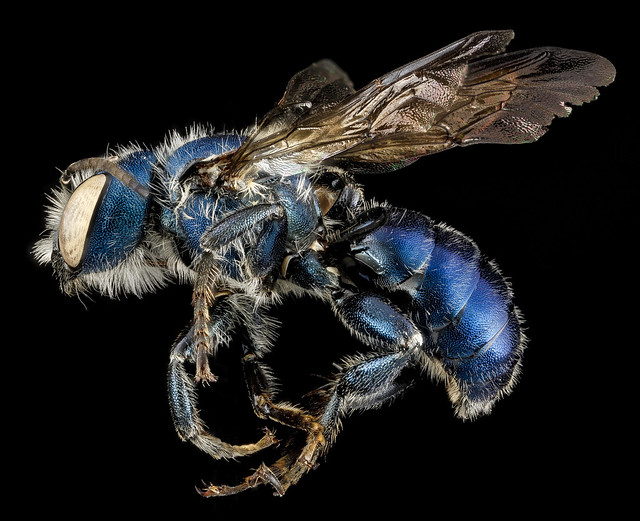
“When we started looking at these pictures, I just wanted to gaze at these shots for long periods of time,” Sam says. “I had seen these insects for many years, but the level of detail was incredible. The fact that everything was focused, the beauty and the arrangement of the insects themselves — the ratios of the eyes, the golden means, the french curves of the body, and the colors that would slide very naturally from one shade to another were just beautiful! It was the kind of thing that we could not achieve at the highest level of art.”
Sam began to show these pictures to several colleagues who also found them visually appealing. They encouraged him to share the photos on Flickr, as a means to transfer these images to other scientists and researchers.
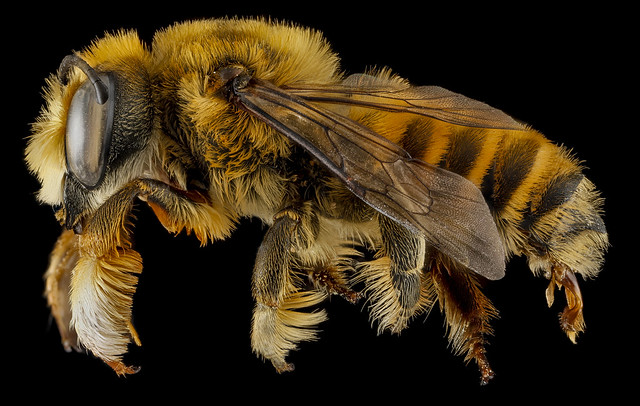
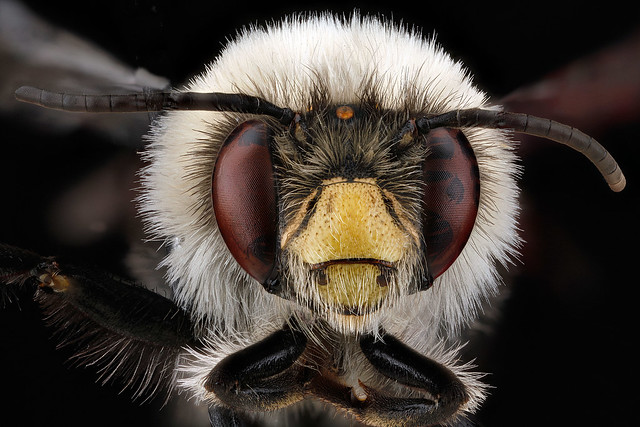
“At some point we found out that someone had posted the Flickr pictures onto Reddit, and it got a huge number of views,” Sam says. “I think it was 200,000 views in two days. I couldn’t believe it! It was at that point we realized that there is interest in these kinds of pictures outside of our scientific circles, and that people just like looking at them.”
Sam says he’s always tried to attract people to what he does but admits it’s been difficult because many us have a preconceived notion that bugs are bad or gross. With these pictures, all of a sudden people were attracted to these insects because of their beauty. People described the bees as “fluffy” with “stained-glass wings.” It’s an entirely new way of reaching people Sam never thought was possible.
“I feel honored as a public servant to bring these pictures to people,” Sam admits. “They’re all public for anyone to see. And the fact that it’s not just important scientifically, but also beautiful… it makes me feel good. It reaches my soft side of my hard-scientist body. And I smile every day when I look at the number of views we’re getting on Flickr.”
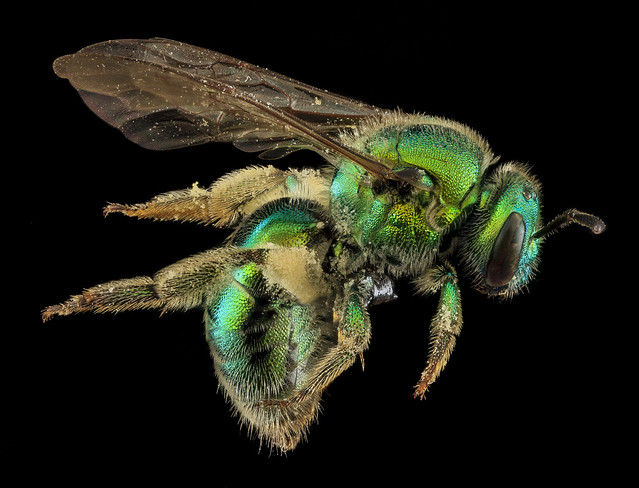
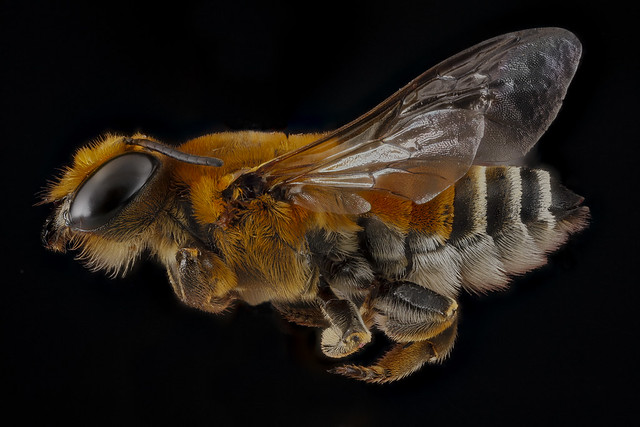
Visit Sam’s photostream to see more of his photography.
Previous episode: Beautiful worlds hidden in tiny drops
 Do you want to be featured on The Weekly Flickr? We are looking for your photos that amaze, excite, delight and inspire. Share them with us in the The Weekly Flickr Group, or tweet us at @TheWeeklyFlickr.



Mental health problems are, y’know, health problems. Treat them the same way, or shut up.
YES I NEED FOR EVERYONE TO SEE THIS
Education Specialist Lucy B. of the Jackson (Mississippi) Zoo wrote us an email, and sez: “Hi there! I work at the Jackson Zoo in Mississippi, and as a super fan of your page, I thought that these pics of our new baby gibbon would be perfect for you. B/C is there nothing cuter? I don’t think so.” [You're right. -Ed]

“These are pictures of Jari, a female white-handed gibbon born on November 22, 2013. She was a very welcomed early Christmas present. Her parents are Mia and Cookie-Man.” [COOKIE MAN? Great name. -Ed]

“Unfortunately, Mia doesn’t have a reliable parenting history, so Jari was whisked off to be cared for by the veterinary staff. Our vet tech Donna has the task of feeding her every 2-3 hours, 24 hours a day.” [Donna needs Red Bull. -Ed]

“Jari is name after the Indonesia word for ‘fingers,’ because as a gibbon she needs to have long arms and fingers to help her swings through the trees. Hope you love her as much as we do!” [Roger that. -Ed]

“All photos were taken by Chris Todd. You can check out pics on our Facebook page.”

Title from The Association, man.


The Copenhagen Wheel developed at MIT learns how you pedal and integrates seamlessly with your motion to make your riding a more enjoyable and effortless experience. Connect the wheel to your smart phone to monitor your activity and customize your ride.
Submitted by: Unknown (via The Copenhagen Wheel)
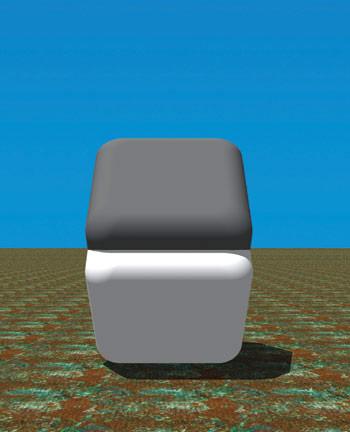
Cover the middle seam with your finger, marvel as the contrast effect changes EVERYTHING. Jason Kottke thinks the creator is a witch. When I showed it to my daughter, she said, "Well, your finger is covering up the light that's making it brighter," which is true in a weird sorta way.
    
|
And…they’re back! The Dynamic Duo of Theo the puppeh and his pocket-sized hoomin Beau, doing what they do best.


22Words, right heah.