Missing a flight can be a huge nightmare. It’s enough to send some customers into quite a tizzy . Before you throw a full-blown fit, check to see if your airline follows the little known “flat tire rule.”

Missing a flight can be a huge nightmare. It’s enough to send some customers into quite a tizzy . Before you throw a full-blown fit, check to see if your airline follows the little known “flat tire rule.”

Eutonina indicans / © Alexander Semenov
For the last several years, marine photographer Alexander Semenov (previously) has lead the divers team at Moscow State University’s White Sea Biological Station located just south of the Artic Circle. Semenov directs scientific dives in extremely cold and harsh conditions to document sea creatures seldom seen anywhere else on Earth. From giant jellyfish to the tiniest of unknown sea worms, the photographer captures almost all of the creatures you see here out in the wild, without the convenience of a laboratory or studio.
It’s estimated that nearly 80% of all aquatic life in the world’s oceans has yet to be studied or even discovered. In response to this potentially vast world of unknown lifeforms, coupled with Semenov’s unceasing interest in marine biology, an ambitious trek across the world’s oceans has been planned for 2016. The Aquatilis Expedition is a proposed journey that will take a team of divers, scientists, and videographers to locations around the globe for the purposes of identifying new species, an odyssey on par with the advertures of Jacques Cousteau.
Many of Semenov’s best photos are available as prints, and he shares regular updates on both Facebook and Flickr.

Cyanea rainbow / © Alexander Semenov

Syllidae from the Sea of Okhotsk / © Alexander Semenov

Cestum veneris, Italy / © Alexander Semenov

Beroe cucumis / © Alexander Semenov

Cyanea nude / © Alexander Semenov

Clione limacina / © Alexander Semenov

Sarsia tubulosa attacked by Cyanea capillata / © Alexander Semenov

Swimming file clam, Australia / © Alexander Semenov

Aglantha digitale / © Alexander Semenov
“An ounce of prevention is worth a pound of cure.” — Benjamin Franklin
For those not familiar with this old idiom, it means it’s less costly to avoid problems from ever happening in the first place, than it is to fix problems once they do. It also happens to be the entire logic behind the invention of the vaccine, and it is my belief that universal basic income has the same potential.
The savings provided by vaccines are staggering to the point of almost being beyond comprehension. The human suffering avoided through vaccinations are immeasurable, but the economic benefits are not, and in fact have been measured. Let’s start with polio.
We estimate that the United States invested approximately US dollars 35 billion in polio vaccines between 1955 and 2005… The historical and future investments translate into over 1.7 billion vaccinations that prevent approximately 1.1 million cases of paralytic polio and over 160,000 deaths. Due to treatment cost savings, the investment implies net benefits of approximately US dollars 180 billion, even without incorporating the intangible costs of suffering and death and of averted fear. Retrospectively, the U.S. investment in polio vaccination represents a highly valuable, cost-saving public health program.
For every $1 billion we’ve spent on polio vaccines, we’ve avoided spending about $6 billion down the road. And that’s purely the economic costs, not the personal costs. You might think our investment in fighting polio is perhaps as good as it gets, but it’s not.
Most vaccines recommended are cost-saving even if only direct medical costs—and not lost lives and suffering—are considered. Our country, for example, saves $8.50 in direct medical costs for every dollar invested in diphtheria-tetanus-acellular pertussis (DTaP) vaccine. When the savings associated with work loss, death, and disability are factored in, the total savings increase to about $27 per dollar invested in DTaP vaccination. Every dollar our Nation spends on measles-mumps-rubella (MMR) vaccination generates about $13 in total savings — adding up to about $4 billion each year.
Just $1 spent on a single MMR shot can save $13 and a DTaP shot can save $27 that would otherwise have been spent on the costs of the full-blown diseases they protect against.
These vaccinations save us incredible amounts of money and suffering as a society, as long as we continue vaccinating ourselves. But what kind of savings are there to be found, when we go all-in and invest in a massive vaccine program so large, its aim is to entirely eradicate something?
Reported as eradicated from the face of the Earth in 1977, and in possibly one of the greatest understatements of all time, the eradication of smallpox by the U.S. proved to be a “remarkably good economic investment.”
A total of $32 million was spent by the United States over a 10-year period in the global campaign to eradicate smallpox. The entire $32 million has been recouped every 2 months since 1971 by saving the costs of the smallpox vaccine, administration, medical care, quarantine and other costs. According to General Accounting Office (GAO) estimates from a draft report, “Infectious Diseases: Soundness of World Health Organization Estimates to Eradicate or Eliminate Seven Diseases,” the cumulative savings from smallpox eradication for the United States is $17 billion. The draft report also estimates the real rate of return for the United States to be 46 percent per year since smallpox was eradicated.
We also didn’t stop at eradicating it from within our own borders. We invested our money in the world.
It has since been calculated that the largest donor, the United States, saves the total of all its contributions every 26 days, making smallpox prevention through vaccination one of the most cost-beneficial health interventions of the time.
Even if we let these numbers sink in for a bit, it’s a huge challenge to fully appreciate because these savings are what we don’t experience. We aren’t spending tens of billions of dollars that we otherwise would have. Had we not spent millions then, we’d be spending billions on all of the effects of smallpox to this day and long into the future.
Try to imagine a world where we didn’t eradicate smallpox. Aside from the obvious increases in our already sky-high health care costs and the deaths of over 100 million people, millions every year would be calling in sick to work to care for themselves or a loved one with smallpox. Businesses would be paying more for sick leave and losing millions of hours of productivity (estimated at $1 billion lost every year). Medical bankruptcies would likely be higher. Crime would likely be higher. The entire economy would suffer along with all of society.
But we didn’t take that path. We chose instead to pay for an ounce of prevention in order to avoid paying for a pound of cure.
Unfortunately we can’t see the effects of what we did, because we made them never happen with the ounce of prevention. We’re saving what will eventually be trillions of dollars, and don’t even give this incredible fact a second thought.
Not only is it hard to see the pounds we’ve avoided, but we also have a really hard time recognizing the pounds we’re paying for, because we consider them normal, just as smallpox would today still be normal if we’d never chosen to eradicate it through mass vaccinations. It would just be an ugly fact of life… like poverty.
What if poverty is like smallpox?
What if the realities of hunger and homelessness aren’t just facts of life, but examples of those costly pounds that we currently consider normal that we could just instead eradicate with an ounce of cure? How much would it cost to eradicate? How much could we save?
As I’ve written about before, a report by the Chief Public Health Officer in Canada looked at this question of potential savings, and estimated that:
$1 invested in the early years saves between $3 and $9 in future spending on the health and criminal justice systems, as well as on social assistance.
It’s rare to see this kind of return on investment. That is, outside of vaccinations. That’s the power of immunizations. Spending $1 on a vaccine for a kid can save $10, but also just giving the same kid $1 can save $9 some decades down the road too. How can this be?
Because childhood poverty is hugely expensive.
Our results suggest that the costs to the United States associated with childhood poverty total about $500 billion per year, or the equivalent of nearly 4 percent of GDP. More specifically, we estimate that childhood poverty each year:
Reduces productivity and economic output by about 1.3 percent of GDP;
Raises the costs of crime by 1.3 percent of GDP; and
Raises health expenditures and reduces the value of health by 1.2 percent of GDP.
The above numbers are from 2007, and since then the child poverty rate has increased from 17% to 25%, so we can safely assume the hit to GDP has increased as well. Assuming a proportional increase, the 2015 loss to economic growth of child poverty could now be 5.6% of GDP, or $981 billion. And that’s only child poverty, not adult poverty.
For the same reason it’s cheaper to just spend $10,000 on the homeless providing a home, than it is to instead spend $30,000 in medical and criminal justice system costs, it is cheaper to prevent people from ever living in poverty, than it is to pay the full costs of poverty. In addition to the costs of child poverty above, these full costs include a significant portion of the estimated $1.4 trillion spent on crime, the $2.7 trillion spent on health care, and the trillions of dollars spent on its many other effects every single year in the U.S.
These numbers are just economic costs. There are biological costs as well. Poverty even rewires our brains. The new study of epigenetics show us such biological costs can be paid spanning entire lives.
Coming of age in poverty may lead to permanent dysfunction in the prefrontal cortex and the amygdala — which, according to the researchers, “has been associated with mood disorders including depression, anxiety, impulsive aggression and substance abuse.”
Fortunately, the even newer study of neurogenesis (the growth of new neurons long thought to be impossible) shows us these effects also need not be permanent.
Chronic stress, predictably enough, decreases neurogenesis. As Christian Mirescu, one of Gould’s post-docs, put it, “When a brain is worried, it’s just thinking about survival. It isn’t interested in investing in new cells for the future.” On the other hand, enriched animal environments — enclosures that simulate the complexity of a natural habitat — lead to dramatic increases in both neurogenesis and the density of neuronal dendrites, the branches that connect one neuron to another. Complex surroundings create a complex brain.
Essentially, we’re recently learning that we can potentially reverse the long-term effects of poverty, if we eliminate it.
Poverty currently affects almost 50 million Americans, 18 million of whom are kids coming of age impoverished. To allow poverty to continue in the 21st century or to eradicate it is the same choice between an ounce or a pound as smallpox was in the 20th century, and outside of an experiment in Manitoba, we’ve been choosing a pound of poverty for pretty much all of recorded history.
As another saying goes, so far we’re being penny-wise and pound-foolish.
Decades ago, we developed a vaccine for smallpox and we used it to eradicate smallpox.
Today, we may already have a vaccine for poverty. It’s been tested, and the results are remarkable.
It’s called universal basic income.
The idea is to give every citizen enough money to cover their basic needs like food and shelter, no strings attached. For the U.S. to guarantee these basic needs to assure no one would live in poverty would cost about $1,000 per adult and $300 per child every month.
For a significant portion of the population here in 2015, this is where the conversation can stop. Once the napkins are whipped out and its $3 trillion price tag is estimated, the idea can be hand-waved away as too expensive.
But is it?
Remember how every $1 spent keeping a child out of poverty can save $3 to $9 as an adult? Well, that means if we started vaccinating kids with a basic income of $300 a month, we would not have to spend $900 to $2,700 a month on them as adults. This also means that when kids became adults, a basic income of $1,000 per month is a savings of up to $1,700 we’d have otherwise spent. So why not start vaccinating our kids against poverty, and consider their basic incomes as adults a net savings?
What if we had hand-waved away the costs of eradicating smallpox as too expensive with napkin math? What if we today faced that same choice we did then? What if the price of smallpox eradication now was calculated on a napkin as being $3 trillion? What would we do? What should we do?
What if the discussion about smallpox eradication never included the reality the investment would be recouped every two months? What if no one talked about the 40% annual return on investment? What if we all kept pretending eradicating smallpox would just be too darn expensive and that it’s just one of those ugly facts of life we just have to deal with until we die?
This is where the conversation about basic income needs to change.
A $3 trillion napkin-math price tag does not reflect a vaccine’s true value. The fact that it’s not even its true price tag doesn’t even really matter (Note: its true price tag is more like $1 trillion after consolidation and elimination of many existing cash-replaceable federal programs) because even at $3 trillion instead of $1 trillion, it’s still an ounce instead of a pound.
Poverty is a disease. It’s an illness that even doctors are beginning to recognize as something that requires the prescription of cash in order to successfully treat its many associated diseases:
“I was treating their bodies, but not their social situations. And especially not their income, which seemed to be the biggest barrier to their health improving. The research evidence was pretty clear on this. Income, poverty, is intimately connected to my patients’ health. In fact, poverty is more important to my low-income patients than smoking, high cholesterol, high-blood pressure, obesity, salt, or soda pop. Poverty wreaks havoc on my patients’ bodies. A 17% increased risk of heart disease; more than 100% increased risk of diabetes; 60% higher rates of depression; higher rates of lung, oral, cervical cancer; higher rates of lung disease like asthma and emphysema… It became pretty clear to me I was treating all of [my patients’] health issues except for the most important one — their poverty.” — Dr. Gary Bloch
We can do more than continually treat poverty’s many economically and physically expensive symptoms. We can eradicate it entirely with a social vaccine designed to immunize against it.
A social vaccine can be defined as, ‘actions that address social determinants and social inequities in society, which act as a precursor to the public health problem being addressed’. While the social vaccine cannot be specific to any disease or problem, it can be adapted as an intervention for any public health response. The aim of the social vaccine is to promote equity and social justice that will inoculate the society through action on social determinants of health.
Basic income is a tested social vaccine. It’s been found to increase equity and general welfare. It has been found to reduce hospitalizations by 8.5% in just a few years through reduced stress and work injuries. It’s been found to increase birth weights through increased maternal nutrition. It’s been found to decrease crime rates by 40% and reduce malnourishment by 30%. Intrinsic motivation is cultivated. Students do better in school. Bargaining positions increase. Economic activity increases. Entrepreneurs are born.
With experiment after experiment, from smaller unconditional cash transfers to full-on basic incomes, the results point in positive directions across multiple measures when incomes are unconditionally increased.
Universal basic income is a social vaccine for the disease of poverty.
We can keep spending trillions every year to treat this disease and its many symptoms, or we can choose to eradicate poverty as we did smallpox through a mass social vaccination program known as basic income.
It costs real money for us to look the other way on poverty. Unlike smallpox and other diseases we can vaccinate ourselves against, the costs of poverty can be more invisible. We don’t get bills in the mail from Poverty, Inc. telling us each month how much we owe, but we still pay these bills because they are included in our many other bills.
When we pay $10,000 in taxes instead of $7,000 because of welfare and health care, that’s in large part a $3,000 poverty bill. When we pay $500 a month instead $400 on our private health insurance premiums, that’s a $100 poverty bill. When we pay $50 on a shirt instead of $45 because of theft, that’s a $5 poverty bill. When we’re taxed a percentage of our homes to pay for prisons, that’s a poverty bill. What other examples can you think of personally? What might we all be spending on poverty every day?
These poverty bills are all around us, but we’re just not seeing them as they are. And let’s not ignore the lack of opportunity bills either.
If just one Einstein right now is working 60 hours a week in two jobs just to survive, instead of propelling the entire world forward with another General Theory of Relativity… that loss is truly incalculable. How can we measure the costs of lost innovation? Of businesses never started? Of visions never realized?
These are the full costs of not implementing universal basic income, and they will only increase as technology reduces our need for work as long as we continue requiring the little work that’s left in exchange for income.
These are the full costs of being penny-wise and pound-foolish by not socially vaccinating ourselves against poverty.
These are the full costs of continuing to opt for a pound of cure instead of an ounce of prevention.
So now, let us consider a new question.
Is the question for us to answer in the 21st century, “Can we afford basic income?”
Or is the question, “Can we not afford basic income?”
"Tilbakeblikk" is the name of a joint project between the Norwegian Forest and Landscape Institute and Norsk Folkemuseum. Tilbakeblikk means “retrospect” or “looking back” in Norwegian, describing the project’s use of photographs taken of the same places separated by long periods of time to illustrate landscape changes in Norway. The images below (starting with photo number two) are interactive—click on each image to see the difference the decades can make.

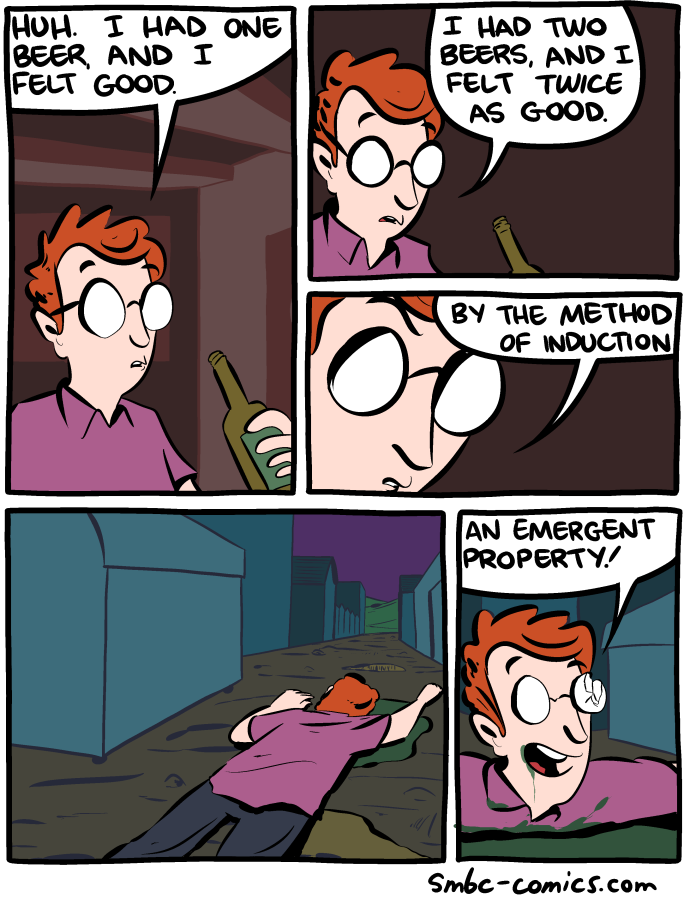
Hovertext: Today's SMBC featuring backgrounds that were actually drawn with some care. Wow!
THE STORE IS BACK AND REDESIGNED! Check it out!
Basic income is a tested social vaccine. It’s been found to increase equity and general welfare. It has been found to reduce hospitalizations by 8.5% in just a few years through reduced stress and work injuries. It’s been found to increase birth weights through increased maternal nutrition. It’s been found to decrease crime rates by 40% and reduce malnourishment by 30%. Intrinsic motivation is cultivated. Students do better in school. Bargaining positions increase. Economic activity increases. Entrepreneurs are born.
With experiment after experiment, from smaller unconditional cash transfers to full-on basic incomes, the results point in positive directions across multiple measures when incomes are unconditionally increased.
”Universal Basic Income as the Social Vaccine of the 21st Century (via letseyx)
It’s almost as if, as a species, we didn’t need to hurt ourselves in order for life to go on.
(via imathers)

Talk about heavy equipment! This is the SLJ900/32, a Chinese bridge-building machine. It weighs 580 metric tons and is 91.8 meters long. It carries and installs concrete bridge girders in places where a crane can’t go. This time-lapse video makes it look simple. It can’t be simple.
But at least it’s doable. Watch the guys working with this machine. They hop around hundreds of feet above a chasm, installing tons of concrete, with no safety harnesses. There are two other videos that give a closer look at some of the steps, if you are interested. -via Daily of the Day
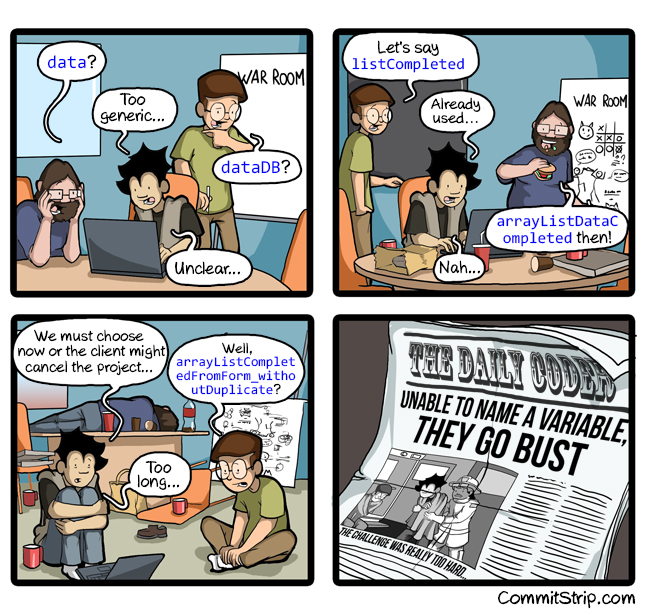
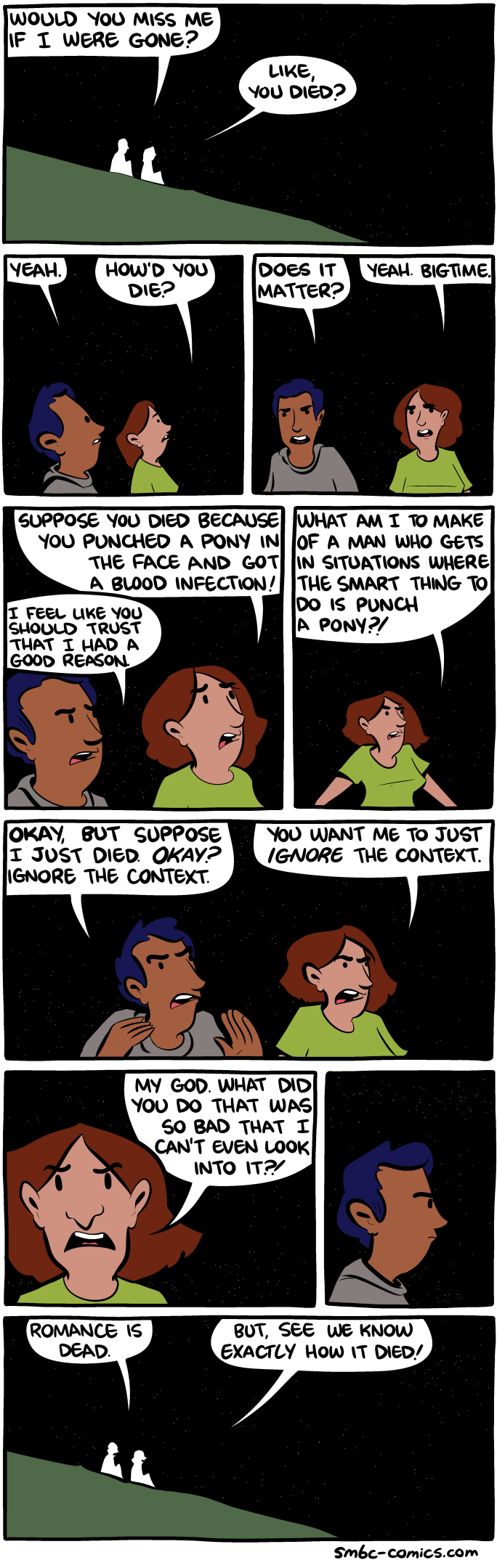
Hovertext: I strangled it with my bare hands!
Hey geeks! We added an ebooks omnibus level to the kickstarter. If you've ever wanted all of my books in digital format, it's now available!

Monty Python And The Holy Grail turns 40 this year, meaning that entire generations have grown up with its cheerful plague humor, taunting Frenchmen, and Tim, the killer Rabbit Of Caerbannog. To celebrate the anniversary, a special edition of the movie is being released on Blu-ray and DVD. Included in the material is 14 minutes of cut animations, all narrated by director Terry Gilliam. Monty Python has also graciously posted the sequence on YouTube for your enjoyment.

Gilliam explains that the style of the segments were inspired by Illustrations In The Margins Of Medieval Manuscripts, which consists of what are essentially doodles made by monks bored with their transcribing duties. He also admits to standing on the shoulders of his illustrators, and simply moving around paper cut-outs in stop-motion fashion. And the trivia-minded Gilliam points out that the majestically-bearded face of God peering down is W.G. Grace, the “Grand ...
Tadeualso Wave of Mutilation in Southland Tales

One of my favorite music cues from all of cinema is the ending of David Fincher’s Fight Club. “Trust me. Everything’s going to be fine,” Edward Norton’s character tells Marla Singer, as explosive charges blow and their surroundings start to come apart. The Pixies’ “Where Is My Mind” roars to life in the background, and Norton intones, “You met me at a very strange time in my life.”
That song, with its stream-of-consciousness lyrics and its simple but poignant refrain, has always struck me as the perfect song to end the film with. In recent days, “Where Is My Mind” was used to great effect in an episode of the hit show Mr. Robot.
Inspired by the song and its use in popular culture, I tried to tackle a unique rendition of it using my cello and looping. With vocalist Annie Jantzer, I shot a video featuring a reverse lip-sync of the song. This required the tedious process of recording the song in studio, filming it, reversing the audio, learning the reversed version, filming the music video in reverse, and then reversing the music video to obtain the final result. Was it worth it? Check out the final product after the jump.
You can buy this song and check out my cello EP at davechenmusic.com.
The post Watch This: A Cello Cover of “Where Is My Mind,” Shot in Reverse appeared first on /Film.
TadeuTim Robbins and Jack Black? How did I miss that?

HBO has cancelled The Brink, the dark geopolitical satire starring Tim Robbins and Jack Black, after one season. Which isn’t too shocking at first glance, given that the series never garnered much buzz and earned only modest ratings. What makes it weird is that the news comes after HBO already renewed The Brink for Season 2, way back in July. More about The Brink cancellation after the jump.
The premium cable network announced The Brink cancellation in a statement:
After evaluating our schedule and our programming needs, we unfortunately decided we cannot give The Brink the attention it deserves for a second season. We are proud of the first season and wish everyone involved in this show the very best.
The Brink followed three very different men who get caught up in a geopolitical crisis: U.S. Secretary of State Walter Larson (Robbins), lowly Foreign Service officer Alex Talbot (Black), and Navy fighter pilot Zeke Tilson (Pablo Schreiber, currently best known as Orange Is the New Black‘s Pornstache). Together, they engage in a desperate struggle to stop World War III.
HBO renewed The Brink for a second season in July, about halfway through its first season. While its ratings were decent, not great, its reviews were mixed. In contrast, Girls and Veep aren’t exactly setting Nielsen boxes on fire, but they’re critical darlings that inspire think pieces and gifs, attract devoted followers, and win statues.
Still, you’d think HBO would have noticed by the time it renewed The Brink that the show wasn’t getting a ton of attention. And they still decided it was worth renewing anyway. So it’s unclear what’s changed in the past four months.
Ballers, which premiered with The Brink earlier this year, is still expected to bounce back for Season 2. And it probably still will, because its numbers were better than The Brink‘s. Still, we’d imagine every HBO cast and crew member just got really nervous all of a sudden. As TV critic Alan Sepinwall points out, this is madness. Madness, I tell you!
So, to be clear: the broadcast nets don't cancel shows anymore, and HBO cancels shows it already renewed. #DogsAndCats #MassHysteria
— Alan Sepinwall (@sepinwall) October 27, 2015
The post HBO Cancels ‘The Brink’ (After Already Renewing It) appeared first on /Film.
 Produto
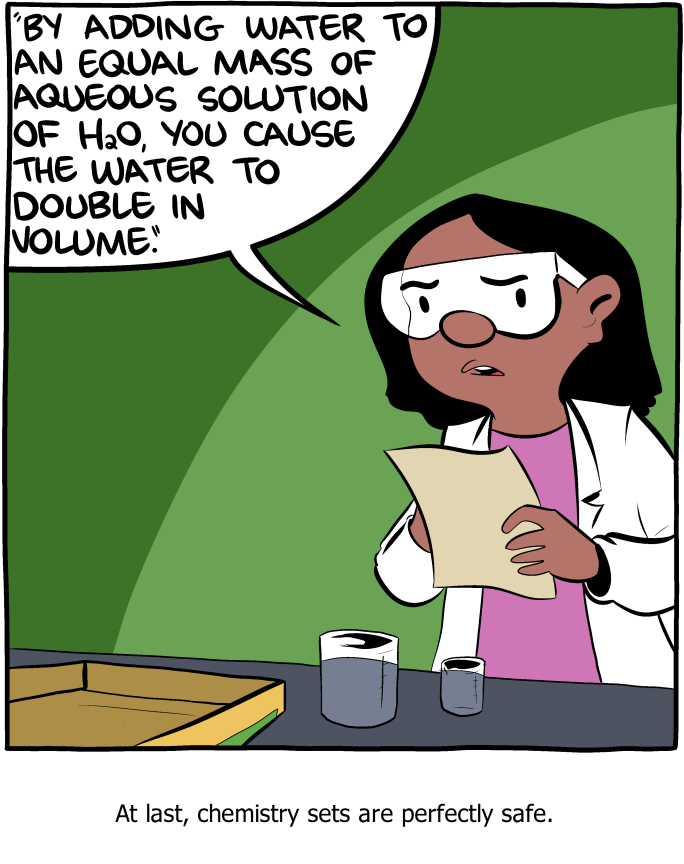
Hovertext: If doubly-hydrogenated oxygen gets into eyes, flush was oxygenated di-hydrogen.
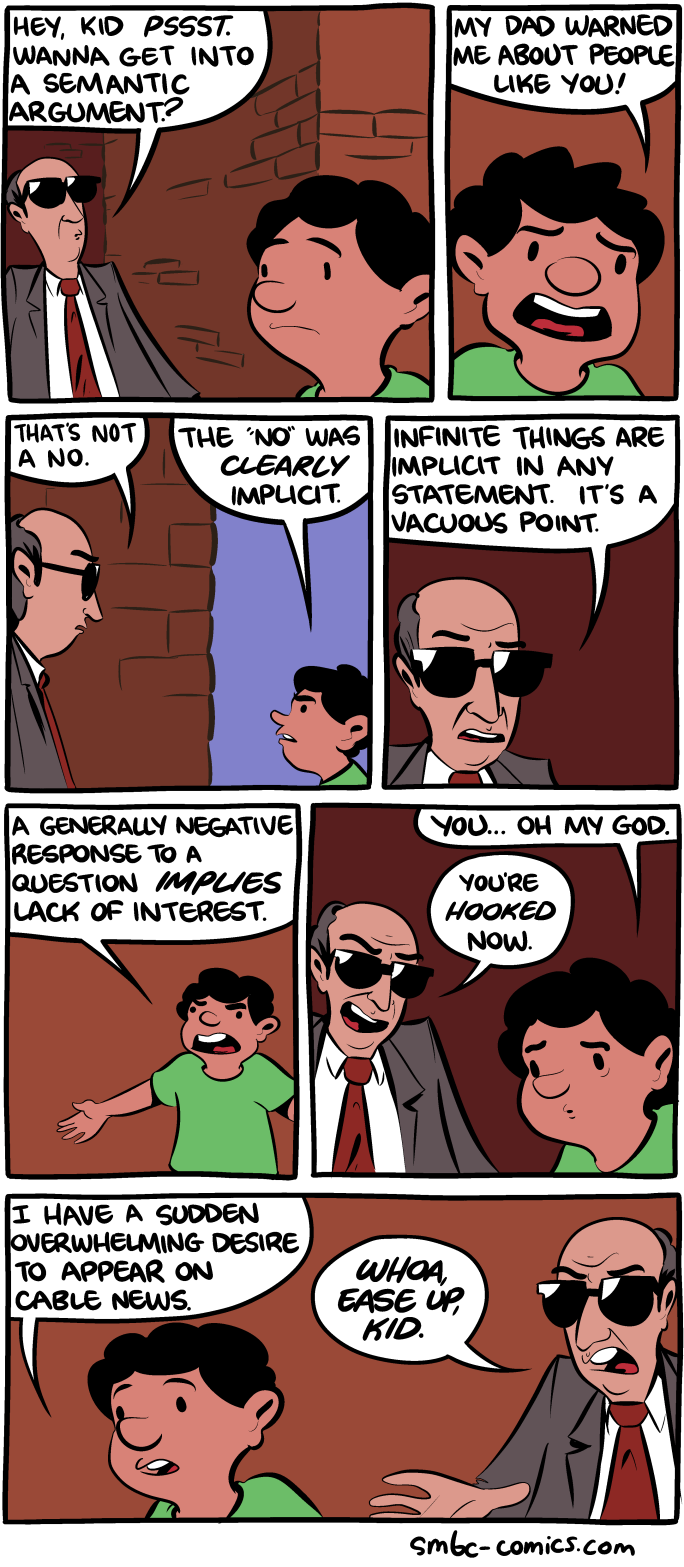
Hovertext: I see junkies everywhere now!
We now go into week two of our most surprisingly successful book launch ever. At this point, just about every damn thing gets signed. The signing process will actually kill me, so please enjoy the upcoming final few months of SMBC.
(Seriously though, thanks geeks!)
TadeuCool simulation
Gavin Schmidt shows different types of particles that swirl around in our atmosphere:
"Different kinds of particles are a different color," explains climate scientist, Gavin Schmidt. "The easiest to see are the reddy-orange particles; those are dust and you can see them streaming them off the Sahara," Also worth noting: white particles (pollution from burning coal and volcanoes); red dots (fires over a particular period); and blue color (seasalt being whipped up into air by the wind).
Nice.
Tags: atmosphere, environment

It’s been well over a century since Mark Twain first released Tom Sawyer and Huckleberry Finn into the world of American literature, but their youthful spirit rages on in the first trailer for Band of Robbers. Written and directed by Adam and Aaron Nee, the indie film reimagines the classic all-American rascals as grown-up men in the modern day.
Huck (Kyle Gallner), fresh out of prison, is trying to go straight, but Tom (Adam Nee), now a crooked cop, drags him into a plot to find the treasure that eluded them in childhood. Other classic characters like Injun Joe (Stephen Lang) and Becky Thatcher (Supergirl‘s Melissa Benoist) also appear. Watch the Band of Robbers trailer after the jump.
The Band of Robbers trailer dropped on YouTube.
Band of Robbers has flown mostly under the radar, but it did pick up some solid reviews after its Los Angeles Film Festival premiere this summer. Indiewire described it as “a thinking man’s Superbad,” complete with “laugh-out-loud moments and thoughtful realizations about young manhood,” while The Playlist praised its “a killer premise, polished direction, and a tone as though Anton Chigurh sauntered into Bottle Rocket.”
Gravitas Ventures has Band of Robbers in select theaters and VOD on January 15, 2016. Here’s a synopsis from the LA Film Fest.
Mark Twain’s young heroes Tom Sawyer and Huckleberry Finn spring vividly back to life, this time as modern-day grown men. When Huck is released from prison he hopes to leave his criminal past behind. But his lifelong friend and corrupt cop, Tom, has other plans, having formed the Band of Robbers, a group of misfits dedicated to locating the hidden treasure that eluded the boys in childhood.
Twain aficionados will find myriad references to their beloved characters, but the film stands on its own as a story about two well-intentioned heroes refusing to bid their childhoods goodbye. Charming and hilarious, the Nee brothers make a winning directorial team in this old-fashioned Boys’ Own yarn thrown headlong into the present day.
The post ‘Band of Robbers’ Trailer: Tom Sawyer and Huck Finn Are All Grown Up and Still Up to No Good appeared first on /Film.
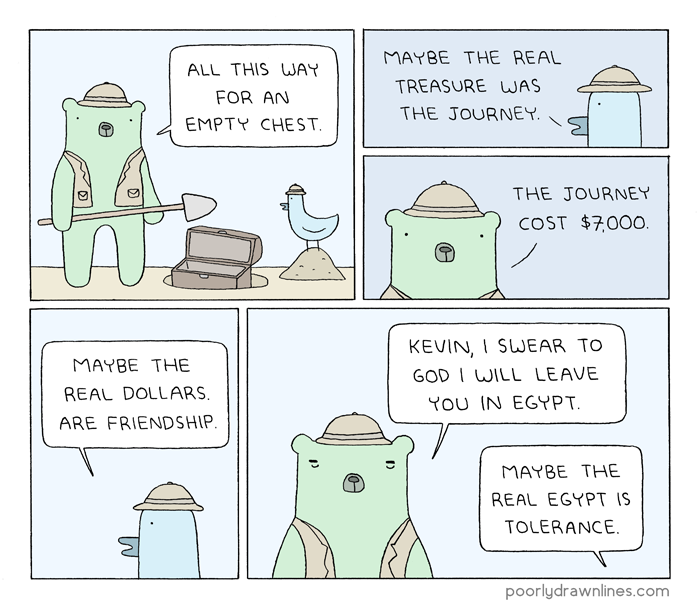
 (
(