Shared posts

15 Jun 16:39

O que houve com o Mediterrâneo? Guerra na Síria, Crise na Grécia e Mortes no Mar!

by gustavochacra

Houve um momento na história que a cultura mediterrânea era a mais forte no Oriente Médio. Um momento quando Beirute, Smyrna, Alexandria e outras cidades nesta parte do mundo estavam interligadas com Genova, Veneza, Marselha. Um momento quando mesmo o interior, com Aleppo, Cairo e Damasco, também era dedicado ao comércio. A diferença é que o mar era o deserto e as caravanas os navios.

Esta ligação do comércio mediterrâneo com o comércio do oriente tornou estas cidades as mais cosmopolitas de suas épocas. Cidades onde viviam judeus, armênios, gregos, genoveses, turcos e árabes. Claro, não era perfeito. Mas, se comparado ao resto do mundo, incluindo a Europa do Norte, na época, era um oásis de liberdade e tolerância.

As pessoas se comunicavam pela língua franca, ou sabir, que misturava um pouco de todos os idiomas do Mediterrâneo. Havia algo do português, do ladino, do espanhol, do francês, do grego, do turco e do árabe. Era uma língua falada apenas. Não deixou herança escrita. E desapareceu assim como praticamente desapareceu grande parte daquela cultura do Mediterrâneo.

Mesmo antes desta época do Mediterrâneo cosmopolita, tivemos os fenícios, os gregos e os romanos. Nossa cultura Ocidental e nossas religiões nasceram no Mediterrâneo. E boa parte da cultura oriental também nasceu no Mediterrâneo. É Istambul ou Constantinopla. É Roma. É Atenas. É a Terra Santa. É Cartago, hoje Tunísia. É Argel. É Tanger. É Mônaco e Nice. É Nápoles. É Barcelona. É Valência. É Sidon e Haifa.

Sem dúvida, na culinária, na música, nas artes e em muitas outras áreas o Mediterrâneo ainda segue culturalmente forte. Mas deixou de ser importante politica e economicamente. Hoje o Mediterrâneo tem crises econômicas no lado europeu, com a Grécia perto de um colapso, com guerras no lado oriental, com a Síria destruída, e milhares de refugiados de toda a África morrendo no mar. As duas cidades mais cosmopolitas, que são Beirute e Tel Aviv, sequer possuem comércio entre si.

Um dia, quem sabe, o Mediterrâneo oriental voltará a ser como no passado. Como escreveu uma jornalista israelense do Haaretz que esteve no Líbano, não há cidade no planeta que os israelenses gostariam mais do que Beirute. Se fossem, talvez não quisessem ir embora nunca mais.

Guga Chacra, comentarista de política internacional do Estadão e do programa Globo News Em Pauta em Nova York, é mestre em Relações Internacionais pela Universidade Columbia. Já foi correspondente do jornal O Estado de S. Paulo no Oriente Médio e em NY. No passado, trabalhou como correspondente da Folha em Buenos Aires

Comentários islamofóbicos, antissemitas, anticristãos e antiárabes ou que coloquem um povo ou uma religião como superiores não serão publicados. Tampouco são permitidos ataques entre leitores ou contra o blogueiro. Pessoas que insistirem em ataques pessoais não terão mais seus comentários publicados. Não é permitido postar vídeo. Todos os posts devem ter relação com algum dos temas acima. O blog está aberto a discussões educadas e com pontos de vista diferentes. Os comentários dos leitores não refletem a opinião do jornalista

Acompanhe também meus comentários no Globo News Em Pauta, na Rádio Estadão, na TV Estadão, no Estadão Noite no tablet, no Twitter @gugachacra , no Facebook Guga Chacra (me adicionem como seguidor), no Instagram e no Google Plus.

15 Jun 13:36

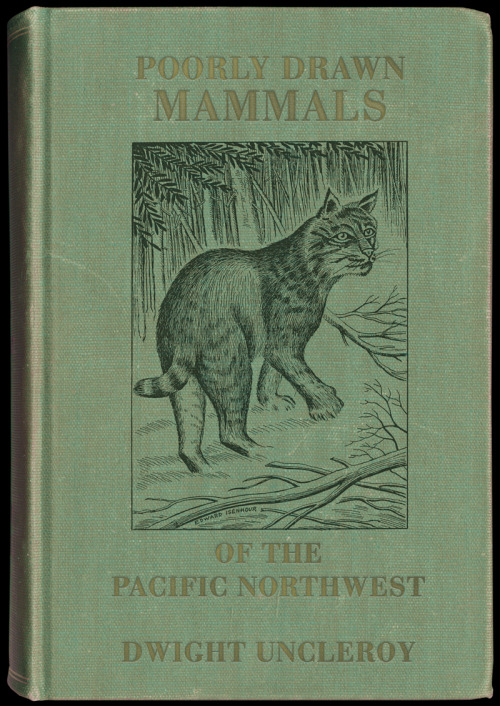
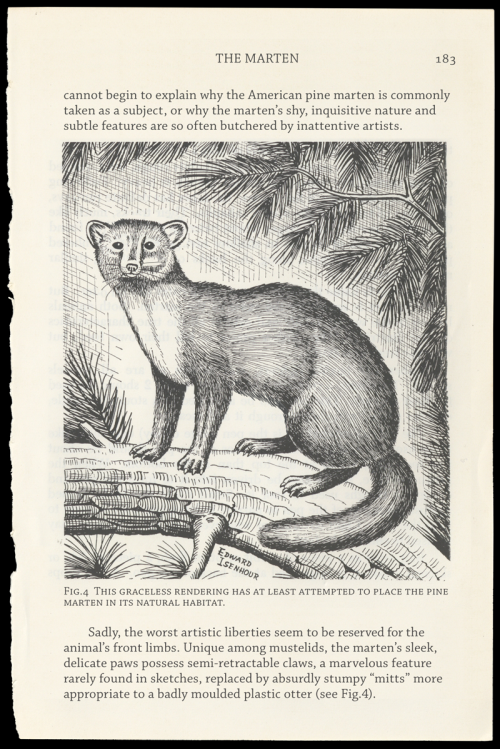
Poorly Drawn Mammals of the Pacific Northwest by Dwight Uncleroy


Poorly Drawn Mammals of the Pacific Northwest by Dwight Uncleroy

15 Jun 13:35

Quirky Monsters Playfully Occupy Abandoned Berlin Warehouses

by Kate Sierzputowski

Monzter_Artwork_02

Monzter_Artwork_05

German street artist Kim Köster is doing the impossible—turning the typically scary content of monsters and abandoned buildings into interactive entertainment for children. Köster started by spray painting mischievous monsters in derelict warehouse sites outside of Berlin, allowing them to playfully interact with the surrounding architecture. Köster is now turning these works into an interactive children’s picture book called Monzter that gives kids a chance to play with these colorful creatures without having to wander into any creepy buildings.

The app invites the audience to reflect and laugh with the philosophical musings of children like, “Are ghosts able to see me?” and “How big is the sun?” The app is iPad compatible and available in the Apple app store.

Köster was born and raised in the North German village of Worpswede. Originally experimenting with drawing and watercolor, Köster moved into the graffiti scene. Like Monzter, he often employs new media within his work allowing for a wide public accessibility of his pieces. (via Geyser of Awesome)

monster_07

Monzter_Artwork_04

Monzter_Artwork_03

monsters_08

Monzter_Artwork_01

15 Jun 13:35

My 21 Aerial Drone Photos Would Be Totally Illegal Today

by amos.chapple

Between the introduction of drone technology, and today’s laws limiting or banning their use, there was a glorious period when you could fly a camera almost anywhere.

These are the results of two years travel with a quad-copter in my backpack.

More info: amoschapplephoto.com

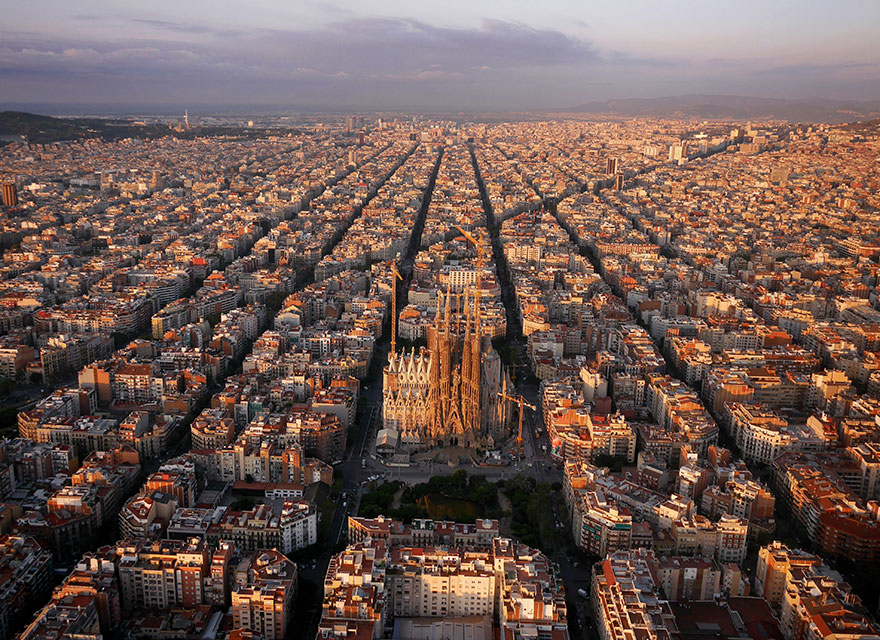
The neatly arranged suburbs around Sagrada Familia, Barcelona

illegal-photography-quadcopter-amos-chapple3

Octagonal city blocks and spacious street corners create a spectacular view. Al fresco beer & tapas in the town become such a delight.

The Hermitage Pavilion, St. Petersburg in autumn mist

illegal-photography-quadcopter-amos-chapple2

I can’t see what the camera is seeing. People find that weird but I quite like the suspense of not knowing what I have until I get the camera in hand.

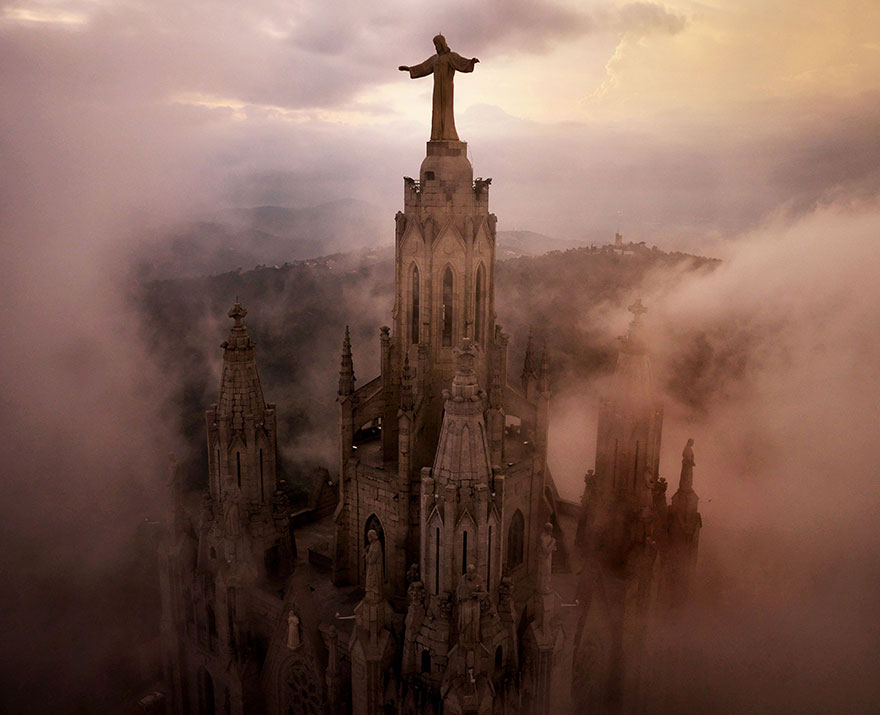
Clouds swirl through the pillars of Sagrat Cor Church, high on a hill above Barcelona

illegal-photography-quadcopter-amos-chapple32

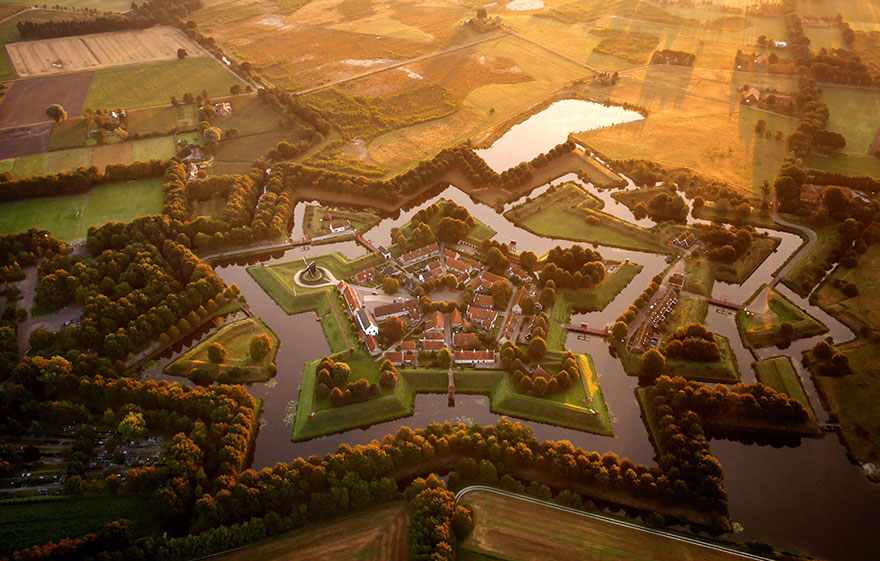
The star fort at Bourtange

illegal-photography-quadcopter-amos-chapple15

Three centuries after the last cannonball was fired in anger at the fort, it now serves as a museum and center of a sleepy farming village in eastern Holland. The low, thick walls were designed to offset the pounding force of cannon-fire.

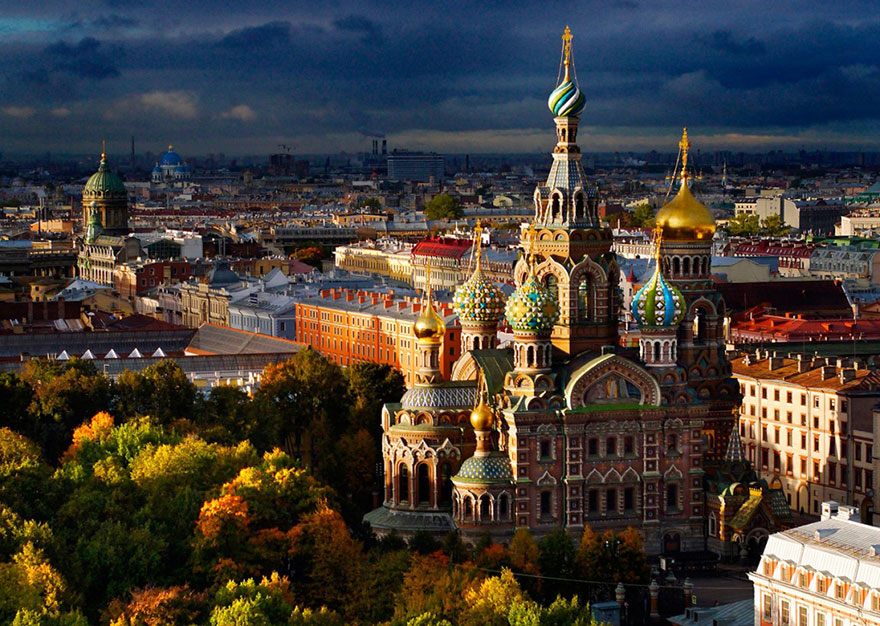
Church on Spilled blood, St. Petersburg

illegal-photography-quadcopter-amos-chapple1

In the early days (2013) you could fly drones almost anywhere.

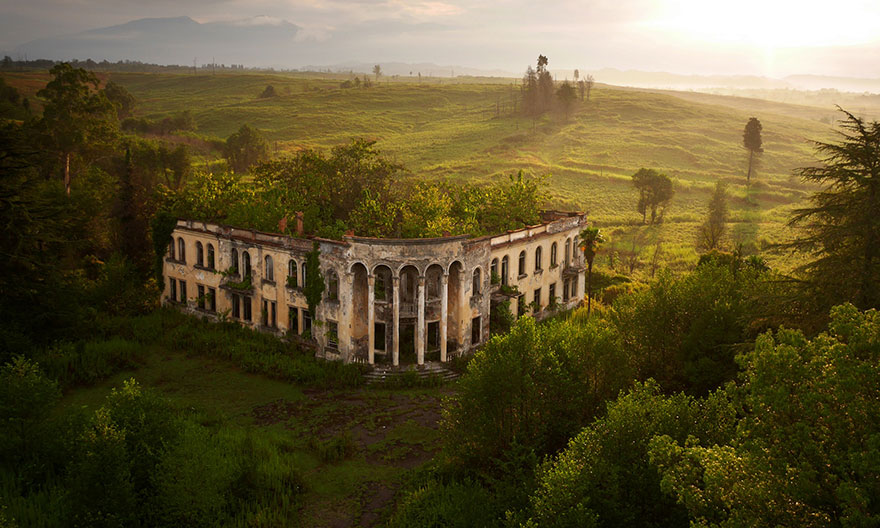
A ruined college inside the breakaway republic of Abkhazia

illegal-photography-quadcopter-amos-chapple12

Ethnic cleansing went down here in the 90s and areas like this one (near Gali) are now a twilight zone of empty buildings and overgrown farmland.

St. Peter & Paul Cathedral, Petergof

illegal-photography-quadcopter-amos-chapple25

With tiny little Christians walking round the base.

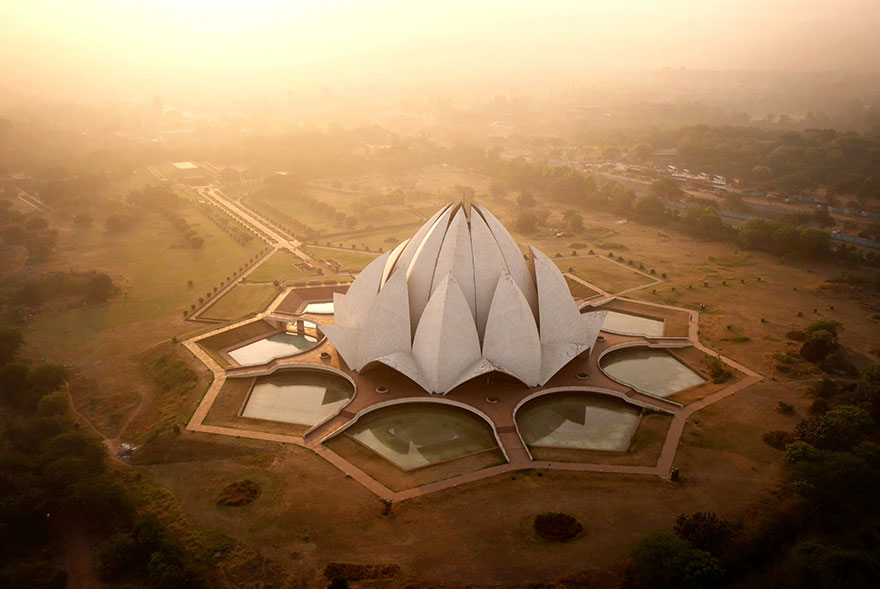
The Lotus Temple, dotted with pigeons at sunrise. Designed by an Iranian exile, the building serves as the centre of the Bahai’i faith in Delhi

illegal-photography-quadcopter-amos-chapple6

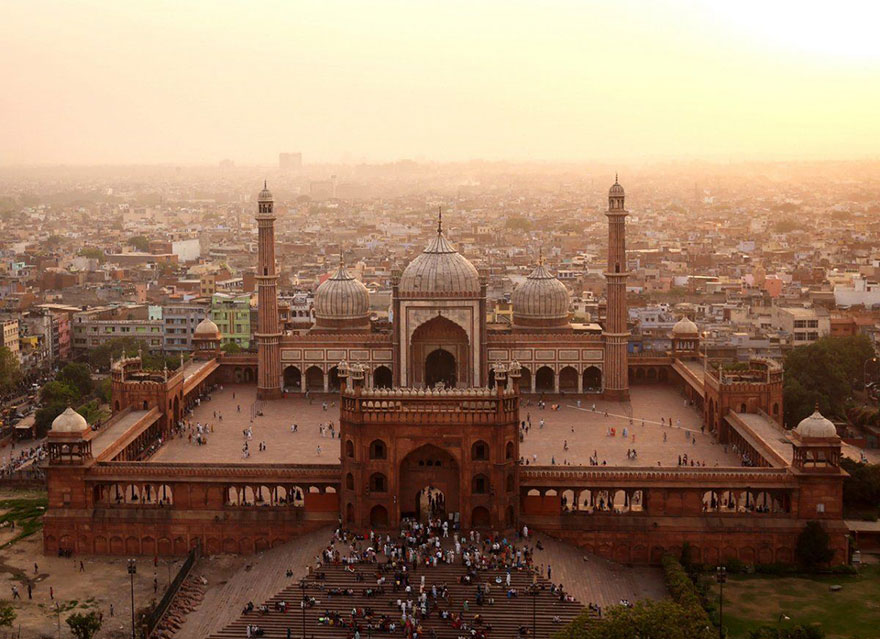
Jama Masjid, the heart of Islam in India

illegal-photography-quadcopter-amos-chapple5

Russia’s candy cane capital

illegal-photography-quadcopter-amos-chapple34

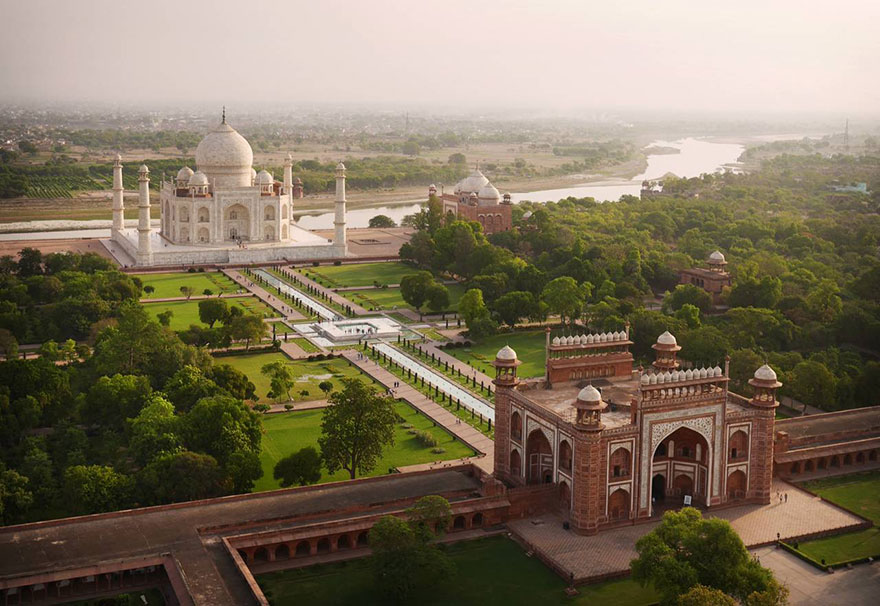
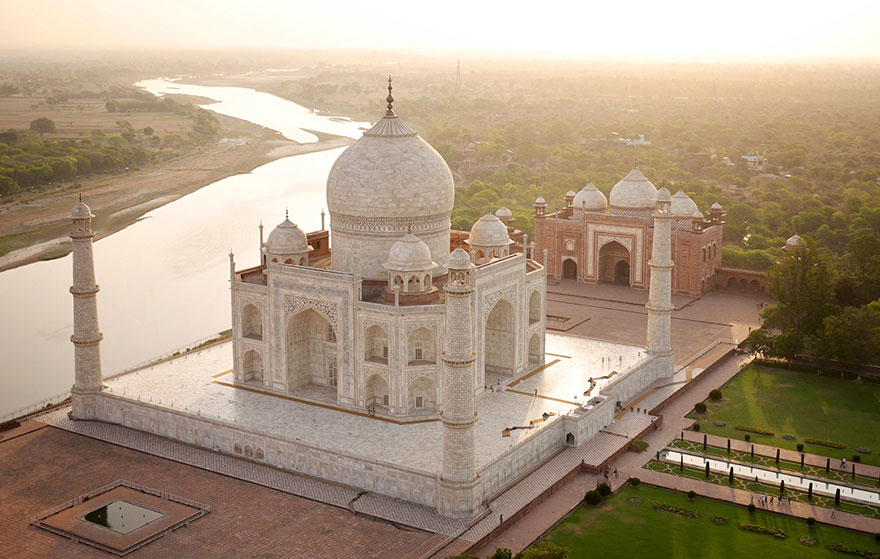
Taj Mahal and gardens as the day’s first tourists trickle in

illegal-photography-quadcopter-amos-chapple7

Security there is incredibly tight and I got busted.

The Taj Mahal in morning light

illegal-photography-quadcopter-amos-chapple10

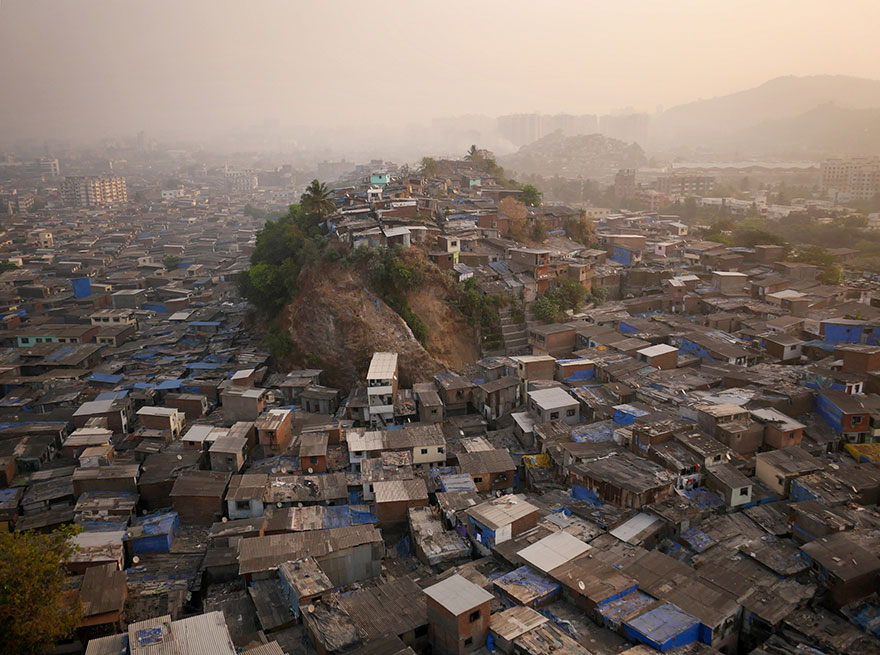
Morning over Maximum City

illegal-photography-quadcopter-amos-chapple8

Known to the locals as a “Hill 3″ this knoll jutting above Mumbai’s northern slums is no more valuable than the land below. Access to running water, which the hill lacks, is more valuable than any view.

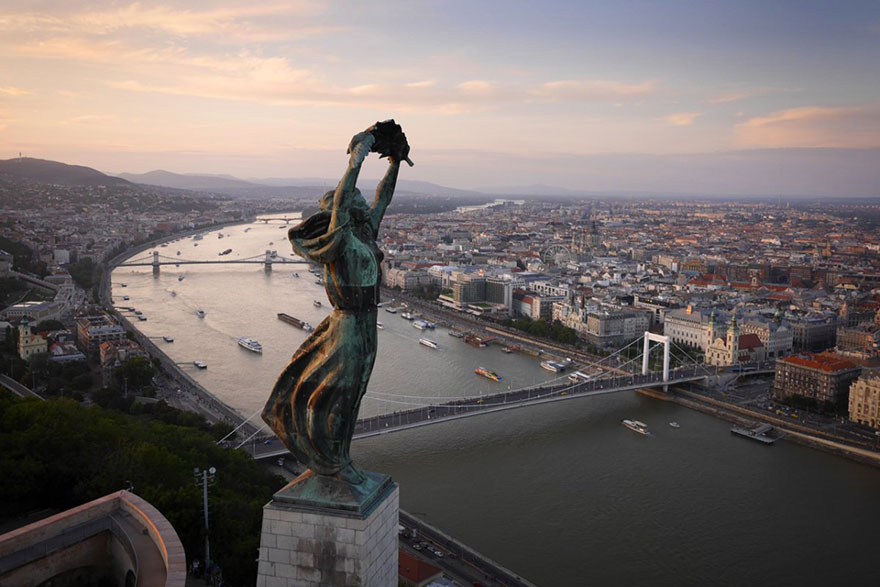
The windswept Liberty Statue, overlooking Budapest

illegal-photography-quadcopter-amos-chapple13

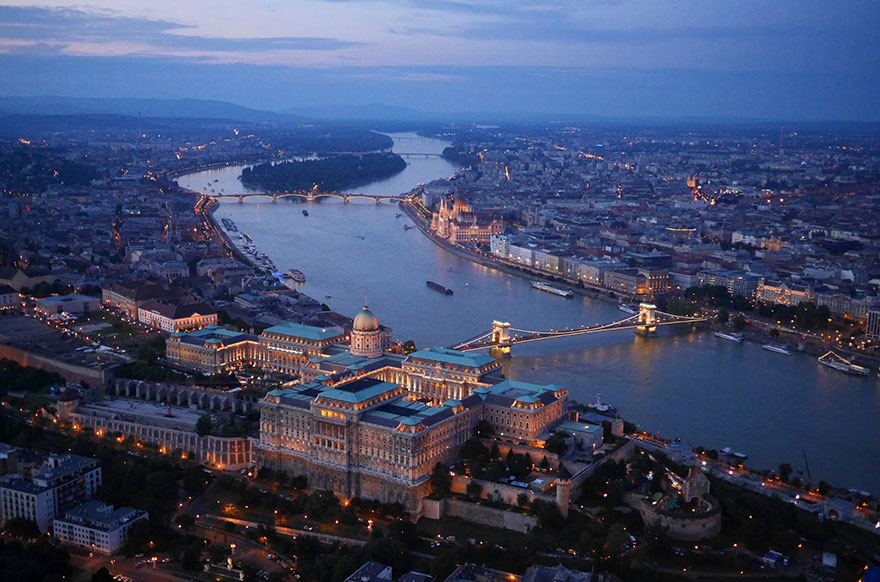
Buda castle at night

illegal-photography-quadcopter-amos-chapple16

The barge in the center of the river is packed full of fireworks. An hour after this pic they were sent booming into the night sky to celebrate the country’s national day.

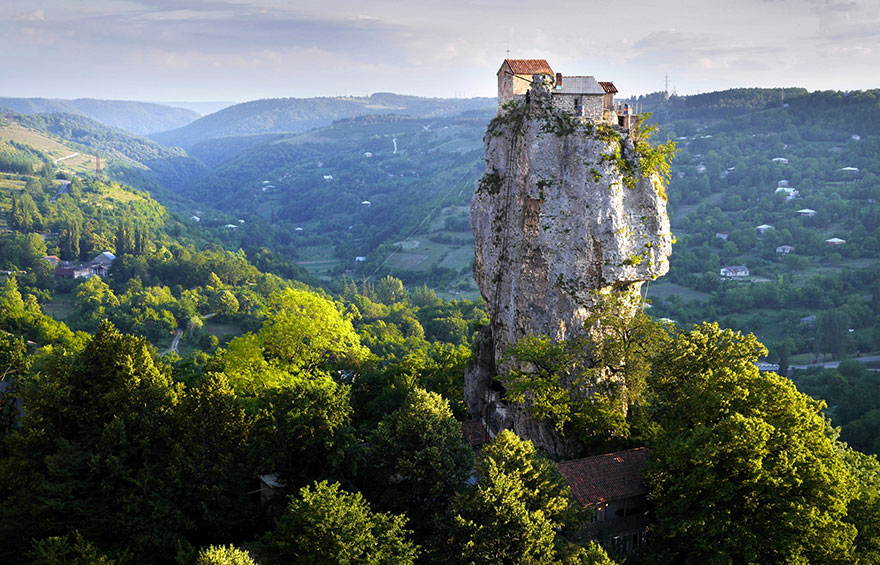
The Katskhi Pillar, where a Georgian hermit has lived for the past twenty years to be “closer to god”

illegal-photography-quadcopter-amos-chapple27

If you look close you can see the ladder. The terrifying ladder which I eventually had to climb.

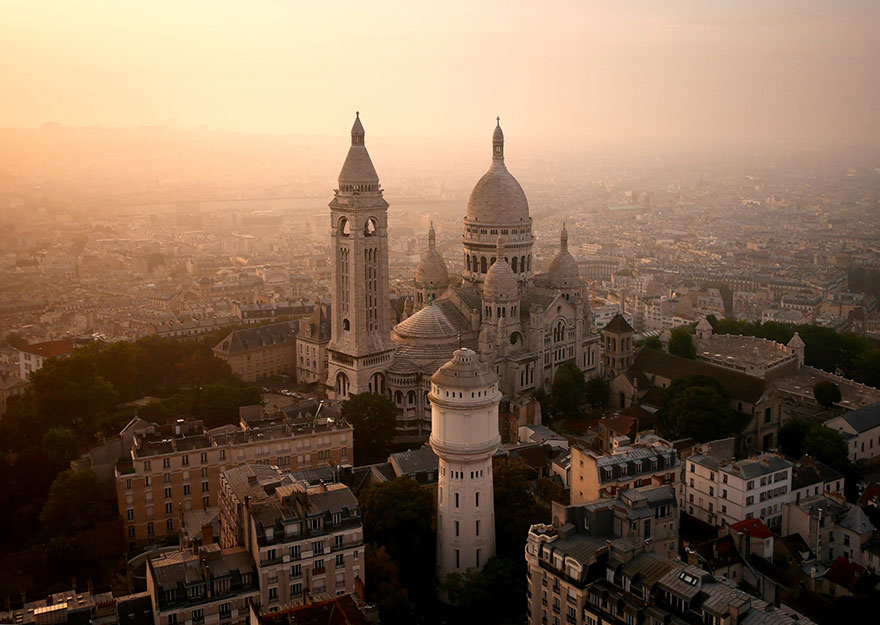
Paris’ Sacré-Cœur glowing in a hazy sunrise

illegal-photography-quadcopter-amos-chapple18

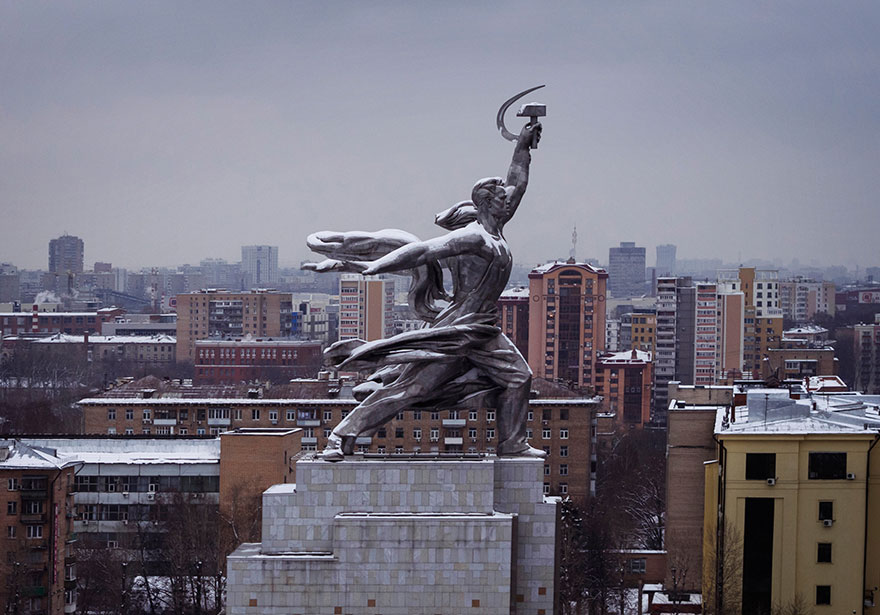
Worker and Kolkhoz Woman striding into the future that was

illegal-photography-quadcopter-amos-chapple20

Built for the soviet pavilion of the 1937 world fair in Paris, the steel masterwork now stands in the suburbs of northern Moscow.

Moscow’s Hotel Ukraina lit up at dusk

illegal-photography-quadcopter-amos-chapple21

This picture was taken as the Russian stock markets crashed on “Black Tuesday”. Little whiffs of panic could be felt on the street. Moscow never looked or felt more like Gotham city.

New Zealand, where only the hobbits have a hard time

illegal-photography-quadcopter-amos-chapple35

Kauri Cliffs golf course.

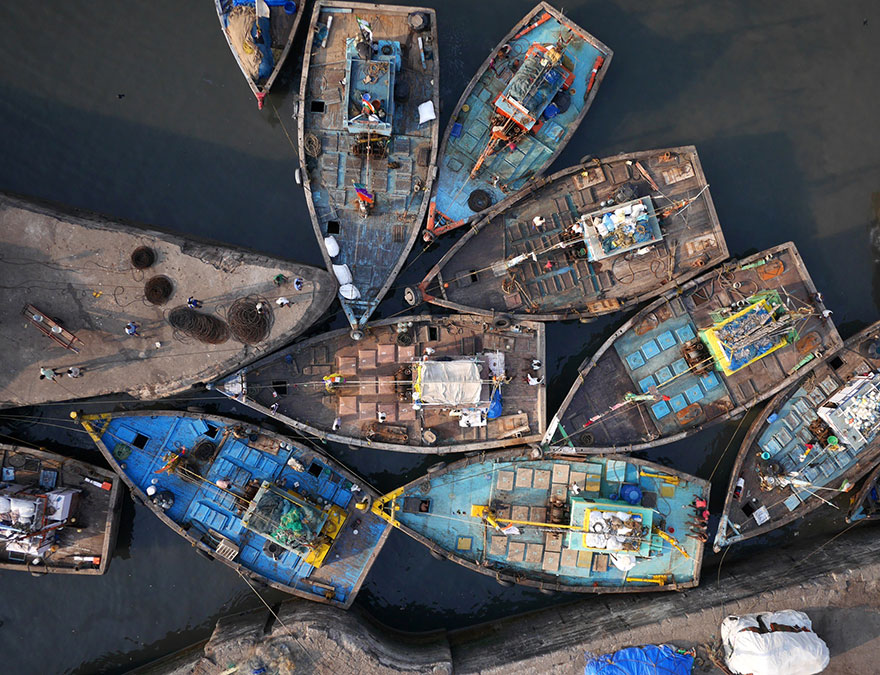
A knot of fishing boats at the entrance to Sassoon Dock, Mumbai

illegal-photography-quadcopter-amos-chapple4

15 Jun 11:42

Philae the comet lander has woken up

The tweet may have been sent by the European Space Agency’s humans on Earth, but it is confirmation that their comet lander Philae has woken up and is back in contact.

I’m alive.(ESA)

Philae is part of the Rosetta mission that was launched in 2004. In August 2014, Rosetta the satellite settled into orbit around the comet 67P Churyumov-Gerasimenko.

In November, the lander Philae was launched and landed on the comet’s surface. It worked for 60 hours gathering scientific data and beaming it back to Earth via Rosetta. But then its solar-powered batteries ran out.

There was hope that as the comet approached the sun, Philae would receive enough sunlight to wake up. After waiting for many months, scientists must be happy that their theoretical prediction has come true.

We still don’t know the exact location of the lander on the comet. But, on June 11, the space agency reported that it might have a location based on images and other data gathered by Rosetta.

This breaking-news story will be updated as we gather more details.

Bookmarked at brandizzi Delicious' sharing tag and expanded by Delicious sharing tag expander.
15 Jun 11:41

Sad... Happy... Sad... Happy...

15 Jun 11:38

Comic for June 15, 2015

Adam Victor Brandizzi

HAHAHAHA
HAHAHA
HA
...
:(

15 Jun 11:37

suffire: Dorothea lasky


suffire:

Dorothea lasky

15 Jun 11:35

Photo


15 Jun 11:34

tastefullyoffensive: A Florida man snapped this photo of a...


tastefullyoffensive:

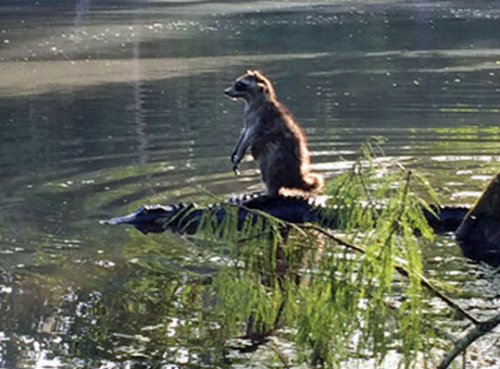
A Florida man snapped this photo of a raccoon riding an alligator at the Ocala National Forest (full story). Photo by Richard Jones via WFTV.

15 Jun 11:33

It was hard to say for how long, but we knew something had...


It was hard to say for how long, but we knew something had definitely been going on out there, in the outside world, when Bobby Boson came hovering during the summer of 1995. 

From: www.simonstalenhag.se

14 Jun 18:36

Comic for 2015.06.14

This entry passed through the Full-Text RSS service - if this is your content and you're reading it on someone else's site, please read the FAQ at fivefilters.org/content-only/faq.php#publishers.

14 Jun 18:36

Comic for June 14, 2015

14 Jun 18:35

hereafter

death isn't the end- there's still the funeral to come.

 Expaded from Oglaf's feed by Oglaf comic's expander.

13 Jun 14:38

The Real Lesson of the Stanford Prison Experiment - The New Yorker

A scene from “The Stanford Prison Experiment,” a new movie inspired by the famous but widely misunderstood study. A scene from “The Stanford Prison Experiment,” a new movie inspired by the famous but widely misunderstood study. Credit PHOTOGRAPH COURTESY SPENCER SHWETZ/SUNDANCE INSTITUTE

On the morning of August 17, 1971, nine young men in the Palo Alto area received visits from local police officers. While their neighbors looked on, the men were arrested for violating Penal Codes 211 and 459 (armed robbery and burglary), searched, handcuffed, and led into the rear of a waiting police car. The cars took them to a Palo Alto police station, where the men were booked, fingerprinted, moved to a holding cell, and blindfolded. Finally, they were transported to the Stanford County Prison—also known as the Stanford University psychology department.

They were willing participants in the Stanford Prison Experiment, one of the most controversial studies in the history of social psychology. (It’s the subject of a new film of the same name—a drama, not a documentary—starring Billy Crudup, of “Almost Famous,” as the lead investigator, Philip Zimbardo.) The study subjects, middle-class college students, had answered a questionnaire about their family backgrounds, physical- and mental-health histories, and social behavior, and had been deemed “normal”; a coin flip divided them into prisoners and guards. According to the lore that’s grown up around the experiment, the guards, with little to no instruction, began humiliating and psychologically abusing the prisoners within twenty-four hours of the study’s start. The prisoners, in turn, became submissive and depersonalized, taking the abuse and saying little in protest. The behavior of all involved was so extreme that the experiment, which was meant to last two weeks, was terminated after six days.

Less than a decade earlier, the Milgram obedience study had shown that ordinary people, if encouraged by an authority figure, were willing to shock their fellow-citizens with what they believed to be painful and potentially lethal levels of electricity. To many, the Stanford experiment underscored those findings, revealing the ease with which regular people, if given too much power, could transform into ruthless oppressors. Today, more than forty-five years later, many look to the study to make sense of events like the behavior of the guards at Abu Ghraib and America’s epidemic of police brutality. The Stanford Prison Experiment is cited as evidence of the atavistic impulses that lurk within us all; it’s said to show that, with a little nudge, we could all become tyrants.

And yet the lessons of the Stanford Prison Experiment aren’t so clear-cut. From the beginning, the study has been haunted by ambiguity. Even as it suggests that ordinary people harbor ugly potentialities, it also testifies to the way our circumstances shape our behavior. Was the study about our individual fallibility, or about broken institutions? Were its findings about prisons, specifically, or about life in general? What did the Stanford Prison Experiment really show?

The appeal of the experiment has a lot to do with its apparently simple setup: prisoners, guards, a fake jail, and some ground rules. But, in reality, the Stanford County Prison was a heavily manipulated environment, and the guards and prisoners acted in ways that were largely predetermined by how their roles were presented. To understand the meaning of the experiment, you have to understand that it wasn’t a blank slate; from the start, its goal was to evoke the experience of working and living in a brutal jail.

From the first, the guards’ priorities were set by Zimbardo. In a presentation to his Stanford colleagues shortly after the study’s conclusion, he described the procedures surrounding each prisoner’s arrival: each man was stripped and searched, “deloused,” and then given a uniform—a numbered gown, which Zimbardo called a “dress,” with a heavy bolted chain near the ankle, loose-fitting rubber sandals, and a cap made from a woman’s nylon stocking. “Real male prisoners don’t wear dresses,” Zimbardo explained, “but real male prisoners, we have learned, do feel humiliated, do feel emasculated, and we thought we could produce the same effects very quickly by putting men in a dress without any underclothes.” The stocking caps were in lieu of shaving the prisoner’s heads. (The guards wore khaki uniforms and were given whistles, nightsticks, and mirrored sunglasses inspired by a prison guard in the movie “Cool Hand Luke.”)

Often, the guards operated without explicit, moment-to-moment instructions. But that didn’t mean that they were fully autonomous: Zimbardo himself took part in the experiment, playing the role of the prison superintendent. (The prison’s “warden” was also a researcher.) /Occasionally, disputes between prisoner and guards got out of hand, violating an explicit injunction against physical force that both prisoners and guards had read prior to enrolling in the study. When the “superintendent” and “warden” overlooked these incidents, the message to the guards was clear: all is well; keep going as you are. The participants knew that an audience was watching, and so a lack of feedback could be read as tacit approval. And the sense of being watched may also have encouraged them to perform. Dave Eshelman, one of the guards, recalled that he “consciously created” his guard persona. “I was in all kinds of drama productions in high school and college. It was something I was very familiar with: to take on another personality before you step out on the stage,” Eshelman said. In fact, he continued, “I was kind of running my own experiment in there, by saying, ‘How far can I push these things and how much abuse will these people take before they say, ‘Knock it off?’ ”

Other, more subtle factors also shaped the experiment. It’s often said that the study participants were ordinary guys—and they were, indeed, determined to be “normal” and healthy by a battery of tests. But they were also a self-selected group who responded to a newspaper advertisement seeking volunteers for “a psychological study of prison life.” In a 2007 study, the psychologists Thomas Carnahan and Sam McFarland asked whether that wording itself may have stacked the odds. They recreated the original ad, and then ran a separate ad omitting the phrase “prison life.” They found that the people who responded to the two ads scored differently on a set of psychological tests. Those who thought that they would be participating in a prison study had significantly higher levels of aggressiveness, authoritarianism, Machiavellianism, narcissism, and social dominance, and they scored lower on measures of empathy and altruism.

Moreover, even within that self-selected sample, behavioral patterns were far from homogeneous. Much of the study’s cachet depends on the idea that the students responded en masse, giving up their individual identities to become submissive “prisoners” and tyrannical “guards.” But, in fact, the participants responded to the prison environment in all sorts of ways. While some guard shifts were especially cruel, others remained humane. Many of the supposedly passive prisoners rebelled. Richard Yacco, a prisoner, remembered “resisting what one guard was telling me to do and being willing to go into solitary confinement. As prisoners, we developed solidarity—we realized that we could join together and do passive resistance and cause some problems.”

What emerges from these details isn’t a perfectly lucid photograph but an ambiguous watercolor. While it’s true that some guards and prisoners behaved in alarming ways, it’s also the case that their environment was designed to encourage—and, in some cases, to require—those behaviors. Zimbardo himself has always been forthcoming about the details and the nature of his prison experiment: he thoroughly explained the setup in his original study and, in an early write-up, in which the experiment was described in broad strokes only, he pointed out that only “about a third of the guards became tyrannical in their arbitrary use of power.” (That’s about four people in total.) So how did the myth of the Stanford Prison Experiment—“Lord of the Flies” in the psych lab—come to diverge so profoundly from the reality?

In part, Zimbardo’s earliest statements about the experiment are to blame. In October, 1971, soon after the study’s completion—and before a single methodologically and analytically rigorous result had been published—Zimbardo was asked to testify before Congress about prison reform. His dramatic testimony, even as it clearly explained how the experiment worked, also allowed listeners to overlook how coercive the environment really was. He described the study as “an attempt to understand just what it means psychologically to be a prisoner or a prison guard.” But he also emphasized that the students in the study had been “the cream of the crop of this generation,” and said that the guards were given no specific instructions, and left free to make “up their own rules for maintaining law, order, and respect.” In explaining the results, he said that the “majority” of participants found themselves “no longer able to clearly differentiate between role-playing and self,” and that, in the six days the study took to unfold, “the experience of imprisonment undid, although temporarily, a lifetime of learning; human values were suspended, self-concepts were challenged, and the ugliest, most base, pathological side of human nature surfaced.” In describing another, related study and its implications for prison life, he said that “the mere act of assigning labels to people, calling some people prisoners and others guards, is sufficient to elicit pathological behavior.”

Zimbardo released video to NBC, which ran a feature on November 26, 1971. An article ran in the Times Magazine in April of 1973. In various ways, these accounts reiterated the claim that relatively small changes in circumstances could turn the best and brightest into monsters or depersonalized serfs. By the time Zimbardo published a formal paper about the study, in a 1973 issue of the International Journal of Criminology and Penology, a streamlined and unequivocal version of events had become entrenched in the national consciousness—so much so that a 1975 methodological critique fell largely on deaf ears.

Forty years later, Zimbardo still doesn’t shy away from popular attention. He served as a consultant on the new film, which follows his original study in detail, relying on direct transcripts from the experimental recordings and taking few dramatic liberties. In many ways, the film is critical of the study: Crudup plays Zimbardo as an overzealous researcher overstepping his bounds, trying to create a very specific outcome among the students he observes. The filmmakers even underscore the flimsiness of the experimental design, inserting characters who point out that Zimbardo is not a disinterested observer. They highlight a real-life conversation in which another psychologist asks Zimbardo whether he has an “independent variable.” In describing the study to his Stanford colleagues shortly after it ended, Zimbardo recalled that conversation: “To my surprise, I got really angry at him,” he said. “The security of my men and the stability of my prison was at stake, and I have to contend with this bleeding-heart, liberal, academic, effete dingdong whose only concern was for a ridiculous thing like an independent variable. The next thing he’d be asking me about was rehabilitation programs, the dummy! It wasn’t until sometime later that I realized how far into the experiment I was at that point.”

In a broad sense, the film reaffirms the opinion of John Mark, one of the guards, who, looking back, has said that Zimbardo’s interpretation of events was too shaped by his expectations to be meaningful: “He wanted to be able to say that college students, people from middle-class backgrounds … will turn on each other just because they’re given a role and given power. Based on my experience, and what I saw and what I felt, I think that was a real stretch.”

If the Stanford Prison Experiment had simulated a less brutal environment, would the prisoners and guards have acted differently? In December, 2001, two psychologists, Stephen Reicher and Alexander Haslam, tried to find out. They worked with the documentaries unit of the BBC to partially recreate Zimbardo’s setup over the course of an eight-day experiment. Their guards also had uniforms, and were given latitude to dole out rewards and punishments; their prisoners were placed in three-person cells that followed the layout of the Stanford County Jail almost exactly. The main difference was that, in this prison, the preset expectations were gone. The guards were asked to come up with rules prior to the prisoners’ arrival, and were told only to make the prison run smoothly. (The BBC Prison Study, as it came to be called, differed from the Stanford experiment in a few other ways, including prisoner dress; for a while, moreover, the prisoners were told that they could become guards through good behavior, although, on the third day, that offer was revoked, and the roles were made permanent.)

Within the first few days of the BBC study, it became clear that the guards weren’t cohering as a group. “Several guards were wary of assuming and exerting their authority,” the researchers wrote. The prisoners, on the other hand, developed a collective identity. In a change from the Stanford study, the psychologists asked each participant to complete a daily survey that measured the degree to which he felt solidarity with his group; it showed that, as the guards grew further apart, the prisoners were growing closer together. On the fourth day, three cellmates decided to test their luck. At lunchtime, one threw his plate down and demanded better food, another asked to smoke, and the third asked for medical attention for a blister on his foot. The guards became disorganized; one even offered the smoker a cigarette. Reicher and Haslam reported that, after the prisoners returned to their cells, they “literally danced with joy.” (“That was fucking sweet,” one prisoner remarked.) Soon, more prisoners began to challenge the guards. They acted out during roll call, complained about the food, and talked back. At the end of the sixth day, the three insubordinate cellmates broke out and occupied the guards’ quarters. “At this point,” the researchers wrote, “the guards’ regime was seen by all to be unworkable and at an end.”

Taken together, these two studies don’t suggest that we all have an innate capacity for tyranny or victimhood. Instead, they suggest that our behavior largely conforms to our preconceived expectations. All else being equal, we act as we think we’re expected to act—especially if that expectation comes from above. Suggest, as the Stanford setup did, that we should behave in stereotypical tough-guard fashion, and we strive to fit that role. Tell us, as the BBC experimenters did, that we shouldn’t give up hope of social mobility, and we act accordingly.

This understanding might seem to diminish the power of the Stanford Prison Experiment. But, in fact, it sharpens and clarifies the study’s meaning. Last weekend brought the tragic news of Kalief Browder’s suicide. At sixteen, Browder was arrested, in the Bronx, for allegedly stealing a backpack; after the arrest, he was imprisoned at Rikers for three years without trial. (Ultimately, the case against him was dismissed.) While at Rikers, Browder was the object of violence from both prisoners and guards, some of which was captured on video. It’s possible to think that prisons are the way they are because human nature tends toward the pathological. But the Stanford Prison Experiment suggests that extreme behavior flows from extreme institutions. Prisons aren’t blank slates. Guards do indeed self-select into their jobs, as Zimbardo’s students self-selected into a study of prison life. Like Zimbardo’s men, they are bombarded with expectations from the first and shaped by preëxisting norms and patterns of behavior. The lesson of Stanford isn’t that any random human being is capable of descending into sadism and tyranny. It’s that certain institutions and environments demand those behaviors—and, perhaps, can change them.

Sign up for the daily newsletter.Sign up for the daily newsletter: the best of The New Yorker every day.
Bookmarked at brandizzi Delicious' sharing tag and expanded by Delicious sharing tag expander.
13 Jun 14:34

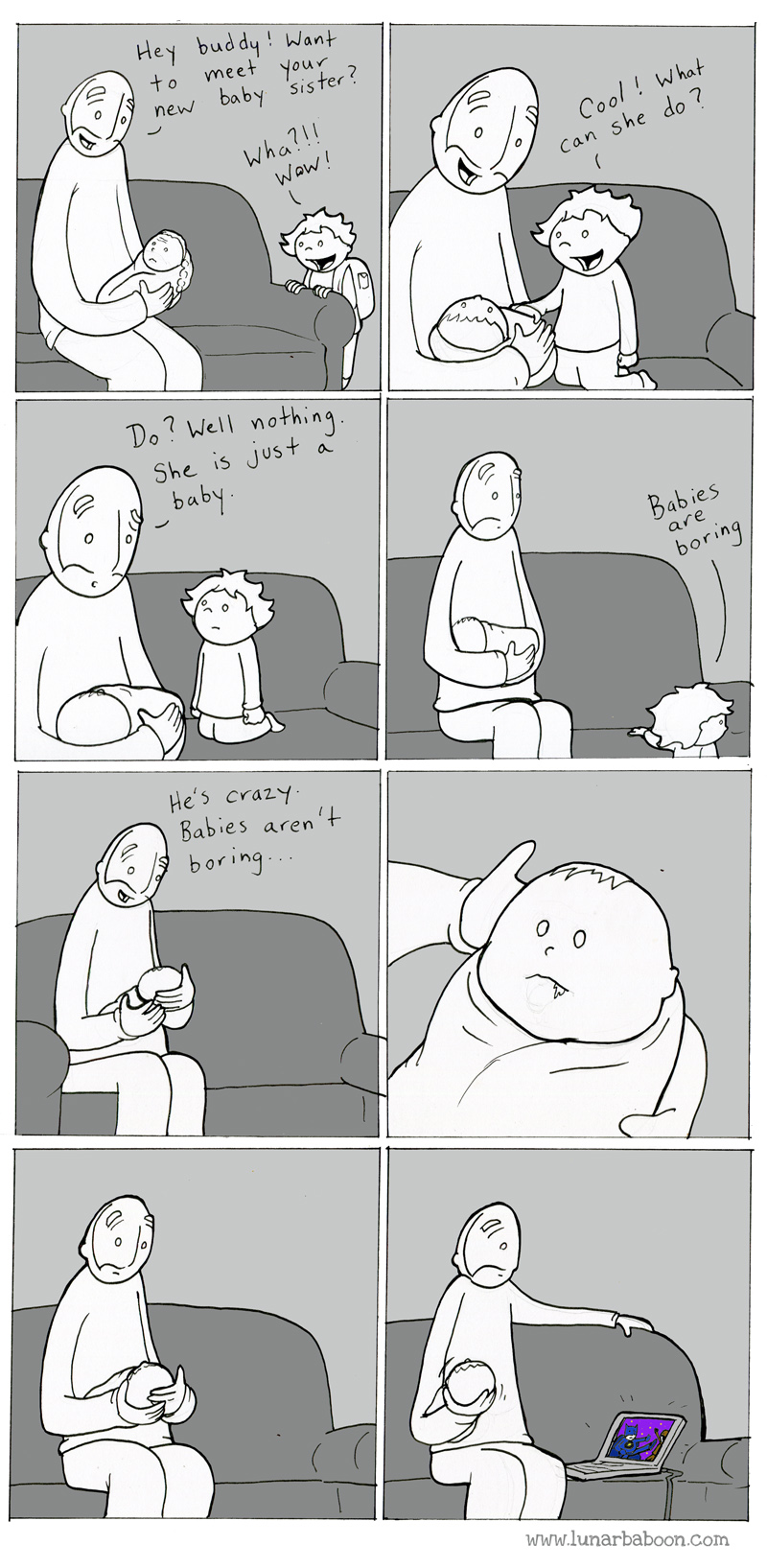
Babies

by Lunarbaboon

Buy your Lunarbaboon: Volume 1 book today..or tomorrow. Monday is good for me too. SHOP!

12 Jun 20:06

Photo


12 Jun 18:31

‘Chunky Knits’ by Anna Mo Incorporate Enormous Stitches to Comfortably Engulf the Body

by Kate Sierzputowski

mo_06

Anna Mo‘s chunky knits are not shy about their pattern, the soft form of her objects forcing the wearer to observe the pieces in all of their magnified glory. To knit these mammoth material works the Ukraine-based Mo not only uses extremely thick sections of wool, but also XXL needles to produce her three-inch-thick stitches. In addition to her wearable works, Mo also sells the yarn that she uses to produce the pieces (100% Australian merino wool) as well as oversized knitting needles so you can produce your own chunky sweaters and blankets.

Mo learned to knit at an early age, continuing the hobby into adulthood as a side project in addition to her work as a designer. Mo uses the tactile nature of knitting to balance her hours in front of the computer, allowing her hands to get as much exercise as her brain. For more images of Mo’s snuggly knits visit her Instagram. (via Beautiful/Decay and ĪGNANT)

mo_09

mo_07

mo_05

mo_04

mo_03

mo_02

mo_01

full

12 Jun 16:25

Practical Politics

by Greg Ross

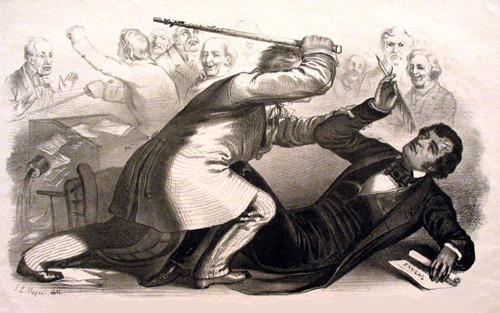
https://commons.wikimedia.org/wiki/File:Southern_Chivalry.jpg

On May 22, 1856, South Carolina representative Preston Brooks approached Massachusetts senator Charles Sumner as he sat writing at his desk in the U.S. Senate chamber. “Mr. Sumner,” he said, “I have read your speech twice over carefully. It is a libel on South Carolina, and Mr. Butler, who is a relative of mine.” Then he began to beat Sumner savagely with his gold-headed walking cane. Blinded with blood, Sumner at first was trapped under the desk, which was bolted to the floor, but he wrenched it free and staggered up the aisle, Brooks raining blows on his head until the cane snapped and Sumner collapsed unconscious. Even then Brooks held him by the lapel and continued to beat him with half the cane until the two were separated.

Sumner had denounced South Carolina senator Andrew Butler in a speech two days earlier in a dispute over slavery in the new territories of Kansas and Nebraska. Brooks was convicted of assault and fined $300, but he received no prison sentence, and his constituents returned him to office. Pro-slavery Southerners sent him hundreds of new canes, one inscribed “Hit him again.”

On Nov. 9, 1889, Col. A.M. Swope encountered Col. William Cassius Goodloe in the corridor of the Lexington, Ky., post office. The two had been battling for control of the state Republican party, and tragically they had adjoining mailboxes.

“You obstruct the way,” said Goodloe.

“You spoke to me,” said Swope. “You insulted me.”

Goodloe drew a knife. Swope drew a Smith & Wesson .38. Goodloe stabbed Swope 13 times, piercing his heart and nearly cutting off his hand. Swope shot Goodloe twice, tearing up his belly and setting his clothes afire. Swope died on the post office floor, and Goodloe staggered to a doctor’s office. He died two days later.

One witness said he never thought he would witness “such a magnificent display of manly courage and bravery.” Goodloe’s uncle, Cassius M. Clay, said of his nephew’s conduct, “I couldn’t have done better myself.”

Please support Futility Closet on Patreon!

12 Jun 16:23

New Laser Engraved Rolling Pins by Valek Imprint Elaborate Designs on Baked Goods

by Christopher Jobson

rolling-1

Last year around this time, Zuzia Kozerska of Valek Rolling Pins (previously) practically set the internet on fire with lasers, more specifically her laser engraved rolling pins that imprint different patterns in cookie dough. Kozerska has been hard at work creating increasingly more complex designs as well as special mini pins just for kids. You can see more in her Etsy shop.

rolling-2

rolling-3

rolling-5

rolling-6-new

rolling-7

rolling-8

12 Jun 12:40

Types

colors.rgb("blue") yields "#0000FF". colors.rgb("yellowish blue") yields NaN. colors.sort() yields "rainbow"
12 Jun 11:47

cdelehanty: Before and after sunrise at Mesa Arch.


cdelehanty:

Before and after sunrise at Mesa Arch.

12 Jun 11:47

Photo


11 Jun 21:28

Coder’s childhood : the magic button

Adam Victor Brandizzi

"Many software titles (games in particular) used the CPU's frequency for timing, so as faster chips came out, some of these games were unplayable. To provide a layer of compatibility for these titles, the "turbo" button was added. The name itself is an intentional misnomer, as the button doesn't boost the speed; engaging it slows the system down to a state compatible with original 8088 chips."
-- https://en.wikipedia.org/wiki/Turbo_button

AAAAAAHHHHH......

11 Jun 21:25

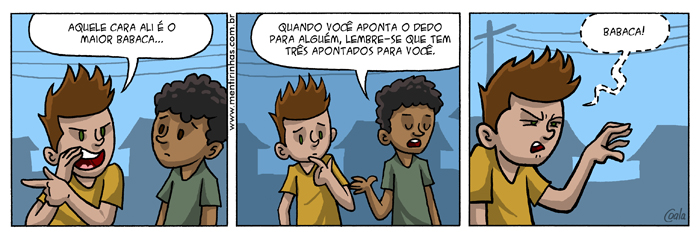
Mentirinhas #832

by Fábio Coala

mentirinhas_820

“Tendeu” mas não compreendeu.

O post Mentirinhas #832 apareceu primeiro em Mentirinhas.

11 Jun 21:16

A Operação Zelotes e a tensão no Carf

by João Villaverde

Sede do Carf, em Brasília.

Quando a Polícia Federal deflagrou a Operação Zelotes, no fim de março, uma parte importante de Brasília prendeu a respiração. A Zelotes desbaratou um grave esquema de corrupção e tráfico de influência no Conselho Administrativo de Recursos Fiscais (Carf). Embora pouco conhecido fora do mundo restrito dos advogados tributaristas, das grandes empresas e dos gabinetes da equipe econômica do governo federal, o Carf é um dos mais importantes espaços de discussão de temas fiscais. Até por ser pouco conhecido, até a Zelotes, que esquemas desbaratados pela polícia foram criados e prosperaram.

No Carf estão, hoje, mais de 115 mil processos tributários. Mais de R$ 500 bilhões – sim, quinhentos bilhões de reais – estão em discussão ali. Cerca de 40 mil processos chegam ao Carf todos os anos, mas, até o ano passado, menos da metade efetivamente era julgado. Desde a Zelotes, no entanto, o Carf está parado. A nova equipe econômica, liderada pelo ministro da Fazenda, Joaquim Levy, o secretário da Receita Federal, Jorge Rachid, e o novo presidente do Carf, Carlos Alberto Barreto, que acabou de assumir, aproveitou o clima de crise criado pela Zelotes para mudar o regimento interno do Carf.

O Carf é a última instância administrativa para processos tributários. Um fiscal da Receita autua um contribuinte (uma pessoa física ou uma empresa) por entender que houve pagamento errado ou falta de pagamento de um imposto. Se o contribuinte reclama, a autuação vai a julgamento na própria Receita Federal. Em praticamente todos os casos, a Receita faz o quê? Claro: fica do lado do fiscal da própria Receita. O contribuinte, então, pode levar para a última instância – o Carf.

Até março, o Carf era ocupado por 216 conselheiros. Metade deles indicado pela Receita e outra metade indicada por confederações empresariais, como a CNI, que representa a indústria, e uma parte menor pelas centrais sindicais. Até março, os conselheiros indicados pelo setor privado podiam desempenhar suas funções no Carf e, ao mesmo tempo, advogar em casos tributários.

Sim, caro leitor, era inacreditável e acontecia até outro dia. Um advogado podia atuar em um processo fiscal e, ao mesmo tempo, julgar um processo no Carf. Graças a isso, escritórios inteiros foram formados para atuar em casos tributários somente por ter um conselheiro inserido no Carf.

Agora, o novo regimento reduziu de 216 para 120 conselheiros e extinguiu algumas turmas especiais que existiam no Carf. Mais importante: agora o governo vai exigir a chamada “dedicação exclusiva”. Ou seja, para ser conselheiro do Carf é preciso ser apenas isso: conselheiro do Carf. Há também a exigência de pelo menos dois anos de dedicação exclusiva.

O Carf, ou “novo Carf”, está prestes a voltar. Os julgamentos devem ser retomados no mês que vem. Ao mesmo tempo, a Operação Zelotes deve entrar na fase final, com as denúncias do Ministério Público, envolvendo empresas e conselheiros. Como será o clima?

Carlos Alberto Barreto, ex-secretário da Receita Federal, atual presidente do Carf

Em entrevista concedida a este blog, concedida por telefone a noite de quarta-feira, o presidente do Carf, Carlos Alberto Barreto, comentou o cenário que está diante do conselho. Confira:

Como será o clima de retorno do Carf? Há a Operação Zelotes e também uma CPI no Congresso…
Barreto: O Carf vai retomar as atividades normais, mas é claro que o clima estará contaminado. Há empresas citadas (na Operação Zelotes) e que têm processos para serem julgados ainda no Carf. É uma situação sensível para qualquer conselheiro. Haverá o novo regimento, as denúncias virão a tona e há também a CPI. Então a pressão será enorme. Mas vamos tentar vivenciar tudo com calma.

Com essas mudanças no regimento interno do Carf, o que espera o governo?
Barreto: Esperamos uma maior velocidade nos julgamentos. Queremos ganhar eficiência, para que mais processos sejam julgados, o que é bom para a Receita e também para o contribuinte. Mas também esperamos que as decisões tenham mais qualidade. 

Especialistas apontam que o Carf continuará privilegiando a Receita, que indica o presidente – no caso, o senhor. Além disso, o presidente tem o chamado “voto de qualidade”, para desempatar decisões em que há divisão dos conselheiros.
Barreto: Ouvimos essas críticas, mas elas não procedem. Temos o voto de qualidade porque não podemos levar eventuais derrotas da Receita para  Justiça comum. O contribuinte que perde no Carf, que é a última instância, pode levar o caso para a  Justiça. Além disso, menos de 5% das decisões totais do Carf são decididas pelo voto de qualidade.

O senhor acredita que conseguirá atrair conselheiros do setor privado agora que será exigida dedicação exclusiva?
Barreto: Não tenho dúvida. Trabalhar no novo Carf vai trazer uma projeção muito grande ao profissional, vai enriquecer o currículo dele.

Então o governo conta com uma espécie de “efeito Banco Central”, né? Onde o economista do setor privado aceita o convite para trabalhar como diretor do BC, mesmo ganhando menos, porque quando ele deixa o cargo consegue voltar a bancos e consultorias com salários muito maiores, além do prestígio.
Barreto: Isso, exatamente. Haverá esse “efeito Banco Central”, contamos com isso.

****

Mudando de assunto

Reforço aqui o convite ao leitor deste blog para visitar o especial multimídia (textos, animações e linha do tempo) das “pedaladas fiscais” do governo Dilma Rousseff, que foram reveladas pelo Estadão. Aqui: As Pedaladas Fiscais do governo Dilma


****

Atualização de 13/06/2015

O editorial do Estadão de hoje trata justamente nas mudanças feitas pelo governo federal no regimento do Carf: Novas regras para o Carf.

11 Jun 21:15

you-want-this-url-huh: nickxdee: THIS IS NEVER NOT FUNNY i...


you-want-this-url-huh:

nickxdee:

THIS IS NEVER NOT FUNNY

i really thought they were talking about colons at first

11 Jun 20:03

Matty Smith’s Photographs Display Vibrant Life Lurking Just Below Sea Level

by Kate Sierzputowski


“Physalia Physalis” – Bushrangers Bay, NSW Australia

Appropriately titled Over/Under, Matty Smith's series showcases the dual environments that exist just above and below sea level. Smith focuses on images right at dusk in order to expose the vibrant colors that shine within the dark waters. Each shot is divided by a wavy strip of ocean just above the center of the photograph. Fish and coral live below the horizon as seagulls and sunsets populate the upper half of the photos.

Tricky photographs to shoot from a technical standpoint, Smith uses a strobe light for the bottom half of the image to ensure that both the animals above and below water are highlighted prominently.

The Australian photographer views each half and half image he captures as a landscape photograph, and prefers environments with depth and attitude over blue sunny skies. Typically Smith scouts his locations via snorkeling expeditions. “For me one of the most wondrous parts of any dive is the moment that the water engulfs my mask as my head slips below the surface,” says Smith. “I think it’s the suspense of the unknown of what lies beneath, the transitional part of moving from one element to the next that feels so magical and the thought of what alien creatures I might encounter.” Many of his photos are available as prints. (via My Modern Met)

_DSC2129 copy
“Smiling Assassin” – American Crocodile, Jardines de la Reina, Cuba.

_DSC2498 copy
“A Silky Encounter 1” – Jardines de la Reina, Cuba

_DSC2545 copy
“A Silky Encounter 2” – Jardines de la Reina, Cuba


“Bluebottle Army” – Bluebottle cnidarian, Bushrangers Bay, NSW Australia

303_0007 copy
“Crimson Tide” – Waratah Anemones, Port Kembla, NSW Australia

303_0434 copy
“Ocean Rose” – Bass Point, NSW Australia

304_4777
“A Shock of Blue” – Bushrangers Bay, NSW Australia

DSC_0730-4 copy
“A Splash of Yellow” – Sargassum Seaweed, Bushranger Bay, NSW Australia

11 Jun 17:39

Around The World With David Bou

by dmitry

“I am David, an illustrator from Lithuania. I want to introduce some of my pictures – traveling illustrations I made. In these pictures I show the mood of great life moments when we travel. Fairly simple postcard-type images of towns are revitalized by my digital watercolor technique. You can feel the wind, the sun, the rain — everything. I’m a bit known in my country but I’d really love to share my work with the rest of the world.”

1
Tuvalu

2
Roterdam, Netherlands

3
Jasper National Park, Alberta. Canada

4
USA, Nevada desert

5
Ireland, field of cherry trees

6
Lithuania, Vilnius

7
Mexico, Baja California Desert

8
France, Paris


Need hosting? Design You Trust is proudly supported and hosted by WebHostingBuzz Premium Infrastructure & Network.
11 Jun 11:16

No, You Hang Up

"What are you talking about? I hung up"
"No, I did"
"No, I did"
"No, I did"
"I'm sorry"
"No, I'm sorry"
"No, I'm sorry"
"No, I'M sorry"
Expanded from Cheer Up, Emo Kid by XPath Expander.