Shared posts

24 Apr 12:25

Who’s who in the battle for Brazil?

by Vincent Bevins

whoswho

Why do ‘pro-government’ protesters battle cops, while pro-impeachment protesters hug them? Which team are these guys on, again? A guide to the current crisis

Vincent Bevins
São Paulo

I just spent a month away from Brazil, which served to remind me of just how inscrutable the struggles currently rocking this country are to foreign observers. They may know that things are not as rosy as they were a few years ago, or that “the government” has messed up or is in trouble. But the contours of the battles are extremely blurry.

For example. Last week, protesters clashed violently with police outside Congress in Brasília during a demonstration against a new legislative project (pictured above). A few days later, on Sunday, a much larger group of protesters, some of whom smiled and posed for selfies with heavily armed cops, cheerfully filled streets around the country,

It is indicative of the topsy-turvy world that crisis-ridden Brazil has entered that the bloody demonstrators battling cops were the ‘pro-government’ protesters, while the cheerful, carnavalesque crowds were calling for the president to be impeachment and her party to be demolished.

That’s because “the government” is not just one government these days, and a number of players (some even less scrupulous than the others) are currently engaged in a fight for its future.

So who are they? What do they want? What are their chances?

The government, part 1 (executive)

President Dilma Rousseff, of the left-leaning Workers’ Party (PT), was re-elected in October and began her second term in January.

The PT has controlled the Presidency since Luiz Inácio “Lula” da Silva took over in 2003. By any global standard, Lula’s time in power was good for Brazil. Buoyed by high prices for its commodities, the economy surged forward, and moderate social programs helped roughly 40 million people rise from poverty into the “new middle class.” He left office with record levels of support.

Dilma, former left-wing guerrilla and Lula’s hand-picked successor, took over in 2011 and enjoyed widespread support for a while. But the commodity boom ended and the economy slowed down amid mistakes made by Dilma’s government. Then the June 2013 protests happened, and so did the World Cup, which only turned out pretty well in contrast to the mess it was expected to be, and because Brazilians were polite enough to keep their rage about wasteful spending to themselves while the foreign fans were here.

By the 2014 election, Dilma had lost much of the goodwill Lula had bestowed to her. She barely beat out opponent Aécio Neves (PSDB) by frantically appealing to the working poor and middle-class leftists, denying many of the economic problems the country faced and promising what we all knew she couldn’t deliver in the short term.

She won, promptly installed a Finance Minister that her core supporters (and probably she herself) consider ‘neoliberal,’ who embarked on a series of painful adjustments as the dire economic straits Brazil finds itself in became exceedingly obvious. For the first time since 2003, regular people’s lives not only stopped improving, but in some cases, began to get worse. And all the while, since the middle of last year, it slowly emerged that the Federal Police have built a credible case that the state-run oil company, Petrobras, funneled billions of dollars to huge construction companies, who then passed some of the bribes on to political parties.

The government, part 2 (legislative)

If Brazil were a monarchy, that would be it. Rousseff would be “the government.” But Brazil is a loose federal republic with a staggering 28 parties active in its two legislative houses, and 26 state governors who each control their own police forces.

Much of Lula’s success was attributable to his ability to cobble together an unlikely coalition of parties and economic actors and thus keep the party going. This group has included right-wing parties, major figures Lula used to bitterly oppose, one president already impeached for corruption, and big parties who may not believe in much, other than the spoils of power.

Maintaining this kind of a coalition is a lot easier if you have Lula’s charisma and political capital. It’s even easier if you have so much money flowing in that you can make everyone in the country richer at the same time.

Dilma has none of this at the moment, and it’s all falling apart.

Amidst the chaos and political weakness of the first few months of Dilma’s second term, the PT lost control of Congress. The “catch-all, pork loving” PMDB has gained control of the Presidency of both houses and is openly rebelling against Dilma. Eduardo Cunha, an evangelical Christian, has been especially combative. Contributors to this blog have made it pretty clear who these guys are. It is not only that have they taken advantage of Dilma’s weakness. They are also reportedly furious that both of their Congressional leaders, Renan Calheiros and Cunha, have been named in the investigation into the Petrobras corruption scandal.

Recently, they have been pushing a bill that allows for more companies to treat employees as contractors. The PT hates this law, and so do the left-wing and union protesters that marched against it last week in Brasília. That’s who battled cops in Brasília last week, decked out in red. They support “the government” (Dilma) against right-wing threats, but despise Cunha and company.

Many people want Neves and the PSDB in power. Many, but less than before, want Dilma’s PT to hold on and thrive. But few people will tell you they love these guys.

selfies

The protesters, 2015 edition (green and yellow)

On Sunday, hundreds of thousands of people took to the streets around the country to denounce Dilma and call for her impeachment. This was less than they mustered a month earlier, but this group and its demands are not going away.

These protesters want Dilma gone, now, and mostly hate the PT passionately. A small minority call outright for military intervention. Anecdotally speaking, these people have not felt represented by the PT government in years, and their anger has exploded further since the October election. Studies suggest they are wealthier and whiter than average Brazilians, and that they are most likely to take their cues from Brazil’s most right-wing major publication.

According to this study, they also hold some strange beliefs. A majority said they think the PT “wants to impose a communist regime in Brazil.” The Economist recently called them a “Tropical tea party.” They are usually law and order voters, which explains why some of them embrace the police that terrify many poor Brazilians and traditional protest groups.

But it is not enough to just wave one’s hands, and say that Brazil has always had a small but powerful right-wing section of the elite, that they never liked the PT anyways and hold views that many English-language readers would find bizarre. That may describe some of the core demonstrators who are actually in the streets. But it’s also important to recognize why they’ve been able to step into the spotlight now, and that many regular people are sympathetic to their broader demands.

Another recent poll made very difficult reading for the PT. Datafolha reported that 63% of respondents support an impeachment process against President Rousseff. And 3/4 of respondents said they supported the recent protests around the country.

This must include many people that voted for her. And it’s not hard to see what explains this swing. Things have gotten worse.

Social movements, unions, and the left (protesters in red)

But it’s not just the rich, white, and conservative that are upset. Many of the core supporters of the PT project had hoped that Dilma would follow up on her left-wing campaign with a shift to the left. She did not. They were doubly mortified to see the country fall into the hands of her former conservative allies in Congress, who have been eager to push an agenda they consider homophobic and a serious threat to labor rights.

In much smaller numbers, they took to the streets yesterday, alongside fast food workers, to protest this new direction. These guys come from the traditional left, and have traditionally clashed with police at times.

And while they bitterly oppose the other group of protesters, accusing them of being golpistas, they are also an outgrowth of real discontent with the status quo. They would argue that to tackle the very real popularity problems the Datafolha survey revealed, the PT should return to its left-wing roots.

It’s also notable that Brazilians, perhaps fed up with the system in general, have been quite eager to support all kinds of protests recently. In 2013, a remarkable 89% supported the protests started by an anarchist-leaning student group after they exploded into wider demands for better public services and an end to corruption.

Who will triumph? (pure speculation)

Marxists and free-market liberals alike sometimes make the mistake of thinking that if things just get bad enough, a solution they like will appear. The radical left looks to 1917, and liberals look to 1989, as evidence of this. But what happens more often is that things just sort of muddle along, in a dispiriting and crappy way, with no easy way out.

While admitting that anything could happen, I’ll venture three possibilities for the next few years. The first is that the political and legal circumstances change, and Dilma is actually impeached. For now, this seems unlikely, but it is possible. In any case, it would only be a victory for the yellow-green protesters in that it would be a blow to the PT. Their preferred representatives would be extremely unlikely to take over. Another possibility is that the PT manages to retake control of the situation, getting the economy back on track and moving into a position in Congress where it can satisfy some of its core supporters. This road looks very difficult from here.

But more likely, in my opinion, is that Dilma will remain weak for the near future, with Minister Levy managing to do enough with the economy to avert disaster, but unable to unleash the country’s full potential, while a rudderless Congress is taken in a new and sometimes strange direction.

Not very exciting, I know. But those are the battle lines for now.

22 Apr 13:11

Quickie

by Greg Ross

University of Strathclyde mathematician Adam McBride recalls that in his student days a particular teacher used to present a weekly puzzle. One of these baffled him:

Find positive integers a, b, and c, all different, such that a3 + b3 = c4.

“The previous puzzles had been relatively easy but this one had me stumped,” he wrote later. He created three columns headed a3, b3, and c4 and spent hours looking for a sum that would work. On the night before the deadline, he found one: 703 + 1053 = 354.

“This shows how sad a person I was! However, I then realised also how stupid I had been. I had totally missed the necessary insight.” What was it?

SelectClick for Answer>

“All you need to do is start with 23 + 33 = 35 and multiply by 353.”

(From Adam McBride, “Mathematics: The Greatest Subject in the World,” The Mathematical Gazette, vol. 89, no. 516 [November 2005].)

The post Quickie appeared first on Futility Closet.

22 Apr 13:07

Raw & Rendered: Experimental 3D Artworks by Joey Camacho

by Christopher Jobson

raw-1

In early 2014, Vancouver-based graphic artist Joey Camacho set out to learn more about rendering images using Cinema 4D and Octane Render, with the goal of creating a new piece each day. His first attempts were pretty rudimentary, but it wasn’t long before his exploration and experimentation began to pay off with increasinly subtle details inspired by biology, sound, and geometry. Only several months into his ‘Progress Before Perfection‘ project, he started getting requests for prints as his images were shared widely around Tumblr and elsewhere. You can see more of his work on Behance and prints of many pieces are available through his website.

anim

raw-2

raw-3

raw-4

raw-5

raw-6

raw-7

raw-8

raw-9

raw-10

22 Apr 12:59

The Civic Statuary Project

by Ethan

The University of Cape Town removed a controversial statue of British colonialist Cecil Rhodes last week, after a month of student protests. Rhodes, who build the De Beers diamond empire, was an unrepentant imperialist whose wealth came from purchasing mineral rights from indigenous leaders and turning their territories into British protectorates. Under his rule in Cape Colony, many Africans lost the right to vote, a step which some scholars see as leading to enforced racial segregation in South Africa. While Rhodes made major donations to charitable causes – including the land the University of Cape Town sits on – his legacy is a challenging and difficult one for many South Africans.

A month ago, student activist Chumani Maxwele emptied a bucket of excrement on the Rhodes statue on the UCT campus. Subsequent protests against the statue including wrapping it in black plastic, smearing it with paint and covering it with graffiti. When the statue was pulled down, protesters beat it with belts and chains as it was hauled away.

beatingrhodes

Protests against the Rhodes statue received widespread support online, spawning the hashtag #RhodesMustFall, and inspiring other attacks on statues throughout South Africa. Statues of Queen Victoria and George V have been splashed with paint in Point Elizabeth and Durban. Statues of Afrikaner leaders and Boer War generals have been targeted as well. The attack that’s received the most international attention was a defacement of a statue of Mahatma Gandhi in Johannesburg, part of a protest that argued that the revered activist had worked with the British colonial government in South Africa to promote segregation.

Statues are one of the oldest forms of figurative art, dating back at least to 40,000 BCE with the Lion man of the Hohlenstein Stadel. In ancient Egypt, Pharaohs were memorialized with Sphinxes, massive limestone statues that dominated the landscape – we might think of these as the first civic sculptures, public art designed to honor religious and political leaders. Fifteen hundred years later, Greek sculptors- who had previously portrayed mythological figures – began honoring political leaders in bronze and marble.

Statues erected for civic reasons are also torn down for civic reasons. Seven days after the Declaration of Independence was signed, General Washington’s troops tore down a statue of King George III that had been erected in 1770 in Bowling Green, a small greenspace at the southern tip of Manhattan Island. The decision to tear the statue down was practical as well as symbolic – the two tons of lead in the statue were turned into 42,000 musket balls for the use of revolutionary soliders. Statues of leaders who’ve been ousted are often torn down, sometimes spontaneously, sometimes with the help of conquering armies.

US marines pull down a statue of saddam hussein on
Statue of Saddam Hussein in Firdos Square, Baghdad, torn down by the US marines.

It’s not only political leaders whose statues fall. In the wake of revelations about widespread sexual abuse by Penn Statue football coaches, a statue of Joe Paterno was removed by the university. The decision to remove the Paterno statue has been controversial, and a crowdfunding campaign has raised funds for a new Paterno statue in downtown State College, Pennsylvania, two miles from the university campus.

While statues are one of the oldest forms of civic artwork and technology (their only rival for age is the cave painting), they still gain attention when people erect them today… especially when they are erected without permission. On April 6th, a small group of artists placed a bronze-colored bust of NSA whistleblower Edward Snowden atop a pedestal in Prison Ship Martyrs Monument in Fort Greene Park, Brooklyn. By mid-afternoon, the bust had been covered with tarpaulins, and later that day, it was removed entirely. The bust took over six months to construct, and cost tens of thousands of dollars to design and deploy.

snowden projection

Frustrated by the brief lifespan of the Snowden statue, The Illuminator Art Collective – a group of artists not related to the original sculptors – projected a hologram-like image of Snowden on a cloud of smoke behind the pillar. The Snowden projection is part of a tradition of artistic intervention that has used projection to create provocative art in public spaces. Polish-American artist Krzysztof Wodiczko has used projections to bring statues “to life”, turning static war memorials into active spaces for the discussion of war and peace.

(Projection is a powerful tactic for civic activism – see Hologramas Por La Libertad, which is using projections of street protests against the side of the Spanish parliament to make a point about new laws that strongly restrict public protest. But this is a story about statues, not projections, so we’ll honor the effort and move on.)

A few days before the Snowden statue and projection, we found ourselves discussing civic statues in our lab, Center for Civic Media. The issue came up not because we were having a deep discussion about the nature of statuary, but because we moved a worktable revealing an open area that might students and I thought might be perfect for a statue. We began talking about the idea of a statue that could be rapidly deployed, which could change to honor different people at different times, and which would inspire discussion about why someone was being honored as a civic hero.

We built a prototype civic statue using an old projector and a sheet of optical rear projection acrylite. (The Media Lab is the sort of place where sheets of acrylite are just kicking around and folks like Dan Novy are generous enough to lend them out.) For our demo, I decided we would honor Professor Attahiru Jega, chairman of Nigeria’s election commission, which had just conducted a presidential election widely regarded as free and fair in which the incumbent president was defeated. Nigerians on all sides of the political spectrum honored Jega’s role in administering a fair election, and “Jega” began to emerge as slang for being chill, calm and avoiding conflict: “20 people showed up for dinner at his house unexpectedly, but he was totally Jega about it and sent out for chicken.”

At @civicMIT, we decided we wanted a statue of Prof. #Jega as a civic hero. Prototyping our new civic statue tech: pic.twitter.com/LUPRgxoieZ

— Ethan Zuckerman (@EthanZ) April 3, 2015

This week is the Media Lab member week, where sponsors come to visit our labs and see our projects. We decided to rapidly prototype the statue so we could show it off, with some simple design constraints:

– It should be quickly deployable, easy to set up and move
– It should be relatively inexpensive (our target is a standalone programmable statue that costs under $500)
– It shouldn’t require a specialized photo shoot – it should use available imagery
– It should prompt discussion within the group hosting the statue about who should be honored and how

As we thought about who to honor, I came across this tweet from my friend Liz Henry:

Dear whoever filmed the shooting of #walterscott that was brave and awesome of you.

— Liz Henry (@lizhenry) April 7, 2015

As it turns out, that brave and awesome man was Feidin Santana, a 23-year old Dominican immigrant who heard Walter Scott being tazed and captured footage of his shooting by police officer Michael Slager. As with Prof. Jega, we found an image online, masked it and added text to form a plaque. Savannah Niles, who is working on a project to build smoothly looping animated GIFs that she calls Glyphs, went a step further and built a statue of Santana that moves, subtly.

savannah from Ethan Zuckerman on Vimeo.

Niles explains what a Glyph is, showing the statue of Feidin Santana

Our prototype raises as many questions as it answers. Some are practical: Should this be a single unit, perhaps using a mirror to bounce the projection onto the screen? Will this work only in dim, interior spaces? Others focus on the community aspects: How do we decide who to honor? We held a brief email exchange about who we might feature, and quickly realized that there’s a real problem when people disagree about who should be honored. We’re working on a system that will allow people to propose candidates and select people to be honored by acclaim, rather than by fiat, which is how we selected Prof. Jega, Feidin Santana and feminist scholar and activist Anita Sarkeesian as our first three honorees.

As we work on this project in the long term, I’m interested in taking on a richer and deeper set of questions: What are statues for in a digital age? Is the rapid deployment and impermanence of these statues a feature or a bug? Can new types of statues help challenge long-standing gender and racial disparities in who we honor?

The civic statuary project is an experiment, and we may or may not continue it beyond showcasing it at this members’ meeting. But this question of how societies honor their civic heroes is a rich one, and I hope this experiment – and this blog post – opens conversations about who and how we memorialize.

22 Apr 12:58

From “Growth Factor“ student short-film by Ryosuke Oshiro (Tokyo...


From “Growth Factor“ student short-film by Ryosuke Oshiro (Tokyo University of the Arts - Geidai).

21 Apr 20:32

Photographer Jessica Fulford-Dobson Captures the Joy of Young Afghan Skateboarders

by Kate Sierzputowski

Jessica-Fulford-Dobson_03-700
All images © Jessica Fulford-Dobson

All images © Jessica Fulford-Dobson

Skateistan_135-(1)-700

Skateistan_097-700

Skateistan_149-700

140511-161554-Skateistan-Kabul-AFG

Australian skateboarder Oliver Percovich created the non-profit Skateistan in 2007, a grassroots project that connects youth and education through skateboarding in Afghanistan. The organization, which has since grown to an award-winning international NGO, caught the attention of London-based photographer Jessica Fulford-Dobson and inspired her to visit the program in Kabul in 2012—especially after learning 45% of the students were female.

In Afghanistan skateboarding has spread to become the number one sport for women, as they are forbidden to ride bicycles. Soon after arriving and entering the girl’s world, Fulford-Dobson was accepted by the young Afghan skateboarders. She photographed the girls with natural light, helping to expose their personalities through simple portraits. Within the images you can see the girls’ natural confidence, images that capture the subjects both posed and candidly skating through the indoor facility.

“I met so many impressive women and girls in Afghanistan: a teacher as tough and determined as any man; young Afghans in their early twenties who were volunteering at an orphanage and were passionate about being seen as strong and willing to fight for themselves, rather than as victims of circumstance; and girls who were being educated to be leaders in their communities and who were already thinking carefully about their own and their country’s future,” said Fulford-Dobson.

Fulford-Dobson won 2nd prize in the 2014 Taylor Wessing Photographic Portrait Prize with Skate Girl, 2014 (one of the photographs taken while on location in Kabul) and her exhibition Jessica Fulford-Dobson: Skate Girls of Kabul opens at Saatchi Gallery in London on April 15 and runs until April 28, 2015. You can donate to Skateistan’s program in Kabul as well as other cities here. (via feature shoot)

21 Apr 20:32

Book Conservator Nobuo Okano Repairs Tattered Books to Make Them Look Brand New

by Johnny Strategy

For the past 33 years Japanese craftsman Okano Nobuo has been repairing tattered books and reconstituting them to look brand new. When a customer brought in an old Japanese-English dictionary that looked like it had been through a few wars, Okano approached it like an art conservationist repairing a painting. Using very basic tools like a wooden press, chisel, water and glue, Okano reconstituted the book to make it look like it was just purchased.

The tedious job required Okano to take each page—all 1000 of them—and flatten out all the creases with tweezers and an iron. But not everything is repaired. Okano makes some things disappear, like the initials of an old girlfriend. And much like the way a sculptor removes pieces to improve on it, Okano applies a subtractive process to bring the book back to life.

Once the job was done the book was returned to the customer, who presented it to his daughter as she was on her way to college. “It’s not their shape or form but what’s inside them that attracts us to books,” says Okano. For a man who makes it his job to repair the shape and form of books it’s an incredibly humbling statement and is a testament to the value we still hold in physical books. (via Reddit)

book-beforeafter

book-1

book-2

book-3

book-beforeafter-2

21 Apr 20:15

Comic for April 21, 2015

21 Apr 20:12

Saturday Morning Breakfast Cereal - If I Were Rich

by admin@smbc-comics.com
21 Apr 16:56

Aurélien Gâteau: Extensive Source Comments or Extensive Commit Messages?

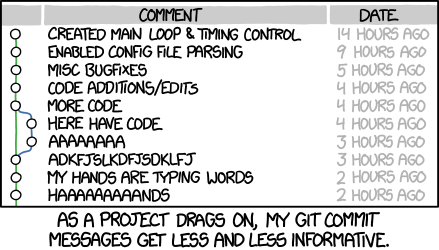
If you consider yourself as a serious developer, you know writing good commit messages is important. You don't want to be that guy:

XKCD #1296: Git Commit

XKCD #1296

This applies to source comments as well: good comments save time, bad comments can be worse than no comments.

For a long time, I usually favored source comments over commit messages: whenever I was about to commit a change which needed some explanations, I would often start to write a long commit message, then pause, go back to the code, write my long explanation as a comment and then commit the changes with a short message. After all, we are told we should not repeat ourselves.

Recently I was listening to Thom Parkin talking about rebasing on Git Minutes #33 (Git Minutes is a great podcast BTW, highly recommended) and he said this: "Commits tell a story". That made me realize one thing: we developers read code a lot, but we also read a lot of commit histories, either when tracking a bug or when reviewing a patchset. Reading code and reading history can be perceived as two different views of a project, and we should strive to make sure both views are readable. Our readers (which often are our future selves...) will thank us. It may require duplicating information from time to time, but that is a reasonable trade-off in my opinion.

So, "Write extensive source comments or extensive commit messages?" I'd say: "Do both".

Flattr this

21 Apr 16:49

Frozach Submitted

21 Apr 16:12

(via tastefullyoffensive:rocketnews24)

21 Apr 16:11

The Adventures of Business Cat


The Adventures of Business Cat

21 Apr 16:08

The Birthday Wish

by Doug

The Birthday Wish

This one is dedicated to Pierre! Happy birthday to you!! :)

Also, Happy Birthday to Queen Elizabeth while we’re at it. Here are more birthday comics.

21 Apr 16:05

a-storm-for-every-spring:fuckyesdeadpool:Deadpool’s official...

tumblr_nlw369RdTb1ry01upo1_500.png

a-storm-for-every-spring:

fuckyesdeadpool:

Deadpool’s official movie twitter follows only one other account

They’re already doing it right

21 Apr 01:07

Photo


21 Apr 01:02

Moonshine

http://oglaf.com/moonshine/

21 Apr 01:00

Comic for April 20, 2015

21 Apr 00:58

Comic for 2015.04.20

Explosm.net - Home of Cyanide and Happiness


More from Explosm

Loading...


Advertisement

Did you know by creating an account you can favorite comics and shorts, automatically bookmark the last one you saw, and more? Learn more about it here!

All content is Copyright © 2000–2015 of Explosm, LLC.

Log in or Register

This entry passed through the Full-Text RSS service - if this is your content and you're reading it on someone else's site, please read the FAQ at fivefilters.org/content-only/faq.php#publishers.

21 Apr 00:58

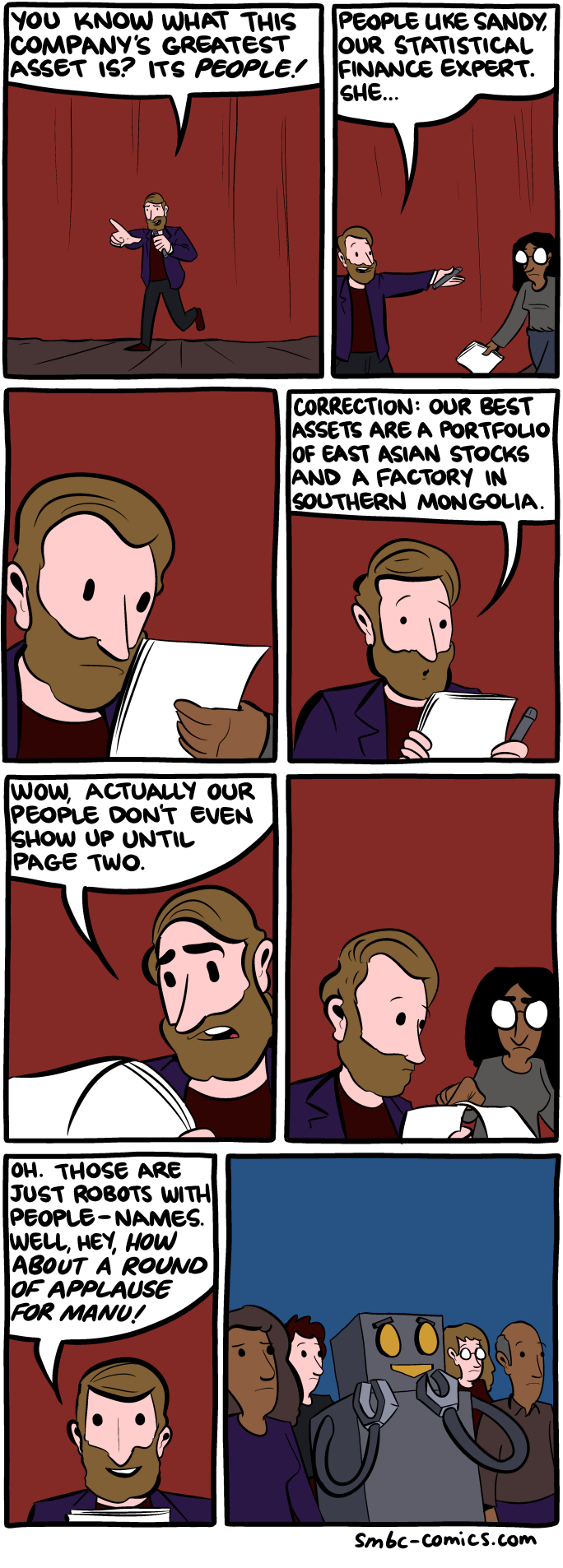
Saturday Morning Breakfast Cereal - Our Greatest Asset

by admin@smbc-comics.com
21 Apr 00:55

MegaNet — New Decentralized, Non-IP Based and Encrypted Network

meganet-decentralized-anonymous-network
The Famous Internet entrepreneur and former hacker Kim Dotcom, who introduced legendary Megaupload and MEGA file sharing services to the World, has came up with another crazy idea — To start his very own Internet that uses the "blockchain".
Just last month, Kim Dotcom, a German millionaire formerly known as Kim Schmitz, launched the public beta of its end-to-end encrypted video and audio chat service called "MegaChat", which it says gives better protection than alternatives such as Skype and Google Hangouts.

Now, his latest series of tweets referred to Kim Dotcom's supposed "MegaNet" which, he believes, would be immune to the global mass surveillance conducted by governments or corporations and would not be based on IP addresses.

MegaNet would be a decentralized, non-IP based network in which the blockchain used by Bitcoin will play an "important role". Decentralizing the Internet means to take the power of the Web away from powerful hands of governments and corporations and put it back in the hands of online users.

This move would offer users a truly free space, where they can communicate privately with anyone else without censorship.

Mr. Dotcom continued to inform his followers that they "would be surprised" about "how much idle storage and bandwidth capacity mobile phones have", adding that "MegaNet will turn that idle capacity into a new network".
Entrepreneur also assured its followers that the consumption of the battery won't be a problem for a large number of phones in the network carrying MegaNet.
"MegaNet won't rely exclusively on mobile networks at launch. But the more powerful phones become the more data & traffic they will carry."
meganet-decentralized-internet
There are a number of similar projects that lead to the change towards Decentralization.

MAIDSAFE  ANOTHER DECENTRALIZED INTERNET
One such is by David Irvine, dubbed MaidSafe — Massive Array of Internet Disks - Secure Access For Everyone. Maidsafe is an open-source program (hosted on GitHub) that enables a decentralized Internet platform.

The key part of MaidSafe is its SAFE network, powered by its participants' computers, which means, instead of specialized servers, data are stored and distributed by a network of internet-connected computers.

Anyone running MaidSafe program will become part of the SAFE Network. The MaidSafe system turns all connected devices into SAFE Network nodes that collectively store data for all MaidSafe users.

Data storage is automatically decentralized, which means a web application using MaidSafe does not store its user's data on any central server — rather the data is spread across many disks and devices owned and managed by many different MaidSafe users. Therefore, no one, whether it’s person or corporation, has an intact copy of a user's file.


PROJECT MAELSTROM  P2P NETWORK TO HOST WEBSITES
At the end of last year, BitTorrent announced Project Maelstrom which is "the first step toward a truly distributed web, one that does not rely on centralized servers."
"Truly an Internet powered by people, one that lowers barriers and denies gatekeepers their grip on our future," said BitTorrent. "If we are successful, we believe this project has the potential to help address some of the most vexing problems facing the Internet today."

According to BitTorrent, the distributed browser could help maintain a more neutral Internet. If an ISP can’t identify where traffic is originating from, then it can’t suppress certain sites accessed from a browser like Maelstrom.


ZeroNet  DECENTRALIZED WEBSITES HOSTING USING BIT TORRENT NETWORK

At the beginning of new year, a new open source project known as ZeroNet launched that aims to deliver a decentralized web platform using Bitcoin cryptography and the BitTorrent network.

ZeroNet uses a combination of BitTorrent, a custom file server and a web based user interface to do so and manages to provide a pretty usable experience. The main goal of this project is to host websites and provide anonymity for each site’s owner.

The Hacker News

Latest Stories

Comments

Bookmarked at brandizzi Delicious' sharing tag and expanded by Delicious sharing tag expander.
21 Apr 00:52

9-squares: 9 Squares 2Top: Sara Bennett, Bran...

21 Apr 00:51

The midnightless midnight

by Adam Victor Brandizzi

If the line below is executed in a JavaScript console, what will be the value of hour?

var hour = new Date(2015, 9, 18, 0).getHours();

The intuitive answer is zero, and it is right in most situations. Yet, in regions under the America/Sao_Paulo time zone, daylight saving time will start at October 18, 2015 at 0:00, so all clocks will advance to 1 AM once they pass through 11:59:59 PM. In other words, in half of Brazil, October 18, 2015 has no midnight. What the line above means, then?

If you test it with Google Chrome, hour will be 1. The browser will somehow assume that you need the first millisecond of the day:

At first I thought it was not correct but now it makes sense to me.[1] In fact, I would never think about it anyway if other browsers followed this behavior. Yet, in Firefox we get a different result:

As a corollary, the date above does not yield October 2015, 18 at all:

While not perfect, this is not an absurd behavior neither. SpiderMonkey considers new Date(2015, 9, 18, 0) as the moment that comens one hour before October 18 at 1 AM. However, this difference of behavior is breaking our tests[2] and causing some bugs (e.g. AUI-1893).

To solve them, we check whether the date's day of month is the expected one; if no, we calculate the DST shift and manually add it to the expected values. It is not elegant, but works. After all, it is rarely easy to deal with time zones, daylight saving time and browser exceptions; handling all of them at once will hardly be succinct.

Since this issue will probably not affect a sizeable number of users, I have no hope to see it solved, but now we know the problem. Once we glimpse the night misteries, we know that strange bug may be caused by the midnightless midnight smiley

[1] This makes sense IMHO because the ECMAScript Language Specification requires the Date constructor to separately build the amount of days in the date and the amount of milliseconds in the day (cf. step 9 at section 15.9.3.1 from ECMA-262). Since the amount of milliseconds in the day will be zero, it is natural to the date to point to the first millisecond from the day. Also, this behavior will ensure the equality new Date(2015, 9, 18).getDate() === 18, which strikes me as very important (and other browsers do not comply with).

[2] The tests break because PhantomJS also follows the Firefox approach.

19 Apr 17:52

Milky Way over Erupting Volcano

Discover the cosmos! Each day a different image or photograph of our fascinating universe is featured, along with a brief explanation written by a professional astronomer.

2015 April 13
See Explanation.  Clicking on the picture will download
 the highest resolution version available.

Milky Way over Erupting Volcano
Image Credit & Copyright: Sergio Montúfar

Explanation: The view was worth the trip. Battling high winds, cold temperatures, and low oxygen, the trek to near the top of the volcano Santa Maria in Guatemala -- while carrying sensitive camera equipment -- was lonely and difficult. Once set up, though, the camera captured this breathtaking vista during the early morning hours of February 28. Visible on the ground are six volcanoes of the Central America Volcanic Arc, including Fuego, the Volcano of Fire, which is seen erupting in the distance. Visible in the sky, in separate exposures taken a few minutes later, are many stars much further in the distance, as well as the central band of our Milky Way Galaxy situated horizontally overhead.

Tomorrow's picture: through the shadow of the moon < | Archive | Submissions | Index | Search | Calendar | RSS | Education | About APOD | Discuss | >

Authors & editors: Robert Nemiroff (MTU) & Jerry Bonnell (UMCP)
NASA Official: Phillip Newman Specific rights apply.
NASA Web Privacy Policy and Important Notices
A service of: ASD at NASA / GSFC
& Michigan Tech. U.

Expanded from APOD by Feed Readabilitifier.
19 Apr 00:50

Comic for 2015.04.18

Explosm.net - Home of Cyanide and Happiness


More from Explosm

Loading...


Advertisement

Did you know by creating an account you can favorite comics and shorts, automatically bookmark the last one you saw, and more? Learn more about it here!

All content is Copyright © 2000–2015 of Explosm, LLC.

Log in or Register

This entry passed through the Full-Text RSS service - if this is your content and you're reading it on someone else's site, please read the FAQ at fivefilters.org/content-only/faq.php#publishers.

19 Apr 00:50

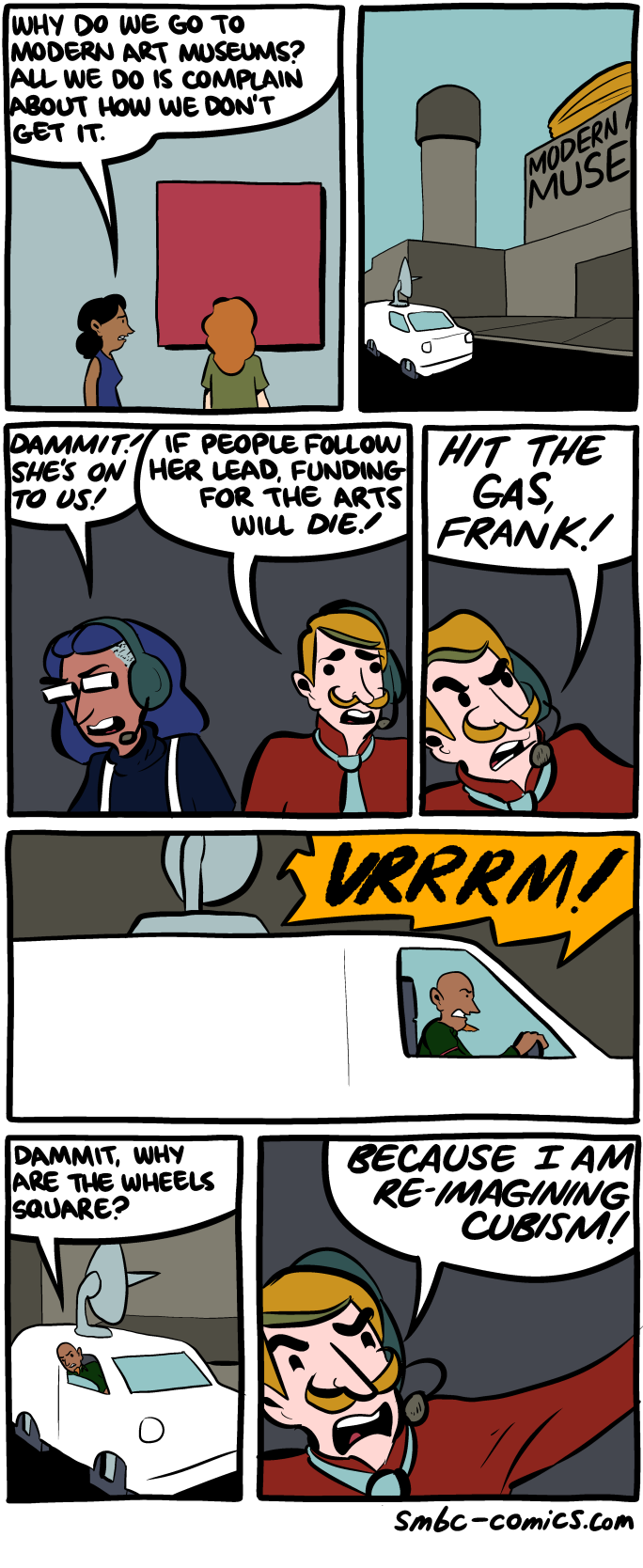
Saturday Morning Breakfast Cereal - Modern Art

by admin@smbc-comics.com
19 Apr 00:48

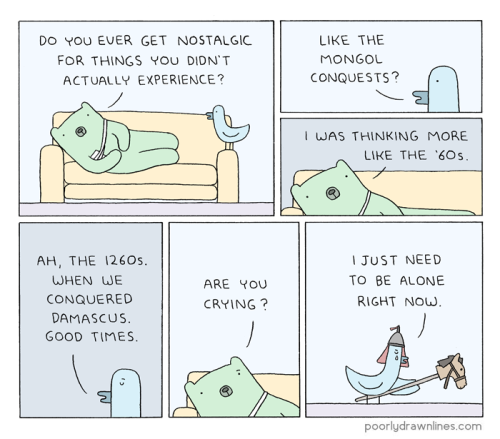
pdlcomics: Good Times

18 Apr 14:20

Criptografia nacional pronta para funcionar em qualquer smartphone e tablet

by Augusto Campos

Enviado por zeuslinux (zeuslinuxΘyahoo·com):

“"A ZTEC, empresa de Brasília e credenciada como Empresa Estratégica de Defesa do Governo, desenvolveu o cartão MCI SD (Módulo Criptográfico Interno com interface SD), que funciona no lugar de um cartão de memória nos celulares e tablets e proporciona uma rede de comunicação criptografada.

Solução requer o sistema operacional Android. Isso porque, explica Raimundo Guimarães Saraiva Júnior, é necessário ter acesso ao código-fonte para blindar o modelo, o que não é permitido pelo iOS, da Apple, e pelo Windows, da Microsoft. Governo já está usando a ferramenta, mas o nome do cliente não pode ser revelado. Produção dos cartões será feita no Brasil, dentro de unidade própria da ZTEC.

"O importante dessa solução, que levou dois anos para ser feita na nossa área de Pesquisa e Desenvolvimento, é que os fornecedores de terceira camada, com hardware criptográfico, são de origem estrangeira e trazem os vícios de origem de segurança. Agora há software e hardware 100% nacional, aptos para proteger o Estado brasileiro e todo o mercado", explica o executivo da ZTEC, em entrevista exclusiva ao portal Convergência Digital. Vale lembrar que a camada 1 é de aplicação. A camada 2 é de Sistema Operacional blindado e a camada 3 é a de hardware criptogrado.

Guimarães Junior explica que já existia uma versão do MCI SD, mas ele não não possuia as dimensões atuais que permitem a inclusão dele em qualquer dispositivo móvel, como smartphones e tablets vendidos no mercado. "O cartão entra como se fosse um cartão de memória. É simples e fácil de manuseiar. Ele vai funcionar como um cofre guardando as chaves e os algoritmos criptográficos que a aplicação de segurança vai rodar", diz.

Para o executivo, o governo possui celulares especiais - desenvolvidos para os órgãos públicos, como o Zcell, da própria ZTEC, que já estão rodando o novo cartão. Há 200 celulares já em atividade em órgãos govenamentais, mas o nome da autarquia ainda não pode ser revelado. Mas a grande aposta, agora, é ampliar a presença no mercado privado de segurança.

Como o cartão se adequa a qualquer dispositivo, a expectativa é que se possa vender um solução de comunicação privada e criptografada. "Estamos unido software e hardware com segurança. Nossa ideia é vender num modelo de licenciamento na nuvem, para que os custos sejam adequados às empresas", projeta Raimundo Guimarães Saraiva Júnior.

Nos últimos dois anos, a ZTEC investiu cerca de R$ 4,5 milhões em Pesquisa e Desenvolvimento e, embora não revele a sua projeção de fabricação desses novos cartões, o executivo garante que a produção será local. "Temos estrutura. As empresas brasileiras de segurança não devem nada para as internacionais", completa"” [referência: convergenciadigital.uol.com.br]

O artigo "Criptografia nacional pronta para funcionar em qualquer smartphone e tablet" foi originalmente publicado no site BR-Linux.org, de Augusto Campos.

18 Apr 13:35

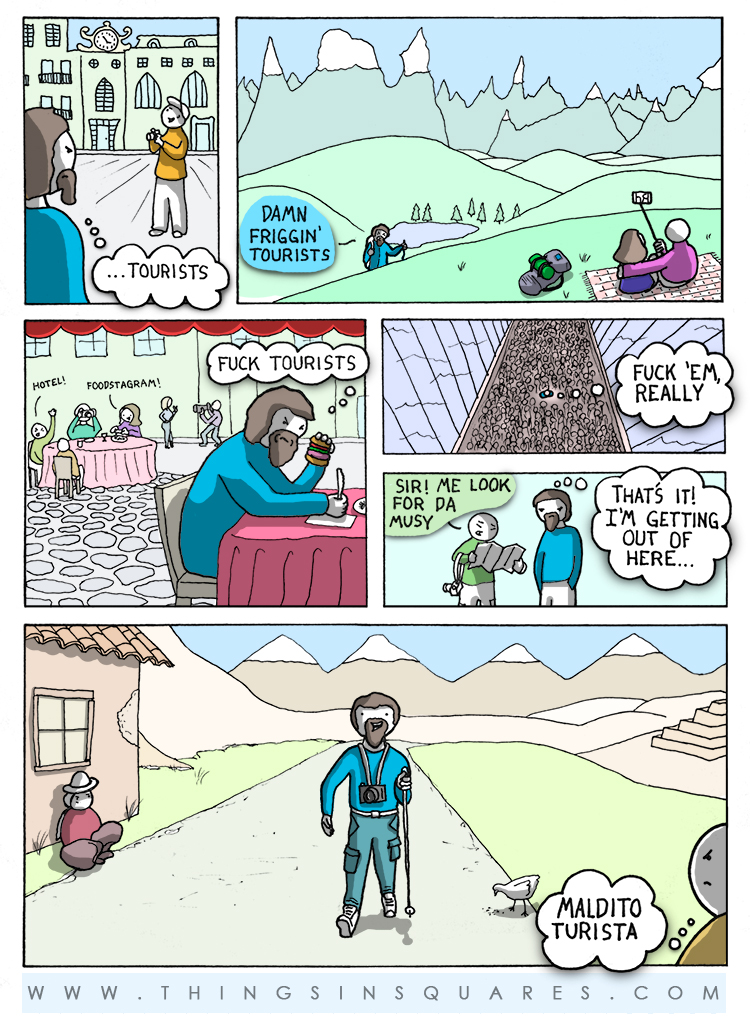
Comics: Tourists

by Cale Grim

Tourists are fucking everywhere. OMG I hate tourists why are they everywhere, FUCK I'm leaving. Oh, why, hello foreign land, I will take your photo from my tour group's stroll on this fine day. I'm totally in the right.

The post Comics: Tourists appeared first on Things in Squares.

18 Apr 11:45

will5nevercome: Aww, cheer up! You’re not even close to rock...


will5nevercome:

Aww, cheer up! You’re not even close to rock bottom yet!