NASA's New Horizons probe, which completed an unprecedented flyby of Pluto in July, has a new destination: a 30-mile-wide chunk of ice known as 2014 MU69 that orbits nearly a billion miles farther out.
Scientists have always planned for the spacecraft to visit to another Kuiper belt object (KBO) — one of the thousand or so pieces of rock and ice that orbit the sun in a cloud beyond Neptune. Today, NASA announced that New Horizons scientists selected 2014 MU69 instead of the other destination in consideration, a similar KBO called 2014 PN70.
NASA still has to officially approve this secondary mission, but all indications are that it will. If everything goes to plan, the spacecraft should reach this distant destination in January 2019.
Why New Horizons is going to visit a Kuiper belt object
After its Pluto flyby, New Horizons is continuing on to 2014 MU69, labeled here as PT1 (for "Potential Target 1").
Many of us imagine Pluto to be at the outer edge of the solar system. But in reality, it's just one of the largest of thousands of Kuiper belt objects. And from the start, NASA planned for New Horizons to fly by another one of these after Pluto: It was sent off with enough fuel to do so, and for the past year, scientists have been using the Hubble Space Telescope to spot potential targets.
Why visit two Kuiper belt objects? Mainly because we know so little about the Kuiper belt as a whole — and because the composition of these KBOs might tell us a lot about the original formation of the whole solar system.
KBOs were formed about 4.6 billion years ago, when Earth and the other planets were created, as well. But for unknown reasons, as Earth continued to grow larger, Pluto stopped growing and was flung outward, perhaps along with many other Kuiper belt objects.
That means that their contents could serve as a sort of frozen time capsule of the early solar system. We've now studied some of the smallest ones (comets, which have extremely elliptical orbits that occasionally bring them closer to Earth) and one of the largest ones (Pluto). Visiting a midsize object like 2014 MU69, New Horizons principal investigator Alan Stern told me before the Pluto flyby, "will really help us connect the dots."
To get there, mission scientists will direct New Horizons to fire its thrusters in October, to slightly alter its trajectory and set it on the proper course. When it flies by the KBOin 2019, it'll take photos and collect other sorts of scientific data to beam back to Earth. After that, New Horizons will keep on flying — but with no subsequent destinations planned, it'll just travel alone, advancing toward the outer reaches of the solar system until its power runs out sometime in the 2030s.
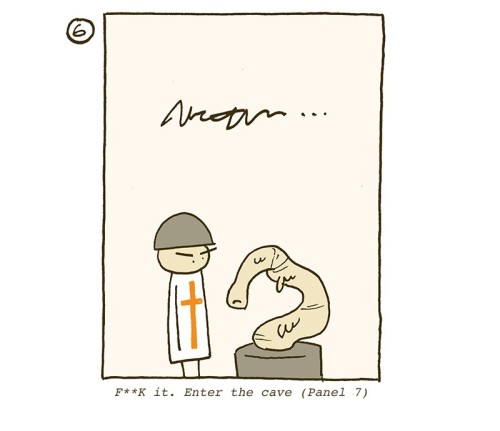
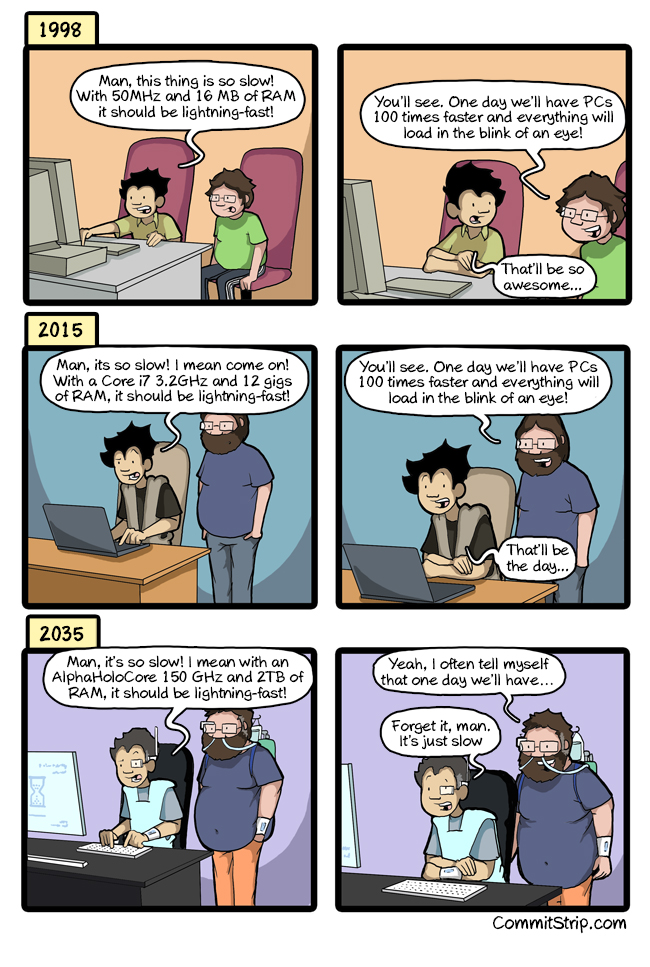
This is not a comic I would—or even could—produce now. For one thing, I wouldn't make a comic with four panels’ worth of pee jokes now. (One, yes. Four, no.) For another, I learned pretty early on that having the four panels depict four different versions of the same conversation is confusing, and it's best to just have the panels occur sequentially.
Mostly, though, it's just that it's been years since I wrote anything this concise.
Missy looked at the comic and pointed out that I have my hands in my pockets, which looks weird to her. What can I say, hands are hard. At least I have hands. That other guy doesn’t seem to have arms!
Carrying guns and wearing jungle fatigues, the three men don’t look like scientists as they push their way through the thick foliage of the Amazon.
They’re trying to reach a clearing they’ve seen on satellite images. When they finally get there, they discover that the largest trees have been uprooted by a tractor. The ground has been seeded with grass to create a pasture for cattle.
Rodrigo Numeriano, 31, finds a piece of a fruit peel, puts it up to his nose and sniffs.
“Someone was just here,” he says.
They’ve found the clues. Now comes the hard part: determining who is causing the damage and who plans to profit.
Each day, Numeriano and other agents from the Brazilian Institute of Environment and Renewable Natural Resources, or IBAMA, fan out across this vast country in 4×4 trucks and helicopters. Part detectives, part environmental special forces, they’re on the hunt for the ranchers and farmers who illegally destroy almost 2,000 square miles of Brazilian rain forest a year.
An officer of the Brazilian Institute of Environment and Renewable Natural Resources questions a man found living near a recent deforestation site.
Not only can it take weeks and prove fruitless to try to find out who has paid an intermediary to deforest, but the fines the agents impose also can go unpaid or become mired in legal proceedings.
Sometimes, the workers disappear into the forest as they hear the agents approach. Sometimes the workers open fire, as they did nearby on an IBAMA helicopter in April. And in this particularly lawless part of Brazil, those who speak with the agents can be silenced violently, forever.
Despite their commitment, the enforcers of Brazil’s environmental law are not winning the war. Government data show that after years of improvement, deforestation rates stopped decreasing in 2012. The country entered recession last year, and farming is one of the few sectors that keep the economy going.
“These people are causing incalculable environmental damage,” Olavo Perin Galvao, 33, says as he navigates labyrinthine pathways toward an illegal clearing and gold extraction site. “But we’re leaving our families, and coming out here, exposing ourselves to the elements and to risk, and the destruction continues.”
His team stops when it spots the footprint of a jaguar, or some other large jungle cat. The imprints of its claws are sunk into a mud road created recently by the forest clearers.
“We don’t need new laws,” he says. “We just need the laws we have to be properly enforced.”
::
Deforestation in Brazil, which is home to more than half of the world’s largest rain forest, happens in stages. First, the biggest trees are cut down and the lumber is sold. Then areas are cleared, by tractor or chain saw. What remains is left to dry and then burned.
These people are causing incalculable environmental damage.- Grass that is planted forms pasture for cows raised for beef. After the land is transformed, enterprising owners can upgrade to more profitable agricultural production, often growing soybeans.
“Unfortunately, for those that don’t care about environmental damage, it makes rational economic sense to deforest,” geographer David Rocha, 33, says as his IBAMA team heads off to track down deforesters. “Agriculture is the only thing keeping Brazil’s economy going.”
Farmers, federal officials and environmentalists all point to two key problems: The government fails to issue new permits for legal activities and also fails to adequately enforce laws against illegal expansion.
A new forestry code, passed in 2012, would let some owners deforest 20% of their land if they preserved the rest sustainably. But unable to act legally, ranchers — some have the right to occupy their land, though not outright ownership, and some have simply stolen it from the state — take their chances, hoping that they can legitimize the operation later.
An IBAMA officer checks a recent deforestation site. By inspecting the tree, he can tell a chainsaw was used.
“People here have stopped believing in the law, if they ever did,” says Manoel Malinski, legal counsel for the municipal region. “Many believe that the moment will come when the world will thank them for what they’ve done.”
Powerful voices in the region dismiss concern about the environmental effects of deforesting.
“We’re plagued by numerous fantasies and by operations that are totally unnecessary,” says Agamenon da Silva Menezes, president of the Union of Rural Producers in Novo Progresso, referring to IBAMA. “People here need to eat. Where will we produce that food? On top of the trees?”
He says he wants landholders to be able to deforest 50% of their land in the Amazon. As for the consequences, he says, “They say it will cause environmental damage. But it’s more fantasy. They don’t have scientific proof for anything.”
Experts point out that much of the food grown in Brazil is produced inefficiently on land already available and is often exported. In addition to long-term concern about climate change, they worry that a water crisis in the Sao Paulo region may have been caused at least in part by diminishing foliage in the Amazon; the jungle’s vegetation, they say, releases a large amount of water into the atmosphere that eventually forms rain clouds.
But that is very far away from this remote region in the south of Para state, which has had one of the country’s highest deforestation rates. This year, federal police arrested influential local businessman Ezequiel Castanha on charges of environmental crimes after an extensive IBAMA investigation.
Speaking on condition of anonymity for fear of reprisal from people involved in illegal deforestation, many in the town say that job opportunities have dried up now that Castanha, whom police dubbed “The Deforestation King of the Amazon,” is no longer around to generate income.
“Environmental crime is what sustains those communities,” says Luciano Evaristo, director of environmental protection, in Brasilia, the capital.
“If we had more resources and more agents, that would help us in policing,” he says. “But if the government could move forward the process of legalization, local producers could move to a more sustainable long-term path.”
::
IBAMA agents arrive at an illegal clearing site.
Six IBAMA agents are packed into a small helicopter, and they pass over vast swaths of what was once forest.
As they approach the top of a misty hill near coordinates gathered recently by satellite, they catch a glimpse of a cow or two wandering below brush. They circle lower and lower, coordinating tight turns through radio headsets that shut out the sound of the blades, and snap photos on cheap smartphones. They touch down in a clearing near a home, to see whether the owner knows anything.
The agents know too well that they must be careful when talking to citizens about deforestation, lest someone sees the exchange.
“A few months ago, we went looking for someone to talk to, and when we got there, unbeknownst to us, he was a man who had secretly tipped us off previously,” says Givanildo de Santos Lima, head of the local IBAMA base.
Soon after, he says, the man was killed. “I believe he was killed because he was talking to us.”
Later, at his computer, he pulls up a news story about the slaying. One of the comments says, “Man, your murderer was shot to death … your murder was avenged brother.”
Environmental crime is what sustains those communities.
Hearing this, the agent is unfazed. “Yes, that’s true. The man who did it was also killed soon after.”
But one man approached today talks, acknowledging that he had heard wood being carried out at night. After listening to him and mapping out pathways from the sky, the team forms a plan.
They walk past a few hundred cloud-white cows, grazing illegally, and into the foliage. They send the chopper off and head up a road, sweating and panting. Some keep their weapons drawn at all times and remain as quiet as possible. But it’s easy to not be heard here because the sounds of birds, insects and other creatures combine into a constant roar.
Then they stop.
“Can you hear that?” Perin Galvao says. “It’s a chain saw.”
But the sound stops, and they continue up the path. It ends in a clearing. It’s the wrong path. They trudge back to the chopper and into town, knowing the clearing will continue for now.
At the end of their day, agents Numeriano and Rocha follow a clue to a locked wooden gate in the forest. They climb over and continue on to a scene of obvious destruction. This time, it’s clear by the height of the grass that it had happened months ago, but there is still an encampment here. A black tarp over crisscrossed trees serves as a tent, and though the hammocks are gone, there are still the remains of a kitchen.
On the table are several high-caliber shotgun cartridges, hot sauce and cachaca, the strong Brazilian spirit.
“It looks like destroying nature can be fun,” Numeriano jokes dryly as he begins to sift through a large box of empty beer cans. He’s looking for a discarded receipt, any kind of clue. It’s no use.
The men begin to tear the wooden structure apart, piece by piece. They form a large pile and pour gasoline over it.
There’s not much more they can do today. They set fire to the illegal encampment and watch it slowly burn.
IBAMA agents, unable to catch the criminals in the act, set fire to an illegal settlement and deforestation base camp.
All photos by Vincent Bevins for the Los Angeles Times
Working as a remote freelancer has many benefits, but setting up an effective distributed working environment can be a real challenge. Of course, there are many approaches that one can take, and no single “best” way will suit everyone. Remote digital workplace organization is indeed a very personal thing, and what works well for one developer may not work well at all for someone else.
With that in mind, the setup I present here is simply what works well for me personally, especially on remote projects that involve both development and system administration. I do believe this approach has a number of advantages, but each reader should consider how to adapt this in a way that works best for them, based on a combination of their operational needs and personal preferences.
My approach is largely based on features offered by SSH and related tools on Linux. Note that users of MacOS and other Unix-like systems can take advantage of the described procedures as well, to the extent that their systems support the described tools.
My Own Personal Mini-Server
An important first step in my setup is a Raspberry Pi 2-powered server in my own home, used to host everything from my source code repositories to demo sites.
Although I do travel, my apartment does serve as my remote “fixed base of operations” with decent Internet connectivity (100 Mbit/sec) and almost no additional latency. This means that, from my apartment, I am basically constrained only by the destination network’s speed. The setup I’m describing works best with this type of connectivity, though it’s not a requirement. In fact, I have also used this approach while I had a relatively low-bandwidth ADSL connection, with most things working just fine. The only real requirement, in my experience, is that the bandwidth either be unmetered or dirt cheap.
As a residential user, I have the cheapest home network router my ISP could buy, which simply isn’t enough for what I need to do. I have therefore requested that the ISP put the router into “bridge mode”, where it only serves as a connection terminator, offering a PPPoE end-point to exactly one connected system. This means the device stops working as a WiFi access point or even as a common home router. All these tasks are handled by a professional small Mikrotik router RB951G-2HnD. It performs the NAT service for my local network (which I’ve numbered 10.10.10.0/24), and offers DHCP to wired and wireless devices connected to it. The Mikrotik and the Raspberry Pi have static addresses because they are used in contexts where a well-known address is required. In my case, those are 10.10.10.1 and 10.10.10.10, respectively.
My home connection doesn’t have a static IP address. For my purposes, this is only a mild inconvenience working remotely since the goal is to create a personal or SOHO working environment, not a 24/7 site. (For those who do require a static IP address for their server, it is worth noting that the cost of static IP addresses has continued to come down and fairly inexpensive static VPN IP options are available.) The DNS broker I use, Joker.com, offers a free dynamic DNS service alongside all of its other services, so one subdomain of my personal domain exists as a dynamic name. I use this name for connecting from the outside to my own network, and the Mikrotik is configured to pass SSH and HTTP through the NAT to the Raspberry Pi. I simply need to type the equivalent of ssh mydomain.example.com in order log in to my personal home server.
Data Anywhere
One significant thing which the Raspberry Pi does not offer is redundancy. I’ve equipped it with a 32 GB card, and that’s still a lot of data to lose in case something happens. To get around that, and to ensure access to my data if the residential Internet access hiccups, I mirror all my data to an external, cloud-like server. Since I’m in Europe, it made sense for me to get the smallest dedicated bare-metal (i.e. unvirtualized) server from Online.net, which comes with a low-end VIA CPU, offering 2 GB RAM and a 500 GB SSHD. As with the Raspberry Pi mini-server, I don’t need high CPU performance or even memory, so this is a perfect match. (As an aside, I remember my first “big” server which had two Pentium 3 CPUs and 1 GB of RAM, and was probably half the speed of the Raspberry Pi 2, and how we did great things with it, which has influenced my interest in optimization.)
I back up my Raspberry Pi to the remote cloud-like server using rdiff-backup. Judging from the relative sizes of the systems, these backups will get me virtually unlimited history. One other thing I have on the cloud-like server is an installation of ownCloud, which enables me to run a private Dropbox-like service. ownCloud as a product is moving toward groupware and collaboration, so it becomes even more useful if more people are using it. Since I started using it, I literally don’t have any local data that is not backed up to either the Raspberry Pi or to the cloud-like server, and most of it is backed up twice. Any additional backup redundancy you can make is always a good thing, if you value your data.
The “Magic” of SSHFS
Most of my work these days involves developing stuff which is not directly web-related (shocking, I know!), so my workflow often follows a classic edit-compile-run cycle. Depending on the specific circumstances of a project, I may either have its files locally on my laptop, I may put them in the ownCloud-synced directory, or, more interestingly, I might place them directly on the Raspberry Pi and use them from there.
The latter option is made possible thanks to SSHFS, which enables me to mount a remote directory from the Raspberry Pi locally. This is almost like a small piece of magic: you can have a remote directory on any server you have SSH access to (working under the permissions your user has on the server) mounted as a local directory.
Have a remote project directory? Mount it locally and go for it. If you need a powerful server for development or testing and – for some reason just going there and using vim in the console is not an option – mount that server locally and do whatever you want. This works especially well when I’m on a low-bandwidth connection to the Internet: even if I do work in a console text editor, the experience is much better if I run that editor locally and then just transfer the files via SSHFS, rather than working over a remote SSH session.
Need to compare several /etc directories on different remote servers? No problem. Just use SSHFS to mount each of them locally and then use diff (or whatever other tool is applicable) to compare them.
Or perhaps you need to process large log files but you don’t want to install the log parsing tool on the server (because it has a gazillion dependencies) and for whatever reason copying the logs is inconvenient. Once again, not a problem. Just mount the remote log directory locally via SSHFS and run whatever tool you need – even if it’s a huge, heavy, and GUI-driven. SSH supports on-the-fly compression and SSHFS makes use of it, so working with text files is fairly bandwidth-friendly.
For my purposes, I use the following options on the sshfs command line:
sshfs -o reconnect -o idmap=user -o follow_symlinks -C server.example.com:. server
Here’s what these command line options do:
-o reconnect - Tells sshfs to reconnect the SSH end-point if it breaks. This is very important since by default, when the connection breaks, the mount point will either fail abruptly or simply hang (which I found to be more common). Really seems to me that this should be the default option.
-o idmap=user - Tells sshfs to map the remote user (i.e., the user we are connecting as) to be the same as the local user. Since you could connect over SSH with an arbitrary username, this “fixes” things so the local system thinks the user is the same. Access rights and permissions on the remote system apply as usual for the remote user.
-o follow_symlinks - While you can have an arbitrary number of mounted remote file systems, I find it more convenient to mount just one remote directory, my home directory, and in it (in the remote SSH session) I can create symlinks to important directories elsewhere on the remote system, like /srv or /etc or /var/log. This option makes sshfs resolve remote symlinks into files and directories, allowing you to follow through to the linked directories.
-C - Turns on SSH compression. This is especially effective with file metadata and text files, so it’s another thing that seems like it should be a default option.
server.example.com:. - This is the remote end-point. The first part (server.example.com in this example) is the host name, and the second part (after the colon) is the remote directory to mount. In this case, I’ve added “.” to indicate the default directory where my user ends up after the SSH login, which is my home directory.
server - The local directory into which the remote file system will be mounted.
Especially if you are on a low-bandwidth or an unstable Internet connection, you need to use SSHFS with SSH public/private key authentication, and a local SSH agent. This way, you will not be prompted for passwords (either system passwords or SSH key passwords) when using SSHFS and the reconnect feature will work as advertised. Note that if you don’t have the SSH agent set up so it provides the unlocked key as needed within your session, the reconnect feature will usually fail. The web is full of SSH key tutorials, and most of the GTK-based desktop environments I’ve tried start their own agent (or “wallet”, or whatever they choose to call it) automatically.
Some Advanced SSH Tricks
Having a fixed point on the Internet which is remotely accessible from anywhere in the world, and which is on a high bandwidth connection – for me it’s my Raspberry Pi system, and it really could be any generic VPS – reduces stress and allows you to do all sorts of things with exchanging and tunneling data.
Need a quick nmap and you’re connected over a mobile phone network? Just do it from that server. Need to quickly copy some data around and SSHFS is an overkill? Just use plain SCP.
Another situation you may find yourself faced with us where you have SSH access to a server but its port 80 (or any other) is firewalled out to the outside network from which you connect. To get around this, you can use SSH to forward this port to your local machine, and then access it through localhost. An even more interesting approach is to use the host to which you are connected over SSH to forward a port on another machine, possibly behind the same firewall. If, for example, you have the following hosts:
192.168.77.15 - A host in the remote local network behind a firewall, to which you need to connect to its port 80
foo.example.com - A host you have SSH access to, which can connect to the above host
your local system, localhost
A command to forward the port 80 on 192.168.77.15 to localhost:8080 via the foo.example.com SSH server would be:
ssh -L 8080:192.168.77.15:80 -C foo.example.com
The argument to -L specifies the local port, and the destination address and port. The -C argument enables compression, so you again can achieve bandwidth savings, and finally at the end you simply type the SSH host name. This command will open a plain SSH shell session to the host, and in addition to that, listen on localhost port 8080, to which you can connect.
One of the most impressive tricks SSH has developed in recent years is its ability to create real VPN tunnels. These manifest themselves as virtual network devices on both sides of the connection (assuming they have appropriate IP addresses set up) and can allow you access to the remote network as if you were physically there (bypassing firewalls). For both technical and security reasons, this requires root access on both machines which are being connected with the tunnel, so it’s much less convenient than just using port forwarding or SSHFS or SCP. This one is for the advanced users out there, who can readily find tutorials on how to do it.
Remote Office Anywhere
You can continue to work even while you wait for your car at the mechanic.
Stripped of the need to work from a single location, you can work literally from anywhere that has half-decent Internet connectivity using the technologies and techniques I’ve outlined (including while waiting for your car at the mechanic). Mount foreign systems over SSH, forward ports, drill tunnels, to access your private server or cloud-based data remotely, while overlooking a sun-bathed beach, or drinking hipster-grade eco-friendly coffee in a foggy city. Just do it!
Ivan is primarily a back-end developer, with 10+ years of experience in architecting and implementing server-side solutions, including non-web-related distributed platforms such as Bitcoin, chat servers, and general client-server solutions. He has handled DBA operations, developed modules for PostgreSQL, operating system kernel modules (FreeBSD), and new algorithms. He is interested in general client-server problems and distributed apps. [click to continue...]
This entry passed through the Full-Text RSS service - if this is your content and you're reading it on someone else's site, please read the FAQ at fivefilters.org/content-only/faq.php#publishers.
This entry passed through the Full-Text RSS service - if this is your content and you're reading it on someone else's site, please read the FAQ at fivefilters.org/content-only/faq.php#publishers.
FrontYardVideo pointed a camera at a caterpillar and captured this beautiful time-lapse video of its metamorphosis. We see it feeding, turning into a chrysalis, and emerging as a monarch butterfly after about two weeks.
O presidente da Confederação Nacional dos Municípios (CNM), Paulo Ziulkoski, avalia que o governo Dilma Rousseff toma o caminho errado ao optar pelo retorno da CPMF, mesmo com a promessa de repartir parte da arrecadação com governadores e prefeitos. Em entrevista exclusiva ao blog, Ziulkoski afirmou que foi procurado na quinta-feira para falar sobre o assunto com o governador do Rio, Luiz Fernando Pezão (PMDB), e com o ministro da Saúde, Arthur Chioro. Mas, para ele, o caminho deveria ser outro para aumentar a arrecadação da União, Estados e municípios.
Para Ziulkoski, o governo deveria restituir a cobrança de Imposto de Renda (IR) sobre os lucros e dividendos das empresas. “Uma alíquota menor, de 15% de IR, renderia cerca de R$ 50 bilhões, partindo da base de dados da própria Receita. Esse dinheiro viria de forma muito mais justa socialmente do que a CPMF e passaria mais facilmente no Congresso, porque seria lei ordinária e não uma emenda constitucional“, disse Ziulkoski.
A arrecadação com IR é repartida com Estados e municípios por meio dos fundos de participação (FPE e FPM, respectivamente), compostos com 23,5% do que é obtido com o imposto. Até 1995, o governo cobrava 15% de IR sobre lucros e dividendos distribuídos pelas empresas a pessoas físicas. Depois, uma lei isentou a cobrança.
Ziulkoski citou dados levantados pelos economistas do Instituto de Pesquisa Econômica Aplicada (Ipea), Rodrigo Orair e Sérgio Gobetti, com base em dados da Receita para dizer que, mesmo que fosse mantida uma isenção do IR para sócios ou titulares das empresas enquadradas no regime Super Simples, o potencial de arrecadação da medida seria de R$ 40 bilhões no curso de um ano.
“A medida também seria um incentivo para as empresas reinvestirem seu lucro“, reforçou o presidente da CNM. Ao tributar a distribuição de lucros e dividendos, o governo poderia incentivar, de forma indireta, que o dinheiro fosse usado pelas empresas para investimentos, o que reduziria a arrecadação, mas produziria efeito econômico positivo. “Seria bom para todo mundo“, resumiu Ziulkoski.
O presidente da confederação dos prefeitos chamou de “desesperadora” a situação dos municípios neste ano, que será agravada em 2016. “Temos obrigações crescentes com educação, saúde, segurança e ninguém mais consegue cumprir a Lei de Responsabilidade Fiscal. Nós estamos pagando o pato pela crise econômica e precisamos urgentemente de recursos, mas que seja de forma justa socialmente. Assim é mais palatável para todos porque ninguém mais aguenta aumento da carga tributária“, disse ele.
Ziulkoski, no entanto, estendeu o braço ao governo para discutir a nova CPMF, mas deixou claro que o diálogo não será fácil entre a União e os prefeitos. “Se a CPMF for mesmo para a saúde, integralmente, o diálogo certamente será menos problemático porque todos precisam de recursos para arcar com as obrigações da saúde. Mas ainda assim será difícil para os parlamentares e os prefeitos confiarem. A CPMF já existiu e não servia somente para a saúde“, disse ele.
A proposta de restituir a tributação sobre lucros e dividendos tem ganhado força. Além da adesão pública da CNM, a ideia tem sido discutida pelo partido da presidente Dilma, o PT, por meio da Fundação Perseu Abramo, e conta com adeptos no Congresso – parlamentares petistas e também do PC do B e do PDT tem defendido, em maior e menor grau, a medida.
A volta da CPMF é preparada pelo governo como forma de garantir a meta fiscal de 2016, estipulada em 0,7% do Produto Interno Bruto (PIB). Ciente de que a arrecadação continuará fraca no ano que vem, dada a recessão na economia, o governo avalia ter um buraco de R$ 70 bilhões, segundo antecipou ontem o Broadcast, para fechar nas contas de 2016. A arrecadação com a nova CPMF, com alíquota de 0,38%, seria justamente essa, segundo estimativas internas da equipe econômica. A antiga CPMF, extinta em dezembro de 2007, era cobrada de todos os brasileiros, pessoas físicas ou jurídicas, em todas as movimentações financeiras. Por incidir em qualquer operação, a CPMF é considerada um tributo “em cascata” – uma empresa pagava CPMF em todas as etapas de sua produção, da compra de insumos à produção, passando pela venda e distribuição.
A Japanese paradise flycatcher feeding its baby. This migratory species is suspected to be in moderately rapid decline as a result of habitat degradation and loss on its wintering grounds.
Handwritten chalk text on a boarded-up window of the Stonewall Inn (1969)
Why did the Mafia own virtually every gay bar including the historic Stonewall Inn?
In the early 1960s the State Liquor Authority (SLA) of New York considered establishments that openly served alcohol to gay people to be “disorderly houses” as well as places where “unlawful practices are habitually carried on by the public”. Consequently, the SLA refused to issue liquor licenses to gay bars and revoked popular gay establishments’ licenses for “indecent conduct”. Sounds like a bulletproof plan to put an end to “indecent conduct”, right?
🍷 👨❤️💋👨 🙅 💰 👮 👯 🌈 😷 🔪 💰
How it became every homophobes’ nightmare:
The Mafia realized that there was a huge, profitable, and untapped market for creating drinking establishments catered towards homosexuals. By the mid-60s, the Genovese crime family controlled the majority of the gay bars in Greenwich Village.
The Mob owner of the famous Stonewall Inn, Tony Lauria Genovese or “Fat Tony”, made as much as $5,000 to $6,000 on the average Friday night from almost a 100% profit.
As a result, Fat Tony had no trouble sliding the New York’s Sixth Police Precinct an envelope with $1,200 a month to turn a blind eye to his many city code violations.
However, the payoffs did not meant that the Mafia-run establishments were exempt from state laws. Luckily, a choreographed dance routine was established between mobsters and cops so that they could each play out their appearances without threatening their mutual access to easy cash.
For instance, police raids never occurred on the busy nights and the owners were always prepared for regular raids. And the managers made sure that there were only a few liquor bottles on the actual premise as they would be confiscated during the police raid, meaning that owners like Fat Tony could continue be open for business again from only suffering minor losses.
It could be said that the price of banning gay bars made the Mafia richer whilst allowing “indecent conducts” such as slow dancing with someone of your own sex, and realizing that you might belong to something of a minority group, to thrive. Unfortunately for the homophobes, this would eventually contribute to the outbreak of the Stonewall Riots, the catalyst for the modern LGBTQ+ movement.
Despite the benefits the new era of LGBTQ+ activism would reap, it shouldn’t be overlooked that the system was also a nightmare to the patrons of gay bars:
The payoffs to the police also enabled Fat Tony to cut corners on hygiene. For instance, Stonewall did not have access to running water so drinks were served in dirty used glasses. The bar was accused of a breakout of hepatitis among its patrons by many Gay Rights groups.
Safety was a serious issue at the Stonewall. The bar lacked a rear exit. which meant that the only escape in the event of a fire or emergency was the narrow front door.
Rumour has it that the alcohol served at the gay bars were stolen or bootlegged. Yet, they were watered down and sold at top-shelf prices when the majority of the patrons of gay bars belonged to the poorest group of New York city.
The more wealthy patrons were subject to blackmail for large sums of money by the Mafia. The employees would single out affluent customers whom were not publicly open with their sexuality. This practice of extortion is said to have been the most profitable aspect of the Mafia club-management.
Overall, the system the Mafia had been established only benefited them. The real nightmare was of course the health and security risks the patrons of gay bars suffered from as the result of SLA’s unfair and homophobic treatment. Thankfully, Stonewall Riots would come out of this and pave the way for the fight towards equality for all sexualities and gender identities.
Sources
Documentaries: Stonewall Uprisingdirected by Kate Davis and David Heilbroner
In 1946, sociologist Mirra Komarovsky asked American undergraduate women whether they had “played dumb” on dates. Some of their responses:
I am engaged to a southern boy who doesn’t think too much of the woman’s intellect. In spite of myself, I play up to his theories because the less one knows and does, the more he does for you and thinks you “cute” into the bargain. … I allow him to explain things to me in great detail and to treat me as a child in financial matters.
When my date said that he considers Ravel’s Bolero the greatest piece of music ever written, I changed the subject because I knew I would talk down to him.
One of the nicest techniques is to spell long words incorrectly once in a while. My boyfriend seems to get a great kick out of it and writes back, “Honey, you certainly don’t know how to spell.”
Once I went sailing with a man who so obviously enjoyed the role of a protector that I told him I didn’t know how to sail. As it turned out he didn’t either. We got into a tough spot, and I was torn between a desire to get a hold of the boat and a fear to reveal that I had lied to him.
I am better in math than my fiancé. But while I let him explain politics to me, we never talk about math even though, being a math major, I could tell him some interesting things.
I was once at a work camp. The girls did the same work as the boys. If some girls worked better, the boys resented it fiercely. The director told one capable girl to slow down to keep peace in the group.
On dates I always go through the “I-don’t-care-anything-you-want-to-do” routine. It gets monotonous but boys fear girls who make decisions. They think such girls would make nagging wives.
I am a natural leader and, when in the company of girls, usually take the lead. That is why I am so active in college activities. But I know that men fear bossy women, and I always have to watch myself on dates not to assume the “executive” role. Once a boy walking to the theater with me took the wrong street. I knew a short cut but kept quiet.
In all, 60 percent said they had “concealed some academic honor, pretended ignorance of some subject, or allowed the man the last word in an intellectual discussion.” “And the funny part of it is that the man, I think, is not always so unsuspecting,” one said. “He may sense the truth and become uneasy in the relation. ‘Where do I stand? Is she laughing up her sleeve or did she mean this praise? Was she really impressed with that little speech of mine or did she only pretend to know nothing about politics?’ And once or twice I felt that the joke was on me: the boy saw through my wiles and felt contempt for me for stooping to such tricks.”
(Mirra Komarovsky, “Cultural Contradictions and Sex Roles,” American Journal of Sociology 52:3 [November 1946], 184-189.)
A creepy case report in the journal Neurocase describes a man who came to believe that his reflection was another person who lived behind the mirror.
The patient, Mr. B., a 78-year-old French man, was admitted to the neurology department in Tours:
During the previous 10 days, Mr. B. reported the presence of a stranger in his home who was located behind the mirror of the bathroom and strikingly shared his physical appearance. The stranger was a double of himself: he was the same size, had the same hair, body shape, and features, wore the same clothes, and acted the same way.
Mr. B. talked with this stranger and was puzzled because he knew much about him. Mr. B. even brought food to the mirror with cutlery for two persons. Eventually, the stranger became aggressive, and Mr. B.’s daughter decided to drive her father to the hospital.
…Mr. B. was well oriented and was perfectly able to recognize the members of his family.
In the hospital, tests revealed possible Alzheimer’s disease. Mr B. was prescribed medication, including an antidepressant and an antipsychotic.
Three months later, the recovery was complete. The delusion had disappeared, and Mr. B. explained that his double had gone.
The authors, Capucine Diard-Detoeuf and colleagues, describe this as a case of “Capgras syndrome for ones own mirror image”. Capgras syndrome is the belief that someone, often a spouse or relative, has been replaced by an exact double who is not really who they appear to be. Mr B. believed that his own image was actually a double of himself.
Diard-Detoeuf et al. note that there have been two previous cases of mirror Capgras syndome, including a 1989 report of “a 77-year-old woman with right temporoparietal atrophy who had long conversations with a double of herself in the mirror.”
The mirror Capgras syndrome is distinct from “mirrored-self misidentification“, a symptom that can occur in dementia, in which the patient thinks that their own reflection is another person.
In that syndrome, the reflection may be seen as a stranger, or a relative. However, Mr B. was aware that the man in the mirror looked just like him – in other words, he didn’t misidentify his reflection as anyone else. Rather, he saw the man in the mirror as some kind of double, similar yet different.
Diard-Detoeuf, C., Desmidt, T., Mondon, K., & Graux, J. (2015). A case of Capgras syndrome with one’s own reflected image in a mirror Neurocase, 1-2 DOI: 10.1080/13554794.2015.1080847












 Diard-Detoeuf, C., Desmidt, T., Mondon, K., & Graux, J. (2015). A case of Capgras syndrome with one’s own reflected image in a mirror Neurocase, 1-2 DOI: 10.1080/13554794.2015.1080847




















![The less common, even worse outcome: "3: [everyone in the financial system] WOW, where did all my money just go?"](http://imgs.xkcd.com/comics/engineer_syllogism.png "The less common, even worse outcome: \"3: [everyone in the financial system] WOW, where did all my money just go?\"")


 Expanded from

 Expanded from