Shared posts

26 May 22:34

Keep me dreaming in pale blues and greens

by Sophia, NOT Loren!

So often in the moments when I’ve been awake too long
When mental power’s fading and I’m slipping off to sleep
I find that longing feeling drifting in and through my heart

In shades of blue that don’t exist in any conscious state
The echoes of a need I cannot name and can’t define
But still I know the call of a familiar unknown thing

I wish myself surrounded by an endless sheet of flames
And covered by a never-ending sea at the same time
If water and inferno could exist atop themselves

I cannot have the things that mind and body claim as needs
I substitute mere shadows of their ultimate demands
A light in blue, and digital effects of ocean roar

To very few these words will, I suspect, convey my mood
Those few, indeed, who know the call of ultra-blue exist
We only linger here for but a moment… and then, home.


Filed under: General
26 May 22:34

A Secret Night Market of Art Is Going on a Cross Country Tour

by Allison Meier
Lost Horizon Night Market (photo by Thom Carroll)

Lost Horizon Night Market (photo by Thom Carroll)

Ephemeral and secretive, the Lost Horizon Night Market (LHNM) started in 2009, appearing periodically late in the night of New York and then spreading to San Francisco. Art and participatory projects are installed in rented box trucks, there is no advertisement, and invitations are word-of-mouth.

Through a new initiative called Everyhere Logistics, 12 trucks are going on the road for the month of August, where over five weekends they’ll visit seven cities across the United States, to both collaborate with current Night Markets and help launch new branches. Everyhere Logistics is funding on Kickstarter to support its over 30 member team, with half the artists traveling from New York and the other half from San Francisco.

OuterBody Labs at the Lost Horizon Night Market (photo by Charles Villyard)

OuterBody Labs at the Lost Horizon Night Market (photo by Charles Villyard) (click to enlarge)

“The ideas that I’m interested in exploring don’t fit well into spaces,” Mark Krawczuk, who is co-leading the project with Kasey Smith, told Hyperallergic. “I’m interested in conversation, communities, and creating complex environments and problems that people learn through. Making a place is the easiest way to do that.”

LHNM evolved from Krawczuk’s Lost Horizon Noodle Truck started in 2008. “The LHNM was based on the idea that trucks were readily available and relatively cheap places you can get access to in urban environments, and that people could work separately, but then bring them together all at once,” Krawczuk explained. The Noodle Truck communal kitchen will be joined in August by such mobile experiences as the Seance Truck, Honey Tea Truck, Outerbody Brain Virus Scanning Center, and Smash Truck. That last truck will be offering destruction opportunities at a May 29 fundraiser at Flux Factory, which is also providing fiscal sponsorship.

“I think that between the overwhelmingly competitive coastal hubs and the economically depressed ‘fly-over’ states, placemaking is more important now than ever,” said Jonah Levy, whose EhL Travel Agency will be touring in a truck and engaging visitors in travel in their own city and beyond. “Artists are finding themselves pushed out of affordable housing, studios, and the exhaustively commercial contemporary art industry.”

He cited other Everyhere Logistics collaborators like Dirby Luongo who worked on the Night Heron water tower speakeasy in Manhattan, Jaclyn Atkinson who is involved in the Battle for Mau Mau Island where DIY boats compete at one of Brooklyn’s less glamorous beaches, and others involved in Figment, House of Yes, Maker Faire, and All World’s Fair as having sought out forgotten edges of their cities as opportunities for creativity.

Philadelphia is already looking for trucks for its August Night Market, although the rest of the route is secret. As the Kickstarter page proclaims: “The best way to find out about Night Market is by participating and running your own truck!” Or by serendipitously stumbling upon it in the night.

Lost Horizon Night Market at a daytime collaboration with SFMOMA in San Francisco (photo by Charles Villyard)

Lost Horizon Night Market at a daytime collaboration with SFMOMA in San Francisco (photo by Charles Villyard)

Everyhere Logistics: Exploring America’s Creative Diaspora is funding on Kickstarter through June 18.

26 May 22:33

Cartoonist Goes on Trial After Being Tortured by Iranian Authorities

by Laura C. Mallonee
Atena Farghadani (Image courtesy Justice for Iran)

Atena Farghadani (Image courtesy Justice for Iran)

The inhumane conditions that 28-year-old artist Atena Farghadani has been subjected to over the past nine months in Iran are horrifying to consider. Arrested in August 2014 by the Iranian Revolutionary Guard, she was imprisoned for four months in Tehran Province’s Gharchak Prison, where she was allegedly beaten and interrogated for up to nine hours a day. After a brief release in December, she was rearrested and sent to Evin Prison in January for posting a video online about her torture. In late February, she went on hunger strike and suffered a heart attack; she’s been shuttered away in a solitary confinement cell ever since.

Why? According to the BBC, Farghadani drew a political cartoon criticizing a law drafted last March that would restrict access to birth control and make vasectomies illegal. The drawing recast Iranian MPs as apes and goats ignorantly casting their votes.

Athena's cartoon depicting members of the Iranian parliament as animals voting on the prohibition of voluntary permanent contraception, or vasectomies. (image taken from Free Atena Facebook page)

Athena’s cartoon depicting members of the Iranian parliament as animals voting on the prohibition of voluntary permanent contraception, or vasectomies. (image taken from Free Atena Facebook page)

For daring to express her opinion, she’s now facing charges of insulting her government and spreading propaganda; if convicted at trial, she could receive lashes and another two years in prison. Somehow, Farghadani seems undaunted. She bravely refuted the accusations in an open letter to the Supreme Leader, Ayatollah Ali Khamenei:

“What you call an ‘insult to representatives of the parliament by means of cartoons’ I consider to be an artistic expression of the home of our nation (parliament), which our nation does not deserve!”

The case has drawn worldwide attention on social media through the hashtag #freeatena, a Facebook page of the same title (with more than 7,000 likes), and an Amnesty International petition, which received 33,000 signatures and was presented to the Iranian Embassy in London on May 18.

A Facebook post in support of Atena (via Free Atena Farghadanii Facebook page)

A Facebook post in support of Atena (via Free Atena Facebook page)

Many other cartoonists have also suffered for their work this year; in fact, it seems to be a particularly terrible year for their trade. In January, five French cartoonists — Jean “Cabu” Cabut, Stéphane “Charb” Charbonnier, Bernard “Tignous” Verlhac, Philippe Honoré and Georges Wolinski — were killed along with other staff members when ISIS gunmen stormed the Charlie Hebdo offices in Paris, angered by a cartoon mocking Mohammed.

In February, Palestinian President Mahmoud Abbas ordered an investigation of newspaper cartoonist Mohammad Saba’aneh for a cartoon that some thought depicted Mohammad. Abbas was eventually asked to apologize for it, as he recently told Mondoweiss, though he has previously been jailed over his work by Israeli authorities.

Similarly in March, the Ecuadorian government opened a criminal investigation against the El Universo newspaper cartoonist Bonil, who has previously gone on trial for his work. According to PanAm Post, Officials have done so under the pretense that Bonil’s comics discriminated against a legislator in the ruling party because he is black, and that discrimination because of ethnicity or socioeconomic status is punishable by law with up to three years in prison.

The controversial cartoon by i depicted the Turkish president meeting two officials outside his newly completed presidential palace, with the cartoon Erdogan saying: “What a bland celebration. We could have at least sacrificed a journalist.” One of the officials is making a gesture that suggests Erdogan is gay. (via ifex.org)

The controversial cartoon by Bahadir Baruter and Ozer Aydogan depicts the Turkish president meeting two officials outside his new presidential palace, with the cartoon Erdogan saying: “What a bland celebration. We could have at least sacrificed a journalist.” One of the officials is making a hand gesture that many are interpreting as a suggestion that Erdogan is gay. (via ifex.org)

In Turkey, the cartoonists Bahadir Baruter and Ozer Aydogan were sentenced on March 24 to 14 months in prison for supposedly insulting President Recep Tayyip Erdogan in a cartoon on the cover of the August 2014 issue of the satirical magazine Penguen. It showed the head of state telling an official outside his palace, “What a bland celebration. We could have at least sacrificed a journalist.” The sentence was eventually reduced so that the artists only had to pay 7,000 Liras each

And most recently on May 20, the Malaysian cartoonist Zunar went to court to refute nine counts of sedition brought against him for drawings and tweets criticizing the country’s judicial system; if convicted on all counts, he could spend 43 years in prison. “My [artistic] talent isn’t just a gift, it’s a responsibility. We artists, including cartoonists, need to overcome self-censorship and do what’s right according to our principals,” he wrote in an op-ed published the same day in Malay Mail Online. “There are many ways to protest, but laughter is the best form of protest.”

26 May 22:33

jynx maze sexually broken

by admin

Jynx_Maze-SexuallyBroken_2014-07-19-09_58_01Jynx_Maze-SexuallyBroken_2014-07-19-09_58_17Jynx_Maze-SexuallyBroken_2014-07-19-09_58_30Jynx_Maze-SexuallyBroken_2014-07-19-09_58_54

Originally posted 2015-05-26 11:08:30. Republished by Blog Post Promoter

jynx maze sexually broken source: droolingfemme.

26 May 22:14

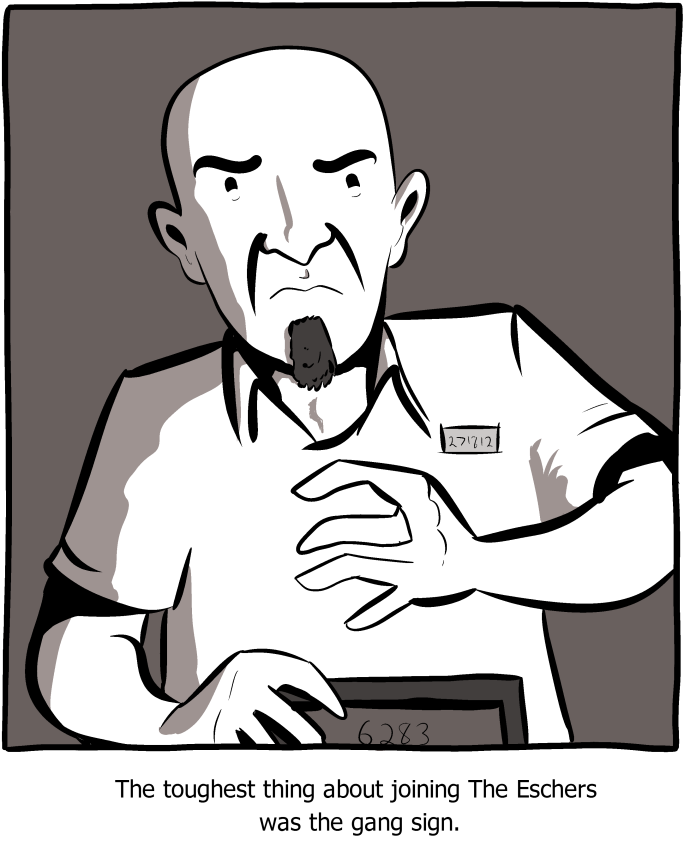
Saturday Morning Breakfast Cereal - Gang Signs

by admin@smbc-comics.com

Hovertext: Things you learn drawing comics - you can't do the Devil's Tuning Fork in color.


New comic!
Today's News:
26 May 22:14

multifandom-madnesss: ESC Crashes My Dash - Best Of pt....


multifandom-madnesss:

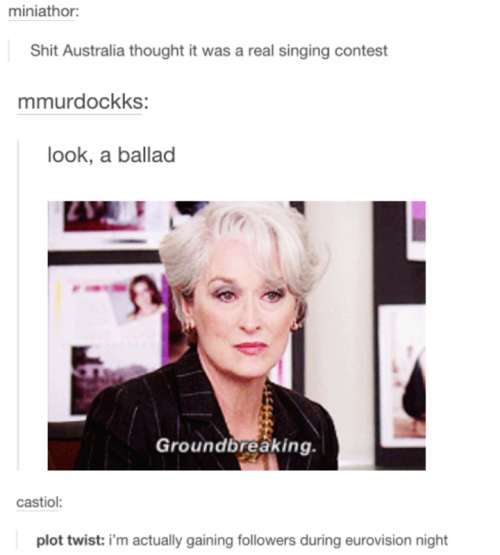
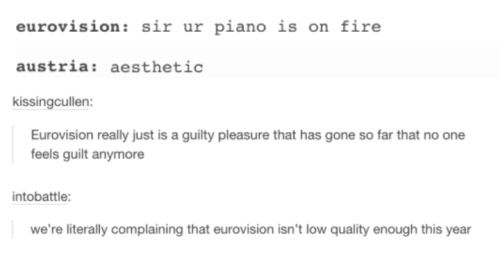
ESC Crashes My Dash - Best Of pt. 1

Yeah, this just about sums it up.

26 May 22:12

New Trash and Found Object Murals by ‘Bordalo II’ on the Streets of Lisbon

by Christopher Jobson

bordalo-1

bordalo-7

bordalo-2

bordalo-3

bordalo-4

bordalo-5

bordalo-6

Artist Bordalo II (previously here and here) uses old tires, bumpers, and other scraps of painted found trash to form towering 3D murals of animals on the streets of Lisbon, Portugal. Collected here are several pieces from the last few months, and you can see much more on Facebook. (via Beautiful/Decay)

26 May 22:11

‘Twin Peaks’ Season Three Doubles to 18 Episodes, Angelo Badalamenti Returning

by Russ Fischer

Twin Peaks season three episode count

Twin Peaks isn’t just back — there’s more of it coming than anyone expected.

The return of Twin Peaks has already become a saga, with Showtime setting up a nine-episode third season to air in 2016, with David Lynch directing all episodes and co-writing with Twin Peaks co-creator Mark Frost. Then Lynch bailed on the series, reportedly over budget and deal issues. But Showtime worked things out with Lynch, and the director returned, just in time for Showtime to announce the third season had expanded from its original nine-episode order.

We didn’t know much more than that. What would be the final Twin Peaks season three episode count? And who else will return to the series now that Lynch is fully on board? During a convention appearance, Sheryl Lee and Sherilyn Fenn revealed some details. Notably, that the series order has doubled, and there’s a suggestion that Angelo Badalamenti, the musical voice of the show, is also coming back.

At Seattle’s Crypticon, Sherilyn Fenn talked about the show’s development so far, calling it a “roller coaster,” and suggesting, as we assumed, that if Lynch had stayed away she would have refused to do the show. But things are back on, and Fenn looks very happy.

She also said, “And 18 episodes now, even!”

Her comment after that went a ways towards confirming some of our suspicions about the money conflict, saying “and I think when he did the nine, he realized he needed nine more to really complete it.”

So the budget Showtime had agreed upon was basically doubling. That’s just a loose account of the dealmaking process, of course, but it does shed a little bit of light on the situation.

Also revealed is the plan to use music from Angelo Badalamenti. There isn’t a specific mention of him doing new music, but one would suspect that will end up being the case. Badalamenti was among the most significant parts of the show’s formula, as his mournful, ghostly music tied all the show’s eccentricities together.

There was also an interesting detail: Twede’s Cafe in North Bend, WA, which served as the Double R Diner in the show’s original location shoot, is being restored to be used in the new shoot.

“We’re shooting there, 100%,” Fenn said when asked about the original Washington locations. She added,

“[David’s] already come here. They’re redoing the R&R Diner to look exactly like it did in the show, and then the owners of the diner are going to keep it that way.”

She also mentioned that Lynch is figuring out how to shoot the Sheriff station, as it has been built up quite a bit since the original shoot.

While many Pacific Northwest locations were used for exteriors during the show’s pilot shoot, most of the series was actually shot north of Hollywood in the San Fernando Valley, in a warehouse that was refitted into stages, with Malibu forests doubling for the northwest in some scenes. We don’t know what the balance will be for the new series, but it sounds like at least some of the interiors will be shot on location, if the interior of the diner is being restored.

One of those interiors will be the Red Room, as Fenn says “she’s alive in the Red Room” while talking about Sheryl Lee. A few minutes later, Lee says “I know that I’m coming back now, but I don’t know how, and I may not know until I show up for the first day.” That’s obviously an exaggeration, but it’s a good way to say she’s not going to reveal anything now.

Fenn also references her character’s own odd end at the conclusion of the second series, explaining that it was the network’s desire for a cliffhanger that led to Audrey’s final scene.

Twin Peaks should begin shooting this September, with the series slated for Showtime in 2016.

Here’s video of the panel appearance, via Welcome to Twin Peaks. The first season three comments are right at the top, and the mentions of Badalamenti and the diner come much later in the talk.

The post ‘Twin Peaks’ Season Three Doubles to 18 Episodes, Angelo Badalamenti Returning appeared first on /Film.

26 May 22:11

Historian Says Don't 'Sanitize' How Our Government Created Ghettos

A helicopter flies over a section of Baltimore affected by riots. Richard Rothstein writes that recent unrest in Baltimore is the legacy of a century of federal, state and local policies designed to "quarantine Baltimore's black population in isolated slums." i

Fifty years after the repeal of Jim Crow, many African-Americans still live in segregated ghettos in the country's metropolitan areas. Richard Rothstein, a research associate at the Economic Policy Institute, has spent years studying the history of residential segregation in America.

"We have a myth today that the ghettos in metropolitan areas around the country are what the Supreme Court calls 'de-facto' — just the accident of the fact that people have not enough income to move into middle class neighborhoods or because real estate agents steered black and white families to different neighborhoods or because there was white flight," Rothstein tells Fresh Air's Terry Gross.

"It was not the unintended effect of benign policies," he says. "It was an explicit, racially purposeful policy that was pursued at all levels of government, and that's the reason we have these ghettos today and we are reaping the fruits of those policies."

Interview Highlights

On using the word "ghetto"

One of the ways in which we forget our history is by sanitizing our language and pretending that these problems don't exist. We have always recognized that these were "ghettos." A ghetto is, as I define it, a neighborhood which is homogeneous and from which there are serious barriers to exit. That's the technical definition of a ghetto.

Robert Weaver, the first African-American member of the Cabinet appointed by President Johnson as his secretary of Housing and Urban Development, described many of the policies that I've described today in a book he published in 1948 called The Negro Ghetto.

The Kerner Commission referred to the ghetto.

This is a term that we no longer use because we're embarrassed to talk about it, and we need to confront our history and stop sanitizing our language and talk openly about what we've done as a nation and what we need to do to undo it. And we can't talk openly if we're going to use euphemisms instead of being explicit about what the reality is.

On how the New Deal's Public Works Administration led to the creation of segregated ghettos

Its policy was that public housing could be used only to house people of the same race as the neighborhood in which it was located, but, in fact, most of the public housing that was built in the early years was built in integrated neighborhoods, which they razed and then built segregated public housing in those neighborhoods. So public housing created racial segregation where none existed before. That was one of the chief policies.

On the Federal Housing Administration's overtly racist policies in the 1930s, '40s and '50s

The second policy, which was probably even more effective in segregating metropolitan areas, was the Federal Housing Administration, which financed mass production builders of subdivisions starting in the '30s and then going on to the '40s and '50s in which those mass production builders, places like Levittown [New York] for example, and Nassau County in New York and in every metropolitan area in the country, the Federal Housing Administration gave builders like Levitt concessionary loans through banks because they guaranteed loans at lower interest rates for banks that the developers could use to build these subdivisions on the condition that no homes in those subdivisions be sold to African-Americans.

On real estate agents' practice of "blockbusting"

In the ghettos, government policy — municipal policy, for example — denied adequate services, garbage wasn't collected frequently. African-Americans were crowded into neighborhoods in the ghetto because so much other housing was closed to them and as a result, housing prices in ghettos were much higher than similar housing in white areas. Rents were much higher than similar housing in white areas ... because you had a smaller supply. It's the basic laws of supply and demand. ... So this created slum conditions.

So when African-Americans managed to break out of those slums and buy a home in a neighboring area, whites could be persuaded that slum conditions were going to be brought with them. So the real estate agents would go into these neighborhoods and try to panic white families into selling their homes cheap to the real estate agents.

They used techniques: They would recruit blacks from the ghetto to walk around the neighborhood pushing baby carriages. They would phone call families in the white area and ask for names that were stereotypically African-American. ... All intended to give the impression that this was rapidly turning into another black slum.

The white families who panicked would then sell their homes to the real estate agents or the speculators at prices far below what they were worth. The speculators would then turn around and resell the homes to African-Americans at far more than they were worth because of the restricted supply, and this policy was called "blockbusting" and it was a policy that was condoned by state licensing boards throughout the country.

26 May 22:10

I Used An NYPD Firearms Training Simulator and Learned I Should Be A Cop

by Liam Mathews
I Used An NYPD Firearms Training Simulator and Learned I Should Be A Cop

Normally, community council meetings are intended to be opportunities for officers and civilians to meet face-to-face and discuss issues in the precinct, but on Wednesday May 20, the Lower East Side’s 7th Precinct hosted a special session, inviting the community to try out an NYPD firearms tactics training simulator. I was intrigued, because it seemed to be a rare opportunity for a civilian to see how the NYPD actually trains its officers in a time when the department’s firearms tactics are controversial. Going in, I didn’t know what to expect from the simulator: Would it be a mini-shooting range? Or a video game? If there were human-shaped targets, would I be allowed to put turbans on them?

The simulator is one part of firearms training that also includes actual time at the shooting range and in-person scenario role-playing. Basic firearms training for recruits is 13 days long, and some officers receive specialized training based on their assignment. Cops also have to get re-certified every other year. The NYPD does not heavily emphasize firearms training compared to other police departments, because its theory is that putting too much emphasis on guns will make officers more likely to shoot.

But NYPD firearms training is notoriously poor. A 2007 study by the high-level defense contractors at the RAND Corporation found that “training in complex policing skills” such as communication and decision-making “could be improved,” and that NYPD officers should carry tasers so that situations aren’t as likely to escalate to deadly force. In 2012, the Times investigated weapons training in the police academy and found that it’s “not taken seriously.” That same year, an officer took to Reddit and wrote, “any average CCW [concealed-carry weapon] citizen who practices more then [sic] twice a year pretty much has most of the department beat in terms of training.” Even Second Amendment advocates are critical of the NYPD: last year, after the accidental shooting death of Akai Gurley, gun blogger Bob Owens of Bearing Arms called the NYPD “poorly-trained” and “incompetent.”

Obviously, I was not expecting to learn “complex policing skills” from an hourlong demo, but I did expect to get a sense of how the NYPD views its guns, and under what conditions officers are meant to reach for them. Big surprise: I did not like what I saw.

The demo was led by Det. Joe Agosto, a firearms trainer from the police academy. He was very adamant about how the media misrepresents what being a cop is like, and how civilians don’t know what it’s like to be in a situation where you don’t know what’s going to happen and you might have to shoot someone. The whole demonstration felt very defensive, like the NYPD was invoking preemptive blamelessness for the next time it killed an unarmed person. Agosto ran down a list of things cops experience during such a stressful, adrenaline-soaked interaction, such as tunnel vision and distortion of time, and while there’s truth to that, it almost sounded like he was making excuses for when mistakes are made. He showed some infographics about how the NYPD kills less people per capita than other police departments, and then showed the first group of people using the simulator how to hold the gun, which was pretty much the extent of the practical training.

The training simulation itself is an interactive video. The officer at the computer queues up a scenario like a cop might encounter in the field, and recruits react to it. The action in the video reacts to whatever tool is used (pepper spray, baton, gun). Basically, it’s a choose-your-own-adventure computer game with a gun for a mouse. Trainees are instructed to talk to the people onscreen, but it’s not fully interactive, because they don’t respond to verbal commands. So it’s designed for trainees to resort to violence.

My scenario was responding to a burglar alarm at a commercial space after business hours. I was the second trainee to use this scenario. In the video, shot from the cops’ point of view, a man comes out from behind a desk. He’s saying he works there. One of his hands is shielding his eyes from the cops’ flashlights, and the other is hidden behind the desk. He does not respond to commands to show his hand. One of the trainees before me attempted to pepper spray him, and in this choose-your-own-adventure option, the suspect pulled out a gun and started shooting. So he was killed.

The duo before me got super violent very quickly, so I came in after to demonstrate a different possible outcome. I didn’t have a partner. Det. Agosto showed me how to hold the gun, and then I was in the scenario. The guy was standing there, hiding his hand, telling me to get the light out of his face. “Show me your hand,” I commanded. He didn’t comply. Since I knew I was talking to recording that wasn’t listening, I ran out of stuff to say very quickly. “Do you want me to show you my ID?” he said. “Yeah, show me your ID,” I answered awkwardly to the screen. Suddenly, he whipped his hidden hand from out behind the desk. He was moving like he had a gun, and he did, kind of. But it wasn’t a firearm, it was a staple gun. He pretended like he was shooting me with the staple gun.

“That’s not funny,” I said. “Put the stapler down.” I didn’t shoot him.

“Wow, wait here, I’m going to get you an application,” Det. Agosto said, impressed. “No one doesn’t shoot him” when he pulls out the stapler in this scenario, he told me.

Perhaps because I was prepped, perhaps because my reaction was slow, or perhaps because I’m by nature not a violent person, I was able to restrain myself and not exert deadly force. In the NYPD training academy, I would be an anomaly, because I would rather talk than shoot. They are trained first and foremost to neutralize threats. Not doing this through violence is apparently novel. But I showed that it can be done.

There were a few more scenarios, and then the meeting ended before the community had a chance to speak. This was an unscheduled, unilateral, undemocratic decision by community council president Don West that royally pissed off people who had come to air grievances, but that’s a story for another time.

(Photo: NYPD 94th Precinct)

The post I Used An NYPD Firearms Training Simulator and Learned I Should Be A Cop appeared first on ANIMAL.

26 May 22:07

Rick Satava’s Luminous Glass Blown Jellyfish Appear Suspended in Motion

by Kate Sierzputowski

Satava_05

The jellyfish tank is the first environment I always run to when visiting an aquarium. I’m drawn to the luminous quality of the underwater creatures’ bodies, as well as their inclusion in a scene that appears to need no sources of artificial light. Glass artist Rick Satava was also captivated by these creatures in the late 80s, and after a trip to the Monterey Bay Aquarium he began to experiment with sculptures that mimicked the experience of a jellyfish’s elegant glide through the water.

Satava began selling these sculptures in 1990, and by 2002 he was crafting about 300 pieces of work a month. The bright jellyfishes he creates are suspended in the glass that surround them, yet each still appears as if their tentacles are rippling through the water. The glass blown approach works perfectly when translated to the round bell-like shape of the jellyfish’s body, as their natural appearance looks like brightly blown glass.

The California-based artist uses a technique in his sculptures called “glass-in-glass,” which consists of a glass sculpture being dipped into a second, molten glass layer. You can find Sativa’s sculptures within dozens of galleries nationally as well as a few locations internationally including Japan, Spain, Sweden, Switzerland. (via My Modern Met)

Satava_07

Satava_06

Satava_04

Satava_03

Satava_02

Satava_01

26 May 22:06

Share-iah Coke

by snopes@snopes.com
Photograph shows a bottle of Coca-Cola with the words "Share a Coke with Isis" printed across the front.
26 May 22:05

moonblossom: deluxetrashqueen:Honestly, Rick Rolling is the best practical joke ever. Like, there’s...

moonblossom:

deluxetrashqueen:

Honestly, Rick Rolling is the best practical joke ever. Like, there’s nothing offensive or mean  spirited about it. It’s just like “Oops you thought there would be something else here but it’s ‘Never Gonna Give You Up’.” which isn’t even a bad song. It’s fairly enjoyable to listen to. There’s no jumpscares, no screaming, no ill will. Just Rick Astley telling you he’s never going to give you up. I think that’s great. “You fell into my trap! Here, listen to this completely benign song that will have no negative effect on you.” 

I wish this were true. There’s a really good article about the problems inherent with rickrolling here.

26 May 22:04

Ex-LGBT conversion therapy is officially illegal in Oregon

Ex-LGBT conversion therapy is officially illegal in Oregon: gaywrites: You read it. Oregon just...
26 May 22:04

onlyblackgirl: milliondollarnigga: leftyrosenthal: It’s not...


onlyblackgirl:

milliondollarnigga:

leftyrosenthal:

It’s not that deep fam

Never that deep

Life be like

26 May 22:04

whew, good thing congress just increased funding for abstinence...


whew, good thing congress just increased funding for abstinence only programs!

26 May 09:30

Photo


26 May 09:29

joshua-wright: I had such fun drawing all the carnage in my...


joshua-wright:


I had such fun drawing all the carnage in my last comic I decided to do it all again, but this time with magic instead of a mattock.

Btw, I too have been searching for the Mirror of Mind-Freeing for many years. Currently I’m cursed with an insatiable love of art and illustration. I’m hoping the mirror can show me that I’m really a stock broker, or maybe a dentist. I hear both those pay pretty well. :) 

26 May 07:40

David Biespiel’s Poetry Wire: Midnight in the Century

by David Biespiel

It was the Hamlet on the Hudson, the late Mario Cuomo, who famously said, “you campaign in poetry and you govern in prose.” When he said poetry, I’m sure he was being figurative and simply meant “inspiring rhetoric” and not actual poetry. But poetry is the word he used and I want to take him at his word. So if you believe Gov. Cuomo’s point about campaigning in poetry then you know this year’s GOP White House hopefuls are fantasy poets all right, and their most recent poems are fairy tales meant to whitewash the reasons the United States declared war on Iraq in 2003.

To be sure, one difference between power politics and powerful poetry is that poets are interested in writing from a moral framework and then rewriting their emotional understanding of our existence in time and history in order to explore the human psyche and human experience. Not so politicians—and here I’m thinking exclusively of the 2016 GOP circus—who simply rewrite history to conform to their political ambitions.

No doubt you’ve been as dumbfounded as I’ve been at the sight of these umpteen candidates reinventing—if not out and out lying about—how America went to war in 2003. So I’ve been thinking, if you were to put their latest campaign poems about Iraq into a single anthology, you’d have to call it Aw, Shucks, The Stupid Intelligence: How America Just Got Fooled By Golly.

If only it were true—and that’s where the GOP campaign poetry falls apart.

Remember, the Iraq invasion caused an American death toll of more than 4,400 and a U.S. price tag of at least $1.7 trillion—that was on top of the Associated Press’ estimated 110,600 Iraqi violent deaths from 2003-2009. I don’t have space in this column to detail the disastrous consequences of the invasion. Now in its 12th year the war goes on with violent sectarian chaos, a dangerous realignment of regional powers, and new terrorist threats against the safety and security of innocent civilians and ancient treasures.

Still, Sen. Marco Rubio of Florida now says the 2003 invasion was the right decision because President George W. Bush had intelligence findings (albeit incorrect ones, or cooked, take your pick) indicating that Iraq had weapons of mass destruction. Bush “made the right decision,” Rubio said the other day in his existential eight-line campaign poem that has become the anthemic verse for the GOP’s retooled position on the causes for the war. Marco Rubio’s poem might be called “The Right Decision” and goes:

Based on the information
he had at that time

Based on the information
he had at that time

Based on the information
he had at that time

Based on the information
he had at that time

Rubio’s couplets echo the opening of Allen Ginsberg’s “Hum Bomb,” and try to make the case that the sound of language alone is all the meaning you need with some poems:

Whom bomb?
We bomb them!
Whom bomb?
We bomb them!
Whom bomb?
We bomb them!
Whom bomb?
We bomb them!

Ginsberg’s repetitions approximate hysteria, but Rubio’s insist that the Bush administration had evenly weighed the so-called evidence for weapons of mass destruction. The truth that Rubio’s poetry hides is this: the Bush administration was hell-bent to go to war against Saddam Hussein in the first place. The Senate Intelligence Committee’s “Phase II” report on prewar Iraq intelligence, released in 2008, officially accused the administration of misleading the public: “the Administration repeatedly presented intelligence as fact when in reality it was unsubstantiated, contradicted, or even non-existent.” Former Senator Jay Rockefeller of West Virginia, who chaired the committee at the time, offered this verdict: “There is no question we all relied on flawed intelligence. But, there is a fundamental difference between relying on incorrect intelligence and deliberately painting a picture to the American people that you know is not fully accurate.”

But still Wisconsin Gov. Scott Walker agrees with Rubio. Walker’s prose poem about the invasion is a brief, single sentence:

I think any president, regardless of party, probably would have made a similar decision to what President Bush did at the time with the information that he had available.

I give Walker points for brevity because a second sentence would have had to address the question of whether if “any president, regardless of party,” knew as a matter of fact and not speculation that a country was building or hiding WMD, would that “president, regardless of party”—would Walker? would Rubio?—be obligated to invade that country as we mistakenly did in Iraq? “If we’re all supposed to answer hypothetical questions,” hypothetical presidential candidate and former Florida Gov. Jeb Bush says in his poem called “Hypothetical Brother,” then—

Knowing what
we know now
I would have
not engaged
I would not have
gone into Iraq

Leave it to Gov. Bush to approximate a shiny, Go, Dog. Go! style for his campaign verse—”I would have not… / I would have not” is a delightful echo of P. D. Eastman’s “Do you like my hat? I do not.”—even as his poem runs counter to Kentucky Sen. Rand Paul’s hostile trope on the endless American war. Paul, whose campaign poetry strikes me as “obscene odes on the windows of the skull” is an isolationist outlier among the Grand Old Party’s poets. Paul says that invading Iraq—even if posed as “just hypothetical”—was “a mistake.” I admit that’s refreshing to hear from a Republican candidate. So I want to believe that Sen. Paul agrees with poet and Iraq veteran Brian Turner’s closing lines to the “The Hurt Locker” that read:

Open the hurt locker
and see what there is of knives
and teeth. Open the hurt locker and learn
how rough men come hunting for souls.

Actual soul-searching does not come easy to our GOP versifiers however. Sen. Ted Cruz’s poem, “Predicated,” is the opposite of hyperbole. Cruz instead goes in for meiosis sprinkled with adynation and aporia:

Knowing what we know now, of course
we wouldn’t go into Iraq

At the time, the intelligence reports
indicated that Iraq was developing weapons

of mass destruction that posed a significant
national security threat

We now know in hindsight
those intelligence reports were false

Now? I think not. Many of us knew something was fishy back then too, especially chief U.N. weapons inspector Hans Blix who asserted repeatedly that the US and British governments were overly dramatizing the threat of WMD in Iraq in order to start a war.

Now, surely, one wants to ask these GOP poets for president not would you have gone to war knowing what you now but given what you know now and assuming too that you would have taken the United States unprovoked to war if Iraq in fact possessed WMD, then would you now go to war against, say, North Korea or Iran or some other country—Canada? Argentina?—should they factually acquire WMD? The implication of the intelligence failure defense is yes, you would go to war, that the United States is obligated to go to war, right?

“I’ve been asked that question a hundred times,” says former Pennsylvania Sen. Rick Santorum’s in his latest campaign verse, “Everybody Accepts That Now.” Back when he was a member of Congress in 2003, Santorum voted to authorize the use of force in Iraq. Now he responds to the question with an answer that doesn’t really matter:

The answer is pretty clear
The information was not correct

and while there were some
things that were true

I don’t think nearly the weight
to require us to go to war

GOP poets are practitioners of the art of negation, that’s for sure, because nothing required the US to go to war. Many of us said so in 2002. In the run up to he war many people believed that the war was a mistake, people who were not misled by the intelligence community, people who understood objectively that the Bush administration wanted to use Iraq as an American political, if not military, base in the Middle East. Millions of war skeptics throughout the United States and the world opposed the administration’s promotion of the invasion based on conflicting, shifting, and false intelligence that was concocted to create the political will and popular support for the invasion. We understood then as we understand now, not that the Bush administration was misled, but that the Bush administration demanded intelligence to support the premise to invade Iraq in the aftermath of 9/11.

We know too from declassified documents that days after the attacks against New York and Washington, DC, then secretary of defense and one-time poet Donald Rumsfeld pushed his staff to plot the overthrow of Saddam Hussein and to start a war in order to achieve it. In 2013 MSNBC reported that “just hours after the 9/11 attacks…Donald Rumsfeld met in the Pentagon with Air Force General Richard Myers, then vice chairman of the Joint Chiefs of Staff, and other top aides. Notes taken by Rumsfeld aide Steve Cambone (and referred to pages 334 and 335 of the 9/11 Commission Report) show the secretary asked for the “best info fast..judge whether good enough [to] hit S.H. [Saddam Hussein] @ same time—not only UBL [Osama bin Laden].” Rumsfeld also tasked Jim Haynes, the Pentagon’s top lawyer, “to talk w/ PW [Paul Wolfowitz] for additional support [for the] connection w/ UBL.” Other comments from the notes: “Need to move swiftly…go massive–sweep it all up things related and not.”

David Corn of Mother Jones recently revisited this historical fact that the Bush administration was “not misled by lousy intelligence; [but instead] they used lousy intelligence to mislead the public.” Some people inside the administration as well, moreover, including anti-terrorism expert Richard Clarke, argued that the intelligence on WMD and any links between Saddam and al Qaeda was unreliable. But hours after the 9/11 attacks, reports James Fallows in the Atlantic, the rush to war with Iraq was underway:

I was in Washington on the morning of September 11, 2001…[I immediately called] a friend who was working inside the Pentagon when it was hit, and had already been mobilized into a team planning the U.S.-strategic response. “We don’t know exactly where the attack came from,” he told me that afternoon. “But I can tell you where the response will be: in Iraq.” …[H]e made clear that even if he personally had felt otherwise, Iraq was where things were already headed.

Four days after the 9/11 attacks, President Bush held a meeting of his advisors at Camp David. Soon after that meeting, rumors emerged of what is by now settled historical fact: that Paul Wolfowitz, with the apparent backing of Donald Rumsfeld, spoke strongly for invading Iraq along with, or instead of, fighting in Afghanistan…The principals voted against moving against Iraq immediately…

Anyone who was paying attention to military or political trends knew for certain by the end of 2001 that the administration and the military were gearing up to invade Iraq. If you want a timeline, again I refer you to my book—or to this review of Bob Woodward’s Plan of Attack, which describes Bush’s meetings with General Tommy Franks in December, 2001, to draw up invasion plans. By late 2001 forces, weapons, and emphasis were already being diverted from Afghanistan in preparation for the Iraq war, even though there had not yet been any national “debate” over launching that war…

All this was a year before the invasion, seven months before Condoleezza Rice’s scare interview (“We don’t want the smoking gun to be a mushroom cloud”), also seven months before Rumsfeld’s “trained ape” quote (“There’s no debate in the world as to whether they have these weapons. We all know that. A trained ape knows that”), and six months before Dick Cheney’s big VFW scare speech (“Simply stated, there is no doubt that Saddam Hussein now has weapons of mass destruction”). It was long before the United States supposedly “decided” to go to war.

In the late summer of 2002, the public began hearing about the mounting WMD menace as the reason we had to invade Iraq. But that was not the reason. Plans for the invasion had already been underway for months. The war was already coming; the “reason” for war just had to catch up.

Despite what we understand to be the facts, today’s poetry apologists for the Iraq war just keep repeating their intelligence error odes. Wouldn’t it be better, however, if they would address the horror of the failed effort in Iraq, both the moral and the military horror, as you see dished up in the opening lines of Dunya Mikhail’s “The War Works Hard”:

How magnificent the war is!
How eager
and efficient!
it wakes up the sirens
and dispatches ambulances
to various places,
swings corpses through the air,
rolls stretchers to the wounded,
summons rain
from the eyes of mothers,
digs into the earth
dislodging many things
from under the ruins

So if the GOP contenders aren’t reinterpreting the past, they’re surely exonerating it. That’s not typically the work of poets. No, it’s usually the job of amoral party apparatchiks. It’s worth remembering, on the other hand, that some politicians campaigned in poetry just fine before the war started. One Illinois state senator, for instance, understood that the country was being misled into war as far back as October 2, 2002. Here are passages from his campaign poem, “Dumb War,” composed in nearly-strict AAB rhymes:

What I am opposed to is a dumb war
What I am opposed to is a rash war
What I am opposed to is the cynical attempt

by Richard Perle and Paul Wolfowitz
and other armchair weekend warriors
to shove their own ideological agendas

down our throats
irrespective of the costs in lives lost
and in hardships borne

That’s what I’m opposed to
A dumb war
A rash war

A war based not on reason
but on passion
not on principle but on politics

I suffer no illusions about Saddam Hussein
He is a brutal man a ruthless man

A man who butchers his own people
to secure his own power
He has repeatedly defied UN resolutions

thwarted UN inspection teams
developed chemical and biological weapons
and coveted nuclear capacity

The world and the Iraqi people
would be better off without him

But I also know that Saddam poses no
imminent and direct threat to
the United States or to his neighbors

that the Iraqi economy is in shambles
that the Iraqi military a fraction of its former strength

he can be contained until
in the way of all petty dictators he falls
away into the dustbin of history

I know that even a successful war
against Iraq will require
a U.S. occupation

of undetermined length
at undetermined cost with
undetermined consequences

I know that an invasion of Iraq

will only fan the flames of the Middle East
and encourage the worst
rather than best impulses

of the Arab world
and strengthen the recruitment arm of al-Qaida
I am not opposed to all wars

I’m opposed to dumb wars

This poet, of course, is Barack Obama. Perhaps GOP candidates should give up on campaigning in poetry and instead listen to the Polish poet Czeslaw Milsoz speaking in prose. In Milosz’s December 8, 1980 Nobel lecture, he laments the ongoing midnight in the century that our collective “refusal to remember” continuously brings upon us. That phrase—”midnight in the century”—was favored by opponents on the left between the 20th century’s two world wars to define the nightmare years in Europe that culminated in the 1939 Hitler-Stalin Pact and was also the name of Victor Serge’s novel about revolutionaries living in the shadow of Joseph Stalin’s betrayal of the Russian revolution. Milosz cautions—as I would caution today’s GOP poetry circus—not to blur what is obvious about history:

Our planet that gets smaller every year, with its fantastic proliferation of mass media, is witnessing a process that escapes definition, characterized by a refusal to remember. Certainly, the illiterates of past centuries, then an enormous majority of mankind, knew little of the history of their respective countries and of their civilization. In the minds of modern illiterates, however, who know how to read and write and even teach in schools and at universities, history is present but blurred, in a state of strange confusion; Molière becomes a contemporary of Napoleon, Voltaire, a contemporary of Lenin. Also, events of the last decades, of such primary importance that knowledge or ignorance of them will be decisive for the future of mankind, move away, grow pale, lose all consistency as if Frederic Nietzsche’s prediction of European nihilism found a literal fulfillment. ‘The eye of a nihilist’—he wrote in 1887—’is unfaithful to his memories: it allows them to drop, to lose their leaves;… And what he does not do for himself, he also does not do for the whole past of mankind: he lets it drop.’ We are surrounded today by fictions about the past, contrary to common sense and to an elementary perception of good and evil. As “The Los Angeles Times” recently stated, the number of books in various languages which deny that the Holocaust ever took place, that it was invented by Jewish propaganda, has exceeded one hundred. If such an insanity is possible, is a complete loss of memory as a permanent state of mind improbable? And would it not present a danger more grave than genetic engineering or poisoning of the natural environment?

Or perhaps it’s wisest for the GOP presidential poetry candidates merely to remember W. H. Auden’s brief rhyme, “Epitaph on a Tyrant,” and then leave the poetry to the poets. In six devastating lines Auden reminds us that “human folly” is heartbreaking. But then the human folly goes on and on and we find ourselves feeling outraged when “respectable senators”—and governors and presidents and candidates for public office—continue the folly into the future:

Perfection of a kind was what he was after
And the poetry he invented was easy to understand;
He knew human folly like the back of his hand
And was greatly interested in armies and fleets;
When he laughed respectable senators burst with laughter
And when he cried the little children died in the streets.

Related Posts:

26 May 07:12

If they'd given Commander Riker his own Star Trek spinoff show, it would not be as good as this

by Rob Beschizza
They should have given the franchise to Jan van den Hemel. [via The Verge]
26 May 06:38

Avocado Love Wool Sculpture by Hanna Dovahan

by Christopher Jobson

avacado-1

avacado-2

Ukranian crafter Hanna Dovahan makes some pretty fantastic wool objects including animals, arthropods, and food which she sells in her Etsy shop. This avocado love piece is on a slightly higher plane of amazing.

26 May 06:38

Photo


26 May 06:38

A Softer World: 1239


buy this comic as a print!
Or share on: facebookreddit
If you enjoy the comic, please consider supporting A Softer World on Patreon
26 May 06:38

Photo


26 May 06:38

Photo


26 May 06:28

sandandglass: ’Indiana Jones’ Reboot Starring Anna Kendrick

26 May 06:27

earthmoonlotus: nevver:There’s another side to the storyOh my...

26 May 05:25

climateadaptation: “Moon Trees” are real, live trees whose seed...


climateadaptation:

“Moon Trees” are real, live trees whose seed went to the moon in 1976. There are about 425 living Moon Trees around the world. Here is a short list of locations

Packed in small containers in [Astronaut Stuart] Roosa’s personal kit were hundreds of tree seeds, part of a joint NASA/USFS project. Upon return to Earth, the seeds were germinated by the Forest Service.

Known as the “Moon Trees”, the resulting seedlings were planted throughout the United States (often as part of the nation’s bicentennial in 1976) and the world. They stand as a tribute to astronaut Roosa and the Apollo program. 

Via NASA

There’s a “second generation” of Moon Trees at the bottom of the page.

26 May 04:15

victoriousvocabulary:VESCOR [verb] 1. to use as food, take for...


victoriousvocabulary:

VESCOR

[verb]

1. to use as food, take for food, feed upon, eat; I eat, feed upon.

2. to enjoy, make use of, use, have; I make use of, enjoy, use.

Etymology: Latin from ve- + esca (food).

[Adrian Borda]

26 May 04:11

Francisco Leite | Erotismo vulgar

by Cherry Catalán

DERBYBLUE (55)

Francisco José de Souto Leite también conocido bajo el seudónimo de Derbyblue, es un ilustrador brasileño que trabaja con diferentes soportes, que van desde lo tradicional como papel y lienzo hasta las mismas calles de la ciudad. Esta mezcla del graffiti junto con remembranzas del cómic de los 60’s y 70’s le da un toque único y característico a su obra.

db12

Llena de colores, la sensualidad y erotismo que alberga el trabajo de Leite pareciera que roza con la vulgaridad; sin embargo no es por pura coincidencia sino que es el mensaje de la misma: la transgresión de lo moral, permitiendo así la crítica social.

Francisco_Leite2

8538862277_eac3b27e3f_o

006

Francisco_Leite18

8539974804_1e60273f2b_o

4

7837634538_d65a2c9224_b

Si deseas saber más de Francisco Leite, te dejamos su flickr:

www.flickr.com/photos/derbyblue