Shared posts

17 Dec 07:44

Can Airlines Make Money?

Can Airlines Make Money?

Nov 5, 2015 · 20,186 views

Few industries are as hated as America’s airlines.

In market research, airlines regularly rank among the most despised industries. A 2014 survey found that Americans hold airlines in only slightly more esteem than cable companies, and they regard insurance companies more favorably than airlines.  

Along with companies like Comcast, AT&T, and Anthem Blue Cross Blue Shield, Americans view airlines as monopolies that they cannot avoid. Just like in the health insurance or wireless business, a few dominant players seem to mistreat customers with impunity. Delta, United, and American Airlines have eliminated meals, made their seats smaller and smaller, overbooked flights, abandoned small cities, and demanded fees for checked bags. Passengers have few alternatives. 

Yet airlines are not raking in profits. Historically, the industry’s financial health has resembled the restaurant business more than an era of robber barons. Six major airlines went through bankruptcy in the 2000s, and from 1979 to 2014, airlines lost $35 billion. 

Richard Branson has famously stated, “If you want to be a millionaire, start with a billion dollars and launch a new airline.” His airline, Virgin America, consistently lost money even as it won accolades for its staff, service, and overall customer experience.

In a letter to investors about airlines, Warren Buffett wrote, “Here a durable competitive advantage has proven elusive ever since the days of the Wright Brothers.” He has called his investment in U.S. Airways one of his biggest blunders.

Venture capitalist Peter Thiel advocates for creating and investing in potential monopolies, yet he describes airlines as an example of a business where competition destroys all the profits. “In the entire hundred year history of the airline industry," he says, "the cumulative profits in the US have been approximately zero."

For years, the dismal prospects of flying people around the world has been almost cliche. Until this past year, when airlines started making record profits.

It’s unclear how you should feel about that. 

A Monopoly on the Skies 

Until 1978, the airline business was stable, boring, and characterized by a level of regulation that even Bernie Sanders might find excessive. 

The American government considered air travel a “public convenience and necessity,” and the federal Civil Aeronautics Board regulated private airlines like utility companies. The CAB set airline ticket prices, approved routes and schedules, and even considered questions like “May the employees of two financially affiliated airlines wear similar-looking uniforms?" Despite the restrictions, airlines performed fine financially as the CAB ensured that they earned a reasonable margin on flights.
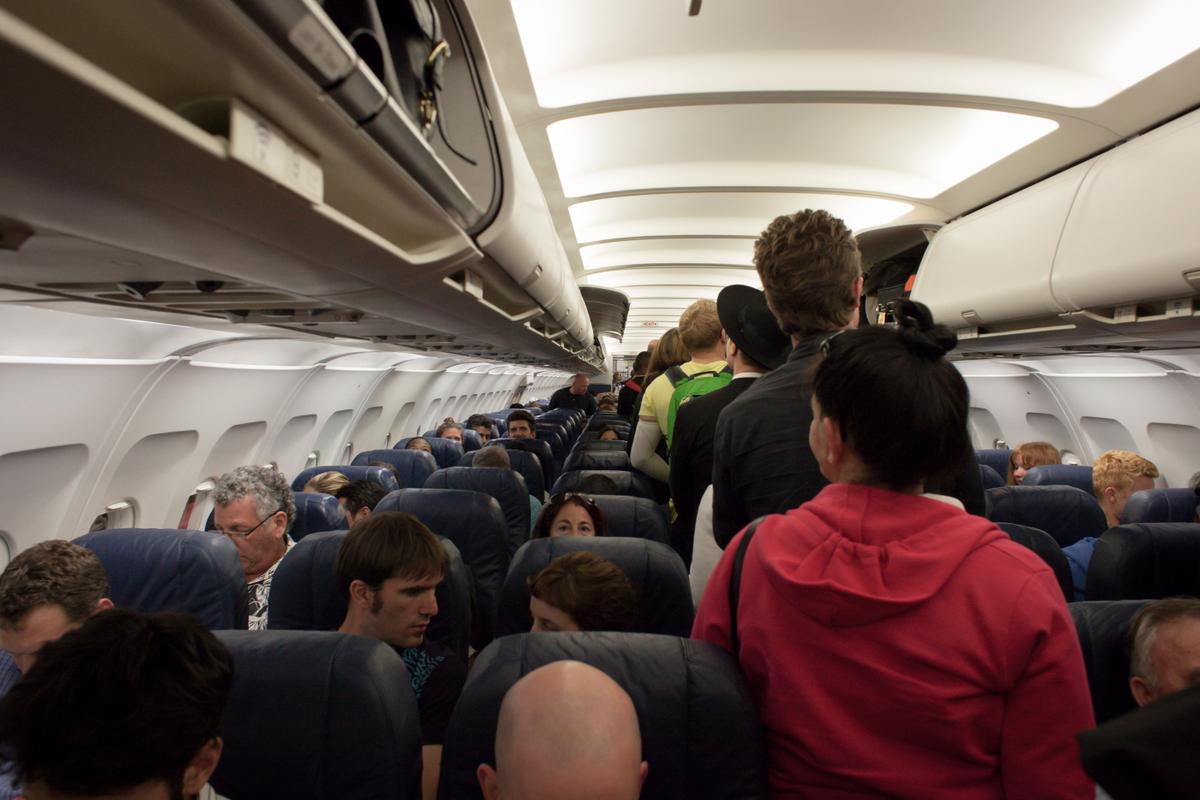
In many ways, regulation created the golden age of air travel. Since airlines could not compete on price or routes, they spent on ad campaigns that featured Andy Warhol, offered unlimited booze, and served dinner with fine china. 

Yet air travel was only golden for those who could afford it, which made Southwest’s no-frills airline so appealing. Southwest avoided CAB’s regulations because it only flew within Texas, and its cheap ticket prices resulted in a fare war between Southwest and a larger carrier. The competition also pushed Southwest to develop its famed “10-minute ‘turns’ between reaching the gate, disembarking passengers, boarding new passengers and leaving.”

The Southwest model combined with liberals’ contention that regulating airlines amounted to corporate welfare inspired Congress and President Carter to unleash the forces of capitalism in 1978. After the passage of the Airline Deregulation Act, airlines existed in a brave new world.

Today, deregulation is generally viewed as a success. Fares dropped, ridership increased, and airlines developed the hub and spoke system, which replaced most direct flights between smaller cities with connections to large hubs like New York, Chicago, and Dallas. 

The real surprise of deregulation, however, is that few to no airlines were able to make a consistent profit. The airline industry has never enjoyed a stretch of profitability that lasted longer than 6 years. Overall, the industry has lost $35 billion since deregulation. 
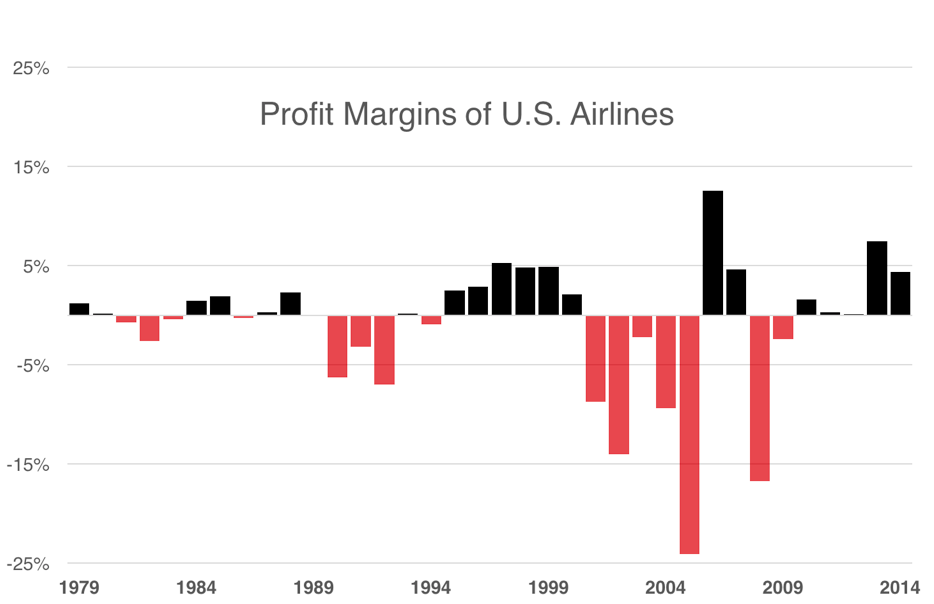
Data from Airlines For America; chart by Priceonomics

This is doubly weird because airlines succeeded at avoiding competition to a greater extent than expected. 

One factor that makes the airline industry monopolistic is the challenge of starting an airline. A new Boeing 777 costs $320 million. Even a low cost, regional carrier needs around $100 million to get started, and the certification process is lengthy. As one airline executive told the New York Times, “The only harder thing to start up than an airline is a nuclear plant.”

The major airlines' real competition-busting innovation, however, has been using the hub system to develop regional monopolies. In 1985, the Executive Vice-President of US Air wrote a memo to his CEO that reveals this thinking:

There is still much to do before we can be confident that we have established a northeast stronghold… Ideally we should control a major portion of the traffic at each of the cities in the northeast. The beauty of the niche strategy is… it enables us to keep control of prices within our niche territory, thus insulating a significant portion of our traffic from the devastating effects of unbridled competition.

Each major airline has a set of hubs, which serve as central points for passengers catching connecting flights—and opportunities for airlines to use their market share to set high ticket prices. Over 75% of passengers flying in and out of Atlanta in 2013 took Delta, and 46% of San Francisco passengers flew United. 

As far as strongholds go, hubs are well defended. Frequent flyer programs give passengers, especially all-important business travelers, incentives to always fly with the airline that dominates their hub. Since hub airports are busy, they have limited gates and windows for takeoff and landing. Short of a major construction project, the only way for competing airlines to acquire gates or takeoff and landing slots is to buy or swap them—and the majority of slots and gates belong to the airline protecting its hub

Economic analyses show that airlines charge more for flights in and out of their hubs, which indicates that their market dominance allows them to set higher prices. Hubs are so important to the industry’s business model that airlines threaten to leave if they face more competition. When Houston voted to allow Southwest to build a new terminal at its airport, which is United’s second largest hub, United promptly reduced the flights it offered through Houston. 

Airlines have also sidestepped competition by merging—a development the deregulators in 1978 expected to prevent through antitrust legislation. Over the last decade, the number of major airlines, who control 85% of domestic traffic, has decreased from nine to four. This increased the number of major American airports dominated by one airline from 34 to 40. 

The Department of Justice has investigated the mergers but allowed them. The fact that a majority of airlines went through bankruptcy in the 2000s was likely a factor. As the Harvard Business Review wrote, “This isn’t J.P. Morgan operating from a position of strength to build a steel monopoly at the beginning of the 20th century; it’s a group of battered, eternally struggling companies trying to come up with a sustainable industry model.”

Where Are The Profits?

The reason people hate monopolies is that they allow companies to profit from our misery. Monopolies give us indecipherable health care policies, mysterious credit card charges, and throttled internet speeds, all delivered with a quality of service that says, “Screw you, you don’t have any other choice.” 

But airlines have not turned their dominant position into sustained profits—in the United States or abroad. Despite deregulation, most American airlines owe their continued existence to the federal government, which not only builds and maintains airports, but has taken responsibility for paying tens of billions of dollars worth of airline worker pensions. 

No one has a definitive answer for airlines’ historic struggle to make money. Instead we have a number of theories.

One possible explanation is that airlines have to deal with other monopolists who can charge high prices. Boeing and Airbus are two of the only companies that make large airplanes. Very few companies make wifi systems for planes. A few large, global freight forwarders fill airlines’ cargo holds. A unionized workforce is the expensive legacy of the regulated, pre-1978 period.

As The Economist put it, “Airlines are wonderful generators of profit—for everyone except themselves.” Of everyone involved in the travel industry, airlines have the slimmest profit margins. 

A related problem for airlines is that high fixed costs make it hard to adjust to changes in demand. If Delta wants to buy a Boeing 777 to offer more flights, it needs to spend over 10% of its 2014 profits (a historically flush year) and recoup its investment over the next 25+ years. But when events like 9/11 lead to less people flying, Delta can’t easily sell its extra 777. It either has to ground it or fly half-empty planes.  

Another complaint is that while airlines have been deregulated, the government still runs or regulates the airports. Critics blame slow-moving bureaucracy for the slow pace of innovation around managing busy airspace: air traffic control still infamously uses radar rather than satellite systems, and most airports hand out takeoff and landing slots rather than auctioning them. This leads to delays and prevents competition. 

A final factor is that airlines may not be monopolistic enough to overcome the problem that they are—as people in the industry increasingly call them—flying buses. Delta, United, Southwest, and JetBlue all offer a similar experience. No one has technology that the others lack, and frequent flier miles, blue potato chips, and friendly staff do not differentiate airlines enough to overcome the fact that price is the only metric most customers care about. As Peter Thiel implies in Zero To One, this is why airlines are not monopolists—they are businesses whose profits are competed out of existence. 

None of the theories feel fully satisfying. They explain why airlines’ costs are high and why profits are volatile, or why the industry may be less than fully efficient, but they don’t explain why the industry has not found a path to profitability in nearly four decades. And given airlines’ demonstrated ability to set prices, it seems wrong to conclude that airlines exist in a state of perfect competition rarely found outside of economics textbooks. 

The debate is slightly less hypothetical, however, because airlines are now enjoying record profits. If you believe airline CEOs, the profits are here to stay. 

Arrested Development

According to executives, airlines have entered a new age of profitability. The International Air Transport Association estimates that airlines globally will make $29.3 billion in 2015. That’s nearly twice its 2014 profits, and North American airlines made half of that $29 billion. Executives sound cautiously bullish.

The narrative from executives is that the bankruptcies and mergers over the past decade were the finale in the industry’s 37-year adjustment to deregulation. As a legacy of the regulated era, airlines like Delta and United had labor contracts that were both expensive and, according to economist Severin Borenstein, rigid and a reason why legacy airlines have lagged newer carriers like Southwest in productivity. 

By going through bankruptcy, airlines renegotiated their contracts to be leaner and more flexible. In a letter to his employees, the CEO of Southwest recently wrote, "The sloth-like industry you remember competing against is now officially dead and buried." 

Bankruptcy also helped airlines merge without falling afoul (so far) of antitrust regulation. When US Air proposed its now completed merger with American, its CEO described the merger as “the last major piece needed to fully rationalize the industry.” Translation: the merger would consolidate the industry enough that airlines could set profitable prices. 

Yet investors remain cautious about airlines’ prospects, and even a casual look at their finances reveals potential reasons why. In 2015, dropping fuel prices saved airlines $35 billion—more than global profits—compared to the previous year. 

Fuel prices alone do not necessarily account for all of the industry’s profits—airlines hedge against the risk of fuel prices rising and falling by locking in rates in futures markets. Given historically precedent, however, the next disaster or recession that sends fuel prices up or demand for air travel down could put the industry in the red. 

The benefit of a string of profitable years is that taxpayers will likely be spared the expense of bailing out airlines, and maybe, just maybe, some of the savings from low fuel prices might be passed along as lower fares.

The downside is that it has put the brakes on an interesting debate that gained steam as airlines went through bankruptcy. 

The bankruptcies and dismal financial records empowered what the Harvard Business Review described as “a revisionist interpretation” of the deregulation of the airline industry. These critics pointed out that the drop in fare prices and increase in the number of passengers after deregulation compared unfavorably with the progress made in the highly regulated fifties, sixties, and seventies—especially after you account for fees and discontinued routes. 

In an epic takedown of the airline industry, Phillip Longman and Lina Khan point out that the government spent more bailing out the airline industry in the 2000s than it spent on Amtrak and General Motors, that airlines have not delivered on low fares, and, most of all, that airlines’ meager profits have come at the expense of stranding America’s heartland. They write

The loss of airline service to rural and remote areas is an old story; by the 1980s, even some state capitals—such as Olympia, Washington; Dover, Delaware; and Salem, Oregon—became places you could no longer fly to except in a private plane. But over the last five years, service to medium-sized airports fell by 18 percent. This latter trend is much more disruptive to the economy, reflecting lost service to important centers of commerce that until recently had major airports but are now isolated—most often due to the frantic pace of airline mergers and downsizing.

The impact is stark. In the 2000s, Cincinnati lost its hub status when it became unprofitable to Delta. Several years later, the CEO of Chiquita Brands International, a company just outside the Fortune 500, grudgingly moved the company away from Cincinnati so that his executives could catch plane flights. 

In search of profits, airlines spent the last ten turbulent years, and the last 3 decades since deregulation, cutting back on flights to smaller markets and focusing on profit centers like New York, Washington, and their regional hubs. 

The airlines may have finally found profits, and even achieved sustainability. Yet 37 years after the government deregulated the industry so that we could benefit from the wonders of competition, airlines have only achieved no-bailouts levels of profitability by monopolizing airports and stranding half the country. 

In other words, we wanted cheap flights. Instead we got baggage fees and connections through Houston. 

Our next post explores the 19th century version of Drake vs Meek Mill: a fight between two mathematicians who both claimed to have invented statistical regression. 

To get notified when we post it →  join our email list.

This post was written by Alex Mayyasi.  You can follow him on Twitter at @amayyasi.


This entry passed through the Full-Text RSS service - if this is your content and you're reading it on someone else's site, please read the FAQ at fivefilters.org/content-only/faq.php#publishers.


15 Nov 21:39

Billionaires Pricing Millionaires Out Of San Francisco

image

Pacific Heights, known for its panoramic views and quaint Victorian houses, is quickly being overrun by Maseratis and massive ultramansions. The neighborhood has historically been a bastion of rich San Franciscans, but is now being increasingly populated by the even ridiculously richer.

Around 2000, the dot-com boom produced a generation of techies who gentrified San Francisco neighborhoods. The dot-com rich, as well as some old-moneyed families from outside the Bay Area, settled predominantly in Pacific Heights. Yet an even more resurgent tech industry in nearby Silicon Valley has produced a new wave of billionaires whose fortunes dwarf those of the mere millionaires before them.

Darius and Nina Ebrahim have been living in the same house on Buchanan street for more than a decade. Both became multimillionaires during the late 1990s: Darius as a venture capitalist, and Nina as a CTO of a startup that made personal websites for pets. They live humbly, with only 3 floors, floor to ceiling windows, and a home theater room. “We bought this place for only $3 million when we moved in,” says Darius. “Just yesterday, we had a real estate agent knock on our door and offer to buy our house for $20 million. That’s almost two-thirds of my net worth!”

Many of the Ebrahim’s neighbors have taken the offers of real estate agents looking to flip mansions to noveau tech rich. They’ve used the extra money to pay for a new Tesla, to fund their children’s private school tuition, and to hire a full-time butler in addition to their full-time nannies, cooking staff, doctors, and drivers. The Ebrahims used to be able to sit outside with their neighbors on a Sunday afternoon, drink mimosas, and smoke Cuban cigars lit with hundred-dollar bills. Now, many of their new neighbors are reclusive, sometimes living in their new properties for a few months out of the year and spending the rest of their time rotating between Shanghai, London, and New York.

“Recently, we’ve been harassed by a Facebook billionaire who wants to tear our mansion down and replace it with an indoor swimming pool extension to her supermansion next door,” says Nina. “Why can’t she just buy a vacation home in the Bahamas and put a swimming pool there like we do?”

The Ebrahims say that they barely recognize the neighborhood anymore. The 1-star Michelin restaurant around the corner, where the Ebrahims used to eat at every day, was forced out of business by ever increasing rent. It has since been replaced by a 3-star Michelin restaurant that they can barely get a table at. “The maître d’ will only seat you if you show proof of ownership of at least two senators,” says Darius.

Walk from Green Street to California Street, and it’s easy to see how the quaintly wealthy neighborhood is rapidly transforming into a glitzy haven for the ultrarich. A local Barney’s closed down, and in its place is a showroom for Gulfstream private jets. The Porsches and Mercedes in the neighborhood have been replaced by Ferraris and Maseratis that speed recklessly through the streets, driven by owners who can more than afford to pay for a speeding ticket.

Mr. and Mrs. Ebrahim initially wanted to stay in Pacific Heights, but they’ve started to reconsider as they’ve watched their neighborhood undergo its radical transformation. They say they might take that Facebook billionaire up on her offer, and they’re thinking of moving to a more “up and coming neighborhood” like the Mission.

11 Nov 09:38

Doctors treat drug-resistant leukaemia with 'gene editing'

by Daniel Cooper
Doctors at Britain's Great Ormond Street Hospital believe that they're on the cusp of a breakthrough in how to treat genetic diseases. Researchers have successfully -- so far -- implemented a method of editing genes that can seek out and eliminate...
11 Nov 03:21

What Developmental Milestones Are You Missing?

by Scott Alexander

[Epistemic status: Speculative. I can’t make this post less condescending and elitist, so if you don’t like condescending elitist things, this might not be for you.]

Developmental psychology never struck my interest in the same way as a lot of other kinds of psychology. It didn’t seem to give me insight into my own life, help me understand my friends, or explain weird things about society.

I’ve changed my mind about all of that after reading David Chapman’s Developing Ethical, Social, and Cognitive Competence.

First, a refresher. Developmental psychology describes how children go from helpless infants to reasonable adults. Although a lot of it has to do with sensorimotor skills like walking and talking, the really interesting stuff is cognitive development. Children start off as very buggy reasoners incapable of all but the most superficial forms of logic but gradually go on to develop new abilities and insights that allow them to navigate adult life.

Maybe the most famous of these is “theory of mind”, the ability to view things from other people’s perspective. In a classic demonstration, researchers show little Amy a Skittles bag and ask what she thinks is inside. She guesses Skittles, but the researchers open it and reveal it’s actually pennies. Then they close it up and invite little Brayden into the room. Then they ask Amy what Brayden thinks is inside. If Amy’s three years old or younger, she’ll usually say “pennies” – she knows that pennies are inside, so why shouldn’t Brayden know too? If she’s four or older, she’ll usually say “Skittles” – she realizes on a gut level that she and Brayden are separate minds and that Brayden will have his own perspective. Sometimes the same mistake can extend to preferences and beliefs. Wikipedia gives the example of a child saying “I like Sesame Street, so Daddy must like Sesame Street too.” This is another theory of mind failure grounded in an inability to separate self and environment.

Here’s another example which tentatively sounds like a self-environment failure. Young children really don’t get foreign languages. I got a little of this teaching English in Japan, and heard more of it from other people. The really young kids treated English like a cipher; everybody started out knowing things’ real (ie Japanese) names, but Americans insisted on converting them into their own special American-person code before talking about them. Kids would ask weird things like whether American parents would make an exception and speak Japanese to their kids who were too young to have learned English yet, or whether it was a zero-tolerance policy sort of thing and the families would just not communicate until the kids went to English school. And I made fun of them, but I also remember the first time I visited Paris I heard somebody talking to their dog, and for a split second I was like “Why would you expect your dog to know French?” before my brain kicked in and I was like “Duuhhhh….”

The infamous “magical thinking” which kids display until age 7 or so also involves confused self-environment boundaries. Maybe little Amy gets mad at Brayden and shouts “I HATE HIM” to her mother. The next day, Brayden falls off a step and skins his knee. Amy intuits a cause-and-effect relationship between her hatred and Brayden’s accident and feels guilty. She doesn’t realize that her hatred is internal to herself and can’t affect the world directly. Or kids displaying animism at this age, and expecting that the TV doesn’t work because it’s angry, or the car’s not starting because it’s tired.

Psychology textbooks never discuss whether this progression in and out of developmental stages is innate or environmental, which is weird because psychology textbooks usually love that sort of thing. I always assumed it was innate, because it was on the same timeline as things like walking and talking which are definitely innate. But I’ve been moved to question that after reading some of the work comparing “primitive” cultures to primitive developmental stages.

This probably isn’t the most politically correct thing to do, but it’s notable enough that anthropologists have been thinking about it for centuries. For example, from Ethnicity, Nationality, and Religious Experience:

Primitive people are generally as intelligent as the people of any culture, including the contemporary industrial-electronic age cultures. that makes it all the more significant that their publicly shared cognitive style shows little identifiable formal operational thought. The probable explanation for this, if true, is simply that formal operational thought is more complexly difficult than earlier modes of thought and will be used in a culture in a publicly shared way only if that culture has developed techniques for training people in its use. Primitive cultures do not do that, and thus by default use easier styles of thought, ones closer in form to concrete oeprational and even pre-operational thought, as defined by Piaget.

Primitive cultures certainly exhibit the magical thinking typical of young children; this is the origin of a whole host of superstitions and witch-doctory. They exhibit the same animism; there are hundreds of different animistic religions worldwide. And although I didn’t talk much about theories of moral development, primitive cultures’ notion of taboo is pretty similar to Kohlberg’s conventional stage.

But if different cultures progress through developmental milestones at different rates or not at all, then these aren’t universal laws of child development but facts about what skills get learned slowly or quickly in different cultures. In this model, development is not a matter of certain innate abilities like walking “unfolding” at the right time, but about difficult mental operations that you either learn or you don’t depending on how hard the world is trying to cram them into your head.

So getting back to David Chapman: his post is mostly about Robert Kegan’s account of “stages of moral development”. I didn’t get much from Kegan himself, but I was fascinated by an idea just sort of dropped into the middle of the discussion: that less than half of the people in modern western countries had attained Kegan’s fourth stage, and only a small handful attained his fifth. This was a way of thinking about development that I’d never heard before.

On the other hand, it makes sense. Take General Semantics (please!). I remember reading through Korzybski’s giant blue book of General Semantics, full of labyrinthine diagrams and promises that if only you understood this, you would engage with the world totally differently, you’d be a new man armed with invincible cognitive weapons. And the key insight, maybe the only insight, was “the map is not the territory”, which seems utterly banal.

But this is a self-environment distinction of exactly the sort that children learn in development. It’s dividing your own representation of the world from the world itself; it’s about as clear a reference to theory of mind as you could ask for. Korzybski considered it a revelation when he discovered it; thousands of other people found it helpful and started a movement around it; I conclude that these people were missing a piece of theory-of-mind and Korzybski gave it to them. Not the whole deal, of course. Just a piece. But a piece of something big and fundamental, so abstract and difficult to teach that it required that whole nine-hundred-something page book to cram it in.

And now I’m looking for other things in the discourse that sound like developmental milestones, and there are oodles of them.

I remember reading this piece by Nathan Robinson, where he compares his own liberal principles saying that colleges shouldn’t endorse war-violence-glorifying film “American Sniper” to some conservatives arguing that colleges shouldn’t endorse homosexuality-glorifying book “Fun Home”:

It is hypocrisy for liberals to laugh at and criticize the Duke students who have objected to their summer reading book due to its sexual and homosexual themes. They didn’t seem to react similarly when students at other universities tried to get screenings of American Sniper cancelled. If you say the Duke students should open their minds and consume things they disagree with, you should say the same thing about the students who boycotted American Sniper. Otherwise, you do not really have a principled belief that people should respect and take in other opinions, you just believe they should respect and take in your own opinions. How can you think in one case the students are close-minded and sheltered, but in the other think they are open-minded and tolerant? What principled distinction is there that allows you to condemn one and praise the other, other than believing people who agree with you are better?

He proposes a bunch of potential counterarguments, then shoots each counterargument down by admitting that the other side would have a symmetrical counterargument of their own: for example, he believes that “American Sniper” is worse because it’s racist and promoting racism is genuinely dangerous to a free society, but then he admits a conservative could say that “Fun Home” is worse because in their opinion it’s homosexuality that’s genuinely dangerous to a free society. After three or four levels of this, he ends up concluding that he can’t come up with a meta-level fundamental difference, but he’s going to fight for his values anyway because they’re his. I’m not sure what I think of this conclusion, but my main response to his article is oh my gosh he gets the thing, where “the thing” is a hard-to-describe ability to understand that other people are going to go down as many levels to defend their self-consistent values as you will to defend yours. It seems silly when I’m saying it like this, and you should probably just read the article, but I’ve seen so many people who lack this basic mental operation that this immediately endeared him to me. I would argue Nathan Robinson has a piece of theory-of-mind that a lot of other people are missing.

Actually, I was kind of also thinking this with his most recent post, which complains about a Washington Post article. The Post argues that because the Democrats support gun control and protest police, they are becoming the “pro-crime party”. I’m not sure whether the Post genuinely believes the Democrats are pro-crime by inclination or are just arguing their policies will lead to more crime in a hyperbolic figurative way, but I’ve certainly seen sources further right make the “genuinely in favor of crime as a terminal value” argument. And this doesn’t seem too different from the leftist sources that say Republicans can’t really care about the lives of the unborn, they’re just “anti-woman” as a terminal value. Both proposals share this idea of not being able to understand that other people have different beliefs than you and that their actions proceed naturally from those beliefs. Instead of saying “I believe gun control would increase crime, but Democrats believe the opposite, and from their different perspective banning guns makes sense,” they say “I believe gun control would increase crime, Democrats must believe the same, and therefore their demands for gun control must come from sinister motives.”

(compare: “Brayden brought the Skittles bag with him for lunch, so he must enjoy eating pennies.” Or: “Daddy is refusing to watch Sesame Street with me, so he must be secretly watching it with someone else he likes better instead.”)

Here are some other mental operations which seem to me to rise to the level of developmental milestones:

1. Ability to distinguish “the things my brain tells me” from “reality” – maybe this is better phrased as “not immediately trusting my system 1 judgments”. This is a big part of cognitive therapy – building the understanding that just because your brain makes assessments like “I will definitely fail at this” or “I’m the worst person in the world” doesn’t mean that you have to believe them. As Ozy points out, this one can be easier for people with serious psychiatric problems who have a lot of experience with their brain’s snap assessments being really off, as opposed to everyone else who has to piece the insight together from a bunch of subtle failures.

2. Ability to model other people as having really different mind-designs from theirs; for example, the person who thinks that someone with depression is just “being lazy” or needs to “snap out of it”. This is one of the most important factors in determining whether I get along with somebody – people who don’t have this insight tend not to respect boundaries/preferences very much simply because they can’t believe they exist, and to simultaneously get angry when other people violate their supposedly-obvious-and-universal boundaries and preferences.

3. Ability to think probabilistically and tolerate uncertainty. My thoughts on this were mostly inspired by another of David Chapman’s posts, which I’m starting to think might not be a coincidence.

4. Understanding the idea of trade-offs; things like “the higher the threshold value of this medical test, the more likely we’ll catch real cases but also the more likely we’ll get false positives” or “the lower the burden of proof for people accused of crimes, the more likely we’ll get real criminals but also the more likely we’ll encourage false accusations”. When I hear people discuss these cases in real life, they’re almost never able to maintain this tension and almost always collapse it to their preferred plan having no downside.

Framed like this, both psychotherapy and LW-style rationality aim to teach people some of these extra mental operations. The reactions to both vary from enlightenment to boredom to bafflement depending on whether the listener needs the piece, already has the piece, or just plain lacks the socket that the piece is supposed to snap into.

This would have an funny corollary; the LW Sequences try to hammer in how different other minds can be from your own in order to develop the skill of thinking about artificial intelligences, but whether or not AI matters this might be an unusually effective hack to break a certain type of person out of their egocentrism and teach them how to deal with other humans.

This raises the obvious question of whether there are any basic mental operations I still don’t have, how I would recognize them if there were, and how I would learn them once I recognized them.

11 Nov 03:03

magictransistor: Hiroshi Yoshida


magictransistor:

Hiroshi Yoshida

11 Nov 02:57

Blank Page Variations

by Grant


Posters are available at my shop.
10 Nov 01:09

Photo


10 Nov 01:08

1583 – Enquanto isso, no ENEM

by Carlos Ruas

2747

10 Nov 01:07

4gifs: Wagging intensifies. [video]


4gifs:

Wagging intensifies. [video]

10 Nov 00:50

Coisa de virgem

by Raphael Salimena

10 Nov 00:50

Do one thing well. image | twitter | facebook | patreon


Do one thing well.

image | twitter | facebook | patreon

10 Nov 00:41

Perfect

by Reza

perfect

10 Nov 00:40

Color Ballpoint Pen Drawings by Nicolas V. Sanchez

by Christopher Jobson

sanchez-1

Artist Nicolas V. Sanchez fills entire sketchbooks with drawings of the world around him rendered in precise color ballpoint. Portraits of families page by page, sprawling scenes of rugged farms and livestock, and near photographic recollections of people and places from residencies in the Dominican Republic and China. Sanchez often explores the roots of his own identity, delving into a bi-cultural upbringing that spans from the American midwest to his family’s rural history in Mexico.

In addition to his exacting pen work, Sanchez is also a painter and works in a distinct style that’s quite different from his ballpoint pen sketches. The sketchbooks help him work through ideas to determine if they eventually meant for a larger canvas, or if they’re meant to exist only in the pages of a book.

Filmmaker Jesse Brass recently sat down to talk with Sanchez in his New York studio for this interview entitled Resolve.

sanchez-2

sanchez-3

sanchez-4

sanchez-5

sanchez-6

sanchez-7

sanchez-8

sanchez-9

sanchez-10

sanchez-11

10 Nov 00:39

Photo


08 Nov 02:55

Já reparram como galos são uns bichos bonitos?


Já reparram como galos são uns bichos bonitos?

08 Nov 01:46

“Millennial Horror Story” by Eat That Toast


“Millennial Horror Story” by Eat That Toast

08 Nov 01:45

(via Nothing To Do With Arbroath: Squirrel makes a giant leap of...

08 Nov 01:39

Photo


08 Nov 01:39

Photo


08 Nov 01:38

Comic for November 07, 2015

by Scott Adams
Death By Emoji - Dilbert by Scott Adams

This entry passed through the Full-Text RSS service - if this is your content and you're reading it on someone else's site, please read the FAQ at fivefilters.org/content-only/faq.php#publishers.

07 Nov 00:55

Photo


07 Nov 00:55

Spider Web

by Doug
07 Nov 00:52

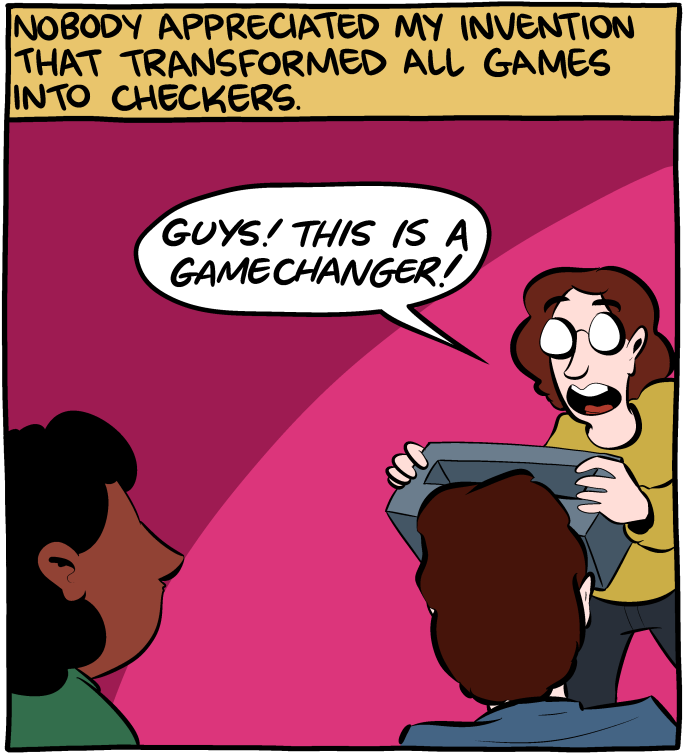
Saturday Morning Breakfast Cereal - Checkers

by admin@smbc-comics.com

Hovertext: C'mon, I can't do induction jokes for an entire week.


New comic!
Today's News:

Two weeks left! If we cross 5,000 backers today, I will LITERALLY eat an entire pie this week.


07 Nov 00:51

Dia ruim

by Will Tirando
Adam Victor Brandizzi

Alguém apanhou hoje.

azar Eleise esposa namorada Will casal trabalho profissão bad day humor curtidas

07 Nov 00:51

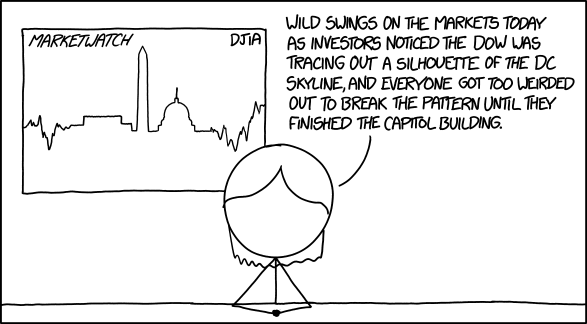
MarketWatch

Markets have been rocked by a second day of uncertainty after someone set up a giant Ouija board on the NYSE wall controlled collectively by the movement of the stock tickers.
07 Nov 00:48

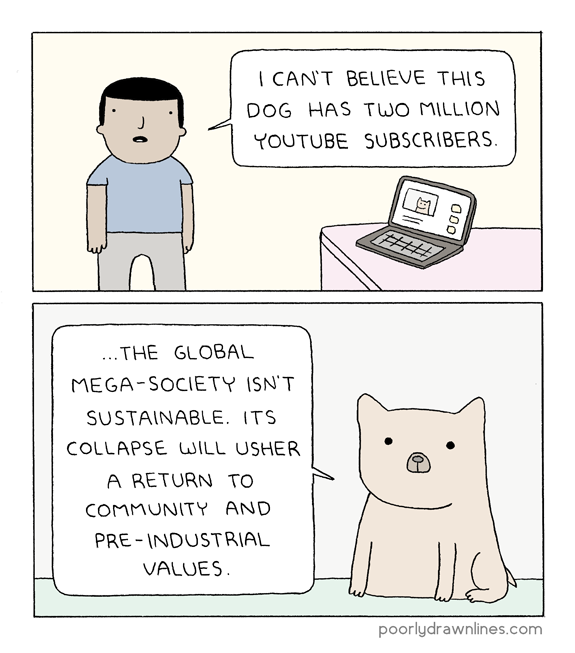
Dog Vid

by Reza

dog-vid

07 Nov 00:48

Photo


07 Nov 00:47

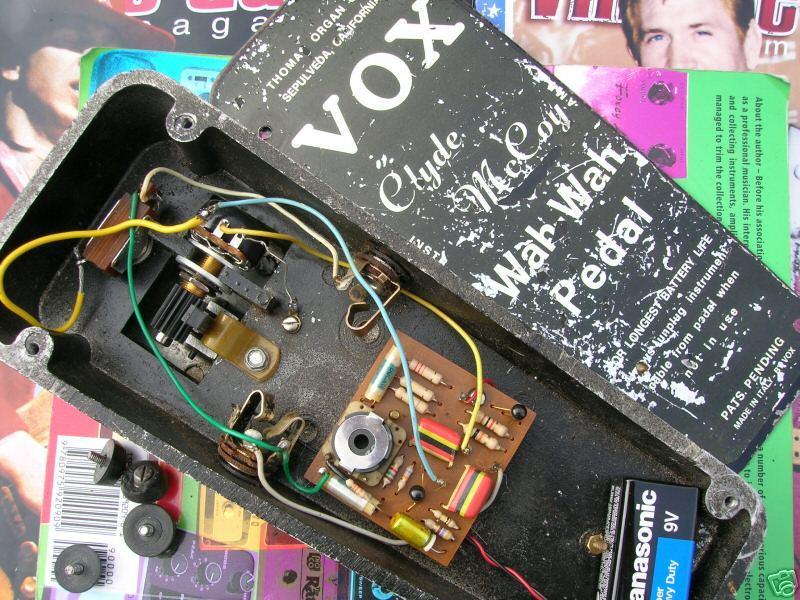
The Invention of the Wah-Wah Pedal

On August 18th, 1969, at around ten o’clock in the morning, Jimi Hendrix raised his white Fender Stratocaster guitar in the air, gazed out across the mud-soaked crowd at Woodstock Music Festival, and began to play “The Star Spangled Banner.”

Over the previous three days, the dairy farm in rural Bethel, New York had been packed with 400,000 people; Hendrix, the highest paid act at the festival, was the last to take the stage, and only 30,000 remained to witness his tongue-in-cheek ode to America.

For three minutes and 43 seconds, the notes screamed and hissed and squealed from his instrument, voicing the frustrations of the nation’s youth. And right at the center of Hendrix’s iconic sound was a guitar effect called the “wah-wah pedal” (or simply, the "wah").

Invented in the midst of a musical revolution in the 1960s, the wah became, in the words of one critic, “psychedelia’s non-psychotropic aid.” Rocked up and down, the pedal evoked sounds that mimicked the cries of a human voice, bridging the divide between music and vocal communication. From Clapton to the theme song for cult classic film “Shaft,” the wah immortalized itself as one of music history’s most recognizable and influential technologies. 

How did this iconic invention come about? And how did it become such a fixture in popular culture? These questions led us on a long and winding road -- one that fittingly begins with The Beatles.

The Beatles’ Amplifier Woes

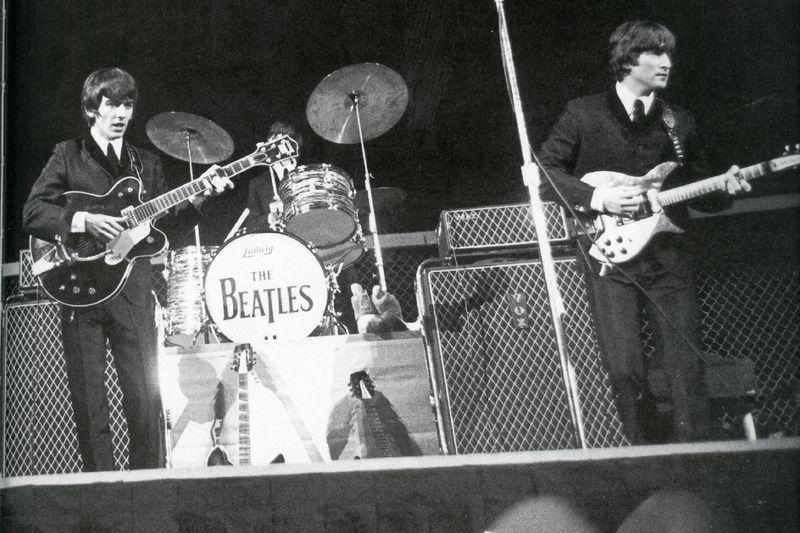
The Beatles performing with their new Vox AC-100 (“Super Beatle”) guitar amplifiers in 1964; via VoxAC100

As The Beatles prepared for their first ever U.S. tour in early 1964, they realized that their technology was inadequate. Over four years, the rock group had established itself as Britain’s favorite quartet, drawing crowds in excess of 10,000 people. Increasingly, screaming fans had rendered their guitar amplifiers completely inaudible during shows.

At the time, the group, like most of Britain’s major acts, was using the Vox AC-30, a 30-watt amplifier made by UK-based Jennings Musical Industries (JMI). When it was brought to JMI’s attention that this model was no longer sufficient for The Beatles, the company designed a 100-Watt version, and affectionately dubbed it the “Super Beatle.” Weeks later, the band -- and their new amplifiers -- made a successful U.S. debut on the Ed Sullivan Show: 73 million people (34% of America) tuned in to hear them play.

Overnight, “Beatlemania” kicked into overdrive, and the group became massively famous in America. Very quickly, JMI realized that it would behoove them to create a U.S. market for their new amplifiers, and they began looking for a distributor. In August of 1964, they settled on an applicant: a small Los Angeles-based firm called Thomas Organ Company.

Initially, JMI shipped Vox amplifiers to Thomas Organ, but, according to JMI, “the high costs of importing Vox amps from the U.K. severely affected profitability.” An enterprising entrepreneur, the CEO of Thomas Organ at the time, convinced JMI to take a deal: for a one-time payment, his company bought the rights to manufacture Vox products in America.

An Accidental Invention

In 1965, in a small back room of a Los Angeles facility, Thomas Organ’s engineers began to build Vox amplifiers. Among these engineers was a bright-eyed 20-year-old by the name of Brad Plunkett.

Plunkett was given a challenging task by Thomas Organ’s CEO: he was to take apart a Vox AC-100 guitar amp and find a way to make it cheaper to produce while still maintaining the sound quality.

“The first thing I noticed,” he recalls in the documentary Cry Baby, “was this little switch [on the amp] entitled ‘MRB.’”

This switch, invented by British engineer Dick Denney and installed on all Vox AC-100 amps at the time, stood for “middle range boost.” When flicked on, it would highlight the middle sound frequencies of the guitar (notes between 300 and 5,000 hertz); in doing so, it would tame the extremes (very high and very low pitches), and produce a flattened, smoother sound. Plunkett realized that he could replace this pricey switch with a potentiometer -- essentially an adjustable knob that divided voltages and acts as a variable resistor -- and achieve the same effect.

“The switches were very expensive, about $4 each,” Plunkett continues. “The potentiometer would only cost about 30 cents.”

A potentiometer; via Wikipedia

After a few days of fiddling around with spare parts, Plunkett succeeded in designing a circuit that could change the frequency of notes by simply rotating a potentiometer. Then, something unexpected happened:

“I went next door, and asked a friend of mine to plug a guitar into this pile of wires, resistors, and capacitors I had on the bench. He strummed a few chords while I turned the knob on the potentiometer. It went ‘WAH-WAH-WAH.’ We looked at each other, and said, ‘Wow! This is really great!’”

Certainly, it was a groovy, unique effect -- but there was no way a guitar player would be able to simultaneously twist a potentiometer knob and play his instrument. Glancing across the room, Plunkett spotted a volume pedal for a Vox Continental organ and had an idea: he grabbed it, gutted it, then wired the potentiometer inside of it with a 9-volt battery. This way, Plunkett was able to control the fluctuation in pitch with his foot.

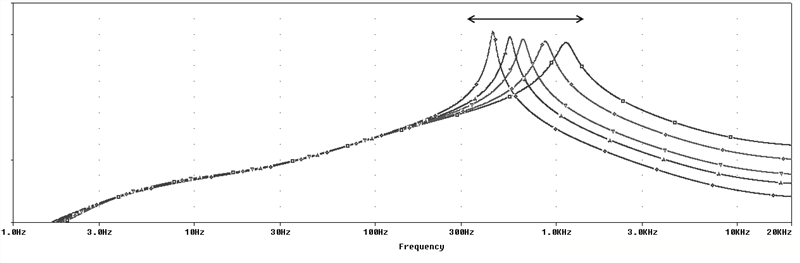
Sound frequency waves of a wah pedal; Via ElectroSmash

The guitar plugged into the pedal, and the pedal lined out to the amplifier, making the contraption an intermediary in which the sound could be manipulated. When the pedal was pushed down, the notes played on the guitar would be filtered at a low frequency; when it was up, they’d be filtered at a high frequency.

“Pretty soon we were drawing a modest crowd [in the office],” says Plunkett. “Everyone agreed that it sounded good, but we didn’t really know how good it was going to be.”

Zappa to Hendrix: How the Wah Took Over Rock N’ Roll

In 1965, electric guitarists really only had four different effects pedals available to them: tape delay, tremolo, spring reverb, and fuzz (distortion). As Art Thompson, senior editor of Guitar Player Magazine, notes in the documentary Cry Baby, “guitar was really popular but had reached a plateau with a lot of pop bands doing the same things.” Musicians were looking for new ways to manipulate and explore sound.

One of these musicians was Del Casher. A studio guitar player for the likes of Gene Autry and Elvis Presley, Casher had just joined the Vox Ampliphonic Orchestra, a troupe of musicians employed by Thomas Organ to market their new Vox products. Here, he came across Plunkett’s early prototype.

“I said, ‘What’s this knob?’ And I’m flipping it around and noticing it’s going wah-wah as I went from left to right,” he recalled in a New York Times interview. “I said: ‘Hold on! This is what I’ve been looking for!’”

Initially, Thomas Organ’s CEO, a fan of big band music, saw the pedal as more of a device for trumpeters, who, for years, had manually created similar “wah”-like effects using rubber mutes. But Casher was insistent that it be marketed to guitar players, and convinced upper management to let him record a demo record showing how it could be used for the guitar. 

“They thought I was a crackpot, but they humored me,” Casher joked. “I got my guitar, my prototype wah pedal, and played all the parts myself.”

Though Casher’s record wasn’t a smash success, his use of the strange effect caught the attention of Frank Zappa. The eclectic rocker hired the guitarist and brought him on tour, during which time Zappa became enamored with the pedal.

In February of 1967, Thomas Organ released the wah pedal to the public. 

At first, the device was marketed as the “Clyde McCoy,” named after a jazz trumpeter who extensively used a mute to create a “wah-wah” effect in the 1920s. But soon, after a more savvy marketing employee suggested that the pedal sounded like “a baby crying,” it was re-branded as the “Cry Baby.” Because of Thomas Organ’s contractual relations with Vox, two pedals were put on the shelves (one called the “Vox Wah-Wah, and the other, the “Cry Baby”) -- both with identical circuitry.

“With the Vox Wah-Wah Pedal, you can play incredible new effects making totally new sounds,” touted one advertisement. “Play the wild Eastern sound of the sitar. Play really 'funky' bass guitar. Play groovier blues. Make your instrument growl, baby.”

Early advertisements for the Vox Wah-Wah pedal; via Vox Showroom

“The wah was, to me, the new voice of the guitar,” Casher said in an interview. “The older school of producers and musicians didn’t see the value to using the wah...until the younger people came onto scene.”

Almost immediately after being released, Frank Zappa purchased one, and, according to Del Casher, then introduced it to guitar luminaries like Eric Clapton and Jimi Hendrix.

A rapid succession of big hits prominently featured guitar solos with the wah pedal -- first, Cream’s “Tales of Brave Ulysses” in May of 1967. This was followed by Jimi Hendrix’s “Up From the Sky” (1967), “Little Miss Lover” (1967), and “Burning of the Midnight Lamp” (July 1968).

“I think we’ll use it some more on records,” Hendrix told a reporter that year. “It’s got a very groovy sound.” Though other big-name bands used the wah, Hendrix redefined its sonic possibilities -- most famously on his 1968 recording, “Voodoo Chile (Slight Return).”

By the end of the 1960s, acts throughout Britain and the U.S. implemented the device into their act, in hopes of latching on to Hendrix’s popularity. In a little less than four years, the wah pedal had gone from a questionable prototype to one of the defining sounds in popular rock music.

“The 1960s were a time of amazing changes in attitude of the music,” explains Rolling Stone journalist Ben Fong-Torres. “When you hear something different, and you’re living in a time that is speaking different languages to you, you take note.”

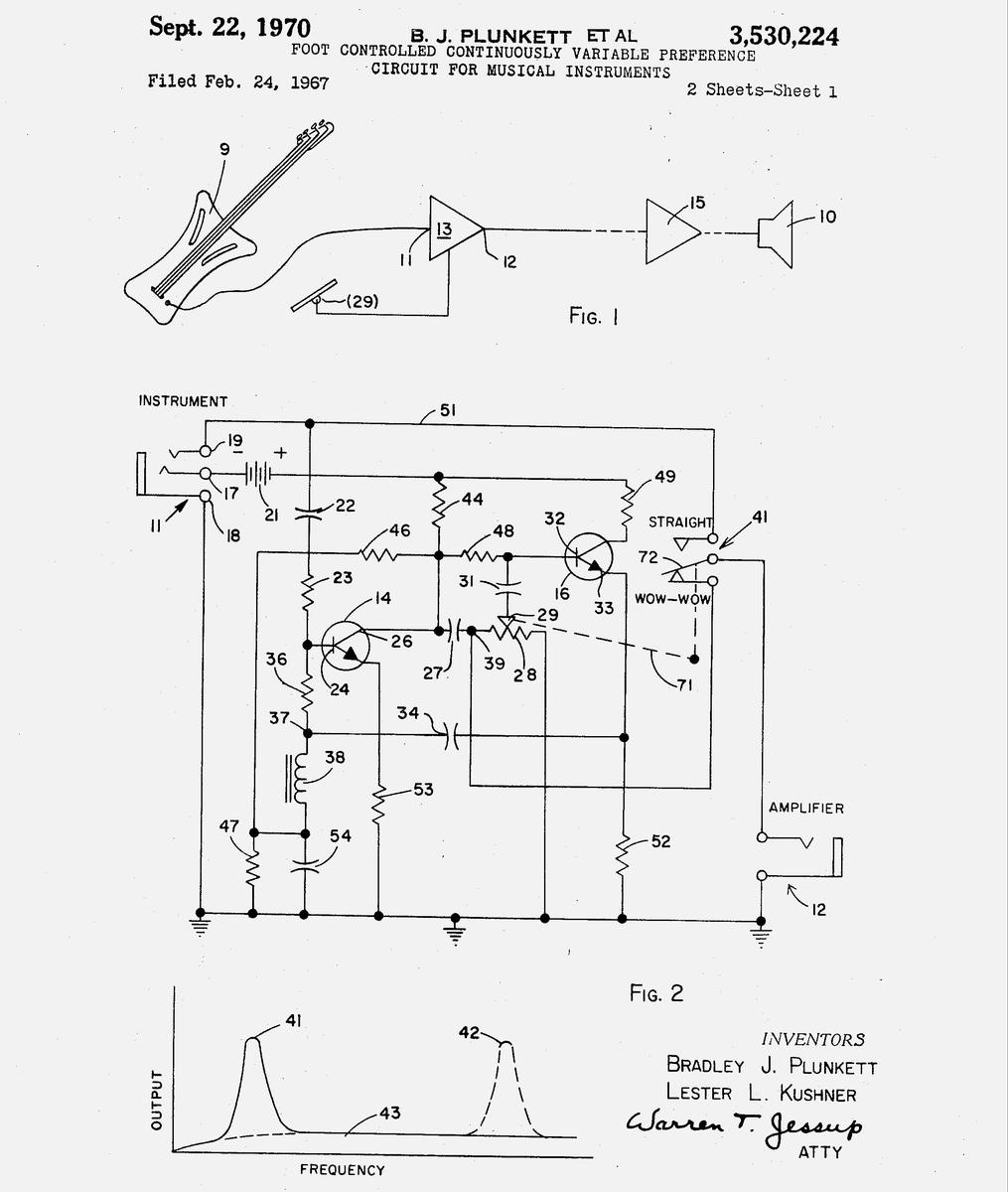
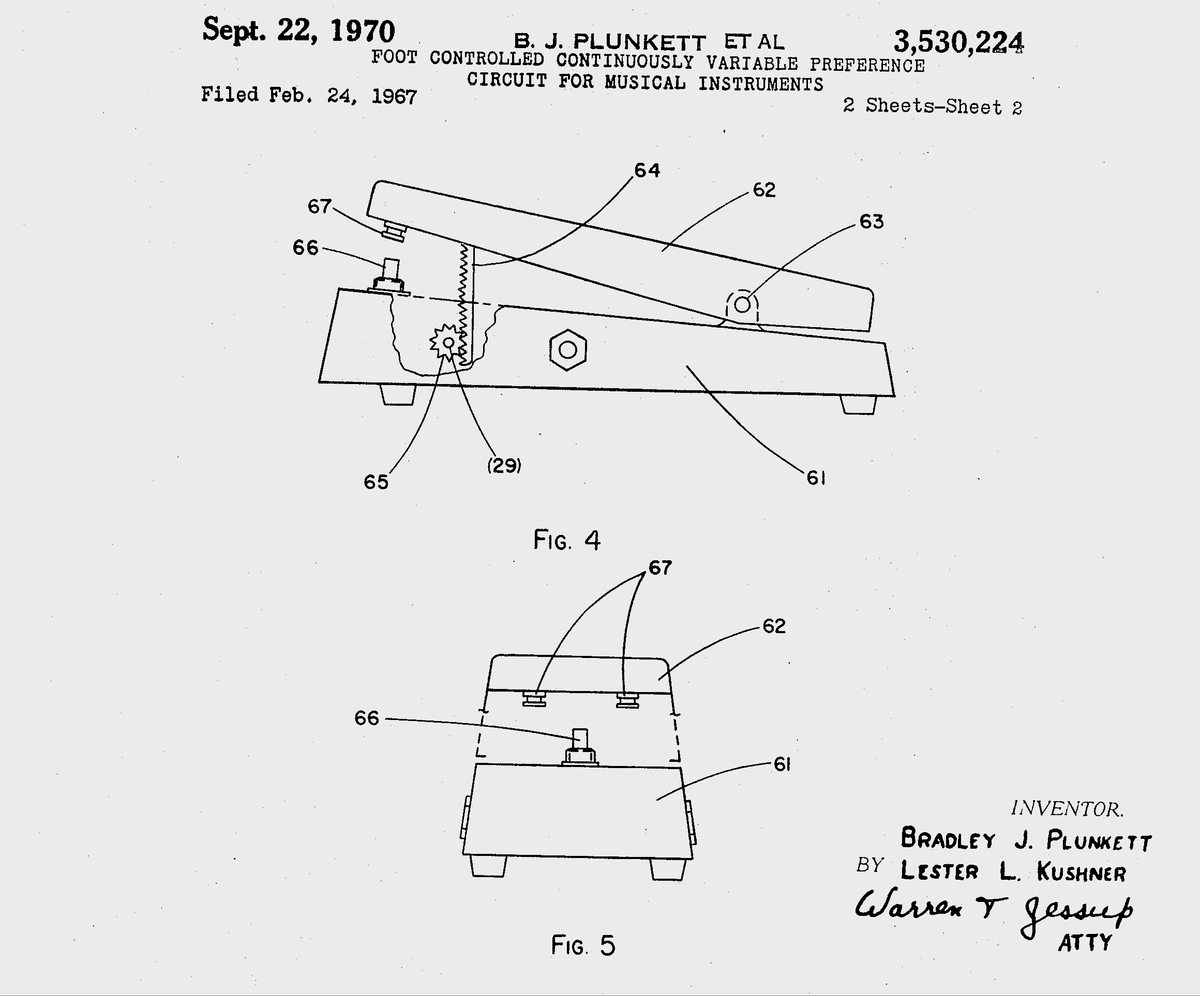
The patent for the wah pedal, secured in 1970, came a little too late; Google Patents

While the wah pedal took advantage of these cultural changes, and gave rock music a new, warbling voice, trouble was on the horizon for its creator, Thomas Organ.

On February 24, 1967, shortly after releasing the device to the public, Brad Plunkett had submitted a patent for the “wah-wah” pedal. Unfortunately, the patent took three years to get approved.

During this time, Warwick Electronics Inc., a much larger company, bought out Thomas Organ. To lower production costs, they decided to shift manufacturing of the wah pedals to Eko, a company in Italy. Here’s where things went horribly wrong.

By March of 1967, the circuitry design for the Cry Baby wah pedal had leaked out of Eko’s production facility, and dozens of imitator pedal brands began popping up all over Europe. Even after Thomas Organ (owned by Warwick) secured the patent on September 22, 1970, they didn’t enforce it: “By the time management realized it was important, everyone was making them,” said one executive, “and it would have been too much of an effort to shut them down.”

With the Vox brand diluted, the wah pedal continued to revolutionize music -- and not just in rock.

Shaft and the Funk Wah Revival

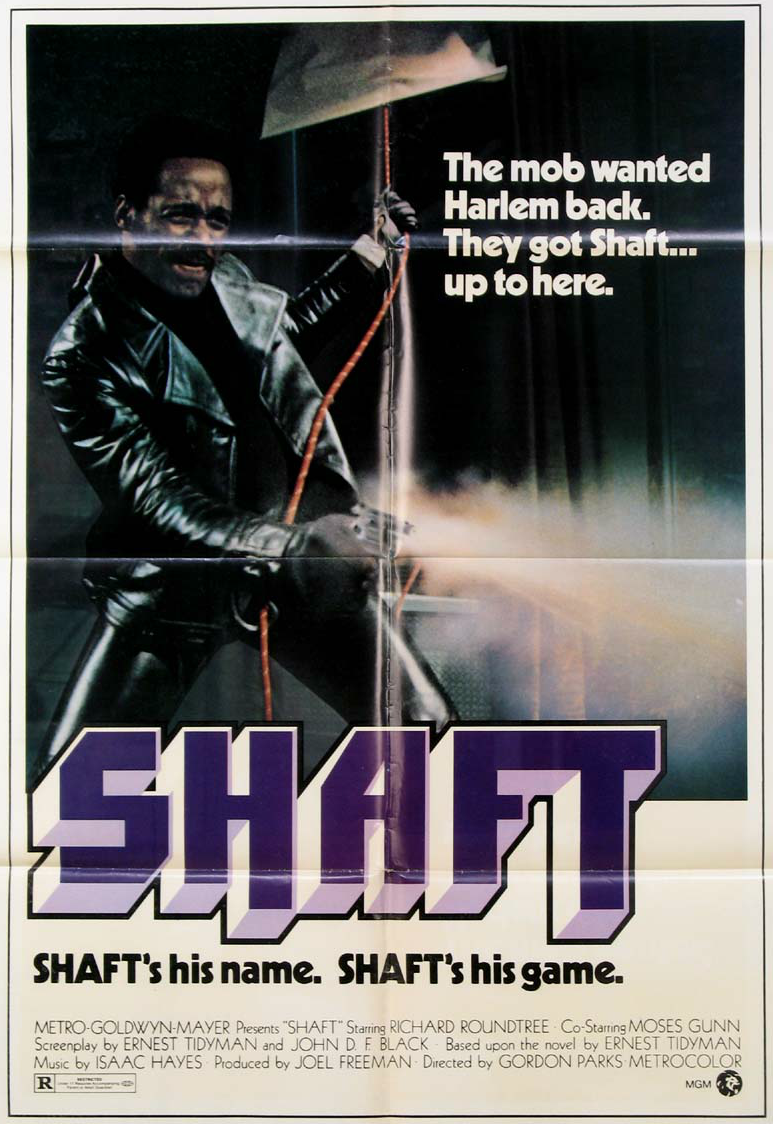
In the 1960s, the wah had found its place in searing rock guitar solos; by 1970, it was manipulated by funk, soul, and R&B artists in a completely different way -- most notably in the movie “Shaft.”

Part of the 1970s’ “blaxploitation” craze, “Shaft” tells the story of an African-American detective who fights his way through Harlem and the Italian mob to recover the daughter of a mobster. When producers at Metro-Goldwyn-Mayer began work film in 1971, they knew that they needed a fittingly badass theme song. Isaac Hayes, a soul singer who’d recently worked on a string of hits, was hired to fulfill this task.

Subsequently, Hayes put together a group of session musicians, including Charles “Skip” Pitts, who, at the time, was widely regarded as “one of the architects of funk guitar.” Pitts recalls the writing process:

“We were looking for something that would go with [Shaft’s] walk. Isaac told the drummer, ‘Give me some 16th notes.’ I was tuning my guitar, and checking the pedals out. I turned on the wah wah pedal, and was testing it out using a little pattern. [Isaac] said, ‘What are you doing?! Keep playing that! Keep playing that riff! I stayed on the same key the whole time -- all through the whole entire damn structure! Didn’t change anything except the structure of my foot.”

The riff -- a rhythmic “chika-chika-chika” strumming -- would become one of the most recognizable guitar parts in history.

“What’s Going On” (Marvin Gaye, 1971), “Papa was a Rollin’ Stone” (The Temptations, 1972), “Come a Little Closer” (Etta James, 1974), “Car Wash” (Rose Royce, 1976), and “I Will Survive” (Gloria Gaynor, 1978).

Death and Rebirth

With the 1980s came an era of new wave and punk rock music. Gradually, rock music fell out of vogue, and was replaced by the new technology of a digital revolution: musicians favored synthesizers over guitars, and effects processors over natural acoustics.

Progress in computer chip integration led to the creation of hundreds of digital guitar pedals, and the wah -- a simple, unsophisticated, electromechanical pedal -- was used less and less.

Thomas Organ also began to come under question for its quality control. In building its wah pedals, the company would “grab whatever [components] that were available from any manufacturer and put them together.” These inconsistencies (largely with the inductor type, which gave the wah its characteristic tone), paired with the pedal’s waning popularity, led Thomas Organ to question its value.

In 1982, Whirlpool, the conglomerate that owned Thomas Organ, decided to shut down the company, and cease production of the wah pedal.

One man, Jim Dunlop, decided he couldn’t stand for this to happen.

Jim Dunlop at the Scottish music awards in 2011; via Dunlop

A Scottish immigrant, Dunlop had founded Dunlop Manufacturing, a guitar accessories company, in 1965 while working part-time as a chemical engineer. After a few early successes redesigning guitar tuners and capos, he moved onto guitar picks, and eventually took over that market space. “He was known as a collector of accessories,” his daughter stated in an interview. “If people had accessories that they couldn’t make, they’d take to Jim Dunlop, and he’d make them.”

In 1982, during Thomas Organ’s liquidation, Dunlop called a VP at Whirlpool and offered to buy the rights to the pedal; the VP, who had no interest in the music business, gladly handed it over. Dunlop then spent 9 months remodeling the pedal: the circuit was rebuilt, the pots were replaced and updated, and it was built to be more durable.

After guitarist Stevie Ray Vaughan recorded a remake of Jimi Hendrix’s “Voodoo Child” in 1984, the pedal gradually came back into heavy use, and was prominently featured by bands like Guns N’ Roses, Metallica, and Toto.

This revival continued through the grunge movement in the 1990s: Nirvana, Alice in Chains, and Pearl Jam championed the pedal’s use, and most big-name guitar players reinstated it into their effect rig.

***

Today, despite the increasing digitalization of popular music, the wah pedal is just as prevalent as it’s ever been. In 2008, for instance, Jimi Hendrix’s old wah pedal sold for $15,500 at an auction, and its owner was immediately inundated by popular artists with requests to borrow it.

Though it has since been usurped by “sexier” effects and computer sound banks that can replicate any sound, the wah has managed to retain its place in music history.

“[The wah] is a dynamic thing, and every moment is new,” says Bobby Cedro, an engineer at Dunlop. “You can never replicate, perfectly, a wah-wah passage. That’s what makes it organic, and that’s what makes it timeless.”

Our next post explores the 19th century version of Drake vs Meek Mill: a fight between two mathematicians who both claimed to have invented statistical regression. 

To get notified when we post it →  join our email list.


This post was written by Zachary Crockett. You can follow him on Twitter at@zzcrockett


This entry passed through the Full-Text RSS service - if this is your content and you're reading it on someone else's site, please read the FAQ at fivefilters.org/content-only/faq.php#publishers.

05 Nov 16:00

RECONSIDER

by David

About 12 years ago, I co-founded a startup called Basecamp: A simple project collaboration tool that helps people make progress together, sold on a monthly subscription.

It took a part of some people’s work life and made it a little better. A little nicer than trying to manage a project over email or by stringing together a bunch of separate chat, file sharing, and task systems. Along the way it made for a comfortable business to own for my partner and me, and a great place to work for our employees.

That’s it.

It didn’t disrupt anything. It didn’t add any new members to the three-comma club. It was never a unicorn. Even worse: There are still, after all these years, less than fifty people working at Basecamp. We don’t even have a San Francisco satellite office!

I know what you’re thinking, right? BOOOORING. Why am I even listening to this guy? Isn’t this supposed to be a conference for the winners of game startup? Like people who’ve either already taken hundreds of million in venture capital or at least are aspiring to? Who the hell in their right mind would waste more than a decade toiling away at a company that doesn’t even have a pretense of an ambition for Eating The World™.

Well, the reason I’m here is to remind you that maybe, just maybe, you too have a nagging, gagging sense that the current atmosphere of disrupt-o-mania isn’t the only air a startup can breathe. That perhaps this zeal for disruption is not only crowding out other motives for doing a startup, but also can be downright poisonous for everyone here and the rest of the world.

Part of the problem seems to be that nobody these days is content to merely put their dent in the universe. No, they have to fucking own the universe. It’s not enough to be in the market, they have to dominate it. It’s not enough to serve customers, they have to capture them.

In fact, it’s hard to carry on a conversation with most startup people these days without getting inundated with odes to network effects and the valiance of deferring “monetization” until you find something everyone in the whole damn world wants to fixate their eyeballs on.

In this atmosphere, the term startup has been narrowed to describe the pursuit of total business domination. It’s turned into an obsession with unicorns and the properties of their “success”. A whole generation of people working with and for the internet enthralled by the prospect of being transformed into a mythical creature.

But who can blame them? This set of fairytale ideals are being reinforced at every turn.

Let’s start at the bottom: People who make lots of little bets on many potential unicorns have christened themselves angels. Angels? Really? You’ve plucked your self-serving moniker from the parables of a religion that specifically and explicitly had its head honcho throw the money men out of the temple and proclaim a rich man less likely to make it into heaven than a camel through a needle’s eye. Okay then!

“It is easier for a camel to go through the eye of a needle than for a rich man to enter the kingdom of God” — Matthew 19:23–26

And that’s just the first step of the pipeline. If you’re capable of stringing enough buzzwords about disruption and sufficient admiration for its holy verses, like software eating the world, and an appropriate yearning for the San Franciscan Mecca, you too can get to advance in this multi-level investment scheme.

Angels are merely the entry level in the holy trinity of startup money. Proceed along the illuminated path and you’ll quickly be granted an audience with the wise venture capitalists. And finally, if your hockey stick is strong, you’ll get to audition in front of the investment bankers who will weigh your ability to look shiny just long enough until the lock-up period on insiders selling shares is up.

And guess what these people call that final affirmation: A LIQUIDITY EVENT. The baptizing required to enter financial heaven. Subtle, isn’t it? Oh, and then, once you’ve Made It™, you get to be reborn an angel and the circle of divinity is complete. Hale-fucking-lujah!

You might think, dude, what do I care? I AM SPECIAL. I’m going to beat all the odds of the unicorn sausage factory and come out with my special horn. And who gives a shit about the evangelical vocabulary of financiers anyway? As long as they show me the money, I’ll call them Big Dollar Daddy if they want to. No skin off my back!

So first you take a lot of money from angels desperate to not miss out on the next big unicorn. Then you take an obscene amount of money from VCs to inflate your top-line growth, to entice the investment bankers that you might be worthy of foisting upon the public markets, eventually, or a suitable tech behemoth.

And every step along this scripted way will you accumulate more bosses. More people with “guidance” for you, about how you can juice the numbers long enough to make it someone else’s problem to keep the air castle in the sky inflated and rising. But of course it isn’t just guidance, once you take the money. It’s a debt owed, with all the nagging reciprocity that comes with it.

Now, if you truly want to become the next fifty-billion dollar Uber in another five years, I guess this game somehow makes sense in its own twisted logic. But it’s more than worth a few moments of your time to reconsider whether that’s really what you want. Or, even more accurately, whether an incredibly unlikely shot at that is what you want.

Don’t just accept this definition of “success” because that’s what everyone is cheering for at the moment. Yes, the chorus is loud, and that’s seductively alluring, but you don’t have to peel much lacquer off the surface to see that wood beneath might not be as strong as you’d imagine.

Let’s take a step back and examine how narrow this notion of success is. First, ponder the question: Why are you here?

“Get Your Ticket To Join The World’s Largest Companies and Most Exciting Startups: It’s not just startups that come to Web Summit. Senior executives from the world’s leading companies will be joining to find out what the future holds and to meet the startups that are changing their industries.” — Web Summit invitation.

That’s one reason: You think you’d like to be mentioned in that headline: The World’s Largest Companies and Most Exciting Startups. In other words, you too would really like to try that unicorn horn out for size. And white, white, is totally your color. It’s meant to be.

Well, to then answer the question, “why are you here?”, you might as well make it literal. Why are you HERE. Dublin, Ireland, The European Union? Don’t you know that surely the fastest and probably the only way to join the uniclub is to rent a mattress in the shifty part of San Francisco where the rent is only $4,000/month?

Because while that area north of Silicon Valley is busy disrupting everything, it still hasn’t caught up with the basic disruption of geography. So if your angel or VC can’t drop by your overpriced office for a jam session, well, then you’re no good at all, are you?

The real question is why do you startup? I don’t actually believe that most people are solely motivated by fawning over the latest hockey stick phenomenon. Bedazzled, probably, but not solely motivated. I invite you to dig deeper and explore those motivations. As inspiration, here were some of mine when I got involved with Basecamp:

I wanted to work for myself. Walk to my own beat. Chart my own path. Call it like I saw it, and not worry about what dudes in suits thought of that. All the cliches of independence that sound so quaint until you have a board meeting questioning why you aren’t raising more, burning faster, and growing at supersonic speeds yesterday?!

Independence isn’t missed until its gone. And when it’s gone, in the sense of having money masters dictate YOUR INCREDIBLE JOURNEY, it’s gone in the vast majority of cases. Once the train is going choo-choo there’s no stopping, no getting off, until you either crash into the mountain side or reach the IPO station at lake liquidity.

I wanted to make a product and sell it directly to people who’d care about its quality. There’s an incredible connection possible when you align your financial motivations with the service of your users. It’s an entirely different category of work than if you’re simply trying to capture eyeballs and sell their attention, privacy, and dignity in bulk to the highest bidder.

I’m going to pull out another trite saying here: It feels like honest work. Simple, honest work. I make a good product, you pay me good money for it. We don’t even need big words like monetization strategy to describe that transaction because it is so plain and simple even my three year-old son can understand it.

I wanted to put down roots. Long term bonds with coworkers and customers and the product. Impossible to steer and guide with a VC timebomb ticking that can only be defused by a 10–100x return. The most satisfying working relationships I’ve enjoyed in my close to two decades work in the internet business have been those that lasted the longest.

We have customers of Basecamp that have been paying us for more than 11 years! I’ve worked with Jason Fried for 14, and a growing group of Basecamp employees for close to a decade.

I keep seeing obituaries of this kind of longevity: The modern work place owes you nothing! All relationships are just fleeting and temporary. There’s prestige in jumping around as much as possible. And I think, really? I don’t recognize that, I don’t accept that, there’s no natural law making this inevitable.

I wanted the best odds I could possible get at attaining the tipping point of financial stability. In the abstract, economic sense, a 30% chance of making $3M is as good as a 3% chance of making $30M is as good as a 0.3% chance at making $300M. But in the concrete sense, you generally have to make your pick: Which coupon is the one for you?

The strategies employed to pursue the 30% for $3M are often in direct opposition to the strategies needed for a 0.3% shot at making $300M. Shooting for the stars and landing on the moon is not how Monday morning turns out.

I wanted a life beyond work. Hobbies, family, and intellectual stimulation and pursuits beyond Hacker News, what the next-next-next JavaScript framework looks like, and how we can optimize our signup funnel.

I wanted to embrace the constraints of a roughly 40-hour work week and feel good about it once it was over. Not constantly thinking I owed someone more of my precious twenties and thirties. I only get those decades once, shit if I’m going to sell them to someone for a bigger buck a later day.

These motives, for me, meant rejecting the definition of success proposed by the San Franciscan economic model of Get Big or GTFO. For us, at Basecamp, it meant starting up Basecamp as a side business. Patiently waiting over a year until it could pay our modest salaries before going full time on the venture. It meant slowly growing an audience, rather than attempting to buy it, in order to have someone to sell to.

By prevailing startup mythology, that meant we probably weren’t even ever really a startup! There were no plans for world domination, complete capture of market and customers. Certainly, there were none of the traditional milestones to celebrate. No series A funding. No IPO plans. No acquisitions.

Our definition of winning didn’t even include establishing that hallowed sanctity of the natural monopoly! We didn’t win by eradicating the competition. By sabotaging their rides, poaching their employees, or spending the most money in the shortest amount of time… We prospered in an AND world, not an OR world. We could succeed AND others could succeed.

All this may sound soft, like we have a lack of aspiration. I like to call it modest. Realistic. Achievable. It’s a designed experience and a deliberate pursuit that recognizes the extremely diminishing returns of life, love, and meaning beyond a certain level of financial success. In fact, not only diminishing, but negative returns for a lot of people.

I’ve talked to more than my fair share of entrepreneurs who won according to the traditional measures of success in the standard startup rule book. And the more we talked, the more we all realized that the trappings of a blow-out success weren’t nearly as high up the Maslovian pyramid of priorities as these other, more ephemeral, harder-to-quantify motivational gauges.

I guess one way of putting what I’m trying to say is this: There’s a vast conspiracy in the world of startups! (Yes, get your tinfoil hats out because Kansas is about to go bye-bye). People act in their own best interest! Especially those whose primary contribution is the capital they put forth. They will rationalize that pursuit as “the good of the community” without a shred of irony or introspection. Not even the most cartoonish, evil tycoon will think of themselves as anything but “doing what’s best”.

And every now and again, this self-interest shows itself in surprisingly revealing ways. Like when you hear angels brag about how YOU CANNOT KNOW WHICH BUSINESS IS GOING TO BE THE NEXT UNICORN. Thus, the rational play is to play as much as you possibly can. I find that a stunning acceptance of their own limited input in the process. Hey, shit, I don’t know which mud is going to stick to the wall, so please, for the sake of my six-pack of Rolexes, keep throwing!!

This whole conference is utterly unrepresentative when it comes to the business world at large! That’s why the mindfuck is so complete. You have a tiny minority of capital providers, their hang-arounds, and the client companies all vested in perpetuating a myth that you need them! That going into the cold, unknown world of business without their money in your mattress is a fool’s errand.

Don’t listen! They’ve convinced the world that San Francisco is its primary hope for progress and that while you should emulate it where you can, that emulation is going to be a shallow one. Best you send your hungry and your not-so-poor to our shores so we can give them a real shot at glory and world domination.

They’ve trained the media like obedient puppies to celebrate their process and worship their vocabulary. Oh, Series A! Cap tables! Vesting cliffs!

But in the end, they’re money lenders.

Morality pitted against the compound leverage of capital is often outmatched. Greed is a powerful motivator in itself but it gets accelerated when you’re serving that of others. Privacy for sale? No problem! Treating contractors like a repugnant automatron class of secondary citizens to which the company needs not show allegiance? PAR FOR COURSE.

Disrupt-o-mania fits the goals of this cabal perfectly. It’s a license to kill. Run fast and break societies.

Not all evil, naturally, but sucking a completely disproportionate amount of attention and light from the startup universe.

The distortion is exacerbated by the fact that people building profitable companies outside the sphere of the VC dominion have little systemic need to tell their story. VCs, on the other hand, needs the continuous PR campaign to meet their recruiting goals. They can’t just bag a single win and be content henceforth.

The presentation of unicorns is as real as the face of a model on a magazine cover. Retouched to the nth degree, ever so carefully arranged, labored over for hours.

The web is the greatest entrepreneurial platform ever invented. Lowest barriers of entry, greatest human reach ever. I love the web. Permission-less, grand reach, diversity of implementation. Don’t believe this imaginary wall of access of money. It isn’t there.

Examine and interrogate your motivations, reject the money if you dare, and startup something useful. A dent in the universe is plenty.

Curb your ambition.

Live happily ever after.


This talk was originally intended for Web Summit 2015 in Dublin, but I had to cancel at the last minute, so it got posted first on Medium, and now it’s here.

05 Nov 15:57

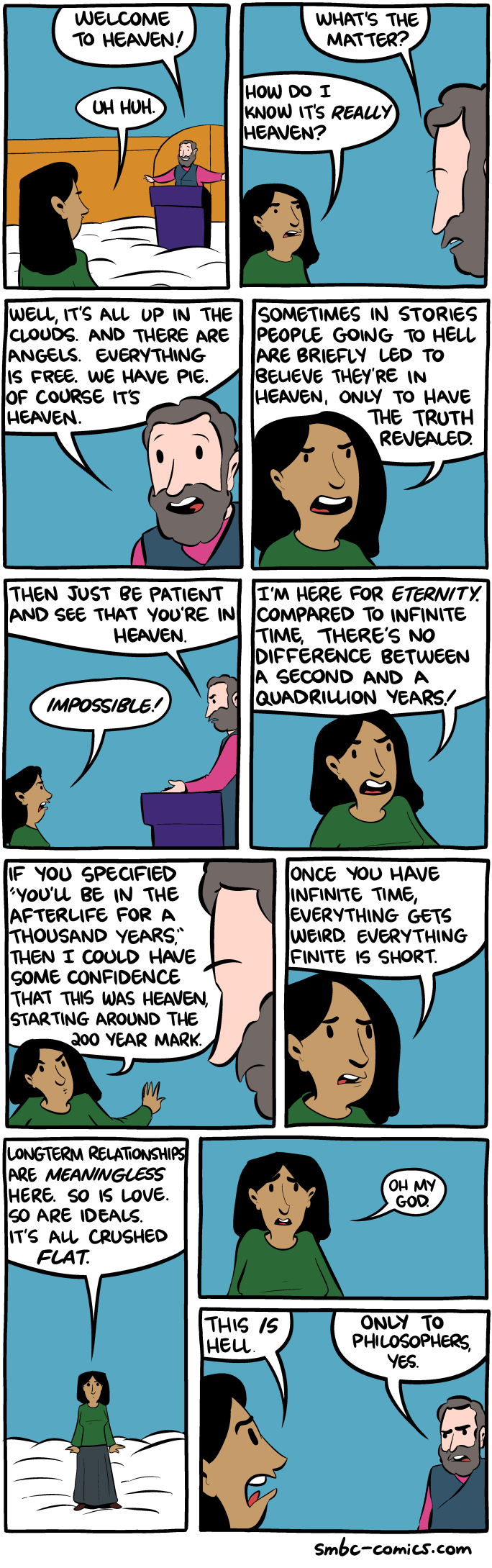
Saturday Morning Breakfast Cereal - Heaven

by admin@smbc-comics.com

Hovertext: OH MY GOD I just realized we haven't accounted for relativity.


New comic!
Today's News: