Adam Victor Brandizzi
Shared posts
17 Dec 07:44

The robot takeover: not so fast . . .
by Tim Harford
‘It is one thing to imagine such a future . . . It is another to have confidence that it is approaching’
Are we nearing a dramatic moment in economic history? Before humans developed agriculture, the world population — and thus the world economy — doubled in size roughly every 250,000 years. After acquiring the power of agriculture, the world economy doubled in size roughly every 900 years. After the industrial revolution, growth accelerated again, and since the second world war the world economy has been doubling in size roughly every 15 years. These numbers have been collated by Robin Hanson, an economist at George Mason University in Virginia; they are based on educated guesses by various economic historians.
If another step change of a similar scale were to happen, the world economy would double in size between now and Christmas. That is hard to imagine but, before the industrial revolution happened, it too would have been hard to imagine. And a small band of believers, not short on imagination, look forward to an economic “singularity”. Hanson is one of them, and the computer scientist Ray Kurzweil, author of The Singularity Is Near, is perhaps the most famous.
The singularity would be a point at which, rather than humans developing new technologies, the new technologies developed themselves. They would do so at a rate far beyond our comprehension. After the singularity, our civilisation would be in the hands of cyborgs, or brains uploaded into the cloud, or genetically enhanced superbeings, or something else able to make itself smarter at a tremendous rate. The future economy might consist of rapid interactions between artificial intelligences. The idea that it might double in size every few weeks no longer seems quite so unimaginable.
But it is one thing to imagine such a future. It is another thing to have confidence that it is approaching. Many economists point out that productivity growth has been sluggish for a long time, which hardly seems to be a precursor to a transformative economic take-off. Growth in advanced economies, far from accelerating, seems to require extraordinary stimulus to prevent it from stopping altogether. Other economists are more bullish, reminding us of a basic fact about the rapid exponential growth in computing power: if it continues, then by definition growth in the future will dwarf growth in the past.
Recently, the economist William Nordhaus published a research paper that aims to adjudicate on this debate. Nordhaus proposes a series of tests that we could use to spot an imminent singularity, looking for evidence that either the productive forces of the economy, or the goods that we enjoy consuming, are being transformed by computing.
Nordhaus’s first test is on the demand side. Is it likely that singularity-prone products such as games, films and computers will eventually absorb most of our spending?
So far, the answer seems to be no. The proportion of spending on such products is falling because their price is collapsing. If this trend continues, limitless digital goods will be the intricate icing on a stodgy economic cake. Our economy will move at the pace of the slowest sectors, and we will be chained to productivity improvements in mundane products such as food, shelter and transportation. After all, we cannot eat smartphone apps.
Perhaps, instead, computing will revolutionise how we produce these mundane products. An obvious second test, then, is to ask whether US productivity is accelerating. It isn’t.
Other tests look at the importance of investment goods in the economy. If the singularity is approaching, one might expect them to become very cheap and to dominate economic output. Are the average prices of investment goods — which include computers and software but also buildings and machinery — falling relative to wages at an accelerating rate? The answer, again, is no. What about the stock of capital relative to US economic output — is it rapidly rising? No.
So far there is not much sign of a singularity in the data. But a couple of tests do point in that direction. For example, the share of US national income accruing to capital rather than labour is increasing, albeit at a modest pace. That is what one might expect as the robots march into human affairs. And within the capital stock, the share of information assets such as software and intellectual property is increasing, although it is still only 6 or 7 per cent of the total. Nordhaus argues that these two tests suggest a singularity is many decades away; his other tests all point in the wrong direction entirely.
At this point the pro-singularity crowd might complain that conventional economic statistics do a poor job of measuring some of the new products and services. A mobile phone, for example, comes bundled with dozens of free products — a flashlight, satnav, an alarm clock and much more.
All this Nordhaus acknowledges — he is, it so happens, one of the world’s leading authorities on measuring the value of goods that conventional statistics miss. He ponders various back-of-the-envelope measures — for example, the amount of time that people spend consuming digital goods such as email. But none of these efforts suggests anything transformative yet.
Perhaps this is complacency. In the movies, the robot takeover tends to be rather sudden. Perhaps cyborgs have kidnapped the real Nordhaus and are using his name to spread disinformation. It is more likely, though, that the singularity is not near.
Written for and first published at ft.com.



04 Nov 09:24

Alexander Semenov Continues to Photograph the Earth’s Most Fragile Marine Wildlife Near the Arctic Circle
by Christopher Jobson

Eutonina indicans / © Alexander Semenov
For the last several years, marine photographer Alexander Semenov (previously) has lead the divers team at Moscow State University’s White Sea Biological Station located just south of the Artic Circle. Semenov directs scientific dives in extremely cold and harsh conditions to document sea creatures seldom seen anywhere else on Earth. From giant jellyfish to the tiniest of unknown sea worms, the photographer captures almost all of the creatures you see here out in the wild, without the convenience of a laboratory or studio.
It’s estimated that nearly 80% of all aquatic life in the world’s oceans has yet to be studied or even discovered. In response to this potentially vast world of unknown lifeforms, coupled with Semenov’s unceasing interest in marine biology, an ambitious trek across the world’s oceans has been planned for 2016. The Aquatilis Expedition is a proposed journey that will take a team of divers, scientists, and videographers to locations around the globe for the purposes of identifying new species, an odyssey on par with the advertures of Jacques Cousteau.
Many of Semenov’s best photos are available as prints, and he shares regular updates on both Facebook and Flickr.

Cyanea rainbow / © Alexander Semenov

Syllidae from the Sea of Okhotsk / © Alexander Semenov

Cestum veneris, Italy / © Alexander Semenov

Beroe cucumis / © Alexander Semenov

Cyanea nude / © Alexander Semenov

Clione limacina / © Alexander Semenov

Sarsia tubulosa attacked by Cyanea capillata / © Alexander Semenov

Swimming file clam, Australia / © Alexander Semenov

Aglantha digitale / © Alexander Semenov
04 Nov 09:23

Cutting Remarks
by Greg Ross
Until her death in 2010, film editor Sally Menke edited all of Quentin Tarantino’s films. He called Menke “hands-down my number one collaborator,” saying, “The best collaborations are the director-editor teams, where they can finish each other’s sentences.”
Because these films were edited in rented houses rather than in studio suites, Menke’s work was largely done alone. To keep her from getting lonely, Tarantino invited his cast and crew to address the camera between takes and say, “Hi, Sally!”
Please support Futility Closet on Patreon!
04 Nov 09:22
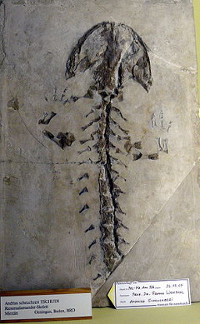

Oops
by Greg Ross
Image: Wikimedia Commons
In 1726, the Swiss naturalist Johann Jakob Scheuchzer mistook the skull and vertebral column of a large salamander from the Miocene epoch for the “betrübten Beingerüst eines alten Sünders” (sad bony remains of an old human sinner) and dubbed it Homo diluvii testis, “the man who witnessed the Deluge.” The fossil lacked a tail or hind legs, so he thought it was the remains of a trampled human child:
It is certain that this [rock] contains the half, or nearly so, of the skeleton of a man; that the substance even of the bones, and, what is more, of the flesh and of parts still softer than the flesh, are there incorporated in the stone; in a word it is one of the rarest relics which we have of that accursed race which was buried under the waters. The figure shows us the contour of the frontal bone, the orbits with the openings which give passage to the great nerves of the fifth pair. We see there the remains of the brain, of the sphenoidal bone, of the roots of the nose, a notable fragment of the maxillary bone, and some vestiges of the liver.
The fossil made its way to Teylers Museum in the Netherlands, where in 1811 Georges Cuvier recognized it as a giant salamander. Ironically, Scheuchzer’s original belief is reflected in the fossil’s modern name, Andrias scheuchzeri — Andrias means “image of man.”
Please support Futility Closet on Patreon!
Adam Victor Brandizzi likes this

04 Nov 08:59

If you are 15 or younger, you’ve never lived when there...
If you are 15 or younger, you’ve never lived when there wasn’t someone living off our planet. Happy 15th Anniversary ISS!
Adam Victor Brandizzi, David Pelaez likes this



02 Nov 20:36
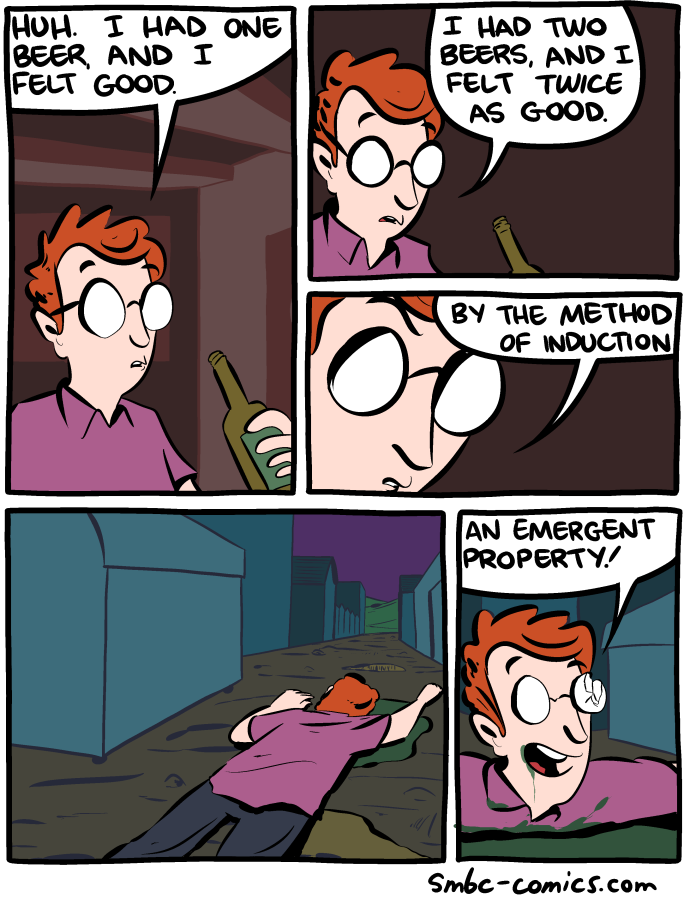
New comic!
Today's News:
Saturday Morning Breakfast Cereal - Induction
by admin@smbc-comics.com
Hovertext: Today's SMBC featuring backgrounds that were actually drawn with some care. Wow!
New comic!
Today's News:
THE STORE IS BACK AND REDESIGNED! Check it out!
Adam Victor Brandizzi likes this
02 Nov 20:36
To solve the retirement crisis, we should work six years and take the seventh off - Quartz
by brandizzi
Developed countries around the world face a retirement crisis. A spiritual practice from the second millennium BC just might be the answer to our problems.
Most people are aware that the Ten Commandments order people to work for six days and rest on the seventh. A far less commonly known feature of the commandments is that in the original plan delivered to Moses on Mount Sinai, man wasn’t supposed to take just one day out of the week to rest. His entire community was supposed to take one whole year of rest out of every seven. In other words: ancient Israelites were supposed to take a sabbatical year. (The Jewish year that just ended in September was just such a shmita, or sabbatical, year.)
A sabbatical year could be the solution to our increasingly fragile pension and retirement systems. People are living longer, which means they keep withdrawing funds from the pool, draining reserves intended for future generations. Meanwhile, birth rates and economic growth have been too low to support the Western world’s aging populations.
The problem is not only about dollars and cents. Our pension systems were conceived in a different era, when people could be reasonably expected to spend their entire working lives at a single job—often an arduous one that would enfeeble them in old age. So it made sense to dedicate one big chunk of our lives to work, and then another big chunk to doing nothing.
Today the nature of work has been vastly altered by globalization and technological change, as well as by emerging trends like the gig economy. And thanks to modern medicine and changes in lifestyle, most of us are still spry at age 65. In fact, a growing body of research suggests that too many years in retirement can make you less mentally sharp, not to mention socially isolated.
What we need is a way to reform retirement so it is both economically sustainable and ensures that we have a better relationship with work throughout our lives.
Enter the Jewish spiritual practice of keeping Sabbath.
Today, sabbatical years are a privilege primarily reserved for academics, high-skilled employees and those wealthy enough to afford twelve months’ worth of soul-searching.
But it doesn’t have to be that way. Companies that offer their employees a chance at sabbaticals, such as software company VMWare and management consulting firm BCG, tend to report that they come back refreshed and full of good ideas.
A yearly sabbatical would also give us a stretch of uninterrupted time to work on our personal passion projects, whether that means building a cabin in the woods, writing a novel or finally mastering Mandarin. Parents would be able to take time to focus on their families while their young children still live at home, rather than delaying leisure time until their children are grown. Those of us who feel restless or dissatisfied with the state of our lives would be able to step outside the daily grind to take stock and decide on a new direction—starting a new business, say, or going back to school.
Given that the modern era demands that people reinvent their skills cyclically in order to achieve and maintain success, this kind of freedom would have a positive ripple effect on the economy, boosting productivity as well as personal happiness.
The point here isn’t to completely abolish retirement. People who are truly elderly, as well as people who have some sort of disability, shouldn’t be forced to work.
But a sabbatical year would make the entire retirement system stronger. People’s preferences tend to be skewed to the short term. This means that most people would be happy to take one year’s worth of retirement money now, even if it means they have to retire later. So pension systems would pay people less money over the course of their lifetimes, helping the systems to remain solvent. This approach would also help sell a politically fraught issue, providing people a tangible benefit in exchange for painful reforms.
Most importantly, the sabbatical year would give all of us a healthier attitude towards work. We all need work to flourish. But while unemployment plagues some members of modern society, those of us privileged to have ample work too frequently become addicted to it, to the detriment of our well-being and, often, that of our families.
Nowhere is it written in the laws of the universe that we must first work for 40 years straight in order to achieve 20 years of rest. We need a mechanism that will restore balance and flexibility to our lives. We need the Sabbath—not just week after week, but also over our lifetimes.
Follow Pascal on Twitter at @pegobry. We welcome your ideas at ideas@qz.com.
This entry passed through the Full-Text RSS service - if this is your content and you're reading it on someone else's site, please read the FAQ at fivefilters.org/content-only/faq.php#publishers.
Adam Victor Brandizzi likes this
02 Nov 20:35

Molten metal storms rage on orphan planet that lost its star
by brandizzi

We just found weather on a lost world. Changes in the brightness of a planet adrift in space could be caused by clouds of molten metal passing in and out of view.
The starless planet, PSO J318.5-22, was discovered in the Pan-STARRS survey in 2013. At about eight times the mass of Jupiter, it’s much more like the giant planets we see orbiting other stars than the small, failed stars called brown dwarfs.
That means it probably formed around a star and was somehow shot out of its orbit into lonely deep space (see artist’s impression, above). That also makes this planet much easier to study than those that are almost lost in the dazzle from the stars they circle.
“You have to work really hard to even see them, whereas this object is just by itself,” says Beth Biller at the University of Edinburgh, UK.
Advertisement
Biller’s team measured the planet’s brightness and found that it could vary by up to 10 per cent in just a few hours. The explanation, they say, could lie in its weather systems.
Stormy spots
“If you think about the Great Red Spot on Jupiter, it would be stormy spots like that,” Biller says. Both worlds have similar rotation periods: 10 hours for Jupiter, and between 5 and 10 hours for the lone planet.
But unlike Jupiter, which has cooled from a hot start over the long life of our solar system, this planet retains a scorching surface temperature of about 1100 kelvin – maintained by internal heat since it has no star.
Those conditions mean that any clouds it has should be molten, containing liquid metals where on Earth we would have water. “These are likely hot silicates and iron droplet clouds,” Biller says. “This makes Venus look like a nice place.”
Caroline Morley, who models exoplanet atmospheres at the University of California, Santa Cruz, thinks the finding may mean that similar planets – whether orbiting stars or not – might show the same behaviour.
“It strongly suggests that these objects should be variable [in brightness],” Morley says. “We really want to be able to look at this variability and then connect it to storm systems.”
Biller’s team is already trying to tease out a similar analysis from observations of a star called HR 8799, which has planets closely resembling this lone world.
That makes this an exciting time to be looking for exo-weather, Morley says. “People have been saying for years that we [should] look at brown dwarfs because they’re like planets, and we can make these connections,” she says. “But now we’re actually starting to do that.”
Reference: arxiv.org/abs/1510.07625
(Image credit: MPIA/V. Ch. Quetz)
This entry passed through the Full-Text RSS service - if this is your content and you're reading it on someone else's site, please read the FAQ at fivefilters.org/content-only/faq.php#publishers.
Adam Victor Brandizzi likes this


02 Nov 07:39
Development needed? Just give cash
by Tim Harford
Adam Victor Brandizzi"They handed out $200 at a time to homeless thieves and drug dealers in the slums of Liberia as part of a larger randomised trial. One could hardly think of a cash injection more likely to be squandered. And yet, on average, just $8 was spent on drinking or drugs; the rest was spent on rent, food, clothes and 'business investments'."
‘A stack of research papers concludes that an excellent cure for poverty is simply to give poor people money’
Is this the most effective development programme in history?” asks Chris Blattman, a political scientist at Columbia University. He adds, “I think it’s a contender.”
The programme is simple enough to explain: give cash handouts of $50,000 to aspiring Nigerian entrepreneurs. Yes, you read that last sentence correctly — but more about the Nigerian cash drop in due course. It is merely the most eye-catching in a stack of research and policy papers to conclude that an excellent cure for the problem of poverty is simply to give poor people money.
That idea seems almost naive. Instinctively, we tend to feel that victims of famines and earthquakes need food and shelter rather than inedible cash. We may feel, also, that cash will be wasted — stolen, spent on drink, frittered away on treats or siphoned off by grasping relatives. Even if the money is well spent, will it generate self-sustaining economic growth? Yet an increasing number of development policy types are reaching the conclusion that cash beats many of the alternatives.
Ponder the most obvious objection first: that poor people will waste the money. David Evans and Anna Popova of the World Bank surveyed 19 randomised trials across the world studying cash transfers. Not one of them found evidence that spending on alcohol or tobacco had increased by a statistically significant amount. Poor people have better things to do with the money and often spend it well or even invest it successfully.
Blattman and his colleagues conducted what one might regard as a test-to-destruction of the “just give cash” policy. They handed out $200 at a time to homeless thieves and drug dealers in the slums of Liberia as part of a larger randomised trial. One could hardly think of a cash injection more likely to be squandered. And yet, on average, just $8 was spent on drinking or drugs; the rest was spent on rent, food, clothes and “business investments”. The most successful of these was a barrel full of strong drink that was resold by the cupful on the street.
What about the rather different idea of handing out cash in emergency situations — after earthquakes or famines or to refugees? (It is now possible to do this electronically through an ATM card or mobile phone.)
Clearly there will be times when cash is useless because there is nothing to buy. But if refugees have money, entrepreneurs will scramble to solve logistical problems and supply them with things to spend the money on. Except for a few cases, such as vitamins and vaccines, refugees are likely to understand their own needs best.
And while cash can be stolen, it is easier to keep electronic cash transfers secure than to ship food long distances through hostile terrain, with each warlord along the way extracting a cut.
Donor agencies are starting to experiment with cash transfers in humanitarian crises. A commission chaired by Owen Barder of the Center for Global Development recently made its recommendations to the UK’s Department for International Development. The first one: “Give more unconditional cash transfers. The questions should always be asked, ‘Why not cash?’ and ‘If not now, when?’”
So what about those Nigerian entrepreneurs? We already knew that small business grants could have big impacts. A few years ago I reported on an experiment conducted by David McKenzie, Suresh de Mel and Chris Woodruff in Sri Lanka after the catastrophic tsunami of 2004.
They gave out modest grants of around $100 to $200 to business owners, and found that on average these cash injections were invested with very high returns — around 10 per cent a month. But these were tiny one-person businesses.
Now David McKenzie has conducted this Nigerian trial of much larger handouts, with the aim of producing larger businesses with the potential to create jobs. The trial examined a business-plan competition — a policy wonk’s version of Dragons’ Den — that was funded by the Nigerian government and run by the World Bank and the Department for International Development. Several hundred applicants won outright but several hundred more were chosen by lottery from the runners-up. By comparing the lottery winners and the lottery losers, McKenzie could see the impact of the cash grant. It was large: three years on, the lucky winners were almost twice as likely as the losers to be running a business, and three times as likely to be employing more than 10 people. Such employers are exceedingly rare in Nigeria but a third of the lottery winners were among their ranks.
Of course, $50,000 is a lot of money and one might expect it to do some good — but McKenzie estimates that the cost per job created compares very favourably with popular entrepreneurship programmes such as mentoring or training. The truth is that while entrepreneurs in Nigeria and other poor countries are held back by corruption, red tape, poor roads and patchy electricity, they are also constrained by a lack of the funds needed to get their ideas off the ground. That is a solvable problem.
But does McKenzie agree with Blattman that he may have discovered the most effective development programme in history? No, he tells me with a chuckle. The most effective development programme, he says, is to let people move to another country. Now that’s a topic for another day.
Written for and first published at ft.com.
Adam Victor Brandizzi likes this
02 Nov 07:29
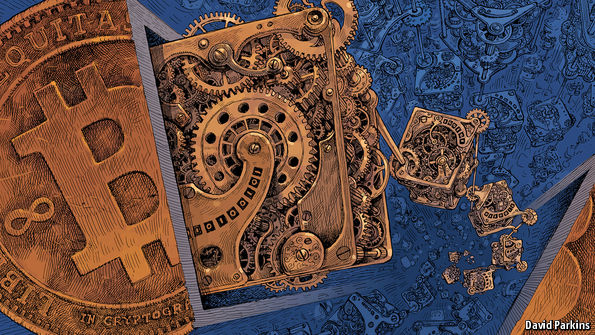

The great chain of being sure about things
by brandizzi
Adam Victor BrandizziSo, even The Economist is in love with blockchains now. Nice summary btw.
WHEN the Honduran police came to evict her in 2009 Mariana Catalina Izaguirre had lived in her lowly house for three decades. Unlike many of her neighbours in Tegucigalpa, the country’s capital, she even had an official title to the land on which it stood. But the records at the country’s Property Institute showed another person registered as its owner, too—and that person convinced a judge to sign an eviction order. By the time the legal confusion was finally sorted out, Ms Izaguirre’s house had been demolished.
It is the sort of thing that happens every day in places where land registries are badly kept, mismanaged and/or corrupt—which is to say across much of the world. This lack of secure property rights is an endemic source of insecurity and injustice. It also makes it harder to use a house or a piece of land as collateral, stymying investment and job creation.
Such problems seem worlds away from bitcoin, a currency based on clever cryptography which has a devoted following among mostly well-off, often anti-government and sometimes criminal geeks. But the cryptographic technology that underlies bitcoin, called the “blockchain”, has applications well beyond cash and currency. It offers a way for people who do not know or trust each other to create a record of who owns what that will compel the assent of everyone concerned. It is a way of making and preserving truths.
That is why politicians seeking to clean up the Property Institute in Honduras have asked Factom, an American startup, to provide a prototype of a blockchain-based land registry. Interest in the idea has also been expressed in Greece, which has no proper land registry and where only 7% of the territory is adequately mapped.
A place in the past
Other applications for blockchain and similar “distributed ledgers” range from thwarting diamond thieves to streamlining stockmarkets: the NASDAQ exchange will soon start using a blockchain-based system to record trades in privately held companies. The Bank of England, not known for technological flights of fancy, seems electrified: distributed ledgers, it concluded in a research note late last year, are a “significant innovation” that could have “far-reaching implications” in the financial industry.
The politically minded see the blockchain reaching further than that. When co-operatives and left-wingers gathered for this year’s OuiShare Fest in Paris to discuss ways that grass-roots organisations could undermine giant repositories of data like Facebook, the blockchain made it into almost every speech. Libertarians dream of a world where more and more state regulations are replaced with private contracts between individuals—contracts which blockchain-based programming would make self-enforcing.
The blockchain began life in the mind of Satoshi Nakamoto, the brilliant, pseudonymous and so far unidentified creator of bitcoin—a “purely peer-to-peer version of electronic cash”, as he put it in a paper published in 2008. To work as cash, bitcoin had to be able to change hands without being diverted into the wrong account and to be incapable of being spent twice by the same person. To fulfil Mr Nakamoto’s dream of a decentralised system the avoidance of such abuses had to be achieved without recourse to any trusted third party, such as the banks which stand behind conventional payment systems.
It is the blockchain that replaces this trusted third party. A database that contains the payment history of every bitcoin in circulation, the blockchain provides proof of who owns what at any given juncture. This distributed ledger is replicated on thousands of computers—bitcoin’s “nodes”—around the world and is publicly available. But for all its openness it is also trustworthy and secure. This is guaranteed by the mixture of mathematical subtlety and computational brute force built into its “consensus mechanism”—the process by which the nodes agree on how to update the blockchain in the light of bitcoin transfers from one person to another.
Let us say that Alice wants to pay Bob for services rendered. Both have bitcoin “wallets”—software which accesses the blockchain rather as a browser accesses the web, but does not identify the user to the system. The transaction starts with Alice’s wallet proposing that the blockchain be changed so as to show Alice’s wallet a little emptier and Bob’s a little fuller.
The network goes through a number of steps to confirm this change. As the proposal propagates over the network the various nodes check, by inspecting the ledger, whether Alice actually has the bitcoin she now wants to spend. If everything looks kosher, specialised nodes called miners will bundle Alice’s proposal with other similarly reputable transactions to create a new block for the blockchain.
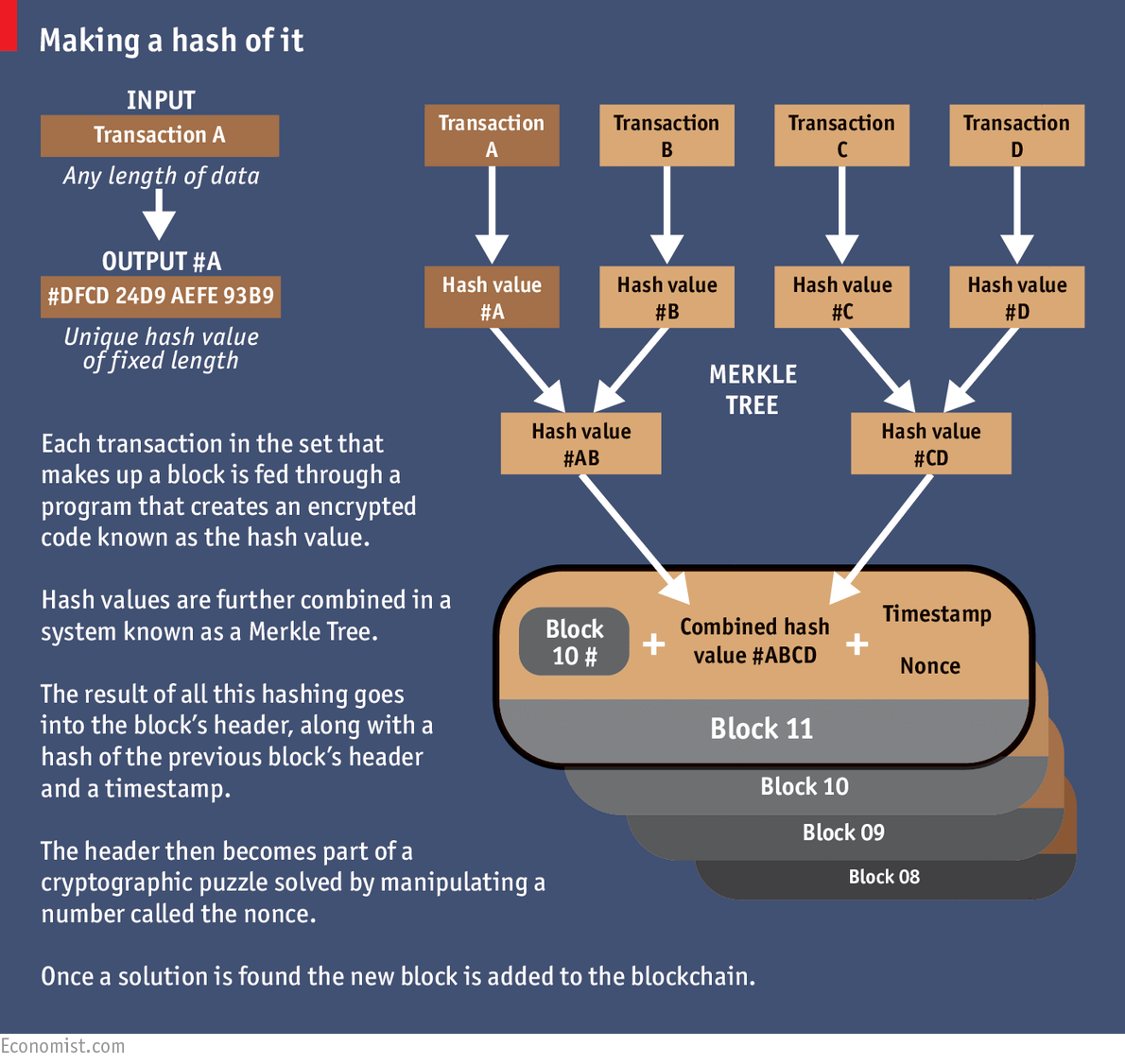
This entails repeatedly feeding the data through a cryptographic “hash” function which boils the block down into a string of digits of a given length (see diagram). Like a lot of cryptography, this hashing is a one-way street. It is easy to go from the data to their hash; impossible to go from the hash back to the data. But though the hash does not contain the data, it is still unique to them. Change what goes into the block in any way—alter a transaction by a single digit—and the hash would be different.
Running in the shadows
That hash is put, along with some other data, into the header of the proposed block. This header then becomes the basis for an exacting mathematical puzzle which involves using the hash function yet again. This puzzle can only be solved by trial and error. Across the network, miners grind through trillions and trillions of possibilities looking for the answer. When a miner finally comes up with a solution other nodes quickly check it (that’s the one-way street again: solving is hard but checking is easy), and each node that confirms the solution updates the blockchain accordingly. The hash of the header becomes the new block’s identifying string, and that block is now part of the ledger. Alice’s payment to Bob, and all the other transactions the block contains, are confirmed.
This puzzle stage introduces three things that add hugely to bitcoin’s security. One is chance. You cannot predict which miner will solve a puzzle, and so you cannot predict who will get to update the blockchain at any given time, except in so far as it has to be one of the hard working miners, not some random interloper. This makes cheating hard.
The second addition is history. Each new header contains a hash of the previous block’s header, which in turn contains a hash of the header before that, and so on and so on all the way back to the beginning. It is this concatenation that makes the blocks into a chain. Starting from all the data in the ledger it is trivial to reproduce the header for the latest block. Make a change anywhere, though—even back in one of the earliest blocks—and that changed block’s header will come out different. This means that so will the next block’s, and all the subsequent ones. The ledger will no longer match the latest block’s identifier, and will be rejected.
Is there a way round this? Imagine that Alice changes her mind about paying Bob and tries to rewrite history so that her bitcoin stays in her wallet. If she were a competent miner she could solve the requisite puzzle and produce a new version of the blockchain. But in the time it took her to do so, the rest of the network would have lengthened the original blockchain. And nodes always work on the longest version of the blockchain there is. This rule stops the occasions when two miners find the solution almost simultaneously from causing anything more than a temporary fork in the chain. It also stops cheating. To force the system to accept her new version Alice would need to lengthen it faster than the rest of the system was lengthening the original. Short of controlling more than half the computers—known in the jargon as a “51% attack”—that should not be possible.
Dreams are sometimes catching
Leaving aside the difficulties of trying to subvert the network, there is a deeper question: why bother to be part of it at all? Because the third thing the puzzle-solving step adds is an incentive. Forging a new block creates new bitcoin. The winning miner earns 25 bitcoin, worth about $7,500 at current prices.
All this cleverness does not, in itself, make bitcoin a particularly attractive currency. Its value is unstable and unpredictable (see chart), and the total amount in circulation is deliberately limited. But the blockchain mechanism works very well. According to blockchain.info, a website that tracks such things, on an average day more than 120,000 transactions are added to the blockchain, representing about $75m exchanged. There are now 380,000 blocks; the ledger weighs in at nearly 45 gigabytes.
Most of the data in the blockchain are about bitcoin. But they do not have to be. Mr Nakamoto has built what geeks call an “open platform”—a distributed system the workings of which are open to examination and elaboration. The paragon of such platforms is the internet itself; other examples include operating systems like Android or Windows. Applications that depend on basic features of the blockchain can thus be developed without asking anybody for permission or paying anyone for the privilege. “The internet finally has a public data base,” says Chris Dixon of Andreessen Horowitz, a venture-capital firm which has financed several bitcoin start-ups, including Coinbase, which provides wallets, and 21, which makes bitcoin-mining hardware for the masses.
For now blockchain-based offerings fall in three buckets. The first takes advantage of the fact that any type of asset can be transferred using the blockchain. One of the startups betting on this idea is Colu. It has developed a mechanism to “dye” very small bitcoin transactions (called “bitcoin dust”) by adding extra data to them so that they can represent bonds, shares or units of precious metals.
Protecting land titles is an example of the second bucket: applications that use the blockchain as a truth machine. Bitcoin transactions can be combined with snippets of additional information which then also become embedded in the ledger. It can thus be a registry of anything worth tracking closely. Everledger uses the blockchain to protect luxury goods; for example it will stick on to the blockchain data about a stone’s distinguishing attributes, providing unchallengeable proof of its identity should it be stolen. Onename stores personal information in a way that is meant to do away with the need for passwords; CoinSpark acts as a notary. Note, though, that for these applications, unlike for pure bitcoin transactions, a certain amount of trust is required; you have to believe the intermediary will store the data accurately.
It is the third bucket that contains the most ambitious applications: “smart contracts” that execute themselves automatically under the right circumstances. Bitcoin can be “programmed” so that it only becomes available under certain conditions. One use of this ability is to defer the payment miners get for solving a puzzle until 99 more blocks have been added—which provides another incentive to keep the blockchain in good shape.
Lighthouse, a project started by Mike Hearn, one of bitcoin’s leading programmers, is a decentralised crowdfunding service that uses these principles. If enough money is pledged to a project it all goes through; if the target is never reached, none does. Mr Hearn says his scheme will both be cheaper than non-bitcoin competitors and also more independent, as governments will be unable to pull the plug on a project they don’t like.
Energy is contagious
The advent of distributed ledgers opens up an “entirely new quadrant of possibilities”, in the words of Albert Wenger of USV, a New York venture firm that has invested in startups such as OpenBazaar, a middleman-free peer-to-peer marketplace. But for all that the blockchain is open and exciting, sceptics argue that its security may yet be fallible and its procedures may not scale. What works for bitcoin and a few niche applications may be unable to support thousands of different services with millions of users.
Though Mr Nakamoto’s subtle design has so far proved impregnable, academic researchers have identified tactics that might allow a sneaky and well financed miner to compromise the block chain without direct control of 51% of it. And getting control of an appreciable fraction of the network’s resources looks less unlikely than it used to. Once the purview of hobbyists, bitcoin mining is now dominated by large “pools”, in which small miners share their efforts and rewards, and the operators of big data centres, many based in areas of China, such as Inner Mongolia, where electricity is cheap.
Another worry is the impact on the environment. With no other way to establish the bona fides of miners, the bitcoin architecture forces them to do a lot of hard computing; this “proof of work”, without which there can be no reward, insures that all concerned have skin in the game. But it adds up to a lot of otherwise pointless computing. According to blockchain.info the network’s miners are now trying 450 thousand trillion solutions per second. And every calculation takes energy.
Because miners keep details of their hardware secret, nobody really knows how much power the network consumes. If everyone were using the most efficient hardware, its annual electricity usage might be about two terawatt-hours—a bit more than the amount used by the 150,000 inhabitants of King’s County in California’s Central Valley. Make really pessimistic assumptions about the miners’ efficiency, though, and you can get the figure up to 40 terawatt-hours, almost two-thirds of what the 10m people in Los Angeles County get through. That surely overstates the problem; still, the more widely people use bitcoin, the worse the waste could get.
Yet for all this profligacy bitcoin remains limited. Because Mr Nakamoto decided to cap the size of a block at one megabyte, or about 1,400 transactions, it can handle only around seven transactions per second, compared to the 1,736 a second Visa handles in America. Blocks could be made bigger; but bigger blocks would take longer to propagate through the network, worsening the risks of forking.
Earlier platforms have surmounted similar problems. When millions went online after the invention of the web browser in the 1990s pundits predicted the internet would grind to a standstill: eppur si muove. Similarly, the bitcoin system is not standing still. Specialised mining computers can be very energy efficient, and less energy-hungry alternatives to the proof-of-work mechanism have been proposed. Developers are also working on an add-on called “Lightning” which would handle large numbers of smaller transactions outside the blockchain. Faster connections will let bigger blocks propagate as quickly as small ones used to.
The problem is not so much a lack of fixes. It is that the network’s “bitcoin improvement process” makes it hard to choose one. Change requires community-wide agreement, and these are not people to whom consensus comes easily. Consider the civil war being waged over the size of blocks. One camp frets that quickly increasing the block size will lead to further concentration in the mining industry and turn bitcoin into more of a conventional payment processor. The other side argues that the system could crash as early as next year if nothing is done, with transactions taking hours.
A break in the battle
Mr Hearn and Gavin Andresen, another bitcoin grandee, are leaders of the big-block camp. They have called on mining firms to install a new version of bitcoin which supports a much bigger block size. Some miners who do, though, appear to be suffering cyber-attacks. And in what seems a concerted effort to show the need for, or the dangers of, such an upgrade, the system is being driven to its limits by vast numbers of tiny transactions.
This has all given new momentum to efforts to build an alternative to the bitcoin blockchain, one that might be optimised for the storing of distributed ledgers rather than for the running of a cryptocurrency. MultiChain, a build-your-own-blockchain platform offered by Coin Sciences, another startup, demonstrates what is possible. As well as offering the wherewithal to build a public blockchain like bitcoin’s, it can also be used to build private chains open only to vetted users. If all the users start off trusted the need for mining and proof-of-work is reduced or eliminated, and a currency attached to the ledger becomes an optional extra.
The first industry to adopt such sons of blockchain may well be the one whose failings originally inspired Mr Nakamoto: finance. In recent months there has been a rush of bankerly enthusiasm for private blockchains as a way of keeping tamper-proof ledgers. One of the reasons, irony of ironies, is that this technology born of anti-government libertarianism could make it easier for the banks to comply with regulatory requirements on knowing their customers and anti-money-laundering rules. But there is a deeper appeal.
Industrial historians point out that new powers often become available long before the processes that best use them are developed. When electric motors were first developed they were deployed like the big hulking steam engines that came before them. It took decades for manufacturers to see that lots of decentralised electric motors could reorganise every aspect of the way they made things. In its report on digital currencies, the Bank of England sees something similar afoot in the financial sector. Thanks to cheap computing financial firms have digitised their inner workings; but they have not yet changed their organisations to match. Payment systems are mostly still centralised: transfers are cleared through the central bank. When financial firms do business with each other, the hard work of synchronising their internal ledgers can take several days, which ties up capital and increases risk.
Distributed ledgers that settle transactions in minutes or seconds could go a long way to solving such problems and fulfilling the greater promise of digitised banking. They could also save banks a lot of money: according to Santander, a bank, by 2022 such ledgers could cut the industry’s bills by up to $20 billion a year. Vendors still need to prove that they could deal with the far-higher-than-bitcoin transaction rates that would be involved; but big banks are already pushing for standards to shape the emerging technology. One of them, UBS, has proposed the creation of a standard “settlement coin”. The first order of business for R3 CEV, a blockchain startup in which UBS has invested alongside Goldman Sachs, JPMorgan and 22 other banks, is to develop a standardised architecture for private ledgers.
The banks’ problems are not unique. All sorts of companies and public bodies suffer from hard-to-maintain and often incompatible databases and the high transaction costs of getting them to talk to each other. This is the problem Ethereum, arguably the most ambitious distributed-ledger project, wants to solve. The brainchild of Vitalik Buterin, a 21-year-old Canadian programming prodigy, Ethereum’s distributed ledger can deal with more data than bitcoin’s can. And it comes with a programming language that allows users to write more sophisticated smart contracts, thus creating invoices that pay themselves when a shipment arrives or share certificates which automatically send their owners dividends if profits reach a certain level. Such cleverness, Mr Buterin hopes, will allow the formation of “decentralised autonomous organisations”—virtual companies that are basically just sets of rules running on Ethereum’s blockchain.
One of the areas where such ideas could have radical effects is in the “internet of things”—a network of billions of previously mute everyday objects such as fridges, doorstops and lawn sprinklers. A recent report from IBM entitled “Device Democracy” argues that it would be impossible to keep track of and manage these billions of devices centrally, and unwise to to try; such attempts would make them vulnerable to hacking attacks and government surveillance. Distributed registers seem a good alternative.
The sort of programmability Ethereum offers does not just allow people’s property to be tracked and registered. It allows it to be used in new sorts of ways. Thus a car-key embedded in the Ethereum blockchain could be sold or rented out in all manner of rule-based ways, enabling new peer-to-peer schemes for renting or sharing cars. Further out, some talk of using the technology to make by-then-self-driving cars self-owning, to boot. Such vehicles could stash away some of the digital money they make from renting out their keys to pay for fuel, repairs and parking spaces, all according to preprogrammed rules.
What would Rousseau have said?
Unsurprisingly, some think such schemes overly ambitious. Ethereum’s first (“genesis”) block was only mined in August and, though there is a little ecosystem of start-ups clustered around it, Mr Buterin admitted in a recent blog post that it is somewhat short of cash. But the details of which particular blockchains end up flourishing matter much less than the broad enthusiasm for distributed ledgers that is leading both start-ups and giant incumbents to examine their potential. Despite society’s inexhaustible ability to laugh at accountants, the workings of ledgers really do matter.
Today’s world is deeply dependent on double-entry book-keeping. Its standardised system of recording debits and credits is central to any attempt to understand a company’s financial position. Whether modern capitalism absolutely required such book-keeping in order to develop, as Werner Sombart, a German sociologist, claimed in the early 20th century, is open to question. Though the system began among the merchants of renaissance Italy, which offers an interesting coincidence of timing, it spread round the world much more slowly than capitalism did, becoming widely used only in the late 19th century. But there is no question that the technique is of fundamental importance not just as a record of what a company does, but as a way of defining what one can be.
Ledgers that no longer need to be maintained by a company—or a government—may in time spur new changes in how companies and governments work, in what is expected of them and in what can be done without them. A realisation that systems without centralised record-keeping can be just as trustworthy as those that have them may bring radical change.
Such ideas can expect some eye-rolling—blockchains are still a novelty applicable only in a few niches, and the doubts as to how far they can spread and scale up may prove well founded. They can also expect resistance. Some of bitcoin’s critics have always seen it as the latest techy attempt to spread a “Californian ideology” which promises salvation through technology-induced decentralisation while ignoring and obfuscating the realities of power—and happily concentrating vast wealth in the hands of an elite. The idea of making trust a matter of coding, rather than of democratic politics, legitimacy and accountability, is not necessarily an appealing or empowering one.
At the same time, a world with record-keeping mathematically immune to manipulation would have many benefits. Evicted Ms Izaguirre would be better off; so would many others in many other settings. If blockchains have a fundamental paradox, it is this: by offering a way of setting the past and present in cryptographic stone, they could make the future a very different place.
This entry passed through the Full-Text RSS service - if this is your content and you're reading it on someone else's site, please read the FAQ at fivefilters.org/content-only/faq.php#publishers.
02 Nov 07:28

Why the yakuza are not illegal
by brandizzi
Adam Victor BrandizziA quite nice story there.
Subscribe now for unlimited articles on all devices.
SUBSCRIBE-
Subscribe now for unlimited articles on all devices
There's plenty more Economist content to read. Just click the link to subscribe today for unlimited access.
Subscribe now and enjoy full access to The Economist
-

Economist.com
Enjoy full access to Economist.com including blog content updated throughout the week and our extensive online archive.
-

The Economist
Read the full weekly edition in print, at Economist.com or via our apps for a range of mobile devices.
-

The Economist in audio
Listen at your leisure to each week's full weekly edition, read by professional broadcasters.
This entry passed through the Full-Text RSS service - if this is your content and you're reading it on someone else's site, please read the FAQ at fivefilters.org/content-only/faq.php#publishers.
02 Nov 07:28
AMBITION
by Platige Image
The short film created in collaboration with European Space Agency to celebrate their pioneer Rosetta mission, which objective is to land on a comet for the first time in human history.
For full credits visit
platige.com/en/page/474-Ambition_Film
More about the production and the mission at
ambitionfilm.com/
youtube.com/user/AmbitionTheFilm
twitter.com/AmbitionTheFilm
esa.int/Our_Activities/Space_Science/Rosetta
Cast: Platige Image
Tags: Platige Image, ESA, Aidan Gillen, Tomek Baginski, Ambition, Rosetta, space, cosmos, comet, exploration and sci-fi
Cooper Griggs, David Pelaez and -1 others like this
31 Oct 09:56


AEP : 16 histórias reais de Portugal mais engraçadas do que qualquer piada
Nesta quinta-feira (29), Nina Paduani contou no Facebook uma história que aconteceu durante a viagem de seus pais e tios a Lisboa.
Nos comentários da publicação original e nas de Alexandre Rosas e Rafael Capanema, redator do BuzzFeed Brasil, que compartilharam o post, outros brasileiros contaram suas experiências em Portugal. Selecionamos as histórias mais engraçadas.

Meus pais e meus tios estão em Lisboa. Vão ao restaurante almoçar. No final, o garçom pergunta:
—Café?
Meu pai:
— Um, por favor.
Meu tio:
— Dois!
Minha tia:
— Três!
Passam alguns minutos e lá vem o garçom.
Com seis cafés.

Querendo me informar mais sobre os acompanhamentos de um dos pratos de um restaurante em Alfama, perguntei ao garçom:
— Mas como vem esse bife aqui?
Ele prontamente me respondeu:
— Alguém o traz da cozinha!

Uma vez fui a um restaurante de um prato só que servia leitão à barraiada:
— Oi, como é o leitão à barraiada?
— Ora, não sabes o que é um leitão?
— Sim, mas o que é à barraiada?
— A região onde estamos.


Vmais / Getty Images
Meu padrasto estava em um ônibus em Portugal com a família e viram em um outdoor escrito algo como “Pasteizinhos de Belém, desde 1920” e uma foto dos pasteizinhos.
Ele comentou com a família, brincando:
— Olha, gente! Desde 1920!
No que uma senhora portuguesa interrompeu:
— Me perdoem, mas aqueles já foram comidos, chegando lá vão encontrar outros fresquinhos.

Um cliente estava indeciso sobre o que pedir. Viu um garçom passando com um prato que o agradou e falou para o que o atendia:
— Pode me trazer aquele.
A resposta do garçom:
— Não será possível porque aquele já é do senhor da mesa ao lado.

Minha amiga estava almoçando no mesmo restaurante que Fernando Pessoa frequentava assiduamente.
Como ela é formada em letras, com mestrado em literatura, estava mais interessada nas histórias do lugar do que na culinária.
No momento de escolher, chama o garçom e pergunta qual era o prato preferido de Fernando Pessoa. Sem pestanejar, ele responde:
— Já quebrou-se há muito tempo!

Estávamos num hotel em Lisboa e descemos pra fumar. Decidi ir até a recepção pra pedir um táxi. Perguntei à funcionária:
— Por favor, você poderia chamar um táxi pra mim?
A funcionária disse que sim, continuou a fazer o que estava fazendo e não chamou o táxi. Daí eu percebi que estava dentro da piada.
Voltei pra fora pra rir um pouco com minha amiga e voltei novamente pra recepção, como se nada tivesse acontecido.
Claro que ela poderia chamar um táxi, não havia nada que a impedisse de fazê-lo.
Daí eu falei:
— Eu preciso de um táxi agora.
E ela:
— Pois não, senhoire.
E ligou pro táxi. Fim.


Baixa, Lisboa Rrrainbow / Getty Images
Um dia em Lisboa eu parei um sujeito na rua e perguntei: “O senhor sabe como chegar no castelo de São Jorge?” Ele respondeu “sei!” e continuou andando.

Meus tios estavam passeando em Portugal e pediram a um senhor:
— Por favor, pode tirar uma foto?
— Claro!
Foi lá e abraçou a minha tia posando pra foto.

Eu estava saindo do hotel e perguntei a alguém:
— Esse ônibus parado aí passa no aeroporto?
O cara responde:
—Não, passa em frente a ele.

Uma vez eu pedi no balcão de uma confeitaria:
— O senhor me vê dois pasteis de Belém?
O cara foi, olhou e não pegou nada.
Eu perguntei:
— Os meus pastéis de Belém?
E ele:
— Ah, a senhora quer que eu lhe dê dois pasteis? Porque só me pediu que visse.

Um dia eu estava no aeroporto em Lisboa e ia pegar uma conexão para Londres.
Perguntei a uma senhora que trabalhava no aeroporto: “Londres é aqui?”.
Ela disse “aqui é Lisboa” e riu.

Fui numa doceria no Porto e perguntei para o garçom:
— Posso pedir aqui no balcão ou pode sentar na mesa?
Ele:
— Prefiro que você sente na cadeira mesmo.

Fui comprar pastéis de Belém no local onde eles são fabricados.
Lugar lotado, balconistas concentrados, atendendo todo mundo super rápido e com muita seriedade.
Os pastéis de Belém vêm (ou pelo menos vinham) numa caixinha sextavada de papelão.
Eu e minha mãe nos aproximamos do balcão e ela pergunta a um dos atendentes:
— Os pastéis de Belém são aquela caixinha?
O balconista responde:
— Não, senhora, é o que tem dentro!
Ele continuou os atendimentos super sério e eu e minha mãe caímos na gargalhada.

Num bar no centro histórico de Lisboa, uma brasileira entra e pergunta:
— Posso estacionar aqui na frente?
O balconista responde:
— Claro que pode. Só corre o risco de levar uma multa.


Azenhas do Mar Sean Pavone / Getty Images
Minha tia estava com uma amiga no restaurante. O garçom criou coragem e indagou:
— Que língua estás a falar que estou entendendo tudo?

Eu tive um professor de lógica que estudou por um tempo em Portugal e um dia ele disse à turma que português não é burro, e sim ‘lógico’. Depois que ele disse isso eu passei a ouvir essas histórias pensando de outro jeito.
Perdoem-me, mas nunca vi nada do género em tempo real, parece que só acontece na comunicação entre portugueses e brasileiros.
O erro está em pensarmos que somos a mesma língua quando na prática não é bem assim.
Também ponho a hipótese de que muitas vezes possa ser o humor português a atacar, é bem irónico e subtil, quando não se está familiarizado com a cultura não se distingue quando é brincadeira ou não.
Como portuguesa te digo que considero esta história perfeitamente possível e compreensível. Porque em Portugal não é comum que se faça pedidos dessa forma.
Normalmente cada um diz o que quer, o garçom que faz a soma. E a ele não cabe julgar se alguém quer encher-se de café ou não. Ele vai te dar exatamente o que pedires, mesmo que considere teu pedido um tanto estranho.
É verdade, somos bem mais literais que os brasileiros!

31 Oct 00:25

Optical Float Paintings Suspended in Layers of Glass by Wilfried Grootens
by Christopher Jobson

Artist Wilfried Grootens paints extraordinary figures comprised of dots and tendrils sandwiched between dozens of laminate glass layers. These strangely precise optical float paintings take on the form of some fantastic microscopic creatures and are sometimes reminiscent of the photos depicting the milliseconds before a nuclear explosion. The design of each cube is so precise, the thin layers of paint appear to completely vanish when viewed from a side angle.
At the age of 15 Grootens first apprenticed as a glass painter at the Derix Company in Germany where he learned to restore antique stained glass windows. Four years later he left on a near decade-long adventure to travel the world, play music, and experience the cultures of Asia and South America before eventually returning to his work with glass. In 1988, he received a Master Craftsman’s Diploma in Munich and by the following year had opened his own studio in Kleve.
Grootens will have work at the upcoming SOFA Expo Chicago through Habatat Galleries starting November 5th. (via ARTchung, Baby)

Where the Shark Bubbles Blow, 2012; 9.5 x 8.25 x 8.25 inches; optical float glass. Painted, laminated, polished.


Where the Shark Bubbles Blow 2015 PL 1 / Where the Shark Bubbles Blow E2 2015

Where the Shark Bubbles Blow III, 2013; 9.25 x 8.5 x 8.25 inches; optical float glass. Painted, laminated, polished.


Rob, Cooper Griggs and one other like this
30 Oct 18:24
The Scientist
by Nathan Kontny
Last week, Consumer Reports pulled their recommendation of Tesla's Model S, Elon Musk's electric car. Once touted as the best-performing car they ever tested, now it has a "worse-than-average" reliability rating. Actually this might not be that big of a blow to Tesla, yet. Typical Model S customers are folks who own two, three or more cars. The Model S is a novelty. If it doesn't work, they have something else to drive.
But Tesla is making a huge bet that their upcoming Model 3 will strike it big in the mainstream market with a price target of $35,000. That's a market where drivers often rely on a single car as their sole means of transport. One that would be less forgiving of reliability problems. If Tesla can't get it right now, can they satisfy an even more demanding crowd? Tesla's stock dropped 7%.
In 2004 at Burning Man, a yearly gathering in the Nevada desert, someone erected a 30 foot wooden pole with a dancing platform on top. Dozens of people failed to climb the pole. And then there's another who gives it his try. He doesn't look like someone who could climb it. And as he's trying, suspicions are confirmed. He's terrible and looks like he's about to fail. He hugs the pole the whole time as he squirms and inches his way up. With sheer determination he reaches the top of that platform. Who was he? Elon Musk.
That's one of many stories you can read in Elon Musk's recent biography from Ashlee Vance. And if you read some of these stories, like how he battled through getting fired from Paypal or survived a close-to-death case of malaria, you might come to the conclusion that it's his perseverance that will help him see Tesla out of this current predicament. But you'd be missing a key ingredient that makes Elon who he is.
My daughter is 17 months old. One of my favorite books we read to her is: This Moose Belongs to Me by Oliver Jeffers. It's a funny tale of a boy named Wilfred who finds a moose and declares the moose is his pet. He names him Marcel. Wilfred gives Marcel all sorts of rules on how to be a good pet. And Marcel does some of them very well. Marcel helps Wilfred stay dry in the rain, and helps him get to hard-to-reach places like apple trees. But Marcel is very poor at following most of the other rules. For example, he doesn't stay close to home. So Wilfred leaves a trail of string behind them as they play to help him find his way back.
One day, Wilfred and his moose happen upon a lady in the forest far from Wilfred's home. The lady starts calling the moose to her: Rodrigo! She thinks the moose is her pet. Wilfred is shocked. This isn't her moose. It's his and his name is Marcel! But the moose happily joins the lady to eat an apple she has for him despite Wilfred's protests. Wilfred fumes and storms off home. But on his way, in his anger, he gets tangled into the string he left behind. Now he's stuck, lost in the woods, and it's becoming night, where all sorts of terrible things could happen. The outcome looks grim.
But along comes the moose who helps Wilfred out of his predicament and carries him back home. Wilfred begins to realize he never really owned the moose. So he and the moose reach a compromise:
The moose would agree to all of Wilfred's rules… whenever it suited him.
Wilfred realized the bigger goal was having a relationship with a wild moose at all. So instead of persisting at a myopic goal, Wilfred had to learn to adapt. First he adapted his surroundings to fit his predicaments. Marcel wouldn't stay close to home, so he used string to help retrace his steps. But even that wasn't enough. Wilfred couldn't bend the moose to his will, so instead of persisting, he quit being so narrow sighted, took a step back to figure out what he truly wanted, and adapted himself to achieve it.
A lot of people are also now familiar with one of Elon Musk's other businesses: SpaceX. Making rockets, Elon has his eyes on sending humans to Mars. Many folks don't realize SpaceX originally started with a goal of sending mice to Mars to watch them procreate. When Elon realized the high costs and the minimal practical value of the experiment, he adapted. He came up with a new idea to send a greenhouse to Mars to study how to grow things in the harsh environment. So he set out trying to get a rocket to ship the greenhouse. But then he bumped into a new obstacle.
Russia was the only place to buy a suitable rocket, and the Russians knew it. And, just like any monopoly, they were going to milk him for as much money as they could.
So he took a step back from his narrow sighted goal, realized what he truly wanted was to get humans into outer space again on a regular basis, then he quit the project all together, and adapted. He decided to just build his own rocket. But rockets cost a lot of money, a lot more money than even Elon has. He decided that SpaceX needed to become the go-to company to help folks launch small objects and satellites to space.
Except, one more wrinkle. Turns out, there isn't enough money in the launching-small-stuff-to-space business to keep SpaceX afloat.
I was emotional about it and disappointed. I’d anticipated a flood of orders but, after eight years, they just did not come.
So they had to adapt. They started making bigger rockets. And now SpaceX is getting into the business of making their own telecommunications network in space.
On and on they adapt. Elon Musk doesn't just persist at a tiny goal. He creates big, large goals, and he adapts everything else around him and himself to reach them.

Guppies are one of the most popular fish in freshwater aquariums. Makes sense. They're colorful and come in so many varieties. They are also found all over the world in wild habitats.
But you might wonder, how could these beautiful fish even survive in the wild? These aren't big fish. They aren't poisonous. They don't have any defense mechanisms that make them vicious fighters. Wouldn't their bright colors actually attract predators who'd destroy their populations?
John Endler, an evolutionary biologist, made an interesting discovery in the 1970s as he examined guppy populations in Trinidad, an island off the coast of Venezuela. Endler found that guppies, even living in the same exact body of water, had remarkable variety. As he studied them closer he noticed that many of the guppies upstream who were protected from predators via a waterfall barrier, were shiny, and beautifully colored. Downstream though, below the waterfall, where predators were more prevalent, the guppies were drab, and had coloring that closely matched the muddy environment of the water.
He was seeing evolution play out in a single body of water. That's unusual. Evolution usually plays itself out over many years. So he and others followed his discovery with numerous experiments using guppies to show how evolution works in a laboratory. He would recreate these conditions, and as soon as he introduced predators in a pool of guppies who were beautifully colored, the guppy population would quickly become drab and their scales would begin to match whatever was the material the laboratory pool was made of.
But if you think a little deeper about evolution, that's actually a bit depressing. Because it wasn't an individual guppy that was adapting. That's not how evolution works. Guppies, by the luck of who their parents were and what DNA they had, were either born shiny and brightly colored or drab. It's just that if a predator was eating beautiful guppies, the drab ones lived on, procreated, and made more drab guppies. It was the population that was adapting.
It's too early to call Tesla's fate. But if you've watched them already, they aren't just making cars. They sell their batteries to consumers and businesses. They sell their car parts to other large car companies like Toyota and Daimler. They're making their own "gas stations" of the future. And before you know it, they might even have the energy company of the future – turning their factories into giant energy stores and supplying electricity from solar energy.
Elon will figure out how to adapt the company to get back their reliability. But I also wouldn't be surprised to hear one day if Tesla gave up selling their own car altogether and focused instead on moving other car companies over to electric. Because that's a bigger end goal.
Elon persists through obstacles. But he's also a quitter. He changes. He adapts. If something gets in his way, instead of plowing through it, he steps back to look to see if there's actually something much more worthwhile to attack. And he adapts himself to go there. He gives himself more opportunities. Because here's the thing. In this story…
We aren't the guppies. We're the scientist.
P.S. You should follow me on Twitter for more stories: here.
Adam Victor Brandizzi likes this
30 Oct 16:36
My Brain is an Asshole
by boulet
Adam Victor BrandizziMinha vida 2


RC, cookiestork and one other like this