Shared posts

19 Apr 02:03

archiemcphee: Anthropomorphism + Wordplay = AwesomeWe’ve...


archiemcphee:

Anthropomorphism + Wordplay = Awesome

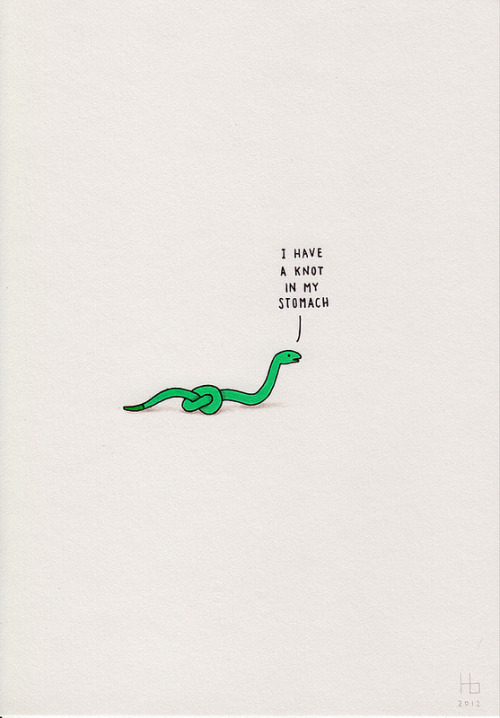
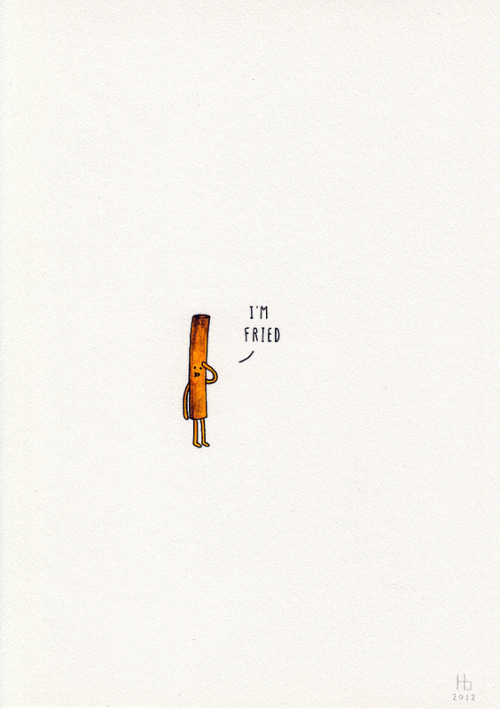
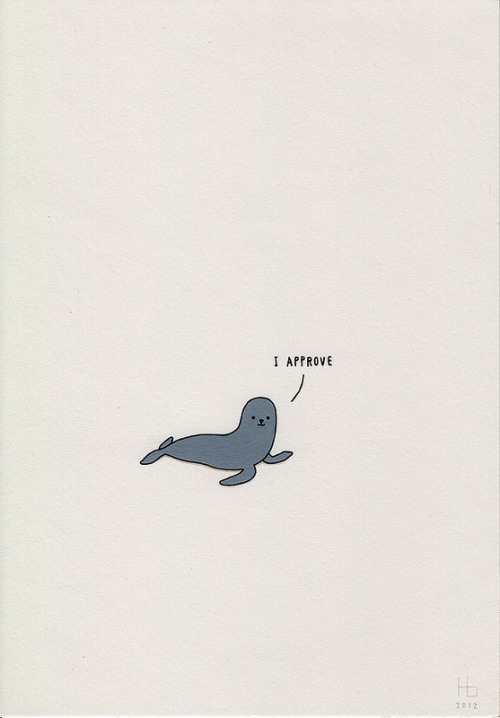
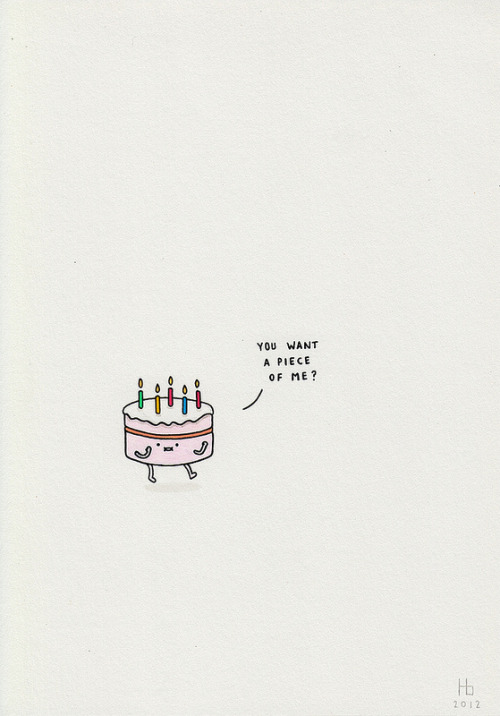
We’ve already got a soft spot for anthropomorphic food so we love these playful minimal ink and acrylic illustrations created by Cape Town, South Africa-based illustrator and designer Jaco Haasbroek. From a bellicose birthday cake to what may be the world’s official all-purpose seal of approval, the series depicts adorably personified Food, Objects and Animals either speaking or captioned by painfully cute puns and other sorts of wordplay.

Click here to view the entire series.

To check out more of his work visit Jaco Haasbroek’s website, Flickr page, Instagram feed or follow him right here on Tumblr at haasbroek.

[via Free York]

18 Apr 23:16

esesokay: autumnyte: When I was younger, I wish someone had told me straight-up that not all...

esesokay:

autumnyte:

When I was younger, I wish someone had told me straight-up that not all adults experience “a calling”. That many of them never find particular purpose in a career. That sometimes, their job is just what pays the bills and they have to seek satisfaction and fulfillment elsewhere. 

Because as an adult, this pervasive notion that there exists a perfect path for everyone, that people should love what they do, and that work is meant to function as a vehicle for fulfilling a person’s grand life destiny is not only inaccurate for many of us, it can be toxic.

The ideal is so ingrained that I have to remind myself constantly I’m not a failure because I don’t adore my job, and because I’m not rocking the world with my work. That is okay

Sometimes, work is just work. There isn’t always a perfect career path, magically waiting to be discovered. There might not be this THING you were born to do. Sometimes, you discover that what you really want to be when you grow up is “paid”.

It’s true. Capitalism only functions bc it needs the majority of people to struggle and not have access to fruitful, materially compensated (passion) work and livelihoods.

This is something i think about a lot w my first generation class and education privilege.

18 Apr 22:47

Pedi-Scope is a heads-down display for cyclists

by Ben Coxworth

The Pedi-Scope lets riders rest their neck while still seeing what's on the road ahead

As many bike riders will know, sustained cycling can end up being a pain in the neck – literally. Tilting your head down toward the ground can provide temporary relief from that pain, but then you're not able to see where you're going ... unless you're using a Pedi-Scope, that is. .. Continue Reading Pedi-Scope is a heads-down display for cyclists

Section: Bicycles

Tags: Comfort, Cycling, Kickstarter

Related Articles:
18 Apr 22:44

Awwww, fee fees. #sadtrombone #THECLOUDISALIE (at Teh Interwebs)


Awwww, fee fees. #sadtrombone #THECLOUDISALIE (at Teh Interwebs)

18 Apr 22:38

15 Most Magnificent Train Routes Around The World

by Aleksandar Ilic
Feature

Some people consider traveling an unnecessary burden that you have to deal with from time to time out of sheer necessity. On the other hand, people who possess that spark of true wanderers and explorers can’t get enough of it. Wanderlust is the word that is most commonly used to explain the state of mind of these people are in. This incredible passion for traveling, experiencing new cultures and civilizations, and seeing new scenery is not easily quenched but also brings a lot of benefits for the traveler as a person. Modern means of transportation, like airplanes, are hardly a good choice when you are traveling with this specific purpose in mind.

This is why people like to take trains when traveling for the sake of traveling. Trains have always had that certain level of causality, as well as the air of mystique that makes them a desirable means of transportation. They are far more comfortable than buses, cars or airplanes, and they provide you with the opportunity to really enjoy magnificent sites during your travels. For this reason, we have decided to compose a list of the most beautiful train routes from around the globe, attempting to provide an option for anyone to experience a stunning train ride that will last through the ages.

1. Bergen Railway, Norway

1. Bergen Railway, Norway

Not many people living outside of Europe are aware how beautiful the scenery of Scandinavia really is. Riding from Bergen to Oslo, you will experience beautiful sights and the environment will change seemingly as if the seasons are changing as you go along. Beautiful fjords, snowy mountaintops and stunning grassy plains will compose this scenery.

2. West Rhine Railway, Germany

2. West Rhine Railway, Germany

Most travellers that go to Germany focus on Berlin and its immense history, high culture and vast cultural life. Still, Germany has a lot more to offer and one of the more beautiful parts is its wine country, the highlight of which is the Rhine valley.  The railroad stretches from Mainz to Koblenz and there are a lot of things to see along the way.

3. Bernina Express Railway, Switzerland to Germany

3. Bernina Express Railway, Switzerland to Italy

The route this train ride will take you through is part of the Swiss Alps and has been put under official the protection of UNESCO as a world heritage. The Bernina Express Railway will take you through the magnificent scenery of the Swiss countryside, lakes and breath-taking glaciers. We recommend taking panorama cars for the best experience possible.

4. Christchurch to Greymouth Railway, New Zealand

4. Christchurch to Greymouth Railway, New Zealand

After the European Alps, let’s pop off to the Southern Alps train ride in New Zealand. If you take a train from Christchurch to Greymouth, you are in for a treat. Canterbury plains and the Waimakariri River, with its beautiful gorges await you along with the magnificent view over the Southern Alps, which will spread out before you.

5. Douro Line Railway, Portugal

DCF 1.0

Back to Europe, to north Portugal to be more specific. This scenic railroad line got its name from the Douro river and was first started in 1887. It follows the river the majority of the way and it’s a big part of the landscape you are going to feast your eyes on. The valley is also a key element of the picturesque scenery that this ride has to offer.

6. The Royal Scotsman, Scotland

6. The Royal Scotsman, Scotland (2)

If you want a top-class luxurious experience, then you are going to enjoy the one The Royal Scotsman has to offer. Even the name itself echoes luxury and elegance! Take a trip from Edinburgh and enjoy the magnificent Scottish Highlands along with its lochs and beautiful green landscapes. The train itself is high quality and ensures maximum comfort.

7. The Sunset Limited, USA

7. The Sunset Limited, USA

When it comes to legendary sceneries in the USA, there is nothing more iconic than its deserts which always brings scenes from western movies to mind. There is simply something beautiful in the ruggedness of the desert and there is no better way to experience it than from the seat on The Sunset Limited! The train goes from Los Angeles and New Orleans and you are going to enjoy every minute of this 48 hour journey.

8. The Danube Express, Hungary to Turkey

8. The Danube Express, Hungary to Turkey

Another luxurious train ride that starts from Eastern Europe, in Budapest, all the way to the oriental Istanbul in Turkey. One of the countries that this very unique line passes through is Transylvania (Romania), home of the famous Vlad Tsepesh, more popularly known as Dracula and see the castle of the historical figure that the legendary vampire character was based on. The journey ends in Istanbul where you should visit the famous Haydarpaşa Terminal, one of the more famous train stations in the world.

9. Al Andalus Express, Spain

9. Al Andalus Express, Spain

Andalusia, a region of southern Spain, is considered one of the more beautiful landscapes in the world. Ever since 1930, Al Andalus Express has been giving people the opportunity to experience the Andalusia in a breath-taking and relaxing manner. This six-day journey starts from Seville and ends in Cordoba.

10. Maharajas’ Express, India

10. Maharajas' Express, India

If you want to see the extravagant side of India, the Maharajas’ Express is the best option for you. This train ride has been titled “World’s Leading Luxury Train” and “World’s Most Expensive Luxury Train in Asia”, and these titles talk volumes about the quality of service and accommodation during the trip. From Mumbai to Delhi, prepare to be amazed!

11. Denali Star Route, Alaska

11. Denali Star Route, Alaska

There are very few places in the world that can match the primal beauty of the Alaskan landscapes. The route that the Denali Star takes will take you through many charming small towns and villages as well and bring you to the magnificent Denali National Park. The entire trip is over within a day, but keep in mind that this is a 12 hour expedition.

12. Talyllyn Railway, Wales

12. Talyllyn Railway, Wales

Ok, if you are a train enthusiast, then you certainly know about the Thomas the Tank Engine book and TV show. What if a I told you that you could ride the line that served as an inspiration for this character. Enjoy a charming ride through the Fathew Valley riding on a steam powered train line that dates all the way back to 1865.

13. Trans-Siberian Railway, Russia

13. Trans-Siberian Railway, Russian

One of the legendary train rides that isn’t recommended for novices. The 5,772 miles journey from Moscow, on the west of the country to Vladivostok in the east take somewhere around 13 days to complete in its entirety. An ominous number isn’t it? This is a real adventure through one of the harshest regions of the world.

14. Hiram Bingham, Peru

14. Hiram Bingham, Peru

South America always had a certain veil of mystery with legends about its rainforests, tribes and so on. One of the most famous archaeological sites of the pre-Columbian Peru is the citadel Machu Picchu. The Hiram Bingham train route can take you around the mountain in a journey that lasts six hours and includes exploring all the best sites.

15. Durango & Silverton Railroad, USA

15. Durango & Silverton Railroad, USA

This classic American train has been proclaimed “Best North American Train Trip” by National Geographic Traveller. The train route has been around since 1881 and travels a 45 mile journey between Durango and the town of Silverton.

The thing that makes train vacations a good idea is the fact that they can be a perfect summer or winter vacation and the dispute concerning which is better has gone on for ages. Pictures are worth a thousand words and experiences vary from train to train. The thing that is definitely true is that you will remember them for the rest of your life and once you try a scenic train journey, you will always love it.

The post 15 Most Magnificent Train Routes Around The World appeared first on Lifehack.

LifeHack?d=qj6IDK7rITs LifeHack?d=I9og5sOYxJI LifeHack?i=xi33IeQb3Dc:LJunlkDh8eg:gIN9v LifeHack?d=cGdyc7Q-1BI LifeHack?d=yIl2AUoC8zA
17 Apr 22:30

will5nevercome: Aww, cheer up! You’re not even close to rock...


will5nevercome:

Aww, cheer up! You’re not even close to rock bottom yet!

17 Apr 22:25

Classic: For a While, This Guy Had the Lowest Voice in all of Music

Submitted by: (via Jim Kidman)

Tagged: Music , bass , Video , g rated , classic , win
17 Apr 22:24

The Murky Law on Free-Range Kids

by Amanda Kolson Hurley
Image

On April 12, it happened again: Rafi and Dvora Meitiv, the “free-range kids” of Silver Spring, Maryland, were picked up and detained by police. The siblings, aged 10 and six, were playing unsupervised in their neighborhood when a man walking his dog spotted them and called the authorities.

Back in December, Rafi and Dvora made national headlines when police picked them up as they walked home from a local park. The children’s parents, Danielle and Alexander Meitiv, subscribe to the philosophy of “free-range” parenting, which holds that children develop self-reliance by exploring their neighborhoods or riding public transportation on their own, if their parents judge them ready. (Disclosure: the Meitiv children attend the same school as my son, though I don’t know them or their parents.)

After the first incident, Montgomery County Child Protective Services investigated and found the senior Meitivs responsible for “unsubstantiated neglect.” Now an attorney for the couple says they will file a lawsuit over their family’s treatment. In fact, the law is not clear on free-range parenting in the state of Maryland, or anywhere else in the country: states and cities generally do not specify the youngest age at which a child can play or walk outside alone.

A few states have laws stipulating the minimum age when a child can be left home alone. In Illinois it is 14, in Maryland, eight, and in Oregon, 10. Maryland’s law further stipulates that a young child left in the care of a person under 13 is “unattended.” Many more states offer home-alone guidelines, which vary as widely as the laws do (age six in Kansas, age 12 in Mississippi).

In North Carolina, the state fire code prohibits leaving children younger than eight home alone. Rarely, a city will have its own ordinance establishing the home-alone age, as Albuquerque does (the age there is 10). In most cases, whether such home-alone rules extend to outdoor spaces is something lawyers could argue either way.

It is possible to see public spaces as being just as safe, or even safer, than private ones.

Although the reaction to the Meitivs’ case has been largely sympathetic, the relative safety of their neighborhood—in a middle-class inner suburb of Washington, D.C.—has been a topic of debate. The police incident report from Sunday referred to “a homeless subject” near the children who was “eyeing” them. A Washington Post columnist worried that the Meitiv kids were not safe walking down Georgia Avenue, a busy road. Internet commenters went back and forth over whether the kids had been playing in a parking garage and how safe that could have been.

Defenders of free-range parents point out that child pedestrian deaths and violent crime in general have actually declined over the last few decades, while the risk of stranger abduction is infinitesimal. And it is possible to see public spaces as being just as safe, or even safer, than private ones. “Eyes on the street” can be protective—as shown, ironically, by the worried passersby who keep calling the police on the Meitivs. A child who is injured in a public place would arguably be more likely to get immediate help than a child who is injured at home, with no adult around.

This difference in perceptions matters, because CPS officers have a great amount of leeway in determining neglect. Laws regarding unsupervised kids are “intentionally vague, because there are so many contextual and fact-specific determinants” to each case, says Vivek Sankaran, who directs the University of Michigan’s Child Advocacy Law Clinic and the Detroit Center for Family Advocacy. “The downside is, it gives parents very little guidance about when they can get into trouble.”

In Maryland as elsewhere, CPS caseworkers weigh numerous factors in such cases, such as a child’s apparent well-being, maturity level, and the length of time for which he or she was left unsupervised. “It’s an incredibly subjective process,” Sankaran says. “There’s a wide degree of discrepancy and variance in some of the decision-making you see in CPS.”

The perceived risk of being at the playground, or walking by the side of the road, may be taken into account too. In other words, if a caseworker (or a judge) thinks a certain neighborhood isn’t safe, or that public spaces in general pose dangers for kids, that can count against “free-range” parents.

Would the Meitivs’ case have been handled differently if the kids had been walking in a subdivision with no busy roads and no homeless people? It seems possible. But families like the Meitivs aren’t usually the ones caught up in the system. Low-income parents who can’t afford child care, or who struggle to arrange it around unpredictable work schedules, may leave their children unsupervised out of necessity rather than on principle. Remember Debra Harrell, the South Carolina mother who got arrested because she let her nine-year-old play in a park as she worked at a McDonald's?

Low-income neighborhoods can also have a higher presence of police and social workers, raising the odds that parents there get reported. As Sankaran notes, these parents are also far less likely to benefit from the presumption that they are making good decisions for their kids.

The answer is not a brighter legal line on the right age to range freely—kids really are too different for that—but a more collaborative child-welfare model. “We should not be taking kids away from situations where reasonable minds honestly disagree” about parenting decisions, Sankaran says. “We should reserve coercion for those extreme situations where … it’s below the standard that any parent should be treating this child.”

Top image: Damon Shaff / Shutterstock.com


17 Apr 22:21

I got it! I got it!… What the hell is this?


I got it! I got it!… What the hell is this?

17 Apr 22:19

Photo


17 Apr 22:17

"The claim that a company like McDonald’s can’t afford to pay wages over the minimum is absolutely..."

The claim that a company like McDonald’s can’t afford to pay wages over the minimum is absolutely insulting when you compare the salary of its CEO to one of its crew members.

I worked at a McDonald’s in New York over the summer and did a little math while I was there. In 2011, former McDonald’s CEO James Skinner made $8.75 million with compensation, according to data compiled by Bloomberg. In comparison, crew members made $7.25 an hour, for about $15,000 a year, if they stayed at the job year-round.

If you take Skinner’s total salary in 2011 and assume that he worked 40-hour week, he would have made $4,200 an hour. In one hour, he made 580 times more than the average McDonald’s worker. James Skinner made $33,600 a day, which is twice the salary tht a McDonald’s crew member makes in a year of full-time work.

Looking at it another way, the average worker would have to work for almost 600 years to make the salary that Skinner made in 2011. In one year, Skinner makes more than I could make in at least six lifetimes.


- Maximum lies about the minimum wage | Socialist Worker | Samantha Valente (via meridithv)
17 Apr 22:16

Photo


17 Apr 22:15

AMB House / Bernardes + Jacobsen Arquitetura

by AD Editorial Team

Architects: Bernardes, Jacobsen Arquitetura
Location: Guarujá – SP, Brazil
Architect In Charge: Paulo Jacobsen
Design Team: Fabiana Porto (coordinator), Edgar Murata, Henrique Carvalho, Marina Nogaró.
Area: 810.0 sqm
Year: 2011
Photographs: Leonardo Finotti

Interior Design: Bernardes + Jacobsen Arquitetura
Team: Eza Viegas (author), Tatiana Kamogawa
Landscape: Jundu Paisagismo
Lighting Design: Lightworks – Airton Pimenta
Facilities: Grau Engenharia
Air Conditioning: Grau Engenharia
Structure: Leão & Associados
Construction: EUM
Site Area: 1310m²

From the architect. The AMB House is situated on the coast of São Paulo, Guaruja City in the middle of the Atlantic Forest. From the street you can only see one of the three floors of the house because the terrain has accentuated slopes that give different views of an almost untouched natural landscape.

The most common situation, where the rooms are upstairs and social rooms are downstairs, was reversed on the design of this residence. On the entrance of the house we have a hall that serves as a mezzanine overlooking the double ceiling living room with proximally 6,00m height and wood frame glass windows with a view looking at the swimming pool and the forest. In the lateral of the hall, the balcony outside is surrounded by large wooden bench, serving as a protection.

In the intermediate floor are the social areas: the living room and dining room, which join the outdoor kitchen, outdoor deck and infinity swimming pool. Downstairs is the intimate area with five suites. It is this strategy of reversing the usual array of social and intimate area that makes the rooms, even overlooking the sea, have the privacy afforded by the trees that are at that level.

The house can be called the balcony house with large glass panels that allow visual contact with the surrounding areas of the residence and the natural landscape of the region. The windows of the rooms have wooden Cumarú shutters .This wood is also present on the deck of the balconies and floors of rooms.  In the living room two bamboo plants sprout from the middle of the floor, bringing the forest into the house

This is how the house shows its relationship with the local landscape, barely visible through the dense forest in the access road, but grows and can be seen on the other side along with the look of a coastline and a stunning tropical forest.

AMB House / Bernardes + Jacobsen Arquitetura © Leonardo Finotti AMB House / Bernardes + Jacobsen Arquitetura © Leonardo Finotti AMB House / Bernardes + Jacobsen Arquitetura © Leonardo Finotti AMB House / Bernardes + Jacobsen Arquitetura © Leonardo Finotti AMB House / Bernardes + Jacobsen Arquitetura © Leonardo Finotti AMB House / Bernardes + Jacobsen Arquitetura © Leonardo Finotti AMB House / Bernardes + Jacobsen Arquitetura © Leonardo Finotti AMB House / Bernardes + Jacobsen Arquitetura © Leonardo Finotti AMB House / Bernardes + Jacobsen Arquitetura © Leonardo Finotti AMB House / Bernardes + Jacobsen Arquitetura © Leonardo Finotti AMB House / Bernardes + Jacobsen Arquitetura © Leonardo Finotti AMB House / Bernardes + Jacobsen Arquitetura Site Plan AMB House / Bernardes + Jacobsen Arquitetura Floor Plan AMB House / Bernardes + Jacobsen Arquitetura Floor Plan AMB House / Bernardes + Jacobsen Arquitetura Floor Plan AMB House / Bernardes + Jacobsen Arquitetura Section AMB House / Bernardes + Jacobsen Arquitetura Section
17 Apr 22:14

The Hotel from Twin Peaks Is Offering a Package for Superfans

In the spring of 1990, David Lynch and Mark Frost’s ABC series Twin Peaks made the question of who killed Laura Palmer the talk of the water cooler every Friday morning—or, for those of us who were just 14, the talk of homeroom. (The query was soon joined by discussions of who shot Agent Cooper, what happened to Josie, and whether it was really plausible that Icelanders were so excited about vacation property in the Pacific Northwest.) While the show was set north of Spokane, much of it was filmed in the greater Seattle area, with the hills, woods, waterfalls, diners, and lumber offices around Snoqualmie and North Bend playing starring roles. Twenty-five years later, many of those spots still welcome fans old and new, enticing them with photo ops and cherry pie specials.

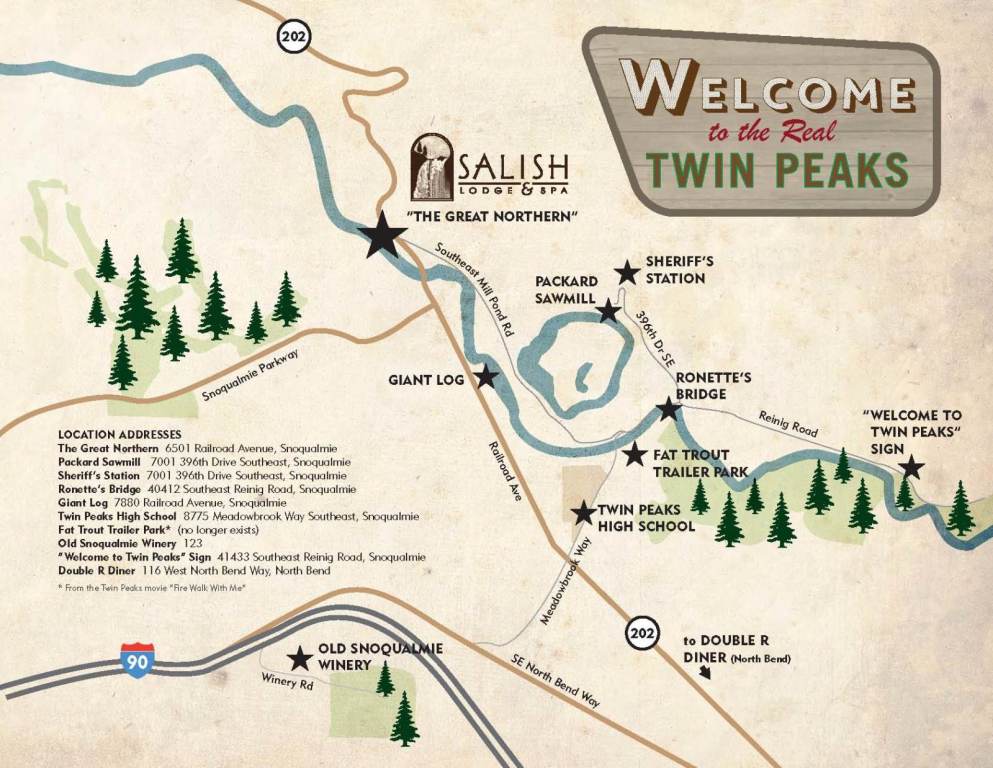
Used as the exterior for the fictional Great Northern Hotel*, the Salish Lodge seemed a little too classy to lure guests with its TV connection. But with interest growing in a Showtime reboot next summer (after the new episodes were announced last October, tickets for this summer’s weekend-long Twin Peaks Festival sold out almost immediately), the luxury spa perched over Snoqualmie Falls 30 minutes east of Seattle is embracing its role on the show. The price of its new Great Northern Escape package (starting at $279–459, depending on the night) reminds you that you’re at a luxe spa resort, not the mere “clean place, reasonably priced” sought by Agent Cooper on the show, but it does come with cherry pie and “damn fine coffee” for two in the Attic, a $15 Amazon gift card (which the hotel notes you could use to stream the show), a map of local shooting locations (see below), and two Dale Cooper gin cocktails. While you drink them, you might discuss Cooper portrayer Kyle MacLachlan’s Washington roots and Walla Walla–area wine label, or when, if ever, Agent Cooper ever took a drink on the show. (Did he have a sip of that traveling judge’s crazy punch?)

The gift shop also offers Twin Peaks souvenirs: a range of prints, a coffee mug, cherry pie filling, and other items. Not all of them nail the aesthetic or spirit of the show (Twin Peaks owls should be creepy like on the button set, not cutesy like on the art print), but they’d still make nice gifts for the zealot in your life.

The true test of any hotel, of course, according to Agent Cooper, is that morning cup of coffee. We’ll have to get back to you on that one.

*Alas, guests can’t stay in Agent Cooper’s room or tour Ben Horne’s office at the Salish Lodge. The interiors for the Great Northern were initially shot at Poulsbo, Washington’s Kiana Lodge (along with several outdoor scenes at the Packard house, including the beach where Laura Palmer’s body washed up, wrapped in plastic), and then filmed on soundstages in LA.

Every other Tuesday: Weekend escapes, travel deals, lodging and dining picks, and ideas for Northwest getaways. (See an example!) 
17 Apr 22:13

al-grave:“What do you play?”“The Clarinet, you?”“I play the...


al-grave:

“What do you play?”

“The Clarinet, you?”

“I play the fucking HAMMER

17 Apr 22:08

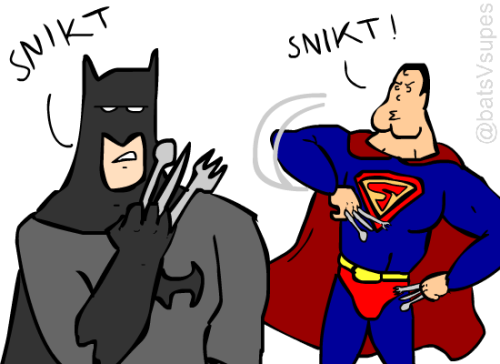
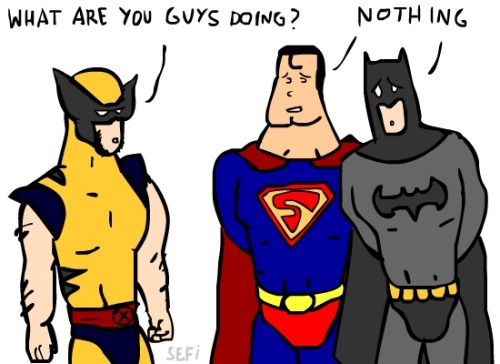
batsvsupes: SNIKT


batsvsupes:

SNIKT

17 Apr 21:55

"And no, before you ask, it’s not possible to take time off from work to go to the doctor. Employers..."

“And no, before you ask, it’s not possible to take time off from work to go to the doctor. Employers are often highly resistant to this and aside from the loss of wages, employees may face retaliation for asking for time off to go to their psychiatrists and other mental health care providers. It doesn’t matter if such retaliation is illegal — even if someone could afford to retain an attorney, employers are adroit at finding reasons to explain why, for example, they cut an employee’s hours or moved her to a different shift with fewer tips, leaving her making less at the end of the week.”

- Affordability isn’t the only barrier to mental health care for low-income people | this ain’t livin’ (via feministlibrarian)
17 Apr 21:52

Photo


17 Apr 21:39

Bat loves stuffing its little face with grapes

by Xeni Jardin

A recently rescued Grey-Headed Flying Fox enjoys gorging on grapes. All of the grapes. (more…)

17 Apr 12:34

Traitors in our midst

by PZ Myers

confederacy

I tend to be suspicious of theories that explain everything all at once, but this discussion of the Civil War really flicked on a light bulb for me. Once this model is in your head, it puts a lot of things into a new configuration that makes sense: modern racial oppression, the Tea Party, the Birther movement, and why I’ve never been able to sit through Gone With The Wind without stomping out in a rage. We lost the Civil War. The Confederacy is still pulling strings.

The Civil War was easy to misunderstand at the time, because there had never been anything like it. It was a total mobilization of society, the kind Europe wouldn’t see until World War I. The Civil War was fought not just with cannons and bayonets, but with railroads and factories and an income tax.

If the Napoleonic Wars were your model, then it was obvious that the Confederacy lost in 1865: Its capital fell, its commander surrendered, its president was jailed, and its territories were occupied by the opposing army. If that’s not defeat, what is?

But now we have a better model than Napoleon: Iraq.

After the U.S. forces won on the battlefield in 1865 and shattered the organized Confederate military, the veterans of that shattered army formed a terrorist insurgency that carried on a campaign of fire and assassination throughout the South until President Hayes agreed to withdraw the occupying U. S. troops in 1877. Before and after 1877, the insurgents used lynchings and occasional pitched battles to terrorize those portions of the electorate still loyal to the United States. In this way they took charge of the machinery of state government, and then rewrote the state constitutions to reverse the postwar changes and restore the supremacy of the class that led the Confederate states into war in the first place.

By the time it was all over, the planter aristocrats were back in control, and the three constitutional amendments that supposedly had codified the U.S.A’s victory over the C.S.A.– the 13th, 14th, and 15th — had been effectively nullified in every Confederate state. The Civil Rights Acts had been gutted by the Supreme Court, and were all but forgotten by the time similar proposals resurfaced in the 1960s. Blacks were once again forced into hard labor for subsistence wages, denied the right to vote, and denied the equal protection of the laws. Tens of thousands of them were still physically shackled and subject to being whipped, a story historian Douglas Blackmon told in his Pulitzer-winning Slavery By Another Name.

So Lincoln and Grant may have had their mission-accomplished moment, but ultimately the Confederates won. The real Civil War — the one that stretched from 1861 to 1877 — was the first war the United States lost.

Read the whole thing. You can’t fight back if you’re unaware of the battle you’re in.

17 Apr 06:11

Exotic bird does a great job of imitating video game sounds

by Xeni Jardin
This Curl-crested Jay, a bird in the same family as crows, lives at the Criadouro Onca Pintada breeding center in Brazil. Read the rest
17 Apr 05:24

Photo


17 Apr 04:51

jenniferrpovey: markthemech:marshybot:I’m laughing because now that Ted Cruz is running for...

jenniferrpovey:

markthemech:

marshybot:

I’m laughing because now that Ted Cruz is running for president, his wife (whose health insurance he was covered under) decided to take a leave of absence to help him campaign, causing them both to lose their health insurance. Now they’re forced to sign up for coverage under the Affordable Care Act or become uninsured.

So since Ted Cruz decided to campaign to repeal Obamacare, he can now only get insurance through Obamacare.

And that, my friends, is a true example of irony.

This is glorious

And appears to be verified. Hahaha.

17 Apr 04:46

An analogy for life. (pages from We Are in a Book! by Mo...


An analogy for life. (pages from We Are in a Book! by Mo Williams)

17 Apr 04:35

OP Wonders About the Poor and Gets Told. This is Why We CAN Have Nice Things.

16 Apr 21:36

Point of view

by Minnesotastan

It's so seldom that we get to post anything cheerful about a rhinoceros...

Found at Big Binho (a reader's blog).
16 Apr 20:22

Doctor Who’s Christopher Eccleston speaks about onscreen inequality

by Caroline Siede
ninthdoctor

Christopher Eccleston is one of the best (and most underrated) Doctors in Doctor Who history. Read the rest

16 Apr 07:49

Stop Hacking Your Life

by A Manly Guest Contributor
Luke.stirling

This reads to me like one of those bullshit arguments based on characterising what individual people do based on some kind of fictional gestalt of all things written within a particular domain.

There is absolutely nothing wrong with always being open at finding new ways to do things. New isn't always better, and I'd say approximately 100% of human beings are aware of this. But without some people, somewhere positing new approaches to familiar tasks and problems, we don't have a pool of ideas to draw from in order to test whether our existing habits and approaches make sense.

Most new ways of doing familiar tasks, or lifehacks if you want, will be useless to the majority of people exposed to them. Often times it's because they just don't work, or that they're effort versus reward ratio turns to be completely skewed in the wrong way. Just as often it's because a certain task is so infrequent for some people that even reading about a new way of doing that thing is a waste of time, let alone even trying that new way of doing that thing.That doesn't in any way invalidate the pursuit of these things.

And anyone who thinks they can't hack themselves is a prisoner of their own self image. That's just total baloney. While "you" might be "big", we are all made up of tiny subroutines in our minds which we are capable of altering. The bigness of a human being is the sum total of all those tiny parts working in concert. Changing one tiny part of you is changing you, sometimes for the better, sometimes for the worse. It's happening all the time any way. Maybe there isn't some amazing hack to turn you into a concert pianist overnight, but that doesn't mean that you can't learn a cool technique to help you master that tiny section of a particular passage that helps you along the way.

Fetishising the opposite end of the spectrum, the just-plain-hard-work, character building approach to living life is spectacularly ableist to boot. Most of modern psychology, and thus our primary means of treating mental issues, amount to lifehacks to work around deficits people have in particular areas because their non-neurotypical brains don't handle the traditional way of dealing with certain situations and problems. And of course maybe the traditional way of cutting an onion works fine for the author with his high functioning motor skills. But new techniques for that, or a thousand other chores might make a seemingly impossible task possible for some others. Sharing those ideas, or "hacks", is a great way to make life a little easier.

People who think they are self-reliant are merely people who have no clue how many ways in which their life is supported invisibly by the culture they live in. And someone who thinks pursuing new and potentially simpler ways of doing things are working against this abstract goal of "self-reliance" are doubly deluded.

Sure, this article is valid criticism if there really are multitudes of people out there constantly integrating new lifehacks into their daily routine with no critical analysis as to their efficacy, and are thus witless slaves to other people's experimental notions. I suspect though that pretty much everyone who reads about lifehacks are critical enough to make choices as to which ones they might try, and also analytical enough to discard those that don't work for them in the cases where they do decide to give them a go.


time

Editor’s Note: This is a guest post from Kyle Eschenroeder.

“There are a thousand hacking at the branches of evil to one who is striking at the root.” –Henry David Thoreau

“100 Life Hacks That Make Life Easier” –Article published on Lifehacker.com (179k social shares)

As legend has it, Alexander the Great undid the world’s most intricate knot. The Gordian Knot held a royal ox-cart to a post and remained tied for hundreds of years.

Then, in 333 BC, Alexander came along and tried to undo the knot. He, like the hundreds before him, couldn’t loosen it. Did he leave it for others to solve? Of course not! He’s Alexander the Great! He took his sword and solved the problem then and there.

We haven’t stopped swinging swords — and looking for easier, quicker, more direct solutions to life’s knotty problems — since.

A couple thousand years later, in 2004, a fellow named Danny O’Brien mentioned “life hack” in a talk about programmers and the “embarrassing” scripts and shortcuts they use. A hack, especially in computer science, is defined by Wikipedia as an “effective but inelegant solution” to a problem.

In 2005, Lifehack.org was created, and the concept took off and no longer centered just on tech shortcuts, but learning easier, niftier ways to do everything from cutting an onion to improving your focus. That same year, the American Dialectic Society named “lifehack” (now one word) as runner-up for its annual “most useful word” award, second only to “podcast.” (Where “love” or “courage” placed on their list I have no idea.)

In 2007 Timothy Ferriss published The 4-Hour Workweek and extended the idea of lifehacking to running a business and creating a leisure-filled lifestyle. Probably 80% of all entrepreneurial and productivity-oriented lifehacks you come across online were popularized by Tim’s book.

In the 2010s, articles, books, and even scientific studies focusing on lifestyle optimization have proliferated. Headlines scream: “You’ve Been Doing This Wrong All Along!” and we dutifully click to figure out how to make the needed improvements. We read up on getting our sleep schedule just right, our diet perfected, and our environment just so, and we tirelessly comply with the advice experts offer by tracking our steps, our breaths, and how much we moved while we snoozed.

All of these lifehacks promise a better life with less effort.

It’s an irresistible offer.

Why untie a knot when you can cut it with your sword?

Two Relationships to Hacks

hack

Many people have had success using these life optimization tools and tricks, and they’re not necessarily a bad thing. Their effect all depends on which of two relationships someone has with hacking:

  1. Hacking for something. When Alexander the Great cut the Gordian Knot he didn’t care about much else besides getting the ox-cart off the pole. Cutting the knot was the best solution to his problem. When a programmer finds a hack that allows him to move forward he has done the same thing. The focus is on an outcome and the hack is a way to get there. This often means solving problems creatively.
  2. Hacking for hacking’s sake. Then there is the person scrolling through Lifehacker collecting listicles. Reading and re-reading the same hacks spewed out a thousand times. This is the person who won’t go to the gym until they know for a fact that they have the “perfect” workout regimen. This is the person who doesn’t start a business because they don’t know how; they always have to do just a little more research before they get going. These are the people who are constantly talking about how they need to get up earlier, to cut out gluten, to implement the Pomodoro technique

Hacking approach #1 can be beneficial; every man should have a little MacGyver in him and keep some duct-tape solutions in his back pocket. And if there’s a better way to cut an onion, by all means, go for it.

But hacking approach #2 invariably leads to a life that’s less optimal, not more. The damage results not so much from the actual hacking practices themselves, but from the mindset their pursuit and adoption begets.

It’s a mindset marked by “Efficiency Paranoia.” You become more focused on hacking — finding just the right tools and environment — than on your goal, and your big-picture progress towards it. You forget that tools must be used to matter. You overlook the fact you are capable of figuring things out on your own (and that the work required to do so can be a great source of pleasure).

The hacking mindset thinks the answer is “out there.” This is why we Google things like “What should I do with my life?” or click on articles that promise “How to Be More Courageous in 5 Easy Steps.”

The hacking mindset tells us that once we master the right seduction techniques we will finally fall in love with the woman of our dreams.

The hacking mindset tells us we will not have to surmount the obstacles on the way to our aims if we can simply find a way around them.

The hacking mindset flatters the part of us who’s lazy, who always wants to take the path of least resistance, who loves feeling superior to the “chumps” who are taking the hard way. But, despite all our new technological advancements, life itself remains stubbornly impervious to hacking. You do not get to cheat death. You do not get to escape being human. You cannot circumvent the universal law which dictates that all goals require work, time, pain, and suffering to attain. The obstacle remains the way.

Once you free yourself from the hacking mindset, you no longer have anxiety that someone out there might have the secret that will finally make everything fall into place. The restless FOMO that comes from thinking there is a more effective way to do something, and the anxiety that you’re not doing life “right,” dissipates. You trust yourself more and become less needy. You begin to effectively assimilate and use information instead of fearfully hoarding it. You enjoy the climb instead of cursing it. And, lo and behold, though you do not take the “optimal” path, you magically, paradoxically, get a whole lot more done.

To liberate ourselves from something that’s so thoroughly ingrained in our culture, we need to learn to see the deleterious ways it manifests itself. So let’s look at six problems presented by the hacking mindset.

Why a Focus on Hacking Leads to a Less Optimal Life

lights

Hacking Stigmatizes Effort

“The whole glory of virtue resides in activity.” –Cicero

If less effort is the goal, exerting effort is a kind of failure.

There is a special breed of “lifestyle designers” who seem to only do things so that they can go travel. (And it seems they only travel for trophy pictures.) Every obligation or responsibility they incur is a failure to lead a free life.

They put together “businesses” that they can automate and never look at again.

They got into this lifestyle because someone scared them of “deferring” the good life until retirement when they won’t be able to appreciate it anyway. Why wait to live!?

The thing is, now they just want to retire immediately. If they had a White Whale then this wouldn’t be an issue.

Instead of having a dream of creating something amazing, their dream is to work from home (and only four hours per week, please).

This doesn’t seem like a compelling aim for a life’s work.

And it certainly doesn’t invigorate us.

God forbid we do anything hard.

God forbid we try more than what is necessary.

Like dogs chasing a car, we aim at an eternal comfort that, if caught, would destroy us.

A focus on hacking makes everything that requires time and toil look undesirable. Yet those are the prerequisites of the pursuit of anything worthwhile. One cannot catch a whale in a net of hacks.

Hacking Undervalues the Obvious and Useful (But Boring) for the New and Ineffectual (But Sexy)

“People say: ‘What good does it do to point out the obvious?’ A great deal of good; for we sometimes know facts without paying attention to them. Advice is not teaching; it merely engages the attention and rouses us, and concentrates the memory, and keeps it from losing grip. We miss much that is set before our very eyes. Advice is, in fact, a sort of exhortation. The mind often tries not to notice even that which lies before our eyes; we must therefore force upon it the knowledge of things that are perfectly well known.” –Seneca, Moral Letters to Lucilius

Everything needs an exclamation mark to be noticed.

Exclamation marks cost advertising dollars though, which means that timeless, but effective advice off which you can’t make a buck gets lost in the noise. You’re never going to see a Super Bowl ad for broccoli, push-ups, or unguided meditation.

The marketing budget for the next easy fix (pharmaceutical stress reduction pill, fat-loss via berry extracts, liposuction, some new diet), on the other hand, is limitless.

It’s the hacks that get the funding. It’s the next ultimate workout program, magic pharmaceutical invention, or method to instant wealth that you’ll pay for.

It’s slightly more nuanced when scientists or academics are doing the selling.

Universities are under extreme pressure to put out exciting new findings. This pressure is passed on to professors who are forced to do “science by PR.” They exaggerate the implications of their findings in order to sell more books or gain more press.

Big Data allows us to draw correlations between anything we want. Data mining isn’t so much mining as it is finding shapes in clouds.

Sometimes a finding makes it through academia intact. Then the journalists get ahold of it…

A possible solution for 2% increase in solar panel effectiveness becomes The Next Clean Energy Revolution is Here!

Everyone loves sexy science.

But, as a rule of thumb, the newest, most hyped information isn’t the most useful.

What is most useful is rarely hidden away behind a pay wall or some esoteric text. More likely it’s in plain sight, it’s been around for a while, and it’s boring.

But it works.

“Take a simple idea and take it seriously.” –Charlie Munger

Hacking Leads To Aimless Optimization

There is no such thing as a naturally occurring aimless life. Aimlessness happens when too many people have convinced you of the importance of too many aims. Aimlessness isn’t just the absence of an aim, it’s the shadow-side of an aim.

“Indefinite attitudes to the future explain what’s most dysfunctional in our world today. Process trumps substance: when people lack concrete plans to carry out, they use formal rules to assemble a portfolio of various options. This describes Americans today. In middle school, we’re encouraged to start hoarding ‘extracurricular activities.’ In high school, ambitious students compete even harder to appear omnicompetent. By the time a student gets to college, he’s spent a decade curating a bewilderingly diverse résumé to prepare for a completely unknowable future. Come what may, he’s ready — for nothing in particular.” –Peter ThielZero to One: Notes on Startups, or How to Build the Future

Perhaps the greatest productivity “hack” is to become what the billionaire investor Peter Thiel would call a “definite optimist.” That means believing in a concrete future and your ability to create it — or at least a part of it.

Many of us are “indefinite optimists” right now. We believe that the world will be better in the future but have no idea what that means. Thiel uses the finance sector to highlight this attitude: You wouldn’t invest if the future seemed bleak, but you don’t need to have a specific vision for what the future actually looks like.

Scrolling through listicles of productivity advice is an act of indefinite optimism. We collect massive amounts of this low-grade information in hopes that one day it will be useful. We go through these lists every day hoping for the thing without considering the source: some blogger who has to write five more articles that day and is desperate for clicks.

A definite optimist wouldn’t do this. Why?

A definite optimist has a White Whale.

Knowing what you want provides a powerful filter against crappy content. Having a definite aim makes it easier to determine what paths aren’t worth going down.

When we optimize for everything we optimize for nothing.

When we try to optimize for life we get into even bigger trouble.

Those who study productivity the most don’t produce the most.

They have nothing to prepare for. There is no context for them to apply anything.

They have made the mistake of believing that you can optimize life. That if they follow the instructions of some study they will find pure bliss. They will finally escape being human.

Without context all we can see is the web of hacks that we’ve created. The perfect routine, the perfect body, and the perfect bank account: all in service of nothing.

Optimization of productivity is like a multiplier. If there is nothing to multiply, you end up at zero. If you have a definite direction you will naturally optimize over time.

Your definite optimism doesn’t even need to be, well, definite. Nobody can predict the future; the point is to have the courage to do so.

Newton cared more about alchemy and Biblical studies than his famous scientific works. After reading these, John Maynard Keynes said, “Newton was not the first of the age of reason, he was the last of the magicians.”

The specific thing that Newton was driven towards wasn’t what mattered for society in the end. It was still crucially important as the thing that drove Newton to do interesting things. Without his interest in the occult we would not have benefited from his other great work.

Aim doesn’t even need to mean that you think you know what will happen. Nassim Taleb suggests we become antifragile in certain areas of our lives. This means benefitting from (often unexpected) volatility. It means being in a position to win from the unknown. This is a specific aim — one that those who would be “ready for anything” ought to consider.

Hacking Distorts Our View of Time

“Thanks to the clock tower, the rhythms of daily life were now dictated by a machine. Over time, people conformed to ever more precisely scheduled routines. Where the priority of the calendar-driven civilization was God, the priorities of the clockwork universe would be speed and efficiency. Where calendars led people to think in terms of history, clocks led people to think in terms of productivity. Time was money. Only after the proliferation of the clock did the word ‘speed’ (spelled spede) enter the English vocabulary.” –Douglas Rushkoff, Present Shock

We feel so much pressure to hack our lives because of the immense responsibility we (and technology we’ve created) have put on the present moment and the need for immediate success. It’s not acceptable to build a business over a decade, it better be profitable in a week.

You can write a novel in November during NaNoWriMo; why take years to create a masterpiece?

The internet makes sure that you have access to anything the moment it crosses your mind. Your digital devices constantly update with what’s happening now. They whip up a faux sense of urgency that must be witnessed or dealt with.

They are violently bringing you back to the present moment. Compare this to a person “being present.” He is not being shocked into the present by alerts. Instead, he is in control of his attention and places it in the present consciously.

To help understand this difference on a deeper level, it’s worth looking at how the Greeks looked at time. There were two types: chronos and kairos.

Chronos is simple. It’s the time measured by the clock tower. Rushkoff says it’s “what we literally mean when we say ‘three o’clock.’ This is time of the clock, meaning belonging to the clock…”

Chronos is what we’re most comfortable with. It is easily measurable so we can pin it down and work with it. We can gauge how we “use” it to make sure everything is just right.

Kairos is more the qualitative side of time. Being qualitative, it demands the human touch. Rushkoff explains:

[Kairos] is usually understood as a window of opportunity created by circumstances, God, or fate. It is the ideal time to strike, to propose marriage, or to take any particular course of action. Carpe diem.

Hacking or optimizing your life is concerned with chronos because that’s the only thing it can be concerned with. There is no clear way to teach kairos without discussing courage, mindfulness, purpose, and humanity. Chronos is more graspable and moldable: make a chart, set the clock for 45 minutes, don’t take meetings, multitask or don’t multitask, on and on.

Kairos is knowing the right time for you while chronos is knowing the time according to the clock. Kairos is knowing when to go in for the kiss while chronos is concerned with your date being on time. Kairos feels that five years is an acceptable amount of time to make a blog profitable; chronos balks at the idea. Kairos understands context, chronos hungers for infinitely more, infinitely faster.

Our chronos-heavy perspective on time doesn’t just cause anxiety; it makes us weak as humans and keeps us stuck in our current circumstances. Rushkoff says this is because:

“It assumes that kairos has no value — that if there is a moment of opportunity to be seized, that moment will break into our flow from the outside, like a pop-up ad on the Web. We lose the ability to imagine opportunities emerging and excitement arising from pursuing whatever we are currently doing, as we compulsively anticipate the next decision point.”

We wait for the email, the text message, the next comment on our new Facebook profile picture. We scroll through Instagram looking for the motivational image we need.

We don’t know what to do with ourselves if our time isn’t being demanded by automated notifications.

Some like to say that we all have the same 24 hours in a day. You and the President. Sure. For someone stuck in chronos this is true. For someone who understands kairos it’s absurd.

Dependence on Replicating the Ideal, Expert-Recommended Circumstances Before Getting Started

air and light and time and space by Charles Bukowski

“– you know, I’ve either had a family, a job,
something has always been in the
way
but now
I’ve sold my house, I’ve found this
place, a large studio, you should see the space and
the light.
for the first time in my life I’m going to have
a place and the time to
create.”

no baby, if you’re going to create
you’re going to create whether you work
16 hours a day in a coal mine
or
you’re going to create in a small room with 3 children
while you’re on
welfare,
you’re going to create with part of your mind and your body blown
away,
you’re going to create blind
crippled
demented,
you’re going to create with a cat crawling up your
back while
the whole city trembles in earthquake, bombardment,
flood and fire.

baby, air and light and time and space
have nothing to do with it
and don’t create anything
except maybe a longer life to find
new excuses
for.

Stephen King wrote Carrie on a makeshift desk set between a washing machine and a dryer. He wrote while his kid cried and his wife banged pots in the nearby kitchen as she prepared dinner.

This should tell you everything you need to know about the requirements of creativity.

Studies come out and tell you that you need to paint your walls a certain color. That you need to sit down at the same place every day (or a different place every day). That you need this or that. Always contradicting, never taking you into consideration.

These studies are concerned with some measurement on some group of people in some study you weren’t involved in.

If you look at the daily rituals of 100 different creative people you’ll find 100 different things that work. For them.

If you know that you must create, then you will. If you feel like you should create, then you’ll find an excuse not to.

When you must create then you have no choice but to find the best environment and ritual for you. These personal environmental hacks are just that: personal.

You must earn the right to hack your creativity. There is no book that can do it for you. No secret method. Just you, honesty, and an aim.

Keep your locus of control on the inside. Scientific studies will try to convince you that you must have everything just so or you won’t be a genius. They will pull your sense of control outside of you until you forget that you have any at all.

If you do the work you’ll find what works for you. Without the work, no amount of studies will teach you what you want to know.

Hacking Favors Irrational Rationality

Focusing on hacking our lives makes it impossible to discern between irrational rationality and rational irrationality.

Irrational rationality is being reasonable at an unreasonable time. It’s relying on logic when your wife is yelling. It’s coming up with “reasonable” excuses for doing something that feels wrong. And it’s trying to figure out ways to be more productive…at a job you hate. It’s trying to hack the thing when what the issue really demands is courage.

Rational irrationality is being unreasonable at the right times. It’s caring “too much” about some trivial detail. It’s putting all your effort into something that might not work. It’s living with purpose when there is no clear reason to do so. It’s putting aside the hacks in favor of something truly difficult.

Rational irrationality is Newton’s obsession with alchemy. It’s Steve Jobs’ demand that the interior of an Apple device be as beautiful as the exterior. It’s writing a novel that probably won’t be published.

It’s what makes life worth living.

These are the moments when you feel you’re doing the right thing even though it’s confusing or angering everyone else. Your aims and methods would never make it onto a list of “How to Optimize X!” But it’s working for you.

The quality of your life depends on moments of taking the leap when the world is telling you not to. These are the moments that we remember for the rest of our lives.

The health of our economy also depends on rational irrationality.

Silicon Valley was built on “irrational” investments.

It takes an organization that can transcend traditional investment rules (hack for short-term profits) in order to truly push technology. Historically, the military has been the only organization to be able to do this consistently.

The Department of Defense needed boundary-pushing electronics to save lives and protect our freedom. A company aimed at maximizing (read “hacking”) profits could never justify this.

Federal sources accounted for over half of the national R&D expenditures in the twenty-five years leading up to 1978. This was only made possible by the rational irrationality that comes with stakes as high as the Soviets threatening US sovereignty.

Imagine stakes this high in your life. When you’re on a mission you wouldn’t dream of hacking your life — of only doing what’s quick and efficient. You use those necessary hacks that will move you towards your goal, sure, but your mindset is focused on the long adventure ahead.

Joseph Campbell’s hero’s journey describes the pain of “knitting together” your dream world and reality. The hero is the one with enough courage to go beyond rationality (what we know can be brought into reality) and come back with something for our world anyway. It’s painful, but it’s more than worthwhile:

For when a heart insists on its destiny, resisting the general blandishment, then the agony is great; so too the danger. Forces, however, will have been set in motion beyond the reckoning of the senses. Sequences of events from the corners of the world will draw gradually together, and miracles of coincidence bring the inevitable to pass. The talismanic ring from the soul’s encounter with its other portion in the place of recollectedness betokens…a conviction of the waking mind that the reality of the deep is not belied by that of common day. This is the sign of the hero’s requirement, now, to knit together his two worlds.

The remainder…is a history of the slow yet wonderful operation of a destiny that has been summoned into life. Not everyone has a destiny: only the hero who has plunged to touch it, and has come up again — with a ring.”

We have rationalized away most good reasons for caring intensely. Newton’s intense drive to solve the mind of God would be looked at as madness now. It seems there are fewer scientific discoveries that will matter widely and last for more than a decade. It doesn’t seem that any book written this year will be read in 100 years.

The modern hero is the one who has the ability to create meaning.

The hero now is the one who can dig down deep and give a damn for no justifiable reason. His ability to maintain virility in the face of an objective purposelessness serves as an inspiration to those around him. He will certainly find hacks along the way, but would never consider hacking the journey itself.

What’s the point? What is there to do?

hammer

“… the labyrinth is thoroughly known; we have only to follow the thread of the hero-path. And where we had thought to find an abomination, we shall find a god; where we had thought to slay another, we shall slay ourselves; where we had thought to travel outward, we shall come to the center of our own existence; where we had thought to be alone, we shall be with all the world.”

–Joseph Campbell, The Hero With A Thousand Faces

What is the one thing that all the weakening effects of our hacking culture outlined above work to undermine?

Self-reliance.

That’s the heart of the matter.

Focusing on hacking cuts our autonomous legs out from under us. It breeds dependence on expert advice and shortcuts in order to get started and keep moving. It emphasizes new and sexy tips and tricks, while obscuring the simple, obvious advice that could actually save us. It focuses our view on the present, and confuses mere activity with moving towards an ultimate aim. It tells us that obstacles are optional, and that if they are encountered, you can always find a way around them — that only suckers climb mountains when you can take the chairlift.

Counteracting the self-reliance-sapping effects of hacking culture isn’t easy; the very nature of the problem denies any prescription, much less a hackable solution. Still, in relation to the six problems we discussed above, several general principles/stances can be recommended:

  • Maintaining a strong, centered posture even as quick fixes and silver bullets are continually thrown at you, using them only when useful, and embracing the effort that’s needed when they’re not.
  • Focusing on obvious, time-tested advice, and what you have found works for you, rather than being distracted by what’s new and sexy.
  • Having a clear aim and avoiding the temptation to optimize for zero.
  • Remembering kairos and that time is not just what your clock can measure.
  • Valuing your own personal experience over what a study says, and feeling free to do your own experiments.
  • Having the courage to care about what you care about, and to do things your way, whether it makes sense to others or not.

The crux of one’s hacking counter-stance must ultimately rest on the prioritization of right action over abstraction. I say “right action” instead of “action” as a reminder that busyness is worse than doing nothing. It feels productive while your soul shrinks and the important things go left undone.

Perhaps your first action must be to create a whole new approach to life — a new mindset that undoes that which has been ingrained since youth.

When we were in school they gave us problems to solve.

When we got jobs they gave us tasks to complete.

But when we graduated, got fired, fell in love, started businesses, had kids?

There was no absolute right answer.

And so we had to write our own questions.

That’s the hardest thing to do when you’ve spent your whole life finding answers to other peoples’ equations.

The hacking mind is obsessed with answering questions. It makes your life small by forgetting there are other questions out there to ask.

The hacking mind will have you think that your life can be measured and thus optimized. That your existence is something to be charted and cheated.

When you start writing your own questions you can reject this notion.

Instead of googling what to do with your life you can live.

Instead of trying to sleep according to the opinions of some scientists you can go to bed when you want.

Instead of reading a book written by a bad business consultant you can read a novel.

Instead of pretending like you want something you can actually want something.

Instead of learning how to manipulate women you could sack up and talk to one.

In short, you can be you.

You know what you want in life.
You like eating the good stuff.
You like challenging things.
You like taking the long way home from work.
You don’t actually want that car.
You can’t be hacked.

Because hacks are small.

And you are big.

_______________________

Kyle kick-starts entrepreneurs at StartupBros.com and is offering this free guide of necessary entrepreneurial epiphanies to you. Feel freer than free to contact Kyle anywhere on the web. Even his inbox: kyle at StartupBros dot com.


16 Apr 07:05

Emergency Time

by Reza

emergency-time

16 Apr 01:25

Podcast of two Kim Stanley Robinson Martian stories

by Cory Doctorow

Tony from Starshipsofa sez, "StarShipSofa podcast is very proud this week to have two short stories by the great science fiction writer Kim Stanley Robinson. First up is the 1999 short story Purple Mars, then we play Discovery Mars published in 2000. Both stories can be found in KSR's Martians collection."