When it comes to writing code, the number one most important skill is how to keep a tangle of features from collapsing under the weight of its own complexity. I’ve worked on large telecommunications systems, console games, blogging software, a bunch of personal tools, and very rarely is there some tricky data structure or algorithm that casts a looming shadow over everything else. But there’s always lots of state to keep track of, rearranging of values, handling special cases, and carefully working out how all the pieces of a system interact. To a great extent the act of coding is one of organization. Refactoring. Simplifying. Figuring out how to remove extraneous manipulations here and there.
Algorithmic wizardry is easier to teach and easier to blog about than organizational skill, so we teach and blog about it instead. A one-hour class, or a blog post, can showcase a clever algorithm. But how do you present a clever bit of organization? If you jump to the solution, it’s unimpressive. “Here’s something simple I came up with. It may not look like much, but trust me, it was really hard to realize this was all I needed to do.” Or worse, “Here’s a moderately complicated pile of code, but you should have seen how much more complicated it was before. At least now someone stands a shot of understanding it.” Ho hum. I guess you had to be there.
You can’t appreciate a feat of organization until you experience the disorganization. But it’s hard to have the patience to wrap your head around a disorganized mess that you don’t care about. Only if the disorganized mess is your responsibility, something that means more to you than a case study, can you wrap your head around it and appreciate improvements. This means that while you can learn algorithmic wizardry through homework assignments, you’re unlikely to learn organization skills unless you work on a large project you care about, most likely because you’re paid to care about it.
Brazil, June 26th 2015 - Public debate between one of the country’s most homophobic pastors / ministers (left) and the president of the LGBT Brazilian Association (right). This picture says a lot.
Парки развлечений для бедняков: Пакистанские Диснейленды
Подборка изображений
Подавляющее большинство населения Пакистана живет очень бедно. Ко всему этому она наполнена очень большим количеством беженцев из Афганистана, которые в основной своей массе живут еще хуже. Тем не менее, не смотря на низкий уровень жизни, в тамошних городских окраинах и трущобах люди не забывают о возможностях для семейных развлечений и отдыха для своих детей. Ими создаются кустарного изготовленные детские площадки и аттракционы, которые являются для тамошних детишек своеобразным подобием крутых парков развлечений, совершенно недоступных им в силу самых разных причин.
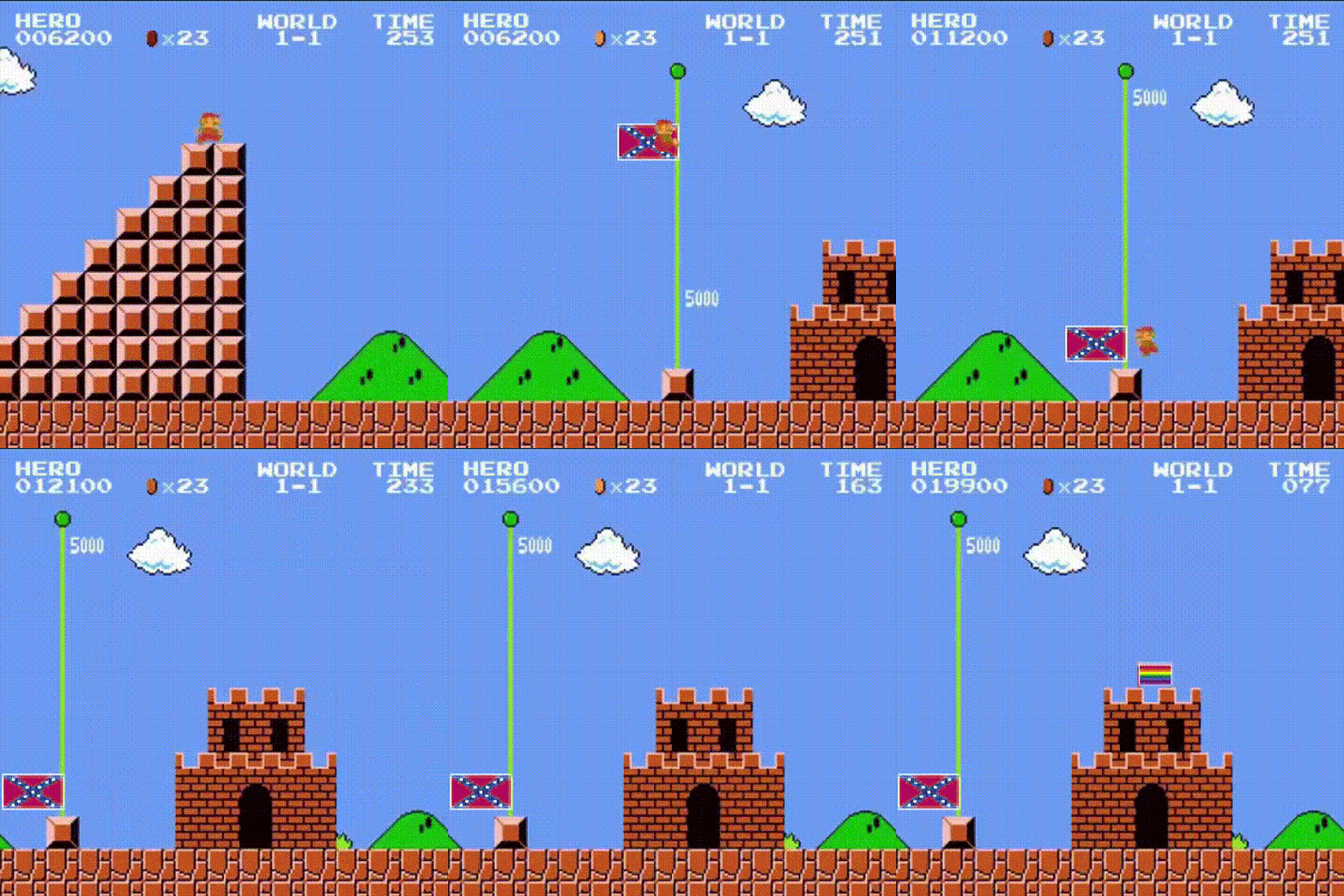
On Friday, Mother Jones shared a cartoon by the Southern Poverty Law Center that pretty much sums up this incredible week (below). Could it get any better? Yes. Some genius knew exactly what that comic strip looked like and created the GIF shown above.
Yesterday was a historic day for the United States, and I was as delighted as everyone else I know. I’ve supported gay marriage since the mid-1990s, when as a teenager, I read Andrew Hodges’ classic biography of Alan Turing, and burned with white-hot rage at Turing’s treatment. In the world he was born into—our world, until fairly recently—Turing was “free”: free to prove the unsolvability of the halting problem, free to help save civilization from the Nazis, just not free to pursue the sexual and romantic fulfillment that nearly everyone else took for granted. I resolved then that, if I was against anything in life, I was against the worldview that had hounded Turing to his death, or anything that even vaguely resembled it.
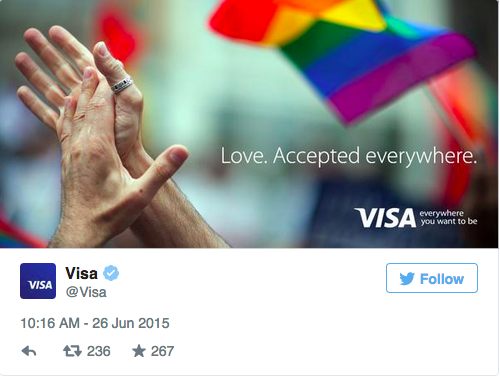
So I’m proud for my country, and I’m thrilled for my gay friends and colleagues and relatives. At the same time, seeing my Facebook page light up with an endless sea of rainbow flags and jeers at Antonin Scalia, there’s something that gnaws at me. To stand up for Alan Turing in 1952 would’ve taken genuine courage. To support gay rights in the 60s, 70s, 80s, even the 90s, took courage. But celebrating a social change when you know all your friends will upvote you, more than a decade after the tide of history has made the change unstoppable? It’s fun, it’s righteous, it’s justified, I’m doing it myself. But let’s not kid ourselves by calling it courageous.
Do you want to impress me with your moral backbone? Then go and find a group that almost all of your Facebook friends still consider it okay, even praiseworthy, to despise and mock, for moral failings that either aren’t failings at all or are no worse than the rest of humanity’s. (I promise: once you start looking, it shouldn’t be hard to find.) Then take a public stand for that group.
Jurassic World, Mad Max Fury Road, and Little Girls
For her birthday, we took my soon-to-be six year-old to Jurassic World. Prior to that, she had watched a bootleg copy of Fury Road with me after I had confirmed that it fit the levels of violence I consider acceptable based on what I know of my daughter.
The most interesting thing to me was her reactions after each film.
After watching MMFR, she talked incessantly about it. (She had talked during the film as well, making observations, etc.) Her name was suddenly changed to Angry Cereal, mirroring two of her favorite characters. She made a new Sims game, spending more time than she ever had before perfecting the characters - and giving them all pets. A Lego car set was turned into a crazy car that could fit into the Mad Max world. Barbies were now the Wives and her dad’s Diablo figurine was now Immortan Joe. It’s been a little over two weeks and she still talks about it.
When the credits rolled on Jurassic World, she said, ‘Can we go see another movie?’ –And that was it. The only other comment vaguely related to the movie was her assertion she liked dinosaurs. Nothing else. No elaborate recreations, nothing.
I had thought with MMFR that my excitement had rubbed off on her but that doesn’t seem to be the case. After Jurassic World, I was excited, encouraging her to talk about her favorite parts. She asked for a Happy Meal. When we went to spend a gift card at Toys-R-Us the next day, I pointed out all the Jurassic World toys. They had Blue! She barely gave them a second glance.
It didn’t jive. She had tons of dinosaur books. Why was she infinitely more interested in an adult movie that was pretty much one big car chase rather than a movie about dinosaurs? Was it because despite the differences in ratings, Jurassic World had frightened her more? Maybe. But when she picked out a new stuffed animal to buy with her gift card, she informed us the little owl’s name was Splendid.
And that was it.
She had watched Fury Road in almost complete silence until the first shot of all the Wives. Then she turned to me and said, “There’s so many girls!” That was her takeaway from MMFR: there were lots of girls! All the girls were fighting together against the bad guy! The girls were the heroes! That was important to her, seemingly even more important than it was to me. Maybe because she’s just getting her first taste of playground culture where boys and girls are separate and the two don’t mix often and it’s been confusing. Maybe because she just really liked seeing girls on the screen. When I ask her, she just shrugs and says, “I don’t know, mommy, I liked all the girls. I liked Toast.”
As an adult, I’m aware of issues with representation. I don’t remember consciously noticing it as a child but I remember Leia and Uhura and Janeway being my favorites. I remember dressing up as Dana Scully. As a mom, I watch my daughter gravitate to girls and women on screen. A movie I thought would a sure thing because DINOSAURS! became a total miss because for her, there was no one on screen that she left the theater wanting to dress up as. There was no incentive for her to change her name to mimic favorite characters. I left grinning because holy shit, raptor squad! She left wanting a cheeseburger.
Children know when they’re being marginalized. They might have no idea what they word marginalized means, but they can still tell, instinctually, when they’ve been misrepresented in and/or excluded from the story.
we’re asking you to come on back to jurassic park and give us another try
the question on everyone’s mind: how can you afford to open another iteration of your consistently doomed dinosaur theme park? well, we found another country willing to fund the development of dinosaurs as weapons.
(it’s paraguay. paraguay is going big-hog on army dinos in 2016)
FAQ
Q. Are your park employees trained to have a haunted look of panic at all times?
A. maybe
Q. Why was there a live juvenile raptor in my hotel room minibar?
A. we don’t know
Q. I overheard a tour guide casually refer to park-goers as “charcuterie,” is this a term of endearment?
A. if you want
Q. My family and I arrived two days ago, and we are constantly in a state of being eaten. What is your refund policy?
A. ha ha what is that
A 14-year-old middle school student in Holiday, Florida, was arrested this week and charged with "an offense against a computer system and unauthorized access," which is a felony. The student reportedly used an administrator password to log into a teacher's computer and change the background image to a photo of two men kissing.
The student also revealed his secrets after he was caught – the password was the teacher's last name, and the teacher had typed it in in full view of the students. The student said many other students used these administrators' passwords (their teachers' last names) so they can screen-share and video chat with other students. The student was briefly held in a nearby detention center, and the county Sheriff warned that other teenagers caught doing the same thing will "face the same consequences."

 Expanded from


 tipolog в Парки развлечений для бедняков: Пакистанские Диснейленды






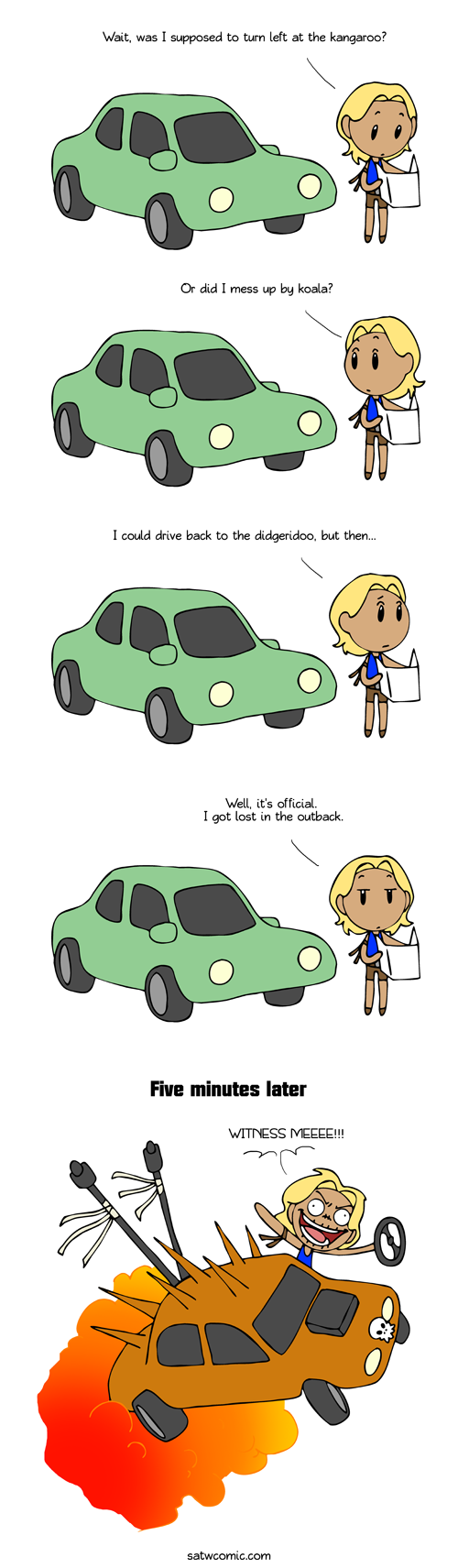 Mad Max Fury Road is awesome, and you're doing yourself a serious disservices if you don't watch it in theaters.