Mahmoudpwnt

Giovanni Stanchi (Rome c. 1645-1672). Oil on canvas. 38 5/8 x 52½ in. (98 x 133.5 cm.) / Courtesy Christie’s

Old master work paintings are frequently cited for their depiction of historical events, documentation of culture, or portraiture of significant people, but there’s one lesser known use of some paintings for those with a keen eye: biology. One such instance is this Renaissance still life of various fruits on a table by Giovanni Stanchi painted sometime in the 1600s that shows a nearly unrecognizable watermelon before it was selectively bred for meatier red flesh.
Horticulture professor James Nienhuis at the University of Wisconsin tells Vox that he’s fascinated by old still life paintings that often contain the only documentation of various fruits and vegetables before we transformed them forever into something more desirable for human use. You can read a bit more about the science behind the changes in watermelons over the last 350 years here. (via Kottke)
Update: Greg Cato writes: “The painting depicts a rare outcome of sub-par growing conditions, known as ‘starring.’ It’s perfectly normal, still happens, and is not the result of selective breeding (although it would be cool if it were).” You can see an example here.

Ratzenberger has had a voice part in all of Pixar’s feature films made to date. His roles include:
(Fact Source) for more facts, follow Ultrafacts

For the analog boys and girls living in a digital world, the work of French multimedia artist Philip Ob Rey should capture your interest. The Iceland-based creator was recently brought to our attention due to his use of discarded VHS tapes. Ob Rey creates nightmarish figures using the black magnetic tape and photographs them wandering the frozen Icelandic landscape.

They’re fantastical, horrific, and darkly beautiful. Lovecraft would approve. The artist created an entire narrative about the creatures, which you can take in on his website. “In the form of an outstanding installation skeletonned with VHS film-rolls, he will present V, his new project.

V senses, V awakenings, V Beings half-God half-Mortal staged through five medias, from the 80’s to our (analogue film, digital 8mm videos, smartphone…) sublimed within a post-modern archeologic research, V visions, V HumantropicSenses, V-HS,” Ob Rey writes of the ominous beings. See more of Ob Rey’s video giants in our gallery.


Via Flavorwire
Mahmoudthis sort of thing has been going around for a while, but i still likem


Canadian artist Guillaume Lachapelle explores the infinite in this series of mysterious 3D printed dioramas titled Visions. Sitting atop pedestals in a darkened gallery, the eerie “rooms” rely on lights and mirrors to create the illusion of vast spaces that seem to reflect into much larger open spaces. These pieces were on view last year as part of a solo show at Art Mur in Québec, and you can see more of them up close over on Artsy.
Mahmoudoof, not great, not great, i can see why the hovertext is true
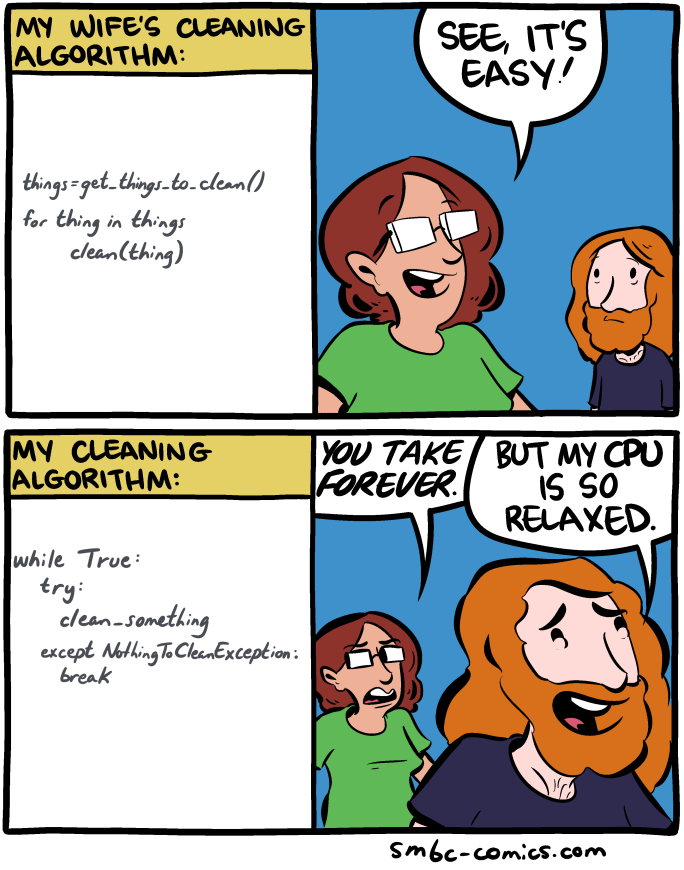
Hovertext: Watch - I can make fun of every religion and get no hatemail, but when I write any amount of code...

based on a conversation i was worried i’d have today, but instead didn’t and everything worked out fine. thanks for nothing, comcast
MahmoudSMBC has been pretty on lately.
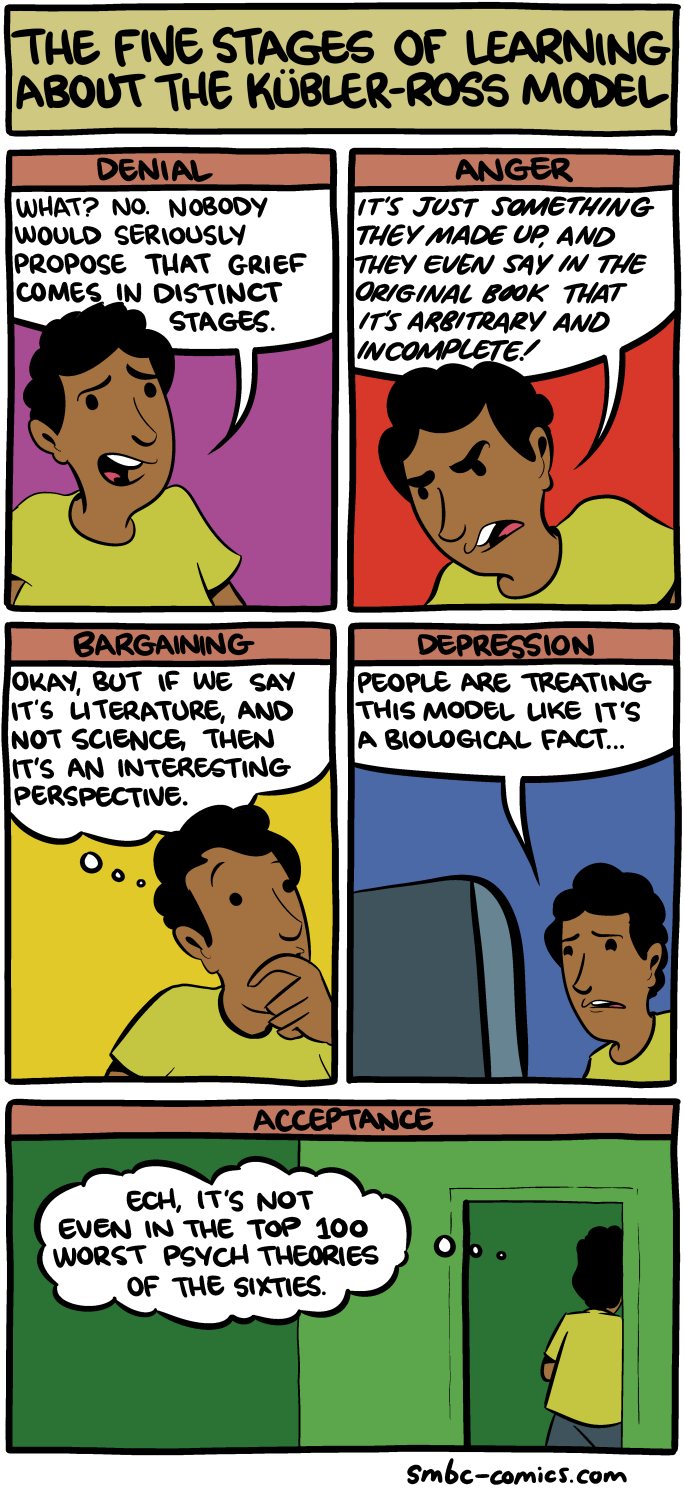
Hovertext: There are also five stages to accepting that you're reading a meta-joke.
 The Javascript party line is that you don't need locking, because no threads, no safety, no problem: every window or tab has its own Javascript context, and that context is guaranteed to behave as if it is single-threaded: sequential execution, timers fire on return to the event loop, processes cannot communicate with each other.
Except then they added localStorage. Oh, what's this? Is it shared memory that can be accessed asynchronously by multiple contexts? Why yes it is! So now you really do need locking. Except then they didn't add mutexes, or even an atomic-read-and-increment operator. Hooray. And they also didn't add any IPC, like a socket that one process can write to and that others can select() on. Hooray.
So let's say you've got an app, it spans multiple documents, and you want a sound to play in reaction to some external, asynchronous event if any of your documents are open. But if three windows are open, you only want that sound to play once per event. The obvious way to do this is to nominate one of those documents as the leader, and pass the conch to someone else if the leader document goes away.
Well, good luck with that, since you only have a shared whiteboard, not real IPC. This means that each of your contexts needs to constantly poll the whiteboard, doing something like, "Has it been too long since the leader has updated their heartbeat timestamp? If so, now I must race with my brethren to try and acquire the lock and become the leader." So aside from that being stupid -- all those timers, all that polling -- it's also inefficient, because it means that there's always an interregnum during which there's no leader (your polling interval). Try to burn fewer cycles by increasing your polling interval and you increase the window during which your asynchronous notifications can't happen.
What kind of Mickey Mouse operation is this? There was better multitasking on MacOS 6.
Oh, and speaking of sound: on iOS, you flat-out cannot play sound unless somewhere higher up on the call stack is a touch gesture. Asynchronous sounds can't be done using the HTML5 audio tag, because... Apple are dicks, I guess? I'm gonna go with that. So apparently there's a newer and completely separate audio interface with a way more convoluted API, and maybe that one works on iOS? But I haven't investigated, having at that point run out of fucks due to the fact that I was starting to have ALSA versus OSS flashbacks and expecting it to tell me my EMU10K1 PCM setting was wrong.
Mahmoudthis saga is continuing

After a sex-tape filmed in the dressing room of the Sanlitun Uniqlo sped like wildfire across the Chinese internet, many are wondering what the legal consequences may be for those involved.One law professor thinks that if the couple did not distribute the video, they should not bear any legal responsibility. If it was uploaded by a third party without the couples’ permission, that person would face charges for uploading sexually explicit material, violation of privacy and damaging reputations.Many netizens believe that the incident was a publicity stunt by Uniqlo, but the company has denied their accusations.”
Source: Netease
"Law Professor Discusses Legal Consequences of Uniqlo Sex Tape"
Originally posted on chinaSMACK - Hot internet stories, pictures, & videos in China


 |
| Thanks to William Lanoutte |
Mahmoudi can't risk one of you not having heard of this
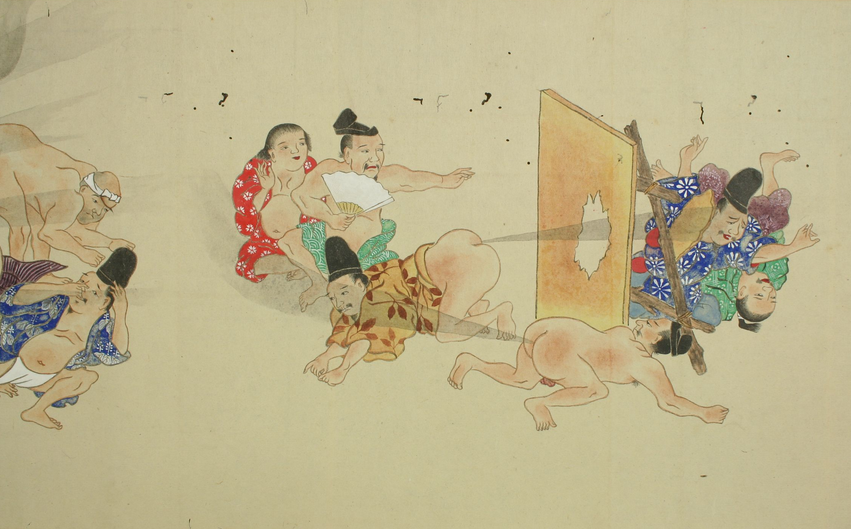
When you think of traditional Japanese art, you might think of a sumi-e ink painting that evokes a copse of bamboo with a few masterful lines. A haiku that captures the fragility of beauty in the length of a tweet. A garden that somehow conveys the transcendence of all things by elegantly framing the wind in the trees.

While the He-Gassen scroll from roughly the 1840s has little of the Zen-like restraint of the above examples, it definitely shows the wind in the trees. He-Gassen (屁合戦) literally translates into “fart battle” and it shows various men and women with their rears in the air, breaking hurricane-strength wind – blasts so powerful that they can launch cats into the air, blow through walls, knock over buildings and generally send victims reeling. The scroll is easily one of the most remarkable, and hilarious, pieces of art I’ve seen in a long while.

The whole thing might look like an extended sketch from Terreace and Phillip, those gassy Canadian TV stars from South Park, but some argue that He-Gassen might have a political dimension. During the Edo period (1603–1867), flatulence was used as a way to mock westerners. Japan was closed off from the outside world and they were feeling more and more pressure from the West until finally American gun boats led by Commodore Matthew Perry forced the country open in 1853. What better way to thwart these Western interlopers than with a cavalcade of industrial strength gas?
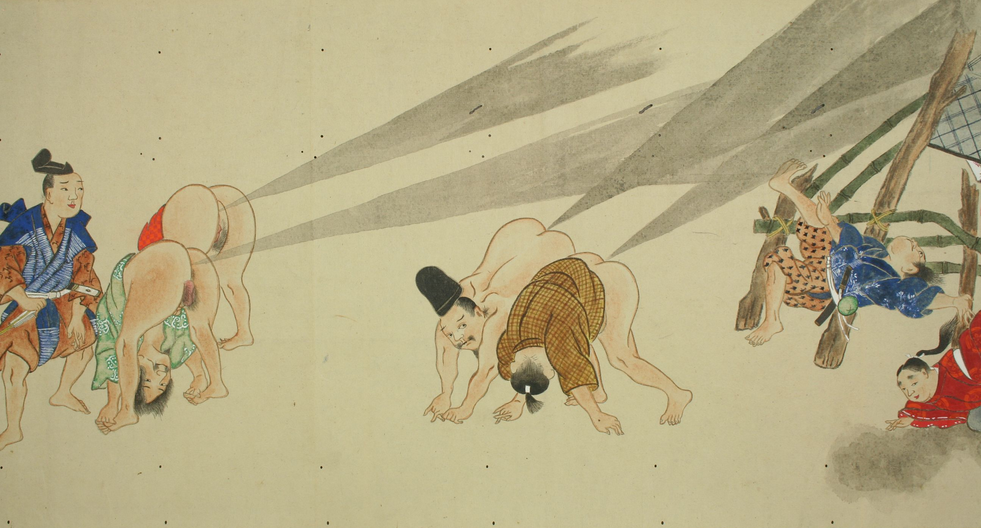
You can see a few choice pictures above, or head over to the Waseda University digital archive and see the whole thing. 38 images in total.
via i09
Related Content:
Hand-Colored Photographs of 19th Century Japan
Hōshi: A Short Film on the 1300-Year-Old Hotel Run by the Same Family for 46 Generations
Jonathan Crow is a Los Angeles-based writer and filmmaker whose work has appeared in Yahoo!, The Hollywood Reporter, and other publications. You can follow him at @jonccrow. And check out his blog Veeptopus, featuring lots of pictures of vice presidents with octopuses on their heads. The Veeptopus store is here.
The (F)Art of War: Bawdy Japanese Art Scroll Depicts Wrenching Changes in 19th Century Japan is a post from: Open Culture. Follow us on Facebook, Twitter, and Google Plus, or get our Daily Email. And don't miss our big collections of Free Online Courses, Free Online Movies, Free eBooks, Free Audio Books, Free Foreign Language Lessons, and MOOCs.
http://www.openculture.com/2015/07/the-fart-of-war.html is a post from: Open Culture. Follow us on Facebook, Twitter, and Google Plus, or get our Daily Email. And don't miss our big collections of Free Online Courses, Free Online Movies, Free eBooks, Free Audio Books, Free Foreign Language Lessons, and MOOCs.
The post The (F)Art of War: Bawdy Japanese Art Scroll Depicts Wrenching Changes in 19th Century Japan appeared first on Open Culture.
Mahmoudchina

After a sex video in a dressing room at the Sanlitun Uniqlo took over the Chinese internet, the storefront has become a new hot spot for tourists to pose for photos.While one reporter was in the store covering the story, he saw 2 men trying to go into the same dressing room, but a vigilant store employee stopped them before they could close the door.One netizen jokingly stated that no matter how good online stores could be, there is one thing they could never do: have fitting rooms.
Source: Netease
"2 Men Caught Heading to Uniqlo Dressing Room"
Originally posted on chinaSMACK - Hot internet stories, pictures, & videos in China


Mahmoudayyyy i bought my first batch of uniqlo here. i still have most of the shirts.

A video of two people having sex in a Beijing Uniqlo dressing room has recently gone viral across social media in China. While the exact situation remains unclear, netizens have already identified a number of individuals whom they think are involved. The video in question shows a clothed male having sex with a naked female from the back while he records their reflection in the mirror with his cellphone. The hashtag associated with the incident, #三里屯优衣库# (“Sanlitun Uniqlo”, Sanlitun is an area in Beijing), has already been used over 16 million times on Weibo.
Source: Netease
"Video of 2 People Having Sex in Beijing Uniqlo Goes Viral"
Originally posted on chinaSMACK - Hot internet stories, pictures, & videos in China


Mahmoudcheck this shit out, like and subscribe
I wake up with a jolt, spilling most of my breakfast cereal onto a thirsty couch. My eyes find the clock. Cleaning will have to wait. I'm downing water like there's no tomorrow, but really tomorrow starts in one minute. Still drinking. All work is thirsty work if the day is long enough, and engineering is no exception. Time's up.
From the literal break of dawn to sunset, no food, drink, or other respite. It's Ramadan. What does this mean, practically? Well, summertime here in Silicon Valley, it means from 4am to 9pm, I battle human nature while writing emails and software. But, far from an antiquated ritual, I see Ramadan as an exercise in lifestyle design.

As we near the end of Ramadan 1436, this year has proven that even in modern and diverse environs, every year brings the same reactions and questions as 1435. Mostly boiling down to:
A bit facetious, but this really is the most common question I get. So just to be clear, traditional interpretation calls for no food, drink (including water), or drugs. From the crack of dawn to sunset. Or in the technical terms, the beginning of sunrise's astronomical twilight to the beginning of sunset's civil twilight.
Individuals adjust according to limitations. If you're not healthy enough to fast, you don't fast. If you feel like you can't complete a fast, you don't. If the sun doesn't set, just do something reasonable. Your intentions are your own, and self-harm does not enter into the purposes of Ramadan.
Everyone has their reasons, but first off Ramadan is not some sort of collective diet. Yes, Ramadan is used by many as a springboard to stymie smoking, overeating, and other unhealthy physical habits. But for me, fasting is about building four virtues:
Not exactly the stuff of classrooms and annual compliance trainings. And yet people are expected to just find these characteristics within themselves, even in environments most antithetical. Countless well-compensated designers and engineers know about the limits of limitless life. We almost immediately pine for constraints. Negative liberty only goes so far, then real freedom becomes about the ability to formulate and follow the orders you give yourself. Design grants creative autonomy, but design tools offer a hundred possibilities draped in a thousand distractions.
Empathy is the most obvious trait built by fasting, and the one promoted most when I was younger. There are poor people in the world, and all should experience their hunger and thirst to understand. Fasting puts you on the path closest to the one they walk, building a visceral empathy that simple imagination can't match. When was the last time you were hungry like the wolf? One month of senses too sharp for civil society. One month of feeling the natural appetites object and interrupt your every thought. But it keeps one connected to so many people, from the most intense protesters to as many as a fifth of American students.
Reflection is critical to the Ramadan fast. Take away food and water, and within a few hours you're transported to the banks of a personal Walden Pond. In much the same way that exercise burns off dirty, anxious energy, fasting stops it from being produced in the first place. It quiets the shores of one's psyche and in the stillness, all is clear. This is the part of Ramadan I look forward to most: a staycation from my usual self-imposed obligations. The line between essential and unnecessary is bright. I don't know much about meditation, but most days of the month, around sunset, I find a certain peaceful state, every thought sorted away in its right place.
Midday is another story. Shouldering a normal workload with the added constraint of a fast is the definition of a stress test. Except unlike software and other commonly-tested constructs, the systems at work here involved grow and strengthen naturally. During Ramadan, I stockpile this discipline to burn over the next 11 months. Discipline complements motivation, especially with creative work like software and architecture. Whereas frustration obviates motivation, discipline rises to the occasion, grateful for the opportunity to push through and grow.
All of the above pours into the last attribute. Confidence is deeply linked to feelings of sufficiency: the ability to say, "What I have is enough to do what I want to do." I'm a big fan of water myself, but even something as essential as hydration isn't as big a deal as we make it. My adolescent fascination with basketball was rooted in Hakeem Olajuwon playing whole NBA games against the Chicago Bulls, 12 hours into a fast. More recently, a fasting Algeria played a strong World Cup game against winners-to-be Germany. People thirst for confidence, not water. Ramadan is a reminder that personal excess breeds anxiety. Consumerism's advertising immerses us in false dependence. Ramadan is the gentle reaffirmation you send yourself that, yes, you can do more with less.
At this point, the how is more of a logistical appendix, but this year's approach was particularly successful. Each year, Ramadan's approach gets me nervous. No matter how many times I fast, despite having survived and thrived not one year ago, I still get skittish at the thought of it. I focus in on the circumstances new to the year, and can't help tweaking my design.
Everyone has different lives and schedules, but my Ramadan unfolds in three phases:
My Ramadan technique goes into effect from day 1. It can be a rough transition, involving some falling asleep while eating cereal, but the long-day summer technique has been perfected over years. Granted, its design leans on the unique schedule afforded a young software engineer. Not everyone can switch away from a standard work-a-day-sleep-at-night schedule. The median practicing Western Muslim probably approaches Ramadan like this:
Straightforward enough, but far from optimal. There's no period of sleep longer than 4 hours, which leaves my energy on a different valence altogether. For the last three years, I've improved on the naïve solution, by switching to a bimodal sleep schedule:
It's a fun change of pace. If the workday seems short, keep in mind that there are no meal or snack breaks, so it evens out. Similarly, there's a lot of new time discovered in these quiet, contemplative nights. Overall my energy, while restricted, stays predictable and manageable. I'm no Hakeem Olajuwon or Algerian footballist, but this year I managed to continue to bike everywhere, several times riding 6 to 15 miles per day. Other innovations this year have included playing violin to stay awake and just eating a small bowl of raisin bran for breakfast. Eating less is unintuitive, but I wake up less thirsty than trying to cram in more calories, and hunger is easier to manage than thirst. Oh, and bubble water.

Sometimes during the day I'd find myself impatient, checking the calendar to see how many days are left. But just as many times at night I've caught myself lamenting the quickness with which my split days have slid past. With Eid-ul-Fitr right around the corner, I must admit I am pleased with the special satisfaction brought by another year, another fast well designed.
Dad’s not coming.
“He is,” you tell your bride as she waits for you to recite the vows you wrote.
He’s not. And the caterer never got the check Dad said he’d give them. Mom’s new husband Rick will have to pay for that.
“I hate Rick,” you tell your brother and Best Man. “I’d rather everyone go hungry than have mom’s Rick pay a dime for my wedding. Just wait, Dad’ll get here.”
The owner of the wedding venue walks up the aisle and pulls you into a non-consensual embrace from which you can’t escape. Her mouth near enough to your ear to send a whisper straight to your spine, she says,
“Kid. We get married when we realize the limits of the family we were born into, and we decide to try and do better by making a family of our own. You reached the limit of how much a man can shuffle his feet. That girl there in the white, you make her wait a second longer and you’ll give her something to wonder about for the rest of your lives together. Give up on your Pa or I’m calling this wedding a no-go right now. I won’t allow a marriage to start like this. Not under my gazebo.”
She releases you and you take this woman as your lawfully wedded wife while your father dances with a prostitute in a motel off the highway, the money for the caterer now cocaine.
Happy Give Up On Dad Day!
Mahmoudthe change width to invert color scheme seems like a great way to give people the seizes
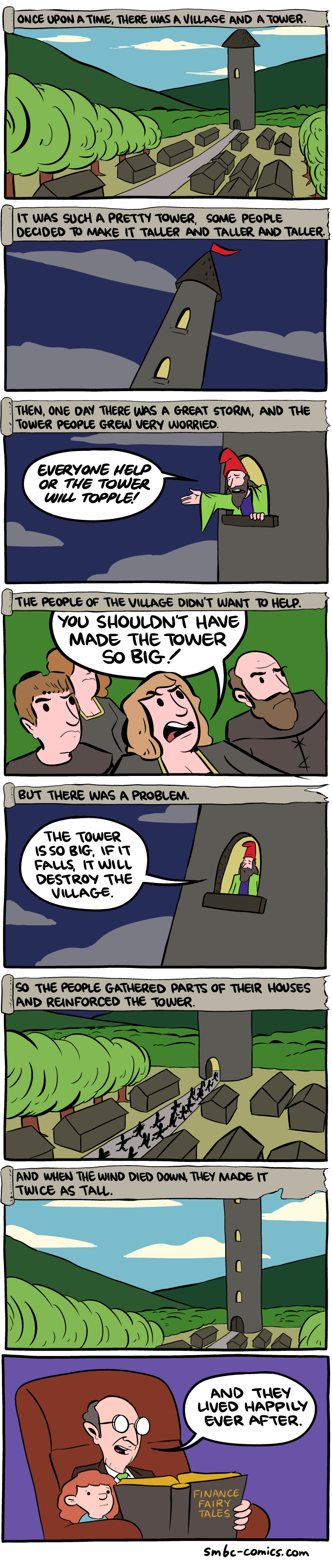
Hovertext: This comic is an allegory for, of course, the 1896 presidential elections.
Mahmoudshit
Mahmoudi thought it was well-known that american indians were asian-descended?

A retired chemist has found ancient Chinese characters, or Hanzi, inscribed on rocks in the New Mexico reservation of the Petrified Forest National Park. John Ruskamp said the characters were definitely not fake, and indicate that Asian ancestors were in America around 1300BC, 2800 years before Christopher Columbus set foot on “the New World” in 1492. The find could rewrite history, which has always said that European explorers were first to set foot on America. One startled netizen questioned if American Indians were in fact Chinese descendents.
Source: Netease