“A generation that cannot endure boredom will be a generation of little men… of men in whom every vital impulse slowly withers, as though they were cut flowers in a vase.”
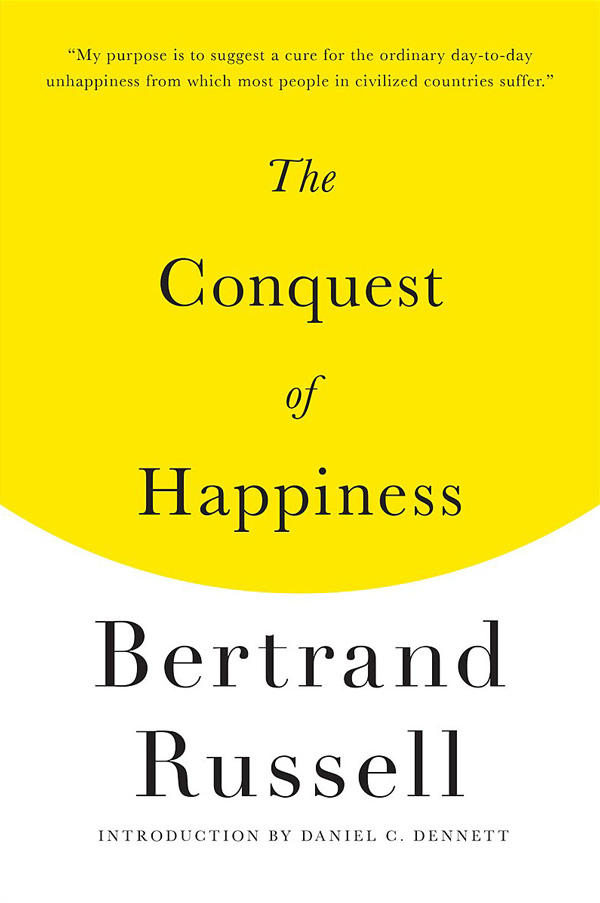 Between the time Kierkegaard contemplated boredom and psychoanalyst Adam Phillips made his bewitching case for why the capacity for it is essential for a full life, Bertrand Russell (May 18, 1872–February 2, 1970) tussled with the subject more elegantly than any other thinker before or since. In a chapter titled “Boredom and Excitement” from his altogether indispensable 1930 classic The Conquest of Happiness (public library) — an effort “to suggest a cure for the ordinary day-to-day unhappiness from which most people in civilized countries suffer” — he teases apart the paradoxical question of why, given how vital it is to our wholeness, we dread boredom as much as we do. Long before our present anxieties about how the age of distraction and productivity is thwarting our capacity for presence — a capacity essential for that very conquest of happiness — Russell shines timeless wisdom and remarkably timely insight on the deep-seated demons of human nature that keep us small and unhappy, and offers sage assurance for transcending them by bringing greater awareness to our own perilous pathologies.
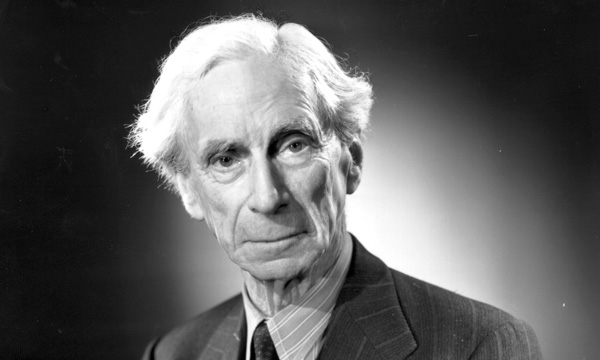
With the same astounding prescience that defines most of his work, Russell writes:
We are less bored than our ancestors were, but we are more afraid of boredom. We have come to know, or rather to believe, that boredom is not part of the natural lot of man, but can be avoided by a sufficiently vigorous pursuit of excitement.
He makes an especially timely note of how the hedonic treadmill of consumerism becomes our chronic, and chronically futile, refuge for running from boredom:
As we rise in the social scale the pursuit of excitement becomes more and more intense. Those who can afford it are perpetually moving from place to place, carrying with them as they go gaiety, dancing and drinking, but for some reason always expecting to enjoy these more in a new place. Those who have to earn a living get their share of boredom, of necessity, in working hours, but those who have enough money to be freed from the need of work have as their ideal a life completely freed from boredom. It is a noble ideal, and far be it from me to decry it, but I am afraid that like other ideals it is more difficult to achievement than the idealists suppose. After all, the mornings are boring in proportion as the previous evenings were amusing. There will be middle age, possibly even old age. At twenty men think that life will be over at thirty… Perhaps it is as unwise to spend one’s vital capital as one’s financial capital. Perhaps some element of boredom is a necessary ingredient in life. A wish to escape from boredom is natural; indeed, all races of mankind have displayed it as opportunity occurred… Wars, pogroms, and persecutions have all been part of the flight from boredom; even quarrels with neighbors have been found better than nothing. Boredom is therefore a vital problem for the moralist, since at least half the sins of mankind are caused by the fear of it.
And yet Russell recognizes the vitalizing value of this greatly reviled state, outlining two distinct types of boredom:
Boredom, however, is not to be regarded as wholly evil. There are two sorts, of which one is fructifying, while the other is stultifying. The fructifying kind arises from the absence of drugs and the stultifying kind from the absence of vital activities.
Our frantic flight from boredom, he admonishes, results in a paradoxical relationship with excitement, wherein we’re at once addicted to its intake and desensitized to its effects:
What applies to drugs applies also, within limits, to every kind of excitement. A life too full of excitement is an exhausting life, in which continually stronger stimuli are needed to give the thrill that has come to be thought an essential part of pleasure. A person accustomed to too much excitement is like a person with a morbid craving for pepper, who comes last to be unable even to taste a quantity of pepper which would cause anyone else to choke. There is an element of boredom which is inseparable from the avoidance of too much excitement, and too much excitement not only undermines the health, but dulls the palate for every kind of pleasure, substituting titillations for profound organic satisfactions, cleverness for wisdom, and jagged surprises for beauty… A certain power of enduring boredom is therefore essential to a happy life, and is one of the things that ought to be taught to the young.
Indeed, the cultivation of this core capacity early in life fortifies the psychological immune system of the adult. Nearly a century before the iPad, which is now swiftly shoved in the screen-hungry hands of every toddler bored to disgruntlement, Russell writes:
The capacity to endure a more or less monotonous life is one which should be acquired in childhood. Modern parents are greatly to blame in this respect; they provide their children with far too many passive amusements… and they do not realize the importance to a child of having one day like another, except, of course, for somewhat rare occasions.

DIY indoor boomerang from the vintage gem 'How to Do Nothing with Nobody All Alone by Yourself.' Click illustration for more.
Instead, he exhorts parents to allow children the freedom to experience “fruitful monotony,” which invites inventiveness and imaginative play — in other words, the great childhood joy and developmental achievement of learning to “do nothing with nobody all alone by yourself,” a testament to Kierkegaard’s insistence that “the more a person limits himself, the more resourceful he becomes.” Russell writes:
The pleasures of childhood should in the main be such as the child extracts from his environment by means of some effort and inventiveness. Pleasures which are exciting and at the same time involve no physical exertion, such, for example, as the theatre, should occur very rarely. The excitement is in the nature of a drug, of which more and more will come to be required, and the physical passivity during the excitement is contrary to instinct. A child develops best when, like a young plant, he is left undisturbed in the same soil. Too much travel, too much variety of impressions, are not good for the young, and cause them as they grow up to become incapable of enduring fruitful monotony.
I do not mean that monotony has any merits of its own; I mean only that certain good things are not possible except where there is a certain degree of monotony… A generation that cannot endure boredom will be a generation of little men, of men unduly divorced from the slow processes of nature, of men in whom every vital impulse slowly withers, as though they were cut flowers in a vase.
Illustration by Jim Stoten from 'Mr. Tweed's Good Deeds.' Click image for details.
Even humanity’s greatest works of literature, Russell points out, have boredom baked into their very substance — something he illustrates with an entertaining example all the more perfectly parodic of contemporary publishing:
All great books contain boring portions, and all great lives have contained uninteresting stretches. Imagine a modern American publisher confronted with the Old Testament as a new manuscript submitted to him for the first time. It is not difficult to think what his comments would be, for example, on the genealogies.
“My dear sir,” he would say, “this chapter lacks pep; you can’t expect your reader to be interested in a mere string of proper names of persons about whom you tell him so little. You have begun your story, I will admit, in fine style, and at first I was very favorably impressed, but you have altogether too much wish to tell it all. Pick out the highlights, take out the superfluous matter, and bring me back your manuscript when you have reduced it to a reasonable length.”
So the modern publisher would speak, knowing the modern reader’s fear of boredom. He would say the same sort of thing about the Confucian classics, the Koran, Marx’s Capital, and all the other sacred books which have proved to be bestsellers.
(Of course, it’s triply tragicomic to imagine what Russell might make of the listicle — today’s ultimate reactionary hedge against our fear of boredom.)

Illustration from 'An ABZ of Love,' Kurt Vonnegut's favorite vintage Danish illustrated guide to sexuality. Click image for more..
He uses the most intimate of metaphors to illustrate the existential emptiness that such groping for fleeting excitement engenders:
Consider the difference between love and mere sex attraction. Love is an experience in which our whole being is renewed and refreshed as is that of plants by rain after drought. In sex intercourse without love there is nothing of this. When the momentary pleasure is ended, there is fatigue, disgust, and a sense that life is hollow. Love is part of the life of Earth; sex without love is not.
This, indeed, is both Russell’s most timeless and most devastatingly timely point — that our dread of boredom is a self-inflicted wound resulting from the singular modern violence of our break with nature. But here is the most striking part: The sight of a man walking down the street transfixed by a glowing rectangle, completely blind to the sky and deaf to the birds and hardened to the wind’s caress, would have been completely foreign to Russell. Many decades before such violent forms of severance from nature existed, he admonishes:
The special kind of boredom from which modern urban populations suffer is intimately bound up with their separation from the life of Earth. It makes life hot and dusty and thirsty, like a pilgrimage in the desert. Among those who are rich enough to choose their way of life, the particular brand of unendurable boredom from which they suffer is due, paradoxical as this may seem, to their fear of boredom. In flying from the fructifying kind of boredom, they fall a prey to the other far worse kind. A happy life must be to a great extent a quiet life, for it is only in an atmosphere of quiet that true joy can live.
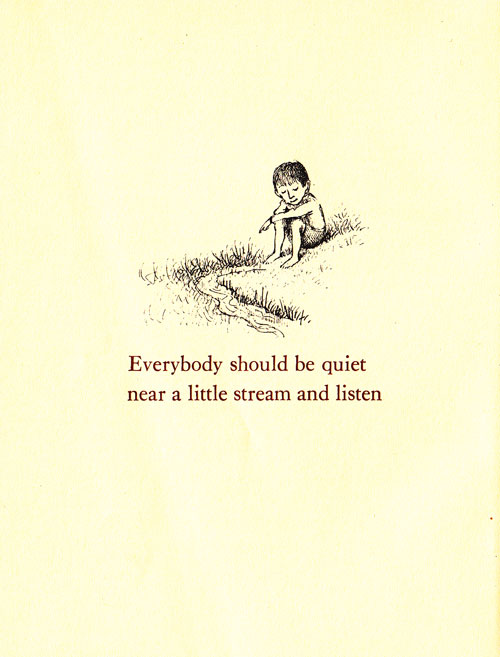
Illustration by Maurice Sendak from 'Open House for Butterflies' by Ruth Krauss. Click image for more.
The Conquest of Happiness is a spectacular, existentially necessary read in its entirety. Complement it with Russell on human nature, his heartening message to descendants, and his ten commandments of teaching and learning.
Donating = Loving
Bringing you (ad-free) Brain Pickings takes hundreds of hours each month. If you find any joy and stimulation here, please consider becoming a Supporting Member with a recurring monthly donation of your choosing, between a cup of tea and a good dinner.
| ♥ $7 / month♥ $3 / month♥ $10 / month♥ $25 / month |

You can also become a one-time patron with a single donation in any amount.

 Brain Pickings has a free weekly newsletter. It comes out on Sundays and offers the week’s best articles. Here’s what to expect. Like? Sign up.

 facebook
 reddit