[This is a short summary; please click the story headline to read the full story on our site]
Adam Victor Brandizzi
Shared posts
07 Oct 23:33
Belgium Considers Selecting Citizens for Senate via Lottery
by Virtually Yours
This is a great idea, and long overdue. If they are able to successfully implement this, perhaps it might catch on in other countries which could also stand to benefit from a healthy dose of direct democracy.
Via Equality by Lot:
Senior politicians in Brussels are supporting a legislative reform that could revolutionize Belgian democracy: according to the plan members of the Senate – the upper...
[This is a short summary; please click the story headline to read the full story on our site]


[This is a short summary; please click the story headline to read the full story on our site]
Albener Pessoa, Jts5665 and 2 others like this
01 Oct 13:00

Enchanting New Light Box Dioramas by Hari & Deepti Tell Stories of Exploration, Travel and Adventure
by Christopher Jobson

It’s been over a year since we last checked in with artist duo Deepti Nair and Harikrishnan Panickerof Hari & Deepti, who construct elegant cut paper dioramas inside backlit light boxes. The medium is perfect for depicting the depth of thick forests, pools of water, or subterranean caves inhabited by spirits and fantastic creatures.
Over the last year Hari & Deepti relocated from Denver to Mumbai where they just completed work for their first European show at Blank Space Gallery in Oslo titled ‘We Are All Made of Stars.’ Like previous exhibitions the event was held in a darkened gallery with the only light emitted from their artwork to better emphasize the themes of travel and adventure depicted in their light boxes.
Keep an eye out for new works in December at Context Art Miami with Black Book Gallery. You can also see more on Instagram.


Laura McCaskill, Barciella and 2 others like this
01 Oct 00:53
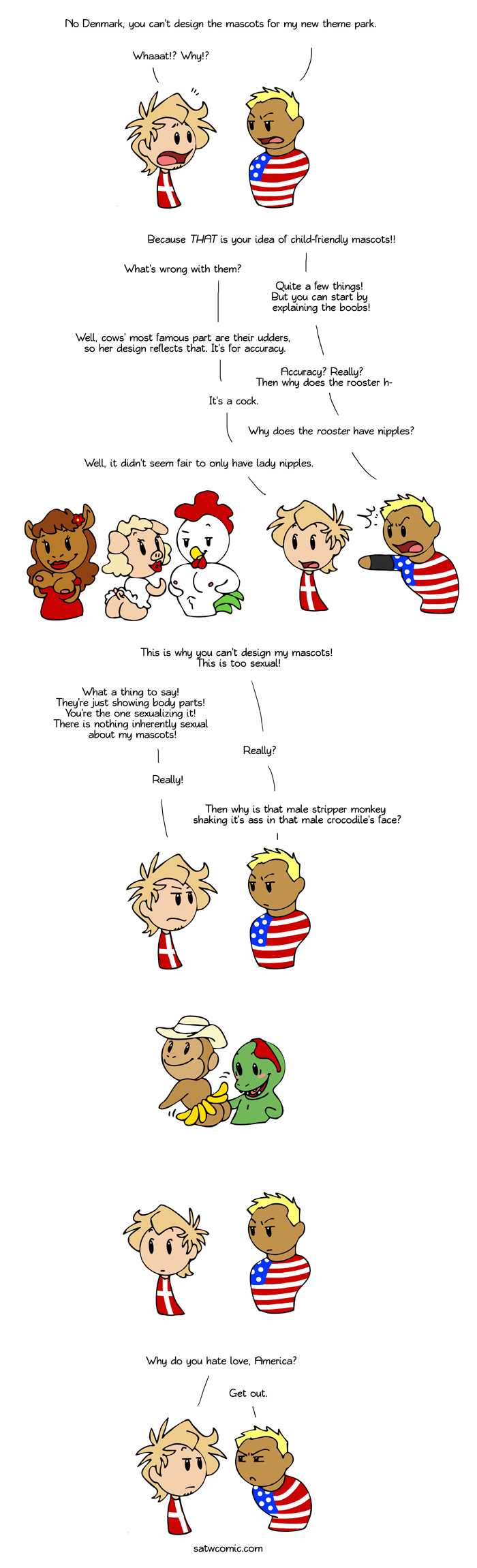 Yes, those are mascots from a real Danish theme park. The infamous BonBon Land. Here's a link to a YouTube video https://www.youtube.com/watch?v=xFrz7i-BneU
The park has many many mascots, but it's these more sexual ones that make the biggest impact on tourists. I went there several times as a kid (the park is mostly for children) and I remember not really thinking about the raunchy animals.
Children will love it
Yes, those are mascots from a real Danish theme park. The infamous BonBon Land. Here's a link to a YouTube video https://www.youtube.com/watch?v=xFrz7i-BneUThe park has many many mascots, but it's these more sexual ones that make the biggest impact on tourists. I went there several times as a kid (the park is mostly for children) and I remember not really thinking about the raunchy animals.
 Expanded from
Lucioc, Adam Victor Brandizzi likes this
29 Sep 19:52

Peer-to-peer pressure
by Tim Harford
‘Are these new players providing a valuable new service or are they merely an arbitrage play?’
Peer-to-peer markets used to be simple: there was eBay. If you had a broken laser pointer you wanted to sell, eBay was the place to find a buyer. Then came the local marketplace Craigslist and, before long, peer-to-peer markets were linking buyers and sellers in every market imaginable: crafts (Etsy); chores (TaskRabbit); transport (Uber); accommodation (Airbnb); consumer loans (Zopa); and even booze (Drizly).
It was exciting, for a while, to realise that you could actually get a car home on a Saturday night in San Francisco, or make money renting out your attic, but the backlash has been simmering for some time. That backlash mixes two complaints, elegantly exemplified when a group of taxicab owners and drivers sued Uber in Atlanta a year ago.
“Uber has been operating in Atlanta with little concern about the safety of their passengers and zero concern for the laws that protect them,” said one of the plaintiffs in a statement to The Atlanta Journal-Constitution. “Our incomes have steadily dropped since Uber started and legally licensed drivers are leaving the business.”
In other words, peer-to-peer services such as Uber are said to be hazardous, and they are also unwelcome competition for incumbents. (Several studies have supported the common-sense conclusion that these new competitors threaten the revenue of existing players.)
These might seem very different issues. It’s one thing to worry about signposting fire exits when you let out a spare room on Airbnb. Protecting the profit margins of fine upstanding local hoteliers is another matter.
Yet the two questions are inevitably tangled up, because both touch on the way incumbents are regulated. One would hope that regulators protect consumers, employees and the public by making it more difficult for drunks and sexual predators to drive cars, for firetraps to host unsuspecting tourists, and for employers to exploit workers. But some regulations seem designed more to protect insiders than to protect consumers.
Consider the New York taxi medallion system: you can’t drive a taxicab without one, and they’ve been million-dollar assets at times, often owned by investors and leased to drivers at a rate of $100 or more a day. New kids Uber and Lyft not only compete for passengers, they compete for drivers too, who may prefer to pay commission to these new players than the flat fee to the medallion owner.
Taxi medallions are a scarce asset created purely by a stroke of the regulator’s pen, and you don’t need to be a hardcore libertarian to conclude that, in this case, the regulator is motivated by protecting the value of this asset. Nor does it take a free-market fundamentalist to believe that if consumers think that taxicabs provide a safer service, they will pay for that safer service.
It may help to approach the debate from a different direction. Are these new players providing a valuable new service or are they merely an arbitrage play, using technology to sidestep taxes that others must pay, and to limbo-dance under regulatory hurdles that rivals must jump?
If the economic value is real, then it is up to the regulators to figure out how to unleash that value rather than trying to legislate it out of existence.
A new study of peer-to-peer markets by economists Liran Einav, Chiara Farronato and Jonathan Levin argues that the economic value is there all right. Peer-to-peer markets make two things possible that were previously hard to imagine.
The first is to make arid markets lush and fertile. The quintessential example is eBay, enabling buyers and sellers of the quirkiest products to find each other and gain by trading. Etsy fits the eBay mould, with sellers who will knit you a cuddly toy designed to resemble a dissected frog, a product that seems unlikely to find a niche on the high street.
The second peer-to-peer trick is to introduce part-timers into the market to meet surges in demand. It’s inefficient to build hotels just to cope with the summer rush, or taxis to cope with New Year’s Eve but, if the demand is there, peer-to-peer markets can pull in a bit of extra supply. As a result, it should be easier to get a cab at 11pm on a Friday, and prices for hotel rooms should be more reasonable during school holidays.
Peer-to-peer markets are well worth having. The challenge for regulators, then, is to catch up. How should Airbnb landlords who let a room for 10 nights a year be placed on a level playing field with regular bed-and-breakfast landlords? Are Uber drivers employees (as a California labour commissioner recently ruled)? Or freelancers using Uber’s software to help them do their jobs (as Uber insists)? Or something else?
James Surowiecki, writing in The New Yorker, recently argued for “something else”, and called for a regulatory overhaul to give “gig-economy workers a better balance of flexibility and security”. That sounds like an admirable aim, although achieving it isn’t straightforward. Giving pensions, vacation rights or unemployment insurance to Uber drivers or TaskRabbit “taskers” would require both clever rules and clever admin systems.
Peer-to-peer markets may once have been simple; now there is more at stake than the occasional broken laser pointer.
Written for and first published at ft.com.
Adam Victor Brandizzi likes this
29 Sep 19:38


Good Boy
by Jason Poland

This is one good boy right here. Today’s comic is inspired by a sweet tweet sesh with Zack! Zack is one of the Three Very Fine Moderators of the Toilcore tumblr, (the other two are Keith and me!)
Follow Zack, Follow Keith and of course, Toilcore is a Very Good tumblr to follow, yes indeed, so please follow that, too.
BTW, I just reordered a batch of Robbie and Bobby books--they should be here in a bout a week–I’ll let you know as soon as they get here!
Adam Victor Brandizzi likes this
29 Sep 19:35
Salvando diff em HTML
by elcio
Comece instalando as ferramentas:
sudo apt-get install colordiff kbtin
Agora você pode:
diff arquivo1.txt arquivo2.txt | colordiff | ansi2html > diff.html
Ou, com git:
git diff | colordiff | ansi2html > gitdiff.html
Você também pode salvar a saída de qualquer comando que retorne ANSI colorido:
ls -lha --color | ansi2html > ls.html
O post Salvando diff em HTML apareceu primeiro em Elcio Ferreira - fechaTag.
Adam Victor Brandizzi, Rafael Bernard Rodrigues Araújo likes this
29 Sep 19:29
yeoldenews: A selection of strange and cryptic personal ads...










mkvande, Adam Victor Brandizzi likes this
28 Sep 11:06
Mondays Hate You
by Doug
Adam Victor BrandizziNão odeio segundas mas é verdade.

Happy Monday!
RaptoR, Sofía Henao and 2 others like this
27 Sep 20:02
A força do improviso
É raro um episódio isolado mudar o rumo da história. Mas é isso o que aconteceu há 30 anos, quando José Sarney e Raul Alfonsín se encontraram pela primeira vez.
Graças à abertura de documentos secretos, agora é possível compreender a excepcionalidade do encontro de Foz do Iguaçu, em novembro de 1985. Com gestos inesperados, os presidentes mudaram para sempre as relações internacionais da América do Sul.
Eles atuaram de supetão e no improviso, sem planejamento nem negociações prévias. A ideia original foi de Alfonsín, que a desenvolveu numa conversa informal com assessores abordo do avião presidencial, pouco antes de pousar em Foz.
O princípio era simples. Ao pousar no Brasil, Alfonsín quebraria o protocolo: diria a Sarney ter interesse em visitar a represa de Itaipu, a poucos quilômetros de distância. "Vamos agora."
Itaipu era uma ferida mal cicatrizada. Quando o Brasil decidira fazer ali uma usina gigantesca, a Argentina lançara campanha contrária na ONU e em todos os foros sul-americanos. A obra, argumentam os argentinos, modificaria a vazão das águas do rio Paraná, que bordeia as principais cidades portuárias do país. Mas o Brasil tocou a obra de Itaipu mesmo assim.
Alfonsín queria uma foto em Itaipu ao lado de Sarney. Era o melhor sinal de que o tema estava superado e que não havia espaço para a rivalidade com um vizinho que tinha de ser visto como sócio.
O passo seguinte de Alfonsín foi ainda mais ousado.
Durante a longa jornada em Foz, Alfonsín convidou Sarney a visitar a instalação nuclear de Pilcaniyeu, em Bariloche. Era ali que a ditadura argentina tocara seu programa clandestino de enriquecimento de urânio.
Ao levar Sarney a tiracolo para um lugar tão sensível, Alfonsín também sinalizava uma ideia poderosa ao público argentino: se a Argentina for ter um programa nuclear, terá de ser às claras e sem levantar suspeitas no Brasil.
Havia algo mais.
Se Sarney aceitasse a proposta da visita, seria forçado a reciprocar o convite. Alfonsín queria visitar Aramar, onde os militares brasileiros enriqueciam urânio.
O esquema de visitas presidenciais cruzadas a instalações nucleares criou um gatilho automático, forçando as partes a adotar níveis crescentes de cooperação.
Sarney entrou no jogo com convicção. Quando um colaborador lhe sugeriu que rejeitasse o convite, o presidente brasileiro o ignorou. E quando o chefe do Exército brasileiro deu declarações públicas a favor da construção de uma bomba atômica, em vez de recuar, Sarney pisou no acelerador. Antes distante, a Casa Rosada virou aliada.
 Expanded from
27 Sep 19:32

banananauyu: thedevilspanties: spart117mc: viridieanfey: roma...
admiring the stockings. 1940’s.
#[40S COMMERCIAL ANNOUNCER VOICE] WHAT’S BETTER THAN THIS? GALS BEING PALS
Fun fact: Though being gay in the 40s sucked, being gay in the military was easier, and pretty common. There were apparently, at one point in time time so many lesbians in the military that when they tried to crack down on it, the girls wrote back and said “Look I can give you the names, but you’ll lose some of your best officers, and half your nurses and secretaries.” And they pretty much shut up about it unless you were especially bad at subtlety. (Source: Odd Girls and Twilight Lovers. A good source for gay history from 1900s onwards.)
Sergeant Phelps worked for General Eisenhower. Four decades after Eisenhower had defeated the Axis powers, Phelps recalled an extraordinary event. One day the general told her, “I’m giving you an order to ferret those lesbians out.’ We’re going to get rid of them.”
“I looked at him and then I looked at his secretary. who was standing next to me, and I said, ‘Well, sir, if the general pleases, sir, I’ll be happy to do this investigation for you. But you have to know that the first name on the list will be mine.’
“And he kind of was taken aback a bit. And then this woman standing next to me said, ‘Sir, if the general pleases, you must be aware that Sergeant Phelps’s name may be second, but mine will be first.’
“Then I looked at him, and I said, ‘Sir, you’re right. They’re lesbians in the WAC battalion. And if the general is prepared to replace all the file clerks, all the section commanders, all of the drivers—every woman in the WAC detachment—and there were about nine hundred and eighty something of us—then I’ll be happy to make the list. But I think the general should be aware that among those women are the most highly decorated women in the war. There have been no cases of illegal pregnancies. There have been no cases of AWOL. There have been no cases of misconduct. And as a matter of fact, every six months since we’ve been here, sir, the general has awarded us a commendation for meritorious service.’
“And he said, ‘Forget the order.’
- The Gay Metropolis: The Landmark History of Gay Life in America
I’ve reblogged this before but it didn’t have these comments and HOLY HOT DAMN DID IT NEED THEM.
make this a TV show please
mkvande, Sophianotloren and one other like this
27 Sep 19:30
Expulsar os muçulmanos não foi uma boa ideia
by Leonardo Monasterio
No dia 22 de setembro de 1609, a Coroa Espanhola decidiu expular 300 mil muçulmanos. O senhores feudais eram contra, porque esses infelizes eram taxados em até 40%, bem mais que os cristãos. Os mouros foram escoltados para fora do reino levando só o que pudessem carregar.
O resultado? Demorou quase uns 200 anos para a população das localidades mais atingidas se recuperar. O produto per capita se convergiu relativamente mais rápido (em parte porque o denominador - as capita - caiu).
A história está contada no texto de Chaney e Hornbeck: Economic Dynamics in the Malthusian Era:Evidence from the 1609 Spanish Expulsion of the Moriscos. Até quem não curte a econometria gostará da parte histórica do artigo.
O resultado? Demorou quase uns 200 anos para a população das localidades mais atingidas se recuperar. O produto per capita se convergiu relativamente mais rápido (em parte porque o denominador - as capita - caiu).
A história está contada no texto de Chaney e Hornbeck: Economic Dynamics in the Malthusian Era:Evidence from the 1609 Spanish Expulsion of the Moriscos. Até quem não curte a econometria gostará da parte histórica do artigo.
Albener Pessoa likes this
27 Sep 19:30
The Sweeping Shadow - Total Solar Eclipse, Australia

Cooper Griggs, Sofía Henao and 2 others like this
27 Sep 11:04
Comics: In Today's Comic, Lola Astral Projects Herself To a Party
by Nina Van Denbempt


Adam Victor Brandizzi, bernot likes this
27 Sep 11:00

Octopus makes its own quicksand then vanishes inside it
Octopus makes its own quicksand then vanishes inside it
Sofía Henao, Adam Victor Brandizzi likes this
27 Sep 11:00
Image Credit & Copyright: Malcolm Park (North York Astronomical Association)
M31 versus M33
Discover the cosmos! Each day a different image or photograph of our fascinating universe is featured, along with a brief explanation written by a professional astronomer.
2015 September 26

Image Credit & Copyright: Malcolm Park (North York Astronomical Association)
Explanation: Separated by about 14 degrees (28 Full Moons) in planet Earth's sky, spiral galaxies M31 at left, and M33 are both large members of the Local Group, along with our own Milky Way galaxy. This narrow- and wide-angle, multi-camera composite finds details of spiral structure in both, while the massive neighboring galaxies seem to be balanced in starry fields either side of bright Mirach, beta star in the constellation Andromeda. Mirach is just 200 light-years from the Sun. But M31, the Andromeda Galaxy, is really 2.5 million light-years distant and M33, the Triangulum Galaxy, is also about 3 million light years away. Although they look far apart, M31 and M33 are engaged in a gravitational struggle. In fact, radio astronomers have found indications of a bridge of neutral hydrogen gas that could connect the two, evidence of a closer encounter in the past. Based on measurements, gravitational simulations currently predict that the Milky Way, M31, and M33 will all undergo mutual close encounters and potentially mergers, billions of years in the future.
Tomorrow's picture: SuperMoonSunday < | Archive | Submissions | Search | Calendar | RSS | Education | About APOD | Discuss | >
Authors & editors:
Robert Nemiroff
(MTU) &
Jerry Bonnell (UMCP)
NASA Official: Phillip Newman
Specific rights apply.
NASA Web
Privacy Policy and Important Notices
A service of:
ASD at
NASA /
GSFC
& Michigan Tech. U.
Adam Victor Brandizzi likes this
26 Sep 20:56

Multi-tasking: how to survive in the 21st century
by Tim Harford
Adam Victor BrandizziExcelente.
Modern life now forces us to do a multitude of things at once — but can we? Should we?
Forget invisibility or flight: the superpower we all want is the ability to do several things at once. Unlike other superpowers, however, being able to multitask is now widely regarded as a basic requirement for employability. Some of us sport computers with multiple screens, to allow tweeting while trading pork bellies and frozen orange juice. Others make do with reading a Kindle while poking at a smartphone and glancing at a television in the corner with its two rows of scrolling subtitles. We think nothing of sending an email to a colleague to suggest a quick coffee break, because we can feel confident that the email will be read within minutes.
All this is simply the way the modern world works. Multitasking is like being able to read or add up, so fundamental that it is taken for granted. Doing one thing at a time is for losers — recall Lyndon Johnson’s often bowdlerised dismissal of Gerald Ford: “He can’t fart and chew gum at the same time.”
The rise of multitasking is fuelled by technology, of course, and by social change as well. Husbands and wives no longer specialise as breadwinners and homemakers; each must now do both. Work and play blur. Your friends can reach you on your work email account at 10 o’clock in the morning, while your boss can reach you on your mobile phone at 10 o’clock at night. You can do your weekly shop sitting at your desk and you can handle a work query in the queue at the supermarket.
This is good news in many ways — how wonderful to be able to get things done in what would once have been wasted time! How delightful the variety of it all is! No longer must we live in a monotonous, Taylorist world where we must painstakingly focus on repetitive tasks until we lose our minds.
And yet we are starting to realise that the blessings of a multitasking life are mixed. We feel overwhelmed by the sheer number of things we might plausibly be doing at any one time, and by the feeling that we are on call at any moment.
And we fret about the unearthly appetite of our children to do everything at once, flipping through homework while chatting on WhatsApp, listening to music and watching Game of Thrones. (According to a recent study by Sabrina Pabilonia of the US Bureau of Labor Statistics, for over half the time that high-school students spend doing homework, they are also listening to music, watching TV or otherwise multitasking. That trend is on the increase.) Can they really handle all these inputs at once? They seem to think so, despite various studies suggesting otherwise.
And so a backlash against multitasking has begun — a kind of Luddite self-help campaign. The poster child for uni-tasking was launched on the crowdfunding website Kickstarter in December 2014. For $499 — substantially more than a multifunctional laptop — “The Hemingwrite” computer promised a nice keyboard, a small e-ink screen and an automatic cloud back-up. You couldn’t email on the Hemingwrite. You couldn’t fool around on YouTube, and you couldn’t read the news. All you could do was type. The Hemingwrite campaign raised over a third of a million dollars.
The Hemingwrite (now rebranded the Freewrite) represents an increasingly popular response to the multitasking problem: abstinence. Programs such as Freedom and Self-Control are now available to disable your browser for a preset period of time. The popular blogging platform WordPress offers “distraction-free writing”. The Villa Stéphanie, a hotel in Baden-Baden, offers what has been branded the “ultimate luxury”: a small silver switch beside the hotel bed that will activate a wireless blocker and keep the internet and all its temptations away.
The battle lines have been drawn. On one side: the culture of the modern workplace, which demands that most of us should be open to interruption at any time. On the other, the uni-tasking refuseniks who insist that multitaskers are deluding themselves, and that focus is essential. Who is right?
The ‘cognitive cost’
There is ample evidence in favour of the proposition that we should focus on one thing at a time. Consider a study led by David Strayer, a psychologist at the University of Utah. In 2006, Strayer and his colleagues used a high-fidelity driving simulator to compare the performance of drivers who were chatting on a mobile phone to drivers who had drunk enough alcohol to be at the legal blood-alcohol limit in the US. Chatting drivers didn’t adopt the aggressive, risk-taking style of drunk drivers but they were unsafe in other ways. They took much longer to respond to events outside the car, and they failed to notice a lot of the visual cues around them. Strayer’s infamous conclusion: driving while using a mobile phone is as dangerous as driving while drunk.
Less famous was Strayer’s finding that it made no difference whether the driver was using a handheld or hands-free phone. The problem with talking while driving is not a shortage of hands. It is a shortage of mental bandwidth.
Yet this discovery has made little impression either on public opinion or on the law. In the United Kingdom, for example, it is an offence to use a hand-held phone while driving but perfectly legal if the phone is used hands-free. We’re happy to acknowledge that we only have two hands but refuse to admit that we only have one brain.
Another study by Strayer, David Sanbonmatsu and others, suggested that we are also poor judges of our ability to multitask. The subjects who reported doing a lot of multitasking were also the ones who performed poorly on tests of multitasking ability. They systematically overrated their ability to multitask and they displayed poor impulse control. In other words, wanting to multitask is a good sign that you should not be multitasking.
We may not immediately realise how multitasking is hampering us. The first time I took to Twitter to comment on a public event was during a televised prime-ministerial debate in 2010. The sense of buzz was fun; I could watch the candidates argue and the twitterati respond, compose my own 140-character profundities and see them being shared. I felt fully engaged with everything that was happening. Yet at the end of the debate I realised, to my surprise, that I couldn’t remember anything that Brown, Cameron and Clegg had said.
A study conducted at UCLA in 2006 suggests that my experience is not unusual. Three psychologists, Karin Foerde, Barbara Knowlton and Russell Poldrack, recruited students to look at a series of flashcards with symbols on them, and then to make predictions based on patterns they had recognised. Some of these prediction tasks were done in a multitasking environment, where the students also had to listen to low- and high-pitched tones and count the high-pitched ones. You might think that making predictions while also counting beeps was too much for the students to handle. It wasn’t. They were equally competent at spotting patterns with or without the note-counting task.
But here’s the catch: when the researchers then followed up by asking more abstract questions about the patterns, the cognitive cost of the multitasking became clear. The students struggled to answer questions about the predictions they’d made in the multitasking environment. They had successfully juggled both tasks in the moment — but they hadn’t learnt anything that they could apply in a different context.
That’s an unnerving discovery. When we are sending email in the middle of a tedious meeting, we may nevertheless feel that we’re taking in what is being said. A student may be confident that neither Snapchat nor the live football is preventing them taking in their revision notes. But the UCLA findings suggest that this feeling of understanding may be an illusion and that, later, we’ll find ourselves unable to remember much, or to apply our knowledge flexibly. So, multitasking can make us forgetful — one more way in which multitaskers are a little bit like drunks.
Early multitaskers
All this is unnerving, given that the modern world makes multitasking almost inescapable. But perhaps we shouldn’t worry too much. Long before multitasking became ubiquitous, it had a long and distinguished history.
In 1958, a young psychologist named Bernice Eiduson embarked on an long-term research project — so long-term, in fact, that Eiduson died before it was completed. Eiduson studied the working methods of 40 scientists, all men. She interviewed them periodically over two decades and put them through various psychological tests. Some of these scientists found their careers fizzling out, while others went on to great success. Four won Nobel Prizes and two others were widely regarded as serious Nobel contenders. Several more were invited to join the National Academy of Sciences.
After Eiduson died, some of her colleagues published an analysis of her work. These colleagues, Robert Root-Bernstein, Maurine Bernstein and Helen Garnier, wanted to understand what determined whether a scientist would have a long productive career, a combination of genius and longevity.
There was no clue in the interviews or the psychological tests. But looking at the early publication record of these scientists — their first 100 published research papers — researchers discovered a pattern: the top scientists were constantly changing the focus of their research.
Over the course of these first 100 papers, the most productive scientists covered five different research areas and moved from one of these topics to another an average of 43 times. They would publish, and change the subject, publish again, and change the subject again. Since most scientific research takes an extended period of time, the subjects must have overlapped. The secret to a long and highly productive scientific career? It’s multitasking.
Charles Darwin thrived on spinning multiple plates. He began his first notebook on “transmutation of species” two decades before The Origin of Species was published. His A Biographical Sketch of an Infant was based on notes made after his son William was born; William was 37 when he published. Darwin spent nearly 20 years working on climbing and insectivorous plants. And Darwin published a learned book on earthworms in 1881, just before his death. He had been working on it for 44 years. When two psychologists, Howard Gruber and Sara Davis, studied Darwin and other celebrated artists and scientists they concluded that such overlapping interests were common.
Another team of psychologists, led by Mihaly Csikszentmihalyi, interviewed almost 100 exceptionally creative people from jazz pianist Oscar Peterson to science writer Stephen Jay Gould to double Nobel laureate, the physicist John Bardeen. Csikszentmihalyi is famous for developing the idea of “flow”, the blissful state of being so absorbed in a challenge that one loses track of time and sets all distractions to one side. Yet every one of Csikszentmihalyi’s interviewees made a practice of keeping several projects bubbling away simultaneously.
Just internet addiction?
If the word “multitasking” can apply to both Darwin and a teenager with a serious Instagram habit, there is probably some benefit in defining our terms. There are at least four different things we might mean when we talk about multitasking. One is genuine multitasking: patting your head while rubbing your stomach; playing the piano and singing; farting while chewing gum. Genuine multitasking is possible, but at least one of the tasks needs to be so practised as to be done without thinking.
Then there’s the challenge of creating a presentation for your boss while also fielding phone calls for your boss and keeping an eye on email in case your boss wants you. This isn’t multitasking in the same sense. A better term is task switching, as our attention flits between the presentation, the telephone and the inbox. A great deal of what we call multitasking is in fact rapid task switching.
Task switching is often confused with a third, quite different activity — the guilty pleasure of disappearing down an unending click-hole of celebrity gossip and social media updates. There is a difference between the person who reads half a page of a journal article, then stops to write some notes about a possible future project, then goes back to the article — and someone who reads half a page of a journal article before clicking on bikini pictures for the rest of the morning. “What we’re often calling multitasking is in fact internet addiction,” says Shelley Carson, a psychologist and author of Your Creative Brain. “It’s a compulsive act, not an act of multitasking.”
A final kind of multitasking isn’t a way of getting things done but simply the condition of having a lot of things to do. The car needs to be taken in for a service. Your tooth is hurting. The nanny can’t pick up the kids from school today. There’s a big sales meeting to prepare for tomorrow, and your tax return is due next week. There are so many things that have to be done, so many responsibilities to attend to. Having a lot of things to do is not the same as doing them all at once. It’s just life. And it is not necessarily a stumbling block to getting things done — as Bernice Eiduson discovered as she tracked scientists on their way to their Nobel Prizes.
The fight for focus
These four practices — multitasking, task switching, getting distracted and managing multiple projects — all fit under the label “multitasking”. This is not just because of a simple linguistic confusion. The versatile networked devices we use tend to blur the distinction, serving us as we move from task to task while also offering an unlimited buffet of distractions. But the different kinds of multitasking are linked in other ways too. In particular, the highly productive practice of having multiple projects invites the less-than-productive habit of rapid task switching.
To see why, consider a story that psychologists like to tell about a restaurant near Berlin University in the 1920s. (It is retold in Willpower, a book by Roy Baumeister and John Tierney.) The story has it that when a large group of academics descended upon the restaurant, the waiter stood and calmly nodded as each new item was added to their complicated order. He wrote nothing down, but when he returned with the food his memory had been flawless. The academics left, still talking about the prodigious feat; but when one of them hurried back to retrieve something he’d left behind, the waiter had no recollection of him. How could the waiter have suddenly become so absent-minded? “Very simple,” he said. “When the order has been completed, I forget it.”
One member of the Berlin school was a young experimental psychologist named Bluma Zeigarnik. Intrigued, she demonstrated that people have a better recollection of uncompleted tasks. This is called the “Zeigarnik effect”: when we leave things unfinished, we can’t quite let go of them mentally. Our subconscious keeps reminding us that the task needs attention.
The Zeigarnik effect may explain the connection between facing multiple responsibilities and indulging in rapid task switching. We flit from task to task to task because we can’t forget about all of the things that we haven’t yet finished. We flit from task to task to task because we’re trying to get the nagging voices in our head to shut up.
Of course, there is much to be said for “focus”. But there is much to be said for copperplate handwriting, too, and for having a butler. The world has moved on. There’s something appealing about the Hemingwrite and the hotel room that will make the internet go away, but also something futile.
It is probably not true that Facebook is all that stands between you and literary greatness. And in most office environments, the Hemingwrite is not the tool that will win you promotion. You are not Ernest Hemingway, and you do not get to simply ignore emails from your colleagues.
If focus is going to have a chance, it’s going to have to fight an asymmetric war. Focus can only survive if it can reach an accommodation with the demands of a multitasking world.
Loops and lists
The word “multitasking” wasn’t applied to humans until the 1990s, but it has been used to describe computers for half a century. According to the Oxford English Dictionary, it was first used in print in 1966, when the magazine Datamation described a computer capable of appearing to perform several operations at the same time.
Just as with humans, computers typically create the illusion of multitasking by switching tasks rapidly. Computers perform the switching more quickly, of course, and they don’t take 20 minutes to get back on track after an interruption.
Nor does a computer fret about what is not being done. While rotating a polygon and sending text to the printer, it feels no guilt that the mouse has been left unchecked for the past 16 milliseconds. The mouse’s time will come. Being a computer means never having to worry about the Zeigarnik effect.
Is there a lesson in this for distractible sacks of flesh like you and me? How can we keep a sense of control despite the incessant guilt of all the things we haven’t finished?
“Whenever you say to someone, ‘I’ll get back to you about that’, you just opened a loop in your brain,” says David Allen. Allen is the author of a cult productivity book called Getting Things Done. “That loop will keep spinning until you put a placeholder in a system you can trust.”
Modern life is always inviting us to open more of those loops. It isn’t necessarily that we have more work to do, but that we have more kinds of work that we ought to be doing at any given moment. Tasks now bleed into each other unforgivingly. Whatever we’re doing, we can’t escape the sense that perhaps we should be doing something else. It’s these overlapping possibilities that take the mental toll.
The principle behind Getting Things Done is simple: close the open loops. The details can become rather involved but the method is straightforward. For every single commitment you’ve made to yourself or to someone else, write down the very next thing you plan to do. Review your lists of next actions frequently enough to give you confidence that you won’t miss anything.
This method has a cult following, and practical experience suggests that many people find it enormously helpful — including me (see below). Only recently, however, did the psychologists E J Masicampo and Roy Baumeister find some academic evidence to explain why people find relief by using David Allen’s system. Masicampo and Baumeister found that you don’t need to complete a task to banish the Zeigarnik effect. Making a specific plan will do just as well. Write down your next action and you quiet that nagging voice at the back of your head. You are outsourcing your anxiety to a piece of paper.
A creative edge?
It is probably a wise idea to leave rapid task switching to the computers. Yet even frenetic flipping between Facebook, email and a document can have some benefits alongside the costs.
The psychologist Shelley Carson and her student Justin Moore recently recruited experimental subjects for a test of rapid task switching. Each subject was given a pair of tasks to do: crack a set of anagrams and read an article from an academic journal. These tasks were presented on a computer screen, and for half of the subjects they were presented sequentially — first solve the anagrams, then read the article. For the other half of the experimental group, the computer switched every two-and-a-half minutes between the anagrams and the journal article, forcing the subjects to change mental gears many times.
Unsurprisingly, task switching slowed the subjects down and scrambled their thinking. They solved fewer anagrams and performed poorly on a test of reading comprehension when forced to refocus every 150 seconds.
But the multitasking treatment did have a benefit. Subjects who had been task switching became more creative. To be specific, their scores on tests of “divergent” thinking improved. Such tests ask subjects to pour out multiple answers to odd questions. They might be asked to think of as many uses as possible for a rolling pin or to list all the consequences they could summon to mind of a world where everyone has three arms. Involuntary multitaskers produced a greater volume and variety of answers, and their answers were more original too.
“It seems that switching back and forth between tasks primed people for creativity,” says Carson, who is an adjunct professor at Harvard. The results of her work with Moore have not yet been published, and one might reasonably object that such tasks are trivial measures of creativity. Carson responds that scores on these laboratory tests of divergent thinking are correlated with substantial creative achievements such as publishing a novel, producing a professional stage show or creating an award-winning piece of visual art. For those who insist that great work can only be achieved through superhuman focus, think long and hard on this discovery.
Carson and colleagues have found an association between significant creative achievement and a trait psychologists term “low latent inhibition”. Latent inhibition is the filter that all mammals have that allows them to tune out apparently irrelevant stimuli. It would be crippling to listen to every conversation in the open-plan office and the hum of the air conditioning, while counting the number of people who walk past the office window. Latent inhibition is what saves us from having to do so. These subconscious filters let us walk through the world without being overwhelmed by all the different stimuli it hurls at us.
And yet people whose filters are a little bit porous have a big creative edge. Think on that, uni-taskers: while you busily try to focus on one thing at a time, the people who struggle to filter out the buzz of the world are being reviewed in The New Yorker.
“You’re letting more information into your cognitive workspace, and that information can be consciously or unconsciously combined,” says Carson. Two other psychologists, Holly White and Priti Shah, found a similar pattern for people suffering from attention deficit hyperactivity disorder (ADHD).
It would be wrong to romanticise potentially disabling conditions such as ADHD. All these studies were conducted on university students, people who had already demonstrated an ability to function well. But their conditions weren’t necessarily trivial — to participate in the White/Shah experiment, students had to have a clinical diagnosis of ADHD, meaning that their condition was troubling enough to prompt them to seek professional help.
It’s surprising to discover that being forced to switch tasks can make us more creative. It may be still more surprising to realise that in an age where we live under the threat of constant distraction, people who are particularly prone to being distracted are flourishing creatively.
Perhaps we shouldn’t be entirely surprised. It’s easier to think outside the box if the box is full of holes. And it’s also easier to think outside the box if you spend a lot of time clambering between different boxes. “The act of switching back and forth can grease the wheels of thought,” says John Kounios, a professor of psychology at Drexel University.
Kounios, who is co-author of The Eureka Factor, suggests that there are at least two other potentially creative mechanisms at play when we switch between tasks. One is that the new task can help us forget bad ideas. When solving a creative problem, it’s easy to become stuck because we think of an incorrect solution but simply can’t stop returning to it. Doing something totally new induces “fixation forgetting”, leaving us free to find the right answer.
Another is “opportunistic assimilation”. This is when the new task prompts us to think of a solution to the old one. The original Eureka moment is an example.
As the story has it, Archimedes was struggling with the task of determining whether a golden wreath truly was made of pure gold without damaging the ornate treasure. The solution was to determine whether the wreath had the same volume as a pure gold ingot with the same mass; this, in turn, could be done by submerging both the wreath and the ingot to see whether they displaced the same volume of water.
This insight, we are told, occurred to Archimedes while he was having a bath and watching the water level rise and fall as he lifted himself in and out. And if solving such a problem while having a bath isn’t multitasking, then what is?
Tim Harford is an FT columnist. His latest book is ‘The Undercover Economist Strikes Back’. Twitter: @TimHarford
Six ways to be a master of multitasking
1. Be mindful
“The ideal situation is to be able to multitask when multitasking is appropriate, and focus when focusing is important,” says psychologist Shelley Carson. Tom Chatfield, author of Live This Book, suggests making two lists, one for activities best done with internet access and one for activities best done offline. Connecting and disconnecting from the internet should be deliberate acts.
2. Write it down
The essence of David Allen’s Getting Things Done is to turn every vague guilty thought into a specific action, to write down all of the actions and to review them regularly. The point, says Allen, is to feel relaxed about what you’re doing — and about what you’ve decided not to do right now — confident that nothing will fall through the cracks.
3. Tame your smartphone
The smartphone is a great servant and a harsh master. Disable needless notifications — most people don’t need to know about incoming tweets and emails. Set up a filing system within your email so that when a message arrives that requires a proper keyboard to answer — ie 50 words or more — you can move that email out of your inbox and place it in a folder where it will be waiting for you when you fire up your computer.
4. Focus in short sprints
The “Pomodoro Technique” — named after a kitchen timer — alternates focusing for 25 minutes and breaking for five minutes, across two-hour sessions. Productivity guru Merlin Mann suggests an “email dash”, where you scan email and deal with urgent matters for a few minutes each hour. Such ideas let you focus intensely while also switching between projects several times a day.
5. Procrastinate to win
If you have several interesting projects on the go, you can procrastinate over one by working on another. (It worked for Charles Darwin.) A change is as good as a rest, they say — and as psychologist John Kounios explains, such task switching can also unlock new ideas.
6. Cross-fertilise
“Creative ideas come to people who are interdisciplinary, working across different organisational units or across many projects,” says author and research psychologist Keith Sawyer. (Appropriately, Sawyer is also a jazz pianist, a former management consultant and a sometime game designer for Atari.) Good ideas often come when your mind makes unexpected connections between different fields.
Tim Harford’s To-Do Lists
David Allen’s Getting Things Done system — or GTD — has reached the status of a religion among some productivity geeks. At its heart, it’s just a fancy to-do list, but it’s more powerful than a regular list because it’s comprehensive, specific and designed to prompt you when you need prompting. Here’s how I make the idea work for me.
Write everything down. I use Google Calendar for appointments and an electronic to-do list called Remember the Milk, plus an ad hoc daily list on paper. The details don’t matter. The principle is never to carry a mental commitment around in your head.
Make the list comprehensive. Mine currently has 151 items on it. (No, I don’t memorise the number. I just counted.)
Keep the list fresh. The system works its anxiety-reducing magic best if you trust your calendar and to-do list to remind you when you need reminding. I spend about 20 minutes once a week reviewing the list to note incoming deadlines and make sure the list is neither missing important commitments nor cluttered with stale projects. Review is vital — the more you trust your list, the more you use it. The more you use it, the more you trust it.
List by context as well as topic. It’s natural to list tasks by topic or project — everything associated with renovating the spare room, for instance, or next year’s annual away-day. I also list them by context (this is easy on an electronic list). Things I can do when on a plane; things I can only do when at the shops; things I need to talk about when I next see my boss.
Be specific about the next action. If you’re just writing down vague reminders, the to-do list will continue to provoke anxiety. Before you write down an ill-formed task, take the 15 seconds required to think about exactly what that task is.
Written for and first published at ft.com.
Adam Victor Brandizzi likes this
26 Sep 20:38
How I Quit Caffeine and Became a Better Man
by Brett and Kate McKay
Adam Victor BrandizziI'll not drop the cup but it is good to be aware.
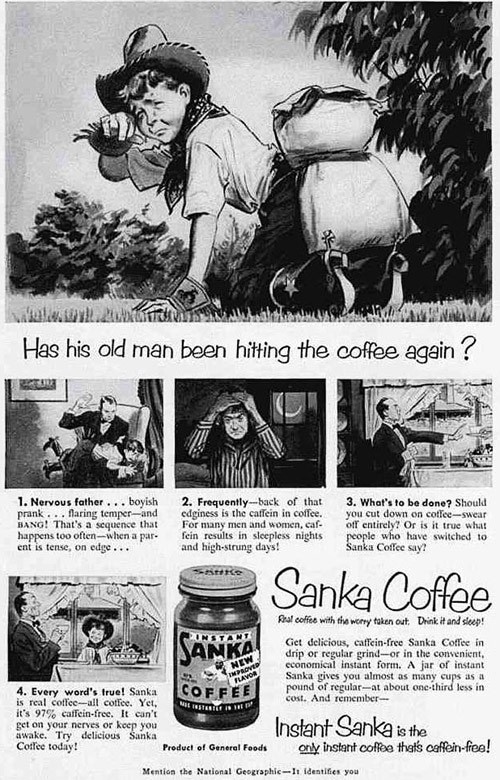
When you look at the vintage advertisement above, it’s hard not to notice some things about it that you wouldn’t see in ads today.
For one, you’d of course never see a company these days depicting spanking. And though it’s still around, you never see ads for Sanka anymore, period.
But there’s another interesting difference on display in the old ad: a public recognition that drinking caffeine may have some ill-effects.
Today, caffeine is America’s most popular drug — touted as an energy-boosting, focus-enhancing wonder supplement without any downside.
But is this really the case? Setting aside all the hype created from millions of dollars spent by the marketers of coffee and energy drinks, what’s the truth about caffeine? And is it possible that quitting it just might help you become a better man?
My Story of Quitting Caffeine
I can remember when I first started consuming caffeine in a deliberate attempt to enhance my performance. Before that point, I didn’t drink Coke or Dr. Pepper hoping it would help me run faster or think better; I drank soda because it tasted good with my Mazzio’s pizza.
But my relationship to caffeine changed during my junior year of high school football. Looking for any advantage I could get during games, I started drinking Red Bull before I took the field and during half-time. I guess I thought it helped, because I stuck with this energy drink regimen throughout the rest of my high school football career.
But football games were the only time I drank energy drinks. I didn’t use caffeine to wake up (even though I was rising at 5:45AM for early morning scripture study with some other high school kids) and I didn’t really drink caffeine during the day, except for an occasional soda on the weekends.
But then I got to college. One semester my sophomore year, I had to pull an all-nighter to finish a project for class. There was a 7-Eleven right next to my apartment complex, so I walked over and got a Big Gulp of Diet Mountain Dew. The fizzy, citrus taste was wonderful, and the 162 mg of caffeine in my 32oz cup kept me alert and awake through the night.
Of course, I was tired the next morning. So on my walk to campus, I made a detour to the 7-Eleven and got another Big Gulp to enjoy on my trek. And I did it again the next morning. And the next one after that. Pretty soon, swigging 32 ounces of neon yellow elixir became a regular part of my balanced breakfast.
Then I learned about 5-hour Energy. They were too expensive for my broke college student budget, so I only used them when I thought I really needed an edge, like before a big exam or when writing a research paper. The daily morning Diet Mountain Dew continued, and after I got married, I even got Kate drinking the stuff — though she was satisfied with just a few sips.
Fast forward to law school, and my morning Dew habit just wasn’t enough to keep me going through my long days in the library, so I expanded to a second one at lunch. 5-hour Energy made more frequent appearances in my routine too. On exam days, I’d have one shot in the morning and another right before starting the test.
It was also at law school that I discovered pre-workout supplements. I started off with one scoop that contained 100 mg of caffeine, but I adapted rather quickly to it. It was only a matter of weeks before I was throwing back four scoops at once. By this time, I could afford to buy 12-packs of 5-hour Energy, and I’d knock one back at lunch, and take another when the 3PM drowsiness started kicking in. At dinnertime, I’d often have some sort of caffeinated soda with my food, so I’d have the energy to do some work after the kids went to bed. And I’d sometimes take a few sips of 5-hour Energy right after dinner as a “palette cleanser.”
Doctors and scientists recommend that folks consume no more than about 300-400 mg of caffeine a day. I didn’t know it, but I was averaging over a 1,000 mg a day.
I never noticed any overt signs that the caffeine was having any ill-effects on my health. My body had developed such a tolerance for it, that even after imbibing caffeine all day long, I could still fall sleep by 11PM, and I slept pretty well through the night. My blood pressure was a bit elevated, but not too much. I learned after getting my genome sequenced at 23andMe that I’m a fast caffeine metabolizer, meaning I can consume 100 mg of caffeine, and the effects will be gone within 30 minutes. This probably explains why I didn’t notice any obvious effects, as well as why I felt like I needed to consume greater and greater amounts of caffeine to feel any “buzz.”
But during my ten years of increasing consumption, a few subtle changes started popping up. I got moodier. Pissy would be the more accurate word. Now, as I’ve discussed in my series on depression, I’m kind of morose by nature, but I had always considered myself a pretty laid back, friendly guy. But little things started to annoy me and my resilience began to shrink. Even Kate noticed that something was different, but neither of us connected my increasing anger and irritability with caffeine. I just figured that increasing irritability came with increasing responsibility with work and fatherhood; I just needed to meditate, write in my journal more, or double-down on my study of stoicism.
My dandruff also started proliferating, and I even started getting these red scales on my scalp. I also started getting an irritating rash that would appear now and then on my cheeks and nose. I had never had the problem before, so I went to a dermatologist and was told it was seborrheic dermatitis. She prescribed me a really expensive cream and shampoo to treat it.
Then, about two months, ago, I felt impressed to give up caffeine. I’m not sure why; the idea just kind of came to me, and I figured I’d give it a 30-day trial simply to see what would happen. I slowly decreased my daily intake over a week and then my no caffeine experiment began, and I quit cold turkey.
I had a pretty bad headache my first day without any caffeine, but I got through it with some aspirin. After that it was pretty much smooth sailing. I thought I would be dragging throughout the day and that I would have little or no focus, but the complete opposite occurred. I actually felt like I had more energy and better, steadier attention. The monkey mind went away. I had a bit of a tired slump in the afternoon, but didn’t feel any more fatigued than when I would take an energy shot to supposedly thwart it. Even more interesting, when I was drinking boatloads of caffeine, I’d be super drowsy by 9PM and would be ready to hit the hay. Without caffeine, I didn’t fall into that evening crater of fatigue. Sure, I was tired, and could fall asleep easily, but I could still do some reading without feeling like I was about to pass out.
My dandruff and seborrheic dermatitis started clearing up too, and I found myself using the prescription shampoo and cream less and less.
The biggest change though was in my mood. The pissiness? Gone. Little things that would once cause me to fly off the handle no longer bothered me. I just felt more patient, steady, and calm. I even felt more genuinely happy, a feeling that, due to my morose nature, doesn’t usually come easily for me. Kate and the kids readily noticed the change, and I felt like I became a better husband and father.
When it came to irritability and the responsibilities of adulthood, I had mixed up correlation and causation. I thought my full plate was making me irritable, but instead it had just led me to think I needed more and more caffeine, and it was the caffeine that was actually making me feel perennially pissed off.
After my month-long break from caffeine, I figured that maybe I had reset my body and mind, and I could go back to drinking energy drinks or soda. In moderation, of course. But even just a couple scoops of pre-workout in the morning or a single 5-hour Energy would cause my cheeks to flare up with seborrheic dermatitis the next day. And my pissiness quickly returned. So after a week of moderate caffeine use, I decided to say goodbye to the drug indefinitely (with the exception of using it before doing an obstacle race or staying up all night for a GoRuck Challenge). For caffeine and I, it was a good 10-year run, but I’m tired of being a pissy, dandruff-covered crank.
Might quitting caffeine have the same kind of benefits for you that it had for me? Today we’ll take a look at America’s most popular drug: how it works, why you might consider giving it up, and methods you can use to kick your own caffeine habit.
How Caffeine Works
The popular conception of caffeine is that it gives you scot-free energy. But the reality is more complicated.
Throughout the day, your brain produces a neurotransmitter called adenosine. When it binds to adenosine receptors in your neurons, nerve activity in the brain slows down, and you start feeling drowsy. To a nerve cell, caffeine looks just like adenosine, which means caffeine can bind to a neuron’s adenosine receptor. When caffeine does this, actual adenosine can no longer bind to the neuron, which means the brain can’t get its “time to get drowsy” message. Because your brain isn’t getting adenosine, instead of slowing down, neural activity starts speeding up.
The pituitary gland observes the increased brain activity as a signal that some sort of an emergency is going on, so it releases hormones that tell the adrenal glands to produce adrenaline (epinephrine) and cortisol. Adrenaline is the “fight or flight” hormone, and it has a number of effects on your body, including dilating your pupils, increasing your heartbeat, and releasing sugar from the liver into the bloodstream for extra energy. These reactions are why you feel a buzz after you consume caffeine.
Besides adrenaline, your body also releases cortisol when you consume caffeine. Cortisol stays in the bloodstream much longer than adrenaline and works with adrenaline to prepare your body to fight or flee. It constricts blood vessels, increases the amount of glucose and insulin in your blood (for quick energy), and increases and partially shuts down the immune system.
Basically, caffeine allows you to activate your physiological fight-or-flight reaction on demand. This stress response was designed to help humans deal with immediate challenges and threats, which is why occasional, short-term bouts of it can indeed be beneficial — making you feel more alert and focused. But dialing up the stress response, and elevating your cortisol all the time, even when you’re sedentary and relatively relaxed, can create problems and deleterious effects in the long-term.
And of course that exactly describes the average American’s daily consumption of caffeine.
Why You Might Consider Quitting Caffeine
Caffeine use is not without its advantages. Research has shown that the moderate, long-term use of caffeine may provide benefits such as: improving memory, boosting testosterone, warding off Alzheimer’s, reducing the risk of kidney stones, reducing weight (by suppressing appetite), and providing protection from type-2 diabetes. The key word here, though, is moderate consumption (300-400 mg a day). Most people don’t know how much caffeine they’re actually consuming; a big 12-ounce mug of coffee can contain as much as 300 mg of caffeine. So if you drink 4 “cups” of it a day, you’ll easily consume 4X the recommended amount.
Research has also shown that caffeine can ward off fatigue during workouts and improve focus. But keep in mind that these studies are based on occasional consumption; if you use caffeine every day, you will develop a tolerance for it that mitigates and even eliminates these benefits. In other words, you only get a buzz when your caffeine use is sporadic.
So caffeine does have benefits, but with important caveats. On the flip side of the coin, quitting caffeine, or at least dialing back your consumption of it, comes with its own set of potential advantages:
Decreased depression and anxiety. Research has shown that heavy caffeine consumption can exacerbate existing depression. This may be because the increased dopamine release that accompanies caffeine can eventually desensitize your dopamine receptors. One symptom of depression is the lack of motivation to do things that once brought you joy. Dopamine is the neurotransmitter of motivation, so if your brain is desensitized to it, motivation decreases, and you sink deeper into a funk. Thus if you’re already susceptible to depressive moods, caffeine might increase your vulnerability to visits from the black dog.
Caffeine can also exacerbate anxiety. The stress hormones that are released in response to caffeine can create jitters, heighten stress, and trigger anxiety attacks. If you’ve ever taken a weight loss drug, like Hydroxycut, which is packed with caffeine, you know it can make you feel insane.
Less irritability. The research is split on whether caffeine increases anger and aggression. Some studies say it doesn’t; others have shown that the stress arousal caffeine triggers can cause irritability, and that eliminating its consumption can decrease feelings of hostility.
The mixed results are probably rooted in the fact that caffeine seems to affect each individual differently. Some may be more sensitive than others. Kate drinks a pre-workout before running on an empty stomach in the mornings, and it doesn’t seem to affect her irritability. But for me, removing caffeine from my diet caused a night and day change in my pissiness. I was much less angry off caffeine than I was when I was drinking it every day. Becoming less irritable made quitting caffeine completely worth it for me.
Clearer skin. The stress hormones released by caffeine cause inflammation which shows up for some folks in the form of acne breakouts and other skin problems like dandruff. If you’ve been a grown-ass man for some time but are still fighting zits like a fifteen-year-old, you might look into eliminating caffeine from your diet to see if it helps.
Lower blood pressure. Caffeine does two things to increase your blood pressure. First, it constricts blood vessels, and second, it increases your heart rate. Several studies have shown that individuals who regularly consume high amounts of caffeine have elevated blood pressure levels compared to non-caffeine users. Even when caffeine users abstain from the stimulant, it typically takes a few days for resting blood pressure levels to decrease to a normal amount. If cardiac problems run in your family, you might consider giving up caffeine to protect your heart health.
More money. While you could get your caffeine by popping cheap pills of No-Doz, most folks prefer a liquid caffeine-delivery system. And these drinks are often expensive. The website Caffeine Informer put together some back-of the-napkin estimates on the amount folks spend per year to get their buzz and came up with the following numbers:
- A Grande Starbucks Latte: $3.65 a day | $26 a week | $1,332 a year
- Monster Energy Drink: $3 a day | $21 a week | $1,095 a year
- Home brewed coffee: $.71 a day | $5 per week | $259 a year
- 5-hour Energy: $3 a day | $21 a week | $1,095 a year
Many people are using a combination of the above drinks, so there’s a chance they’re spending $2,000+ a year to get their fix. What would you do with an extra $1,000 or $2,000 a year if you quit caffeine?
Greater antifragility. Strengthening antifragility in all areas of my life is a goal of mine, but my caffeine consumption worked against this aim. If I were somewhere I couldn’t get my fix, I’d get a headache and feel like crap. I’d have to remember to pack a 5-hour Energy when I went camping or on a trip. It affected me psychologically too; if I didn’t get my pre-workout in the morning, then I just didn’t think I’d have that great of a workout. Or if I didn’t get my energy shot in the afternoon, I felt like I couldn’t be as productive or creative in my work. I hated feeling emotionally and physically dependent on a substance to be able to function normally.
Better sleep. If you’ve had trouble sleeping, caffeine may be the culprit. If you don’t want to give up caffeine completely, at least consider cutting yourself off before 3PM so you can get a more restful slumber.
Caffeine will actually work when you really need it. If you’ve been drinking caffeinated beverages regularly, you’ve likely developed a tolerance for it, meaning it really doesn’t affect you or give you any kind of boost, beyond warding off effects of withdrawal. You drink it not to feel great, but just to avoid feeling bad; you’re basically spending money merely to maintain the status quo.
Caffeine is best reserved for use as a secret weapon — something you’ve got in your backpocket when you really do need a buzz, like before a race or an all-night study session.
Ultimately everybody has to decide for themselves if the benefits of caffeine are worth the price of the downsides. It’s a balancing act for sure, and each person is going to be different.
How to Quit Caffeine
If you’ve decided you’d like to experiment with eliminating caffeine from you life, here are some tips on how to successfully break the habit:
Go Cold Turkey…
Some folks just decide to give up caffeine completely. The big benefit of going cold turkey is that you can kick the habit faster and enjoy the benefits of a caffeine-free life sooner than if you took a more gradual approach. The big downside is that you may experience severe withdrawal symptoms like a pounding headache (the headache comes from the blood vessels in your head opening back up to their normal size and normal blood flow returning). These withdrawal symptoms may lead some to prematurely throw in the towel.
If you decide to go cold turkey, consider starting on a Friday, so you have the weekend to deal with the severe withdrawal symptoms that happen early in the quitting process. Drink plenty of water and have aspirin at the ready. Don’t give up even if it seems unbearable.
… Or Wean Yourself Off
A less painful method is to wean yourself off caffeine gradually. The upside of this method is you can reduce or even eliminate withdrawal symptoms. The downsides are that it takes longer to become caffeine free, and it requires you to be much more mindful of the amount of caffeine you’re drinking.
To wean yourself off, gradually reduce the amount of caffeinated beverages you drink over time. So if you’re a coffee drinker, you can reduce the amount of cups you drink by ¼ each day. If you drink energy drinks, cut back by half a can each day. If you’re doing a pre-workout, reduce your scoops by one each week. You get the idea.
You can control the pace at which you cut back; you can reduce to zero in a matter of days or you can give yourself a few weeks to eliminate caffeine. Experiment with the pace and see what works for you.
Replace One Ritual With Another
The reason people generally get their caffeine from drinks rather than tablets, is that they’re after more than the drug itself. Drinking a hot cup of coffee or a cold, fizzy energy drink is an enjoyable ritual to start the day or make it through a boring afternoon.
So instead of just going cold turkey or weaning yourself from caffeine to nothing, it can be beneficial to replace your usual caffeinated fare with non-caffeinated alternatives. Replacing your old drinks with plain old water can be effective for some folks, but you may need something that feels a little “richer” to fill the gap. So, for example, as you reduce the amount of caffeinated coffee, you could replace it with decaf (this substitute is popular among folks quitting joe) or herbal tea. As you decrease the amount of caffeinated soda you drink, you could swap it for sparkling seltzer. I really like to drink something with a little flavor in the morning, so I replaced my pre-workout supplement for one with just branch chain amino acids (this has the added benefit of possibly helping with my post-workout recovery, since I exercise in a fasted state).
Of course these replacements cost money, which will reduce the cost-saving benefit of quitting caffeine, but if it helps you break the habit, it can be worth it. Remember that whenever you “hack the habit loop” you keep the same routine as before, but replace the reward you used to get from your old behavior, with a new reward.
Switch to a Milder Form of Caffeine
Another method I’ve come across to reduce the ill-effects of caffeine isn’t to completely eliminate it from your life, but rather to replace your caffeinated beverages with a milder form. Green tea and yerba mate are the most popular coffee and energy drink alternatives. There are also chocolate beverages out there that provide a mild energy boost in the form of theobromine. These alternative drinks have much less caffeine, but still provide a gentle stimulating effect. What’s more, they offer a myriad of health benefits.
If you’re working on something especially challenging, and need a boost in focus, without the physiological effects of caffeine, try a nootropic.
Concluding Thoughts
Like most things in life, caffeine has its pros and cons. But also like most things in life, we often give very little thought to the two sides of the issue. We mindlessly knock back our caffeinated beverages because that’s what we’ve always done, and that’s what we see seemingly everyone else doing. There’s so much money invested in the energy drink business, and thus so much pro-caffeine hype out there, that you rarely run into a discussion of the drug’s potential downsides. But those downsides are at least worth considering.
By doing my own experiment, I’ve personally learned that caffeine isn’t for me, and that my life is better off without it. How does caffeine affect you? Do its pros outweigh the cons in your life? If you’re not sure, and especially if you feel like something’s not right with your life, but you don’t know what’s wrong, try your own experiment. If you don’t notice much of a change, then keep on keeping on with your caffeinated life. No harm, no foul. If do you notice a significant improvement in some areas of your life, then you can decide if giving it up altogether, or using it just for special occasions, might be a decision that helps you become a better man.
Want to share your thoughts on this article? Send us a tweet or join the discussion on Facebook!
___________
Sources
Caffeine edited by Gene A. Spiller
Caffeine Blues by Stephen Cherniske
Adam Victor Brandizzi likes this
26 Sep 20:35

Here’s my art for the upcoming pen and paper RPG Mutant:...
Here’s my art for the upcoming pen and paper RPG Mutant: Maskinarium.
Fria Ligan has a kickstarter for it: (in Swedish):
https://www.kickstarter.com/projects/1192053011/mutant-maskinarium
Adam Victor Brandizzi likes this
26 Sep 20:20
The Jungle Book (Trailer)
by Mal Sehen
Die Fünf Filmfreunde
Der erste Trailer zum Live-Action-Dschungelbuch ist endlich da und jagt einem gleich jede Menge Gänsehaut ein. Ich wollte mir einfach nicht vorstellen, dass es möglich sei, dass Disney ihre eigenen Klassiker noch einmal aufleben lassen könnte, aber hier kann man mal sehen wie man sich täuschen kann.
Unter der Regie von Jon Favreau (Iron Man) können die Tier sogar sprechen, ohne albern zu wirken: Panther Baghira wir von Ben Kingsley gesprochen, Bär Balu von Bill Murray, der Tiger Shir Khan von Idris Elba, Christopher Walken macht den Affenkönig Louie, Lupita Nyong’o spricht die Wölfin Raksha und Scarlett Johansson lispelt die Schlange Kaa.
Ob die deutsche Synchronisierung wenigstens die deutschen Pendants machen, oder ob wir Otto Waalkes, ein bis zwei Dschungelcamp Gewinner und einen beliebigen Ochsenknecht hören werden, habe ich jetzt erstmal nicht finden können. Hoffen wir das Beste.
via MP
Der Beitrag The Jungle Book (Trailer) erschien zuerst auf Die Fünf Filmfreunde.
Adam Victor Brandizzi, Martin likes this

26 Sep 20:09

Sometimes you’re a genius and you make a comic, what can I tell...
by punchthemoon
Sometimes you’re a genius and you make a comic, what can I tell you?
Adam Victor Brandizzi, bernot likes this


26 Sep 19:39

And most exciting of all:
Coming Soon: You’re A Scientist! (Make Your Own Mistakes: Volume 1)
by admin

Coming soon! A new interactive adventure!
You are just a lowly beaker cleaner…until fate intervenes. When the Fake Science Laboratories come calling, you answer—and it turns out to be the greatest adventure of the last 15 minutes.
Can YOU make the mistakes that will save/destroy/do nothing notable to the lab? Can YOU turn the pages? Can YOU really read?
FREE and CREATIVE COMMONS ON:
- iBooks
- Kindle
- Microsoft Word Doc
- The Pirate Bay
- and more!
Sign up to be alerted the exact moment of release!
And most exciting of all:
$9.99 for a beautiful, giftable, paperback copy.
Don’t miss out…on science!
Get an e-mail the INSTANT this science is available!
Submit your email address here…for science.
Enter your email now! You’ll be the first on the block to get your free copy!
And just in case you ignored our numerous, relatively polite requests for your email address:
mkvande, Adam Victor Brandizzi and one other like this
26 Sep 19:38
ArtStation - ruins of han, by Te HuMore concept art here.

Adam Victor Brandizzi, Randy Laue likes this
26 Sep 19:38
ArtStation - - H O M E -, by Eduardo García

mkvande, Adam Victor Brandizzi and one other like this

24 Sep 09:33


If a Tree Falls in the Forest… These Megaphones Will Amplify Its Sound
by Kate Sierzputowski
All images by Tõnu Tunnel

The soothing sounds of nature have never been easier to hear after a group of interior architecture students from the Estonian Academy of Arts decided to infiltrate a nearby forest with three giant wooden microphones. The sound-amplifying installation is near RMK’s pähni nature centre, an area where one can currently rest within the grooves of one of three megaphones to intently listen to the detailed rustling of leaves or chirping of birds both near and far.
Valdur Mikita, a writer who has often covered the way Estonian culture is tied to the 51% of forests that comprise it said, “It’s a place to listen, to browse the audible book of nature – there hasn’t really been a place like that in Estonia before.”
According to interior architect Hannes Praks the three-metre diameter megaphones will act as a “bandstand” for the environment around it. “We’ll be placing the three megaphones at such a distance and at a suitable angle, so at the centre of the installation, sound feed from all three directions should create a unique merged surround sound effect,” said Praks.
The structures will not only be available for solo meditation, but also serve as stages for intimate events and protective structures for spending the night in the woods—which in this forest you can do for free. (via Mental Floss)


Randy Laue, bernot and 3 others like this
23 Sep 23:38
 Philosophizing, pre-internet.(Flickr/Erik Drost—CC-BY-2.0)
 Printed encyclopedias: still a thing(Princeton University Press)
 Edward Zalta presents the SEP to the 2015 Wikimania conference.(Aasrubio—CC BY-SA 4.0)
 The ever-changing SEP(SEP)
 Jacques Louis David’s The Death of Socrates. An ugly man with an authorial voice.(Public Domain)
 The SEP makes high-quality PDFs like this available to members.(SEP)
This free online encyclopedia has achieved what Wikipedia can only dream of - Quartz
Adam Victor BrandizziElogio muito merecido ao SEP.
The Stanford Encyclopedia of Philosophy may be the most interesting website on the internet. Not because of the content—which includes fascinating entries on everything from ambiguity to zombies—but because of the site itself.
Its creators have solved one of the internet’s fundamental problems: How to provide authoritative, rigorously accurate knowledge, at no cost to readers. It’s something the encyclopedia, or SEP, has managed to do for two decades.
The internet is an information landfill. Somewhere in it—buried under piles of opinion, speculation, and misinformation—is virtually all of human knowledge. The story of the SEP shows that it is possible to create a less trashy internet. But sorting through the trash is difficult work. Even when you have something you think is valuable, it often turns out to be a cheap knock-off.
The story of how the SEP is run, and how it came to be, shows that it is possible to create a less trashy internet—or at least a less trashy corner of it. A place where actual knowledge is sorted into a neat, separate pile instead of being thrown into the landfill. Where the world can go to learn everything that we know to be true. Something that would make humans a lot smarter than the internet we have today.
The impossible trinity of information
The online SEP has humble beginnings. Edward Zalta, a philosopher at Stanford’s Center for the Study of Language and Information, launched it way back in September 1995, with just two entries.
Philosophizing, pre-internet.(Flickr/Erik Drost—CC-BY-2.0)That makes it positively ancient in internet years. Even Wikipedia is only 14. Sites that have been around 20 years mostly belong to brands that predate the internet—like Bloomberg or MTV—or they’re old sites that just happen to still work, like the classic Space Jam.
The SEP is neither pre-internet, nor is it ossified. It now contains nearly 1,500 entries, and changes are made daily. The site gets over a million page views per month—a respectable number, given how many entries there are with titles like Tibetan epistemology and philosophy of language or Peirce’s theory of signs. The American Library Association’s Booklist review called it “comparable in scope, depth and authority” to the biggest philosophy encyclopedias in print, the 10-volume offerings from Routledge and Macmillan—and that was nearly a decade ago.
John Perry, the director of the center, was the one who first suggested a dictionary of philosophical terms. But Zalta had bigger ideas. He and two co-authors later described the challenge in a 2002 paper (pdf, p. 1):
A fundamental problem faced by the general public and the members of an academic discipline in the information age is how to find the most authoritative, comprehensive, and up-to-date information about an important topic.
That paper is so old that it mentions “CD-ROMs” in the second sentence. But for all the years that have passed, the basic problem remains unsolved. The requirements are an “impossible trinity”—like having your cake, eating it, and then bringing it to another party. The three requirements the authors list—”authoritative, comprehensive, and up-to-date”—are to information what the “impossible trinity” is to economics. You can only ever have one or two at once. It is like having your cake, eating it, and then bringing it to another party.
Yet if the goal is to share with people what is true, it is extremely important for a resource to have all of these things. It must be trusted. It must not leave anything out. And it must reflect the latest state of knowledge. Unfortunately, all of the other current ways of designing an encyclopedia very badly fail to meet at least one of these requirements.
Where other encyclopedias fall short
Book
Authoritative: √
Comprehensive: X
Up-to-date: X
Printed encyclopedias: still a thing(Princeton University Press)Printed books are authoritative: Readers trust articles they know have been written and edited by experts. Books also produce a coherent overview of a subject, as the editors consider how each entry fits into the whole. But they become obsolete whenever new research comes out. Nor can a book (or even a set of volumes) be comprehensive, except perhaps for a very narrow discipline; there’s simply too much to print.
Crowdsourcing
Authoritative: X
Comprehensive: X
Up-to-date: √
A crowdsourced online encyclopedia has the virtue of timeliness. Thanks to Wikipedia’s vibrant community of non-experts, its entries on breaking-news events are often updated as they happen. But except perhaps in a few areas in which enough well-informed people care for errors to get weeded out, Wikipedia is not authoritative. Basic mathematics entries on Wikipedia were a “a hot mess of error, arrogance, obscurity, and nonsense.” One math professor reviewed basic mathematics entries and found them to be a “a hot mess of error, arrogance, obscurity, and nonsense.” Nor is it comprehensive: Though it has nearly 5 million articles in the English-language version alone, seemingly in every sphere of knowledge, fewer than 10,000 are “A-class” or better, the status awarded to articles considered “essentially complete.”
Speaking of holes, the SEP has a rather detailed entry on the topic of holes, and it rather nicely illustrates one of Wikipedia’s key shortcomings. Holes present a tricky philosophical problem, the SEP entry explains: A hole is nothing, but we refer to it as if it were something. (Achille Varzi, the author of the holes entry, was called upon in the US presidential election in 2000 to weigh in on the existential status of hanging chads.) If you ask Wikipedia for holes it gives you the young-adult novel Holes and the band Hole.
In other words, holes as philosophical notions are too abstract for a crowdsourced venue that favors clean, factual statements like a novel’s plot or a band’s discography. Wikipedia’s bottom-up model could never produce an entry on holes like the SEP’s.
Crowdsourcing + voting
Authoritative: ?
Comprehensive: X
Up-to-date: ?
A variation on the wiki model is question-and-answer sites like Quora (general interest) and StackOverflow (computer programming), on which users can pose questions and write answers. These are slightly more authoritative than Wikipedia, because users also vote answers up or down according to how helpful they find them; and because answers are given by single, specific users, who are encouraged to say why they’re qualified (“I’m a UI designer at Google,” say).
But while there are sometimes ways to check people’s accreditation, it’s largely self-reported and unverified. Moreover, these sites are far from comprehensive. Any given answer is only as complete as its writer decides or is able to make it. And the questions asked and answered tend to reflect the interests of the sites’ users, which in both Quora and StackOverflow’s cases skew heavily male, American, and techie.
Moreover, the sites aren’t up-to-date. While they may respond quickly to new events, answers that become outdated aren’t deleted or changed but stay there, burdening the site with a growing mass of stale information.
The Stanford solution
So is the impossible trinity just that—impossible? Not according to Zalta. He imagined a different model for the SEP: the “dynamic reference work.”
Dynamic reference work
Authoritative: √
Comprehensive: √
Up-to-date: √
To achieve authority, several dozen subject editors—responsible for broad areas like “ancient philosophy” or “formal epistemology”—identify topics in need of coverage, and invite qualified philosophers to write entries on them. If the invitation is accepted, the author sends an outline to the relevant subject editors.
This is not somebody randomly deciding to answer a question on Quora. “An editor works with the author to get an optimal outline before the author begins to write,” says Susanna Siegel, subject editor for philosophy of mind. “Sometimes there is a lot of back and forth at this stage.” Editors may also reject entries. Zalta and Uri Nodelman, the SEP’s senior editor, say that this almost never happens. In the rare cases when it does, the reason is usually that an entry is overly biased. In short, this is not somebody randomly deciding to answer a question on Quora.
An executive editorial board—Zalta, Nodelman, and Colin Allen—works to make the SEP comprehensive. They steer the encyclopedia away from the “wiki-hole”—having to open endless Wikipedia pages defining jargon in order to understand the topic at hand. “We tell our authors to try to write an entry that is self-contained,” Nodelman explains.
Edward Zalta presents the SEP to the 2015 Wikimania conference.(Aasrubio—CC BY-SA 4.0)Of course, it’s not just single entries that have to be comprehensive, but the encyclopedia as a whole. The board sees to this too, looking for cases where one long entry should be split up, or where one should absorb another. “We had an entry on brains in a vat, but that was subsumed by ‘skepticism and external content,'” Nodelman adds (in easily the most philosophy-department line I’ve heard since earning my bachelor’s degree). Subject editors help with this as well, by identifying areas that deserve more attention and soliciting writers.
Can something so thorough be up-to-date? The editors have ways to make sure that it is.
A new entry is expected to contain the freshest possible information and research on a topic. As soon as it is published, the clock starts ticking on a new deadline. In exactly four years—or earlier if research has moved on significantly—the author must again hand in the most up-to-date entry on the topic.
In effect, therefore, each entry is on its own publishing schedule. “This is the only rational way to somehow keep track of all of the arcane topics out there,” adds Zalta. “We are processing updates and changes daily,” says Nodelman. An ever-changing What’s New page shows the SEP revisions and additions for each day.
The ever-changing SEP(SEP)Updates come from a variety of sources. Quartz spoke to several SEP authors and editors, some of whom said that the encyclopedia is used frequently both as a reference and as a teaching tool. This means that philosophers are some of the SEP’s core readers, and they can alert authors or subject editors to incorrect or insufficient entries. Knowledgable readers are encouraged to do the same, even if they’re not philosophers.
The fact that there is a specific author and editor, and that the SEP has become so important to philosophy, helps make all of this easier. Any errors reflect poorly on the contributors, and someone who spots a slip-up can talk to a real person about it—neither of which is true with Wikipedia. And if an author is slow or unwilling to respond, the editorial board will transfer his or her responsibilities to a brisker philosopher.
The individual can be wiser than the crowd
There are a bunch of other benefits to this approach. Chief among them is giving the encyclopedia what Zalta calls an “authorial voice.”
“Profoundly ugly, resembling a satyr more than a man.”—The SEP on Socrates After regularly trawling through the internet information trash heap, it’s easy to forget exactly what that means: something written by a professional writer who has deep knowledge of the material at hand and an actual personality.
An exemplary SEP entry in this regard is the one on Socrates, written by Debra Nails, a specialist in ancient Greek philosophy. It contains a section called “Socrates’ strangeness” that captures the man in a way that’s much too elegant and confident to be on Quora or Wikipedia.
The extant sources agree that Socrates was profoundly ugly, resembling a satyr more than a man—and resembling not at all the statues that turned up later in ancient times and now grace Internet sites and the covers of books. He had wide-set, bulging eyes that darted sideways and enabled him, like a crab, to see not only what was straight ahead, but what was beside him as well; a flat, upturned nose with flaring nostrils; and large fleshy lips like an ass. Socrates let his hair grow long, Spartan-style (even while Athens and Sparta were at war), and went about barefoot and unwashed, carrying a stick and looking arrogant. He didn’t change his clothes but efficiently wore in the daytime what he covered himself with at night.
Jacques Louis David’s The Death of Socrates. An ugly man with an authorial voice.(Public Domain)This authorial voice also avoids the tendency of crowdsourcing to be unhelpfully uncontroversial. For a long time, Wikipedia’s introductory line on Immanuel Kant read that he was “a central figure of modern philosophy.” The SEP, on the other hand, confidently calls him “the central figure in modern philosophy.” It’s a difference of only one word, but it explains the consensus of the philosophical community and conveys Kant’s true significance. (While I was writing this, Wikipedia updated that line to read “the central figure,” but quoting and attributing the SEP.)
Another benefit of the SEP’s not being crowdsourced is that minority views get more exposure. Wikipedia’s overview of feminist philosophy is hopelessly short. The SEP has dozens of meticulously researched entries. A 2012 survey by Wikimedia, Wikipedia’s parent organization, found that about 90% of its volunteers were men. “Its entries on Pokemon and female porn stars are comprehensive, but its pages on female novelists or places in sub-Saharan Africa are sketchy,” said the MIT Technology Review in its article The Decline of Wikipedia, which criticizes its byzantine editing hierarchy. The same goes for an important idea in philosophy: feminism. Wikipedia’s overview of feminist philosophy is hopelessly short. The SEP, on the other hand, is home to dozens of meticulously researched entries on the topic.
So the SEP model works, and it has 1,500 fact-checked, peer-reviewed entries to prove it.
Who pays the philosopher?
You might think all this can only be possible courtesy of a wealthy patron underwriting generous fees for authors and a large staff of editors. Not at all.
To be fair, Stanford does pay most of the operating costs. But the SEP has a paid staff of only three—Zalta, Nodelman, and Allen—plus five other Stanford employees who spend 20% of their time on technical support. Neither the authors, nor the dozens of subject editors, get so much as a dime for their troubles.
Neither the authors, nor the dozens of subject editors, get so much as a dime for their troubles. And all the authors and editors I spoke to seemed perfectly happy with this arrangement, even though some entries are a long time in the making. Siegel, the philosophy of mind editor, said that most take at least a few months from start to finish. The longest one she has overseen “stretched out for some years.”
There are a few reasons why contributors are willing to put in the time. First, these are already things that they are deeply interested in and enjoy. Peter Adamson, author of the entries on Al-Kindi and the Theology of Aristotle, noted that he had already written books on these topics. Siegel mentioned that being an editor allowed her to “keep up with interesting segments of the field.”
“I am very lucky to be able to do philosophy for a living,” writes Adamson, “and I am interested in doing things that would justify why I should be allowed to make a living in this rather nice way, where I am effectively paid to do something that I would do for free, as a hobby.”
“I’m absolutely sure more people have read my [SEP] entries on Frege than all my other publications combined.” Then there is the fact that the SEP allows academic philosophers to reach a wider audience. This helps them gain recognition and bring ideas they think are important to the world outside universities and conferences.
“I thought writing this entry would be a good way to bring attention to the many interesting and socially relevant debates that were taking place among feminist philosophers and gender and sexuality theorists about sex markets,” said Laurie Shrage, author of Feminist Perspectives on Sex Markets.
Zalta put it more bluntly: “I’m absolutely sure more people have read my entries on Frege than all my other publications combined.”
But perhaps the overriding motivation of SEP contributors is simply to further the enterprise of philosophy by creating a place to better understand it.
“I liked the fact that the SEP was going to be open access, and it was becoming a very important resource for students, instructors, and scholars in related fields,” said Shrage, when I asked why she contributed. Siegel echoed this altruistic motive: “Philosophy is a complicated subject,” she said. “People feel invested in the SEP in part because it helps philosophers at all stages orient themselves to philosophical problems and figures that may be new to them.”
If the SEP ever shuts down, Stanford promises to give the libraries that contributed all their money back, with interest. To pay running expenses not covered by Stanford, the team obtained nearly $2 million in grants over the first 15 years. But they wanted something more sustainable, so they hired a business consultant (this is Stanford, after all), Javier Ergueta, and he proposed an idea that now provides around a third of the budget. The SEP asks academic libraries to make a one-time contribution. That doesn’t get them access to the SEP, since it’s already freely accessible, but they enjoy some extra “member benefits,” like the ability to use their own branding on a version of the encyclopedia, and to save the full archives.
Moreover, their money goes into an SEP endowment, managed by the same company that takes care of Stanford University’s endowment of over $20 billion. If the SEP ever shuts down, Stanford promises to give the libraries that contributed to SEP all their money back, with interest. “It became a no-risk investment for the libraries, and it’s a way for them to invest in open access,” says Zalta.
Libraries were enthusiastic. The SEP was able to raise over $2 million from the long list of contributors, and Stanford added $1 million to the library endowment. The university also provides 60% of SEP’s budget—not much to ask from such a rich institution. The remaining 10% comes from a “friends of the SEP” program, which for $5, $10, or $25 a year lets individual users download nicely formatted PDFs of the articles, good for printing or archiving for personal use.
The SEP makes high-quality PDFs like this available to members.(SEP)All this creative business thinking means the SEP can continue to exist long beyond these 20 years. “Our grant application days are over,” says Zalta. “We are practically self-sufficient as long as we don’t try to grow too much or too fast.”
The internet should look more like the SEP
The SEP is a highly rare case of knowledge being separated from the trash heap. The question is, can we make more of the internet like this?
The model cannot apply universally. Wikipedia is still necessary for its uncanny ability to provide basic (if often flawed) introductions to nearly everything. And StackOverflow probably offers the best chance at bringing some order to the ever-changing world of computer programming, where new languages and frameworks rise and fall with the sun.
Indeed, it might seem like philosophy is almost uniquely well-suited to the SEP’s model. It is a slow-moving discipline practiced by, literally, “lovers of wisdom,” willing to share lots of their time to spread that wisdom around. The SEP method has been tried in other fields, without success. Big tech companies could play the role of Stanford, putting money and staff into an encyclopedia of software development. “People have contacted us from linguistics, to Egyptian studies, to a music department that wanted to make an online reference work,” Zalta says. None have been able to make a full dynamic reference happen.
Still, there are two reasons why it could be replicated.
First, even fast-moving, young disciplines like computer science or economics have core concepts that deserve comprehensive and authoritative explanation. StackOverflow is great at providing answers to highly specific programming questions, like how to round a number to two decimal points in Python, but fails to explain abstract or technical things like the theory of algorithms or the fundamentals of cryptography. In economics, there are dozens of excellent blogs, but where do you go to get an in-depth, impartial, picture of the marginal theory of value or comparative advantage?
These core ideas are fundamental. Self-taught programmers are wont to “solve” problems by copy-and-pasting code straight from StackOverflow and crossing their fingers, with little sense of what the code is doing or why it works. Economics blogs might tell you that Greece’s economy needs to become more competitive, but it’s hard to understand what exactly that means without an intuition for these central concepts.
The second reason an SEP-like model could work more broadly is that the unpaid labor put in by SEP writers and editors isn’t something new to academia. Refereeing papers, editing journals, and other work outside an academic’s core research and teaching are typically unpaid in most fields. “It hadn’t been done this way for reference works,” Zalta says; but having changed in philosophy, where writing for the SEP has become just another way to spend time working to make the field better, it could change elsewhere.
Nor does it just have to be only academics who contribute to online reference works. In computer science, say, it would make just as much sense for big tech companies to play the role of Stanford, putting money and staff into an authoritative encyclopedia of software development. Given the shortage of well-trained developers for hire, they have an incentive to do so. “I think our model could be reproduced if you get the right people involved.” And large companies are already used to this form of self-interested altruism: They work on open-source code that benefits other programmers as well as their own.
What would it take to make this happen? The SEP’s model contains lots of clever insights on how to create a reference that stands the test of time—the library funding, the archiving for citation, the automatic deadline for article updates. But Zalta’s ultimate prescription requires nothing clever at all. Just old-fashioned resolve.
“What we had was several people single-mindedly focused on making this work,” he said. “I think our model could be reproduced if you get the right people involved.”
Landfill no more
You hear two things about information online. Nobody trusts it, yet everybody is referring to it, even for critical things like Ebola. That is not a recipe for an informed society.
The SEP is likely too rigorous to be the standard against which all information online is compared. But it shows we can create many more places that explain clearly the things humans know to be true. Bewildered Googling and tab-opening, tumbling indefinitely down the wiki-hole (if such a thing can even be said to exist), could be a thing of the past, if we only tried. It would be a lot more like the internet we always wanted.
Image of Rodin’s The Thinker at the Cleveland Museum of Art by Erik Drost on Flickr, used under Creative Commons 2.0 license. Image of Edward Zalta by Aasrubio on Wikipedia, used under Creative Commons 4.0 license.
mkvande, Adam Victor Brandizzi likes this
23 Sep 23:25
Saturday Morning Breakfast Cereal - Cross Product
by admin@smbc-comics.com
Adam Victor Brandizzi likes this