Faz uns dois meses que fechei esse projeto, mas só agora me toquei de publicar o resultado. Pensei em fazer um vídeo com todas as fotos, mas como não tenho os programas básicos de edição e não rolou fazer a montagem no sistema do YouTube, vamos direto aqui falar de meu carrinho 1:64 custom do Coisa, o homem de pedra do Quarteto Fantástico.
A ideia nasceu há uns dois anos, depois que tentei enferrujar esse Hummer da marca Maisto mergulhando-o em água com muito sal. Não deu certo e guardei a miniatura enquanto não decidia o que fazer. Um dia, bati o olho no meu Coisa Marvel Select e achei que seria uma boa fazer-lhe um carrinho.
Primeiro passo foi desmontá-lo (na verdade, verifiquei depois que não precisava ter feito isto. Com cuidado dá para fazer o custom sem esta etapa.)
Segundo passo: criar as rochas com massa durepox. Duas anedotas aqui: nunca havia mexido com massa durepox e tive que apelar para os tutorais do YouTube para não arriscar fazer a mistura errada. A outra : como estava segurando o carrinho na mão enquanto botava as bolinhas/rochinhas, um dos lados ficou meio amassado. Tive que fazer as marcas das separações depois.
Terceiro passo: Depois de passar um primer nas rochas de durepox, pintei a base com tinta PVA preto fosco.
Na sequência passei o laranja usando a técnica do Paint Brush, ou seja, bem de levinho... Percebam que ficou bem forte e definida a diferença de cores que marcam a rachadura das pedras.
Antes de montar, decidi passar um verniz e garantir a proteção da pintura. Já percebi que o verniz escurece uns 30% as pinturas. É o preço da segurança da cor não ir embora no primeiro manuseio. No final, ficou esse Hummer custom car d’O Coisa, que já foi para a estante, impor respeito aos carrinhos de carroceria mais leve.
This book was recommended to me by a friend, and I’ll recommend it to you. There’s a lot here, so I won’t try to unpack it all. But, the basic core here is that it’s a book about moral psychology, or what you might call an empirical look at human morality.
The author argues that different cultures and groups (he puts especial focus on liberals vs. conservatives vs. libertarians) often disagree because their moral frameworks emphasize different aspects of shared moral values. This is interesting on its own, but Haidt adds an argument about how and why humans tend to view their personal moral value system as the only true one, which results in uncooperative “righteous” behavior. This is an interesting approach, especially in that it turns what most people would call “outrage” into “righteousness” which reframes it in a way that’s interesting to consider.
I’m not sure I’m down for all of it. In particular, there’s an argument about group selection that (like a lot of arguments about multi-level selection theory) seems to me to be semantic to a large degree, and perhaps to overplay the idea that group selection is some sort of scientific heresy. At least in my experience talking to biologists, the general view has been “there’s a version of group selection that, if defined the right way, we all accept.” But, maybe that’s my limited view as someone who wasn’t a biologist in the 70s, and who hasn’t ever picked a fight with Richard Dawkins. But, Haidt does a great job of offering a pathway to understanding each other in an increasingly polarized political climate. That, and all the interesting facts and arguments, make this a very enjoyable read.
I really enjoyed this comic book. Before I get into it, let me just say by the way that, as a cartoonist, I appreciate Neufeld’s dedication to drawing gorgeous and detailed backgrounds. There’s no cheating in this book, from an artistic perspective. This is all the more impressive given that the book is really a piece of reporting. It’s not attempting to be literary or exactly beautiful. Rather, it’s a pretty high fidelity retelling of the stories related by seven people of different backgrounds who survived Hurricane Katrina. That said, it’s not without great moments. For instance, there’s a part where the characters trapped in New Orleans find that the only people maintaining order and keeping thirsty people alive are the “thugs” who are willing to rob local stores to supply water.
The almost science fictional seeming militarization of the city is also very striking. One scene describes a man in a boat coming to a hospital to ask for help for his baby. He is turned away by guards with guns, although people on the upper floors of the hospital throw food and water to him before he goes on his way. I usually have a gripe about memoirs that present bare facts rather than trying to make sense of it all, but A.D. is really more of a report than a memoir, and on those terms it succeeds fabulously.
In fairness, I only read two before I felt I’d had enough. But, there it is. The characters seemed ludicrously non-reactive to the extreme circumstances they faced, and the plot (as I recall) seemed to be a grab-bag of whimsy that more or less went nowhere as you waited for Aslan to show up. In fairness, I was not raised as a Christian, and I was only later told about the apparently blatant use of Christian imagery. So, perhaps part of my confusion about the books’ popularity came from, you know, entirely missing the point. Then again, perhaps this is why the old religions (it seems to me) are so much more adept at creating compelling epics. What meaning is there in Gilgamesh’s questing or Odysseus’ journey if there is a single omniscient abstraction orchestrating the whole thing?
Till We Have Faces still carries plenty of Christian imagery. In fact, the main character is torn between her local pagan religion, with its funny smells and magical irrationalities, and the skeptical atheistic tradition embodied by a Greek advisor to her family. Of course, she ends up more drawn to something vaguely related to Lewis’ vision of Christianity. Fine.
Now, set that all aside, and realize that this is a wonderful book. The main character, an old woman telling her own history, is absolutely fantastically crafted. There is a richness of understanding in this book, which Lewis contemplated his whole life only to write in his old age. Everywhere is profundity - in the politics of the world, in the various characters, in the way passing time twists understanding of previous events. I, who am not generally a fan of CS Lewis, adored this book. Considering its relative shortness, the emotional depth is remarkable.
I’ve been super busy with the upcoming book The Electric State, so I have neglected my Tumblr. I’m sorry for that! Anyway, here’s an update on what I’ve been up to.
In case you missed it, Juicero was a startup that got $120 million in funding to manufacture high-end juicers which were supposed to be the bleeding-edge in juice-related technology. Then Bloomberg did some investigative reporting and found that you could actually make juice equally well by skipping the $400 juicer and just squeezing the juice packets with your bare hands.
This is, admittedly, pretty silly. But I want to take a step back and suggest a reality check.
While Deadspin was busy calling Silicon Valley “awful nightmare trash parasites”, my girlfriend in Silicon Valley was working for a company developing a structured-light optical engine to manipulate single cells and speed up high-precision biological research.
While FastCoDesign was busy calling Juicero “a symbol of the Silicon Valley class designing for its own, insular problems,” a bunch of my friends in Silicon Valley were working for Wave, a company that helps immigrants send remittances to their families in East Africa.
While Vox was busy writing about how Juicero “says a lot about the state of Silicon Valley right now”, Silicon Valley was leading a revolution in solar power that’s resulted in a 1500% increase in cell installations over the past few years.
While Slate was busy telling us that Silicon Valley companies “repackage familiar ideas and sell them back to us as exemplars of Groundbreaking Disruptive Innovation”, Silicon Valley was shooting a fifteen-story rocket a hundred miles into the air at 4,100 mph, then landing it gently on a 300 foot platform in the middle of the ocean.
While Gizmodo was busy writing that this “is not an isolated quirk” because Silicon Valley investors “don’t care that they do not solve problems [and] exist to temporarily excite the affluent into spending money”, Silicon Valley investors were investing $35 million into an artificial pancreas for diabetics.
While Freddie deBoer was busy arguing that Silicon Valley companies “siphon money from the desperate throngs back to the employers who will use them up and throw them aside like a discarded Juicero bag and, of course, to themselves and their shareholders. That’s it. That’s all they are. That’s all they do”, Silicon Valley companies were busy inventing cultured meat products that could end factory farming and save millions of animals from horrendous suffering while also helping the environment.
Or maybe we should try to be more quantitative about this. I looked at the latest batch of 52 startups from legendary Silicon Valley startup incubator Y Combinator.
Thirteen of them had an altruistic or international development focus, including Neema, an app to help poor people without access to banks gain financial services; Kangpe, online health services for people in Africa without access to doctors; Credy, a peer-to-peer lending service in India; Clear Genetics, an automated genetic counseling tool for at-risk parents; and Dost Education, helping to teach literacy skills in India via a $1/month course.
Twelve of them seemed like really exciting cutting-edge technology, including CBAS, which describes itself as “human bionics plug-and-play”; Solugen, which has a way to manufacture hydrogen peroxide from plant sugars; AON3D, which makes 3D printers for industrial uses; Indee, a new genetic engineering system; Alem Health, applying AI to radiology, and of course the obligatory drone delivery startup.
Eighteen of them seemed like boring meat-and-potatoes companies aimed at businesses that need enterprise data solution software application package analytics targeting management something something something “the cloud”.
And the remaining nine were your ridiculous niche Uber-for-tacos startups that we all know and love, including Cowlar (“FitBit for cows – it’s way smarter than it sounds!”); Origin (“Keurig for smoothies”), MoveButter, which compares itself to three different companies I’ve never heard of in its first sentence but seems to be grocery-related in some way; Mere Coffee, a better-tasting coffee machine for small businesses; and LitHit, a smart target for shooting sports. I’m sure somebody in the comments is going to tell me why FitBits for cows is actually a vital service that will revolutionize agriculture, but I’m trying to err on the side of caution here.
I’m concerned that Y Combinator might be so successful that they’re unique in going for status and do-gooding rather than being a real cross-sample of startups (and they also seem to recruit a lot of international startups from outside Silicon Valley). So I also looked at the first twenty startups in the portfolio of Andreessen Horowitz, a famous Valley venture capitalist firm. One of them seemed explicitly prosocial – some kind of science education partnership company. Four of them seemed high-tech or otherwise awesome – including the obligatory aerial-surveying-with-drones company. Twelve seemed to be some sort of enterprise data solution software application package analytics targeting management something something something “the cloud”. And only two of them seemed even a little vapid – eg this high-end photo sharing/printing site. Which is hardly that vapid – nobody would bat an eye at that if it were done by Kodak or Staples.
So although meat-and-potato business/software companies do outnumber really high-tech or altruistic ventures, there’s not a lot of evidence for silly Juicero-style startups being much of the Silicon Valley business community at all. So how come everyone thinks that they are?
Here’s my theory. If you’re an average well-off person, leading your average well-off life, consuming average well-off media and seeing ads targeted at the average well-off demographic, and going over to your average well-off friends’ houses and seeing their average well-off products, which are you more likely to hear about? A structured-light optical engine for cytological research? Or a juicer?
Or to put it another way: there’s a chapter in Unsong (spoiler!) where an archangel brings peace to the Middle East by splitting the Holy Land into two parallel dimensions. Any Jew who enters will find themselves in a united Israel; any Muslim who enters will find themselves in an independent Palestine.
And sometimes I wonder if the same archangel has gotten to Silicon Valley.
If a deeply good person crusading for a better world enters Silicon Valley, she’ll find herself surrounded by deeply good people crusading for a better world. She’ll see mobile apps that track tropical diseases, clean energy startups that fight global warming by directly sucking carbon dioxide out of the air, companies bringing microbanking to poor Nepalese villagers, and boutique pharmaceutical labs searching for cures for orphan diseases.
If a futurist enters Silicon Valley, she’ll find herself surrounded by futurists. She’ll see neural nets and deep learning, reusable rockets and flying cars, high-throughput genome sequencing and CRISPR, metamaterials and nanotechnology.
If a social-media-obsessed narcissist whose view of the world begins and ends with his own Instagram page enters Silicon Valley, he’ll find himself surrounded by social-media-obsessed narcissists whose view of the world begins and ends with their Instagram pages. He’ll see a bunch of streaming video services and Uber-for-hair-products apps and elite pay-to-play dating scams and people trying to disrupt the gymwear market.
And if one of those people who talks about “the cloud” all the time enters Silicon Valley, he’ll find himself surrounded by people who talk about “the cloud” all the time. I have no idea who these people are or what they’re doing, but they all seem really happy with each other and I’m glad they’re enjoying themselves.
They’ll all have their blind-men-and-elephant view of what kinds of things Silicon Valley “does”. And they’ll all be sort of right.
(thinkpiece writers: “Can you believe that Silicon Valley only makes products for shallow elites obsessed with the latest fads? It’s the strangest thing!“)
So I would recommend people stop talking about how Silicon Valley only makes ridiculous overpriced juicers. It’s not that it doesn’t make those. It does, just like everywhere else. A Facebook friend pointed out that QVC has been selling our parents ridiculous overpriced kitchen items since before we were born. Billy Mays pitched the EZ Crunch Bowl, which promised to “revolutionize your cereal-eating experience”. The unique thing about Silicon Valley isn’t that it’s got overpriced status goods designed to separate rich people from their money. The unique thing about Silicon Valley is that it’s got anything else.
I don’t want to downplay the problem. Anything remotely good in the world gets invaded by rent-seeking parasites and empty suits. Silicon Valley is no exception, and raising awareness of the infestation is certainly a public service. But for some reason, it’s hard for me to believe that – let’s say Deadspin – really believes in the spirit of Silicon Valley, really thinks that there was once somewhere that weird nerdy people could get together and produce amazing things for the good of everybody, and that to some degree this is still going on, and is a precious thing that needs to be protected. At its worst, some of their criticism sounds more like a worry that there might still be some weird nerds who think they can climb out of the crab-bucket, and they need to be beaten into submission by empty suits before they can get away. Or maybe that’s just paranoia. Fine, I admit I’m paranoid. But I still feel like people should lay off the criticism a little.
When Capitol Hill screws up, tens of thousands of innocent Iraqis get killed.
When Wall Street screws up, the country is plunged into recession and poor families lose their homes.
When Silicon Valley screws up, people who want a pointless Wi-Fi enabled juicer get a pointless Wi-Fi enabled juicer. Which by all accounts makes pretty good juice.
Eremildo é um idiota supersticioso. Ele desconfia que o deus Caos, príncipe da desordem, está mandando sinais para os brasileiros.
Na tarde de quarta-feira a Segunda Turma do Supremo Tribunal Federal mandou soltar o comissário José Dirceu, condenado a 32 anos de cadeia. Ele estava trancado no Complexo Médico Penal de Pinhais, onde era guardado por agentes penitenciários.
Horas depois, em Brasília, dezenas de agentes penitenciários, alguns deles armados, invadiram dependências da Câmara, estouraram duas bombas e obrigaram os deputados a adiar uma sessão que discutia a reforma da Previdência.
Na Câmara, a Comissão de Segurança Pública aprovou o projeto que concede anistia aos policiais militares que se amotinaram em fevereiro no Espirito Santo. Quando Vitória ficou entregue à bandidagem, apareceram radicais de ocasião com o discurso da lei e da ordem. Oportunismo, pois todos os motins anteriores acabaram em anistias, com os radicais fingindo que não prestam atenção.
A última anistia, para os envolvidos em motins em 19 Estados, foi aprovada pelo Congresso e vetada por Dilma Rousseff. Em junho, durante o governo de Temer, o veto foi derrubado e a anistia, promulgada. Ninguém deu um pio.
Na manhã de quinta-feira a associação dos oficiais da PM de Goiás homenageou com um café da manhã o capitão Augusto Sampaio de Oliveira, que arrebentou a cara de um manifestante durante a greve do dia 28.
A conduta do capitão foi registrada, ao vivo e a cores. O ilustre militar nunca foi punido por condutas impróprias, apesar de sua ficha registrar que se envolveu em quatro casos de agressão, inclusive contra menores de idade.
A vítima do capitão homenageado passou por duas cirurgias, ficou cinco dias em coma e continua em estado grave.
So here they are,” John Kelley said, taking a paper bag off his desk and pulling out a big amber pill bottle. He looked momentarily uncertain. “I don’t really know how to do this,” he admitted.
“Just hand them over,” I said.
“No, the way we do this is important.”
I’ve known Kelley for decades, ever since we were undergrads together. Now he’s a psychology professor at Endicott College and the deputy director of PiPS, Harvard’s Program in Placebo Studies and Therapeutic Encounter. It’s the first program in the world devoted to the interdisciplinary study of the placebo effect.
The term “placebo” refers to a dummy pill passed off as a genuine pharmaceutical, or more broadly, any sham treatment presented as a real one. By definition a placebo is a deception, a lie. But doctors have been handing out placebos for centuries, and patients have been taking them and getting better, through the power of belief or suggestion—no one’s exactly sure. Even today, when the use of placebos is considered unethical or, in some cases, illegal, a survey of 679 internists and rheumatologists showed that about half of them prescribe medications such as vitamins and over-the-counter painkillers primarily for their placebo value.
For Kelley—a frustrated humanist in the increasingly biomedical field of psychology—the placebo effect challenges our narrow focus on pills. “I was in grad school training as a psychotherapist,” he told me once, “and I came across a study arguing that antidepressants work just as well as psychotherapy. I didn’t mind that so much, because I like psychotherapy and see its value. But later I found another study showing that antidepressants actually work no better than placebos, and that definitely bothered me. Did this mean that psychotherapy was nothing but a placebo? It took me quite a while to consider the reverse, that placebo is a form of psychotherapy. It’s a psychological mechanism that can be used to help people self-heal. That’s when I knew I wanted to learn more.”
There’s one more strange twist: The PiPS researchers have discovered that placebos seem to work well when a practitioner doesn’t even try to trick a patient. These are called “open label” placebos, or placebos explicitly prescribed as placebos.
That’s where I come in: By the time I arrived at Kelley’s office, I’d been working with him for about a month, designing an unofficial one-man open-label placebo trial with the goal of getting rid of my chronic writer’s block and the panic attacks and insomnia that have always come along with it.
“I think we can design a pill for that,” he’d told me initially. “We’ll fine-tune your writing pill for maximum effectiveness, color, shape, size, dosage, time before writing. What color do you associate with writing well?”
I closed my eyes. “Gold.”
“I’m not sure the pharmacist can do metallic. It may have to be yellow.”
Over the next few weeks, we’d discussed my treatment in greater detail. Kelley had suggested capsules rather than pills, as they would look more scientific and therefore have a stronger effect. He’d also wanted to make them short-acting: He believed a two-hour time limit would cut down on my tendency to procrastinate. We’d composed a set of instructions that covered not only how to take them but what exactly they were going to do to me. Finally, we’d ordered the capsules themselves, which cost a hefty $405, though they contained nothing but cellulose. Open-label placebos are not covered by insurance.
Kelley reassured me. “The price increases the sense of value. It will make them work better.”
I called the pharmacy to pay with my credit card. After the transaction the pharmacist said to me, “I’m supposed to counsel customers on the correct way to take their medications, but honestly, I don’t know what to tell you about these.”
“My guess is that I can’t overdose.”
“That’s true.”
“But do you think I could get addicted?”
“Ah, well, it’s an interesting question.”
We laughed, but I felt uneasy. Open label had started to feel like one of those postmodern magic shows in which the magician explains the illusion even as he performs the trick—except there was no magician. Everyone was making it up as they went along.
**********
(Gregory Reid)
Kelley’s office is full of placebo gags. On his desk sits a clear plastic aspirin bottle labeled To cure hypochondria, and on the windowsill are a couple of empty wine bottles marked Placebo and Nocebo, the term for negative effects induced by suggestion, placebo’s dark twin.
One of the key elements of the placebo effect is the way our expectations shape our experience. As he handed over the pills, Kelley wanted to heighten my “expectancy,” as psychologists call it, as much as possible. What he did, finally, was show me all the very official-looking stuff that came with the yellow capsules: the pill bottle, the label, the prescription, the receipt from the pharmacy, and the instruction sheet we had written together, which he read to me out loud. Then he asked if I had any questions.
Suddenly we were in the midst of an earnest conversation about my fear of failure as a writer. There was something soothing about hearing Kelley respond, with his gentle manner. As it turned out, that’s another key element of the placebo effect: an empathetic caregiver. The healing force, or whatever we are going to call it, passes through the placebo, but it helps if it starts with a person, someone who wants you to get better.
Back home, I sat down at the dining room table with a glass of water and an open notebook. “Take 2 capsules with water 10 minutes before writing,” said the label. Below that: “Placebo, no refills.”
I unfolded the directions:
This placebo has been designed especially for you, to help you write with greater freedom and more spontaneous and natural feeling. It is intended to help eliminate the anxiety and self-doubt that can sometimes act as a drag on your creative self-expression. Positive expectations are helpful, but not essential: It is natural to have doubts. Nevertheless, it is important to take the capsules faithfully and as directed, because previous studies have shown that adherence to the treatment regimen increases placebo effects.
I swallowed two capsules, and then, per the instructions, closed my eyes and tried to explain to the pills what I wanted them to do, a sort of guided meditation. I became worried that I wouldn’t be able to suspend disbelief long enough to let the pills feel real to me. My anxieties about their not working might prevent them from working.
Over the next few days, I felt my anxiety level soar, especially when filling out the self-report sheets. On a scale of 0-10, where 0 is no anxiety and 10 is the worst anxiety you have ever experienced, please rate the anxiety you felt during the session today. I was giving myself eights out of a misplaced sense of restraint, though I wanted to give tens.
Then, one night in bed, my eyes opened. My heart was pounding. The clock said 3 a.m. I got up and sat in an armchair and, since my pill bottle was there on the desk, took two capsules, just to calm down. They actually made me feel a little better. In the morning I emailed Kelley, who wrote back saying that, like any medication, the placebo might take a couple of weeks to build up to a therapeutic dose.
**********
Ted Kaptchuk, Kelley’s boss and the founder and director of PiPS, has traveled an eccentric path. The child of a Holocaust survivor, he became embroiled in radical politics in the 1960s and later studied Chinese medicine in Macao. (“I needed to find something to do that was more creative than milking goats and not so destructive as parts of the antiwar movement.”) After returning to the U.S., he practiced acupuncture in Cambridge and ran a pain clinic before being hired at Harvard Medical School. But he’s not a doctor and his degree from Macao isn’t even recognized as a PhD in the state of Massachusetts.
Kaptchuk’s outsider status has given him an unusual amount of intellectual freedom. In the intensely specialized world of academic medicine, he routinely crosses the lines between clinical research, medical history, anthropology and bioethics. “They originally hired me at Harvard to do research in Chinese medicine, not placebo,” he told me, as we drank tea in his home office. His interests shifted when he tried to reconcile his own successes as an acupuncturist with his colleagues’ complaints about the lack of hard scientific evidence. “At some point in my research I asked myself, ‘If the medical community assumes that Chinese medicine is “just” a placebo, why don’t we examine this phenomenon more deeply?’”
Some studies have found that when acupuncture is performed with retractable needles or lasers, or when the pricks are made in the wrong spots, the treatment still works. By conventional standards, this would make acupuncture a sham. If a drug doesn’t outperform a placebo, it’s considered ineffective. But in the acupuncture studies, Kaptchuk was struck by the fact that patients in both groups were actually getting better. He points out that the same is true of many pharmaceuticals. In experiments with postoperative patients, for example, prescription pain medications lost half their effectiveness when the patient did not know that he or she had just been given a painkiller. A study of the migraine drug rizatriptan found no statistical difference between a placebo labeled rizatriptan and actual rizatriptan labeled placebo.
What Kaptchuk found was something akin to a blank spot on the map. “In medical research, everyone is always asking, ‘Does it work better than a placebo?’ So I asked the obvious question that nobody was asking: ‘What is a placebo?’ And I realized that nobody ever talked about that.”
To answer that question, he looked back through history. Benjamin Franklin’s encounter with the charismatic healer Franz Friedrich Anton Mesmer became a sort of paradigm. Mesmer treated patients in 18th-century Paris with an invisible force he called “animal magnetism.” Franklin used an early version of the placebo trial to prove that animal magnetism wasn’t a real biological force. Franklin’s one mistake, Kaptchuk believed, was to stop at discrediting Mesmer, rather than going on to understand his methods. His next question should have been: “How does an imaginary force make sick people well?”
Kaptchuk sees himself as picking up where Franklin left off. Working with Kelley and other colleagues, he’s found that the placebo effect is not a single phenomenon but rather a group of inter-related mechanisms. It’s triggered not just by fake pharmaceuticals but by the symbols and rituals of health care itself—everything from the prick of an injection to the sight of a person in a lab coat.
And the effects are not just imaginary, as was once assumed. Functional MRI and other new technologies are showing that placebos, like real pharmaceuticals, actually trigger neurochemicals such as endorphins and dopamine, and activate areas of the brain associated with analgesia and other forms of symptomatic relief. As a result of these discoveries, placebo is beginning to lose its louche reputation.
“Nobody would believe my research without the neuroscience,” Kaptchuk told me. “People ask, ‘How does placebo work?’ I want to say by rituals and symbols, but they say, ‘No, how does it really work?’ and I say, ‘Oh, you know, dopamine’—and then they feel better.” For that reason, PiPS has begun sponsoring research in genetics as well.
After meeting with Kaptchuk, I went across town to the Division of Preventive Medicine at Brigham and Women’s Hospital to see the geneticist Kathryn Tayo Hall. Hall studies the gene for Catechol-O-methyltransferase (also called COMT), an enzyme that metabolizes dopamine. In a study of patients being treated for irritable bowel syndrome, she found a strong relationship between placebo sensitivity and the presence of a COMT enzyme variant associated with higher overall levels of dopamine in the brain. She also found a strong relationship between placebo insensitivity and a high-activity form of the COMT enzyme variant associated with lower dopamine levels. In other words, the type of COMT enzyme these patients possessed seemed to determine whether a placebo worked for them or not.
Is COMT “the placebo gene”? Hall was quick to put her findings in context. “The expectation is that the placebo effect is a knot involving many genes and biosocial factors,” she told me, not just COMT.
There is another layer to this, Hall pointed out: Worriers, people with higher dopamine levels, can exhibit greater levels of attention and memory, but also greater levels of anxiety, and they deal poorly with stress. Warriors, people with lower dopamine levels, can show lesser levels of attention and memory under normal conditions, but their abilities actually increase under stress. The placebo component thus fits into the worrier/warrior types as one might expect: Worriers tend to be more sensitive to placebos; warriors tend to be less sensitive.
In addition to being a geneticist, Hall is a documentary filmmaker and a painter. We sat in her office beneath a painting she had done of the COMT molecule. I told her, a little sheepishly, about my one-man placebo trial, not sure how she would react.
“Brilliant,” she said, and showed me a box of homeopathic pills she takes to help with pain in her arm from an old injury. “My placebo. The only thing that helps.”
**********
What might the future of placebo look like? Kaptchuk talks about doctors one day prescribing open-label placebos to their patients as a way of treating certain symptoms, without all the costs and side effects that can come with real pharmaceuticals. Other researchers, including those at the National Institute of Mental Health, are focusing on placebo’s ability to help patients with hard-to-treat symptoms, such as nausea and chronic pain. Still others talked about using the symbols and rituals of health care to maximize the placebo component of conventional medical treatments.
Hall would like to see placebo research lead to more individualized medicine; she suggests that isolating a genetic marker could allow doctors to tailor treatment to a patient’s individual level of placebo sensitivity. Kelley, for his part, hopes that placebo research might refocus our attention on the relationship between patient and caregiver, reminding us all of the healing power of kindness and compassion.
Two weeks after returning home from Boston, the writing capsules seemed to kick in. My sentences were awkward and slow, and I disliked and mistrusted them as much as ever, but I did not throw them out: I did not want to admit to that in the self-reports I was keeping, sheets full of notes like “Bit finger instead of erasing.” When the urge to delete my work became overwhelming, I would grab a couple of extra capsules and swallow them (I was way, way over my dosage—had in fact reached Valley of the Dolls levels of excess). “I don’t have to believe in you,” I told them, “because you’re going to work anyway.”
One night, my 12-year-old daughter began having trouble sleeping. She was upset about some things happening with the other kids in school; we were talking about it, trying to figure out how best to help, but in the meantime she needed to get some rest.
“Would you like a placebo?” I asked.
She looked interested. “Like you take?”
I got my bottle and did what John Kelley had done for me in his office at Endicott, explaining the scientific evidence and showing her the impressive label. “Placebo helps many people. It helped me, and it will help you.” She took two of the shiny yellow capsules and within a couple of minutes was deeply asleep.
Standing in the doorway, I shook two more capsules into the palm of my hand. I popped them into my mouth and went back to work.
I once heard Seth Godin give a talk to a group of marketers in London. After this session, someone asked his secret to being so productive. Seth not only publishes books and starts ventures, he famously finds the time to reply personally to every single email he receives.
Seth replied simply, “I don’t watch TV and I don’t go to meetings.”
That really resonated with me. I’ve worked in organizations where more than 75% of every calendar day was blocked with internal meetings.
1. Understand that all problems are not the same. So why are your meetings? Does every issue deserve an hour? Why is there a default length?
2. Schedule meetings in increments of five minutes. Require that the meeting organizer have a truly great reason to need more than four increments of realtime face time.
3. Require preparation. Give people things to read or do before the meeting, and if they don’t, kick them out.
4. Remove all the chairs from the conference room. I’m serious.
5. If someone is more than two minutes later than the last person to the meeting, they have to pay a fine of $10 to the coffee fund.
6. Bring an egg timer to the meeting. When it goes off, you’re done. Not your fault, it’s the timer’s.
7. The organizer of the meeting is required to send a short email summary, with action items, to every attendee within ten minutes of the end of the meeting.
8. Create a public space (either a big piece of poster board or a simple online page) that allows attendees to rate meetings and their organizers on a scale of 1 to 5 in terms of usefulness. Just a simple box where everyone can write a number. Watch what happens.
9. If you’re not adding value to a meeting, leave. You can always read the summary later.
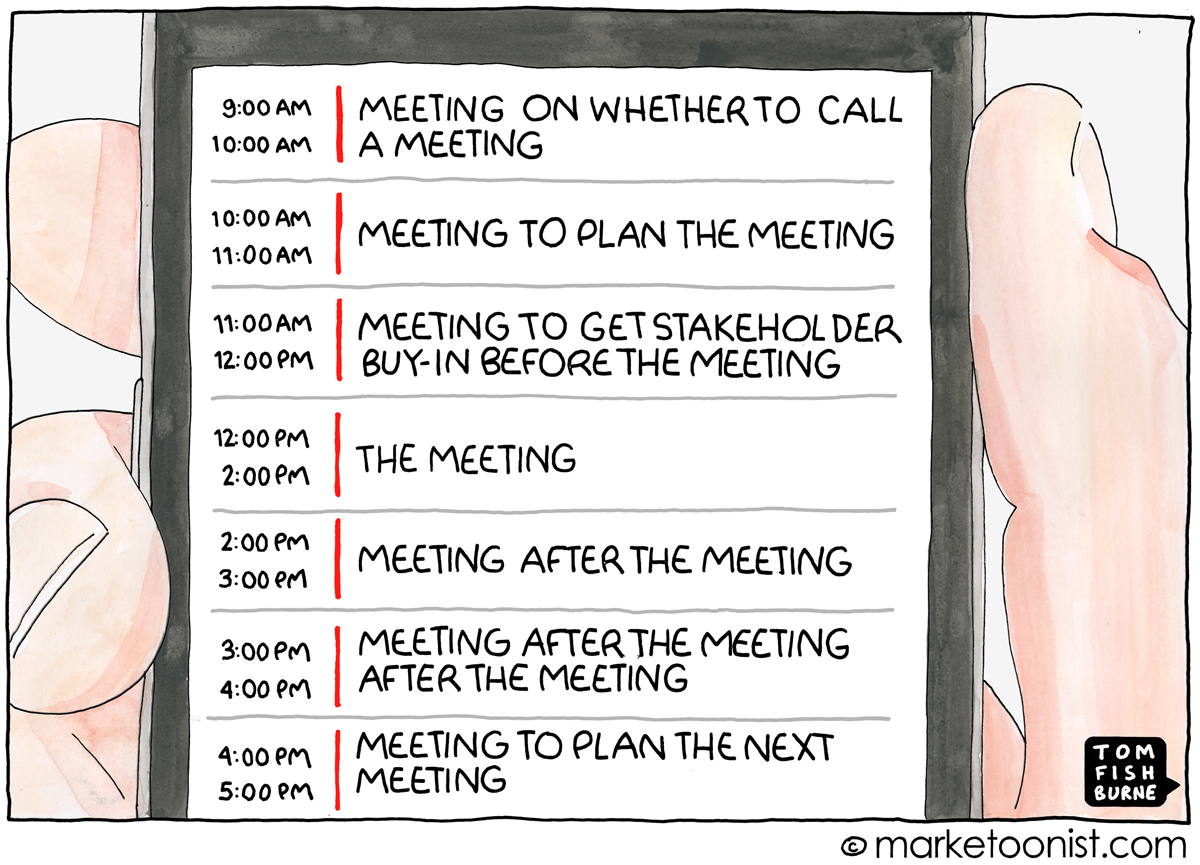
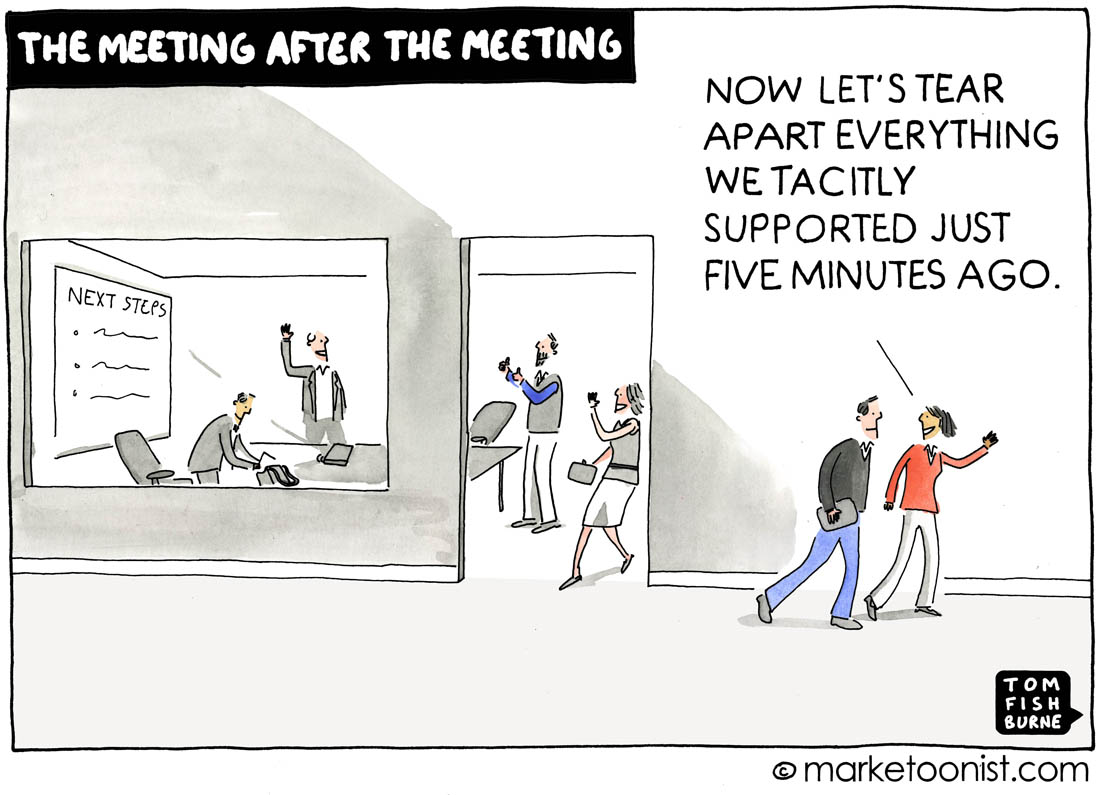
Here’s a related cartoon I drew a few years ago on “The meeting after the meeting”.
At the other extreme, we have the most unpopular play in blackjack: surrender. It’s a bit like folding in poker — instead of hitting or standing, you exit the hand without playing, “surrendering” half your bet. Used on bad hands, surrender significantly improves player outcomes. But most players who scrupulously play every other rule in the book ignore surrenders. If I had a nickel for every blackjack player who told me “you don’t win the hands you don’t play,” well, let’s just say my cumulative lifetime blackjack earnings would be a much more robust number.
The fact is, if you have a losing blackjack hand, you are better off walking away with half your bet than none of it. And so it is in life. When you’re in the wrong job, the best career move you can make is to walk away, and spend your most precious resource (your time) on something with a better payoff.
As humans we are prone to a cognitive error known as the “sunk cost fallacy.” Blackjack players hate surrender because they don’t want to walk away from their ante. Humans hate quitting jobs because they’ve worked so hard and invested so much.
In my first job out of college, I had an important realization: sometimes you can end up on a team or a project or a situation that is screwed up, for any number of reasons. Let’s call it bad luck. Sometimes you can do something about it. I have an over-developed sense of responsibility (or perhaps hubris), so fixing what was broken was always my first instinct. When I ran into problems that were too big for me to fix, I felt upset and betrayed. This stuff was messed up — why wasn’t my boss solving the problem? Or the execs? Why wouldn’t someone take responsibility, the way I would in my work? It was unfair.
Then one day, drinking coffee in the break room, I had an epiphany: unfairness exists in the universe. I can’t control it; I can and should try to fix it, but if I fail, I still have two choices: I can stick around feeling like a victim, or I can leave. Leaving may come at a big cost, a cost I may not want to pay. If I don’t, then I’m making a conscious tradeoff to be here and thus in a sense I did choose the conditions. This mindset was liberating, because it meant that I always had agency.
Once I realized I had the choice to quit, I realized I had a lot of other choices, too, that had previously seemed inaccessible to me. I could change teams, projects, job function — I had nothing to lose if the alternative was quitting the company. In the end I got the best of both worlds: I switched projects, and later went back to my original team with a mandate to solve problems that had seemed so intractable to me earlier.
Going back to the career impact of luck — sometimes you can’t control aspects of your environment. Your company is going under, your team is dysfunctional, your skills and effort are a bad match for the work, your confidence is shot. At moments like these, your sunk cost fallacy is likely to kick in. You are likely to think you have to stay committed because you’ve already invested so much. But if you want to maximize your overall outcomes, walking away needs to be in your vocabulary. You need to choose to leave an environment that makes you feel small, even if it means starting over.























.png)







.png)