
Adam Victor Brandizzi
Shared posts
06 May 21:26


Off the Ground
by Reza
Christosza.czugaszwili, Adam Victor Brandizzi and one other like this
03 May 08:56

How to Enjoy Collecting Things
by Scott Meyer
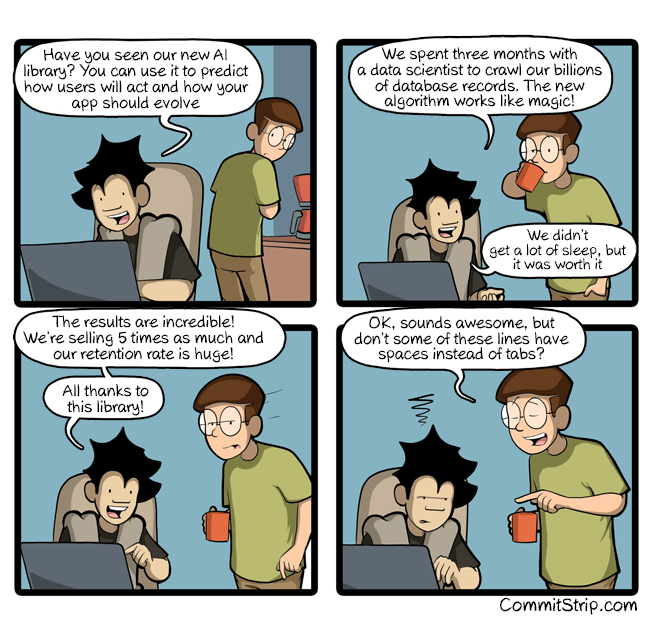
Here, in panel two of this comic, you can see the larval beginnings of the Knifeketeer.
Oh man, I can’t wait until the super hero comics really kick in. Just sayin’.
Note from Missy: The chain mail gloves are the only fictitious garment in the last panel. Scott does, in fact, own multiple fezzes, more than one luchador mask, and a smoking jacket.
As always, thanks for using my Amazon Affiliate links (US, UK, Canada).
Adam Victor Brandizzi likes this
03 May 08:54
Com Aécio e Alckmin na frigideira, PSDB vai a Doria: mas quem é ele?
Tucano tem uma peculiaridade. Quando alguém discorda dele, o doutor repete o que acabou de dizer. Afinal, sua sabedoria é tamanha que, se alguém discorda, isso é sinal de que não entendeu.
Mesmo aceitando-se essa superioridade intelectual, a última pesquisa do Datafolha mostrou que chegou a hora de o tucanato entender que Aécio Neves e Geraldo Alckmin estão na frigideira.
 | |
| Vestido de verde-amarelo, João Doria inaugura a praça Ayrton Senna, no Ibirapuera |
Presidente do PSDB, o neto de Tancredo Neves governou Minas Gerais durante oito anos, elegeu seu sucessor, teve 51 milhões de votos na eleição de 2014 e hoje tem 8% das intenções de voto. Em alta, só a sua rejeição (44%), disputando com Lula (45%).
Geraldo Alckmin, o cidadão que por mais tempo ocupou o governo de São Paulo desde os tempos coloniais, foi candidato a presidente em 2006. Sua rejeição pulou de 17% para 28%, enquanto as intenções de voto em seu beneficio caíram de 8% para 6%.
Só a propensão a repetir a proposta quando o interlocutor discorda (no caso, o eleitorado brasileiro) pode explicar que o tucanato ficasse preso na bola de ferro do dilema Aécio-Alckmin.
Atribuir a fritura dos dois às nuvens que a Odebrecht colocou em suas biografias é um exagero. Ambos estão em queda desde dezembro. Os dois foram corroídos pela ferrugem do tucanato e pela radioatividade que Michel Temer transmite aos seus aliados. Os sábios do PSDB também não podem reclamar da plataforma plutófila do presidente, pois ela se parece mais com a alma tucana do que com a esperteza do PMDB.
O instinto de sobrevivência do PSDB arrasta os tucanos para o colo do prefeito paulistano, João Doria. O que ele representa ninguém sabe e, pela sua conduta política, pode vir a representar qualquer coisa. Intitula-se um "gestor", linda palavra, uma das favoritas de Sérgio Cabral quando assumiu o governo do Rio.
Capaz de encantar um conservadorismo órfão, Doria terá um ano para mostrar serviço. Alguns de seus tiques assustam. Em certos momentos, seu sorriso lembra o de Jack Nicholson na inesquecível cena do museu de Gotham City, quando o "Joker" salva um quadro de Francis Bacon.
Doria oscila entre boas iniciativas e o mundo da lua. Com o Corujão da Saúde, descongestionou a fila de exames médicos da cidade. Acabou com o tratamento de "excelência" nos documentos oficiais e extinguiu a edição em papel do "Diário Oficial". Quando vai para mundo da lua, aumenta a velocidade permitida em vias expressas ou tenta transformar o Uber num instrumento a serviço de fura-greves.
Joia de sua coroa, o diretor da biblioteca municipal resolveu encrencar com o samba, logo com o samba. O desenho final de seu projeto de privatizações, sobretudo a do autódromo de Interlagos, mostrará se ele tem a cabeça de um Carlos Lacerda, criando o aterro do Flamengo, ou de um Eduardo Paes, tentando entregar a marina da Glória ao empresário Eike Batista.
Há um aspecto triste na ferrugem tucana. O partido de Franco Montoro, Mário Covas e Fernando Henrique Cardoso não formou quadros políticos. (Foi uma verdadeira usina de gênios, mas eles foram todos para bem sucedidas carreiras no mercado financeiro). Obcecado pela figura de Lula, o PSDB fez-lhe tamanha oposição que se esqueceu de cuidar da própria identidade.
Adam Victor Brandizzi likes this

03 May 00:27
Twitter Shareholders Will Vote on Turning the Company Into a Cooperative Owned by its Users
by brandizzi
- There's a campaign to turn Twitter into a user-owned co-operative, and shareholders will vote on it next month.
- If the vote passes the company will have to prepare a report on the feasibility of the radical restructuring.
- It's symptomatic of dissatisfaction among some shareholders as Twitter struggles to grow or turn a profit.
On May 22, Twitter shareholders will vote on whether to investigate a radical proposal: Turning the social network into a cooperative owned by its users.
Next month is the company's annual meeting, and one of the items on the agenda calls for it to look into becoming a cooperative.
The proposal -- to be voted on by shareholders -- asks the company to "prepare a report on the nature and feasibility of selling the platform to its users via a cooperative or similar structure with broad-based ownership and accountability mechanisms."
Twitter is opposed to the plan, and it seems unlikely to win the vote. But it's an interesting proposal -- and underlines the discontent some shareholders feel with the ailing social network, which is struggling to grow or turn a profit.
The idea draws on a petition calling for a co-op structure that has been signed by nearly 3,500 people. The petition contrasts the social network's global reach and influence with the gloomy forecasts about its financial performance, arguing that its conventional structure means its social value isn't being properly appreciated.
"For a lot of us Twitter is the fastest, easiest way to know and share what’s going on around us -- it sparks conversations, spreads information and energizes movements," the petition reads.
"But Wall Street thinks the company is a failure because it’s not raking in enough profit for shareholders. That means that Twitter is up for sale, and there is a real risk that the new owner may ruin our beloved platform with a narrow pursuit of profit or political gains."
A co-operative structure could, the proposal on the annual meeting's agenda says, "result in new and reliable revenue streams, since we, as users, could buy in as co-owners, with a stake in the platform's success. Without the short-term pressure of the stock markets, we can realize Twitter's potential value, which the current business model has struggled to do for many years. We could set more transparent accountable rules for handling abuse. We could re-open the platform's data to spur innovation."
It adds: "Overall, we'd all be invested in Twitter’s success and sustainability. Such a conversion could also ensure a fairer return for the company's existing investors than other options."
The Twitter proposal cites a number of examples of cooperatives as evidence it could work: "For successful enterprises like the Green Bay Packers, REI and the Associated Press, their popularity, resilience and profitability is a result of their ownership structure. Examples of online companies include successful startups like Managed by Q, which allocates equity to office cleaners, and Stocksys United, a stock-photo platform owned by its photographers."

Twitter's stock has been on a downwards trajectory for years.
Image credit: Markets Insider
Twitter's governance, unsurprisingly, isn't a fan of the suggestion. In a statement, it argues "the proposal is not in the best interests of Twitter and our stockholders." It goes on (emphasis ours):
"We believe that preparing a report on the nature and feasibility of selling the 'platform,' and doing so only to 'its users,' would be a misallocation of resources and a distraction to our board of directors and management -- resources and management time that could otherwise be used to build the long-term value of Twitter. The proposal would have Twitter explore the sale of the 'platform' to one specific group of people, 'its users,' 'via a cooperative or similar structure.' The proposal has pinpointed a very specific type of transaction and ownership structure and the board of directors does not believe that the course of action suggested in the proposal would enhance the value of the 'platform' or Twitter. Further, limiting exploration of strategic transactions that may enhance stockholder value to one narrow option would not be in accordance with the board of directors’ responsibilities to take actions that are in the best interests of Twitter and its stockholders. We believe Twitter is on track to continue building on the long-term value of Twitter for all of our stockholders as a publicly held corporation and not as a 'cooperative or similar structure' owned solely by 'its users.' As a publicly traded company, our users are also free to become stockholders of Twitter without any need to change the structure of the company."
That last point is an important one -- users can already take ownership in Twitter, if they're prepared to go to the effort of buying stock.
This unanimous opposition from the board means the vote is unlikely to pass. And even then, there'd be no guarantee on what the report into the possibility of becoming a co-op would say, or whether the company would follow through with it.
But nonetheless, it's a fascinating look at an alternative structure for a major tech company. These days there's a trend towards consolidation of power and voting rights in founders. Thanks to a radical proposal, Mark Zuckerberg is selling much of his stock in Facebook (to fund his philanthropy) while retaining his voting rights. And when Snapchat parent company Snap went public earlier in 2016, it deprived would-be investors of voting power.
One relatively rare exception is crowd-funding platform Kickstarter, which is a "public benefit corporation" -- a status that requires it to "consider the impact of their decisions on society, not only shareholders."
More from Business Insider
Rob Price
Rob Price is a technology reporter for Business Insider.
Read more
Adam Victor Brandizzi likes this

02 May 16:41
Like zines about computers? You might love Bubblesort Zines
Hello! As you have probably noticed, I make zines about computers! Sometimes I hear from people who are excited about my zines, and want to show them to their kids! This is cool, but kids aren’t really my target audience, so they’re not always the perfect fit!
So. If you are excited about adorable computer science zines for kids / teenagers (or even for adults!), you should know about Bubblesort Zines by Amy Wibowo! This is an ever-growing (7 and counting!) collection of zines aimed at teenage girls. Teenage girls are smart and curious people who are interested in learning complicated things about science & technology! (and also often like adorable drawings, like, who doesn’t?)
Like when I was 13, I was so interested in learning about programming computers, but I didn’t know where to start! I learned to program when my math teacher gave me a programmable graphing calculator when I was 15.
I’m especially excited today about her Pixel Perfect zine about image processing, which she just released. It’s about:
how Instagram filters work, how a computer can help you dither or simplify an image to recreate it as cross stitch, knitting, or a lego mural, how Snapchat can detect a face to put a flower crown on your head, and other image processing topics!
I don’t know how any of that stuff works! I ordered it and I’m really excited to read it.
awesome zine on how the internet works!
Recently I reread her zine on how the Internet works called “How does the internet” and I remembered how much I loved it, so I wanted to tell all of you how great I think it is and why.
In this 50-page zine, she explains a bunch of old communication methods (like carrier pigeons & torches!), how modern computer networking needs to solve a lot of the same problems (“what happens if messages get lost?”) and some of the details of how computer networking works (“computers address messages to each other using IP addresses!”).
I find the range of topics she covered really impressive:
- How people used to use carrier pigeons to send messages
- How the ancient Greeks used torches to spell out messages!
- Morse code!
- IP addresses!
- How data travels over the internet using wires & wireless!
- The idea of checksums!
- DNS, TCP, and HTTP!
- How TCP packets get routed over the internet!
- HTML!
and she explains all these things in a clear and fun way without dumbing down the ideas. It doesn’t tell you everything about computer networking, but I definitely didn’t understand the basics of how TCP worked when I was teenager learning HTML (or even when I started working as a professional web developer!), and maybe if I did I would have understood better what was happening behind the scenes when I started using HTML and making Geocities sites when I was 14!
❤ smart, friendly, inclusive zines ❤
In addition to explaining complicated+interesting topics in a clear and fun way (which is my favorite thing in the world), I think the mission of her zines is really important. Here’s a quote from the Bubblesort Zines About Us page:
Computer science and programming are powerful tools for expressing creativity and for actuating change. Let’s make sure that these tools & skills are accessible to everyone. […] This means framing computer science in a way that is accessible and inclusive to people who might not think there is a place for them in computer science.
Basically the goal of these zines, as I understand it, is to show people (especially-but-not-only teenage girls) that interesting computer science concepts like encryption, image processing, and computer networking can be for them.
I think that’s really important, and I’m really delighted to see such high-quality explanations presented in a smart and friendly way that’s very different from the traditional way CS material is presented. Often material that’s written for young people gets dumbed down or doesn’t go into all the interesting details, but of course 13-14 year olds can understand a lot of complex concepts, as long as you explain them clearly!
If, like me, you think this is awesome, here are some links:
-
Bubblesort Zines store. The zines that are out so far are:
- Bubble sort and other sorts (on sorting algorithms!)
- How do do calculators even (on how calculators work!!!)
- Literal Twitter Bot (instructions for how to make a fun electronics project with a tweeting bird!!)
- How does the internet
- Cache Cats (how computer memory works!)
- Pixel Perfect (image processing!!)
- Secret Messages (cryptography!)
- Her great Twitter account: @sailorhg
- Her kickstarter campaign from last year has a lot of great pictures of the zines
- Amazing 10-year career retrospective (she’s worked on so many interesting projects!)
She’s continuing to produce more awesome zines so it’s worth following her updates!
Roslyn , Adam Victor Brandizzi likes this

02 May 16:41

Click here to go see the bonus panel!
Hovertext:
Looks like I'll need two days off because there's some famine in here too.
New comic!
Today's News:
Saturday Morning Breakfast Cereal - Sick Day
by tech@thehiveworks.com
Click here to go see the bonus panel!
Hovertext:
Looks like I'll need two days off because there's some famine in here too.
New comic!
Today's News:
Book Review Tuesday! More available at TheWeinerworks.com
The Pope of Physics (Segrè and Hoerlin)
Perhaps there’s no good way to get all the info now, but I would’ve loved to get a stronger feel for all those deathbed conversations with great and controversial thinkers. I don’t want to say it’s a bad book - in fact it might be the best Fermi biography available. It also has the incidental point of interest that one of the authors is the nephew of Emilio Segrè, which may explain why the sections about Fermi’s friends were some of the best and most detailed of the book. If you, like me, enjoy biographies from the Heroic Age of Physics, it’s definitely worth a read.
Pandemic (Shah)
Shenzhen (DeLisle)
Nurbh.j, Adam Victor Brandizzi likes this
01 May 22:18
.png)
Click here to go see the bonus panel!
Hovertext:
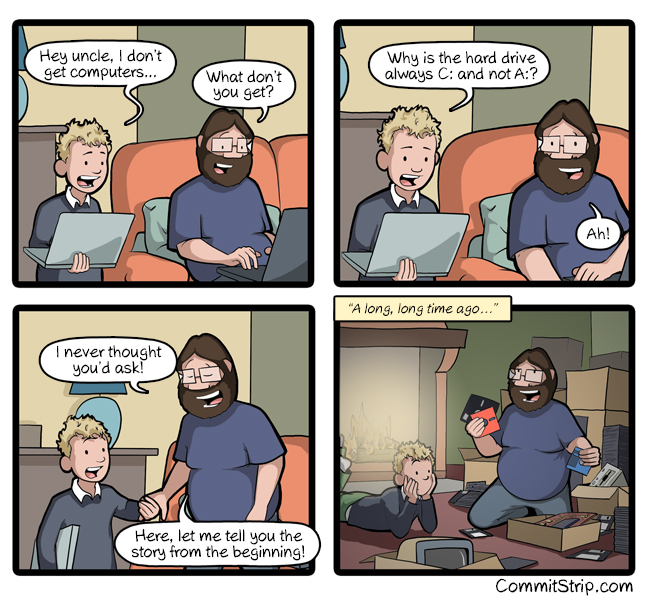
Anyone who creates their version of panel 3 will be rewarded with 42 Internet points.
New comic!
Today's News:
Saturday Morning Breakfast Cereal - How to Photograph Science
by tech@thehiveworks.com
Click here to go see the bonus panel!
Hovertext:
Anyone who creates their version of panel 3 will be rewarded with 42 Internet points.
New comic!
Today's News:
In which Kyle Hill of Nerdist presents the fifth form of matter:
Luke.stirling, Adam Victor Brandizzi likes this


01 May 06:04
All The Mathematical Methods I Learned In My University Math Degree Became Obsolete In My Lifetime | The Huffington Post
by brandizzi
If you are connected with the world of K-12 mathematics education, it’s highly unlikely that a day will go by without you uttering, writing, hearing, or reading the term “number sense”. In contrast everyone else on the planet would be hard pressed to describe what it is. Though entering the term into Google will return close to 38 million hits, it has yet to enter the world’s collective consciousness. Stanford mathematician Keith Devlin explains what it is.
When I graduated with a bachelors degree in mathematics from one of the most prestigious university mathematics programs in the world (Kings College London) in 1968, I had acquired a set of skills that guaranteed full employment, wherever I chose to go, for the then-foreseeable future—a state of affairs that had been in existence ever since modern mathematics began some three thousand years earlier. By the turn of the new Millennium, however, just over thirty years later, those skills were essentially worthless, having been very effectively outsourced to machines that did it faster and more reliably, and were made widely available with the onset of first desktop- and then cloud-computing. In a single lifetime, I experienced first-hand a dramatic change in the nature of mathematics and how it played a role in society.
The shift began with the introduction of the electronic calculator in the 1960s, which rendered obsolete the need for humans to master the ancient art of mental arithmetical calculation. Over the succeeding decades, the scope of algorithms developed to perform mathematical procedures steadily expanded, culminating in the creation of desktop packages such as Mathematica and cloud-based systems such as Wolfram Alpha that can execute pretty well any mathematical procedure, solving—accurately and in a fraction of a second—any mathematical problem formulated with sufficient precision (a bar that allows in all the exam questions I and any other math student faced throughout our entire school and university careers).
So what, then, remains in mathematics that people need to master? The answer is, the set of skills required to make effective use of those powerful new (procedural) mathematical tools we can access from our smartphone. Whereas it used to be the case that humans had to master the computational skills required to carry out various mathematical procedures (adding and multiplying numbers, inverting matrices, solving polynomial equations, differentiating analytic functions, solving differential equations, etc.), what is required today is a sufficiently deep understanding of all those procedures, and the underlying concepts they are built on, in order to know when, and how, to use those digitally-implemented tools effectively, productively, and safely.
In many ways, that change in the society-required focus of mathematics education echoed a change in the nature of mathematics as an intellectual discipline that had taken placed in the late nineteenth century. Beginning in Germany (in particular, the small university town of Goettingen), the primary focus of mathematics shifted dramatically at that time from executing procedures to solve problems, to analyzing and understanding properties of, and relationships between, abstract mathematical concepts.
The most basic of today’s new mathematical skills is number sense. (The other important one is mathematical thinking. But whereas the latter is important only for those going into STEM careers, number sense is a crucial 21st Century life-skill for everyone.) Descriptions of the term “number sense” generally run along the lines of “fluidity and flexibility with numbers, a sense of what numbers mean, and an ability to use mental mathematics to negotiate the world and make comparisons.” The well-known mathematics educator Marilyn Burns, in her 2007 book, About Teaching Mathematics, describes students with a strong number sense like this: “[They] can think and reason flexibly with numbers, use numbers to solve problems, spot unreasonable answers, understand how numbers can be taken apart and put together in different ways, see connections among operations, figure mentally, and make reasonable estimates.”
In 1989, the US-based National Council of Teachers identified the following five components that characterize number sense: number meaning, number relationships, number magnitude, operations involving numbers and referents for number, and referents for numbers and quantities.
Though to outsiders, mathematics teaching designed to develop number sense can seem “fuzzy” and “imprecise”, it has been well demonstrated that children who do not acquire number sense early in their mathematics education struggle throughout their entire subsequent school and college years, and generally find themselves cut off from any career that requires some mathematical ability.
That outsiders’ misperception is understandable. Compared to the rigid, rule-based, right-or-wrong precision of the math taught in my schooldays, number sense (and mathematical thinking) do seem fuzzy and imprecise. But the fuzziness and imprecision is precisely why that is such an important aspect of mathematics in an era where the rule-based, precise part is done by machines. The human brain compares miserably with the digital computer when it comes to performing rule-based procedures. But that human mind can bring something that computers cannot begin to do, and maybe never will: understanding. Desktop-computer and cloud-based mathematics systems provide useful tools to solve the mathematical aspects of real-world problems. But without a human in the driving seat, those tools are totally useless. And high among the “driving abilities” required to do that is number sense.
If you are a parent of a child in the K-12 system, there is today just one thing you should ensure your offspring has mastered in the math class by the time they graduate: number sense. Once they have that, any specific concept or procedure that you or they will find listed in the K-12 curriculum can be mastered (in the nature and to the degree required, given that procedural execution can be done by machine) quickly and easily as and when required. An analogous state of affairs arises at the college level, with the much broader notion of mathematical thinking in place of number sense.
Make no mistake about it, acquiring that modern-day mathematical skillset definitely requires spending time carrying out the various procedures. Your child or children will still spend time “doing math” in the way you remember. But whereas the focus used to be on mastering the skills with the goal of carrying out the procedures accurately — something that, thanks to the learning capacity of the human brain, could be achieved without deep, conceptual understanding — the focus today is on that conceptual understanding. That is a very different goal, and quite frankly a much more difficult one to reach.
This, by the way, is the new state of affairs that the mathematics Common Core was created to address. Outsiders, including politicians in search of populist issues to incite voters and others with an axe to grind, have derided caricatured portrayals of this important new educational goal, by describing it as “woolly” and “fuzzy”. But I disposed of that uninformed red herring already. The fact is, number sense is (rightly, and importantly) the primary focus of 21st Century K-12 mathematics education that millions of children around the world are receiving today. Children who are not getting such an education are going to be severely handicapped in the world they are being educated to inhabit.
In a follow-up article, I’ll look at some of the research behind the move away from computational mastery of procedures to the development of number sense in the K-12 education world, and say something about how it can best be taught.
This article is an expanded version of an essay published on Edge.org on January 1, 2017.
Adam Victor Brandizzi likes this
01 May 06:04
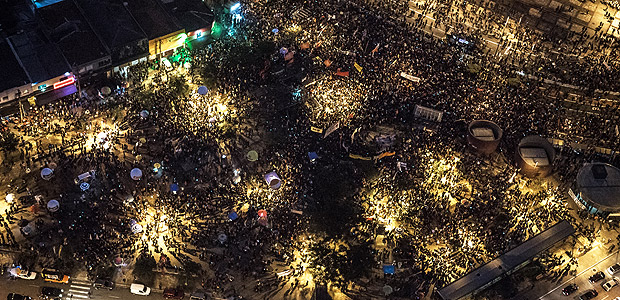
Em países escandinavos, flexibilização trabalhista foi comprada caro dos trabalhadores
Adam Victor BrandizziUm bom ponto: a reforma é boa (para mím pessoalmente é espetacular!) mas não tem contrapartida.
Subestime a greve geral de sexta-feira (28) quem quiser. Categorias importantes pararam e grandes cidades brasileiras tiveram reduções significativas de movimento.
Isso tudo aconteceu sem cobertura da TV na véspera e com cobertura da PM no dia. E na mesma semana em que dois partidos que precisam de votos entre os potenciais grevistas, PSB e Solidariedade, resolveram discutir a relação com Temer.
Sozinha, a greve geral não deve reverter os votos já, digamos, transacionados para aprovar as reformas. Mas talvez ela seja vista, daqui a algum tempo, como início de uma nova fase na relação entre capital e trabalho no Brasil. Afinal, o sistema político brasileiro deixou de funcionar como lugar de negociação de conflitos redistributivos.
Em uma democracia funcional, a reforma trabalhista da semana passada talvez fosse aprovada. Há argumentos defensáveis para nos movermos em direção a um sistema onde mais coisas sejam negociadas entre sindicatos e patrões, ao invés de legisladas.
As sociedades mais bem-ordenadas do mundo, os países escandinavos, têm normas trabalhistas bastante flexíveis.
Mas o que faz desses países as sociedades mais justas do mundo é que essa flexibilização das relações de trabalho foi comprada bastante caro dos trabalhadores.
Duas coisas equilibram as negociações salariais no modelo escandinavo.
Em primeiro lugar, um Estado de bem-estar social extremamente generoso, que custa muito dinheiro em impostos, inclusive, vejam só que diferença cultural interessante, impostos pagos pelos ricos. Não há perspectiva do Estado de bem-estar social brasileiro se expandir no curto prazo.
Em segundo lugar, centrais sindicais fortíssimas, que reúnem grande parte da população e conseguem negociar acordos muito bons para os trabalhadores. Se os defensores da reforma trabalhista brasileira vissem um sindicato escandinavo pela frente, fugiriam chorando e pedindo que a Otan o bombardeasse.
Já aqui no Brasil, a flexibilidade foi comprada com distribuição de cargos para 300 sujeitos com medo da polícia no Congresso brasileiro.
Resta a greve, e não só a de sexta: o "negociado" que de agora em diante vai prevalecer sobre o legislado será obtido sob ameaça de greve, ou será uma farsa.
É uma questão em aberto se o acirramento dessas negociações levará a um sindicalismo forte e capaz de negociar responsavelmente em nível nacional ou à multiplicação de corporativismos.
E há um outro cenário possível, que é a degeneração completa da sociedade civil brasileira, com a perda definitiva de poder de barganha dos trabalhadores. Talvez tenhamos uma longa fase de capitalismo selvagem que pode, sim, gerar crescimento, mas com um preço em democracia e civilidade.
Analisar uma sociedade dessas com mais do que marxismo vulgar será desperdiçar conceito.
Aceito colocar na mesa de negociação uma reforma trabalhista que valorize as negociações diretas entre capital e trabalho, e, aliás, acho uma boa ideia ter essa conversa.
Mas antes quero saber quanta redistribuição de renda o empresariado está disposto a oferecer em troca da flexibilização. Isto é a maneira civilizada de conduzir a luta de classes, é como se faz nas sociedades bem-ordenadas.
Aqui, ao invés disso, compra-se o "centrão". Nos últimos dois anos, a fraude de classes foi o motor de nossa história.
Adam Victor Brandizzi likes this



28 Apr 23:34
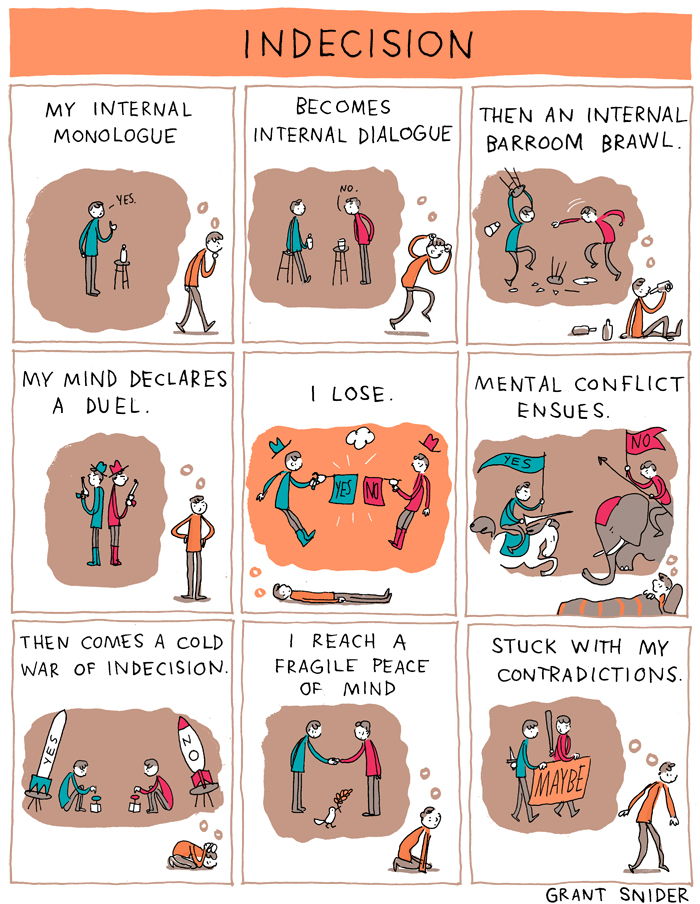
You can read more comics of inner conflict in my book, The Shape of Ideas:
http://www.
Indecision
by Grant
You can read more comics of inner conflict in my book, The Shape of Ideas:
http://www.
Cirince, Adam Victor Brandizzi and one other like this
28 Apr 23:33
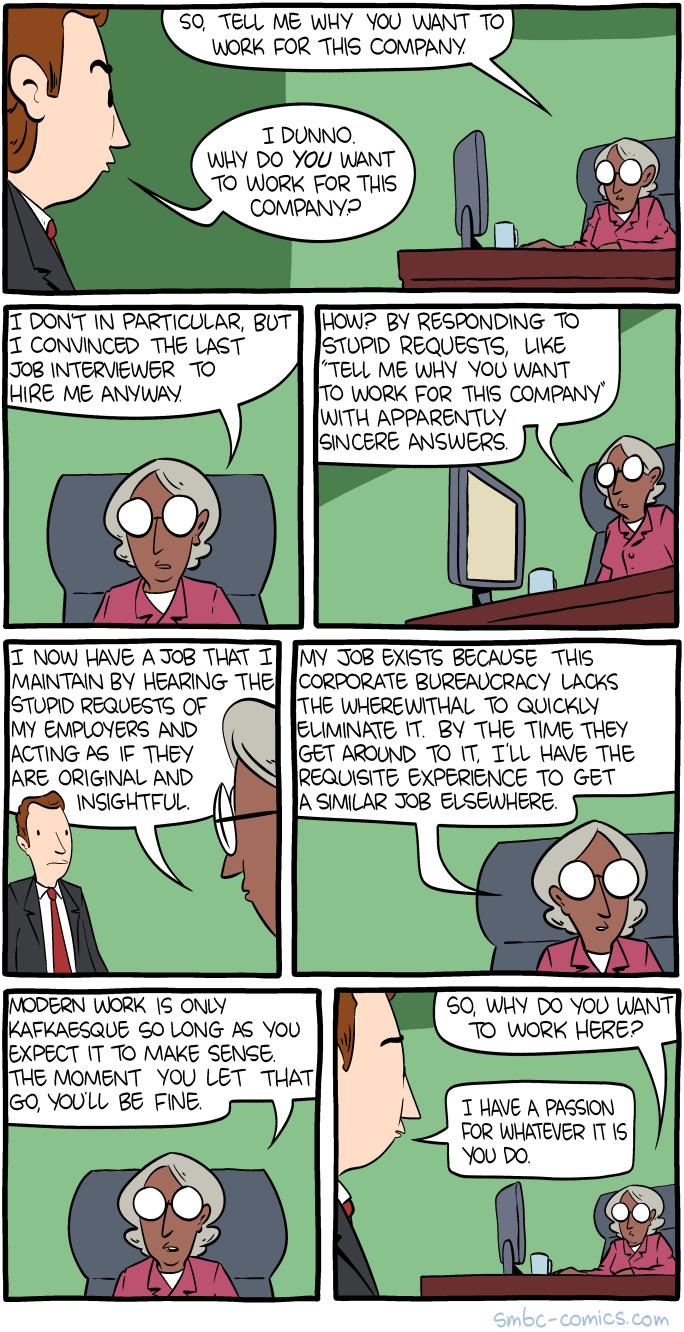
Click here to go see the bonus panel!
Hovertext:
I'm starting to wonder if I don't have some deeply repressed fantasy where I'm a middle aged woman who participates in overly blunt job interviews.
New comic!
Today's News:
Saturday Morning Breakfast Cereal - Why do you want to work here?
by tech@thehiveworks.com
Click here to go see the bonus panel!
Hovertext:
I'm starting to wonder if I don't have some deeply repressed fantasy where I'm a middle aged woman who participates in overly blunt job interviews.
New comic!
Today's News:
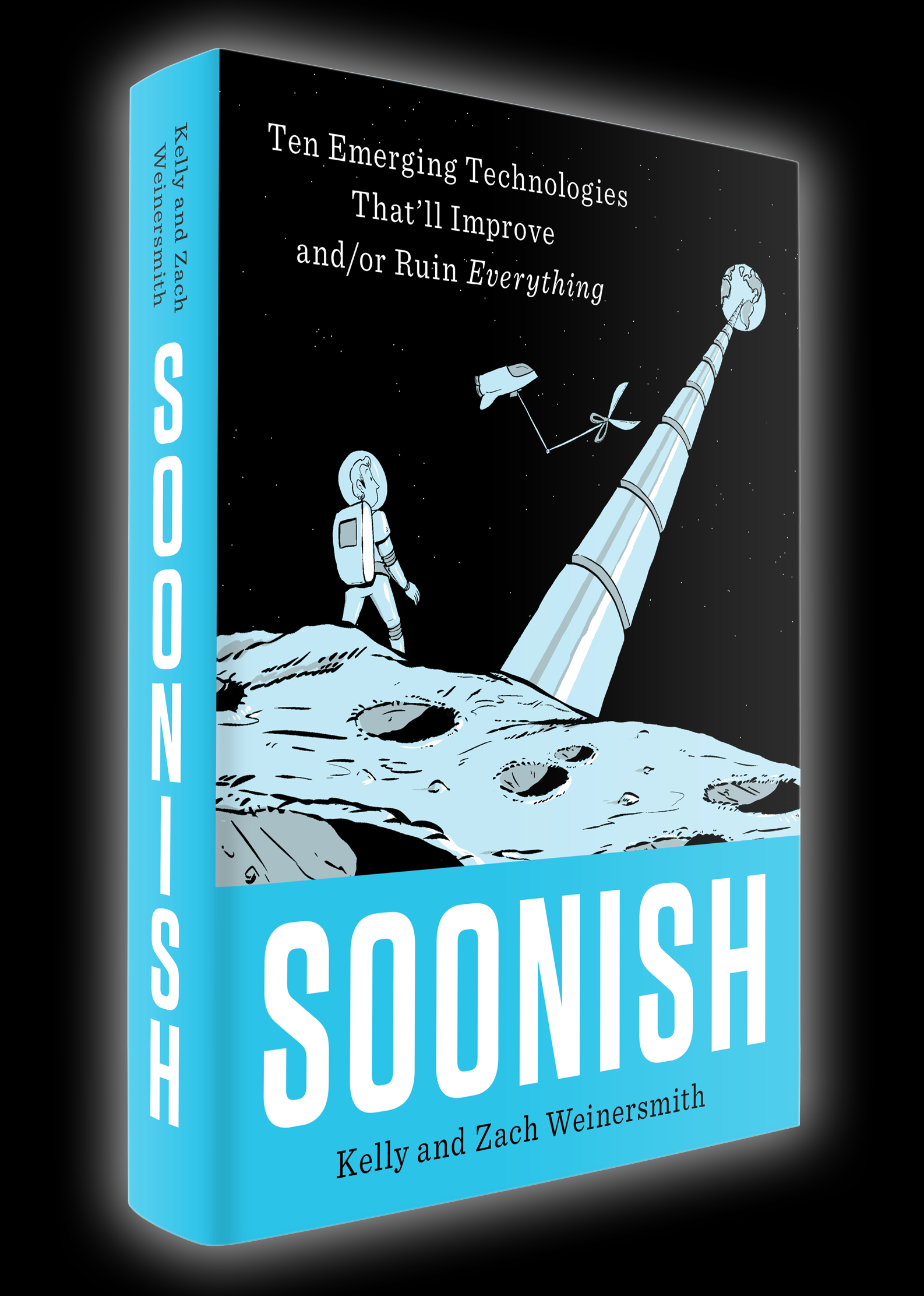
HEY BRITAIN! Soonish is available in the UK. We've used metric units, added the letter "U" after every "O" and as a courtesy, every book will be lightly dampened with cold rain.
Adam Victor Brandizzi, tao and 3 others like this
28 Apr 23:32
Servidores do Google começam a funcionar em Cuba
A partir desta quarta-feira (26), a internet cubana conta com os servidores do Google, mais uma etapa da abertura econômica do país.
Leia mais (04/27/2017 - 15h02)
Adam Victor Brandizzi, Girino likes this
28 Apr 23:32
Something to read: best articles of the last 60 years | Successful English
by brandizzi
Adam Victor BrandizziJá tinha lido alguns, bons mesmo.
Reading doesn’t get much better than this! This month, Something to read offers a special collection of the best magazine articles of the last 60 years. The articles provide a unique view of American history and culture by some of its best non-fiction writers. High intermediate and advanced English students will find many hours of good reading to feed their English acquisition process.
The list of articles was compiled by Kevin Kelly, web pioneer, cofounder of Wired Magazine, and former editor of the Whole Earth Catalog. The Open Culture web site, where I found the lists, calls special attention to Fear and Loathing in Las Vegas by Hunter S. Thompson, David Foster Wallace’s Consider the Lobster, and Gay Talese’s 1966 Esquire cover story, Frank Sinatra Has a Cold.
Top 25
Here’s the list of the top 25 articles – based on the number of times an article was recommended – from the last 60 years. Links to the top articles from each decade – 1960s, 70s, 80s, etc. – are at the end of this article. The comments were written by the people who suggested the articles.
Gay Talese, Frank Sinatra Has a Cold. (Esquire, April 1966)
Hunter S. Thompson, The Kentucky Derby is Decadent and Depraved. (Scanlan’s Monthly, June 1970)
Neal Stephenson, Mother Earth, Mother Board: Wiring the Planet. (Wired, December 1996) On laying trans-oceanic fiber optic cable.
David Foster Wallace, Federer As Religious Experience. (The New York Times, Play Magazine, August 20, 2006)
David Foster Wallace, Consider the Lobster. (Gourmet Magazine, August 2004)
John Updike, Hub Fans Bid Kid Adieu. (The New Yorker, October 22, 1960) About Ted Williams career framed by his last game. I read it every opening day without fail.
Hunter S. Thompson, Fear and Loathing in Las Vegas: A Savage Journey to the Heart of the American Dream. (Rolling Stone. Part I: November 11, 1971; Part II: November 25, 1971)
Richard Ben Cramer, What Do You Think of Ted Williams Now? (Esquire, June 1986)
Jon Krakauer, Death of an Innocent: How Christopher McCandless Lost His Way in the Wilds. (Outside Magazine, January 1993) Article that became Into the Wild.
Susan Orlean, The American Man at Age Ten. (Esquire, December 1992) [Ed.’s note: Not available in Esquire’s online archive, but you’ll find it with a little searching. Also republished in Orlean’s The Bullfighter Checks Her Makeup and Glass’s The New Kings of Nonfiction.]
Edward Jay Epstein, Have You Ever Tried to Sell a Diamond? (Atlantic Magazine, February 1982) Diamonds, De Beers, monopoly & marketing.
Ron Rosenbaum, Secrets of the Little Blue Box. (Esquire, October 1971) The first and best account of telephone hackers, more amazing than you might believe.
Tom Junod, Can you say…”Hero”? (Esquire, November 1998) A profile of Mr. Rogers. [Ed.’s note: This article was also quoted in Esquire’s 70 Greatest Sentences published October 1, 2003.]
Michael Lewis, The End. (Portfolio, November 11, 2008) Breaks down supposedly complex economic cause and effect into very engaging, easily understood analysis. Real life characters as interesting and entertaining as the best fiction. A must.
George Plimpton, The Curious Case Of Sidd Finch. (Sports Illustrated, April 1, 1985) I remember being extremely angry (for a few minutes) that the Mets were going to get this guy instead of my A’s. I was an honest kid and man, it just seemed so unfair. When I realized it was a prank, I wasn’t as upset. Because I always thought this guy, in some form, would someday show up and blow away the Twins, the Angels, and the Giants wearing an A’s uniform. I’m still waiting!
David Foster Wallace, Shipping Out: On the (Nearly Lethal) Comforts of a Luxury Cruise. (Harper’s Magazine, January 1996)
Jon Krakauer, Into Thin Air. (Outside Magazine, September 1996)
Tom Junod, The Falling Man. (Esquire, September 2003)
Gene Weingarten, The Peekaboo Paradox. (The Washington Post, Sunday Magazine, January 22, 2006) Story about the weirdest clown, the Great Zucchini, you’ll never want to meet. Keep reading….
David Foster Wallace, Host. (Atlantic Magazine, April 2005)
Gene Weingarten, Pearls Before Breakfast. (The Washington Post, Magazine, April 8, 2007) Joshua Bell is one of the world’s greatest violinists. His instrument of choice is a multimillion-dollar Stradivarius. If he played it for spare change, incognito, outside a bustling Metro stop in Washington, would anyone notice?
Chris Jones, The Things That Carried Him. (Esquire, May 2008) It’s extremely moving without being saccharine or twee. It’s a military story, but utterly without jingoism or indictment. And it’s wonderfully observed.
Michael Lewis, Wall Street on the Tundra. (Vanity Fair, April 2009) An in depth analysis of the financial collapse of Iceland. Excellent. There are some great one liners (this isn’t actually one of them, but it’ll give you the idea): “This in a country the size of Kentucky, but with fewer citizens than greater Peoria, Illinois. Peoria, Illinois, doesn’t have global financial institutions, or a university devoting itself to training many hundreds of financiers, or its own currency. And yet the world was taking Iceland seriously.”
Gene Weingarten, Fatal Distraction: Forgetting a Child in the Backseat of a Car Is a Horrifying Mistake. Is It a Crime?(The Washington Post Magazine, March 8, 2009) Winner of the 2010 Pulitzer Prize in Feature Writing.
The best of each decade
Happy reading!
Warren Ediger
Roslyn , Adam Victor Brandizzi likes this

28 Apr 23:29

A regra do jogo
by ricardo coimbra
Adam Victor BrandizziEu até que gostei da maior parte da reforma trabalhista mas... bem, é basicamente isso aí.

Clique na imagem para aumentar
Adam Victor Brandizzi likes this



28 Apr 23:25

Click here to go see the bonus panel!
Hovertext:
Cartooning is actually my part-time job.
New comic!
Today's News:
Saturday Morning Breakfast Cereal - Sexy Construction
by tech@thehiveworks.com
Click here to go see the bonus panel!
Hovertext:
Cartooning is actually my part-time job.
New comic!
Today's News:
BAHFest Sydney is now taking submissions! Check it out!
Adam Victor Brandizzi likes this
