Shared posts

14 Oct 21:42

Introduction to Quantum Computing

by brandizzi

A guide to solving intractable problems simply

Brad Huntting and David Mertz
Published on September 01, 2001

Comments

Alan Turing invented the programmable computer in 1936 (see Related topics) as a thought experiment to show that certain mathematical problems were not computable. Implicit in his argument was the idea that a computer, armed with sufficient resources, is capable of realizing any reasonable algorithm.

Since that time, the computer industry has not only managed to build programmable computing machines, they've also outdone themselves by doubling the capabilities every eighteen months or so. Despite these frenetic advances in computer technology, modern computers are still unable to make significant dents in hard problems. Problems that require exponential resources (compared to the size of the problem itself), remain as intractable today as they were in 1936.

In 1982 Richard Feynman suggested that the venerable Turing machine might not be as powerful as people thought. Feynman was trying to simulate the interaction of N particles with quantum mechanics. Try as he might, he was unable to find a general solution without using exponential resources.

Yet somehow, nature is able to simulate this mathematical problem using only N particles. The conclusion was inescapable: nature is capable of building a fundamentally superior computing device, and that suggests that the Turing machine had not been the all-purpose computer people had thought.

Visualizing a quantum computing problem

QC algorithms involve thinking in terms of probabilistic factors, a conceptual change for current programmers. In some ways, this is like the conceptual shift involved in using OOP, or functional programming, or multi-threading, for the first time. In another sense the shift is more fundamental since it opens up a whole new class of (probably) non-equivalent problems.

Let's imagine the following problem. We need to find a path through a complicated maze. Every time we follow one path, we soon come across new branches. Even knowing there is some path out, it is easy to get lost. A well-known algorithm, so to speak, for walking a maze, is the right hand rule -- follow the right hand wall until you are out (including around dead-ends). This may not be a very short path, but at least you will not repeat the same corridors. In computer terms, this rule is also known as recursive tree descent.

Now let's imagine another solution. Stand at the entrance to the maze, and release a sufficient quantity of colored gas to fill every corridor of the maze simultaneously. Have a collaborator stand at the exit. When she sees a whiff of colored gas come out, she simply asks those gas particles what path they traveled. The first particle she queries will most likely have traveled the shortest possible path through the maze.

Naturally, gas particles are not entirely wont to tell us about their travels. But QCs act in a manner very similar to our scenario. Namely, they fill the whole problem space, and then only bother asking for the correct solution (leaving all the dead-ends out of the answer space).

The qcl quantum computer simulator

Simulating a quantum computer on a traditional classical computer is a hard problem. The resources required increase exponentially with the amount of quantum memory under simulation, to the point at which simulating a QC with even a few dozen quantum bits (qubits) is well beyond the capability of any computer made today.

qcl only simulates very small quantum computers, but fortunately it's just powerful enough to demonstrate the concept behind some useful QC algorithms.

Like the supercomputers of yesteryear, the first of tomorrow's QCs will probably consist of some exotic hardware at the core which stores and manipulates the quantum state machine. Surrounding this will be the life support hardware that sustains it and presents the user with a reasonable programming environment. qcl simulates such an environment by providing a classical program structure with quantum data types and special functions to perform operations on them.

Let's start with some familiar operations from classical computing using qcl. Since qcl is an interactive interpreter with a syntax vaguely similar to C, we can just fire it up and start entering commands into it. To make our examples more readable we'll restrict the number of quantum bits under simulation to 5.

Listing 1. Initializing qcl and dumping a qubit
$ qcl --bits=5
[0/8] 1 |00000>
qcl> qureg a[1];
qcl> dump a
: SPECTRUM a: |....0>
1 |0>

Here we have allocated a 1 qubit (Boolean) variable from the qcl quantum heap. The quantum state of the machine, |00000>, is initialized to all zeros. The |> characters signify that this is a quantum state (sometimes called a ket), while the string of 5 0's (one for each bit in the quantum heap) form the label for the state. This is known as the Dirac notation (a.k.a. bra-ket) for quantum mechanics. Its main advantage over traditional mathematical notation for linear algebra is that it's much easier to type.

"qureg a[1]" allocates a one bit variable a from the quantum heap. The dump a command gives us some information about a. The SPECTRUM line shows us where the qubits for a have been allocated in the quantum heap; in this case the 0-bit of a is the rightmost qubit in the heap. The next line tells us that, were we to measure a, we would see "0" with probability "1".

Of course the ability to peek at quantum memory is only possible because qcl is a simulator. Real quantum bits can't be observed without irrevocably altering their values. More on this later.

Many of the primitive quantum operators provided by qcl are familiar from classical computing. For instance, the Not() function flips the value of a bit.

Listing 2. A Boolean function on a qubit
qcl> Not(a);
[2/8] 1 |00001>

Not() applied again to the same qubit will undo the effect of the first which is exactly what we would expect from classical computing.

The CNot(x,y) operator tests the value of y and if it is "1", it flips the value of x. This is equivalent to the statement x^=y in C.

Listing 3. Some more qubit operators (CNot)
qcl> qureg b[2];
qcl> Not(b[1]);
[3/8] 1 |00100>
qcl> CNot(b[0], b[1]);
[3/8] 1 |00110>
qcl> dump b[0];
: SPECTRUM b[0]: |...0.>
1 |1>
qcl> dump b[1];
: SPECTRUM b[1]: |..0..>
1 |1>

The CNot() operator, like the Not() operator is its own inverse. Apply it a second time and it reverses the effect of the first, leaving you in the same state as when you started.

This idea of reversibility is critical to understanding quantum computing. Theoretical physics tells us that every operation on quantum bits (except for measurement) must be undoable. We must always keep enough information to work any operation backwards. This means that operations like assignment ( x=y ), AND (x&=y), and OR (x|=y)-- which we take for granted in classical computing -- have to be modified for use in QC. Fortunately, there's a straightforward formula for converting irreversible classical operations into quantum operations.

First we never overwrite a quantum bit except to initialize it to "0". So where we would have done an assignment (x=y), we instead initialize the target (x=0) and use exclusive or (x^=y) as in the example above.

Listing 4. Reversible simulation of Boolean AND
nomadic$ qcl --bits=5
[0/8] 1 |00000>
qcl> qureg c[3];
qcl> Not(c[1]);
[3/8] 1 |00010>
qcl> Not(c[2]);
[3/8] 1 |00110>
qcl> dump c
: SPECTRUM c: |..210>
1 |110>
qcl> CNot(c[0], c[1] & c[2]);
[3/8] 1 |00111>
qcl> dump c
: SPECTRUM c: |..210>
1 |111>

The CNot(x, y & z) will flip the value of x if y and z are "1". So if x is initialized to "0" before we start, this is effectively the same thing as calculating y&z and storing the value in x. It's a subtle distinction, but one that is critical in quantum computing.

Now let's look at some operations that have no classical analogues. The most striking, and at the same time one of the most useful, is the Hadamard function, appropriately labeled Mix() by qcl. Mix() takes a computational basis state like |0> or |1> and turns it into a quantum superposition. Here's a one qubit example:

Listing 5. Superposing states with Mix()
[0/8] 1 |00000>
qcl> qureg a[1];
qcl> dump a;
: SPECTRUM a: |....0>
1 |0>
qcl> Mix(a);
[1/8] 0.707107 |00000> + 0.707107 |00001>
qcl> dump a;
: SPECTRUM a: |....0>
0.5 |0> + 0.5 |1>

In this example we exploited the quantum mechanics principle of superposition. According to the dump a, if we were to measure a, we would see "0" or "1" with an equal probability of 0.5 (0.707107 2 ).

If you've never been exposed to this concept of superposition before it can be a little confusing. Quantum mechanics tells us that small particles, such as electrons, can be in two places at once. Similarly a quantum bit can have two different values at the same time. The key to understanding this all is vector arithmetic.

Unlike a classical computer where the state of the machine is merely a single string of ones and zeros, the state of a QC is a vector with components for every possible string of ones and zeros. To put it another way, the strings of ones and zeros form the basis for a vector space where our machine state lives. We can write down the state of a QC by writing out a sum like so:

Listing 6. The vector state of a quantum computer
a|X> + b|Y> + ...

Where X, Y, etc are strings of ones and zeros, and a, b, etc are the amplitudes for the respective components X, Y, etc. The |X> notation is just the way physicists denote "a vector (or state) called X".

The Mix() operator (Hadamard operator) when applied to a bit in the |0> state will transform the state into sqrt(0.5)(|0>+|1>) as in the example above. But if we apply Mix() to a bit that's in the |1> state we get sqrt(0.5)(|0>-|1>). So if we apply Mix() twice to any qubit (in any state) we get back to where we started. In other words, Mix() is it's own inverse.

If we have two qubits a and b (initialized to zero) and we perform a sequence of quantum operations on a and then do the same to b, we would expect to wind up with a and b having the same value, and we do.

Listing 7. Independent superposed qubits
qcl> qureg a[1];
qcl> Not(a);
[1/8] 1 |00001>
qcl> Mix(a);
[1/8] 0.707107 |00000> + -0.707107 |00001>
qcl> qureg b[1];
qcl> Not(b);
[2/8] 0.707107 |00010> + -0.707107 |00011>
qcl> Mix(b);
[2/8] 0.5 |00000> + -0.5 |00010> + -0.5 |00001> + 0.5 |00011>
qcl> dump a
: SPECTRUM a: |....0>
0.5 |0> + 0.5 |1>
qcl> dump b
: SPECTRUM b: |...0.>
0.5 |0> + 0.5 |1>

In this example, a and b are completely independent. If we measure one it should have no effect on the other.

Listing 8. Measurement-independent qubits
qcl> measure a;
[2/8] -0.707107 |00001> + 0.707107 |00011>
qcl> dump b
: SPECTRUM b: |...0.>
0.5 |0> + 0.5 |1>

As expected, the spectrum of b was unchanged by measuring a.

If the operations were more complicated than a simple Not();Mix(), we might be tempted to perform them only once on a and then copy the value from a to b. OK, we can't really copy (because it's not a reversible operation), but we can initialize b to zero and CNot(b,a) which accomplishes the same goal.

Alas, this doesn't do what we would expect. But let's just try it and see what we do get:

Listing 9. Attempting a qubit-copy operation
qcl> qureg a[1];
qcl> Not(a);
[1/8] 1 |00001>
qcl> Mix(a);
[1/8] 0.707107 |00000> + -0.707107 |00001>
qcl> qureg b[1];
qcl> CNot(b,a);
[2/8] 0.707107 |00000> + -0.707107 |00011>
qcl> dump a;
: SPECTRUM a: |....0>
0.5 |0> + 0.5 |1>
qcl> dump b;
: SPECTRUM b: |...0.>
0.5 |0> + 0.5 |1>

The spectrum of a and b look correct. And indeed if we were to measure just a or b we would get the same result as above. The difference lies in what happens when we measure both a and b.

Keep in mind that the outcome of a measurement is random, so if you're repeating this experiment, your mileage may vary.

Listing 10. Measurement collapsing qubit superposition
qcl> measure a;
[2/8] -1 |00011>
qcl> dump b
: SPECTRUM b: |...0.>
1 |1>

By measuring a, we collapsed the superposition of b. This is because a and b were entangled in what physicists call an EPR pair, after Einstein, Podolsky, and Rosen, all of whom used this in an attempt to show that quantum mechanics was an incomplete theory. John Bell, however, later demonstrated entanglement in real particles by experimental refutation of the Bell Inequality (which formalized the EPR thought experiment).

What happens when you try to copy one quantum variable onto another? You wind up with entanglement rather than a real copy.

Deutches problem

Suppose we are given a function that takes a one bit argument and returns one bit. And to keep things on the up and up, let's require that this be a pseudo-classical function. If we hand it a classical bit (0 or 1) as an argument, it will return a classical bit.

There are exactly 4 possible functions that fit this requirement.

Listing 11. All four possible Boolean unary functions
f(x) -> 0            # constant zero result
f(x) -> 1            # constant one result
f(x) -> x            # identity function
f(x) -> ~x           # boolean negation

The first two are constant, meaning they output the same value regardless of input. The second two are balanced meaning the output is 0 half the time and 1 half the time. Classically there's no way to determine if f() is constant or balanced without evaluating the function twice.

Deutches problem asks us to determine whether f() is constant or balanced by evaluating f() only once. Here's how it works.

First, we have to construct a pseudo-classic operator in qcl that evaluates f(x). To do this we'll define a qufunct with arguments for input and output. For example:

Listing 12. Defining a quantum function in qcl
qufunct F(qureg out, quconst in) {
    CNot(out, in);
    Not(out);
    print "f(x)= ~x";
}

If out is initialized to "0", calling this function will change out to f(x)=~x. You can comment out either the CNot() or Not() lines to get one of the other three possible functions. After we put the above code snippet in a file called f_def.qcl we can test F() to make sure it does what we want:

Listing 13. Interactively importing and testing F()
qcl> include "f_def.qcl";
qcl> qureg in[1];
qcl> qureg out[1];
qcl> F(out,in);
: f(x)= ~x
[2/8] 1 |00010>
qcl> dump out;
: SPECTRUM out: |...0.>
1 |1>
qcl> reset
[2/8] 1 |00000>
qcl> Not(in);
[2/8] 1 |00001>
qcl> dump in
: SPECTRUM in: |....0>
1 |1>
qcl> F(out,in);
: f(x)= ~x
[2/8] 1 |00001>
qcl> dump out
: SPECTRUM out: |...0.>
1 |0>

Now let's reset the quantum memory, and run Deutches algorithm. It works by first putting the in and out bits into a superposition of four basis states.

Listing 14. Deutches algorithm (line numbers added)
(01)  qcl> reset;
(02)  qcl> int result;
(03)  qcl> Not(out);
(04)  [2/8] 1 |00010>
(05)  qcl> Mix(out);
(06)  [2/8] 0.707107 |00000> + -0.707107 |00010>
(07)  qcl> Mix(in);
(08)  [2/8] 0.5 |00000> + 0.5 |00001> + -0.5 |00010> + -0.5 |00011>
(09)  qcl> F(out,in);
(10)  : f(x)= ~x
(11)  [2/8] 0.5 |00010> + 0.5 |00001> + -0.5 |00000> + -0.5 |00011>
(12)  qcl> Mix(in);
(13)  [2/8] 0.707107 |00011> + -0.707107 |00001>
(14)  qcl> Mix(out);
(15)  [2/8] -1 |00011>
(16)  qcl> measure in, result;
(17)  [2/8] -1 |00011>
(18)  qcl> if (result == 0) { print "constant"; } else { print "balanced"; }
(19)  : balanced

With lines 1-7 we put the in/out bits into a superposition of four base states with positive amplitudes +0.5 for states where "out=0" and negative amplitudes -0.5 where "out=1." Note that even though we have four non-zero amplitudes, the sum of the squares of the absolute values of the amplitudes always adds up to one.

At line 9 we run the quantum function F() which XORs the value of f(in) into the out qubit. The function F() is pseudo-classical, meaning it swaps basis vectors around without changing any amplitudes. So after applying F() we still have two amplitudes with value "+0.5" and two with the value "-0.5."

By applying the F() function to a superposition state, we have effectively applied F() to all four basis states in one fell swoop. This is what's called "quantum parallelism" and it's a key element of QC. Our simulator will, of course, have to apply F() to each of the basis states in turn, but a real QC would apply F() to the combined state as a single operation.

The Mix() functions at lines 14 and 16 flip the machine state out of a superposition and back into a computational base state (|00011>). If we had not run F() at line 9, this would have brought us back to the state we had at line 4 (this is because Mix() is its own inverse). But because we swapped amplitudes with F(), undoing the superposition puts us into a different state than where we were at line 9. Specifically the in qubit is now set to "1" rather than "0".

It's also instructive to note that the amplitude of -1 in line 15 is unimportant. A quantum state is a vector whose overall length is of no interest to us (as long as it's not zero). Only the direction of the vector, the ratios between the component amplitudes, is important. By keeping quantum states as unit vectors, the transformations are all unitary. Not only does this make the theoretical math a lot easier, it keeps the errors incurred doing numerical calculations on classical computers from snowballing out of control.

Controlled phase transformation

The original goal of quantum computing was to simulate the behavior of arbitrary quantum systems using a small set of basic components. So far we have discussed the Not(), CNot() and Mix() functions. To round out the set and allow for universal quantum computation, we need the Controlled Phase function, CPhase().

CPhase() takes a (classical) floating point number as its first argument and a qubit as it's second argument. CPhase(a,x) alters the component amplitudes of the machine's base states as follows:

  • the amplitudes for base states where x is |0> are unchanged, while
  • the amplitudes for base states where x is |1> are multiplied by exp(i*a)=cos(a)+i*sin(a).

The coefficients for the machine states where x=1 are rotated in the complex plain by a-radians. For example:

Listing 15. Demonstrating the CPhase() function
$ qcl --bits=5
[0/5] 1 |00000>
qcl> qureg a[1];
qcl> Mix(a);
[1/5] 0.707107 |00000> + 0.707107 |00001>
qcl> CPhase(3.14159265, a);
[1/5] 0.707107 |00000> + -0.707107 |00001>
qcl> reset
[1/5] 1 |00000>
qcl> Mix(a);
[1/5] 0.707107 |00000> + 0.707107 |00001>
qcl> CPhase(0.01, a);
[1/5] 0.707107 |00000> + (0.707071,0.00707095) |00001>
qcl> dump a
: SPECTRUM a: |....0>
0.5 |0> + 0.5 |1>

Since exp(i*pi)=-1, CPhase(pi,x) will flip the sign of the |1> component. CPhase(0.01, x) rotates the phase of the |1> component by one one-hundredth of a radian in the complex plane. The parenthesized tuple (0.707071,0.00707095) is the qcl representation of the complex number exp(0.01*i)=0.707071+i*0.00707095.

Bigger problems and solutions

Deutches problem and its N-bit generalization, the Deutch-Jozsa problem, may be interesting, but they don't have much practical value. Fortunately, there are other quantum algorithms that promise bigger payoffs.

Shor's algorithm, for example, is able to find the period of a function of N bits in polynomial time. While this doesn't sound like a big deal, the difficulty of factoring and finding a discrete logarithm forms the basis of most if not all public-key cryptography systems.

Less spectacular, but much easier to implement is Grover's algorithm which searches an unordered list of N items in O(sqrt(N)) time. The best classical algorithm takes, on average, N/2 iterations to search such a list.

Conclusions

One of the tasks of classical computers since their inception as been to simulate electrical circuits to help design faster computers. This feedback loop has helped fuel half a century of explosive growth in the computer industry. Quantum Computing has the potential to shift this explosive growth into an even higher gear as QC's are used in the creation of faster and more powerful quantum computing elements.

In Aug 2000, Isaac L. Chuang of the IBM Almaden Research Center announced that he and his collaborators had constructed a 5 qubit machine using a molecule with 5 Fl atoms (see Related topics). Unfortunately this technology probably won't scale up to a usable size.

So when will the first scalable quantum computer be built? There are several candidate technologies for storing, manipulating and moving qubits. A complete list is beyond the scope of this article, but it's probably safe to say that the first useful QC is still one or two decades away.

Downloadable resources

Related topics

Subscribe me to comment notifications
Let's block ads! (Why?)

06 Oct 05:50

A sobrevivente de massacre que 'adotou' centenas de órfãos de dois lados de conflito étnico - BBC Brasil

by brandizzi

Em outubro de 1993, quando a guerra civil explodiu em Burundi, país de 11 milhões de habitantes no leste da África, Marguerite Barankitse foi forçada a assistir ao massacre de 72 amigos hutus.

O conflito entre hutus e tutsis foi desencadeado naquele ano após a morte do presidente hutu Melchior Ndadaye e até hoje o país, palco de uma sangrenta guerra civil entre as duas etnias em 2006, ainda vive em clima de tensão por causa da polarização étnica.

Antiga colônia da Alemanha e da Bélgica, o Burundi é hoje uma das nações mais pobres do mundo.

Por ser de origem tutsi, Barankitse foi poupada na matança. Mas foi nesse momento que decidiu cuidar das 25 crianças deixadas órfãs pelo episódio, com a ambição de fazer nascer "uma nova geração" de burundineses tolerantes.

Assim, ela deu o primeiro passo para a criação da ONG Maison Shalom (Casa de Paz, naem tradução livre) - uma espécie de "império humanitário" que chegou a contar com maternidade, escola médica e outras instalações e ajudou mais de 30 mil crianças até 2015, quando o presidente Pierre Nkurunziza, hutu, ordenou o bloqueio das contas das diversas organizações fundadas por Barankitse em resposta a sua notória oposição política ao governo.

Hoje com 61 anos, a mulher de roupas coloridas e alegria contagiante é conhecida no Burundi como "mamãe Maggy". À BBC Brasil, ela contou que "sempre (foi) uma rebelde", considerada "louca" por amigos e vizinhos por criticar o ódio interétnico latente que alimenta conflitos no país desde sua independência da Bélgica, em 1962 - a exemplo do que ocorreu na vizinha Ruanda, onde o genocídio de 1994 matou cerca de 800 mil pessoas.

Barankitse foi professora de francês na cidade de Ruyigi, uma das cinco mais importantes do país, mas aos 24 anos foi suspensa de suas funções por criticar o que via como discriminação escolar contra alunos hutus. Além disso, desafiou os costumes locais e permaneceu solteira, mas adotou, cedo, sete crianças de ambas as etnias - órfãs da violência interétnica.

Para ela, isso foi uma maneira de "mostrar para o mundo que tutsis e hutus podiam sim viver juntos e em paz" e que "o problema não era étnico, mas de má governança".

"Sempre disse que (a situação no país) era uma bomba-relógio e que era preciso fazer algo. Eu queria mostrar aos burundineses que é possível viver em coesão social."

Massacre

A vida de Barankitse mudaria no dia 24 de outubro de 1993. Representantes da minoria tutsi começaram uma campanha sistemática de exterminação de hutusm em retaliação a ações similares cometidas por hutus contra tutsis - como os familiares de Maggy, todos assassinados.

A ONU estima que mais de 300 mil burundineses foram assassinados em oito anos de conflito - que só foi encerrado em outubro de 2001, com a assinatura do Acordo de Arusha.

A então mãe solteira de 38 anos se refugiou com seus sete filhos na paróquia local, onde trabalhava como secretária. Além de abrigo para ela e os filhos, Barankitse ainda escondeu ali 97 homens, mulheres e crianças - a maioria hutus.

"Eram 9 horas da manhã. Quando vi eles chegando, tutsis como eu, armados com machados, facões e paus, disse, bem brava: 'Vocês estão loucos? Deus não nos criou para nos matarmos. Os hutus mataram minha família. Não queiram virar assassinos também'".

"Mas não funcionou", diz ela.

Despida, amarrada em uma cadeira e tratada como traidora, Maggy foi forçada a presenciar o assassinato dos adultos, entre eles sua grande amiga Juliette, uma tutsi que, por princípio, preferiu não abandonar o marido hutu.

O relato do episódio é o único que apaga o sorriso e enche de lágrimas os olhos de Maggy.

"Juliette me olhou e disse: 'Maggy, você pode criar minhas crianças como se fossem tuas? Eu vou seguir meu marido'. Ela olhou os assassinos e me deu Lydia e Lysette. Lydia tinha 1 ano, Lysette 3 e meio", recorda, mostrando uma foto recente das garotas, duas jovens sorridentes em uma paisagem do Canadá, onde terminam seus estudos.

Considerada traidora pelos tutsis, Juliette foi decapitada em frente à amiga e às filhas. Maggy e todas as crianças foram poupadas em troca do dinheiro que havia na sacristia.

"Foi aí que eu entendi que eu tinha uma missão esplêndida. Peguei essas crianças e não sabia aonde ir. Pra começar, fui ao cemitério. Pedi ao Senhor que me desse força. Eu não tinha força, não tinha casa, não tinha dinheiro."

Ajuda

Por sugestão de um dos órfãos, 'mamãe Maggy' entrou em contato com umvoluntárioalemão que vivia na região e que aceitou alojar o grupo em sua casa.

"Cada dia, chegavam crianças feridas, órfãs. Até os criminosos deixavam crianças lá. Eu tinha uma força que não sei de onde tirava. Fazia berços com papelão, ia a ONGs que não me atendiam, pegava embalagens de computadores e serragem e com isso fazia os colchões. Pedia alimento ao programa mundial (da ONU). E as crianças mais velhas, meus sete primeiros filhos, ajudavam."

Em sete meses, sua "família" não convencional cresceu: de 32 para 400 crianças. Foi então que a criação de uma primeira ONG, Maison Shalom (Casa de Paz), se impôs como uma necessidade, para permitir a capatação de recursos.

"Não fiz só pelas crianças. Na verdade, eu quis criar uma nova geração. Eles são hutus e tutsi...indo à escola juntos, poderão mudar sua comunidade."

Para ajudar os menores a lidar com os traumas deixados pela violência étnica, Maggy se apoiava na capacitação e na alegria - uma estratégia que ainda prevalece em suas instituições.

"O que tira o trauma das crianças é, primeiro de tudo, o amor. Nunca as chamei de órfãs. Dizia que eram príncipes e princesas. Sempre disse que podem reconstruir e ser atores de seu futuro. E cada noite a gente dançava, tocava tambores (parte da tradição cultural burundinesa). Havia alegria naquela casa! Alguns, mesmo cegos, se tornaram músicos."

Maggy assegura ainda que a coabitação entre crianças de etnias diferentes, mas com problemas similares, também tinha efeitos positivos.

"As crianças choravam quando chegavam, mas eram as outras crianças que as ajudam com a lidar com o trauma primeiro. Um dizia pro outro: 'Ah, você não tem um braço? Veja, e eu não tenho um olho. E daí? Quem é melhor? Essa maneira faz com que eles contem suas histórias sem que você os converta em vítimas."

Com a mobilização de Maggy, as doações internacionais começaram a chegar e a Maison Shalom foi ganhando, gradualmente, uma escola, uma biblioteca, um cinema-teatro onde as crianças e a própria fundadora descreviam, em peças, os crimes interétnicos cometidos no Burundi.

Seus olhos brilham ao lembrar: "A gente encenava os crimes e enfeitiçava os criminosos. O primeiro filme foi Romeu e Julieta, que mostra como as pessoas são bestas quando se matam".

Ao mesmo tempo, com a ajuda de um advogado, Maggy realizava os trâmites necessários para restituir às crianças as propriedades de suas famílias dizimadas e ajudava grupos de irmãos a se instalarem e recomeçarem uma vida independente.

Império humanitário

E cada vez que aparecia uma nova necessidade, Maggy respondia criando uma nova estrutura ligada a Maison Shalom.

Dessa forma, para reduzir a mortalidade materna que dava origem a cada vez mais órfãos, ela criou uma maternidade que daria origem ao Hospital Rema, que chegou a ser o mais importante da região de Ruyigi. Chloé, uma de seus primeiros sete filhos, formada em medicina na Suíça, foi a responsável pelo lugar.

Quando a comunidade começou a sofrer com a fome, Maggy criou uma pequena cooperativa agrícola que mais tarde se multiplicaria em 27, em três províncias do país.

Uma escola médica, um banco de microfinanças e um pequeno hotel são outros projetos derivados da Maison Shalom, todos com o objetivo de permitir que as crianças, uma vez mais velhas, tenham meios e capacidades para se responsabilizar pela própria subsistência.

Questionada sobre a origem dos fundos para financiar tantos projetos, Maggy ri.

"Havia uma loucura que contaminava os outros. Conheci pessoas que me fizeram doações, depois ganhei um prêmio de um milhão de dólares em Seattle, a Suécia me deu o Prêmio Nobel das Crianças, com 700 mil dólares, depois foi a Caritas alemã, uma cooperante belgame deu três casas em Bujumbura. É isso que quer dizer galvanizar as pessoas. Viam que eu não me desestabilizava, mesmo com 250 bebês chorando do outro lado, e me viam cantando com as crianças."

Recomeçar

Em 2016, Barankitse foi indicada para o Prêmio Nobel da Paz e ganhou o prêmio Aurora - de US$ 1 milhão - entregue pelo ator George Clooney em cerimônia em Yerevan, na Armênia, "pelo impacto que teve ao salvar milhares de vidas e cuidando de órfãos e refugiados nos anos de guerra civil no Burundi".

Um ano antes, a violência voltara a explodir no Burundi com a decisão do presidente, Pierre Nkurunziza, em abril de 2015, de concorrer a um terceiro mandato, infringindo o Acordo de Paz e Reconcilição de Arusha, assinado em agosto de 2000.

Vários burundineses foram às ruas para protestar e a repressão violenta do governo causou, até agora, a morte de mais de 500 pessoas, de acordo com a ONU. Outras 410 mil abandonaram suas casas fugindo da violência. Pela primeira vez, Maggy foi uma delas.

Depois de criticar abertamente a tentativa do presidente de permanecer no poder, ela teve seu passaporte revogado, um mandado internacional de prisão emitido pelo governo - que até agora foi ignorado por vários países europeus que a receberam - e passou a receber ameaças de morte.

O governo passou a acusá-la de conspiração e corrupção de menores, e ordenou o bloqueio das contas bancárias ligadas a Maison Shalom, ameaçando a sobrevivência de todas as infraestruturas que Barankitse criou no Burundi.

Exilada em Kigali, em Ruanda, 'mamãe Maggy' utilizou as últimas doações recebidas para fundar uma nova ONG, a Oásis de Paz, dedicada a ajudar os refugiados burundineses que chegaram em massa a Ruanda.

"Eu também poderia me sentar em chorar. O que eu não sofri? Comecei perdendo meu pai aos cinco anos. Vi toda essa guerra. Tomaram tudo o que tinha. Fugi (para Kigali) sem nada. Mas eu sabia que, com o amor, iria recomeçar. Nada pode deter o amor. Nem o ódio, a guerra, a doença. Eles não me terão!", afirma.

Apesar da determinação, Barankitse admite que tem medo de ser executada.

"A morte dá medo. Até o filho de Deus disse: 'Pai, por que você me abandonou?' Eu não pretendo ser um mártir."

Let's block ads! (Why?)

06 Oct 05:49

O homem que foi da Índia à Suécia de bicicleta por amor - BBC Brasil

by brandizzi

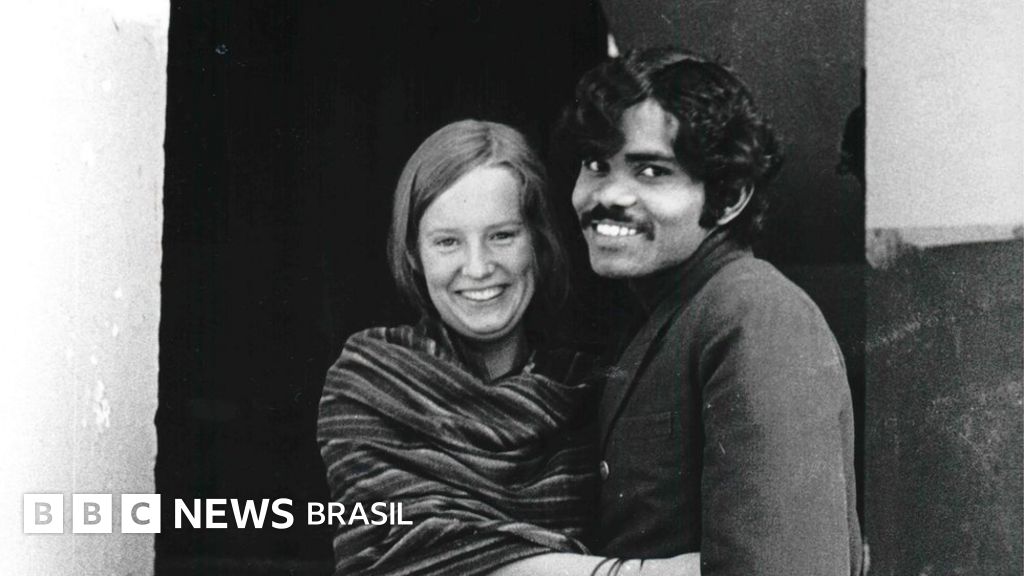
O artista indiano PK Mahanandia conheceu a turista Charlotte Von Schedvin em uma tarde de inverno de 1975, em Nova Déli, quando ela pediu-lhe que desenhasse o seu retrato. Foi aí que começou uma história de amor que culminaria com uma épica jornada de bicicleta da Índia à Europa.

Charlotte visitava a Índia quando viu Mahanandia no distrito de Connaught Place, na capital indiana.

Ele era um jovem artista, mas já bem conhecido por seus retratos.

Curiosa com a promessa do artista de "fazer um retrato em 10 minutos", ela resolveu experimentar, mas não ficou impressionada com o resultado e voltou no dia seguinte.

Novamente, o resultado não foi satisfatório.

Em sua defesa, Mahanandia diz que estava preocupado com uma previsão que sua mãe fizera vários anos antes.

Ele cresceu em uma aldeia no Estado de Orissa, no leste da Índia, onde enfrentou discriminação pelos estudantes de castas superiores porque era um dálit, ou "intocável", a casta mais inferior da sociedade segundo o hinduísmo, principal religião do país.

Sempre que ele ficava triste, a mãe dizia que, segundo o horóscopo, um dia ele se casaria com uma mulher "do signo de Touro, vinda de uma terra distante, musical e que será dona de uma floresta".

'Amor à primeira vista'

Quando conheceu Charlotte, imediatamente lembrou-se das previsões da mãe e perguntou se a sueca era proprietária de uma floresta.

Charlotte Von Schedvin, de uma família da nobreza sueca, respondeu que tinha uma floresta e acrescentou que além de ser "musical" (gostava de tocar piano), seu signo era de Touro.

"Tinha uma voz dentro de mim que dizia que ela era a predestinada", disse Mahanandia à BBC. "Nesse primeiro encontro, fomos atraídos um pelo outro como ímãs. Foi amor à primeira vista."

"Ainda não sei o que me fez perguntar aquilo e depois convidá-la para um chá. Pensei que ela ia dar queixa na polícia", continua.

Mas a reação da moça não foi bem assim.

"Achei que ele era honesto e quis saber por que tinha feito aquelas perguntas", lembra ela.

Depois de várias conversas, ela aceitou ir até Orissa com ele.

Ali, Mahanandia levou-a para conhecer um famoso monumento local, o templo Konark, dedicado ao sol e listado como Patrimônio Mundial da Humanidade pela Unesco.

"Fiquei comovida quando PK me mostrou o Konark. Eu lembrava daquela imagem do templo de pedra em um quadro no meu quarto de estudante, em Londres, mas não tinha ideia de onde ficava. E lá estava eu, diante dele."

Os dois se apaixonaram e, depois de passarem alguns dias no vilarejo dele, retornaram a Nova Déli.

"Ela vestiu um sári quando encontrou meu pai pela primeira vez. Não sei ainda como ela conseguiu. Com as bênçãos do meu pai e da minha família, nos casamos de acordo com a tradição tribal", conta ele.

Charlotte havia viajado de carro com amigos até Déli, desde a Suécia, seguindo um interário conhecido na época como "trilha hippie" - cruzando a Europa, a Turquia, o Irã, o Afeganistão e o Paquistão - para chegar à Índia em 22 dias.

Ela se despediu dele e iniciou a viagem de volta, mas fez com que ele prometesse que iria encontrá-la em sua casa, na cidade sueca de Boras.

Mais de um ano se passou e os dois mantiveram contato por carta. Mahanandia não tinha dinheiro para comprar uma passagem de avião.

Um dia, resolveu vender tudo o que tinha, comprou uma bicicleta e a seguiu pela mesma trilha hippie.

'A arte me salvou'

A viagem dele começou no dia 22 de janeiro de 1977; ele pedalava diariamente cerca de 70 quilômetros.

"A arte me salvou. Fiz retratos de pessoas e algumas me deram dinheiro, outras, comida e abrigo", relembra.

Mahanandia lembra que o mundo era muito diferente em 1970. Por exemplo, ele não precisava de visto para passar por vários países.

"O Afeganistão era um país tão diferente de hoje. Era calmo e bonito. As pessoas adoravam arte e grandes partes do país não eram habitadas."

Ele acrescenta que, no Afeganistão, as pessoas entendiam quando ele falava hindi, mas a comunicação se tornou um problema quando entrou no Irã.

"Novamente a arte me salvou. Acho que o amor é uma língua universal e as pessoas entendem isso."

"Aqueles eram dias diferentes. Acho que as pessoas tinham mais tempo livre para se dedicar a um andarilho como eu."

Mas ele não ficava cansado de tanto pedalar?

"Sim, muito. Minhas pernas doíam. Mas a expectativa de encontrar Charlotte e o fato de estar vendo novos lugares me fizeram seguir em frente", afirma.

Choques culturais

Ele chegou à Europa no dia 28 de maio, mais de cinco meses após partir de Nova Déli. Em Viena, na Áustria, ele pegou um trem para Gotemburgo, na Suécia, depois de pedalar por mais de 5,5 mil km.

Depois de enfrentar vários choques culturais e a difícil tarefa de impressionar os pais de Charlotte Von Schedvin, os dois finalmente casaram-se, oficialmente, na Suécia.

"Eu não tinha ideia do que era a cultura europeia. Era tudo novo para mim, mas ela me apoiou em cada passo. Ela é uma pessoa especial. Ainda sou apaixonado como era em 1975", diz.

Aos 64 anos, Mahanandia vive com Charlotte e os dois filhos do casal na Suécia, onde continua trabalhando como artista.

Mas ele ainda não entende "por que as pessoas acham que foi uma grande coisa vir de bicicleta para a Europa".

"Eu fiz o que tinha de fazer. Não tinha dinheiro, mas tinha que encontrá-la. Eu estava pedalando por amor, mas nunca amei pedalar. É simples."

Let's block ads! (Why?)

09 Jul 18:32

How to "Riff" on an Idea

I don’t know when comedians started using the word “riff.” I’m certain that it stems from some stand-up comics’ delusional wish to be seen as the jazz musicians of comedy. Just like some other stand-up comics claim to be the fighter pilots of comedy.

Those are both things I had more than one comedian say to me over the course of my comedy career.

Whenever somebody tells you they’re the “something much cooler” of “whatever it is that they actually are,” it’s indicative of a serious self-esteem problem. Take it from someone who grew up near Yakima, the town that calls itself “The Palm Springs of Washington.”

Hey, by the way, my latest book, Run Program, is out now! It's a book about a rogue AI that has the intelligence of a child. You might think that would make the AI less dangerous, but you'd be wrong. Anyway, I'm quite proud of it. Please check it out, if you have a chance.

As always, thanks for using my Amazon Affiliate links (USUKCanada).

02 Jul 00:54

Comic for June 28, 2017

by Scott Adams
02 Jul 00:52

The Ultimate Fight

by Doug
02 Jul 00:50

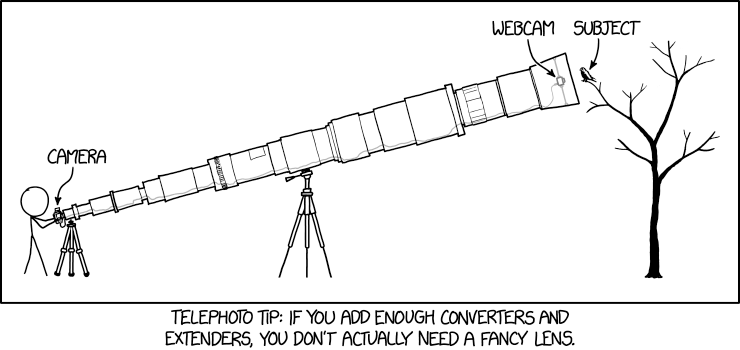
Telephoto

I was banned from the airliners.net photography forum by concerned moderators after the end of my lens started brushing against planes as they flew by.
01 Jul 11:28

Princess Party

https://www.oglaf.com/princessparty/

01 Jul 11:24

Saturday Morning Breakfast Cereal - Pale Blue Dot

by tech@thehiveworks.com


Click here to go see the bonus panel!

Hovertext:
We need to build a space elevator just so we can all get a taste of this.

New comic!
Today's News:

Just about a week left to submit your proposal for BAHFest Houston! Rice kids, this is your chance to show up MIT. Carpe diem.

01 Jul 11:23

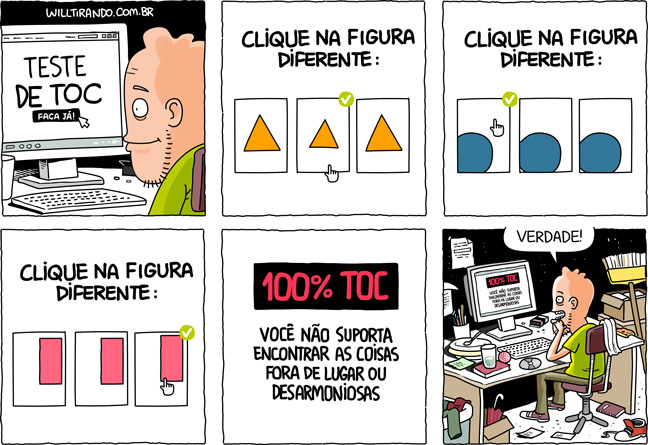
Teste de TOC

by Will Tirando

01 Jul 11:22

Refresh Types

The hardest refresh requires both a Mac keyboard and a Windows keyboard as a security measure, like how missile launch systems require two keys to be turned at once.
01 Jul 11:22

Kevin’s Quest

by Reza

01 Jul 11:19

Whomp! - Beaten to the Punchline

by tech@thehiveworks.com

New comic!

Today's News:
01 Jul 11:19

Night Birds

by Doug
01 Jul 11:17

How to Videotape Your Will

I intend to start my video will this way. If I do, I will make it clear that my surroundings area rented set, so not only will none of my beneficiaries get any of the items they see in the video, bet procuring them for said video cost quite a bit of money, reducing how much there is left for anyone to inherit.

I know they won’t be happy with me, but at that point, what are they going to do?

Hey, by the way, my latest book, Run Program, is out now! It's a book about a rogue AI that has the intelligence of a child. You might think that would make the AI less dangerous, but you'd be wrong. Anyway, I'm quite proud of it. Please check it out, if you have a chance.

As always, thanks for using my Amazon Affiliate links (USUKCanada).

01 Jul 11:17

Wishing Eye Was There

by nedroid

Wishing Eye Was There

01 Jul 11:15

Coach

by Doug
01 Jul 11:15

Comic for June 22, 2017

by Scott Adams
01 Jul 11:15

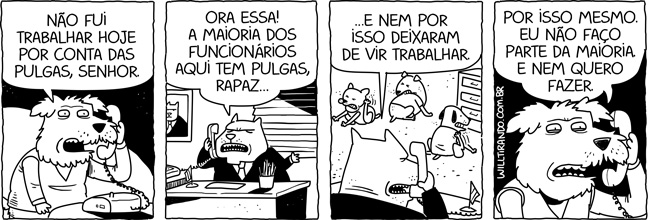
Viva Intensamente # 315

by Will Tirando

01 Jul 11:14

Priorities

by Reza

01 Jul 11:14

Saturday Morning Breakfast Cereal - A Reason

by tech@thehiveworks.com


Click here to go see the bonus panel!

Hovertext:
And the further back in time we go, the shittier it gets!

New comic!
Today's News:
01 Jul 11:11

Scuba Diving

by Doug
29 Jun 23:26

wholesomeIf you like my comics, you can find me here: webtoon /...


wholesome

If you like my comics, you can find me here: 

webtoon / website / facebook / twitter / patreon

29 Jun 23:24

Sofrência universal

by brunomaron

lactea


Arquivado em:dinâmica de bruto
29 Jun 23:06

Astronauta libertado (Catedral de Salamanca)

by noreply@blogger.com (Ronald Sanson Stresser Junior)


Conheça a história por trás do astronauta esculpido na Catedral de Salamanca, construída há mais de 300 anos

A figura talhada de um astronauta moderno pousado sobre a fachada da entrada norte da Catedral de Salamanca, na Espanha, destoa de todo o resto e impressiona a todos que passam por ali. A igreja, nos estilos barroco e gótico, foi construída entre 1513 e 1733. De forma inevitável, as teorias que envolvem os astronautas antigos, as viagens através do tempo e acontecimentos sobrenaturais surgem com explicações variadas.


No entanto, e apesar do mistério pairar sob uma nuvem de incerteza, o astronauta enigmático da Catedral de Salamanca parece ter uma explicação muito mundana. A figura está localizada em uma coluna, na entrada da Nova Catedral, e representa um astronauta com botas, capacete e o que parece ser um sistema de respiração em seu peito, com tubos que se conectam a uma mochila na parte traseira de seu traje. Com a mão direita, ele segura uma espécie de vara e com a esquerda se apoia em uma folha. Seu rosto expressa uma perplexidade imutável.


Como é possível alguém ter esculpido uma imagem tão nítida de um astronauta moderno em uma catedral construída há centenas de anos e muito antes de tal personagem existir? 

Ao que tudo indica, isso teria acontecido, na verdade, há muito pouco tempo, quando, em 1992, a catedral foi restaurada. 

Na época, a “Porta de Ramos”, como é chamada a entrada norte da Catedral, sofreu uma grande deterioração com o passar do tempo. Dessa forma, a escultura do astronauta seria uma adição do pedreiro Miguel Romero e teria escapado da observação do arquiteto Jerómio García de Quiñones, o responsável pela restauração. O fato teria obedecido a uma velha tradição, na qual os restauradores costumam incluir algum elemento moderno, próprio da época em que é realizada a restauração – neste caso, um astronauta.

Claro que essa é apenas uma hipótese, e muitos afirmam que a figura está lá desde a construção original da catedral, que teria sido restaurada por causa de alguns danos em sua estrutura. Sem fotos, testemunhas ou evidências que permitam saber a história real, as conclusões, sejam quais forem, ainda são mera teoria.

Fonte: lagranepoca.com | seuhistory.com

18 Jun 17:09

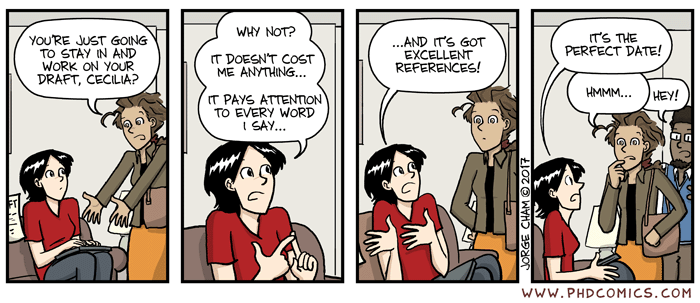
06/16/17 PHD comic: 'Perfect'

Piled Higher & Deeper by Jorge Cham
www.phdcomics.com
Click on the title below to read the comic
title: "Perfect" - originally published 6/16/2017

For the latest news in PHD Comics, CLICK HERE!

18 Jun 11:11

Cottonmouth Myths and Facts

by rmosco
Adam Victor Brandizzi

Não tenho nenhum interesse nisso, mas esses desenhos são tão agradáveis ^^

18 Jun 10:57

Calling In Sick

by Brian

Bonus Panel

The post Calling In Sick appeared first on Fowl Language Comics.

18 Jun 10:55

Dark Matter Recipe Calls for One Part Superfluid | Quanta Magazine

by brandizzi

Inside galaxies, the role of the electromagnetic trap would be played by the galaxy’s gravitational pull, which could squeeze dark matter together enough to satisfy the density requirement. The temperature requirement is easier: Space, after all, is naturally cold.

Outside of the “halos” found in the immediate vicinity of galaxies, the pull of gravity is weaker, and dark matter wouldn’t be packed together tightly enough to go into its superfluid state. It would act as dark matter ordinarily does, explaining what astronomers see at larger scales.

But what’s so special about having dark matter be a superfluid? How can this special state change the way that dark matter appears to behave? A number of researchers over the years have played with similar ideas. But Khoury’s approach is unique because it shows how the superfluid could give rise to an extra force.

In physics, if you disturb a field, you’ll often create a wave. Shake some electrons — for instance, in an antenna — and you’ll disturb an electric field and get radio waves. Wiggle the gravitational field with two colliding black holes and you’ll create gravitational waves. Likewise, if you poke a superfluid, you’ll produce phonons — sound waves in the superfluid itself. These phonons give rise to an extra force in addition to gravity, one that’s analogous to the electrostatic force between charged particles. “It’s nice because you have an additional force on top of gravity, but it really is intrinsically linked to dark matter,” said Khoury. “It’s a property of the dark matter medium that gives rise to this force.” The extra force would be enough to explain the puzzling behavior of dark matter inside galactic halos.

A Different Dark Matter Particle

Dark matter hunters have been at work for a long time. Their efforts have focused on so-called weakly interacting massive particles, or WIMPs. WIMPs have been popular because not only would the particles account for the majority of astrophysical observations, they pop out naturally from hypothesized extensions of the Standard Model of particle physics.

Yet no one has ever seen a WIMP, and those hypothesized extensions of the Standard Model haven’t shown up in experiments either, much to physicists’ disappointment. With each new null result, the prospects dim even more, and physicists are increasingly considering other dark matter candidates. “At what point do we decide that we’ve been barking up the wrong tree?” said Stacy McGaugh, an astronomer at Case Western Reserve University.

The dark matter particles that would make Khoury and Berezhiani’s idea work are emphatically not WIMP-like. WIMPs should be pretty massive as fundamental particles go — about as massive as 100 protons, give or take. For Khoury’s scenario to work, the dark matter particle would have to be a billion times less massive. Consequently, there should be billions of times as many of them zipping through the universe — enough to account for the observed effects of dark matter and to achieve the dense packing required for a superfluid to form. In addition, ordinary WIMPs don’t interact with one another. Dark matter superfluid particles would require strongly interacting particles.

The closest candidate is the axion, a hypothetical ultralight particle with a mass that could be 10,000 trillion trillion times as small as the mass of the electron. According to Chanda Prescod-Weinstein, a theoretical physicist at the University of Washington, axions could theoretically condense into something like a Bose-Einstein condensate.

But the standard axion doesn’t quite fit Khoury and Berezhiani’s needs. In their model, particles would need to experience a strong, repulsive interaction with one another. Typical axion models have interactions that are both weak and attractive. That said, “I think everyone thinks that dark matter probably does interact with itself at some level,” said Tait. It’s just a matter of determining whether that interaction is weak or strong.

Cosmic Superfluid Searches

The next step for Khoury and Berezhiani is to figure out how to test their model — to find a telltale signature that could distinguish this superfluid concept from ordinary cold dark matter. One possibility: dark matter vortices. In the lab, rotating superfluids give rise to swirling vortices that keep going without ever losing energy. Superfluid dark matter halos in a galaxy should rotate sufficiently fast to also produce arrays of vortices. If the vortices were massive enough, it would be possible to detect them directly.

Let's block ads! (Why?)

18 Jun 10:55

Saturday Morning Breakfast Cereal - Safety

by tech@thehiveworks.com


Click here to go see the bonus panel!

Hovertext:
One day, we'll have personal robot servants who realize human bodies are the major source of dust in the house.

New comic!
Today's News:

You can still win an early copy of Soonish by predicting the awful future here!