Shared posts

27 Jun 02:00

Our poor sleeping habits are filling our brains with neurotoxins

We’ve known for some time that sleep is important for the restoration and strengthening specific functions in the brain linked to memory, regulating emotions, decision-making, and even creativity. But scientists are now discovering the processes through which sleep also cleans the brain like a plumbing system, in the process changing its cellular structure.

This research has led to an increasingly sophisticated understanding of the brain’s internal workings—and is one more reminder of why it’s so essential that humans make sure they get the proper amount of sleep.

Previously, scientists thought the brain only cleaned itself by trickling toxins through brain tissues, but researchers now believe wastes are forcefully pushed through the brain at a much faster and higher pace, according to Maiken Nedergaard, co-director of the Center for Translational Neuromedicin at the University of Rochester Medical Center School of Medicine and Dentistry.

 “The less deep sleep you have, the less effective you are at clearing out this bad protein.” Nedergaard dubbed this liquid cleaning system “the glymphatic system,” derived from the lymph system, which filters toxic waste products out of the body. The waste products that are filtered through the brain prevent neurological illnesses like Alzheimer’s and Parkinson’s. Nedergaard’s research was followed up by a 2013 study which found “hidden caves” open up in the brain while we sleep, allowing cerebrospinal fluid to flush neurotoxins through the spinal column in copious amounts.

Basically, the cerebrospinal fluid sits around your brain and spinal cord and “every six to eight hour period, filters through the brain while you’re asleep,” Tara Swart, a senior lecturer at MIT specializing in sleep and the brain, told Quartz. “The whole process takes six to eight hours.”

Much more important than your average cleaning system, this process clears neurotoxins out of your brain, specifically one called beta-amyloid, which has been found in clumps in the brains of people with Alzheimer’s disease. When this system can’t function properly due to lack of sleep, harmful remnants, like beta-amyloid, are allowed to build up.

A 2015 study published in the journal Nature Neuroscience was one of the first to look at humans rather than animal subjects when examining how sleep can fight against memory impairment. As it turns out, beta-amyloid also works to prevent your body from getting the rest it needs, creating something of a vicious cycle for the chronically sleep-deprived.

As Matthew Walker, one of the neuroscientists who authored the study, wrote: “The more beta-amyloid you have in certain parts of your brain, the less deep sleep you get and, consequently, the worse your memory. Additionally, the less deep sleep you have, the less effective you are at clearing out this bad protein.”

  CEOs have long bragged of their ability to only sleep four to five hours a night, but Swart says this bravado misses the point  As a result of these findings, Swart said she’s been “even more careful about [her] sleep.” In fact, as part of Swart’s Neuroscience For Leadership class at MIT in April, she discussed the serious health consequences that come from neglecting shut-eye. Swart, who is also a leadership coach, has been instructing executives to sleep for years. She promotes techniques related to diet and exercise, and warns that sleeping next to your smartphone—the one that emits 3G and 4G signals all night—affects your brain patterns, restructuring your brain cells and likely preventing you from allowing your brain to clean out waste material properly.

Research published in 2007 has already found that the electrical radiation emitted from smart devices is picked up by electrodes inside our brains. Scientists are still trying to figure out just how much damage the electromagnetic signals emitted from WiFi equipment can actually do to the human brain. But by potentially preventing our brains from flushing beta-amyloid—just by being in close proximity—it’s clear these devices already have the potential for serious damage.

Ultimately, how much sleep you think you need has little to do with it. CEOs have long bragged of their ability to only sleep four to five hours a night, but Swart says this bravado misses the point: even if you don’t feel sleepy, your brain needs those six to eight hours to cleanse itself every day. (Then there’s the multitude of research that shows a rested and resilient brain performs better, is better able to regulate emotions and think creatively.)

If having enough time to sleep is a challenge for you, Swart suggests naps. Taking even 20 minutes of shut-eye is comparable to “literally plugging in your phone battery,” says Swart, similar to a power boost. For 30 minutes of downtime, your brain will experience improved learning and memory. For those fortunate enough to snag 60 to 90 minutes of rest, “new connections can form which can unleash creativity in the brain.”

“And that’s why Google has nap pods,” Swart explained.

You can follow Vivian on Twitter at @vivian_giang. We welcome your comments ideas@qz.com.

Bookmarked at brandizzi Delicious' sharing tag and expanded by Delicious sharing tag expander.
21 Jun 05:05

Buster Keaton’s art

Summary
The sad fate of the silent-film star. Buster Keaton’s art was sublime. Then came talkies, alcoholism, and drifting around Hollywood in a “land yacht”

from cabinetmagazine.org

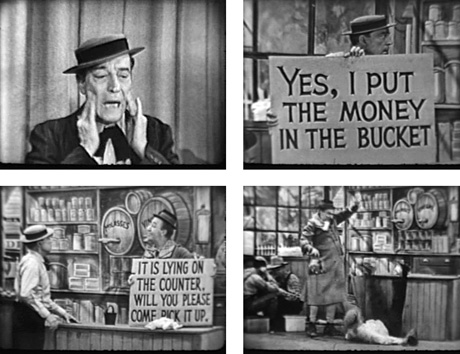
“Now, ladies and gentlemen, I have really something of great interest to the public!” The former vaudevillian Ed Wynn is providing the introductory patter to a segment in an episode of his eponymous comedy show, broadcast live in primetime on 9 December 1949. Wynn, who would later voice the Mad Hatter in Disney’s adaptation of Alice In Wonderland (1951), is a jolly host: he looks like a horned owl in a clown costume, plump and bespectacled with a rubbery excitement to his expressions that suggests he’s already half-cartoon. His speech has an avuncular warmth, tumbling with a ringmaster’s glee through his slightly pinched sinuses. The other treats on the show have included a special guest appearance from the famously deadpan actress Virginia O’Brien, nicknamed “Miss Ice Glacier,” who sang “Bird in a Gilded Cage,” and blubbery Ed’s attempt to dance a ballet overture. The curtains behind Wynn that hide the set from the audience are fuzzy, gray, and monstrously thick, looking like nothing so much as a carefully graded spectrum of various sorts of domestic dust; the studio has the acoustics of a damp attic. Wynn tells the audience that they are about to have “the great privilege in seeing for the first time, certainly on television, and alive, almost!”—an odd thing to say, don’t you think?—“one of the greatest of the great comedians of the silent moving-picture days. Mr. Buster Keaton!”


Buster Keaton on The Ed Wynn Show, 9 December 1949.

Here he is, a little man in his trademark outfit of porkpie hat and rumpled suit. He ignores all conversational prompts, playing dumb and nodding a little as if out of beat with the situation, mid-daydream. “The American public would like to hear you say something. Would you say something? Go ahead,” Wynn cajoles him, “speak!” And upon these ventriloquist’s orders, Buster commences a routine that looks like a ludic premonition of the anguished choreographies found in Samuel Beckett’s plays. (Shortly before his death, he would appear as the solitary figure in Beckett’s metaphysically queasy 1965 short, Film).1 Carefully, the voice must be readied—the whole body is involved. He shrugs his shoulders a few times, bends his knees to ensure that he’s suitably limber, then performs some exaggerated respirations that make his chest swell and deflate like a ragged bellows. There’s a mysterious procedure of cheek massage and jaw agitation in which he looks like a gargoyle attempting to reverse the effects of amphetamines. He spritzes something into his mouth, the host looks quizzically on, and what shy laughter there was in the audience has receded like a weak breeze. Then, at last, he says “Hello!” in an eager innocent’s yelp. Wynn is astonished! His owlish eyes go wide, and Buster falls, exhausted, into his arms as the audience chuckles. Television is probably more accommodating to such outbursts of staccato weirdness than any other medium, but Buster’s act is much more than just an odd trick. He isn’t out of shape: a subsequent re-enactment of “the first scene he ever did for a camera” will prove he’s freakishly limber for a fifty-four-year-old and his timing’s still pin-sharp. This impish revision of an old routine about a hatful of black molasses, with Wynn taking the role originally played by Buster’s old pal (and Hollywood outcast) Roscoe “Fatty” Arbuckle will exaggerate the formal habits of silent film—intertitles and melodramatic expressions—to levels of inspired lunacy. Like in all his best films, the sleepwalking smoothness of his physical antics combines with a preternatural sense of how film itself can be the subject of witty subversions and knowing mischief.


Publicity still from the 1930 film Free and Easy, Keaton’s first starring role in a talkie.

That bewildering joke, which suggests that Buster can only speak after laboriously readying his body, plays on the strange fate of silent film stars in our imagination: silence is a symptom of their magical condition. The more of them you watch, the more difficult it becomes to think of them as possessing voices at all. (Would Theda Bara be mute in public, too?) What breeds in silence is, naturally, a sort of excitable noise: heightened fascination, fantastical lore, and outlandish forms of erotic gossip, all of which conspire to hide the dumbstruck star. The uproarious arrival of sound often led these delicate figures into the long and lonely twilight of their careers. The silence that reigned in the cinema twenty years before seemed unspeakably distant and, like the others, Buster had transformed into a relic, an object suitable for gawking audiences and inducing occasionally lyrical fits of nostalgic reflection. But he was able to stage a return when many had retreated into memory or private darkness. The year of his appearance on The Ed Wynn Show, Clara Bow, the actress who had slinked through the world’s erotic dreamscape for much of the 1920s, had been admitted to a mental hospital with a mistaken diagnosis of schizophrenia, then subjected to aggressive electroshock treatment. Ravaged upon release, she abandoned her family and moved into a bungalow near Los Angeles that she seldom left until her death in 1965. Buster was ruined by a slow fall into alcoholism but returned, and yet his rehabilitation and—let’s go for the hysterical mood of melodrama—resurrection conjure up more ghosts. His alcoholism was seemingly cured by a manic, spuriously medical process, and he didn’t quite vanish in the obscure years before its success. There’s plenty of intoxicating material to be found by studying Buster if you dodge the lustrous peaks of his career in favor of going deep into its gloom and supposed dead ends.

Unfurling this distended postscript without acknowledgement of the astonishing properties of Buster’s art would be unkind. A case study of his childhood might be equally rich, too. Born in 1895, which makes his age exactly synchronous with cinema itself, he was a willing participant in vaudevillian mishegoss as soon as he could walk. According to myths circulated by his father, he had survived a few twirls in the eye of a Kansas tornado when he was three. Alongside his parents, he was part of the Three Keatons, a riotous slapstick act in which his mother played saxophone and his father discoursed on child discipline while hurling Buster about the stage. His education was irregular; his father was an alcoholic. In photographs from this time, he looks like a playful wraith.

As a child, silent cinema was a ghost house I had to explore. My sense of reality was already perilously vague and the thought of these films that would allow me to watch the mischief of specters—everyone in them was, by the time of my childhood, decidedly dead—was a deep and wicked thrill. Whole days disappeared in the attempt to cast the shadow of Nosferatu on the wall as I climbed the stairs again and again. (I failed: it was very tough to get the head correct, my skull lacking the required Expressionist jags.) I remember chancing across Buster’s face in a film history book one monochrome morning and feeling the peculiar sensation that this haunted boy knew I was looking at him. Wholly at odds with the wild-eyed mania that silent film acting often promised, his presence was gentle and radiated an unmistakable sadness. He had the dreamy, lonesome look of a stray dog. His eyes would widen in moments of moonstruck goofing or genuine enchantment, then look on the edge of sleep when he was puzzled. Nobody else’s body yielded so smoothly to the sublime mindlessness that the best physical comedy requires, and he was beautiful in a way that, say, a clerical nebbish like Harold Lloyd would never match. On film, even in flashes of jackrabbit energy, he’s airily nimble and weirdly aided by the jittery accelerations and diminuendos of silent film speed that can make him seem too limber in his skittering or too light in his falls to be made of flesh and bone. At those moments he’s closer to a bewitched marionette.


Keaton listening to his own voice, late 1920s.

In 1928, Buster was talked into giving up his own studio, where he made his finest films, and switching to the ascendant MGM. Bad contracts were signed; dark clouds began to settle in his head. His subsequent drift into alcoholism looks like a commonplace response to the baleful state of Hollywood and deep marital discord. Seven years before, Buster had married Natalie Talmadge, a delicate, fawn-like beauty of seemingly untrammelled malevolence who banished him from their bedroom once he had supplied her with the two sons (and the mansion) she required, reported him for kidnapping when he took the boys for a weekend jaunt, and refused to hear his name in her presence until she died in 1969 after years blasted on painkillers and hopelessly soaked in booze. She appears to have dreamed of transforming Buster into a bland mixture of benefactor and milquetoast, though let’s note that as the far less successful middle sister of two wildly famous actresses, Norma and Constance, she was never able to tell her own story, skewed and vituperative as it might have been. Natalie’s chief occupation was perfecting the girlish swirls of her sisters’ signatures on an endless cascade of publicity stills. In a photograph taken on their wedding day, Buster stands in between the three sisters in a spotlight of May sunshine, looking like a man about to be led to the gallows. Norma and Constance retired with the advent of the talkies. Norma was reputedly the inspiration for Lina Lamont in Singin’ in the Rain (1952), the starlet of uncommon radiance destroyed by the arrival of sound, which reveals to the world that she’s in possession of the shrill, needling voice of a Brooklyn chipmunk. The reclusive, gone-to-ruin silent movie heroine played by Gloria Swanson in Billy Wilder’s Sunset Boulevard (1950) is also an acidulous portrait of Norma. Like her sister, she suffered an unhappy fate, fleeing to Las Vegas, gorging on painkillers, seeing no one, and drinking all the time until she died there on Christmas Eve in 1957. (Much the same happened to Constance: they made a tragic trio).


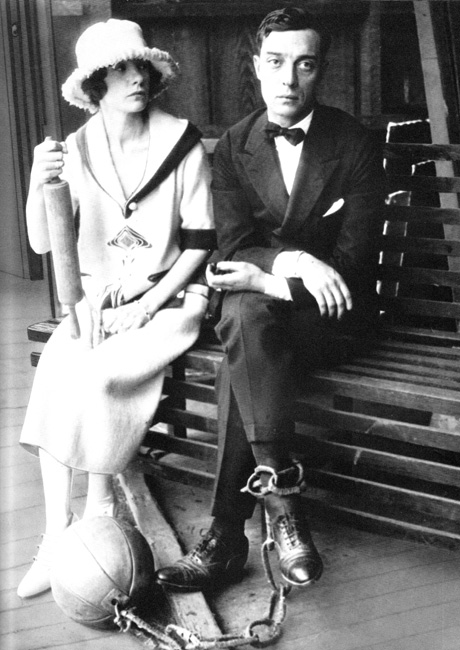
The bonds of matrimony. Buster and Natalie a few weeks after their wedding.

As the marriage dissolved, Buster tumbled toward oblivion, too, succumbing to the song of what he called his “inner Bacchus” in order to escape domestic pressures. He became estranged from his sons, whose last names were changed so that they were suddenly Talmadge property. The pleasures of drinking had long since faded into the delirious routine of everyday alcoholism as he got drunk from sunrise until he blacked out. As he recalls in his autobiography, My Wonderful World of Slapstick (1960), “all my weekends were lost weekends.”2 He left the mansion and drifted around Hollywood in a land yacht, “a fancy house on wheels that had twin motors in the chassis of a Fifth Avenue bus, contained two drawing rooms, a galley, an observation deck and slept eight persons.” By way of melancholy endorsement, he notes, “I had as much fun with my land yacht as a man can whose purpose is to forget his whole private world has fallen apart.” In a drunken blur one Monday afternoon, he staggered down to the MGM lot and befriended an extra—“I could not say today whether she was a blonde, brunette or a redhead”—took her home, and let her have her pick of the contents of Natalie’s enormous wardrobe, heaping up piles of cocktail dresses, fur coats, gowns, and sparkling shoes. He appeared in What? No Beer! (1933), a dismal but hugely successful talkie with the antic Jimmy Durante in which this mismatched double act accidentally become beer barons as Prohibition’s on the wane. Buster plays a taxidermist and suitably moves with the shambling gait of a bear half-stuffed with wool. When shooting was over one night, he tried to drink himself into unconsciousness but failed and came reeling into the studio the next morning, only to promptly pass out.

When he awoke, he found a letter from the studio bosses telling him he was fired. Buster had become a drunk at a time when alcohol was a source of immense moral panic. (William Burroughs’s grandmother had the motto, “I’d rather a son o’ mine came home dead than drunk!”) Grimmest of all, he had fallen for whiskey, which, as he said later, was popularly regarded as “pure evil, apparently being distilled in hell itself.”

Throughout the early 1930s, the backdrops shuffled like a collection of old postcards as Buster appeared in cheap slapstick short films shot in Mexico, France, and England. He read the “idiot cards” that rendered lines in foreign languages into phonetic English, repeating his dialogue over and over again for different territories to save on the expense of dubbing. Drinking was a useless form of self-sabotage—even knockout drunk, he was still able to perform his stunts.


Keaton accessorized, ca. 1930.

Whenever he sobered up, he was stricken with delirium tremens. In the nightmarish hallucinations that typically accompany this condition, he was attacked by bloodthirsty squirrels. According to rumor, he escaped from his straitjacket while in a psychiatric hospital, performing the great trick he had learned from Harry Houdini as a boy. In 1933, somebody sent him to dry out in the seclusion of Arrowhead Springs in San Bernardino, a nurse called Mae Scriven in tow to supply “the right amounts of whiskey so I wouldn’t go nuts and hypodermics to put me to sleep.” After a week of enforced temperance, he absconded to Mexico and married Scriven in accordance with some drunken, japing impulse. (Marrying your nurse must always be a sign of full-scale psychoanalytic catastrophe.) They soon divorced.

The screwball humor that came in the dust of the Depression and after the end of silent cinema often revels irrepressibly in the sound of speech itself: puns, comic accents, wolf whistles, sly one-liners, devilish loquacity, seductions sung with tongue in cheek, anarchic contortions of flirtatious, professorial, and gangster talk. You can find all of this friskily embodied in the verbal shenanigans of Groucho Marx and even in the to-and-fro routines of lesser lights like Abbott and Costello. Against that, Buster’s humor can look glassy, slow, and luminously strange, like ballet.

Dreaming of Buster’s voice is a natural activity. Some peculiar flutter in the mind always makes you lend voices to silent things. A sudden pall of sadness is perhaps natural, too, on hearing it for the first time, as he doesn’t produce the angelic mumble you might imagine but the parched groan of something that lives in the dark. In a high-spirited moment from Doughboys (1930), he sings and plays ukulele with two other soldiers before lights out, providing a basso punctuation of rhythmic gibberish while one of his pals takes the lead with an utterly bewildering and ecstatic outburst of half-drowned scat singing that suggests the yowling of a hungry cat.

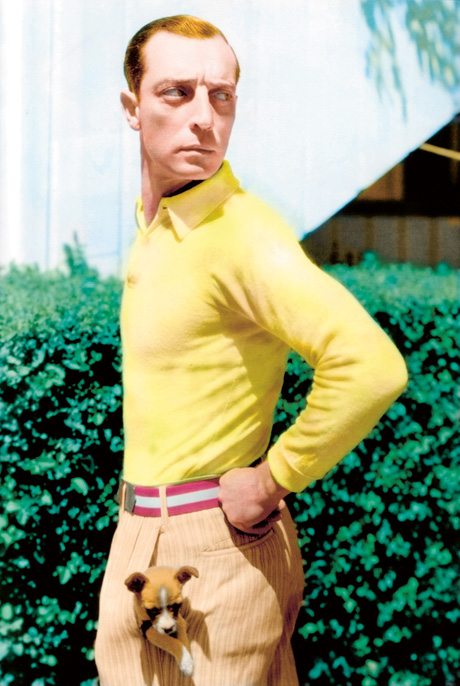
If you collect photographs of Buster, you soon notice how rare it is to see him in color. In those you can find, he looks as if he’s the subject of one of those fin-de-siècle hand-tinted portraits of a dead body that Victorian families cherished so intensely. There’s a ghoulishly thrilling painted snapshot from 1930: clown make-up drools exuberantly over his tragic face while Lon Chaney (who died that year) looks at him askance from his own portrait like a mean-spirited saint. In another shot from the same sequence, Buster appears in a vest—athletic, aglow, like he’s escaped from the pages of a fantasia by Jean Genet.

Between jobs during this bleak period in the 1930s, he was taking pratfalls on the streets for cash and drinking with tramps. In another sanatorium, he was subjected to “a reasonable facsimile” of the Keeley Cure: “Nurses and doctors do nothing but pour liquor into you, giving you a drink every half-hour on the half-hour. You get your favorite snort all right, but never twice in a row. Instead they start you off with whiskey and on succeeding rounds give you gin, rum, beer, brandy, wine—before they get around to the whiskey again. … When you plead, ‘Oh, no! Take it away please!’ all you get from your bartenders and barmaids in white coats is a friendly smile. ‘Please take it away,’ you repeat, ‘it hurts my stomach.’ ‘Just one more,’ they say, for their purpose is to make the hurt in your stomach grow until it becomes unforgettable.” There’s a blackly comic rhythm to this episode of aversion therapy that’s uncannily close to the circumstances in some of his films. All those doctors recall the hundreds of policemen pursuing poor Buster in Cops (1922), the wicked two-reeler that concludes with him locked up and his porkpie hat lying on a tombstone. In Hard Luck (1921), heartbroken and penniless, he repeatedly attempts to kill himself but always fails. On a darkened road he lies in the path of two looming headlights only for it to be revealed that the beams belong to a pair of motorcycles. In a rich man’s kitchen, he spies a bottle marked “Poison,” not knowing that a crafty dipsomaniac waiter has filled it with whiskey. As soon as he guzzles down that favorite snort, he swaggers off, then gets lost in the wilderness. The lurid horrors of his round-the-clock drinking in the sanatorium acquire an extra brutal kick when you learn that drenching the patient in alcohol was meant as only one part of the Keeley Cure, a turn-of-the-century treatment that seems to have been concocted in a medicine show performance of vulpine promise and pharmacological make-believe.

Leslie Keeley’s “Gold Cure” was struck upon as a commercial enterprise in 1879, claiming to conquer tobacco habits, opium addiction, alcoholism, and neurasthenia. “Fatty” Arbuckle might have submitted to a similar treatment when he beat his morphine addiction during World War I. The cure was a tonic of mysterious provenance that contained “Double Chloride of Gold,” strychnine—commonly purveyed as rat poison—and apomorphine. This mixture supposedly replenished the cells that had grown dependent on the addict’s favorite substance. The tonic could be purchased through mail order for patients who wished to kick their habit at home, but it was more often administered by injection, four times a day, at a Keeley Institute. By the end of the nineteenth century, every state in America had one of these institutes for the treatment of addiction and some had as many as three.3 Upon admission, alcoholic patients were supplied with as much drink as they could stomach before being inducted into a four-week program of temperance and strictly regimented calm that forecasts the pastoral conditions of modern rehabilitation centers.

But Buster was subjected to a maimed version of the cure that sounds especially sadistic and effectively dragged him through the wild terror of a waking nightmare. Aversion therapy attempts to infect the patient’s memory with dark associations between what they crave and its effects so that, eventually, out of sheer revulsion, the desire might be conquered. Rates of relapse were high among those who underwent the Keeley Cure in its proper form, even if contemporary accounts sound breezily triumphant or like so much circus barking: “They went away sots and returned gentlemen!”4 Buster was obliterated by the warped version of the cure he received twice in quick succession, and the second attempt was successful but not in the supernatural fashion that Keeley’s huckster advertising often claimed. Straight out of the sanatorium, he performed an act of private significance: “I walked to the bar and ordered two manhattans. I drank them one after the other. … I did not touch a drop of whiskey or any other alcoholic drink for five years.”


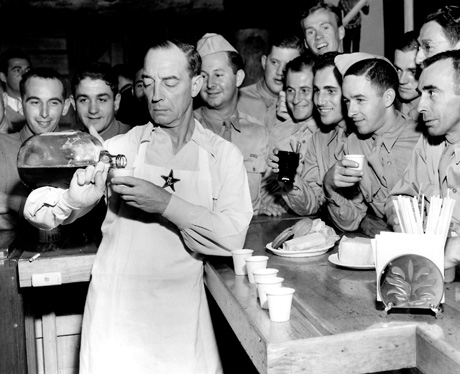
Keaton plying servicemen with drinks at the Hollywood Canteen, ca. 1944. Courtesy the Academy of Motion Picture Arts and Sciences.

He resumed drinking at a gentler tempo after that. When he met Beckett in New York before the shooting of Film started, he was drinking beer and watching a baseball game on TV. He didn’t offer Beckett a drink—“maybe he thought a man like Beckett didn’t drink beer”5—and said almost nothing throughout their encounter, asking only if he could wear his familiar hat in the film.

As he aged, he grew bald, gristly, marble-eyed, hangdog, though rough traces of his youthful beauty remained. His job became making quick appearances in unexpected places. Always, in these later performances, he arrives from and returns to a becalmed region of the past. He appeared in Sunset Boulevard as one of “the waxworks” playing in Gloria Swanson’s bridge game. Television had kept the formats and rhythms of vaudeville alive so he was at home there. The audience’s applause at the end of these spots congratulated him for surviving. Greta Garbo went into the regal isolation that would continue until her death in 1990; Chaplin abandoned America for Switzerland. Buster stayed in Los Angeles, watched a lot of TV, and kept working up until his death from lung cancer in 1966. (One last, late snapshot: Old Buster smoking in a borrowed tuxedo, with a pensive macaque under his arm.) As you chase Buster’s ghost down these mysterious corridors, you never quite reach him, but it seems strangely resonant to note that he always had a very quiet voice.


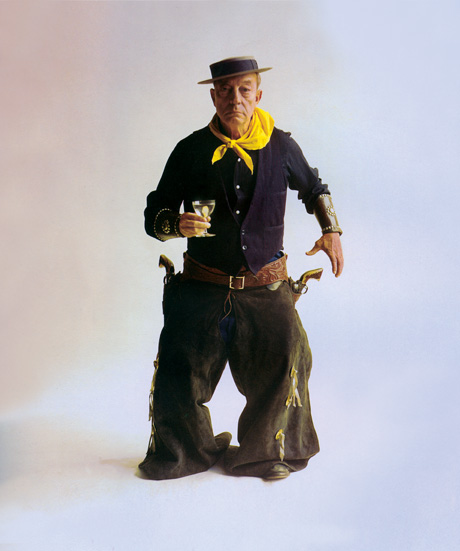
Keaton posing for a 1957 Smirnoff vodka ad. Photo Bert Stern.

  1. Beckett once received a request for permission to mount a Broadway production of Waiting for Godot where Marlon Brando would play Estragon and Keaton undertake the role of Vladimir. Nothing came of it. Keaton would have made a brilliant Lucky, the terrified serf whose role is almost entirely mute.
  2. All of Keaton’s quotes are taken from Buster Keaton and Charles Samuels, My Wonderful World of Slapstick (New York: Da Capo Press, 1982).
  3. See Mark Edward Lender and James Kirby Martin, Drinking in America: A History (New York: The Free Press, 1987), p. 123.
  4. This is the awed response of Joseph Medill, publisher of the Chicago Tribune, who initially did not believe the treatment would be efficacious. Quoted in William L. White, Slaying The Dragon: The History of Addiction Treatment and Recovery in America (Normal, IL: Chester Health Systems/Lighthouse Institute, 1998), p. 51.
  5. Alan Schneider, Beckett’s friend and director of Film, quoted in Damned to Fame: The Life of Samuel Beckett (London: Bloomsbury, 1997), p. 512.
Cabinet is published by Immaterial Incorporated, a non-profit organization supported by the Lambent Foundation, the Orphiflamme Foundation, the New York City Department of Cultural Affairs, the National Endowment for the Arts, the New York State Council on the Arts, the Danielson Foundation, the Katchadourian Family Foundation, the Edward C. Wilson and Hesu Coue Wilson Family Fund, and many individuals. All our events are free, the entire content of our many sold-out issues are on our site for free, and we offer our magazine and books at prices that are considerably below cost. Please consider supporting our work by making a tax-deductible donation by visiting here.
20 Jun 16:48

Oh, Fuchs! Advogado de graça

by João Paulo Charleaux

SimpsonsNum surto vanguardista, a OAB derrubou no domingo a norma estúpida que há mais de dez anos proibia advogados de defenderem clientes pobres sem cobrar nada. Embora gente altruísta pratique a advocacia pro bono há mais de 100 anos no Brasil, a ordem que os representa tinha achado por bem considerar a prática ilegal, sob alegação de que se tratava de “captação de clientes”. Os visionários da OAB sugeriam num raciocínio tortuoso que o pobre ajudado por um advogado pro bono era na verdade uma vítima indefesa e desavisada de um golpista malvado. Com a decisão de domingo, cai a proibição. A partir de agora, a cobrança ou não de honorários passa a ser assunto exclusivo entre cliente e advogado, o que põe a OAB no sistema capitalista com uns 2 mil anos de atraso. A regulação constará no parágrafo 2 do Código de Ética da Advocacia reformado.

Mais de 30 milhões de brasileiros precisam de um advogado, mas não podem pagar. São pessoas pobres que disputam a guarda dos filhos, pais que não pagam pensão, trabalhadores que divergem dos patrões, idosos que não conseguem se aposentar, um batalhão de gente que tem a vida paralisada por um trâmite que custa caro. A OAB achava que toda essa gente deveria se estapear para conseguir um defensor público pago pelo Estado. Agarrar um deles é mais difícil que passar no vestibular. Segundo uma pesquisa realizada pelo Instituto Pro Bono no primeiro semestre de 2013, só na cidade de São Paulo, havia mais de 82 mil cidadãos para cada Defensor Público.

O Rio de Janeiro tem a maior e mais antiga defensoria. Fundada em 1977, ela possui 989 defensores, número mais alto entre todos os Estados. Mas quando esse efetivo é dividido pela população fluminense, o número de habitantes para cada defensor é de 16.171, o que deixa o Rio em oitavo lugar no ranking nacional, com base em dados do Censo de 2010. No Paraná, cada defensor teria de atender mais de 1 milhão de cidadãos para fechar a conta.

Para fugir do gargalo, inventou-se a figura do “advogado dativo” – profissional avulso remunerado pelo Estado para atender pessoas físicas de baixa renda. O negócio virou uma teta na qual alguns dos 50 mil dativos mamavam gostosamente sem que houvesse qualquer fiscalização do Estado sobre a qualidade do atendimento prestado. Brasil adentro, muitos advogados vivem exclusivamente destes contratos dativos e eles têm um peso tremendo na hora de votar na OAB.

Dados de 2011 mostram que o governo de São Paulo gastava R$ 200 milhões com a Defensoria Pública e R$ 300 milhões com a remuneração de dativos.

O compromisso dos políticos da OAB com os dativos era claro. Só em 2014, o Tribunal de Ética e Disciplina (TED) da OAB havia se pronunciado pelo menos 20 vezes, em caráter consultivo, contra advogar de graça para pessoas físicas. Era a Tropa de Choque da coisa toda. O jogo pesado incluía dossiês contra advogados que faziam do pro bono uma bandeira política.

“Não se trata, absolutamente, de esvaziar atribuições da Defensoria Pública, que cumpre no Brasil um papel insubstituível. A advocacia pro bono tampouco diz respeito a extinguir a categoria dos advogados dativos. Antes disso, ela é uma forma complementar de enfrentar um problema persistente que mantém milhares de brasileiros à margem da cidadania, enquanto outros milhares de advogados interessados em dedicar parte do seu tempo ao atendimento gratuito se veem proibidos por uma resolução. Esse monopólio da pobreza é inadmissível. Infelizmente, no Brasil, existem pobres para todos. E é nossa função mudar essa realidade”, disse o advogado Marcos Fuchs, diretor do Instituto Pro Bono, num artigo assinado com o jurista Miguel Reale Júnior e a jovem advogada Raíssa Gradim, em 2012, na Folha.

Três anos depois, veio a vitória do pessoal que defende o acesso à Justiça no Brasil. Fuchs tem sido um batalhador e tanto à frente desse negócio. Não fosse corintiano, corria o risco de canonizar-se pela defesa de uma causa tão inequivocadamente certa.


18 Jun 12:26

Vergonhazinha

by brunomaron

vergonha


HQ publicada na revista TRIP desse mês


Arquivado em:cara a cara
18 Jun 12:25

Got a little guest strip today from John Sutton over at the...


Got a little guest strip today from John Sutton over at the Petri Dish. Thanks John. 

18 Jun 12:10

Seeing this kid fly in a stunt plane with her dad is true joy

by Casey Chan on Sploid, shared by Alissa Walker to Gizmodo

It’s good to be young. It’s good to be young when life is simple and fear isn’t something you’ve learned yet and fun can be expressed in its most joyful form. It’s good to be young and have a dad who can take you on a stunt plane ride of your life and bend the world. I mean, look at 4-year-old Lea, she’s having the time of her life in the plane.

Read more...


17 Jun 12:43

(photo via haobiantai)


(photo via haobiantai)

17 Jun 12:37

Double whammy. [video]


Double whammy. [video]

17 Jun 12:36

More Pun Dog. (images via genralkaos)


More Pun Dog. (images via genralkaos)

17 Jun 12:17

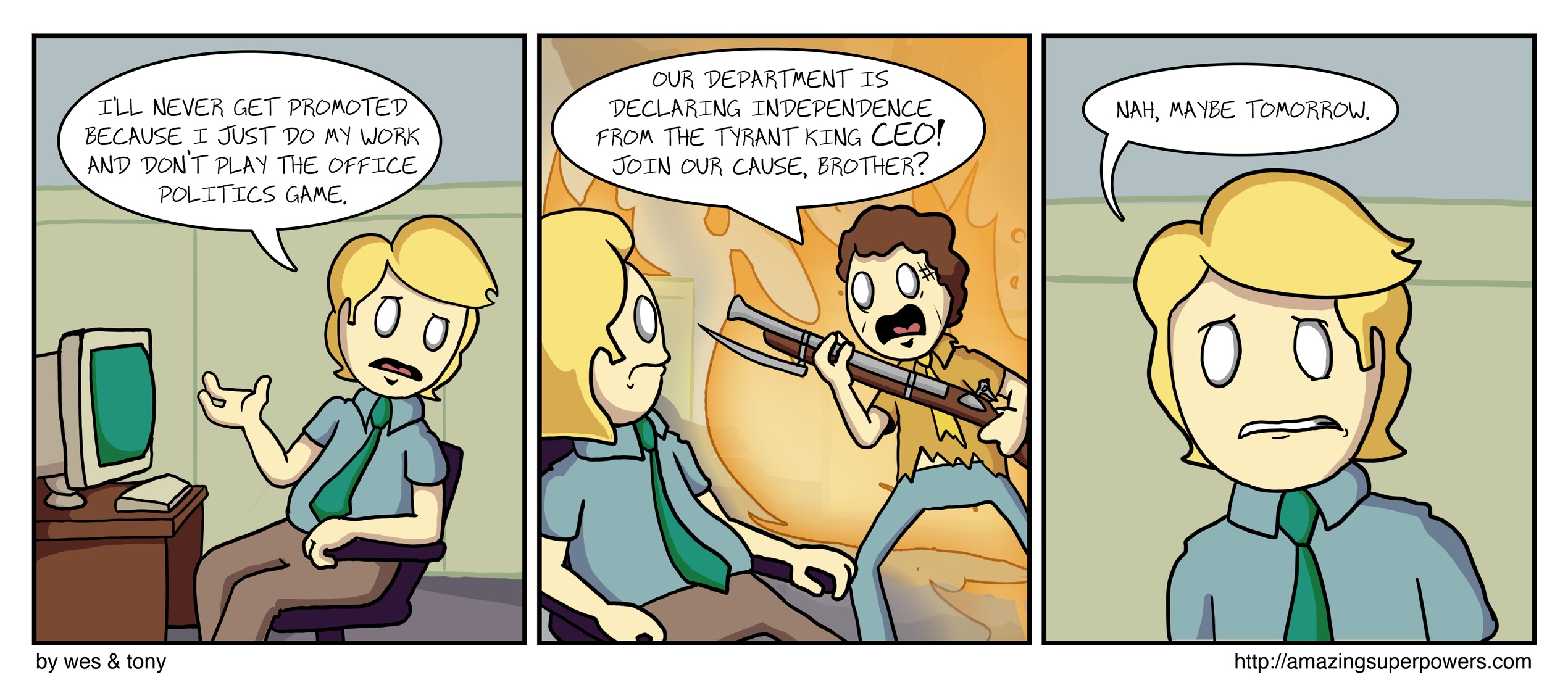
Office Politics

by Wes + Tony

BRING ME THE HEAD OF GARY FROM HR

Hey! Since we have a bunch of other projects in the pipeline these days, our update schedule is all over the place. So we’re doing what we should have done a long time ago and making a mailing list, seen in green above. We don’t want to spam you so we will only email when there is a new comic… or whenever we find an AMAZING deal on penis enlargement pills.

Also, for funsies we’ll put additional bonus junk in the emails, like rejected comics or an inside look at the glamorous life of making jokes for the internet. What a deal!

17 Jun 12:17

Cat Problems

by Doug

Cat Problems

An early birthday dedication to Lisa S. — Hope you have a great birthday tomorrow, Lisa! :)

And here are more cat comics!

17 Jun 12:16

Planning

[10 years later] Man, why are people so comfortable handing Google and Facebook control over our nuclear weapons?
16 Jun 20:29

What Is Code? If You Don't Know, You Need to Read This

Adam Victor Brandizzi

No começo, achei nhé, mas fui lendo e mano! que texto excelente. E é profundamente ~multimídia~, então clique e veja no site.

Let’s Begin

A computer is a clock with benefits. They all work the same, doing second-grade math, one step at a time: Tick, take a number and put it in box one. Tick, take another number, put it in box two. Tick, operate (an operation might be addition or subtraction) on those two numbers and put the resulting number in box one. Tick, check if the result is zero, and if it is, go to some other box and follow a new set of instructions.

You, using a pen and paper, can do anything a computer can; you just can’t do those things billions of times per second. And those billions of tiny operations add up. They can cause a phone to boop, elevate an elevator, or redirect a missile. That raw speed makes it possible to pull off not one but multiple sleights of hand, card tricks on top of card tricks. Take a bunch of pulses of light reflected from an optical disc, apply some math to unsqueeze them, and copy the resulting pile of expanded impulses into some memory cells—then read from those cells to paint light on the screen. Millions of pulses, 60 times a second. That’s how you make the rubes believe they’re watching a movie.

Apple has always made computers; Microsoft used to make only software (and occasional accessory hardware, such as mice and keyboards), but now it’s in the hardware business, with Xbox game consoles, Surface tablets, and Lumia phones. Facebook assembles its own computers for its massive data centers.

So many things are computers, or will be. That includes watches, cameras, air conditioners, cash registers, toilets, toys, airplanes, and movie projectors. Samsung makes computers that look like TVs, and Tesla makes computers with wheels and engines. Some things that aren’t yet computers—dental floss, flashlights—will fall eventually.

When you “batch” process a thousand images in Photoshop or sum numbers in Excel, you’re programming, at least a little. When you use computers too much—which is to say a typical amount—they start to change you. I’ve had Photoshop dreams, Visio dreams, spreadsheet dreams, and Web browser dreams. The dreamscape becomes fluid and can be sorted and restructured. I’ve had programming dreams where I move text around the screen.

You can make computers do wonderful things, but you need to understand their limits. They’re not all-powerful, not conscious in the least. They’re fast, but some parts—the processor, the RAM—are faster than others—like the hard drive or the network connection. Making them seem infinite takes a great deal of work from a lot of programmers and a lot of marketers.

The turn-of-last-century British artist William Morris once said you can’t have art without resistance in the materials. The computer and its multifarious peripherals are the materials. The code is the art.

2.1 How Do You Type an “A”?

Consider what happens when you strike a key on your keyboard. Say a lowercase “a.” The keyboard is waiting for you to press a key, or release one; it’s constantly scanning to see what keys are pressed down. Hitting the key sends a scancode.

Just as the keyboard is waiting for a key to be pressed, the computer is waiting for a signal from the keyboard. When one comes down the pike, the computer interprets it and passes it farther into its own interior. “Here’s what the keyboard just received—do with this what you will.”

It’s simple now, right? The computer just goes to some table, figures out that the signal corresponds to the letter “a,” and puts it on screen. Of course not—too easy. Computers are machines. They don’t know what a screen or an “a” are. To put the “a” on the screen, your computer has to pull the image of the “a” out of its memory as part of a font, an “a” made up of lines and circles. It has to take these lines and circles and render them in a little box of pixels in the part of its memory that manages the screen. So far we have at least three representations of one letter: the signal from the keyboard; the version in memory; and the lines-and-circles version sketched on the screen. We haven’t even considered how to store it, or what happens to the letters to the left and the right when you insert an “a” in the middle of a sentence. Or what “lines and circles” mean when reduced to binary data. There are surprisingly many ways to represent a simple “a.” It’s amazing any of it works at all.

Coders are people who are willing to work backward to that key press. It takes a certain temperament to page through standards documents, manuals, and documentation and read things like “data fields are transmitted least significant bit first” in the interest of understanding why, when you expected “ü,” you keep getting “�.”

2.2 From Hardware to Software

Hardware is a tricky business. For decades the work of integrating, building, and shipping computers was a way to build fortunes. But margins tightened. Look at Dell, now back in private hands, or Gateway, acquired by Acer. Dell and Gateway, two world-beating companies, stayed out of software, typically building PCs that came preinstalled with Microsoft Windows—plus various subscription-based services to increase profits.

This led to much cursing from individuals who’d spent $1,000 or more on a computer and now had to figure out how to stop the antivirus software from nagging them to pay up.

Steve Ballmer

Ballmer chants “Developers!”

Source: Youtube

Years ago, when Microsoft was king, Steve Ballmer, sweating through his blue button-down, jumped up and down in front of a stadium full of people and chanted, “Developers! Developers! Developers! Developers!”

He yelled until he was hoarse: “I love this company!” Of course he did. If you can sell the software, if you can light up the screen, you’re selling infinitely reproducible nothings. The margins on nothing are great—until other people start selling even cheaper nothings or giving them away. Which is what happened, as free software-based systems such as Linux began to nibble, then devour, the server market, and free-to-use Web-based applications such as Google Apps began to serve as viable replacements for desktop software.

Expectations around software have changed over time. IBM unbundled software from hardware in the 1960s and got to charge more; Microsoft rebundled Internet Explorer with Windows in 1998 and got sued; Apple initially refused anyone else the ability to write software for the iPhone when it came out in 2007, and then opened the App Store, which expanded into a vast commercial territory—and soon the world had Angry Birds. Today, much hardware comes with some software—a PC comes with an operating system, for example, and that OS includes hundreds of subprograms, from mail apps to solitaire. Then you download or buy more.

There have been countless attempts to make software easier to write, promising that you could code in plain English, or manipulate a set of icons, or make a list of rules—software development so simple that a bright senior executive or an average child could do it. Decades of efforts have gone into helping civilians write code as they might use a calculator or write an e-mail. Nothing yet has done away with developers, developers, developers, developers.

Thus a craft, and a professional class that lives that craft, emerged. Beginning in the 1950s, but catching fire in the 1980s, a proportionally small number of people became adept at inventing ways to satisfy basic human desires (know the time, schedule a flight, send a letter, kill a zombie) by controlling the machine. Coders, starting with concepts such as “signals from a keyboard” and “numbers in memory,” created infinitely reproducible units of digital execution that we call software, hoping to meet the needs of the marketplace. Man, did they. The systems they built are used to manage the global economic infrastructure. 1 If coders don’t run the world, they run the things that run the world.

Most programmers aren’t working on building a widely recognized application like Microsoft Word. Software is everywhere. It’s gone from a craft of fragile, built-from-scratch custom projects to an industry of standardized parts, where coders absorb and improve upon the labors of their forebears (even if those forebears are one cubicle over). Software is there when you switch channels and your cable box shows you what else is on. You get money from an ATM—software. An elevator takes you up five stories—the same. Facebook releases software every day to something like a billion people, and that software runs inside Web browsers and mobile applications. Facebook looks like it’s just pictures of your mom’s crocuses or your son’s school play—but no, it’s software.

Photographer: Boru O’Brien O’Connell for Bloomberg Businessweek; Set design: Dave Bryant

2.3 How Does Code Become Software?

We know that a computer is a clock with benefits, and that software starts as code, but how?

We know that someone, somehow, enters a program into the computer and the program is made of code. In the old days, that meant putting holes in punch cards. Then you’d put the cards into a box and give them to an operator who would load them, and the computer would flip through the cards, identify where the holes were, and update parts of its memory, and then it would—OK, that’s a little too far back. Let’s talk about modern typing-into-a-keyboard code. It might look like this:

ispal: {x~|x}

That’s in a language called, simply, K, famous for its brevity. 2 That code will test if something is a palindrome. If you next typed in ispal "able was i ere i saw elba", K will confirm that yes, this is a palindrome.

So how else might your code look? Maybe like so, in Excel (with all the formulas hidden away under the numbers they produce, and a check box that you can check):

Excel

But Excel spreadsheets are tricky, because they can hide all kinds of things under their numbers. This opacity causes risks. One study by a researcher at the University of Hawaii found that 88 percent of spreadsheets contain errors.

Programming can also look like Scratch, a language for kids:

Scratch

That’s definitely programming right there—the computer is waiting for a click, for some input, just as it waits for you to type an “a,” and then it’s doing something repetitive, and it involves hilarious animals.

Or maybe:

      PRINT *, "WHY WON'T IT WORK
      END

That’s in Fortran. The reason it’s not working is that you forgot to put a quotation mark at the end of the first line. Try a little harder, thanks.

All of these things are coding of one kind or another, but the last bit is what most programmers would readily identify as code. A sequence of symbols (using typical keyboard characters, saved to a file of some kind) that someone typed in, or copied, or pasted from elsewhere. That doesn’t mean the other kinds of coding aren’t valid or won’t help you achieve your goals. Coding is a broad human activity, like sport, or writing. When software developers think of coding, most of them are thinking about lines of code in files. They’re handed a problem, think about the problem, write code that will solve the problem, and then expect the computer to turn word into deed.

Code is inert. How do you make it ert? You run software that transforms it into machine language. The word “language” is a little ambitious here, given that you can make a computing device with wood and marbles. Your goal is to turn your code into an explicit list of instructions that can be carried out by interconnected logic gates, thus turning your code into something that can be executed—software.

A compiler is software that takes the symbols you typed into a file and transforms them into lower-level instructions. Imagine a programming language called Business Operating Language United System, or Bolus. It’s a terrible language that will have to suffice for a few awkward paragraphs. It has one real command, PRINT. We want it to print HELLO NERDS on our screen. To that end, we write a line of code in a text file that says:

PRINT {HELLO NERDS}

And we save that as nerds.bol. Now we run gnubolus nerds.bol, our imaginary compiler program. How does it start? The only way it can: by doing lexical analysis, going character by character, starting with the “p,” grouping characters into tokens, saving them into our one-dimensional tree boxes. Let’s be the computer.

Character Meaning
P Hmmmm...?
R Someone say something?
I I’m waiting...
N [drums fingers]
T Any time now...
Space Ah, "PRINT"
{ String coming!
H These
E letters
L don’t
L matter
O la
Space la
N just
E saving
R them
D for
S later
} Stringtime is over!
End of file Time to get to work.

The reason I’m showing it to you is so you can see how every character matters. Computers usually “understand” things by going character by character, bit by bit, transforming the code into other kinds of code as they go. The Bolus compiler now organizes the tokens into a little tree. Kind of like a sentence diagram. Except instead of nouns, verbs, and adjectives, the computer is looking for functions and arguments. Our program above, inside the computer, becomes this:

Trees are a really pleasant way of thinking of the world. Your memo at work has sections that have paragraphs? Tree. Your e-mail program contains messages that contain subject lines and addresses? Tree. Your favorite software program that has a menu bar with individual items that have subitems? Tree. Every day is Arbor Day in Codeville.

Of course, it’s all a trick. If you cut open a computer, you’ll find countless little boxes in rows, places where you can put and retrieve bytes. Everything ultimately has to get down to things in little boxes pointing to each other. That’s just how things work. So that tree is actually more like this:

Every character truly, truly matters. Every single stupid misplaced semicolon, space where you meant tab, bracket instead of a parenthesis—mistakes can leave the computer in a state of panic. The trees don’t know where to put their leaves. Their roots decay. The boxes don’t stack neatly. For not only are computers as dumb as a billion marbles, they’re also positively Stradivarian in their delicacy.

That process of going character by character can be wrapped up into a routine—also called a function, a method, a subroutine, or component. (Little in computing has a single, reliable name, which means everyone is always arguing over semantics.) And that routine can be run as often as you need. Second, you can print anything you wish, not just one phrase. Third, you can repeat the process forever, and nothing will stop you until the machine breaks or, barring that, heat death of the universe. Obviously no one besides Jack Nicholson in The Shining really needs to keep typing the same phrase over and over, and even then it turned out to be a bad idea.

Instead of worrying about where the words are stored in memory and having to go character by character, programming languages let you think of things like strings, arrays, and trees. That’s what programming gives you. You may look over a programmer’s shoulder and think the code looks complex and boring, but it’s covering up repetitive boredom that’s unimaginably vast. 3

This thing we just did with individual characters, compiling a program down into a fake assembly language so that the nonexistent computer can print each character one at a time? The same principle applies to every pixel on your screen, every frequency encoded in your MP3 files, and every imaginary cube in Minecraft. Computing treats human language as an arbitrary set of symbols in sequences. It treats music, imagery, and film that way, too.

It’s a good and healthy exercise to ponder what your computer is doing right now. Maybe you’re reading this on a laptop: What are the steps and layers between what you’re doing and the Lilliputian mechanisms within? When you double-click an icon to open a program such as a word processor, the computer must know where that program is on the disk. It has some sort of accounting process to do that. And then it loads that program into its memory—which means that it loads an enormous to-do list into its memory and starts to step through it. What does that list look like?

Maybe you’re reading this in print. No shame in that. In fact, thank you. The paper is the artifact of digital processes. Remember how we put that “a” on screen? See if you can get from some sleepy writer typing that letter on a keyboard in Brooklyn, N.Y., to the paper under your thumb. What framed that fearful symmetry?

Thinking this way will teach you two things about computers: One, there’s no magic, no matter how much it looks like there is. There’s just work to make things look like magic. And two, it’s crazy in there.

Magic

Photographer: Asger Carlsen for Bloomberg Businessweek; Set Design: Dave Bryant

2.4 What Is an Algorithm?

“Algorithm” is a word writers invoke to sound smart about technology. Journalists tend to talk about “Facebook’s algorithm” or a “Google algorithm,” which is usually inaccurate. They mean “software.”

Algorithms don’t require computers any more than geometry does. An algorithm solves a problem, and a great algorithm gets a name. Dijkstra’s algorithm, after the famed computer scientist Edsger Dijkstra, finds the shortest path in a graph. By the way, “graph” here doesn’t mean but rather

Think of a map; streets connect to streets at intersections. It’s a graph! There are graphs all around you. Plumbing, electricity, code compilation, social networks, the Internet, all can be represented as graphs! (Now to monetize …)

Many algorithms have their own pages on Wikipedia. You can spend days poking around them in wonder. Euclid’s algorithm, for example, is the go-to specimen that shows up whenever anyone wants to wax on about algorithms, so why buck the trend? It’s a simple way of determining the greatest common divisor for two numbers. Take two numbers, like 16 and 12. Divide the first by the second. If there’s a remainder (in this case there is, 4), divide the smaller number, 12, by that remainder, 4, which gives you 3 and no remainder, so we’re done—and 4 is the greatest common divisor. (Now translate that into machine code, and we can get out of here.)

There’s a site called Rosetta Code that shows you different algorithms in different languages. The Euclid’s algorithm page is great. Some of the examples are suspiciously long and laborious, and some are tiny nonsense poetry, like this one, in the language Forth:4

: gcd ( a b -- n )
  begin dup while tuck mod repeat drop ;

Read it out loud, preferably to friends. Forth is based on the concept of a stack, which is a special data structure. You make “words” that do things on the stack, building up a little language of your own. PostScript, 5 the language of laser printers, came after Forth but is much like it. Look at how similar the code is, give or take some squiggles:

/gcd {
{
  {0 gt} {dup rup mod} {pop exit} ifte
} loop
}.

And that’s Euclid’s algorithm in PostScript. I admit, this might be fun only for me. Here it is in Python (all credit to Rosetta Code):

def gcd(u, v):
    return gcd(v, u % v) if v else abs(u)

A programming language is a system for encoding, naming, and organizing algorithms for reuse and application. It’s an algorithm management system. This is why, despite the hype, it’s silly to say Facebook has an algorithm. An algorithm can be translated into a function, and that function can be called (run) when software is executed. There are algorithms that relate to image processing and for storing data efficiently and for rapidly running through the elements of a list. Most algorithms come for free, already built into a programming language, or are available, organized into libraries, for download from the Internet in a moment. You can do a ton of programming without actually thinking about algorithms—you can save something into a database or print a Web page by cutting and pasting code. But if you want the computer to, say, identify whether it’s reading Spanish or Italian, you’ll need to write a language-matching function. So in that sense, algorithms can be pure, mathematical entities as well as practical expressions of ideas on which you can place your grubby hands.

Dijkstra distributed a remarkable and challenging set of 18 memos to the global computer science community, starting in the 1960s and continuing up until his death in 2002, known as “EWDs,” many of them handwritten.

One thing that took me forever to understand is that computers aren’t actually “good at math.” They can be programmed to execute certain operations to certain degrees of precision, so much so that it looks like “doing math” to humans. 6 Dijkstra said: “Computer science is no more about computers than astronomy is about telescopes.” 7 A huge part of computer science is about understanding the efficiency of algorithms—how long they will take to run. Computers are fast, but they can get bogged down—for example, when trying to find the shortest path between two points on a large map. Companies such as Google, Facebook, and Twitter are built on top of fundamental computer science 8 and pay great attention to efficiency, because their users do things (searches, status updates, tweets) an extraordinary number of times. Thus it’s absolutely worth their time to find excellent computer scientists, many with doctorates, who know where all the efficiencies are buried.

It takes a good mathematician to be a computer scientist, but a middling one to be an effective programmer. Until you start dealing with millions of people on a network or you need to blur or sharpen a million photos quickly, you can just use the work of other people. When it gets real, break out the comp sci. When you’re doing anything a hundred trillion times, nanosecond delays add up. Systems slow down, users get cranky, money burns by the barrel. 9

The hardest work in programming is getting around things that aren’t computable, in finding ways to break impossible tasks into small, possible components, and then creating the impression that the computer is doing something it actually isn’t, like having a human conversation. This used to be known as “artificial intelligence research,” but now it’s more likely to go under the name “machine learning” or “data mining.” When you speak to Siri or Cortana and they respond, it’s not because these services understand you; they convert your words into text, break that text into symbols, then match those symbols against the symbols in their database of terms, and produce an answer. Tons of algorithms, bundled up and applied, mean that computers can fake listening.

A programming language has at least two jobs, then. It needs to wrap up lots of algorithms so they can be reused. Then you don’t need to go looking for a square-root algorithm (or a genius programmer) every time you need a square root. And it has to make it easy for programmers to wrap up new algorithms and routines into functions for reuse. The DRY principle, for Don’t Repeat Yourself, is one of the colloquial tenets of programming. That is, you should name things once, do things once, create a function once, and let the computer repeat itself. This doesn’t always work. Programmers repeat themselves constantly. I’ve written certain kinds of code a hundred times. This is why DRY is a principle.

Enough talk. Let’s code!

2.5 The Sprint

After a few months the budget is freed up, and the Web re-architecture project is under way. They give it a name: Project Excelsior. Fine. TMitTB (who, to be fair, has other clothes and often dresses like he’s in Weezer) checks in with you every week.

He brings documents. Every document has its own name. The functional specification is a set of at least a thousand statements about users clicking buttons. “Upon accessing the Web page the user if logged in will be identified by name and welcomed and if not logged in will be encouraged to log in or create an account. (See user registration workflow.)”

God have mercy on our souls. From there it lists various error messages. It’s a sort of blueprint in that it describes—in words, with occasional diagrams—a program that doesn’t exist.

Some parts of the functional specification refer to “user stories,” tiny hypothetical narratives about people using the site, e.g., “As a visitor to the website, I want to search for products so I can quickly purchase what I want.” 10

Then there’s something TMitTB calls wireframe mock-ups, which are pictures of how the website will look, created in a program that makes everything seem as if it were sketched by hand, all a little squiggly—even though it was produced on a computer. This is so no one gets the wrong idea about these ideas-in-progress and takes them too seriously. Patronizing, but point taken.

You rarely see TMitTB in person, because he’s often at conferences where he presents on panels. He then tweets about the panels and notes them on his well-populated LinkedIn page. Often he takes a picture of the audience from the stage, and what you see is an assembly of mostly men, many with beards, the majority of whom seem to be peering into their laptop instead of up at the stage. Nonetheless the tweet that accompanies that photo says something like, “AMAZING audience! @ the panel on #microservice architecture at #ArchiCon2015.”

He often tells you just how important this panel-speaking is for purposes of recruiting. Who’s to say he is wrong? It costs as much to hire a senior programmer as it does to hire a midlevel executive, so maybe going to conferences is his job, and in the two months he’s been here he’s hired four people. His two most recent hires have been in Boston and Hungary, neither of which is a place where you have an office.

But what does it matter? Every day he does a 15-minute “standup” meeting via something called Slack, which is essentially like Google Chat but with some sort of plaid visual theme, and the programmers seem to agree that this is a wonderful and fruitful way to work.

“I watch the commits,” TMitTB says. Meaning that every day he reviews the code that his team writes to make sure that it’s well-organized. “No one is pushing to production without the tests passing. We’re good.”

Your meetings, by comparison, go for hours, with people arranged around a table—sitting down. You wonder how he gets his programmers to stand up, but then some of them already use standing desks. Perhaps that’s the ticket.

Honestly, you would like to go to conferences sometimes and be on panels. You could drink bottled water and hold forth just fine.

2.6 What’s With All These Conferences, Anyway?

Conferences! The website Lanyrd lists hundreds of technology conferences for June 2015. There’s an event for software testers in Chicago, a Twitter conference in São Paulo, and one on enterprise content management in Amsterdam. In New York alone there’s the Big Apple Scrum Day, the Razorfish Tech Summit, an entrepreneurship boot camp for veterans, a conference dedicated to digital mapping, many conferences for digital marketers, one dedicated to Node.js, one for Ruby, and one for Scala (these are programming languages), a couple of breakfasts, a conference for cascading style sheets, one for text analytics, and something called the Employee Engagement Awards.

Tech conferences look like you’d expect. Tons of people at a Sheraton, keynote in Ballroom D. Or enormous streams of people wandering through South by Southwest in Austin. People come together in the dozens or thousands and attend panels, ostensibly to learn; they attend presentations and brush up their skills, but there’s a secondary conference function, one of acculturation. You go to a technology conference to affirm your tribal identity, to transfer out of the throng of dilettantes and into the zone of the professional. You pick up swag and talk to vendors, if that’s your thing.

First row: TechCrunch Disrupt NYC, May 2011; Google I/O developers conference, San Francisco, May 2013; Global Mobile Internet Conference, Beijing, April 2015
Second row:Nvidia GPU, San Jose, September 2010; South by Southwest (SXSW) Interactive Festival, Austin, March 2013; Apple Worldwide Developers Conference (WWDC), San Francisco, June 2008
Third row: TechCrunch Disrupt NYC, May 2012; Re:publica conference, Berlin, May 2015; TechCrunch Disrupt NYC, May 2015
Fourth row: SXSW Interactive Festival, Austin, March 2014; WWDC, San Francisco, June 2015; Bloomberg Technology Conference!, San Francisco, June 15-16

Technology conferences are where primate dynamics can be fully displayed, where relationships of power and hierarchy can be established. There are keynote speakers—often the people who created the technology at hand or crafted a given language. There are the regular speakers, often paid not at all or in airfare, who present some idea or technique or approach. Then there are the panels, where a group of people are lined up in a row and forced into some semblance of interaction while the audience checks its e-mail.

I’m a little down on panels. They tend to drift. I’m not sure why they exist.

Here’s the other thing about technology conferences: There has been much sexual harassment and much sexist content in conferences. Which is stupid, because computers are dumb rocks lacking genitalia, but there you have it.

Women in software, having had enough, started to write it up, post to blogs. Other women did the same. The problem is pervasive: There are a lot of conferences, and there have been many reports of harassing behavior. The language Ruby, the preferred language for startup bros, developed the worst reputation. At a Ruby conference in 2009, someone gave a talk subtitled “Perform Like a Pr0n Star,” with sexy slides. That was dispiriting. There have been criminal incidents, too.

Conferences began to develop codes of conduct, rules and algorithms for people (men, really) to follow.

If you are subject to or witness unacceptable behavior, or have any other concerns, please notify a community organizer as soon as possible … 

Burlington Ruby Conference

php[architect] is dedicated to providing a harassment-free event experience for everyone and will not tolerate harassment or offensive behavior in any form.
php[architect]

The Atlanta Java Users Group (AJUG) is dedicated to providing an outstanding conference experience for all attendees, speakers, sponsors, volunteers, and organizers involved in DevNexus (GeekyNerds) regardless of gender, sexual orientation, disability, physical appearance, body size, race, religion, financial status, hair color (or hair amount), platform preference, or text editor of choice.
devnexus

When people started talking about conference behavior, they also began to talk about the larger problems of programming culture. This was always an issue, but the conference issues gave people a point of common reference. Why were there so many men in this field? Why do they behave so strangely? Why is it so hard for them to be in groups with female programmers and behave in a typical, adult way?

“I go to work and I stick out like a sore thumb. I have been mistaken for an administrative assistant more than once. I have been asked if I was physical security (despite security wearing very distinctive uniforms),” wrote Erica Joy Baker on Medium.com who has worked, among other places, at Google.

Famous women in coding history


Ada Lovelace: The first programmer. She devised algorithms for Charles Babbage’s “analytical engine,” which he never built.
Ada Lovelace Grace Murray Hopper: World War II hero and inventor of the compiler.
Grace Murray

“Always the only woman in the meeting, often the first—the first female R&D engineer, first female project lead, first female software team lead—in the companies I worked for,” wrote another woman in Fast Company magazine.

Fewer than a fifth of undergraduate degrees in computer science awarded in 2012 went to women, according to the National Center for Women & Information Technology. Less than 30 percent of the people in computing are women. And the number of women in computing has fallen since the 1980s, even as the market for their skills has expanded. The pipeline is a huge problem. And yet it’s not unsolvable. I’ve met managers who have built perfectly functional large teams that are more than half female coders. Places such as the handicrafts e-commerce site Etsy have made a particular effort to develop educational programs and mentorship programs. Organizations such as the not-for-profit Girl Develop It teach women, and just women, how to create software.

It’s all happening very late in the boom, though. In 2014 some companies began to release diversity reports for their programming teams. It wasn’t a popular practice, but it was revealing. Intel is 23 percent female; Yahoo! is 37 percent. Apple, Facebook, Google, Twitter, and Microsoft are all around 30 percent. These numbers are for the whole companies, not only programmers. That’s a lot of women who didn’t get stock options. The numbers of people who aren’t white or Asian are worse yet. Apple just gave $50 million to fund diversity initiatives, equivalent to 0.007 percent of its market cap. Intel has a $300 million diversity project.

The average programmer is moderately diligent, capable of basic mathematics, has a working knowledge of one or more programming languages, and can communicate what he or she is doing to management and his or her peers. Given that a significant number of women work as journalists and editors, perform surgery, run companies, manage small businesses, and use spreadsheets, that a few even serve on the Supreme Court, and that we are no longer surprised to find women working as accountants, professors, statisticians, or project managers, it’s hard to imagine that they can’t write JavaScript. Programming, despite the hype and the self-serving fantasies of programmers the world over, isn’t the most intellectually demanding task imaginable.

Which leads one to the inescapable conclusion: The problem with women in technology isn’t the women.

Some demographics taken from Stack Overlow's 2015 developer survey:

Bookmarked at brandizzi Delicious' sharing tag and expanded by Delicious sharing tag expander.
16 Jun 18:12

The Disposable Life of a 20-Year-Old Confidential Informant

by Anthony L. Fisher

On June 27, 2014, the body of 20-year-old Andrew Sadek, a promising electrical student at the North Dakota State College of Science (NDSCS) in Wahpeton, North Dakota, was pulled from the Red River bordering North Dakota and Minnesota.

Missing for two months, the young man was found shot in the head, wearing a backpack filled with rocks. 

The grisly death of a college student in one of the safest towns in the state, where violent crime is extremely rare, did not lead to a sweeping investigation. In fact, police immediately said they did not suspect foul play.

Such a supposition strains credulity as it is, but what would be slowly revealed over the following months is that Andrew had been working as a confidential informant for the police, and that his school knew that authorities were busting its students and using them as bait to catch drug dealers

This is a story of overzealous prosecution of minor drug offenses by a task force answerable only to itself, callous official indifference toward a grieving family, and a lack of transparency by authorities that raises more questions than it answers. 

Paramount among these questions: Why are police using non-violent, first-time offenders in the very dangerous role of confidential informant?  

A QUIET FARM KID

Growing up on a family-owned farm in Rogers, North Dakota, Andrew Sadek was active with the raising of their cattle and particularly close to his parents, who lost their older son, Nick, in a car accident in 2005.

Andrew was a few weeks shy of graduation when he went missing in May 2014. Days later, the Sadeks received the shocking news that a warrant had been issued for Andrew's arrest for two felony counts of distributing a controlled substance. 

In an interview with Reason TV, Andrew's mother, Tammy, described her deceased younger son as "kind of a homebody" whose only previous brush with the law was a speeding ticket.

"His dreams were to become an electrician and take over the family farm," Tammy says of Andrew. "We sent him off to college, he was excelling at college. That's why this was such a shock to us."

For two gut-wrenching months, the Sadeks prayed Andrew would come home to the farm to help with the spring calving, while police continued to assume Andrew was on the lam.

Then, Andrew's body was found.

Shot. Wearing the backpack filled with rocks. Not wearing the clothes he was last seen in. Without his wallet. An autopsy proved inconclusive in determining suicide or homicide, and no weapon has yet been found.

But according to the Sadeks, Sgt. Steve Helgeson of the NDSCS Campus Police, the lead officer in charge of the investigation, tried to convince them that their son put on the rock-filled backpack, shot himself in the head, and somehow propelled himself into the river. 

Tammy says Sgt. Helgeson told her "That's what kids do in that area, they commit suicide," referring to the golf court bridge over the river that connects the Bois de Sioux golf course.

No one who knew Andrew supports this theory. His friend Justin Rippentrop told Reason TV that Andrew was a "laid-back, generous, fun-loving guy," who never showed depressive tendencies and seemed in particularly good spirits as his graduation date approached. Crucially, no one at the college has indicated that Andrew was exhibiting any signs of emotional distress, and no suicide note has been found.

A DRUG TASK FORCE LACKING TRANSPARENCY AND ACCOUNTABILITY

What the police knew but continued to keep from the Sadeks, was that Andrew had been working as a confidential informant for the Southeast Multi-County Agency (SEMCA), a drug task force answerable only to its own board, a 12 person committee made up of local senior police officers and elected officials.

Andrew first came into contact with SEMCA in April 2013, after he twice sold marijuana, a total of 4.5 grams or $80 worth, to a confidential informant. Shortly thereafter, a police raid on Andrew's dorm room turned up nothing but a small plastic grinder and some marijuana residue. 

But the grinder, plus the two sales to SEMCA's informant in a "school zone," which in North Dakota includes colleges, was enough for authorities to threaten Andrew with two Class A felony charges, each carrying a possible 20 year sentence. Or, he could "voluntarily" agree to work as a confidential informant.

Upon enrolling at NDSCS, Andrew signed a Family Educational Rights and Privacy Act (FERPA) waiver obligating the school to inform his parents of any disciplinary issues, but the school never notified the Sadeks following the raid on his dorm room, or any time thereafter.

Faced with the prospect of spending the bulk of his life in prison, and without consulting a lawyer or his parents, Andrew chose to become an informant, agreeing to make two controlled buys from each of three SEMCA-targeted drug dealers. 

When Andrew was last seen leaving his dorm building on May 1, 2014, he still owed SEMCA one last controlled buy. 

Refusing to accept authorities' speculation that Andrew had committed suicide, the Sadeks hired a private investigator, who discovered a significant amount of water in the wheel wells of Andrew's car, suggesting that someone may have driven Andrew's car to the banks of the river where his body was found, before returning it to the campus parking lot. 

WHO'S IN CHARGE HERE?

Because Andrew's body was found on the Minnesota side of the river, the NDSCS campus police claimed the case was not in their jurisdiction, which the North Dakota Attorney General's office confirmed. But the Minnesota Bureau of Criminal Apprehension told Valley News Livea newscast in Fargo, North Dakota, that they have nothing to do with it. For all the agencies involved with busting Andrew Sadek for selling a small amount of pot, no agency is willing to take the lead in solving his violent death. 

Valley News Live reporter Nicole Johnson told Reason TV, "It took a long time to get the results of the autopsy. So I called (Sgt.) Steve Helgeson, the officer in charge of this case, and he told me it was not a top priority." Johnson adds that no one who has directly worked on the case has answered a question of theirs since Andrew was found in June 2014.

Finding no help from the local authorities, the Sadeks' demanded a state-wide investigation, which culminated in a report from the North Dakota Attorney General's Bureau of Criminal Investigation, released in January 2015.

The report revealed for the first time that Andrew had been working as a confidential informant for SEMCA. 

That the school knew of the raid on Andrew's dorm room in 2013, but allowed his parents to learn this news only after he went missing raises significant ethical and legal questions in its own right. But the fact that SEMCA only disclosed Andrew's status as a confidential informant because they were forced to by the Attorney General, more than a year after the young man was first targeted by the task force, demonstrates a heartless lack of concern for confidential informants even after they end up dead.

The SEMCA report runs all of four and a half pages, nearly half of which merely names the board members and the authors of the report.  And despite the obvious dangers inherent with being an informant working for the police to bust drug dealers, the report found that SEMCA had acted appropriately when using Andrew, a non-violent first time offender, as a C.I. The report's conclusion offered four minor tweaks to protocol, such as having a "Pre-Ops briefing" and assigning a supervisor to each case. 

In February 2015, Reason's Jacob Sullum wrote about Wahpeton Police Chief Scott Thorsteinson, a SEMCA board member, and his response to the violent death of a confidential informant in his town:

Thorsteinson conceded that police informants work in "a dangerous subculture" but said cops usually "bend over backwards to protect their C.I."

Thorsteinson said Sadek's death is no cause for reflection on the methods used by drug warriors in North Dakota. "These types of investigations are conducted the same way pretty much everywhere where people breathe in and out," he said. "They never did anything wrong that needed to be changed." Thorsteinson, who acknowledged that Sadek's mother "had to go through a difficult ordeal," explained that busting drug offenders is a thankless but necessary job. "Law enforcement... we're generally not popular," he told KVLY. "The sheep dog is not loved by the flock, and they're hated by the wolf, but we do it anyway." In Thorsteinson's view, the citizens he serves are sheep, while harmless pot dealers like Sadek are wolves.

The lack of a statewide chain of command allowed SEMCA to operate as an entity answerable only to itself. And though SEMCA's board remains intact, the agency now falls under the jurisdiction of the North Dakota attorney general. When contacted by Reason TV about the use of college students as confidential informants, Liz Brocker, a spokesperson for North Dakota's Attorney General Wayne Stenehjem, replied, "We have no opinion about confidential informants." 

The Wahpeton Police Department, Richland County State's Attorney, SEMCA, and both NDSCS and its campus police department all either declined to comment or did not respond to Reason TV's request for comment.

DISPOSABLE YOUNG LIVES

Andrew Sadek is not the only young person to be terrified into working as a C.I. In 2014, a confidential informant at the University of Massachusetts died of a drug overdose, prompting criticism that if his parents had been notified, he might have been able to receive treatment for substance abuse. In 2015, Buzzfeed reported on the widespread use of confidential informants on the campus of Ole Miss.

Most notably, in 2008, Florida State student Rachel Hoffman was murdered when police compelled her to make an illegal gun purchase. A sweeping 2012 New Yorker article recounted Hoffman's tragic fate:

She had never fired a gun or handled a significant stash of hard drugs. Now she was on her way to conduct a major undercover deal for the Tallahassee Police Department, meeting two convicted felons alone in her car to buy two and a half ounces of cocaine, fifteen hundred Ecstasy pills, and a semi-automatic handgun.

The operation did not go as intended. By the end of the hour, police lost track of her and her car. Late that night, they arrived at her boyfriend's town house and asked him if Hoffman was inside. They wanted to know if she might have run off with the money. Her boyfriend didn't know where she was.

"She was with us," he recalled an officer saying. "Until shit got crazy."

Two days after Hoffman disappeared, her body was found in Perry, Florida, a small town some fifty miles southeast of Tallahassee, in a ravine overgrown with tangled vines. Draped in an improvised shroud made from her Grateful Dead sweatshirt and an orange-and-purple sleeping bag, Hoffman had been shot five times in the chest and head with the gun that the police had sent her to buy.

Hoffman's death led to state-wide reforms regarding the use of confidential informants, including common-sense modifications such as forbidding the use of recovering drug addicts as informants, additional training for informants and officers, and more robust recordkeeping requirements so that unsuitable candidates are not needlessly placed in potentially lethal situations. In March 2015, a new proposal made it through Florida's Senate Criminal Justice Committee to "add teeth" to "Rachel's Law," which includes criminal penalties for officers who fail to follow protocol or endanger their assigned informants. 

THE DEATH THEY WISH WOULD GO AWAY

When the police aggressively prosecute young people unfamiliar with the criminal justice system and then use them as confidential informants, they assume a certain amount of responsibility for their safety. But the lack of interest by the agencies that ensnared Andrew Sadek in vigorously investigating his death as potential murder suggests they wish the case would just go away.

Which only begs the question, why?

Why are the authorities not investigating this case with the same aggressive zeal they continue to use on the campus of NDSCS busting small-time drug sellers?

The heartbroken Sadek family searches for justice for their son, though they are not confident that any law enforcement agency will continue to investigate Andrew's death. Tammy hopes that Andrew's death can serve as a cautionary tale to other young people who get in over their heads and feel they have no other choice but to work as an informant.

"I don't want other kids to end up in this situation," Tammy says. "Talk to your parents. Talk to a lawyer. Don't do the police's job for them."

About 9.45 minutes. 

Written and Produced by Anthony L. Fisher.

Camera by Alex Manning.

Special Thanks to Jim Wareham, Ike Walker, Nicole Johnson and Bradford Arick of Valley News Live.

MUSIC: "I Was a Boy" and "Dishonest" by Wooden Ambulance (http://www.facebook.com/wooden.ambulance); "Old" by Smokey Hormel (http://www.smokeyhormel.com)

Scroll down for downloadable versions of this video, and subscribe to Reason TV's YouTube channel for daily content like this.

16 Jun 18:11

Photo


16 Jun 18:11

Cartas para Humanidade

by Clara Gomes

bdj-150519-web

16 Jun 15:29

Cracked Log Lamps by Duncan Meerding

by Christopher Jobson

log-1

Tasmania-based furniture and lighting designer Duncan Meerding highlights the naturally occuring cracks in sustainably sourced logs by inserting warm yellow LEDs that illuminate each piece of wood from within. Meerding, who is legally blind, is fascinated by unusual light applications which he refers to as his “alternative sensory world.” Each cracked log lamp can be used as a stool, table, or simply a light accessory, and the pieces are available through a number of shops throughout Australia. Photos by Jan Dallas. (via My Modern Met, Inhabitat)

log-2

log-3

log-4

log-5

log-6

log-7

16 Jun 15:10

The truth about our norm core

by Tim Harford
Undercover Economist

‘Social pressure matters but it is not the only thing that matters. Facts can trump groupthink’

While not quite as infamous as Philip Zimbardo’s Stanford prison simulation, or Stanley Milgram’s obedience research, Solomon Asch’s conformity experiments remain among the most celebrated in psychology. In 1951, Asch’s research showed that our judgments about simple factual matters can be swayed by what people around us say. The finding echoed down the decades. Milgram found in 1961 that people were willing to administer apparently dangerous electric shocks when ordered to do so by an experimenter. In 1971, Zimbardo set up an imitation prison in a Stanford University basement with subjects given the role of guards and prisoners, then observed as the guards humiliated the prisoners.

Between them, the three academic psychologists taught us that in order to fit in with others, we are willing to do almost anything. That, at least, is what we are told. The truth, as so often, is more interesting.

Asch gave his subjects the following task: identify which of three different lines, A, B or C, was the same length as a “standard” line. The task was easy in its own right but there was a twist. Each individual was in a group of seven to nine people, and everyone else in the group was a confederate of Asch’s. For 12 out of 18 questions they had been told to choose, unanimously, a specific incorrect answer. Would the experimental subject respond by fitting in with the group or by contradicting them? Many of us know the answer: we are swayed by group pressure. Offered a choice between speaking the truth and saying something socially convenient, we opt for social convenience every time.

But wait — “every time”? In popular accounts of Asch’s work, conformity tends to be taken for granted. I often describe his research myself in speeches as an example of how easily groupthink can set in and silence dissent. And this is what students of psychology are themselves told by their own textbooks. A survey of these textbooks by three psychologists, Ronald Friend, Yvonne Rafferty and Dana Bramel, found that the texts typically emphasised Asch’s findings of conformity. That was in 1990 but when Friend recently updated his work, he found that today’s textbooks stressed conformity more than ever.

This is odd, because the experiments found something more subtle. It is true that most experimental subjects were somewhat swayed by the group. Fewer than a quarter of experimental subjects resolutely chose the correct line every time. (In a control group, unaffected by social pressure, errors were rare.) However, the experiment found that total conformity was scarcer than total independence. Only six out of 123 subjects conformed on all 12 occasions. More than half of the experimental subjects defied the group and gave the correct answer at least nine times out of 12. A conformity effect certainly existed but it was partial.

This surprised me, and it may surprise others who have read popular accounts of the so-called conformity studies. I doubt that it surprised Asch. Conformity was already a well-established finding by 1951, and his experiments were designed to contrast with earlier research on social norms. This previous research showed that people conformed to social pressure in situations where there was no clear correct answer — for instance, when asked to identify which of two ungrammatical sentences was the most ungrammatical. But Asch wanted to know if peer pressure would also wield influence when the crowd was unambiguously wrong. His research provided an answer: social pressure is persuasive but, for most people, the facts are more persuasive still.

Myths about famous experiments have always grown in the telling. It seems most unlikely that Archimedes ran naked through the streets of Syracuse yelling “Eureka!”, and an apple probably did not strike Newton’s head. But there seems to be something particularly attractive about these famous psychology experiments that paint us all as sheep — even when the experiments may have been flawed, impossible to replicate or (as with Asch’s work) have simply found something much more subtle than the myth would have us believe.

The psychologist Christian Jarrett comments, “the resistance to tyranny shown by many participants in Zimbardo’s prison study has largely been ignored, and so, too, has the disobedience shown by many participants in Milgram’s seminal work.”

Zimbardo’s Stanford prison experiment was shocking stuff, and raised serious questions about research ethics. But we should also ask questions about what Zimbardo really found. By his own admission he gave a strong steer to the guards, and cast himself as their ally in a quest to dehumanise the prisoners. “We’re going to take away their individuality in various ways,” he told them. Other psychologists have suggested that this was more a test of obedience to Zimbardo than a demonstration that sadism blooms given the opportunity.

Few textbook accounts of the study mention Zimbardo’s attempt to influence the guards; nor do they point out that two-thirds of the guards refrained from sadism.

Social pressure matters but it is not the only thing that matters. Solomon Asch showed that facts can trump groupthink. It would be ironic if our own biased recollections of his finding proved him wrong.

Written for and first published at ft.com.

16 Jun 12:10

The Mask Of Sorrow in Magadan, Russia.

16 Jun 12:09

Going on vacation this week, so there will only be a few...


Going on vacation this week, so there will only be a few updates. Treasure them.

16 Jun 12:06

I Hate When the World Recycles NPCs

funny-fail-pic-glitch-matrix-fashion

Submitted by: (via R0bynne)

Tagged: the matrix , what , glitches
16 Jun 12:04

Comic for June 16, 2015

16 Jun 12:02

Spam Isn't Even Trying to be Clever Anymore

funny-facebook-fail-spam-legit

Submitted by: (via HolstenerLiesel)

Tagged: email , spam , seems legit
15 Jun 20:48

RT @gabrielolinto: #this http://t.co/ad6oPfMTOH

by Pai Osias
15 Jun 20:30

El de Iron Man es mi favorito por @The_False_Joker


15 Jun 20:30

Photo


15 Jun 20:30

Photo


15 Jun 20:29

Impressive Crocheted Leaf Sculptures by Susanna Bauer

by Christopher Jobson

leaf-1
art-photographers.co.uk

To truly appreciate the delicacy of Susanna Bauer‘s leaf sculptures, think of crunching a dead leaf in your hand, how it disentigrates into dust with the slightest effort. To work with dry and fragile leaves as a medium for crochet seems nearly impossible, but Baur somehow manages it with ease, turning leaves into cubes, tunnels, and geometric patterns with techniques that might be more appropriate for durability of leatherwork. She shares about her process:

There is a fine balance in my work between fragility and strength; literally, when it comes to pulling a fine thread through a brittle leaf or thin dry piece of wood, but also in a wider context – the tenderness and tension in human connections, the transient yet enduring beauty of nature that can be found in the smallest detail, vulnerability and resilience that could be transferred to nature as a whole or the stories of individual beings.

Bauer has a new exhibition of work at Lemon Street Gallery in Cornwall, England through June 27th, and you explore a bit more on Facebook

leaf-2
art-photographers.co.uk

leaf-3
Simon Cook

leaf-4
art-photographers.co.uk

leaf-5
art-photographers.co.uk

leaf-6
Susanna Bauer

leaf-7
art-photographers.co.uk

leaf-8
Susanna Bauer

leaf-9
Simon Cook

leaf-10
art-photographers.co.uk

leaf-11
art-photographers.co.uk

leaf-12
art-photographers.co.uk

bauer
Susanna Bauer

15 Jun 20:22

jedavu: Unbelievable Places That Look Like They’re From Another...


Tianzi Mountains, China


Fly Geyser, Nevada, Usa


Dragonblood Trees, Socotra, Yemen


Pamukkale, Turkey


Glowworms Cave, New Zealand


Abraham Lake, Canada


Monte Roraima - Venezuela


Dallol Volcano, Ethiopia


Son Doong Cave, Vietnam


Giants Causeway In Northern Ireland

jedavu:

Unbelievable Places That Look Like They’re From Another Planet

Unbelievable Places That Look Like They’re From The Mushroom Kingdom

15 Jun 13:32

Cleaning up Spånviken.www.simonstalenhag.se


Cleaning up Spånviken.

www.simonstalenhag.se