This newborn pudu deer sleeps in a flowerpot. IT SLEEPS IN A FLOWERPOT.


Crown jellyfishes are the six families of true jellyfish that belong to the order Coronatae. They are distinguished from other jellyfish by the presence of a deep groove running around the umbrella, giving them the crown shape from which they take their name.

I don’t read much, or really any, political theory at this point in my life. It’s an important field but I have little background in it and the start-up cost of time and energy to read difficult texts is high. But political theorists can often add a great deal of context to the ideological framework of political movements. And so I was quite interested in reading Alex Gourevitch’s From Slavery to Cooperative Commonwealth, which is an exploration of how the Knights of Labor and other workers’ movements of the 19th century reframed ideas of republicanism in order to demand Independence from exploitative captialism.
Because of my lack of a background in political theory, I am writing this review in the context of how the book is useful for the U.S. historian. Framing his story with the biracial organizing of the Knights of Labor in Louisiana, which led to the Thibodaux Massacre, Gourevitch argues that the Knights created a rhetoric of freedom that could appeal to African-Americans because it was about not having masters of any kind. This brought together African-Americans’ lived experiences and memories of slavery with working people of all races who had new demands for emancipation from their employers. Ideally, the Knights hoped workers could create cooperative institutions that would allow them to be truly independent and avoid the tyranny of capital altogether.
This master-slave language was a significant transition in the history of republican thought. The two key points for Gourevitch is a) republicanism had largely been an elite language in the past and b) slavery was a real live thing in the United States and when it was gone, workers could then use that language to serve their own purposes. On the first, 19th century workers appropriated this elite language around independence and virtue to describe the world of labor relations. Slavery and elite republicanism had been tied together from the Greeks and Romans to the Founding Fathers in Virginia. Life in the United States challenged this in a number of ways, creating not only working class definitions of it, but most prominently, abolitionists who tried to disconnect the need for chattel slavery from American republican thought. Abolitionists like William Lloyd Garrison completely rejected workers’ claims to be slaves, often in vociferous terms, because workers were not unfree like slaves and therefore the comparison were not apt. Economic dependence was not unfreedom.
But the defeat of slavery then solved the abolitionist objection to worker use of this language, or at least made that appropriation less of a threat to their political project. With one form of slavery undone, workers sought to use republicanism to undo what was becoming a new and increasingly powerful form of unfreedom: the employer-employee relationship of the Gilded Age. The issue of independence was at the core of labor’s critique of this new system. The changes in American work developing before the Civil War began to create widespread changes to workers’ independence and freedom. If they labored for 12 hours but only made enough money to buy goods that took 4 hours to produce, that was 8 hours a day being stolen from them by their employer. And even if contracts were enforced fairly, the conditions of control had become so bad after the Civil War that workers were still oppressed. They didn’t make enough money to withhold their labor from employers, so the system was already unequal. Then the contract ceded total control of the workplace to the employer. Ultimately, only cooperative workers organizations could allow workers to escape this system of capitalism and regain their independence. A cooperative republic would challenge the dominant system of production and give workers control over their lives again.
This book gets at another key issue in American history, which is how a Republican Party that ended slavery and sought rights for free blacks during Reconstruction could then turn around and not only crush workers movements, but talk about unions in apocalyptic terms. But these two things were not contradictory in the mindset of Republicans. Garrison himself could celebrate black freedom in terms of “independent laborers by voluntary contract.” But what did “voluntary” mean? For mainstream Republicans, it was the conditions an employee agreed to when he (most likely) agreed to take a job. This construction of freedom did not have any room for other forms of compulsion like the need to eat or put a roof over your head. Freedom did not have to extend any farther than compulsory labor at the point of a lash. The Supreme Court itself roundly rejected the idea of alternative forms of tyranny in the Slaughterhouse Cases of 1873 when white New Orleans butchers said a new law forcing them to work at a single private institution violated the 14th Amendment by violating their economic independence and placing them in servitude. From there through Lochner, Gourevitch takes readers through how the courts routinely found that freedom of contract was true freedom, ignoring the increasingly unequal realities of Gilded Age society that led to the rise of the Knights in the 1870s and 1880s as a response.
Gourevitch also helps us understand the Knights’ unfortunate position toward immigrants, especially the Chinese and eastern Europeans. Labor republicans held themselves and other workers to very high standards because they believed the cooperative republic would have to rest on the morality of its members. These standards could easily not be fulfilled. They would them blame workers for their own failings. Given the racial milieu of the late 19th century, blaming workers for their own problems could easily morph into racial characterization. However, Gourevitch doesn’t really get into how the Knights managed to include African-Americans into this system when the Chinese and eastern Europeans could not be. That’s a weakness of the book, but you can read Joseph Gerteis’ Class and the Color Line for an understanding of that. Unfortunately, that book is not cited in Gourevitch’s bibliography, even though it was published in 2007. Interestingly, the two books use the same image for their cover.
Gourevitch does not shy away from the modern implications of his study in the New Gilded Age, noting that “who is subject to whose will” is a key question today. (177) Like in the 19th century, employers are using unnecessary power against workers to hurt their lives, such as cracking down on bathroom breaks to use Gourevitch’s example. He suggests the positives of using labor republicanism rhetoric and moving toward cooperative enterprises today. Personally, I’m really skeptical that cooperative enterprises can succeed on any large scale. But as I have argued before, one of the similarities between the two Gilded Ages is that in both cases, working people were smacked in the face by a radically transforming capitalism that left them figuring out just what the heck happened to their lives searching for any alternative to that system. So any alternative should be on the table today.
Ultimately, Gourevitch wrote a book that goes a long way to explaining some of the trickier and most often misunderstood intellectual trends in American history.


Project by Design I/O is a huge interactive installation for children for the New York Hall of Science, featuring an ecosystem of virtual animals to play with:
Connected Worlds is a large scale immersive, interactive ecosystem developed for the New York Hall of Science. The installation is composed of six interactive ecosystems spread out across the walls of the Great Hall, connected together by a 3000 sqft interactive floor and a 45ft high waterfall. Children can use physical logs to divert water flowing across the floor from the waterfall into the different environments, where they can then use their hands to plant seeds. As the different environments bloom, creatures appear based on the health of the environment and the type of plants growing in it. If multiple environments are healthy creatures will migrate between them causing interesting chain reactions of behaviors.
Connected Worlds is designed to encourage a systems thinking approach to sustainability where local actions in one environment may have global consequences. Children work with a fixed amount of water in the system and have to work together to manage and distribute the water across the different environments. Clouds return water from the environments to the waterfall which releases water to the floor when it rains.
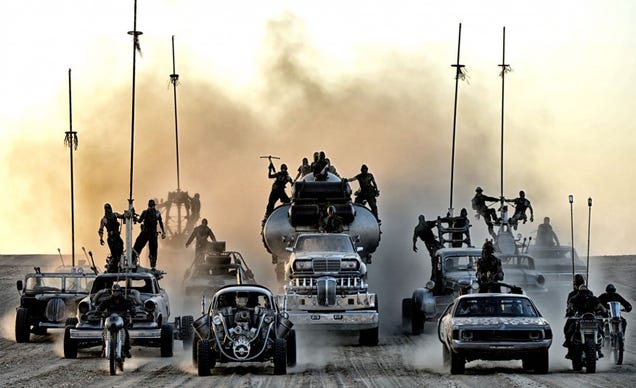
I’m serious. Mad Max: Fury Road should not exist. It should never have gotten made. It certainly shouldn’t be as awesome as it is. And yet somehow, against all odds, this impossible cinematic masterpiece is in theaters right now, in defiance of reality itself.
Obviously, the fact that Hollywood decided to make a new Mad Max film 30 years after the last movie came out isn’t that exceptional. If there’s a franchise that anyone has nostalgia for — or at least awareness of — there’s a decent chance that Hollywood will make another in hopes of cashing in. Generally, these tend to be remakes or reboots, so the first miracle is that Fury Road isn’t a needless reboot, but a new chapter in the Mad Max saga. I can’t imagine how much Hollywood execs wanted to remake The Road Warrior, or give a new origin story for Tom Hardy’s turn as Max. I don’t know how director George Miller managed to convince the studio that modern audiences didn’t need to be coddled.
Actually, I don’t know how Miller was hired to direct the movie at all. Yes, Miller was the creator, writer and director of all three Mad Max movies, but when has Hollywood ever shown a creator loyalty? That’s not a studio executive’s job. Their job is to make as much money as possible, and given Miller’s track record, there’s no way he should have been hired, creator or not.
Do you know what Miller was doing before he returned to Mad Max? In the last 20 years, he has only directed three other movies: Happy Feet, a CG cartoon about a bunch of dancing penguins, Happy Feet Two, and Babe: Pig in the City. Three movies not just for kids, but for little kids. Movies that contain no action to speak of, no violence, and nothing in common with Fury Road. He literally hadn’t made an action flick since Mad Max: Beyond Thunderdome in 1985, and it wasn’t even a very good movie! Yes, Miller was tapped to direct a Justice League movie several years ago, but that fell apart, and no one gets to put “almost” on their resume.
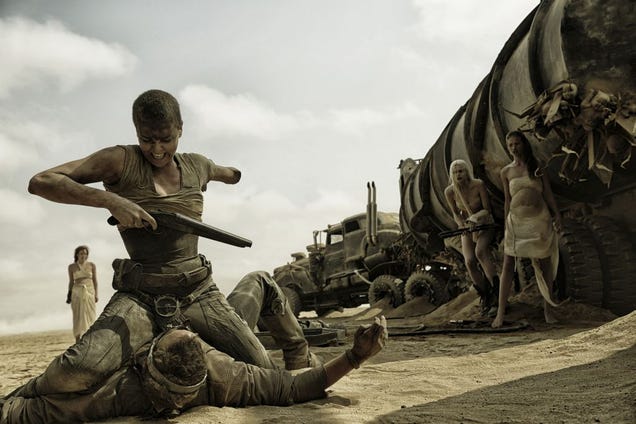
Look, I know it makes sense to normal people that you would only let the creator of Mad Max make a new Mad Max movie, but Hollywood studio executives are not normal people. They’re cocaine-addled lunatics who are terrified at the idea of losing potential box office revenue. From that viewpoint, hiring Miller is a legitimately risky decision. He’s woefully out of practice, his last action film was mediocre anyways, he’s 70 years old… there’s no reason to suspect he could make a summer blockbuster, let alone a modern summer blockbuster, let along a goddamned action movie masterpiece. There are plenty of other movie directors out there who, while they may make crappy movies, still make movies that almost always make money. As nightmarish as it is to consider, from a studio exec’s point of view, it would have been more fiscally responsible to give Fury Road over to a Brett Ratner or a Len Wiseman or one of their ilk.
But not only was Miller hired, he was given a massive $150 million budget and, more insanely, he seemingly also had complete creative control. You know who gets that deal? Practically no one. Maybe guys like Chris Nolan, who have churned out enough summer blockbusters over the years that the studio doesn’t feel the need to second-guess their every decision.
The reason I know that Miller must have had almost total control over the movie is because he was allowed to make decisions no studio executive would have or should have allowed, no matter how much cocaine he/she was on. Here five things I can’t believe Miller was allowed to do:
• Have Max be the sidekick in his own film.
• Hire Nicholas Hoult, one of Hollywood’s youngest, most attractive stars, then shave his head, paint him bone white, and have him play a character with disgusting chapped lips for the entire movie.
• Get rid of Max’s iconic car in the first few minutes of the flick.
• Ignore conventional action movie structure in order to present one giant, two-hour long car chase.
• Give the main villain a name that will confuse every one all the time, because they assume there’s been some kind of error and the character’s real name must be “Immortal Joe.”
These are all reasons the film is awesome, but they’re also not things the studio should have allowed. These aren’t safe decisions. But then again, there’s nothing safe about Fury Road.

Was Miller blackmailing the president of Warner Bros. or something? Did he find a genie? Because those are the only two reasonable solutions for why Fury Road got made now, which, by the way, is yet another miracle. Reportedly, Miller has been working on Fury Road since 1998 and very nearly got it made on several occasions. At first Mel Gibson was going to reprise the role of Max, which would have been a disaster, because Gibson is an anti-Semitic loon. Then it was going to be a a 3D CG animated movie, which probably would have been lame and looked terrible, and even if it was good wouldn’t have been nearly as good as the movie we eventually got.
Ignoring the fact that most films that languish that long in development hell never, ever, ever get made anyways, so many random things had to happen to prevent us from getting an earlier, crappier version of Fury Road. The movie had to be thwarted, over and over again, for nearly 20 years so we could get this version of Fury Road — so Miller would have this specific idea, so the studio would give him that much money, that for god knows what reason the executives didn’t interfere with Miller’s vision, and that Gibson wasn’t involved.
So I’ll say it again — Mad Max: Fury Road shouldn’t exist. It shouldn’t have been possible. It certainly wasn’t plausible. Hollywood executives are paid to prevent this sort of potential disaster from ever happening. And yet somehow, one 70-year-old man who had been stuck directing children’s movies for two decades took a somewhat beloved franchise from the ‘80s and not only made one of the most badass movies of all time, but also created a legitimate masterpiece of the action genre.
If that’s not a miracle, I don’t know what is.
Contact the author at rob@io9.com.
Sophianotloren"How about AT THE Y?!" ~wink, wink~
SophianotlorenThe War On (some classes of people who use some kinds of) Drugs is working *exactly* as intended.
Cops standing in front of big drug seizures look great on the evening news. But it sells a lie that we’re winning, just like George Bush on an aircraft carrier declaring that a war was over that still rages on today.
It’s not only that we can’t win this war, it’s that we’re destroying ourselves fighting it. We are literally addicted to the War on Drugs. A half-century of failed policy, $1 trillion, and 45 million arrests has not reduced daily drug use—at all. The U.S. still leads the world in illegal drug consumption, drugs are cheaper, more available, and more potent than ever before.
Our justice system is a junkie, demanding its daily fix of arrests, seizures and convictions. It needs drugs. It’s as hooked as that guy sticking a needle into his arm even though he knows it’s killing him.
” |
Courtney
shared this story
from  Super Opinionated. Super Opinionated.
|
The Onion’s coverage on gay marriage has been on fire (x).
I really hope that movie gets made before they all die, and that it wins literally all the Oscars. Including “Best Visual Effects,” probably for the buck-wild Pride Parade scene.


The twinkling lights dotting the ceiling of this dazzling cave system are the work of arachnocampa luminosa, a bioluminescent gnat larva (also called a glowworm) found throughout the island nation of New Zealand. It is believed that the light, emitted mostly from females, is how the insects find mates. These long-exposure photos by local photographer Joseph Michael capture small communities of worms amongst 30 million-year-old limestone formations on North Island. You can see more shots from the project titled Luminosity, here.


Curious tech project from the Naemura Lab of University of Tokyo uses a fast strobing effect to stringed instruments to visualize the oscillation of strings played to the naked eye:
Because a CMOS sensor scans video line by line in sequence, fast moving objects are distorted during the scanning sequence. The morphing and distortion are called the rolling shutter effect, which is considered an artistic photographic technique like strip photography and slit-scan photography. But the effect can only be seen in a camera viewfinder or a PC screen. It is usually not perceived by the naked eye.
To cope with this limitation, Wobble Strings allows the rolling shutter effect to be observed in real time using spatially divided stroboscopic projection. The system can produce a wobbly slow-motion effect by generating animation of sweep lines. It also alters the color and texture of strings using a projection of the color and texture sweep lines. Guitar players can monitor their strings’ oscillation, and the audience can experience an artistic visual effect that corresponds with the guitar sound.

John Ashbery, “The Painter” (2014), collage, 15 x 20.5 inches (all images courtesy of Tibor de Nagy)
I have known John Ashbery since 1975, which means that either I should excuse myself from writing a review of his collages — especially since I wrote about them in 2008, (The Brooklyn Rail, October 2008) when he had his first exhibition at the age of eighty-one – or that I am in the position to know his work (the poems and collages) better than most people, and therefore have a duty to write about them. I will let the reader brood over that muddle, particularly since I don’t think what follows even qualifies as a review, which implies a critical distance on the part of the writer.

Guy Maddin, “Untitled (#29)” (2015), collage on bookcover, 13 1/8 x 9 inches (click to enlarge)
I do know that I had no intention of writing about the two exhibitions currently at Tibor de Nagy (June 18–July 31, 2015), John Ashbery & Guy Maddin: Collages and Richard Baker: The Doctor is Out, when I went to the gallery. However, after seeing the serendipitous pairing of Ashbery’s and Maddin’s collages with Baker’s gouaches of paperback book covers, I changed my tune.
Like a pun that unexpectedly springs to mind, the pairing would not let me resist saying the obvious: this is a gathering of humbly made works by three individuals who love the vernacular, and who especially prize that moment when a commonplace object — such as a cartoon, movie still, art reproduction, or book cover — can suddenly and swiftly transport you to a heavenly place of the imagination. The key word is “transport,” a derided possibility in an age of very good copies, shiny outsized baubles and “uncreative” writing.
At a time when the art world’s nattering nabobs of positivity seem enthralled with lavish materials, production costs, price tags, auction records and other boorish spectacles, I find it refreshing to see work that requires little more than a pair of scissors, a pot of glue, paint brushes and gouache. As for materials, how about old book covers, used paperbacks, faded postcards, reproductions of famous and not-so-famous works of art, and vintage celebrity photographs — stuff found at flea markets and dusty, secondhand stores.

Guy Maddin, “Untitled (#07)” (2015), collage and whiteout on bookcover, 9.875 x 7.75 inches (click to enlarge)
Made out of printed and painted pieces of paper, this small gem of an exhibition reminds you that you don’t have to rent a huge studio and hire scads of assistants and managers — in other words, be rich — to make art. I remember the late Holly Solomon saying to me, back in the early 1980s, that things began going wrong in the art world when “artists decided they wanted to be like their collectors” — rich people who didn’t make anything, had others do their bidding, and never got their hands dirty, even when they went into the garden. In addition to being a pioneering dealer of the Pattern and Decoration movement, Ms. Solomon seems to have possessed a talent for the oracular.
Ashbery, Maddin and Baker are not averse to getting their hands dirty, to cutting, pasting and painting. They love movies of all kinds, from black-and-white silent films, to the works of Luis Bunuel, Man Ray and Jacques Tati, to early David Lynch and the wonderfully trashy Ed Wood. Add to their love of movies, from the high to the shabby, a love of books of all kinds, alongside cartoons and memorabilia, and you get an idea of their shared passion for the ephemeral. In different ways, each of them has memorialized a fleeting moment, revitalized a forgotten or neglected possibility, and juxtaposed disparate fragments.

John Ashbery, “Desert Flowers” (2014), collage, 9.75 x 14 inches
Here are my short biographical takes on Ashbery, Maddin and Baker (think of them as “program notes”). John Ashbery, who has written fiction, criticism, and plays, is best known for his beguiling poetry, which drives some people to bang their heads against the nearest wall, and others to celebrate their oddness, humor and beauty. He made his first collages while a student at Harvard, inspired in part by the Surrealists, but only started showing them in the last decade.
Guy Maddin, who was born in Winnipeg, Manitoba, Canada, is a filmmaker and installation artist whose debut feature film was Tales from the Gimli Hospital (1985-88). According to the film critic J.Hoberman: “Maddin’s most distinctive trait is an uncanny ability to exhume and redeploy forgotten cinematic conventions.” Emma Myers described Maddin’s recent film, The Forbidden Room (2015), as “a series of cavernous, roiling story chambers in which viewers can safely enjoy an onslaught of deranged narrative excess without enduring any actual bodily harm.” One of “the story chambers” is Ashbery’s screenplay of a lost Dwain Esper movie, How To Take a Bath (1937).

Richard Baker, “Despair” (2015), mixed media on paper, 12 x 10 inches
According to the gallery press release:
Ashbery wrote his own adaptation of the long-lost Dwain Esper exploitation film How to Take a Bath, which Maddin then filmed. The finished film, a short, is now included in Maddin’s latest feature The Forbidden Room, which has been described as “a film treatment in collage”.
Richard Baker is a painter who has expanded beyond painting to make things from whoopee cushions and the cheap, throwaway 3D glasses you get at movies to chocolate bars and marshmallows. Known for his large still-life paintings of incongruent objects, Baker branched out a few years ago and began painting gouaches of actual books, their scuffed and dirty covers.
He is married to the terrific poet, Elizabeth Fodaski, and his art can be found on the cover of Robert Polito’s poetry book, Hollywood and God (2009).

Richard Baker, “Sodom or The Quintessence of Debauchery” (2014), mixed media on board, 12 x 10 inches (click to enlarge)
Add to this pairing of collages by Ashbery and Maddin the gouaches of book covers by Richard Baker, all of which have to do with psychotherapy — which the artist stretches to include various mental states (“despair), sexual acts (“sodomy”) and literary studies (“Hamlet and Oedipus”) — and you get a wonderful stew, at once modest, unpretentious and wholly satisfying.
At the same time, the collages, especially those by Maddin, can be unsettling (a face cut away), creepy (a behatted monkey sitting alone and forlorn at a table in an empty nightclub), or, in the case of Ashbery, funny and innocently gay (two young men from the 1930s standing by the side of the road in their shorts, hitchhiking). They don’t do much to their source (be it a postcard, art reproduction or book cover), but the changes they do make transform it into something unexpected and delightful. There is a good deal humor in these works, a sense of the absurdity of the world and everyday life, all shot through mystery, wonderment and love. Their orchestrations of the disparate are an all too rare delight in this lucre-obsessed world.
John Ashbery & Guy Maddin: Collages and Richard Baker: The Doctor is Out continue at Tibor de Nagy (724 Fifth Avenue, Midtown, Manhattan) through July 31.
Update: It’s actually Sunday and I’m not running behind at all. Thanks to the commenters for pointing this out before I actually started posting articles.
I’m moving slowly on a rainy morning. The featured post today will be “Slurs: Who Can Say Them, When, and Why”. The conservative freak-out over President Obama saying “Racism, we are not cured of it. And it’s not just a matter of it not being polite to say nigger in public” provides an occasion for me to collect some thoughts that should be obvious, but for some reason aren’t to some people. I’ll try to keep it amusing, with relevant clips from Clerks 2 and Life of Brian.
Since I’m getting a late start, it might be 10 before that appears.
There’s an amazing week to cover in the summary: two major Supreme Court decisions; Confederate symbols started coming down — not just in South Carolina, but all over; the TPP is back from the dead; and President Obama’s eulogy for the shooting victims in Charleston might go down as one of the great American speeches. Expect that around noon.
And I’ll close with something celebratory: a video of two actual, non-animated, boogying elephants.


Been feeling good about the nation in the last few days? Well, that’s fine and all. It’s the weekend. Now get back to fighting to preserve basic reproductive rights for women that are under severe attack from your Confederate-flag waving, gay marriage hating states.
If the Supreme Court doesn’t step in by the end of June, almost every abortion clinic in Texas will stop providing terminations, leaving only eight clinics in six cities to offer services to the 27 million people in its borders. That scenario is devastating. It also might not be the worst thing we see happening as July unfolds. July 1 is also the implementation date of a number of laws that were passed this legislative session, and depending on certain judicial decisions the state of abortion access may be dramatically changing starting in just a few more days.
A last-minute temporary injunction of Kansas’s new ban on D&E abortions will keep that state from losing the ability to offer abortion services past the first trimester, a situation that would have occurred otherwise as of July 1. District Court Judge Larry Hendricks announced on Thursday that the ban will be put on hold for now while litigation surrounding the law continues. Without the injunction, abortion clinics must either induce labor to end a pregnancy that has proceeded past 14 weeks gestation, or simply tell the patient to carry her pregnancy to term.
Meanwhile, July 1 is also the start date of a new 48-hour, face-to-face waiting period the Tennessee legislature passed earlier this spring. That waiting period, as well as a law requiring all abortion clinics meet much more stringent, medically unnecessary “ambulatory surgical center” regulations, was signed by the Governor in May and also will be enforced at the first of the month. A request for an injunction was filed late on June 25, and it is unclear yet if a judge will block it.
One never knows what Anthony Kennedy will actually do so maybe the Court does step in here. I remain skeptical. The gay rights movement has had a lot more victories in recent years than the women’s movement and one can argue that gay men now have more rights than women of any sexual orientation. The fight for freedom must include the right to accessible abortion. That’s in real trouble for large swaths of the nation.

Mary Cassatt, “The Blue Room” (1878), oil on canvas, 90 x 129 cm. National Gallery of Art, Washington (Image via Web Gallery of Art)
The Guardian reported this week that Queen Elizabeth appeared “unimpressed by a painting given to her by the German president, Joachim Gauck.” The painting, which depicts the Queen as a young girl riding a blue pony, is called “Horse in Royal Blue.” The Queen was quoted as saying, “It’s a funny colour for a horse.”
All political power is primarily an illusion. Illusion. Mirrors and blue smoke, beautiful blue smoke rolling over the surface of highly polished mirrors, first a thin veil of blue smoke, then a thick cloud that suddenly dissolves into wisps of blue smoke, the mirrors catching it all, bouncing it back and forth.
—Jimmy Breslin
Blueness doth express trueness.
—Ben Jonson
When
Sir
Beelzebub called for his syllabub in the hotel in Hell
Where Proserpine first fell,
Blue as the gendarmerie were the waves of the sea,
(Rock and shocking the barmaid).—Dame Edith Sitwell, “Sir Beelzebub”
No one can tell what goes on in between the person you were and the person you become. No one can chart that blue and lonely section of hell. There are no maps of the change. You just… come out the other side. Or you don’t.
—Stephen King
There is no blue without yellow and without orange.
—Vincent van Gogh
Oh, the blues ain’t nothing but a good woman feeling bad.
—Georgia White
Whippoorwills call, evenin’ is nigh
Hurry to my blue heaven
Turn to the right, there’s a little white light
Will lead you to my blue heaven.—George A Whiting, “My Blue Heaven”
Mozart has the classic purity of light and the blue ocean; Beethoven the romantic grandeur which belongs to the storms of air and sea, and while the soul of Mozart seems to dwell on the ethereal peaks of Olympus, that of Beethoven climbs shuddering the storm-beaten sides of a Sinai. Blessed be they both! Each represents a moment of the ideal life, each does us good. Our love is due to both.
—Henri Frederic Amiel
We have a beautiful
mother
Her green lap
immense
Her brown embrace
eternal
Her blue body
everything
we know.—Alice Walker, “We Have a Beautiful Mother”
It suddenly struck me that that tiny pea, pretty and blue, was the Earth. I put up my thumb and shut one eye, and my thumb blotted out the planet Earth. I didn’t feel like a giant. I felt very, very small.
—Neil Armstrong
The man bent over his guitar,
A shearsman of sorts. The day was greenThey said, “You have a blue guitar,
You do not play things as they are.”The man replied, “Things as they are
Are changed upon the blue guitar.”And they said then, “But play you must,
A tune beyond us, yet ourselves,A tune upon the blue guitar
Of things exactly as they are.—Wallace Stevens, “The Man with the Blue Guitar”
So, so you think you can tell
Heaven from Hell,
Blue skies from pain.
Can you tell a green field
From a cold steel rail?
A smile from a veil?
Do you think you can tell?—Roger Waters and David Jon Gilmour, “Wish You Were Here”
And now for your semi-regular linkdump.
I interrupted Obama because we need to be heard (Jennicet Gutierrez)- If you read one thing this week, make it this. The “White House Heckler” lays out the things the President wanted to silence her from saying.
This Is Why Everyone Cheering Gay Marriage Should Stand With the White House “Heckler” Now (Bea Esperanza Fonseca)- Where next? Very neatly answered.
Against Students (Sara Ahmed)- Thorough takedown of the absolutely dreadful shite being spouted about higher education. This is a fucking must-read.
NHS Gender Identity Symposium – Some Basic Demands (Queer Blue Water)- The bare minimum UK-based trans people want from the state.
Why the Charleston AME Church Shooting was not a “hate crime” (Kojothelibsoc)- How the language used to discuss the Charleston massacre erases what is actually going on.
Dylann Roof is not an extremist (Zoe Samudzi)- In a similar vein, because there’s a lot of fuckery going on in the white media.
This Is What It’s Like To Recover From An Eating Disorder During Ramadan (Hussein Kesvani)- Examining the intersections between Islam and eating disorders.
‘Now I have the money to feminise my face I don’t want to. I’m happy that this is the face God gave me’ (G2)- Laverne Cox being all-round incredible.
Is it a slippery slope if we remove the Confederate flag? Yes, and that’s a good thing for America (Shaun King)- Removing the Confederate flag could force conversations that need to happen.
In Defense of Casual Romance (Kitty Stryker)- Casual romances are something I’d love to see more of.
We Need To Talk About The Furiosa Comic (Ana Mardoll)- Thorough takedown of the Furiosa comic, which seems to have failed everywhere Fury Road succeeded.
What If We Treated All Consent Like Society Treats Sexual Consent? (Alli Kirkham)- Good 101 on how ridiculously consent is treated.
And finally look at this terrible little fluffy home invader!


DarkAngelØne
“Native American digital artist, DarkAngelØne, collaborates with photographers to create fantastic gif artwork that transforms original still pictures into moving masterpieces. ”
What’s interesting to note is that the artist claims not to be an artist. Instead, DarkAngelØne writes in his About page that he sees himself “as someone who just likes to play with pictures”. A humble attitude for someone who comes up with the stuff you can see below.
I like the inspirational aspect in this. It opens a window to look out into what modern technology is only just starting to allow us to do with it creatively.
how i wish i could see at all times

The Onion
Tibetan Teen Getting Into Western Philosophy
US (2004)
[Source]This thing oughta be framed and placed in every Asian art museum in the West.
So, every year here in San Francisco on the day before the parade, there’s the Dyke March and Pink Saturday. There’s a lot of important history behind both of those things, and I recommend investigating them beyond this post. Every year, I go to both, which is pretty easy to do because the Dyke March goes from Dolores Park, down the traditional march route through the Mission District, and then ends back up in the Castro, where everyone chills out, dances, drinks, eats, and the streets are closed to cars for the party (called Pink Saturday). It’s a “take back the night” sort of event.
This year, something changed with who runs the organization of the combined event. I’m an outsider so I don’t have all the details on a lot of this, but I can tell you what happened as far as I understand it. Usually the Sisters of Perpetual Indulgence organize it, and get donations to do so during the event. They do a really amazing job every year, security is tight but that’s reassuring, and the streets are clear and clean by midnight. The morning after Pink Saturday, you’ll walk out into the Castro and you can’t really tell that 100,000 people were just partying wildly in the street.
But the Sisters didn’t run it this year. Someone ran it who had no fucking idea what they were doing. And they had the entirely non-brilliant idea of changing the time of the march, the march route, and the time of the event’s shutdown. It not being the Sisters’ event, they couldn’t call it Pink Saturday and tried to re-brand it as “Pink Party.” I heard, from people in the street while everyone was asking what the fuck was going on (I’ll get to that in a minute), that proper community outreach wasn’t done, and the new schedule was probably going to impact the services at local churches, who usually re-schedule their Saturday services around the march.
Anyway, they decided to start the Dyke March 2 1/2 hours early. Before they started it, they ranted on the microphone about how they were saving the Dyke March, and talked shit about the Sisters, which was really fucking classless and disrespectful. They spoke as if they were going to run it form now on. Then they said, let’s march.
The Dykes on Bikes revved their engines, parked around the corner from where they traditionally park, now out of view of Dolores Park. There were much fewer than usual. The new organizers started the march. And everyone was completely confused.
Before they started the march, Dolores Park and the surrounding area looked like this:
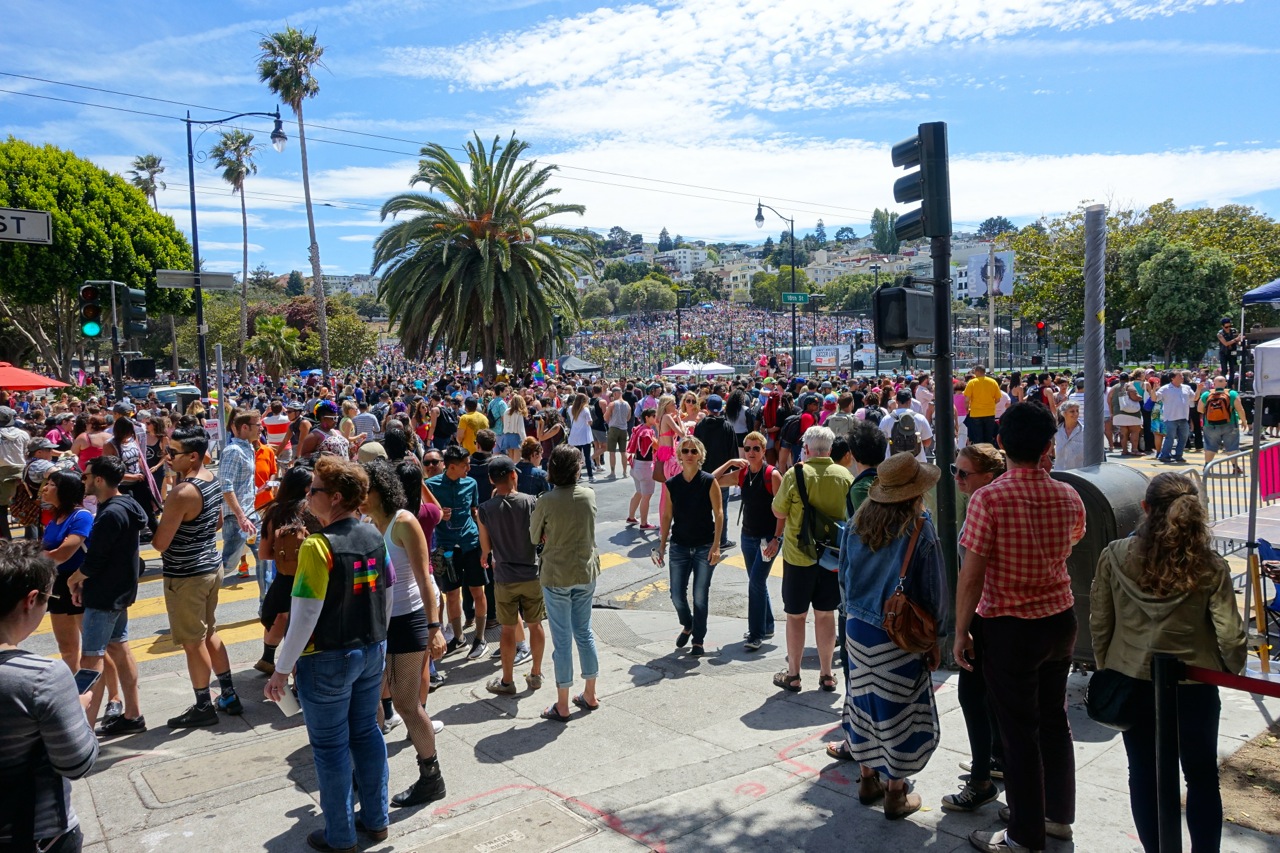
After they started the march, and marched away with some of the people, Dolores Park and the surrounding area looked like this:
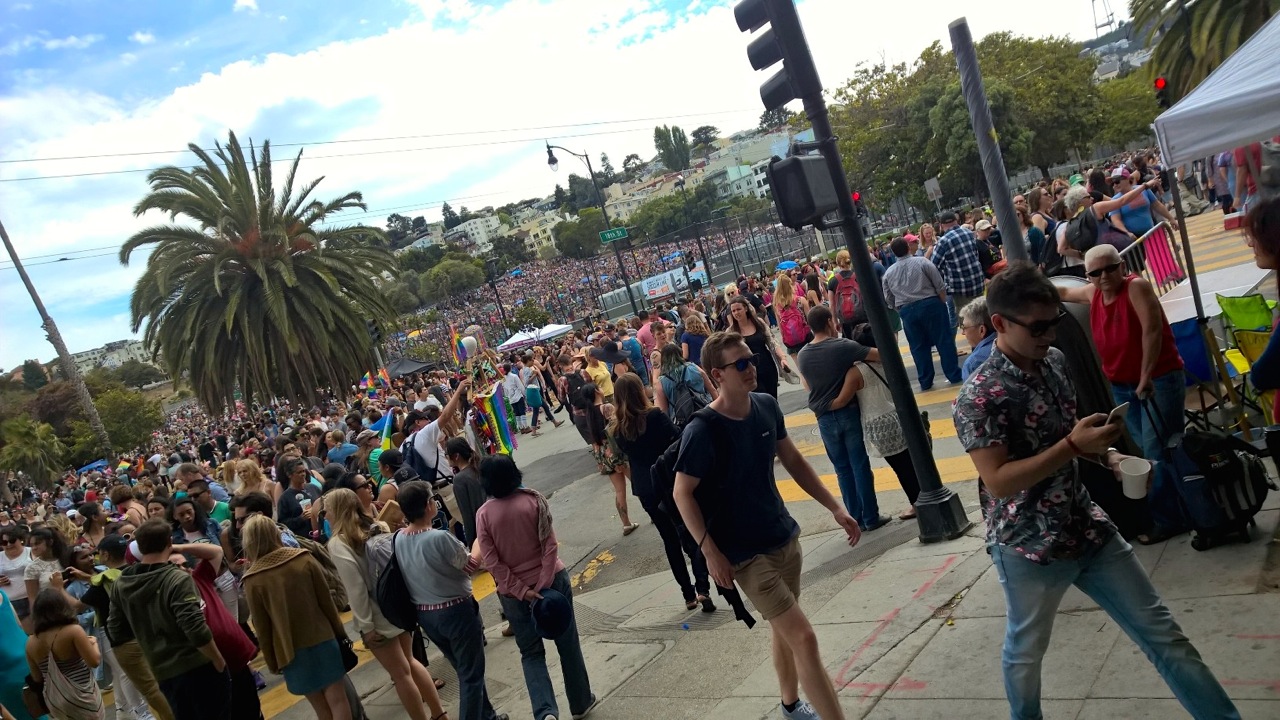
This is when all us total strangers started asking each other what the hell was going on. We stood there, wondering what to do. My friends asked if we should go with the march, and I said I didn’t want to, that I wanted to see what might happen. After a few minutes of nothing, we decided to go to the Big Gay Karaoke House Party we go to every year, which is along the old Dyke March route — used to be you could sit on the porch and cheer on the dykes as they went by.
So we walked past a barrier of motorcycle cops, and another gate, and just outside the gate, I turned around and saw this:
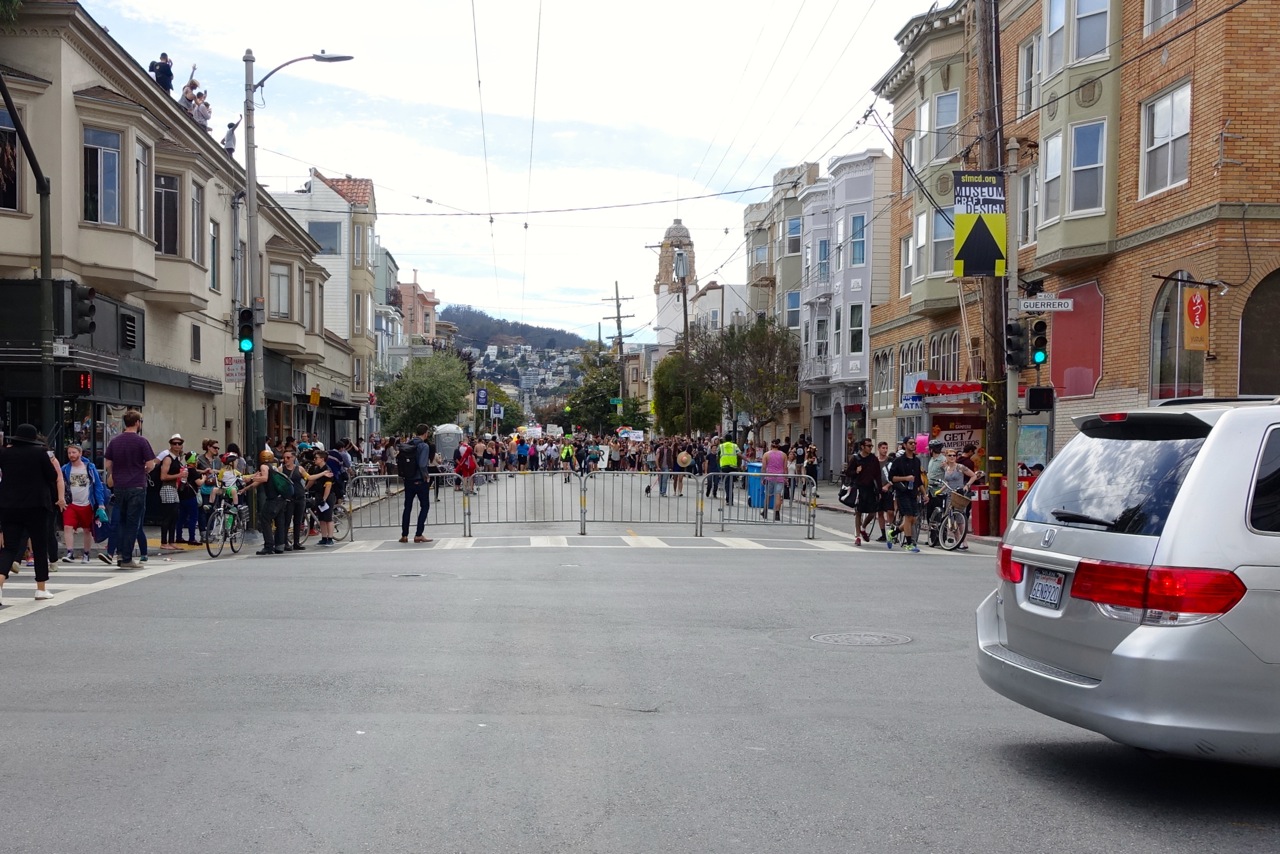
I told my friends to stop. I walked out into traffic. And saw a wall of dykes, marching. Through the cops, who decided there were too many to stop. (I have it on good authority one of the cops actually high-fived one of the marchers.)
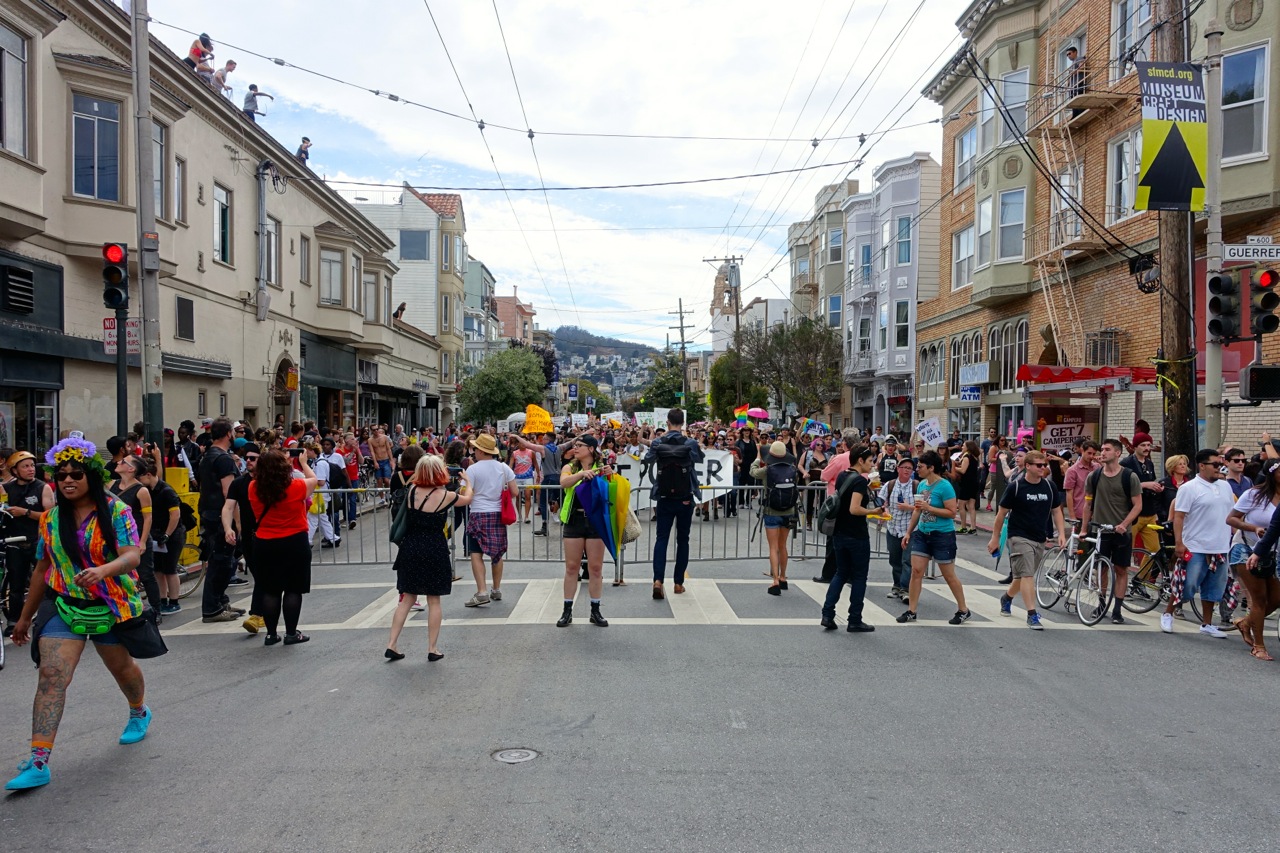
I stayed in the middle of the intersection. The wall surged forward, over the barrier and into the intersection of Guerrero and 18th.
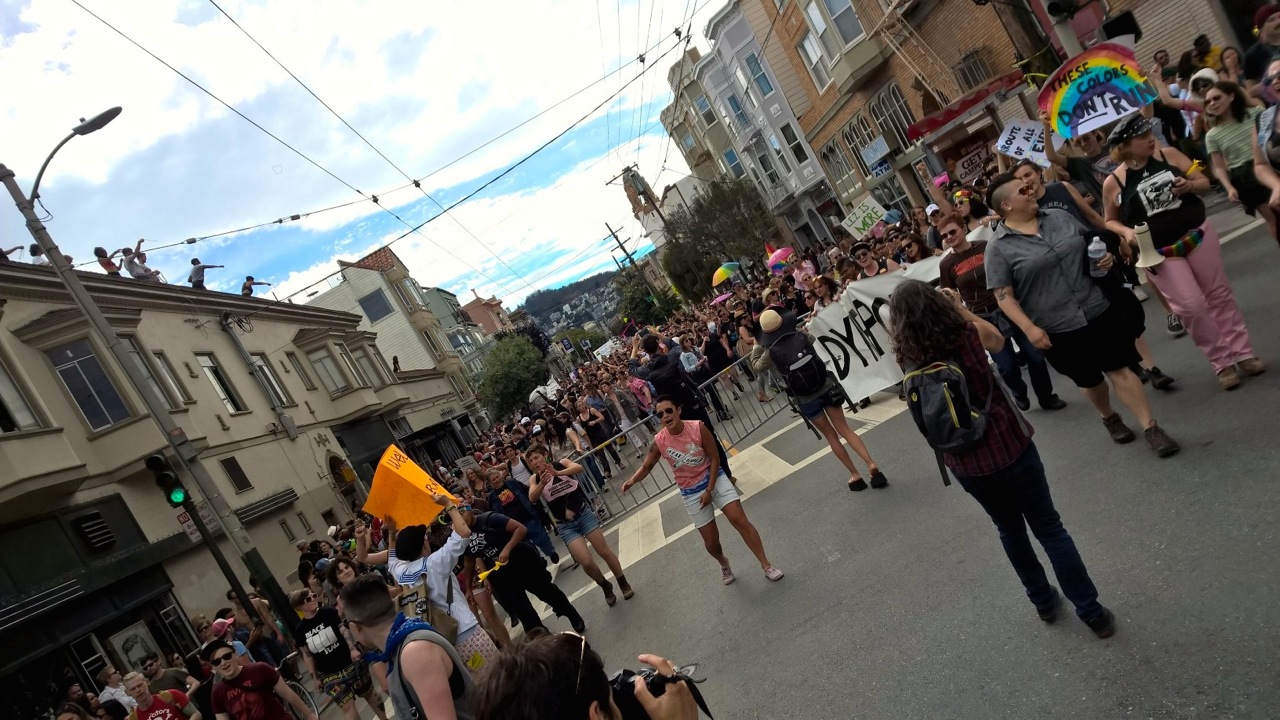

They were chanting. They were powerful. They were angry, and it was a righteous anger.
They were taking back the Dyke March.
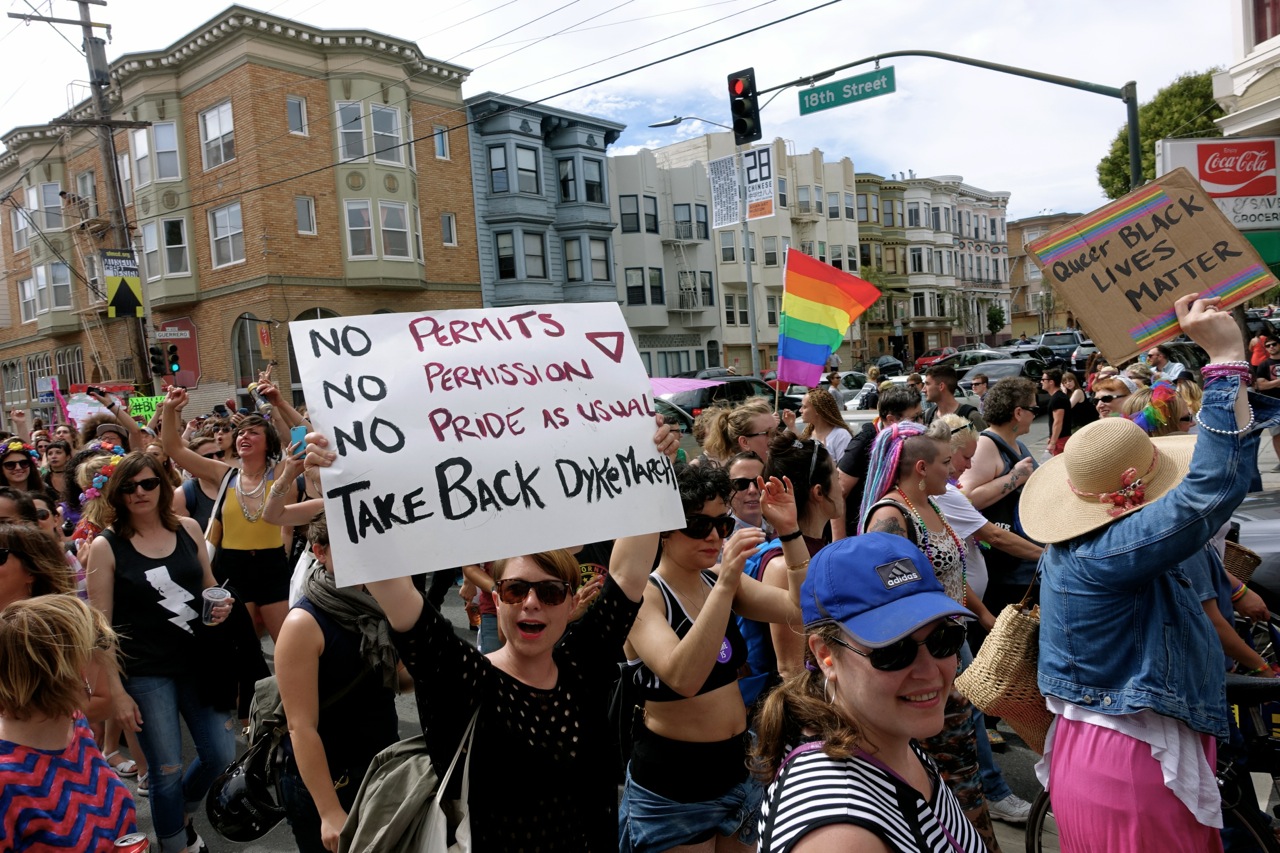
And the march was massive. Blocks and blocks of women smiling and yelling, “Whose streets? OUR STREETS! Whose streets? OUR STREETS!” And I yelled with them, shooting photos with one hand and making a fist in the air with the other one.

I went to take a picture of this person, and they said no — you belong in the photo, and pulled me in.
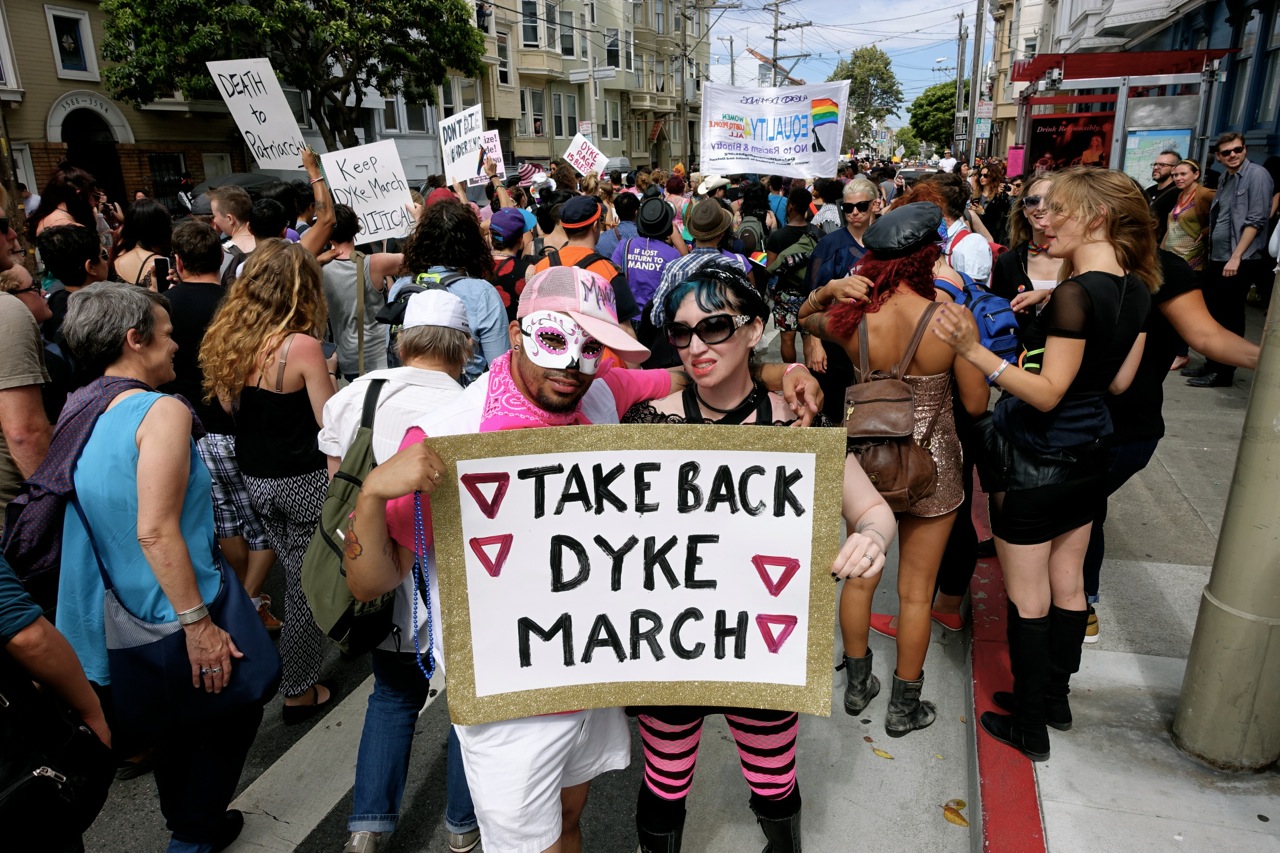
We all walked with the march down to our house party, and then parked our platforms and drank beer on the porch, cheering on the dykes, who streamed past for a long time.
Upstairs later, I noticed this new paint job on 18th:
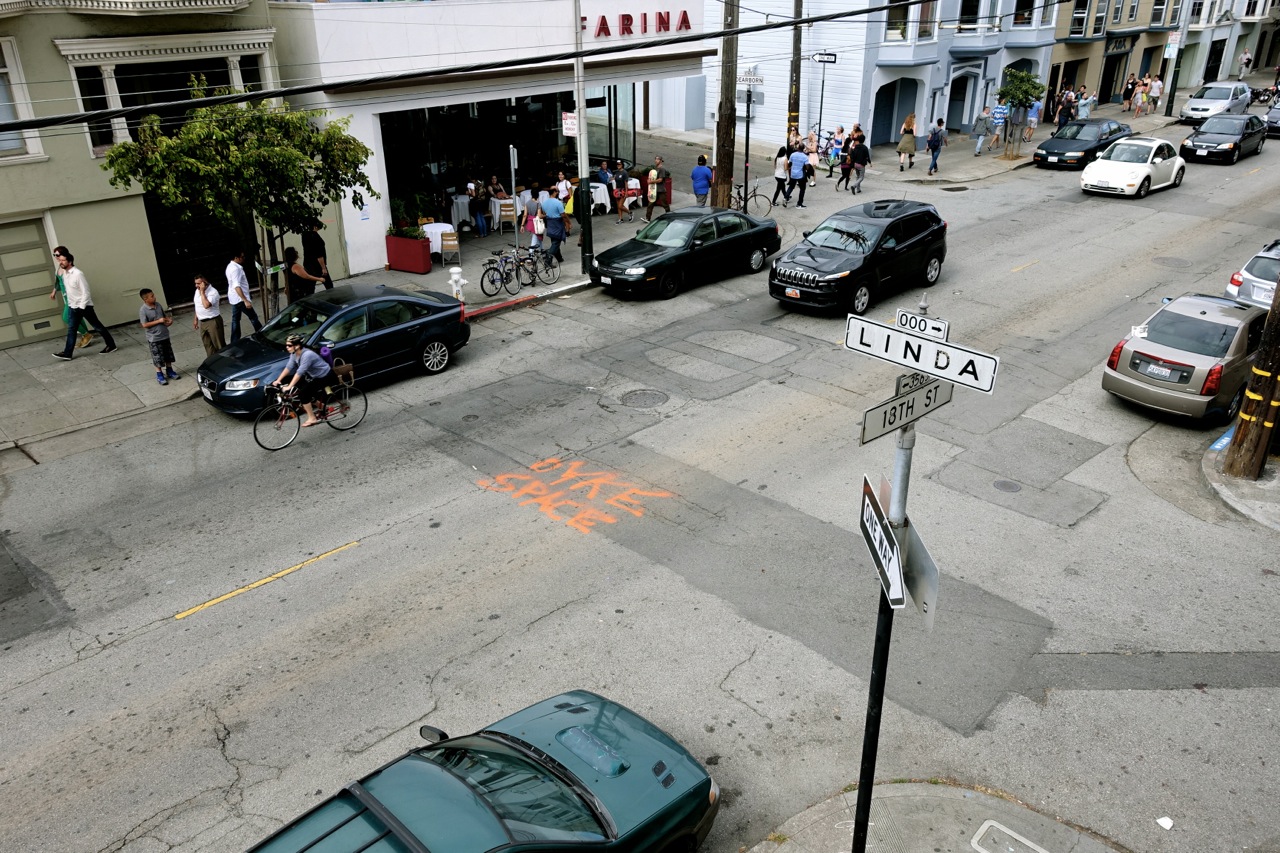
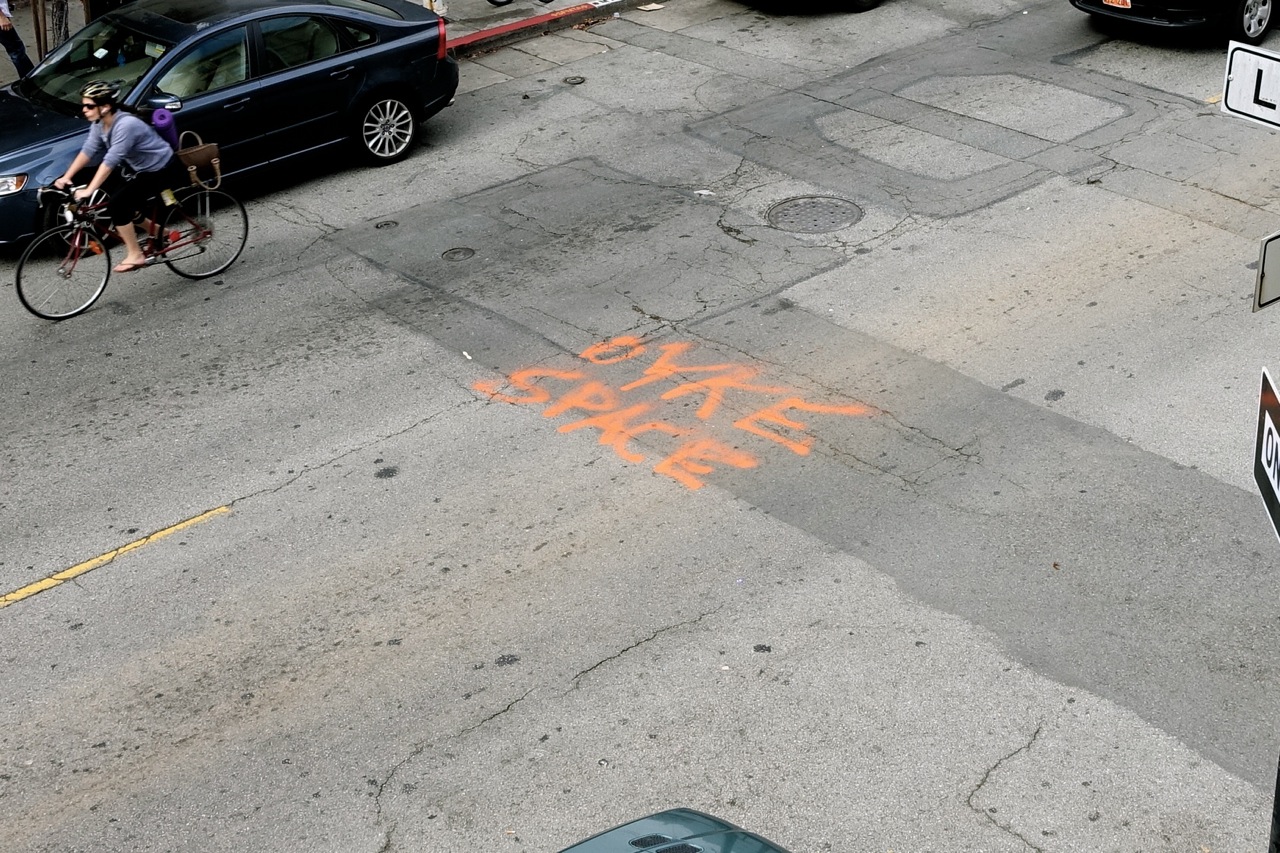
After some epic gay karaoke, we ambled out to get food, and people were literally dancing in the street all down 18th, in front of Bi-Rite, and they were insanely happy, and friendly. But then at 7, the police started clearing the street, and the street sweepers came (this usually happens at midnight). People danced on the sidewalk — until the cops cleared them along. There were tons of police, it was way too early to kick everyone out, and they were visibly frustrated.

We walked back to my apartment, and saw that they were trying to shut down the Castro, too — four hours before the party usually ends. Before dark. If you’ve ever been to Pink Saturday, or you know anything about it, you know that this makes no sense, and it flies in the face of why being in the Castro on that night (night in particular) is important.
I noticed that one half of the event had like no police, and security was so lax in places that it was worrying (we weren’t checked, or stopped, or anything). So, I really hope everyone gets home safe tonight. Like, please.
I hope The City gives the Sisters everything they need — like, MONEY and support — to run the event next year.
If you want to see all the photos I took of the Dyke March, they’re in this Flickr album. I’m in the Pride parade tomorrow with Senator Mark Leno, so if you watch it on TV — look for me!
The post What happened at the Dyke March today appeared first on Violet Blue ® :: Open Source Sex - Journalist and author Violet Blue's site for sex and tech culture, accurate sex information, erotica and more..

This debate over whether happy hours should be banned, as they currently are in Illinois, has a clear answer: no. I have lived in states with happy hour. I currently live in a state that does not have them. I don’t see a discernible difference in people’s behavior after work. What happens here is food-based happy hours or evenings like $1 oysters that effectively do the same thing to get people in the door. The real issue here is with driving after going to happy hour. And that’s an important problem. But it’s also a manageable issue. First, a lot of people going to happy hour are going to be responsible citizens. Second, a lot of those people in a city like Chicago are already taking public transportation because driving into the heart of the city to go to work is unpleasant. Third, bartenders can be strict about how much they serve. Fourth, we know from a lot of experience that prohibitionist policies don’t work. We’ve all seen plenty of people at bars who are completely irresponsible no matter what the prices of drinks are. Offering a slightly lower drink price for a couple of hours is not going to radically change the number of people who are doing so.
I suppose in an ideal world, either nobody would need to drink at all or we would not have cars and free public transportation should shuttle us rapidly from place to place so that drunk driving would never be an issue. Neither of these things will ever happen. So given that, the question is how to manage it. Ultimately, if people want to get loaded, they are going to do so no matter what the state says about it. Promoting responsible drinking, training servers and bartenders to watch out for customers who are drinking too much, encouraging taxis and public transportation, and offering low-priced food to go along with the drinks are all policies that will encourage a positive result while also offering bars and restaurants a new line of business. I thought the opinion that suggested happy hours would help bars offset the likelihood of higher minimum wages was sensible and reinforces how we can create a policy that helps everyone here.
Again, none of this is dismissing the severe problem of drunk driving. But not allowing Illinois residents to go to a happy hour is not going to solve that problem.
At this point, it’s really the little things I miss the most.
I miss being silly with MFP. I miss learning new things about someone else, discovering the things they love and showing them the things that I’m fond of — showing off the “weird American food” as she would call it, lampooning typical American attitudes toward other cultures while ooh-ing and ahh-ing over IHOP, or being told “You sound so Indo!” as I (was attempting to) learn and speak a little bit of Malay. I miss sharing closeness with someone, and I really want that again.
And it’s the most stupid little trivial stuff that reminds me; yeah, I can say “thank you” in Malay (or Indonesian) but I’ve forgotten how to count to 5, and I don’t have anyone to endlessly croon in schmoopy call-and response strings of “sayang.”
I’m not trying to find those exact same things again — nobody could ever replace her, and I wouldn’t dream of trying to find someone who reminded me of her, since I’d remember all of the pain and anger and ugliness that marred our relationship, too — but I want that kind of closeness, the things that made us an “us.”


Big victory for home health care workers in Massachusetts. The workers and their union, SEIU, came to an agreement with the state government to raise their minimum wage to $15 by July 2018. That’s still pretty far off given that they already make at least $13.30. But it’s also the first statewide agreement in SEIU’s Fight for $15 campaigns and that’s well worth noting and celebrating.