Photographer Matt Emmett doesn't pay attention to signs that say "do not enter." While traveling around Europe, the urban explorer looks for the eerie beauty found in the derelict and forgotten. Emmett has photographed everything from abandoned hotels to power stations; before entering a new location, he always reads up about the history first. He offers a detailed description of each picture he takes on his Flickr.
"I enjoy being in such magnificent places alone or in a small group," Emmett told mental_floss. "The atmosphere that hangs over a derelict power station or steel plant, for me, puts them on a level with the Angkor Wat's or Machu Pichu's of this world."
A rooftop view of an abandoned asylum in Northern Italy. A lot of the medical equipment and machines can still be found inside.
A ruined chapel at a private residence in Italy.
The inside of a cooling tower in Belgium.
A crane in an old factory.
A radome in Belgium.
Inside the radome.
The overgrown window of a UK manor house.
A decaying library in a manor house in England.
Faded fresco paintings cling to the walls of the entrance hall at a large abandoned Villa complex.
This strange structure was created by an artist to house himself and his sheep. It's located on private land in the Cotswolds, England.
Rusting radar dishes along the Norfolk and Lincolnshire coast in England.
The banister of an abandoned Italian villa. It was converted into a psychiatric hospital in the 1800s.
Light shining through the Oculus Tower in Italy. The factory was used to process sugarbeets in sugars and oils.
Wooden cabinets that were used to hold patient information at a psychiatric hospital in Northern Italy.
An old television sits by the window in Bull Manor in England.
A ruined colonnade encased in foliage. This photo is one of the photographer's favorites.
A home abandoned after a fire during World War II.
A statue of Neptune stands guard over a secret underwater dome in the UK.
A Victorian reservoir located under the streets of London, England. "The echo in here had fantastic delay to it, my whoop coming back to me around four seconds after it left my mouth," Emmett said.
A surgery room at an abandoned psychiatric hospital. "The hospital was famous in the 1930s for being one of the pioneering sites for the research and early practice of frontal lobe lobotomy," Emmett writes.
A long hallway of a military hospital used to take care of U.S. soldiers during the Gulf War. "Places like this remind me that [nature] always prevails and nothing we create can ever stand up to her and the passage of time," Emmett said.
Another view of the Oculus Tower in Italy.
A tunnel in underground London.
Photographer and son in the Box Quarry in the UK.
A jet engine test area at Pyestock NGTE, a Royal Aircraft Establishment facility in Fleek, UK, that has since been demolished.
When Ryan Palser is not working at Boss Key Productions as a senior animator, he’s usually busy building robots and replicas in his studio. Since fallout 4 will be released later this year, I thought you guys would appreciate seeing Ryan’s amazing plasma gun replica.
Here is the final product of months of work. I am beyond happy with the way it all came together in the end. I have to give major props to my painter wife Dena for really helping me take this gun to the next level with the amazing weathering job.
We feel that showing kids you can aspire to any career, regardless of gender, is important. That’s why we’re always excited when we see LEGO sets depicting female minifigs in a variety of careers, especially STEM. Take a look at some items currently available in the LEGO store while perusing some of the new Ideas projects worthy of your votes!
Scientific American has alerted us to a few new LEGO sets you might be interested in.
A few items in their space port tag include these minifigs:
While these are all AMAZING, Weinstock also notes that with the exception of a branded Doc McStuffins‘ Duplo set, “there are no women of color among the new STEM professionals.”
Ok, now onto the voting portion. You know folks can submit ideas to become real LEGO sets? Well there are some fantastic examples right now. For instance, the “Scientists in History” set created by Mibitat.
They write:
“Currently proposed are 8 scientist vignettes, of which 3 or 4 (voted for by you) could be included in the set:
Charles Darwin is observing a monkey in a tree as he ponders his theory of evolution, struggling for acceptance from the people.
Alan Turing, pioneering computer scientist,is in his lab working on a code-breaking computer.
Mary Anning is down in Dorset trying to extract some fossils.
Marie Curie is in her lab with her equipment as she experiments with radioactivity
Thomas Edison is in his workshop with his incandescent lamp and gramophone
Nikola Tesla is in his lab as he observes his Tesla coil behind the safety of a Faraday cage.
Rosalind Franklin is using x-ray crystallography to observe the structure of DNA.
Lise Meitner is experimenting with atoms in her lab as she comes up with her theory of nuclear fission.”
Ada Lovelace (1815-1852) is widely credited as the first computer scientist and Charles Babbage (1791-1871) is best remembered for originating the concept of a programmable computer. Together they collaborated on Babbage’s early mechanical general-purpose computer, the Analytical Engine. Whilst never fully built in their lifetime, Lovelace’s notes on the engine include what is recognised as the first algorithm intended to be carried out by a machine. Because of this, she is often regarded as the first computer programmer.
And, “Help Ada Junior with her maths homework in the miniature classroom, but just make sure the creepy bat doesn’t steal her beloved teddy bear.”
“I’m a female research geologist with a love of legos- this is a sample of my career. The scene here shows research geologists discovering minerals in a limestone rock formation and the characterization of the minerals in the laboratory.
The entire project has 213 pieces total.
Field geology: A female and male geologist with a dog (there’s always the obligatory geology dog) exploring a crystal cave system complete with stratigraphic layers. Accessory pieces include: compass/brunton, rock hammer, shovel, and a geology dog.
Petrographic laboratory: Petrographic laboratory: Mineral analysis performed with a light
microscope and a scanning electron microscope (SEM) complete with
an electron backscatter detector to distinguish phases and an energy dispersive
X-ray spectrometer (EDS) to determine elemental composition using
microanalysis software.”
Replica of L’Hermione docked at New York City’s South Street Seaport after a 31-day journey on the Atlantic (photo by the author for Hyperallergic)
Inspired by the Harper’s Index,Sum of the Arts is a periodic tabulation of numbers floating around the art world and beyond.
Days a replica of the 18th-century ship which brought the Marquis de Lafayette to the American Revolution, l’Hermione, took to travel from France to the United States = 31
Number of demerits accumulated by artist James McNeill Whistler when he was expelled by Robert E. Lee from West Point in 1854 = 240
Temperatures in celsius at which geologist Jeff Karson and sculptor Bob Wysocki pour melted basalt rock to replicate a lava flow = 1,100 to 1,1350
Square footage of exhibition space planned for the Louvre Abu Dhabi, which pushed back its opening to 2016 = 99,000 (compared to 63,000 at the new Whitney Museum of American Art)
Estimated amount (in US dollars) art collectors spent at auction on Contemporary, Modern, Postwar, and Impressionist art in the first six months of 2015 = 3,700,000,000
According to research by the Global Media Monitoring Project, women comprise 24% of the people read about or heard in print, radio, and television news—a statistic that has changed very little in the last twenty years. The Women’s Media Center outlines actions being taken around the world to combat gender bias in media reporting.
Finally, a stray cat who watched over a Japanese subway station was deified as a Shinto goddess after passing away last week. Mourners, who numbered around 3,000 at her funeral, say the beloved feline can haz special status and that it is nothing to LOL about. (Guardian via @AnnetteYReed)
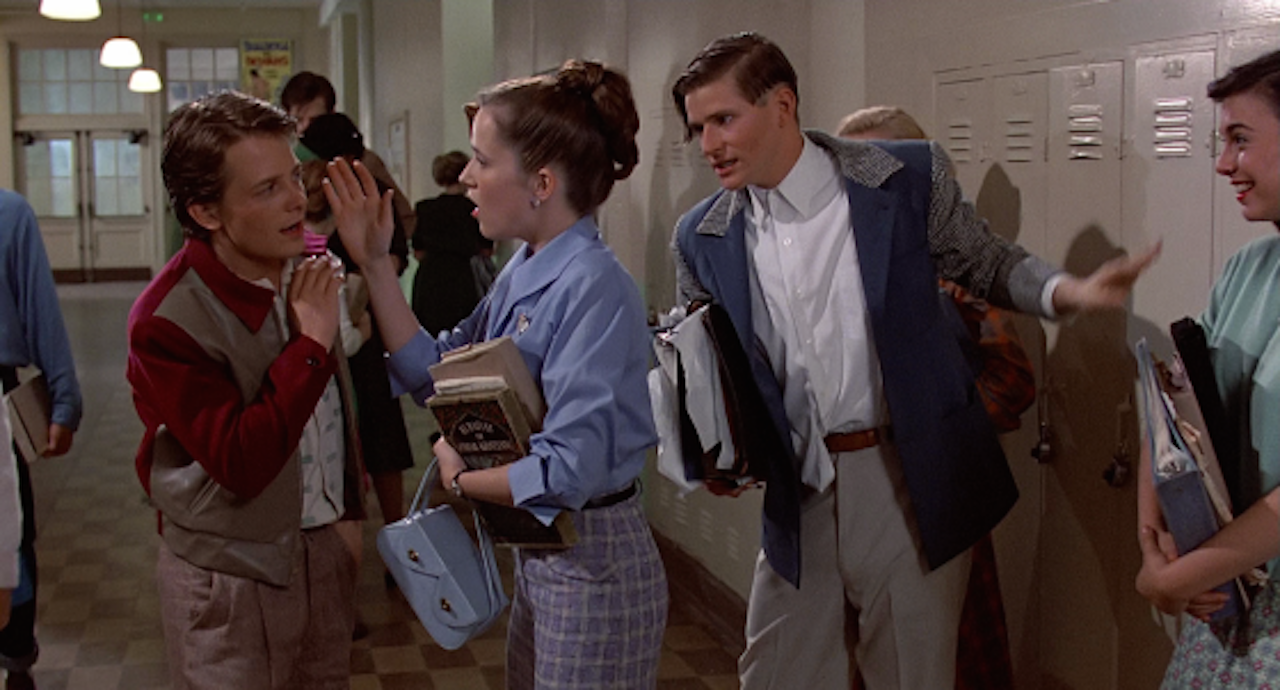
Marty McFly in Hill Valley, 1955 (image via Huffington Post)
One of the greatest pleasures of teaching design history to college students — apart from watching their reactions as I play excerpts from grouchy interviews with the legendary Braun designer Dieter Rams in class — is time travel. Not the actual temporal kind, but the generational kind, where you realize that you’re the only person in the room who remembers the 1980s, and everyone else in the room is really curious about that.
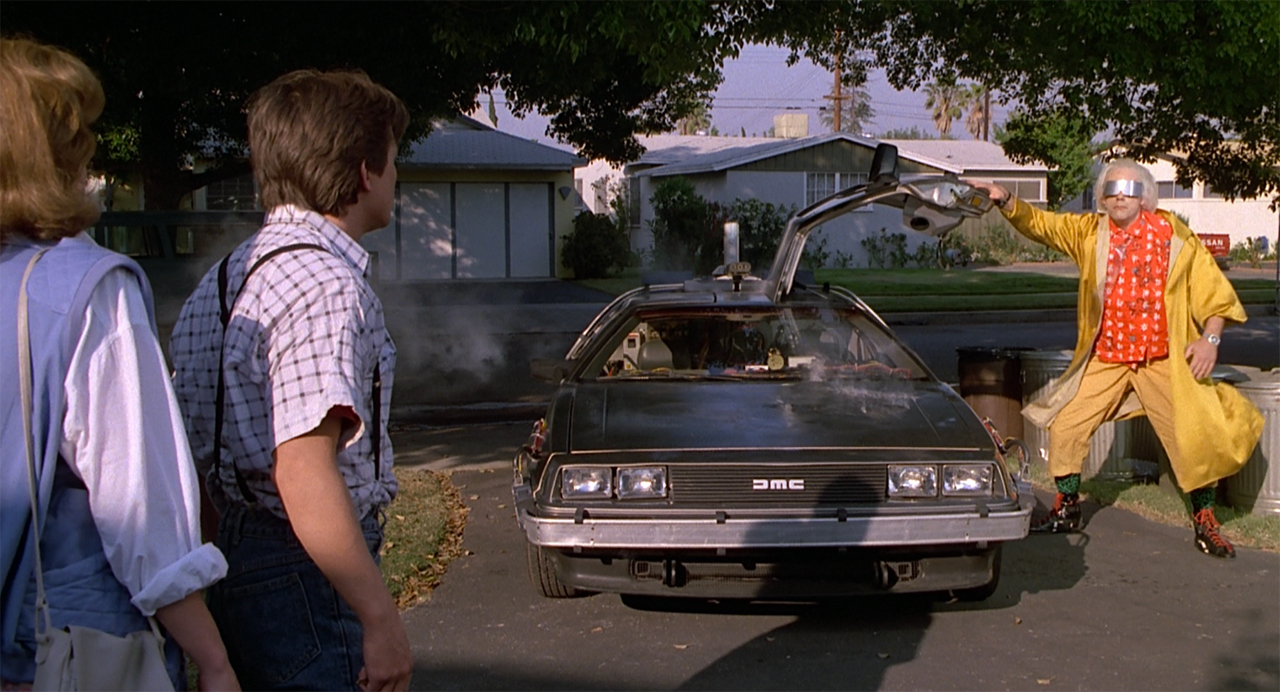
Doc and Marty’s test run of the DeLorean, 1985 (image via thedissolve.com) (click to enlarge)
Rebecca Onion’s recent essay in Aeon Magazine, “Against Generations,” argues persuasively that the labels we use to shuffle and sort the long march of cohorts in our society are tools of the lazy, and that the “personalities” we assign to these arbitrarily determined populations are the stuff of wonkish trend pieces, offering no real insight. In this I think she may be right, but even if the labels are more akin to horoscopes than accurate diagnoses, there’s no getting around the fact that when we were born impacts how and whether we use and enjoy certain technologies or products. The discipline of design history is partly predicated on this, and Anna Garvey’s fantastic essay “The Oregon Trail Generation” illustrates it beautifully (speaking as a fellow covered-wagon pioneer.) If a technology is new when you are an adolescent, it is truly yours; your parents don’t know how to use it, and older kids are busy with some slightly outdated thing you’re not interested in. You use the new thing to connect with peers and carve out a knowledge-based niche with its own humor and aesthetics. Every few years, the technology in question changes, but this dynamic seems to be eternal — at least since the dawn of industrialization.
A survey class in the history of modern design is required for students in the College of Media Arts at Drexel University. It introduces future fashion merchandisers, graphic designers, app builders, game architects, and digital animators to things like Anglo-Japanese furniture from the Aesthetic Movement and, a bit later on, Tupperware and Womb Chairs. To break up the slew of slides in class, from time to time I used clips from movies and TV to illustrate styles, objects, or social mores from other eras. When we talked about the 1980s and the wave of nostalgia then for the 1950s, we went straight to the source: Robert Zemekis’s sci-fi masterpiece Back to the Future.
Marty with his parents in high school, 1955 (image via fogsmoviereviews.com) (click to enlarge)
When I realized last fall that today, July 3, 2015, marks exactly 30 years since the movie came out, it came as something of a shock, for two reasons. First, not only do I remember seeing this movie in the theater, I remember seeing the theatrical trailer. Second, and more importantly, the distance of time that separates us today from the year the movie came out (1985) is the same amount of time that separates teen protagonist Marty McFly from the year to which he travels back in time, 1955.
When the film came out, 1980s audiences chuckled at the depictions of 1950s hulking, wood-encased television sets, crinolines, neon-lit diners, and the characters’ pervasive lack of familiarity with things like diet soda, puffy outerwear, and Eddie Van Halen. Watching it today adds another layer to a virtual archaeological dig, in which we find 1985 chock-full of tape decks and sports cars, but missing smartphones and laptops.
Examining the design and narrative conceits of this movie through my students’ eyes as best I can, something I had never thought to question before became strikingly clear: the plot of Back to the Future revolves almost entirely around cars. Every nail-biting scene in the movie, from uncrating the plutonium to escaping from the Libyans to harnessing “a bolt of lightning” from the clock tower, unfolds in the service of Marty and Doc Brown’s attempt to retrofit their nuclear-powered DeLorean from 1985 to run on gas (with an extra jolt of electricity) like an American car from the 1950s. Marty’s nemesis, Biff Tannen, drives a gleaming 1946 Ford Deluxe Convertible (which is memorably sullied during a manure incident), and Marty’s truck is the fetish object that signals his return to a new and improved version of 1985 at the film’s conclusion.
Biff Tannen and his gang in the 1946 Ford Super Deluxe (via btothef.tumblr.com)
Would this be the case if the movie were made today? I asked a student, a professor, a curator, and a technology reporter for their takes on this, and though all hail from different cohorts, the common response was a firm “no.” Things really have changed in 30 years.
You could say that cars are to the history of design what paintings are to the history of art — not because they form the bulk of the content, but because the car industry so perfectly illustrates many of the principles that form the basis of the discipline, interwoven as it is with the advent of the interstate system, world’s fair attractions, consumerism, advertising, and popular culture, from drive-in movies to the Beach Boys.
Car manufacturing and marketing have shaped contemporary consumer culture more profoundly than many of us realize, even for those of us who can’t (or won’t) drive. Henry Ford conceived of the “5-Dollar Day,” which enabled his own factory workers to purchase Model-T’s on their salaries, crucially transforming what had up until then been a luxury good into a middle class staple. Less well known (but familiar to those in the habit of watching closing credits on PBS) is Alfred P. Sloan, who ran General Motors from the 1920s to ’50s. While “Fordism” made cars affordable by keeping parts identical and models consistent year after year, Sloan turned this concept on its head by introducing the practice of annual styling (“Sloanism”) — that is, the introduction of new shapes, features, and colors to car models each year as though they were fall fashion collections. Last year’s model might run just fine, but the new Cadillac is available in Azure Blue and has fins. It was one of the most successful examples of planned obsolescence put into practice in the 20th century, and its legacy is evident in the design and production of consumer goods today. If you’ve ever wrestled with the question of whether you actually need the newest model of the iPhone, you have Alfred P. Sloan to thank (or blame).
David Raizman, the Drexel professor whose textbook History of Modern Design has become the go-to resource on this topic for educators, grew up during the auto industry’s golden age. “I lived through the great age of the ‘Big 3’ [Chrysler, Ford, and General Motors], and anxiously awaited the unveiling of the new annual models each fall when my older brother’s Popular Science magazine arrived,” he writes. “The subtle differentiation of models and brands, as I think of it now, was so full of meaning in terms of lifestyle, status, and aspiration.” Whereas appliances are domestic, cars are roving public spectacles. There’s hardly a better way to understand the practice of aspirational consumption than to study the cars, car advertising, and the car culture that made the Route 66 era so beguiling.
Doc Brown returned from the future, 1985 (image via imdb.com)
Like all golden ages eventually do, the age of the ‘Big 3’ came to a close, and with it the utopian optimism that surrounded car design and styling, says Donald Albrecht, curator of architecture and design at the Museum of the City of New York. “I think that the whole interest in progress as a positive phenomenon has greatly changed, and popular depictions in movies and games are far more dystopian than utopian. Even Disneyland’s Tomorrowland has been frozen in a streamlined 1950s version of the future.” Why the change? Albrecht cites the gas shortages of the 1970s and the nascent environmental movement of the same period as likely causes. The perfectly timed arrival of compact cars from Japan in the 1980s shifted consumer desire to new qualities like efficiency and fuel economy, as did the growing ranks of young people in urban centers who preferred public transportation.
Much has been made of the claim that Millennials aren’t as interested in cars as previous generations were, a debate sparked in 2012 by an article in The Atlantic by Jordan Weissman. Whether or not this is true — with such a large cohort, there’s bound to be great variation — the fact is that we associate the romance of the car as a consumer product and symbol of teenage freedom with words like “classic” and “vintage,” rather than “new” or “innovative.” What would Marty McFly rely on today, to get “back to the future” in 2015? “It would be whatever the next Apple device is,” speculates New York Times technology columnist Farhad Manjoo, who notes that the energy among young industrial designers seems increasingly focused on mobility — by which he means the portability of mobile devices, not cars. Manjoo recalls that earlier in the evolution of computers and laptops, the focus was on trying to increase memory to make devices more powerful and faster; today, much of the emphasis is on trying to increase battery life so that devices can be untethered from the wall for longer periods of time. In a sense, our love affair with technology has migrated from the machines that move us to and fro to the tiny gadgets that allow us to stay connected no matter where we are, offering us a different way of changing the scenery.
Doc and Marty just after the test run, 1985 (image via moeatthemovies.com) (click to enlarge)
Drexel graphic design student Maddy Russell echoes Manjoo’s citation of the Apple Watch as a potential replacement for the DeLorean, adding, “Smartwatches have been experimented with in the past, for example, James Bond’s Omega Seamaster had a detonator and shot lasers in GoldenEye and let’s not forget Michael Knight’s smartwatch in Knight Rider let him communicate with the car.”
For the moment, time travel is not really a pressing concern for industrial designers. But moviemakers and smartwatch developers, take heed: a tiny, wrist-sized flux capacitor might be just the ticket.
When you read the poetry of Najwan Darwish, the young Palestinian poet, who is no relation of Mahmud Darwish, you realise the disconnections are even starker. Mahmud spelt out the stakes, asserting Palestinian identity firmly in the soil, the olive gardens, the scent of jasmines, the welcoming and proud Arab heart, the bewildered victim of an occupation, seeking reconciliation against barbwires, against tanks and gunshots, against history. Najwan’s poetry, like his grief, is more irreconcilable, because the thin hopes which Mahmud left behind have been bulldozed and gunned down further. The difference between Mahmud and Najwan, you realise, is ultimately a difference in the escalation of violence. Too much violence has ripped the soul of Palestinian poetry. The difference is summed up by Najwan, most brilliantly in these lines which tell of a larger climate of horror we are living in:
In the 1930s
it occurred to the Nazis
to put their victims in gas chambers
Today’s executioners are more professional
They put the gas chambers
in their victims
In the light of this change that has taken place in the Palestinian situation and its reflection in the poetry, I read the poetry in Suvir Kaul’s Of Gardens and Graves, endearingly published by ‘Three Essays Collective’. In this review, I shall concentrate, only on the exceptional poems in the book, which are translations of poems mostly from the Kashmiri by Suvir. I shall leave alone the essays by the author, which trace the literary, political and historical phases of Kashmir’s predicaments. It is also beyond the scope of this review to engage with Javed Dar’s chilling photo essay, showing people of a landscape at once outraged and disconsolate, facing the territorialising beastliness of military occupation. To address all the genres would need different approaches that would split the thematic coherence of the review.
The poems chosen in this collection, a lot of them ghazals, reverberate with the passing away of another era that I associate with Agha Shahid Ali and his poetry. That era did not end long ago, for Shahid died in 2001, but since then a spate of violence, like in the case of Palestine, has unleashed inconsolable wounds into the Kashmiri landscape, psyche and life. For India, Kashmir has been reduced to a territory to defend, if necessary against its people. The shape drawn by the coloniser’s pencil is dearer to the postcolonial nation than the breath, song and hands of the people who inhabit a place they call paradise.
The intentions of the Kashmiri voice are laid down in these lines of a ghazal by Ghulam Nabi Tak ‘Naazir’:
That which could not be told, tell now
Keep, keep writing the value of speech
The urgency is twofold: That which was perhaps not being said so far in hope that the nightmare shall pass, needs to be said now when the nightmare has worsened. That which was perhaps not said in the past because everything was too present, too near at hand, too palpable a bruise to immediately reflect upon, needs to finally be spoken aloud, put on paper. The time has come for Kashmiris to write the history of their present. It is the only way tongues can utter their freedom against the jaws of occupation.
So the poet, Arshad Mushtaq writes, when time went out of joint in Kashmir’s summer of 2010, on the painful images that prompted him to pick up stones:
When they left Lal Ded naked
On the banks of the Rambiar,
When they killed Yusuf before Zooni’s eyes
That’s when I threw stones!
It was the Mughal emperor Akbar who deposed and exiled Habba Khatoon, or Zooni’s husband, and Kashmir’s ruler, Yusuf, to Bihar where he eventually died. Shahid had written in ‘A Prologue’, how it was since Akbar’s act of imperial injustice, Kashmir seized to be free. He also writes how it was Habba Khatoon’s grief – “alive to this day” – that “roused the people into frenzied opposition to Mughal rule”. That was when, Arshad reminds us Kashmiris picked up the stone. Against the history of the technology of violence, a stone sounds like an innocent, idyllic object of resistance.
The reference to the mystic saint-poet, Lal Ded, is symbolic in the poem, Rambiar being the river in Shopian, where two young women, Neelofer Jan and Aasiya Jan, were found murdered in 2009. Zooni and Lal Ded are not mere names of the dead in Kashmir; they are present in the everyday language of poetry, because Kashmir’s history draws its sustenance from their shining examples of rebellion against loss.
In the ghazal by Ghulam Hassan ‘Ghamgeen’, you read further proof of how remote the Kashmiris have grown, even from themselves. Medicines don’t work, when the heart is suffering. No war epic or love poem can be read in times of war and grief.
If you have something to say, come yourself
Don’t you send a messenger here, matyov, not even one
Easy to put a shoulder to a hill and shift its location
But very difficult to change a mind, not even one
In these two calmly intractable couplets, Ghulam gives you the impression of a people who are deaf to the intentions of middlemen. If the once-endearing neighbour wants to say something, let him show up, or it would be silly of him to imagine anything else will work. You can change the address of a hill, but not the estranged state of its inhabitants.
Mohiuddin ‘Massarat’, in a post-Shahidian atmosphere of grief, is no longer speaking of a grieving I, the lone, exilic and searching self, or the figurative and symbolic self, looking for its other. Grief is no longer addressed as a letter of endearing complaint to the disappeared neighbour, the “you”. All of that is reminiscent of Shahid in ‘Farewell’. Mohiuddin is ironically indifferent, a cynic poet who registers the insignificance of witnessing. The landscape watches too many dead, breathes too much death, and its excess shadow has entered into people’s silences.
Our own become strangers sometimes
Flesh is pulling off nails, what’s to me?
We know how Kashmiris are separated within themselves today, not merely across communities but through their different responses (ideological and political) to the crisis at hand, so relations are tearing apart, and so is the shared language between them. And to all this, the poet, almost sneers in a mock gesture, it’s nothing to him, he isn’t bothered.
The hopes of reconciliation in Shahid’s poetic imagery, lying however frozen in time, has already passed into a zone of nostalgia, a nostalgia that has been trampled by further acts of state violence and its machinations to keep even a semblance of reconciliation further apart. In such times, the poet Bashir ‘Dada’, surveys the scene with disturbing clarity. With a wrenched heart, he writes about the failed dream of reconciliation, of homecoming, in these unforgettable lines, which evoke sadness and wonder at the same time:
For I cherish the failures of love – and willingly we will fail:
I – become the evening – will search for you everywhere;
as you – become the morning – disappear, o lost one.
Shahid had left addressing the pessimism of rationality, where the disappeared (Hindu) neighbour is not expected to forgive, precisely because there is everything and nothing to forgive after the sudden severance of ties. Bashir puts another nail to this coffin of expectations by admitting, both sides are now willingly ready to fail each other.
I would like to end by adding my thoughts further on this exceptional poem in Urdu on which Suvir pauses and meditates with diligence and care. It is a poem in Urdu by Shabir ‘Azar’, titled ‘Corpse’. The poet sees a corpse in the lake. The lake is a mirror. The face of the corpse is a stranger’s. The corpse disturbs the poet. It stalls thought and casts a shadow on the (poet’s) future. The poet has often thrown stones at the lake’s mirror, trying to scatter the corpse’s image in the water. But the corpse’s face would still raise its head at the edge of the lake and stare back at him. The poet questions his gesture, trying repeatedly in vain to smash the reflection of the dead. For the mirror and the corpse are locked in each other’s reflections. The poet is as doomed and locked in the gaze of this reflection as much as the lake and the corpse’s face. They are excruciatingly tied to each other. In ‘Farewell’, Shahid imagined the temple and the mosque “locked / in each other’s reflections.” In Shabir’s poem, the image is starker and real, it is bodily, with an eerie suggestiveness: The face of the corpse is a stranger’s but the stranger is too close, perhaps, the self’s double. If the origins of the lake in Kashmir began with Shahid’s mythopoetic imagery of how Brahma’s voice of torn water ran down the slopes of Zabarvan and turned Kashmir into a lake, in Shabir those mythical ties have no bearing, replaced by an irremovable image, of a corpse that refuses to disappear. If Kashmir is a lake where its face can seek the reflection of its solitude, that reflection is now haunted by the presence of its double, the image of death. It is, as if, the face is being tempted or invited to consider making peace with the image of the corpse:
if the corpse
is in the lake
the lake too
is in the corpse
The poem ends by suggesting disturbing questions to the reader: Does the corpse belong to the past, the present, or also the future? How long will the corpse keep appearing on the lake’s surface to haunt Kashmir’s face of solitude?
The range of poetry in this book is remarkably chosen, arranged and edited by Suvir Kaul. It offers ample evidence of Kashmir’s poetic scene, somber, lyrical, and often numbing, with an acute sense of history and place. The poets, many of them deeply invested in the ghazal form, are remarkably thoughtful and they offer critical insights into Kashmir’s desperate situation. It won’t be an exaggeration to persuade readers to buy and read this book just by the strength of the poetry alone. Javed Dar’s photographs and Suvir’s essays will surely open up different horizons of engagement regarding what’s gone terribly wrong in Kashmir. Our future is intertwined with the future of this martyred place.
I cannot believe how cute this little bee is, or how full her pollen baskets are! That large yellow glob on her right side is a package of pollen that she’ll bring back to the hive.
Ben Butler (previously) is fascinated by the complex structures that emerge from simple and delicate processes. This phenomena can be found in the elaborate systems produced by ant colonies to human cities, small quotidian actions accumulating into overpowering structures. Unbounded, Butler’s installation on display at Rice University Gallery in Houston, Texas, uses this same idea by assembling over 10,000 pieces of poplar wood into a matrix-like structure. This massive arrangement coalesces into an unexpectedly mesmerizing array of grids that stretch to fill the gallery space.
Butler approached this installation, as he commonly does within his practice, without initial sketches or ideas of what he would like the structure to look like. He played with the materials, discovering configurations on the spot. Although the grids within Unbounded were pre-made in his studio, the way they were configured and connected horizontally was all in response to the space. This way of acting in the present ensured that the structure’s outcome would be organic, and not purely responding to a preconceived shape.
Poplar wood was chosen for the installation because of its malleability and abundance, which gave Butler the ability to fiddle with a material that seemed endless. This idea of endlessness also tied into the title he chose for the piece. Butler wanted the piece to have no defined boundary or vantage point, but encourage the audience to walk around and within the structure, discovering it from all angles.
Butler received an MFA in sculpture from the School of the Art Institute of Chicago in 2003. He currently lives and works in Memphis, Tennessee and Quogue, New York and has an upcoming exhibition of his sculptures and drawings at The University of Mississippi Museum, Oxford opening in September 2015.
Citizens of Chicago need to prepare themselves for a "cloud tax" that went into effect on July 1. The nine-percent tax to cloud services like Netflix, Spotify and Xbox Live is the result of an "amusement tax" ruling that items "delivered electronical...
The FCC made it clear that towns should have the freedom to build their own broadband services, and one cooperative group is determined to take advantage of that liberty. WiredWest has gained the support of 22 Massachusetts towns for a municipal broa...
For a long time, the BBC has operated knowing that licence fee funding may be taken away. With all eyes on how it spends public money, the broadcaster tightened its belt and committed to saving £1.5 billion by 2017. The problem with this, and cost-cu...
Stephen Colbert addressing a local Yelp review controversy on ‘Only In Monroe’ (all screenshots via YouTube)
In preparation for his debut on CBS’s The Late Show in September, Stephen Colbert kept his hosting skills sharp by serving as guest host on Monroe, Michigan’s public access talk show Only In Monroe. A video of the 41-minute episode was posted to Colbert’s YouTube page on Wednesday.
Internet commenters immediately hailed it as “classic” Colbert. Yet the satirical political reporter told the New York Times that he would give up his tongue-in-cheek shtick when he assumed his role at The Late Show. Instead, he would be more “himself.” If his stint on Only In Monroe is any indication of what’s to come, we can only assume that what we see in it is something like the “real” Colbert.
The set of Only In Monroe is reassuringly familiar, with its unmistakable public access aesthetic of harsh lighting, fake potted plants, and generic corporate furniture from circa 1995. Every small-town studio looks like this, so even if we’re not from Monroe, we feel like we know it. Because we know it, we assume that it’s real. In case you were worried, Monroe is indeed real, which the station’s commercials confirm. Just a short drive from Detroit, the town is touted as “authentic” with a “real downtown” where you can “take a break and slow down, have coffee.”
Stephen Colbert interviewing ‘Only In Monroe’ co-hosts Michelle Bowman and Kaye Lani Rae Rafko Wilson
As stand-in host, Colbert makes Only In Monroe’s regular co-hosts, Michelle Bowman and Kaye Lani Rae Rafko Wilson, the celebrity guests for the evening. That’s not to say that these women aren’t generally regarded as such — they’re well known in Monroe, and Colbert has no shortage of information on them. He takes Bowman to task on her infamous claim that she can paint their nails just about anywhere, and he probes Wilson on what kind of power and responsibility came with being Miss America 1988.
After reading scathing Yelp! reviews of an area watering hole, Colbert welcomes another local celebrity — Marshall Mathers, aka Eminem. He seems to know less about the internationally acclaimed rapper than he did about his earlier guests. It’s unclear whether or not Mathers is legitimately offended by his interviewer’s lack of information, or if he is simply playing along with a predetermined act. Nevertheless, Colbert flatly states: “If you’re a bigger deal than I know about, I want to know who you are. I just don’t know who you are.”
The way Colbert treats his respective guests suggests that celebrity is relative and reality is subjective, lessons Andy Warhol taught us all too well with his art and his own deadpan talk show. What confers celebrity status isn’t talent or wealth, but media visibility. In Monroe, Michigan, Bowman and Wilson are just as visible as Eminem, if not more so. But in the proliferation of media images, is the essence of the person behind the celebrity compromised?
Stephen Colbert interviewing Eminem on ‘Only In Monroe’
Colbert seems to think so. He asks Mathers, in light of the lyrics to the rapper’s latest song “Phenomenal,” “do you have to be a monster to be phenomenal?” He wraps up by mentioning that he has a new project starting in the fall, and that while he’d like to be successful, he wonders if it’s possible to do so without losing a sense of humanity. The show concludes with Colbert and Mathers staring meaningfully into the cameras while doing the Miss America wave.
If this is just another persona in a long line of performative stints by Colbert, perhaps the only thing it reveals is that even he doesn’t know how to be “himself” anymore. In an era when we’re increasingly defined by our media presence, maybe we’re all just performing “ourselves.”
I just watched Marjoe, the 1972 documentary about an ex-child preacher turned hippie who supported himself by going back out on the preacher circuit even though he believed none of it. It’s pretty great. If you want to understand why the current wingnut world is a giant grift, this is a good place to start as he gives out all the secrets. This film won Best Documentary at the Academy Awards. He then went on to appear in 17 episodes of Falcon Crest in the 80s. Here’s an excerpt.







 We feel that showing kids you can aspire to any career, regardless of gender, is important. That’s why we’re always excited when we see LEGO sets depicting female minifigs in a variety of careers, especially STEM. Take a look at some items currently available in the LEGO store while perusing some of the new Ideas projects worthy of your votes!


 And finally, a real geologist has created a set showcasing her work! Circe Verba, research geologicst at the National Energy Technology Laboratory writes:





 The poem ends by suggesting disturbing questions to the reader: Does the corpse belong to the past, the present, or also the future? How long will the corpse keep appearing on the lake’s surface to haunt Kashmir’s face of solitude?


 Citizens of Chicago need to prepare themselves for a "cloud tax" that went into effect on July 1. The nine-percent tax to cloud services like Netflix, Spotify and Xbox Live is the result of an "amusement tax" ruling that items "delivered electronical...
 The FCC made it clear that towns should have the freedom to build their own broadband services, and one cooperative group is determined to take advantage of that liberty. WiredWest has gained the support of 22 Massachusetts towns for a municipal broa...
 For a long time, the BBC has operated knowing that licence fee funding may be taken away. With all eyes on how it spends public money, the broadcaster tightened its belt and committed to saving £1.5 billion by 2017. The problem with this, and cost-cu...


