Shared posts

04 Feb 14:05

If you dislike like, then you will… (the dislike club part III)

by Benjamen Walker

This week Anthropologist Gabriella Coleman tells us about the internet’s original Dislike Club, Anonymous. Biella has spent the last eight years hanging out with Anons both on IRC and in IRL. Her new book “Hacker, Hoaxer, Whistleblower, Spy: the many faces of Anonymous”  is the definitive book on the topic, nothing else comes close.  Biella also gets me to watch V for Vendetta, something I have refused to do out of my fanboy respect for writer Alan Moore (who refused to watch it or put his name on the movie). I wish I could un-see it already.  Also: Commodify your dislike!

dislike3image

14 Dec 02:41

2014 Mayo Transform: Dr. David Katz on lifestyle medicine

Burly.Thurr

Thanks CC. Adding to my playlist. Will be awhile, with 50 in the queue.

Group of people walking University of California

Part 1: Dr. David Katz of the Yale University Prevention Research Center says there's a short list of lifestyle factors that give us incredible power over our medical destinies.

Dr. Katz told the Mayo Clinic Center for Innovation's 2014 Transform Conference that lifestyle is the best medicine, and culture is the spoon. DNA is not our medical destiny, dinner is.

Part 2: Dr. Prabhjot Singh of Columbia University speaks about the value of community health workers.

MPR's Healthy States initiative is a sponsor of the 2014 Mayo Tranform conference.

12 Dec 21:06

When Is It OK for a Cop to Kill Someone?

by Marina Koren
Burly.Thurr

"Cops are, after all, human. Their discretion can save lives, but it can also be dead-wrong."

The factors at play in the moments a police officer chooses to shoot—or not shoot—a person.

10 Dec 20:05

5 songs I'm too embarrassed to name Song of the Year

by Kelsey McKinney
Burly.Thurr

Sharing for Beyonce/Nicki, but they're all pretty good.

These are the songs I would pick as the best tracks of 2014 if I had an ounce of courage.

They all say something fascinating about the state of music in 2014. They are masterpieces of production, vocal ability, and lyricism. They are also not typical choices for the best track of 2014 — they are in the wrong genre, or not unanimously loved, or even almost unanimously disliked.

There are some songs I could pick for the best of 2014 that would fill me with slightly less shame, but it's important to earn all our pleasures, guilty and otherwise. So here are five songs that I could have picked as the best of the year, but was just too embarrassed to admit I loved. (Please ignore that I am doing so right now.)

"Girl in a Country Song" by Maddie & Tae

Maddie & Tae's subversive, catchy as hell commentary on the state of bro-country didn't top any charts this year, but it was one of the best country songs out there. It's a melodic jam that lulls you into complacency with all of the easy chord changes and twangy guitars of typical country — and it has a great twist.

"We used to get a little respect," Maddie & Tae sing, "now we're lucky if we even get to climb up in your truck, keep our mouths shut, and ride along, and be a girl in a country song." It's a direct hit on songs like "Cruise" by Florida Georgia Line that turn women into just another decoration for a pickup truck with lines like, "this brand new Chevy with a lift kit/Would look a hell of a lot better with you up in it."

The singers put out their first EP this year, but "Girl in a Country Song" made its home among plenty of other feminist country music anthems this year, including my personal runner-up in the ultra-specific category of "feminist country anthem," "Quarterback" by Kira Isabella, a song about high-school rape and its repercussions. But "Girl in a Country Song" takes the title because it's so fitting for 2014, a year when so many women raised their voices as loud as they could.

"Fancy" by Iggy Azalea, feat. Charli XCX

Yeah, you've heard of this one. You probably hate this one. But hear me out!

Hating the song of the summer because it's overplayed ("Call Me Maybe") or terrible ("Blurred Lines") is a year-end tradition. This year's Song of Summer, "Fancy," is perhaps one of the most criticized of all time. Is Iggy Azalea appropriating a culture that's not hers? Almost definitely. Is this song still catchy as hell? Absolutely.

Part of the reason "Fancy" can be just catchy enough to overcome those accusations of Azaelea's appropriation is that it's incredibly self-aware, almost in spite of itself. The opening statement,"First things first I'm the realest" is, as Chris Molanphy wrote for Slate, "a statement laced with either unwitting irony or sardonic self-commentary — probably both."

In fact, the best parts of Azalea's "Fancy" — the chorus and bridge — aren't even sung by her; they're sung by pop star of the future Charli XCX, whose next album comes out Monday. The hook on this song is so catchy that those first three beats became one of the most recognizable lead-ins of the year. "Fancy" is catchy, fun, and really well-produced. It could easily be the Song of the Year.

"Inside Out" by Spoon

Spoon's 2014 album They Want My Soul was lauded by lovers of traditional rock everywhere. The groovy, guitar-heavy tracks are easy to listen to, but sadly just as easy to forget. On the whole, They Want My Soul is an album with songs that are mostly passable not because they are great songs, or even good songs, but because they were released on an album that said SPOON at the top of it. But, yeah, the album got fantastic reviews. Picking a track from this album as best of the year wouldn't be controversial; admitting that it's one of the few off the album I even like would.

Still, it's true. By far the standout off They Want My Soul is "Inside Out," a mellow, dreamy rock song where lead singer Britt Daniels multi-tracks his voice into layers of calming, grooving jams, instead of the catchy, lyric-heavy, piano-backed songs Spoon is famous for. (Think "The Way We Get By.")

But I could only go so far as to place this song on this list. Picking a Spoon song for its production in a year where we had incredible productions from rappers like FKA Twigs and new pop stars like Rita Ora would be a step too far.

"Flawless Remix" by Beyonce feat Nicki Minaj

It's almost heresy to pick a remix of Beyoncé over the original Beyoncé, but here we are. Despite my deep and abiding love for the spoken word portion of last year's "***Flawless," where Chimamanda Ngozi Adiche reads from her now-famous TED Talk about feminism, those words are even more powerful when placed at the start of the song, as they are in the remix.

So, yeah, I'll take Beyoncé's do-over, instead of her first take. This song is more varied and interesting than the original, and the bridge, instead of Ngozi Adiche's spoken word, is Nicki Minaj rapping, "The queen of rap slayin' with queen B. If you ain't on the team, you playin for team D."

But this one's also worth considering because of what this artist meant to 2014. Beyoncé had some moments this year. She performed "Drunk in Love" with Jay-Z at the Grammys, and stood in front of a full wall display of the word "FEMINIST" at the VMAs. Amazingly, she feels like an even bigger star than when she dropped Beyoncé, the album the original "Flawless" featured on, around this time last year.

"Good Kisser" by Usher

"Good Kisser" came out to a slew of mixed reviews, but I loved it. The full album that backs up this track has yet to appear, but "Good Kisser," released in May, is a knock-out of a song. When I relistened to all (64) of the songs I thought could be picked as the best of the year, I stopped on "Good Kisser" every time, because it's so diverse, musically and technically, and so shimmeringly smooth that it's an easy song to fall in love with.

The uptempo R&B song pairs Usher's soulful, well-ranged vocals with the backing beats of EDM. It feels like equal parts retro vinyl-pop hit and '80s smash hit. It's a feel-good song in a year where those were often far too hard to come by. But the song's timelessness also might be an argument against it. The best song of the year should have some sort of ineffable 2014-ness to it, and "Good Kisser" lacks that.

Plus, come on, picking an Usher song is a 2004 move. This is 2014, an era when we must stand boldly for the songs we loved that others hated.

Come back every day of December for Vox's picks of some of our favorite pop culture of 2014.

10 Dec 16:58

invaderxan: Broccoli MRI

Burly.Thurr

Looks GMO to me.


invaderxan:

Broccoli MRI

09 Dec 23:38

Wanderers

Burly.Thurr

Originally saw via TertiaryMatt, but sharing via Cooper because NASA!

How far out will humanity explore? How far out will humanity explore?


09 Dec 18:58

Nowhere, Thomas Alleman

Burly.Thurr

Striking compositions.


Nowhere, Thomas Alleman

09 Dec 18:57

tastefullyoffensive: Bill Nye explains why he always wears bow...

Burly.Thurr

Fabulous, even if fabricated. But I'm not sure Nye is up for fibbing. via GN.


tastefullyoffensive:

Bill Nye explains why he always wears bow ties. [video/image via jakealc1]

09 Dec 13:07

Candyland and the Nature of the Absurd

Burly.Thurr

Perfection, via bernot.


Sartre and Camus told everyone that their falling out was over politics, but really it was mostly over Sartre evoking
09 Dec 02:26

Why gas prices are so low right now, explained in 2 minutes

by Brad Plumer
Burly.Thurr

Hadn't realized how much oil Russia produces and exports. I mean the sheer production vs. use disparity. How are they not better off? Can't they take a cue from Norway?

Gasoline prices in the United States have fallen to their lowest level since 2010. And the reason for that is pretty simple — global oil prices are crashing. But why are oil prices crashing? That's a more complex story, as we explain in the video above.

oil prices and gas prices dec 7

(GasBuddy.com/Vox)

Further reading

Oil prices keep plummeting as OPEC starts a price war with the US

What the huge drop in gasoline prices means for America

How far do oil prices have to fall to throttle the US shale boom?

Right now is a perfect time to raise the gas tax

08 Dec 20:51

The American Justice System Is Not Broken

Burly.Thurr

Spot on.

In July, New York police officer Daniel Pantaleo choked unarmed black man Eric Garner to death, in broad daylight, while a bystander caught it on video. That is what American police do. Yesterday, despite the video, despite an NYPD prohibition of exactly the sort of chokehold Pantaleo used, and despite the New York City medical examiner ruling the death a homicide, a Staten Island grand jury declined even to indict Pantaleo. That is what American grand juries do.

In August, Ferguson, Mo., police officer Darren Wilson shot unarmed black teenager Michael Brown to death in broad daylight. That is what American police do. Ten days ago, despite multiple eyewitness accounts and his own face contradicting Wilson's narrative of events, a grand jury declined to indict Wilson. That is what American grand juries do.

In November 2006, a group of five New York police officers shot unarmed black man Sean Bell to death in the early morning hours of his wedding day. That is what American police do. In April 2008, despite multiple eyewitness accounts contradicting the officers' accounts of the incident, Justice Arthur J. Cooperman acquitted the officers of all charges, including reckless endangerment. That is what American judges do.

In February of 1999, four plainclothes New York police officers shot unarmed black man Amadou Diallo to death outside of his home. That is what American police do. A year later, an Albany jury acquitted the officers of all charges, including reckless endangerment. That is what American juries do.

In November of 1951, Willis McCall, the sheriff of Lake County, Fla., shot and killed Sam Shepherd, an unarmed and handcuffed black man in his custody. That is what American police do. Despite both a living witness and forensic evidence which contradicted his version of events, a coroner's inquest ruled that McCall had acted within the line of duty, and Judge Thomas Futch declined to convene a grand jury at all.

The American justice system is not broken. This is what the American justice system does. This is what America does.

The Atlantic's Ta-Nehisi Coates has written damningly of the American preference for viewing our society's crimes as aberrations—betrayals of some deeper, truer virtue, or departures from some righteous intended path. This is a convenient mythology. If the institutions of white American power taking black lives and then exonerating themselves for it is understood as a failure to live out some more authentic American idea, rather than as the expression of that American idea, then your and my and our lives and lifestyles are distinct from those failures. We can stand over here, and shake our heads at the failures over there, and then return to the familiar business, and everything is OK. Likewise, if the individual police officers who take black lives are just some bad cops doing policework badly, and not good cops doing precisely what America has hired and trained them to do, then white Americans may continue calling the police when black people frighten us, free from moral responsibility for the whole range of possible outcomes.

The murders of Michael Brown, Eric Garner, Sean Bell, Amadou Diallo, Sam Shepherd, and countless thousands of others at the hands of American law enforcement are not aberrations, or betrayals, or departures. The acquittals of their killers are not mistakes. There is no virtuous innermost America, sullied or besmirched or shaded by these murders. This is America. It is not broken. It is doing what it does.

America is a serial brutalizer of black and brown people. Brutalizing them is what it does. It does other things, too, yes, but brutalizing black and brown people is what it has done the most, and with the most zeal, and for the longest. The best argument you can make on behalf of the various systems and infrastructures the country uses against its black and brown citizens—the physical design of its cities, the methods it uses to allocate placement in elite institutions, the way it trains its police to treat citizens like enemy soldiers—might actually just be that they're more restrained than those used against black and brown people abroad. America employs the enforcers of its power to beat, kill, and terrorize, deploys its judiciary to say that that's OK, and has done this more times than anyone can hope to count. This is not a flaw in the design; this is the design.

Policing in America is not broken. The judicial system is not broken. American society is not broken. All are functioning perfectly, doing exactly what they have done since before some of this nation's most prosperous slave-murdering robber-barons came together to consecrate into statehood the mechanisms of their barbarism. Democracy functions. Politicians, deriving their legitimacy from the public, have discerned the will of the people and used it to design and enact policies that carry it out, among them those that govern the allowable levels of violence which state can visit upon citizen. Taken together with the myriad other indignities, thefts, and cruelties it visits upon black and brown people, and the work common white Americans do on its behalf by telling themselves bald fictions of some deep and true America of apple pies, Jesus, and people being neighborly to each other and betrayed by those few and nonrepresentative bad apples with their isolated acts of meanness, the public will demands and enables a whirring and efficient machine that does what it does for the benefit of those who own it. It processes black and brown bodies into white power.

That is what America does. It is not broken. That is exactly what is wrong with it.

The Concourse is Deadspin's home for culture/food/whatever coverage. Follow us on Twitter:@DSconcourse.

08 Dec 17:06

New Efforts To Revamp Police Procedures Amid Charges Of Racism

Burly.Thurr

Diane's style is an acquired taste, but she has a good show. #beyondpod

Protests continue in several cities over the killings of unarmed African Americans by white police officers. Amid charges of racism, a look at new efforts to assess and revamp police procedures.
08 Dec 16:16

Report that Grumpy Cat made $99.5 million in two years is "completely inaccurate"

by Kelsey McKinney
Burly.Thurr

God damnit. I feel pretty conflicted about this.

Reports that Grumpy Cat, a real cat who is internet famous for looking really unhappy all of the time, has made $99.5 million over two years are "completely false" owner Tabatha Bundesen told the Huffington Post. She did not clarify how much Grumpy Cat has made.

UK newspapers the Telegraph and Express originally reported the figure, crediting the cat's appearances at places like South by Southwest and her on-air special "Grumpy Cat's Worst Christmas Ever" for the earnings.

To get an idea of how astronomical the (untrue, as it turns out) earnings are for a internet cat celebrity, here are the most recent yearly incomes for six major stars:

These totals are only a single year's income according to Forbes, and they are estimates.

Here's a graph created by @JodySie:

grumpy cat rich

Correction: A previous version of this article reported that Bundesen had made $99.5 million off of Grumpy Cat. The piece has been updated.

08 Dec 00:04

Photo


07 Dec 01:33

Будапештский меморандум

Burly.Thurr

Sharing for nostalgia's sake. And also to note, if you're using Chrome and are in ThOR Trending, if you right click and hit Translate to English, every damn post is translated (if Google recognizes the language). It's pretty incredible.

Ровно 20 лет назад, 5 декабря 1994 года в Будапеште был подписан меморандум о гарантиях безопасности в связи с присоединением Украины к договору о нераспространении ядерного оружия. Подписали его Россия, США, Украина и Великобритания


После развала СССР возникли сложности с крупнейшим в мире ядерным арсеналом, который оказался разбросан на территориях независимых теперь государств, в том числе в Казахстане, Белоруссии и Украине. В Украине на момент распада СССР хранилась треть всего ядерного оружия, что делало эту страну третьей крупнейшей ядерной державой мира. Оружие, физически находящееся на территории Украины, контролировалось, однако, из командных центров в России.

В 1994 году после долгих переговоров был подписан Будапештский меморандум. Согласно нему Украина брала на себя обязательство удалить со своей территории ядерное вооружение и присоединялась к договору о нераспространении ядерного оружия как страна участник, не обладающая ядерным оружием. К 1996 году обязательства Украины были выполнены.

Россия, США и Великобритания брали на себя обязательства уважать независимость, суверенитет и существующие границы Украины

Ниже полный текст меморандума (выделения мои)
154
Международный договор
Меморандум от 05 декабря 1994 года

Меморандум о гарантиях безопасности в связи с присоединением Украины к Договору о нераспространении ядерного оружия


Принят


Правительством России,
Правительством Соединенного Королевства Великобритании и Северной Ирландии,
Правительством Соединенных Штатов Америки,
Правительством Украины


  1. Российская Федерация, Соединенное Королевство Великобритании и Северной Ирландии, Соединенные Штаты Америки и Украина,

  2. приветствуя присоединение Украины к Договору о нераспространении ядерного оружия в качестве государства, не обладающего ядерным оружием, учитывая обязательство Украины об удалении всех ядерных вооружений с ее территории в установленные сроки,

  3. отмечая перемены в мире в области безопасности, в том числе окончание "холодной войны", создавшие условия для глубоких сокращений ядерных сил, подтверждают следующее:

  4. 1.Российская Федерация, Соединенное Королевство Великобритании и Северной Ирландии и Соединенные Штаты Америки подтверждают Украине свое обязательство в соответствии с принципами Заключительного акта СБСЕ уважать независимость, суверенитет и существующие границы Украины.

  5. 2.Российская Федерация, Соединенное Королевство Великобритании и Северной Ирландии и Соединенные Штаты Америки подтверждают свое обязательство воздерживаться от угрозы силой или ее применения против территориальной целостности или политической независимости Украины и что никакие их вооружения никогда не будут применены против Украины, кроме как в целях самообороны или каким-либо иным образом в соответствии с Уставом Организации Объединенных Наций.

  6. 3.Российская Федерация, Соединенное Королевство Великобритании и Северной Ирландии и Соединенные Штаты Америки подтверждают Украине свое обязательство в соответствии с принципами Заключительного акта СБСЕ воздерживаться от экономического принуждения, направленного на то, чтобы подчинить своим собственным интересам осуществление Украиной прав, присущих ее суверенитету, и таким образом обеспечить себе преимущества любого рода.

  7. 4.Российская Федерация, Соединенное Королевство Великобритании и Северной Ирландии и Соединенные Штаты Америки подтверждают свое обязательство добиваться незамедлительных действий Совета Безопасности ООН по оказанию помощи Украине как государству-участнику Договора о нераспространении ядерного оружия, не обладающему ядерным оружием, в случае если Украина станет жертвой акта агрессии или объектом угрозы агрессии с применением ядерного оружия.

  8. 5.Российская Федерация, Соединенное Королевство Великобритании и Северной Ирландии и Соединенные Штаты Америки подтверждают в отношении Украины свое обязательство не применять ядерное оружие против любого государства-участника Договора о нераспространении ядерного оружия, не обладающего ядерным оружием, кроме как в случае нападения на них, их территории или зависимые территории, на их вооруженные силы или их союзников таким государством, действующим вместе с государством, обладающим ядерным оружием или связанным с ним союзным соглашением.

  9. 6.Российская Федерация, Соединенное Королевство Великобритании и Северной Ирландии, Соединенные Штаты Америки и Украина будут консультироваться в случае возникновения ситуации, затрагивающей вопрос относительно этих обязательств.

  10. Настоящий Меморандум будет применимым с момента подписания. Подписано в четырех экземплярах, имеющих одинаковую силу на английском, русском и украинском языках.

  11. г. Будапешт, 5 декабря 1994 г.


Весь документ с преамбулой

Upd: в 1994 году в законодательстве РФ не было положения о ратификации международных договоров. Документ вступил в силу с момента подписания.

06 Dec 00:49

Why Elon Musk's Batteries Frighten Electric Companies

by Soulskill
Burly.Thurr

I love this idea, that the gigafactory could, ahem, disrupt the home solar market.

JoeyRox writes: The publicized goal of Tesla's "gigafactory" is to make electric cars more affordable. However, that benefit may soon be eclipsed by the gigafactory's impact on roof-top solar power storage costs, putting the business model of utilities in peril. "The mortal threat that ever cheaper on-site renewables pose" comes from systems that include storage, said physicist Amory Lovins. "That is an unregulated product you can buy at Home Depot that leaves the old business model with no place to hide."

Share on Google+

Read more of this story at Slashdot.


05 Dec 21:38

Oh, this guy is deadly.  When he compares our cops to South...

Burly.Thurr

Oof. The blisters are already rising from the burn.


Oh, this guy is deadly.  When he compares our cops to South Africa’s—I just want to pull a paper bag over my head.  I’m going to Denmark next year.  Maybe I’ll tell people I’m from Canada.

05 Dec 02:56

Foucault, put to the question

Burly.Thurr

A comment in my immediately previous post made me notice this was in ALD today. It seems relevant, but I haven't gotten through it yet.

JONATHAN RÉE

We hope you enjoy this free piece from the TLS, which is available every Thursday in print and via the TLS app. This week’s issue considers Henry James’s debt to Goethe, Paris during the dark days of the Occupation, teaching etiquette in China, the latest offerings from Patrick Modiano, new poems by Fleur Adcock and Dan Burt – and much more.

Throughout his frantic career as teacher, writer and activist, Michel Foucault kept returning to the same old question: what does it mean to think of someone as a “subject”, or in other words as a locus of conscious experience, of knowledge and error, innocence and guilt, or reason and desire? And is the meaning of subjectivity always the same, or does it alter as circumstances change? These were classical philosophical questions and, as a diligent student in post-war Paris, he had grappled with the answers proposed by a succession of master-thinkers from Plato to Descartes, and from Kant and Hegel to Husserl, Heidegger and Sartre. But in 1951, at the age of twenty-five, he got a job as an instructor in psychology, and started to dabble in participant observation on the wards of the Hôpital Sainte-Anne, the largest psychiatric institution in Paris. What began as a sideline soon turned into a passion, as Foucault began to suspect that the archives of lunatic asylums might throw more light on the nature of subjectivity than the classics of philosophy ever could, and that philosophical theories of reason were merely the obverse of popular notions of insanity. His first major publication, in 1961 – the monumental Histoire de la folie – was not just an account of the history of madness, but also a challenge to traditional histoire de la philo.

The book divided critical opinion, and like all his work it continues to do so. Foucault was prone to intellectual self-indulgence, issuing methodological edicts that said more for his sense of himself as a daring innovator than for his willingness to come to terms with alternative lines of thought. And for all his vaunted radicalism, he never strayed far from the mainstream philosophical assumption that the culture of modern Europe – principally France and Germany – epitomizes the history of the world and that its roots go back through the Enlightenment, the Renaissance and the Middle Ages to ancient Rome and Greece. He was also prone to preposterous generalizations, attempting to read off the mentalities of entire populations and epochs from a handful of random documents. But you do not need to be a star-struck member of the nil nisi bonum school of Foucault studies to recognize that he had a genius for sniffing out recondite sources of information – memoirs, medical texts, court records, advice books, architectural drawings, or works of pastoral guidance – and opening up totally unexpected perspectives on how our ancestors imagined their lives, and how we might imagine our own. He has been reproached for failing to establish plausible positive versions of what the past was really like, but his histories were always meant to be suggestive rather than substantive. He wanted to make us suspicious of the kinds of narratives that make the past look like a long dark night of error, leading up to the dawning of truth in our own time. He wanted to persuade us that the institutions and intuitions that strike us as obvious and inevitable may really be accidents that might never have happened. And he wanted to remind us that if our predecessors look cruel and credulous to us, we are likely to look just as bad in the eyes of our successors. Even our confidence in our own rationality, as contrasted with the madness of others, is liable, he suggested, to crumble into dust: “one day, perhaps, we will no longer know what madness was”.

He wanted to persuade us that the institutions and intuitions that strike us as obvious and inevitable may really be accidents that might never have happened

One of Foucault’s favourite sources was a book entitled Du Traitement moral de la folie, published in 1840 by François Leuret, a doctor peddling a cure for madness that depended not on physical methods but on what he called “strong moral pressure”. Leuret’s book included an account of the case of Mr A, a carpenter who lived a normal productive life for many years until the trees started speaking to him and the stars spelt out secret messages. He was carried off to an asylum, but refused to co-operate with the attendants on the grounds that he was engaged in clandestine work on behalf of the King. Leuret then took charge of his case, and after listening patiently as Mr A explained how he was protecting the state from its enemies, he told him, on his authority as a man of science, that his stories were irrational fantasies, and that he would have to renounce them if he wanted to regain his freedom. But Mr A was not impressed, and Leuret decided to reinforce his appeal to reason with douches of cold water – a painful treatment, no doubt, but far preferable to languishing in endless lunacy. And in this case at least the water treatment worked like magic: within twenty-four hours Mr A was distancing himself from his delirium and acknowledging that his grandiose notions bore no connection to reality.

Foucault was particularly taken with a few pages of dialogue in which Leuret tried to extract an aveu from Mr A – an avowal or confession of his errors – and he paraphrased the passage in numerous texts and talks, including a seminar paper in English delivered in New York in 1980:

One morning Leuret placed Mr A., his patient, in a shower-room. He makes him recount in detail his delirium. “But all that”, said the doctor, “is nothing but madness. Promise me not to believe in it any more”. The patient hesitates, then promises. “That is not enough”, replies the doctor. “You have already made me similar promises and you haven’t kept them.” And he turns on the cold shower above the patient’s head. “Yes, yes! I am mad!” the patient cries. The shower is turned off; the interrogation is resumed. “Yes. I recognise that I am mad”, the patient repeats. “But”, he adds, “I recognise it because you are forcing me to do so”. Another shower. “Well, well”, says Mr A, “I admit it. I am mad, and all that was nothing but madness”.

According to Foucault, this kind of “moral treatment”– cure by means of avowal – could never have been attempted before the nineteenth century, when medical practice started to be colonized by the procedures of law and morality. Leuret, he suggested, was more like a modern prosecutor than an old-style physician: all he wanted from his patient was an explicit “avowal” of madness in an appropriate form of words, and “what happens in the head of Mr A is a matter of perfect indifference”. But there was one striking contrast: in a court of law a defendant who makes a confession will be found guilty, whereas in an asylum the truth values are inverted. The lunatic’s avowal of insanity is “the reverse of a performative speech act” because “madness as a reality disappears when the patient asserts the truth and says that he is mad”. As soon as Mr A uttered the words “I am mad” of his own free will, Leuret could certify him as sane, and he was free to leave the asylum and resume his place in society.

judges began to think of themselves as experts not on legal texts but on criminal minds, and malefactors were expected not just to take their punishments, but to reflect on the inner meaning of their crimes

Foucault told the New York seminar that he had been captivated by the “bizarre practice” of avowal ever since coming across Leuret’s case history twenty years before, and announced plans for a sustained history of its deployment across a range of medical, legal and religious practices. The following year, he gave a series of lectures on avowal for the law faculty at the Catholic University of Louvain, but when he died in 1984 – suddenly, as a result of AIDS, at the age of fifty-seven – it looked as though, apart from a few manuscript fragments, they were irretrievably lost. Several years ago, however, an almost complete stash of tape recordings was discovered in Louvain. The lectures were reconstructed through the patient labours of Fabienne Brion and Bernard Harcourt, and published with an excellent apparatus in 2012; they are now available in a scrupulous English translation.

Wrong-Doing, Truth-Telling makes an uneven but exhilarating book. Foucault opens by rehearsing his analysis of the douche-induced avowal that Leuret procured from Mr A, and then sets out a framework for a general history of the obligation to truthfulness, or to “truth-telling about oneself”. He proposed to start with its origins in Presocratic Greece, and then trace its development through the centuries, concluding with its modern use as a “weapon”, not only in medicine, law and politics, but also in the field of personal intimacy. When I say “I love you”, for example, I am not offering you information about how I happen to feel, but making an avowal – a formulaic declaration which puts me in a position of dependence and binds me to a practice of truth-telling – and Foucault hoped he would be able to explain why.

He could not cover the whole story in his six lectures at Louvain, but he got under way with detailed expositions of a ceremonial chariot race in the Iliad and Oedipus’ belated recognition of his guilt in Oedipus Rex. Between these two moments, Foucault says, we must postulate the emergence of a new kind of legal process, based not on the outcome of a tournament between antagonists, but on the authority of a third party: a judge, with a duty to discern a single truth transcending the clash of claims and counter-claims. He pauses to suggest that dramatists from Sophocles to Shakespeare, Corneille and Schiller were always preoccupied with the connection between justice and avowal, but hastens back to ancient Greece, and the philosophical idea of self-knowledge as self-mastery. Against this background, Christian practices of truthfulness mark a revolutionary break, appealing not to the luminous certainty of religious or philosophical orthodoxy, but to the unfathomable recesses of the subject’s sinful soul. For a Christian, self-knowledge was not a means to heroic autonomy, but an exercise in humble submission and an opening towards the tormented spirituality that Foucault calls “the hermeneutics of the self”. Formalized rituals of public penance would later give way to informal confessions to a priest, only to be revived in the rule-bound practices of the medieval Church. We then move on to the notion of legal truth and its role in early modern forms of the political state, ending up with the thoroughgoing psychologization of crime in the nineteenth century, as judges began to think of themselves as experts not on legal texts but on criminal minds, and malefactors were expected not just to take their punishments, but to reflect on the inner meaning of their crimes.

No one could read this helter-skelter history without being thrilled by its reckless inventiveness, and probably a little alarmed as well. Foucault knew that his lectures fell far short of providing a definitive history of avowal, and kept apologizing to his students for gaps in his knowledge and obscurities in his exposition, urging them to mistrust his conclusions and investigate the archives for themselves. It is good advice, and having acted on it in a small way I can report that his interpretation of Leuret and the case history of Mr A – the starting point of the whole inquiry – is hopelessly awry. Leuret never insisted on extracting an “avowal” from his deluded patient – indeed he said explicitly that it would be therapeutically disastrous to do so – and he was satisfied when Mr A simply ceased to set any store by his ideas about hearing voices and being an agent in the service of the King. But if Foucault sometimes nods and often exaggerates, he remains a bracingly original historian, with a knack for being more interesting than anyone else, even when barking up the wrong tree.


Jonathan Rée is a freelance historian and philosopher.

04 Dec 19:24

Ну вот, я теперь в туалет боюсь ходить

Burly.Thurr

This is what happens with your basement toilet.


04 Dec 18:49

naturemetaltolkien: Attestation of Vegvísir in the Huld...

Burly.Thurr

fking excellent norse mythology share from GN.


naturemetaltolkien:

Attestation of Vegvísir in the Huld Manuscript.

The Huld Manuscript is the name given to the book of collected Icelandic staves and spells, compiled by Geir Vigfusson in the 19th Century. Huld is the name of a völva in the Ynglinga and Sturlunga Sagas, who practiced Seiðr magic. A later Icelandic tale by Snorri Sturlusson tells us that she was a mistress of Odin, and mothered two demi-goddesses by him, who were named Þorgerðr and Irpa. If we look at the etymology, “Huld” means “Hidden” or “Secret” and is derived from Old Norse “Hulda”.  This root is seen in many other words in Germanic lore.

04 Dec 05:18

Iran Attacked Islamic State Militants in Iraq

Burly.Thurr

Sort of presumptuous of us to think we know more about sectarian tensions than Iran:
"The Defense Department said the U.S. is not coordinating with Iran on airstrikes and expressed concerns that increased Iranian involvement could fuel sectarian tensions."

Iran launched airstrikes in recent days against Islamic State forces along its border with Iraq, an effort to exert more military influence in the region in the face of America’s resurgent role.
03 Dec 23:00

December 03, 2014

Burly.Thurr

I'm sure there are better arguments to hamstring buddhism, but this one is my favorite.


POW
03 Dec 16:44

Sweden's center-left government is collapsing after just 3 months in office

by Matthew Yglesias
Burly.Thurr

Fking Sweden. At least they CAN go back to the ballot box.

  1. Sweden's center-left government is on the verge of collapse today, according to the BBC.
  2. The proximate cause is that prime minister Stefan Lofven can't secure a parliamentary majority for his proposed budget, which includes tax hikes to finance new spending on jobs.
  3. Lofven's coalition is the largest bloc in parliament, but only holds a minority of seats.
  4. Lofven has only been in office three months.
  5. In Sweden, like most parliamentary democracies, the "collapse" of a government means new elections not a period of anarchy.

Stefan Lofven's problematic minority government

The root cause of Lofven's troubles is the difficult manner in which he won the most recent Swedish election. His coalition of left-of-center parties secured more votes and parliamentary seats than the previous governing coalition of right-of-center parties. But neither coalition secured a majority of seats. Instead, the populist anti-immigration party Sweden Democrats pulled 13 percent of the vote.

Neither main group of parties was willing to join the Sweden Democrats in a coalition, so the prime minister's job fell to Lofven. But actually getting bills passed in parliament required the cooperation — or at least passive accommodation via abstention — of one of the opposition parties. That's a recipe for instability. So while it's mildly surprising that Lofven's government is collapsing it's not exactly shocking.

A sensible approach to gridlock

Americans may be familiar with the specter of a head of government being unable to secure a legislative majority for his key policy ideas. The Swedish solution to this dilemma — new elections which may resolve the gridlock — seems to have a lot of advantages over the American system of executive orders and repeated political crises.

Further reading

02 Dec 15:36

Op-ed: Outbreak forecasts sometimes wrong because they work

Burly.Thurr

Wouldn't it be nice if we could prove the climate change models wrong, too?

Op-ed: Outbreak forecasts sometimes wrong because they work
01 Dec 19:48

t-ii: Civil rights attorney/MSNBC legal analyst Lisa Bloom...

Burly.Thurr

I feel ill about how poorly this grand jury action was carried out. Why is it not possible for another, hopefully competent, prosecutor to bring a case now? Is the evidence so conflicting that it's not possible to go to court against the GJ decision not to indict?


t-ii:

Civil rights attorney/MSNBC legal analyst Lisa Bloom points out that Darren Wilson’s cross-examination was a joke

01 Dec 17:50

If You Think This is About Extreme Frugality, You’re Missing The Point

by Mr. Money Mustache
Burly.Thurr

this is the first thing i've read by MMM. i see the attraction, LD and CC.

nymag

A few months back, I joined in fnymagor an episode of a podcast called the Disciplined Investor. The host Andrew Horowitz and I were chatting about money, raising children, stock market crashes and so on, and then this question popped out of the void and really surprised me:


So, there must be something you really miss. What’s the thing that it hurt most to give up, to live the way you do so you could retire early?

What happens when your son wants to go to Disneyland, and you have to turn to him and say, ‘Sorry, that’s just not in the budget this year’?”


For some reason, the question stirred up so much stern enthusiasm in me that I had to loosen my collar to let some of the steam shoot out. There were so many wrong but telling assumptions behind it. It was asked from such a well-meaning but self-defeating position.  I quietly took a deep breath and did my best to explain that this is exactly where the path of the Sucka Consumer divides from that of the Mustachian.

More recently, this lifestyle you and I share showed up in New York Magazine, which brought us a good amount of new attention. The writer Annie Lowrey seemed to get the idea pretty well, describing Mustachianism as a thing people (even rich people) aspire to by choice, rather than a wacky  thing that some extremely warped people are doing because that’s all they can afford. Economist Ezra Klein mused on Twitter that frugality might now be becoming a status competition that replaces clueless consumption. I sure hope so.

Unfortunately, the article was capped with a flashy but  misleading headline*:  Meet The Blogger Who Wants You To Spend Like You’re Poor.

 Another version of the same article was given the label This Tightwad is Trending“.

Those were probably calculated phrases, because the goal of any headline is to capture attention and draw in readers. The problem is that too many of those readers still aren’t getting it. You end up with comments like,


CindyWhitebread

“Fiscal responsibility is one thing but I haven’t time for cheap people. I am financially careful but I refuse to deprive myself of the few luxuries I prefer to indulge. People like Mustache take it to another level.”

Harveywallbanger 
“So the point of living like you are poor is to have enough money to retire in your 30’s and live like you’re poor… perpetually? No thank you.”


So let’s break it down real quick so brand new Mustachians will know what this shit is about, while the old timers can stand in the back and sing along.

This is not about being cheap, minimalist, or extreme.

It’s about using logic and science to design a Slightly Less Ridiculous Than Average Lifestyle in order to live more happily.

The Mustache family does not lead an “extremely frugal” lifestyle by any stretch of the imagination. I mean, holy shit, we are a multimillionaire family living in an expensive house with a stream of luxury goods, services and food shooting at us from all directions.

Not only do we bathe daily in this spectacular river of affluence, but we even walk casually away from it a few times a year in order to ride in Jet Aircraft which allow us to sample other unnecessary parts of the world. The total bill for this nuclear explosion of consumption is an outrageous $25,000 per year, which would be closer to $40,000 if you accounted for mortgage interest or rent on a comparable house. The life we lead in this rich part of a rich country is extreme, but at the other end of the scale than that suggested by the critics.

The only unusual part by American standards is that we could afford to spend many times more, and yet somehow we choose not to do it. This is a lifestyle of choice, not a sacrifice we make just because we don’t want to have to go back to the office. And therein lies the reason this blog is of any use to anyone:

 Learning to separate “happiness” from  “spending money” is the quickest and most reliable way to a better life.

The side-effect of this is that your life will become much less expensive and you will therefore become much wealthier very quickly.

But it’s not about the money, and as long as you think it is about the money, you’re still fucked.

 So I explained to the man in the interview that if we wanted to go to Disneyland, we would go to Disneyland. Hell, we would live inside the park or perhaps one of the Disney-owned cruise ships if we saw fit. We just happen to find that tourist traps like Disney are a pretty pale and distant second place compared to the fine places that Mother Nature has built for us.

We don’t use our bikes for transportation and hauling instead of our cars, even in the dark and even in the middle of winter because it saves us a few dollars of fuel. We do it because it’s an awesome way to connect with your own town, stay in proper condition, adapt naturally to your own climate, and live like a real human instead of a sanitized, flabby car clown.

I don’t swim and and paddle kayaks and canoes all summer because I lack the funds to buy a twin-engine motorboat. I do it because when it comes to recreational pastimes, muscle wins over motor every fucking time.

I’m not expecting my son to earn his own living early in life and pay for his own higher education because I’m a tightass or because it would break the bank to fund a Harvard doctorate. I set out this challenge because pampering your kids only encourages a dependence on Pampers, while giving them the advantage of working for their own rewards is the best possible gift. I will give him unlimited time, guidance, and access to knowledge, and teach him how to amass an embarrassingly large fortune in a short amount of time. It will then be his choice how to put this knowledge to work.

We spend most of our time at home, a place which I built from the ground up with the valuable helping hands of a few friends. We do our own cooking and cleaning and of course maintenance. Entertaining, creating things, stories and music and hosting a neverending stream of fun guests. Even my gym, workshop, and office are right here in the same spot.

None of this is done because this is a cheap way to live, but because it’s a rich and efficient way to get in touch with all the things that make a human happy. We could go out and get faint approximations of these same services by driving around constantly to various cities and manage to spend more, but why the hell would we do this?

Oddly enough, it hasn’t always been this way. At age 21, I had a fairly materialistic life planned for myself: perhaps a 4500 square foot luxury home in the best neighborhood and a reasonably flashy car like an Acura NSX. Maybe a vacation house or two later on, once I made CEO.

But over the years, this has changed. Even after retirement, our costs have continued to drop even as our income has increased. The choices are no longer based on saving money, but rather on doing our best to live a good life. This was a pleasant surprise to me, but it seems to be an incomprehensible incongruity to the average consumer.

I told the man that my family’s lifestyle was not designed from the top down, starting with a restrictive budget and chopping off important activities based on their cost. Instead, it is a work in progress where we learn as much as possible about the entire planet and the various lifeforms therein, and do whatever we feel is most worthwhile given our limited time aboard this fine ship. Nothing is off-limits based on cost, because making money is fairly easy at this point. We do whatever we want, go wherever we want, and buy anything and everything we feel is worthwhile.

And as for that New York Magazine headline, no, I don’t want you to Spend Like You’re Poor. To me, that would imply car loans, processed food, hair salons, restaurants, lawn care companies, housekeepers and all the things that people get when they follow the standard script of a people who are starved for free time and chasing material comforts as a replacement for happiness.

I want you to spend like you are the richest person in the world, a person who has so much happiness and balance in your life that you can’t imagine anything you could buy that would make you any happier.


* Annie has since confirmed to me that writers for most magazines don’t get final say on their own headlines. I think you need to fix that, NY Magazine. If you’re going to hire people to write for you, why go in and subsequently mess with their shit? These are artists, and you get a better product if you don’t run in with a can of spray paint to make little adjustments after they finish their creation. Otherwise you’ll find an empty desk waiting for you as soon as they reach financial independence themselves.


 Further Reading: New people might enjoy this list of frequently complained questions, which I wrote a couple years back after a similar media incident. Glad you’re here!

01 Dec 16:10

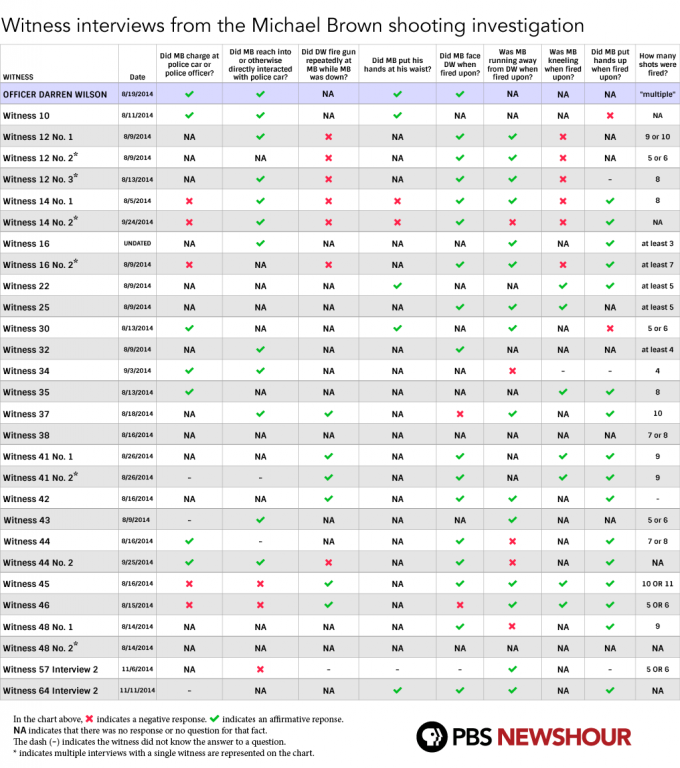
Analysis of Michael Brown shooting witnesses: 16 out of 18 say hands up when shot

by Xeni Jardin
Burly.Thurr

Since the grand jury process failed, the media is the only place to hash this out right now.

table-finalfinalup4

PBS NewsHour published this comprehensive, easy-to-understand analysis of witness statements in the not-so-grand jury proceedings over Darren Wilson's fatal shooting of Mike Brown. (more…)

01 Dec 14:50

[EMSK] Here's how you actually jump a car, and it's the perfect size to keep in your wallet.

Burly.Thurr

yeah, i messed this up this morning. got the car started on the second try, though.

01 Dec 14:40

November 30, 2014

Burly.Thurr

Oh thank god.


POW!
01 Dec 03:05

Photo

Burly.Thurr

When minaj was good. And Kanye.