Shared posts

04 Feb 14:05

Paying For It (the dislike club part II)

by Benjamen Walker

Our mini-series about the internet continues. This week we take a close look at the fundamental business model of the web – advertising. In 1993  your host was a founding member of an international monkey wrench gang that fought billboards in outer space. He recently ran into one of his old comrades in Midtown-South (Manhattan’s tech district) and discovered that his side actually lost the war. Ethan Zuckerman, the man who invented the pop up ad, admits that we must rethink the fundamentals of the web, and activist, writer, and filmmaker Astra Taylor questions whether the internet actually benefits independent creators.

toe31pic

The Dislike Club is  a story-in-progress, it will play out on the podcast over the next few weeks and then culminate December 21 on Radiotonic, from ABC RN’s Creative Audio Unit.

29 Nov 01:59

abandonedography: Some of the best footage I’ve seen filmed of...


abandonedography:

Some of the best footage I’ve seen filmed of an abandoned place. 

Postcards from Pripyat, Chernobyl

29 Nov 01:26

True color

26 Nov 01:53

Never email me again.

Burly.Thurr

For Lev. Not to Lev.


Never email me again.

24 Nov 23:19

thechristmaspatch: Hyperbole and a Half - The Motivation...

Burly.Thurr

Same.


thechristmaspatch:

Hyperbole and a Half - The Motivation Game

this is too accurate for me right now

24 Nov 21:56

No One Can Do The "OOH WAH AH AH AH" Part From That Disturbed Song

by Samer Kalaf on The Concourse, shared by Lacey Donohue to Gawker
Burly.Thurr

Not a great share, only for the "chode-rock" term.

Even if you despise Disturbed and their chode-rock anthem "Down With the Sickness," you know what it is. And you know the part at the beginning when lead singer David Draiman hoarsely yells, "OOH WAH AH AH AH." After googling the phrase—initially looking for the five-minute "endurance test"—I found this compilation of people at karaoke, struggling hard. Whoever made this: thank you.

Read more...


24 Nov 20:21

Crows playing in the snow


Crows playing in the snow

24 Nov 14:10

AOC 16" USB Monitor (Refurbished) $70 - $95

  • Model: E1649Fwu
  • Model: E1659Fwu
  • 16" 16:9 1366x768 display connects via USB
  • USB-powered, too
  • Only 1.4" thick for the cheaper one, 0.9" thick for the other one
  • The more expensive model is USB 3.0; the other one is USB 2.0
  • We don't think it makes much difference performance-wise but there you go

Holy crap, they make portable USB monitors?

Why weren't we told? We like to think we're reasonably aware of what's going on in consumer electronics. You know, since that knowledge is basically the only thing that keeps us out of the free soup line. But somehow, the very existence of portable USB monitors slipped right by us.

It's especially weird because we would have been all over these. We've all suffered the jarring discomfort of going from our nice, spacious multi-monitor desk setup to the impossibly cramped confines of a single laptop display on the road. We've all had those moments when we're this close to dumping our laptops in the nearest trash can, walking away from our careers, and descending headlong into a twilight world of pure sensual debauchery, a short, violent life of overindulgence in every degradation save one: never, ever having to work on a little laptop screen again.

OK, that last one might just be us.

The point is, USB monitors! Throw one of these slim 1366x768 babies in your backpack or suitcase. Go somewhere. Plug it into your laptop - nope, no additional power cable, it's even USB-powered. Double your screen real estate just like that. Or, dare we suggest, triple it by buying two?

With one of these by our side on our next work trip, our laptop straitjacket is a thing of the past. We'll be happy upright citizens once again. We'll find the strength to resist the siren song of squalid self-indulgence. For another month or two, anyway.

24 Nov 14:07

Interstellar SPOILERCAST - 11/18/2014

by Will Smith
Burly.Thurr

via TM. Sharing to listen later in BeyondPod.

Adam, Norm, and Will have mixed feeling about Interstellar, Christopher Nolan's latest project. Rest assured of one thing though, there will be spoilers aplenty. Enjoy!
24 Nov 04:50

How to Make Girl Scout Cookie Shots, Get Drunk

by John Farrier
Burly.Thurr

I have a buzz, so I thought I'd share: "Girl Scout Cookies—especially Thin Mints—are delicious! They do, however, have low alcohol content."

Girl Scout Cookies—especially Thin Mints—are delicious! They do, however, have low alcohol content. That’s in sharp contrast to Andrea Romano and Laura Vitto of Mashable, who created this video showing you how to make shots that taste like popular Girls Scout Cookie flavors.


(Video Link)

After making their shots, Romano and Vitto immediately consume them. So they become increasingly intoxicated through the video. Thus they follow a classical rule of videography: shoot drunk, edit sober.

-via That’s Nerdalicious!

22 Nov 00:53

Minnesota not on track to meet proposed emissions reductions

Burly.Thurr

Follow-on to the Google post about climate change yesterday. More proof that nothing is happening.

Even with its renewable energy standard and new solar law, Minnesota is not on track to meet federal emissions reductions aimed at addressing climate change, state officials said Thursday.

Minnesota would need to reduce greenhouse gas emissions by more than a third by 2030 under proposed U.S. Environmental Protection Agency rules. But the state is on track to reduce emissions only by 3 percent by then, said David Thornton, an assistant commissioner for the Minnesota Pollution Control Agency.

"The policies in place have made some difference up until now, and the major difference they're going to be making into the future is offsetting the growth that we're going to be seeing," Thornton told a group of policy makers and business representatives during a forum held by the Environmental Initiative.

That means Minnesota needs a variety of new or expanded strategies to reduce emissions, he said.

Between now and February, state agencies led by the Environmental Quality Board will work with a consultant, the Center for Climate Strategies, to analyze current emissions and determine which policy options would give the state the most bang for its buck. Environmental Initiative, a nonprofit group that builds partnerships, will organize meetings for industry, agriculture and other sectors of the economy to provide input.

Ideas like expanding the renewable energy standard, retiring coal plants and planting urban forests will be analyzed based on three criteria: expected emissions reductions, cost and job creation.

So far, it appears an expanded renewable energy law, improving energy efficiency and retiring or repowering at least one of the coal generators at Xcel Energy's Sherburne County Generating Station would give the state the biggest reductions. Thornton said even though the consultants have already come up with some estimates, the process has merely begun.

"They can come up with some good ideas but figuring out how to implement them is the big barrier," he said. "That's one of things we're looking for in the next phase of input."

22 Nov 00:35

November 20, 2014

Burly.Thurr

Still haven't read Moby Dick, but this was an excellent TL;DR.


Whee!
21 Nov 17:38

31262: Russian Arktika-class nuclear powered Icebreaker Yamal

by theburnlab
Burly.Thurr

via GN. Nuke beat.


31262:

Russian Arktika-class nuclear powered Icebreaker Yamal

21 Nov 02:57

Why Google halted its research into renewable energy

by Brad Plumer
Burly.Thurr

Today in We're-Fucked news.

Back in 2007, Google had a simple idea for addressing global warming — we just need to take existing renewable-energy technologies and keep improving them until they were as cheap as fossil fuels. And, voila! Problem solved.

That was the logic behind the company's RE-C project, which aimed to produce one gigawatt of renewable electricity for less than the price of coal. The hope was to do this within years, not decades. So the company invested in new geothermal drilling R&D and put $168 million toward Brightsource's Ivanpah solar tower in the Mojave Desert.

By 2011, however, Google decided that this energy initiative wasn't going to work out as planned and shut things down. Unlike, say, Google Glass or self-driving cars, Google wasn't interested in this particular moon shot. So what happened?

In a recent long essay at IEEE Spectrum, two Google engineers on the project — Ross Koningstein and David Fork — explain the thinking behind the closure. It's not that Google has given up on renewable energy. (The company still spends many millions of dollars buying wind energy for its servers.) Partly it's that they simply weren't on track to achieve their specific goals.

But, more interestingly, the project also made the engineers realize that their original clean-energy goal wasn't nearly ambitious enough.

'Today's renewable energy technology won't save us'

How did they figure? The two engineers calculated what would happen if Google actually achieved its dream of creating a renewable electricity source (say, geothermal or solar) that was cheaper than coal. A major breakthrough.

That would be a huge deal for climate. More and more electric utilities would switch over to this cleaner source over time. By 2050, the Google engineers' modeling suggested, US carbon-dioxide emissions would be 55 percent lower than what we're currently on pace for.

But they also found that this new technology would still be adopted too slowly to avert significant global warming — in part because the technology wouldn't be cheap enough to displace all the existing coal and gas plants out there that have already been paid for. As a result, the amount of carbon dioxide in the atmosphere would keep rising sharply (the purple line below). And note that this is a best-case scenario for Google's original dream:

Data Sources: "The Impact of Clean Energy Innovation," Google-McKinsey, 2011; "Target Atmospheric CO2: Where Should Humanity Aim?," James Hansen et al., 2008 (IEEE Spectrum)

That's why the two engineers ultimately concluded that "Today's renewable energy technologies won't save us." Clean-energy technology needs to get much, much, much better — not just so that it's competitive with natural gas and coal, but good enough that everyone will readily start switching over within the next 40 years. Here are some rough sample numbers:

Residential customers in the contiguous United States pay from $0.09/kWh to $0.20/kWh, a significant portion of which pays for transmission and distribution costs. And here we see an opportunity for change.

A distributed, dispatchable power source [i.e., something that could be installed anywhere and turned on and off whenever needed] could prompt a switchover if it could undercut those end-user prices, selling electricity for less than $0.09/kWh to $0.20/kWh in local marketplaces. At such prices, the zero-carbon system would simply be the thrifty choice.

Unfortunately, most of today's clean generation sources can't provide power that is both distributed and dispatchable. Solar panels, for example, can be put on every rooftop, but can't provide power if the sun isn't shining. If we invented a distributed, dispatchable power technology, it could transform the energy marketplace and the roles played by utilities and their customers.

So, for example, if we had incredibly cheap solar panels with batteries that could store electricity during cloudy or dark periods and power an entire home for less than current utilities can — well, everyone would rush out to buy them and there'd quickly be little need for existing coal and gas plants. Carbon pollution would drop very, very quickly.

But we're still far from that point. To get there, the new clean energy sources can't just be comparable to fossil fuels. They have to be clearly superior.

Is Google's view too pessimistic?

We're going to need more power. (Sean Gallup/Getty Images)

Now, this view of what it takes to solve global warming might seem overly pessimistic — and perhaps too Silicon Valley-centric — to some. After all, other groups like the Intergovernmental Panel on Climate Change have calculated that we can drastically cut carbon emissions with today's technologies. We'll just likely need to layer on additional policies like carbon taxes, efficiency regulations, subsidies, and so forth.

Here's the rationale for the policy-heavy view: Many clean-energy technologies aren't competitive with coal and gas and oil right now, but that's largely because fossil-fuel plants and cars can emit as much carbon-dioxide as they want without paying for the damage it causes. So what if we had, say, a carbon tax that leveled the field? Or regulations that required older, dirtier power plants to shut down early? Then clean energy would have a leg up.

Koningstein and Fork, for their part, sound pessimistic about policy. They're skeptical that governments around the world are ever going to be able to penalize fossil-fuel usage sufficiently. "Rather than depend on politicians' high ideals to drive change, it's a safer bet to rely on businesses' self interest: in other words, the bottom line." Make clean energy irresistible, and the problem will solve itself.

This harkens back to an old dispute among people thinking about how best to tackle climate change — between those who argue we need major technological revolutions to solve the problem and those who argue that existing technology plus incremental progress plus better efficiency plus the right mix of policy can curtail emissions quickly and drastically. (Obviously it's also possible to believe both things would help, but people seem to enjoy splitting into camps.)

On the question of R&D, Google's engineers ultimately settle for a bit of a hybrid view. They propose that governments and energy companies should consider a 70-20-10 rule of thumb for investing in energy:

The bulk of R&D resources could go to existing energy technologies that industry knows how to build and profitably deploy. These technologies probably won't save us, but they can reduce the scale of the problem that needs fixing. The next 20 percent could be dedicated to cutting-edge technologies that are on the path to economic viability. Most crucially, the final 10 percent could be dedicated to ideas that may seem crazy but might have huge impact.

That's a bit different from the way the US government invests, where upwards of 90 percent of energy R&D goes toward established tech and probably around 0.1 percent goes toward pie-in-the-sky stuff. (Note also that the United States, other governments, and the private sector all spend remarkably little on energy R&D in any case.)

That might not be an entirely satisfying answer — it's partly a hope that something incredible, like cheap fusion power, will come out of that 10 percent. But their essay is a good starting point for thinking about the scale of the problem.

Further reading

Solar power keeps getting cheaper — but not for the reasons you'd expect

How to solve global warming, in 7 steps

Is there a free-market solution to global warming?

20 Nov 21:05

Journey to the Center of the Earth

Burly.Thurr

Shitty. The link at the bottom goes to a russian site. You can read about it in english with google translate. Basically, it says a mine flooded with brine, and a sinkhole formed because of it. I can't really follow it, but I think it happened today. So perhaps we'll know more later. But it seems unrelated to the methane gas sink hole/explosion that happened awhile back.

19 Nov 18:14

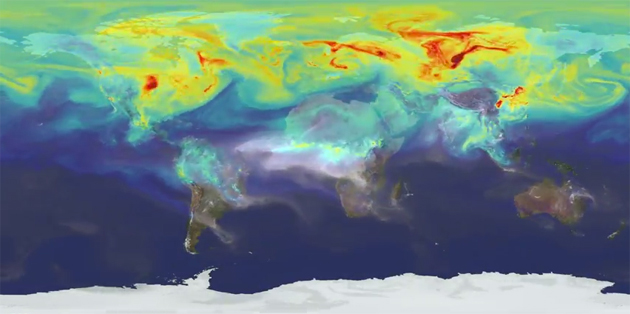
Here's what a year's worth of carbon dioxide looks like

by Jon Fingas
Burly.Thurr

It's so great to see the difference between winter and summer months. I was pretty amazed until I realized that the color scale change is on the order of +/- 10ppm. But still, good stuff.

It's easy to talk about carbon dioxide (CO2) emissions and their effect on our planet, but visualizing them? That's hard. Thankfully, NASA has stepped up to the plate with a computer model that shows how CO2 travels across Earth's atmosphere in the...

17 Nov 20:46

The truth about cast iron

by Jason Kottke

At Serious Eats, Kenji López-Alt sets the record straight about some misconceptions people have about cast iron pans.

The Theory: Seasoning is a thin layer of oil that coats the inside of your skillet. Soap is designed to remove oil, therefore soap will damage your seasoning.

The Reality: Seasoning is actually not a thin layer of oil, it's a thin layer of polymerized oil, a key distinction. In a properly seasoned cast iron pan, one that has been rubbed with oil and heated repeatedly, the oil has already broken down into a plastic-like substance that has bonded to the surface of the metal. This is what gives well-seasoned cast iron its non-stick properties, and as the material is no longer actually an oil, the surfactants in dish soap should not affect it. Go ahead and soap it up and scrub it out.

I have two cast iron pans, including this skillet I use almost exclusively for making the world's best pancakes. Although, after hearing from Kenji that vintage cast iron pans can be slight better than modern pans, I might seek a replacement on Etsy. See also how to season a cast iron pan.

Tags: cooking   food   Kenji Lopez-Alt
14 Nov 17:05

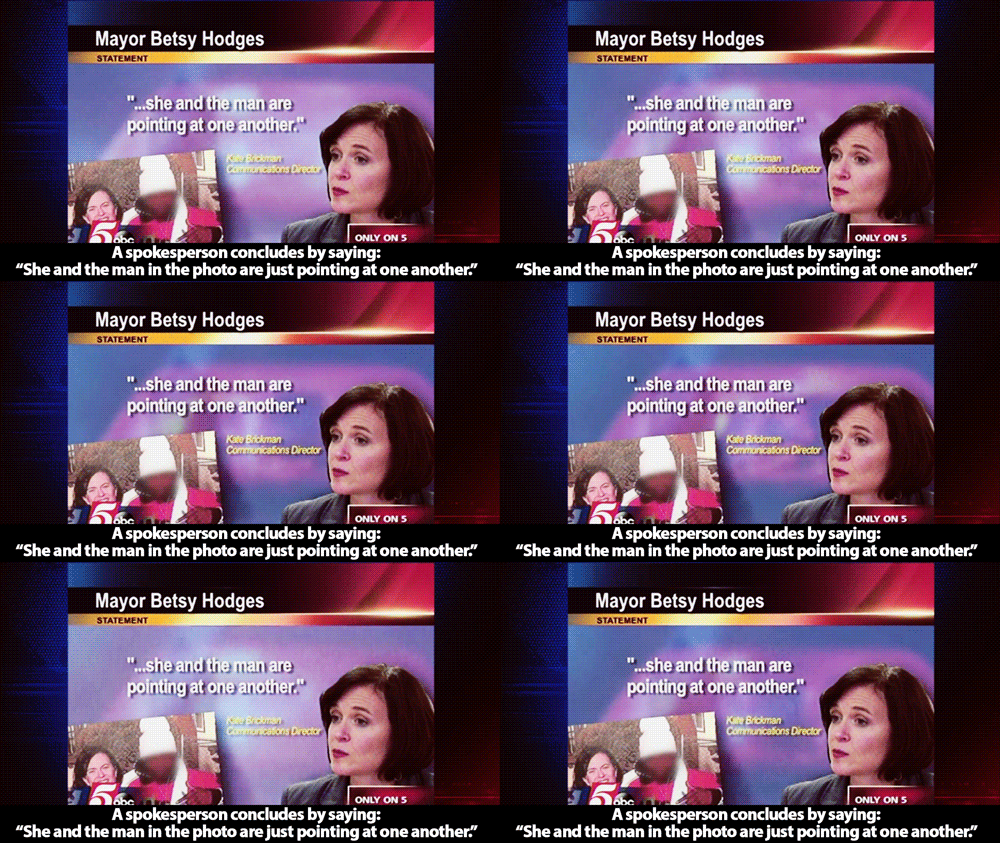
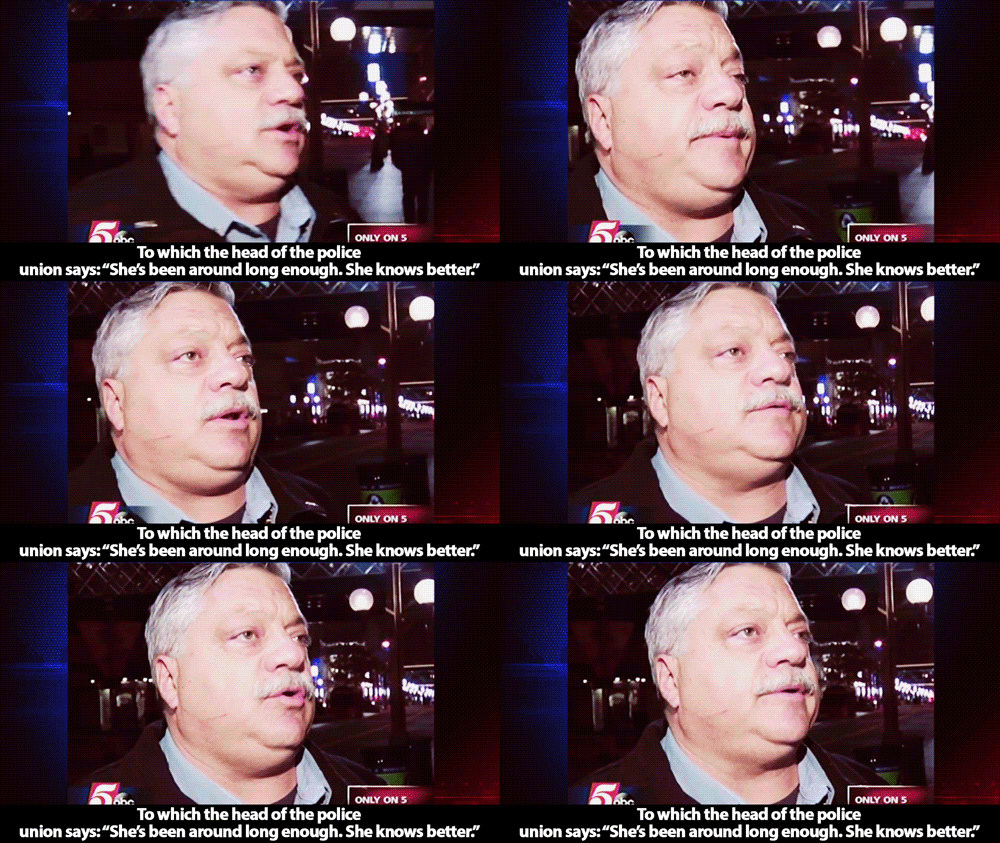
Photo

Burly.Thurr

Good summary. So embarrassed that my local news station is making national news this way.


12 Nov 00:17

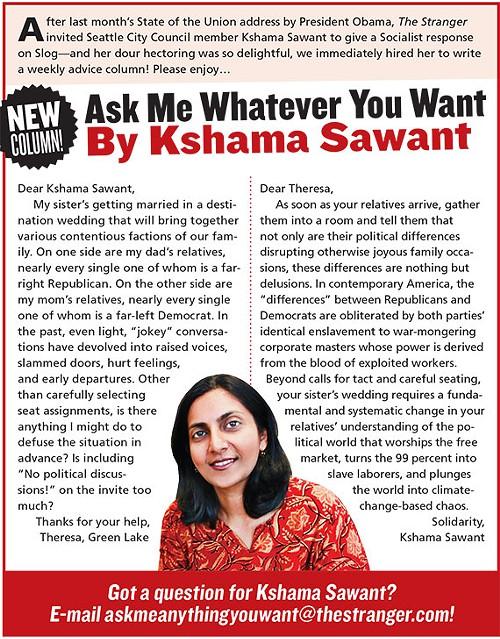
RT @crulge: let's take a moment to remember the best advice column ever written,...

by Osias Jota
Burly.Thurr

A guilty pleasure to read.

Author: Osias Jota
Source: Twitter Web Client
RT @crulge: let's take a moment to remember the best advice column ever written, from Seattle's @cmkshama http://t.co/2m84OUoVBm
11 Nov 14:50

Lost in space

Burly.Thurr

Anxiety inducing, but still cool. Try to get past the insufferable dubstep beat.

11 Nov 08:46

The Best Thinkpiece About Millennials And Potatoes

Burly.Thurr

"“To stay relevant and increase demand for potatoes,” the Board wrote, “it will be critical to understand Millennials and how potatoes fit into their lives—now and in the future.”" I learned the term "phablet" from this article.

The takeaway for American potato growers and distributors is clear: “In fact, potatoes rate highest on what’s most important to Millennials.”
11 Nov 01:59

maxistentialist: Maciej Cegłowski: In 1952, an American...

Burly.Thurr

fascinating.


maxistentialist:

Maciej Cegłowski:

In 1952, an American attaché in Moscow was innocently fiddling with his shortwave radio when he heard the voice of the American ambassador dictating letters in the Embassy, just a few buildings away. He immediately reported the incident, but though the Americans tore the walls out of the Ambassador’s office, they weren’t able to find a listening device.

When the broadcasts kept coming, the Americans flew in two technical experts with special radio finding equipment, who meticulously examined each object in the Ambassador’s office. They finally tracked the signal to this innocuous giant wooden sculpture of the Great Seal of the United States, hanging behind the Ambassador’s desk. It had been given as a gift by the Komsomol, the Soviet version of the Boy Scouts.

Cracking it open, they found a hollow cavity and a metal object so unusual and mysterious in its design that it has gone down in history as ‘The Thing’.

‘The Thing’ had no battery, no wires, no source of power at all. It was was just a little can of metal covered on one side with foil, with a long metal whisker sticking out the side. It seemed too simple to be anything.

That night the American technician slept with ‘The Thing’ under his pillow. The next day they smuggled it out of the country for analysis.

The Americans couldn’t figure out how ‘The Thing’ worked, and had to ask the British for help. After a few weeks of fiddling, the Brits finally cracked The Thing’s secret.

That little round can was a resonant cavity. If you shone a beam of radio waves at it at a particular frequency, it would sing back to you, like a tuning fork. The metal antenna was just the right length to broadcast back one of the higher harmonics of the signal.

The resonator sat right behind a specially thinned piece of wood under the eagle’s beak. When someone in the room spoke, vibrations in the air would shake the foil, slightly deforming the cavity, which in turn made the resonant signal weaker or stronger.

As the attaché discovered, you could listen to this modulated signal on a radio just like a regular broadcast. ‘The Thing’ was a wireless, remotely powered microphone. It had been hanging on the ambassador’s wall for seven years.

Today we have a name for what ‘The Thing’ is: It’s an RFID tag, ingeniously modified to detect sound vibrations. Our world is full of these little pieces of metal and electronics that will sing back to you if you shine the right kind of radio waves on them.

But for 1952, this was heady stuff. Those poor American spooks were up against a piece of science fiction.

Today I want to talk about these moments when the future falls in our laps, with no warning or consideration about whether we’re ready to confront it.

Another amazing talk by the creator of Pinboard. I first heard Maciej speak at XOXO, he blew me away. This transcript of his Webstock talk was also amazing.

Technically outside the scope of this blog, but this was way too interesting/cool not to share.

11 Nov 00:40

How many states will legalize marijuana and how soon?

Burly.Thurr

The article is here: http://www.psmag.com/navigation/politics-and-law/what-spread-same-sex-marriage-future-recreational-weed-93048/
Seems well reasoned. "So, if recreational marijuana does follow this pattern—and there is little reason to expect otherwise—we very well may see national marijuana legalization within seven years, in 2021."

How many states will legalize marijuana and how soon?
10 Nov 17:49

картинки от ВладС

Burly.Thurr

clever. not sure it's true, though.

09 Nov 23:10

What Powers the Sudden Legalization of Cannabis in the US?

by david

This week, Oregon, Alaska and Washington D.C. joined Colorado and Washington State on the list of US states to legalize or decriminalize cannabis (marijuana).

What powers this sudden and dramatic U-turn in drugs policy? Humanistic sense dawning on the authorities? The artful lobbying of the pro-campaigners? Or are local legislators just smoking some serious green?

Well, they’re definitely getting on high on one kind of green…

» See our visualisation

09 Nov 23:08

Antibiotic Resistance

by david

A lot of fear and furore around the increasing resistance of bacteria to antibiotics. We took a look at the numbers.

See our visualisation.

The datasheet has more info: http://bit.ly/KIB_Antibiotics

Taken from the forthcoming infographic mega-tome, Knowledge is Beautiful (HarperCollins, Sep 2014)
Pre-order Amazon US & UK.

08 Nov 03:54

Preliminary Benefit-Cost Assessment of Final UN Open Working Group Post-2015 Development Targets

Burly.Thurr

This article was highlighted in a recent Freakonomics Radio podcast: http://www.wnyc.org/story/fixing-world-bang-buck-edition/

This report assesses the targets in the OWG’s Final Outcome Document from 19 July 2014. This builds upon the information presented in similar documents which the Copenhagen Consensus Center released in the lead up to the 11th and 12th session of the OWG. From the first report to this one, we have updated ratings as the targets have been reformulated, and we have added new explanation and suggestions for better wording.  

MDGs

High Level Panel

  11th OWG

 12th OWG

Final

# total targets

140       →

212     →

169

# Phenomenal

13          →

27        → 

13*

# Poor

10         →

23        →

# words in all targets^

374

889

2360     →

4389    →

4369

The number of targets suggested by the Final OWG document is 169, substantially down from the 212 targets for the 12th session. However, the text is only 20 words shorter, from a total word count of 4389 to one of 4369. Thus, while the number of targets has decreased, the number of words within each target has increased almost as much. Overall, it is unlikely we can implement all these proposed interventions to reach all of these targets simultaneously, and completely. Therefore, the international development community will need to prioritize which targets to strive for first, or to devote more resources towards. This decision will rest on a number of factors, not just economics - but knowing the costs and benefits provides an important piece of information. 

Of course, the Post-2015 goals have yet to be finalized, and it is our hope this document will help UN representatives prioritize the final list of targets for replacing the Millennium Development Goals.

The assessments were put together by interviewing 32 of the world’s top economists in their respective fields. The benefits and costs do NOT solely reflect money. In line with standard welfare economics principles, all benefits and costs have been considered (such as improved health and improved environmental impacts) – which have subsequently been converted into a dollar value.

The key for assessments are:

PHENOMENAL – Robust evidence for benefits more than 15 times higher than costs
GOOD – Robust evidence of benefits between 5 to 15 times higher than costs
FAIR – Robust evidence of benefits between 1 to 5 times higher than costs
POOR – The benefits are smaller than costs or target poorly specified (e.g. internally inconsistent, incentivizes wrong activity)
UNCERTAIN – There is not enough knowledge of the policy options that could reach the target OR the costs and benefits of the actions to reach the target are not well known

08 Nov 01:27

Installation to mark the 25th anniversary of the fall of the...

Burly.Thurr

Wow that's cool, wish I could see it in person.


AP Photo/Steffi Loos


Hannibal Hanschke / Reuters


Pawel Kopczynski / Reuters


Fabrizio Bensch / Reuters


Fabrizio Bensch / Reuters


AP Photo/Steffi Loos

Installation to mark the 25th anniversary of the fall of the Berlin Wall, Lightgrenze, goes live.

07 Nov 19:10

‘Metal is Beautiful’, Hypnotic Super Slow Motion Video of Drill Creating Metal Shavings

by Brian Heater
Burly.Thurr

via GN.


“Metal is Beautiful”
is a strangely hypnotic short video by YouTube channel 1stVideoChannel that features super slow motion video of a power drill creating metal shavings. The effect is strangely hypnotic.

via Digg

07 Nov 14:02

A Really Bad Month

by Jessica Olien
Burly.Thurr

Damn.

by Jessica Olien

intro

sequence1

sequence2

sequence3

sequence4
Jessica Olien is a writer and illustrator who moves a lot.

22 Comments