Shared posts

03 Apr 16:27

rainnecassidy:ragequeen89:deducecanoe:zetsubonna:kyraneko:whatnur...

Burly.Thurr

Thank god it's good friday. Perfect for insurance fan fiction.


rainnecassidy:

ragequeen89:

deducecanoe:

zetsubonna:

kyraneko:

whatnursejack:

thewinterotter:

kyraneko:

doujinshi:

I hate that I laughed at this

"Like a good neighbor, State Farm is there," and another one appears. And dodges the downward sweep of claws, darting to the side, bouncing off the pentagram’s barriers, and tripping over the demon’s tail. "In the Vatican!" she cries out as she moves, using the State Farm Agent summoning charm to modify the situation as she was taught, and mentally thanking her trainer for expecting her to be fast enough to do it on the first incantation.

Most State Farm agents, when they run into trouble, have to get the customer to do the jingle a second time. That guy with the buffalo was lucky.

The magic takes hold, and she materializes in the aisle of St. Peter’s Basilica, still holding the demon by the tail, in the middle of Sunday morning Mass. The music clatters unprofessionally to a halt as laypeople, deacons, priests, monks, nuns, and the Pope all turn their attention to the surprised demon whose fifth course of dinner has turned, unaccountably, into a visit to one of his least favorite places on Earth.

There is chanting in Latin, and vaguely cross-shaped gestures, and clouds of incense, and the demon vanishes in a puff of smoke, whether from the efforts of the clergy or of his own volition no one can say. The Agent doesn’t wait, fleeing towards the doors and escaping in the confusion.

She gains the exit and walks, purposefully, toward Rome proper; there, she ducks into the nearest alley. A burner cell phone comes out of one of the less-used pockets of her purse, and she dials a number from memory.

"Allstate," says a smooth masculine voice after three rings.

"State Farm," she answers. "I’m calling in a favor."

"Yeah?" Interest. "What sort?"

As she talks she’s pulling out her smartphone, keying an app that was activated by the summoning, and pulling up the policyholder data that enabled the incantation to work.

"Insurance fraud," she said, and can almost hear teeth sharpening on the other end of the line. She gives him the name, the address, the policy number. "Someone needs some mayhem."

"That’s my name," the man says.

She smiles. “Someone needs all the mayhem.”

He chuckles. Slow. Evil. Even with the echoes of demonic laughter ringing in her ears, she’s impressed. “Don’t worry,” he says, almost purring.

"You’re in good hands."

OH MY FUCKING GOD I just read insurance commercial fan fiction and it was so good, bless you, I’m going to remember this day forever.

IT COMES BACK TO ME! *preens*

Part 2:

It’s not too long later—-State Farm will occasionally loan out their teleportation trick, though Heaven help anyone who tries to use it to compete with them—-and the man they call Mayhem is squatting next to a demonic circle with tacky half-dried blood under the leather soles of his shoes. Whoever dispelled the circle didn’t do a good job of it; the ring is still faintly smoldering and Mayhem has already singed his fingers on the air above it. He’s in the basement of a house with a State Farm homeowner’s policy, waiting for his partner in, erm, crime, to show up.

"Oh, good heavens." He smiles at the sound of someone hopping delicately back, then carefully tiptoeing through the mess. Demons are messy eaters, and Flo’s wearing all white.

She steps gingerly over what might be most of a femur, looks from circle to Mayhem to—-is that half a skull on the floor? “Freaky. Whaddaya need?”

"Tech," he says. "State Farm knows the homeowner summoned them, but the Agent reported at least five people present. Maybe six. She isn’t sure, what with being busy evading a demon inside a very small space with zappy walls."

Flo’s already got a—-where does she get those from anyway? a cardboard box in her hands. Mayhem watches as she unfolds it, refolds it, and ends up with something significantly bigger, shaped like a satellite dish. He tries to watch how she does it; they may be working together, but they’re still rivals and his own higher-ups will be very interested in the latest whatever-it-does that Progressive has come up with.

A blue glow lights up the concave side. Mayhem is pretty sure cardboard doesn’t work that way. Flo makes a pleased sound, and starts rattling off names, addresses, policy numbers.

Impressed, Mayhem asks, “How the fuck?” If Progressive is developing some sort of superspy technology, well, that’s kind of ominous.

Flo grins and looks embarrassed. “I, ah, have occasional dealings with a couple guys from That Other Insurance Company. One of them knows someone who knows someone who works in quality control for the Infernal Realms, and it turns out Hell monitors all their summoned manifestations for safety purposes. His contact got me the list of who was there.”

Mayhem nods. He’s had occasional encounters That Other Insurance Company himself. Bland, grey-suited, timid men who are even worse spies than they are insurance agents. “Wait, Hell has a quality control department?”

"And all other forms of administration," Flo says. "I understand it’s to generate maximum paperwork. It is a place of punishment, after all."

Mayhem actually winces. “That’s definitely hellish. All right. The Agent who called me in is flying back from Italy and should meet us in a few hours. Should give us plenty of time to plan an attack. Are they all State Farm customers?”

"Just the one," Flo replies, folding her toy up, and Mayhem watches with vague envy as it becomes a giant sword. "One Allstate, one Progressive, one Geico, two Farmers. We gonna invite anyone else to the party?" She hopes so. Mayhem’s precision strikes on any sort of insurance fraud perpetrators are the stuff of legend, and the Farmers guys would bring in enough absurdity to make it a work of art.

Mayhem’s grin is something that ought to haunt her nightmares. Instead, she finds herself matching it. “Yes,” he says. “Let’s.”

I had to explain WHY insurance fanfiction should exist to an Australian who has not seen American insurance commercials. This is fucking gold.

We live in amazing times

I don’t think I can never not reblog this.

I AM SCREAMING

03 Apr 13:13

What *exactly* is CatholicVote trying to say, here? That queers...


What *exactly* is CatholicVote trying to say, here? That queers are fierce and fabulous? Well, hey, thanks for finally noticing, y’all! 

Be the homosexual rainbow fleece-wearing wolf you want to see in the world. Or bear. Or otter. Whatever. You do you.

03 Apr 01:16

Fredo and Pidjin

Burly.Thurr

Happy Easter everyone.

02 Apr 14:24

Yes, IPA is good too. But If a bar boasts 43 beers on tap and 35...

Burly.Thurr

via bernot.


Yes, IPA is good too. But If a bar boasts 43 beers on tap and 35 are IPAs I get a little bored. And when a brewery’s Barley Wine has more IBUs than half the IPAs on tap at a bar, I get a little irritated.

02 Apr 13:20

Episode 3: When Knowledge Conquered Fear, Cosmos: A SpaceTime...

Burly.Thurr

Magical thinking beat.


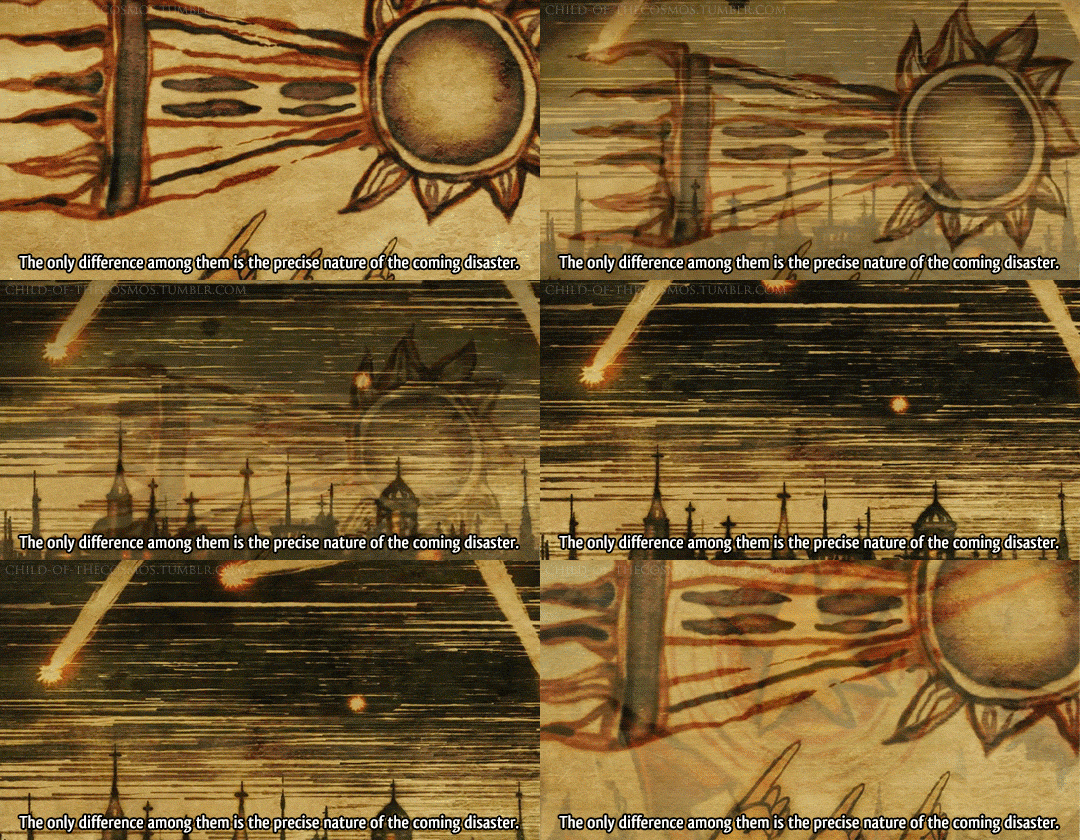
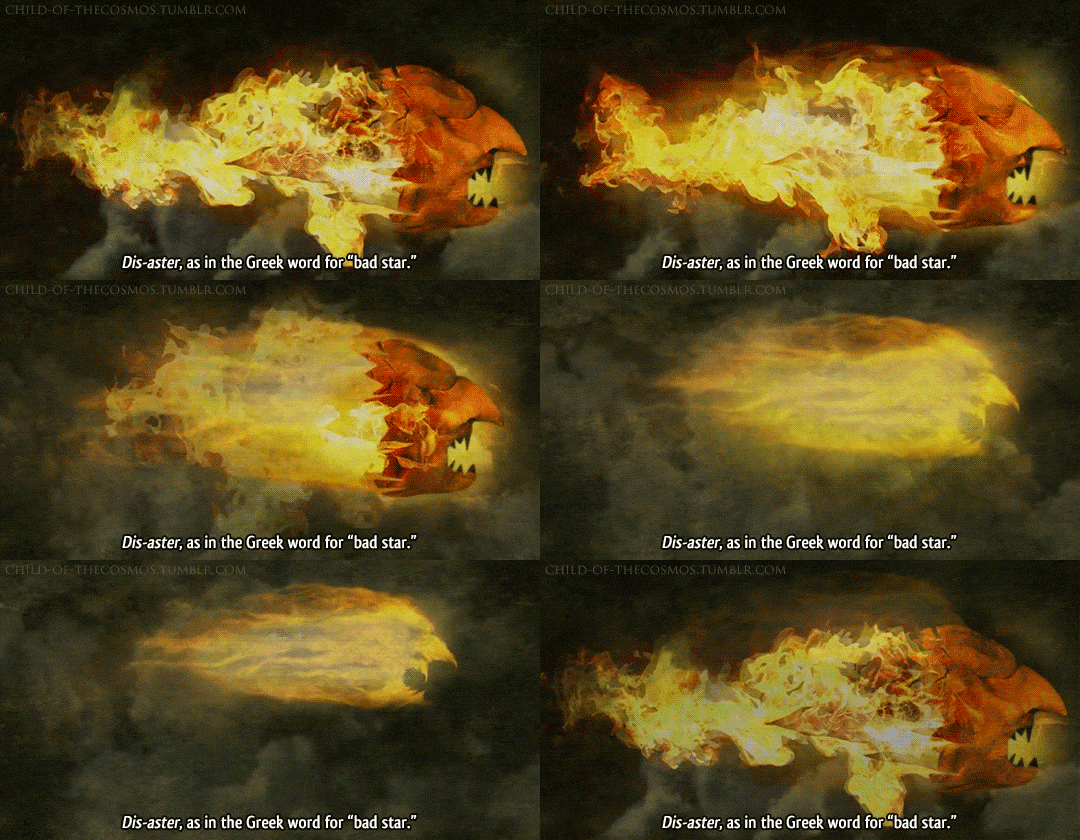
Episode 3: When Knowledge Conquered Fear, Cosmos: A SpaceTime Odyssey
02 Apr 13:16

"Were we incapable of empathy – of putting ourselves in the position of others and seeing that their..."

“Were we incapable of empathy – of putting ourselves in the position of others and seeing that their suffering is like our own – then ethical reasoning would lead nowhere. If emotion without reason is blind, then reason without emotion is impotent.””

- ― Peter Singer (via psych-quotes)
01 Apr 13:14

White girl twist

Burly.Thurr

#awkwarddance

31 Mar 21:18

sufferingsappho:fizzylimon:phampants:Artist removes 1 inch off...

Burly.Thurr

What is art. Who am i.


sufferingsappho:

fizzylimon:

phampants:

Artist removes 1 inch off the peak of England’s highest mountain; Brits want their inch back.

It is still England’s highest mountain, but Scafell Pike is ever so slightly smaller now after an artist stole the top inch of the summit to display in a gallery.
Oscar Santillan, 34, was accused of vandalism after removing the stone pinnacle of the 3,209ft Lake District peak for an exhibition in London.
Ian Stephens, managing director of Cumbria Tourism, said: “This is taking the mickey and we want the top of our mountain back.”

Brits want a single inch of mountain returned but haven’t done anything about, IDK, nearly every exhibit in the British Museum. Interesting.

Brits stole entire countries and they trippin over a rock. Fuck their mountain.

^^^THIS.

30 Mar 19:38

Amanda Knox's Ordeal Is Finally Over

by Matt Schiavenza
Burly.Thurr

A travesty of justice is right. But it's disingenuous to imply no one knows what happened to Kercher, the murder victim, when there is someone serving a 16 year sentence that started in 2008.

Image

Seven and a half years after her implication in the stabbing death of Meredith Kercher—a 21-year-old Briton studying in Perugia, Italy—turned Amanda Knox into an international media sensation, her long, lurid, public saga is finally over. On Friday, Italy's Supreme Court of Cassation overturned the conviction of Knox and Raffaele Sollecito, her then-boyfriend, in a decision that surprised both the prosecution and defense. The verdict concluded a wrenching judicial seesaw for the two defendants, who were first found guilty in 2009, then freed in 2011, and found guilty by a separate court last January.

In a statement released through her attorney, Knox expressed elation and vowed to put the ordeal behind her.

Knox and Sollecito's elation at the acquittal aside, the seven and a half year ordeal has been a travesty for everyone involved.

"I am tremendously relieved and grateful for the decision of the Supreme Court of Italy," she said. "The knowledge of my innocence has given me strength in the darkest times of this ordeal."

The discovery of Kercher's dead body on the morning of November 2, 2007, began a story whose tawdry details—and the ineptitude of the Italian justice system—overshadowed the crime itself. Much of this attention focused on Knox, who shared an apartment with Kercher and two Italian women. Described as intelligent but naive by her stepfather, Knox's behavior in the immediate aftermath of her arrest elicited widespread scorn. Photographers spotted Knox and Sollecito kissing while police investigated the crime scene. Later, she engaged in calisthenics while under questioning by the police. Knox tried to defend herself against her critics by explaining that she was under considerable shock and distress. But her behavior conveyed a sense that she was, as The Atlantic's Olga Khazan wrote last year, too "loose and bouncy" for a woman whose roommate had just been murdered.

The focus on Knox's personality intensified during the trial, when the prosecution argued that she and Sollecito had killed Kercher during a sexual experience gone awry. The allegation was later abandoned—but caused the international media, eager to capitalize on Knox's good looks, to speculate at length about the young American's sexual activities.

Knox also undermined her own case in many ways. Initially, she told investigators that she was present in the apartment the night Kercher was killed, and that the screams of the victim forced Knox to cover her ears. But Knox soon retracted this statement. Instead, she said, she and Sollecito had spent a romantic evening together at his apartment and only returned to her place the following morning, in order to take a shower. (Sollecito's apartment apparently suffered from plumbing problems.) Separately, Knox implicated Patrick Lumumba, a Congolese-born bar owner who employed the young American as a waitress, in the crime. Perugia police soon cleared Lumumba of wrongdoing, but Knox came under investigation for calumny.

These distractions were exacerbated by sloppy police work. According to a 2011 Rolling Stone profile by Nathaniel Rich, the authorities who initially arrived at Kercher and Knox's apartment were junior-level "postal policemen" who failed to clear the crime scene of bystanders and handled forensic evidence without care. The key physical evidence implicating Sollecito—a bra clasp of Kercher's containing the Italian's DNA—was not found until seven weeks after the murder.

Knox's slander of Lumumba, meanwhile, came after hours of interrogation in Italian, a language she could barely speak and for which she was not provided an interpreter. (Selene Nelson, writing in Salon, disputes this account.) Her statement was deemed inadmissible during her murder trial, but, in an Italian peculiarity, was included in a slander suit brought by Lumumba that later merged with other charges against Knox. Italian prosecutors even persisted after another man, Rudy Guede, was separately convicted in Kercher's murder. Guede, an Ivorian immigrant, was found guilty in 2008 and is now serving a 16-year prison sentence.

Knox and Sollecito's elation at the acquittal aside, the seven-and-a-half-year ordeal has been a travesty for everyone involved. Knox and Sollecito spent nearly four years in prison. Patrick Lumumba has not received any restitution after Knox's false implication of his guilt, even though her statement was made under duress. The ordeal focused intense media attention on the personal life of a young woman who blundered her way into a sensational murder. The media circus surrounding the case has caused distress for Knox and for Sollecito, who told the Italian press he has claimed difficulty in finding a job.

But most tragically, the attention paid to Knox has detracted from the individual most deserving of it: Meredith Kercher. While Knox and Sollecito now have an opportunity to rebuild their lives, Kercher's grieving relatives are no closer to finding out what happened to their daughter on the last night of her life.


30 Mar 19:21

Photo


30 Mar 17:36

The US only has two icebreakers. That may be a problem if the Arctic keeps melting.

Burly.Thurr

Russia has 17 ice breakers while the US has 2. It just made me realize how much more area and people Russia has to deal with administratively. No wonder they struggle with admin, even with "talented leaders" we all "know and love." That russian nuclear powered ice breaker is hott, tho.

The US Coast Guard Cutter Polar Star in Seattle moments before the reactivation ceremony in 2010. (US Coast Guard/Flickr)

Here's one unexpected consequence of global warming: As the planet gets hotter and the frozen Arctic keeps melting, the United States may end up needing more icebreakers.

Yes, icebreakers.

In a recent policy brief, Shiva Polefka, an analyst at the Center for American Progress, made the case that the US Coast Guard was woefully short of heavy icebreakers and unprepared for a warmer Arctic, where it would have to deal with everything from oil spills to stranded ships. For now, the US government has just two working icebreakers — far fewer than Russia or Canada:

icebreakers-webfig.0.png

(Center for American Progress)

In recent years, politicians in Alaska have been warning about this very problem. "Without access to heavy icebreakers, we will be unable to adapt to historic changes in the Arctic," Rep. Don Young (R-AK) has said.

So is there really an urgent icebreaker gap? Or is this all overblown?

As the world warms, the US Coast Guard will have to deal with a busier Arctic

159226313.0.jpg

Salvage teams conduct an assessment of Shell's Kulluk drill barge on January 9, 2013 in Kodiak Island's Kiliuda Bay in Alaska. An oil rig which ran aground in Alaska has been refloated and is being towed to a nearby harbor, with no signs of pollution seen, officials said on January 7. (TIM AUBRY/AFP/Getty Images)

Back when the Arctic Ocean was covered in ice year-round, this simply wasn't an issue. Hardly anyone was looking for oil or navigating ships up in this forbidding region. So the US Coast Guard didn't have much to do here.

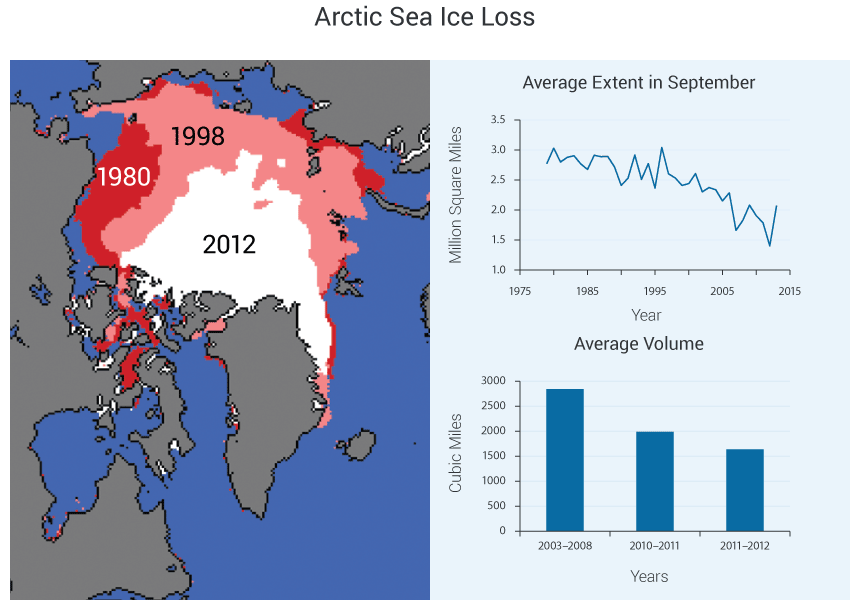
But that's now changing. The Arctic is heating up faster than any region on Earth, and the extent of sea ice has been declining 3 to 4 percent per decade since 1979. In the summer months, especially, the Arctic Ocean is opening up:

CS_arctic-sea-ice-loss_V2.0.png

(National Climate Assessment)

Suddenly, lots of companies — and countries — are moving in. Royal Dutch Shell is pursuing oil and gas exploration in the Beaufort and Chukchi Seas north of Alaska. Shell's first exploratory drilling campaign in 2012 was a disaster, but the Interior Department is expected to approve further forays this summer. Arctic fishing and shipping are also expanding, with 53 ships traversing Russia's Arctic last summer.

The Coast Guard is in charge of the emergency response to oil spills

If that traffic keeps growing, it could be a big headache for the US Coast Guard, which is legally tasked with enforcing fishing and maritime laws and helping ships in distress.

The Coast Guard is also, crucially, responsible for handling the emergency response to any offshore oil spills. That could become an issue in the Arctic. Shell, for one, is hoping one day to build permanent oil platforms in Alaska's Chukchi Sea. If that happened, the Coast Guard would have to be able to conduct year-round emergency and spill response in icy and treacherous conditions.

The Coast Guard currently has just one — aging — heavy icebreaker

Oddly enough, Polefka argues, icebreakers actually become more crucial in a warmer world. The Arctic's permanent sea ice is receding and being replaced by much more volatile perennial ice.

"Today, winter sea ice now forms and recedes over a much larger proportion of the Arctic Ocean," Polefka notes. "In addition, loose icebergs and pack ice can be quickly transported long distances and jam into thick ridges and treacherous, hull-crushing floes."

Currently, the US has little capacity to move through this ice. The country's only functional heavy icebreaker — the US Coast Guard Cutter Polar Star — was commissioned in 1976, recently went through major repairs, and can likely only last until 2020 or so. Another medium icebreaker, the Polar Sea, has been disabled and sitting in a Seattle port since 2010. Both are well past their intended lifespan. There's also a smaller icebreaker, Healy, which is mostly used for supporting scientific research.

Meanwhile, back in 2013, the Department of Homeland Security suggested it would potentially need at least six icebreakers "to adequately meet mission demands in the high latitudes." (That's three heavy icebreakers, three medium.) The Coast Guard requested a new icebreaker in its FY2013 budget, but that proposal has largely languished in Congress.

But are more icebreakers really necessary?

138397514.0.jpg

A Russian nuclear powered icebreaker Yamal traveling through the Arctic Ocean on its way to the North Pole. (Photo by Nery Ynclan/NBC/NBCU Photo Bank via Getty Images)

That said, there's room to wonder whether demand for icebreakers will really grow so fast in the near future.

As one recent piece in the Economist explores, the predicted boom in Arctic activity may grow less quickly than once expected. Low oil prices are likely to dissuade many companies from fossil-fuel exploration in dangerous icy regions. Companies like Total and Statoil have already been pulling out of the region. What's more, the unreliability of Arctic sea ice may dissuade many container ships from using northern routes, even if they are slightly faster.

A new heavy icebreaker would cost roughly $1 billion

There's also the vexing question of cost. The Congressional Research Service notes that acquiring a new heavy icebreaker would have a price tag of between $900 million and $1 billion. The Coast Guard's entire 2016 budget request for acquisition is just $1.01 billion. So any money would likely have to come from the Department of Defense's budget. Alternatively, Rep. Young has put forward bills to lease icebreakers from private firms, and some Alaska officials have pondered whether the state might help chip in.

That may explain why some people have been now making the national security case for icebreakers. The US Navy, for one, pointed out in its recent "Naval Operations Concept" report that, in the case of an armed standoff in the Arctic, the Coast Guard would be in charge of guiding warships through the ice. Meanwhile, Polefka points out that Russia now has 14 Arctic-ready icebreakers and is building 3 more.

So how big a concern is this? Some experts have long been skeptical that the Arctic is going to be rife with conflict as it opens up. The eight nations that sit inside the Arctic Circle — the US, Canada, Russia, Greenland, Iceland, Finland, Norway, and Sweden — are already working together through the Arctic Council, a forum that has been signing treaties on everything from cleaning up oil spills to search-and-rescue missions.

There are occasionally tensions within these forums — last year, the US and Canada sent a junior delegation to Russia, which was seen as a snub. But, for now at least, cooperation has mostly prevailed. If that persists, it may be harder to make the national security case for more icebreakers.

Further reading

-- The Congressional Research Service has an in-depth report on the various debates in Congress over how and whether to fund a new icebreaker.

-- An overview of the melting Arctic and some of the issues it raises

29 Mar 21:58

Photo

Burly.Thurr

There is a god beat.


27 Mar 14:05

Photo


26 Mar 20:24

And Now, A Little Cheerful News...

by driftglass
Burly.Thurr

@CC. Does this excite you? I have not read the book.


Steve Loves the ’80s: Why It Makes Perfect Sense That Spielberg Is Bringing ‘Ready Player One’ to the Big Screen

As reported by Deadline, semi-well-known movie director Steven Spielberg — auteur of such cult art-house flicks as JawsE.T. the Extra-Terrestrial, and Saving Private Ryan — has signed on to direct the film version of Ernest Cline’s 2011 video-game dystopia novel Ready Player One. It’s a sublime pairing of director and source material for several reasons, not the least of which is that this marks, as far as I can tell, the first time in history that a book that mentions a particular filmmaker has been adapted for the screen by said filmmaker. And if it’s not the first time, such an event is at least exceedingly rare. I mean, I Googled it and asked two very knowledgeable people, and they couldn’t remember such a thing having happened before.
Ready Player One is set in a near-future, economically destitute, ecologically ruined United States. The only escape from the drab and dire existence of daily life is the OASIS, a fully realistic and massive online realm encompassing platforms for every conceivable human activity, with the exception of eating and excreting...

Ready Player One was one of the, well, funnest SF novels I had read in a long time.  It has all the elements I loved about golden age SF -- big ideas, terrific pacing, epic sweep, vile villains, underdog heroes -- and the humane, non-Pollyannish, open-heartedness I loved about some of the best of the New Wave SF from the 60s and 70s.  

And unlike some unfilmable SF epics, RPO was made for the big screen, and Speilberg was made to put it there.


driftglass
26 Mar 12:25

Ben and Jerry’s, Amanda McCall

Burly.Thurr

Ready for Rocky Roadham.


Ben and Jerry’s, Amanda McCall

25 Mar 20:26

Squirrel Plan

Burly.Thurr

Magical thinking as harm beat.

[Halfway to the Sun ...] Heyyyy ... what if this BALLOON is full of acorns?!
25 Mar 02:06

exactlywhatiwasthinking:Rock on cacti.Rock on.


exactlywhatiwasthinking:

Rock on cacti.
Rock on.

24 Mar 19:03

Photo

Burly.Thurr

Who needs a drink?


24 Mar 02:14

Consolation for Life’s Darkest Hours: 7 Unusual and Wonderful Books that Help Children Grieve and Make Sense of Death

by Maria Popova
Burly.Thurr

These look amazing.

From Japanese pop-up magic to Scandinavian storytelling to Maurice Sendak, a gentle primer on the messiness of mourning and the many faces and phases of grief.
“If you are protected from dark things,” Neil Gaiman said in the context of his fantastic recent adaptation of the Brothers Grimm, “then you have no protection of, knowledge of, or understanding of dark things when they show up.” Maurice Sendak was equally adamant about not shielding young minds from the dark. Tolkien believed that there is no such thing as “writing for children” and E.B. White admonished that kids shouldn’t be written down to but written up to. In her wise reflection on the difference between myth and deception, Margaret Mead asserted that “children who have been told the truth about birth and death will know … that this is a truth of a different kind.”

And yet we hardly tell children — nor ourselves — those truths. Half a century after children’s literature patron saint Ursula Nordstrom lamented that “some mediocre ladies in influential positions are actually embarrassed by an unusual book,” most books for young readers still struggle to validate children’s darker emotions and make room for difficult, complex, yet inescapable experiences like loss, loneliness, and uncertainty.

Here are some proudly unusual books addressing these all too common yet commonly shirked emotional realities.

1. MY FATHER’S ARMS ARE A BOAT
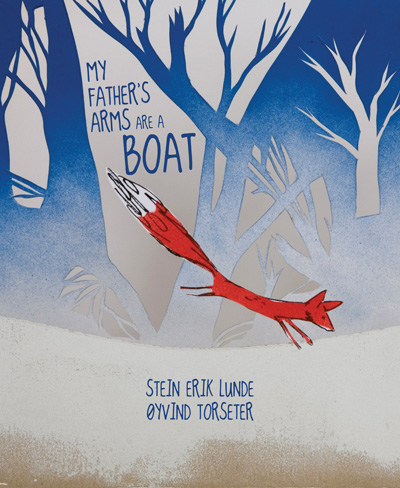
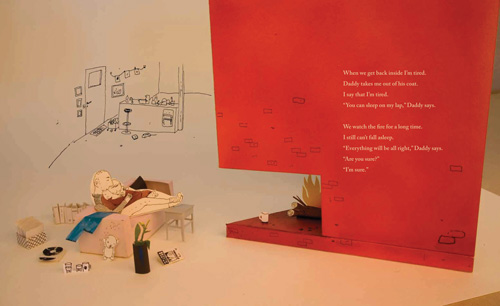
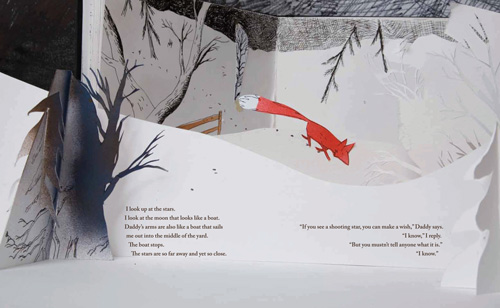
For more than a decade, Brooklyn-based Enchanted Lion — an independent one-woman children’s book powerhouse — has been churning out some of the bravest and most sensitive picture-books of our time, championing foreign writers and artists who create layered universes of experience outside the unimaginative bounds of the pantheon. Among them is My Father’s Arms Are a Boat (public library) by writer Stein Erik Lunde and illustrator Øyvind Torseter (of The Hole fame), translated by Kari Dickson.

This tender Norwegian gem tells the story of an anxious young boy who climbs into his father’s arms seeking comfort on a cold sleepless night. The two step outside into the winter wonderland as the boy asks questions about the red birds in the spruce tree to be cut down the next morning, about the fox out hunting, about why his mother will never wake up again. With his warm and comforting answers, the father watches his son make sense of this strange world of ours, where love and loss go hand in hand.

Above all, it is story about the quiet way in which boundless love and unconditional assurance can embolden even the heaviest of spirits to rise from the sinkhole of anxiety and anguish.

Lunde, who also writes lyrics and has translated Bob Dylan into Norwegian, is a masterful storyteller who unfolds incredible richness in few words. Meanwhile, Torseter’s exquisite 2D/3D style combining illustration and paper sculpture, reminiscent of Soyeon Kim’s wonderful You Are Stardust, envelops the story in a sheath of delicate whimsy.

2. THE FLAT RABBIT

When death comes and brings grief with it, as Joan Didion memorably put it, it’s “nothing like we expect it to be.” What we need isn’t so much protection from that engulfing darkness as the shaky comfort of understanding — a sensemaking mechanism for the messiness of loss.

That’s precisely what Faroese children’s book author and artist Bárður Oskarsson does in The Flat Rabbit (public library) — a masterwork of minimalist storytelling that speaks volumes about our eternal tussle with our own impermanence.

The book, translated by Faroese language-lover Marita Thomsen, comes from a long tradition of Scandinavian children’s books with singular sensitivity to such difficult subjects — from Tove Jansson’s vintage parables of uncertainty to Stein Erik Lunde’s Norwegian tale of grief to Øyvind Torseter’s existential meditation on the meaning of something and nothing.

The story, full of quiet wit and wistful wonder, begins with a carefree dog walking down the street. Suddenly, he comes upon a rabbit, lying silently flattened on the road. As the dog, saddened by the sight, wonders what to do, his friend the rat comes by.

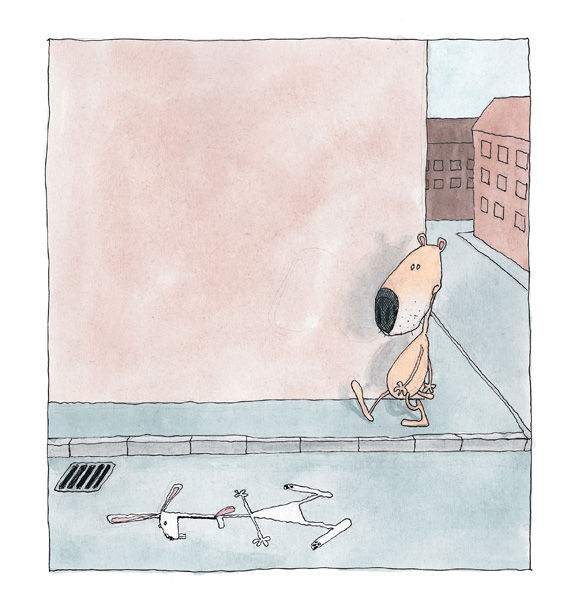
“She is totally flat,” said the rat. For a while they just stood there looking at her.

“Do you know her?”

“Well,” said the dog, “I think she’s from number 34. I’ve never talked to her, but I peed on the gate a couple of times, so we’ve definitely met.”

The two agree that “lying there can’t be any fun” and decide to move her, but don’t know where to take her and head to the park to think.

The dog was now so deep in thought that, had you put your ear to his skull, you would have actually heard him racking his brain.

Embedded in the story is a subtle reminder that ideas don’t come to us by force of will but by the power of incubation as everything we’ve unconsciously absorbed clicks together into new combinations in our minds. As the dog sits straining his neurons, we see someone flying a kite behind him — a seeming aside noted only in the visual narrative, but one that becomes the seed for the rabbit solution.

Exclaiming that he has a plan, the dog returns to the scene with the rat. They take the rabbit from the road and work all night on the plan, hammering away in the doghouse.

In the next scene, we see the rabbit lovingly taped to the frame of a kite, which takes the dog and the rat forty-two attempts to fly.

With great simplicity and sensitivity, the story lifts off into a subtle meditation on the spiritual question of an afterlife — there is even the spatial alignment of a proverbial heaven “above.” It suggests — to my mind, at least — that all such notions exist solely for the comfort of the living, for those who survive the dead and who confront their own mortality in that survival, and yet there is peace to be found in such illusory consolations anyway, which alone is reason enough to have them.

Mostly, the story serves as a gentle reminder that we simply don’t have all the answers and that, as John Updike put it, “the mystery of being is a permanent mystery.”

Once the kite was flying, they watched it in silence for a long time.

“Do you think she is having a good time?” the rat finally asked, without looking at the dog.

The dog tried to imagine what the world would look like from up there.

“I don’t know…” he replied slowly. “I don’t know.”

The Flat Rabbit was one of the best children’s books of 2014.

3. DAVEY MCGRAVY

If grief is so Sisyphean a struggle even for grownups, how are tiny humans to handle a weight so monumental once it presses down? Poet David Mason offers an uncommonly comforting answer in Davey McGravy (public library) — a lyrical litany of loss for children of all ages. Across a series of poems, accompanied by early-Sendakesque etchings by artist Grant Silverstein, we meet a little boy named Davey McGravy living in the tall-treed forest with his father and brothers. A few tender verses in, we realize that Davey is caught in the mire of mourning his mother.

Without invalidating the deep melancholy that has set in, Mason makes room for the mystery of life and death, inviting in the miraculous immortality of love. With great gentleness, he reminds us that whenever we grieve for someone we love, we grieve for our entire world, for the entire world; that whenever one grieves, the whole world grieves.

THE KITCHEN

He walked to where his father stood
and hugged him by a leg
and wept like the babe he used to be
in the green house by the lake

He wept for the giants in the woods
for the otter that swam in the waves.
He wept for his mother in the fog
so far away.

And then he felt a hand,
a big hand in his hair.
“It’s Davey McGravy,” his father said.
“I’m glad you’re here.”

“Davey McGravy,” he said again,
“How’s that for a brand new name?
Davey McGravy. Not so bad.
I like a name that rhymes.”

And there was his father on his knees
holding our boy in his arms.
And Davey McGravy felt the scratch
of whiskers and felt warm.

“Nobody else has a name like that.
It’s all your own.
Davey McGravy. Davey McGravy.
You could sing it in a song.

And then his father kissed him,
ruffled his hair and said,
“Supper time, Davey McGravy.
Then it’s time for bed.”

TO LOVE

May I call you Love?

Very well, then, you are Love,
and this is a tale about a boy
named Davey.

Never mind the rest of his name.
You need only know that he was born
in the land of rain
and the tallest of tall trees —

great shaggy cedars like the boots
of giants covered in green,
and where the giants had gone
no one could ever tell.

Only their boots remained
on the wet green grass,
surrounded by ferns on the shore
of a long, cold, windy lake.

That’s where Davey was born, Love.
That’s where you must imagine him,
a wee squall of tears and swaddling,
a babe, as you were too a babe,

with parents and the whole canoe,
the whole catastrophe
we call a family —
the human zoo.

Only a rare poet can merge the reverence of Thoreau with the irreverence of Zorba the Greek to create something wholly unlike anything else — and that is what Mason accomplishes in Davey McGravy.

4. WE ARE ALL IN THE DUMPS WITH JACK AND GUY
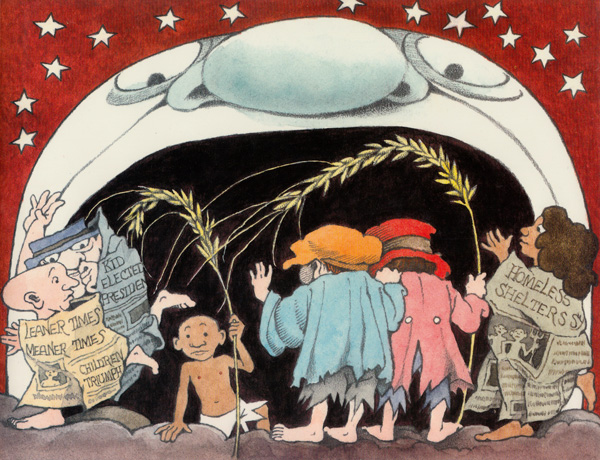
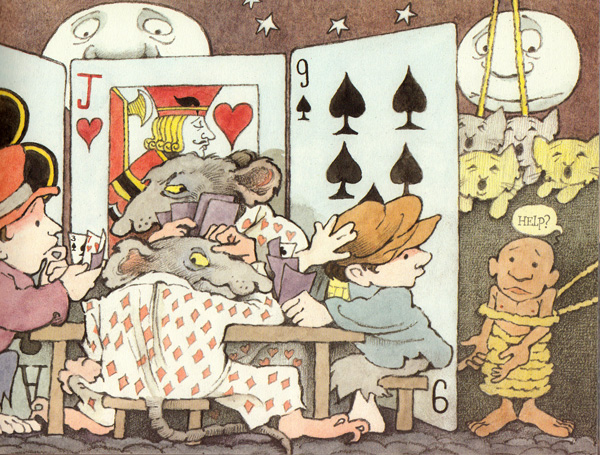
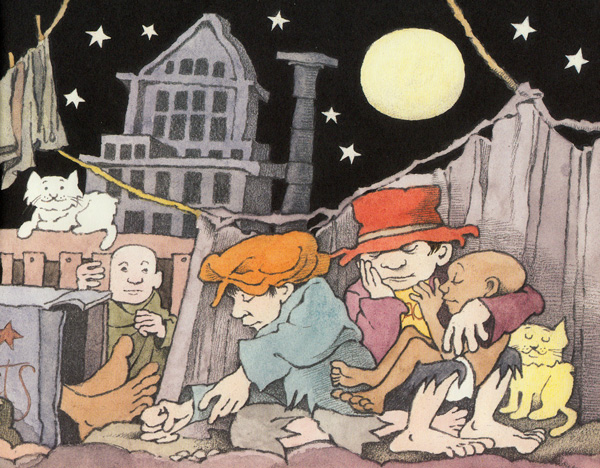
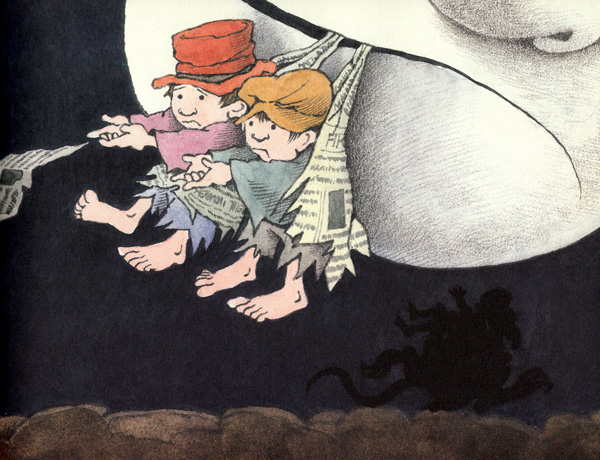
The 1993 masterwork We Are All in the Dumps with Jack and Guy (public library), which I’ve covered extensively here, is the darkest yet most hopeful book Maurice Sendak ever created, as well as one of his most personal. It’s an unusual fusion of two traditional Mother Goose nursery rhymes — “In the Dumps” and “Jack and Gye” — reimagined and interpreted by Sendak’s singular sensibility, and permeated by many layers of cultural and personal subtext.

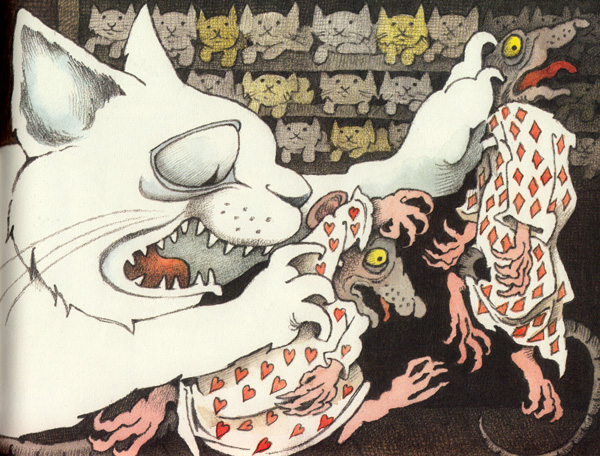
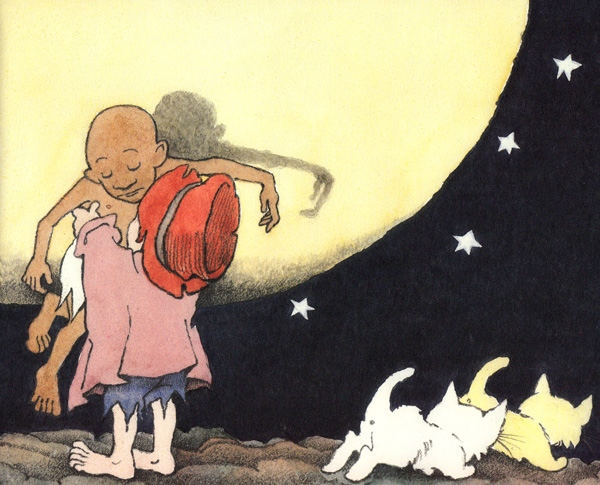
On a most basic level, the story follows a famished black baby, part of a clan of homeless children dressed in newspaper and living in boxes, kidnapped by a gang of giant rats. Jack and Guy, who are strolling nearby and first brush the homeless kids off, witness the kidnapping and set out to rescue the boy. But the rats challenge them to a rigged game of bridge, with the child as the prize. After a series of challenges that play out across a number of scary scenes, Jack and Guy emerge victorious and save the boy with the help of the omniscient Moon and a mighty white cat that chases the rats away.
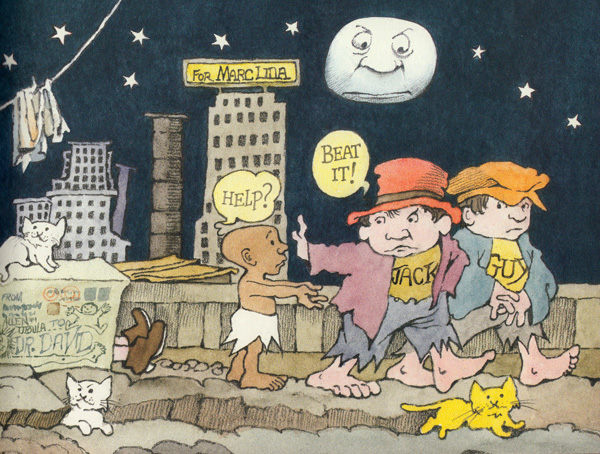
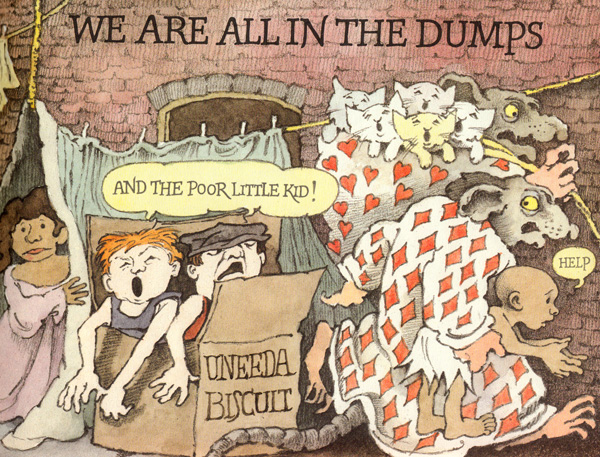
Created at the piercing pinnacle of the AIDS plague and amid an epidemic of homelessness, it is a highly symbolic, sensitive tale that reads almost like a cry for mercy, for light, for resurrection of the human spirit at a time of incomprehensible heartbreak and grimness. It is, above all, a living monument to hope — one built not on the denial of hopelessness but on its delicate demolition.
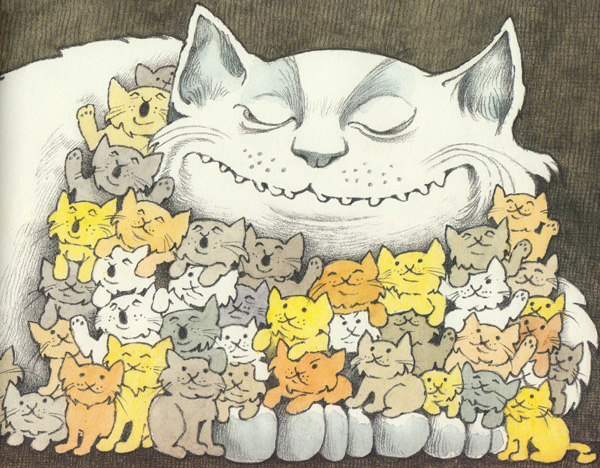
But the book’s true magic lies in its integration of Sendak’s many identities — the son of Holocaust survivors, a gay man witnessing the devastation of AIDS, a deft juggler of darkness and light.
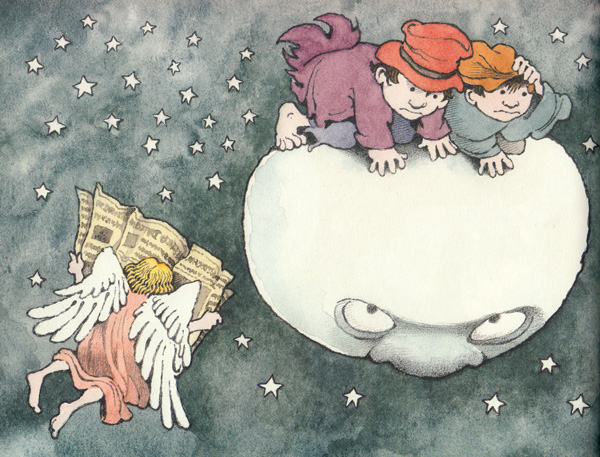
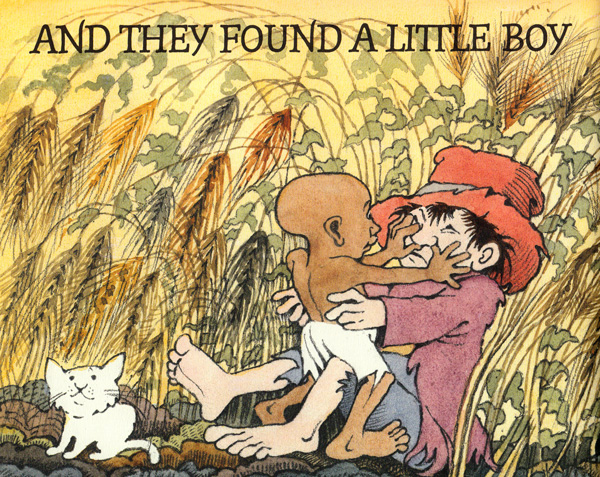
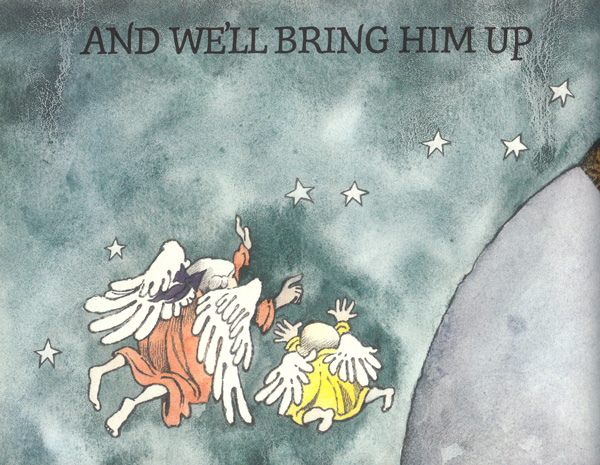
Jack and Guy appear like a gay couple, and their triumph in rescuing the child resembles an adoption, two decades before that was an acceptable subject for a children’s book. “And we’ll bring him up / As other folk do,” the final pages read — and, once again, a double meaning reveals itself as two characters are depicted with wings on their backs, lifting off into the sky, lending the phrase “we’ll bring him up” an aura of salvation. In the end, the three curl up as a makeshift family amidst a world that is still vastly imperfect but full of love.
We are all in the dumps
For diamonds are thumps
The kittens are gone to St. Paul’s!
The baby is bit
The moon’s in a fit
And the houses are built
Without walls

Jack and Guy
Went out in the Rye
And they found a little boy
With one black eye
Come says Jack let’s knock
Him on the head
No says Guy
Let’s buy him some bread
You buy one loaf
And I’ll buy two
And we’ll bring him up
As other folk do

In many ways, this is Sendak’s most important and most personal book. In fact, Sendak would resurrect the characters of Jack and Guy two decades later in his breathtaking final book, a posthumously published love letter to the world and to his partner of fifty years, Eugene Glynn. Jack and Guy, according to playwright Tony Kushner, a dear friend of Sendak’s, represented the two most important people in the beloved illustrator’s life — Jack was his real-life brother Jack, whose death devastated Sendak, and Guy was Eugene, the love of Sendak’s life, who survived him after half a century of what would have been given the legal dignity of a marriage had Sendak lived to see the dawn of marriage equality. (Sendak died thirteen months before the defeat of DOMA.)

All throughout, the book emanates Sendak’s greatest lifelong influence — like the verses and drawings of William Blake, Sendak’s visual poetry in We Are All in the Dumps with Jack and Guy is deeply concerned with the human spirit and, especially, with the plight of children. See more of it here.

5. LOVE IS FOREVER

In Love is Forever (public library), writer Casey Rislov, who holds a master’s degree in elementary education and has an intense interest in special needs, and artist Rachel Balsaits unpack the complexities of loss with elegant simplicity.

The sweet verses and tender illustrations tell the story of Little Owl, who loves her Grandfather Owl very much. With the help of her parents and baby brother, Little Owl processes the profound sadness over her grandfather’s death by learning to keep his love alive forever.

Our love is a gift, a treasure to hold,
a story in our hearts forevermore.

This gift of love we have been given
is one that is pure, constant and sure.

The final pages feature a short guide for parents and teachers to the basic psychological phenomena that the mourner experiences and how to address those in children.

6. NICOLAS

Nicolas (public library), the debut of Quebecois cartoonist Pascal Girard, is a kind of children’s book for grownups chronicling the many faces and phases of grief in a series of autobiographical sketches that unfold over the decades since the childhood death of Girard’s younger brother, Nicolas. With great subtlety, honesty, and unsentimental sensitivity, he explores the multitude of complex emotions — sadness, numbness, restlessness, anxiety, even boredom, in Kierkegaard’s sense of existential emptiness — and their disorienting nonlinear flow.

From the confusing first days after Nicolas’s death from lactic acidosis in 1990, to Girard’s teenage years awkwardly telling kids in high school about his loss, to life as an adult paralyzed with dread over having a child of his own on account of everything that might go wrong, this moving visual narrative is at once utterly harrowing and tenaciously hopeful, told with gentle humor and great humanity.

Woven throughout the deeply personal story are the common threads of mourning, universal to the human experience — how we cling to the illusion that understanding the details of death would make processing its absoluteness easier, how we channel our restlessness into an impulse to do something (there is Girard as a boy, fundraising for lactic acidosis research in his neighborhood; there he is as a teenager, numbing the unprocessed grief with drugs), how bearing witness to the mourning of others rekindles our own but also makes more deeply empathetic (Nicolas, one realizes midway through the book, died exactly eleven years before the 9/11 attacks, the news of which resurfaces Girard’s grief as he is bowled over with empathy for the tragedy of others), and most of all how “the people we most love do become a physical part of us, ingrained in our synapses.”

What emerges is the elegant sidewise assurance that while grief never fully leaves us, we can be okay — more than that, in the words of Rilke, we can arrive at the difficult but transformative understanding that “death is our friend precisely because it brings us into absolute and passionate presence with all that is here, that is natural, that is love.”

7. LITTLE TREE

Pop-up books have a singular magic, but even the pioneering vintage “interactive” picture-books of Italian graphic designer Bruno Munari can’t compare to the beauty, subtlety, and exquisite elegance of those by Japanese graphic designer and book artist Katsumi Komagata.

When his daughter was born in 1990, Komagata expanded his graphic design studio, One Stroke, into publishing and began making extraordinary picture-books — including some particularly thoughtful and beguiling masterpieces for children with disabilities, from tactile pop-up gems to sign-language stories.

In 2008, Komagata released Little Tree (public library) — a most unusual and immeasurably wonderful story tracing the life-cycle of a single tree as it explores, with great subtlety and sensitivity, deeper themes of impermanence and the cycle of all life.

I received this delicate treasure as a gift from a dear friend, who had met Komagata at the Guadalajara International Book Fair. The book, she said, was inspired by a young child struggling with making sense of life and death after the loss of a beloved father, one of Komagata’s own dear friends.

On each spread of this whimsical trilingual story — told in Japanese, French, and English — a different stage of the tree’s growth unfolds, beginning with the tiny promise of a seedling poking through the snow.

No one notices such a small presence … be still here in the snow

Slowly, it grows into the recognizable shape of a tree and makes its way through the season — shy leaves greet the world in spring, a lush crown bathes in summer’s sunshine and turns a warm yellow, then a glowing red, as autumn embraces it.

A family of birds packs its nest, preparing to fly away for the winter.

When winter descends — that philosophical staple of intelligent children’s books — the mood darkens.

Clouds cover the sky
The wind blows hard, almost breaking the branches
Sheets of rain fill the darkness … be still here in the dark

But spring eventually returns, and the whole cycle repeats and repeats, until the tree grows “tall enough to look around when at the beginning it was too small and everything was big.”

Indeed, the book is very much a study in perspective — the existential through the spatial — as the tree’s height increases and its shadow shifts. With his gentle genius, Komagata casts the shadows of all peripheral characters and objects — a street lamp, a man walking his dog, a bird — not from the perspective of the reader but from that of the tree, appearing upside-down on the page. (To capture Komagata’s intended vignettes, I photographed the book from the top of the page facing down, following the tree’s viewpoint.)

And so the cycle of life continues — a new crow takes the nest built by last year’s bird, and as it observes these rhythms, the tree’s “point of view keeps changing.”

The man who lost a friend lays a flower down
It can’t be helped … be still here

But as wistful as the story is, the book is ultimately optimistic — a beautiful allegory for the same notion found in Rilke’s philosophy of befriending death in order to live more fully. At the end, the seed spurs a new turn of the cycle of life, going back to the beginning.

The seed was carried somewhere unknown
Surely it will exist for someone even though no one notices such a small presence at the beginning

* * *

For a grownup counterpart, see Meghan O’Rourke’s moving memoir of learning to live with loss, Anne Lamott on grief and gratitude, Atul Gawande’s indispensable Being Mortal, and Joanna Macy on how Rilke can help us befriend our mortality.

Donating = Loving

Bringing you (ad-free) Brain Pickings takes hundreds of hours each month. If you find any joy and stimulation here, please consider becoming a Supporting Member with a recurring monthly donation of your choosing, between a cup of tea and a good dinner.


♥ $7 / month♥ $3 / month♥ $10 / month♥ $25 / month


You can also become a one-time patron with a single donation in any amount.


Brain Pickings has a free weekly newsletter. It comes out on Sundays and offers the week’s best articles. Here’s what to expect. Like? Sign up.


23 Mar 14:41

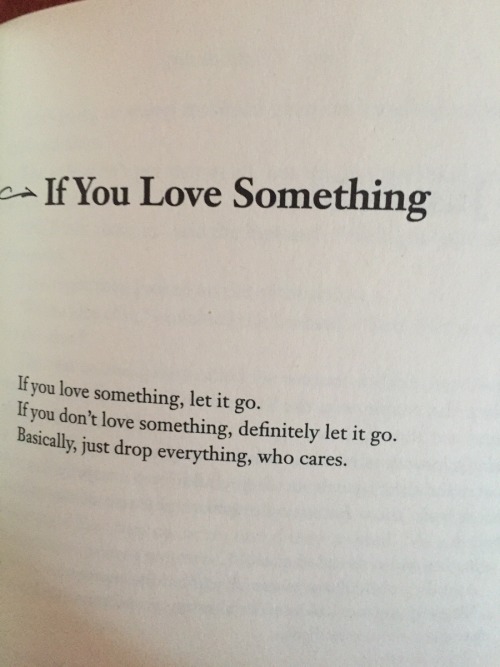
Let it go. (photo via mattryd7)

Burly.Thurr

Yeah, fk it. via Sr. Pelaez.


Let it go. (photo via mattryd7)

20 Mar 20:53

Kara Tippetts, a woman who wrote an open letter to Brittany Maynard, is about to die

Burly.Thurr

Magical thinking as harm beat. Some fucked up shit at work here: "but perhaps [suffering] can be the place where true beauty can be known." and "beauty will meet us in that last breath." But that last breath is only beautiful if you needlessly suffered all the way to the end? WTF.


Kara Tippetts, an author and mother of four, has terminal breast cancer at the age of 38. (Photo by Jay “Napoleon” Lyons)

A Christian author and blogger with terminal cancer who tried to convince Brittany Maynard to reconsider her November decision to die through doctor-assisted suicide is facing her own death.

Maynard made headlines as the 29-year-old who chose to die on Nov. 1 by taking a legal lethal prescription as she faced an aggressive cancerous brain tumor.

Kara Tippetts, an author and mother of four, has terminal breast cancer at the age of 38. Kara Tippetts, an author and mother of four, has terminal breast cancer at the age of 38.

Tippetts, a Colorado Springs wife of a pastor and 38-year-old mother of four who was diagnosed two years ago with stage four breast cancer, has become the poster face of an opposite view. Her book publicist confirmed on Thursday that her family believes she is close to death.

Tippetts’s open letter to Maynard on Ann Voskamp’s popular blog went viral in many Christian circles. “Dear heart, we simply disagree,” Tippetts wrote. “Suffering is not the absence of goodness, it is not the absence of beauty, but perhaps it can be the place where true beauty can be known. In your choosing your own death, you are robbing those that love you with the such tenderness, the opportunity of meeting you in your last moments and extending you love in your last breaths.”

Tippetts argued in her post that hastening death is not what God intended.

I get to partner with my doctor in my dying, and it’s going to be a beautiful and painful journey for us all.

But, hear me —  it is not a mistake —

beauty will meet us in that last breath.

Her story was picked up by Ross Douthat, who wrote about the debate represented by Maynard and Tippetts.

“The future of the assisted suicide debate may depend, in part, on whether Tippetts’s case for the worth of what can seem like pointless suffering can be made either without her theological perspective, or by a liberalism more open to metaphysical arguments than the left is today,” Douthat wrote.

Kara Tippetts, a mother of four with terminal breast cancer,tried to convince cancer-patient Brittany Maynard to reconsider her November decision to die through doctor-assisted suicide. Now Tippetts is in hospice care. Kara Tippetts, a mother of four with terminal breast cancer, is in hospice care. (Jay “Napoleon” Lyons)

Tippetts was admitted into hospice care in December. On Friday, her husband Jason Tippetts wrote about his wife’s final days.

“I have an us that cannot be lost,” Jason Tippetts wrote. “And I still get small moments where we are us. But I grieve as I watch her fade. The peace that is in our house is amazing, peace in the midst of tears, peace in the midst of impending loss, but it is peace.”

Jay Lyons, a producer who is a friend of the Tippetts, raised more than $15,000 of his goal of $13,750 to create a documentary.

Before her death in November, Maynard became an advocate for laws for legal protections for terminally ill patients who want to die with medical assistance, legal in five states in the United States.

“Goodbye to all my dear friends and family that I love. Today is the day I have chosen to pass away with dignity in the face of my terminal illness, this terrible brain cancer that has taken so much from me … but would have taken so much more,” she wrote on Facebook before her death.

Brittany Maynard, a 29-year-old with terminal brain cancer, tells her story and explains why she plans to ingest a prescription that will end her life on Nov. 1 in this video from advocacy group Compassion & Choices. (Compassion & Choices via YouTube)

NPR host Diane Rehm has emerged as a key force in the end-of-life debates. Americans are divided on the role of medicine in the issue, according to recent Pew Research surveys. When asked about end-of-life decisions for other people, two-thirds of Americans say there are at least some situations in which a patient should be allowed to die, while nearly a third say that medical professionals always should do everything possible to save a patient’s life. Of those polled, 47 percent approved and 49 percent disapproved of laws that would allow a physician to prescribe lethal doses of drugs for a terminally ill patient.

Interested in more religion stories? Read more from Acts of Faith:

Behold! What Shakespeare’s words on mercy can teach us about Internet shaming

Can one pastor bridge deep divides between evangelicals and mainline Protestants?

Presbyterian Church (USA) changes its constitution to include gay marriage

20 Mar 01:47

Dicks by Mail, A Service That Anonymously Mails an Edible ‘Bag of Dicks’ to Your Enemies

by Rebecca Escamilla
Burly.Thurr

Shouldn't have looked at this right before lunch. NOM NOM

Handful of gummies
photo by budwik

Dicks by Mail is a new service that will anonymously mail a bag of penis-shaped gummy candy along with a note that reads in bold type “EAT A BAG OF DICKS” to anyone the buyer chooses, much like the popular Ship Your Enemies Glitter service. More information about the service, including suggestions for recipents and how to send a mouthful of phallic sweets to your target, is available at their hilarious FAQ, though they don’t answer the question of whether a hard candy version will be made available.

We have a long history of sending dicks to people. Starting in middle school with those folded notes, that unfold to a big veiny cock. Moving to texting ‘8===D’ to random people in high school all the way to snapchatting below the belt pics to ladies from the bar/church. But now it’s on to bigger and better things; now it’s on to Dicks by Mail.

Dicks by Mail
image via Dicks by Mail

Note and candy
photo by budwik

Bag of dicks opening
photo by budwik

via Pixable

19 Mar 06:17

taikonaut:humanoidhistory:Fifty years ago today, cosmonaut...


taikonaut:

humanoidhistory:

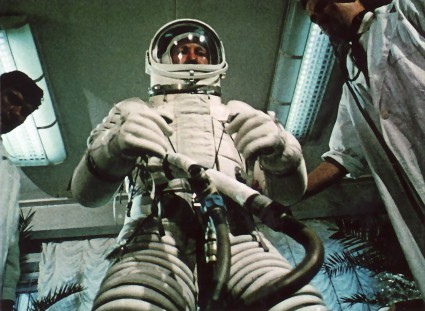
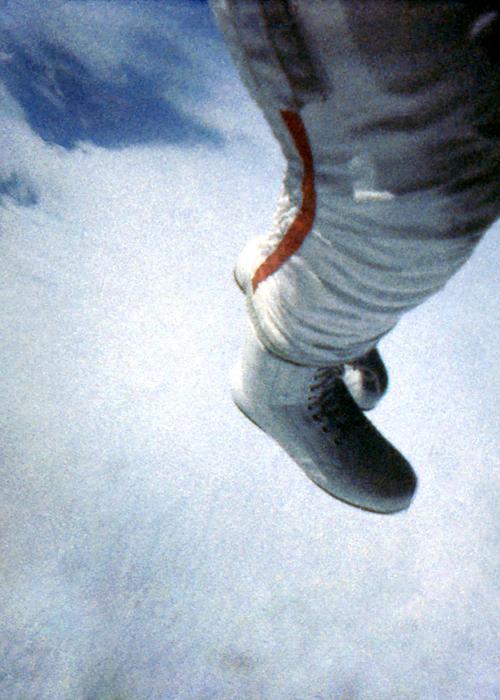
Fifty years ago today, cosmonaut Alexei Leonov made history when he stepped outside the Voshkod 2 spacecraft and became the first person ever to walk in space. As a small step, as a great leap, Leonov’s 12-minute spacewalk was an adventure for the ages — and it almost killed him.

The BBC has the story of how his spacesuit started inflating into a death trap:

At this point the cosmonaut realised something was wrong. The lack of atmospheric pressure in space had slowly caused his spacesuit to inflate like a balloon. He recalls:
"My suit was becoming deformed, my hands had slipped out of the gloves, my feet came out of the boots. The suit felt loose around my body. I had to do something.”
"I couldn’t pull myself back using the cord. And what’s more with this misshapen suit it would be impossible to fit through the airlock."
In five minutes he would be in the Earth’s shadow, and plunged into total darkness. Without telling ground control, the cosmonaut decided to bleed half of the air out of his spacesuit through a valve in its lining. This risked starving his body of oxygen, but if he couldn’t get back inside the capsule, he’d be dead anyway.
Leonov let out a little oxygen at a time to reduce the pressure. But as he did so, he started to feel the first hints of decompression sickness.
“I began to get pins and needles in my legs and hands. I was entering the danger zone, I knew this could be fatal.”
He started coiling the cord in order to haul himself back. When he finally reached the airlock, he pushed the camera in, grabbed the sides and lurched through head first.
The extreme physical exertion had caused his temperature to soar; he was now at risk of heatstroke and sweating uncontrollably. The globules filled his helmet, obscuring his vision.
Leonov was supposed to re-enter the airlock feet first. Getting in the wrong way meant he had to turn himself around in the cramped space to make sure the umbilical cord was inside and the hatch was locked.
He says: “It was the most difficult thing: I’m in this suit and I had to turn around in the airlock. But with the perspiration, I couldn’t see anything.”
"I don’t normally sweat much, but on that day I lost 6kg in weight.”
After curling around in his bulky suit, in such a narrow space, Leonov finally made it back inside the craft.

(BBC)

Jesus Christ that’s most of my phobia list right there.

18 Mar 00:49

2 dinosaurs explain why driving a car is absolutely terrifying

by Joseph Stromberg
Burly.Thurr

Really wish I could outsource my commute to a professional or AI. Help us self-driving cars, you're our only hope.

Ryan North. Used with permission.) Get Dinosaur Comics books and prints here.

Most American adults drive every day. Which makes it easy to for us to forget how terrifying and insane it is that we entrust virtually anyone to safely operate a two-ton machine traveling at 70 miles per hour.

This comic — one of Ryan North's many hilarious and absurd Dinosaur Comics — perfectly captures this lunacy. Lose your concentration while driving for just a second, and you risk killing yourself, your loved ones, and total strangers.

The good news is that traffic deaths in the US have been declining for several decades now. But the bad news is that cars still kill more than 30,000 people per year — putting them just outside the top 10 causes of death in the US.

The even worse news is that outside of a few particular cities, pretty much our entire country's transportation infrastructure has been designed for cars, making it extremely difficult for us to substantially reduce our dependence on them.

Eventually, self-driving cars might completely change this equation, saving thousands of lives. Still, some experts are skeptical they'll ever fully take off.

17 Mar 01:21

Photo

Burly.Thurr

Grotesque but (and?) mesmerizing.


17 Mar 01:09

loserstfu:If Kanye West and kim kardashian were both drowning and you only had time to save one,...

Burly.Thurr

I was caught off-guard by that fantastic ending.

loserstfu:

If Kanye West and kim kardashian were both drowning and you only had time to save one, what kind of sandwich would you make?

16 Mar 20:14

\o/[via]

Burly.Thurr

NSFW-ish. But also, poetry in motion.


\o/

[via]

16 Mar 20:12

msflamingo:Here is your St Patrick’s Day activity, courtesy of...

Burly.Thurr

jeezus.


msflamingo:

Here is your St Patrick’s Day activity, courtesy of the Catholic Church.

13 Mar 21:20

The Junk DNA Fight

Burly.Thurr

Interesting. I had taken the idea that there was no "junk DNA" as gospel, but I guess the matter hasn't been entirely settled in the scientific community(?) It also seems like a climate change controversy analogy would be inappropriate here.

From yesterday's New York Times Magazine, here's an excellent intro by Carl Zimmer to the Junk DNA Wars.

In January, Francis Collins, the director of the National Institutes of Health, made a comment that revealed just how far the consensus has moved. At a health care conference in San Francisco, an audience member asked him about junk DNA. “We don’t use that term anymore,” Collins replied. “It was pretty much a case of hubris to imagine that we could dispense with any part of the genome — as if we knew enough to say it wasn’t functional.” Most of the DNA that scientists once thought was just taking up space in the genome, Collins said, “turns out to be doing stuff.”

For Gregory and a group of like-minded biologists, this idea is not just preposterous but also perilous, something that could yield bad science. The turn against the notion of junk DNA, they argue, is based on overinterpretations of wispy evidence and a willful ignorance of years of solid research on the genome. They’ve challenged their opponents face to face at scientific meetings. They’ve written detailed critiques in biology journals. They’ve commented on social media. When the N.I.H.’s official Twitter account relayed Collins’s claim about not using the term “junk DNA” anymore, Michael Eisen, a professor at the University of California, Berkeley, tweeted back with a profanity.

I've written about this several times over the last couple of years, and the issues are far from being settled. We medicinal chemists should keep an eye on this stuff, because what's riding on it is a whole unexplored universe of drug discovery - or not.

13 Mar 19:44

Bill Clinton Definitely Sent More Than Two Emails

by Adrienne Lafrance, The Atlantic

The former president says he only ever sent two electronic missives. Yeah, right.