Shared posts

19 Feb 21:05

A More Realistic Version of the Law & Order: SVU Episode “Intimidation Game”

by Rebecca Watson

The long-running TV series Law & Order: Special Victims Unit is known for ripping stories from the headlines (which then are said to not resemble any person in fiction or real life), and so it’s no great surprise that the most recent episode addressed Gamergate, the “movement” of mostly young men harassing women in the gaming industry with slurs and rape and death threats.

In the episode, which US viewers can watch on Hulu, Raina Punjabi (a game designer who is an amalgam of Anita Sarkeesian and Zoe Quinn) is threatened by men who hate women for seemingly encroaching on their territory (so far, so accurate). It goes downhill from there: the cops desperately want to help and protect the Raina, but she dismisses the threats and continues with her game launch despite the threats. At one point she is SWATted (meaning the men call the cops and tell them someone is at her address with hostages and a gun, so the SWAT team breaks down her door and points guns at her).

Raina still doesn’t want the cops’ help but agrees to let them come to the game launch. At the launch, the cops are unable to stop men from kidnapping her, at which point she is horribly raped and abused as the cops try to find the criminals. In the end, she admits the men have won and she quits the gaming industry.

Obviously, there were a lot of inaccuracies with this episode, so I’ve taken it upon myself to rewrite it using dialogue actually taken from the FBI and police officers I spoke to most recently about actual threats I received last month:

RAINA: Hello, I’d like to report some very concerning and specific threats that have been made against me online.

ICE T: Okay, I can’t promise that we can do anything but I can definitely take a report.

RAINA: Um, okay. Well, first of all, men have posted my address online and are saying they’re going to “SWAT” me. Do you know what SWATting is?

ICE T: Swapping? No, I . . . I have no idea what you’re talking about. Are you reporting a crime, ma’am?

RAINA: No, SWATting is where people call the cops and tell them there’s a gunman with hostages at my address, in the hopes a SWAT team will break down the door . . .

ICE T: I don’t understand. Is there a crime in progress you are trying to report? Because if so you have to call 911.

RAINA: I . . . no, I’m saying that this is a thing that people are saying they’re going to do to me, so it’s important that you know not to break down my door if you get a report like that.

ICE T: Why would someone do that, ma’am?

RAINA: What? I don’t know. They just do.

ICE T: Well I’m not sure what you want me to do about it.

RAINA: I . . . I guess just make a note of it? In case you get a report? So that you can maybe call me before sending a SWAT team over?

ICE T: I guess I’ll write a note down but I don’t know what else you want me to do.

RAINA: Okay, well also there are men specifically threatening to kill me.

ICE T: And is this online?

RAINA: Yes.

ICE T: So no one has done anything to you in person?

RAINA: Not yet, no. They’re threatening to rape and kill me.

ICE T: But just online.

RAINA: Yes, just online.

ICE T: Okay, well I’ve written up a report here. We can’t do anything until someone actually does something to you but when they do we’ll be able to consult this report.

RAINA: I have their names and the cities they live in . . .

ICE T: Do they live in New York?

RAINA: No, but one is in New Jersey and another is in Philadelphia . . .

ICE T: Ma’am, we can’t do anything about that. You’ll have to call their local PD and make a report there.

RAINA: And will they be able to do something?

ICE T: They’ll be able to make a report.

RAINA: Oh.

ICE T: Is there anything else?

RAINA: I . . . I guess not.

ICE T: Why are you still standing there?

RAINA: Well, there’s still 40 minutes left in this episode.

ICE T: Oh, don’t worry about that. We’ll just flash forward to after you’re murdered. We’ll fill the rest of the show with all of us wondering what we could have possibly done to prevent this tragedy.

RAINA: I hate you.

THE END

19 Feb 00:46

I only wish I was better at it.

19 Feb 00:45

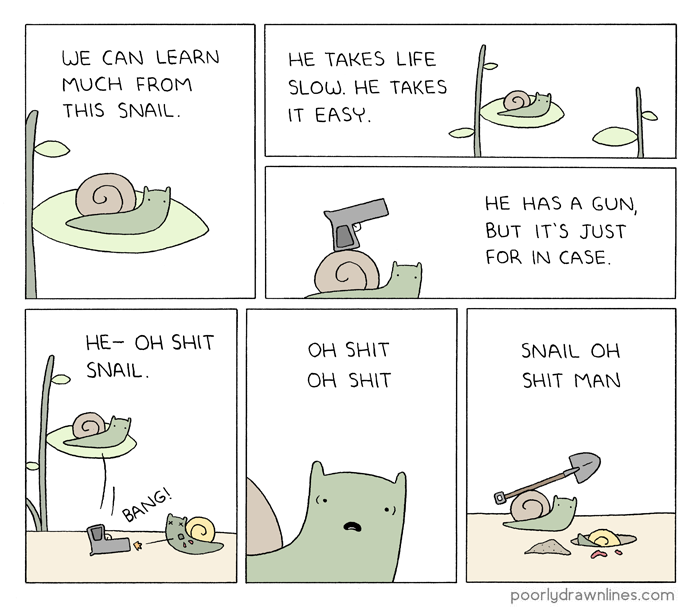
Learn From Snail

by Reza

learn-from-snail

19 Feb 00:45

Photo


19 Feb 00:41

Photo


19 Feb 00:39

Photo


19 Feb 00:32

Perspective.


Perspective.

19 Feb 00:31

Kool-Aid Cat


Kool-Aid Cat

19 Feb 00:30

Photographer Captures Amazing Images of a Tiny Green Tree Frog Riding Atop a Giant Rhinoceros Beetle

by Lori Dorn

Frog Riding Beetle 1

Indonesian wildlife photographer Hendy Mp has captured absolutely amazing images of a tiny Reinwardt’s tree frog riding atop a giant rhinoceros beetle, like a tiny cowboy upon his steed. Giddy-up!

Frog - Beetle Introduction

Frog Beetle - Getting On

Frog Riding Beetle Side View

Frog Riding Beetle 3

Frog Riding Beetle 2

photos by Hendy Mp

via Daily Mail, Bored Panda

18 Feb 21:09

kateordie:archiemcphee: Today the Department of Unexpected...


kateordie:

archiemcphee:

Today the Department of Unexpected Interspecies Friendship is sighing happily while looking at these awesomely adorable photos of a pair of BFFs who happen to be a Little Owl named Napoleon, aka Poldi, and a Belgian Malinois named Ingo. These fast friends live with Tanja Brandt, a professional animal photographer and collage artist based in Dusseldorf, Germany, who photographs the unusual pair while they’re all outside enjoying the fresh air together. Napoleon is the runt of a brood of 7 little owls hatched by a professional breeder. Ingo often assists Brandt while she photographs other birds, including her Harris’s Hawks, which easily dwarf little Poldi.

"I go outside with them together — Napoleon on my hand, Ingo is free running. I do the same with my big Harris Hawks, but they are also free and can fly. Not so with Napoleon. It’s too dangerous. Every cat would kill him, he don’t know hows [sic] to live free.
And so, this is why they trust each other. They respect each other and they can read each other. Ingo knows every reactions from the wild birds and if they are angry, he goes another way […] with the wild birds, he is very soft (not with other dogs or something else).”

Click here to learn more about Poldi and Ingo. For more photos of them, as well as photos of Brandt’s other avian friends, visit Tanja Brandt’s 500px page.

[via Bored Panda and 500px]

The buddy cop movie WE deserve!

Poldi and Ingo!

18 Feb 20:25

What’s right with Minneapolis?

by PZ Myers

The Atlantic takes a look at Minneapolis, which is an outlier in several ways: it’s doing relatively well economically (it’s no Detroit), but at the same time, it’s managed to avoid extreme disparities — there’s affordable housing without the overpriced real estate at the top (it’s no San Francisco, in a good way). How do they do it?

Among other factors, it’s all about…wealth redistribution.

In the 1960s, local districts and towns in the Twin Cities region offered competing tax breaks to lure in new businesses, diminishing their revenues and depleting their social services in an effort to steal jobs from elsewhere within the area. In 1971, the region came up with an ingenious plan that would help halt this race to the bottom, and also address widening inequality. The Minnesota state legislature passed a law requiring all of the region’s local governments—in Minneapolis and St. Paul and throughout their ring of suburbs—to contribute almost half of the growth in their commercial tax revenues to a regional pool, from which the money would be distributed to tax-poor areas. Today, business taxes are used to enrich some of the region’s poorest communities.

Never before had such a plan—known as “fiscal equalization”—been tried at the metropolitan level. “In a typical U.S. metro, the disparities between the poor and rich areas are dramatic, because well-off suburbs don’t share the wealth they build,” says Bruce Katz, the director of the Metropolitan Policy Program at the Brookings Institution. But for generations now, the Twin Cities’ downtown area, inner-ring neighborhoods, and tony suburbs have shared in the metro’s commercial success. By spreading the wealth to its poorest neighborhoods, the metro area provides more-equal services in low-income places, and keeps quality of life high just about everywhere.

The Republicans keep trying to destroy it, but Minnesota is more of a socialist paradise than most places in the US, and it freakin’ works.

18 Feb 20:23

“The idea of two sexes is simplistic. Biologists now think there is a wider spectrum than that.”

by PZ Myers

That quote is from a good article in Nature on how sex is non-binary — my only quibble would be with that “now”. You’d have to define “now” as a window of time that encompasses the entirety of my training and work in developmental biology, and I’m getting to be kind of an old guy. Differences in sex development (DSDs) are common knowledge, and rather routine — and coincidentally, I’m giving an exam on sex chromosome anomalies today.


The article works through a lot of basic concepts: chimeric sex, genetic vs. cellular vs. organismal sex, and the development of sexual characters. I was so happy that they did not trigger one of my pet peeves, the claim that we all start out as female — we don’t, we start out sexually indifferent.

That the two sexes are physically different is obvious, but at the start of life, it is not. Five weeks into development, a human embryo has the potential to form both male and female anatomy. Next to the developing kidneys, two bulges known as the gonadal ridges emerge alongside two pairs of ducts, one of which can form the uterus and Fallopian tubes, and the other the male internal genital plumbing: the epididymes, vas deferentia and seminal vesicles. At six weeks, the gonad switches on the developmental pathway to become an ovary or a testis. If a testis develops, it secretes testosterone, which supports the development of the male ducts. It also makes other hormones that force the presumptive uterus and Fallopian tubes to shrink away. If the gonad becomes an ovary, it makes oestrogen, and the lack of testosterone causes the male plumbing to wither. The sex hormones also dictate the development of the external genitalia, and they come into play once more at puberty, triggering the development of secondary sexual characteristics such as breasts or facial hair.

That’s exactly right.

The major point of the article is something a lot of people deny: that sex is complicated, there’s more than two states of human existence, and most importantly, that biology verifies the existence of a continuum of sexual differentiation. Drag this article out next time someone tries to argue that biology supports their simplistic version of a discrete sexual dichotomy.

Yet if biologists continue to show that sex is a spectrum, then society and state will have to grapple with the consequences, and work out where and how to draw the line. Many transgender and intersex activists dream of a world where a person’s sex or gender is irrelevant. Although some governments are moving in this direction, Greenberg is pessimistic about the prospects of realizing this dream — in the United States, at least. “I think to get rid of gender markers altogether or to allow a third, indeterminate marker, is going to be difficult.”

So if the law requires that a person is male or female, should that sex be assigned by anatomy, hormones, cells or chromosomes, and what should be done if they clash? “My feeling is that since there is not one biological parameter that takes over every other parameter, at the end of the day, gender identity seems to be the most reasonable parameter,” says Vilain. In other words, if you want to know whether someone is male or female, it may be best just to ask.

I’ll also add that it’s not just biology that supports the idea that sex is a spectrum. It’s also the case of psychology and sociology — any science that has to address sex differences.

18 Feb 20:04

Caffeine can really mess with your head

by Murray Carpenter
Panic attacks, psychosis, and violent impulses. Free with your pumpkin spice latte! Read the rest
18 Feb 19:54

Binary Isn’t

by John Scalzi

There’s a very interesting piece in Nature today about how science is making it more clear than ever that the binary nature of the sexes isn’t actually binary at all — that there are a lot of gradiations in biological sexual development, brought on not only via chromosomal differentation (the old “XX” and “XY” thing) but a host of other processes. This is how people with XY chromosomes can (rarely) get pregnant and give birth, and how a man who fathered four children can be discovered to have a womb. Biology: It’s wacky.

I don’t imagine this report will make essentialists (“There’s men and there’s women and that’s it!”) particularly happy, but then it’s not actually the job of science to reinforce people’s comfort zones — or bigotries, to be less polite about it. But I look forward to the mental two-step some of these folks will take to try to cram this information into their understanding of the world, rather than to expand their understanding of the world based on this information. That should be interesting, and a little bit sad.


18 Feb 08:30

Flowcharts

Whoa, and if you overlay a Fibonacci spiral on a golden spiral it matches up almost perfectly!
17 Feb 21:07

WATCH: American kids react to breakfasts from around the world

by Mark Frauenfelder

American kids attempt to eat traditional breakfasts from Korea, Brazil, Finland, Vietnam, Poland, and Netherlands. (more…)

17 Feb 21:03

Man, jailed for 3 months, released after "drugs" turn out to be vitamins

by Mark Frauenfelder

keystone-kops

Minnesota cops pulled over Joseph Burrell for driving out of a grocery store parking lot without turning on his headlights. Read the rest

17 Feb 20:59

The brilliant ideas and radiant visions of reclusive SF author Greg Egan

by Patrick Lohier
There are no pictures of Greg Egan online, and his website has a disclaimer that while some of his more dedicated fans claimed to have tracked down a picture of the author, it’s not him. Read the rest
17 Feb 20:37

You Can’t Take Back What You Already Have

by John Scalzi

First, go read this. This is only one dude, to be clear, but his defensive, angry and utterly terrified lament is part and parcel with a chunk of science fiction and fantasy fandom and authors who want to position themselves as a last redoubt against… well, something, anyway. It essentially boils down to “The wrong people are in control of things! We must take it back! Attaaaaaaaack!” It’s almost endearing in its foot-stompy-ness; I’d love to give this fellow a hug and tell him everything will be all right, but I’m sure that would be an affront to his concept of What Is Allowed, so I won’t.

Instead let me make a few comments about the argument, such as it is. Much of this stuff I addressed last year when a similar kvetch appeared, but let me add some more notes to the pile.

1. The fellow above asserts that fans of his particular ilk must “take back” conventions and awards from all the awful, nasty people who currently infest them, as if this requires some great, heroic effort. In fact “taking back” a convention goes a little something like this:

Scene: CONVENTION REGISTRATION. ANGRY DUDE goes up to CON STAFFER at the registration desk.

Angry Dude: I AM HERE TO TAKE BACK THIS CONVENTION AND THE CULTURE THAT SO DESPERATELY CRIES OUT FOR MY INTERVENTION

Con Staffer: Okay, that’ll be $50 for the convention membership.

(Angry Dude pays his money)

Con Staffer: Great, here’s your program and badge. Have a great con!

Angry Dude:

I mean, everyone gets this, right? That conventions, generally speaking, are open to anyone who pays to attend? That the convention will be delighted to take your money? And that so long as one does not go out of one’s way to be a complete assbag to other convention goers, the convention staff or the hotel employees, one will be completely welcome as part of the convention membership? That being the case, it’s difficult to see why conventions need to be “taken back” — they were never actually taken away.

But the conventions are run by awful, nasty people! Well, no, the small local conventions (and some of the midsized ones, like Worldcon) are run by volunteers, i.e., people willing to show up on a regular basis and do the work of running a convention, in participation with others. These volunteers, at least in my experience, which at this point is considerable, are not awful, nasty people — they’re regular folks who enjoy putting on a convention. The thing is, it’s work; people who are into conrunning to make, say, a political statement, won’t last long, because their political points are swamped by practical considerations like, oh, arguing with a hotel about room blocks and whether or not any other groups will be taking up meeting rooms.

(Larger cons, like Comic-cons, are increasingly run by professional organizations, which are another kettle of fish — but even at that level there are volunteers, and they are also not awful, nasty people. They’re people who like participating.)

But the participants are awful, nasty people with agendas! That “problem” is solved by going to the convention programming people and both volunteering to be on panels and offering suggestions for programming topics. Hard as it may be to believe, programming staffers actually do want a range of topics that will appeal to a diverse audience, so that everyone who attends has something they’d be interested in. Try it!

Speaking as someone who once was in charge of a small convention open to the public, i.e., the Nebula Awards Weekend (I would note I was only nominally in charge — in fact the convention was run and staffed by super-competent volunteers), my position to anyone who wanted to come and experience our convention was: Awesome! See you there. Because why wouldn’t it be?

Again, science fiction and fantasy conventions can’t be “taken back” — they were, and are, open to everyone. I understand the “take back” rhetoric appeals to the “Aaaaugh! Our way of life is under attack” crowd, but the separation between the rhetoric and reality of things is pretty wide. Anyone who really believes conventions will be shocked and dismayed to get more paying members and attendees fundamentally does not grasp how conventions, you know, actually work.

2. Likewise, the “taking back” of awards, which in this case is understood to mean the Hugo Awards almost exclusively — I don’t often hear of anyone complaining that, say, the Prometheus Award has been hijacked by awful, nasty people, despite the fact that this most libertarian of all science fiction and fantasy awards is regularly won by people who are not even remotely libertarian; shit, Cory Doctorow’s won it three times and he’s as pinko as they come.

But yet again, you can’t “take back” the Hugos because they were never taken away. If you pay your membership fee to the Worldcon, you can nominate for the award and vote for which works and people you want to see recognized. All it takes is money and an interest; if you follow the rules for nominating and voting, then everything is fine and dandy. Thus voting for the Hugo is neither complicated, nor a revolutionary act.

Bear in mind that the Hugo voting set-up is fairly robust; the preferential ballot means it’s difficult for something that’s been nominated for reasons other than actual admiration of the work (including to stick a thumb into the eyes of people you don’t like) to then walk away with an award. People have tested this principle over the years; they tended to come away from the process with their work listed below “no award.” Which is as it should be. This also makes the Hugos hard to “take back.” It doesn’t matter how well a work (or its author) conforms to one’s political inclinations; if the work itself simply isn’t that good, the award will go to a different nominee that is better, at least in the minds of the majority of those who are voting.

The fellow above says if his little partisan group can’t “take back” the awards, then they should destroy them. Well, certainly there is a way to do that, and indeed here’s the only way to do that: by nominating, and then somehow forcing a win by, works that are manifestly sub-par, simply to make a political (or whatever) point. This is the suicide bomber approach: You’re willing to go up in flames as long as you get to do a bit of collateral damage as you go. The problem with this approach is that, one, it shows that you’re actually just an asshole, and two, it doesn’t actively improve the position of your little partisan group, vis a vis recognition other than the very limited “oh, those are the childish foot-stompers who had a temper tantrum over the Hugos.” Which is a dubious distinction.

With that said: Providing reading lists of excellent works with a particular social or political slant? Sure, why not? Speaking as someone who has been both a nominee and a winner of various genre awards, I am utterly unafraid of the competition for eyeballs and votes — which is why, moons ago, I created the modern version of the Hugo Voter’s Packet, so that there would be a better chance of voters making an informed choice. Speaking as someone who nominates and votes for awards, I’m happy to be pointed in the direction of works I might not otherwise have known about. So this is all good, in my view. And should a worthy work by someone whose personal politics are not mine win a Hugo? Groovy by me. It’s happened before. It’s likely to happen again. I may have even nominated or voted for the work.

But to repeat: None of this contitutes “taking back” anything — it merely means you are participating in a process that was always open to you. And, I don’t know. Do you want a participation medal or something? A pat on the head? It seems to me that most of the people nominating and voting for the Hugos are doing it with a minimum of fuss. If it makes you feel important by making a big deal out of doing a thing you’ve always been able to do — and that anyone with an interest and $50 has been able to do — then shine on, you crazy diamonds. But don’t be surprised if no one else is really that impressed. Seriously: join the club, we’ve been doing this for a while now.

3. Also a bit of paranoid fantasy: The idea that because the wrong people are somehow in charge of publishing and the avenues of distribution, this is keeping authors (and fans, I suppose) of a certain political inclination down. This has always been a bit of a confusing point to me — how this little partisan group can both claim to be victimized by the publishing machine and yet still crow incessantly about the bestsellers in their midst. Pick a narrative, dudes, internal consistency is a thing.

Better yet, clue into reality, which is: The marketplace is diverse and can (and does!) support all sorts of flavors of science fiction and fantasy. In this (actually real) narrative, authors of all political and social stripes are bestsellers, because they are addressing slightly different (and possibly overlapping) audience sets. Likewise, there are authors of all politicial and social stripes who sell less well, or not at all. Because in the real world, the politics and social positions of an author don’t correlate to units sold.

With the exception of publishing houses that specifically have a political/cultural slant baked into their mission statements, publishing houses are pretty damn agnostic about the politics of their authors. The same publishing house that publishes me publishes John C. Wright; the same publishing house that publishes John Ringo publishes Eric Flint. What do publishing houses like? Authors who sell. Because selling is the name of the game.

Here’s a true fact for you: When I turn in The End of All Things, I will be out of contract with Tor Books; I owe them no more books at this point. What do you think would happen if I walked over to Baen Books and said, hey, I wanna work with you? Here’s what would happen: The sound of a flurry of contract pages being shipped overnight to my agent. And do you know what would happen if John Ringo went out of contract with Baen and decided to take a walk to Tor? The same damn noise. And in both cases, who would argue, financially, with the publishers’ actions? John Ringo would make a nice chunk of change for Tor; I’m pretty sure I could do the same for Baen. Don’t kid yourself; this is not an ideologically pure business we’re in.

(And yes, in fact, I would entertain an offer from Baen, if it came. It would need many zeros in it, mind you. But that would be the case with any publisher at this point.)

Likewise, I don’t care how supposedly ideologically in sync you are with your publisher; if you’re not selling, sooner or later, out you go. These are businesses, not charities.

But let’s say, just for shits and giggles, that one ideologically pure faction somehow seized control of all the traditional means of publishing science fiction and fantasy, freezing out everyone they deemed impure. What then? One, some other traditional publisher, not previously into science fiction, would see all the money left on the table and start up a science fiction line to address the unsated audience. Two, you would see the emergence of at least a couple of smaller publishing houses to fill the market. Three, some of the more successful writers who were frozen out, the ones with established fan bases, could very easily set up shop on their own and self-publish, either permanently or until the traditional publishing situation got itself sorted out.

All of which is to say: Yeah, the paranoid fantasy of awful, nasty people controlling the genre is just that: Paranoid fantasy. Now, I understand that if you’re an author of a certain politicial stripe who is not selling well, or a fan who doesn’t like the types of science fiction and fantasy that other people who are not you seem to like, this paranoid fantasy has its appeal, especially if you’re feeling beset politically/socially in other areas of your life as well. And that’s too bad for you, and maybe you’d like a hearty fist-bump and an assurance that all will be well. But it doesn’t change the fact that at the end of the day, no matter who you are, there will always be the sort of science fiction and fantasy you like available to you. Because — no offense — you are not unique. What you like is probably liked by other people, too. There are enough of you to make a market. That market will be addressed.

Again, I am genuinely flummoxed why so many people who are ostensibly so in love with the concept of free markets appear to have a genuinely difficult time with this. It’s not all illuminati, people. It never was.

4. And this is why, fundamentally, the whole “take back the genre” bit is just complete nonsense. It can never be “taken back,” it will never be “taken back,” and it’s doubtful there was ever a “back” to go to. The genre product market is resistant to ideological culling, and the social fabric of science fiction fandom is designed at its root to accomodate rather than exclude. No one can exclude anyone else from science fiction and fantasy fandom when the entrance requirement is, literally, an interest in the genre, or some particular aspect of it. You can’t exclude people from conventions that require only a membership fee to attend. Even SFWA has opened up to self-publishing professional authors now, because it recognized that the professional market has changed. To suggest that the genre contract to fit the demands of any one segment of it doesn’t make sense, commercially or socially. It won’t be done. It would be foolish to do so.

The most this little partisan group (or those who identify with it) can do is assert that they are the true fans of the genre, not anyone else. To which the best and most correct response is: Whatever, dude. Shout it all you like. But you’re wrong, and at the end of the day, you’re not even a side of the genre, you’re just a part. And either you’re participating with everyone else in what the genre is today, or you’re off to the side wailing like a toddler who has been told he can’t have a lollipop. If you want to participate, come on in. If you think you’re going to swamp the conversation, you’re likely in for a surprise. But if you want to be part of it, then be a part of it. The secret is, you already are, and always have been.

If you don’t want to participate, well. Wail for your lolly all you like, then, if it makes you happy. The rest of us can get along without you just fine.


17 Feb 20:19

I never thought of it that way

by PZ Myers

This wacky Saudi cleric has a novel proof that the earth does not rotate. You see, if the earth rotates, then all you’d have to do to fly west* is get in an airplane, hop into the air, and stay stationary and wait for your destination to roll up under you. And you wouldn’t be able to fly east because your destination would keep rolling away from you. Therefore, the earth must be stationary.

Apparently, he also believes that the sun orbits the earth, and that astronauts have not been to the moon, but I haven’t been able to find any record of his innovative arguments for those claims, which I’m sure would be eminently entertaining.

*He’s also a little unclear about which direction the earth rotates, but go with it, he’s on a roll.

17 Feb 02:28

NSA has ability to embed spying software in computer hard drives, including yours

by Xeni Jardin
The agency can hide software deep within hard drives made by Western Digital, Seagate, Toshiba and other top manufacturers, reports Kaspersky Labs. Read the rest
16 Feb 22:22

Watch what happens when you toss a brick in a washing machine

by Mark Frauenfelder

Category: Entertainment -- Throwing bricks and other heavy objects into washing machines and recording their self-destruction.

A quicker way to do it:

16 Feb 20:02

7 Ways Anti-Vaxxers Are Worse than You Ever Could Have Imagined

by Jamie Bernstein

I wrote the other day about how most parents that are not vaccinating are not senseless or stupid; They are just parents who have anxieties around vaccines and are not sure of whether it is the best choice for their child. Sure, some of their beliefs about vaccines may be unfounded in science, but they are trying to do what is best for their children even though they may actually be putting their children in more danger as a result.

Although this does describe most parents that are afraid of vaccinating, there is a small yet vocal organized anti-vaccine movement who go way beyond just questioning vaccine safety. I became interested in the anti-vaccine movement a couple years ago after I became so curious about what exactly anti-vaxxers were doing and saying that I went to one of their rallies. Since then I have been following their organizations and blogs and went to their big conference a couple years ago (where I was subsequently recognized and kicked out despite following all rules and being nothing but respectful). From years of following the anti-vaccine movement closely, I’ve learned that whatever you think about anti-vaxxers, you are probably underestimated the utter absurdity of their beliefs. For the purposes of this post, when I use terms like “anti-vaxxers,” I am talking specifically about the extremist anti-vaccine proponents that are part of the organized movement. I should also point out that, as anyone who themselves are part of any movement know, factions exist within the movement. People are not homogenous and even if they all agree that vaccines are bad they may not agree on all the details. Not all anti-vaxxers will believe all of the things mentioned here but these are all things that I have seen mentioned often by anti-vaxxers and published on their websites and blogs.

Anti-vaxxers believe that people who promote vaccines are the equivalent of Nazis and rapists.

When I say that “anti-vaxxers believe vaccine-proponents are equivalent to Nazis,” I don’t mean it as an exaggerated metaphor. They literally believe that organizations like the CDC are the same as Nazi Germany. Back in 2010 when I went to an anti-vaccine rally, a band called the Refusers played a song entitled “Vaccine Gestapo” with lyrics such as

They’re a medical military priesthood
Just like Adolf they preach the greater good
Conscientious objectors are just little snot
Why don’t you quit complaining and go get your shots

In addition to accusing the CDC of being the Gestapo, they often will play the victim card, such as suggesting that antivaccinationists are treated like Jews were in Hitler’s Germany. That’s right, because we all know that anti-vaxxers are being rounded up and gassed. Vaccine mandates are totally equivalent to that. That must be why they are such a fan of comparing themselves to Anne Frank.

Although anti-vaxxers are quite the fans of holocaust metaphors, it’s not the only horrible thing in the world that vaccine proponents could be compared to. Just this month at Age of Autism (AoA), a popular anti-vaccine blog, they published a post comparing vaccine mandates for public schools to human trafficking. I’m not kidding. They call vaccine mandates Vaccine Trafficking, writing that “Vaccine trafficking is a form of modern forced medical experimentation where people profit from the control and exploitation of others.”

They even got in a Nazi reference in the following description of why vaccine mandates are equivalent to human trafficking.

Although forced medical experimentation is commonly thought to be a thing of the past, dealt with and eliminated by The Nuremberg Code after WWII, vaccine trafficking still exists today throughout the United States and globally when traffickers use force, fraud, or coercion to control other people for the purpose of increasing international vaccine sales by forcing them to be injected with scores of dangerous, ineffective, “unavoidably unsafe”, potentially-fatal vaccines against their will.

This is completely bananas and yet this is the type of fear-mongering language often used by the anti-vaccine movement when communicating to their followers the dangers of vaccines.

Oh, and of course I can’t forget about the vaccine rape metaphors. Anti-vaxxers are constantly comparing giving a child a vaccine to raping them, because in their minds it’s the same thing. Memes like this one, which accuse doctors and nurses of being child rapists, are shared by anti-vaxxers on social media.

[photo of man grabbing a woman with his hand over her mouth and a distressed look on her face] “FORCED PENETRATION: I’m going to stick this in you. But it’s a vaccination, so shut the fuck up and enjoy it, bitch.”

Just in case you’re inclined to believe this is just a one-time thing, over at Respectful Insolence, David Gorski has compiled a whole bunch of instances of anti-vaxxers writing articles where they compare the act of vaccinating to rape.

If you can think of something terrible, then an anti-vaxxer has probably made the comparison between that horrible thing and vaccines.

The anti-vaccine movement has ties to the tea party.

Although anti-vaxxers are often seen as liberal whole-foods shopping types, in fact the organized anti-vax movement consists of right-wing extremists and has ties to the tea party. Anti-vaxxers have actually formed their own political party called the Canary Party which lobbies for removal of vaccine mandates. They often will partner with tea party groups in order to protest tough vaccine mandates for public schools and other pro-vaccine measures. They borrow much of the “freedom” language that is popular with the tea party and other right wing and libertarian groups when pushing for laws that make it easier to opt-out of vaccines.

Anti-vaxxers are shockingly ableist.

Most anti-vaccine organizations masquerade as organizations helping parents who are raising children with autism. However, despite saying they are helping families deal with autism, they way they treat people with autism and other mental disabilities is appallingly ableist.

When Jenny McCarthy made her now infamous appearance on Oprah where she first said that she believed vaccines were responsible for her son’s autism, she said that when she first got her son’s diagnosis it made her feel “like death.” She said that soon after her son got the MMR vaccine “boom—the soul’s gone from his eyes.” In other words, people with autism are people who have lost their souls.

Speaking at the anti-vax con AutismOne, RFK Jr. said that children getting autism from vaccines is like the “Nazi death camps.” Not only do we have another holocaust metaphor here, but I don’t think I need to explain why a person having autism is not equivalent to being imprisoned in a Nazi death camp.

In general, the anti-vaccine movement often treats autism like a fate worse than death. It’s why they are so vehement that if vaccines cause autism than vaccines must be far worse than all the diseases that they are meant to protect from. They do not seem to realize that many people with autism and other mental illnesses live rich, full lives.

The Feminist Skeptic explains why the anti-vax view that says that autism is the worst thing that could possibly happen to your child is so problematic:

it leads to the idea that risking preventable diseases (that can totally kill your kid!), autism biomedchelation therapyLupron therapy, and even outright murder is totally justifiable, because hey, your kid wasn’t “normal” (whatever that means), and you just wanted to make them better, even if it means causing them further suffering in the process.

Oh, and speaking of anti-vaxxers defending the murder of mentally ill children…

Anti-vaxxers defend parents who murder their mentally ill children.

Back in 2013, a Chicago mother planned and carried out the murder of her son Alex Spourdalakis. Alex was 14 years old and severely autistic. His mother first gave him an overdose of his medication, but when he didn’t succumb she stabbed him multiple times and cut his wrists. This was big news in Chicago, but prior to the murder I had already heard of Alex Spourdalakis because over at Age of Autism they had been talking about him and his mother for months, offering both emotional support and financial in the form of a fundraiser. Andrew Wakefield himself filmed a video of him sitting at the bedside of Alex in a Chicago hospital. They claimed the hospital was illegally preventing Alex’s mother from taking him home and were abusing him and keeping him restrained. The entire anti-vaccine movement rallied around the Spourdalakis family, vilified the hospital, and eventually got Alex discharged so that he could continue to get alternative medicine treatments at home rather than the science-based psychiatric care that the hospital provided. David Gorski describes the entire horrific story in an incredibly detailed post at Respectful Insolence.

The anti-vaxxers were supporting the Spourdalakis family prior to the gruesome murder of Alex. You would then expect that after the murder they would walk back their support or perhaps even admit they were wrong. Instead, over a year later they have only dug in their heels. In fact, they have actually created a documentary entitled “Who Killed Alex Spourdalakis?” where they claim that it wasn’t his mother who murdered him, but the medical community and of course the vaccines which made him sick in the first place. They strongly imply that the murder was regrettable yet understandable in the face of a medical community that refused to allow the mother to treat her child using only unproven alternative medicine. The fact that they find the tragic murder of an autistic child even remotely understandable and defend the murderer is ableism at its most extreme.

Anti-vaxxers don’t believe vaccines protect you against disease.

This point is one of the more controversial even within the anti-vaccine movement. Most of the leaders of the movement will say that they believe vaccines do prevent against diseases, though they will often then give reasons why vaccines aren’t actually very effective or no longer needed since the diseases they protect against are so rare. However, the anti-vaccine movement is rife with those who believe that the disease-preventing power of vaccines is a myth or conspiracy.

Just this month Melanie Mallon used Skepchick’s Bad Chart Thursday to feature and consequently destroy an article from VaccineImpact.com on how measles has magically been reduced to the low levels we have today with no help from the vaccine. Measles just naturally decided it didn’t really like humans as much as it used to and went away on its own. The fact that measles saw sharp decreases in the U.S. following the introduction of the measles vaccine is just coincidence. This argument, that vaccines are not at all effective, is a popular one among anti-vaxxers.

Anti-vaxxers subscribe to dangerous alternative medicine for treating the mentally ill.

As I mentioned earlier, many autism organizations are actually anti-vaccine organizations in disguise. As such, they often will promote various alternative medicine treatments for children with autism. Katie and Ashley from Mad Art Lab went to the anti-vaccine con AutismOne in 2012 and reported back that the con was a cornucopia of alternative medicine, with “biomedical treatments, like supplements, special diet items (gluten-free and casein-free, of course), and, oh yeah, hyperbaric oxygen chambers.”

Although some of these treatments may not be harmful, many of them require strict diets or expensive medication and therapies that have no evidence of effectiveness and may even cause harm. Anti-vaxxers also will often discourage traditional medical treatments in favor of alternatives and in some cases, the treatments they encourage are incredibly harmful. Dr. Mark Geier, who has a ton of support from the anti-vax movement had his medical license suspended in 2011 for chemically castrating autistic children. This wasn’t something he was doing unbeknownst to his anti-vax supporters. In fact, anti-vaxxers supported him and continue to support him in using chemical castration to “treat” autistic children. Since losing his medical license, they have treated him like a martyr.

Anti-vaxxers believe that the government is knowingly and purposefully poisoning children

I already mentioned a lot of conspiracy theories that anti-vaxxers believe, but one of the most prominent is that the government and pharmaceutical companies know vaccines are ineffective and highly dangerous but promote them via propaganda and pass laws mandating them for children going to public school in order to make all that sweet, sweet vaccine money.

Back in the Vaccine Trafficking article I mentioned earlier, the author writes:

There are two primary factors driving the spread of vaccine trafficking: high profits and low risk.  Actually, since 1986, it’s no risk, with a captive and guaranteed market, mostly paid for by taxpayer dollars and cash-strapped parents. Like other prescription-drug trafficking, vaccine trafficking is a pharma-driven criminal industry that is based on the principle of “poison to profit”, with the goal being to ensure that every American is somewhere between sick and dead, for as long as possible. Every year, vaccine traffickers generate billions of dollars in profits by victimizing millions of people around the world, including here in the United States.

This type of extremist fear-mongering stating that the government and pharmaceutical companies are knowingly poisoning children is standard fare on anti-vaccine websites. The thing that’s always got me about this conspiracy is that if the government and pharmaceutical companies did come up with fake vaccines to make money, why would they inject children with poison? Why not inject them with saline instead or something else non-harmful? The only explanation is that anti-vaxxers believe that the government and pharmaceutical companies are cartoonish villains who poison children for fun.

Don’t worry though, the anti-vaxxers have a response to this. According to them, the reason the big pharma uses poison rather than placebo to sell their fake vaccines is because they are secretly eugenicists. Seriously.


I want to reiterate as I did at the start of this piece that these are not things that the average parent who is opting out of vaccines believe. These are the fringe extremists who produce literature vilifying vaccines, run anti-vaccine blogs, events and conferences, and promote laws making opting out of vaccines easier. Though they are small in number, they are almost exclusively holding up the entire myth of the dangerous vaccine that is creating fear and anxiety among parents and leading to lower vaccine rates and outbreaks of diseases like measles. They run organizations purporting to help families with autistic children while actually just using that as cover to lobby against vaccinations. I think it’s important to emphasize just how utterly ridiculous their true beliefs really are. They go way, way beyond just “vaccines cause autism” or “vaccines contain dangerous toxins” to levels that include vast conspiracy theories and ableism.

Special thanks to David Gorski who helped me track down many of the examples of the horrific things that anti-vaxxers have published.

Featured image is a tinted screen shot of the front page of Age of Autism.

16 Feb 01:36

sswincestiel:lepreas:mahramore:shots fired rockets launched


sswincestiel:

lepreas:

mahramore:

shots fired

rockets launched

16 Feb 01:36

m0llyh8su: therickymartin: andysambergsbitch: explaining...


m0llyh8su:

therickymartin:

andysambergsbitch:

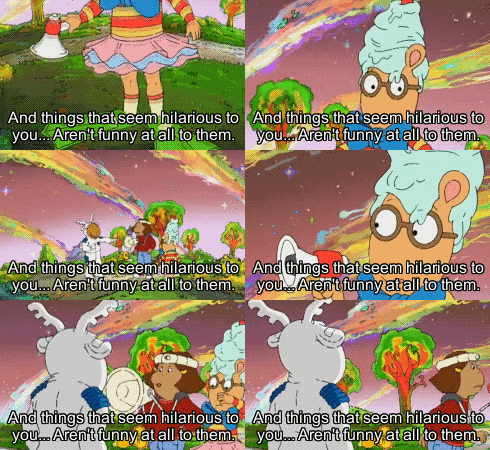
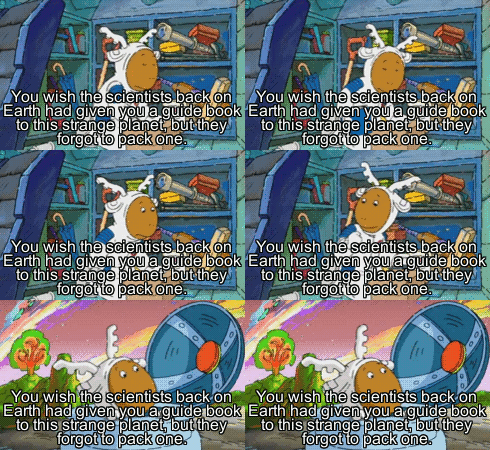
explaining autism

Holy fuck Arthur was on some next level shit

Oh my god

16 Feb 01:35

nevermindtheb0ll0cks: this is so important

Courtney shared this story from Super Opinionated.


nevermindtheb0ll0cks:

this is so important

16 Feb 01:35

February 14, 2015


15 Feb 21:19

Propo War: The Culture Clash Between AMERICAN SNIPER and THE HUNGER GAMES

by Devin Faraci
Propo War: The Culture Clash Between AMERICAN SNIPER and THE HUNGER GAMES

AMERICAN SNIPER and MOCKINGJAY PART 1 are jockeying for box office supremacy. They're basically the same movie, from different POVs.

15 Feb 19:51

Sunday Sweets That Defy Gravity

by Jen

It's hard enough to make a gorgeous cake, but how about one that seems to float in mid-air?

(By Vicky Angel Cake Design)

What cakey voodoo is this??
Because I LIKE IT.


Yep, these frosted feats of engineering never cease to amaze me, so today, it's ALL floating voodoo Sweets, guaranteed to make your jaw drop.

(By Ponquecitos and Cakes)

A little birdy told me this is actually impossible. So 'fess up, bakers: how'd you do that?


(By Kaysie Lackey)

I know it's hard to look at anything besides that hilarious face, but check out the feet. There's only one touching the ground!


Or how about the ol' "invisible server" party trick?

(By Cake Heart)

If someone didn't startle their guests by letting go of that spatula handle with a flourish of jazz hands, then this cake was wasted. WASTED, I SAY.


Some fabulous piratey goodness:

(By Kara's Couture Cakes)


And I suppose this one isn't quite as gravity defying, but I'm including it anyway, because c'mon. It's Alice falling down the rabbit hole:

(By Fiona Black. Anyone have a website for her?)

Plus I love the upside-down cake design, the falling book pages, and the teeny room at the bottom!


But for a truly mad Wonderland cake, you can't beat this tea time treat:

(By Natalia Da Silva)

WOW.


Or how about this Beauty?

(By Truly Custom Cakery, now closed)

ALSO WOW.


This Angry Bird isn't even touching the board!

(By Pirikos)

The only support is through the slingshot!


This one looks more like an art gallery exhibit than dessert:

(By JT Cakes)

Gorgeous, and another one that had me scratching my head; still not sure how the supports on this work!


And finally, the one that made me gasp the loudest with sheer, "No, srsly, how'd they DO that?!" ness:

(By Yener's Way)

Drippy chocolate sauce has never looked more magical.

Hope you guys enjoyed today's floating fancies! Happy Sunday!

*****

Thank you for using our Amazon links to shop! USA, UK, Canada.

15 Feb 00:16

“The Glass Cliff” And 4 Other Ways Our Coworkers Treat Us Differently Because of Gender

by behanceteam
No matter how self-aware you may be, you’re subtly influenced by the personality and demographic characteristics of those around you.

It’s an awkward reality of most people’s daily experiences. Women and men will tell you—and their anecdotes are backed up by psychology research—how they are treated differently in professional situations simply because of their gender. Especially when we don’t act in what is considered a “gender appropriate” manner, it can adversely affect how other people of both sexes perceive us.

What are these biases? Here are five ways you can expect your gender to shape your experience at work:

Women are penalized for speaking out and getting angry

Professional women are judged harshly (by men and other women) for being vocal. For instance, one study found that male and female participants rated a female CEO as less competent and less suitable for leadership roles when she was described as being outspoken and opinionated. The precise opposite pattern was found for male CEOs, who were judged negatively for being reticent.

It’s a similar story when it comes to expressing anger—an emotion, which, so long as it’s controlled, can be an important part of negotiation and a tool for motivating under-performers. Unfortunately, if you’re female and you vent your frustration by getting angry, you can expect to pay a price. A 2008 study showed that men who got angry were viewed by men and women as high status and more competent, yet women who displayed their anger were rated afterwards as less competent and lower status.

Male and female participants rated a female CEO as less competent and less suitable for leadership roles when she was described as being outspoken and opinionated.

Helpfully, the same study pointed to a strategy for female workers to avoid this backlash—make the source of your anger explicit and shift the focus onto the reasons for your frustration, and in the process you’re less likely to be penalized.

Men don’t get a free ride, either. They too suffer discrimination when they behave in ways, such as being modest in an interview, that are considered “unmanly.” 

Men suffer prejudice for having a female boss

As opportunities in the workplace become more obtainable for both sexes, an inevitable side effect is more men with female bosses. Yet such is the persistence of old-fashioned ideas about gender, that if you’re a man in this position, you’re likely to be treated differently, especially in industries usually considered male territory.

This effect was highlighted in a study that asked research participants to read hypothetical scenarios. When a man was described as working for a woman in the construction industry, male and female participants said they’d pay him less, and they considered him lower status and less masculine compared with men who had male bosses. (Female workers did not suffer they same prejudice if they were described as working for a male boss in a female industry.)

We should also recognize that when their male reports are perceived as having lower machismo, this likely reverberates on the female leader. Due to the fear of being perceived as less masculine, men may be reluctant to work under a woman.

Admittedly this is not a practical solution, but the study found that in their trials, the bias against men with female bosses was offset if men emphasized stereotypical masculine credentials, such as mentioning they liked sports and fast cars. That can feel unsatisfactory however, as the real answer is that we need a change in perspective and attitude about gender stereotypes overall.

Women tend to be placed in charge of failing organizations

Despite evidence suggesting that companies perform better when they have more women on their boards, it remains the case that women are hugely under-represented in senior management. And when they are promoted to the top roles, psychologists analyzing British firms have noticed a trend—women are especially likely to be placed in charge of failing organizations, an effect referred to as the “glass cliff.”

Women are especially likely to be placed in charge of failing organizations, an effect referred to as the “glass cliff.”

Anecdotally, one high-profile example was the election in 2009 of Jóhanna Sigurðardóttir as prime minister of Iceland—the first woman to fill that role—just as the country was reeling from the global recession. Some have also identified Marissa Mayer’s appointment at Yahoo in 2012 as another classic case.

It’s thought the effect occurs because people value traditionally feminine characteristics in times of crisis, such as strong communication skills. But of course, the timing of this favoritism represents a poisoned chalice for women—by taking over a failing organization, they are more likely to be blamed if and when the ship finally sinks. 

Men who take family leave are seen as weak

Workplace reforms have made it easier for men to take (often unpaid) leave to care for newborn children or sick relatives, but changes to people’s attitudes are more stubborn. Research suggests that many of us still cling to traditional ideas that say men’s priority should be their work and we judge them negatively if they do otherwise. Scholars call this the “flexibility stigma.”

One study using fictitious personnel records found that men, but not women, who took leave to care for a child or sick relative were judged harshly by participants—it was assumed they were less dedicated at work and less helpful to their colleagues.

A more recent study by psychologists at Rutgers University told a similar story and gave clues to the reasons for the stigma. Participants read an interview transcript between a male employee and an HR manager. Men who requested time off to care for a sick relative were judged to be poorer workers and given fewer rewards because male and female participants saw them as weak and feminine. 

Men who requested time off to care for a sick relative were judged to be poorer workers and given fewer rewards.

It seems it’s not enough to introduce policies that allow men time off for their families—we also need a revolution in attitudes. One option is to make paternity leave compulsory so that men aren’t prejudiced against for choosing to put their families first.

We should also add that women too, frequently suffer prejudice in relation to family issues, no more so than when they are pregnant. The myth of “baby brain” or “pregnesia” is widespread (the idea that women’s minds go awry when they’re pregnant), and studies show that pregnant job candidates are less likely to get the role than their non-pregnant peers with matching qualifications and interview performance.   

Women suffer from “benevolent sexism”

Benevolent sexism describes the way women are often treated with apparent kindness because it’s assumed they are less capable. For example, consider the finding from the NHS in England—women managers were sent on just as many training courses as men, but they were less likely to be assigned to the most challenging tasks, such as learning how to handle major incidents and emergencies.

The researchers think this is because many male decision-makers still assume that women need protection from harm— a classic case of benevolent sexism. Yet a follow-up survey with students found that women express just as much desire to take part in the most challenging work experiences as men. Eden King at George Mason University and his colleagues concluded their results show “women’s advancement may be stifled not only by traditional (hostile) forms of sexism but also by seemingly positive (benevolent) decisions and behaviors.”

***

The psychology literature is full of examples of how men and women are penalized when they behave in ways that clash with traditional ideas about the genders. Overturning these prejudices is going to take time, but simply being aware of these gender effects will give you the chance to put counter-strategies in place.

By allowing everyone to reach their true potential, regardless of their gender, we all win. Don’t just take my word for it—last year, when researchers in Canada and Singapore looked at Olympic medal tallies by country, a clear pattern emerged: in countries with more gender equality, both women and men tended to score more medals.

How about you?

Have you noticed any of these biases in your career?