
Shared posts

05 Apr 11:46

Photographer Klaus Leidorf’s Aerial Archaeology
by Christopher Jobson

Remember Summertime

Scrap Tires

Sailing Hay Bales

Summer Toboggan Run

Isar Nuclear Power Plant

Stock of Wood

River Vils At Schalkham, Bavaria

Autumn In The Vineyard

Under Snow

Poplar Avenue

Wave Pattern

Surrounded

Clones

Technical Break
Perched at the window of his Cessna 172, photographer Klaus Leidorf crisscrosses the skies above Germany while capturing images of farms, cities, industrial sites, and whatever else he discovers along his flight path, a process he refers to as “aerial archaeology.” Collectively the photos present a fascinating study of landscapes transformed by the hands of people—sometimes beautiful, sometimes frightening. Since the late 1980s Leidorf has shot thousands upon thousands of aerial photographs and currently relies on the image-stabilization technology in his Canon EOS 5D Mark III which is able to capture the detail of single tennis ball as it flies across a court. You can explore over a decade of Leidorf’s photography at much greater reslution over on Flickr. All images courtesy the artist.
Rafa, Juan Utrilla de Noriega and 16 others like this
16 Feb 13:09
Шедевры рекламных постеров
Большая часть рекламы вызывает у нас только раздражение. Однако иногда профессионалам в самом высоком смысле этого слова, работающим в сферах маркетинга и рекламы, удаётся найти решения, достойные только восторженного “вау!” В этой статье мы собрали коллекцию именно таких маленьких рекламных шедевров:
Реклама оптики Keloptic

Реклама компании Weight Watchers, оказывающей помощь желающим похудеть

Чупа-чупс без сахара

Всемирный фонд дикой природы. Страшно (слева). Ещё страшнее (справа)

Телескопы Orion

Организация King Khalib: “Есть вещи, которые нельзя скрывать”

Зубная нить Colgate


Фольксваген: “Идеальная парковка”

Крем Nivea для мужчин: “Потому что жизнь оставляет на лице морщины”


“Лайками не поможешь. Стань волонтёром”

Почтовая компания Fedex: “Китай-Австралия”

gonzo, strellockbug and one other like this
16 Feb 13:05


[GEEK SCHOOL] Excel Formulas 5: Lookups, Charts, Statistics, and Pivot Tables
by Matt Klein

Having reviewed basic functions, cell references, and date and time functions, we now dive into some of the more advanced features of Microsoft Excel. We present methods to solve classic problems in finance, sales reports, shipping costs, and statistics.
These functions are important to business, students, and those who are just want to learn more.
VLOOKUP and HLOOKUP
Here is an example to illustrate vertical lookup (VLOOKUP) and horizontal lookup (HLOOKUP) functions. These functions are used to translate a number or other value into something which is understandable. For example, you can use VLOOKUP to take a part number and return the item description.
To investigate this, let’s go back to our “Decision Maker” spreadsheet in Part 4, where Jane is trying to decide what to wear to school. She is no longer interested in what she wears, since she has landed a new boyfriend, so she will now wear random outfits and shoes.
In Jane’s spreadsheet, she lists outfits in vertical columns and shoes, horizontal columns.

She opens the spreadsheet and the function RANDBETWEEN(1,3) generates a number between or equal to 1 and 3 corresponding to the 3 types of outfits she can wear.
She uses the function RANDBETWEEN(1,5) to pick among five types of shoes.
Since Jane cannot wear a number we needs to convert this to a name, so we use lookup functions.
We use the VLOOKUP function to translate the outfit number to outfit name. HLOOKUP translates from shoe number to the various types of shoes in the row.
The spreadsheet works like this for outfits:

Excel picks a random number from 1 to 3, since she has three outfit options.
Next the formula translates the number to text using =VLOOKUP(B11,A2:B4,2) which uses random number the value from B11 to look in the range A2:B4. It then gives the result (C11) from the data listed in the second column.
We use the same technique to pick shoes, except this time we use VOOKUP instead of HLOOKUP.

Example: Basic Statistics
Almost everyone knows one formula from statistics – average – but there is another statistic that is important for business: standard deviation.
For example, many a person who has gone to college has agonized over their SAT score. They might want to know how they rank compared to other students. Universities want to know this too because many universities, especially prestigious ones, turn down students with low SAT scores.
So how would we, or a university measure and interpret SAT scores? Below are SAT scores for 5 students ranging from 1,870 to 2,230.

The important numbers to understand are:
Average – Average is also referred to as the “mean”.
Standard Deviation (STD or σ) – This number shows how widely dispersed a set of numbers are. If the standard deviation is large, then the numbers are far apart and if it is zero, all the numbers are the same. You could say that the standard deviation is the average difference between the average value and the observed value, i.e. 1,998 and each SAT score. Please note, it is common to abbreviate standard deviation using the Greek symbol sigma “σ”.
Percentile Rank – When a student receives a high score, they can brag that they are in the top 99% percentile or something like that. “Percentile rank” means the percentage of scores are lower than one particular score.
Standard deviation and probability are closely-linked. You can say that for each standard deviation, the probability or likelihood that that number is inside that number of standard deviations is:
| STD | Percentage of scores | Range of SAT scores |
| 1 | 68% | 1,854-2,142 |
| 2 | 95% | 1,711-2,285 |
| 3 | 99.73% | 1,567-2,429 |
| 4 | 99.994% | 1,424-2,572 |
As you can see, the chance that any SAT score is outside 3 STDs is practically zero, because 99.73% of the scores are within 3 STDs.
Now let’s look at the spreadsheet again and explain how it works.

Now we explain the formulas:
=AVERAGE(B2:B6)

The average of all the scores over the range B2:B6. Specifically, the sum of all the scores divided by the number of people who took the test.
=STDEV.P(B2:B6)

The standard deviation over the range B2:B6. The “.P” means STDEV.P is used over all the scores, i.e., the entire population and not just a subset.
=PERCENTRANK.EXC($B$2:$B$6,B2)

This calculates the cumulative percentage over the range B2:B6 based upon the SAT score, in this case B2. For example, 83% of the scores are below Walker’s score.
Graphing the Results
Putting the results in a graph makes it easier to understand the results, plus you can show it in a presentation to make your point more clearly.

Students are on the horizontal axis and their SAT scores are shown as a blue bar graph on a scale (vertical axis) from 1,600 to 2,300.
The percentile ranking is the right-hand vertical axis from 0% to 90%, and is represented by the grey line.
How to Create a Chart
Creating a chart is a topic unto itself, however we will explain briefly how the above chart was created.
First, select the range of cells to be in the chart. In this case A2 to C6 because we want the numbers as well as the student’s names.

From the “Insert” menu select “Charts” -> “Recommended Charts”:

The computer recommends a “Clustered-Column, Secondary Axis” chart. The “Secondary Axis” part means it draws two vertical axes. In this case, this chart is the one we want. We don’t have to do anything else.

You can use move the chart around and resize it until you have it as the size and in the position you want. Once you’re satisfied you can save the chart in the spreadsheet.

If you right-click the chart, then “Select Data”, it shows you what data is selected for the range.
The “Recommended Charts” feature usually bails you out from having to deal with such complicated details as determining what data to include, how to assign labels, and how to assign the left and right vertical axes.
In the “Select Data Source” dialog, click “score” under “Legend Entries (Series)” and press “Edit”, and change it to say “Score”.

Then change series 2 (“percentile”) to “Percentile”.

Return to your chart and click on the “Chart Title” and change it to “SAT Scores”. Now we have a complete chart. It has two horizontal axes: one for SAT score (blue) and one for cumulative percentage (orange).

Example: The Transportation Problem
The transportation problem is a classic example of a type of mathematics called “linear programming”. This lets you maximize or minimize a value subject to certain constraints. It has many applications to wide array of business problems, so it is useful to learn how it works.
Before we get started with this example we have to enable the “Excel Solver”.
Enable Solver Add-In
Select “File” -> “Options” -> “Add-ins”. At the bottom of the add-ins options, click the “Go” button next to “Manage: Excel Add-ins”.

On the resulting menu, click the check box to enable “Solver Add-in” and click “OK”.

Example: Calculate the Lowest iPad Shipping Costs
Suppose we are shipping iPads and we are trying to fill our distribution centers using the lowest transportation costs possible. We have an agreement with a trucking and airline company to ship iPads from Shanghai, Beijing, and Hong Kong to the distributions centers shown below.
The price to ship each iPad is the distance from the factory to the distribution center to the plant divided by 20,000 kilometers. For example, it is 8,024 km from Shanghai to Melbourne which is 8,024/20,000 or $.40 per iPad.

The question is how do we ship all these iPads from these three plants to these four destinations at the lowest possible cost?
As you can imagine, figuring out this could be very difficult without some formula and tool. In this case we have to ship 462,000 (F12) total iPads. The plants have a limited capacity of 500,250 (G12) units.

In the spreadsheet, so that you can see how it works, we have typed 1 into cell B10 meaning we want to ship 1 iPad from Shanghai to Melbourne. Since transportation costs along that route are $0.40 per iPad the total cost (B17) is $0.40.

The number was calculated using the function =SUMPRODUCT(costs,shipped) “costs” are the ranges B3:E5.

And “shipped” are the range B9:E11:

SUMPRODUCT multiplies “costs” times the range “shipped” (B14). That is called “matrix multiplication”.

In order for SUMPRODUCT to work properly, the two matrices – costs and shipped – have to be the same size. You can get around this limitation by making extra costs and shipping columns and rows with zero value so that the arrays are the same size and there is no impact on the total costs.
Using the Solver
If all we had to do was multiply the matrices “costs” times “shipped” that would not be too complicated, but we have to deal with constraints there as well.
We have to ship what each distribution center requires. We put that constant into the solver like this: $B$12:$E$12 >= $B$13:$E$13. This mean the sum of what is shipped, i.e., the totals in cells $B$12:$E$12, must be greater than or equal to what each distribution center requires ($B$13:$E$13).

We cannot ship more than we produce. We write that constraints like this: $F$9:$F$11 <= $G$9:$G$11. Put another way, what we ship from each plant $F$9:$F$11 cannot exceed (must be less than or equal to) the capacity of each plant: $G$9:$G$11.

Now go to the “Data” menu and press the “Solver” button. If the “Solver” button is not there, you need to enable the Solver add-in.
Type in the two constraints detailed earlier and select the “Shipments” range, which is the range of numbers that we want Excel to calculate. Also pick the default algorithm “Simplex LP” and indicate that we want to “minimize” the cell B15 (“total shipping costs”), where it says “Set Objective”.

Press “Solve” and Excel saves the results into the spreadsheet, which is what we want. You can also save this so you can play around with other scenarios.
If the computer says it cannot find a solution, then you have done something that is not logical, for example, you may have requested more iPads than the plants can produce.
Here Excel is saying that it found a solution. Press “OK” to keep the solution and return to the spreadsheet.

Example: Net Present Value
How does a company decide whether to invest in a new project? If the “net present value” (NPV) is positive, they will invest in it. This is a standard approach taken by most financial analysts.
For example, suppose the Codelco mining company wants to expand the Andinas copper mine. The standard approach to determine whether to move ahead with a project is to calculate the net present value. If the NPV is bigger than zero, then the project will be profitable given two inputs (1) time and (2) cost of capital.
In plain English, cost of capital means how much would that money would earn if they just left it in the bank. You use the cost of capital to discount cash values to present value, in other words $100 in 5 years might be $80 today.
In the first year, $45 million is set aside as capital to finance the project. The accountants have determine that their cost of capital is 6%.

As they start mining, the cash starts coming in as the company finds and sells the copper they produce. Obviously, the more they mine, the more money they make and their forecast shows their cash flow increasing until it reaches $9 million per year.
After 13 years, the NPV is $3,945,074 USD, so the project will be profitable. According to Financial analysts the “pay-back period” is 13 years.
Creating a Pivot Table
A “pivot table” is basically a report. We call them pivot tables because you can easily switch them one type of report to another without having to make an entire new report. So they pivot in place. Let’s show a basic example that teaches the basic concepts.
Example: Sales Reports
Sales people are very competitive (that’s part of being a salesman) so they naturally want to know how they fare against one another at the end of the quarter and end of the year, plus how much their commissions will be.
Suppose we have three sales people – Carlos, Fred, and Julie – all selling petroleum. Their sales in dollars per fiscal quarter for the year 2014 is shown in the spreadsheet below.

To generate these reports, we create a pivot table:
Select “Insert ->Pivot Table, it is on the left-hand side of the toolbar:

Select the all the rows and columns (including the salesman name) as shown below:

The pivot table dialog box appears to the right-hand side of the spreadsheet.
If we click all four fields in the pivot table dialog box (Quarter, Year, Sales, and Salesperson) Excel adds a report to the spreadsheet that makes no sense, but why?

As you can see, we have selected all four fields to add to the report. Excel’s default behavior is to group rows by text fields and then sum all the rest of the rows.
Here it gives us the sum of the year 2014 + 2014 + 2014 + 2014 = 24,168, which is nonsense. Also it gave is the sum of the quarters 1 + 2 + 3 + 4 = 10 * 3 =3 0. We don’t need this information so we deselect these fields to remove them from our pivot table.

“Sum of Sales” (total sales) is pertinent however, so we’ll fix that.
Example: Sales by Salesman
You can edit “Sum of Sales” that to say “Total Sales”, which is clearer. Also, you can format the cells as currency just like you would format any other cells. First click on “Sum of Sales” and select “Value Field Settings”.

On the resulting dialog, we change the name to “Total Sales” then click “Number Format” and change it to “Currency”.

You can then see your handiwork in the pivot table:

Example: Sales by Salesman and Quarter
Now let’s add subtotals for each quarter. To add subtotals just left-click on the “Quarter” field and hold and drag it to the “rows” section. You can see the result on the screenshot below:

While we’re at it, let’s remove the “Sum of Quarter” values. Simply click on the arrow and click “Remove Field”. In the screenshot, you can now see we’ve added the “Quarter” rows, which breaks down each salesperson’s sales by quarter.

With these skills fresh in mind, you can now create pivot tables from your own data!
Conclusion
Wrapping up, we have shown you some of the features of Microsoft Excel’s formulas and functions that you can apply Microsoft Excel to your business, academic, or other needs.
As you have seen, Microsoft Excel is an enormous product with so many features that most people, even advanced users, do not know all of them. Some people might say that makes it complicated; we feel it’s more comprehensive.
Hopefully, by presenting you lots of real-life examples, we have demonstrated not only the functions available in Microsoft Excel but have taught you something about statistics, linear programming, creating charts, using random numbers, and other ideas that you can now adopt and use in your school or where you work.
Remember, if you want to go back and take the class again, you can start fresh with Lesson 1!
    
|


20 Jul 02:25



Summer BBQ Quinoa Salad.
by Jessica
You GUYS.

I made quinoa again.
Sort of trendy. Nothing that exciting. But when all the flavors mesh together, very exciting.
I like it.
I like you. So I’m telling you about it.

I hesitate to call this one of my ideal summer meals since it still involves a fair amount of cooking. After all, it is like 90 degrees (or as I like to refer, 432 degrees) outside, but I’ve had an ear infection and gross stuff like that so for me, it’s been a nice, chilly 68 degrees. In my house. For dayssssss. I didn’t realize what a dumb idea it was to turn on the oven until I walked outside and was smacked in the face with my own personal thick cloud of hell. If you don’t know me… heat is not my friend.
So anyhoo, this bowl of quinoa is certainly a MEAL. It has chicken and beans and bacon and corn and roasted red peppers and I can’t even think of one more thing that it might need.The best part is that it tastes awesome cold, so while the whole oven-turning-on thing is a pain, it’s worth it in the end. Make a big batch, stick it in the fridge. Uh, I actually stuffed this into tortillas one day too. Like BBQ quinoa salad tacos.
Too much?
I didn’t think so.

It’s also a completely perfect complementary meal if you’re sitting on the couch trying to belt out every Bruno Mars song known to make in your own little a cappella group. I’ve spent the last ten days (at least) speaking in Pitch Perfect lingo and I have to say… I think it’s the Mean Girls of this decade. Right? The amount of times I’ve watched it in the last two weeks is absurd and I realize that all of you must think that I do nothing else but sit on the couch and watch TV.
You’d be partially correct. I eat too.

Summer BBQ Quinoa Salad
Yield: serves 2 to 4
Total Time: 40 minutes
Ingredients:
2 cups cooked quinoa
4 slices thick-cut bacon, chopped
1 red onion, sliced
2 garlic cloves, minced
2 boneless, skinless chicken breasts, cut into pieces
1 teaspoon salt
1 teaspoon pepper
1/2 teaspoon smoked paprika
1/2 teaspoon onion powder
1/3 cup BBQ sauce + more for drizzling
1 cup cooked chickpeas
1 cup sweet corn kernels
1 (12-ounce) jar roasted red peppers, drained and chopped
1/2 cup freshly torn cilantro
4 green onions, sliced
Directions:
Heat a large nonstick skillet over medium heat and add the bacon. Cook until crispy and fat is rendered, then remove the bacon with a slotted spoon and place it on a paper towel to drain. Add the onions to the skillet and toss to coat in the bacon grease. Cover the skillet, reduce the heat to low and cook until the onions begin to caramelize, about 10-15 minutes, stirring occasionally while cooking. Stir in the garlic and cook for 30 seconds, then remove the onions and the garlic and place them in a bowl.
Season the chicken with the salt, pepper, paprika and onion powder. Add it to the same skillet over medium-high heat and cook until it is browned and golden on all sides, about 10 minutes. Once the chicken is cooked through, stir in 1/3 cup of the BBQ sauce and reduce the heat to low. Add in the cooked quinoa, onions, chickpeas, corn, red peppers and half of the cilantro and green onions. Toss well to mix. Right before serving, stir in the bacon, reserving a little bit for topping. Serve and garnish with the remaining cilantro, green onions and bacon.
I lasted less than a week attempting to share a recipe without corn. Swear it’s worth it.
©2012 How Sweet It Is
gonzo, Johnson.aaron.a likes this
13 Jul 11:52


How To Make Mexican Street Corn (Elotes)
by J. Kenji López-Alt

[Photographs: J. Kenji Lopez-Alt]
This is the best way to serve corn, period.
I know that's a bold statement, but it's one I've backed up with years of detailed scientific studies into the eating habits of my wife and the occasional friend or neighbor. I've calculated to several decimal places exactly how much faster the average ear of corn cooked in this manner disappears from the table and down the gullet of an unsuspecting dinner guest than an ear of corn cooked through other means, cross-referencing and controlling for seasonality, the °Bx of the corn, and the starting appetite of the diner. I've conducted blind, double-blind, and even triple blind* taste tests and ran the results through sophisticated analysis algorithms I had specially programmed.
*That's when even the corn doesn't know it's being eaten.
As luck would have it, I've since lost all of this data in an unfortunate diving accident (note: never attempt to free dive without rubber pants your size), but believe me when I tell you that I have rigorously proven this corn to be more delicious than any other.
Don't believe me? Just try out this recipe risk-free. If you are in anyway unsatisfied, I offer a 100 percent, no-questions-asked, money-back guarantee.*
*Cost of time, ingredients, internet connection fees, paper, printer ink, gas, coal, cooking equipment, beers, or any other costs with actual monetary value not included.

The basic premise is to start out with really great grilled corn, already unarguably* one of the most delicious things on the face of the planet. There are many ways to grill corn, but in this case, you want to go with fully shucked cobs, cooked directly over very hot coals. If all goes well, the corn should be completely cooked through just as it begins to char, rendering each kernel bursting with sweet juice with a rich, nutty flavor from the toasting.
*To the wiseguy trying to argue with the unarguable right now: you're fooling no one.

Next up, you'll want to combine a few more delicious things together. Cotija cheese, crumbled finely (if you can't find it, a good crumbly feta will do well), Mexican cream (or sour cream), mayonnaise, garlic, cilantro, and powdered chili.
There are those strange folks out there who can't seem to stomach mayonnaise or mayonnaise-slathered food. To those, I would first suggest attempting to try to start thinking about finding more joy in your life, then immediately follow it up by filling their mouths with deliciously saucy grilled corn before they can begin to argue otherwise.
The most delicious thing about all those delicious ingredients is that they become even more delicious when you combine them all together into a creamy sauce.
Want to know how to take what's already more delicious and turn it into something that's more than more delicious? Slather more delicious item A over more delicious item B to create more more delicious item C.

A + B = C, but magically, C > A + B. That's the magic of synergy in foods, and it comes out in spades in this recipe. The final result is sweet, salty, savory, creamy, nutty, and—with the help of a squeeze of lime—tart. To my mind, it's the very best way to get a taste of summer. Gloriously drippy, fat-smothered summer.
When I make corn like this, I plan on at least an ear and a half per person, though realistically, it's better to go with two, it's that darn delicious.

And if you're in the mood for something a bit more demure, you can always go the fork-and-plate route by making esquites, a close cousin to this dish, and equally delicious.*
*How can the most delicious way to eat corn be just as delicious as a different way to eat corn? Because they're both the most delicious way. Just go with it.
Get The Recipe
Mexican Street Corn (Elotes) »
About the author: J. Kenji Lopez-Alt is the Chief Creative Officer of Serious Eats where he likes to explore the science of home cooking in his weekly column The Food Lab. You can follow him at @thefoodlab on Twitter, or at The Food Lab on Facebook.
Get the Recipe!
Jesper Thunstedt, Jimbo Jiggins and 2 others like this
12 Jul 14:59


A Primer on Krav Maga: The Combative System of the Israeli Defense Forces
by Brett

I can’t remember how I first heard about Krav Maga, but I do remember being immediately intrigued. All martial arts have an appeal to most men and their fighting spirit, but Krav Maga’s draw owes less to the mystique of many of the traditional disciplines and more to a distinct aura of bad-assitude. It’s a simple and effective “street fighting” self-defense system that’s more martial than art. A well-trained practitioner of Krav Maga is basically a walking human weapon.
Wanting to learn more about Krav Maga, I first looked for a reputable gym that taught the system in my area, but I unfortunately came up short. So I got a set of Mastering Krav Maga DVDs for Christmas last year to familiarize myself with some of its basic principles. Wanting to know still more, I then called up David Kahn, the badass dude who made the videos and the Chief Instructor of the U.S. Israeli Krav Maga Association, to get his insights firsthand.
What I discovered is that Krav Maga is a brutally effective tactical mixed martial art/combative and self-defense system that lives up to its reputation. If you too have ever wondered what Krav Maga is all about, here’s your primer.
The History of Krav Maga
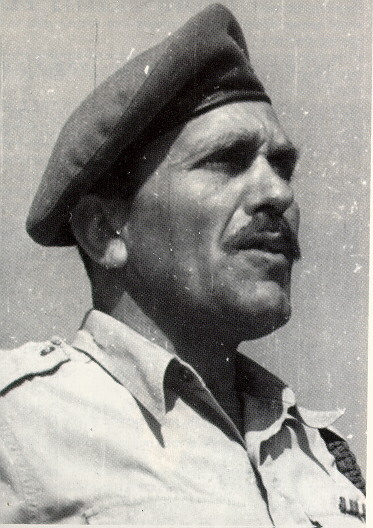
Imi Lichtenfeld, founder of Krav Maga.
To fully appreciate Krav Maga, David says, you need to know its history.
The origins of Krav Maga can be traced to pre-World War II Czechoslovakia (present-day Slovakia) and a young Jewish athlete named Imi Lichtenfeld. Imi was a nationally and internationally renowned boxer, wrestler, and gymnast. Beginning in the mid-1930s, fascist and anti-Semitic groups rose to power in Czechoslovakia and began inflicting violence on Jewish communities. Feeling duty-bound to protect his neighbors, Lichtenfeld organized a group of young men to patrol his community and defend against would-be attackers. He quickly learned, however, that his training in sport martial arts was no match for the anti-Semitic thugs he encountered. Fighting for points in a match and fighting for your life in a street fight require a different mindset and different techniques. To effectively defend himself and his community, Imi began synthesizing his martial art knowledge and started placing an emphasis on attacks that quickly disabled and neutralized a threat.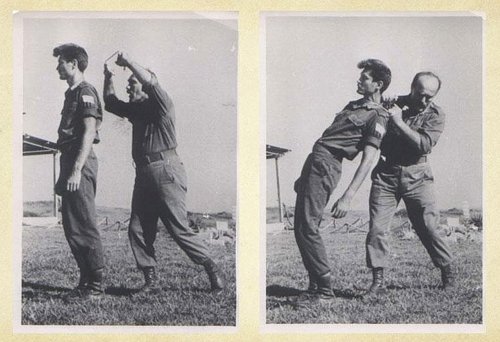
By 1940, Imi found himself living under a Nazi-allied puppet regime and decided to head for Palestine to join the Zionist Movement and fight for a Jewish state of Israel. When he moved to Palestine in 1942, he joined the Haganah, a pre-Israel Jewish paramilitary organization with a mission to protect Jewish settlers from locals who did not welcome the new arrivals. Israeli military leaders quickly noticed Imi’s fighting skills and his ability to teach those skills to others. They put him in charge of training the military’s elite fighting forces, including the Palmach (elite strike force), the Palyam (marine commandos), and the Haganah.
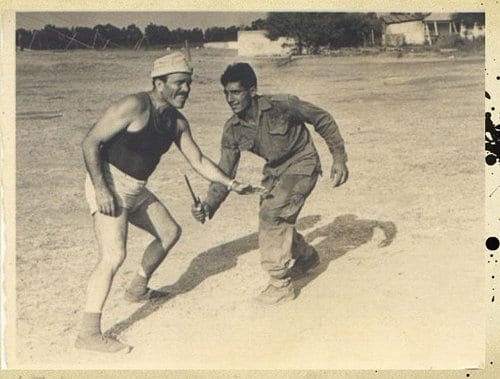
After Israel gained statehood in 1948, these separate fighting forces were merged into the Israel Defense Forces (IDF), and Lichtenfeld was named the Chief Instructor of Physical Fitness at the IDF School of Combat Fitness. It was in this role that he developed what today is known as Krav Maga. Lichtenfeld needed a combative system he could teach new military recruits in just three weeks — one that was simple, efficient, and effective, and could be applied in a number of lethal situations. To create such a system, Lichtenfeld combined the most effective techniques of boxing, aikido, judo, wrestling, and jujitsu into a single, fluid, fighting military discipline that emphasized continuous motion, simultaneous defense and attack, and attacks to an assailant’s soft tissue and pressure points. He called his self-defense system “Krav Maga,” meaning “contact combat” in Hebrew. It quickly became the official combative of the IDF and continues to be today.
After retiring from the IDF, Lichtenfeld began teaching Krav Maga to Israeli citizens.
Imi taught Krav Maga for nearly 20 years in the IDF. After retiring from military service in 1964, he began devoting his time and energy to modifying and teaching the self-defense system to civilians. Imi opened two Krav Maga studios in Israel where he taught thousands of students and instructors, all while continuing to add and improve upon the fighting discipline he had developed in the military. In 1974, Imi founded the Krav Maga Association, a non-profit dedicated to promoting and teaching Krav Maga in Israel and throughout the world.
Krav Maga is still the official combative system of the Israeli Defense Forces.
A few of Imi’s early disciples brought Krav Maga to the United States, and it quickly became a preferred close-combat system in many U.S. military and police forces. Several commercial Krav Maga organizations have formed over the years to teach and promote Krav Maga in the U.S., each with a counterpart in Israel. Each of these organizations claim to be the “true” heir and guardian of Imi Lichtenfeld’s original Israeli Krav Maga, and go out of their way to show their connection to Krav’s founder.
The Principles of Krav Maga

As mentioned above, Krav Maga is a tactical mixed-martial art/combative and self-defense system that combines boxing, judo, jujitsu, and aikido. In recent years, other martial arts have been incorporated into Krav Maga such as muay Thai and Wing Chun.
Neutralize the threat. The primary goal in Krav Maga is to neutralize your threat as quickly as possible. This overarching goal governs all the other principles of Krav Maga. Because your aim is to dominate and incapacitate your attacker as soon as possible, pretty much anything goes in Krav Maga. You can’t worry about fighting etiquette when your life is on the line. You do whatever you have to do to preserve your life.
Keep it simple. There aren’t katas or patterns in Krav Maga. Just strikes, holds, and blocks. Krav Maga was designed so that it could be put to use as soon as possible.
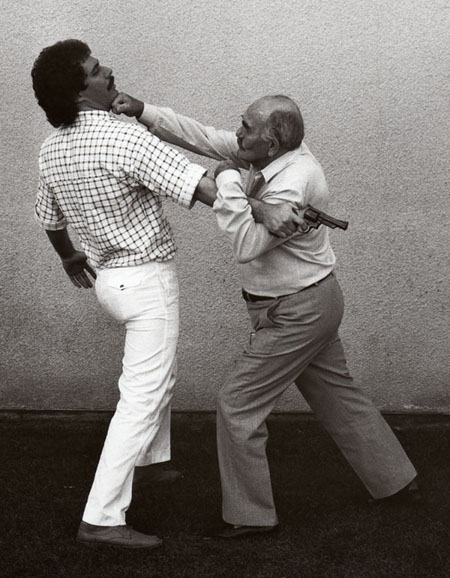
Simultaneous defense and attack. Many martial arts treat defensive and offensive moves as separate and discrete actions, e.g., first you block (defensive), then you kick when you find an opening (offensive). The downside of this approach is that it’s reactive and you typically just end up in a cycle of never-ending defensive movements. In Krav Maga, the fighter looks to combine an offensive movement with every defensive movement — he wants to disrupt the attack and simultaneously counterattack. For example, if an attacker goes for your throat, you’d not only try to deflect his attack, but also simultaneously counterattack by going for his eyes, groin, or throat. The goal is to neutralize your threat as quickly as possible. (Sidenote: Wing Chun also has a similar simultaneous defensive/offensive principle.)
Retzev, or continuous motion. Related to the principles of simultaneous defense and attack is retzev, a Hebrew word for “continuous motion.” David Kahn describes retzev as a “seamless explosion of violence,” in which the goal is to neutralize your attacker with a continuous series of aggressive defensive and offensive movements. As your attacker reacts to your counterattacks, you’ll respond with more punches, kicks, and headbutts until the attacker is no longer a threat. Retzev requires a fighter to work from instinct and not rely on a pre-set routine. A well-trained practitioner of Krav Maga will know how to react to any type of threat without hesitation.

Use of weapons of opportunity. You can easily incorporate firearms and knives into Krav Maga. Besides these traditional weapons, Krav Maga also teaches practitioners to improvise and use any object at their disposal as a weapon. Keys, pens, belts, and chairs can all be incorporated into Krav Maga techniques in order to neutralize your opponent as quickly as possible.
Weapon defense. Besides teaching students how to use weapons, Krav Maga also shows how to defend yourself from an armed attack.
Focus on vulnerable soft tissue and pressure points. A well-known principle of Krav Maga is its emphasis on attacking vulnerable soft tissue and pressure points. Many counterattacks involve eye gouging, groin attacks, and strikes to the throat. Some criticize Krav Maga for this, arguing that “it’s not manly to punch a guy in the nuts.” I brought this criticism up with David during our conversation and this was his response: “Krav Maga’s goal is to neutralize a dangerous attacker as quickly as possible. Plain and simple. Sometimes a strike to the groin is the best option to neutralize an attack. When you’re violently attacked in the street, the person attacking you isn’t following some sportsman’s code of chivalry — he wants to hurt, maim, or possibly kill you — so why should you give him the courtesy of not punching below the belt? You can’t worry about fighting etiquette or what’s ‘manly’ when your life is at stake.”
Subduing techniques. In addition to striking attacks, Krav Maga also utilizes subduing techniques in order to de-escalate a violent confrontation. Joint locks and various grabs are used to exert control over your attacker and put you in a position to end the threat.
Krav Maga in Action
How to Get Started in Krav Maga
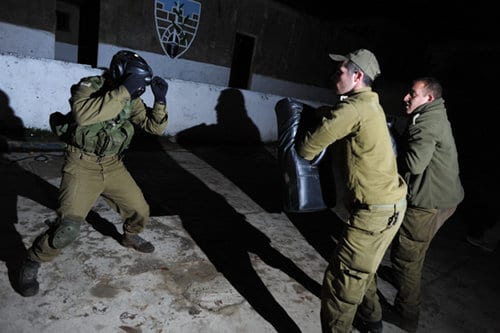
Join a Krav Maga gym. The best way to get started with Krav Maga is to join a Krav Maga gym. “Krav Maga, like any martial art, is best learned in a group and under the guidance of a well-trained instructor,” says David. Because Krav Maga is designed to prepare you for real-life attacks, you need to have people who can help simulate those situations for you in a gym. It’s hard to practice how to defend and counterattack a headlock if no one is there to put you in a headlock.
David did have one caveat about joining a Krav Maga gym. Because of Krav’s growing popularity in the United States, there are a lot martial arts studios saying they teach Krav Maga in order to get new students, even though the instructors sometimes have little or no formal training in the system. “Do your research and make sure the instructors are legit,” David says. If the instructor has trained in Israel, that’s a good sign.
As mentioned above, there are several competing Krav Maga organizations that claim to be teaching the “true” Krav Maga of Imi Lichtenfeld. It’s a touchy subject among Krav Maga followers and there have been lawsuits between the groups. David is the Chief Instructor of the U.S. Israeli Krav Maga Association (IKMA), a non-profit formed in 1978 by Imi Lichtenfeld to govern and promote the teaching of Krav Maga. There are gyms across the country that associate with U.S. IKMA. David teaches at the gym in New Jersey. If you’re in the area, stop by and check it out. David is a super nice guy and you’ll learn a lot.
Buy videos and books. If you can’t find a reputable Krav Maga gym in your area, there are plenty of instructional books and DVDs on the subject. Watching a DVD is definitely no substitute for actually training in a gym, and you shouldn’t try out moves you’ve learned solely by video in a street fight, but the DVDs will give a basic overview of Krav Maga and its techniques. I highly recommend David’s set of DVDs, Mastering Krav Maga. They’re very well-done and David does a great job explaining and demonstrating the methods and movements.
Related posts:
- Don Draper Judo: Unarmed Self-Defense from the Mad Men Era
- A Man’s Guide to the Martial Arts: Getting Started
- So You Want My Job: Martial Artist
- How To Throw a Dynamite Overhand Punch
- How to Use a Flashlight in a Tactical Situation
|
|
Albener Pessoa, Yum likes this
28 Apr 14:19



carunsa: tumblingwithstyle: “oh, there are pictures.. I keep...
“oh, there are pictures.. I keep them where I need the most cheering up.”
For those who don’t know the story behind this:
Before Maggie was born, Homer Simpson worked at the Nuclear Plant because he needed the money to pay for all the debt. Once Homer Simpson finally payed the debt, he quit his job to work at his dream job at the bowling alley. When Homer Simpson found out that Marge was pregnant with Maggie, he became depressed that he had to quit his job at the bowling alley because the salary couldn’t support them. When Homer Simpson begged Mr. Burns for his old life back, he put a plaque that reads “Don’t Forget: You’re Here Forever.” When Maggie was born, Homer instantly fell in love with her. When Lisa asked Homer where did all Maggie’s baby pictures went, Homer explains that he keeps it where he needs it the most
Scott Weigand and -1 others like this
28 Apr 09:49


Cody Cobb. Some of the best photographs I’ve ever seen by...
Some of the best photographs I’ve ever seen by Cody Cobb (On Tumblr):


gonzo, John.boddie and one other like this
27 Apr 08:18


20+ Cheatsheets & Infographics For Photographers
by Brian
We love cheatsheets as one can refer to them and make quick amendments to better our skills. Since many loved our last compilation of cheatsheet for designers, we’ve decided to compile another set of cheatsheets, this time for photographers.
Amateur photographers, and even pros can easily benefit from these cheatsheets as it is a resource for fresh and new ideas. We’ve scoured the Web and have found a wide variety of cheatsheets covering various aspects of photography and catering to the many levels of skills and interest of anyone who calls themselves a photographer.
Most of the pictures you see here are cropped for a nice fit, so remember to click on the links to check out the entire cheatsheet or infographic. Some of them are really long and can give you a ton of worthwhile information that you really can’t do without.
Recommended Reading: Five Vital Black & White Photography Tips


3 Ways to Affect Depth of Field

What Your Camera Captures At Every Lens’ Focal Length


Portrait Lighting For Home Studio

Nikon vs Canon: Shooting Modes


More Photography Resources
Here are more (but wordy) resources to help in certain photography situations. The following also includes keyboard shortcuts for Adobe Lightroom and Apple Aperture together with a few other cheatsheets for certain DSLR models.

Wedding Photography Cheatsheet


Landscape Photography Cheatsheet


Best Shutter Speeds For Every Situation

Adobe Lightroom Keyboard Shortcuts – Windows & Mac

Apple Aperture Keyboard Shortcuts

Canon Memory Card Compatibility

Related posts:
|
|
Brian Huxtable, venkman likes this
13 Apr 20:41

Street Artist Roadsworth Transforms the Streets of Montreal into a Visual Playground
by Christopher Jobson


In 2001 artist Peter Gibson began a guerrilla street art campaign to encourage the city of Montreal to build more bike lanes. What began as a project borne of activism eventually became an art project that continues to this day. Assuming the name Roadsworth stating, “where Wordsworth is a poet of words, Roadsworth is a poet of roads,” the artist has cleverly modified roads, sidewalks, parking lots and any other publicly visible asphalt surface he can transform with paint. If you want to learn more, the artist recently took a moment to share some thoughts with My Modern Met and you can see much more of his work on his website.
Update: Colossal reader Roula adds via Facebook: The first image “is a visual translation of ‘nid de poule‘—chicken nest, which is the quebecois expression for potholes.”
gonzo, David Pelaez likes this
12 Apr 14:15

© Bertien Van Manen
Ясное мышление требует мужества, а не интеллекта.
/Томас Сас/

© Yasuyuki Takagi
Каждый день я узнаю все больше и больше красивых вещей. Это сводит меня с ума. Я хочу нарисовать все это и голова моя раскалывается.
/Клод Моне/

© William Hacker
Люди, которые не движутся, не замечают своих цепей.
/Роза Люксембург/

© Denis Roche
Из интервью семейной пары:
– Скажите, как вам удалось прожить вместе целых 65 лет?
– Понимаете, мы родились в такое время, когда сломанные вещи старались починить, вместо того, чтобы их выбросить.

© Carl de Keyzer
Быть занятым недостаточно: таковыми бывают и муравьи. Вопрос в том, чем ты занят?
/Генри Дэвид Торо/

© Paul McDonough
Иногда самым адекватным ответом на реальность будет сойти с ума.
/Филипп К. Дик/

© Jonathan Carroll
Мы никогда не занимались с ней любовью в постели. Мы занимались любовью, когда держали друг друга за руки
/Ян Томас/
acosmist - человек, считающий, что не существует ничего
paralian - человек, который живет рядом с морем
aureate (золотистый) - имеющий отношение к фантазии или к словам, которые любят использовать поэты
dwale (белладонна) - бездумно бродить
sabaism - поклоняться звездам
Aubade - любовь песня, которая поется на рассвете
eumoirous - ощущение счастья из-за того, что ты честный и здоровый
mimp - говорить в чопорной манере, как правило с поджатыми губами
ци
© Bertien Van Manen
Ясное мышление требует мужества, а не интеллекта.
/Томас Сас/
© Yasuyuki Takagi
Каждый день я узнаю все больше и больше красивых вещей. Это сводит меня с ума. Я хочу нарисовать все это и голова моя раскалывается.
/Клод Моне/
© William Hacker
Люди, которые не движутся, не замечают своих цепей.
/Роза Люксембург/
© Denis Roche
Из интервью семейной пары:
– Скажите, как вам удалось прожить вместе целых 65 лет?
– Понимаете, мы родились в такое время, когда сломанные вещи старались починить, вместо того, чтобы их выбросить.
© Carl de Keyzer
Быть занятым недостаточно: таковыми бывают и муравьи. Вопрос в том, чем ты занят?
/Генри Дэвид Торо/
© Paul McDonough
Иногда самым адекватным ответом на реальность будет сойти с ума.
/Филипп К. Дик/
© Jonathan Carroll
Мы никогда не занимались с ней любовью в постели. Мы занимались любовью, когда держали друг друга за руки
/Ян Томас/
acosmist - человек, считающий, что не существует ничего
paralian - человек, который живет рядом с морем
aureate (золотистый) - имеющий отношение к фантазии или к словам, которые любят использовать поэты
dwale (белладонна) - бездумно бродить
sabaism - поклоняться звездам
Aubade - любовь песня, которая поется на рассвете
eumoirous - ощущение счастья из-за того, что ты честный и здоровый
mimp - говорить в чопорной манере, как правило с поджатыми губами
gonzo, Denys Nazarenko and -1 others like this


09 Apr 08:23

The 2012 Human Tower Competition in Tarragona, Spain
by Christopher Jobson


You’ve probably seen photographs of the Concurs de Castells, the human tower competition held in the region of Catalonia, Spain, but photographer David Oliete got a pretty unique perspective in 2012, shooting the entire event at what appears to be a nearly aerial position. As the throngs of castellers—hundreds of men, women and even children—push forward in a claustrophobic mass to build their best human towers, biological shapes reminiscent of insects or even animal cells begin to form. Oliete shares with me via email about the competition:
The most important Human Tower Competition is called “Concurs de Castells” and it takes place in the city of Tarragona once every two years. Its XXIV edition took place during the 6th and 7th October 2012 with the participation of 32 teams from all around Catalonia and a live audience of more than 20,000 people. During the competition, the higher and difficult to build a tower is, the more points a team gets. Every human tower is usually between six and ten levels high. Teams are made of between 100 to 500 women and men. Young and light members form the top of the tower while heavier members form the base.
The “castells” have also been one of the most important cultural traditions in Catalonia for more than 200 years. “Strength, balance, courage and common sense” is their motto. In 2010, the castells were declared by UNESCO to be amongst the Masterpieces of the Oral and Intangible Heritage of Humanity”.
You can see many more shots from Oliete’ shoot of the Concurs de Castells 2012 over on Flickr, and you can also catch up with him on Facebook. (via devid sketchbook)
gonzo, Denny Wells likes this

09 Apr 08:22

Flickr Finds No. 30
by Christopher Jobson


Cathy Hammer / New installation by Kaarina Kaikkonen

So here we are at our 30th edition of Flickr Finds, my personal challenge to ferret out the greatest photos found on Flickr every few weeks. It should be bi-weekly, it never is, but I think we all benefit from the quality versus the regularity. This is a really phenomenal week for photography, and if you like what you see here please click through each photo above to learn more about the individual photographers—this is truly only the tip of the iceberg for each of these artists. If you’d like you can check out previous Flickr Finds.


09 Apr 08:05


Hanging with the hoodoos
by Arnold Chao





These rock pillars, or hoodoos, tell the geologic story of erosion seen in treasured natural landscapes worldwide. Over millions of years, changes in climate conditions shaped them by washing away sediments and chipping off slabs of earth.
See more photos: Fantastic Hoodoos gallery | Bryce Canyon National Park group
Photos from martin zalba, ladigue_99, marichica88, Luke Notsoblack, and geoGraf.
gonzo, Cooper Griggs likes this


09 Apr 07:42
 Print Recipe


Edna Mae’s Sour Cream Pancakes
by Ree
 These pancakes…aren’t just any pancakes.
They’re…wait for it…
They’re Edna Mae’s Sour Cream Pancakes!
Of course, you probably already figured that out based on the title of this post.
I’ve always been really great at building suspense.
Or not.
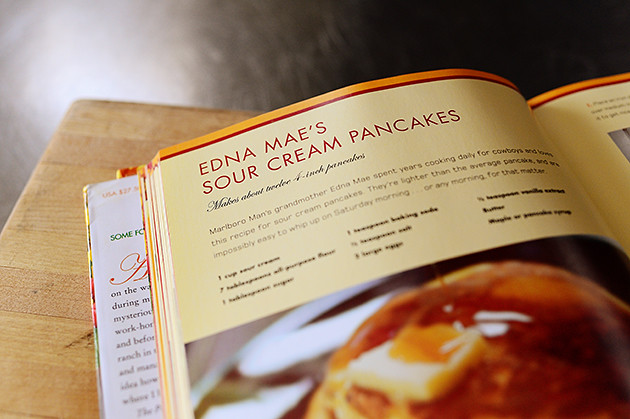 I love this recipe so much, I put it in my first cookbook. It’s turned out to be one of the most-enjoyed recipes in the book.
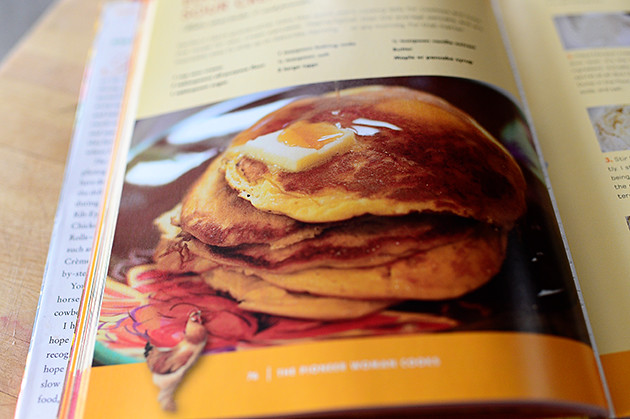 Recently, I was sharing with Edna Mae (she’s Marlboro Man’s precious grandmother) some of the nice things people have told me about her delicious pancakes, and it dawned on me that I’d never, in the six years since I first started posting about cooking, posted it here on my website.
What an outrage!
What an oversight!
INCONCEIVABLE!
Well, I’m righting that wrong right now. Alright? Righty-Oh.
Right on.
I’ll stop now.
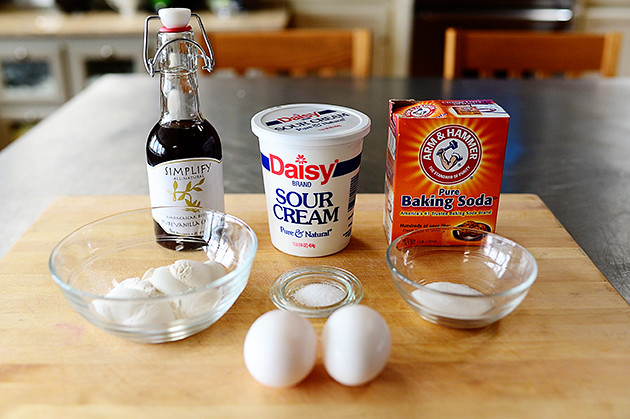 The ingredients couldn’t be more simple: Sour cream, flour, baking soda, sugar, salt, eggs, and vanilla!
 Sour cream is the star of the show.
 Measure a cup…
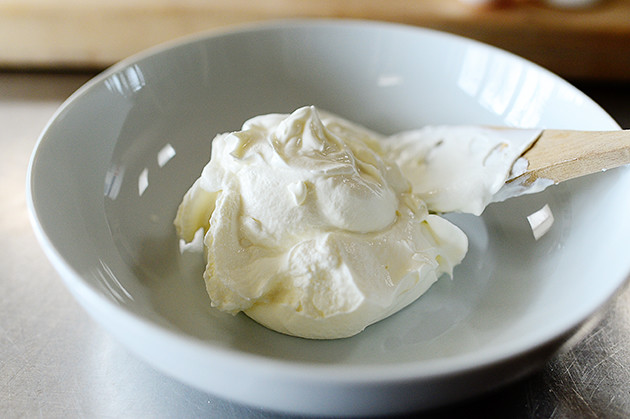 And throw it into a bowl.
 Sprinkle in the flour, and it is at this time that I’ll point out that aside from the comments I hear from people who love these pancakes after they make them, I receive quite a few questions from people before they’ve made them for the first time.
“That can’t possibly be the right amount of flour…can it?”
Yes! It’s correct, baby! That’s what makes these glorious little wonders so…well, wonderful. They’re not weighed down with flour; they’re light and a decidedly different texture. You’ll be able to tell from the first bite.
 Next, add baking soda…
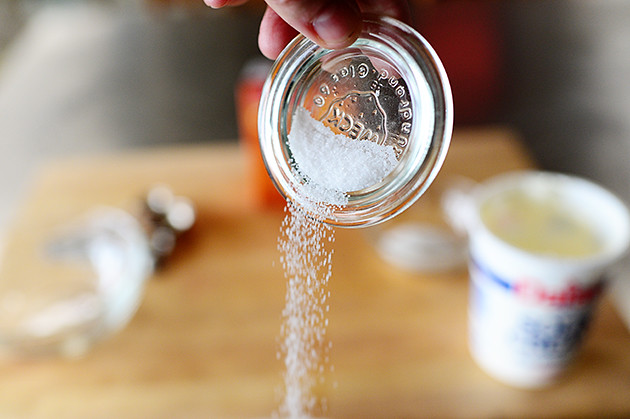 Salt…
Salt…
 And sugar.
A note on the sugar: Edna Mae’s original recipe calls for 1 tablespoon. I sometimes do two or three, because it makes the pancakes a little sweeter…but if you prefer all the pancake sweetness to come from the syrup you pour over the top, go ahead and keep it at one.
I realize that made no sense. Sorry.
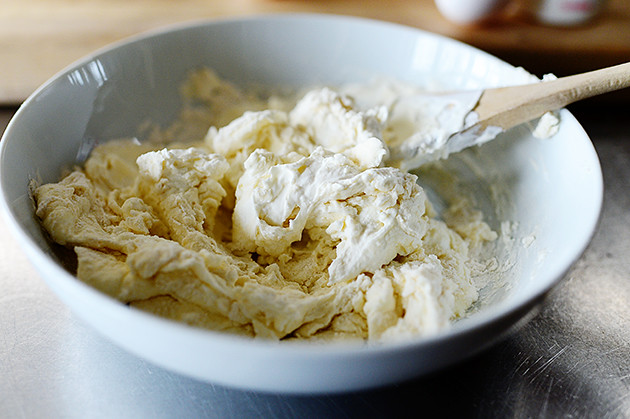 Now, stir the sour cream and the dry ingredients until it just starts to come together.
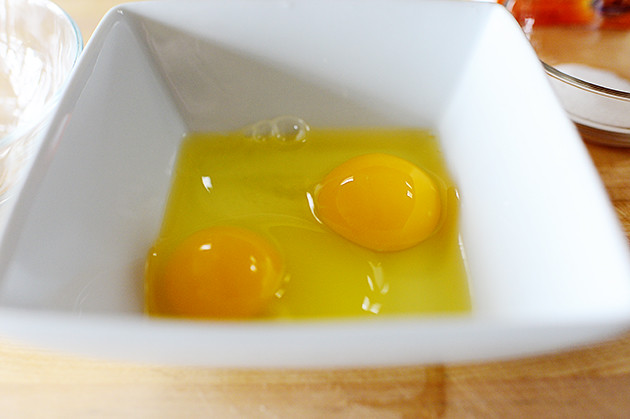 In a separate bowl, crack 2 eggs…
 Add a little vanilla…
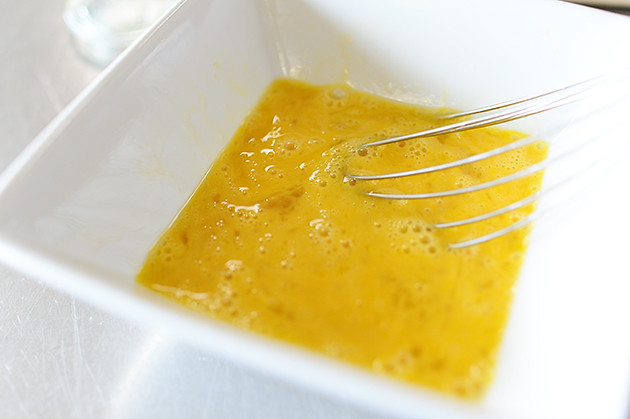 And whisk it together until totally combined.
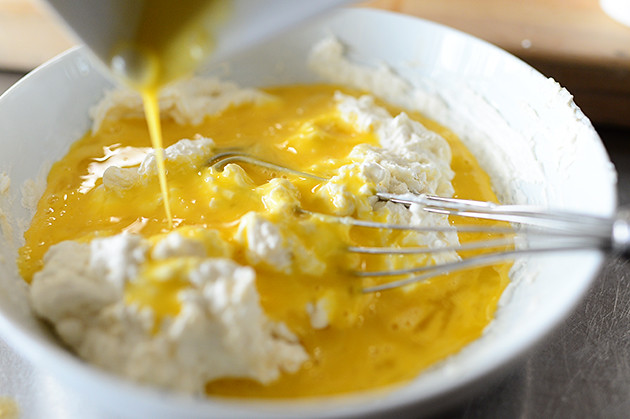 Pour it into the bowl with the sour cream mixture…
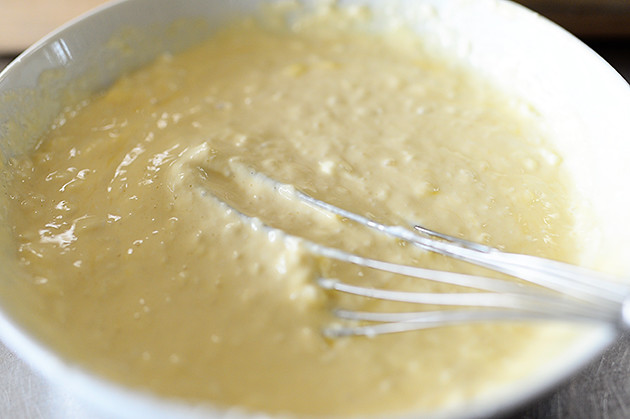 And whisk it until it just comes together. You don’t need to beat it to death, and you shouldn’t be concerned with lumps—that’s what it should look like.
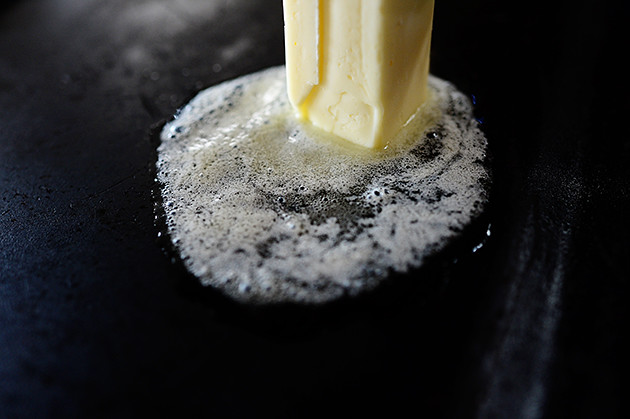 To fry ‘em up, smear a whole bunch of butter on a griddle or skillet over medium-low heat (get the griddle totally heated before you do.)
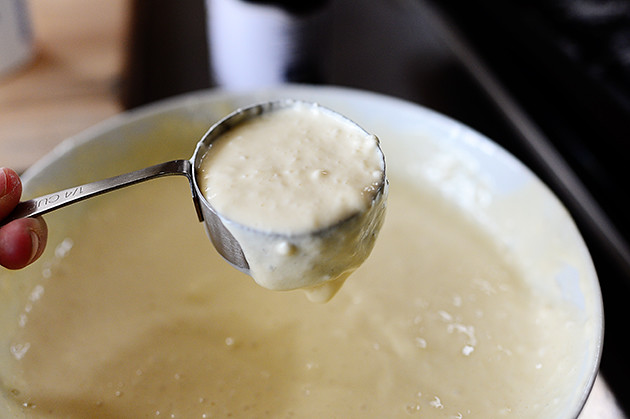 When the butter’s sizzling, grab 1/4 cup of batter…
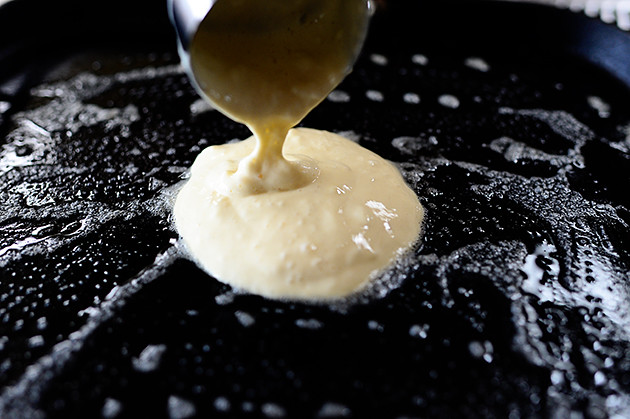 And pour it on.
 Let it cook for 2 minutes or so, and when the sides look like they’re starting to set and bubbles just start to form…
 Flip it over and let it cook for another 2 minutes or so.
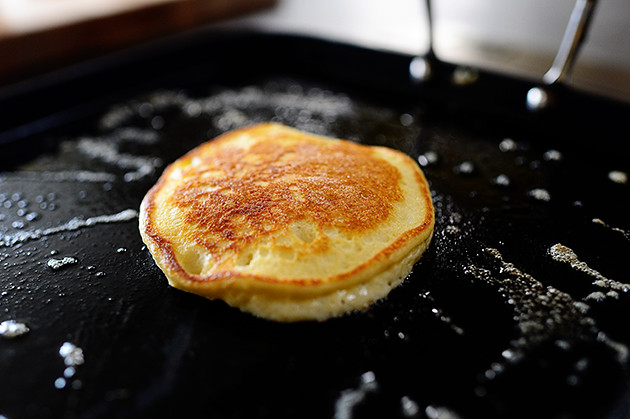 Keep going with the rest of the batter until the pancakes are “done,” but note that they’ll be a little softer than regular pancakes. As long as both sides are nice and deep golden brown, they should be good to go!
 So here’s how I roll with pancakes.
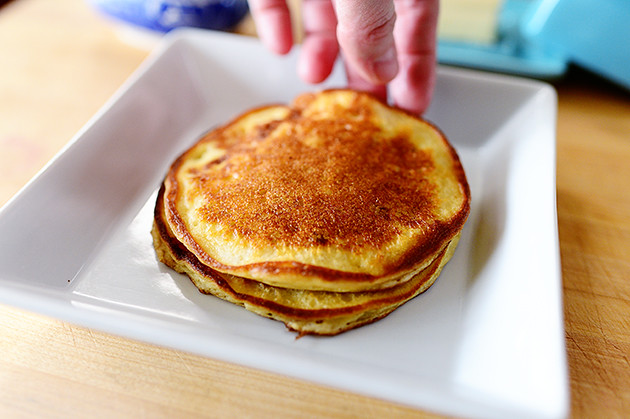 Keep going…
 Keep going…
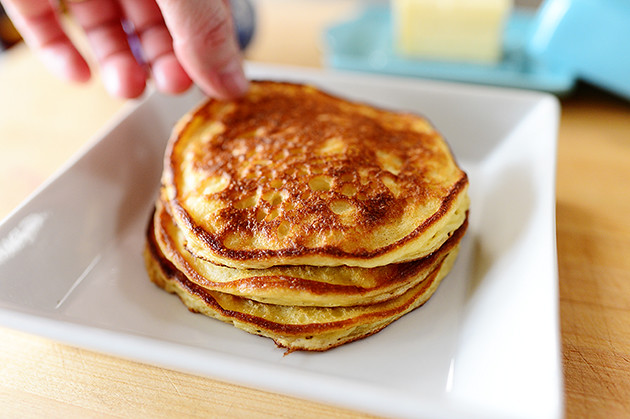 Keep going…
 Okay. I think I’ll stop there.
 Warm syrup is a must. A requirement of life. A mandate.
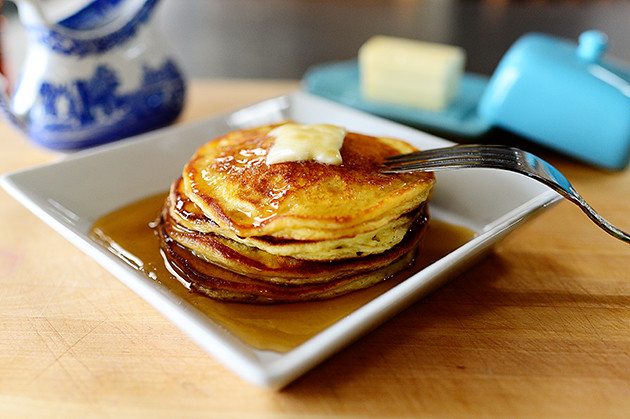 Lean in for a minute. I wanna tell you a secret.
Come closer…
Come closer…
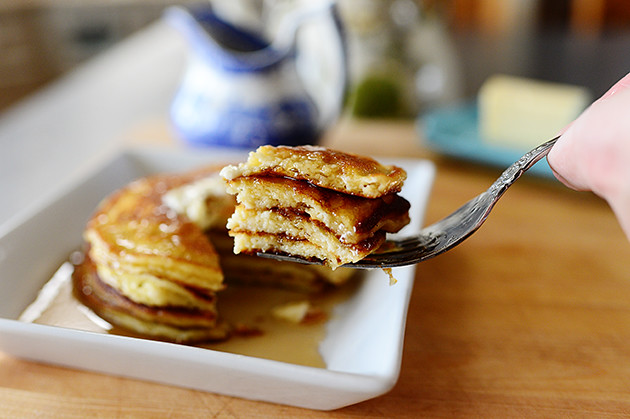
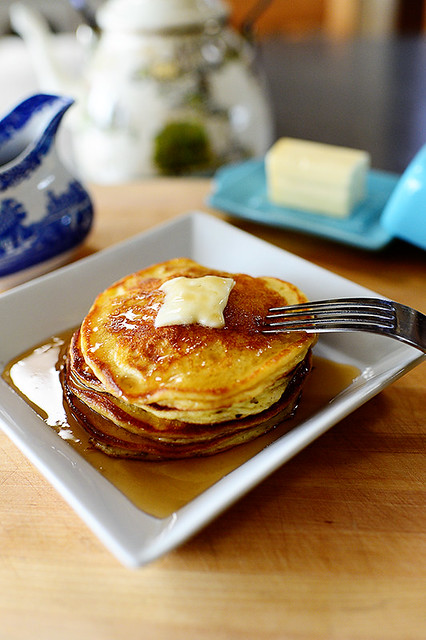 You’re going to absolutely love these. They’re light but decadent, different but familiar. Lemme know how you like ‘em.
 Here’s the handy printable.
Have a wonderful Monday, everyone!
RecipeEdna Mae’s Sour Cream Pancakes
- Prep Time:
- Cook Time:
- Difficulty:
- Easy
- Servings:
- 2
Print Recipe
Ingredients
- 1 cup Sour Cream
- 7 Tablespoons All-purpose Flour
- 2 Tablespoons Sugar
- 1 teaspoon Baking Soda
- 1/2 teaspoon Salt
- 2 whole Large Eggs
- 1/2 teaspoon Vanilla Extract
- Butter, For Frying And Serving
- Warm Syrup, For Serving
Preparation Instructions
In a small bowl, whisk together eggs and vanilla. Set aside.
In a separate small bowl, stir together flour, sugar, baking soda, and salt.
In a medium bowl, stir together the sour cream with the dry ingredients until just barely combined (don't overmix.) Whisk in the egg mixture until just combined.
Heat a griddle over medium-low heat and melt some butter in the pan. Drop batter by 1/4 cup servings onto the griddle. Cook on the first side until bubbles start to form on the surface and edges are starting to brown. Flip to the other side and cook for another minute. (Pancakes will be a little on the soft side.)
Serve with softened butter and syrup.
Posted by Ree on April 8 2013
Olga, Golemkerensky likes this

09 Apr 06:31


What porn do they watch in the Vatican?
by Cory Doctorow

TorrentFreak's been looking at the BitTorrent video-downloading from the small pool of downloaders in Vatican City, and they've reported in with the Vatican's favorite pornography:
In the interests of science we researched each of the titles (including the curiously named RS77_Episode 01) and discovered that downloaders in the Vatican have one or two unusual ‘niche’ interests. We won’t link to our discoveries here, but feel free to do your own ‘research’ using the titles shown above. There isn’t a commandment that covers these films directly, but some might argue there should be.
TorrentFreak couldn’t find a priest prepared to make a comment and apparently the Pope is “busy” today. On a Sunday?
Priests Watch DVD Screeners While Pirates Download Filth in the Vatican 
|
|
Christian, Tomas.jung and 2 others like this