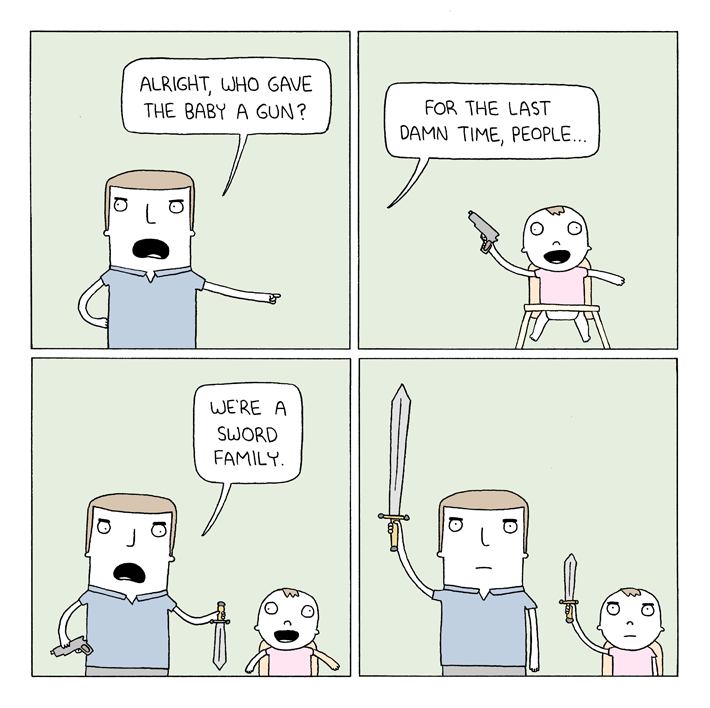
The Original Hyperloop Carried a Cat Through the NYC Mail System (and subway sandwiches) http://bit.ly/1cQuXyz
The Original Hyperloop Carried a Cat Through the NYC Mail System (and subway sandwiches) http://bit.ly/1cQuXyz

Adventure Time: Explore the Dungeon Because I DON’T KNOW! is coming out for a lot of systems (3DS, Wii U, Xbox 360, PlayStation 3, and Windows), but the 3DS version will have a $39.99 special edition that includes a copy of the game, BMO packaging in a SteelBook case, a bonus DVD (actor interviews, storyboard art from Pendleton Ward, and more), and a Finn and Jake’s Dungeon Guide enhanced manual.
The 3DS game also has an exclusive feature — BMO appears on the touch screen with hints and game commentary. The Wii U version also has BMO appearing on the GamePad, where he’ll deliver over 300 voice clips with “game tips, boss hints, clues about enemy weaknesses, game commentary, and more.” All versions release this fall.
PREORDER Adventure Time 3DS games, Regular Show 3DS, upcoming games

Another victim of Starbucks Hearing Disorder.

Though many people blamed him for The Beach Boys’ internal troubles last year, band member Mike Love says he had nothing to do with it. Rather, he tells Billboard that it was “the people who were running” the 50th anniversary reunion tour that were ultimately responsible for the firing of Brian Wilson, Al Jardine, and David Marks from the touring Boys. Love had previously denied firing Wilson, but now says the giant, unseen hand of some evil overlord thwarted some other mystery project he had going with Wilson as well, and that—while the group was “supposed to be allowed to get together to write songs from scratch like we did in the ‘60s”—“that was never to be, and it wasn’t because of me.” Love says he’s also upset that band never really got rolling, but acknowledges that working with Wilson, his cousin, is “not that uncomplicated ...
Read more


Read more of this story at Slashdot.


|
By Adam Smith on August 15th, 2013 at 9:00 pm.
Damn you, Democracy 3, and damn you Cliffski. I wouldn’t say I’m quite at the point where I sympathise with the many blood-sucking insects that make up the UK’s political scene, but I worry that I’m starting to think like one of them. When I began playing, I was determined to do the right thing. A couple of hours later, I realised I didn’t know what the right thing was anymore. Two days in, I’d have chopped off my own hand for a few more votes.
I’m trying to steer the country away from economic disaster, having spent my first year in office encouraging higher standards of science education, attempting to prevent the British from becoming the brainless backwater of the 21st Century. The plan was working and the people (most of them; some of them) were happy, but the expense of funding the future threatened to punish the present. Budget cuts loomed and I swiftly found myself between the rock of populist appeal and the hard place of economic necessities. Idealism dies young in Democracy 3’s high-pressured simulation, where every choice makes somebody unhappy and the main screen, a political petri dish of interlinked nodes, soon comes to resemble a nefarious web.
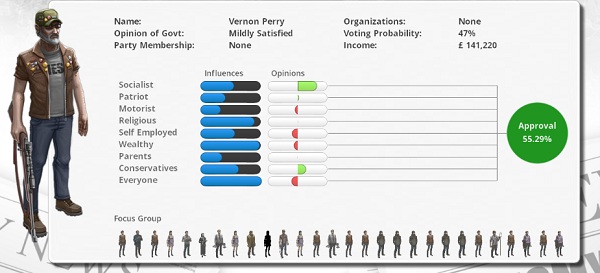
Over the last few days, as I’ve tinkered with Positech’s latest government sim, the sense that those nodes – and the situation they represent – were acting as a trap became embedded in my brain. I, the Prime Minister, am a fly, caught on sticky strands that I can tug one way or the other, but can never escape. Admittedly, I can fail, fall short when the election rolls around, vacating my place on the chopping block and leaving some other poor bastard stricken and splayed, dangling like a piñata in full view, pummelled by polls and impossible choices.
Democracy 3 never lies to the player, which is extraordinary considering its themes. Or perhaps it pulls the wool over my eyes constantly but is incredibly good at concealing the fact of its fictions. That seems unlikely. The mathematical models that drive the consequences of every decision, major or minor, are transparent. Hover the cursor over any policy decision, population segment or funding slider, and lines appear showing which other aspects of the system will be impacted.

It’s the kind of insight that even the Challenger 2 of thinktanks would fail to provide. Taking tourism as an example, we can see that a high sales tax, terrifying levels of violent crime and border controls that would shame Arstotzka are all putting a dent in the potential earnings from visitors to my increasingly Orwellian Britain. This leads to serious problems. Ninety percent of automobile accidents are caused by impact with unsold novelty replicas of Tower Bridge and with Britain beating seven shades out of itself while tourists stay away, there’s a real danger that the next royal baby will be born without a single camera lubriciously angled to appreciate its arrival.
I’m tempted to close the borders completely, to let the island nation sever its links with the world and fend for itself. I’m extremely popular with the kind of patriotic loons who holler and applaud every time I loosened gun laws (there are currently no restrictions whatsoever on purchase or ownership) and tightened immigration laws. I won’t earn re-election for an extra term, having driven most of the country to despair, but could things have been much worse?

To explain precisely how things could have been worse, I’d like to talk about my efforts to do right by the people of the United Kingdom. My version of ‘doing right’ involves the creation of a tolerant society that helps those in need but also rewards brilliance. I also quite like the idea of Big Government, especially when I am the government. I’m mega-ego-maniacal and wouldn’t have taken the job if I didn’t think I could improve every single aspect of the country, from spy agencies to healthcare, by taking on the yoke of leadership and flourishing under the strain.
It’s not a yoke though, remember. It’s a web. The stresses and pressures of leadership are not relentless and crushing. There are no time limits, no real limitations at all apart from political capital, which is the currency required to take actions, generated by loyal cabinet members between turns. Instead, the difficulty comes from the realisation that pulling any one strand causes an unwanted effect elsewhere. I don’t think I’ve made a single action that hasn’t had at least one undesirable consequence. That the game explicitly details those consequences beforehand makes the decision-making all the more difficult. You’re pulling the trigger knowing full well that it’s pointing at somebody’s head.
And so it goes. I’m caught between the need for political survival, which requires me to offer pity-fuck policies to unhappy demographics, and the desire to create a decent society, which requires me to stop using phrases like ‘pity-fuck policies’.

In order to ensure I’m elected for another term, I spend the first term pandering to the masses. I lower taxes, and improve spending on education and health. In order to balance the books, a sharp increase in corporate, property and inheritance tax.
Obviously, anyone who owns property or inherits anything at all must have plenty to spare. Or not, as the case may be. Suddenly, I’m unpopular with old people, particularly the ones surviving on pensions in large houses they can’t afford to maintain. I’ll need to find the money that goes toward building my utopia elsewhere. Becoming an instant caricature, I cut police and security funding. When everybody takes to dancing in circles with flowers in their hair, we won’t need a police force.
Britain’s proud ship of state sails onward. For a while.

Toward the end of my second term, no matter how many sliders I adjust and how much I try to fix things, it’s all gone a bit Clockwork Orange. I’m very unlikely to win re-election again and the security tab shows that there are several increasingly dangerous organisations on the rise. Even though I was intentionally pushing my decisions to extremes, I can’t help but think this is the world I would have unintentionally created given enough time.
Reading Alec’s experiences, I suspect we’ll both find that balance is the key. Stable, middle ground, run of the mill governing. The game’s strength is in presenting so many options, all of them enticing and, importantly, all possible from the beginning. There are limits on power but despite its sober appearance, Democracy permits flights of fancy and I suspect a lot of the pleasure I take from the finished version will be found in pushing the simulation as far as possible in various directions.

It’d be interesting to begin with a manifesto, or even to spend the early part of the game in opposition, attempting to topple a current government by over-promising and gleefully celebrating when they plunge the country into chaos and debt. The most devious aspect of the game is the rapidity of the indoctrination process. I’d been playing for about half an hour when I found myself convinced that I wanted to win the next election in order to be a better leader in my net term. Compromising today in order to be an honest man tomorrow.
Until tomorrow comes.

President Obama has always made environmental issues a big part of his platform, and now the White House is taking another step towards going green by installing solar panels. According to The Washington Post, the White House residence is having panels installed on the roof of the First Family's residence, a move that's been in the works for nearly three years. Back when the White House made its announcement in 2010, the administration said that it would conduct a bidding for between 20 and 50 panels, and those being installed now are said to be made in the US.
A Washington Post source from inside the White House says that the move is "a part of an energy retrofit that will improve the overall energy efficiency of the building," with other planned changes including updated building controls and variable speed fans. Oddly enough, it's been nearly 30 years since solar panels last graced the roof of the White House — Jimmy Carter had panels installed in the late '70s, but Ronald Reagan had them removed in 1986.
From previously unpublished descriptions of Adolf Hitler’s responses to films he watched in 1938 and 1939. The notes, written by Hitler’s adjutants as part of daily records of his activities and now kept in the Bundesarchiv in Berlin, are excerpted in The Collaboration: Hollywood’s Pact with Hitler, by Ben Urwand, published by Harvard University Press this month. Compiled and translated from the German by Ben Urwand.
Tip-Off Girls: switched off
Capriccio: the most potent crap
Stormy: switched off after the first 100 meters
Swiss Miss (Laurel and Hardy): The Führer applauded the film.
Nights in Andalusia: Imperio Argentina very good; directing bad
Way Out West (Laurel and Hardy): good!
Bluebeard’s Eighth Wife: switched off
The Great Gambini: switched off
Shanghai: switched off
Fun in the Snow: Not particularly good. Anny Ondra is capable of much more difficult roles.
China Seas: switched off
Thirteen Chairs: Good — the ending was changed, as Dr. Goebbels said.
The Princess Comes Across: very good
Marie Antoinette: The Führer switches off the film.
Two Women: obnoxious
Dance on the Volcano: bad, especially Gustaf Gründgens
Block-Heads (Laurel and Hardy): was deemed very good because it presents a lot of very nice ideas and clever jokes
The Green Hell: does not find much applause because the depiction is very often not realistic enough
Tarzan the Ape Man: bad
firehoseshagowunnnnn

Vin Diesel is diving back into science fiction movies with a vengeance — with a strange new feature called Soldiers of the Sun. Which is apparently about Orcs that live in Earth, in the future. Ooook.

|
|
Mass. cop suspended for Tsarnaev leak back on job USA TODAY SHARE 9 CONNECT 26 TWEET 5 COMMENTEMAILMORE. The Massachusetts cop suspended after leaking arrest photos of Dzhokhar Tsarnaev — following the publication of a sympathetic photo of the Boston Marathon bombing suspect on the cover of ... and more » |
firehosemeanwhile, in Portland

Continue reading Gone Home review: First-Person Snooper
 Gone Home review: First-Person Snooper originally appeared on Joystiq on Thu, 15 Aug 2013 14:03:00 EST. Please see our terms for use of feeds.
firehosevia Wilson
"When will nonviolent resistance be redeemed from this twisted reading of Letter from Birmingham Jail, so that one might resist in a manner that allows continued, successful resistance, rather than simply submission to authority? In the broader mindset of activism in the United States, I predict that the answer is: never."
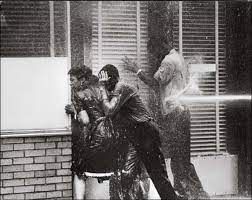
In the United States, discussion around bottom-up political activism has, for almost fifty years, been synonymous with discussion of civil disobedience. Civil disobedience has an almost theological role in US political activism. Writings on civil disobedience are canonical; particular interpretations of civil disobedience are simplified into pillars, commandments, and noble truths of activism; ambiguities of the cosmology are played out via the power struggles of sects; and deviations from doctrine are often considered anathema.
The history of political struggle in the United States is not the history of civil disobedience. From the Pullman strikes, to Colorado Labor Wars, to the Oakland General Strike of 1946, tactics not generally recognized as ‘civil disobedience’ have been on the front lines of protest. So when did civil disobedience gain its canonical role?
Different sources will trace the history of civil disobedience to various sources, from Ghandi’s doctrine of Satyagraha, to Thoreau’s titular essay, to Shelley’s poem The Mask of Anarchy in the wake of the Peterloo Massacre, to the Bible, and to Sophocles’ play Antigone. But in the United States, any discussion of grassroots activism will inevitably find its way to Martin Luther King Jr. and the Civil Rights Movement—the US kernel of activist authenticity.
 The Civil Rights Movement earns this authenticity for a variety of reasons. Perhaps primarily, contemporary readings of history consider the cause all but inviolate. Only the most marginal and disreputable commentators would say that the Civil Rights Movement was wrong for fighting the racist laws in many areas of the country. Second, the Civil Rights Movement is largely viewed to have won its struggle, culminating in the Civil Rights Act of 1964 and the Voting Rights Act of 1965 (the latter only recently gutted by a Supreme Court decision). And third, the Movement has a singular champion of civil disobedience in Martin Luther King Jr. Although he was hardly the sole leader of the movement, his admirable writings and speeches, and his assassination during the height of the struggle has made him stand out in historical accounts, and his recognition alone makes him a symbol within a particular understanding of how the Civil Rights Movement accomplished what it did.
While the Civil Rights Movement is incredibly important to United States history, it is worth looking critically at how this focus shapes the understanding of civil disobedience and political activism. King’s Letter from a Birmingham Jail was written to justify a particular protest campaign of nonviolent resistance among his peers. King argued that what he and others were protesting was fundamentally unjust, and therefore they must resist. And one of the nonviolent means in which they resisted was civil disobedience, which King traced back to the Bible.
I hope you are able to see the distinction I am trying to point out. In no sense do I advocate evading or defying the law, as would the rabid segregationist. That would lead to anarchy. One who breaks an unjust law must do so openly, lovingly, and with a willingness to accept the penalty. I submit that an individual who breaks a law that conscience tells her is unjust, and willingly accepts the penalty of imprisonment in order to arouse the conscience of the community over its injustice, is in reality expressing the highest respect for law.
However, when activists discuss the Letter today, they read King’s words as a blanket strategy, not as a tactic. King and the other Birmingham Campaign protesters were resisting the laws which legalized segregation and outlawed public protest and boycotts, as well as the general climate of racism and bigotry. In such a circumstance, resisting the Birmingham laws against protest become a fundamental component of protest. In response to and anticipation of protests, boycotts, picketting, and marches had all been declared illegal by the police. Therefore, the link between justice of the protest campaign and civil disobedience of the city laws that would disrupt that protest is implicit.
King only mentions civil disobedience in one paragraph of the letter. But he mentions nonviolent direct action throughout the entirety of the letter. Nonviolent direct action is a broader playbook of protest tactics than mere civil disobedience. Eugene Sharp, who has written a book detailing many strategies and tactics of nonviolent protest, lists 198 methods of nonviolent protest and persuasion, of which only two are civil disobedience. So why has political activism come to focus on civil disobedience in particular?
A legal regime will attempt to use every manner at its disposal to perpetuate itself, and therefore will make tactics of resisting it illegal, to the furthest extent possible. King argues that unjust laws must be resisted, even if one thinks the legal regime is just. This concept of living a just life regardless of the intervention of unjust authorities is the core motivation of his call to nonviolent resistance. But in a climate in which the legal regime makes arbitrary laws to stem protest, it means that all forms of resistance become civil disobedience. If an occupation is deemed illegal, occupying becomes civil disobedience. If a boycott is illegalized, it is suddenly civil disobedience. If a book is banned by law, printing, distributing, or reading the book is civil disobedience.
 While certainly, laws that prohibit resistance should be not be followed in a time of resistance, this legal climate begins to conflate the words of King in activist discourse. The moral imperative to nonviolent resistance transits to a moral imperative to civil disobedience. This is problematic, because while a sense of justice as the backbone of a wide strategy of resistance is a major component of a generalized humanity, linking that sense of justice to a tactic of breaking laws is a recent development that has negative effects for bottom-up activism. The presence of injustice is a good reason to resist, but the presence of injustice is not necessarily a good compulsion to engage in civil disobedience. A strategy of resistance may declare itself in general beyond the legal regime, but any tactical activity in resistance must be chosen more carefully.
Laws will most certainly be broken in the course of resistance. But breaking laws is not the point—resistance is the point. Given the nonviolent precepts and religious tenor of moral resistance and submission in King and others’ writing and actions, and the ravenous extent of the legal system in the United States, civil disobedience in practice becomes shorthand for ‘get arrested.’ Civil disobedience, and all nonviolent resistance, becomes a categorical submission to arrest in practice—alert police laws will be broken, show up at place to break laws, and when all is ready, begin to violate the law and immediately offer oneself up to the police as they step into make arrests. Engaging in this dance with the police is considered to be upping the moral intensity of one’s protest, and engaging in just action. However, the crime for which one is arrested is never mentioned. Crossing an arbitrary line on a military base to be arrested by guards waiting for just this specific task is, in this liturgical practice, just as much a resistance as removing the train tracks that transport war materiel from that military base under the cover of night. A law is broken, one is arrested, therefore one’s activism is just. But what is never mentioned is that the penalty for sabotaging railroad tracks is far more significant than that of trespassing, because of course, the former would actually be a great imposition to the operation of a military base, whereas the latter is hardly an inconvenience. Trespassing is a minor offense, and often after the arrest such charges are dropped. The risk to the resister is minimal, as is the resistance. But as long as some law is broken, the activists can consider their actions to be just and nonviolent resistance is considered to have occurred.
Given the legal system in the United States which makes advocation of any particular crime in itself an offense, we can dispense with the hypothetical examples of what crimes might be more political expedient to resistance (this author certainly takes the threat of the legal regime seriously), and discuss the simple notion of submitting to arrest. Edward Snowden, the NSA leaker who is currently seeking political asylum after breaking laws by publicizing classified information, has been encouraged via editorials to come back to the United States to ‘justify’ his actions in the inevitable trial that would result from his arrest. If his resistance is real, he should be prepared to face jail time. This represents the most inane contortion of nonviolent resistance, by allowing the legal regime that is being resisted to define who is truly resisting. By evading arrest, Snowden is less of a resistor than if he was facing prison for the rest of his life, as the leaker Bradley Manning is.
 The notions of civil disobedience and legalities have become so central to theories of political activism in the United States, that the moral rectitude espoused by Martin Luther King Jr. and others has been rewritten as a desire for Christian martyrdom. Activism is only activism, it is argued, if all activists end up behind bars. The legal regime has so fully interpolated nonviolent resistance into its laws and the culture of those laws, that whether one submits to that authority has become the ultimate arbiter of whether one’s resistance against that authority is just.
At what point will the runaway legal regime become so nefarious that we might see resistance not only as a violation of statutes, but a long term resistance to the system itself? When will nonviolent resistance be redeemed from this twisted reading of Letter from Birmingham Jail, so that one might resist in a manner that allows continued, successful resistance, rather than simply submission to authority? In the broader mindset of activism in the United States, I predict that the answer is: never. Despite the fact that the legal regime has learned to adapt to the tactics of the Civil Rights Movement in the last half century and is now better equipped to make civil disobedience ineffectual. Activist culture in the United States depends on the theological centrality of civil disobedience to justify its own existence and understand itself within history. Re-interpreting this history in the context of the contemporary legal regime is possible, but it is also hard work, and is in itself being illegalized at every turn. Unfortunately, the moral imperative to resist has been satiated by martyrdom, and the risks of redefining this resistance away this revisionist civil disobedience strategy are great.

Whether homemade or store-bought, kimchi is delicious straight from the jar, but it can also be incorporated into lots of other dishes. These savory kimchi pancakes make a scrumptious snack, side dish, or appetizer. It's easy to make them gluten-free and vegan, too. Just grab a skillet and a few simple ingredients.

|
|
firehose'Graphic Designer - This has come to mean "design, but not web design."
Software Engineer / Programmer - This has come to mean "programming, but not for the web." '
literally
There are loads of job titles in our industry. The opinion on their usefulness range from harmful (i.e. leads to “not my job” syndrome) to vital (i.e. people change companies sometimes and need common language). Since they are out there and we use them, there should be some consistency to their definition. Perhaps we can get closer to nailing that down.
Let's light this fire, shall we? This is all debatable, of course.
These are legit in my opinion.
If "designer" is in the title, the job is designing. Literally deciding and implementing how websites look and work. "Web" is in the title because the job is specifically focused on the web. Specific skills would be design-tools-of-choice, HTML, CSS, and light JavaScript.
If the job is also designing for print, apps, signage, products, clothing, etc., the title would be widened to Designer.
This job is focused on HTML, CSS, JavaScript, and light backend work. Not design. The lack of "designer" in the title is intentional. Because the job doesn't require design, deeper skill in the other technologies is implied. You likely have a grasp on some concepts beyond the core technologies, for instance regression testing or performance.
A synonym might be Front End Engineer. I tend to think of that as a requiring a deeper and more specific skillset, possibly with more narrow focus or at a higher level.
Technology specific job titles may be also be appropriate here, like "JavaScript Developer" or "JavaScript Engineer" for a job where that is primarily what needs to be done. Although, none of the front end technologies live in a bubble so I generally prefer Front End Developer.
This job is more about designing and less about implementation. Really good at design-tools-of-choice with perhaps only light HTML and CSS skill. A synonym might be a Visual Designer.
A specific focus on studying and researching how people use a site. Then ushering changes for the better through the system and testing the results. May not have or need any design or implementation skill. All jobs should care about user experience, but this job lives it.
Primarily design, just like a UI Designer, but with specific focus on how things are used and movement.
The job is quality control, leadership of other designers, and client communication. A synonym could be Design Director.
This job is focused on back end work and working with languages specific to the web, like PHP, ASP, Ruby, Python, etc. Medium skill in database/server work, medium skill in JavaScript, light skill in HTML. This is very different from a Front End Developer as there is little working with the design and heavier on programming concepts and concerns, like security and structure.
Synonyms could be Web Programmer or Web Application Developer.
This job is a combination of front and back end work. Seriously though, not mostly one and a little of the other. Good crossover people are needed at organizations and this is a high end job.
Rather than working directly on implementation, this job is about the structural design of websites. Things like the taxonomies, metadata, scheduling, and analysis of content. A synonym might be Information Architect. They might work with people who work with content in a more general way like a Writer, Copywriter, or Editor.
This job works with the actual computers and tech equipment. A hardware person.
The job bridges the gap between IT and Developers. They handle things like server software, version control, deployment, build processes, and testing servers/processes. I wish this had a more job-title-y feeling to it. As it stands it sounds like what you would call the whole team of people with this job.
This job is about guiding the site as a whole (or a major feature of the site) toward a better future. Largely dealing with people and planning. A Project Manager would be similar but smaller in scope and possibly a temporary role rather than full job title.
This job is about communicating directly with users of the site to provide help. Then triaging bugs/problems to the internal team. Also understanding/communicating the voice and vibe of the community around the site.
This is a big enough sub industry that it can be its own job.
Any of these job titles can be prefixed with Junior or Senior. Junior meaning less skill/experience. Senior or Lead meaning more skill/experience. Responsibility and pay commensurate. The tech is the same.
Consultant might be suffix to any of these job titles as well, like a Front End Development Consultant, in which you offer strategic advice and help.
The following are not job titles.
Like I said in the intro, the opinion on job titles is hugely variant. Right in the middle is not caring at all. If that's you, awesome! That probably means you work for yourself or for some little startup where your title can be like "Lead Hucklebucker" or some other nonsense. That's just good fun, live it up!
Careful with these if the job is actually web related.
Did I miss any important ones? Surely there is very specific job titles that are legit. That's fine because they are specific. It's the big general ones that we need to be concerned about. Did I get any wrong? Have you ever changed jobs and found it problematic? How does your organization handle it?
Job Titles in the Web Industry is a post from CSS-Tricks
If you're at all interested in the Pioneer Anomaly (and you really should be, it's fascinating), The Pioneer Detectives ebook by Konstantin Kakaes looks interesting.
Explore one of the greatest scientific mysteries of our time, the Pioneer Anomaly: in the 1980s, NASA scientists detected an unknown force acting on the spacecraft Pioneer 10, the first man-made object to journey through the asteroid belt and study Jupiter, eventually leaving the solar system. No one seemed able to agree on a cause. (Dark matter? Tensor-vector-scalar gravity? Collisions with gravitons?) What did seem clear to those who became obsessed with it was that the Pioneer Anomaly had the potential to upend Einstein and Newton -- to change everything we know about the universe.
Kakaes was a science writer for The Economist and studied physics at Harvard, so this topic seems right up his alley. Available for $2.99 for the Kindle and for iBooks on iOS.
Tags: books Konstantin Kakaes NASA physics Pioneer Anomaly science spacefirehosethat's what your dev ass gets for not documenting a fucking thing

by James

 This pair of striking images of teeth colonized by ambitious antiquarian architecture are part of a campaign for Maxam toothpaste from JWT Shanghai; the slogan is "Don't let germs settle down."
MAXAM Civilization-Egypt / Civilization-Rome / JWT Shanghai (via JWZ) 
|
|

The following photos were taken from 1914-1918 by my great-grandfather Lt. Walter Koessler during his time as a German officer in the first World War. They're part of a collection of over a thousand photos, stereographs and their negatives that my family has been saving for a century. This is an unusually large and complete collection, and I've taken on the task of preserving it and printing it so other people can experience this history too.
Walter's training as an architect drew him to photograph and sketch many buildings throughout the war. Churches were a particular favorite, and with their roofs blown off by battle these were probably rare opportunities to capture their insides on the insensitive film of the time.
These photos have never been published before.

As an officer with experience in photography, Walter was a prime choice for reconnaissance and documentation missions. These photos are of St. Quentin Cathedral in northern France, which burned down in August 1917.

Walter took aerial photos in the war as well. Family stories tell of him taking photos with a camera looking through the bottom of a biplane and swapping photographic plates out as they flew.


This New York Times article indicates that there was some dispute around the cause of the fire, and that Berlin's offices investigated and issued a statement. Due to the unusual size of these images compared to the rest of the album and the inclusion of aerial photos, I think Walter's photos were used in that investigation.
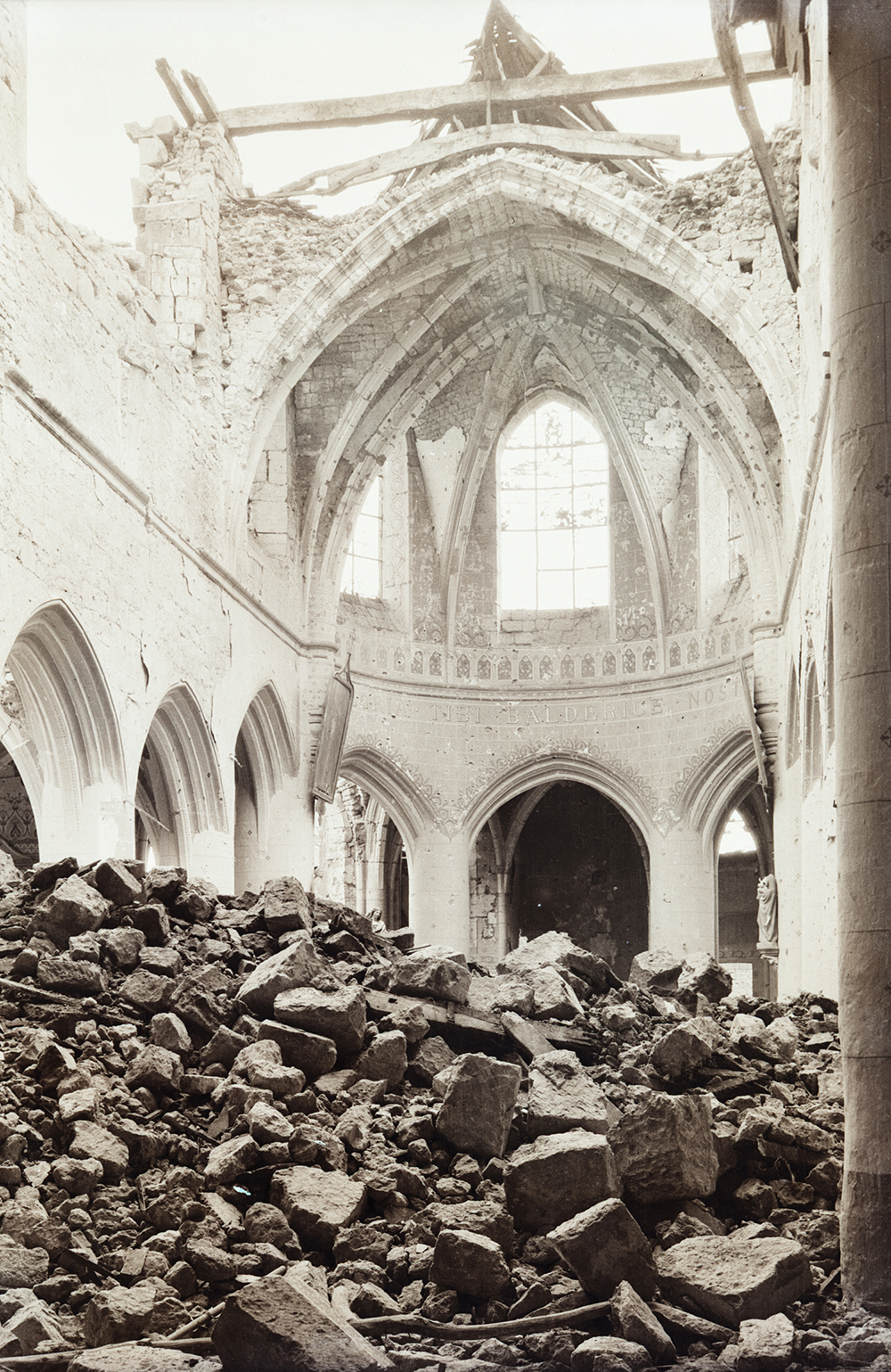
This series from a church in France is one of my favorites in the collection. Again, due to the size of these photos and the number Walter took, it's possible that these were meant for official business. Below, a detail from the above photo showing two statues among the rubble.

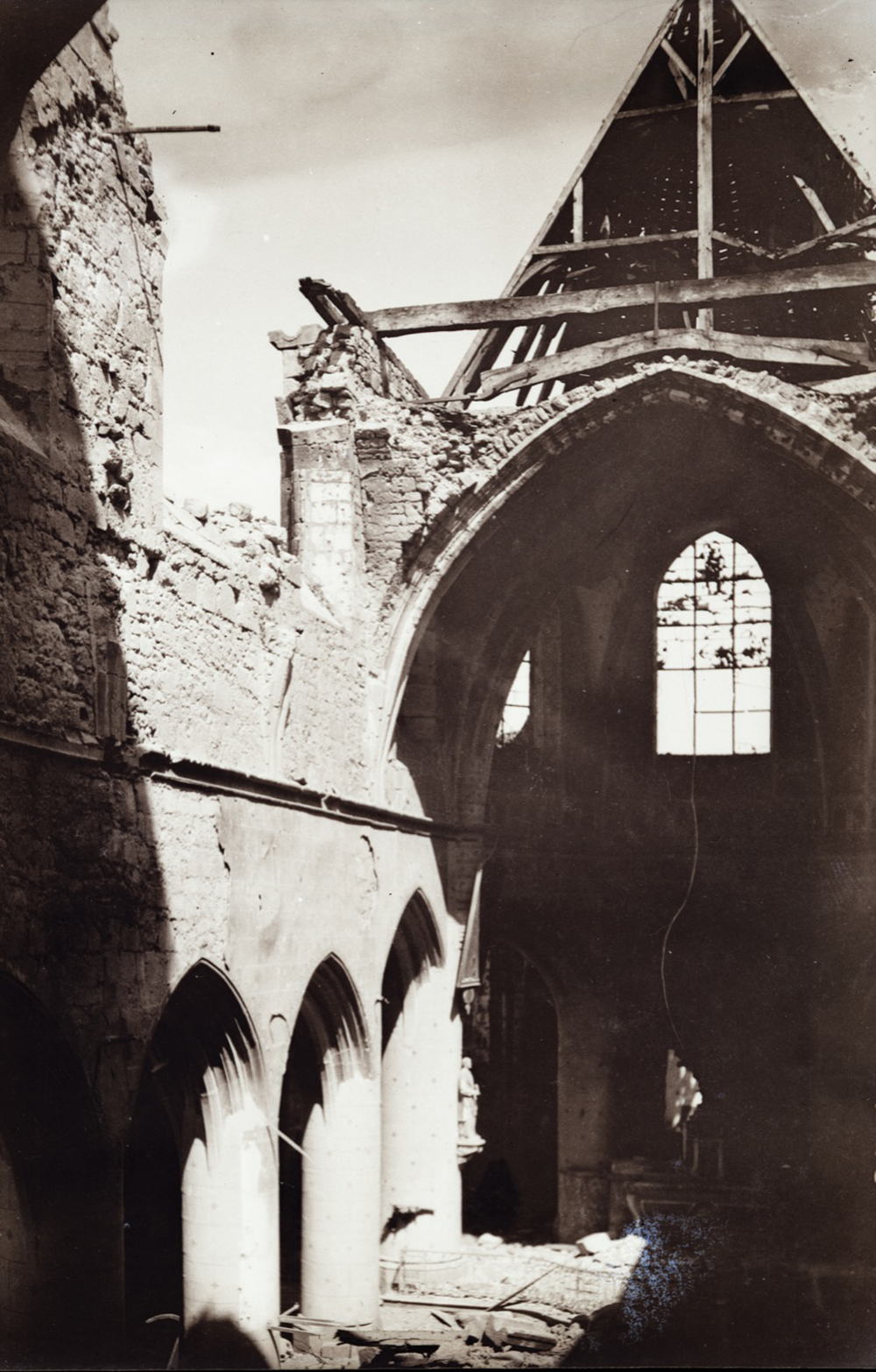

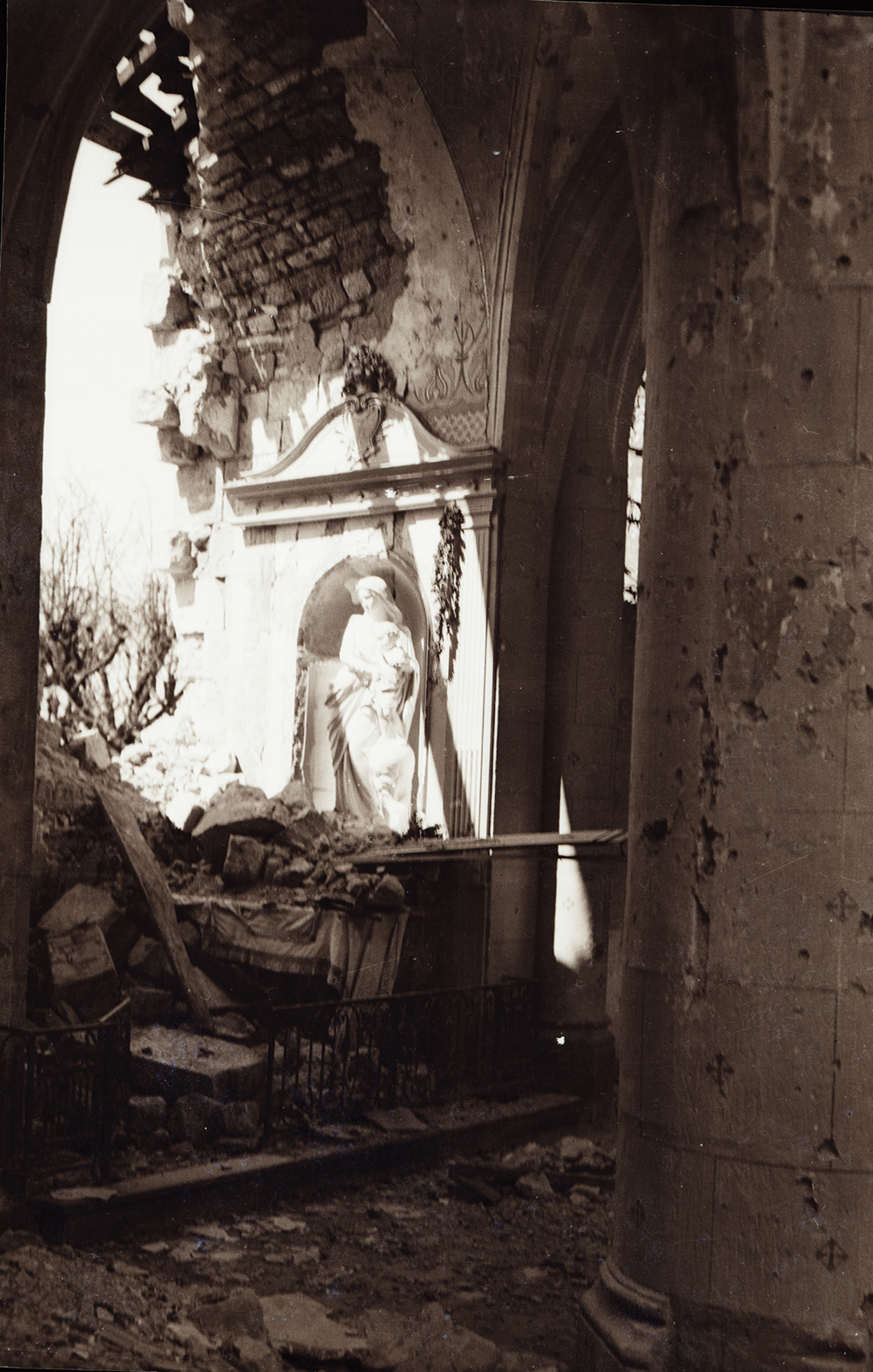
You can see more of this collection as I scan it on Tumblr. If you're interested in seeing the full collection and helping me preserve it, please support me in making a print copy of the book on Kickstarter.
Walter took advantage of some unique opportunities to capture WWI on film. His photos tell the stories of living in the trenches, visiting home with friends, his work as an aerial reconnaissance photographer and his increasing understanding of the horrors of war.

|
|
firehoseaaaaaaaaaaaAAAAAAAAAAAAAAAAAAAAAAA

Author and Microsoft program manager J.D. Meier offers this free time management training course that will help you learn a new skill or build better habits through 30-day "improvement sprints."

|
|
[Video Link] Kevin O’Leary, co-host of the CBC business news program The Lang and O’Leary Exchange uses every dirty trick in the book to try to derail an articulate 14-year-old girl named Rachel Parent, who advocates for GMO food labeling. Every time, the girl keeps her cool and stays on track.
The conversation got ugly when O’Leary accused Parent of being a “lobbyist” against GMOs and then equated her position of questioning GMOs to somehow supporting malnutrition and the death of children. Remaining cool-headed and composed throughout his harangue, Parent countered that people have a basic right to know what’s in our food and explained she has no vested interest in honest food labeling. She then highlighted the most basic facts for O'Leary: genetically engineered crops don’t actually out-produce organic crops, GMOs are treating human beings as lab rats, and consumers have a right to know what they're buying or eating.
TV Host Bully Shot Down By Cool 14-Year-Old Activist

|
|
| Piled Higher & Deeper by Jorge Cham |
www.phdcomics.com
|
|
 |
||
|
title:
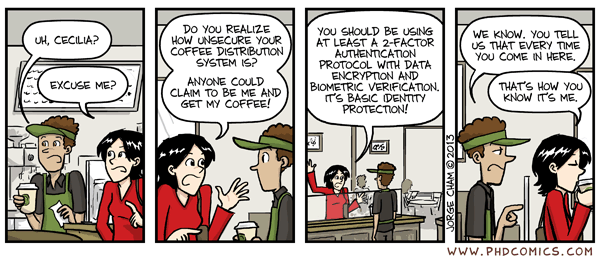
"Coffee Security" - originally published
8/9/2013
For the latest news in PHD Comics, CLICK HERE! |
||