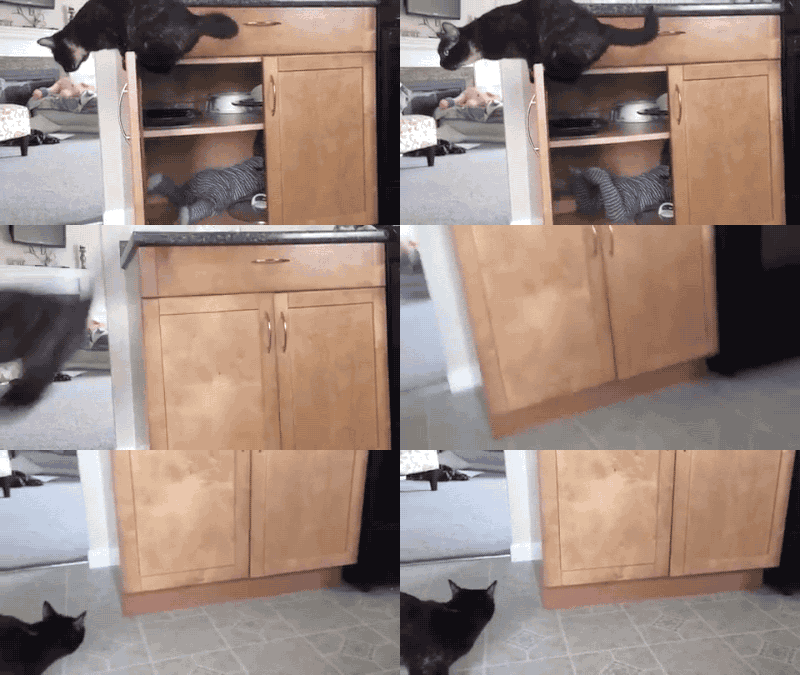
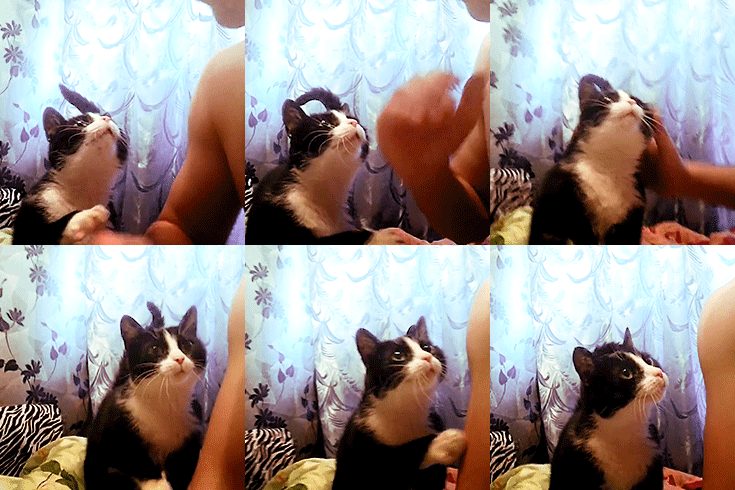
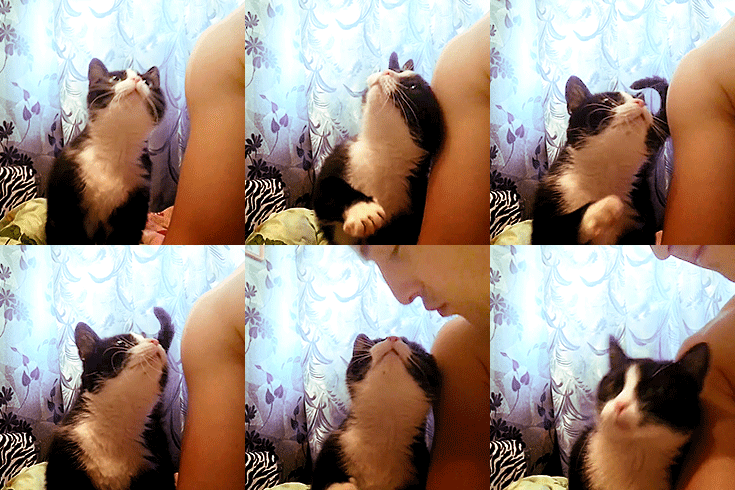
[Now can SOMEone please get me some sharks with frickin’ laser beams attached to their heads? How HARD can this BE?]

(DP&F.)
Filed under: Uncategorized Tagged: 007 reference, koala


[Now can SOMEone please get me some sharks with frickin’ laser beams attached to their heads? How HARD can this BE?]
(DP&F.)
 “I work at a vet and we were brought two baby birds found in a parking lot. Gene Wilder (shown here) seemed perfectly healthy. Our wildlife rescue won’t accept song birds, so I decided to feed him/her myself and release him/her in a bird friendly environment. Starting at sunrise, I fed Gene a mixture of mashed worms, baby bird supplements, and a liver based food every 40-60 minutes until sun down.”

“When Gene started fluttering around and exploring, I knew it was time for the next stage. Song birds have a lot of instinct and after being released, Gene learned to catch bugs on his own, though he still occasionally comes up to us begging for food. Gene was a lot of work and I’m happy he/she did well, but I don’t recommend or encourage people to take and raise wild animals.” -Heather B.


A herd of sheep go for a stroll in Venice, Italy. Some of them decide to stop off for a quick nibble!
(DP&F.)


 The only thing better than Cute Little Fuzzy Bebeh Peeps…are Cute Little Fuzzy Bebeh Peeps wearing hats. They’re NOT just for Easter anymore.


Thanks to Julie P.


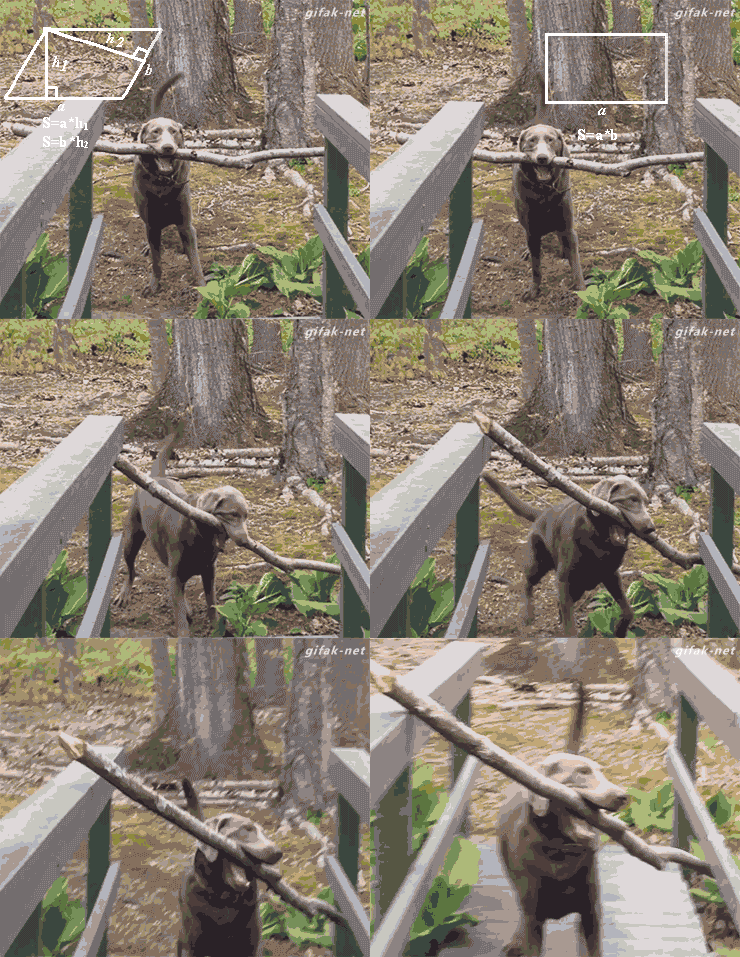
[The stick is THIS wide…but the bridge is only this wide. Boy, feels just like one of those problems they gave us in fourth grade.]
(Mashable.)
[*Note: It seems AFV videos may now not play outside the U.S. Here’s another (shorter) version to try. -Ed.]



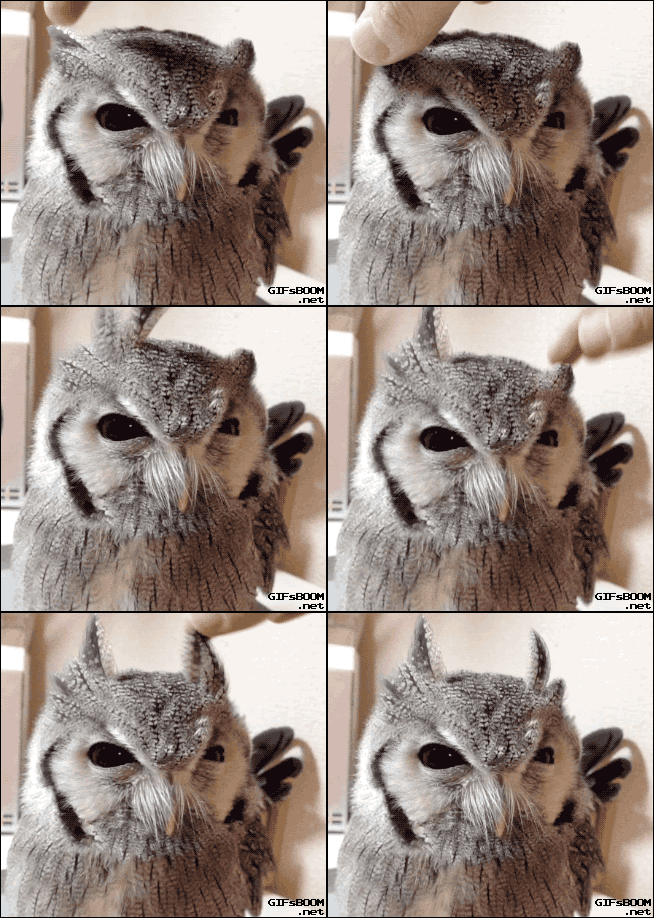

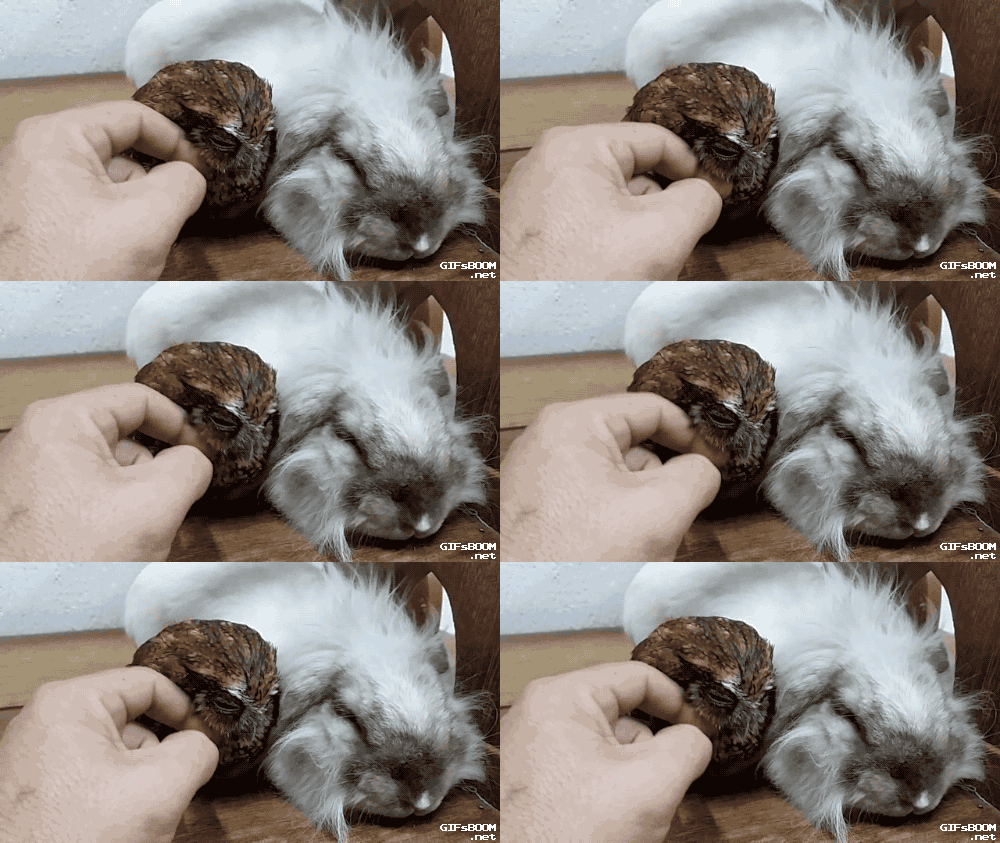


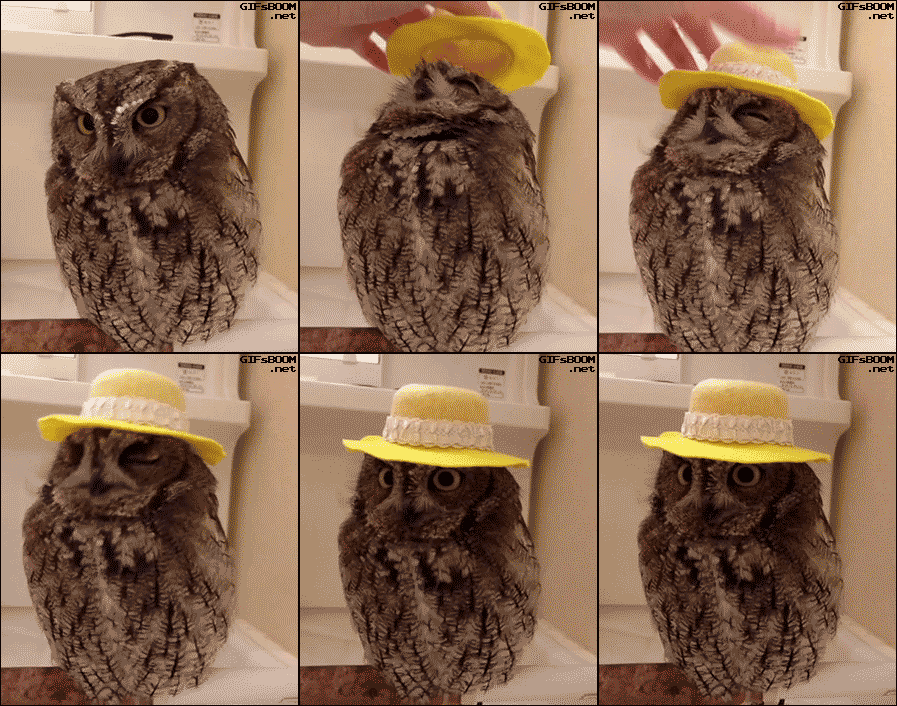

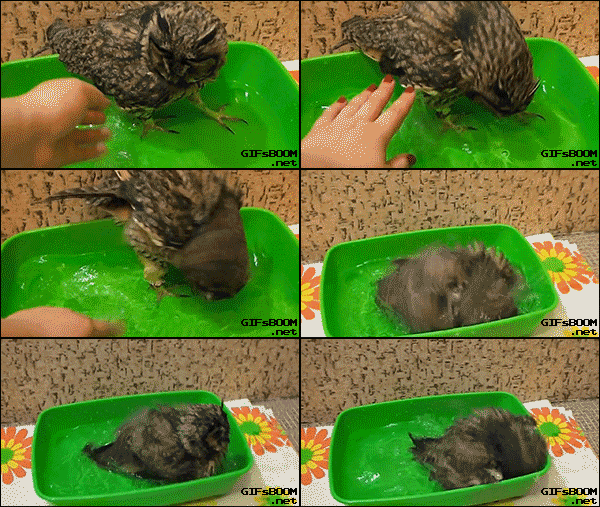
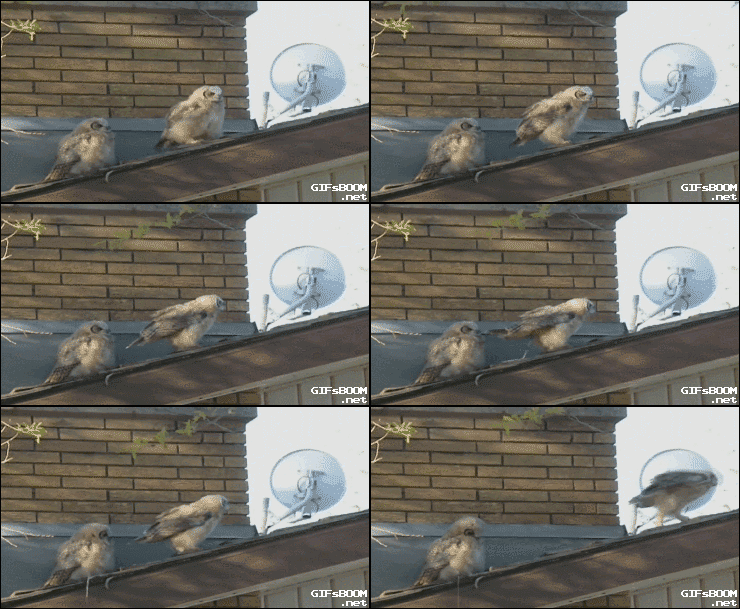
What even are owls.

by uaiHebert
From pigeons to porky-pines, no matter what kinda bebeh you are…there’s just no getting over you.


Photos from The Dodo, sent in by Elizabeth G. Head and deck concept by Amy Grant.


Get offa my bebeh cloud(ed leopards.)


(Four tiny leopards came online eight days ago at the Point Defiance Zoo and Aquarium, Tacoma. Photos from The Guardian via Heatherington, who also provided the Stones reference.)


A gentle giant in an age of monsters, the Triceratops roamed the earth during the Late Cute-acious period. Although a peaceful plant-eater, Triceratops could be a fearsome adversary, thanks to its tough protective skull and its three lethal horns, which brought instant death to all who angered it… starting with the guy who glued them on in the first place.

“My dog has clearly had enough of my crap,” admits Redditor BIGMc_LARGEHUGE.


 That’s the slogan on the back of the “Mewgaroo” hoodie, straight from the brilliant minds of The Big J. Stuff your kitteh in the front pouch for some portable snorgling- even has a removable liner (second photo below) to collect all the cat hair. We’re not sure why that person (first photo below) is hanging out of the dryer; remember this key concept: make sure your kitteh isn’t IN the hoodie when drying. (Also notice the CAT EARS ON the hoodie. They’ve done it again.)


“Hi C.O., back in November you posted a custom, pillow portrait by artist Sarah Clark. We couldn’t resist — we got two for our cats Mac and Cheese (Cheese is the smiling goof.) Plus, we got one of her stock pillows, which looks very much like our foster kitty!” -Charmz.


Dan Kahan writes:
I know you are on 30-day delay, but since the blog version of you will be talking about Bayesian inference in couple of hours, you might like to look at paper by Turing, who is on 70-yr delay thanks to British declassification system, who addresses the utility of using likelihood ratios for helping to form a practical measure of evidentiary weight (“bans” & “decibans”) that can guide cryptographers (who presumably will develop sense of professional judgment calibrated to the same).
Actually it’s more like a 60-day delay, but whatever.
The Turing article is called “The Applications of Probability to Cryptography,” it was written during the Second World War, and it’s awesome.
Here’s an excerpt:
The evidence concerning the possibility of an event occurring usually divides into a part about which statistics are available, or some mathematical method can be applied, and a less definite part about which one can only use one’s judgement. Suppose for example that a new kind of traffic has turned up and that only three messages are available. Each message has the letter V in the 17th place and G in the 18th place. We want to know the probability that it is a general rule that we should find V and G in these places. We first have to decide how probable it is that a cipher would have such a rule, and as regards this one can probably only guess, and my guess would be about 1/5,000,000. This judgement is not entirely a guess; some rather insecure mathematical reasoning has gone into it, something like this:-
The chance of there being a rule that two consecutive letters somewhere after the 10th should have certain fixed values seems to be about 1/500 (this is a complete guess). The chance of the letters being the 17th and 18th is about 1/15 (another guess, but not quite as much in the air). The probability of a letter being V or G is 1/676 (hardly a guess at all, but expressing a judgement that there is no special virtue in the bigramme VG). Hence the chance is 1/(500 × 15 × 676) or about 1/5,000,000. This is however all so vague, that it is more usual to make the judgment “1/5,000,000” without explanation.
The question as to what is the chance of having a rule of this kind might of course be resolved by statistics of some kind, but there is no point in having this very accurate, and of course the experience of the cryptographer itself forms a kind of statistics.
The remainder of the problem is then solved quite mathematically. . . .
He’s so goddamn reasonable. He’s everything I aspire to.
Reasonableness is, I believe, and underrated trait in research. By “reasonable,” I don’t mean a supine acceptance of the status quo, but rather a sense of the connections of the world, a sort of generalized numeracy, an openness and honesty about one’s sources of information. “This judgement is not entirely a guess; some rather insecure mathematical reasoning has gone into it”—exactly!
Damn this guy is good. I’m glad to see he’s finally posting his stuff on Arxiv.
The post New Alan Turing preprint on Arxiv! appeared first on Statistical Modeling, Causal Inference, and Social Science.

THESE PARENT BIRDS ARE SO BEAUTIFUL LIKE BIRDY DRAG QUEENS WITH FLAWLESS EYELINER AND THE BABY LOOKS LIKE AN UNFINISHED MUPPET AND I’M DEAD.

House wearing a house painting a house on a house.