Shared posts

30 Oct 22:18

Don’t base your business on a paid app

by David

The App and Play stores have turned out to be exceptionally poor places to run a software product business for most developers. They’re great distribution channels for service makers, like Facebook or Lyft or Basecamp, but they’re terrible places to try to make a living (or better) selling software products.

At a buck or few per app, how could it be otherwise? That type of pricing will work for Angry Birds and a handful of other games, but very poorly for most other types of software products. The scale you need, the sustained influx of new customers, well, it’s a place for mega stars, and people who think they can beat the odds at becoming just that.

That’s why I’ve been discouraging people from chasing dreams of a successful, sustainable software product business by pursuing paid apps. Far better be your odds at succeeding with a service where the app is simply a gateway, not the destination.

Watching users of Tweetbot heckle the team for daring to charge $5 for a 8-month upgrade only reaffirms that belief. It’s a sad sight of entitlement, but at this point also entirely predictable.

Apple and Google both benefit from having apps be as cheap as possible. For Apple, that means people will buy an iPhone more readily when the cost to fill it with software is near nil. For Google, it means app makers have to shove ads into products to make them pay. Win-win-lose.

What’s good for platform makers is often not good for those who build upon it. That’s where the whole picking up pennies in front of a steamroller comes from. Yes, a few may be quick enough to pickup enough pennies to fill a jar, but for most, it’s not a wise trade of risk vs reward.

Forget the paid app.

12 Oct 01:46

Saturday Morning Breakfast Cereal - Babies

by admin@smbc-comics.com

Hovertext: Hey, at least she didn't give her the book on duck sex.


New comic!
Today's News:

Hey Seattle BAH-goers, we created a facebook page for the event with info. 

07 Oct 23:33

Monumental Splashes of Stainless Steel Calligraphy by Zheng Lu

by Christopher Jobson

lu-1-hero
Water Dripping – Splashing, 2014. Sundaram Tagore Gallery

Chinese artist Zheng Lu has long been fascinated by the properties of water, from its amorphous shape when flying through the air to the quality of light that glints across its surface. Lu also grew up in a literary family where the art of Chinese calligraphy played a meaningful role in his upbringing. In his large-scale stainless steel sculptures, the artist merges the two unrelated interests to create gravity-defying waves of calligraphy that twist and splash dramatically through the air.

To make each artwork Lu begins with with a plaster base to which he gradually adheres thousands of laser-cut Chinese characters. The final pieces can sit either freestanding on a pedestal or installed as numerous suspended parts that are linked in space to fill an entire gallery.

One of Lu’s largest sculptures from his water series is currently on view at Sundram Tagore Gallery in New York through October 10th, and you can see more of his work on Artsy and at Fabien Fryns Fine Art.

lu-1
Sundaram Tagore Gallery

lu-3

lu-4-new

2-up

lu-5
Water in Dripping No.7, 2013. Fabien Fryns Fine Art

lu-6
Sundaram Tagore Gallery

lu-7
Sundaram Tagore Gallery

lu-8
Sundaram Tagore Gallery

07 Oct 23:33

Laffer, Cheney e Rumsfeld

by Leonardo Monasterio
A Curva de Laffer existe, mas na mão dos políticos e dos economistas irresponsáveis é um perigo. Eles sempre dizem que estamos à direita do máximo de arrecadação: ou seja, uma redução das alíquotas levaria a um aumento da receita do governo, uma vez que a atividade econômica seria estimulada. É a fantasia atraente supply-sider. (A fantasia simétrica keynesiana é: "se gastarmos mais, o PIB aumenta mais que proporcionalmente e a arrecadação também. Festa!")
O repugnante vídeo abaixo, com o próprio Laffer, Donald Rumsfeld e o Dick Cheney, mostra o nascimento dessa ideia perigosa. (O jantar da trinca deve ter sido concentração de mau caratismo da história, só comparável talvez ao dia em que Nixon jantou sozinho.*)
* A frase original.
07 Oct 23:32

bunnyfood: Bird plays Peekaboo


bunnyfood:

Bird plays Peekaboo

06 Oct 00:27

How to Call a Relative

by Scott Meyer

This strip was written in jest. How sad is it that I have to clarify that?

I have a pretty good relationship with my immediate family, and bear no ill will toward my extended family. I’d be perfectly happy to live in the same town as them if they lived somewhere fit for human habitation.

I know that’s a harsh thing to say. There are people who love the combination of harsh winters, brutal summers, crushing isolation, lack of opportunity, and the omnipresent smell of manure. That’s their thing, and it’s not my place to judge. It is may place to avoid their place, and I do.

Note from Missy: I find it deliciously prescient that this strip was written when we still lived in the same state as his family, but we then proceeded to move three time zones away.

Good news everybody! My most recent novel The Authorities is available now!

I ended up removing the tradmark symbol from the official title. It was playing havoc with the Amazon search algorithm.

NOTE: There was a problem with the link earlier, but it's workign now. Sorry for the trouble.

You can comment on this comic on Facebook.

As always, thanks for using my Amazon Affiliate links (USUKCanada).

06 Oct 00:18

Dark side of typography

by turn
06 Oct 00:17

Anésia # 244

by Will Tirando

Anésia Dolores fotos internet vazou intimidade susto Bino Stênio Garcia

– Foge, Anésia. É uma cilada.

06 Oct 00:17

Unquote

by Greg Ross

2015-10-05-unquote

“Murder is a crime. Describing murder is not. Sex is not a crime. Describing sex is.” — Gershon Legman

Please support Futility Closet on Patreon!

06 Oct 00:16

by It’s the Tie

06 Oct 00:16

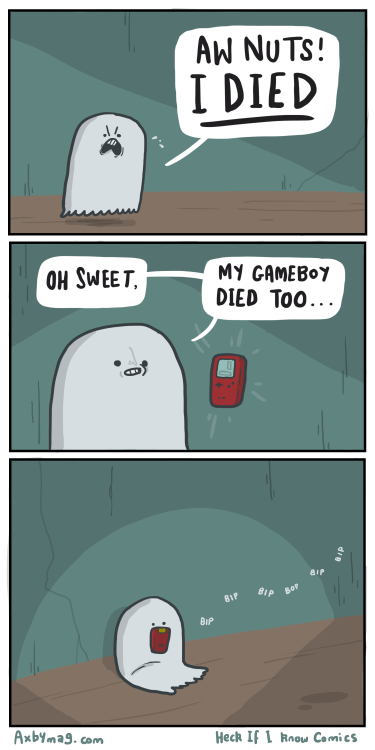
by Heck If I Know Comics

06 Oct 00:15

Mothers

by itsthetie


lions

bonus

The post Mothers appeared first on It's The Tie!.

06 Oct 00:15

Photo


06 Oct 00:13

Keyboard Problems

In the future, a group of resistance fighters send me back in time with instructions to find the Skynet prototype and try to upgrade it.
04 Oct 18:49

Por que o apoio de Putin a Assad pode ajudar Netanyahu?

by gustavochacra

No meu post de ontem, fiz um guia para entender a intervenção da Rússia na Síria. Em um dos itens, mencionei como Israel seria afetado. Hoje, me aprofundarei um pouco mais.

Basicamente, a intervenção da Rússia para a defender o regime de Bashar al Assad na Síria pode beneficiar Israel. E não será apenas porque os russos combaterão organizações terroristas e extremistas como o ISIS, também conhecido como Grupo Estado Islâmico ou Daesh, e a Frente Nusrah (Al Qaeda na Síria). O maior benefício israelense será na redução do poder de influência do regime de Teerã sobre Damasco.

Os iranianos e seus aliados do Hezbollah, como sabemos, não possuem identificação ideológica com Assad, que lidera um regime laico. São aliados de ocasião. O regime de Teerã precisa logisticamente de Assad para manter o Hezbollah bem armado em uma frente contra Israel. E Assad precisa do Irã porque não tem muitos aliados pelo mundo e comparte do ódio pelo extremismo islâmico sunita.

Com a eclosão da Guerra da Síria e o caos que se instalou, o Irã e o Hezbollah perceberam uma brecha nas colinas do Golã para tentar instalar uma nova frente com bases de lançamentos de mísseis contra Israel. A vantagem, em relação ao sul do Líbano, é que, em caso de conflito, os mísseis seriam lançados do território sírio. Desta forma, Israel teria de responder contra a Síria, e não contra o Líbano. O Hezbollah, portanto, não correria o risco de ver o território libanês arrasado por bombardeios israelenses como ocorreu em 2006. A aliança do grupo xiita com os principais grupos cristãos libaneses, como a Frente Patriótica Nacional de Michel Aoun, não seria afetada.

Assad, enfraquecido, tem de tolerar estas iniciativas do regime de Teerã e do Hezbollah. Sem o grupo xiita e sem o regime de Teerã, talvez sequer estivesse no poder em Damasco. O líder sírio depende de ambos para continuar no comando do país.

Com a intervenção da Rússia, porém, a equação muda. O regime sírio fica menos dependente dos iranianos e do grupo xiita libanês. Os russos, como sabemos, não devem permitir ameaças a Israel. Putin e Netanyahu se dão bem e possuem ótimos canais de diálogo. O líder israelense é mais próximo do líder russo do que de Barack Obama, presidente dos EUA. E Assad, avesso a religião embora alauíta de nascimento (sua mulher é sunita liberal e usa All Star e Levi’s em vez de véu), até prefere Putin aos religiosos do Irã e do Hezbollah – se Assad tivesse assinado a paz com Israel em 2008, teria possivelmente dado um pé na bunda dos iranianos e hoje seria talvez o maior aliado americano no combate ao terrorismo global, sendo chamado de estadista por republicanos e democratas em Washington.

Moscou, portanto, pode ajudar a afastar um pouco Assad do Irã e do Hezbollah, embora não o suficiente para quebrar a aliança – mesmo porque a Rússia também possui boas relações com o Irã. Mas certamente Putin não irá permitir que sua ofensiva seja prejudicial a Israel. Se houver sucesso, os russos tendem a tentar impedir o estabelecimento de bases de lançamento de mísseis no Golã.

Guga Chacra, comentarista de política internacional do Estadão e do programa Globo News Em Pauta em Nova York, é mestre em Relações Internacionais pela Universidade Columbia. Já foi correspondente do jornal O Estado de S. Paulo no Oriente Médio e em NY. No passado, trabalhou como correspondente da Folha em Buenos Aires

Comentários islamofóbicos, antissemitas, anticristãos e antiárabes ou que coloquem um povo ou uma religião como superiores não serão publicados. Tampouco são permitidos ataques entre leitores ou contra o blogueiro. Pessoas que insistirem em ataques pessoais não terão mais seus comentários publicados. Não é permitido postar vídeo. Todos os posts devem ter relação com algum dos temas acima. O blog está aberto a discussões educadas e com pontos de vista diferentes. Os comentários dos leitores não refletem a opinião do jornalista

Acompanhe também meus comentários no Globo News Em Pauta, na Rádio Estadão, na TV Estadão, no Estadão Noite no tablet, no Twitter @gugachacra , no Facebook Guga Chacra (me adicionem como seguidor), no Instagram e no Google Plus

04 Oct 18:39

Paperwork

by Greg Ross

Three ancient problems are famously impossible to solve using a compass and straightedge alone: doubling the cube, trisecting an angle, and squaring the circle. Surprisingly, the first two of these can be solved using origami.

In the first, doubling the cube, we’re given the edge of one cube and asked to find the edge of a second cube whose volume is twice that of the first; if the first cube’s edge length is 1, then we’re trying to find \sqrt[3]{2}. Begin by folding a square of paper into three equal panels (here’s how). Then draw up bottom corner P as shown above, so that it’s touching the top edge while the bottom of the first crease, Q, touches the second crease as shown. Now point P divides the top edge into two segments whose proportions are 1 and \sqrt[3]{2}.

To trisect an angle, begin by marking the angle in one corner of a square (here’s it’s CAB). Make a horizontal fold, PP’, anywhere across the square. Then divide the space below this crease in half with another crease, QQ’. Fold the bottom left corner up so that corner A touches QQ’ (at A’) and P touches AC. Now A’AB is one-third of the original angle, CAB.

The first of these constructions is due to Peter Messer, the second to Hisashi Abe. Strictly speaking, each uses creases to produce a marked straightedge, which is not allowed in classical construction, but they’re pleasingly simple solutions to these vexing problems. There’s more at origami wizard Robert Lang’s website.

Please support Futility Closet on Patreon!

04 Oct 14:21

From 1975-1980 Activist Adam Purple Built a Circular Urban Garden in New York that ‘Knocked Down’ the Surrounding Buildings

by Christopher Jobson

garden-4
Still from Adam Purple and the Garden of Eden / Harvey Wang and Amy Brost

In 1975, artist and social activist Adam Purple, known for his permanent purple attire, looked out his window in the crime-ridden Lower East Side of New York City to witness two children playing in a pile of rubble. Struck by his own memories of a childhood spent barefoot in rural pastures and forests in Missouri, he suddenly wished these children could feel the dirt beneath their own feet in a safe, debris-free environment. Almost immediately he began work on the Garden of Eden.

Over period of five years, Purple worked continuously to build a concentric garden that would eventually grow to 15,000 square feet. As nearby abandoned structures were torn down the garden continued to grow, a process he metaphorically likened to a garden that knocked down the buildings around it. He physically hauled bricks and building materials away from the site, and hauled in manure from the horses in Central Park.

The Garden of Eden not only provided safe haven to the community, but also produced food in the form of corn, berries, tomatoes, and cucumbers. By the early 80s it had become a famous and beloved landmark in the Lower East Side.

Unfortunately the city of New York never officially recognized Purple’s garden. While other local parks were clearly marked on official city maps, the Garden of Eden space was always labeled as ‘vacant’. Despite pleas from the community, the entire garden was razed with bulldozers in just 75 minutes on January 8, 1986 to make way for development.

Purple himself narrates his story in this thoughtful video by Harvey Wang and Amy Brost from back in 2011. Sadly, he died two weeks ago at the age of 84, and there is currently a fund-raising effort to collect money for his burial and to erect a memorial near 184 Forsyth Street where the garden once stood. Donated.

You can see more photos and read more about Purple in this book, also by Wang & Brost.

garden-6
Still from Adam Purple and the Garden of Eden / Harvey Wang and Amy Brost

garden-7
Still from Adam Purple and the Garden of Eden / Harvey Wang and Amy Brost

1976
Still from Adam Purple and the Garden of Eden / Harvey Wang and Amy Brost

1977
Still from Adam Purple and the Garden of Eden / Harvey Wang and Amy Brost

1978
Still from Adam Purple and the Garden of Eden / Harvey Wang and Amy Brost

1979
Still from Adam Purple and the Garden of Eden / Harvey Wang and Amy Brost

1985
Still from Adam Purple and the Garden of Eden / Harvey Wang and Amy Brost

garden-1
Still from Adam Purple and the Garden of Eden / Harvey Wang and Amy Brost

detroyed
After a decade of work and upkeep, the Garden of Eden was razed with bulldozers on January 8, 1986 by the City of New York in 75 minutes.

garden-3
Adam Purple, 1930-2015. Still from Adam Purple and the Garden of Eden / Harvey Wang and Amy Brost

04 Oct 14:18

luvmocha: fatalperfume: christel-thoughts: talesofthestarship...


luvmocha:

fatalperfume:

christel-thoughts:

talesofthestarshipregeneration:

goldenluxe:

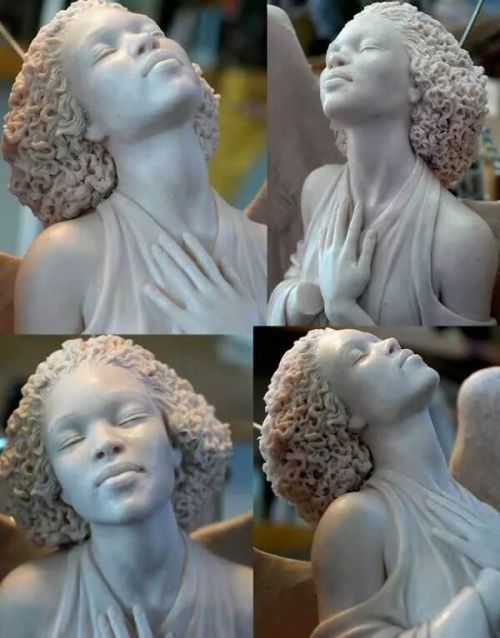
Who made this goddess? I love her! The eyes,nose,lips and that haiiirr

anyone know the artist?

looks like Mark Newman

http://marknewman.deviantart.com/gallery/?catpath=/

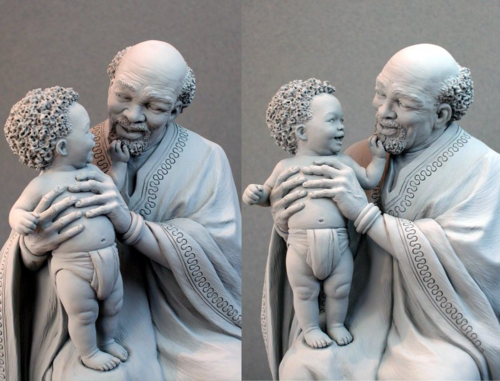
image

^^ this one is called “Grandpa’s Favorite”. 

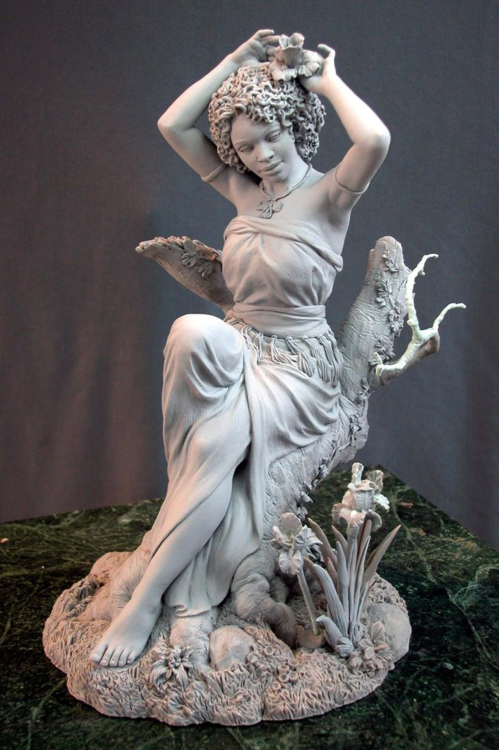
image

^^ this one is called “Iris in Bloom”.

he’s awesome. 

You never see classical inspired sculptures with POC.. So this is really something to me. Absolutely beautiful.

Beautiful, you just have to admire.

03 Oct 18:24

Children of the Yuan Percent: Everyone Hates China’s Rich Kids - Bloomberg Business

Jason Zhang, age 22

Photographer: Ka Xiaoxi

Emerging from a nightclub near Workers’ Stadium in Beijing at 1:30 a.m. on a Saturday in June, Mikael Hveem ordered an Uber. He selected the cheapest car option and was surprised when the vehicle that rolled up was a dark blue Maserati. The driver, a young, baby-faced Chinese man, introduced himself as Jason. Hveem asked him why he was driving an Uber—he obviously didn’t need the cash. Jason said he did it to meet people, especially girls. Driving around late at night in Beijing’s nightclub district, he figured he’d find the kind of woman who would be charmed by a clean-cut 22-year-old in a sports car.

When I heard this story from a friend who had also been in the car, I asked for the driver’s contact info. I introduced myself to Jason over WeChat, China’s popular mobile app, and asked for an interview. He replied immediately with a screen shot that included photos of women in various states of undress. “Best hookers in bj :),” he added. I explained there had been a misunderstanding, and we arranged to have coffee.

When we met at a cafe in Beijing’s business district, it was clear that Jason, whose surname is Zhang, was different from other young Chinese. He had a job, at a media company that produced reality TV shows, but didn’t seem especially busy. He’d studied in the U.S., but at a golf academy in Florida, and he’d dropped out after two years. His father was the head of a major HR company, and his mother was a government official. He wore a $5,500 IWC watch because, he said, he’d lost his expensive one. I asked him how much money he had. “I don’t know,” he said. “More than I can spend.” So this was it: I had found, in the wild, one of the elusive breed known in China as the fuerdai, or “second-generation rich.”

The son of the richest man in China caused a stir by posting this photo of his dog wearing two gold Apple Watches.

Photographer: Ka Xiaoxi

As portrayed in the local press, fuerdai are to China what Paris Hilton was to the U.S. a decade ago, only less tasteful. Every few months there’s a fuerdai scandal, whether it’s a photo of a woman about to set fire to a pile of 100-yuan ($16) notes; members of the much derided Sports Car Club posing beside their Lamborghinis; or someone pulling a gun during a street race. In 2013 reports of a fuerdai sex party at the beach resort of Sanya provoked a nationwide finger-wag. Two prominent rich kids got into a public arms race over who had the bigger stash: The widely despised socialite Guo Meimei posted photos online of herself with 5 million yuan worth of casino chips; her rival responded with a screen shot of his bank statement, which appeared to contain 3.7 billion yuan. (Guo was sentenced to five years in prison for running a gambling den.) Recently, the son of Wang Jianlin, a real estate mogul and the richest man in China, trolled the nation by posting a photo of his dog wearing two gold Apple Watches, one on each forepaw. Fuerdai outrages occasionally feature government intrigue, such as a 2012 Ferrari crash in Beijing involving two young women and the son of a high-level official, all of whom were at least partially naked when they were thrown from the car. The man’s father, a top aide to then-president Hu Jintao, was later arrested and charged with corruption.

The fuerdai (pronounced foo-arr-dye) aren’t just an embarrassment. The Communist Party seems to consider them an economic or even political threat. President Xi Jinping himself spoke out this year, advising the second generation to “think about the source of their wealth and how to behave after becoming affluent.” An article published by the United Front Work Department, the bureau that manages relations between the party and nonparty elite, warned: “They know only how to show off their wealth but don’t know how to create wealth.” Some local governments have taken steps to reeducate their wealthy elite. In June, according to Beijing Youth Daily, 70 heirs to major Chinese companies attended lectures on filial piety and the role of traditional values in business.

While Xi’s anticorruption campaign has curbed some of the most outrageous wealth-flaunting, the gap between rich and poor is still evident to anyone on a Beijing street weaving between fruit vendor carts and black Audis. Now, as the economy slows and the party looks for scapegoats, the fuerdai are in the precarious position of having to justify their existence and show that China’s future leaders aren’t just money-igniting, Ferrari-wrecking layabouts. Not all of them, anyway.

Martin Hang, age 31

Photographer: Ka Xiaoxi

After a few weeks of nosing around, I persuaded a crew of fuerdai to invite me to one of their occasional dinners. When I arrived, I wondered if I’d come to the wrong place. It was an outdoor barbecue spot in northern Beijing, with locals sitting on stools so low they were almost squatting, swilling Yanjing beer and chewing on lamb skewers. Identifying the centimillionaire scions among the riffraff was difficult. The fuerdai trickled in, dressed the same as everyone else in the restaurant—in tank tops, button-downs, jeans, flip-flops. The only giveaway was the liquor they brought: French Champagne and a bottle of Maotai, the choicest brand of baijiu. Martin Hang, the gregarious organizer of the dinner and editor of a magazine called Fortune Generation (no relation to the U.S. publication), introduced everyone. The dozen guests included Wang Daqi, 30, son of a famous business consultant, who had recently written a book about rich kids in China; Albert Tang, 20, a philosophy student at Bard whose father runs a major Beijing publishing house; and Sophia Cheng, 27, the only woman in the group. It still wasn’t clear to me what threshold of wealth one needed to exceed to be fuerdai, but Cheng assured me she qualified. (Hang disagreed.) Her parents had given her a vast amount—more than 100 million yuan, she said—which she invested in film, mobile-gaming, and meat-processing companies.

Drinking began in earnest before the food arrived. We toasted as a group, then in pairs, then in subgroups, then in pairs again, until everyone was so shattered that it felt like we’d known each other forever. Conversation volleyed between business and gossip. One member of the group was dubbed the Champagne Prince for his ordering habits at clubs. Another attendee, Lin Xin, 30, talked up his company’s technology for authenticating antiques. Someone joked about how wannabe rich kids would go to clubs and rent bottles of expensive liquor to display on their table to make it look like they had money. (“But what if a girl wants to drink it?” another person wondered.) Cheng mentioned that she had a few spare chickens in her car; did anyone want to try some? Tang, the philosophy student, pulled me aside and asked what I knew about the Freemasons.

At the center of it all was Hang, who, as editor of Fortune Generation and a prominent member of the Relay China Elite Association, a nonprofit that serves as a social club for the second-generation rich, functions as a connector among China’s children of privilege. Hang, 31, explained how Relay works. “We’re trying to help the second generation do better together,” he said, speaking carefully and with precision, even after many drinks. Founded in 2008, Relay was created to help fuerdai meet other fuerdai, who might be facing similar challenges of wealth. There’s an initiation fee of 200,000 yuan, and members must prove that their family businesses pay at least 50 million yuan in annual taxes. At forums held several times a year, the heirs listen to lectures on topics such as how to minimize taxes or maximize profit (“All legal stuff,” one member assured me) and visit each other’s companies. “Most of the time the forum is very boring,” Hang said. He rolled out the magazine in 2011, hoping to promote a more positive image of fuerdai than the decadent wastrels usually portrayed in the media. It was a rebranding: Relay’s members dropped the fu (“wealthy”) from fuerdai and started to refer to themselves using a new term, chuangerdai, which means “second-generation entrepreneurs,” or just erdai, “second generation.” Each month the magazine cover features a different child of privilege, usually male, wearing a suit and striking a casually authoritative pose—for the July issue, while leaning on an Audi. (The two-page ad immediately following the cover is also for Audi.) 

“They know only how to show off their wealth but don't know how to create wealth”

The purpose of the organization, Hang said, is to encourage second-generation kids to take over the family business or at least play a role in its management. Such companies are crucial to the Chinese economy, he said: Not only do they make up 85 percent of non-state-owned enterprises, they also put long-term success ahead of quarterly results.

The downside is that family-run companies are, well, run by families, and most kids in China don’t relish the idea of working alongside their parents. Hang took issue with the statistic, released by Shanghai Jiaotong University in 2012, that 82 percent of second-generation heirs aren’t willing to take over their family business. He didn’t dispute the data so much as the semantics: “They aren’t willing to do it, but they still have to.”

It’s a distinction that Hang knows well. His father’s advertising agency, started in 1993, is one of the largest of its kind in Jiangxi province. After graduating from college, Hang avoided the agency. He studied financial management in the Netherlands and bought the rights to Norron, a Norse god-themed online game. He was cocky about his business acumen. “I thought I was awesome,” he said. “I was a fuerdai—I wasn’t interested in talking to other people.” When the game failed to take off, Hang decided to join his father’s company. “I had a choice,” he said. “I could do something else, but it would make my parents work very hard. They never said I had to, but I thought it was necessary.” 

All fuerdai face a version of the same problem: They have everything but the ability to surpass their own parents. Whatever they achieve will be credited to their family, not to themselves. Hang described always being introduced as “the son of Mr. Hang.” When Wang, the author, found a publisher for his book, he didn’t know if they wanted to publish it because it was good, or because of his famous father. “People will always say your only competence is that you were reincarnated into a good family,” he said. He told me about the difficulty of explaining the burdens of inheritance to the nonwealthy. “They never understand—‘Why are you in pain?’ ” said Wang. “I say it’s not relevant. The amount of wealth doesn’t determine how happy you are. You can only know by experiencing it.”

Models hired to attend Hang’s birthday party.

Photographer: Ka Xiaoxi

It’s no surprise that most fuerdai, after summering in Bali and wintering in the Alps, reading philosophy at Oxford and getting MBAs from Stanford, are reluctant to take over the family toothpaste cap factory. Ping Fan, 36, who serves as executive deputy director of Relay, moved to Shanghai to start his own investment firm rather than work at his father’s real estate company in Liaoning province. He picked Shanghai, he said, “because it was far from my family.” After graduating from Columbia University, Even Jiang, 28, briefly considered joining her mother’s diamond import business, but they disagreed about the direction of the company. Instead, she went to work at Merrill Lynch, then returned to Shanghai to start a concierge service, inspired by the American Express service she used when living in Manhattan. Liu Jiawen, 32, whose parents own a successful clothing company in Hunan province, tried to start her own clothing line after graduating. “I wanted to show I could do it on my own,” she said. The company failed.

Along with riches, fuerdai often inherit a surplus of emotional trauma. The first generation of Chinese entrepreneurs came of age during a time that rewarded callousness. “They were the generation of the Cultural Revolution,” said Wang. “During that time, there was no humanity.” His grandfather, the principal of a middle school in Guizhou province, was humiliated by Red Guards. “They were raised cruelly—there was no mercy. It was survival of the fittest.” Many fuerdai have their parents’ same coldness, Wang said: “They’re really hard to be friends with.”

Zhang, the Uber driver, was sent to boarding school starting in kindergarten, even though his parents lived only a short distance from the school. Perhaps to compensate for their inattention, they gave him everything he wanted, including hundreds of toy cars. Last Christmas he bought himself the Maserati. “It’s like their childhood has not ended,” Wang said of his fellow rich kids. “Their childhood was not fully satisfied, so they always want to prolong the process of being children.” Thanks to China’s one-child policy, most fuerdai grew up without siblings. That’s why so many travel in packs on Saturday nights, Wang said. “They want to be taken care of. They want to be loved.”

For Zhang, partying is a way of staving off boredom. He used to go out clubbing five nights a week. “If I didn’t go, I couldn’t sleep,” he said. He doesn’t lack for companionship, he added. Two or three times a week, he’ll hire a high-end sex worker—a “booty call,” in his words—for $1,000 or more. Zhang prefers paying for sex to flirting with a girl under the pretense that he might date her. “This way is more direct,” he said. “I think this is a way of respecting women.” But some nights, sitting at home alone, he scrolls through the contacts on his phone only to reach the bottom without finding anyone he wants to call. When we first spoke, he said he had a girlfriend of three years who treated him well, but that he didn’t love her. “You’re the first person I’ve told that to,” he said.

Most fuerdai don’t talk about their problems so openly. “They have trust issues,” said Wayne Chen, 32, a second-generation investor from Shanghai. “They need a place to talk. They need a group.” Relay offers a setting in which they can speak honestly, without having to pretend. “It’s similar to a rehab center,” he said. 

Even Jiang, age 28

Photographer: Ka Xiaoxi

In July, Jiang noticed that business at a barbecue restaurant she owns in Shanghai was slower than usual. “It was only half of the crowd,” she said. The stock market had been falling since June and was down 38 percent from its peak by the end of the summer. Over dinner at the restaurant, I asked Jiang and Chen, who are a couple, as well as Hang, if fuerdai had felt the pain of the market crash. “Of course,” Jiang said. “A lot of their family companies are listed.” She herself had bought stocks, she said, but pulled out when the market got too bumpy. Chen said his family money was invested in a “risk-averse way,” much of it in fixed-income assets and funds of funds.

Still, the volatility—and more important, the government’s clumsy response to it—signaled a deeper discord within China’s slowing economy, which affects the fuerdai as much as anyone. Raising money is tougher than before, said Jiang. Hang said the slowdown has hurt ad sales at the magazine, particularly from real estate companies.

Many fuerdai have moved money overseas—Boston Consulting Group put the amount of Chinese money invested abroad at $450 billion in 2013—often with the goal of gaining foreign citizenship. A survey conducted in 2013 found that 64 percent of Chinese high-net-worth individuals had emigrated or wanted to emigrate overseas. I asked Hang, Chen, and Jiang if fuerdai worry about their money. “Some do,” Hang said. “His dad sent him to the U.S.” He laughed and pointed at Chen, who is now an American citizen. Hang, who is married and has a 4-year-old son, said he hasn’t ruled out emigrating.

It’s not just China’s stock market drop that makes fuerdai jittery. “It’s society, too,” said Chen. “Like the Occupy Wall Street protests.” There’s always been a tendency in Chinese society to “hate the rich,” Hang said. It’s the same sentiment that fueled the Cultural Revolution, and was once practically the Communist Party’s mission statement. (Emphasis on “was.”)

Exacerbating the problem, most fuerdai don’t mix much with the working classes. “When we were children, we went to the best schools, so we didn’t encounter a lot of poor people,” Hang said. “This is very dangerous for society.” Relay is therefore planning to start a program fostering ties between fuerdai and children from the countryside. It also organizes charity drives. After a chemical factory exploded in Tianjin in August, killing more than 100 people, its members donated 1.5 million yuan through the local government. To hear Hang explain it, philanthropy is about more than just social responsibility—it’s about social stability.

That said, when I asked Jiang if she thought inequality was a problem in China, she was ambivalent. “I don’t know,” she said. “There are two groups of poor people. One is, you don’t work hard. You deserve to be poor because you don’t work hard. Second is, you work hard but can’t succeed. I think we should help the second group of people. … There’s a saying, jiu ji bu jiu pin—‘We’ll help you if you have an emergency, but we cannot help you if you’re poor.’ ”

The search for meaning is arguably harder for fuerdai than it is for most people 

One day this summer, at the urging of a friend, Wang decided to call his father and tell him he loved him. Wang senior picked up the phone. “I love you, Dad,” Daqi said. There was a pause. “Are you drunk?” his father asked. Wang told this story at a gathering at his father’s complex on a Friday night in August. The guests were friends he had met through Lifespring, a self-help company that, with introductory classes costing upward of $1,000, caters largely to fuerdai. (The original Lifespring was the subject of numerous lawsuits in the U.S. in the 1980s and ’90s, including charges of wrongful death, and went out of business in 1998.) Wang said the group has helped him reconcile his feelings about his father and has also provided the support and community he was unable to find at, say, the club.

With instant gratification never more than a credit card swipe away, the search for meaning is arguably harder for fuerdai than it is for most people. Some, like Jiang and Wang, feel most purposeful when deviating from their parents’ path. For others, returning to the family business is, to their surprise, a source of satisfaction. Liu said she’s glad she took over her family’s clothing company because it made her parents happy—a sentiment her former rebellious self would probably have scoffed at.

Not everyone has discovered a purpose. Zhang, the Uber driver, said his job at the TV production company is hardly his ideal career. But he’s not sure what is. “As a kid, I had a lot of dreams,” he said when we met up at the cafe near his office. “I wanted to be a golfer or a race car driver or a doctor, something like that. … But when you get older, you see more, and you see that some goals are just a dream.” He lit up a cigarette—now illegal indoors in Beijing—barely casting a glance to see if a waiter would stop him. Zhang never had any limitations, which was perhaps itself a limitation. “I don’t really have a plan,” he said. “Probably it’s a sad thing, but it’s the truth.” When I asked him if he’s happy, he said it’s all a question of attitude. “You can find a million reasons to be sad,” he said, “but you only have to find one reason to be happy. Every day I find one.” I asked him what today’s reason was. “Today, I meet you,” he said. “It’s a happy thing.”  

Bookmarked at brandizzi Delicious' sharing tag and expanded by Delicious sharing tag expander.
03 Oct 18:04

StupidRay

by delfrig

StupidRay

facebooktwittergoogle_plusredditpinterestlinkedinmail
03 Oct 18:02

Antes que o chefe veja

by André Farias

Vida de Suporte

Só vai curtir essa tirinha quem não tiver o chefe adicionado no Facebook.


Antes que o chefe veja é um post do blog Vida de Suporte.
03 Oct 18:01

Photo


03 Oct 17:58

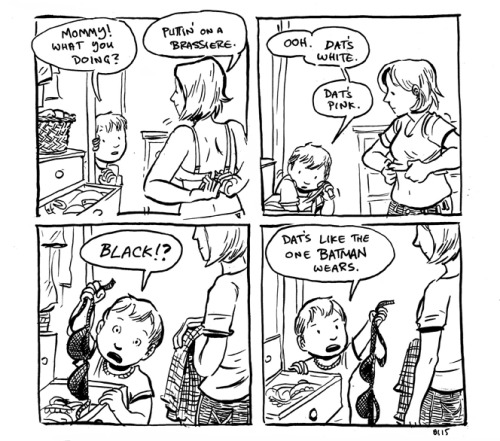
operationbabyhave:Sure, sounds legit. (There’s this bizarre...


operationbabyhave:

Sure, sounds legit.

(There’s this bizarre lateral transmission of Superhero Facts that happens among the small boys at his preschool. They’ve never read the comics or seen the movies, but they know with absolute conviction that there’s BATMAN, and he wears black. SPIDERMAN shoots fire at bad guys. HULK SMASH has torn purple pants, and so forth)

01 Oct 12:47

Moments of Inspiration

Charles, I just talked to John and Mildred, who run that company selling seeds and nuts, and their kids with MOUTHS are starving!
01 Oct 12:46

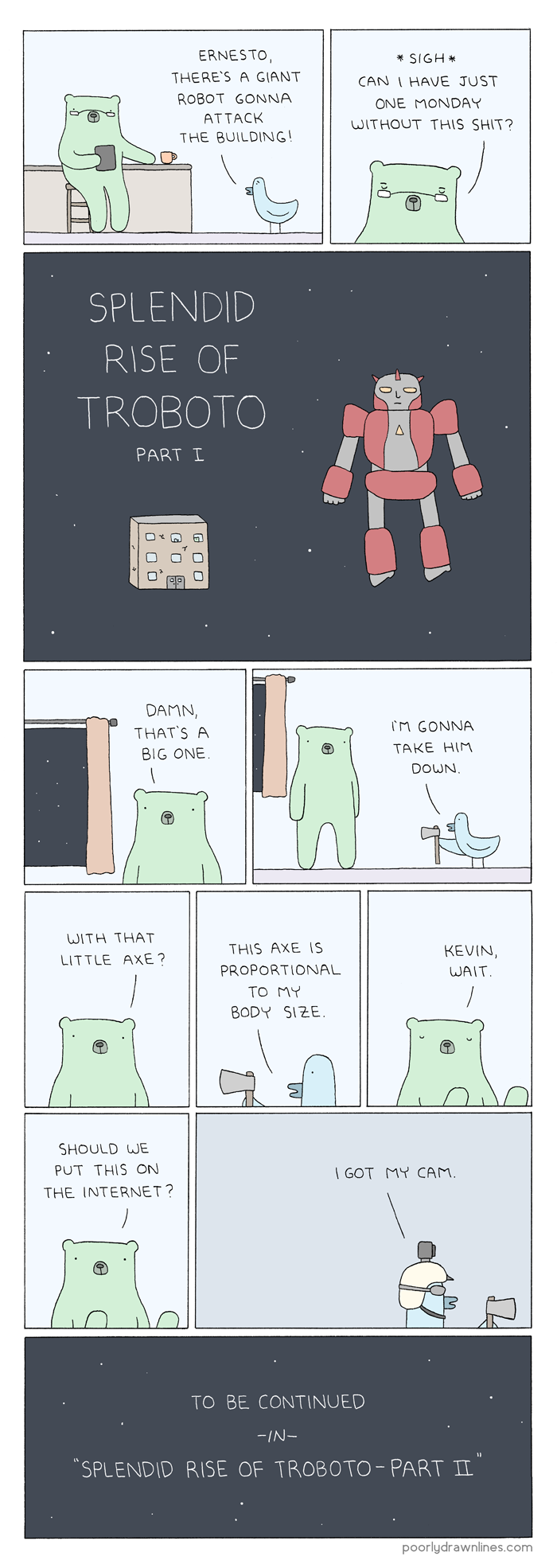
Troboto

01 Oct 00:50

(photo by braverthanbrave)


(photo by braverthanbrave)

01 Oct 00:49

Você sabia que a Arábia Saudita matou 130 iemenitas em um casamento?

by gustavochacra

A comunidade internacional corretamente tem seu foco na Guerra da Síria. Mas não deve fechar os olhos para a guerra civil da Líbia, causada em larga escala pelo Ocidente (especialmente a França), e a Guerra do Yemen, onde a Arábia Saudita tem matado civis iemenitas como se fossem passarinhos com armas vendidas pelos EUA.

Nesta semana, o regime saudita matou mais de 130 pessoas em um bombardeio a um casamento no Yemen. A maior parte das vítimas era composta por mulheres e crianças. Não há quase protestos internacionais. Todos se calam diante desta guerra dos sauditas contra os houthis. O resultado da ofensiva saudita, com apoio americano, é o fortalecimento da Al Qaeda na Península Arábica, mais poderosa organização terrorista do mundo.

Se fosse o Irã, o regime de Bashar al Assad ou Israel responsável pelo bombardeio, a gritaria internacional seria corretamente generalizada. Mas, por algum motivo, quando o regime saudita, o mais radical do mundo junto com o do ISIS (Grupo Estado Islâmico ou Daesh), mata civis iemenitas, a comunidade internacional ignora.

A Arábia Saudita possui um regime de Apartheid contra mulheres e minorias religiosas, como os xiitas. O regime saudita ajudou a difundir a ideologia wahabbita, que serve de base para a Al Qaeda, ISIS, Boko Haram, Al Shebab e Taleban. O regime saudita mata homossexuais. O regime saudita decapita pessoas. E 15 dos 19 terroristas do 11 de Setembro, assim como Bin Laden, eram sauditas.

Guga Chacra, comentarista de política internacional do Estadão e do programa Globo News Em Pauta em Nova York, é mestre em Relações Internacionais pela Universidade Columbia. Já foi correspondente do jornal O Estado de S. Paulo no Oriente Médio e em NY. No passado, trabalhou como correspondente da Folha em Buenos Aires

Comentários islamofóbicos, antissemitas, anticristãos e antiárabes ou que coloquem um povo ou uma religião como superiores não serão publicados. Tampouco são permitidos ataques entre leitores ou contra o blogueiro. Pessoas que insistirem em ataques pessoais não terão mais seus comentários publicados. Não é permitido postar vídeo. Todos os posts devem ter relação com algum dos temas acima. O blog está aberto a discussões educadas e com pontos de vista diferentes. Os comentários dos leitores não refletem a opinião do jornalista

Acompanhe também meus comentários no Globo News Em Pauta, na Rádio Estadão, na TV Estadão, no Estadão Noite no tablet, no Twitter @gugachacra , no Facebook Guga Chacra (me adicionem como seguidor), no Instagram e no Google Plus

30 Sep 23:50

Por que o regime da Venezuela ameaça a Guiana e o Brasil ignora?

by gustavochacra

Há um conflito entre dois países que fazem fronteira com o Brasil e quase ninguém sabe. A Venezuela ameaçou a Guiana caso o país seguisse explorando petróleo em um território na parte ocidental desta ex-colônia britânica. As duas nações chegaram inclusive a convocar seus embaixadores, apesar de estes terem voltado a seus postos nos últimos dias.

Na ONU, o presidente da Guiana, David Granger, acusou a Venezuela de impedir o país de explorar seus recursos naturais, chegando a ameaçar investidores. Disse que os venezuelanos ocupam parte do território, proibindo explorações de petróleo por partes dos guianenses. O regime de Maduro também foi acusado de tentar anexar a totalidade da zona marítima da Guiana, além de cinco das dez regiões.

Apenas para colocar no contexto, a disputa entre a Guiana e a Venezuela envolve cerca de 40% do território guianense, ao oeste do rio Essequibo, que deságua no mar a poucos quilômetros de Georgetown, capital do país. Esta é uma região rica em petróleo. A disputa foi resolvida no século 19, quando a Guiana era uma colônia britânica, mas a Venezuela nunca aceitou. Durante o regime de Chávez e agora no de Madura, as ameaças venezuelanas se intensificaram.

A Guiana é um pequeno país da América do Sul, que possui 1.308 km de fronteira com o Brasil. A sua composição étnica é bem diferente do restante do continente. Mais de 40% dos guianenses têm origem no que hoje seria a Índia e o Paquistão. Eles foram levados para a Guiana quando o país era território britânico. Outros 30% são negros descendentes de escravos. Há 15% de habitantes multirraciais e 10% de indígenas. O restante é composto por portugueses, brasileiros e chineses.

Único país de língua inglesa da América do Sul, os guianenses são um das nações com maiores diásporas do mundo. Cerca de 55% da população vive no exterior (o número sobe para oito em cada dez se levarmos em conta quem tem diploma universitário) – é um das cinco maiores colônias de Nova York. Aliás, muitas pessoas que você imagina ser da Índia nos EUA são na realidade guianenses.

Com 735 mil habitantes, é um dos raros países do mundo, junto com o Líbano, sem maioria religiosa. Cerca de 30% são protestantes, 30% hindus, além de minorias católicas (10%) e Islâmica (10%).

A economia é dependente da exportação de commodities. Os principais parceiros comerciais são os EUA e o Canadá. O Brasil praticamente ignora o vizinho, que fará 50 anos de independência no ano que vem. A cantora Rihana, uma das maiores celebridades do mundo, tem origem guianense.

Guga Chacra, comentarista de política internacional do Estadão e do programa Globo News Em Pauta em Nova York, é mestre em Relações Internacionais pela Universidade Columbia. Já foi correspondente do jornal O Estado de S. Paulo no Oriente Médio e em NY. No passado, trabalhou como correspondente da Folha em Buenos Aires

Comentários islamofóbicos, antissemitas, anticristãos e antiárabes ou que coloquem um povo ou uma religião como superiores não serão publicados. Tampouco são permitidos ataques entre leitores ou contra o blogueiro. Pessoas que insistirem em ataques pessoais não terão mais seus comentários publicados. Não é permitido postar vídeo. Todos os posts devem ter relação com algum dos temas acima. O blog está aberto a discussões educadas e com pontos de vista diferentes. Os comentários dos leitores não refletem a opinião do jornalista

Acompanhe também meus comentários no Globo News Em Pauta, na Rádio Estadão, na TV Estadão, no Estadão Noite no tablet, no Twitter @gugachacra , no Facebook Guga Chacra (me adicionem como seguidor), no Instagram e no Google Plus

30 Sep 23:43

Away

by Justin Boyd

Away

I should have never bought caffeinated syrup freshman year, first semester. That was a mistake.


bonus panel
30 Sep 23:36

Photo