my boner may be on fire but u can still touch it.
my boner may be on fire but u can still touch it.

In the infamous novel The Dice Man, the narrator Luke Rhinehart decides to hand his life over to randomness. The biggest of decisions will be made by dice. In one episode, he leads a mass escape from a secure mental hospital. In another, he tucks his young son into bed and then — after consulting the dice — leaves his wife and family for ever.
It’s an unsettling book, and Rhinehart is an anti-hero whose horrifying behaviour leads to ruin. Yet, most of us could do with a little more randomness in our lives. The roll of a die or the toss of a coin can actually help us make better decisions.
There are two quite different reasons for this. The first is that by pre-committing to follow a random instruction, we can end up making decisions that we should have been making all along. The status quo has a strange hold over us. Stuck in a job that we dislike, or with a romantic partner who is anything but romantic, all too often we stick with the devil we know.
Deciding that “if the coin comes up heads, I’ll leave my boyfriend” may be the only way that some of us have to break through the inertia and make tough decisions. A 50 per cent chance of dumping the oaf is better than no chance at all.
But what evidence do I have that we tend to be trapped by the status quo? In fact, the evidence is better than anyone could reasonably wish for, because a few years ago the idiosyncratic economist Steven Levitt launched a website, FreakonomicsExperiments.com, that was part publicity stunt and part data-gathering exercise. Levitt invited people who were agonising over a life decision to log in to the website, fill in some questions, and then abdicate responsibility to the flip of a digital coin. As the months went past, Levitt followed up, asking people whether they had obeyed the coin or ignored it, and how they were now feeling about the decision. Some of those decisions were weighty indeed: people had been pondering whether to propose, resign, have a baby, seek a divorce, adopt a child or start a business.
It’s an odd experiment, but what makes it powerful is that the coin toss randomly allocated people into two groups, one pushed towards action (the coin came up heads) and one pushed towards restraint. People did indeed tend to obey the coin — not always, but often enough — and those in the “heads” group tended to be happier several months on. When we’re genuinely undecided about whether to change the status quo, that probably tells us a change to the status quo is long overdue.
This isn’t to say that everyone pondering a drastic change in life should leap into action, hiring that divorce lawyer, storming into the boss’s office or searching for a sperm donor. But Levitt’s research suggests that if we’re genuinely undecided about a new direction, we should probably just get on with it. If the coin helps, fine. (In retrospect, if Levitt had used a biased coin, he would have made hundreds of people happier.)
…
Randomness, then, can prod us into taking actions that we fear. But it can also divert us into taking actions that we might not have imagined at all. A simple example of this emerged in 2014, when some London Underground staff launched a two-day strike that closed about two-thirds of Tube stations.
After the strike, the economists Ferdinand Rauch, Shaun Larcom and Tim Willems looked at data from London’s electronic farecard system, identifying individuals who took the same route morning after morning. [pdf] Most of these regular commuters had to find a different route to work during the strike. But what was surprising was that one in 20 of them stuck to their new routes after the strike was over. Even commuters, whom we would imagine had honed their daily journey to perfection, can find a better route when a random shock forces them to do so. Computer algorithms often use the same basic trick when searching for solutions to complex problems: stirring in a judicious dose of randomness prevents the search from getting stuck down a dead end.
Many creative types understand this principle very well. Perhaps the most famous example is the Oblique Strategies, a set of cards assembled by artist Peter Schmidt and musician Brian Eno. The cards are full of gnomic instructions — “Change Instrument Roles” or “Twist the Spine” — and Eno deployed them while working with David Bowie on his celebrated Low, “Heroes” and Lodger albums. Great guitarists such as Adrian Belew or Carlos Alomar would find themselves having to play the drums or hopping randomly between chords that Eno was indicating on a blackboard. They did not enjoy the experience: Alomar later compared it to being slapped in the face. But the results were superb.
One can have too much of a good thing, of course, and throw the dice too often. George Cockcroft, author of The Dice Man, experimented with a dice-driven life himself for a while but did the sensible thing and settled down once he found a life he loved. And Eno himself told me that he only used the Oblique Strategies cards when he got stuck.
And did he get stuck often?
“Oh, all the time.”
Written for and first published in the Financial Times.
My new book “Messy” was published yesterday in the US. If you like my writing, why not buy a copy? (Or pre-order the UK edition, which is out very soon). (US) (UK)
(You can unsubscribe at any time)
Email Address
Silk—the stuff of lustrous, glamorous clothing—is very strong. Researchers now report a clever way to make the gossamer threads even stronger and tougher: by feeding silkworms graphene or single-walled carbon nanotubes (Nano Lett. 2016, DOI: 10.1021/acs.nanolett.6b03597). The reinforced silk produced by the silkworms could be used in applications such as durable protective fabrics, biodegradable medical implants, and ecofriendly wearable electronics, they say.
Researchers have previously added dyes, antimicrobial agents, conductive polymers, and nanoparticles to silk—either by treating spun silk with the additives or, in some cases, by directly feeding the additives to silkworms. Silkworms, the larvae of mulberry-eating silk moths, spin their threads from a solution of silk protein produced in their salivary glands.
To make carbon-reinforced silk, Yingying Zhang and her colleagues at Tsinghua University fed the worms mulberry leaves sprayed with aqueous solutions containing 0.2% by weight of either carbon nanotubes or graphene and then collected the silk after the worms spun their cocoons, as is done in standard silk production. Treating already spun silk would require dissolving the nanomaterials in toxic chemical solvents and applying those to the silk, so the feeding method is simpler and more environmentally friendly.
In contrast to regular silk, the carbon-enhanced silks are twice as tough and can withstand at least 50% higher stress before breaking. The team heated the silk fibers at 1,050 °C to carbonize the silk protein and then studied their conductivity and structure. The modified silks conduct electricity, unlike regular silk. Raman spectroscopy and electron microscopy imaging showed that the carbon-enhanced silk fibers had a more ordered crystal structure due to the incorporated nanomaterials.
Some questions remain. One is exactly how the silkworms incorporate the nanomaterials in their silk. Another is what percentage of the nanomaterials eaten by the worms make it into the silk instead of being excreted or otherwise metabolized. The carbon materials are not visible in the cross sections of the silk threads, perhaps because the nanoparticle content is low, Zhang says. Answering these questions might be a task for biologists, she adds.
Polymer chemist Qing Shen at Donghua University reported similar work in 2014 using 30-nm-wide multiwalled carbon nanotubes, which also increased the silk fibers’ strength and toughness (Mater. Sci. Eng., C 2014, DOI: 10.1016/j.msec.2013.09.041). Zhang says that the smaller, 1- to 2-nm-wide single-walled nanotubes her team uses “are more suitable for incorporation into the crystalline structures of silk protein.”
This work provides an “easy way to produce high-strength silk fibers on a large scale,” says materials scientist Yaopeng Zhang of Donghua University, who has fed titanium dioxide nanoparticles to silkworms to create superstrong silk resistant to ultraviolet degradation. The electrical conductivity of the carbon-reinforced silk might make it suitable for sensors embedded in smart textiles and to read nerve signals, he says.
NEW ENGLAND PALS: I’ll be the special guest at TopatoCo’s Drink and Draw Event, this Wednesday the 12th! Come through!
Couple of things for sale!
SKELETON PARTY, PLTM volume 1
The Nib Calendar of Obscure Holidays! – I drew the cover and also February!

Stranded in Java after the Japanese invasion of 1941, the Dutch minesweeper Abraham Crijnssen found a unique way to sneak out: The crew covered the decks with jungle foliage and painted the hull to resemble cliffs, giving the ship the appearance of a small island.
Traveling only at night and anchoring near shore, the minesweeper gradually made her way to West Australia, becoming the last Allied vessel to escape Java and the only one of her class in the region to survive.
(Thanks, Paul.)

Happy birthday, Stacey R.! Time for another Cat Plumber for you! 

Geração Brasil’s prodigious coder on a scene where he shows his skills in a job interview.
tag reads “INTRODUCTION TO C PROGRAMMING”
Tirinha inspirada em sugestão enviada por Márcio Ximenes.
Adam Victor Brandizzi"I suspect archaeologists just see vaginas everywhere."
| Piled Higher & Deeper by Jorge Cham |
www.phdcomics.com
|
|
 |
||
|
title:
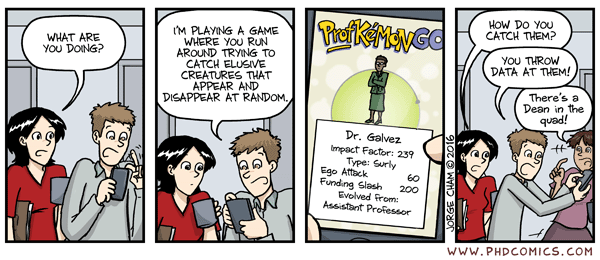
"Gotta Catch Them All" - originally published
10/3/2016
For the latest news in PHD Comics, CLICK HERE! |
||