Shared posts

01 May 06:05

Why don't schools teach debugging?

In the fall of 2000, I took my first engineering class: ECE 352, an entry-level digital design class for first-year computer engineers. It was standing room only, filled with waitlisted students who would find seats later in the semester as people dropped out. We had been warned in orientation that half of us wouldn’t survive the year. In class, We were warned again that half of us were doomed to fail, and that ECE 352 was the weed-out class that would be responsible for much of the damage.

The class moved briskly. The first lecture wasted little time on matters of the syllabus, quickly diving into the real course material. Subsequent lectures built on previous lectures; anyone who couldn’t grasp one had no chance at the next. Projects began after two weeks, and also built upon their predecessors; anyone who didn’t finish one had no hope of doing the next.

01 May 05:03

Goodhearting IQ, cholesterol, and tail latency

Most real-world problems are big enough that you can't just head for the end goal, you have to break them down into smaller parts and set up intermediate goals. For that matter, most games are that way too. “Win” is too big a goal in chess, so you might have a subgoal like don't get forked. While creating subgoals makes intractable problems tractable, it also creates the problem of determining the relative priority of different subgoals and whether or not a subgoal is relevant to the ultimate goal at all. In chess, there are libraries worth of books written on just that.

And chess is really simple compared to a lot of real world problems. 64 squares. 32 pieces. Pretty much any analog problem you can think of contains more state than chess, and so do a lot of discrete problems. Chess is also relatively simple because you can directly measure whether or not you succeeded (won). Many real-world problems have the additional problem of not being able to measure your goal directly.

IQ & Early Childhood Education

In 1962, what's now known as the Perry Preschool Study started in Ypsilanti, a blue-collar town near Detroit. It was a randomized trial, resulting in students getting either no preschool or two years of free preschool. After two years, students in the preschool group showed a 15 point bump in IQ scores; other early education studies showed similar results.

In the 60s, these promising early results spurred the creation of Head Start, a large scale preschool program designed to help economically disadvantaged children. Initial results from Head Start were also promising; children in the program got a 10 point IQ boost.

The next set of results was disappointing. By age 10, the difference in test scores and IQ between the trial and control groups wasn't statistically significant. The much larger scale Head Start study showed similar results; the authors of the first major analysis of Head Start concluded that

(1) Summer programs are ineffective in producing lasting gains in affective and cognitive development, (2) full-year programs are ineffective in aiding affective development and only marginally effective in producing lasting cognitive gains, (3) all Head Start children are still considerably below national norms on tests of language development and scholastic achievement, while school readiness at grade one approaches the national norm, and (4) parents of Head Start children voiced strong approval of the program. Thus, while full-year Head Start is somewhat superior to summer Head Start, neither could be described as satisfactory.

Education in the U.S. isn't cheap, and these early negative results caused calls for reductions in funding and even the abolishment of the program. Turns out, it's quite difficult to cut funding for a program designed to help disadvantaged children, and the program lives on despite repeated calls to cripple or kill the program.

Well after the initial calls to shut down Head Start, long-term results started coming in from the Perry preschool study. As adults, people in the experimental (preschool) group were less likely to have been arrested, less likely to have spent time in prison, and more likely to have graduated from high school. Unfortunately, due to methodological problems in the study design, it's not 100% clear where these effects come from. Although the goal was to do a randomized trial, the experimental design necessitated home visits for the experimental group. As a result, children in the experimental group whose mothers were employed swapped groups with children in the control group whose mothers were unemployed. The positive effects on the preschool group could have been caused by having at-home mothers. Since the Head Start studies weren't randomized and using instrumental variables (IVs) to tease out causation in “natural experiments” didn't become trendy until relatively recently, it took a long time to get plausible causal results from Head Start.

The goal of analyses with an instrumental variable is to extract causation, the same way you'd be able to in a randomized trial. A classic example is determining the effect of putting kids into school a year earlier or later. Some kids naturally start school a year earlier or later, but there are all sorts of factors that can cause that happen, which means that a correlation between an increased likelihood of playing college sports in kids who started school a year later could just as easily be from the other factors that caused kids to start a year later as it could be from actually starting school a year later.

However, date of birth can be used as an instrumental variable that isn't correlated with those other factors. For each school district, there's an arbitrary cutoff that causes kids on one side of the cutoff to start school a year later than kids on the other side. With the not-unreasonable assumption that being born one day later doesn't cause kids to be better athletes in college, you can see if starting school a year later seems to have a causal effect on the probability of playing sports in college.

Now, back to Head Start. One IV analysis used a funding discontinuity across counties to generate a quasi experiment. The idea is that there are discrete jumps in the level of Head Start funding across regions that are caused by variations in a continuous variable, which gives you something like a randomized trial. Moving 20 feet across the county line doesn't change much about kids or families, but it moves kids into an area with a significant change in Head Start funding.

The results of other IV analyses on Head Start are similar. Improvements in test scores faded out over time, but there were significant long-term effects on graduation rate (high school and college), crime rate, health outcomes, and other variables that are more important than test scores.

There's no single piece of incredibly convincing evidence. The randomized trial has methodological problems, and IV analyses nearly always leave some lingering questions, but the weight of the evidence indicates that even though scores on standardized tests, including IQ tests, aren't improved by early education programs, people's lives are substantially improved by early education programs. However, if you look at the early commentary on programs like Head Start, there's no acknowledgment that intermediate targets like IQ scores might not perfectly correlate with life outcomes. Instead you see declarations like “poor children have been so badly damaged in infancy by their lower-class environment that Head Start cannot make much difference”.

The funny thing about all this is that it's well known that IQ doesn't correlate perfectly to outcomes. In the range of environments that you see in typical U.S. families, to correlation to outcomes you might actually care about has an r value in the range of .3 to .4. That's incredibly strong for something in the social sciences, but even that incredibly strong statement is a statement IQ isn't responsible for "most" of the effect on real outcomes, even ignoring possible confounding factors.

Cholesterol & Myocardial Infarction

There's a long history of population studies showing a correlation between cholesterol levels and an increased risk of heart attack. A number of early studies found that lifestyle interventions that made cholesterol levels more favorable also decreased heart attack risk. And then statins were invented. Compared to older drugs, statins make cholesterol levels dramatically better and have a large effect on risk of heart attack.

Prior to the invention of statins, the standard intervention was a combination of diet and pre-statin drugs. There's a lot of literature on this; here's one typical review that finds, in randomized trials, a combination of dietary changes and drugs has a modest effect on both cholesterol levels and heart attack risk.

Given that narrative, it certainly sounds reasonable to try to develop new drugs that improve cholesterol levels, but when Pfizer spent $800 million doing exactly that, developing torcetrapib, they found that they created a drug which substantially increased heart attack risk despite improving cholesterol levels. Hoffman-La Roche's attempt fared a bit better because it improved cholesterol without killing anyone, but it still failed to decrease heart attack risk. Merck and Tricor have also had the same problem.

What happened? Some interventions that affected cholesterol levels also affected real health outcomes, prompting people to develop drugs that affect cholesterol. But it turns out that improving cholesterol isn't an inherent good, and like many intermediate targets, it's possible to improve without affecting the end goal.

99%-ile Latency & Latency

It's pretty common to see latency measurements and benchmarks nowadays. It's well understood that poor latency in applications costs you money, as it causes people to stop using the application. It's also well understood that average latency (mean, median, or mode), by itself, isn't a great metric. It's common to use 99%-ile, 99.9%-ile, 99.99%-ile, etc., in order to capture some information about the distribution and make sure that bad cases aren't too bad.

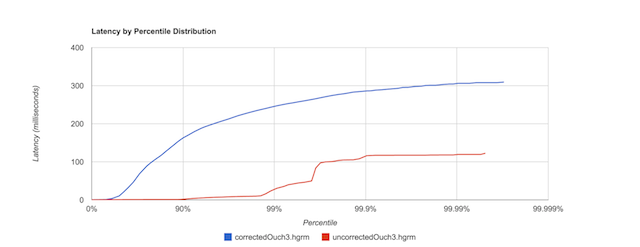
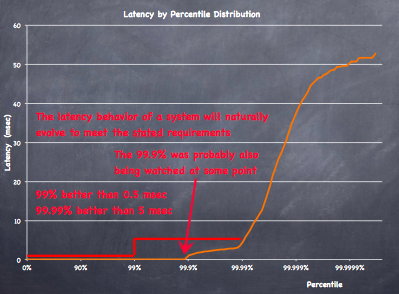
What happens when you use the 99%-iles as intermediate targets? If you require 99%-ile latency to be under 0.5 millisec and 99.99% to be under 5 millisecond you might get a latency distribution that looks something like this.

Latency graph with kinks at 99%-ile, 99.9%-ile, and 99.99%-ile

This is a graph of an actual application that Gil Tene has been showing off in his talks about latency. If you specify goals in terms of 99%-ile, 99.9%-ile, and 99.99%-ile, you'll optimize your system to barely hit those goals. Those optimizations will often push other latencies around, resulting in a funny looking distribution that has kinks at those points, with latency that's often nearly as bad as possible everywhere else.

It's is a bit odd, but there's nothing sinister about this. If you try a series of optimizations while doing nothing but looking at three numbers, you'll choose optimizations that improve those three numbers, even if they make the rest of the distribution much worse. In this case, latency rapidly degrades above the 99.99%-ile because the people optimizing literally had no idea how much worse they were making the 99.991%-ile when making changes. It's like the video game solving AI that presses pause before its character is about to get killed, because pausing the game prevents its health from decreasing. If you have very narrow optimization goals, and your measurements don't give you any visibility into anything else, everything but your optimization goals is going to get thrown out the window.

Since the end goal is usually to improve the user experience and not just optimize three specific points on the distribution, targeting a few points instead of using some kind of weighted integral can easily cause anti-optimizations that degrade the actual user experience, while producing great slideware.

In addition to the problem of optimizing just the 99%-ile to the detriment of everything else, there's the question of how to measure the 99%-ile. One method of measuring latency, used by multiple commonly used benchmarking frameworks, is to do something equivalent to

for (int i = 0; i < NUM; ++i) {
  auto a = get_time();
  do_operation();
  auto b = get_time();
  measurements[i] = b - a;
}

If you optimize the 99%-ile of that measurement, you're optimizing the 99%-ile for when all of your users get together and decide to use your app sequentially, coordinating so that no one requests anything until the previous user is finished.

Consider a contrived case where you measure for 20 seconds. For the first 10 seconds, each response takes 1ms. For the 2nd 10 seconds, the system is stalled, so the last request takes 10 seconds, resulting in 10,000 measurements of 1ms and 1 measurement of 10s. With these measurements, the 99%-ile is 1ms, as is the 99.9%-ile, for the matter. Everything looks great!

But if you consider a “real” system where users just submit requests, uniformly at random, the 75%-ile latency should be >= 5 seconds because if any query comes during the 2nd half, it will get jammed up, for an average of 5 seconds and as much as 10 seconds, in addition to whatever queuing happens because requests get stuck behind other requests.

If this example sounds contrived, it is; if you'd prefer a real world example, see this post by Nitsan Wakart, which finds shows how YCSB (Yahoo Cloud Serving Benchmark) has this problem, and how different the distributions look before and after the fix.

Order of magnitude latency differences between YCSB's measurement and the truth

The red line is YCSB's claimed latency. The blue line is what the latency looks like after Wakart fixed the coordination problem. There's more than an order of magnitude difference between the original YCSB measurement and Wakart's corrected version.

It's important to not only consider the whole distribution, to make make sure you're measuring a distribution that's relevant. Real users, which can be anything from a human clicking something on a web app, to an app that's waiting for an RPC, aren't going to coordinate to make sure they don't submit overlapping requests; they're not even going to obey a uniform random distribution.

Conclusion

This is the point in a blog post where you're supposed to get the one weird trick that solves your problem. But the only trick is that there is no trick, that you have to constantly check that your map is somehow connected to the territory1.

Resources

1990 HHS Report on Head Start. 2012 Review of Evidence on Head Start.

A short article on instrumental variables. A book on econometrics and instrumental variables.

Aysylu Greenberg video on benchmarking pitfalls; it's not latency specific, but it covers a wide variety of common errors. Gil Tene video on latency; covers many more topics than this post. Nitsan Wakart on measuring latency; has code examples and links to libraries.

Acknowledgments

Thanks to Leah Hanson for extensive comments on this, and to Scott Feeney and Kyle Littler for comments that resulted in minor edits.


  1. Unless you're in school and your professor likes to give problems where the answers are nice, simple, numbers, maybe the weird trick is that you know you're off track if you get an intermediate answer with a 170/23 in front of it. [return]
28 Apr 23:35

Comic for April 27, 2017

by Scott Adams
27 Apr 03:02

Reading citations is easier than most people think

It's really common to see claims that some meme is backed by “studies” or “science”. But when I look at the actual studies, it usually turns out that the data are opposed to the claim. Here are the last few instances of this that I've run across.

Dunning-Kruger

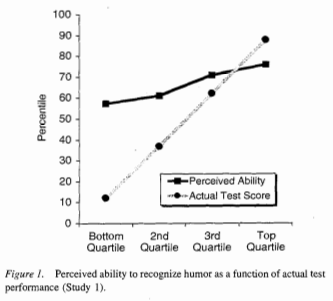
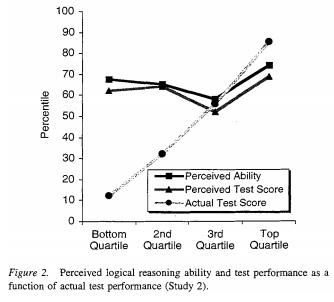
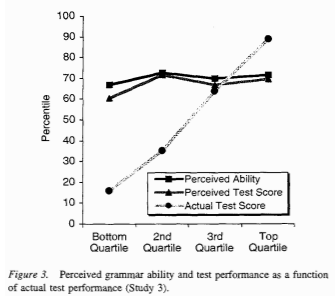
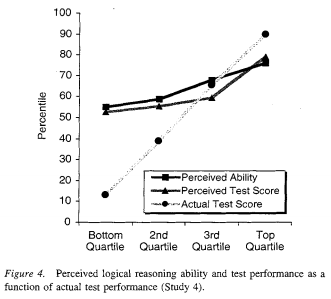
A pop-sci version of Dunning-Kruger, the most common one I see cited, is that, the less someone knows about a subject, the more they think they know. Another pop-sci version is that people who know little about something overestimate their expertise because their lack of knowledge fools them into thinking that they know more than they do. The actual claim Dunning and Kruger make is much weaker than the first pop-sci claim and, IMO, the evidence is weaker than the second claim. The original paper isn't much longer than most of the incorrect pop-sci treatments of the paper, and we can get pretty good idea of the claims by looking at the four figures included in the paper. In the graphs below, “perceived ability” is a subjective self rating, and “actual ability” is the result of a test.

Dunning-Kruger graph Dunning-Kruger graph Dunning-Kruger graph Dunning-Kruger graph

In two of the four cases, there's an obvious positive correlation between perceived skill and actual skill, which is the opposite of the first pop-sci conception of Dunning-Kruger that we discussed. As for the second, we can see that people at the top end also don't rate themselves correctly, so the explanation for Dunning-Kruger's results is that people who don't know much about a subject (an easy interpretation to have of the study, given its title, Unskilled and Unaware of It: How Difficulties in Recognizing One's Own Incompetence Lead to Inflated Self-Assessments) is insufficient because that doesn't explain why people at the top of the charts have what appears to be, at least under the conditions of the study, a symmetrically incorrect guess about their skill level. One could argue that there's a completely different effect that just happens to cause the same, roughly linear, slope in perceived ability that people who are "unskilled and unaware of it" have. But, if there's any plausible simpler explanation, then that explanation seems overly complicated without additional evidence (which, if any exists, is not provided in the paper)1.

A plausible explanation of why perceived skill is compressed, especially at the low end, is that few people want to rate themselves as below average or as the absolute best, shrinking the scale but keeping a roughly linear fit. The crossing point of the scales is above the median, indicating that people, on average, overestimate themselves, but that's not surprising given the population tested (more on this later). In the other two cases, the correlation is very close to zero. It could be that the effect is different for different tasks, or it could be just that the sample size is small and that the differences between the different tasks is noise. It could also be that the effect comes from the specific population sampled (students at Cornell, who are probably actually above average in many respects). If you look up Dunning-Kruger on Wikipedia, it claims that a replication of Dunning-Kruger on East Asians shows the opposite result (perceived skill is lower than actual skill, and the greater the skill, the greater the difference), and that the effect is possibly just an artifact of American culture, but the citation is actually a link to an editorial which mentions a meta analysis on East Asian confidence, so that might be another example of a false citation. Or maybe it's just a link to the wrong source. In any case, the effect certainly isn't that the more people know, the less they think they know.

Income & Happiness

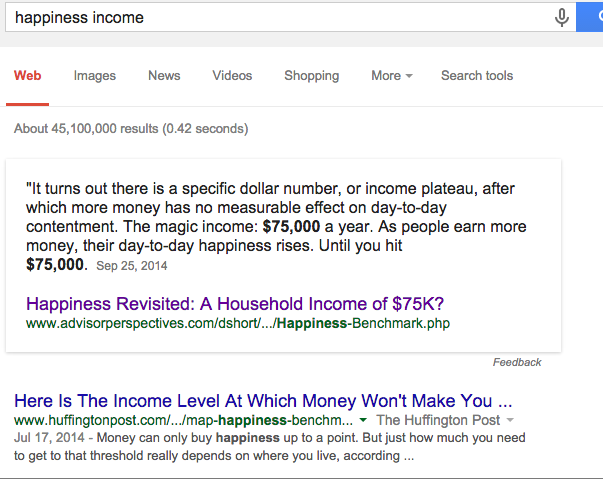
It's become common knowledge that money doesn't make people happy. As of this writing, a Google search for happiness income returns a knowledge card that making more than $75k/year has no impact on happiness. Other top search results claim the happiness ceiling occurs at $10k/year, $30k/year, $40k/year and $75k/year.

Google knowledge card says that $75k should be enough for anyone

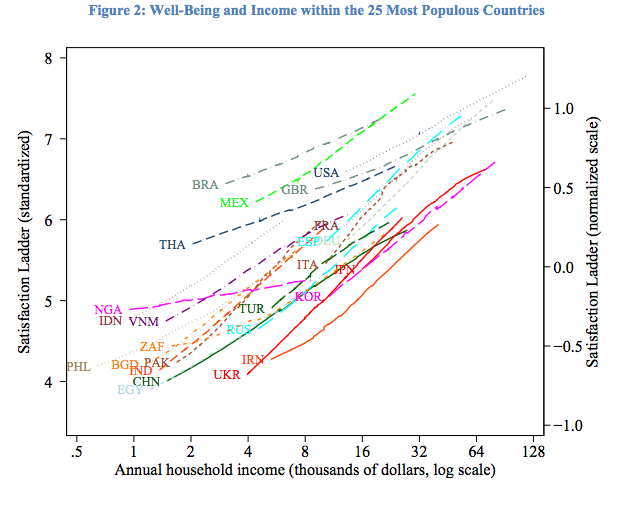
Not only is that wrong, the wrongness is robust across every country studied, too.

People with more income are happier

That happiness is correlated with income doesn't come from cherry picking one study. That result holds across five iterations of the World Values Survey (1981-1984, 1989-1993, 1994-1999, 2000-2004, and 2005-2009), three iterations of the Pew Global Attitudes Survey (2002, 2007, 2010), five iterations of the International Social Survey Program (1991, 1998, 2001, 2007, 2008), and a large scale Gallup survey.

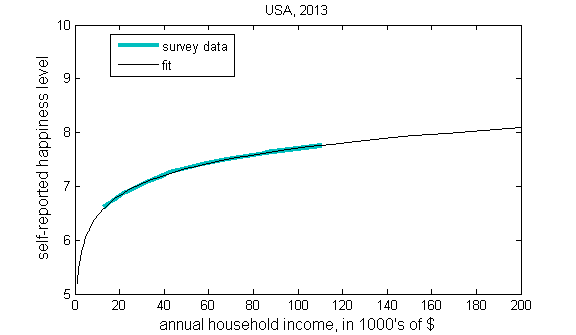
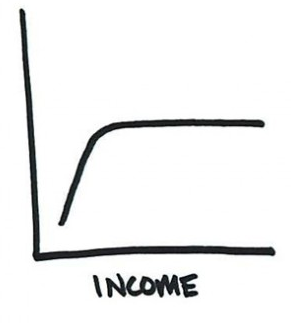
The graph above has income on a log scale, if you pick a country and graph the results on a linear scale, you get something like this.

Best fit log to happiness vs. income

As with all graphs of a log function, it looks like the graph is about to level off, which results in interpretations like the following:

Distorted log graph

That's an actual graph from an article that claims that income doesn't make people happy. These vaguely log-like graphs that level off are really common. If you want to see more of these, try an image search for “happiness income”. My favorite is the one where people who make enough money literally hit the top of the scale. Apparently, there's a dollar value which not only makes you happy, it makes you as happy as it is possible for humans to be.

As with Dunning-Kruger, you can look at the graphs in the papers to see what's going on. It's a little easier to see why people would pass along the wrong story here, since it's easy to misinterpret the data when it's plotted against a linear scale, but it's still pretty easy to see what's going on by taking a peek at the actual studies.

Hedonic Adaptation & Happiness

The idea that people bounce back from setbacks (as well as positive events) and return to a fixed level of happiness entered the popular consciousness after Daniel Gilbert wrote about it in a popular book.

But even without looking at the literature on adaptation to adverse events, the previous section on wealth should cast some doubt on this. If people rebound from both bad events and good, how is it that making more money causes people to be happier?

Turns out, the idea that people adapt to negative events and return to their previous set-point is a myth. Although the exact effects vary depending on the bad event, disability2, divorce3, loss of a partner4, and unemployment5 all have long-term negative effects on happiness. Unemployment is the one event that can be undone relatively easily, but the effects persist even after people become reemployed. I'm only citing four studies here, but a meta analysis of the literature shows that the results are robust across existing studies.

The same thing applies to positive events. While it's “common knowledge” that winning the lottery doesn't make people happier, it turns out that isn't true, either.

In both cases, early cross-sectional results indicated that it's plausible that extreme events, like winning the lottery or becoming disabled, don't have long term effects on happiness. But the longitudinal studies that follow individuals and measure the happiness of the same person over time as events happen show the opposite result -- events do, in fact, affect happiness. For the most part, these aren't new results (some of the initial results predate Daniel Gilbert's book), but the older results based on less rigorous studies continue to propagate faster than the corrections.

Chess position memorization

I frequently see citations claiming that, while experts can memorize chess positions better than non-experts, the advantage completely goes away when positions are randomized. When people refer to a specific citation, it's generally Chase and Simon's 1973 paper Perception in Chess, a "classic" which has been cited a whopping 7449 times in the literature, which says:

De Groat did, however, find an intriguing difference between masters and weaker players in his short-term memory experiments. Masters showed a remarkable ability to reconstruct a chess position almost perfectly after viewing it for only 5 sec. There was a sharp dropoff in this ability for players below the master level. This result could not be attributed to the masters’ generally superior memory ability, for when chess positions were constructed by placing the same numbers of pieces randomly on the board, the masters could then do no better in reconstructing them than weaker players, Hence, the masters appear to be constrained by the same severe short-term memory limits as everyone else ( Miller, 1956), and their superior performance with "meaningful" positions must lie in their ability to perceive structure in such positions and encode them in chunks. Specifically, if a chess master can remember the location of 20 or more pieces on the board, but has space for only about five chunks in short-term memory, then each chunk must be composed of four or five pieces, organized in a single relational structure.

The paper then runs an experiment which "proves" that master-level players actually do worse than beginners when memorizing random mid-game positions even though they do much better memorizing real mid-game positions (and, in end-game positions, they do the about the same as beginners when positions are randomized). Unfortunately, the paper used an absurdly small sample size of one chess player at each skill level.

A quick search indicates that this result does not reproduce with larger sample sizes, e.g., Gobet and Simon, in "Recall of rapidly presented random chess positions is a function of skill", say

A widely cited result asserts that experts’ superiority over novices in recalling meaningful material from their domain of expertise vanishes when they are confronted with random material. A review of recent chess experiments in which random positions served as control material (presentation time between 3 and 10 sec) shows, however, that strong players generally maintain some superiority over weak players even with random positions, although the relative difference between skill levels is much smaller than with game positions. The implications of this finding for expertise in chess are discussed and the question of the recall of random material in other domains is raised.

They find this scales with skill level and, e.g., for "real" positions, 2350+ ELO players memorized ~2.2x the number of correct pieces that 1600-2000 ELO players did, but the difference was ~1.6x for random positions (these ratios are from eyeballing a graph and may be a bit off). 1.6x is smaller than 2.2x, but it's certainly not the claimed 1.0.

I've also seen this result cited to claim that it applies to other fields, but in a quick search of applying this result to other fields, results either show something similar (a smaller but still observable difference on randomized positions) or don't reproduce, e.g., McKeithen did this for programmers and found that, on trying to memorize programs, on "normal" program experts were ~2.5x better than beginners on the first trial and 3x better by the 6th trial, whereas on the "scrambled" program, experts were 3x better on the first trial and progressed to being only ~1.5x better by the 6th trial. Despite this result contradicting Chase and Simon, I've seen people cite this result to claim the same thing as Chase and Simon, presumably from people who didn't read what McKeithen actually wrote.

Type Systems

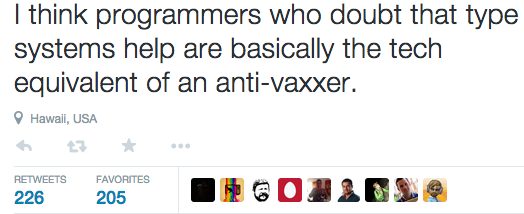
Unfortunately, false claims about studies and evidence aren't limited to pop-sci memes; they're everywhere in both software and hardware development. For example, see this comment from a Scala/FP "thought leader":

Tweet claiming that any doubt that type systems are helpful is equivalent to being an anti-vaxxer

I see something like this at least once a week. I'm picking this example not because it's particularly egregious, but because it's typical. If you follow a few of the big time FP proponents on twitter, you'll see regularly claims that there's very strong empirical evidence and extensive studies backing up the effectiveness of type systems.

However, a review of the empirical evidence shows that the evidence is mostly incomplete, and that it's equivocal where it's not incomplete. Of all the false memes, I find this one to be the hardest to understand. In the other cases, I can see a plausible mechanism by which results could be misinterpreted. “Relationship is weaker than expected” can turn into “relationship is opposite of expected”, log can look a lot like an asymptotic function, and preliminary results using inferior methods can spread faster than better conducted follow-up studies. But I'm not sure what the connection between the evidence and beliefs are in this case.

Is this preventable?

I can see why false memes might spread quickly, even when they directly contradict reliable sources. Reading papers sounds like a lot of work. It sometimes is. But it's often not. Reading a pure math paper is usually a lot of work. Reading an empirical paper to determine if the methodology is sound can be a lot of work. For example, biostatistics and econometrics papers tend to apply completely different methods, and it's a lot of work to get familiar enough with the set of methods used in any particular field to understand precisely when they're applicable and what holes they have. But reading empirical papers just to see what claims they make is usually pretty easy.

If you read the abstract and conclusion, and then skim the paper for interesting bits (graphs, tables, telling flaws in the methodology, etc.), that's enough to see if popular claims about the paper are true in most cases. In my ideal world, you could get that out of just reading the abstract, but it's not uncommon for papers to make claims in the abstract that are much stronger than the claims made in the body of the paper, so you need to at least skim the paper.

Maybe I'm being naive here, but I think a major reason behind false memes is that checking sources sounds much harder and more intimidating than it actually is. A striking example of this is when Quartz published its article on how there isn't a gender gap in tech salaries, which cited multiple sources that showed the exact opposite. Twitter was abuzz with people proclaiming that the gender gap has disappeared. When I published a post which did nothing but quote the actual cited studies, many of the same people then proclaimed that their original proclamation was mistaken. It's great that they were willing to tweet a correction6, but as far as I can tell no one actually went and read the source data, even though the graphs and tables make it immediately obvious that the author of the original Quartz article was pushing an agenda, not even with cherry picked citations, but citations that showed the opposite of their thesis.

Unfortunately, it's in the best interests of non-altruistic people who do read studies to make it seem like reading studies is difficult. For example, when I talked to the founder of a widely used pay-walled site that reviews evidence on supplements and nutrition, he claimed that it was ridiculous to think that "normal people" could interpret studies correctly and that experts are needed to read and summarize studies for the masses. But he's just a serial entrepreneur who realized that you can make a lot of money by reading studies and summarizing the results! A more general example is how people sometimes try to maintain an authoritative air by saying that you need certain credentials or markers of prestige to really read or interpret studies.

There are certainly fields where you need some background to properly interpret a study, but even then, the amount of knowledge that a degree contains is quite small and can be picked up by anyone. For example, excluding lab work (none of which contained critical knowledge for interpreting results), I was within a small constact factor of spending one hour of time per credit hour in school. At the conversion rate, an engineering degree from my alma mater costs a bit more than 100 hours and almost all non-engineering degrees land at less than 40 hours, with a large amount of overlap between them because a lot of degrees will require the same classes (e.g., calculus). Gatekeeping reading and interpreting a study on whether or not someone has a credential like a degree is absurd when someone can spend a week's worth of time gaining the knowledge that a degree offers.

If you liked this post, you'll probably enjoy this post on odd discontinuities, this post how the effect of markets on discrimination is more nuanced than it's usually made out to be and this other post discussing some common misconceptions.

2021 update

In retrospect, I think the mystery of the "type systems" example is simple: it's a different kind of fake citation than the others. In the first three examples, a clever, contrarian, but actually wrong idea got passed around. This makes sense because people love clever, contrarian, ideas and don't care very much if they're wrong, so clever, contarian, relatively frequently become viral relative to their correctness.

For the type systems example, it's just that people commonly fabricate evidence and then appeal to authority to support their position. In the post, I was confused because I couldn't see how anyone could look at the evidence and then make the claims that type system advocates do but, after reading thousands of discussions from people advocating for their pet tool/language/practice, I can see that it was naive of me to think that these advocates would even consider looking for evidence as opposed to just pretending that evidence exists without ever having looked.

Thanks to Leah Hanson, Lindsey Kuper, Jay Weisskopf, Joe Wilder, Scott Feeney, Noah Ennis, Myk Pono, Heath Borders, Nate Clark, and Mateusz Konieczny for comments/corrections/discussion.

BTW, if you're going to send me a note to tell me that I'm obviously wrong, please make sure that I'm actually wrong. In general, I get great feedback and I've learned a lot from the feedback that I've gotten, but the feedback I've gotten on this post has been unusually poor. Many people have suggested that the studies I've referenced have been debunked by some other study I clearly haven't read, but in every case so far, I've already read the other study.


  1. Dunning and Kruger claim, without what I'd consider strong evidence, that this is because people who perform well overestimate how well other people perform. While that may be true, one could also say that the explanation for people who are "unskilled" is that they underestimate how well other people perform. "Phase 2" attempts to establish that's not the case, but I don't find the argument convincing for a number of reasons. To pick one example, at the end of the section, they say "Despite seeing the superior performances of their peers, bottom-quartile participants continued to hold the mistaken impression that they had performed just fine.", but we don't know that the participants believed that they performed fine, we just know what their perceived percentile is. It's possible to believe that you're peforming poorly while also being in a high percentile (and I frequently have this belief for activties I haven't seriously practiced or studied, which seems likely to be the case for the participants of the Dunning-Kruger study who scored poorly on tasks with respect to those tassks). [return]
  2. Long-term disability is associated with lasting changes in subjective well-being: evidence from two nationally representative longitudinal studies.

    Hedonic adaptation refers to the process by which individuals return to baseline levels of happiness following a change in life circumstances. Two nationally representative panel studies (Study 1: N = 39,987; Study 2: N = 27,406) were used to investigate the extent of adaptation that occurs following the onset of a long-term disability. In Study 1, 679 participants who acquired a disability were followed for an average of 7.18 years before and 7.39 years after onset of the disability. In Study 2, 272 participants were followed for an average of 3.48 years before and 5.31 years after onset. Disability was associated with moderate to large drops in happiness (effect sizes ranged from 0.40 to 1.27 standard deviations), followed by little adaptation over time.

    [return]
  3. Time does not heal all wounds

    Cross-sectional studies show that divorced people report lower levels of life satisfaction than do married people. However, such studies cannot determine whether satisfaction actually changes following divorce. In the current study, data from an 18-year panel study of more than 30,000 Germans were used to examine reaction and adaptation to divorce. Results show that satisfaction drops as one approaches divorce and then gradually rebounds over time. However, the return to baseline is not complete. In addition, prospective analyses show that people who will divorce are less happy than those who stay married, even before either group gets married. Thus, the association between divorce and life satisfaction is due to both preexisting differences and lasting changes following the event.

    [return]
  4. Reexamining adaptation and the set point model of happiness: Reactions to changes in marital status.

    According to adaptation theory, individuals react to events but quickly adapt back to baseline levels of subjective well-being. To test this idea, the authors used data from a 15-year longitudinal study of over 24,000 individuals to examine the effects of marital transitions on life satisfaction. On average, individuals reacted to events and then adapted back toward baseline levels. However, there were substantial individual differences in this tendency. Individuals who initially reacted strongly were still far from baseline years later, and many people exhibited trajectories that were in the opposite direction to that predicted by adaptation theory. Thus, marital transitions can be associated with long-lasting changes in satisfaction, but these changes can be overlooked when only average trends are examined.

    [return]
  5. Unemployment Alters the Set-Point for Life Satisfaction

    According to set-point theories of subjective well-being, people react to events but then return to baseline levels of happiness and satisfaction over time. We tested this idea by examining reaction and adaptation to unemployment in a 15-year longitudinal study of more than 24,000 individuals living in Germany. In accordance with set-point theories, individuals reacted strongly to unemployment and then shifted back toward their baseline levels of life satisfaction. However, on average, individuals did not completely return to their former levels of satisfaction, even after they became reemployed. Furthermore, contrary to expectations from adaptation theories, people who had experienced unemployment in the past did not react any less negatively to a new bout of unemployment than did people who had not been previously unemployed. These results suggest that although life satisfaction is moderately stable over time, life events can have a strong influence on long-term levels of subjective well-being.

    [return]
  6. One thing I think it's interesting to look at is how you can see the opinions of people who are cagey about revealing their true opinions in which links they share. For example, Scott Alexander and Tyler Cowen both linked to the bogus gender gap article as something interesting to read and tend to link to things that have the same view.

    If you naively read their writing, it appears as if they're impartially looking at evidence about how the world works, which they then share with people. But when you observe that they regularly share evidence that supports one narrative, regardless of quality, and don't share evidence that supports the opposite narrative, it would appear that they have a strong opinion on the issue that they reveal via what they link to.

    [return]
27 Apr 02:53

Northern Pygmy-Owl

by rmosco

27 Apr 02:51

Sword.

by Ryan
27 Apr 02:44

Kevin’s Project

by Reza

27 Apr 02:44

Geochronology

'The mountains near here formed when the ... Newfoundland ... microplate collided with, uhh ... Labrador.' 'Ok, now you're definitely just naming dogs.' 'Wait, no, that's actually almost correct.'
27 Apr 02:43

Saturday Morning Breakfast Cereal - Recreation

by tech@thehiveworks.com


Click here to go see the bonus panel!

Hovertext:
Happily, this will never be true of nerd comics.

New comic!
Today's News:
27 Apr 02:40

How to Recover from the Failure of Your Mobile Phone

by Scott Meyer

The phone I had that broke was an early HTC model that was terrible from day one. The older phone I went back to was my trusty Palm Treo.

My Treo was made in 2003. It had a touch screen and a web browser. It could handle e-mails, and text messages. It played MP3s, and video files. I read books on it, and could open and edit PDFs, Word, and Excel files.

It did all of this years before the iPhone was introduced.

That’s why I’ve always said that what made the iPhone special wasn’t anything that it could do. It was the fact that it did many of those things well. The Treo didn’t. It was a fine e-mail machine, but almost everything else it did was severely compromised.

Also, when you held it up next to a first-generation iPhone, the Treo looked like an import from the 1960s Soviet Union. If I still had it, all I’d have to do is spray it with copper metallic paint and it would be steampunk.


As always, thanks for using my Amazon Affiliate links (USUKCanada).

27 Apr 02:38

Saturday Morning Breakfast Cereal - Words

by tech@thehiveworks.com


Click here to go see the bonus panel!

Hovertext:
More and more, I think the 'they're just a sequence of sounds' is one of the more pointless observations you can possibly make.

New comic!
Today's News:

Book Review Tuesday is here! More reviews at TheWeinerWorks.com

Pyongyang (DeLisle) A quick and fun sketch of the author’s time spent working for an animation studio in North Korea. I don’t have too much to say about it, other than that it’s quite enjoyable, and that I plan to read other books by the author. This isn’t a memoir like March or Maus - it’s not trying to bring you to a heightened awareness of the universe. It’s not particularly poignant, nor is it trying to be. It’s just an incredible well-told, occasionally quite funny, recounting of a short strange time in the author’s life.

Elbow Room (Dennett) Okay, so I’ve wanted to read a book on compatibilism, the belief that “free will” and a deterministic universe are compatible. This seems crazy to me, and I trust the reasons are obvious.

So, I read this book, and my honest initial reaction was disappointment. A lot of the book is spent talking about computer, biology, evolution, and so forth, which to me seems like a sort of sideshow. If so, it’s an especially egregious sideshow, since Dennett frequently complains of perilously misleading elements stuck into philosophical theories.

That said, as I thought it over and discussed it more with people, I got the basic idea, which (to simplify drastically) isn’t so much that you can have free will in a deterministic universe, but that your idea of what free will means is probably wrong. I don’t want to go too in depth in this review, but as a way to think about it, try to consider what the basic physical rules would be for a universe that permitted your intuitive notion of free will. It’s hard to think of anything that doesn’t posit some cheat that just asserts that you do.

In short, I didn’t get the hit of wild enlightenment I was hoping for. Unusually for me, I learned something, yet left disappointed. I will illustrate by the use of what I’ll call Two Dialogues Concerning Free Will.

Dialogue 1:

Mom: Hey, you wanna see a DINOSAUR?!

Kid: but isn’t that impossible?!

Mom: come with me!

[Cut to: Park]

Mom: Meet the pigeon! You know, according to science, birds are living dinosaurs!

Kid: But I wanted a T. Rex!

Mom: Jesus, kid. Obviously that was never gonna happen.

Dialogue 2: Compatibilist: Hey, you wanna see me combine free will and determinism?!

Zach: Sure thing! But how?

Compatibilist: I’ll show you!

[Cut to: Zach reading book]

Zach: So determinism is still true, but individuals appear to have choices, and we can call that free will if we like?

Compatibilist: Yeah. What? Did you think I was going to claim an individual human could defy causality itself?

Zach: I thought maybe-

Compatibilist: By Descartes’ beard, you’re dumb!

--End of Scene-- So, that’s where I am now on this. Like the kid at the park, I’m not disagreeing with the idea that my initial notion of the subject matter was flawed. I’m just annoyed at the way the exciting revelation was presented.

Vietnamerica (Tran) What a great memoir. I’ve been reading a lot of memoirs in graphic novel format lately, and this one was one of the very best, both in terms of its style and execution. I especially enjoyed the way in which the book moved from scene to scene without frequently telling you what year or location it was.

The artwork and, well, comicking itself was just so good that I rarely had to take a second to figure out where the scene had changed to.

The only critique that occurred to me is that the “character” of Tran himself in the story feels very… unformed. Maybe this is simply because it depicts Tran mostly at a younger age, where he would’ve been, indeed, unformed. But, I couldn’t help but feel that the character is so self-flagellating (he is almost always depicted as a sort of know-it-all punk kid) that you miss what could be a more whole interaction between kids and parents. Tran’s past self feels less like a person than a point of embarrassment that the author is covering over with humor.

It still works well enough, but I would’ve loved if, here and there, we had a moment of just Tran being himself, in a way that only develops character, rather than moving forward the book’s telling of history. But, still, quite a good memoir comic, and absolutely beautiful.

27 Apr 02:33

Comic for April 25, 2017

by Scott Adams
27 Apr 02:31

Shopping At Target

by Brian
27 Apr 02:31

Saturday Morning Breakfast Cereal - Dadbucks

by tech@thehiveworks.com


Click here to go see the bonus panel!

Hovertext:
Later, the kid agrees to do chores, but only in exchange for precious metals.

New comic!
Today's News:

Thank you so much MIT. Congrats to James Propp and Olivia Walch. We hope to see you again next year.

24 Apr 00:02

Sociólogo Sérgio Abranches analisa a Lava Jato e a crise da democracia - 23/04/2017 - Ilustríssima - Folha de S.Paulo

by brandizzi

RESUMO Célebre pela expressão "presidencialismo de coalizão", autor analisa impactos da Lava Jato no sistema político. Para ele, as revelações sobre corrupção ampliam o fosso entre partidos e cidadãos, um fenômeno que afeta democracias em todo o mundo e que não será resolvido com simples mudanças nas leis eleitorais.

Ilustração de Adams Carvalho para Ilustríssima
Ilustração de Adams Carvalho

Quando começou a escrever "Ruling the Void" (governando o vácuo), em 2007, o politólogo Peter Mair tocou no ponto nevrálgico da crise que atinge a democracia em todo o mundo. Especialista em política comparada, chegou a uma visão sombria sobre a trajetória dos sistemas partidários nas sociedades contemporâneas.

"A era da democracia de partidos passou. Embora os partidos permaneçam, eles se tornaram tão desconectados da sociedade mais ampla e buscam uma forma de competição tão sem sentido que não parecem mais capazes de sustentar a democracia na sua forma presente", afirmou.

Mair chamava a atenção para um dos problemas cruciais da grande transição que vivemos no século 21, o do esvaziamento da democracia representativa.

Este é o subtítulo que deu a seu ensaio: "Ruling the Void: The Hollowing of Western Democracy" (Verso Books, 2013; governando o vácuo: o esvaziamento da democracia ocidental). Ele trabalhou nesse livro até 2011, quando morreu sem poder completá-lo.

O resultado desse projeto foi publicado postumamente. Nele, o autor examina a mudança na natureza dos partidos políticos e o impacto negativo que isso provoca na permanência, na legitimidade e na efetividade da democracia representativa contemporânea.

Ele vê com preocupação a emergência de uma noção de democracia destituída de seu componente popular e o aumento da desconfiança na política, nos políticos e nos partidos. Esse processo trouxe a própria democracia para a agenda de debates na imprensa e na academia, a ponto de hoje falar-se de seus problemas e dos caminhos para sua revitalização mais do que em qualquer outro momento no passado.

Para Mair, o renovado interesse pelos problemas da democracia revela menos a intenção de revigorá-la, aproximando-a dos cidadãos, e mais o desejo de desencorajar a participação popular.

A crise da representação se agrava com a oligarquização dos partidos, dominados por grupos políticos que se perpetuam no poder e usam a estrutura da sigla não para canalizar demandas e valores das pessoas que pretendem representar, mas como trampolim para outros cargos e posições.

O caso da Lava Jato mostra que, no Brasil, esse controle de cargos também teve por objetivo negociar transações milionárias e ilegais.

SOCIAL-DEMOCRACIA

Ao não se sentirem representados, os cidadãos viram as costas para a política e para as agremiações. Dissemina-se o sentimento antipolítica; os eleitores passam a buscar forasteiros –o "não político", o "gestor" e o "magistrado", entre outros– e se afastam cada vez mais da trilha democrática, pela esquerda ou pela direita.

Mair e vários outros críticos dos rumos adotados pela democracia partidária nas últimas décadas atribuem à social-democracia a responsabilidade principal pela crise de representação.

A culpa maior, por assim dizer, seria dos partidos de esquerda e centro-esquerda, que fracassaram em apresentar um paradigma de democracia popular e políticas públicas compatíveis com as transformações da sociedade.

Essas mudanças redesenharam as forças sociais, redefiniram os setores despossuídos e criaram novas necessidades. Tudo isso em um quadro de forte redução da capacidade de gasto discricionário por parte dos governos.

O Estado de bem-estar social, que se tornou o centro de gravidade das políticas da esquerda democrática, amadureceu. Hoje, uma porção muito maior da população partilha o orçamento de pensões e benefícios sociais criados ao longo do século 20. A demografia mudou, porém; as pessoas vivem mais e recebem esses recursos por mais tempo, enquanto encolhe a base de contribuintes.

Esse é o aspecto central dos ensaios recolhidos por Armin Schäfer e Wolfgang Streeck para o volume sobre a política na era da austeridade, "Politics in the Age of Austerity" (Polity Press, 2013).

Uma tendência geral de limitação orçamentária obriga os governos de qualquer persuasão a fazer escolhas responsáveis ou prudentes, o que costuma torná-los menos capazes de atender a seus eleitores, afirma Peter Mair ("Smaghi versus the Parties: Representative Government and Institutional Constraints", Smaghi versus os partidos: governo representativo e condicionantes institucionais).

A combinação entre essa restrição de recursos e o desgosto com as práticas políticas produz um descolamento perigoso entre as aspirações da sociedade e a satisfação com a democracia.

Um dos resultados é o aumento da alienação eleitoral, com índices baixos de comparecimento ou taxas altas de votos nulos ou em branco. O fenômeno se repete em regimes presidencialistas e parlamentaristas e em todos os sistemas, seja majoritário-distrital, seja proporcional, seja misto.

DIREITA, ESQUERDA

Vivemos, praticamente no mundo inteiro, um ciclo político-econômico-social que distancia cada vez mais o público da política.

Os governos liberal-democráticos adotam medidas de austeridade e reduzem os gastos sociais, com a consequente perda de apoio de boa parte dos eleitores.

Os governos de esquerda, por sua vez, incapazes de desenvolver propostas redistributivas compatíveis com o orçamento do Estado contemporâneo, gastam além da conta, quando não resvalam para o puro populismo, e enfrentam crise de endividamento e quebra da confiança do mercado financeiro dominante. Se buscam agir dentro dos limites do possível, não conseguem suprir toda a demanda social, e os cidadãos em desvantagem é que deixam de confiar neles.

Num movimento pendular, são em geral sucedidos por um governo de austeridade, que acarreta mais desemprego e mais perdas. A economia em transição não gera dinamismo suficiente para retornar ao pleno emprego nem para recuperar totalmente a renda real do conjunto da população.

A diferença é que as soluções da direita liberal-democrática cumprem seus objetivos e restauram as condições de funcionamento regular da economia, ainda que a alto custo social. As da esquerda democrática não resolvem os problemas que se propõem a resolver e criam novos, com custos sociais que atingem sua própria base.

O sociólogo Claus Offe, em ensaio para essa mesma coletânea ("Participatory Inequality in the Austerity State: A Supply-Side Approach", desigualdade de participação no Estado da austeridade: uma abordagem pelo lado da oferta), fala em governos sitiados, que não aumentam impostos porque não querem afetar a economia real, já em dificuldades crescentes.

Administrações de inclinação social, por outro lado, não conseguem cortar despesas porque a própria necessidade de diminuir o peso da carga tributária produz orçamentos cada vez mais comprometidos com gastos que não podem ser reduzidos.

Em resposta, os cidadãos deixam de acreditar na possibilidade de controle democrático sobre as políticas governamentais.

Esse ciclo, escreve Offe, agrava o dilema democrático. A desigualdade na repartição de recursos sociais, econômicos e educacionais (cognitivos) reforça as distorções eleitorais: após uma rodada de piora distributiva, os setores mais prejudicados têm ainda menos vontade de participar das votações.

BUSCA DE SOLUÇÕES

Como os governos são vistos como responsáveis pelo aumento das desigualdades, cresce o sentimento de que o sufrágio não faz diferença.

Desse modo, a alienação eleitoral, que incide com força proporcionalmente maior sobre os setores mais insatisfeitos e descrentes, reduz a possibilidade de renovação política, o que, por sua vez, realimenta a alienação eleitoral.

Dado esse cenário, o que farão os cidadãos que se abstêm nas escolhas eleitorais, descreem dos governos de todos os matizes e não acreditam que as instituições sejam capazes de oferecer soluções efetivas para seus problemas?

Parte encara esses duros fatos e enfrenta os riscos de se virar por conta própria. É essa fatia da população que termina servindo de base social para as teorias pós-democráticas, que miram um futuro de democracia despolitizada, sem povo, apenas guardiã dos direitos constitucionais e dirigida com eficácia, mimetizando a gestão privada.

Outra parte recorre a protestos como os realizados nas periferias pobres de Paris e Londres ou a manifestações com objetivos difusos, que somam demandas díspares de parcelas heterogêneas da sociedade, como se viu nas manifestações de 2013 no Brasil, e não criam apoio sustentado para movimentos políticos mais consistentes.

Nenhum analista imagina que esse estado de coisas seja durável, o retrato do futuro para sempre. Todos veem esta como uma situação transitória.

A Era Do Imprevisto - A Grande Transição Do Século XXI
Sérgio Abranches
l
Comprar

Em meu ensaio *"A Era do Imprevisto: A Grande Transição do Século XXI" [Companhia das Letras, 2017, 416 págs., R$ 59,90, R$ 39,90 em e-book]*, argumento que este é um quadro de transição radical e longa, que vai alterar nossas vidas muito profundamente e de formas ainda imprevisíveis.

Terminada a transição, é certo que o mundo será em tudo bastante diferente: na sociedade, na economia, na política, no clima e no ambiente. Não se sabe, contudo, o que resultará desse processo; o desfecho dependerá das escolhas que os distintos povos da sociedade global em formação farão nos próximos anos e décadas.

Daí por que é central a questão da democracia e da participação eleitoral justa e igualitária. Trata-se dos instrumentos de que a sociedade dispõe para fazer essas escolhas. Não haverá oligarquias ilustradas que possam fazer legitimamente essas escolhas por nós. A qualidade do jogo democrático, daqui para a frente, será decisiva para o futuro do mundo pós-transição.

BRASIL

Não é difícil ver que essas questões estão dolorosamente presentes na vida política brasileira, nas últimas duas décadas.

A campanha de Fernando Henrique Cardoso (PSDB) pelo segundo mandato presidencial, em 1998, foi marcada pela crise do real e pela necessidade de realizar os já àquela época chamados ajustes fiscais. A reforma da Previdência era item saliente da agenda do governo e não passou por margem mínima no Congresso.

Na disputa de 2002, Lula (PT) divulgou sua "Carta ao Povo Brasileiro", na qual se propunha a manter a política de estabilidade e a responsabilidade com as contas públicas. O petista também fez sua reforma da Previdência, no setor público, estabelecendo idade mínima para as aposentadorias.

Dilma Rousseff (PT), no seu primeiro mandato, regulamentou a reforma de Lula. No segundo e incompleto período presidencial, fez mudanças no sistema de pensões, após ter reconhecido a inevitabilidade do ajuste fiscal –cuja premência negara como candidata.

A política econômica de Michel Temer (PMDB) baseia-se nos mesmos pilares. Suas prioridades são o equilíbrio orçamentário e a reforma da Previdência.

As crescentes limitações de recursos do Estado brasileiro são evidentes por si mesmas. Elas se agravam pelas enormes distorções técnicas e políticas de nosso processo orçamentário e pelo recurso recorrente à elevação de impostos, por vezes disfarçados de contribuição. Em decorrência, temos uma carga tributária brutal, desigual e complexa. Ficou difícil taxar ainda mais os contribuintes sem estrangular a economia e a sociedade.

Temos um Leviatã anêmico, grande, burocrático e ineficaz. Um quadro educacional em frangalhos, que contribui para o aumento das desigualdades sociais e políticas. Um sistema de saúde em colapso, que deixa a população a descoberto e sob risco de conviver com surtos epidêmicos, como os de dengue, zika, chikungunya e, recentemente, febre amarela.

As coalizões que se sucedem no poder, independentemente da orientação ideológica do partido presidencial, mostram-se incapazes de extirpar distorções no gasto público que premiam setores ineficientes, obsoletos e de impacto nocivo no meio ambiente.

As reformas já feitas não eliminaram os privilégios incrustados no Orçamento e no sistema de seguridade, atingindo sempre e somente os menos favorecidos e o cidadão mediano.

Ilustração de Adams Carvalho para Ilustríssima
Ilustração de Adams Carvalho

COALIZÃO

A Terceira República, inaugurada com a promulgação da Constituição de 1988, reafirmou o presidencialismo de coalizão como modelo político-institucional para o país, após a ditadura militar (1964-1985). A incapacidade de o partido que elege o presidente fazer a maioria não decorre de regras eleitorais, mas da realidade social de uma nação continental, heterogênea e desigual.

A fatia do Congresso Nacional que o partido presidencial consegue obter nas eleições diminuiu em relação ao padrão na Segunda República (1946-1964).

Essa redução se deveu a fatores sociológicos –como urbanização, industrialização, elevação dos níveis educacionais– e políticos –principalmente o aumento do número de partidos (em razão da liberalidade das regras de criação de legendas), a facilidade na distribuição de recursos públicos para seu financiamento corrente e a ausência de freios e contrapesos sobre o uso dessas verbas.

Na Segunda República, tínhamos um sistema de fragmentação moderada em comparação com outras democracias, como mostrei em meu artigo "Presidencialismo de Coalizão: O Dilema Institucional Brasileiro" ("Revista Dados", vol. 31, nº 1, 1988, págs. 5-32).

Hoje, com quase 30 anos de Terceira República, temos o sistema partidário com maior fragmentação entre todas as democracias, como mostra Jairo Nicolau em livro recente sobre o sistema partidário-eleitoral brasileiro, "Representantes de Quem? Os (Des)caminhos do seu Voto da Urna à Câmara dos Deputados" [Zahar, 2017, 176 págs., R$ 39,90, R$ 19,90 em e-book].

Tanto pior, a hiperfragmentação coincide com a máxima deformação dos partidos, que convergiram para um padrão comportamental comum: clientelista e de formação de coalizões de comparsas em lugar de coalizões de propostas.

Cria-se ambiente propício para o recurso frequente e desabusado ao financiamento ilegal e à propina para fins políticos e de enriquecimento ilícito, buscando a perpetuação das oligarquias no poder.

A oligarquização, o descolamento das bases sociais e do público em geral e o casamento espúrio com financiadores ou grupos de interesses levaram ao completo esvaziamento de nossa estrutura partidária. Se conhecesse o caso brasileiro contemporâneo, Peter Mair teria outra dimensão de vácuo representativo, que talvez ensombreasse ainda mais sua visão.

A hiperfragmentação engendra a necessidade de uma coalizão de dimensão tal que excede a capacidade de manejo político articulado, tornando o presidencialismo refém de facções partidárias e pequenas legendas.

CORRUPÇÃO

O fundo partidário, ao distribuir recursos de acordo com o tamanho da bancada da Câmara dos Deputados eleita na legislatura anterior, perpetua o poder das oligarquias.

Ao dar fatia generosa de dinheiro para todas as siglas, banca aventureiros dispostos a viver de legendas vazias e arrivistas políticos que achacam o governo.

Essa não é a fonte do deficit público, da corrupção ou do toma lá, dá cá, mas contribui significativamente para elevá-los a potências nunca antes imaginadas.

Corrupção e troca-troca de favores são elementos de nossa cultura política. Inserem-se nas regras de funcionamento do sistema, que incentivam intenso jogo de clientelismo e oportunismo no processo orçamentário e nas nomeações para cargos na máquina estatal.

Também aparecem nas licitações, com procedimentos puramente formais que acobertam o ataque aos cofres públicos por meio de sucessivos ajustes no preço final, gerando o sobrepreço que financiará as propinas e engordará o caixa de empresas sem méritos nem escrúpulos.

Essas negociatas provocam inversão terrível no papel da população. Esta, em tese, deveria ser fonte e objetivo das ações públicas. Na prática, não é origem nem destino, mas a base do financiamento do setor público e do setor privado a ele atrelado, além de destinatária da conta dos desmandos e dos sacrifícios da austeridade.

Não é natural nem necessário que seja assim, mas, nos últimos dias, o público brasileiro viu estarrecido duas gerações de donos da Odebrecht, uma das maiores empresas do país, cliente do orçamento oficial há décadas, detalharem o modus operandi da vasta máquina de corrupção política por eles montada.

Além de tratarem com naturalidade tenebrosas transações, mostraram que haviam transformado a geração de caixa para financiar a propina e sua distribuição em negócio sofisticado, estruturado com métodos de gestão empresarial.

As delações, agora sem o véu do sigilo, mostram a generalização do caixa dois e o uso de recursos de sobrepreço de obras públicas para bancar propinas via doações declaradas à Justiça Eleitoral.

Revelam que não havia fronteiras ideológico-partidárias. Era um arranjo pluralista. Os partidos e suas oligarquias igualaram-se na competição por essas verbas subtraídas ilicitamente do Tesouro.

Caberá ao Poder Judiciário fazer a limpeza criteriosa e dura dessa coalizão promíscua e ilegal entre partidos e empresários, políticos e gerentes. A correção desses desvios só será possível por meio da Justiça e dos órgãos de controle, como o Ministério Público.

Aumenta a judicialização da política, fato que Peter Mair havia previsto, em razão das distorções do sistema representativo.

O GRANDE DESAFIO

A crise interna que o Brasil atravessa encontra-se com os tremores da grande transição mundial. Uma transição que combina mudanças tectônicas nas estruturas da sociedade global e transformações locais, de adaptação e aproveitamento das novas possibilidades que vão sendo abertas.

Enfrentamos um grande desafio. Precisaremos refundar nossa democracia, redesenhar nosso modelo político e renovar nossa elite política para que possamos surfar as ondas do tsunami de mudanças.

Quanto menos escolhas coletivas virtuosas formos capazes de produzir, mais penosa será a travessia. Quanto mais aproveitarmos os potenciais e recursos que temos –e não são poucos– para atravessar bem a transição e lançar os alicerces sólidos da sociedade que seremos no futuro, maior a possibilidade de sucesso.

O futuro não está dado. Ele será o resultado de um misto de escolhas e imprevistos. Quanto melhores as nossas escolhas, menor o risco de sermos colhidos indefesos pelos imprevistos.

Há movimentos incontroláveis nas camadas tectônicas da transição. Mas há espaço, como nunca houve em tempos recentes, para iniciativas, inovações e livres escolhas –particulares e coletivas, domésticas e globais– que darão as formas da sociedade humana no futuro.

Temos a vantagem de saber que nosso sistema político, nossas elites políticas e boa parte da elite empresarial não estão aptos a fazer boas escolhas em nosso nome.

Um caminho muito ruim seria a sensação de impotência diante desse quadro de espanto e frustração, com a opção pelo silêncio político e pela alienação eleitoral. Pior ainda seria o recurso ao protesto violento e sem foco, às divisões polarizadas estéreis.

Nesses tempos líquidos, como os chamava o sociólogo Zygmunt Bauman (1925-2017), de incerteza, imprevisto e inquietude, não há possibilidade de consenso. Mas há espaço para a concorrência plural e democrática de projetos para o país, para que possamos escolher, coletivamente, os rumos que queremos para ele depois desse colapso moral e político que desafia nossa democracia.

Já superamos grandes perigos com sucesso. Afastamos a ditadura e construímos a Terceira República, a mais democrática de nossas experiências republicanas, com todas as falhas que temos visto. Vencemos a hiperinflação. Reduzimos a pobreza e a desigualdade.

Agora temos duas novas tarefas coletivas pela frente. Revigorar nossa democracia, tornando-a menos vulnerável à corrupção e ao controle oligárquico, e definir os modos pelos quais atravessaremos a grande transição do século 21.

Não é uma coisa que se possa fazer com a simples mudança de regras eleitorais.

Let's block ads! (Why?)
23 Apr 20:11

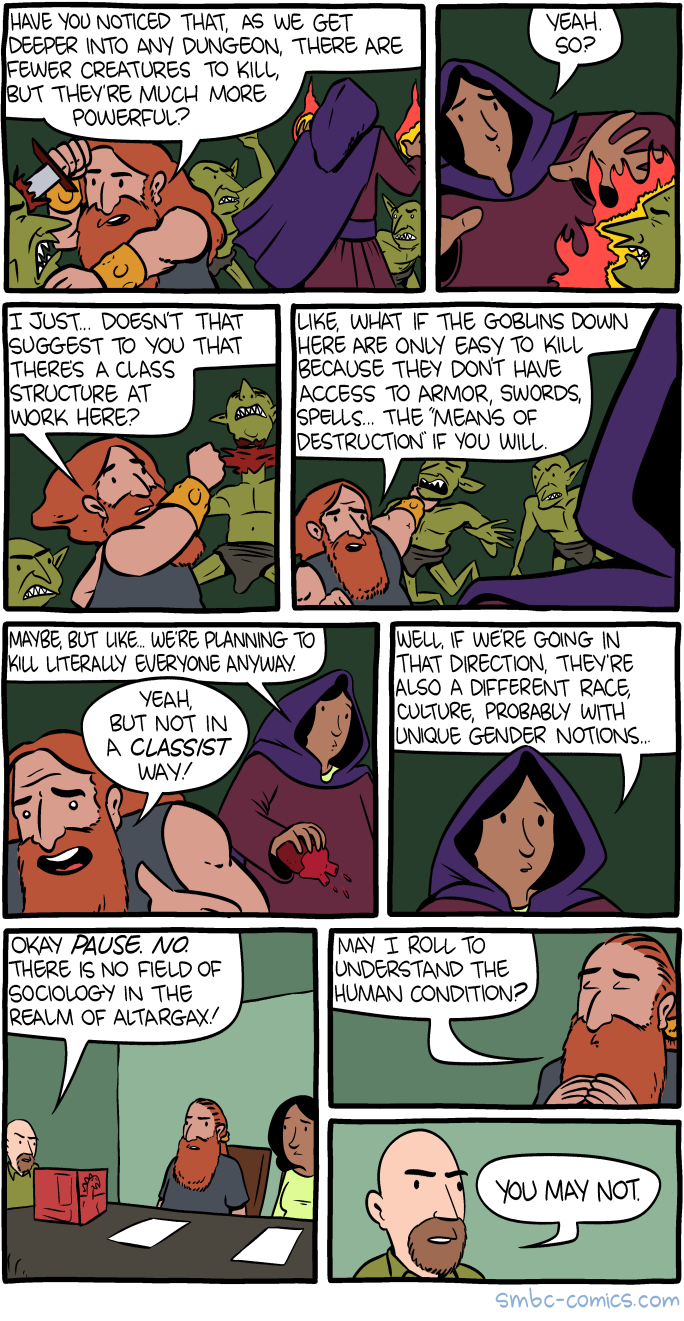
Saturday Morning Breakfast Cereal - Dungeon Classes

by tech@thehiveworks.com


Click here to go see the bonus panel!

Hovertext:
Anyone caught emailing me in regards to the accuracy of today's comic shall be tarred, feathered, and made to carry a sign that reads 'No fun.'

New comic!
Today's News:

Last full day to get your BAHFest East tickets! We moved over a bunch of cheap tickets, but after these are gone, there are no more!

Also, in case you missed it, I'll be signing books prior to the show at MIT Press Bookstore, from 3-430. If you don't want to wait in line after the show, this is the way to go. <3


23 Apr 20:02

Comic for April 23, 2017

by Scott Adams
22 Apr 07:36

vicomte-devalmont:“At 70 years old if I could give my younger...


vicomte-devalmont:

“At 70 years old if I could give my younger self one piece of advice, it would be to use the words ‘fuck off’ much more frequently" HELEN MIRREN

22 Apr 07:28

icecreamsandwichcomics: I actually love Monopoly and also my...


icecreamsandwichcomics:

I actually love Monopoly and also my friends hate me now

Full Image - Twitter - Bonus

22 Apr 07:16

Faça uma tira

by Will Tirando

22 Apr 07:15

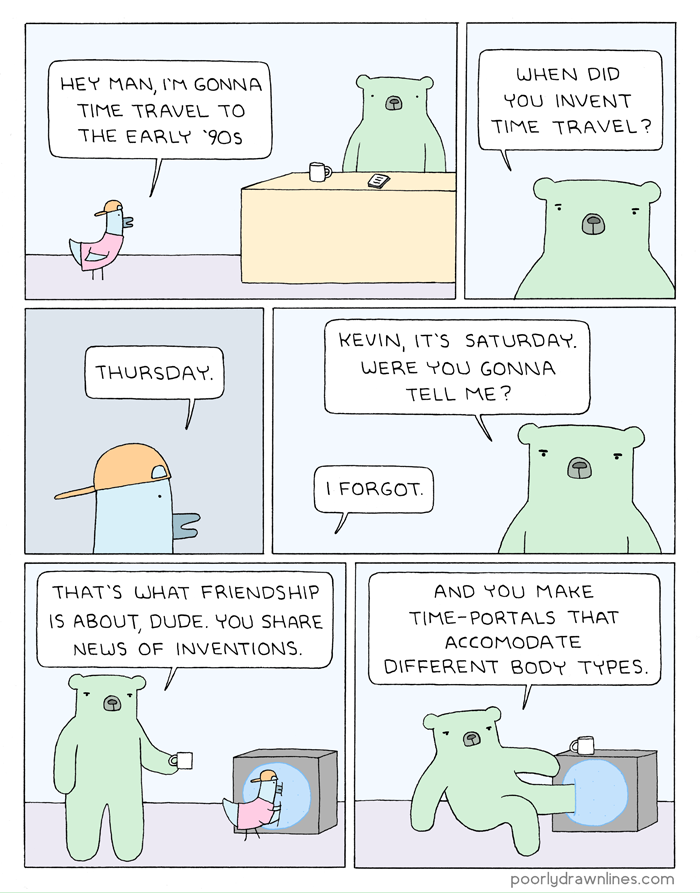
News of Inventions

by Reza

22 Apr 07:11

Turn it up to 11

by Scandinavia and the World
Turn it up to 11

Turn it up to 11

View Comic!


22 Apr 07:10

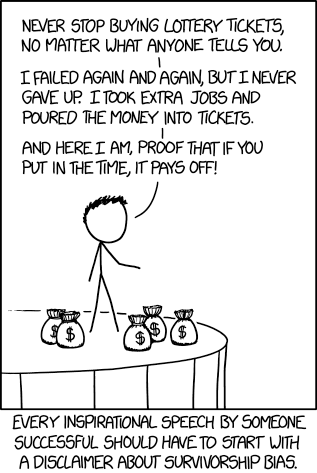
Survivorship Bias

They say you can't argue with results, but what kind of defeatist attitude is that? If you stick with it, you can argue with ANYTHING.
22 Apr 07:08

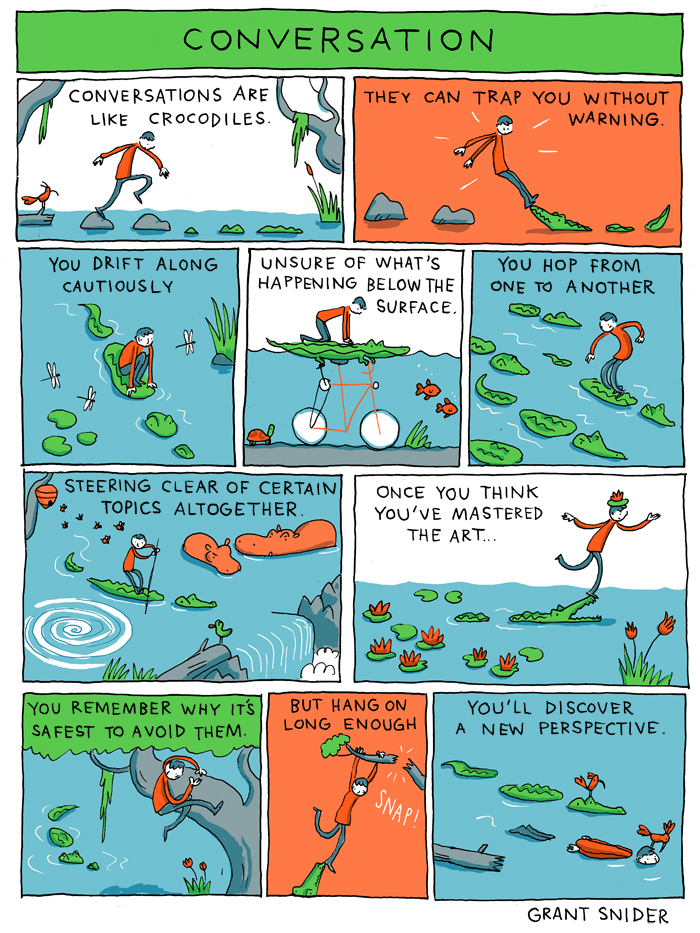
Conversation

by Grant
22 Apr 07:07

Saturday Morning Breakfast Cereal - Satan-Fingers

by tech@thehiveworks.com


Click here to go see the bonus panel!

Hovertext:
Discovered in the delightful though occasionally frustrating Moscow Puzzles

New comic!
Today's News:

We're running out of most tickets for BAHFest MIT, so we've moved over some of the more expensive ones to lower levels. Buy soon or feel shame!

22 Apr 07:05

that little bean headed turd should watch himself 


that little bean headed turd should watch himself 

22 Apr 06:55

Portugal Pushes Law To Partially Ban DRM, Allow Circumvention | Techdirt

by brandizzi
Adam Victor Brandizzi

Ah, eles passaram por fases ruins também! Mas podíamos fazer uma república unida, como era o o Reino Unido de Portugal, Brasil e Algarves :)

from the straight-to-the-Priority-Watch-list-naughty-step-for-you dept

You might think that copyright on its own has enough problems. And yet DRM, originally designed to protect digital copyright material from unauthorized copying, has managed to make things much worse. It not only punishes with extra inconvenience those who acquire legal copies -- but not those who manage to find illegal versions without DRM -- it also allows the DMCA to be used to disable competitors' products, to create repair monopolies, and even to undermine the very concept of ownership. You can see why the copyright industry really loves DRM, and fights to preserve its sanctity. And you can also see why the following news from Portugal, where the parliament has just approved a bill allowing DRM circumvention and even bans in certain situations, is such a big deal. As TorrentFreak reports:

The bill, which received general approval last December, tackles the main issues head-on by granting copying permission in some circumstances and by flat-out banning the use of DRM when the public should have right of access to a copyrighted work.

In a boost to educators, citizens will be given the right to circumvent DRM for teaching and scientific research purposes. There will also be an exception for private copying.

The draft also outlaws the use of DRM on copyright works that have fallen into the public domain, works which support cultural heritage, and works that were created by public entities or funded with public money.

Those are all eminently sensible restrictions on DRM, but they are likely to be met with howls of anger by the copyright maximalists if Portugal's president approves the law, as seems likely. That's because it would set a crucial precedent for allowing DRM to be circumvented legally, and establish that DRM can be completely forbidden in some situations. As a result, we can probably expect Portugal to be punished in the traditional manner: by being placed on the ridiculous "Priority Watch" list of the USTR's Special 301 report. If that does happen, let's hope Portugal follows Canada's lead, and treats the move with the contempt it deserves.

Follow me @glynmoody on Twitter or identi.ca, and +glynmoody on Google+

Let's block ads! (Why?)

22 Apr 06:50

'Collaboration' Creates Mediocrity, Not Excellence, According to Science | Inc.com

by brandizzi
Adam Victor Brandizzi

I'd say collaboration can create mediocriy (not that it does), but this is a very important point. Too many organizations I've seen falling prey of the unreflected collaboration dogma.

If you listen to management pundits, "collaboration" is all the rage. While the term is a bit fuzzy, what's usually meant by "collaboration" is 1) plenty of ad-hoc meetings and 2) open-plan offices that increase the likelihood that that such meetings take place.

In previous columns, I've pointed out that open-plan offices, with all their interruptions, distractions, and noise pollution, are productivity sinkholes. I've also pointed out that collaboration tends to penalize the competent who end up doing most of the work.

A recent study published in Applied Psychology has now confirmed that a collaborative work environment can make top performers--the innovators and hard-workers--feel miserable and socially isolated.

The problem is that rather than seeing a top performer as a role models, mediocre employees tend to see them as threats, either to their own position in the company or to their own feelings of self-worth.

Rather than improving their own performance, mediocre employees socially isolate top performers, spread nasty rumors about them, and either sabotage, or attempt to steal credit for, the top performers' work. As the study put it: "Cooperative contexts proved socially disadvantageous for high performers."

This social isolation creates special difficulties for introverted employees who work in open-plan offices. While some extroverts seem to draw energy from a chaotic environment, introverts find such environments draining.

Sometimes the only way that introverts can get their work completed is to work from home, creating even more potential social isolation. Indeed, top performers who work from home are natural and easy target for workplace gossip and backbiting.

Unless checked, this tendency can result in an exodus of top talent. As a recent Inc.com column pointed out: "The No. 1 reason high performers leave organizations in which they are otherwise happy is because of the tolerance of mediocrity."

No kidding.

This is not to say that teamwork is a bad thing, per se. Indeed, most complex projects require a team to successfully complete. For teams to be effective, though, they need leaders who can swiftly squelch any attempt to isolate or denigrate a top performer.

In other words, your teams may need hierarchical leadership more than they need additional collaboration opportunities. Similarly, your company may need more private spaces than "open" areas that encourage more social interaction.

Let's block ads! (Why?)

22 Apr 06:49

seriously, the guy has a point | gregfallis.com

by brandizzi
Adam Victor Brandizzi

At the very least, the story of both statues is amazing!

I got metaphorically spanked a couple of days ago. Folks have been talking about the Fearless Girl statue ever since it was dropped in Manhattan’s Financial District some five weeks ago. I have occasionally added a comment or two to some of the online discussions about the statue.

Recently most of the Fearless Girl discussions have focused on the complaints by Arturo Di Modica, the sculptor who created Charging Bull. He wants Fearless Girl removed, and that boy is taking a metric ton of shit for saying that. Here’s what I said that got me spanked:

The guy has a point.

This happened in maybe three different discussions over the last week or so. In each case I explained briefly why I believe Di Modica has a point (and I’ll explain it again in a bit), and for the most part folks either accepted my comments or ignored them. Which is pretty common for online discussions. But in one discussion my comment sparked this:

Men who don’t like women taking up space are exactly why we need the Fearless Girl.

Which — and this doesn’t need to be said, but I’m okay with saying the obvious — is a perfectly valid response. It’s also one I agree with. As far as that goes, it’s one NYC Mayor Bill de Blasio agrees with, since he said it first (although, to be fair, probably one of his public relations people first said it first).

But here’s the thing: you can completely agree with the woman who responded to my comment AND you can still acknowledge that Arturo Di Modica has a point. Those aren’t mutually exclusive or contradictory points of view.

Let me apologize here, because I have to do some history — and for reasons I’ve never understood, some folks actively dislike history. It’s necessary though. So here we go. Back in 1987 there was a global stock market crash. Doesn’t matter why (at least not for this discussion), but stock markets everywhere — everywhere — tanked. Arturo Di Modica, a Sicilian immigrant who became a naturalized citizen of the U.S., responded by creating Charging Bull — a bronze sculpture of a…well, a charging bull. It took him two years to make it. The thing weighs more than 7000 pounds, and cost Di Modica some US$350,000 of his own money. He said he wanted the bull to represent “the strength and power of the American people”. He had it trucked into the Financial District and set it up, completely without permission. It’s maybe the only significant work of guerrilla capitalist art in existence.

People loved it. The assholes who ran the New York Stock Exchange, for some reason, didn’t. They called the police, and pretty soon the statue was removed and impounded. A fuss was raised, the city agreed to temporarily install it, and the public was pleased. It’s been almost thirty years, and Charging Bull is still owned by Di Modica, still on temporary loan to the city, still one of the most recognizable symbols of New York City.

Arturo Di Modica (the one in the beret)

And that brings us to March 7th of this year, the day before International Women’s Day. Fearless Girl appeared, standing in front of Charging Bull. On the surface, it appears to be another work of guerrilla art — but it’s not. Unlike Di Modica’s work, Fearless Girl was commissioned. Commissioned not by an individual, but by an investment fund called State Street Global Advisors, which has assets in excess of US$2.4 trillion. That’s serious money. It was commissioned as part of an advertising campaign developed by McCann, a global advertising corporation. And it was commissioned to be presented on the first anniversary of State Street Global’s “Gender Diversity Index” fund, which has the following NASDAQ ticker symbol: SHE. And finally, along with Fearless Girl is a bronze plaque that reads:

Know the power of women in leadership. SHE makes a difference.

Note it’s not She makes a difference, it’s SHE makes a difference. It’s not referring to the girl; it’s referring to the NASDAQ symbol. It’s not a work of guerrilla art; it’s an extremely clever advertising scheme. This is what makes it clever: Fearless Girl derives its power almost entirely from Di Modica’s statue. The sculptor, Kristen Visbal, sort of acknowledges this. She’s said this about her statue:

“She’s not angry at the bull — she’s confident, she knows what she’s capable of, and she’s wanting the bull to take note.”

It’s all about the bull. If it were placed anywhere else, Fearless Girl would still be a very fine statue — but without facing Charging Bull the Fearless Girl has nothing to be fearless to. Or about. Whatever. Fearless Girl, without Di Modica’s bull, without the context provided by the bull, becomes Really Confident Girl.

Fearless Girl also changes the meaning of Charging Bull. Instead of being a symbol of “the strength and power of the American people” as Di Modica intended, it’s now seen as an aggressive threat to women and girls — a symbol of patriarchal oppression.

In effect, Fearless Girl has appropriated the strength and power of Charging Bull. Of course Di Modica is outraged by that. A global investment firm has used a global advertising firm to create a faux work of guerrilla art to subvert and change the meaning of his actual work of guerrilla art. That would piss off any artist.

See? It’s not as simple as it seems on the surface. It’s especially complicated for somebody (like me, for example) who appreciates the notion of appropriation in art. I’ve engaged in a wee bit of appropriation my ownself. Appropriation art is, almost by definition, subversive — and subversion is (also almost by definition) usually the province of marginalized populations attempting to undermine the social order maintained by tradition and the establishments of power. In the case of Fearless Girl, however, the subversion is being done by global corporatists as part of a marketing campaign. That makes it hard to cheer them on. There’s some serious irony here.

And yet, there she is, the Fearless Girl. I love the little statue of the girl in the Peter Pan pose. And I resent that she’s a marketing tool. I love that she actually IS inspiring to young women and girls. And I resent that she’s a fraud. I love that she exists. And I resent the reasons she was created.

I love the Fearless Girl and I resent her. She’s an example of how commercialization can take something important and meaningful — something about which everybody should agree — and shit all over it by turning it into a commodity. Fearless Girl is beautiful, but she is selling SHE; that’s why she’s there.

Should Fearless Girl be removed as Di Modica wants? I don’t know. It would be sad if she was. Should Di Modica simply take his Charging Bull and go home? I mean, it’s his statue. He can do what he wants with it. I couldn’t blame him if he did that, since the Fearless Girl has basically hijacked the meaning of his work. But that would be a shame. I’m not a fan of capitalism, but that’s a damned fine work of art.

I don’t know what should be done here. But I know this: Arturo Di Modica has a point. And I know a lot of folks aren’t willing to acknowledge that.

Advertisements

Share this:

Like this:

LikeLoading...

Let's block ads! (Why?)
22 Apr 06:49

Why are enterprises interested in the block chain? | Stuff Yaron Finds Interesting

by brandizzi

My day job has required me to look into issues related to using the block chain in the enterprise. This lead me to a simple question - why would an enterprise be interested in the block chain for running its own business?

Near as I can tell the purpose of the block chain is to maintain a distributed database with ACID behavior that is resistant to byzantine attacks.

So when I look at the use of the block chain in the enterprise the first question I ask myself three questions, does this customer scenario need:

  1. an ACID database?
  2. to be distributed?
  3. to be resistant to byzantine attacks?

If the answer to any of these question is no then they probably don’t need the block chain.

When I talk to enterprises they typically are interested in 2 and 3 more than 1. This isn’t to say that nobody cares about 1, just that when I talk to enterprises that’s not where they have started so far. But I could very well be talking to the wrong people.

They like the distributed nature of the block chain because they want to be able to work either with other units in the same company or with other businesses. But what the enterprises don’t want to do is to create some central authority to run things either in the form of a new internal group or some kind of consortium (in the case of multi-business scenarios). They really like the idea that there doesn’t have to be a central authority to do business on the block chain.

The other aspect of the block chain that they like is the guarantees around byzantine attacks. In many cases these businesses don’t really trust each other. So they like the idea that the system is resistant against bad actors.

There is yet another aspect of the block chain that I haven’t really heard enterprises talk about but I do hear a lot from people trying to sell block chain to enterprises, and that is resistance to key disclosure. In a future article I’ll go into this scenario in some detail.

I’m also in the middle of writing another article capturing all the scenarios I’ve run into with enterprises that are looking to use the block chain. But I’m still doing some work collecting and clarifying those scenarios.

Let's block ads! (Why?)