
A monkey plays in a pond surrounded by carp at a wildlife park in Hefei, Anhui province in China
Picture: REUTERS (via Pictures of the day: 17 July 2013 - Telegraph)
A monkey plays in a pond surrounded by carp at a wildlife park in Hefei, Anhui province in China
Picture: REUTERS (via Pictures of the day: 17 July 2013 - Telegraph)
What will come of Secretary of State Kerry’s announcement that he has achieved agreement between Israel and the Palestinians to restart peace talks? The news that there will be—pending further clarifications—”talks” in Washington between Israeli and Palestinian emissaries says little: Israelis and Palestinians have engaged in intermittent negotiations for more then twenty years, during which time Israel has placed nearly half a million settlers, a good many of them violently aggressive nationalists, in the West Bank and built a wall cutting into Palestinian land and separating Palestinian villages from their fields and water supplies. A new round of talks may give Israel some respite from the slowly building efforts to delegitimize Israel’s territorial conquests, and from Palestinian initiatives in the UN General Assembly and the International Criminal Court.
Israel may be able to count, for the moment, on unconditional diplomatic support from the United States, but really does fear international “delegitimization.” And absent a peace process, there are constant small reminders that American support may not forever be unconditional. Last weekend at the Aspen Institute, outgoing CENTCOM commander James Mattis, a Marine general, said Israeli occupation of the West Bank directly threatened American military interests in the Mideast, and threatened to turn Israel into an “apartheid” state. David Petraeus had said the same thing a few years ago, only to quickly retreat when he came under fire from AIPAC. Does anyone doubt that this is what top American generals (not to mention, of course, diplomats) responsible for broader American interests in the Muslim world actually believe? In any case “peace talks”—a strung out process in which Israel half-heartedly negotiates with the Palestinians about statehood, might at least stall independent Palestinian diplomatic efforts.
Few observers are optimistic that “peace is at hand.” Reason one: Israel is led by a right wing coalition whose leading party has written opposition to a Palestinian statehood explicitly into its platform. Many key Israeli ministers explicitly and passionately oppose to a Palestinian state. No one who has followed Benjamin Netanyahu’s career thinks he has anything to offer the Palestinians except bantustans. There have been Israeli leaders who do want a two-state solution, and new ones might emerge again. But they aren’t in the Israeli goverment, or at least not influential within it, for the moment.
Secondly, even the so-called Israel peace camp seems to be naive about negotiations. Nathan Thrall in the New York Review of Books points to surveys in which Israeli two state solution advocates assume that settlements like Ariel and Maale Adumin would remain part of Israel under any agreement. But those settlements lie deep within the West Bank and their surrounding infrastructure would effectively deny a Palestinian West Bank state territorial contiguity.
Thirdly, the Palestinians are too weak. The PA, which seems to have been bludgeoned into agreeing to talks, lacks both democratic and popular legitimacy. At this point, the tired face of Mahmoud Abbas seems to signify an old and tired organization. Its leaders are subject to tremendous pressures, including veiled bribery. Tony Blair has been boasting of an “economic peace” paradigm which would funnel billions of dollars into the Palestinian “economy.” How much of this cash might be dangled in front of leading PA figures, who are perhaps not all completely beyond the temptations of self-enrichment? This seems an almost inevitable consequence of negotiations between such unequal parties.
Finally, there are indications are that Obama has lost whatever interest he might once have had in pushing for a just peace. To these most recent negotiations, he has evidently allowed Kerry to select Martin Indyk, one of the key figures of the failed Oslo process, to oversee the talks. Indyk is knowledgeable but hardly even handed; he has a long time emotional association with Israel, being one of the founders of the AIPAC spin-off Washington Institute. Indyk is very much in the “Israel’s lawyer” mode of American mediators. His appointment sends the signal that Obama is not going to push Israel to make concessions. (Phil Weiss wonders why it seems to be necessary that all American Mideast diplomats be Jewish.)
We will see. I believe negotiations that cleaved closely to the 1967 borders as a template could achieve a genuine breakthrough. That the seemingly intractable issue of the Palestinian “right of return” could be resolved in other ways than the immediate return of hundreds of thousands of Palestinian to Israel proper. That it wouldn’t kill Israel to acknowledge the crimes of the Nakba, anymore than it any other country has been harmed from acknowledging past crimes. But look as I might, I don’t see the current Israeli government negotiating on the basis of a Palestinian state within the ’67 borders, and I don’t see an American government ready to insist upon it. In which case, the negotiations will be merely a part of the ongoing political struggle, one which also includes the incipient international movement to boycott the Israeli occupation.
There are a lot of people complaining about lousy software patents these days. I say, stop complaining, and start killing them. It took me about fifteen minutes to stop a crappy Microsoft patent from being approved. Got fifteen minutes? You can do it too.
In a minute, I’ll tell you that story. But first, a little background.
Software developers don’t actually invent very much. The number of actually novel, non-obvious inventions in the software industry that maybe, in some universe, deserve a government-granted monopoly is, perhaps, two.
The other 40,000-odd software patents issued every year are mostly garbage that any working programmer could “invent” three times before breakfast. Most issued software patents aren’t “inventions” as most people understand that word. They’re just things that any first-year student learning Java should be able to do as a homework assignment in two hours.
Nevertheless, a lot of companies large and small have figured out that patents are worth money, so they try to file as many as they possibly can. They figure they can generate a big pile of patents as an inexpensive byproduct of the R&D work they’re doing anyway, just by sending some lawyers around the halls to ask programmers what they’re working on, and then attempting to patent everything. Almost everything they find is either obvious or has been done before, so it shouldn’t be patentable, but they use some sneaky tricks to get these things through the patent office.
The first technique is to try to make the language of the patent as confusing and obfuscated as possible. That actually makes it harder for a patent examiner to identify prior art or evaluate if the invention is obvious.
A bonus side effect of writing an incomprehensible patent is that it works better as an infringement trap. Many patent owners, especially the troll types, don’t really want you to avoid their patent. Often they actually want you to infringe their patent, and then build a big business that relies on that infringement, and only then do they want you to find out about the patent, so you are in the worst possible legal position and can be extorted successfully. The harder the patent is to read, the more likely it will be inadvertently infringed.
 The second technique to getting bad software patents issued is to use a thesaurus. Often, software patent applicants make up new terms to describe things with perfectly good, existing names. A lot of examiners will search for prior art using, well, search tools. They have to; no single patent examiner can possibly be aware of more than (rounding to nearest whole number) 0% of the prior art which might have invalidated the application.
Since patent examiners rely so much on keyword searches, when you submit your application, if you can change some of the keywords in your patent to be different than the words used everywhere else, you might get your patent through even when there’s blatant prior art, because by using weird, made-up words for things, you’ve made that prior art harder to find.
Now on to the third technique. Have you ever seen a patent application that appears ridiculously broad? (“Good lord, they’re trying to patent CARS!”). Here’s why. The applicant is deliberately overreaching, that is, striving to get the broadest possible patent knowing that the worst thing that can happen is that the patent examiner whittles their claims down to what they were entitled to patent anyway.
Let me illustrate that as simply as I can. At the heart of a patent is a list of claims: the things you allege to have invented that you will get a monopoly on if your patent is accepted.
An example might help. Imagine a simple application with these three claims:
1. A method of transportation
2. The method of transportation in claim 1, wherein there is an engine connected to wheels
3. The method of transportation in claim 2, wherein the engine runs on water
Notice that claim 2 mentions claim 1, and narrows it... in other words, it claims a strict subset of things from claim 1.
Now, suppose you invented the water-powered car. When you submit your patent, you might submit it this way even knowing that there’s prior art for “methods of transportation” and you can’t really claim all of them as your invention. The theory is that (a) hey, you might get lucky! and (b) even if you don’t get lucky and the first claim is rejected, the narrower claims will still stand.
What you’re seeing is just a long shot lottery ticket, and you have to look deep into the narrower claims to see what they really expect to get. And you never know, the patent office might be asleep at the wheel and BOOM you get to extort everyone who makes, sells, buys, or rides transportation.
So anyway, a lot of crappy software patents get issued and the more that get issued, the worse it is for software developers.
The patent office got a little bit of heat about this. The America Invents Act changed the law to allow the public to submit examples of prior art while a patent application is being examined. And that’s why the USPTO asked us to set up Ask Patents, a Stack Exchange site where software developers like you can submit examples of prior art to stop crappy software patents even before they’re issued.
Sounds hard, right?
 At first I honestly thought it was going to be hard. Would we even be able to find vulnerable applications? The funny thing is that when I looked at a bunch of software patent applications at random I came to realize that they were all bad, which makes our job much easier.
Take patent application US 20130063492 A1, submitted by Microsoft. An Ask Patent user submitted this call for prior art on March 26th.
I tried to find prior art for this just to see how hard it was. First I read the application. Well, to be honest, I kind of glanced at the application. In fact I skipped the abstract and the description and went straight to the claims. Dan Shapiro has great blog post called How to Read a Patent in 60 Seconds which taught me how to do this.
This patent was, typically, obfuscated, and it used terms like “pixel density” for something that every other programmer in the world would call “resolution,” either accidentally (because Microsoft’s lawyers were not programmers), or, more likely, because the obfuscation makes it that much harder to search.
Without reading too deeply, I realized that this patent is basically trying to say “Sometimes you have a picture that you want to scale to different resolutions. When this happens, you might want to have multiple versions of the image available at different resolutions, so you can pick the one that’s closest and scale that.”
This didn’t seem novel to me. I was pretty sure that the Win32 API already had a feature to do something like that. I remembered that it was common to provide multiple icons at different resolutions and in fact I was pretty sure that the operating system could pick one based on the resolution of the display. So I spent about a minute with Google and eventually (bing!) found this interesting document entitled Writing DPI-Aware Win32 Applications [PDF] written by Ryan Haveson and Ken Sykes at, what a coincidence, Microsoft.
And it was written in 2008, while Microsoft’s new patent application was trying to claim that this “invention” was “invented” in 2011. Boom. Prior art found, and deployed.
Total time elapsed, maybe 10 minutes. One of the participants on Ask Patents pointed out that the patent application referred to something called “scaling sets.” I wasn’t sure what that was supposed to mean but I found a specific part of the older Microsoft document that demonstrated this “invention” without using the same word, so I edited my answer a bit to point it out. Here’s my complete answer on AskPatents.
Mysteriously, whoever it was that posted the request for prior art checked the Accepted button on Stack Exchange. We thought this might be the patent examiner, but it was posted with a generic username.
At that point I promptly forgot about it, until May 21 (two months later), when I got this email from Micah Siegel (Micah is our full-time patent expert):
The USPTO rejected Microsoft's Resizing Imaging Patent!
The examiner referred specifically to Prior Art cited in Joel's answer ("Haveson et al").
Here is the actual document rejecting the patent. It is a clean sweep starting on page 4 and throughout, basically citing rejecting the application as obvious in view of Haveson.
Micah showed me a document from the USPTO confirming that they had rejected the patent application, and the rejection relied very heavily on the document I found. This was, in fact, the first “confirmed kill” of Ask Patents, and it was really surprisingly easy. I didn’t have to do the hard work of studying everything in the patent application and carefully proving that it was all prior art: the examiner did that for me. (It’s a pleasure to read him demolish the patent in question, all twenty claims, if that kind of schadenfreude amuses you).
(If you want to see the rejection, go to Public Pair and search for publication number US 20130063492 A1. Click on Image File Wrapper, and look at the non-final rejection of 4-11-2013. Microsoft is, needless to say, appealing the decision, so this crappy patent may re-surface.) Update October 2013: the patent received a FINAL REJECTION from the USPTO!
There is, though, an interesting lesson here. Software patent applications are of uniformly poor quality. They are remarkably easy to find prior art for. Ask Patents can be used to block them with very little work. And this kind of individual destruction of one software patent application at a time might start to make a dent in the mountain of bad patents getting granted.
My dream is that when big companies hear about how friggin’ easy it is to block a patent application, they’ll use Ask Patents to start messing with their competitors. How cool would it be if Apple, Samsung, Oracle and Google got into a Mexican Standoff on Ask Patents? If each of those companies had three or four engineers dedicating a few hours every day to picking off their competitors’ applications, the number of granted patents to those companies would grind to a halt. Wouldn’t that be something!
Got 15 minutes? Go to Ask Patents right now, and see if one of these RFPAs covers a topic you know something about, and post any examples you can find. They’re hidden in plain view; most of the prior art you need for software patents can be found on Google. Happy hunting!
Need to hire a really great programmer? Want a job that doesn't drive you crazy? Visit the Joel on Software Job Board: Great software jobs, great people.

Pio X quis ver o tango de perto para avaliar se era apto para a cristandade
“Demasiado sensual!”. “Obsceno!”. “Satânico!”. Estas eram algumas das duras expressões emitidas pelos bispos franceses ao referir-se ao ritmo sul-americano em 1913, quando arrasava nos salões da burguesia parisiense. Os arcebispos de Paris, Cambray e Sens, junto como o bispo de Poitiers atacaram ferozmente esse ritmo “pecaminoso” desde seus púlpitos, pedindo que a Santa Congregação da Disciplina dos Sacramentos analisasse o caso e considerasse sua proibição.
Diante da polêmica que ameaçava tornar o tango alvo de uma proibição da Igreja Católica, a embaixada argentina em Roma decidiu demonstrar ao papa Pio X (1903-1914) que a dança de forma alguma ameaçava os bons costumes cristãos. Os diplomatas argentinos estavam respaldados por diversos jovens da aristocracia italiana, ansiosos por dançar o tango no carnaval de 1914. Tudo indicava que se a Igreja o proibisse, as Forças Armadas da Itália impediriam que seus oficiais o dançassem nos elegantes bailes que estavam sendo preparados para essa festividade.
Poucas semanas antes do carnaval, em fevereiro desse ano, o Sumo Pontífice encarregou-se de julgar, pessoalmente, os eventuais “perigos” do tango. Os encarregados de defender o ritmo perante o supremo chefe da cristandade foi um casal de irmãos da aristocracia italiana. Os jovens “enganaram” o papa Pio X, dançando uma versão “light”, que fosse o suficientemente “inofensiva” para os padrões morais do Santo Padre.
O cuidado dos dançarinos em evitar qualquer tipo de “obscenidade” obteve resultados exagerados. Pio X, após a exibição do tango no Vaticano, ironizou sobre essa moda proveniente da Argentina: “ela obriga seus escravos (os dançarinos) a dançar um baile tão pouco divertido”. O papa aproveitou a ocasião para recomendar a “furlana”, dança camponesa do século XIX, que considerava mais “animada”.
Com o prestígio obtido nos salões da aristocracia européia e certa neutralidade papal, o caminho estava aberto para que o tango voltasse à Buenos Aires. Não sendo mais visto como um ritmo do lumpen, conquistou a classe média e expandiu-se, permitindo, dessa forma, o sucesso de cantores como Carlos Gardel. O tango começava a conquistar os corações e mentes dos argentinos.
Mas, a má fama do tango ainda permaneceu pairando sobre a Europa em certos setores da sociedade. Uma década depois, no dia 1 de fevereiro de 1924, outro papa, neste caso, Pio XI (1922-39), quis analisar pessoalmente aquilo que Pio X havia autorizado.
Nesta ocasião, o tango foi dançado – novamente em versão “diet” – pelo bailarino argentino Casimiro Aín. A melodia escolhida foi um raro tango com nome religioso, o “Ave María”, do compositor Francisco Canaro.
Para conquistar o coração do papa, Aín fez um malabarismo no fim do tango que o deixou em posição de genuflexão diante do Sumo Pontífice. Pio XI retirou-se do salão em silêncio. A reação papal foi interpretada como um sinal de aprovação. Nunca mais o tango teve que passar pelo crivo da Santa Sé.

Pio XI – os tangueiros interpretaram que, quem cala, consente
PAPA TANGUEIRO – Quase um século depois da autorização de Pio X para o tango um argentino de Buenos Aires tornou-se sumo pontífice. O portenho em questão, o cardeal Jorge Mario Bergoglio, entronizado como papa Francisco, afirma que o tango é seu ritmo musical preferido (além de gostar de ópera e música folclórica argentina). Bergoglio também declara-se fã da “milonga”, que é uma espécie mais acelerada do tango.
Durante sua juventude Bergoglio foi um bom dançarino de tango, segundo os amigos. Ele dançava com sua namorada nos bailes em Flores – seu bairro natal – e outros lugares da cidade.
Mas, o romance concluiu quando descobriu sua vocação religiosa. Bergoglio não dançou mais o tango. Mas, continua ouvindo o gênero musical.
E falando em paqueras, tango e religiosidade, há um tango imortalizado por Gardel que é o “Missa das onze”, no qual o intérprete indica que vai à missa para paquerar uma moça que freqüenta o culto nesse horário:
Os cantores preferidos do papa Francisco: Carlos Gardel, Julio Sosa, Ada Falcón e Azucena Maizani (a quem administrou a extrema-unção em 1970).
Bergoglio também gosta de óperas, gênero musical que sua mãe, Regina Sívori, costumava ouvir quando ele e seus irmãos eram pequenos.
Em sua biografia “O Jesuíta”, de 2010, que após sua eleição como papa foi rebatizada de “Papa Francisco – conversas com Jorge Bergoglio” – ele diz que gosta muitíssimo do tango. Segundo afirma, esse ritmo musical sai de “dentro da alma”.
Sua orquestra preferida era a de Juan D’Arienzo, a.k.a., “El rei del compás” (O rei do compasso) famoso pelo compasso marcado. E também aprecia Astor Piazzolla.

Bergoglio, no portenhíssimo “subte” (metrô) da linha A em 2008. Meia década antes de ser Francisco.
E o Ave Maria (Tanti anni prima), de Astor Piazzolla:
Mais detalhes sobre o tango (suas origens, gírias e o dia em que fui tradutor de Astor Piazzola) em meu livro “Os Argentinos”, da Editora Contexto.


 PERFIL: Ariel Palacios fez o Master de Jornalismo do jornal El País (Madri) em 1993. Desde 1995 é o correspondente de O Estado de S.Paulo em Buenos Aires. Além da Argentina, também cobre o Uruguai, Paraguai e Chile. Ele foi correspondente da rádio CBN (1996-1997) e da rádio Eldorado (1997-2005). Ariel também é correspondente do canal de notícias Globo News desde 1996.
Em 2009 “Os Hermanos“ recebeu o prêmio de melhor blog do Estadão (prêmio compartilhado com o blogueiro Gustavo Chacra).
 Acompanhe-nos no Twitter, aqui.
 …E leia os supimpas blogs dos correspondentes internacionais do Estadão:
 E, de bonus track, veja o Facebook da editoria de Internacional do Portal do Estadão,aqui.


Num post sobre alguns libertários simpáticos aos confederados (sul) na guerra civil americana, eis esse excelente trecho sobre visões heterodoxas (não-convencionais) sobre um determinado assunto e os pontos positivos e negativos disso.
The psychology and sociology of the cultic milieu plagues small movements, kind of unavoidably. If you hold a very unpopular opinion, and you come to think that you know enough to see the ways in which the establishment and official institutions and the flagship media organizations are unfair to your opinion or skew public information or otherwise stack the deck, that predisposes you to believe that it could be true in other cases, too. You think you’re a brave, unorthodox, independent mind– and it might even be true!– and when someone approaches you with another unorthodox minority view that they say has been misrepresented or suppressed, well, you sense a like mind. You’re necessarily less disposed than other people are to treating the weight of received opinion as authoritative. That’s both good and bad; you’ve (presumably) invested some intellectual work and effort in arriving at your own initial unorthodox view, but information and time are scarce and you’re not going to do that every time. Your new predisposition may deprive you of some of the informational advantages of conventional wisdom in areas where you aren’t investing that effort. But, c’est la vie; and there are sometimes advantages to the mindset, too.
Vale a pena ler o texto inteiro. Especialmente porque ele é escrito por um (parece-me) libertário (portanto um direitista), mas que não é alguém como o Reinaldo Azevedo. Pelo contrário, a clareza e a força dos argumentos dele reforça a ideia de que a esquerda e a direita podem se engajar em debates produtivos e ao final respeitosamente discordarem. Meus caros esquerdistas leitores deste blog. Leiam o texto completo.



“I’m a naturalized Italian, but I’m from Ghana. I was abandoned by my parents and adopted by two angels. I suffer with racism everyday. I’m the first black to wear the jersey of Italy. I’m not angry, but my life experiences make me act differently from other people. Then, try to learn more before you criticize me.” - Mario Balotelli
| Piratas Do Tietê | Larte |
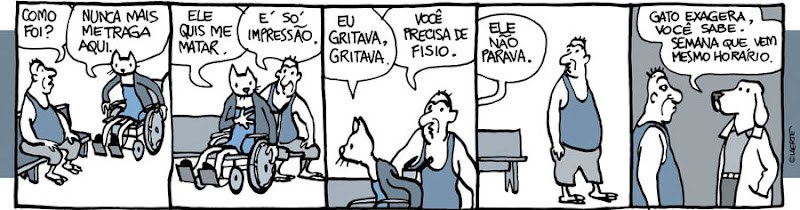 | |

You’re fitted with a watch that imparts an electric current to your skin in increments too small to distinguish. Initially it’s set to 0 (off), and the settings run up to 1000. At the start of each week you’re allowed a period of experimentation to compare various settings, and then the watch is returned to its last setting. Then you have the option to increase the setting by 1; if you do this, you get $10,000. You may never reduce the setting.
What should you do? On the first day your experimentation shows you that the highest setting is completely intolerable; at that setting you’d pay any amount of money to get rid of the watch. But on this first week your decision is simply whether to advance from 0 to 1, getting $10,000 for accepting an imperceptible amount of pain. That seems attractive.
The trouble seems to be that your evaluations are “transitive” only at a large scale. If you prefer 0 to 500 and 500 to 1000, then it’s valid to conclude that you’ll prefer 0 to 1000. But if you prefer 51 to 4 (because of the financial reward) and 103 to 51, can we conclude that you’ll prefer 103 to 4? Not necessarily.
Unfortunately for all of us, this describes a lot of life. “The self-torturer is not alone in his predicament,” writes philosopher Warren S. Quinn, who proposed this puzzle in 1990. “Most of us are like him in one way or another. We like to eat but also care about our appearance. Just one more bite will give us pleasure and won’t make us look fatter; but very many bites will. And there may be similar connections between puffs of pleasant smoking and lung cancer, or between pleasurable moments of idleness and wasted lives.” What’s the best course?
(Warren S. Quinn, “The Puzzle of the Self-Torturer,” Philosophical Studies, May 1990)

A submerged statue of the Hindu Lord Shiva amid the flood waters of the river Ganges, June 17, 2013
if i ever end up being normal is it going to be like that time when spongebob became normal
normal spongebob looks like elijah wood
fCUK
holy shit
hi
how are ya

This form of eucalyptus tree grows in Maui rainforests where the bark peels back to reveal a gorgeous range of colors.
Those lucky little fuckers get rainbow trees?


Use of medication in the treatment of mental illness is something I feel ambivalent about. For some people it’s incredibly important to take it, and it’s integral to the management of their illness. My personal experience is that trying med after med and it having little or no effect means it’s better to be off them. No pill I ever took lifted my mood, stopped me panicking and gave the day even a small bit of meaning like having a dog has done, so yep, I think pets should be included in prescriptions.
Adam Victor BrandizziPlanejamento de cidade é como democracia: é uma farsa que não dá certo, mas de todas as alternativas que também não dão certo, é a que falha da melhor maneira.

It’s not something that is overly talked about or which the general public is privy too, but whenever you see a brothel it often poses more questions than answers. Who goes there? What’s it like inside? Is it illegal? Where are the girls from? What happens if you bump into a co-worker on the way out?
Well, inquisitive & celebrated German photographer Bettina Flitner has ventured into the den of lust to ask probably the most revealing question of all – what actually drove you to pay for sex with a stranger? Over 10 days in a brothel in Germany she interviewed a range of men aged between 21 and 73. All were candid, honest and upfront about their motivations and experiences with women.
Below are their stories, you can see the full series via her website or view her previous releases here
Guenther, 55, divorced:
I need much sex. It excites me to have always new women. I also go to swingers clubs. But there are often old and ugly women. Sometimes I book a woman from an escort agency. My type? Black or pale skin. Mulatto or from Latvia. No silicone breasts and no injected lips. I don’t like women who are too professional I prefer the ones who make it only sometimes. They perform better. My last time is one week ago. She said that is was the best sex ever. 50 Euros. Business as usual. The price-performance ratio is good here.
Kai, 49, bank employee, divorced, 2 children:
Why I go the brothel? I would never get women like these here. And I can overstep the limits here. For example anal intercourse I wouldn’t have the heart to ask a normal woman to do it. Costs 100 Euros extra. I don’t like the very young and very thin girls. They can have normal breast and a little belly a womanly shape. Since three years I have sex with the same woman. If she likes it? I can only believe, what she is pretending.
Iwan, 65, motor mechanic, single:
You do it once. Twice. And then you are used to it. Normally I have to invite a pretty woman twice for dinner, costs 100 Euros and then it probably doesn’t work. Here it works always. I also had sex with a Colombian several times a beautiful woman well-built. She was very passionate or she was a good actress… But she suddenly disappeared. What a pity.”
Christian, 23, forwarding merchant, single:
Why I pay for sex? Women are often a pain in the ass. They stress me when I haven t got enough time for them. If I want to fuck I go here – and I leave. That’s it. A girlfriend often bores me after a short time. And to pay for sex has that certain something. In a way, that’s power. You own the woman. You can do with her whatever you want.
What do you make of them? Lost souls looking for love in the wrong places? Misogynistic men living in the dark ages? Or a refreshing & honest take on modern day sexuality?
Via Bettina Flitner

gOOOOOOD JOb
I’m glad I’m not the only one that noticed this.
actual perfect cosplayers these guys
Adam Victor BrandizziCena clássica de Alien regravada com cachorros?