Shared posts

14 Jul 15:30

The Things I Find in My Yard After a Heavy Rain

by John Scalzi

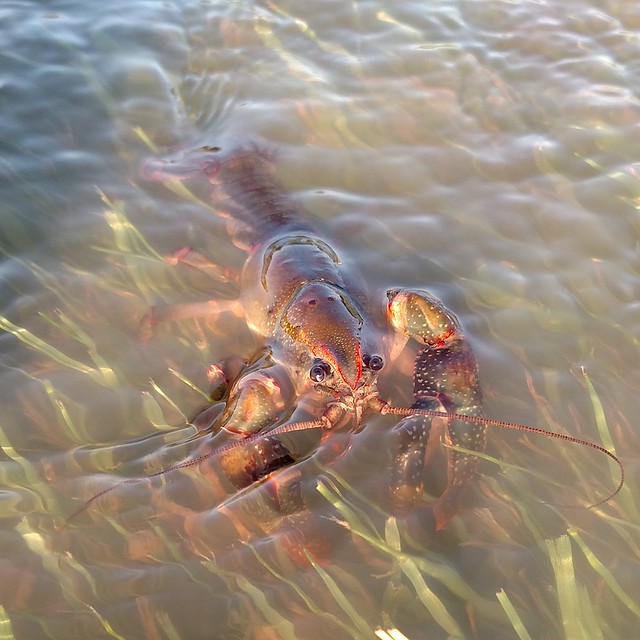
Here you go.

Close up of the crawdad, say? Very well, here you are:

Also, I found this, too:

I don’t know what kind of fish it is. I call it a “yard trout.”

Both of these things were perfectly alive, incidentally. The yard trout was slightly beached on the grass, however; I gently pushed it back into the “river” with my toe and it swam away in the direction of the creek down the road.

You find such interesting things in your yard after heavy rains, I have to say.


14 Jul 15:29

NASA gives Instagram the exclusive on Pluto

by James Vincent

Excitement over the New Horizons probe's flyby past Pluto has been pretty remarkable, and NASA, it seems, has known exactly how to take advantage: hit up social media. The US space agency published the most detailed image of Pluto ever this morning at around 7AM ET, sharing the photo via Instagram an hour before it was scheduled to be posted to the official nasa.gov website.

It's a canny decision by NASA, which enjoys some 3.5 million followers on the photo sharing network and routinely clocks up more than 100,000 likes per image. The space agency's social media manager John Yembrick told Wired that the idea was simply to give the world "a sneak peek on Instagram," and that NASA feels it's "important to engage new audiences." The space...

Continue reading…

14 Jul 15:29

Baldur’s Gate II: Shadows of Amn by Matt Bell

by Samuel Sattin

Genre fiction and literary fiction have made an uneasy alliance over the last decade. The literary establishment has discovered the usefulness of speculative fiction. Well-regarded literary authors have seized upon the precepts of genres that for so long were labeled inconsequential; in the last year, for example, we’ve witnessed Kazuo Ishiguro’s brilliant take on Arthurian fantasy, Emily St. John Mandel’s elegant dabbling in post-apocalypse, and the announcement of a science-fiction television drama to be pioneered by Zadie Smith. With the floodgates easing open, literary authors are herding toward the pariah genres that they avoided for so many years.

Enter Matt Bell. With his new memoir/exploration of the classic D&D fantasy game Baldur’s Gate II: Shadows of Amn, which is also the title of the book, he takes an obsession from his youth and applies it to the embattled topic of genre and literary convention.

Bell has come to be known as a literary author, and his recent fiction has veered toward a sort of spooky, transubstantiated naturalism. If you follow Bell on Facebook, or read deeply into his work, you find his enthusiasm for genre, not just in fiction, but in the vastly imperfect world of games, both traditional and digital. His love of swords and sorcery is woven into the fabric of his being, in the same way that people remember foods from their childhood with various degrees of desire and disgust.

Like the source material it explores, Baldur’s Gate II is fricative. We are introduced to a narrator somewhat unsure of why he has decided to embark on his enterprise. He understands the subject matter well—it’s a fragment of his adolescence. The game was an early model of what would become the choose-your-own-alignment style of play, in which character avatars can make moral/ethical decisions that, in theory, alter the outcome of the quest. This appealed to a generation of young gamers, many of whom were engaging with fraught personal decisions themselves, and were agog at the possibility of choice-based interfaces.

Each section of Bell’s book is preceded by a character quote from the game. The first quote, uttered by a barbarian ranger called Minsc, is telling in its excess. “Go for the eyes Boo, GO FOR THE EYES!! RrraaAAGHGHH!!!” we read, before going on to receive a brief note about the game version. The second quote, also by Minsc (“Will you help me? We must join together once more, and our fury will be such that bards will run their quills dry! Yes, ink will be scarce where e’er we go.”), implies that we should prepare for what’s to come—a look at the relationship between the aesthetic status of video games and the writer himself, who has come to leave behind and/or conceal his geek persona in favor of cultural acceptance. Baldur’s Gate II feels in many ways like a coming out tale. Bell, queasy about how he should reconcile his love for gaming and fantasy with an old guard literary establishment that is selective about who can include speculative elements in fiction and how, attempts to break free from a mold of his own making.

Matt Bell

Matt Bell

Bell doesn’t spend too much time or energy expounding on the design elements of Baldur’s Gate II. Though it would have certainly been an appealing choice for many authors to wax poetic on the Infinity Engine (the software used to generate the game’s revolutionary isometric structure), or the country of Amn in which BGII is set, Bell resists the temptation, preferring instead to concentrate on whether or not the game reflects the experience it promises and, more interestingly, the experience of writing and reading fiction. In chapter 2, for instance, foreshadowing many more such instances to come, Bell veers into a discussion of ethics in gaming, as it pertains to violence.

In Baldur’s Gate II, you are both the victim of great acts of violence and also violence’s greatest perpetrator, killing your way across every realm you roam. How does the game’s story account for the tension between the atrocities it claims its villains have perpetrated and the incredible numbers of violent acts the player is asked to commit? Mostly by pretending there is no conflict, no dissonance, no contradiction.

Over and over again, Bell asks us to think of games as they might translate to prose; perhaps as a way for the author to explore his own sense of accountability as it relates to media consumption, or perhaps as a wider critique—common these days—of accepted micro-notions of race, gender, and violence, in pop culture. His sword, as a writer, cuts both ways, carving into an ambivalence that many consumers of genre fiction tend to glaze over.

Bell juxtaposes the axiological elements of Baldur’s Gate II with scenes from his own youth. He recalls his childhood as happy and mostly uncontroversial, with a large, stable, supportive family. Bell’s father introduced him to Dungeons & Dragons indirectly, after passing along a stack of his old books. Bell started playing it with his older brother, who was even more enthused about it. What is fascinating is not how Bell came to become interested in role playing games, but in how it leads him to a candid discussion of his own writing and, by extension, literary convention as a whole.

At one time Bell wrote a book set in the Dungeons & Dragons universe called The Last Garrison. Co-authored with Matthew Simmons, it was eventually published by Wizard’s of the Coast under the penname Matthew Beard. Bell wasn’t especially serious about writing the novel when he and Simmons starting kicking around the idea, but when Simmons informed Bell of the possibility of getting an editorial contact, the two decided to embark. They drafted up a story reminiscent of Akira Kurosawa’s Seven Samurai, and the pitch was approved. Bell thought it would be a fun, silly project that he would look back on with fondness. But as he continued to work on the book, Bell became disillusioned.

Despite how much of my life I’ve spent with D&D, there was still a big part of me that felt dumb working on a D&D book. As much as I liked geeking out in bars with friends about our good old days playing D&D or our current video game obsessions, I found that the thrill of actually writing this novel wasn’t sustainable for me. Months into the project, I still frequently felt like I was just filling out an outline, and writing game mechanics into the prose felt like the worst kind of fan fiction.

This is one of the most fascinating conundrums in the book. Can genre conventions truly mesh with a literary author’s ambition to be taken seriously? What does it mean “to be taken seriously” anyway?

Another wound I continue to carry is the deep shame I sometimes feel about who I was and what I was interested in when I was a child, as a teenager, as an adult: how the fantasy novels and the role-playing and the video games don’t match cleanly to the image I’ve tried to cultivate as a “serious” man, as a writer of fiction, a professor, and an editor.

From chapter four on, Bell gets to the theme at the heart of Baldurs Gate II: perceptions of success in the literary community, where smoke and mirrors abound. Bell is honest about his fears of being seen as inconsequential, and this is a breath of fresh air, since so many authors are loath to admit to being unsure about their vision. Bell’s ambivalence toward genre isn’t just something he discusses openly. It’s something you can feel as a reader throughout this book.

Authors are far from free to write what they want, regardless of how much they may be convinced otherwise. Baldurs Gate II is about exactly that. It’s an uneasy, courageous, and ultimately vulnerable attempt to bridge a divide most of us are unwilling to admit exists. Bell’s book succeeds because it lays this conflict bare. Anything less would have been yet another eruption of nostalgia, a piecemeal expression of the kind of postmodern decadence that we’ve seen too much of in recent years.

Related Posts:

14 Jul 15:27

Richard Glossip and the Broken Death Penalty

by Scott Lemieux

130515154110-lethal-injection-table-horizontal-large-gallery

The Breyer/Ginsburg dissent in Glossip v. Gloss made a strong argument that the death penalty is categorically unconstitutional, a position that may well become the default position of Democratic Supreme Court nominees. It’s worth noting — as Breyer’s dissent did not — that Richard Glossip is a particularly strong case for the arbitrary, unreliable nature of the death penalty:

Richard Glossip is Exhibit A for problems of reliability and fairness with the process that sentences people to death, particularly when prosecutors rely heavily on plea-bargaining with one defendant in order to convict a defendant who refused to admit guilt.

[…]

Richard Glossip is likely to be executed, even though the Oklahoma Supreme Court implied if not stated outright that, given the inconsistencies in the trial record and police reports in his first trial, and decent counsel would have beaten the murder charge, if not the entire conviction.

Richard Glossip is likely to be executed even though the witnesses at his second trial were trying to recall events that happened more than seven years ago and at least two justices not known for their liberalism think prosecutorial misconduct biased the jury.

Richard Glossip is likely to be executed even though Justin Sneed, who provided the only evidence that directly ties Glossip to the murder of Barry Van Treese, was induced to testify by the promise that he would not be executed. Not exactly the most reliable testimony.

Richard Glossip is likely to be executed because no physical evidence can exonerate him. There is no physical evidence in this case. The central issue is whether Justin Sneed lied or exaggerated in order to save his skin.

Richard Glossip is likely to be executed even though Oklahoma has decided not to execute the person who actually committed the murder, Justin Sneed. This seems particularly arbitrary given that one of the aggravating factors in the case was the brutality of the murder and Sneed was the person who actually committed the murder.

Richard Glossip is likely to be executed even though for almost a decade, Oklahoma was prepared to promise Glossip that he would not be executed if he confessed to the crime. Glossip is being executed because he exercised his constitutional right to a jury trial.

There are some similarities between this case and McKleskey v. Kemp, the 1987 case in which the Supreme Court considered whether the death penalty was unconstitutional if there was proof of systematic racial discrimination. (Majority holding: ¯\_(ツ)_/¯) It’s not a prefect comparison: there is the possibility that Glossip is entirely innocent of the murder, whereas McKleskey was part of the robbery that led to the killing of a police officer and was at the scene. But McKlesley was singled out among the four conspirators for the death penalty based on “evidence” that he was the triggerman that came from an illegally paid informant.

To return to Glossip, Thomas’s concurrence responded to Breyer’s lengthy demonstration of the arbitrary nature of the death penalty by describing some horrible crimes committed by people who were executed. But this is just a non-sequitur. Breyer’s argument was not that nobody executed in the United States has convicted a heinous crime. Breyer’s argument was that the death penalty does not reliably single out the worst crimes for the ultimate punishment, even in death penalty jurisdictions, and sometimes results in killing people who were guilty of no crime at all. The facts of the lead petitioner’s case illustrate this. The evidence that Glossip is guilty at all is underwhelming, and even assuming arguendo that he paid for the murder he’s not obviously more culpable or deserving of punishment than the man who committed it.

Potter Stewart said in Furman v. Georgia, the case that temporarily suspended the death penalty in 1972, that the death sentences in question were cruel and unusual “in the same way that being struck by lightning is cruel and unusual.” It remains true today.

14 Jul 15:24

Photo

by villeashell


14 Jul 15:24

“Care for a little necrophilia? Hmmm?”Brazil (1985) dir. Terry...

by villeashell


“Care for a little necrophilia? Hmmm?”

Brazil (1985) dir. Terry Gilliam

14 Jul 09:48

On Pluto and planethood: or, how science isn’t very good at classification

by stavvers

As I write, New Horizons is within celestial spitting distance of Pluto. When the craft was launched in 2006, Pluto was a planet. It isn’t any more.

Later in 2006, the International Astronomical Union (IAU), decided to finally get their shit together and define what a planet actually was. You see, in the run-up to 2006, improvements in observation methods had led to the discovery of what is scientifically known as a fucking fuckload of objects, at least one of which was more massive than Pluto. This would not do, because with each new discovery, it had been possible to say it wasn’t a planet because it was smaller than Pluto (pleasingly, the object more massive than Pluto was named Eris, after the goddess of fucking shit up and ruining everyone’s day). And so the IAU decided to finally figure out what the hell comprised a planet, and couldn’t manage a definition that left you with My Very Easy Method Just Shows Us Nine Planets.

And so, Pluto was stripped of its planetary status, because it only met two out of the three criteria they’d settled on for planethood: yes, Pluto orbited the Sun and was massive enough to be approximately round, but unfortunately for poor old Pluto, it didn’t meet the third criteria–clearing the neighbourhood of its orbit (i.e. there’s other stuff around where Pluto orbits).

This isn’t the first time a planet has been demoted. A little over 200 years ago, it was hypothesised that there was a small planet between Mars and Jupiter, to account for the relatively large gap between the two planets. They found the hypothesised planet in 1801 (then they lost it, then they found it again, but that’s a different story entirely). They named it after the goddess of agriculture, gave it a symbol and everything. Just a year later, another object in the vicinity was found… and then another, then another, and then basically they had a fucking fuckload of the fucking things. It was eventually decided that we would call these small objects orbiting between Mars and Jupiter the asteroids, and they were a different kettle of fish to the planets.

Funnily enough, with the 2006 definition of planets and dwarf planets, Ceres has been sort-of-promoted, to occupy the same dwarf planet class as Pluto. Good for it, I suppose.

The 2006 definition of planethood has been criticised, because of the “clearing the neighbourhood of its orbit” criteria, and not just because it means Pluto is no longer a planet, which kind of makes everything we learned at school about the nine planets a fiction (or something). The thing is, it also means that Earth isn’t a planet, because we have Cruithne, and Jupiter isn’t because of its trojans, and Neptune isn’t a planet either because of its army of plutinos… turns out that this “clearing the neighbourhood” gig is not particularly well-defined either, so if I fancied, I could demote that oversized shitlord Jupiter, with its more moons than it has any business having and its smug red spot.

It’s worth noting at this juncture that while the science upon which the “clearing the neighbourhood of its orbit” is based doesn’t deplanet Earth, Jupiter and Neptune, the wording of the definition adopted by the IAU doesStern and Levinson wrote a discussion paper, laying out a proposed new scheme which contained size criteria for a planet–small enough to have never ignited a fusion reaction, but big enough to be roundish. As well as this, they suggested dividing “uberplanets” from “unterplanets” by their ability to be gravitationally dominant. This is not simply clearing the neighbourhood of everything: a gravitational interaction is acceptable. The paper is an interesting, and reasonably accessible one, and well worth a read as it outlines a lot of the problems with approaches to defining a planet. It’s assumed that the IAU’s neighbourhood clearance criterion was based on Stern and Levinson’s work, although Alan Stern himself points out that it’s a bit of a shitty criterion and excludes literally half the planets.

So, in short, what happened was we started out with no definition of a planet: it was something we just knew when we saw one. And now, we have a definition of a planet, and it’s pretty much just a manifestation of what feelings we have about planets, which Alan Stern described as “sloppy science and it would never pass peer review”.

That’s a thing with the science of categorisation, though. For the most part, it simply reflects what prejudices and constructions we have about whatever is being categorised, because it’s humans doing the categorising. It is something which needs to be undertaken with a degree of reflexivity. A lot of the time, we can pootle on for years lumping and splitting things into various categories, only for that to be thrown into disarray when new information emerges (take, for example, the advent of DNA analysis, and how that has moved a lot of animals around the tree of life). With new information, we tend to redefine based on what we already think.

Some areas are more behind than others. For example, if we defined planets in the same way we considered biological sex, we’d only count the five or six planets we can see with the naked eye.

I expect that within my lifetime, I will see the definition of “planet” changed once or twice more, to incorporate new discoveries, but, more than that, to maintain a comfortable number of planets that falls within Miller’s Magic Number: I suspect this is the ultimate motivation for creating a reductive approach to categorisation.

So, is Pluto a planet, or is it not a planet? Does it really matter? I consider it so, not due to any scientific criteria–although I am sure I could rustle up a definition. All right, fine, fuck it. A planet should have an atmosphere which isn’t predominatly just particles flying at it from the Sun. This makes Pluto a planet (it has an atmosphere and literally as I write this a spaceship is studying it!), but it makes Mercury not a planet since it doesn’t fit this criterion; which is fine, because fuck Geminis, they don’t need a ruling planet, the two-faced bastards.

This, then, is the challenge in classification, categorisation, and building definitions, and similar problems pop up everywhere. Remember this, when you see definitions presented, and categories built by scientists. Remember it, and question it–what do they stand to gain, or preserve?

__

A couple of years after Pluto got demoted, I was doing my PhD (I never finished). My subject matter involved classification and categorisation, and I turned to the natural sciences to have a look at how they did stuff. I suppose, in its own way, this post is the reinterpretation of the findings of the literature review I published; this is something which lurked in the back of my mind, but I didn’t really have the courage to say at the time, because it would put my work on a pretty shaky footing from the off. I needed to believe that classification systems had some sort of “objectivity” to them. I might have nodded in Borges’s direction then, but now I think I’m basically with him.


14 Jul 07:02

NY or LA? Try Neither

by Michelle Vider
Sophianotloren

"L.A.'s fine, but it ain't home; New York's home, but it ain't mine no more..."

At Hyperallergic, Claire Voon breaks down a report from New York’s Center for an Urban Future. The report’s findings include evidence that New York City has outpaced Los Angeles for sheer number of workers in the creative sector, while higher rents and lower grants and wages make it increasingly difficult for workers in that sector to actually live.

Related Posts:

14 Jul 06:51

A Brazilian Nanny’s Journey North to Find Her Family

by Laura C. Mallonee
(click to enlarge)

An image from Tiago Coelho’s ‘Dona Ana’ series (all images courtesy Tiago Coelho)

It’s never easy leaving home, but for many northern Brazilians who seek work in the country’s wealthier south, doing so can mean never seeing their loved ones again.

Tiago Coelho’s Dona Ana series tells the heartbreaking story of one woman who was separated from her family for more than 40 years. Ana left her parents in Pará state in 1970, when she was 17 years old, to seek a better life. Since she couldn’t then read or write, and phoning was too expensive, they eventually lost touch completely.

In 1993, when Coelho was very young, Ana arrived at his house in Rio Grande do Sul to work as his nanny. She became like a second mother to him, and when he began studying photography, she often posed for portraits. But Ana sometimes wondered about what had happened to her real family back home. So in 2010, she decided to travel back north and enlisted Coelho’s help.

“Ana asked me to take a picture of the family she had built in southern Brazil, because she wanted to show her relatives in the north in case she found them,” he told Hyperallergic. “While I was taking the picture, I felt the emotion, and I decided that I would go help her find them.”

Coelho documented the nearly 2,500-mile journey from his small hometown of Santo Antônio da Patrulha to the even tinier village of Japinha, where Ana grew up. The images show her trajectory from hanging laundry and watering plants in his parents’ house to waiting at the bus station with her suitcase and finally walking up the muddy road to her old home. There’s a palpable momentousness throughout, with Ana’s expressive face furrowing into many shades of excitement and apprehension.

Coelho remembers the exact moment they realized the trip wasn’t in vain. They were on a bus near Japinha, and a woman approached to ask if Ana’s name was Adelina — her sister. She was stunned to learn who Ana was. “Since Japinha is so small, with about 700 inhabitants, she had become a myth for being away since she was young,” Coelho said. “Forty years without any news, and everyone thought she was dead.”

Ana was reunited with her incredulous family, and though she returned to her job in southern Brazil, she now visits them every year. The trip restored a part of her life she thought had been lost, and it gave her a sense of wholeness and empowerment — so much so, that when she saw Coelho’s photographs compiled in book form, she felt compelled to add some context. “She complained that I hadn’t told the story well,” he remembered. “The book had too many blank pages, so she said she would write it herself.”

(click to enlarge)

Tiago Coelho’s ‘Dona Ana’ (click to enlarge)

“When I was ten, we moved to a place called Pitoro. We worked on the field, which was, as always, far from home. Father made a living out of hunting and fishing. He enjoyed growing rice with us, beans, corn, cassava, and cotton. I enjoyed working. The woods were dense and there were monkeys, deer, lowland pacas, armadillos, agouties, snakes, and tortoises. We were two families. One day, there came a jaguar that followed us from our house to the field. It wouldn’t bite, just growl. There were many times when we had to run because it came closer to our fishing spot. I was ten. After that, there wasn’t much else. I played up till when I was twelve. On a summer’s day, a really dry summer, we ran out of water. We saw a crab hole in wet mud and started digging from eight in the morning till five in the afternoon for more water to spring. We didn’t have any water for washing. It was dreadful. It was God who ruled this place. We dug for three days, and the spot from where we drew water dried up.”

An image from Tiago Coelho's 'Dona Ana'

Tiago Coelho’s ‘Dona Ana’ (click to enlarge)

“On August 23, 1960, I left my parents’ house because I’d been suffering so much. I was a grown child and still got spanked, and I decided, during our talk, that I’d had enough. The world is big and the borders of Pará are deserted. They threatened to kill me and I left for Belem, the capital of Pará. I started working as a housemaid. I wasn’t familiar with money and couldn’t read, so I was duped many times … Four years later, I was invited to work in Sao Paulo for a year. This invitation came when I was almost 29, and that was in 1975, on January 12. We rode there on a VW Beetle.”

(click to enlarge)

Tiago Coelho’s ‘Dona Ana’ (click to enlarge)

Tiago_Coelho_Miss Ana_12

An image from Tiago Coelho’s ‘Dona Ana’ series

Tiago_Coelho_Miss Ana_13

Tiago Coelho’s ‘Dona Ana’ (click to enlarge)

“When I was born in 1946, [Pará] was dense woodland. There were only Indians, jaguars, monkeys, birds, a river full of fish, crocodiles and snakes.”

(click to enlarge)

Tiago Coelho’s ‘Dona Ana’ (click to enlarge)

“When my sister-in-law saw me getting off the bus, she told her son that either his grandmother had resurrected or Jesus was coming.”

Tiago_Coelho_Miss Ana_18

An image from Tiago Coelho’s ‘Dona Ana’ series

Coelho_Tiago_Miss_Ana_08

An image from Tiago Coelho’s ‘Dona Ana’ series

Tiago_Coelho_Miss Ana_20

Tiago Coelho’s ‘Dona Ana’ (click to enlarge)

“My family thought I was dead because they knew nothing about me. But my youngest brother had so much faith that I was alive that he proposed prayers and fasting. When I met him, it was so emotional that we cried and held each other for a long time.”

Tiago_Coelho_Miss Ana_22

Tiago Coelho’s ‘Dona Ana’ (click to enlarge)

“… in 1993, I started working for Ieda Coelho, Tiago’s mother. He was nine. This household enabled me to better search for my relatives, since they helped to make it happen in 2010. We went aimlessly, for we knew nothing about them on this trip. It was me, my husband and Tiago. We went looking for information. We went to a radio station, and then to the Assemblies of God church where we found the name of a son-in-law of my dead uncle’s. From then on, the doors to the reunion were opened, for I found two sisters of mine, whose emotions ran high.”

Coelho_Tiago_Miss_Ana_11

An image from Tiago Coelho’s ‘Dona Ana’ series

Coelho_Tiago_Miss_Ana_10

An image from Tiago Coelho’s ‘Dona Ana’ series


14 Jul 06:50

Media Appearances

by Scott Santens

All of my media appearances that are linkable directly, in order of newest to oldest:

Review the Future Podcast (July 30, 3015)

WNYC's The Takeaway (July 28, 2015)

Redacted Tonight with Lee Camp on RT America (July 10, 2015)

Occupy Radio (June 24, 2015)

WNYC's The Takeaway (June 22, 2015)

Musings of a Shibe Podcast (May 25, 2015)

HuffPost Live (May 20, 2015)

KNPR's State of Nevada (May 20, 2015)

P2P Connects Us (March 25, 2015)

Robot Overlordz (March 12, 2015)

LIG (November 23, 2014)


Silvrback blog image

Like my blog? Please subscribe and also consider making a monthly pledge of support.


Help me create basic incomes and take the BIG Patreon Creator Pledge.

Subscribe to my blog | Follow me on Twitter | Like me on Facebook | Follow me on Tumblr

14 Jul 06:50

Restoring 16th-Century European Martial Arts Manuals

by Allison Meier
A digitally restored Achille Marozzo 16th-century fencing image (all photos courtesy Draupnir Press)

A digitally restored Achille Marozzo 16th-century fencing image (all images courtesy Draupnir Press)

For researchers or practitioners interested in the history of European martial arts, many of the resources are in private hands, and online images from key texts on fencing or other sword fighting are of middling quality. Adelheid Zimmerman of the Madison, Wisconsin-based Draupnir Press is a printmaker involved in Historical European Martial Arts (HEMA), and she is combining these interests in the pursuit of high-quality reproductions of 16th-century illustrations.

“Unlike Asian martial arts, there was a time when all of the masters who had learned their skills from a living master died out, and much of their knowledge was lost with them,” Zimmerman told Hyperallergic. “The HEMA community is now using books and manuscripts of dead masters to reconstruct that lost knowledge.”

A colored version of a print from the previous Joachim Meÿer project

A colored version of a print from the previous Joachim Meÿer project

Her project to restore Marozzo’s Side Sword Illustrations, successfully funded through Kickstarter with a few days to spare, follows her previous restoration campaign for images from Joachim Meÿer’s 16th-century manual A Foundational Description of the Art of Fencing. The current project focuses on Achille Marozzo’s Opera Novaan influential 1536 manual from the Bolognese school of swordsmanship. In the context of her work, “restoration” refers to reviving the quality of the initial printing with a new copper engraving created by a die manufacturer from detailed Photoshop work on a photograph or scan of the original woodblock print.

Cutting diagram from the Meyer project

Cutting diagram from the Meyer project

Print being pulled from a Vandercook press

Print being pulled from a Vandercook press

“The restoration that I do is digital, making it a bit different from traditional restoration,” Zimmerman explained. “Printed works need to be preserved and generally are not physically restored. By taking high-resolution digital images and then restoring those, I can create both digital images and physical reproductions that look like the original without altering the source material.”

Essential to the printmaking project is also making these restorations accessible to the public, and she offers licenses for their use in other projects. Affordable prints from her ongoing martial arts work are also available through Draupnir Press (letterpress prints in the current Kickstarter start at $20).

“The books that I am working from are rare and often privately held,” she stated. “While there are photos or scans of these illustrations on the internet, they are of very poor quality. I use my technical skill and understanding of the printing process and the artist’s style to restore these digital images to what the original illustration would have looked like.”

A digitally restored Marozzo image

A digitally restored Marozzo image

Restoration of Marozzo’s Side Sword Illustrations is funding through July 17 on Kickstarter. 

14 Jul 06:47

Photo


14 Jul 06:47

Photo


14 Jul 06:29

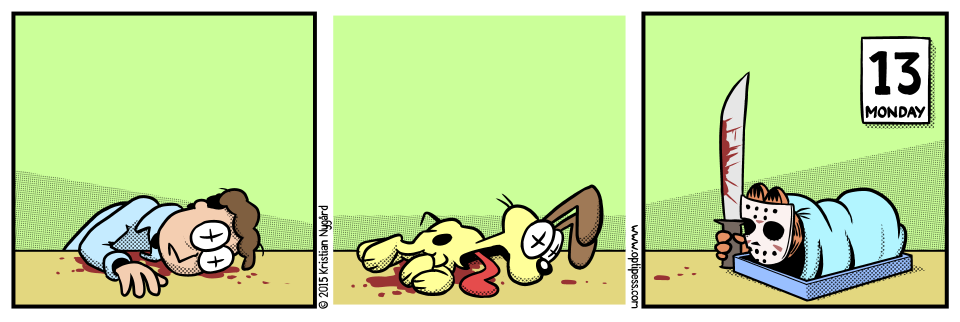
Mondays

by Kristian

…and his lawyers.

Ahem, this comic comes with huge apologies to Jim Davis…

14 Jul 06:28

Photo

Sophianotloren

https://youtu.be/LnTcrqBdELA
Social eyes don't look twice...



14 Jul 05:55

Photo

Sophianotloren

As I saw someone on tumblr put it: "Pretty much the beginning of every Pokemon game."


14 Jul 05:45

cringing: cringing: do you know what literally drives me up the fucking wall?

cringing:

cringing:

do you know what literally drives me up the fucking wall?

image

14 Jul 05:44

skrylaxthefish: tin-d0g: Why can’t skrillex ever win a fishing tournament? Because he always...

skrylaxthefish:

tin-d0g:

Why can’t skrillex ever win a fishing tournament?

image

Because he always drops the salmon

14 Jul 05:44

Photo


14 Jul 05:44

Photo

Sophianotloren

1. I hate raccoons (creepy motherfuckers.)
2. This was touching and awesome anyway.
3. When I saw it took something like 12 hours to respond I thought "wow, that's super quick!" Where I am, that's nothing at all -- if there's even a response at all.


14 Jul 05:41

RT @_Xtin_: Kid has nutbar antivax parents. Kid uses babysitting money to get vaccinated...

by Pai Osias

Minha nova heróia

800px-Coturnix_coturnix_eggs_normal.jpg
Author: Pai Osias
Source: Mobile Web (M5)
RT @_Xtin_: Kid has nutbar antivax parents. Kid uses babysitting money to get vaccinated on the DL. YASSSSS RT @chaeronaea: lmfao http://t.…
CJZ57OAUkAABo1q.jpg:large
14 Jul 05:40

maay-we-meet-again: still-loyal: “You’re too young to be in love" let me just remind you that...

maay-we-meet-again:

still-loyal:

“You’re too young to be in love" 

let me just remind you that when Romeo and Juliet met ,Romeo was 16 and Juliet was 13.

yea, and six people died, the city was left in shambles, and they killed themselves over a miscommunication. probably not the best example.

14 Jul 05:39

Photo


14 Jul 05:39

Photo


14 Jul 05:39

Having homework over the weekend...

laughingstation:


Friday: “Psh, I’ll do it all on Sunday.”

image

Sunday:

image

Click me!! for more funny posts!

14 Jul 05:39

babylizard: robin thicke goes to order a hamburger at mcdonalds but there’s a family of ducks in...

babylizard:

robin thicke goes to order a hamburger at mcdonalds but there’s a family of ducks in front of him taking forever to order. he hates these bird lines

14 Jul 05:38

freddythefandomhorse: A large portion of this website.


freddythefandomhorse:

A large portion of this website.

14 Jul 05:38

Photo


14 Jul 05:38

lackyannie: NO ONE KNOWS HOW TO IMPREGNATE GIRLS WITHOUT HAVING...


lackyannie:

NO ONE KNOWS HOW TO IMPREGNATE GIRLS WITHOUT HAVING SEX LIKE GASTON

14 Jul 05:37

Photo