Shared posts

22 Jul 01:19

Again and again, again, again, again-again, never stop

by Sophia, NOT Loren!

I usually don’t bother even writing it down or saying anything, because it’s so common, so frequent that it just turns into a droning mess…

I need to be fucked. I need sex. I’m horny and alone and unsatisfied. I need sex. I need more sex. I need different kinds of sex than I’m getting. I need to fuck.

I need to be eating better. I need to be eating more often. I’m not eating enough. Need food. Pink pervert needs food… badly. I really gotta eat. I should eat something. I haven’t had a meal today. Need to eat.

It’s too loud! Wish I had some peace and quiet. So noisy! Fuck, this noise is driving me crazy… it’s so loud here, I can’t think! Another panic attack, things are so noisy here. Too much noise!

I don’t know where I’m going to live. I need a place to live. When do I find a home? Gotta find something long-term and stable for housing. I need a place to live… where am I going to live?

It’s the same thing on repeat. The same thing on repeat. The same thing on repeat.

I’m just going to go to sleep for now… again.


Filed under: General
20 Jul 14:18

Photo


20 Jul 02:20

Stabbity recommends things

by Stabbity

Lately I’ve been playing a ton of Don’t Starve and Don’t Starve Together (the multiplayer version). If you like open world, no hand-holding survival games, check it out. You will die over and over again and you’ll keep wanting to give it just one more try. To quote one of the reviews:

You will die.

Spiders will murder you.
Hounds will murder you.
Bunnymen will murder you.
Trees will murder you.
Tentacles will murder you.
Shadows will murder you.
Giants will murder you.
Penguins will obliterate you.
Bees will f**king destroy you.

And that’s only if you don’t starve first.

On the less frustrating side, the art is adorable. All of the creatures that will try (and usually succeed) to murder you are really cute.

Another game you should try if you like dying repeatedly is Dungeons of Dredmor. It’s basically an old-school roguelike with nice graphics, friendly controls, and a sense of humour. You’ll die a lot, but the little obituaries the game gives you are so good you can’t even really be mad about it. Plus you can worship Inconsequentia, Goddess of Pointless Sidequests and sacrifice lutefisk to the Lutefisk God. Dungeons of Dredmor is also quite a good deal these days because it came out in 2011.

A friend also introduced me to Space Team a little while ago, that game is amazing at parties. It’s a cooperative multiplayer mobile game where you yell incomprehensible technobabble at each other – everyone gets a set of controls on their screen and a console where you get instructions, but the instruction you get might not apply to the controls on your screen. That’s where the yelling comes in :) If you like Space Team, there’s a kickstarter to support the developer to release more games. It can be a bit of a pain to get everyone’s devices connected, but it’s well worth the hassle.

On the book side of things, Richard Morgan’s A Land Fit For Heroes trilogy is a) awesome, and b) complete, for those of you who hate waiting for the next book in a series to come out. A land fit for heroes is a noir fantasy, which totally works for me but may not be everyone’s cup of tea. The characters are interestingly flawed, the world building is fantastic (I find books that let things be mysterious much more interesting than books that insist on spoonfeeding you every little detail), and if you’re going to read it I recommend getting all three books at once because you will want to know what happens next right now.

19 Jul 17:20

Why I’m Disliked: A Ten Point List

by John Scalzi

(WARNING: Neepery, not directly about Hugos, but somewhat related. Also it is about me observing other people observing me, so there’s a whole lot of me in this post. So: Ego alert. Also, it’s long, because I wanted to get out in one place. Skip it if you just don’t care. I don’t mind! Really!)

Over on Facebook at the moment, and as a subset of a larger discussion, there’s a conversational thread about why so many dudes (and it is largely dudes, and dudes of a certain sort and political persuasion) have such a rabid dislike of me, both as a writer and as a human being.

Naturally, I have thoughts on this, based on years of personal observation, so below you’ll find my hypotheses on why I am so widely disliked by a certain type of dude. These hypotheses are mix and match: Not all will apply to everyone.

1. Because I’m an asshole. Gotta put this one in here, and have to put it up top, because indeed, I like pretty much everyone in the world can be a complete asshole from time to time. Depending on who you are (and my opinion of you), you may see my asshole side more often than others do. I do, for various reasons, some systematic and some relating specifically to me, have the luxury of being able to get away with being an asshole more frequently than some other people can or would. So when the mood strikes me, I often have the ability to go ahead and be one.

Disclaimers, now: I try not to be an asshole nearly all of the time, and the mood doesn’t strike me very much in any event, especially as I get older and the amount of fucks I have to give about this sort of nonsense decreases over time. I particularly try to be sensitive to being an asshole to people I see having less power than I do, structurally speaking (i.e., that whole “punch down” thing). I also try very hard not to lead with the asshole card, or to be the first asshole on the scene.

But I don’t always succeed, and also and independently, from time to time I decide that me being an asshole is a thing I need to do. In that situation, if I’m being an asshole in your direction, you’re perfectly justified in disliking me. I’m okay with you disliking me. I may even want you to dislike me. Because it likely amuses me, and because I think it’s what you rate. Some people deserve a thumb in the eye.

2. Because they’re assholes. Which a significant number of them are, for various reasons, including, apparently, some of them making a calculated decision that being a jerk is a viable marketing tactic. They’ve decided, apparently, to address an untapped “asshole” sales demographic. This is a bold strategy and we’ll have to see how it works out for them. Personally I suspect the number of people enticed by an “all asshole, all the time” public relations strategy is smaller than one might suspect. But it’s not my career, and if it gives them joy, then fine.

In which case disliking me is just part and parcel of being a professional asshole. I’m a nice big target, and there’s apparently an estimation that being seen in opposition to me, or framing one’s self as one of my hopeful nemeses, conveys certain marketing advantages. It’s sort of an unpleasant variation of starfucking. I am also skeptical of this as a viable marketing strategy, in part because generally speaking when I’m aware of it being attempted, I don’t address the starfucker directly anymore. It’s fine if they want to play that game; I don’t have to participate. Which sort of lowers its strategy value, in my opinion. But again, if it gives them joy, well, whatever.

3. Because of my politics. Many of the dudes who dislike me have politics that range from reactionary conservative to bourgeois fascist, accompanied by social positions that range from outdated to bigoted (there’s a strong correlation between those political and social positions, mind you, and probable causation as well). I’m no model liberal or progressive, to be sure, but my positions, social and political, are sufficiently left of their own that a) they see me as a useful foil, b) I am in their estimation a leader of a larger, and further left, social/political movement that they created in their heads as a threat to their own largely reactionary, somewhat bigoted way of life. In this case it helps that I’m a well-off straight white man, since using me as a target means they get to deflect criticism of a bigoted worldview.

It also means that they see me as an affirmative-action beneficiary of the non-existent political and social movement that they’ve created inside their heads, which they also think runs things in the science fiction and fantasy genre, which it does not, because, again, it doesn’t actually exist outside their heads. If it did, in the manner in which they seem to believe it does I, as a well-off straight white man, would be an extraordinarily unlikely candidate for their approbation when it came to sales and awards. The fact that they appear to think I am an excellent candidate for this approbation is a significant tell about their own worldview, i.e., that even an alleged social/political movement celebrating/ordering diversity requires a well-off straight white man as a figurehead.

Related to this:

4. Because I should be with them and I’m not. I’m a well-off straight white man who writes military science fiction (among other things); if you look at the stats, the correlation between these categories and “socially/politically conservative” is pretty high. That I’m not socially or politically conservative is apparently a source of confusion and upset for some. Likewise, I’m a well-off straight white man who is a loudmouth on the Internet and who writes about poverty and inequality and who has been unapologetically for things like same-sex marriage and the right of women to have total reproductive control of their own bodies, and has used his influence in his field to speak against harassment, and for diversity. Which is also apparently not what I should be doing.

That I am doing these things, and that I don’t have the expected politics for my easily-slottable demographic, is confounding — and also, if you’re the sort of person who gets upset about these things, suggests possibly that I am a traitor to well-off-ness, and straightness, and whiteness, and man-ness, all of which have, apparently, very specific conditions of being, of which I may not actually meet. Hold that thought, we’ll get back to it.

5. Because I’m successful: Despite not slotting in how I should socially or politically, and not receiving the imprimatur of the folk who apparently believe they have the ability to decide who and what is really science fiction and what is not, I’ve nevertheless done very well in my field, while others doing similar things (and doing it better, in their opinion), are not doing as well as I am. This clearly isn’t fair or right.

Obviously, the fact that I am doing better than some others despite my inauthentic nature means that I am a beneficiary of manufactured success, either at the hands of the social/political movement they’ve created inside their head which does not actually exist, or by the manipulations of my publisher, who for some reason has decided that tying itself to a writer who doesn’t sell, to the tune of millions of dollars and more than a dozen books, is a valid and solid commercial strategy. Which, of course, just makes the detractors even more annoyed.

All of this combines to the following:

6. Because I’m not a real man. My political and social positions, and my success which must obviously not be real, mean that I’m not an actual man man. I’m not an alpha male. I’m a beta or even a gamma, a submissive tool of women, in cowering awe of real men, and probably gay, because being gay is the worst possible thing for a man to be, and one that is, is hardly deserving to be called a man at all.

Note well the strategy here: When a man who does not meet these fellows’ requirements for manhood nevertheless succeeds — and succeeds in a field they have claimed as their own stomping ground — the play is de-masculinize him (by their silly definition of “masculine”) as much and as quickly as possible. In other words, they try to demote that man. They’re trying to demote me from manhood, because manhood, in this formulation, is really the only thing that matters.

This, unsurprisingly, leads to the next reason they dislike me:

7. Because they can’t actually do anything to me. In point of fact, I can’t be demoted by them, either out of my manhood, or out of any other advantage I have. After all their blathering and whining and conspiracy theories and nasty mean awful snarkings, they have changed precisely nothing. Look, I’ve been on the receiving end of this nonsense literally for years, and none of it — none of it — has ever made a single material difference in how I’ve led my life, how my career has advanced, or how I do my work on a day-to-day basis. Nobody cares. Literally no one cares.

When faced with this sort of general impotence, the response appears to be: Try harder. Well, again: I wish them joy. It won’t matter to me.

8. Because of envy. This one is pretty obvious in some specific cases. I’ve been pretty successful despite being a mewling coward of a gamma, whereas some of them have been notably unsuccessful at nearly everything they’ve done despite being awesome supergeniuses who are always thinking sixteen steps ahead, so tremble when I walk amongst you, puny humans. To which my response is: I’m sorry your life has turned out so poorly for you, but this is not really my problem, and also, I wish you would stop trying to make it my problem.

9. Because I refused to recognize that they were right about something that one time, or several times. This is also specific to a couple of people who thought they were pretty good with that whole arguing thing, and were making points that were clearly self-evidently correct, and were non-plussed when I noted that they were not self-evident, and also, they couldn’t argue their way out of a paper bag. Clearly in these cases the problem was not their positions or their inability to elucidate them in a coherent manner, but that I was mean. Unsurprisingly, people who think they are right about most things more often than not appear to hold long grudges against people who point out they’re often not right, and not right more often than they would like.

10. Because of tribal identification. At this point there’s simply a small cadre of people who have decided that the world is against them — or have decided that it’s a smart career move to convince other people that the world is against them — and moved to hook in a bunch of other like-minded folks to create a tribe. When doing something like this, it’s nice to have something for the tribe to exercise their daily two-minute hate against. For this cadre, at this moment, these things include a non-existent political and social movement they’ve created in their heads, the awards this non-existent political and social movement supposedly control, and me, as a titular icon of this non-existent political and social movement.

If you’ve been convinced to join this tribe, this is great — you’ve been pointed in a particular direction, given your instructions, and now all you have to do is follow the steps. That the steps are silly, based on nonsense and are, in the case of me at the very least, liable to effect nothing, is almost aside the point. The point is: membership. Belonging. And something to hate, or at least dislike.

And again: If it gives these people joy to dislike me, it’s no skin off my nose. I’ll be doing my own thing. I do think it’s sad, however. I hope eventually they decide that they have better things to do. There are, indeed, so many other, better, things to do with one’s life. Let’s hope they figure out what those things might be.


19 Jul 16:45

Broken electronic billboard being tested for all working...


Broken electronic billboard being tested for all working colors 

Via Brilliant Ads (Twitter)

19 Jul 16:17

Tumblr | 5cc.png

5cc.png
19 Jul 16:16

Photo


19 Jul 16:16

Unsolicited

by Lunarbaboon

Make a dad happy with Lunarbaboon Volume 1: http://lunarbaboon.bigcartel.com/product/lunarbaboon-volume-1

19 Jul 15:43

The suspense is terrible…(Buy a print of this comic)


The suspense is terrible…

(Buy a print of this comic)

19 Jul 15:01

Photo


18 Jul 14:58

marauders4evr:DO YOU KNOW HOW LONG I’VE WAITED FOR THIS GIFSET!?


marauders4evr:

image

DO YOU KNOW HOW LONG I’VE WAITED FOR THIS GIFSET!?

18 Jul 14:57

Mud Above Sky Below: Love and Death in Jacob Lawrence’s ‘Migration Series’

by Barry Nemett

Jacob Lawrence, “The Migration Series” (1940-41), panel 52: “One of the largest race riots occurred in East St. Louis” (1941), casein tempera on hardboard, 18 x 12 inches. The Museum of Modern Art, New York. Gift of Mrs. David M. Levy (© 2015 The Jacob and Gwendolyn Knight Lawrence Foundation, Seattle / Artists Rights Society (ARS), New York. Digital image © The Museum of Modern Art/Licensed by SCALA / Art Resource, NY)

Spring, 1968. All my students were black, and I wasn’t. Jacob Lawrence, who was teaching a course down the hall from me at Pratt Institute, was a famous artist and a real teacher; I wasn’t either of those things.

When I introduced myself as a third-year undergrad at Pratt and told him about the Life Drawing class I was offering, Mr. Lawrence smiled. I explained that the college was providing a free model and drawing lessons for low-income adults in the area as part of a program I had helped initiate. “Drawing from a live model is important,” he said.

This highly accomplished man, older and far wiser than me, represented a different kind of model. When I asked if he’d say a few words to my class, his smile broadened. Not surprisingly, he made a big hit that evening, and every evening session thereafter, spending almost as much time in my classroom as he did in his. His eye and mind and storytelling skills were always spot-on. Though I remember him as being too kind to say anything too critical about anyone’s work, my students and I learned a great deal.

Summer, 1968. I continued to learn from Jacob after the class ended because, along with painters like Phillip Pearlstein and Ben Shahn, he was one of the artists-in-residence at Skowhegan School of Painting & Sculpture in Maine, where I was on scholarship that summer. Everyone knew who Jacob Lawrence was. But he was shy and didn’t know too many people there, so he talked to me a lot.

Rural and remote, Skowhegan was renewing. Hectic and tense, Brooklyn was exhausting; poverty and anger were in the air, deep breaths not a good idea. The night after Martin Luther King was murdered, my African American roommate (born and raised near where Jacob grew up in Harlem after his family had migrated from the south) roamed the Brooklyn streets in violent protest. Americans dropped bombs in Vietnam, while anti- and pro-war advocates screamed at each other back home. People forgot they were alike, something Jacob was incapable of doing. He seemed as full of peace and patience in New York as in Maine, and as giving with me and every other student and fledgling artist he talked to as he was with Pearlstein and Shahn.

60 Panels. Lawrence was also as comfortable painting friends and neighbors in carpenter shops, churches, pool halls, and libraries as he was portraying race riots and lynchings. His paintings, currently on display at the Museum of Modern Art in a show titled One-Way Ticket: Jacob Lawrence’s Migration Series and Other Works, testify to the generous sweep of his mind, heart, and brush. Lawrence’s series of 60 small, unpretentious panels illustrate the journey of the approximately six million African Americans who migrated from the rural South to the urban Northeast, Midwest, and West in the first half of the 20th century. The dream before them: to secure better opportunities for their families and themselves. They would leave segregation and Jim Crow behind. In Lawrence’s paintings, people work, walk, wait, and die. They gather at train stations, school blackboards, and voting machines, as well as in courts, jails, and funerals. At MoMA, I felt the tensions of the arduous exodus he had heard and read about since he was a child. I felt the artist’s great big ambition to tell a great big story in a way that would allow 8- and 80-year-olds alike to understand and experience it. I felt a peoples’ desperation. I felt Black History in my gut.

The Migration Series (1940-41) was originally shown the year it was completed (under the title Migration of the Negro) at the prestigious Downtown Gallery in New York, marking the first time a New York gallery represented an African American artist. Another first: When MoMA bought half the series (all the even-numbered panels; the Phillips Collection in Washington, D.C. bought all the odd numbers), Jacob Lawrence became the first African American to have work included in the Modern’s permanent collection.

Although each painting is an independent composition, this Jackie Robinson of the New York art world meant for the entire suite to be viewed as a single narrative: “I consider it one work, not 60 works,” Lawrence said. By bringing all the panels together in one large room—and by filling adjacent rooms with other paintings, as well as photographs, cartoons, cinematic footage, music, writings, and various objects documenting the migration story—the exhibition at the Museum of Modern Art is a comprehensive, educational, moving event.

“When the subject is strong,” Lawrence once stated, “simplicity is the only way to treat it.” Accordingly, the migration paintings are raw and powerful in their plainness. Each panel is accompanied by a short, simple text. Examples: “They were very poor” (caption for panel 10). “There had always been discrimination(panel 19). The artist’s wife, the painter Gwendolyn Knight, whom he married in 1941, when he was 23 years old, wrote some of these captions. Lawrence completed the Migration Series that same year. The written words built into this major work by the newlyweds were sincere and strong, like the couple’s 59-year marriage.

Discussing her initial attraction to her husband, Knight recalled in an interview with the Seattle Post-Intelligencer that Jake “was a sweet little fellow” who “was doing these great paintings.” Well, that “sweet little fellow” produced one of the 20th century’s most important American works of art, the Migration Series, and he shares creative blood with one of the 19th century’s most important Spanish works: The Disasters of War series by Francisco de Goya. Both series are comprised of small works that aim to collectively chronicle a drawn-out historical event fraught with tragedy. Like Lawrence, Goya attached captions to his suite of visual images. Another connection is that both artists are as sensitive to form as they are to content. Part of the sadism that ignites Goya’s “Que hai gue hacer mas” (“What more is there to do?”), an etching from his War series, is that its beauty matches its repulsiveness. On the inhale, a museum-goer can luxuriate in the rhythm and volumes of the forms, the richly varied mark making, the drama of the light, or the Spanish master’s eye for choosing which details to celebrate and which to ignore. On the exhale, that same art lover can watch a poor, upside-down bastard getting sabered from crotch to skull. As in several of Lawrence’s paintings and many of Goya’s etchings, the savagery and sorrow are difficult to look at, but so seductively portrayed, you do.

Francisco Goya, “Qué hai que hacer mas? (What more can one do?” (1810-1814), from Los Desastres de la Guerra (The Disasters of War) (via Wikimedia.org)

Panel 52. Goya’s etching came to mind while I was standing in front of Lawrence’s painting with the caption, “One of the Largest Race Riots Occurred in East St. Louis.” The Baltimore riots occurred less than two weeks before the opening of this exhibition. The riots in Ferguson, a suburb of St. Louis, occurred less than 6 months before that. As a Baltimore-based artist, panel 52 in particular struck close to home, although in Baltimore, the physical damage was directed mainly at property rather than people. In panel 52, a lifeless body looms above the rioters like a collapsed roof falling upon the frenzied men below. He is topped only by the chimney of an oversized hand and a knife blade, blue like the horizon it’s about to sever on its way toward the broad-backed man. Of all 60 panels, the St. Louis painting is the most violent, involving the most active and extreme example of hate. But in its formal elegance, for me, it is the most beautiful.

Hate is ugly. If there’s no structure to that ugliness, however, we’re not likely to take the message in. Not for long, anyway. You look away and don’t look back. In panel 52, Lawrence hammers carnage into place. We see the brawlers’ same-style shoes; it takes a minute to separate these from those. Yet each of the solid shapes filling the spaces between the figures is exquisitely distinct. Likewise, while the long-limbed battlers are stylized in a similar manner, they are inventively—beautifully—choreographed, dancing in the blue.

Mud above. Sky below. Even as the men and the spaces between them jigsaw their puzzle pieces into place, the world rendered in the St. Louis riot painting is topsy-turvy. Sky is not where it’s supposed to be. Or it’s become sea. This is a bold, bare-bones moment painted in a limited palette, the three primary colors (along with green) clashing with blacks and whites. The yellow rain slicker is key. Turn its switch on in your imagination and everything around it starts banging and yawing. Lawrence interprets color, form, and space expressionistically, not through literal depiction. Wending from here to there, limbs tie the fighters together, like veins, like human calligraphy. Clothed figures, flayed. Rage. Flat, opaque shapes wasting down to billy club legs, all sharp edges and angles. No light source, so no modeling of form and no cast shadows. No flab. No sense of place. Just stark figure/ground, staged.

Franz Kline, “Mahoning” (1956), on display as part of “America is Hard to See” at the Whitney Museum of American Art (photo by Tiernan Morgan for Hyperallergic)

I don’t know whether Lawrence’s slightly older contemporary, the Abstract Expressionist painter Franz Kline, ever saw this composition, but if he did, I bet he’d have felt a painterly kinship to its zigzag of rumbling lines, shapes, and spaces between. Beyond its borders, that rumbling has leaned slightly in distance and leaped greatly in time from St. Louis to Ferguson; it has rampaged through Newark, Detroit, Boston, Baltimore, Cleveland, Houston, Charleston . . . sadly, through too many cities across our country. Returning our eyes, ears, and mind back in time to St. Louis, I bet Kline would’ve dug the Dizzy Gillespie-like rendition of “Taps” that seems to trumpet from Lawrence’s combo of battlers. Dug it and grieved.

Another combo: the four boll weevils that ravaged a crop of sunny cotton balls earlier in Lawrence’s narrative (panel 9), reappear here in panel 52. Having been accidentally railroaded north, the insects now lay crushed inside the blackness of the dead man’s trouser pocket. Well, sort of. No boll weevils are actually portrayed, but I imagine them in panel 52 because I saw them in panel 9. Memory and imagination play a part in reading any work of art, especially in multi-scene works like the Migration series, where story unfolds over time, as in a novel, movie, song, or ballet. After all, what is not pictured is often more poignant than what is.

0. An example of this is panel 15 where, within a barren landscape, an empty noose hangs dead center. We see two people: a forlorn, faceless figure (pictured) and the hanged man (in our mind’s eye). Death is both conspicuously absent and overwhelmingly present. Likewise, no sign of tears. But there are tears. Listeners are moved to them by the film footage of Billie Holiday singing “Strange Fruit” in an adjoining gallery. Mesmerizing in its mournful, drawn-out notes and pauses—as much death in the silences as in the sounds—I heard Holiday’s song as I looked at Lawrence’s painting. I pictured the singer walking the same streets that Freddie Gray walked in the Sandtown-Winchester neighborhood of West Baltimore, where both Gray and Holiday were raised, and where Gray’s fatal arrest led to April’s unrest. I thought of the report I recently read, stating that almost 4,000 black men, women, and children were lynched in the south between 1877 and 1950.

Here is fruit for the crows to pluck,
For the rain to gather, for the wind to suck,
For the sun to rot, for the trees to drop.
Here is a strange and bitter crop.

Billie Holiday’s “Strange Fruit” is about the lynching of an African American in this “pastoral scene of the gallant south.” But lynching is not named in the lyrics, just as, in Jacob Lawrence’s painting, the hanged man is not pictured.

Jacob Lawrence, “The Migration Series” (1940-41), panel 15: “Another cause was lynching. It was found that where there had been a lynching, the people who were reluctant to leave at first left immediately after this,” casein tempera on hardboard, 18 x 12 inches. The Phillips Collection, Washington, D.C. Acquired 1942 (© 2015 The Jacob and Gwendolyn Knight Lawrence Foundation, Seattle / Artists Rights Society (ARS), New York. Photograph courtesy The Phillips Collection, Washington, D.C)

On his way to the police station, the injured and handcuffed Freddie Gray was not filmed or photographed behind the police van’s closed doors. So there is no documentation of this “rough ride,” during which he was apparently unprotected from being tossed around in the back of the vehicle—a tactic that dates back to the Reconstruction, when bound prisoners were transported in harshly jolting horse-drawn carriages. We are left to imagine how Gray’s spine was broken at the neck while he was in police custody. The fact that riots broke out as a result of what was not actually seen is both a reflection of built-up outrage over injustice and a testament to the power of the implied.

On a related note, the lack of landscape details in panel 52, the previously described East St. Louis race riot, is consistent with that painting’s thrift. No predictable drips or pools of blood, for example, or even any buildings or trees to locate the action. The few carefully chosen details are not what you’d expect: red suspenders here, a vinyl, yellow rain slicker there, now part of a happening far worse than drooping pants or bad weather. Beneath a fecal sky, a deadly headlock represents the only human embrace. At least the man has a face; only two of the men do. Lawrence relies on elements of the composition itself— including the figures’ gestures and distortions of form and scale—to suggest facial expression, once again celebrating the viewer’s imagination over the artist’s delineation.

Remarkably, given the troubled times they recount, only three of the Migration Series panels portray anger or violence—riot scenes each—while images of struggle, sorrow, community, and hope are there in abundance. Yes, many of the paintings are disturbing. Nonetheless, one of Lawrence’s strengths is his gentleness. The size of the panels contributes to this. Private and public at once, they are intimate in inches, yet mural-scale in impact. And if his images jar now, think about their wallop when the Migration works were created. The Internet did not exist. TV hardly did, and only in black and white. The year the series was completed, 1941, marked the debut of television news, broadcast solely in New York on one channel, and only for a few minutes daily. Who imagined then that someday millions of viewers would see the same stories with the same visuals, every day, rerun all day long, all around the world?

1. There’s a great deal to be said for the power of technology to report events or “up close and personal” stories. But there is also much to be said for standing in a gallery before a single image, one-to-one, or for looking at a series of images, one-by-one. Sure, Lawrence’s paintings are available in books or online, but they are best lingered over in person. That’s when a work like the Migration Series can bring tears or anger, as can the realization that many of the very same injustices that caused millions to leave their southern homes continue to plague our country today. As I write this, cell phone cameras are capturing, at an alarming rate, unlawful force by police officers. The caption for panel 22 reads: “Another of the social causes of the migrants’ leaving was that at times they did not feel safe, or it was not the best thing to be found on the streets late at night. They were arrested at the slightest provocation.” Sound familiar?

Past. Present. Future. The recent turmoil in American cities spotlights longstanding racial problems. Maybe now, city and state legislatures will enact changes in the allocation of funds for education in low-income areas, for black unemployment, and for policing the police. By destroying property and neighborhood stores in Baltimore, rioters drew attention to long-standing inequities that have fueled their rage. But they also undermined the quality of their own lives and the lives of their neighbors by putting innocent people out of work and by eliminating already limited neighborhood services. Heroically, beginning the day after the fires and looting, a great many inner city residents who played no part in the destruction helped repair the damage. Volunteers, including students from Baltimore colleges, such as Maryland Institute College of Art, where I teach, joined them. Following the model of a socially conscious artist like Jacob Lawrence, many MICA students documented or interpreted through their artwork what they heard and saw.

Mud above. Sky below. When Leah Dickerman curated One Way Ticket: Jacob Lawrence’s Migration Series at MoMA, she had no way of knowing how timely the show would be. Or maybe she did. Happily, works of art do not have an expiration date. Unhappily, neither does discrimination. Lawrence, ever the quiet man, still has a lot to say. “Drawing from a live model is important,” he said. In panel 52, Lawrence lets nature serve as an out-of-whack model by defying laws of gravity when he places “mud above, sky below,” metaphorically connecting hate and death by positioning the fighters underground. Jacob Lawrence’s 60 groundbreaking panels eyeball subjects as small, yet agriculturally evil, as a boll weevil beetle, and as epic as Africa and the black diaspora.

The African-American writer James Baldwin noted that, “Not everything that is faced can be changed, but nothing can be changed until it is faced.” Through Lawrence’s paintings, we face a shameful period of our past. The Migration Series is a visual history lesson. Jacob Lawrence—ever the observer, the storyteller, the teacher—painted the past in a manner that looked toward the future: a future where there is no strange “fruit for the crows to pluck” or rough rides in paddy wagons, a future where the sky will be where it ought to be and mud will remain below.

One-Way Ticket: Jacob Lawrence’s Migration Series and Other Works continues at the Museum of Modern Art (11 W 53rd Street, Midtown West, Manhattan) through September 7.

18 Jul 14:23

The South or the Nation?

by Erik Loomis

6a00d834516a0869e201bb0847c219970d-500wi

Tom Sugrue is a great historian and he makes excellent points in this op-ed about how racism is not just a southern problem but a national problem. But let’s face it, this is an overstated case. Even if everything he says about the North is true, and it pretty much is, Dylann Roof still shot up a church in Charleston, South Carolina (Denmark Vesey’s church no less), it is southern states that are seeking to disfranchise African-Americans in the wake of the Supreme Court overturning the most important parts of the Voting Rights Act and it’s also southern states denying the Supreme Court’s verdict on gay marriage, executing African-Americans in racist criminal injustice systems, and where the last die-hards going to the mat for the Confederate flag are hanging on.

Yes, racism is a national problem. No, the North and the West are hardly immune from the horrors of white supremacy. But yes, these problems are worse in the South and it’s important to recognize where the front line of the civil rights struggle remains.

18 Jul 13:53

Be the adult you always wanted to be.. Lime popsicle + el...


Be the adult you always wanted to be..
Lime popsicle + el dorado rum + green chartreuse + basil

#cocktails #pdx #summer

18 Jul 13:53

July has been busy and productive in the garden! Tomatoes are...


Layout complete, with black vinyl layed down to solarize some weeds


Gorgeous triangle flashback calendula from Territorial Seed, with Globe Basil and Brandywine tomatoes in the background


Chamomile, sage and rosemary starts have been keeping the bugs out of my lettuce bed


Cayenne peppers and more globe basil


A watermelon hoop over cabbage and leeks


The catio is complete!

July has been busy and productive in the garden! Tomatoes are just starting to pink, lettuce hasn’t bolted quite yet, I’ve got far too many watermelons on the vine, and cabbage is almost ready. I am starting to plan out over-fall and over-winter veggies,  as I put late-season carrots and kale seeds out. 

I am still struggling with weeds that I have “inherited” from the previous owner of the house, so I’ve layed down black plastic to try to nuke them out. One measure I’ll have to take is layering the areas around and behind the beds with cardboard and mulch this fall, and leave it over winter. I’ve been reading Evelyn Hadden’s “Beautiful No-Mow Yards” to identify a variety of ground covers I can start in the spring, once the weeds have been smothered out of existence.

18 Jul 13:53

Tracing Back to the World’s Oldest Known Cello

by Allison Meier
Amati “King” cello at the Metropolitan Museum of Art

Amati “King” cello at the Metropolitan Museum of Art (all photos by the author for Hyperallergic)

The Metropolitan Museum of Art is hosting a special summer guest: the world’s oldest known cello. Known as the Amati “King” cello, the 16th-century instrument is on loan from the National Music Museum on the campus of the University of South Dakota.

Andrea Amati constructed the instrument in Cremona, Italy, and through his sons several generations would make the Amati name integral to stringed instrument evolution. “He influenced all of the violin makers up to this day, including Stradivari and Guarneri,” said Ken Moore, Frederick P. Rose curator in charge in the Department of Musical Instruments. “He is credited with being the father of the modern violin. Before him there were all sorts of shapes and sizes, and he standardized things and also made templates so he could produce the instruments a bit faster. He really was the one who created the formula for violin making to this day.”

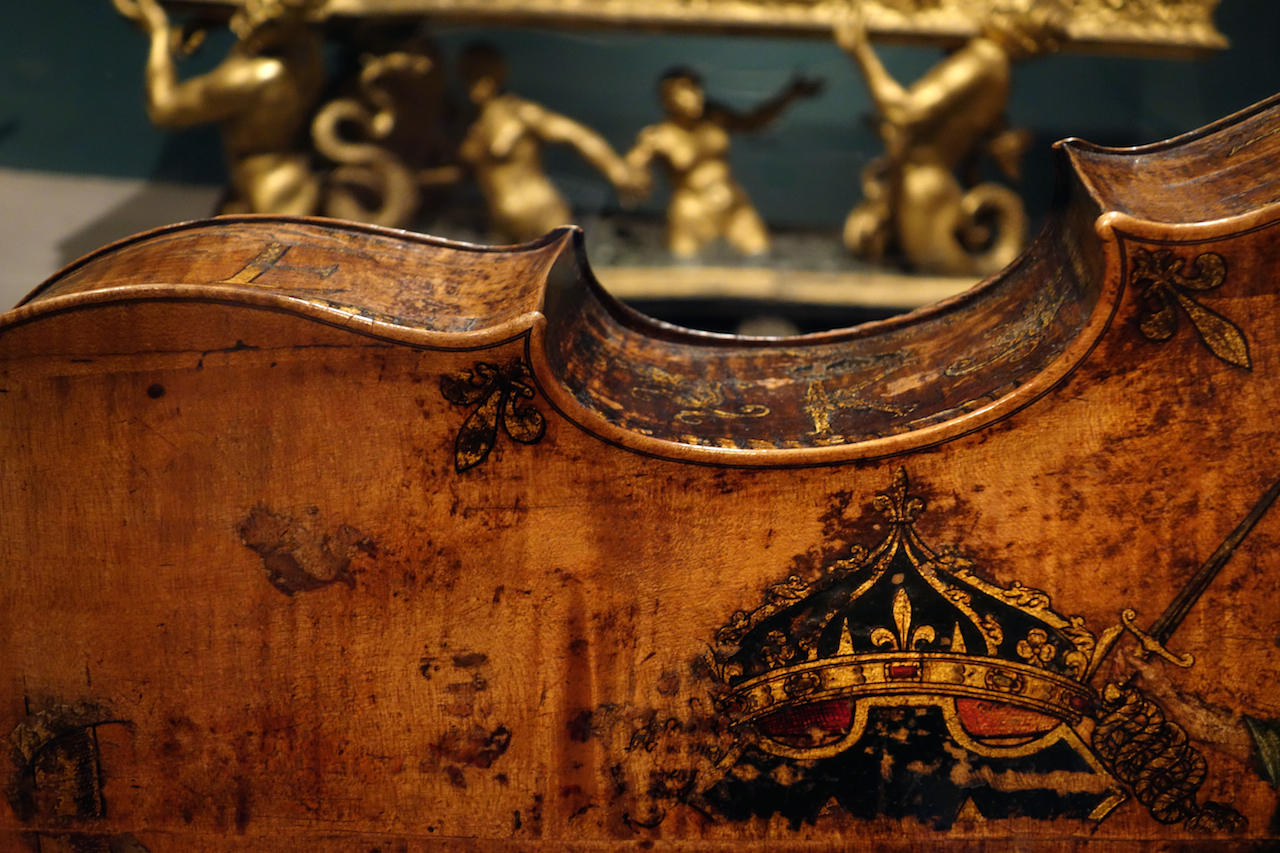
Displayed in the Met’s André Mertens Galleries for Musical Instruments, the King cello is joined by two other Amati instruments: a viola on loan from the Sau-Wing Lam Collection, and a 1560 violin in the Met’s collections. The royal name refers to its commission for the court of King Charles IX of France, and the paint on the cello’s body echoes this history. A “K” topped with a crown refers to Charles IX (“Karolus”) and alongside words for piety (“pietate”) and justice (“ivsticia”) are emblazoned along with other royal symbols. Andrew Dipper, consultant conservator at the Yale University Collection of Musical Instruments, delved into the symbolism on the Met’s Of Note blog, also noting that the King cello “was not a singular invention, but rather a member of a larger family of instruments of fixed measurements related together by profound mathematical, geometrical, and acoustical relationships of size and tone, which gave the set the ability to perform, in unison, some of the world’s first orchestral music for bowed strings.”

Amati “King” cello at the Metropolitan Museum of Art

Amati “King” cello at the Metropolitan Museum of Art

Amati “King” cello at the Metropolitan Museum of Art

Amati “King” cello at the Metropolitan Museum of Art

Amati “King” cello at the Metropolitan Museum of Art

Amati “King” cello at the Metropolitan Museum of Art

As it was a court instrument, the bass instrument was made for a chamber setting, with softer strings and gentler tones. “What you hear today is not what they sounded like back then, they were actually quite different,” Moore said. It was the reconfiguring of the instrument for more modern concert settings in 1801 that preserved it, especially in the wake of the French Revolution when it ended its court life. “The King cello was a much larger bass instrument,” Moore said. “They cut the instrument down and made it smaller, to make it more cello size, because the instrument it was before became obsolete. By cutting it down they actually saved this instrument.”

Evidence of the modification is in the neck, which was once perpendicular rather than at an angle for newer high tension strings, and the paintings on the back are misaligned, revealing the alterations. The Met actually has the only violin by Antonio Stradivari restored to its original Baroque design from later alterations, which the museum can use to compare modern and historic sounds.

The opportunity to bring the cello from the Vermillion, South Dakota, museum was helped along by Bill Clinton’s star-spangled saxophone. The cello journeyed with the presidential instrument that was already arriving for the Met’s Celebrating Sax: Instruments and Innovation. The National Music Museum may be off the beaten path for many museum visitors and music lovers, but through the Met loans some of its rich treasures are reaching a broader audience, and revealing some of the early history of the violin.

Amati “King” cello at the Metropolitan Museum of Art

Amati “King” cello at the Metropolitan Museum of Art

Amati “King” cello at the Metropolitan Museum of Art

Amati “King” cello at the Metropolitan Museum of Art

Amati “King” cello at the Metropolitan Museum of Art

Amati “King” cello at the Metropolitan Museum of Art

Amati “King” cello at the Metropolitan Museum of Art

Amati “King” cello at the Metropolitan Museum of Art

Amati “King” cello at the Metropolitan Museum of Art

Amati “King” cello at the Metropolitan Museum of Art

The Amati “King” cello is on view in the André Mertens Galleries for Musical Instruments at the Metropolitan Museum of Art (1000 Fifth Avenue, Upper East Side, Manhattan) through September 8. 

18 Jul 13:52

Sun Ra Films

by Erik Loomis

I realized that some of you have probably never seen any of the Sun Ra films. Allow me to alleviate this serious problem in your life.

18 Jul 13:52

Photo


18 Jul 13:52

Hanno - Projects

by knot
Sophianotloren

I'll let'cha lick a lollipop...

18 Jul 13:52

People are very concerned that fat kids, most of whom probably aren’t even fat, aren’t hating themselves enough

by Ampersand
Sophianotloren

#LoseHateNotWeight #EffYourBeautyStandards

Kevin Drum at Mother Jones is so very concerned, because “our kids are fat” but “they don’t know it.” Not that Kevin read a study, exactly, but he did read Fat kids don’t know they’re fat anymore, a post at Washington Post’s Wonkblog written by the also-so-very-concerned Roberto Ferdland. Hey, and FoxNews is totally on this:

fox-on-fat-teens

It’s hard to be sure, because these people’s citations are crappy, but I think the study they’re all referring to is More Overweight Adolescents Think They Are Just Fine, in The American Journal of Preventive Medicine.

1) First, to set some context, let’s look at some photos of a few real people and their BMIs.1

bmi-photos-2

The standard for what counts as “overweight” and “obese” varies by age; the older you are, the higher your BMI can be before you’re classified as overweight or obese. The study people are reporting on looked at kids ages 12-16. The three women whose photos I found don’t appear to be ages 12-16 – they’re college-aged, I’d guess – but the photos above still give useful context for what these BMI definitions of “overweight” and “obese” mean in real life, context that’s entirely lacking in the stories I linked to.2

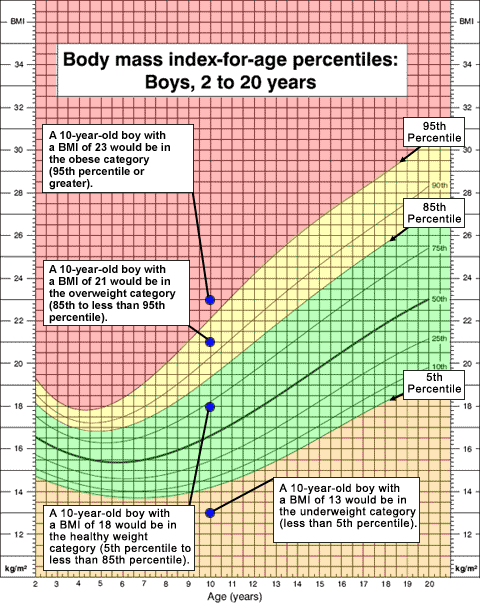
So please keep this in mind: A twelve year old with a BMI of 22.7, like Stacey, would be “overweight” according to the standards used by this study. And if she didn’t think of herself as overweight, according to this study, that would be a problem. Similarly, a sixteen year old with a BMI of 25.7, like Shauna, would be “overweight,” and if she thinks her weight is normal, this study wants her put on a diet. And a sixteen year old with a BMI of 30, like Sharon, would be “obese,” and again, this study does not want her thinking of her body as acceptable.3

2) When FoxNews and The Washington Post do stories like this, they want readers (or viewers) to imagine genuinely, unambiguously fat teens going “I’m not fat! What are you talking about?” Because that is a very compelling story, albeit not a true story. As well as being notable because How amazing! How could they not know they’re fat?!?, it gives the comforting feeling of prejudices confirmed. It’s common to think of both kids and fat people as being unintelligent, and this story relies on that prejudice to seem plausible.

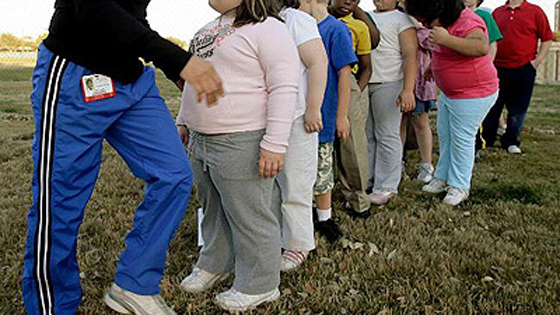
Here’s the photo that Kevin chose to illustrate his post, for example. For those of you who don’t want to click through, it shows a line-up of well-above-average-size fat children. The photo was originally a stock image that showed all the kids from head to toe, but in Kevin’s article the photo was cropped to make it into a dehumanizing headless fatties photo. (I’m not assuming that Kevin himself did the cropping or photo selection.)

It’s not remotely plausible that the kids in that photo – or anyone that fat – is unaware that they’re fat. They’d have to be in comas not to know, because our society has been slamming them with this knowledge (and telling them IT IS NOT ACCEPTABLE!) for their whole lives. But those kids are, apparently, who Kevin imagines when he reads this study; he worries that there are loads of genuinely fat people, like me, who somehow have never realized we’re fat.

Trust me, Kevin. We know. You can stop worrying. What this study shows is that lots of kids, most of whom aren’t fat, think their bodies are normal. Which they are.

3) The “overweight” and “obesity” levels for kids are, by the way, completely useless and arbitrary.4

The definitions are based on comparisons to government data from the 1960s through the 1990s. So when a reporter writes that 30% of kids are overweight, all that means is that 30% of kids would would have been in the 85th percentile of BMI for kids several decades ago. There’s no scientific reason to believe kids in 1965 were the “correct” weight, or that 85% is a meaningful cutoff point; these are simply the divisions chosen because they wanted something they could attach a number to.

Making things even more arbitrary, in 2010 they changed the labels so that kids that were “in danger of overweight” in 2009 are now “overweight,” and the kids formerly called “overweight” are now “obese.”

4) There are a ton of unstated but dubious assumptions underlying all this concern – the belief that being fat is the same as being unhealthy, the idea that fat children become fat adults, the idea that kids being less accepting of their bodies makes them healthier – that I don’t feel I have time to address in this post. But for a start, I’d recommend reading this well-cited article by Jon Robison (pdf link). Here’s a sample:

When it comes to fat children and adult morbidity, the relationship appears to be… tenuous. In the study of a thousand British families the authors concluded that there was “no excess adult health risk from childhood or teenage overweight.”

Furthermore, in the review of 17 studies that examined the tracking of obesity from childhood to adulthood mentioned above, children whose fatness persisted into adulthood had no more disease risk than adults who had never been fat. In fact, fat adult women who were also fat as children actually had lower triglycerides and total cholesterol.

Though it is often taken for granted that fat children means unhealthy children, the extensive review of screening and interventions for childhood overweight in the journal Pediatrics in 2005 “did not locate adequate longitudinal data relating childhood weight status to childhood health outcomes.”

The much heralded national “epidemic” of childhood diabetes has also failed to materialize. Although type II diabetes may be increasing in certain ethnic groups, according to the U.S. Centers for Disease Control, the disease is “still rare in childhood” with the incidence remaining much lower than other childhood afflictions that seem to garner significantly less media coverage.

5) This study is good news, even though the study authors don’t seem to realize that. If this study’s findings are accurate, then a lot more kids are accepting their bodies as “normal” today. That’s wonderful news, both for fat kids and for non-fat kids. Let’s keep up the good work.

  1. These photos came from Kate Harding’s wonderful “Illustrated BMI Categories” photoset. The women chose to share their photos with their BMI information publicly.
  2. I’m sorry I haven’t created a similar image of BMIs illustrated with photos of young men, because the official BMI standards for boys are every bit as ridiculous, and every bit as harmful. But writing this post has already taken me forever, and I’m not even half done with it, and for whatever reason far fewer boys have put their photos online with their BMIs that I can find, so I apologize to myself and all the other fat boys out there.
  3. For a girl age 12, a BMI of 21.8 or above is “overweight,” and a BMI of 25.2 or above is “obese.” For a girl age 16, 24.6 BMI or above is “overweight,” and 28.8 BMI or above is “obese.” Here’s the source for these BMIs (pdf). The official BMIs for “overweight” and “obese” for boys are similar.
  4. Here, have a bunch of links about appalled parents finding out that the government classifies their rather thin kids as fat: 1 2 3 4 5 6. Seriously, click through. Look at the photos.
18 Jul 13:46

A Link Farm For Discussing The Fake Planned Parenthood Video

by Ampersand
18 Jul 13:46

Photography by Megan Eagles (and a cat)

by Violet Blue

MK Eagles

UK erotic photographer Megan Eagles (MK Eagles) has a wonderful catalog, and I love that she still sells copies of her zine. I found her on C-Heads, and they point us to this great interview with her in Fotograifa, where she refers to the female gaze. But between the two, I love this quote:

Ever since I discovered a Helmut Newton editorial in an old magazine when I was 12, I was blown away. I never knew that women could be shown in such a way, powerful and sexual, with their own agency.

Helmut Newton is one of my most important visual artists, too.

While checking out her galleries, I cam across one of my favorite surprise guests in erotic photography: Cats!

MK Eagles cat

Megan Eagles cat

MKE cat

The post Photography by Megan Eagles (and a cat) appeared first on Violet Blue ® :: Open Source Sex - Journalist and author Violet Blue's site for sex and tech culture, accurate sex information, erotica and more..

18 Jul 13:46

Top o’ the Heap #dumpster #stuffedanimal #horse #refuse...


Top o’ the Heap
#dumpster #stuffedanimal #horse #refuse #losangeles #california #marvista #sad (at Mar Vista, Los Angeles)

18 Jul 13:45

NASA gives you a flyover view of Pluto's icy mountains

by Edgar Alvarez
Hey NASA, stop blowing our minds, okay? Actually, no, please continue....
18 Jul 13:45

Kenyan Artist Digs Through Electronic Refuse and Found Metal to Create Dazzling Sculptural Eyewear

by Kate Sierzputowski

glasses-2

Digging through electronic refuse and found metal in Kenya’s capital of Nairobi, Cyrus Kabiru refashions found materials into different wearable forms. Often these take the form of flamboyantly composed glasses, large eyewear that can often mask the entire face.

Kabiru explains that his glasses obsession started at a young age, and blossomed as his father crushed his dreams of owning his own pair. “When I was young, I used to admire real glasses but my dad was a bit harsh and he never wanted me to have real glasses. That’s the reason I started making the glasses.”

His creations situate themselves in several different areas of art, shuffling between performance, sculpture, and fashion—embodying the playfulness of the youth generation in Nairobi. “When you walk in town and you see someone with my glasses, the glasses will [get] all your attention,” said Kabiru. “If you have any stress it is like a therapy.”

In addition to his found object sculptures and glasses, Kabiru is a self-taught painter, his subject matter being humorous portrayal of contemporary Kenyan life. His most recent series uses thousands of bottle caps sewn together to depict African nature. “I really love trash. I try to give trash a second chance. I change it to be something else, which is like it will stay for more than 100 years now.” (via prosthetic knowledge)

glasses-3

Kenya_11

glasses-1

Kenya_12

Kenya_10

Kenya_09

Kenya_08

Kenay_05

Kenya_04

Kenya_03

18 Jul 13:45

Photo

Sophianotloren

So preeeeetyyyyyy!


18 Jul 13:44

Tokyo, Mon Amour: The City in Photos, as Monster and Muse

by Edward M. Gómez

Aperture’s Tokyo-themed issue, number 219, Summer 2015 (all photos courtesy of Aperture)

Think photography and its history, and it’s easy to recall iconic images of New York, Paris or London, cities whose buildings and street life have long served up compelling subjects for amateur and professional shutterbugs alike.

Eugène Atget’s Paris photographs, which he began producing in the late 1890s, captured for the ages a sense of that city’s enchanting ambiance, no matter how much abuse parts of its distinctive urban fabric would suffer in the 20th century.

Lewis Hine, Berenice Abbott, William Klein and other notable photographers gave the world indelible visions of New York; for their cameras, the city’s slums, style-makers and skyscrapers provided a rich visual feast.

In East Asia, sprawling, dynamic, constantly changing Tokyo also has a long history as a seductive subject and muse for innovative camera artists, but that tradition and the remarkable, often unexpected images it has produced are still not so widely known in the West outside a relatively small but growing community of collectors, curators and photography buffs.

The Aperture Foundation’s book, “Japanese Photobooks of the 1960s and ‘70s”

More recently, though, awareness of Japanese photographers outside their homeland has been given a big boost by events like Shashin: Photography from Japan, a talks-and-exhibitions series that took place a few months ago in New York, and, now, by Aperture’s summer 2015 issue, which is devoted to Tokyo and those Japanese photographers who have documented this megalopolis in all its complexity and monstrous-kooky charm. Also providing valuable background information for newcomers to this subject area are The PhotoBook Review (Aperture’s sister magazine), whose spring 2015 issue contained several Japan-related articles, and the book Japanese Photobooks of the 1960s and ‘70s, which is the essential guide to its subject in English.

That book, which was co-edited and co-authored by Ryūichi Kaneko and Ivan Vartanian, was published in 2009 by Aperture, the New York-based cultural-educational foundation that promotes photography appreciation through publishing and other programs. Its eponymous photo-quarterly, Aperture, which was first issued in 1952, is one of the most influential magazines of its kind. Kaneko and Vartanian are experts in the field of Japanese photography and the history of Japanese photography books, which are commonly known as “photobooks.” Tokyo-based Kaneko owns a collection of photography publications totaling some 20,000 items. Also based in Tokyo, Vartanian is an American curator and publisher, and the founder of Goliga Books, Inc. He was also the founder and served as the program director of the recent Shashin festival.

Michael Famighetti, Aperture’s editor, notes that the magazine aims to offer its readers “global narratives” about the history of photography. In 2014, for example, it published an issue that examined photography in, from and about the Brazilian city of São Paulo. Aperture’s latest, Tokyo-themed issue, for which Vartanian served as consulting editor, continues that kind of outward-looking, city-focused investigation.

Japanese-photography expert Ivan Vartanian’s essay examines the history and influence of Japanese photography magazines and photobooks (click to enlarge)

A longtime Tokyo resident, Vartanian points out that, as a subject, the Japanese capital “is quite important for understanding photography from Japan,” as if to suggest that, as a major cultural and media hub, a lot of what has become known nationally and internationally in the field is showcased there. It may also be the case that, for many Japanese camera artists, the city remains an inevitable topic to be confronted or wrestled with.

Certainly in post-World War II Japanese photography, as in the art of that era, a sense can be felt of rawness, of searching for truth and affirmations of life among the rubble and the rebuilding, and of befuddlement in the face of — if not even some distaste for — an emerging technological-consumerist culture. What did it all mean?

Consider the boldness and range of the work of such classically modern and contemporary Japanese photographers as Shōmei Tōmatsu (1930-2012), who recorded the effects of the atomic bombing of Nagasaki and whose grainy, impressionistic images would influence later generations of photo-makers; or Eikoh Hosoe (b. 1933), whose avant-garde compositions often abstract and eroticize the human body; or Masahisa Fukase (1934-2012), who documented the gruesome activity of an animal slaughterhouse and later shot pictures only of his wife, then finally focused on ravens. (Hosoe and Fukase’s works are featured in Another Language: Eight Japanese Photographers, an exhibition on view through August 30 at the “Rencontres Arles” festival in southern France.)

In New York, Russet Lederman, a teacher in the art criticism and writing MFA program at the School of Visual Arts, and her husband, Jeff Gutterman, are longtime collectors of Japanese photobooks. Lederman, who helped organize the Shashin festival, remembers when she and her husband first saw Japanese photographer Daidō Moriyama’s book, Japan: A Photo Theater (1968), in 2002.

She recalls that, in its “blurry and out-of-focus images […] there was a strong disregard for conventional technique and a rejection of the ‘beautiful print.’” She and Gutterman were struck by “the forceful nature of what could at times seem like random subject matter — chaotic street scenes, raw sexuality and a less-than-idealized Japanese society” that were not “the quiet and polite Japan of tourist photography.”

Lederman observes that “Moriyama’s images were a response to the contradictions inherent in Japanese society during the postwar period. Here was a Japan that had been defeated, then occupied by the American military and was now recovering at warp speed, and in which American ways were simultaneously emulated and reviled.”

Photographer Daidō Moriyama’s book “Shashin yo sayōnara (Bye-bye, Photography Dear)” (1972) is one of many classics featured in Japanese Photobooks of the 1960s and ‘70s (click to enlarge)

Vartanian advises, “It’s important to avoid stereotyping and reducing the work of an artist to [a reflection of a notion of] a national identity.” Nevertheless, there are certain characteristics of the bodies of work of some of the best-known (outside Japan, that is) modern and contemporary Japanese photographers that probably have become familiar both at home and abroad.

For example, the high visibility in the art and style media in recent decades of such prolific photographers as Moriyama (b. 1938) and Nobuyoshi Araki (b. 1940) may have done a lot, for better or worse, to establish a sense among some foreign observers of a contemporary Japanese-photo “look” or “style”: grainy, impulsive-feeling shots of everything from vending machines to potted plants, along with endless images of street life and the city’s darker, seedier, kinkier sides (in Araki’s oeuvre, rope-bound, naked women are as common as cars or kitty cats).

Araki, who survived air raids as a child, has produced a voluminous body of work that, for all its no-limits effusiveness, may be seen as unabashedly life-affirming. Tokyo Love: Spring Fever 1994, a photobook he co-shot with the American photographer Nan Goldin, is filled with images of teenage girls. In it, he wrote, “I know that the minute you let go, death comes creeping up from behind.”

Aperture’s latest issue blasts the notion of a signature Japanese photo style as it examines just what “Tokyo” has meant to the photographers who have made it their own. “Is Tokyo even a city at all?” writes the Tokyo-based critic Noi Sawaragi. He notes that the National Capital Region’s agglomeration of 23 wards, numerous contiguous cities and even two island chains out in the Pacific Ocean “has no geographic center” and “no boundaries.”

Sawaragi also asserts that “[t]he history of Tokyo simply doesn’t exist,” since the city has been destroyed numerous times” — “after the 1923 Great Kantō earthquake, after the 1945 [U.S.-led] air raids, [and] in the wake of the rampant consumerism of the late 1980s.”

That bit about the city not having a history might be something of a poetic stretch, but with a nod to its spirit, during postmodernist design’s heyday a few decades ago and at the height of Japan’s postwar economic boom, Western pomo mavens marveled at Tokyo architecture’s stylistic pastiches and the capital’s seamless blending of the traditional, the futuristic and the go-go now.

That sense of constant cacophony — but not chaos; Japan’s capital is a crowded but generally orderly place — seems to inform a lot of the Tokyo images Japanese photographers have produced over the years (see, again, the work of Moriyama and Araki). Many have captured the city’s quieter, more intimate moments and spaces, too, often with the kind of slap-in-the-face sense of existential awareness that comes with feeling like a tiny human fish in a vast urban sea.

In his essay in Aperture’s Tokyo issue, Vartanian looks back and explains how important certain specialty magazines and photobooks — as presentation platforms and artistic expressions in their own right — were in the promotion of art photography in Japan. He points out that, in the 1950s, affordable cameras became available and popular. Magazines like Asahi Camera and Camera Mainichi offered technical information about cameras but, he writes, they “also published some of the most important photography of postwar Japan,” showcasing the work of, among others, Tōmatsu, Kishin Shinoyama, Moriyama, Yutaka Takanashi and Issei Suda. Such magazines also introduced the work of famed foreign photographers.

In a 2008 interview that is transcribed in Japanese Photobooks of the 1960s and ’70s, Moriyama says, “With photobooks and magazines, there is nothing beyond the printed matter. An actual photographic print creates one type of world that is totally different from the world that comes about from printed matter.”

Aperture’s Tokyo issue looks at “Kekkai” (2014), Nobuyoshi Araki’s recent series of collaged, color-Polaroid photos (click to enlarge)

Lederman notes that “Japan is [still] a print culture. All it takes is a walk through Tokyo’s Jinbōchō district [of new- and used-books shops] to realize this. In comparison, New York has so few bookstores, despite a now-booming American and Western photobook culture.” Lederman says she responds to Japanese photographers’ “raw expression of a world that lurks at the edges of the camera’s lens.”

In his Aperture essay, Vartanian notes that, in a year-long serialization in Asahi Camera in 1969 titled “Akushidento” (“Accident”), Moriyama “explored the questions: Does a photographer search for images that he has already envisioned in his mind’s eye? Or is the process of taking photographs an exploration of the universe and a means by which to engage something new?”

Yasufumi Nakamori is the associate curator of photography at the Museum of Fine Arts, Houston, where he organized the exhibition For a New World to Come: Experiments in Japanese Art and Photography, 1968-1979. (It closed a few days ago but will be presented in a modified form in New York starting on September 11 at Japan Society and New York University’s Grey Art Gallery.)

In his own article in Aperture’s Tokyo issue, Nakamori refers to the student protests that took place in Japan in the late 1960s against the renewal of the 1952 U.S.-Japan security treaty and the forthcoming Expo ’70 world’s fair in Osaka, with its utopian-future theme, which they saw as a media-charming distraction from the political unrest.

Nakamori writes, “In the wake of these protests, Japanese artists began to search for new ways of portraying a rapidly changing world.” Some of them “sought to transcend their previous art practices — that is, painting and sculpture — and many turned to photography.” They wanted, Nakamori explains, to test “the limits of artistic form, particularly since they were aware of such international tendencies as Postminimalism and Conceptualism.” He cites, for example, Hitoshi Nomura, whose photo-based conceptualist works measured time in different ways, and Jiro Takamatsu, whose photographs of photographs from his family albums called attention to the status of photo prints as physical objects.

Curator Yasufumi Nakamori’s essay mentions artist Jiro Takamatsu’s photographs of photographs from family albums, like the one shown here (click to enlarge)

In looking at the work of many a contemporary Japanese photographer, is it worthwhile — or necessary — to keep in mind this history of their predecessors’ tradition-busting depictions of society in the postwar period, plus the formal-aesthetic influence of classic photobooks, plus a long-simmering malaise that has been felt in Japan since the collapse of the “bubble economy” at the beginning of the 1990s, plus a new sense of unease as China now looms large, and Japan re-examines its regional role, which the conservative government of Prime Minister Shinzō Abe has taken steps to remilitarize?

Whatever such trends might add up to in terms of an artistic legacy or influence on art-making, as Aperture’s Tokyo issue makes clear, Japanese photography is as diverse and innovative as ever. Among other offerings, it also features Sōhei Nishino’s vast photocollage, Diorama Map Tokyo (2013-14); edgy, nocturnal images by Takuma Nakahira, who co-published the experimental, magazine-style photobook Provoke beginning in the late 1960s; and the work of Mayumi Hosokura, who shoots human nudes, crystals and other natural forms with pristine clarity. Of interest, too, are Naoya Hatakeyama’s eloquently plain, color-rich images. He focuses on Tokyo’s nondescript infrastructural architecture — roads, railings, walkways — with an eye for its easy-to-overlook, unwitting grandeur.

For readers who are unfamiliar with Japanese photography trends, Aperture’s Tokyo issue reveals its richness, diversity, audacity — and unpredictability. Editor Famighetti says, “It’s a single issue; it can only scratch the surface.” Still, he adds, in an era of Instagram and the ubiquitous, invincible selfie, “when images are circulating everywhere, often divorced from any context,” his publication’s goal, if not its obligation, “is to create a context and to discuss what’s happening today, and how that relates to the continuum of photography.”

18 Jul 12:52

afraiddave: This saw senses when it hits flesh. I just thought...


afraiddave:

This saw senses when it hits flesh.

I just thought that was the world’s most powerful hotdog

18 Jul 12:51

Photo


18 Jul 02:51

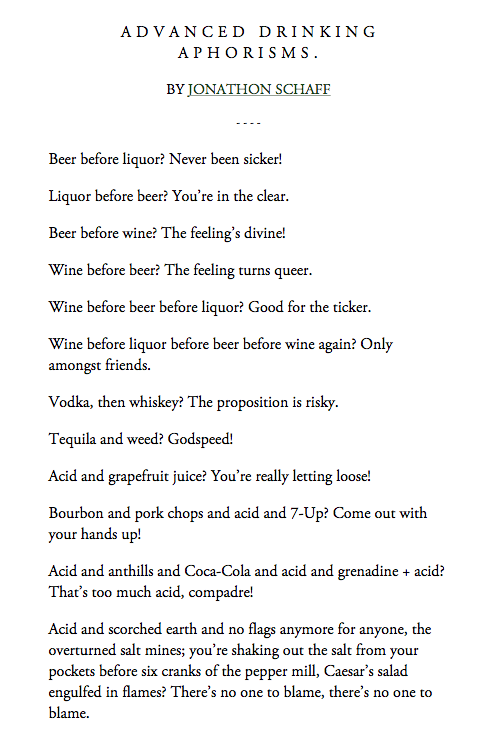
Advanced Drinking Aphorisms