Shared posts

14 Mar 07:00

Racism and Frat Culture

by Erik Loomis

DeVotie

Many (most? all?) white fraternities are white supremacist institutions. It’s not just the frat at the University of Oklahoma. And that white supremacist history goes back to their foundation. Robert Cohen breaks this down at History News Network, specifically connecting it to fraternities during the Civil Rights Movement.

The only difference between the racist chants in 2015 and 1961 that I can discern is that the fraternities today seem more inclined to do their chanting in private. At Oklahoma this semester the chant came in what started out as a private fraternity setting (a bus apparently transporting fraternity members from some fraternity-related event). The privacy was, of course, violated by the leaking of the tape of the chant, but clearly the chant was not designed for public consumption. The Georgia chant, on the other hand, was made in public, at a segregationist rally at the campus historic archway entrance in January 1961 at the height of the university’s integration crisis. Some 150-200 Georgia students had just hung a black faced effigy of Hamilton Holmes, who along with Charlayne Hunter, had in January 1961 become the first African American student to attend the historically segregated University of Georgia. The white students first “serenaded the effigy with choruses of Dixie and then sang “There’ll never be a nigger in the ________ fraternity house,” whose various names they inserted. Clearly, UGA students in 1961, operating in a historically segregated university and a segregated college town (Athens, Georgia) did not feel the pressure their 21st century fraternity counterparts do – at racially integrated campuses – to keep their racist displays to themselves. But if the venue was different the racist sentiment and mode of expression were virtually identical.

I mentioned the whole OU incident on Twitter. Historian Kevin Kruse (whose book on housing and white flight in Atlanta is must reading for all of you) tweeted this back at me:

@imillhiser @ErikLoomis Devotie was 1st to die in Civil War. Boarding steamboat, fell in river, drowned. Self-inflicted demise seems fitting

— Kevin M. Kruse (@KevinMKruse) March 9, 2015

Who is this Devotie? That is Sigma Alpha Epilson founder Noble Leslie DeVotie. It should be noted that the frat’s homepage proudly states that of its 376 members that fought in the Civil War, 369 fought for the Confederacy. Again, the white supremacist institution goes back a long time. Anyway, DeVotie, pictured above. He actually was the first person to die in the Civil War. From his Wikipedia page:

He drowned on February 12, 1861, while on duty as chaplain of the Alabama troops. He was 23 at the time of his death. As he was about to board a steamer at Fort Morgan, Alabama, he made a misstep and fell into the water. Three days later his body was washed ashore. He was the first man to lose his life in the Civil War. Even though the Civil War did not begin until April 12, 1861, Alabama had seceded from the Union in January, hence the reason for his being the first casualty.

These are the principles and the kind of competent leader this prominent organization was founded upon.


14 Mar 06:56

"The Cause of Action is Denied as Unintelligible"

by Kevin

"An amusing order," said Matt, who sent me this. Matt, you had me at "Living Soul Chief Asan Manuel Mustafah Fearce W. Yahzoo."

Yahzoo

This comes to us from the Northern District of West Virginia, where yesterday a judge dismissed a petition filed by Mr. Living Soul Chief Asan Manuel Mustafah Fearce W. Yahzoo (hereinafter "Living Soul Chief") on the grounds that she was "unable to determine the legal basis for Petitioner's claims."

He seems to have been asking the court to release everyone under the age of 16 who is currently in the custody of the federal government or any court or state entity within West Virginia. The first two pages of the petition argue that canon law requires it, and he seems to have a point, or at least he would if canon law applied here. The remaining 45 pages list all the officials who are directed to free the aforementioned prisoners.

But he really gets going in the lebellus, described by the court thusly:

Attached to the petition is a second forty-seven page document which is labeled "Lebellus." Forty-five pages of that document are devoted to listing respondents, including President Barack Obama, President George W. Bush, President William Jefferson Clinton, President George Herbert Walker Bush, and individually named members of the 113th Congress, 112th Congress, 111th Congress, 110th Congress, 109th Congress, 108th Congress, 107th Congress, 106th Congress, 105th Congress, 104th Congress, 103rd Congress, 102nd Congress, 101st Congress, 100th Congress, and fifty-five governors.

These people are to be prosecuted for their many crimes—so obviously the guy is not completely crazy—but the trial is apparently to be held in the Vatican, and petitioner seeks $1,666 trillion in damages, all to be paid to the Yazoo Tribe Eternal Living Trust, none of which increases his credibility much. The court found that "Petitioner has not included any facts or [binding] law in support of his cause of action, and the same must be denied as unintelligible."

Living Soul Chief seems to have been representing himself, although as you know lawyers are entirely capable of incomprehensible nonsense too.

So what the hell is a "lebellus"? Good question. This seems to be a misspelling of libellus, which literally means "small book" in Latin but was also used to refer to a variety of legal documents under Roman law. This is one of the (surprisingly) rare examples where Wikipedia has led me astray, because the only kind of libellus it refers to at the moment is "a document given to a Roman citizen to certify performance of a pagan sacrifice, hence demonstrating loyalty" to the Emperor. Basically it was a receipt you could get to prove you weren't a Christian if they came by looking for people to persecute. But according to the Catholic Encyclopedia, the Church later used the same term to refer to "letters of indulgence," which were apparently receipts you could get to prove you weren't a pagan, once the shoe was on the other spiritual foot. So that's nice.

But according to Black's Law Dictionary, which some nerd had sitting around in her office here, libellus was generally used to mean a complaint or petition of some kind, like libellus supplex (a petition to the Emperor) or libellus repudii (if you wanted a divorce). This possibly older sense is obviously what Living Soul Chief had in mind here, though whoever told him to do this was just wasting his time.

The dismissal was without prejudice, although it seems unlikely that an amendment is going to fix things here.

14 Mar 06:52

3D-printed Iron Man gauntlet becomes a kid's awesome bionic arm

by Mariella Moon
It looks like Iron Man's arm, but it's actually a fully-functioning bionic prosthetic for a seven-year-old kid. Electronically wired and capable of moving, it can, for instance, open and close its hand if the user flexes their bicep. The limb was cre...
14 Mar 06:48

Why Spider-Man is a city person.


Why Spider-Man is a city person.

14 Mar 06:48

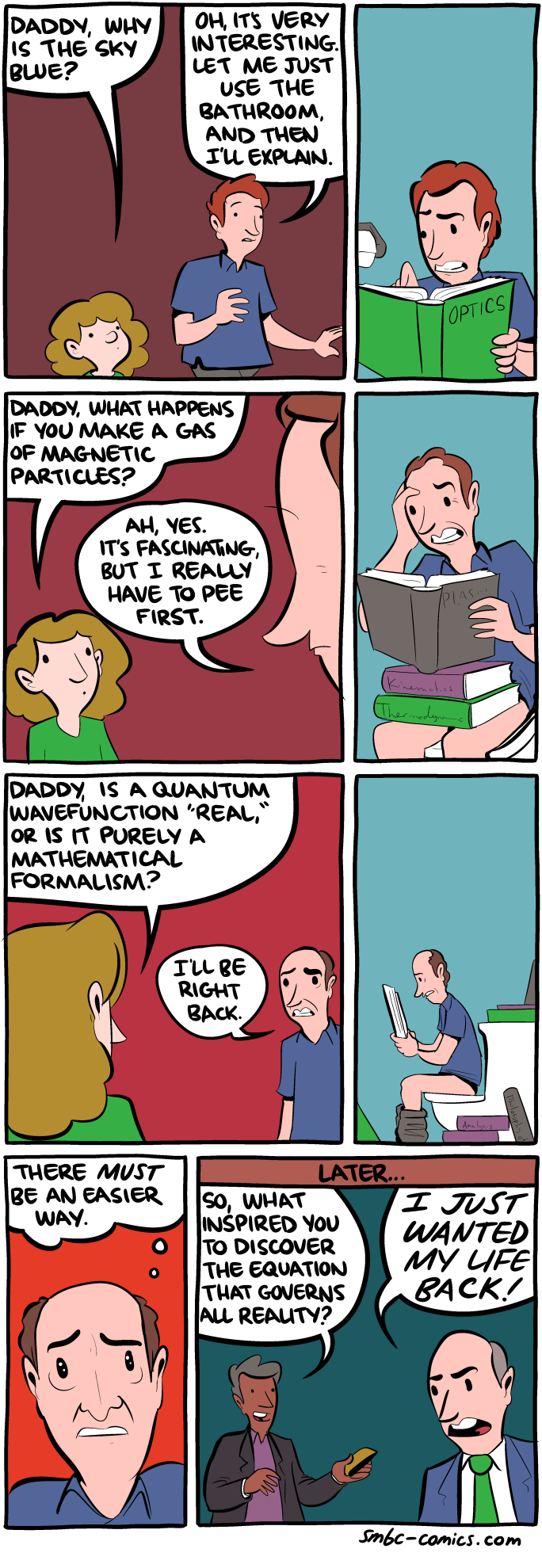
Saturday Morning Breakfast Cereal - Why is the Sky Blue?

by admin@smbc-comics.com

New comic!
Today's News:

 Big announcement, coming Monday!

14 Mar 06:47

The Tragedy of Godzilla

by Doug
14 Mar 06:45

Photo


14 Mar 06:44

“I’m trying to make sure my son stays out of trouble. But he...


“I’m trying to make sure my son stays out of trouble. But he just turned 14, and there’s only so much I can control when I’m not around him. I was coming home from work the other day, and he was getting home from school at the same time, and I saw his group of friends try to grab a lady’s purse. I ran across the street, grabbed them, gave the lady back her purse, and said: ‘I’m sorry. These boys used to be my son’s friends. And I’m calling all of their fathers.’ It embarrassed him. But I told him: ‘If I hadn’t done what I did, you’d be in jail.’”

14 Mar 06:23

Photo


14 Mar 06:21

-teesa-:3.11.15


-teesa-:

3.11.15

14 Mar 06:20

gameraboy: If you’re like me…


gameraboy:

If you’re like me…

13 Mar 03:34

Lindsey Graham: Fascist

by Erik Loomis

Mussolini-balcony-Palazzo-Venezia1-1024x640

It used to be that to call a Republican politician a fascist was rank hyperbole, even if they were right-wingers. But in the 2016 Republican primary, fascism is evidently Lindsey Graham’s strategy:

And here’s the first thing I would do if I were president of the United States. I wouldn’t let Congress leave town until we fix this. I would literally use the military to keep them in if I had to. We’re not leaving town until we restore these defense cuts. We are not leaving town until we restore the intel cuts.

Calling in the military to force Congress to pass a particular program that, not coincidentally, funds the military? That actually is fascism. Good job Lindsey. It’s early in the election cycle as well. Surely this can be topped and some Republican will call for full-fledged military government.

Also, quite the clarification from Graham’s spokesperson:

Graham’s spokesperson has clarified to Bloomberg that when Graham said “I would literally use the military to keep them in if I had to,” that statement was “not to be taken literally.” Glad that’s been cleared up.

Literally.


13 Mar 03:34

TV and Movies I’ve Watched Lately: The Slap, Dear White People, Time Lapse, Tinker Bell And The Legend Of The NeverBeast, Sarah Conner Chronicles, The Hobbit

by Ampersand

neverbeast

The Slap. The first episode of the American TV show made me recall something Gore Vidal once wrote: “Bad books on writing tell you to “WRITE WHAT YOU KNOW”, a solemn and totally false adage that is the reason there exist so many mediocre novels about English professors contemplating adultery.”

But actually, Gore Vidal didn’t say that, Joe Haldeman did. So much for the accuracy of my memory.

Anyhow, the first episode of The Slap is about Hector, a well-off liberal white guy with a great wife and kids and a 40th birthday party which he spends contemplating having an affair with his kid’s 16-year-old babysitter. But I knew that the premise of The Slap is that a guy slap’s someone else’s child in the first episode. So the only thing that made Hector interesting, to me, was that by the end of the episode he would do something completely uncharacteristic for someone of his personality and class position, and slap another person’s child.

But then it turned out that the slap wasn’t delivered by him; it was delivered by his boorish right-wing stereotype cousin Harry. (I warned you there’d be spoilers.) So, in fact, there is absolutely nothing interesting about this dude in whose tedious P.O.V. I’ve just spent forty minutes trapped.

Anyhow, boorish right-wing stereotype Harry slaps the bratty, undisciplined child of self-righteous left-wing stereotypes Gary and Rosie.

I’d bet money the writers of the American The Slap are middle-of-the-road liberal Democrats, much like Hector. And it’s just… boring and annoying that their slapper is such a cartoon of right-wingers, and Gary and Rosie are such cartoons of social-justice types. This is the sort of Aaron Sorkinesque crap that makes me sympathize with Conservatives who call liberals smug condescending assholes.

But I kept on watching, because a friend told me that the series features shifting points of view and seeing how different characters view the same events, and I love that kind of stuff. So I watched the second and third episodes, and they were better, largely because they weren’t in Hector’s perspective.

But then I found out that the Austrialian The Slap, on which the American The Slap is based, is available on Netflix. And I starting watching it, and you know what? It’s MUCH better. In the Aussie version, Hector from the start is narcissistic and a bit of dick towards his family, which makes his interest in screwing the babysitter less out of the blue. Harry, while still arrogant, is apolitical rather than right-wing. Every female character is more three-dimensional and distinct than on the US version, and the relationship between lifelong friends Anouk, Aisha (Hector’s wife), and Rosie is shown as being as central to this group of characters as that between cousins Hector and Harry.

One notable difference is that everyone seems less friggin’ rich in the Aussie version. It’s as if American TV producers just can’t imagine a story being interesting if it’s not about rich people.

Conclusion: If you like extended multi-protagonist narratives about how one bad decision can lead to a bunch of bad repercussions for a group of fairly lousy people, check out the Australian version of The Slap.

* * *

Charles and I watched Dear White People, a crowdfunded indie movie, tonight. I enjoyed it; for a political movie about anti-black racism, it was surprisingly UN-idealogical, as all the main characters ended up having to shift away from pat ideologies at one point or another. In fact, if there’s an underlying ideology in this film, it’s the director’s beliefs that Black people’s stories are interesting and worth telling. The actors were fine (lead actress Tessa Thompson, from Veronica Mars, was especially good). The story wasn’t the greatest; the script was sometimes self-indulgent (the movie theater bit was out of character and felt like sketch comedy), and the supporting characters felt more like plot drivers than characters. But the central four characters were all fun to watch, and the film’s refusal to accept simple answers to anything was refreshing.

Passes the Bechdel test by a hair – there are two lead female characters, and they talk at least once about something other than a man. But although two of the four lead characters are female, there’s a default-male trap that the director falls into; every significant supporting character in this movie is male.

* * *

I love low-budget sci-fi that has to rely more on a clever script than on special effects. I also love time travel movies. So no surprise I watched Time Lapse, a low-budget suspense movie about three roommates who discover that a camera pointed at their living room window takes pictures of what will be going on in their apartment 24 hours in the future.

The writers are clearly Hitchcock fans; the characters try to use the camera to take control of their lives (by getting wealthy by betting on sports, for example), but very quickly it seems as if the camera might be controlling them instead, and things spiral out of control. The plot gets enjoyably convoluted, seemingly irrelevant details from early in the film turn out to be crucial, and disaster looms. I enjoyed it.

The comparison to Hitchcock doesn’t do Time Lapse any favors. No one can expect first-time filmmakers on a tiny budget to be able to approach Hitchcock’s stunning cinematography, but watching this made me appreciate how expert Hitchcock was at making characters distinct and full of blood and nuance, even when they’re just there to drive the plot along. That doesn’t happen here. And sure, these actors aren’t Jimmy Stewart and Grace Kelly, but neither the script or direction gives the actors a chance to play full characters.

Also, from a feminist perspective, this movie isn’t offensive, but it sure ain’t great – the one major female character’s participation in the plot is mostly kissing one boy or the other, and her love life seems to be her only interest.

So: A fun time-travel thriller, but one that is probably too flat to be memorable. I liked it, but I bet their next movie will be better.

I’m pretty sure this fails the Bechdel test. There are only two female characters (one very minor), and they’re never on screen together.

* * *

I watched Tinker Bell and the Legend of the NeverBeast with the girls (Maddox and Sydney, now aged 9 and 11).

First of all, gotta say this for the Tinker Bell series of movies – a Disney powerhouse that mostly stays below the radar but is hugely profitable – every Tinker Bell movie passes the Bechdel test with flying colors. But this newest installment in the franchise is definitely tenser, darker and more gut-wrenching than the previous Tinker Bell movies (not a very high bar to clear, admittedly).

It was really good! The animation was good enough to be expressive and enjoyable, and to bring in some good visuals (but very basic! Don’t expect any million-dollar “Brave” hair animation here), and grown-ups will find the story familiar. But sometimes it’s fun to watch a well-done version of a familiar tale! And the character design of the NeverBeast – borrowing from both Where The While Things Are and Studio Ghibli, I think – is gorgeous (the spiral patterns on its fur work really well when animated).

I’d recommend that anyone with a 7-12 year old friend sit down and watch this with them. Especially animal lovers. But if your friend (or you) is susceptible to tear-jerkers, you’d best have tissues handy for the ending.

Trivia: Tink’s voice actor, Mae Whitman, was also the voice of Katara in “Avatar: The Last Airbender,” and played Ann Veal on “Arrested Development”, so if her choice of roles say anything about her she must be a neat person.

* * *

Speaking of time travel narratives, I’ve been rewatching the two seasons of Terminator: The Sarah Conner Chronicles. A very underrated show that started out well and got smarter and deeper as it went along; I wish it had lasted longer, although at least the second season ends at a decent story-ending point.

Another easy Bechdel-test passer, although I wish there had been more than two significant non-white characters.

* * *

I saw the most recent Hobbit movie. Helped, perhaps, by my ultra-low expectations, I had fun. It was pretty, the landscapes were very pretty, the special effects were nice, a great group of actors, some of the fight scenes were well done in American blockbuster style. It didn’t feel as bloated and annoying as the second Hobbit movie.

It was all very… competent. If you enjoy seeing expert setbuilding and makeup and costuming, there’s a lot to enjoy here. But what a steep decline from how good the Lord of the Rings movies were (and those were far from perfect).

It did pass the Bechdel test, perhaps, but only barely – the Elf lady may have spoken to the little human girls about fleeing the burning city while they were, well, fleeing the burning city. Lots of “oh, the cowardly male character is wearing a dress, how hilarious” humor that stopped being funny sometime in the 1990s, I think.

* * *

So what have you watched lately?

13 Mar 03:27

RIP, Sir Terry Pratchett

by tengrain
Giants once walked amongst us, and few were more funny and insightful than the author Terry Pratchett, who died today at age 66 (much, much too young) from Alzheimer’s disease. Truth be told, ol’ ‘Grain preferred reading Pratchett over Douglas … Continue reading →
13 Mar 03:27

Alcohol Doesn’t “Fuel” Racism

by bspencer


Parker Rice of OKU apologized for his racist chants. An excerpt:

“I know everyone wants to know why or how this happened. I admit it likely was fueled by alcohol consumed at the house before the bus trip, but that’s not an excuse.”

Right, it’s not. Alcohol doesn’t fuel racism. That’s why you’ll never hear someone say “Oh man, I was so wasted last night I threw up on my date and started hating the Jews.” Alcohol does not cause racism, it only reveals it.


13 Mar 03:26

Press Release: U.S. Sex Worker Rights Activists to Advocate Before UN Human Rights Council

by bppp

March 12, 2015

FOR IMMEDIATE RELEASE

CONTACTS: Geneva team- Monica Jones 602-575-9332, J.M. Kirby: jm.kirby@law.cuny.edu;

United States- Janet Duran- 973-900-4887, Penelope Saunders- 917-817-0324, penelope.saunders@gmail.com


U.S. Sex Worker Rights Activists to Advocate Before UN Human Rights Council

Advocates Call for Justice as the UN Reviews the U.S. Human Rights Record

Geneva- Representatives of U.S.-based sex worker rights organizations will travel to Geneva, Switzerland next week, March 15-21st, to meet with members of the United Nations Human Rights Council (HRC), and to call for greater human rights protections. As the HRC prepares for a review of the U.S.’ human rights record later this spring, civil society organizations from throughout the U.S. are traveling to Geneva to educate members about violations of civil, political, economic and social human rights in the U.S.

For Monica Jones, a human rights advocate and transgender woman of color from Phoenix, AZ, the issues she will raise while in Geneva have directly impacted her own life. The target of discriminatory police profiling, Monica Jones was wrongfully arrested under an anti-prostitution police sweep program in Phoenix, called Project ROSE. After a long fight and an appeal, a judge dismissed Monica Jones’ charges earlier this month. However, like many transgender and gender non-conforming people of color, she is threatened by regular harassment by police, who use anti-sex work laws to intimidate and harm members of communities already vulnerable to discrimination. “As long as the police can target my community using these anti-sex work laws,” Ms. Jones notes, “we will never be safe from violence, including the violence of incarceration.”

Sex worker rights advocates participated in the prior review of the U.S. via the UN Universal Periodic Review (UPR) process, through which countries’ human rights records are submitted to scrutiny every four years. As a result, the U.S. adopted Recommendation 86, obligating it to increase human rights protections for sex workers. In advance of the review this year, advocates with Best Practices Policy Project, Desiree Alliance, and Sex Workers Outreach Project-NY submitted a report to the HRC, demonstrating that the U.S. has failed to live up to the promises of Recommendation 86.

The report, written in consultation with sex workers and their allies throughout the country, shows that criminalization and stigmatization of sex workers, and those profiled as such, exposes them to rape, extortion, assault, harassment, and discrimination at the hands of law enforcement. Criminalization and stigma can also lead to denial of housing, healthcare, parenting and other reproductive rights, education, incomes, and employment. The report demonstrates that the legal system frequently fails to recognize that sex workers can be victims of crime, and thus denies justice or support to sex workers who seek help. At a recent civil society meeting organized in advance of the UPR by the U.S. State Department, New Jersey Red Umbrella Alliance member Janet Duran told officials that “most of the violence [sex workers] fall victim to is at the hands of the very people who should be protecting them.”

Advocates are concerned that the U.S. exports stigma and discrimination through policies such as the “anti-prostitution loyalty oath” attached to development funding. “We will ask the world to hold the U.S. accountable for making sex workers vulnerable to human rights abuses,” said J.M. Kirby of the Best Practices Policy Project. “Our country should be promoting human rights for all, including sex workers, not shaming people because of the work that they do.”

###

13 Mar 03:26

Art-Minded Feminists Become Wikipedians for a Weekend

by Sarah Cowan
The Art+Feminism 2015 Wikipedia Edit-a-thon at Babycastles (all photos by the author unless otherwise noted)

The Art+Feminism 2015 Wikipedia Edit-a-thon at Babycastles (all photos by the author unless otherwise noted)

When Shulamith Firestone wrote in 1970, “Feminism, when it truly achieves its goals, will crack through the most basic structures of our society,” she couldn’t have predicted she was referring to Wikipedia.

Although it’s user-driven, and so still not considered a scholarly source, Wikipedia has become an undeniable part of the status quo since its creation in 2001 — it’s the seventh-most visited site on the internet. Though there had long been speculation about gender disparity on the site, the first study to measure the gap wasn’t conducted until 2010, and the results were dismal: only 8.5–16% of editors on Wikipedia are women, with just 1% transsexual or transgender. As of this writing there have been no official studies on multicultural participation and representation on the site. Perhaps the largest hurdle to gathering such data is that it takes being well versed in Wikipedia to do so.

(via Wikipedia)

(image via Wikipedia)

At first glance Wikipedia’s fundamental rules appear fairly progressive: every editor is a volunteer, except for a handful of paid employees of the Wikimedia Foundation, and though there are hierarchies of editors with ascending administrative privileges granted through collective nomination, any reader of Wikipedia can also be an editor by simply creating an account. Once signed in, users have access to “talk pages,” spaces rife with commentary, where debates over articles rage and objections to entries arise. There is strong opposition to the idea of “ownership,” whereby any one person or group can guard a page from collective editing, and by the sheer size of the community, the site is equipped with checks and balances that keep the content relatively neutral and anonymous. In this world where aperspectivity veils individual efforts, blame is hard to place and activism difficult to spot.

Without top-down organization, the Wikimedia Foundation has no power over who uses the site or how, so its attempts to close the gap involve funding independent initiatives. Two of its grants have gone to a group called Art+Feminism, which began organizing Wikipedia edit-a-thons last year, creating real-life spaces where one like-minded community — in this case artists and feminists — meets, plays, and becomes another: Wikipedians. The group hosted their second annual event last weekend on the occasion of International Women’s Day, with the Museum of Modern Art (MoMA) serving as the flagship location and over 75 satellite events taking place across the globe, from Russia to New Zealand. Over the course of the weekend, 334 new articles were added to Wikipedia, with edits and additions to countless others.

The Art+Feminism 2015 Wikipedia Edit-a-thon at the Museum of Modern Art

The Art+Feminism 2015 Wikipedia Edit-a-thon at the Museum of Modern Art

On Saturday, every horizontal surface in MoMA’s education center was covered with a laptop, each one brought by the more than 200 people who devoted their time to the project for the day. Though there were snacks and the occasional distraction of the free childcare programming, the look and feel was that of a college library during finals, though the crowd represented a much a wider age range. On Sunday, Babycastles, an indie video game collective with a DIY venue on 14th Street, provided a sharp contrast to the view overlooking MoMA’s snow-covered sculpture garden; there the setup was more informal, with tables arranged around Aram Bartholl’s photogenic, disorienting sculptures of oversized hands holding iPhone-shaped frames. Comfortably at capacity throughout the day, each folding chair was vacated at the same rate it was filled, all amid handmade arcade machines.

“I think it’s important for consciousness-raising,” said Siân Evans, a co-founder of Art+Feminism. “There’s a feeling here of solidarity, and that’s the way in which this is like an activist project. That kind of momentum does require to some degree in-person.”

Another Art+Feminism co-founder, Jacqueline Mabey, took a moment out from checking in participants to explain the urgency of the event’s focus: “Wikipedia is a site of contestation because it appears in the top five Google search results, and because it has creative commons licensing its content gets pulled into other places. So absences there are going to matter because they get multiplied across the internet.”

Indeed, it’s not just among Wikipedia’s editors that women are underrepresented; the content on the site reflects the same disparity. At MoMA the previous day, volunteer Jason Smith had noted how deeply skewed Wikipedia’s measures of importance are. “There is an article on every single submarine ever built. There is a full article on every single plane ever built. There’s an article on every single porn actress who ever won anything, but a children’s book author — that will get marked for deletion because it’s not considered important.”

Ari Spool, who organized the Babycastles event, explained, “I don’t know a lot of people who actively edit Wikipedia or are involved in the Wikipedia community, but I do know a lot of researchers and artists. I think artists are natural archivists of work they’re interested in. So extracting their knowledge base from their heads can fill in a lot of holes.”

A task list at MoMA (click to enlarge)

A task list at MoMA

Despite varying demographics, what seemed to bind both the MoMA and Babycastles groups (beyond wifi) was that everyone I spoke with was an amateur, having just made a Wikipedia user account for the event. At the museum, basic trainings were being held every half hour in a lecture room, and volunteers roamed the tables to offer individualized advice. First-time-editor Lucy Drummond was excited to create a page for artist Camille Henrot, while Karen Landman was “beefing up” Elaine de Kooning’s entry. Participants at Babycastles were encouraged to work on articles about women scientists as well as artists, and a list of female Japanese video game music composers had been added to the tasks for the day.

Beth Gollnick, who is writing a dissertation on women in Light and Space art, was adding to an already-existing page on Mary Corse when I stopped to talk to her. As a scholar, she sees Wikipedia as an important gateway for research. “I’m already trying to make sure these artists are getting recognition for the work that they did,” she said, “In some ways it is recuperative, the information is there, but what information is easily accessible determines who gets worked on, who gets attention.”

In a sense, that’s the reverse of Wikpedia’s goal. Given that everyone I met was a self-professed feminist, the consciousness-raising at the event had less to do with politics than navigating the site’s rules and regulations, which struck many as unintuitive. Reading through those pillars with a more critical eye, lines like, “We strive for articles that document and explain the major points of view” supported by “reliable, authoritative sources,” as well as the convoluted notability and conflict-of-interest guidelines, are strikingly contradictory to a feminist perspective. Feminism has historically valued the networks and personal, lived experiences that give underprivileged members of society a voice. If objectivity and neutrality are the goals, a feminist initiative will casually undermine that along the way. Many of the participants who attend these events may be viewed on the site as amateurs, but are experts offline in a way as yet unrecognized by Wikipedia guidelines, and by proxy, by the dominant culture. (Ironically, MoMA has been shown to have an abysmal gender gap in its collection, but if Gollnick’s thinking is correct, the Wikipedia additions could convince art institutions to make parity the priority it clearly isn’t today.)

2015 Art+Feminism Wikipedia Edit-a-thon volunteers at MoMA (image via Wikipedia)

2015 Art+Feminism Wikipedia Edit-a-thon volunteers at MoMA (image via Wikipedia) (click to enlarge)

“One of Wikipedia’s rules is that there are no hard and fast rules,” said Marcea Decker, a volunteering Wikipedian and a member of the organization FemTechNet. “It’s dynamic and ever-changing, and especially because it tries to be a democratic platform that mediates decisions through discussion, there’s a lot of room to challenge these pillars that do have structurally biased flaws within them. I think that these efforts, maybe not explicitly but indirectly, put those pillars to the test. Are these really the best practices for Wikipedia?”

At MoMA the graffiti artist Lady K Fever was at work writing her own page (she had been listed as one of the artists to be added for the day.) Though that might set off conflict-of-interest alarms for Wikipedians, a lightbulb was turning on for her. “As women we are always thinking about our place in history,” she said. “What do we have to do to be legendary, to be written into the history or the herstory of the world? Knowing that you have to have references to be notable, it makes me want to accomplish more.” A younger woman shyly chimed in from across the table, “And you don’t just want to be important for being ‘good for a girl.’” The whole table was listening now, nodding. “I had to work hard to get outside the all-female graffiti world,” said Lady K Fever. “The society would like us to only paint with each other.” But when I asked if they felt titling the event “Art+Feminism” pigeonholed them as women rather than simply artists, they all agreed: “No, that feels good.”

The Art+Feminism 2015 Wikipedia Edit-a-thons took place at the Museum of Modern Art (11 W 53rd Street, Midtown East, Manhattan) on March 7, 11am–5pm, at Babycastles (127 W 14th St, Chelsea, Manhattan) on March 8, 1–7pm, and at other venues around the world throughout the weekend.

13 Mar 03:26

Incessant Sewer-Dweller LegalMatch Has A Cunning Plan To Get My Business

by Ken White

Late yesterday I saw a new email in my inbox. The subject line caught my eye:

Son under indictment

A new case? One never knows. I opened it.

I found not a new client, but an old friend: one Steve Kramer of LegalMatch, a "service" that purports to help match clients to lawyers. I've written before about emails from Steve Kramer and LegalMatch in unflattering terms. For reasons I cannot recall I previously did not name them; I referred to them with thematic accuracy as Feculent Q. Pus-Crust of the Society for Cornholing Unsuspecting Children. I'm naming them now.

Feculent — pardon me, Steve — has continued to spam me even after threatening me with litigation for criticizing him and even after I reminded him that he was spamming someone he had previously threatened.

Here are some of the email subject lines Steve Kramer has sent over the last two years:

Son under indictment (3/11/15)

My son has been charged with statutory rape (11/25/14)

intent to distribute (11/13/12)

felony arrest (1/4/12)

No, Steve Kramer's son is not — so far as I know — a one-man crime wave. Rather, Steve Kramer and LegalMatch use deceitful clickbait email subjects to get lawyers to look at their spam. As his latest says:

Ken

Let me know whether the following snap shot of some of our recent financially capable LA area criminal defense clients looks like a fit.

Cordially,

Steve Kramer
For Legal Match
310-990-3026

It's nice that Steve Kramer is so forgiving that he's still first-naming me after I've sassed him and written mean posts about him.

Emails from Steve-O and Legal Match contain a sort of list of client inquiries that consumers have apparently left on LegalMatch.

EX FELON WITH POSSESSION OF FIREARM
BELL, CA 02/16/2015 C154733487378

FREE MY SON
AUGUST F. HAW, CA 02/16/2015 ✔ C154721465270

VIOLATION OF PROVATION
SAN FERNANDO, CA 02/15/2015 ✔ C154646769498

LEAVING THE SCENE OF A ACCIDENT
LYNWOOD, CA 02/15/2015 ✔ C154643116086

2SUSPECTS TRAFFICKING 48LBS OF DRUGS
LOS ANGELES, CA 02/14/2015 ✔ C154536359337

Steve and LegalMatch represent in their solicitation that somehow they have determined that these people are "financially capable" — meaning, I guess, that they can afford to hire a lawyer. In any litigation I look forward to discovering what methodology they used to evaluate the assets of the "violation of provation" guy. They also represent that these are "criminal defense clients." Yet the emailed lists includes entries like this:

FREON EXPOSURE WORKING AT GENERAL DYNAMICS 80'S.
WALNUT, CA 02/09/2015 C154071310246

Perhaps this person has been criminally charged with exposing himself or herself to freon at General Dynamics in the 1980s. I presume they will explore a statute of limitations defense.

LegalMatch views its system — where people describe their cases, to be reviewed by potential lawyers — as a service to the lawyer-seeking community. Whether it is also a boon to the law enforcement community remains to be seen. It encourages customers to leave entries like this one in the most recent solicitation email:

ACCUSED OF MURDER OCCURRED IN SELF-DEFENSE ROLLING HILLS ESTATES, CA 02/10/2015 ✔ C154102776952

Who read that? Well, apparently, any LegalMatch lawyer with access to that client database, and any prospective LegalMatch lawyer to whom Steve Kramer sent the email. All of those people now know that there is a person accused of murder in or near Rolling Hills Estates, California, in February of 2015, who says they did kill the person but did so in self-defense. Did they get legal advice before making that disclosure? Did they think that the disclosure would be kept confidential? Did they know it would be sent out in spam emails? Would a court treat such an entry as privileged, despite how recklessly it is being bandied about? Is LegalMatch certain that it didn't sent this information to anyone with connections to the victim, or the victim's family's lawyers, or the prosecutors, or the investigating officers, or the media? Do you think that — assuming this is a real case — the media would be interested in hearing that the accused was admitting to having killed the victim but was asserting self-defense?

Of course, if that entry is entirely fabricated, I suppose it's not so much an amoral and reckless disclosure by LegalMatch as it is false advertising.

I've written to Steve Kramer, LegalMatch's press office, and their general counsel asking some questions.10 Among them is this question — does LegalMatch think that it is not bound by the CAN-SPAM Act, which (as LegalMatch's blog will tell you) prohibits misleading subject lines and requires clear opt-out-of-this-spam systems?

LegalMatch is not the only turd in the beclouded punchbowl of the legal marketing community. But, despite vigorous competition, it is one of the oldest, most noisome, and most persistent turds. Steve Kramer has been pestering the unwilling about LegalMatch for years, and LegalMatch has been using sleazy tactics (and promising to improve them) for a decade.

Yet LegalMatch continues to thrive. That means some lawyers out there are paying them. Those lawyers are equally responsible for perpetuating these practices. And the clients — oh, the clients. Citizens, know this: if you hire someone through LegalMatch, you're hiring someone desperate or stupid or cynical enough to accept this bad behavior.

Back in 2012 I told Steve Kramer "Remove me from your spam list forthwith." Perhaps this post will help get results.

Incessant Sewer-Dweller LegalMatch Has A Cunning Plan To Get My Business © 2007-2014 by the authors of Popehat. This feed is for personal, non-commercial use only. Using this feed on any other site is a copyright violation. No scraping.

13 Mar 03:23

John Currin’s Silly Porn-Inspired Portraits Somehow Work

by John Seed
JOHN CURRIN Maenads, 2015 Oil on canvas 48 x 36 x 1 1/4 inches (121.9 x 91.4 x 3.2 cm) Photo by Douglas M. Parker Studio

John Currin, “Maenads” (2015), oil on canvas, 48 x 36 x 1 1/4 inches (all photos courtesy Gagosian Gallery)

LOS ANGELES — John Currin’s bizarre vignettes of feminine allure are bound to arouse some rather rich and complicated feelings in the viewer, and that is a good thing. His current show at Gagosian Gallery in Beverly Hills, his first Los Angeles–area exhibition in 10 years, consists of 11 new oil paintings of invented muses that are magnetic in their beauty and weirdly compelling in their historically inspired, imagined settings.

Working with the confidence of a chef who knows his ingredients well, Currin spices his paintings with references borrowed from high and low culture and leavens them with humor. The most prevalent flavor in Currin’s current stylistic mix is Mannerism, the sensual and decadent “late style” that charmed Venetian aristocrats in the late 16th century, and provided a counterpoint to the previous generation’s fixation on Classicism. In particular, the portraits of Pontormo (1494–1557), a Florentine Mannerist, seem to haunt the delicate features of several of Currin’s invented women. Pontormo’s influence is also apparent in a certain floating, self-conscious langour present in a number of their poses.

Maenads (detail)

“Maenads” (detail)

One painting of a Neo-Mannerist flavor, titled “Maenads,” references the frenzied female followers of Dionysius: “Maenads” roughly translates to “the raving ones.” In Currin’s composition, a nearly nude, auburn-haired beauty with two apples on her knee rocks forward on a tasseled golden pillow. Another woman, who floats behind the right shoulder of the central figure, pleasures herself — or probably pleasures herself — on a billowing cloud of pinkish fabric. A third beauty on the left looks away while possibly helping with the possible pleasuring: Currin teases his viewers, and himself, by obscuring the sexual particulars.

Over the past few years Currin has been working with pornographic imagery, and several of the works on view at Gagosian reveal glimpses of recycled porno painted with an Old Master touch. If “Maenads” seems hard to place in terms of time and culture, keep in mind that Currin has syncretized what you would normally think of as incompatible sources — I get Vogue, Hustler, Pontormo, and possibly the Bed, Bath & Beyond fall catalogue — into a single composition. And somehow it works 

Of course, part of the reason Currin is able to do what he does is that his skills as a painter continue to grow. He has been working on textured canvases, including some with a herringbone weave, and when his work is viewed in person, Currin’s bravura brushwork and ability to render soft flesh, reflective fabrics, and decorative patterns is impressive.

Parmagiannino, Self-Portrait in a Convex Mirror, 1524,  Oil on convex wood panel, 9.6 inches in diameter (LINK TO WIKIMEDIA)

Parmagiannino, “Self-Portrait in a Convex Mirror” (1524), oil on convex wood panel, 9.6 inches in diameter (courtesy Wikimedia)

The inspiration for another of Currin’s striking new paintings — “Nude in a Convex Mirror” — seems to come from another Mannerist: Parmigianino (1503–1540). His remarkble “Self-Portait in a Convex Mirror” was created when the artist was only twenty-one and presented to Pope Clement VII as an advertisement of his talent. Working on a curved wooden panel, Parmigianino used a convex mirror’s distortion to emphasize his pale, pinky-ringed hand: it makes his touch almost available.

Currin’s tour de force uses a similar effect to expand a nude woman’s shapely ass into a stupendous, tondo-filling monument of sensuality. Call it gimmicky if you want, but I found this painting both very funny and very beautiful. In fact, Currin’s paintings are all slightly humorous and silly, as if he wants to remind us that rendering beauty without levity carries the risk of achieving dull, chilly perfection.

 JOHN CURRIN Nude in a Convex Mirror, 2015 Oil on canvas 42 x 42 inches (106.7 x 106.7 cm)

John Currin, “Nude in a Convex Mirror” (2015), oil on canvas, 42 x 42 inches

Mannerism works for Currin because it is an aristocratic style that favors invention. In a certain unexpected way, Mannerist distortion has also brought out a Picassian aspect in Currin’s work. Looking over the massive buttocks of “Nude in a Convex Mirror,” I was reminded of a talk I heard by Françoise Gilot, the mother of two of Picasso’s children. She recounted that Picasso often had dreams in which women and parts of their bodies became very large or very small. The exaggerated eroticism of Currin’s callipygean tondo suggests that a new direction for his work might be to follow Picasso’s lead and use distortions of scale for more expressive purposes.

In contrast, Currin’s painting “Altar,” which shows us a single woman with a suggestively placed hand, is more optically conventional. It is also peculiar: the figure’s improbable acorn-shaped fabric hat adds quirk to what might otherwise come across as a rather dated piece of soft-core erotica. The work succeeds somewhat better as an allegory of painting as a form of mental masturbation.

JOHN CURRIN Altar, 2015 Oil on canvas 40 x 28 x 1 1/4 inches (101.6 x 71.1 x 3.2 cm)

John Currin, “Altar” (2015), oil on canvas, 40 x 28 x 1 1/4 inches

“Altar” is a sweet and sour picture and it brings up an issue often raised by the acrid humor in Currin’s work: he frequently treats his subjects of both sexes with a measured contempt. This invariably has the paradoxical effect of making the works more appealing, and in the case of Currin’s current paintings of women, it makes their saccharine sweetness tolerable.

Taken too literally, it may be easy to find things to dislike about this show. Some might argue that Currin is just another in a long line of men who objectify women for their own purposes. Then again, it is important to realize that Currin paints from his imagination, and seeing these women as “real” in any way leads down the wrong path entirely. While products of an artist’s erotic musings, the works are pure inventions, drawing viewers into a rich conversation with unexpected fusions of high and low culture.

John Currin continues at Gagosian Gallery (456 North Camden Drive, Beverly Hills, California) through April 11. 

13 Mar 03:10

A Yo' Momma Contest Betwixt an Edgy Teen and the Godfather of Psychoanalysis

13 Mar 03:09

When someone looks at my clothes/hair/makeup and tells me, "It's not Halloween anymore."

13 Mar 03:08

asylum-art:Lana Crooks: These Objects Are All Made From The Same...


asylum-art:

Lana Crooks: These Objects Are All Made From The Same Unexpected Material

on Etsy | Flickr | Instagram | Facebook

At Modern Eden Gallery

Lara Crooks is an incredibly talented artist who makes marvelous pieces out of dyed wool. They all look so amazing and unique that it’s hard to believe they’re all made from the same material. It’s crazy to see such a soft material look like something so hard and realistic as human bones, but Crooks makes it possible. 


13 Mar 03:08

dagothar:twin-city-ankh-and-morpork:Sir Terry Pratchett, 28...


dagothar:

twin-city-ankh-and-morpork:

Sir Terry Pratchett, 28 April 1948 – 12 March 2015

“DON’T THINK OF IT AS DYING, said Death. JUST THINK OF IT AS LEAVING EARLY TO AVOID THE RUSH.”  

Art by Paul Kidby

Sir Pratchett, it has been an honor.

13 Mar 03:06

posting about how sad i am that terry pratchett is gone required...


posting about how sad i am that terry pratchett is gone required me to accept that terry pratchett is gone, and i’m only barely able to do that now.

thank you mr. pratchett

13 Mar 03:06

Photo


13 Mar 03:05

Andromeda, oil on canvas, 50x50cm, 2013 zeynep beler


Andromeda, oil on canvas, 50x50cm, 2013

zeynep beler

13 Mar 03:04

Photo


13 Mar 03:02

Scientists make strides in beaming solar power from space

by Andrew Tarantola
The idea of powering humanity by gathering an endless supply of solar energy from space has taken a huge step towards becoming a reality. Scientists working for JAXA, Japan's space administration, have announced a major breakthrough in wireless power...
13 Mar 03:01

trashxe:chantillyxlacey:please do not participate in that whiteout garbage tomorrowplease do not...

trashxe:

chantillyxlacey:

please do not participate in that whiteout garbage tomorrow

please do not participate in that whiteout garbage tomorrow

please do not participate in that whiteout garbage tomorrow

please do not do it

if I see ANYONE participating in white out your ass will be unfollowed and blocked so fast.

(I ain’t saying white ppl cant post selfies tomorrow, just don’t do it in support of #whiteout)

Spreading the word. When I first heard about the whiteout nonsense, I thought it was a joke. But no, I was disappointed. Now I am disappointed for other reasons.

13 Mar 03:00

Vertical Forest: An Urban Treehouse That Protect Residents from Air and Noise Pollution

by Kate Sierzputowski
© Beppe Giardino

© Beppe Giardino

A potted forest of trees and branching steel beams disguise this 5-story apartment building in Turin, Italy. Designed by Luciano Pia, 25 Verde brings plants up off the ground in an attempt to evade Turin’s homogeneous urban scene and integrate life into the facade of the residential building.

The undulating structure creates a transition from outdoors to in, holding 150 trees that absorb close to 200,000 liters of carbon dioxide an hour. This natural absorption brings pollution protection to its residents, helping to eliminate harmful gasses caused by cars and harsh sounds from the bustling streets outside. The trees’ seasonal progression also creates the ideal microclimate inside the building, steadying temperature extremes during the cold and warmer months. The plants’ full foliage block rays of sun during the summer while letting in warm light during the winter.

The building holds 63 units, each benefiting from the terraces and vegetation just beyond their windows and walls. Each species of plant has been chosen purposefully from deciduous plant life in Turin to provide the highest variety of color, foliage, and blooming. This innovative design provides a childlike dream while also instilling real world benefits to those who live in this urban treehouse. (via Divisare)

© Beppe Giardino

© Beppe Giardino

© Luciano Pia

© Luciano Pia

© Beppe Giardino

© Beppe Giardino

© Beppe Giardino

© Beppe Giardino

© Beppe Giardino

© Beppe Giardino

© Beppe Giardino

© Beppe Giardino

© Beppe Giardino

© Beppe Giardino