Shared posts

05 Apr 06:19

Great Job, Internet!: An Instagram user is making junk food look high end

by Caroline Siede

“Small portions. Tweezered everything.” That’s the description of this new Instagram account that makes junk food look like high end dining cuisine. Under the username Chef Jacques Lamerde (which translates to Chef Jack Shit), this Picasso of processed portions turns everything from SpongeBob SquarePants macaroni and cheese to Hungry Man frozen dinners to Pop-Tarts into intricately plated masterpieces.

05 Apr 06:16

Today In Mass Incarceration

by Scott Lemieux

I don’t condone the behavior of the Atlanta teachers and administrators who cheated on high-stakes tests, although I also think that the cheating was foreseeable given the incentives (and this can’t be an isolated case.) But this is a classic case of vastly disproportionate punishment:

On their eighth day of deliberations, the jurors convicted 11 of the 12 defendants of racketeering, a felony that carries up to 20 years in prison. Many of the defendants — a mixture of Atlanta public school teachers, testing coordinators and administrators — were also convicted of other charges, such as making false statements, that could add years to their sentences.

Judge Jerry W. Baxter of Fulton County Superior Court ordered most of the educators jailed immediately, and they were led from the courtroom in handcuffs. Judge Baxter, who presided over a trial that began with opening statements more than six months ago, will begin sentencing hearings next week.

Hopefully the sentences won’t reach 20 years, but the fact that they were sent to prison immediately suggests that many years of hard time will be involved. It strikes me that more than token jail time for this offense is absurd, particularly in a country where the de facto punishment for torture and economy-destroying financial fraud is “nothing.”


05 Apr 06:15

pervocracy:What I Mean When I Say I’m Sex-PositiveI think freedom of sexuality is something that we...

pervocracy:

What I Mean When I Say I’m Sex-Positive

  • I think freedom of sexuality is something that we all need and very few of us have
  • I think sexual pleasure is a legitimate thing to want and ethically pursue
  • I do not judge people for the (consensual) sex that they have or want
  • I will not tolerate slut-shaming
  • I will not tolerate hatred of people based on gender or orientation (including asexual)
  • I will not tolerate hatred of sex workers
  • I believe comprehensive, honest, non-judgmental sex education is necessary for public health and happiness
  • I think understanding of sexual consent—what it is, why it matters—is sorely lacking in society and crucially important
  • I reject preconceptions of what kind of sexuality a person should have, whether these preconceptions are based on gender, age, culture, disability, survivor status, or basically anything else
  • I value people’s individual freedom of choice in determining their sex lives (including the choices not to have sex)

What I Don’t Mean

  • Everyone should have sex
  • Everyone should have kinky, non-monogamous, exhibitionistic, pansexual sex
  • Accepting someone’s sexuality means you have to participate in it, watch them engage in it, or hear about it in detail
  • Nothing related to sex is ever hurtful for anyone
  • Feminism should be all about sex
  • Sex fixes everything
05 Apr 06:15

Why Women Don’t Negotiate Their Job Offers

Why Women Don’t Negotiate Their Job Offers:

misandry-mermaid:

In repeated studies, the social cost of negotiating for higher pay has been found to be greater for women than it is for men. Men can certainly overplay their hand and alienate negotiating counterparts. However, in most published studies, the social cost of negotiating for pay is not significant for men, while it is significant for women.
The results of this research are important to understand before one criticizes a woman — or a woman criticizes herself — for being reluctant to negotiate for more pay. Their reticence is based on an accurate read of the social environment. Women get a nervous feeling about negotiating for higher pay because they are intuiting — correctly — that self-advocating for higher pay would present a socially difficult situation for them — more so than for men.
But here’s a twist: we love it when women negotiate assertively for others. It’s just when women are negotiating assertively for themselves — particularly around pay — where we find a backlash. Unsurprisingly, research also shows that women perform better (e.g., negotiate higher salaries) when their role is to advocate for others as opposed to negotiating for more for themselves. Men’s behavior and the ensuing social effects don’t shift much depending on whether they are advocating for themselves or others.
05 Apr 06:14

unite4humanity:He gets it.


unite4humanity:

He gets it.

05 Apr 06:13

timblywimbly: This scene is one of the funniest things I’ve...


timblywimbly:

This scene is one of the funniest things I’ve seen

04 Apr 22:10

jumpingjacktrash:i think a lot of us, when we’re growing up, we learn kind of the opposite of...

jumpingjacktrash:

i think a lot of us, when we’re growing up, we learn kind of the opposite of self-care. a kind of self-disregard, if that makes any sense.

especially those of us who have invisible disabilities, we needed extra rest or extra help or something different from other kids, but not only did we not get it, we were made to feel greedy or lazy for needing it. so we internalized that, and we grew up with this feeling that having needs is weakness.

hands up if you were shocked to discover that not everyone goes through life being exhausted and hungry and strung out all the time. o/

for the longest time i just thought everyone else was better than me at hiding the fact that they were constantly in pain and sleep deprived.

04 Apr 22:10

Comic for April 02, 2015

04 Apr 22:09

Encyclopedia Brown and the Case of the Biblio-bully

by Kerry

Our submitter, Lee, says he recently went to the library in search of some subjects for drawing practice. While browsing the botany section, he flipped open a particularly old and musty book when suddenly…OH, SNAP!

You have no life b/c you are at a library reading a leaf book.

related: Pages missing (all)

04 Apr 22:09

Reviews on Amazon

04 Apr 22:08

I... Wait, What?

video-games-i-wait-what

Submitted by:

Tagged: wtf , medal of honor
04 Apr 22:07

heroicstrider:theheadphonesmeanidontwanttotalk: This came into...


heroicstrider:

theheadphonesmeanidontwanttotalk:

This came into my work today and it made me really happy, because it’s so perfect and there needs to be more of this.

Just think of the little blind kid who’s just learning to read Braille and they find this and think for the first time that something was made special for them, with them in mind, and here it is telling them that there are others like them and that you don’t need to see to still experience all the joys and beauties of the world. That color can be smelt and heard and felt as much as seen. That you are not experiencing the world in a lesser or incomplete way, but just differently, and difference is beautiful.

Bless this children’s book author from the bottom of my heart. Bless.

ar…

04 Apr 22:02

Photo


04 Apr 22:02

Saturday Morning Breakfast Cereal - Car-Boat

by admin@smbc-comics.com

Hovertext: Now, Subma-Plane, that's a different story...


New comic!
Today's News:

 Do you have yours yet?

04 Apr 21:50

Beautifully Realistic Octopus Fascinators Featuring Tentacles Made From Ringlet Curls

by Rebecca Escamilla

Peach octopus fascinator

Western Australia-based artist Kirstie Williams creates beautiful octopus fascinators out of synthetic hair, paint, and glass eyes. Ringlet curls trail down from the cephalopod-themed hair accessory to form tentacles, creating an imaginative, realistic hair-octopus hybrid.

Her fascinators are available for purchase made-to-order at CuriousCephalopods on Etsy. Williams has generously posted well-illustrated instructions on making a larger wig version.

Yellow octopus fascinator

Purple octopus fascinator

Blue and purple octopus fascinators

Wedding octopus fascinator

WIP octopus fascinator

images via Kirstie Williams

via Apolonis Aphrodesia, Steampunk Tendencies, io9

04 Apr 02:06

Is this a good time to ask a completely ridiculous question?

by Paul Campos

m

Erik’s post about media discourse regarding higher ed is related to an aspect of Steve Solomon’s “is this a good time to go to law school” piece that itself reflects . . . wait, this sentence is getting too complicated.

Why do people ask questions like “is this a good time to go to law school?”

Compare:

Is this a good time to get a Ph.D. in political science?

Is this a good time to go to college?

Is this a good time to get married?

Is this a good time to write a novel?

Is this a good time to buy a house?

All these questions are the same, in that they’re asked at a uselessly high level of abstraction.

Good questions are things like:

Is this a good time to see Jerry Bruckheimer’s new film?

Is this a good time to take Bill Kristol’s advice regarding foreign policy?

Is this a good time to put ketchup on the hot dog I plan to wash down with a vodka “Martini” [sic]?

These questions are specific, and have real, specific answers.


04 Apr 02:05

You were saying something about best intentions

by Paul Campos

pulp fiction

Michael Simkovic thinks I don’t understand how grant-funded research works. He also thinks I criticized him for failure to disclose that the S&M million-dollar degree articles were funded by Access Group and LSAC. I didn’t criticize him for failing to disclose this, since I never claimed these articles was funded in that way:

So great is [Access Group’s and LSAC’s] enthusiasm for these findings that they are, as the intrepid scamblogger Dybbuk reveals, generously funding their further propagation. (emphasis added)

As for how grant funding works, Prof. Simkovic is much troubled by the suggestion that the sources of his funding could affect the character of what I believe are referred to in the relevant literature as “deliverables:”

Frank and I are interested in methodological rigor, not in particular results or outcomes, which in any case are unknowable until after we analyze the data. We believe in maximizing the transparency of the methods we use for our research so that it can be replicated or challenged by future empirical researchers. There has never been any effort by LSAC or Access Group to influence or censor our results.

Yet Prof. Simkovic and his co-author have levied exactly the same criticisms regarding how the funding of research might influence the conclusions reached that I suggested might be applicable to their work:

Two professors at Seton Hall University, Frank Pasquale and Michael Simkovic, have been tracking studies released by Lumina-funded think tanks that criticize federal student lending, which is Sallie Mae’s direct competitor. For example, Lumina has given the New America Foundation, a nonpartisan think tank that focuses on issues ranging from national security to technology, nearly $3 million since 2008… “It’s hard to make sense of a lot of what Lumina is advocating on student loans unless you think of how it would benefit Sallie Mae,” says Michael Simkovic, an associate professor at Seton Hall… There is “no connection at all” between Sallie Mae and The New America Foundation, said Kevin Carey, director of the Education Policy Program at the New America Foundation, who said two of the three studies that criticized federal student loans were funded exclusively by the Gates Foundation.”

A number of recent Brookings studies have been singled out for criticism by academics and others… One study, released in June, analyzed Federal Reserve Board data that tracks student debt and income levels in young households to conclude that typical student borrowers were no worse off now than they were a decade ago and that reports of a student debt crisis may be overblown. The study contradicted arguments from critics of the for-profit student-loan industry… Michael Simkovic, a visiting associate professor of law at the University of North Carolina at Chapel Hill and an expert on lending issues, said that if Brookings’s reports on student debt were to dictate policy, they would “boost the profits of the student lenders like Sallie Mae.” Critics pointed to a potential tie between Brookings and the lending industry: $1.9 million in donations since 2009 from the Lumina Foundation… Lumina did not underwrite the June study, according to co-authors Matthew M. Chingos and Beth Akers…. Lumina’s director of strategy, Zakiya Smith, said suggestions of meddling were “mind-boggling.”

Prof. Simkovic also says the money from two groups who are, to put it mildly, eager to see certain sorts of results from S&M’s further work is only going toward their salaries, as well as some research costs, so what’s the problem? This is a remarkably naive (to put it charitably) interpretation of what benefit Seton Hall and S&M are getting, respectively, from the grant-funding of this research. Grant-funding of their salaries, or part of their salaries, takes that money off the rest of Seton Hall Law School’s budget, which, given the fact that the school was recently on the verge of laying off its untenured faculty (including, presumably, Prof. Simkovic), adds up to a pretty powerful incentive to come up with the right results at the remains of the day.

But as the quotes from him above illustrate, he understands all this perfectly well, or at least he does when it’s not in his self-interest to forget it. (“It is difficult to get a man to understand something when his salary depends etc.”).

Prof. Simkovic gives some anecdotal examples, off the top of his head, of grant-funded law school research, to illustrate that I supposedly don’t understand how common such research is. My statements in regard to this aren’t made off the top of my head: they are based on studying the budgets of several dozen law schools over the past couple of years. Those budgets reveal that grant-funding, on average, covers a tiny percentage (usually much less than five percent, and often less than one percent) of these schools’ operating costs.

*An amusing side note: Prof. Simkovic doesn’t actually link to LGM, but rather to a PDF of my post. Apparently the landlord who is leasing his cyber-real estate out for Prof. Simkovic’s benefit cannot bear the thought of providing LGM with any link love.

Also, if you laugh at this you’re going to Hell.


04 Apr 01:56

Our Vision of Jupiter Has Sure Changed Through the Years

04 Apr 01:55

What *exactly* is CatholicVote trying to say, here? That queers...


What *exactly* is CatholicVote trying to say, here? That queers are fierce and fabulous? Well, hey, thanks for finally noticing, y’all! 

Be the homosexual rainbow fleece-wearing wolf you want to see in the world. Or bear. Or otter. Whatever. You do you.

04 Apr 01:53

Violence against men is a feminist issue

vixyish:

Wowsers! 

Cats, I’m getting hate mail for a comment I added to an earlier reblog, suggesting that advocacy for male victims of rape & abuse can co-exist with feminism, and that feminists actually want to end violence against men just as much as they want to end violence against women. (No threats, though one person did say that people like me “should be shot”.)

I debated answering these publicly, but they’re not anon, and I don’t really want to drop the internet on their heads. In particular, one identifies himself as a male victim of abuse/rape, and no victim of violence should be attacked or shamed, or declared publicly if they haven’t chosen to tell the story in public themselves.

So instead I will just clarify once again: rape and abuse of men is a feminist issue.

By which I mean, rape and abuse of men is an issue that feminists care about.

The reason men get dismissed or told “you should’ve just enjoyed it” if they are raped or abused is PATRIARCHY. It is patriarchy that tells men that being vulnerable or a victim of violence is shameful because it isn’t “manly”. It is patriarchy that tells men that being “like a girl” is a bad thing. That being beaten up makes them a “pussy” or a “sissy”, especially if the perpetrator of violence is female. That message is everywhere. From body type to sports ability to sexual orientation. Patriarchy is the system that tells women they have to be submissive and sexy, and tells men they have to be dominant and unfeeling, and tells non-binary folks that they flat-out don’t exist.

That’s kinda why feminists would like everyone to be working together on this dismantling-the-patriarchy stuff. Patriarchy harms people of all gender identities.

Men get shamed for seeking help for mental health issues, violence, abuse, and other problems because PATRIARCHY tells them it’s “weak”. 

Feminists don’t want women to be told there’s a right and wrong way to be a woman. We also don’t want men to be told there’s a right and wrong way to be a man.

04 Apr 01:51

(photo by paraselena)


(photo by paraselena)

04 Apr 01:51

(photo via catfun4ever)


(photo via catfun4ever)

04 Apr 01:51

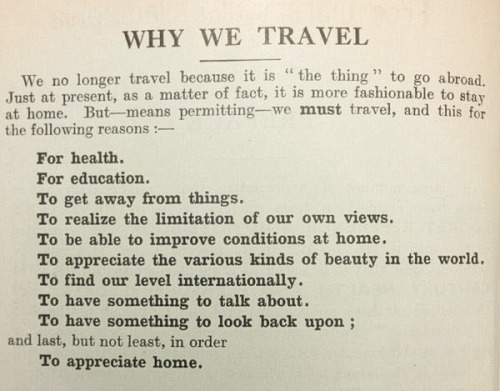
Why We Travel, 1932

04 Apr 01:49

McDonald’s raises its minimum wage–a little

by Marion

McDonald’s announcement yesterday that it is raising the pay of workers at the outlets it owns, although not franchises, still comes as good news to everyone who cares about the plight of low-wage workers.  Everyone should.

But before breaking out the champagne, read these comments from Brandon Weber:

      Five Things to Know About McDonald’s Wage Announcement.

  1. Half a million Walmart workers just won raises to $10—456% more employees than are covered by McDonald’s announcement.
  2. The increase applies only to workers at corporate stores, which means only about 10% of the company’s U.S. workers will see a change in their income. About 1.6 million workers worldwide will get a raise of $0.
  3. Nearly everyone who works at McDonald’s will still get paid less than $10 an hour – not enough to pay the bills. And many will still be making far less. In many places, McDonald’s workers earn the federal minimum of $7.25, which means even those who will see an increase as a result of Wednesday’s publicity stunt will still be stuck trying to support families on $8.25 an hour.
  4. The announcement came a day after McDonald’s and other fast-food workers announced plans for the biggest-ever strike to hit the fast-food industry—a 200-city walkout on April 15.
  5. McDonald’s low wages cost taxpayers more than $1 billion a year. This won’t put a dent in that amount.

Fight for 15 (a minimum wage of $15/hour) is protesting McDonald’s weak announcement today in cities throughout the country.   McDonald’s has taken a tiny step.  It and other employers of low-wage workers need to do more.

03 Apr 18:20

Apollonia Saintclair 563 - 20150403 Le rite de passage (The prom...


Apollonia Saintclair 563 - 20150403 Le rite de passage (The prom night)

02 Apr 20:33

Embroidered Paintings and Historical Photos by Mana Morimoto

by Christopher Jobson

newton

Fiber artist Mana Morimoto spares no medium with her vibrantly stitched embroidery that spans sculptures, installations, weavings, and 2D materials like concert tickets and advertisements. Among my favorite of her works are these embroidered monochromatic photographs and paintings. An etching of Isaac Newton is overlaid with rainbows of light and Morimoto even goes meta by embroidering on images depicting other fiber artists, going so far as mimicking the progress of a weaving on an old photograph. You can explore more of her work in Tumblr, Cargo Collective, and some of her works are available as prints on Society6.

brooklyn

frida

paintings

rushmore

weaving

ainulady

bike

gramaphone

weaving-2

02 Apr 19:25

Fredo and Pidjin

02 Apr 19:24

Progress on the Police-Filming Front

by Kevin

Two or three pieces of good news here. First, the Texas bill that would have made it illegal for you to film a cop beating you (see "Texas Bill Would Make It Illegal for You to Film a Cop Beating You" (Mar. 26)) seems to have been withdrawn by its sponsor, the probably-well-meaning-but-not-too-thoughtful Rep. Jason Villalba. The legislature's site just says "no action taken in committee" on HB 2918 (the bill was scheduled for a hearing on March 26), but there are reports that Villalba decided to drop it completely after the state's largest union of police officers said it would oppose the bill.

Villalba reportedly insisted that he had only withdrawn the bill temporarily because "it's being amended and the hearing [was going to] run very late," but some (specifically, me) are suggesting that in fact he pulled it because pretty much everybody hates it.

Turns out there was already a competing proposal in Texas, HB 1035, which would not only state that recording officers is legal, it would make it illegal for law enforcement to alter, destroy, or conceal a recording of police operations without the owner's written consent. I don't know what that bill's chances are, but would guess they are approximately infinitely better than those of HB 2918.

Second, as Courthouse News reports (also PINAC), lawmakers in both California and Colorado have also introduced bills aimed at protecting the right to film public servants in public. 

California's SB 411, sponsored by Sen. Ricardo Lara, would amend two anti-police-obstruction laws to state that, as long as an officer is in a public place or you are somewhere you have a right to be, taking a picture or making an audio or video recording of said officer "does not constitute, in and of itself, a violation" of those laws. Nor is it probable cause for an arrest on actual obstruction charges, or even reasonable suspicion for a brief detention.

Weirdly, on their face(s) the existing laws seem to punish attempted obstruction more severely than actual obstruction, which seems like a bad idea. That's one area where you don't want to encourage people to finish what they started. Anyway, you shouldn't do either, but the bill would make it clear that a mere recording is not a violation of either law. The first hearing on that bill is set for April 7.

Colorado HB 15-1290, introduced on March 19, is aimed at the same problem but would address it by giving the photographer a right to sue the law-enforcement agency for the violation, and would establish a civil penalty of $15,000 (plus actual damages). It would also make it illegal for an officer to seize or destroy a lawful recording without either permission or a warrant.

These laws shouldn't be necessary, but unfortunately they are. Taking pictures in public isn't obstruction. Obstruction is obstruction. Also, just a suggestion—if you tell me I can't film you in public, no matter what, filming you in public is going to move way up my priority list. Because what you're telling me is, "I'm about to do something ridiculous, illegal, or ridiculously illegal. So don't look." I'm not only looking, I'm deleting all my other videos right now so I have room to get all of whatever you are about to do. So that's how that works.

01 Apr 17:23

Sprawl: Terrible in All Ways

by Erik Loomis

800px-Rio_Rancho_Sprawl

Suburban sprawl is a horrible thing for so many reasons. The environmental impact is enormous, eating up green space, farm land, and habitat. It reinforces racial and class exclusion and de facto segregation. It also externalizes its costs in all sorts of ways with severe impacts on the economy and our lives.

So take this number as more of a starting point than a final answer: A new analysis authored by Todd Litman at the Victoria Transport Policy Institute concludes that sprawl costs the U.S. economy more than $1 trillion every year.

More than half of that, Littman calculates as part of a New Climate Economy research project lead by the London School of Economics, is borne by people living in sprawling places who have to drive more, among other things. About $400 billion of it is borne by other people, in the form of air pollution or traffic congestion, or costlier public services — all of it created not necessarily by consumer demand for big homes and lots of driving, but also by policies in America that encourage and subsidize sprawl.

“An awful lot of auto travel and sprawl is the result of market distortions,” Litman says. He’s talking about policies like the home mortgage interest deduction that encourages large, suburban housing, as well as the fact that we don’t charge people for the true costs of using roads. In a more efficient market, he says, “consumers would rationally choose to own fewer automobiles, to drive less, to rely more on walking, cycling and public transit, and they’d choose more compact home and work locations simply because that really optimizes everybody’s benefits.”

But wait, there’s more!

You can parse the math behind his big number. It doesn’t include the costs in lower social mobility for children growing up in the most sprawling metros. It doesn’t take into account the higher housing costs many families would pay if they moved closer to the city, or the price tag if we built the kind of public transit we’d need to support a denser population. Economic modeling is by definition imprecise — all the more so when we’re modeling a matter like land use that influences everything from the air we breathe to our quality of life.

The other thing about sprawl is that once it is built, it’s almost impossible to fix to turn into a sustainable, dense city. Decent public transportation is probably never going to come to Rio Rancho, New Mexico or Round Rock, Texas because the number of people who can access any given bus or train stop is so few. And while walking core downtowns can be built in these places, one would still have to drive to get to them. Of course, part of the appeal for many of moving to the sprawl is so they never have to walk. A friend was involved in an attempt to bring a downtown to Rio Rancho. It was a total disaster. Not surprising for a city that called their urban planning department “Developer Services.”


01 Apr 17:21

Once More, Britain Refuses to Return the Elgin Marbles

by Laura C. Mallonee
Sophianotloren

But... they better have that one inch of their mountain back, right this instant! ~sigh~

A reclining Dionysos, from the Parthenon's east pediment (c. 447–433 B.C.) (Image via Wikimedia)

A reclining Dionysos, from the Parthenon’s east pediment (c. 447–433 BCE) (photo via Wikimedia)

In 2013, UNESCO asked the British Museum to let it mediate a deal between it and the government of Greece, which has been calling for the return of the Elgin Marbles with ever-growing fervor for the past 30 years.

There was no answer. So in November 2014, UNESCO asked once more. Again, no response — and to make things worse, the museum lent a couple of the marbles to Russia. Finally last week, according to the AFP, the British Museum’s director, Richard Lambert, sent a letter to Athens politely announcing the trustees’ decision to “respectfully decline this request.”

Greece was livid. “We deplore the categorical refusal by the British of UNESCO’s invitation to launch a mediation process over the Parthenon sculptures housed in the British Museum,” Greek culture minister Nikos Xydakis said in a statement. “The British negativism is overwhelming, along with its lack of respect for the role of mediators.”

It’s only the latest flare-up in a dispute that has been growing, steadily but surely, over the past three decades — a quandary for cultural heritage preservationists, art historians, and governments alike that has its roots in one 19th century British earl’s quest for unique home decor.

The Parthenon in Athens (Image via Wikimedia)

The Parthenon in Athens (photo via Steve Swayne/Wikimedia)

About 200 years ago, while Lord Elgin was serving as the first British ambassador to the Ottoman Empire (its ally against Napoleonic France), he was keeping a keen lookout for sculptures he might use to adorn his mansion back in Scotland, as was then the fashion. Elgin traveled to Athens’s 2,500-year-old Acropolis and saw the Parthenon, which was falling apart. It had suffered greatly through the years after first serving as Athens’s treasury — first as a Byzantine church, next as a mosque, then as a munitions storehouse in 1687, when it exploded.

The concept of “cultural heritage” wasn’t so trendy back in Elgin’s day. The Turks, who had ruled Greece since the mid-15th century, didn’t seem to care about the old stones, and neither did the local Greeks (it’s worth remembering that Britain itself didn’t realize the treasure it had in Stongehenge until the early 20th century). Elgin asked the Turkish Sultan’s permission to make molds of the figures that adorned it, but he quickly realized he could just as easily take the originals themselves. Armed with a permit from the ruler mandating that “no one meddle with [Elgin’s men’s] scaffolding or implements nor hinder them from taking away any pieces of stone with inscriptions and figures,” he carted half of the sculptures away between 1801 and 1805.

A part of the West Frieze (Image via Wikimedia)

A part of the West Frieze (photo via Wikimedia)

Whatever sultanic permits Elgin may have had, you don’t have to be a lawyer to sense that his fairly dodgy tactics wouldn’t fly so well today. Even his contemporary, Lord Byron — a Romantic and lover of ruins — opposed the sacking of the Parthenon sculptures. “Blind are the eyes that do not shed tears while seeing, O, Greece beloved, your sacred objects plundered by profane English hands that have again wounded your aching bosom and snatched your gods, gods that hate England’s abominable north climate,” he wrote in his epic poem Childe Harold’s Pilgrimage.

Elgin’s defenders claim that he didn’t plan to decorate his home with the actual sculptures, but that he intended to bequeath them to a museum from the start. That process was sped along by his impending divorce, which forced him to sell the marbles to the British Museum in 1816 for £35,000 (about $4 million today) to settle his debts. To his credit, he spurned higher offers from other countries because he wanted them to be conserved in England.

Since then, the marbles have been the crown jewels of the British Museum, the one thing that anyone with an hour to spend there goes to see. In 1924, when The Chronicles of Narnia author C.S. Lewis was a young man, he visited the museum and later waxed poetic about them in his diary. “The things from the Parthenon I appreciated more than I had hoped,” he wrote. “[The figure of Artemis] is just thoughtful, unconscious of itself, serious, inhuman, and (so to speak) irrelevant — out of our world.”

The Parthenon's East Pediment at the British Museum (Image via Wikimedia)

The Parthenon’s East Pediment at the British Museum (photo via Wikimedia)

But it’s impossible to visit the marbles today without feeling slightly uncomfortable about their provenance — especially in a time when looting in the Middle East has become the focus of international attention. Many individuals and organizations have been advocating for the Greek sculptures’ return, including the British Committee for the Reunification of the Parthenon Marbles, the Marbles Reunited Campaign, the Melina Mercouri Foundation, and most recently, the human rights lawyer Amal Alamuddin Clooney, who has been advising the Greeks on the dispute.

Proponents argue that since the marbles are all part of one larger work of art, they should be reunited with the rest at the Parthenon. They say they are a crucial and priceless piece of Greek heritage that belongs in the country. They point to the recent construction of the Acropolis Museum, a state-of-the-art institution completely capable of housing them. Most importantly, they claim the sculptures were taken illegally. Lord Elgin himself once wrote in a letter: “The Turkish government absolutely denied that the persons who had sold these marbles to me had any right to dispose of them.” For the most part, the British public seems to agree. A 2014 Yougov survey showed that only 23% of citizens think the marbles should stay in Britain.

Others think the sculptures ought to remain at the museum. It’s widely believed that had Elgin not taken the marbles, they would have been destroyed by the many conflicts that racked Greece in the 20th century. Last year, a small survey of 70 journalists and arts organizations in the UK, the Middle East, and Asia revealed that 60% believe the sculptures should stay in London. Many also say that sending the marbles back to Greece will open up a Pandora’s Box of similar requests. And, finally, England itself contends that Elgin’s removal of the marbles was perfectly legal, as he purchased them with the documented blessing of the ruling power.

“While we remain keen to cooperate with UNESCO in its work, the fact remains that the Parthenon sculptures in the British Museum were legally acquired by Lord Elgin under the laws pertaining at the time and the Trustees of the British Museum have had clear legal title to the sculptures since 1816,” British Culture Minister Ed Vaizey wrote to UNESCO in another letter last week.

The Elgin Marbles at the British Museum (Image courtesy Andrew Dunn, Wikimedia)

The Elgin Marbles at the British Museum (photo by Andrew Dunn/Wikimedia)

But the fact also remains that, whatever the technical legality of its ownership, the British Museum has a major PR problem on its hands. It’s the kind of marketing issue that, in the age of viral media, could easily blow up — especially should Greece decide to sue the museum in an international court. And the British Museum recognizes that. On its website, it describes itself as a “steward” of the marbles, keeping them “in trust for the nation and the world.” It goes on:

The sculptures from the Parthenon have come to act as a focus for Western European culture and civilization, and have found a home in a museum that grew out of the eighteenth-century ‘Enlightenment,’ with its emphasis on developing a shared common culture that goes beyond national boundaries.

The museum has also shifted its strategy. As recently as December 2014, it told the Telegraph it couldn’t loan the marbles to Greece because it wasn’t sure the country would return them. But in his letter to Athens, Lambert said the museum wanted to explore collaboration with Greek institutions. “We believe that the more constructive way forward, on which we have already embarked, is to collaborate directly with other museums and cultural institutions,” he wrote.

Only time will tell if that’s enough to satisfy Greece and all its defenders, who likely still feel that the former colonial power should just take a bow and graciously give the marbles back. The world would be truly impressed.