Shared posts

06 May 10:57

Hopefully, the Supreme Court Will Solve This Problem Soon

by Scott Lemieux

The death of freedom continues:

New results from the Commonwealth Fund Biennial Health Insurance Survey, 2014, indicate that the Affordable Care Act’s subsidized insurance options and consumer protections reduced the number of uninsured working-age adults from an estimated 37 million people, or 20 percent of the population, in 2010 to 29 million, or 16 percent, by the second half of 2014. Conducted from July to December 2014, for the first time since it began in 2001, the survey finds declines in the number of people who report cost-related access problems and medical-related financial difficulties. The number of adults who did not get needed health care because of cost declined from 80 million people, or 43 percent, in 2012 to 66 million, or 36 percent, in 2014. The number of adults who reported problems paying their medical bills declined from an estimated 75 million people in 2012 to 64 million people in 2014.

I’d have to give all of the credit to Reagan’s tax cuts.

06 May 10:56

not-all-the-prayers: This is the single greatest piece of x...


not-all-the-prayers:

This is the single greatest piece of x files trivia I’ve ever read

06 May 10:56

3chum: when i asked my dad about these he just said “she likes...


3chum:

when i asked my dad about these he just said “she likes van gogh” 

06 May 10:56

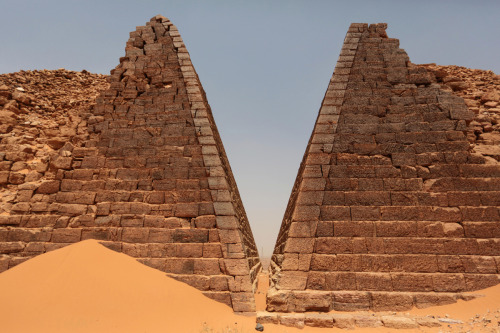
The Forgotten Pyramids of Meroë


CC BY-SA Joe Pyrek


Mohamed Nureldin Abdallah/Reuters


Mosa'ab Elshamy/AP


Mosa'ab Elshamy/AP


Abd Raouf/AP


Mohamed Nureldin Abdallah/Reuters

The Forgotten Pyramids of Meroë

06 May 10:54

Eshima Ohashi Bridge, A Tall Bridge in Western Japan That Resembles a Roller Coaster for Cars

by E.D.W. Lynch

Roller Coaster Bridge in Japan
photos via The Asahi Shimbun/Getty Images

The Eshima Ohashi Bridge is a Japanese rigid frame bridge with an unusually high span that–from certain angles–makes the structure look like a roller coaster for cars. In reality, the 144-foot-tall bridge features grades no steeper than 6.1% (long lens photography exaggerates the incline). The bridge connects the cities of Matsue and Sakaiminato in Western Japan. The bridge’s high span is designed to accommodate boat traffic, as Sakaiminato is a major fishing port.

Roller Coaster Bridge in Japan
photos via The Asahi Shimbun/Getty Images

Roller Coaster Bridge in Japan
photo via burningbaka

Roller Coaster Bridge in Japan
photo via burningbaka

via Bored Panda

06 May 10:53

Get a Grip #walkway #yellow #grippers #knobs #ramp #dots...


Get a Grip
#walkway #yellow #grippers #knobs #ramp #dots #california

06 May 10:52

(via sasaq:sivata_bucho)

06 May 10:52

Reconsidering The Wire

by Erik Loomis

Freddie Gray Protest in Baltimore

Dave Zirin has an excellent essay about reconsidering The Wire in the wake of the police murdering Freddie Gray. And he’s right–one thing missing from the show is how the police are actively part of the oppression of the poor and African-Americans in Baltimore and a second thing missing from the show are community activists and people standing up to make their own lives better. Doesn’t mean it’s not a great show, but it really is far from a complete view of the problems that have create modern Baltimore.

06 May 08:32

thefrogman:[instagram]

06 May 08:32

Government scales back plans for license plate-tracking program

by Daniel Cooper
To say that there's been some concern about the Department of Homeland Security's on-again, off-again license plate-tracking initiative is something of an understatement. Despite fresh resistance from the ACLU, the agency is persisting with the proje...
06 May 08:16

Photo


05 May 15:55

In the Hole

To get this shot, taken in Austria, Your Shot member Christoph Jorda set up two Profoto B1 flash systems: one on top of the ice cave and one inside. “We had to dig out the entrance of the cave because it was almost totally closed by the snow you see in the foreground,” Jorda writes. The problem? According to Jorda, the ice cave was at an altitude of nearly 9,800 feet, the temperature was at minus 4ºF, and the flash didn’t work properly. “So he [had] to jump a couple of times to get it right,” he says.

Jorda’s image was recently featured in Your Shot’s Daily Dozen.

This photo was submitted to Your Shot, our storytelling community where members can take part in photo assignments, get expert feedback, be published, and more. Join now »


05 May 15:54

Mostly Mute Monday: The Most Extreme View Into Deep Space (Synopsis)

by Ethan

“It is by going down into the abyss that we recover the treasures of life. Where you stumble, there lies your treasure.” –Joseph Campbell

Imagine you just stared into darkness, collecting every photon of light that came by. What would you wind up seeing? The Hubble Space Telescope has done this many times, creating the Hubble Deep Field first and then the Hubble Ultra Deep Field with upgraded cameras and more time. But most recently, the eXtreme Deep Field has surpassed even that.

Image credit: NASA, ESA, G. Illingworth, D. Magee, and P. Oesch (University of California, Santa Cruz), R. Bouwens (Leiden University), and the HUDF09 Team (inset) / NASA, ESA, S. Beckwith (STScI) and the HUDF Team (main).

Image credit: NASA, ESA, G. Illingworth, D. Magee, and P. Oesch (University of California, Santa Cruz), R. Bouwens (Leiden University), and the HUDF09 Team (inset) / NASA, ESA, S. Beckwith (STScI) and the HUDF Team (main).

With double the exposure time in the same region as the Ultra Deep Field, we’ve set the most robust lower limit on the number of galaxies in the Universe, and learned what it will take to find the rest.

Image credit: Both HXDF (L) and HUDF (R) teams.

Image credit: Both HXDF (L) and HUDF (R) teams.

Go read (and view) the whole thing!

05 May 15:53

An Artistic History of Death

by Laura C. Mallonee
1996.204d

Willem Van Swanenburg, “Death and an Arrow About to Strike the Man Down,” plate 4 from ‘Allegory of the Misuse of Worldly Property, after Maarten van Heemskerk,’ (1609), engraving, Dr. and Mrs. E. William Ewers Gift for Fine Arts Fund and Vanderbilt Art Association, Acquisition Fund Purchase (all images courtesy Vanderbuilt Art Gallery)

The way most people in developed nations today experience the passing of loved ones contrasts sharply with the way humans have historically confronted death. Before the 20th century, illnesses were deadlier and lives were shorter; people typically died at home, and family members grieved publicly. Today, medical innovations have helped us live longer, in some cases extending life unnaturally. We die in hospitals, nursing homes, and assisted living facilities — often alone. And while people still wear black at funerals, we return to our usual wardrobe as soon as they’re over, unlike Mary Todd Lincoln, who expressed her bereavement after President Lincoln’s death by donning a widow’s garb until her own.

Memento Mori — Looking at Death in Art and Illustration at the Vanderbilt University Fine Arts Gallery considers death’s role in society over the past 500 years. The oldest object in the exhibition is Vesalius’s anatomical treatise De humani corporis fabrica libri septem (1555), which shows — as co-curator Holly Tucker wrote in her book Blood Work: A Tale of Medicine and Murder in the Scientific Revolution — how “medical exploration took place most frequently in the domain of death.” Other pieces on display include a second-stage silk mourning dress from 1909, memorial jewelry woven from the hair of the dead, and a tombstone carved by sculptor William Edmondson. “Many of these traditions are no longer a part of Western culture,” Gallery Director Joseph S. Mella told Hyperallergic. He explained that these are set alongside the show’s contemporary works, like Enrique Chagoya’s 2003 lithograph “La Portentosa Vida de la Muerte,” which “deal more with the idea of death and issues of death in society rather than the death of individuals.”

Death Mask

“Plaster Death Mask of the Physiologist, Dr. Jan (Johann) Evangelista Purkinje” (1869), the Eskind Biomedical Library Special Collections

Edmondson

William Edmondson, “Williams Tombstone” (1931), limestone, Collection of the Tennessee State Museum

Hair Jewelry 1

Maker unknown, “Mourning Brooch in Memory of Stephen Gore with a Lock of his Hair and the Inscription on the Verso, ‘Stephen Gore/Born/Apl 29th 1790/Obt/Sept 16 1845′” (c. 1845), gold, steel clasp, glass and hair, Collection of Janet Hasson

Hair Jewelry 2

Maker unknown, “Mourning Bracelet” (c. 1850–80), braided hair with incised gold ornamentation and clasp, Collection of the Tennessee State Museum

Rowlandson

Thomas Rowlandson and William Comb, “I have a secret art to cure/Each malady, which men endure” from ‘The Quack Doctor,’ found in ‘The English Dance of Death,’ from the designs of Thomas Rowlandson, accompanied with metrical illustrations by the author of ‘Doctor Syntax,’ Vol. I” (1814), hand-colored etching with aquatint, the Eskind Biomedical Library Special Collections

Vesalius

Andreas Vesalius, “De humani corporis (On the fabric of the human body),” second edition (1555), woodcut, the Eskind Biomedical Library Special Collections

White Plague Poster

Dutch Saunders, “What are you doing to end the White Plague” (c. 1912), offset lithograph, Peabody College Collection, Vanderbilt University Fine Arts Gallery

1969.025

William Hogarth, “A Harlot’s Progress, plate VI, fourth state: The Funeral, 1744″ (reprint, after 1800), engraving, hand colored, Gift of Mrs. Mapheus Smith in memory of Mapheus Smith

1976.005

Nathaniel Currier and James Merritt Ives, “Death of Robert E. Lee” (1870), lithograph, Gift of Thomas B. Brumbaugh, Professor of Fine Arts, Emeritus

1979.0354P

Käthe Kollwitz, “Tod packt eine Frau (Death Seizes a Woman)” (1934), lithograph, the Peabody College Collection, Vanderbilt University

1992.087

Tsukoika Yoshitoshi, “The Hell Courtesan Jigukudayu sees herself as a Skeleton in the Mirror of Hell,” from the series ‘Yoshitoshi Ryakuga’ (Sketches by Yoshitoshi) (1882), woodblock print, the Herman D. Doochin Collection, Vanderbilt University Fine Arts Gallery

2003.052

Enrique Chagoya, “La Portentosa Vida de la Muerte” (The Prodigious Life of Death) (2003), lithograph, Dr. and Mrs. E. William Ewers Gift for Fine Arts Fund Purchase (courtesy the artist)

Memento Mori — Looking at Death in Art and Illustration continues at the Vanderbilt University Fine Arts Gallery (Cohen Memorial Hall, 1220 21st Avenue South, Nashville, Tennessee) through May 23.

05 May 15:26

The Hugo Award-Nominated Bspencer

by bspencer

Just kidding, I haven’t been nominated for a Hugo award; apparently they don’t give those out for writing smartass comments on political blogs. However, Apex Magazine is a Hugo award-nominated sci-fi/horror magazine…and I’m on this month’s cover.

I’M OUTTA HERE, CHUMPS! Fame and fortune awaits.

Here’s my latest:

05 May 15:06

Sasquatch Sexual Harassment Is Real, Part III

by Scott Lemieux

Bijan, in comments:

I would think that a casual familiarity with online harassment of women would give one pause before making claims about the impossible crudeness of sexual harassment in the 1960-70s.

This reminds me to link to this superb and chilling article about Zoe Quinn, who’s still facing the effects of a calculated and systematic campaign of harassment. Beth has covered this well, but one of the many appalling things about “the Zoe letter” that launched the campaign described nothing that anybody who isn’t a angry misogynist crackpot should care about even if you assume it’s all true. Woman in a brief relationship may not have been monogamous, I’m supposed to give a shit why? As is well-known, the insinuations of issues with ethicsingamingjornalism are so baseless Maureen Dowd would consider them insufficient evidence in a column about the Clintons. With his Ace Rothstein-style possessiveness and sexist resentment, to any decent person the author comes off much worse than the target. And yet, the thing actually started a large online movement. Maybe, just maybe, this should be a hint that the patriarchy is not dead?

And if you haven’t already, see Amanda Hess’s crucial article on the subject. On the original topic at hand, see Sarah Seltzer.

05 May 15:05

'Bourbon Empire' Reveals The Smoke And Mirrors Of American Whiskey

by Stacy Adimando

A new book suggests that tall tales on craft bourbon labels are the rule rather than the exception. They're just one example of a slew of "carefully cultivated myths" created by the bourbon industry.

» E-Mail This

05 May 15:04

ArtRx NYC

by Jillian Steinhauer

Armenian intellectuals who were arrested and later executed en masse by Young Turk government authorities on the night of April 24, 1915. (via Wikipedia)

This week we remember the Armenian Genocide, celebrate queer cartoonists, debate the necessity of all-women exhibitions, think about how posters work, and much more.

 Armenian Genocide: A Dark Paradigm

When: Wednesday, May 6, 7:30pm (general $15/students $10; buy tickets online)
Where: School of Visual Arts Theater (333 West 23rd Street, Chelsea, Manhattan)

All that I have seen and heard surpasses all imagination. Speaking of “thousand and one horrors” is very little in this case, I thought I was passing through a part of hell.

These words were spoken by August Bernau as he witnessed the Armenian Genocide of 1915, during which nearly 1.5 million Armenians were killed and deported by the Ottoman Turks. The mass murder inspired Raphael Lemkin to coin the term “genocide,” but to this day the event remains unrecognized as such by the American government (among others). As part of its World Voices Festival, PEN is hosting a night of remembrance for the Armenian Genocide, which will feature a panel discussion with Armenian cultural leaders and include readings of work by Armenian writers killed in 1915. —Kemy Lin

 Do We Need Women-Only Exhibits?

When: Thursday, May 7, 7pm (free)
Where: Museum of Arts and Design (2 Columbus Circle, Midtown, Manhattan)

Should there be art exhibitions and programming be solely dedicated to women artists? In conjunction with MAD’s current exhibition Pathmakers: Women in Art, Craft and Design, Midcentury and Today, a group of curators, artists, and writers will gather to discuss the recent proliferation of women-only shows, conferences, and galleries. The panelists — including Hyperallergic’s own senior editor Jillian Steinhauer — will meditate on questions of institutional responsibility and of the necessity and/or limitations of gender-based categorization in art programming. —KL

Atelier Brancusi re-created in Paris (photo by Kemy Lin)

 Brancusi in America

When: Opens Thursday, May 7
Where: Paul Kasmin Gallery (515 West 27th Street, Chelsea, Manhattan)

In 1926, perplexed American customs officials came across a thin, gold sculpture, purportedly of a bird, that had little resemblance to any avian creature. They classified it under “Kitchen Utensils and Hospital Supplies” and levied a 40% tariff against the work’s value. That sculpture, Constantin Brancusi’s “Bird in Space,” became the subject of the landmark case Brancusi v. United States, which established that nonrepresentational sculpture could be art. Brancusi’s clean, quirky (and sometimes obscene) sculptures paved the way for Minimalism in the US, and starting on Thursday some of them will be shown in close proximity at Paul Kasmin Gallery, similarly to the installation of his reconstructed studio “Atelier Brancusi” in Paris. —KL

 Queers & Comics: LGBT Cartoonists’ Conference

When: Thursday, May 7–Friday, May 8 (check site for schedule)
Where: Center for Lesbian and Gay Studies (CLAGS), The Graduate Center-CUNY (365 Fifth Avenue, Midtown, Manhattan)

A conference to celebrate the craft and history of queer cartoonists will take over CLAGS: The Center for LGBTQ Studies at the CUNY Grad Center for two days. Panels will focus on such topics as “Trans Visibility in Imagined Worlds” and “Queer Memoir,” while artists Howard Cruse and Alison Bechdel (also a newly minted MacArthur fellow) will give keynotes. If you can’t make it, select events will be live-streamed and archived for posterity. —Vic Vaiana

 How Posters Work

When: Opens Friday, May 8
Where: Cooper Hewitt, Smithsonian Design Museum (2 East 91st Street, Upper East Side, Manhattan)

Having trouble getting people to show up your shows, political actions, or gatherings? Take a look Cooper Hewitt’s new showcase of 125 posters from its permanent collection, exploring poster art through 14 design principles. With examples from World War II propaganda and the psychedelic era, this show aims to pin down the traits of captivating poster iconography. —VV

 Memento Mori: A Love Story

When: Saturday, May 9, 8pm (free)
Where: Morbid Anatomy Museum (424 Third Avenue, Gowanus, Brooklyn)

Taking a slightly different path from other UCLA art history PhD grads, Paul Koudounaris spent years photographing places of death around the world. In his most recent book, Memento Mori, Koudounaris explores our diverse relationships with skeletal remains through mossy Indonesian burial caves, Roman catacombs, and a festival in Bolivia where skulls are honored with cigarettes placed between their bony teeth. Koudounaris is an engaging speaker, and this talk will likely put the seemingly macabre in its historical context. —Allison Meier

 #Rawhide

When: Opens Saturday, May 9
Where: Venus Over Manhattan (980 Madison Avenue, Upper East Side, Manhattan)

In its latest exhibition, Venus Over Manhattan will showcase depictions of the cowboy from the 1890s to today, covering the period of the Hollywood Western and more recent erotic appropriations of American bravado’s avatar. The rugged stud of the frontier has inspired the likes of Warhol, Avedon, and Lichtenstein, all of whom are featured. Come check out images like Dennis Hopper’s portraits of John Wayne and the Marlboro Man, and other iterations of the Wild West’s wildest hero and sex symbol.—VV

 Last Chance: Full Tilt

When: Closes Sunday, May 10
Where: Novella gallery (164 Orchard Street, Lower East Side, Manhattan)

An exhibition curated by poet, critic, and Hyperallergic Weekend Editor John Yau is one not to be missed. Full Tilt features seven artists, all of whom make geometric paintings, some of whom do not have gallery representation — because, as Yau wisely writes, “I do not want to write only about what is being shown, as that renders complaints about the market moot.” In fact, Yau’s whole statement for the exhibition is terrific, so you should read it and then go see the show. And if you want to do further reading on any of the artists included, check out Hyperallergic pieces here, here, here, here, here, and here.

*   *   *

With contributions by Kemy Lin, Allison Meier, and Vic Vaiana

05 May 15:03

isaiahbush: ultrafacts: Source (Video of Salar de...


isaiahbush:

ultrafacts:

Source

(Video of Salar de Uyuni)

Follow Ultrafacts for more facts

Border between heaven and Earth

05 May 14:57

spoopywitchbitch: lil-bit-ghei: valium-stepmom: dinodrifterdar...


spoopywitchbitch:

lil-bit-ghei:

valium-stepmom:

dinodrifterdarsh:

dividedconsciousness:

sizvideos:

Video

I should be able to watch this video without fear for the women in it.

^

my immediate thought was  yeeesh they probably got death/rape threats

Buzzfeed ladies don’t give a shit about assholes and have actually acted in and directed MANY videos regarding sexism.

here for all of this, oh and dick physics

05 May 14:52

i-come-by-it-honestly: Mallory Ortberg on fire on twitter today...


i-come-by-it-honestly:

Mallory Ortberg on fire on twitter today (as usual).

05 May 09:40

This blog is nsfw due to advocating you overthrow your bosses, corporate structures and capitalism itself

05 May 09:40

You Can Get Your Grade Changed, but Do You Want to Fill Out the Paperwork?

05 May 09:39

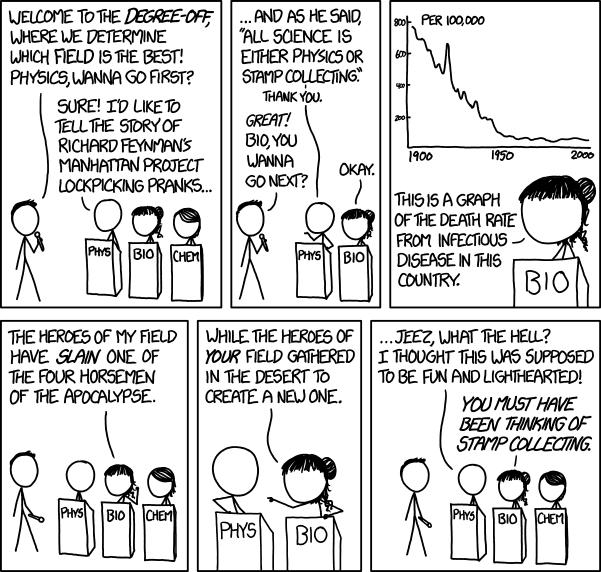
Degree-Off

I'M SORRY, FROM YOUR YEARS OF CONDESCENDING TOWARD THE 'SQUISHY SCIENCES', I ASSUMED YOU'D BE A LITTLE HARDER.
05 May 09:39

Sasquatch Sexual Harassment Is Real, Part II

by Scott Lemieux

My first post responding to Hanna Rosin’s assertion that Joan Holloway’s sexual harassers were cartoon villains was already running long, but I there are a couple more examples that I think are instructive. First, Irin Carmon passes on this from Lilly Ledbetter’s autobiography:

It didn’t take too long, either, for me to understand that I could never let my guard down. Whenever we were in the office together, one of my shift foremen— a tall, blue-eyed man named Donald— would grin and make the most inappropriate comments, without warning. Donald always dressed neatly and had a good-natured manner of speaking, so it sometimes took me a minute to register what he’d said. We’d be talking about work, and out of the blue he’d interject, “That must be one of them French bras you’re wearing, because it’s got those things up high and your nipples are showing.” Or he’d catch me retrieving a file from the file cabinet, and he’d observe, “If you kept bending over at the file cabinet, you might get something rammed in your ass that you don’t want. I know I could take care of that.” As his words sank in, I kept my head averted, shame spreading its red flush across my face, shock and embarrassment flooding my body.

After a few of these awkward moments, I learned to steel myself for his comments. When Donald inspected my department, despite the fact that it was spotless and in order, he’d say things like, “Goddammit, Lilly, this looks like a whorehouse.” I wouldn’t flinch. “Really?” I’d reply. “I wouldn’t know. I’ve never been to a whorehouse.”

[…]

The next thing I knew, he started talking about how well he’d done at Goodyear, and explained in detail his wife’s personal connections with the top dogs at corporate headquarters in Akron. After he finally quit talking about himself, I thought we were about to get down to the business of my performance and future. Instead, he said, “Well, I rank you an eleven out of twelve. If you want a better score, you can meet me at the Ramada Inn.” I stared at him blankly for a moment. Surely, he was just joking. I was used to crude remarks, but Jeff stared right back at me, expecting an answer— just as if he’d asked me another question about the machinery. I glanced at the clock. We’d been in his office for over an hour. I replied, “I’m not sure I understand.” He exhaled cigarette smoke in my direction before he repeated himself. My temples throbbed. I felt a jolt of anger. I told myself to breathe and think, and not to do anything I’d regret.
I asked, “How can you do that based on my performance?”
“In a place like this, Lilly, it’s more important that your bosses like you than that you do a good job.” A wisp of smoke trailed out of one of his nostrils. I calculated Vickie’s college tuition. Phillip would be in college before I knew it. I still had a few years ahead of me before Vickie and Phillip were independent. Then there were the household bills and expenses that Charles’s paycheck didn’t cover. I didn’t know what to say that wouldn’t make the situation worse, so I stood up and walked toward the door. Out of the corner of my eye, I saw Jeff smash his cigarette with a rough jab into the overflowing aluminum ashtray on his desk. That night I couldn’t sleep. The following day I tried to ask Jeff about my evaluation. When I approached him, he said, “Nothing you say matters. You’re at the bottom, where you’ll stay.” I pressed him to tell me why, but he only replied, “That’s where I want you. You’ve made the wrong people mad these past few months and caused me a lot of trouble.” Several days later I tried to talk to another manager about the problem. He replied in an unconcerned tone, “What are you so worried about? If there’s a layoff, you’ll go anyway, so don’t worry about it. You’re okay.” It wasn’t much longer after this that Goodyear said it was cutting back on supervisors and demoted me, moving me from final finish to special tire trials in July 1981.

Or, perhaps, we should cite the fact that 2 managers at the CBC were recently fired over their handling of serial sexual abuser and harasser Jian Ghomeshi. If one of the most prominent public figures in Canada can get away with far more egregious behavior for years, I’m supposed to believe that a boss at an advertising agencies notorious for its sexism even among other advertising agencies wouldn’t ask for sexual favors? Please.

Finally, it’s worth noting that Joan getting 50 cents on the dollar was, alas, an excellent deal — in 1970, her lawsuit would have had no chance.

05 May 09:37

"A teacher who is attempting to teach, without inspiring the pupil with a desire to learn, is..."

“A teacher who is attempting to teach, without inspiring the pupil with a desire to learn, is hammering on a cold iron.”

- Horace Mann, educational reformer (4 May 1796-1859)
05 May 09:37

Photo


05 May 09:37

No Comment

by Rachel Newcombe

Empty.

An hour later. Still empty. This bothers me. I am embarrassed that it bothers me. But not embarrassed enough that it stops me from checking again. I can tell you that I didn’t waste time checking throughout the day, in between seeing patients, I could tell you that, but that would be a lie. I can tell you I only checked a few more times on Wednesday, November 12th. I could say that, but that would be a lie too. The truth is I lost count.

*

November 13th, 2014.

It’s the day after my first Rumpus article is posted: 

The Rumpus Interview with Paul Gilmartin
By Rachel Newcombe, November 12th, 2014

No comments. No bold red balloon with a number inside.

Empty Comment Balloon

Paul Gilmartin, the subject of the interview, emails me and lets me know how much he appreciates the article. This makes me happy. I love his podcast the Mental Illness Happy Hour and hope that the Rumpus article will guide people to his show. I’m getting emails from my therapist friends and colleagues who read the interview. Their responses are positive. They are happy to see depictions of psychoanalysis in mainstream writing. A relief for me. I worried my colleagues would criticize how I described the process of psychoanalysis. A link to the Gilmartin interview is posted on www.internationalpsychoanalysis.net. Does this make my article more professionally legitimate? And what exactly does that mean anyway?

More responses and emails from my colleagues. All positive. This isn’t a lie. But now that I think about it I probably will not receive personal emails from people who didn’t like the interview. Now I am full out judging myself. My superego is clamping down. Harsh and accusing. Why does it matter that I want my work to be responded to positively? Or to be responded to at all?

My hunch is that every single one of us who writes something for publication wants to know that someone has read our work. We want to make contact. Why else would we make our writing public? Now there is an idea. What if at the end of every piece of writing the writer posted what they were hoping for from their reader. It would go something like this: Rachel Newcombe is a psychoanalyst in the San Juan Islands and Seattle, Washington. When you read this article she hopes that you will write a really short comment letting her know you will check out Gilmartin’s podcast. Oh, and she also wouldn’t mind if you commented on her interviewing style.

*

November 14th.

My daughter calls me from college and tells me she put a link to the Gilmartin interview on her Facebook page.

November 15th.

Yes. I checked.

Empty.

Empty Comment Balloon

*

At this point on day two I tell myself I am relieved that there are no mean or snarky comments. I tell myself I’d rather have an empty red balloon than a red balloon with the numeral three tucked inside indicating there are some comments waiting to be read. Comments that might say, “The interviewer is a narcissist.” or “The interviewer obviously does not understand psychoanalysis.” or my worst fear, “What is the point of this interview?”

I am relieved the balloon is empty. This is not a lie.

*

Later in the week I remember The Rumpus posted a review of the new book Women in Clothes. There it is, October 15th, 2014. Amy Feltman tells us she is interviewing the book’s three authors, “Sheila Heti, Heidi Julavits, and Leanne Shapton, “via Skype, with the occasional interruption of poor connection and an eavesdropping ghost.”

I read the interview and halfway through I know I will definitely buy this book. When I get to the end of the interview I read the author’s bio:

Amy Feltman is currently pursuing an MFA in Fiction from Columbia University. She works at Poets & Writers Magazine and is in the murky midst of editing her first novel.

That’s it. The end. No comments. How can this be? Why no comments? Am I part of the problem? Perhaps I am guilty by omission. I thoroughly enjoyed the interview yet I didn’t leave a comment. Why? I guess I am worried it’s trite to write, “Great interview. I am excited to buy the book.” Now I feel guilty.

Empty Comment Balloon

*

It’s still early in the morning and I have plenty of time before I need to leave the house. Lately my routine involves getting up at 5 a.m., making coffee and reading The Rumpus.

I land on October 29th, 2014, The Rumpus Interview with Alysia Abbott by Jody Smiling. I absolutely love this interview, like really love it. I had already read Abbott’s book, Fairyland and was blown away by her story and her writing. I am completely hooked by the end of Smiling’s introduction. Who is this writer Jody Smiling? I slide down to the end of the article and read her bio:

Jody Smiling divides her time between San Francisco and Toronto but her heart never leaves Banff. Her work recently appeared in Toronto Life and Prism International. She’s working on Lessons from Koostatak, a biography of an ordinary teacher. She tweets @jodysmiling. 

I google Jody Smiling. I jot down her name on the pad next to my computer. I know I will read more of Smiling’s work.

When I finish the review I see someone has left a comment. I read it.

One Comment

Elizabeth Coleman Says:
October 30th, 2014 at 3:08 a.m.

It love it when an interviewer asks such perceptive & thoughtful questions. And Alysia Abbott’s answers shine — great stuff on the process of memoir, why she chose the title she did, and the story behind her book’s coming film adaptation by Sofia Coppola (which seems like such a great match)

Wow. I love Elizabeth Coleman’s comment. I completely agree with her assessment of Smiling as an interviewer and Abbott as a writer.

It’s rather odd. I am not jealous. Instead, I am inspired. The next day I lend my copy of Fairyland to a friend.

*

I stumbled upon The Rumpus in 2013, the year I fell in literary-love with Lidia Yuknavitch. I had just finished reading The Chronology of Water and I googled to find out more about this woman who was making me flutter and up popped a link to:

The Rumpus Interview with Elizabeth Scarboro and Lidia Yuknavitch
By Roxane Gay April 3rd, 2013

Yuknavitch, like the writer Carole Maso, puts forth writing that defies categorization in favor of using words and fragments of ideas that transgress into their own beautiful structure, beckoning the reader to suspend preconceived ideas about linear narrative.

The interviewer Roxane Gay tells us why she is doing this interview:

In recent years, as I’ve read more memoirs, I have struggled with how to talk about memoir critically, how to separate form from content. Both Yuknavitch and Scarboro, whose books echo each other in interesting ways, were willing to talk with me about this question of what to do with memoir, and much more.

I, too, am interested in how to talk and write about memoir and the thorny issue of how to separate form from content or how to determine if that is even possible. This interview introduces me to both Elizabeth Scarboro and Roxane Gay. In City Lights Books in San Francisco last summer I spot Roxane Gay’s book, Bad Feminist, and remember where I first heard of her, The Rumpus. And then I learn that Roxane Gay was the Essay Editor at The Rumpus. Of course.

I continue wondering how the website The Rumpus has been in existence and I’ve known nothing about it? I was clueless. I feel an obsession coming on.

*

As predicted my Rumpus education/obsession takes off. First stop:

Conversations with Writers Braver Than Me #14: Marco Roth
By Sari Botton January 4th, 2013

I read the entire interview and finish with two prominent thoughts, 1) I must read Roth’s The Scientists: A Family Romance and 2) I must read Botton’s Goodbye to All That: Writers on Loving and Leaving New York.

You know the exhilaration that comes when you realize there are writers who have the same sensibilities as you and then how your own voice becomes more recognizable to you? Well, this is what was happening to me during my Rumpus education. It was like back in 2001 when I first read Carole Maso, a writer and thinker who exposed me to the elegance of non-traditional writing. I followed the Maso thread to Kathy Akers and Eileen Myles and made an unwavering commitment to experiment with my academic writing. It was freeing.

You think you know what a book is, what reading is, what constitutes a literary experience. In fact you’ve been happy all these years to legislate the literary experience. All too happy to write the rules.

–Carol Maso

So I read both Roth and Botton. I discover that Marco Roth is the nephew of writer Anne Roiphe. I heard Roiphe speak at a conference in 2001 in New York City, The Anxiety of Authorship: Examining and Overcoming Women’s Inhibitions in Self-Expression. Carol Maso was there too. She and Roiphe were on a panel called The Writer’s Voice. I also find out that Roth went to The Dalton School in New York City where I taught in the early 1980s. Roth’s father was a doctor at Mt. Sinai Hospital and I also worked at Mt. Sinai Hospital. I feel oddly connected to Marco Roth.

Then there is Sari Botton. Her book speaks to me because like the writers in her book I also loved and left NYC after calling it my home for twenty-six years. When Botton’s follow-up book comes out, Never Can Say Goodbye: Writers on Their Unshakable Love for New York, I buy that one too. The first essay I read is by Rumpus founder and Editor-in-Chief Stephen Elliott. I like learning about his connection to NYC and San Francisco. Living with my own unshakable love for NYC, I want to tell Stephen that I have recently fallen in love with San Francisco. Truly, madly, deeply in love in a way that I never thought I could after leaving NYC. Although I like where I now live on Orcas Island, just knowing San Francisco is a short two-hour flight away has changed my life. My newfound urban love, San Francisco, has me wondering if I should contact Sari Botton and pitch her an idea I have about co-editing a book.

I am in deep. The Rumpus has become a full blown passion. The good kind. My life has not become unmanageable. Well, not yet. But what it has become is fuller.

Before I contemplate ways to pace myself I know I have one last urgent task. I have to find out some details about Stephen Elliott. I cannot rest until I do this. I hit the FAQ section and get a quick overview:

Founded by Stephen Elliott, The Rumpus launched on January 20, 2009. Since then, our community has grown but we’ve kept our core: we want to change the conversation. We want to introduce you to authors you’ve never heard of before and to provide perspective on books, films or media that will make you look deeper. What’s meaningful to our writers and readers doesn’t usually fall in step with marketing schedules, breaking news or what’s trending on the Internet; at The Rumpus, we care about what moves people. We believe that literature is community—

Now I get why I like this website so much. I feel a sense of belonging each time I log on. The Rumpus is a gift. Bountiful. Presents that keep coming. I don’t care if that sounds trite. It’s how I feel. I read about Stephen Elliott. There’s so much. I decide to start with The Adderall Diaries and A Life without Consequences. I also sign up for The Daily Rumpus and get “overly personal emails from Stephen Elliott.”

Thank You Comment

My friend once said to me if you want to get a sense of someone’s unconscious just follow their web history for a day. Well, anyone looking at my web history for the past year and a half would see that my unconscious process has many streams flowing to and from TheRumpus.net.

* 

Endnote:

I check my Paul Gilmartin interview a week after it is posted. A dazzling red balloon with a “1” in the middle.

One Comment

I quickly scroll down to the bottom and read:

One Response to “The Rumpus Interview with Paul Gilmartin”

Inverness Says:
November 21st, 2014 at 7:06 a.m.

Thank you for this lovely interview.

Related Posts:

05 May 09:35

kurenai-shisou: They’re all looking good _(:3c I rarely catch...


kurenai-shisou:

They’re all looking good _(:3c I rarely catch them on full house but yeah w

Also that cat who liked the Mari ball and the cat who likes the fishbowl appeared to me this week www

05 May 09:34

montondemierda: