Sophianotloren
Shared posts
05 May 09:48

I need to unlock all these cats on Neko Atsume <3
I need to unlock all these cats on Neko Atsume
05 May 09:48

The Whitney Chickened Out On This ‘Huck Finn’ Sculpture
by Liam Mathews
The New Yorker’s May 11th issue includes a profile of the sculptor Charles Ray, tracking his life and career and peculiarities. One small section of the piece is devoted to the controversy around his piece “Huck and Jim,” a sculpture of the characters from Mark Twain’s The Adventures of Huckleberry Finn. The sculpture depicts a 9-foot-tall Jim, a grown-man runaway slave, standing protectively next to Huck, a fourteen year-old-boy, as the boy bends over in a scooping position. They are both naked, as they are in the novel, and Jim’s penis is large and unavoidable. Ray began “Huck and Jim” in 2009 when the Whitney asked him to propose a sculpture to go in a public plaza in front of their then-planned, now-newly-opened building downtown. Ray felt that the characters would be a great fit for a museum of American art, as he believes Huck Finn is a definitive piece of American art.
The Whitney’s director and chief curator were initially supportive of the work, but became leery as time went on. They worried that the image of a naked black man together with a naked white boy, no matter how innocent or historical, would be offensive to passersby, who wouldn’t necessarily know or care about the context. The Whitney’s director, Adam Weinberg, told Ray that the sculpture could go anywhere on the Whitney’s property except the plaza, but Ray was unwilling to compromise on the location. So the Whitney passed on the sculpture, which now sits semi-finished and homeless in Charles Ray’s studio in Santa Monica.
 Photo: Charles Ray and Matthew Marks Gallery
Nobody comes out of this anecdote looking great. The Whitney looks cowardly for committing to and then backing out on a potentially polemic artwork, and Ray looks stubborn and out-of-touch and trollish for proposing a sculpture of a giant naked black man and small naked white boy for a public space and then refusing to compromise when that idea is quite reasonably flagged as controversial.
The sculpture cannot reasonably be interpreted as offensive, as one look at it shows there’s nothing lascivious or even sexual about it. But it’s certainly confrontational. Putting up a big sculpture of a runaway slave with his genitalia exposed in a public space would be provocative and attention-grabbing, but maybe not in the way the Whitney would have wanted. Perhaps the more cowardly thing for the Whitney to back away from is the way this sculpture would have forced people walking past the Whitney to grapple with America’s history of racism. Is the offensive part the fact that he’s naked or that he’s a slave? By not putting this sculpture out, is the Whitney failing to take an opportunity to champion a work of thought-provoking, important American art, and thus cheapening itself as an institution?
If anything, the sculpture proves the continued inflammatory relevance of The Adventures of Huckleberry Finn and Jim. The book is endlessly challenged and censored and debated for its use of the word “nigger,” missing the point that it’s a reflection of its racist time. That debate is now seeping from literature into sculpture, but apparently we’re not yet ready to have it, since the Whitney didn’t take the risk and allow us to see the sculpture in public and let us decide for ourselves.
(Photo: Charles Ray and Matthew Marks Gallery)
The post The Whitney Chickened Out On This ‘Huck Finn’ Sculpture appeared first on ANIMAL.
Rosalind, Sophianotloren and one other like this

05 May 09:43


rodimeme: xiki-muffin: creativelycultivated: respect-thetrillo...
Watch: The “pink tax” is secretly costing women thousands — and not just at the drug store
Yooooooooooo
Women pay more for products. Men pay more for clothing.
Do men really pay more for clothes?
Yea, seriously. Shirts, sneakers, jeans, socks…etc. Ask your male friends how much they pay for a pair of descent jeans. It’ll blow your mind.
At least their pants have fucking pockets tho
“Men pay more for clothing.”
(Target)
Are you sure?
Are you
(Walmart)
ABSOLUTELY SURE??
BECAUSE I’M NOT ENTIRELY CONVINCED
LIKE AT ALL
THAT MEN HAVE IT HARDER
(Victoria’s Secret)
OH AND SHOULD I BRING UP PANTIES WHILE I’M AT IT? I am a firm believer of the “fuck you, I’ll wear briefs that don’t give me a wedgie, I don’t care if they’re not sexy” policy, but a lot of women are expected to wear panties and thongs because GASP WOMEN MUST BE BEAUTIFUL AT ALL TIMES. Here’s a screenshot of some Victoria’s secret panties!
Wow. It’s almost as if there’s a pattern here.
Women are expected to buy more clothing, and literally all of it is more expensive, so fuck all of you.


Rosalind and -1 others like this
05 May 09:42
funkybug: theslayprint: ricki-minaj: “I feared for my...


Rosalind and -1 others like this
05 May 09:40

Original art by Kate Leth, as seen on Bitch Planet #2, variant...
by profanefame
Original art by Kate Leth, as seen on Bitch Planet #2, variant cover.
Tattoo by Kayla Talty at Eternal Art in Santa Rosa, CA.
bernot and -1 others like this
05 May 09:40
00syd: vardpup: bodybuilding dot com thread where two guys argue about how many days are in a...
bodybuilding dot com thread where two guys argue about how many days are in a week
I’m dead
This is a truly amazing example of toxic masculinity.
05 May 09:40
wet fod 4 skin diamond
by admin


Originally posted 2015-05-04 21:03:23. Republished by Blog Post Promoter
wet fod 4 skin diamond source: droolingfemme.
Sophianotloren likes this
05 May 02:56

kimberleydestruction: flootzavut: myusshi: taleasoldastimelord...
I’d like to give my Facebook friend a standing ovation
Cats have more notes than this, come on people.
*wild applause*
I love people sometimes, this is perfection.
AHAHAHAHAHAHAHA
bernot, Sophianotloren and one other like this
05 May 02:56
Marginalized Person: Why are allies such trash tbh? They never stand up for us but reap rewards from everyone else for being progressive while we're out here getting shit on by the same people.
Marginalized Person: Why are allies such trash tbh? They never stand up for us but reap rewards from everyone else for being progressive while we're out here getting shit on by the same people.
Self-Proclaimed Ally: Wow thats like really rude, maybe if you aren't going to be nice you don't deserve my help. I don't have to do any of this you know. I have power over you. No one cares if I do or don't you literally don't even matter, so you better be more gracious.
Self-Proclaimed Ally: Wow thats like really rude, maybe if you aren't going to be nice you don't deserve my help. I don't have to do any of this you know. I have power over you. No one cares if I do or don't you literally don't even matter, so you better be more gracious.
Sophianotloren, firehose likes this
04 May 15:14
Government Provolone
by bspencer
Conservatives seemingly never run out of ideas for trying to deprive and humiliate poor people. Check out this list of dairy items poor Wisconsinites may or may not be able to buy:

- No fresh Mozzarella for the plebes.
- No sharp cheddar, either. Everybody knows one taste of sharp cheddar leads to revolution.
- I didn’t know American cheese came not individually wrapped. No fancy fake cheese, huh? SUCK IT, POORS!
- No crumbles. So that means no great convenience ingredients like crumbled Feta or Bleu. I’m starting to get the impression that Wisconsin lawmakers simply don’t want poor people to put anything tasty in their mouths.
I’m just genuinely baffled by this list. I mean, it really looks as though these guys went out of their way to be cruel to poor people.
Sophianotloren likes this
04 May 15:13


DEA Agent: If You Legalize Pot, Rabbits Will Get High
by Kevin
Amazingly, this is not from an episode of South Park, but rather is actual testimony from a DEA agent before the Utah Senate in February. (Washington Post)
At the time, Utah was considering a bill to legalize the medical use of cannabis, though not the smoking of marijuana itself. (Devices that "facilitate cannabis combustion" would still have been illegal.) The bill's sponsor, GOP Sen. Mark Madsen, said he was acting because he had been touched by the stories of people suffering from debilitating injuries who benefited from cannabis. Among those people: GOP Sen. Mark Madsen, who says he has back problems. Madsen admitted that he had visited Colorado a couple of weeks before "and tried that [cannabis] under the direction of my doctor.”
I'd like to think that his doctor actually went with him, like Hunter S. Thompson's lawyer went to Vegas. But he probably didn't.
Asked if he thought cannabis was effective, Madsen said yes, although he couldn't quite bring himself to say that he had personally "felt better" thanks to a controlled substance. “It has effective analgesic properties," he reported instead, and also, "I observed a diminution in my level of pain," which sounds a little like he came home from work early and found his body using cannabis, and while he certainly didn't approve he had to admit the body did seem to have benefitted from the experience.
But Madsen was a lot more eloquent when talking about the bill's purpose, saying it was about freedom, compassion, and the "right of a free people" to make decisions without government interference. And he made vastly more sense than DEA agent Matt Fairbanks, who testified in opposition, and who in less than five minutes of testimony managed to fill the chamber roughly hip-deep in mouth droppings.
After some yapping about "facts" and "science," Fairbanks got to the meat of his testimony, which was his claim that legalizing medical marijuana will turn it into an out-of-control "cash crop" that will ruin the environment. Fairbanks said he is on the DEA's amusingly named "marijuana eradication team" in Utah, and in the course of tromping around outdoors destroying plants he has seen the damage that illegal growing sites do.
"Personally, I have seen entire mountainsides subjected to pesticides, harmful chemicals, deforestation and erosion," Fairbanks said. "The ramifications to the flora, the animal life, the contaminated water, are still unknown." Not entirely unknown, though, because he personally witnessed some ramifications to animal life. In particular, he claimed that at one site he had seen "rabbits that had cultivated a taste for the marijuana...." These stoner rabbits had, he reported, lost all motivation. "One of them refused to leave us," he testified, and "we took all the marijuana around him, but his natural instincts to run were somehow gone."
Is it 4:20 yet?
Apparently all the others did remember how to run, though, so maybe the rabbit population isn't suffering from reefer madness to quite the degree he was suggesting.
Perhaps to address such concerns, though, Madsen later added a provision that required medical marijuana to be cultivated only "indoors, in an enclosed, locked facility that is accessible only by an individual with a valid medical cannabis agent registration card." (This presumably would not include individual rabbits, but it'd be clearer if they just used the word "person.") But despite this and several other amendments, the bill did not pass, failing in the Senate on March 9 by just one vote.
It is pretty clear from the final debate on the bill that instead of taking on the substance, its opponents buried it under a mound of technicalities. They all said they supported sick people, of course, but couldn't vote for the bill because it didn't mandate alarm systems at marijuana dispensaries, or this or that other thing. And that's when they made any sense at all. One opponent said he was quite concerned because given that marijuana would still be illegal under federal law, someone carrying a medical-marijuana card might have his guns taken away. What? Another noted that marijuana is, after all, a "dangerous drug," and pointed out that when it was legalized in Colorado, there was an spike in the number of young people admitted to the ER after overdosing on marijuana, a dramatic point that is weakened slightly by the fact that it is completely false.
At least two of the senators who voted against the bill said they previously supported it but changed their minds just days before the final session. That suggests they didn't buy Fairbanks's testimony back in February, but maybe the rabbit lobby got to them later.
Related Stories
Sophianotloren likes this
04 May 06:33


I’d Rather Like Men Than To Be a Sad Puppy
by John Scalzi
And to be clear, it wouldn’t be anything close to a difficult choice.
Hur hur, homophobia's a gas when you're a Sad Puppy! pic.twitter.com/naUdpcOr2m
— John Scalzi (@scalzi) May 4, 2015
Again: I'm mostly sad for the Sad Puppies. So much insecurity and envy and anger and need. For their own sakes, I wish they were happy.
— John Scalzi (@scalzi) May 4, 2015
Note that my pity for the Sad Puppies doesn't preclude me pointing out they are assholes. And that they've made the active choice to be so.
— John Scalzi (@scalzi) May 4, 2015
Also, if I DID like men more than women, so what? That would be a perfectly good thing, nor would I be the slightest bit ashamed of it.
— John Scalzi (@scalzi) May 4, 2015
If Brad Torgersen wants to insult me, insinuating I'm gay won't work. It's not an insult to be gay. Be an insult to be a Sad Puppy, however.
— John Scalzi (@scalzi) May 4, 2015
And now to cleanse your eyeballs of rank homophobic stupidity, here are some happy puppies. Enjoy them.

Update: Torgersen attempts an apology; I discuss it in the first comment in the comment thread.
firehose, Sophianotloren and one other like this
04 May 06:32


gravyholocaustsucks: wallofdis: ericgeller: iwantthepony: jon...
waitingonoblivionThe West Wing + The Onion headlines, 1/?
Amazing.
yesssssssssssssssss
This is a masterpiece.
04 May 06:30

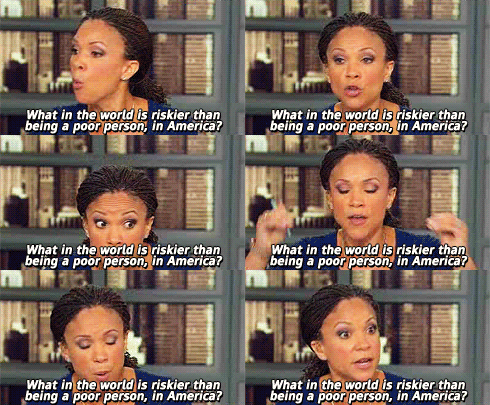
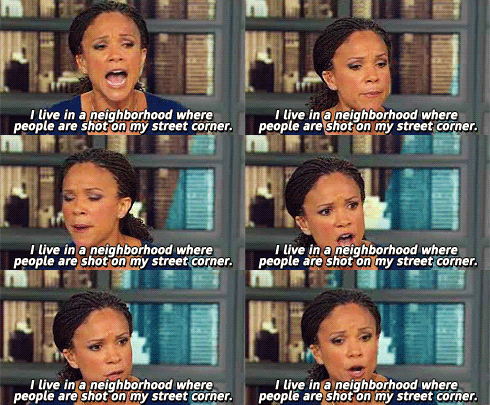

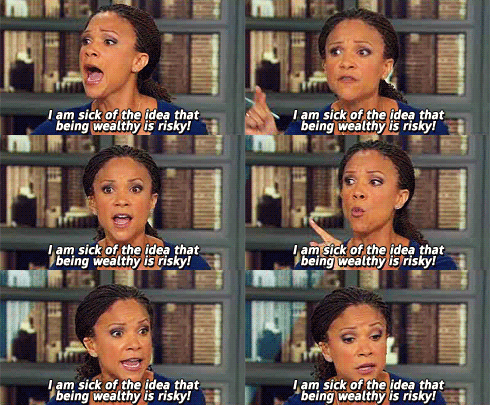


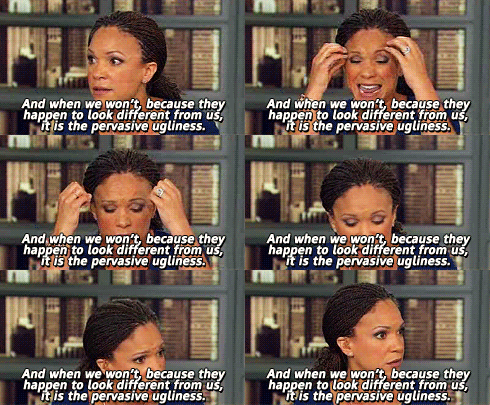
lookpeople:liberalisnotadirtyword: Melissa...
Melissa Harris-Perry: Nothing is riskier than being poor in America [full video]
Have I put this up on my blog before?
Fuck it, here it is again.
Always reblog.
clauaud, Sophianotloren and 4 others like this
04 May 06:18
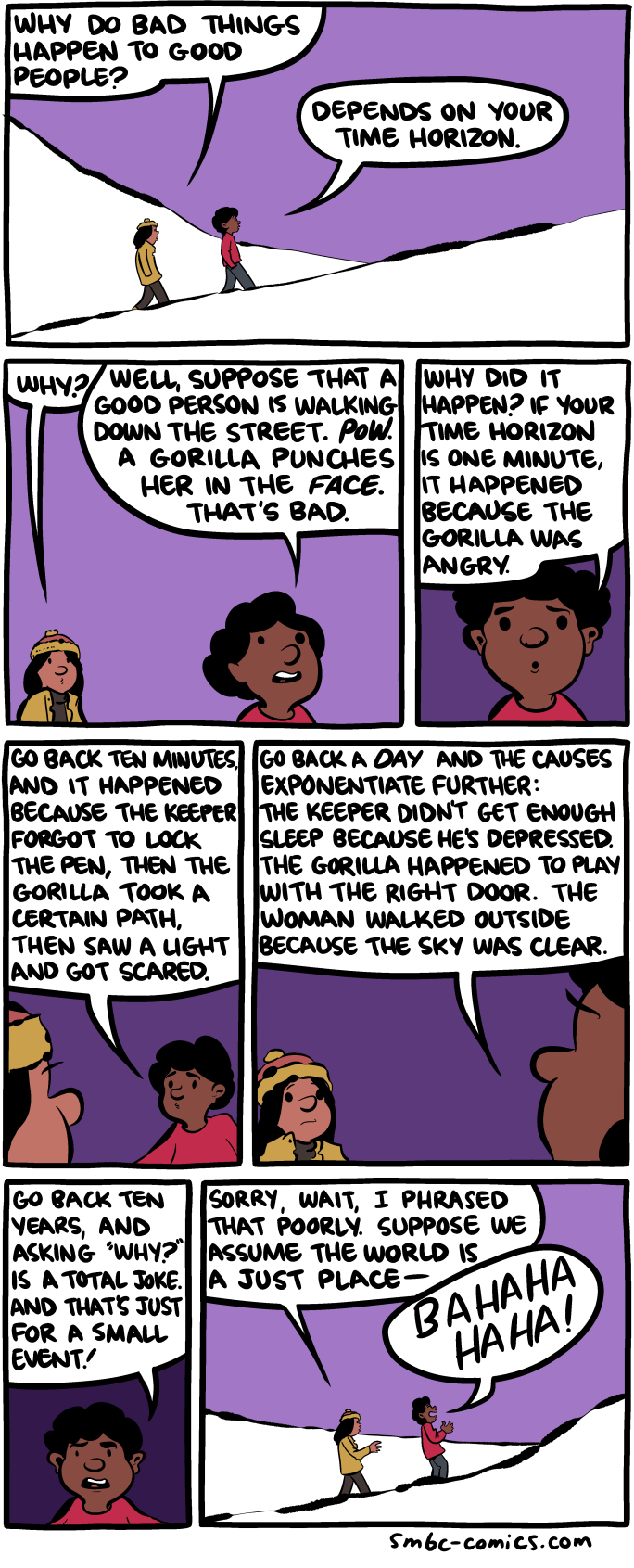
Saturday Morning Breakfast Cereal - Cause and Effect
by admin@smbc-comics.com
clauaud, Claudio Navarro Henriquez and 6 others like this



04 May 03:34


harrietjones1066: Brazil (1985) The Truth shall set you...
Brazil (1985)
The Truth shall set you Free.
A perfect example of beautiful photography capturing an ugly, ugly future.
Sophianotloren, Tertiarymatt and one other like this
04 May 03:33


Check Out: A New Index of Copyright Fair Use Cases
by David Malki
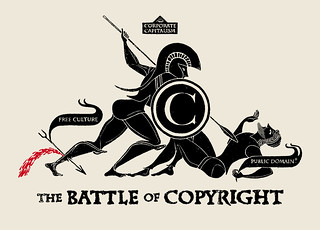
Source: Christopher Dombres via Flickr
The U.S. Copyright Office has launched a new Fair Use Index:
Fair use is a longstanding and vital aspect of American copyright law. The goal of the Index is to make the principles and application of fair use more accessible and understandable to the public by presenting a searchable database of court opinions, including by category and type of use (e.g., music, internet/digitization, parody).
The Fair Use Index is designed to be user-friendly. For each decision, we have provided a brief summary of the facts, the relevant question(s) presented, and the court’s determination as to whether the contested use was fair.
The Index itself is a series of summaries of key legal decisions regarding copyright and fair use, largely from the last sixty years.
It’s super interesting to me! Wondermark is, of course, created using images from the public domain. Which is not the same as fair use; public domain works have no copyright, whereas fair use is made of works that are copyrighted.
But copyright in all its gleaming facets is still a topic near and dear to my heart as an artist, author, and attentive internet citizen: I’ve written a fair amount about copyright and intellectual property.
The Fair Use Index includes some watershed copyright cases, such as 1978′s Walt Disney Productions v. Air Pirates, the precedent that defines the infringement threshold for copying copyrighted characters for “parody” purposes.
It might be said that under the Air Pirates test, the entire product line of the t-shirt website TeeFury is illegal, and I notice that very conveniently, most of their designs are only available in strictly limited, before-they-can-send-us-a-cease-and-desist editions.
Also included is the “Betamax” case, 1984′s Sony Corporation v. Universal City Studios, which ruled that recording a free broadcast of live television onto videotape for later home viewing — referred to as “time-shifting” — was, indeed, legal. “Home taping” (of both television and radio) was the big I.P. boogieman threat before “piracy”, and this court decision was what enabled the VCR, as a consumer device, to exist at all.
In browsing, I also came across some interesting cases I hadn’t heard about before, such as:
• 1985′s MGM v. Honda Motor Corp., in which MGM sued — and won — claiming that a spy-themed Honda commercial was too reminiscent of their copyrighted character, James Bond (and that it damaged the James Bond brand to show him in a Honda);
• 2004′s MasterCard v. Nader 2000, in which MasterCard sued — and lost — a copyright infringement suit against Ralph Nader’s presidential campaign commercials which copied/parodied its “priceless” slogan;
• 2006′s CleanFlicks v. Soderbergh, in which the company CleanFlicks, which edited objectionable content out of Hollywood movies and re-sold them to customers who preferred them that way, sought a declaratory judgment that doing so was legal — and lost. They thought they’d be OK because they’d buy a copy of the actual DVD, add in the edited version, and re-sell that precise physical DVD — not unlike buying a book, blacking out various passages, and then re-selling that physical book. Anyway, they lost;
• And of course, 2011′s CCA and B v. F+W Media, which ruled that the parody book Elf Off the Shelf (featuring a drunken, naughty elf), was, indeed, legal. Thank God for that.
The Fair Use Index: really great browsing, if you’re interested in copyright!
Sophianotloren, Tertiarymatt likes this
04 May 03:27

This is part of a series on how I approach game lighting. Part 1 was about light fixtures, and part 2 is about light as a formal material.
In part one, we began by thinking about light culturally -- light has meant different things to different people across history, and you must consider that meaning when lighting your spaces. But in part two, we observed that much of our everyday relationship to light is more immediate and less intellectualized, that we often use light to help us do things. Theoretical frameworks about light help us articulate what we think the light is doing.
One of the most common theoretical frameworks for lighting is the three-point lighting system, used mainly in photography and film. As I argued in part 2, one of light's most important jobs is to allow you to read the surface or topology of an object. The three point system helps us formalize light source in terms of how to "read" an object. (I also argue that it has some serious weaknesses for 3D video games, but we'll get to that in a minute.)
It's called "three point" because there's at least three light sources involved:
 The key light (B) is your primary light source that lights most of the object, the fill light (C) helps brighten up the dark parts so we can read the surface better, and the back light (D) is more like a rim light to accent the back edge of the silhouette and distinguish it from the background.
It's a very standard kind of setup. You should only do this when this is the mood you want -- that is, if you want something that looks "safe" and "high production" as if it were shot in a studio or film set, then use three-point lighting.
But if you want something to feel a bit more scary or sinister, you could borrow the techniques of countless campfire horror stories and point a hard keylight upward, as if illuminated solely by the infernal glow of hell. Or if you want something to feel more mysterious, strengthen the back light to illuminate the back of someone's head but dim the key and fill.
These make for nice screenshots.
... this is also where a lot of 3D game artists and game designers suffer from bad phenomenology. They think their goal is to achieve great screenshots, and in film / photography / theater / 2D games that is an admirable goal. But as people working in 3D games, our actual goal is to craft some sort of navigable 3D space, experience, or system, and our lighting needs to be part of that context.
A screenshot is not a 3D space, which means a lot of this three-point methodology falls apart once you add any kind of interactivity or camera movement to it.
Say I'm lighting something without a strong key light... but what if I walk around and look at the object from the other side? Suddenly, the back light is now a key light, and the effect is totally different. Is this still mysterious, and if so, is it the same kind of mystery? What are we actually telling the player to look at, here?
To me, this is biggest weakness of using three-point lighting in 3D games -- key / fill / back lights are relative to the viewer's perspective, but most 3D games involve a freely moving and rotating camera perspective. I argue a virtual place is understood best as a constructed space, not as a series of still screenshots. De_dust is not a series of camera angles, it is a continuous geography with an infinite number of camera angles. Three-point lighting was intended for situations where perspective was controlled, and a 3D video game is not one of those situations.
... Unless we control the player's perspective anyway. Or if we can't control perspective, at least we can strongly influence the player's reading of a space and imply a specific vantage point. Then the player will do what we want them to do. Or at least understand what we were trying to do.
For instance, what if the space had specific "frames"? What if we placed a chair at a window, or required the player to enter through a doorway?

If there's a chair, we're signalling to the player that they should consider where the chair was facing. If there's a door, we know with certainty the player will have to enter the room through that doorway. Trust your player to understand the framing and vantage point we're implying. Chair placement is a "passive" type of frame, while a doorway is more "active", and both rely on already establishing the floorplan and interaction methods before committing to lighting.
Maybe that means we should usually do lighting design later in the development process, once we know the basic shape of a world and what we do in it. This begs the question -- what is a typical workflow for doing lighting design? How do we do it?
We've been treating lighting design as a thing you study or conceptualize. However, good lighting designers know that they have to test their setups, consider maintenance regimes (an unfixable fixture is a poorly designed fixture), and actually measure light levels with specialized devices (the industry uses candelas / lumens to quantify light) because the most important part of design is in the implementation. They visualize the distribution of light levels using photometric diagrams like this:

The only way to know if a key light is actually performing as a key light is to watch someone walk through your space. Lighting design cannot happen in a vacuum, disconnected from the world. You should light a game according to the context, according to what the game is about, and what is happening in the game, and whether the game engine permits you to do it in the way you want to do it.
To know if we're achieving our objectives with lighting, or whether our design is even feasible, we have to TEST THE IMPLEMENTATION. Until we do that, the design isn't done.
So then, um, how do we do game lighting, exactly?...
NEXT TIME: part 4, how 3D engines think about lighting
Lighting theory for 3D games, part 3: the heresy of three-point lighting
by Robert Yang
This is part of a series on how I approach game lighting. Part 1 was about light fixtures, and part 2 is about light as a formal material.
In part one, we began by thinking about light culturally -- light has meant different things to different people across history, and you must consider that meaning when lighting your spaces. But in part two, we observed that much of our everyday relationship to light is more immediate and less intellectualized, that we often use light to help us do things. Theoretical frameworks about light help us articulate what we think the light is doing.
One of the most common theoretical frameworks for lighting is the three-point lighting system, used mainly in photography and film. As I argued in part 2, one of light's most important jobs is to allow you to read the surface or topology of an object. The three point system helps us formalize light source in terms of how to "read" an object. (I also argue that it has some serious weaknesses for 3D video games, but we'll get to that in a minute.)
It's called "three point" because there's at least three light sources involved:
It's a very standard kind of setup. You should only do this when this is the mood you want -- that is, if you want something that looks "safe" and "high production" as if it were shot in a studio or film set, then use three-point lighting.
But if you want something to feel a bit more scary or sinister, you could borrow the techniques of countless campfire horror stories and point a hard keylight upward, as if illuminated solely by the infernal glow of hell. Or if you want something to feel more mysterious, strengthen the back light to illuminate the back of someone's head but dim the key and fill.
 |
| Left: sinister uplights. Right: mysterious side light, little or no key light. |
... this is also where a lot of 3D game artists and game designers suffer from bad phenomenology. They think their goal is to achieve great screenshots, and in film / photography / theater / 2D games that is an admirable goal. But as people working in 3D games, our actual goal is to craft some sort of navigable 3D space, experience, or system, and our lighting needs to be part of that context.
A screenshot is not a 3D space, which means a lot of this three-point methodology falls apart once you add any kind of interactivity or camera movement to it.
Say I'm lighting something without a strong key light... but what if I walk around and look at the object from the other side? Suddenly, the back light is now a key light, and the effect is totally different. Is this still mysterious, and if so, is it the same kind of mystery? What are we actually telling the player to look at, here?
 |
| Depending on your perspective, a back light can become a key light, and vice versa. |
... Unless we control the player's perspective anyway. Or if we can't control perspective, at least we can strongly influence the player's reading of a space and imply a specific vantage point. Then the player will do what we want them to do. Or at least understand what we were trying to do.
For instance, what if the space had specific "frames"? What if we placed a chair at a window, or required the player to enter through a doorway?
If there's a chair, we're signalling to the player that they should consider where the chair was facing. If there's a door, we know with certainty the player will have to enter the room through that doorway. Trust your player to understand the framing and vantage point we're implying. Chair placement is a "passive" type of frame, while a doorway is more "active", and both rely on already establishing the floorplan and interaction methods before committing to lighting.
Maybe that means we should usually do lighting design later in the development process, once we know the basic shape of a world and what we do in it. This begs the question -- what is a typical workflow for doing lighting design? How do we do it?
We've been treating lighting design as a thing you study or conceptualize. However, good lighting designers know that they have to test their setups, consider maintenance regimes (an unfixable fixture is a poorly designed fixture), and actually measure light levels with specialized devices (the industry uses candelas / lumens to quantify light) because the most important part of design is in the implementation. They visualize the distribution of light levels using photometric diagrams like this:
The only way to know if a key light is actually performing as a key light is to watch someone walk through your space. Lighting design cannot happen in a vacuum, disconnected from the world. You should light a game according to the context, according to what the game is about, and what is happening in the game, and whether the game engine permits you to do it in the way you want to do it.
To know if we're achieving our objectives with lighting, or whether our design is even feasible, we have to TEST THE IMPLEMENTATION. Until we do that, the design isn't done.
So then, um, how do we do game lighting, exactly?...
NEXT TIME: part 4, how 3D engines think about lighting
Sophianotloren likes this
04 May 03:24
Leap of Faith into the Wild : Foreword
by earth
This is a Teafaerie communique via Erowid because the Teafaerie is already out of communication range and the message that she sent apparently went missing into one of the many digital black holes. The following is assembled from emails she sent while en route…
Teafaerie Leap of Faith Fund: Teafaerie followers, consider supporting her by sending $10-$20 to The Teafaerie’s Paypal account. This is to help create a small emergency fund for her adventure to Central and South America. She could really use a few bucks to get her through.
A few words from the Teafaerie:
I have $100 in my pocket. And I’ve climbed onto an airplane heading to Panama for three plus weeks.
This will be my most intense adventure so far. I’m going to try to get this terrifying thing out of me that’s been haunting my journeywork since the very beginning. Occam’s razor says that it’s an element of my own unconscious, of course, but it has its own vibe and its own art style and its own creepy Black Speech. In recent years, it has its own extremely upsetting cancer-related imagery.
I’m going to work with someone who comes highly personally recommended who specializes in spiritual, psycho-physical extractions. I don’t even believe in this shit.
But, it’s been bothering me and coming up again and again, so why not take the leap of faith and do the work? Regardless of the outcome, I expect it to make one hell of a write-up if I survive.
If the Amazon eats me, I love you! It’s sincerely been an honor to get to be, live, and work with you.
I’m asking for support to be sent to my PayPal account, which I can access via a debit card, because I got on the plane with only $100 US. Which is still not much, what with stuff like the airport tax and unexpecteds, to say nothing of emergency money. But the force is with me and I’m not trying to color myself as desperate.
The awesome woman who is working with me has agreed to spend three weeks with me for free. I would like to be able to offer her a little something, though. Even if it’s sent after the fact.
Infinite love either way! Amazing stories when – yes that’s WHEN I return.
Sophianotloren likes this
04 May 03:24

A classic mismatch
by PZ Myers
Were you all following the big fight yesterday? No, not the overhyped, overpaid sight of two rather repellent grown men pounding each other, but the one between Sam Harris and Noam Chomsky. I wouldn’t be surprised if you missed it, or tuned out after the first couple of blows, because they were grossly mismatched, and it was kind of a rout.
Here’s a round-by-round summary.
Round 1
Harris pleas for Chomsky to engage him, claiming that there are many misunderstandings between them; he is willing to clarify things privately, even though his many, many followers would like to see them find common ground.
Chomsky acknowledges that maybe there are misconceptions, and he’s willing to discuss them privately. But he doesn’t see any point in discussing them publicly.
Score: I’d have stored this round a tie, as a neutral opening, except that obviously Harris later decides to make their private discussion public. 0/1, Harris/Chomsky.
Round 2
Given the go-ahead, Harris opts not for discussion, but for a massive dump of a long excerpt from his book, The End of Faith, in which he argues against Chomsky, claiming America is not as bad as radical Muslims. Really, it’s huge. It’s got footnotes. I’d have called the fight on the grounds of a massive foul right there — he’s just walked out into the ring and shat on Chomsky’s shoes. Throwing a chapter of a book at someone is not an inviting way to bring on a discussion.
His main strategy, though, can be distilled down to the two quotes below: America can blow things up because we’re good at heart.
Take the bombing of the Al-Shifa pharmaceuticals plant: according to Chomsky, the atrocity of September 11 pales in comparison with that perpetrated by the Clinton administration in August 1998. But let us now ask some very basic questions that Chomsky seems to have neglected to ask himself: What did the U.S. government think it was doing when it sent cruise missiles into Sudan? Destroying a chemical weapons site used by Al Qaeda. Did the Clinton administration intend to bring about the deaths of thousands of Sudanese children? No. Was our goal to kill as many Sudanese as we could? No. Were we trying to kill anyone at all? Not unless we thought members of Al Qaeda would be at the Al-Shifa facility in the middle of the night. Asking these questions about Osama bin Laden and the nineteen hijackers puts us in a different moral universe entirely.
It was OK to blow up a pharmaceutical plant, because we didn’t intend to hurt anyone, as if we were completely unaware of the fact that a cruise missile loaded with high explosives might, you know, cause injury and death.
We are also forgiven because some Americans protest atrocities.
This is about as bad as human beings are capable of behaving. But what distinguishes us from many of our enemies is that this indiscriminate violence appalls us. The massacre at My Lai is remembered as a signature moment of shame for the American military. Even at the time, U.S. soldiers were dumbstruck with horror by the behavior of their comrades. One helicopter pilot who arrived on the scene ordered his subordinates to use their machine guns against their own troops if they would not stop killing villagers. As a culture, we have clearly outgrown our tolerance for the deliberate torture and murder of innocents. We would do well to realize that much of the world has not.
I note that dead children are OK as long as some people oppose the murders, if you’re American. The rest of the world…well, the existence of non-Americans who similarly decry murder and mayhem does not excuse their wickedness. It seems a little unfair.
Chomsky replies with a quote from himself. It’s only fair!
Or take the destruction of the Al-Shifa pharmaceutical plant in Sudan, one little footnote in the record of state terror, quickly forgotten. What would the reaction have been if the bin Laden network had blown up half the pharmaceutical supplies in the U.S. and the facilities for replenishing them? We can imagine, though the comparison is unfair, the consequences are vastly more severe in Sudan. That aside, if the U.S. or Israel or England were to be the target of such an atrocity, what would the reaction be? In this case we say, “Oh, well, too bad, minor mistake, let’s go on to the next topic, let the victims rot.” Other people in the world don’t react like that. When bin Laden brings up that bombing, he strikes a resonant chord, even among those who despise and fear him; and the same, unfortunately, is true of much of the rest of his rhetoric.
Though it is merely a footnote, the Sudan case is nonetheless highly instructive. One interesting aspect is the reaction when someone dares to mention it. I have in the past, and did so again in response to queries from journalists shortly after 9-11 atrocities. I mentioned that the toll of the “horrendous crime” of 9-11, committed with “wickedness and awesome cruelty” (quoting Robert Fisk), may be comparable to the consequences of Clinton’s bombing of the Al-Shifa plant in August 1998. That plausible conclusion elicited an extraordinary reaction, filling many web sites and journals with feverish and fanciful condemnations, which I’ll ignore. The only important aspect is that single sentence—which, on a closer look, appears to be an understatement—was regarded by some commentators as utterly scandalous. It is difficult to avoid the conclusion that at some deep level, however they may deny it to themselves, they regard our crimes against the weak to be as normal as the air we breathe. Our crimes, for which we are responsible: as taxpayers, for failing to provide massive reparations, for granting refuge and immunity to the perpetrators, and for allowing the terrible facts to be sunk deep in the memory hole. All of this is of great significance, as it has been in the past.
I think he noticed Harris’s false equivalency. One can simultaneously condemn the terrorism of the 9/11 hijackers while also condemning violent retribution, that also kills innocent people.
And, by the way, pretending that the deaths in the Sudan were unintentional is absurdly disingenuous.
Most commentary on the Sudan bombing keeps to the question of whether the plant was believed to produce chemical weapons; true or false, that has no bearing on “the magnitude with which the aggression interfered with key values in the society attacked,” such as survival. Others point out that the killings were unintended, as are many of the atrocities we rightly denounce. In this case, we can hardly doubt that the likely human consequences were understood by US planners. The acts can be excused, then, only on the Hegelian assumption that Africans are “mere things,” whose lives have “no value,” an attitude that accords with practice in ways that are not overlooked among the victims, who may draw their own conclusions about the “moral orthodoxy of the West.”
Score: Harris is the author of a book on morality; to come out swinging with a ridiculous moral assertion, suggesting that massive civilian deaths can be forgiven if the cause is pure, is like punching yourself out. Chomsky possesses a moral clarity that Harris can only dream about. -1/1, Harris/Chomsky.
Round 3
Harris replies with evasions and a hypothetical. He’s flailing wildly! What is it with these guys who have to invent bizarre, impossible scenarios, like the ticking nuclear bomb that will kill millions if we don’t torture someone, or in this case a strange story of bombing pharmaceutical factories to protect the populace from harm.
1. Imagine that al-Qaeda is filled, not with God-intoxicated sociopaths intent upon creating a global caliphate, but genuine humanitarians. Based on their research, they believe that a deadly batch of vaccine has made it into the U.S. pharmaceutical supply. They have communicated their concerns to the FDA but were rebuffed. Acting rashly, with the intention of saving millions of lives, they unleash a computer virus, targeted to impede the release of this deadly vaccine. As it turns out, they are right about the vaccine but wrong about the consequences of their meddling—and they wind up destroying half the pharmaceuticals in the U.S.
What would I say? I would say that this was a very unfortunate event—but these are people we want on our team. I would find the FDA highly culpable for not having effectively communicated with them. These people are our friends, and we were all very unlucky.
2. al-Qaeda is precisely as terrible a group as it is, and it destroys our pharmaceuticals intentionally, for the purpose of harming millions of innocent people.
What would I say? We should imprison or kill these people at the first opportunity.
Sam, STOP PUNCHING YOURSELF!
Instead of al-Qaeda, try applying your moral calculus of intent to the US. Were we being purely altruistic (option #1), trying to clear out a bad batch of vaccine from that pharmaceutical factory? Would it be unfair for the citizens of the Sudan to judge us as guilty of #2? And isn’t it just stupidly dishonest to create this weird dichotomy of intent?
I’d also suggest that no, even if it were an ally that attacked us with intent #1, it would make no difference: American outrage would be high. We’d ask the obvious question: if you thought there was a bad batch of vaccines coming off the assembly line, why didn’t you just tell us — we’d be motivated to correct the problem ourselves.
When you complain about “God-intoxicated sociopaths”, you’ll have to excuse me for wondering if you aren’t talking about the US congress.
Chomsky refocuses everything: this isn’t a discussion about far-fetched hypothetical scenarios, it’s about real world morality. It’s also not an abstract exercise in contriving rationalizations — people are dying.
As for Clinton and associates being “genuine humanitarians,” perhaps that explains why they were imposing sanctions on Iraq so murderous that both of the highly respected international diplomats who administered the “Oil for food” program resigned in protest because they regarded them as “genocidal,” condemning Clinton for blocking testimony at the UN Security Council. Or why he poured arms into Turkey as it was carrying out a horrendous attack on its Kurdish population, one of the worst crimes of the ‘90s. Or why he shifted Turkey from leading recipient of arms worldwide (Israel-Egypt excepted) to Colombia, as soon as the Turkish atrocities achieved their goal and while Colombia was leading the hemisphere by far in atrocious human rights violations. Or why he authorized the Texaco Oil Company to provide oil to the murderous Haitian junta in violation of sanctions. And on, and on, as you could learn if you bothered to read before launching accusations and professing to talk about “ethics” and “morality.”
I’ve seen apologetics for atrocities before, but rarely at this level – not to speak of the refusal to withdraw false charges, a minor fault in comparison.
Score: It’s another own goal for Harris, stooping to depths of ludicrously sophomoric philosophical games. Chomsky is talking about reality. -1/1, Harris/Chomsky.
Round 4
Oh, jebus, Sam Harris:
Unfortunately, you are now misreading both my “silences” and my statements—and I cannot help but feel that the peremptory and censorious attitude you have brought to what could, in fact, be a perfectly collegial exchange, is partly to blame. You appear to have begun this dialogue at (or very near) the end of your patience. If we were to publish it, I would strongly urge you to edit what you have already written, removing unfriendly flourishes such as “as you know”, “the usual procedure in work intended to be serious,” “ludicrous and embarrassing,” “total refusal,” etc. I trust that certain of your acolytes would love to see the master in high dudgeon—believing, as you seem to, that you are in the process of mopping the floor with me—but the truth is that your emotions are getting the better of you. I’d rather you not look like the dog who caught the car.
IT’S A KNOCKOUT. THIS FIGHT IS OVER. WE HAVE ACHIEVED PEAK HARRIS.
No, really, that is pathetically petulant. Harris is making a tone argument: Chomsky is not being collegial enough, isn’t accepting his word games, is seeing right through his pretense. He seems to seriously believe he’s winning this debate — I’m worried that he’s suffering from a concussion, except that this seems to be Harris’s default mode. He also declared victory in his argument with Bruce Schneier.
While Harris is reeling in delusional fantasies, Chomsky walks up and stomps him some more. I guess this isn’t one of those genteel fights that get called when one opponent is shattered.
Your effort to respond to the question that you had avoided in your published article is, I’m afraid, indeed embarrassing and ludicrous. The question was about the al-Shifa bombing, and it won’t do to evade it by concocting an outlandish tale that has no relation whatsoever to that situation. So you are still evading that question. It takes no telepathy to perceive that.
So let’s face it directly. Clinton bombed al-Shifa in reaction to the Embassy bombings, having discovered no credible evidence in the brief interim of course, and knowing full well that there would be enormous casualties. Apologists may appeal to undetectable humanitarian intentions, but the fact is that the bombing was taken in exactly the way I described in the earlier publication which dealt the question of intentions in this case, the question that you claimed falsely that I ignored: to repeat, it just didn’t matter if lots of people are killed in a poor African country, just as we don’t care if we kill ants when we walk down the street. On moral grounds, that is arguably even worse than murder, which at least recognizes that the victim is human. That is exactly the situation. And we are left with your unwillingness to address the very clear question that opened the passage you cite is, instead offering evasions that are exactly as I described. And your unwillingness to address the crucial ethical question about intentions.
Score: We’re in Bambi vs. Godzilla territory here. There’s no point to scoring anything.
Round 5
Harris is lying on the mat, bleeding, whining about how cantankerous Chomsky is being.
Chomsky again reminds him that of course intent matters, but it’s not relevant here. He reminds Harris who is the master.
I do not, again, claim that Clinton intentionally wanted to kill the thousands of victims. Rather, that was probably of no concern, raising the very serious ethical question that I have discussed, again repeatedly in this correspondence. And again, I have often discussed the ethical question about the significance of real or professed intentions, for about 50 years in fact, discussing real cases, where there are possible and meaningful answers. Something clearly worth doing, since the real ethical issues are interesting and important ones.
Round 6
Oh, the humanity! Please let it end. Put Sam out of his misery. Harris complains again that Chomsky is being cantankerous
, and that he’d never be so unkind if they were face to face.
Here is my assumption about the al-Shifa case. I assume that Clinton believed that it was, in fact, a chemical weapons factory—because I see no rational reason for him to have intentionally destroyed a pharmaceutical plant in retaliation for the embassy bombings. I take it that you consider this assumption terribly naive. Why so?
Chomsky replies with reason — that stuff Harris claims to champion.
The bombing of al-Shifa was an immediate response to the Embassy bombings, which is why it is almost universally assumed to be retaliation. It is inconceivable that in that brief interim period evidence was found that it was a chemical weapons factory, and properly evaluated to justify a bombing. And of course no evidence was ever found. Plainly, if there had been evidence, the bombing would not have (just by accident) taken place immediately after the Embassy bombings (along with bombings in Afghanistan at the same time, also clearly retaliation).
Score: I may have to censure Chomsky for so brutally tearing apart a man when he’s down. What is this, Mortal Combat? Finish him!
Round 7
Harris: Chomsky is uncharitable
and prickly
! More whining about tone.
Then he repeats his claim that he can rank order the callousness and cruelty
, making al-Qaeda the king of evil, while a Clinton conscious of the deaths he would cause is less evil, and a Clinton who acted justly, but happened to kill a bunch of people accidentally, is less evil still.
It’s as if he hasn’t been paying attention.
Chomsky isn’t playing this game anymore.
To summarize, then, you issue instructions about moral issues that you have never even considered to people who have considered and discussed these issues for many decades, including the very case you cite. And when this is explained to you in detail, you have nothing to say except to repeat your initial stance.
Round 8
Harris announces his intent to take his ball and go home.
I’m sorry to say that I have now lost hope that we can communicate effectively in this medium. Rather than explore these issues with genuine interest and civility, you seem committed to litigating all points (both real and imagined) in the most plodding and accusatory way. And so, to my amazement, I find that the only conversation you and I are likely to ever have has grown too tedious to continue.
It’s all Chomsky’s fault that he got battered so badly!
So Chomsky tears him a new one. Again. I haven’t seen so much destruction since the last superhero movie I watched.
Very glad to see that we are terminating this interesting non-interchange with a large measure of agreement. I agree with you completely that we cannot have a rational discussion of these matters, and that it is too tedious to pretend otherwise. And I agree that I am litigating all points (all real, as far as we have so far determined) in a “plodding and accusatory way.” That is, of course, a necessity in responding to quite serious published accusations that are all demonstrably false, and as I have reviewed, false in a most interesting way: namely, you issue lectures condemning others for ignoring “basic questions” that they have discussed for years, in my case decades, whereas you have refused to address them and apparently do not even allow yourself to understand them. That’s impressive.
There’s also no other way to pursue your various evasions of the “basic question” that arises right at the outset of the passage of mine that you quoted. No need to run through this again, but the plodding review makes it clear that you simply refuse to answer the question, perhaps not surprisingly.
I’ll put aside your apologetics for the crimes for which you and I share responsibility, which, frankly, I find quite shocking, particularly on the part of someone who feels entitled to deliver moral lectures.
Round 9
It’s all over except for the slinking away. Harris asks to publish these emails, as if he thinks this has been a triumph for him; Chomsky agrees. So he does. But of course he has to throw in a bit of bragging.
You and I probably share a million readers who would have found a genuine conversation between us extremely useful. And I trust that they will be disappointed by our failure to produce one, as I am. However, if publishing this exchange helps anyone to better communicate about these topics in the future, our time won’t have been entirely wasted.
I am not a reader of Harris, which perhaps explains why I am not disappointed at all. Harris exhibited his usual woefully oblivious moral ineptitude, and Chomsky slapped him down hard.
I am most amazed by the fact that Harris then promoted this as a personal victory.
Anna Baas, Sophianotloren and 2 others like this
04 May 03:17
The Democrats We Don’t Need
by Erik Loomis

Another reason why we need pressure from Bernie Sanders and the left wing of the Democratic Party is to push back against the corporate pressure that motivates much of the Democratic political class. Delaware governor Jack Markell is the perfect example of this, as his Atlantic piece is nothing but a restatement of centrist, pro-business, DLC shibboleths as solutions for the problems we face. The Trans-Pacific Partnership will be great for the American working class! I’m willing to sign a bill to raise my state’s minimum wage to a whopping $8.25, but only if we have financial counseling at places of employment so workers can figure out that they need 2 jobs to survive on that salary!! And maybe, after letting corporations set the agenda, we will beg them to stop inversion mergers that allow them to get away with paying virtually no taxes in the United States!!!
Markell can smugly dismiss populism, Occupy, protest, and economic activism all he wants to but his way has led to the New Gilded Age and I’m glad to see more Americans seriously questioning if not rejecting the pro-corporate approach to American politics.
Sophianotloren likes this
04 May 03:16
Twelve Dollar Minimum Wage
by Erik Loomis
Can the nation afford a $12 minimum wage in 2020? The answer is obviously yes on the face of it. But the always useful Economic Policy Institute released a report showing that the answer is in fact yes.
A federal minimum wage of $12.00 in 2020 would return the wage floor to about the same position in the overall wage distribution that it had in 1968.
In 1968, the minimum wage stood at 52.1 percent of the median wage.5 By 2014, this ratio had fallen to 37.1 percent.
Raising the federal minimum wage to $12.00 by 2020, under the conservative assumption of no real wage growth at the median, would leave the ratio at 54.1 percent, just above where it was in 1968.
If we assume just 0.5 percent annual real wage growth for the median worker between now and 2020, the ratio would fall to 49.9 percent.
A broadly similar story emerges when using the average hourly earnings of nonsupervisory production workers, instead of the median wage, as a benchmark.
The federal minimum wage was equal to 53.0 percent of the average production worker wage in 1968. By 2014, this ratio had fallen to 35.2 percent.
Raising the federal minimum wage to $12.00 by 2020 would restore the ratio to 51.4 percent (under the conservative assumption of no real wage growth for production workers), just below its 1968 value.
The strong rise in average worker productivity and the increase in the age and educational attainment of low-wage workers in the last five decades suggest that the 1968 benchmark may understate the economy’s capacity to support a higher national wage floor in 2020.
The compression of median wages across the U.S. states over the last five decades, especially the catching up of lower-wage states, means that the federal minimum wage has less impact on low-wage states today than was the case in 1968.
What I want to know is whether we can have a $20 minimum wage by 2020.
Sophianotloren likes this
04 May 03:14
It’s not what you do, it’s how you do it
by Stabbity
To quote my search terms: what happens if you’re a dominant woman who enjoys penetration?
Well, your partner better penetrate you if he doesn’t want you to find a new one 
More seriously, it’s really common for kinky people to believe that some actions are inherently dominant and some are inherently submissive, as ridiculous as that idea is when you actually think about it. Because it’s such a common belief, even if you don’t think that way yourself you’re likely to run into people who do, which makes it pretty hard to avoid worrying about whether the thing you want to do might be completely misinterpreted.
For example, it’s pretty common for people to assume that being penetrated is a submissive action. That’s ridiculous, actions aren’t inherently anything. Lending a friend money might be a good thing, unless that money helps them to stay in denial about their addiction. Punching someone in the face might be a bad thing, unless they’re learning a martial art and need to experience getting hit in a safe environment in case they ever get hit for real. It’s the context that matters, that’s what gives an action meaning.
So in the context of a dominant woman telling her submissive partner to penetrate her, to do it the way she likes, and to keep it up until she’s good and done, it’s pretty clear that she’s not doing anything remotely submissive. Performing a particular action in no way changes the fact that she’s calling all of the shots. By the same token, performing a particular action in no way makes the submissive man doing the penetrating dominant. He’s still following orders and he’s still doing it to make their dominant happy.
Where things get messy is that even if our hypothetical dom knows perfectly well that telling someone to penetrate her doesn’t make her submissive, her partner might still have the idea that some actions are fundamentally submissive. Now she has to worry about how he’s going to react and face the possibility that their relationship might end if he can’t get over the idea that an action is fundamentally submissive. That’s pretty fucking scary, especially if you’re new to domination and deep down you’re still scared you really aren’t dominant enough (that goes away eventually, right?)
The possibility of being told you’re not good enough or losing your relationship sucks, but if someone thinks he can tell you what kind of sex you’re allowed to want he’s not very fucking submissive now is he? It may take a while to find him, but I guarantee there is someone out there who cares more about who you actually are than who he thinks you should be.
Also, the idea that letting other people decide what kind of sex I have could possibly be anything but submissive irritates the shit out of me. Am I seriously supposed to prove how dominant I am by doing what I’m told? I hate to break it to those assholes, but that’s not how domination works.
If you’re dominant and you like penetration, go for it! Anyone who says that means you’re not really dominant is too stupid to listen to.
Rosalind, Sophianotloren and -1 others like this
03 May 09:23
he cooks for me
by Library Vixen
I suck the meat from your bone
nourishing me until I moan
kitchen smells warm and yeasty
My oven heaves loaves so meaty
branch hard strains reaching for the juncture
juices pour out with each puncture
Dine and gorge I provide the cunt to feast
Your tongue laps up my tasty treat

Sophianotloren likes this
03 May 00:40
pengiesama:mattgoldey:Hitchhikers Guide to the Galaxy by...
 |
Courtney
shared this story
from  Super Opinionated. Super Opinionated.
|
Maxim Bange, clauaud and 3 others like this