Shared posts

26 Jan 14:13

Every month, thousands ask Google for help with their sexless marriages

by Timothy B. Lee
Burly.Thurr

Dan Savage job security. I hope his podcast is at the top of the results, and if it isn't, he should be sponsoring those results.

People are much more worried about the lack of sex in their marriages than the lack of, well, anything else, including happiness, love, and talking. At least, that's what the Google search results seem to indicate.

Here's a sad fact: 21,090 people per month googled the phrase "sexless marriage," and nearly 3,000 more searched for "sex starve marriage" and "no sex marriage." For comparison, the other top marriage related searchers were 6,029 people searching for "unhappy marriage," and 2,650 searched for "loveless marriage."

Google searches about spouses being unwilling to have sex are 16 times more common than searches about spouses being unwilling to talk.

The numbers come from an article for the New York Times, Seth Stephens-Davidowitz crunches data from Google searches and offers a number of findings — some surprising, others not — about life in the bedroom.

The data suggest a lack of sex is a less common concern for unmarried couples. "Sexless relationship" was searched 3,675 times per month, fewer than the 5,867 searches for "abusive relationship" and slightly more than the 3,563 searches for "complicated relationship."

There's much more interesting data on people's sex searches in the full article.

24 Jan 00:14

Wealthy L.A. Schools' Vaccination Rates Are as Low as South Sudan's

by Olga Khazan, The Atlantic

When actors play doctors on TV, that does not make them actual doctors. And that does not mean they should scour some Internet boards, confront their pediatricians, and demand fewer vaccinations for their children, as some Hollywood parents in Los Angeles have apparently been doing.

23 Jan 20:43

Sesame Street Tackles Patriots, Wins #DeflateGate

by David Lumb
Burly.Thurr

I don't give a shit about DeflateGate, but now I give a little shit because I'm very entertained by Sesame Street trolling Tom Brady.

Tom Brady and the rest of New England's Super Bowl-bound team have met their match in Elmo and the word of the day: inflate.

D is for #DeflateGate. And Dynamic. And Devastating.

Read Full Story


23 Jan 03:34

José González premieres new song “Leaf Off / The Cave” — listen

by Ben Kaye
Burly.Thurr

Not blown away on the first listen, but I'm looking forward to hearing the rest of the album. And he's coming to the US, the Cedar in April!

Swedish folk musician José González will return February 17th with Vestiges & Claws, his first solo album since 2007. Due out via Mute Records, the 10-track LP sees influence from “’70s Brazilian productions, American folk rock, and West African desert blues,” according to a press release. So far, we’ve heard those varied sounds come together in the enchanting lead single “Every Age”. Today, González has debuted another album track with “Leaf Off / The Cave”.

This time around, González’s sonic concoction is geared toward more light and whimsical fare, with his driving acoustic guitar reflecting everything from tropical music to Moroccan folk and even bits of ’60s baroque pop. It’s a truly beguiling mixture, one that González uses to deliver affirmations about living life and self-actualization. Listen in below.

In support of Vestiges & Claws, González has announced his first North American tour in almost seven years. Find the full itinerary here.

Vestiges & Claws Tracklist:
01. With the Ink of a Ghost
02. Let It Carry You
03. Stories We Build, Stories We Tell
04. The Forest
05. Leaf Off / The Cave
06. Every Age
07. What Will
08. Vissel
09. Afterglow
10. Open Book


23 Jan 02:49

"In the early hours of Nov. 2, 2013, in Dearborn Heights, Michigan, a pounding at the door startled..."

Burly.Thurr

I heard this protect-the-home argument at work recently. Ugh.

“In the early hours of Nov. 2, 2013, in Dearborn Heights, Michigan, a pounding at the door startled Theodore Wafer from his slumber. Unable to find his cell phone to call the police, he grabbed the shotgun he kept loaded in his closet. Wafer opened the door and, spotting a dark figure behind the screen, fired a single blast at the supposed intruder. The shot killed a 19-year-old girl who was knocking to ask for help after a car accident.
 
Shortly after midnight on June 5, 2014, two friends left a party briefly. Upon returning they accidently knocked on the wrong door. Believing burglars were breaking in, the frightened homeowner called the police, grabbed his gun and fired a single round, hitting one of the confused party-goers in the chest.
 
On Sept. 21, 2014, Eusebio Christian was awakened by a noise. Assuming a break-in, he rushed to the kitchen with his gun and began firing. All his shots missed but one, which struck his wife in the face.
 
What do these and so many other cases have in common? They are the byproduct of a tragic myth: that millions of gun owners successfully use their firearms to defend themselves and their families from criminals. Despite having nearly no academic support in public health literature, this myth is the single largest motivation behind gun ownership. It traces its origin to a two-decade-old series of surveys that, despite being thoroughly repudiated at the time, persists in influencing personal safety decisions and public policy throughout the United States.”

- The Myth Behind Defensive Gun Ownership - Evan DeFilippis and Devin Hughes - POLITICO Magazine
23 Jan 01:28

Yes, Lindsay Lohan really posted an Instagram mourning Saudi King Abdullah

by Max Fisher
Burly.Thurr

I did not know this about the ruling elites in Saudi.

You are reading this correctly: American movie star and personal trainwreck Lindsay Lohan posted an Instagram mourning the death of 90-year-old Saudi Arabian monarch King Abdullah. And she used Arabic, and her Arabic is reportedly solid but not really appropriate to the occasion. It's not an expected turn of events, but the seeming incongruity here is more telling than you might think.

Inshallah and Wallahi are common Arabic expressions meaning "God willing" and "I swear it to God."

It turns out that Lindsday Lohan was quite close with a well-connected member of a wealthy Saudi family: Mohammed al-Turki.

If that surprises you, it shouldn't. Saudi Arabia is in many ways one of the world's most regressive and backwards countries, forcing its citizens to abide by ultra-conservative restrictions that treat women as barely human and stifling dissent with threat of punishments as barbaric as public lashings and beheadings. However, individual members of prominent, wealthy families are often quite Westernized and liberal. Mohammed al-Turki uses his family's unimaginable wealth to buy himself a career as a Hollywood producer, where he met Lohan. Other members drive race cars, or generally live in luxury in the West.

King Abdullah, who was 90, is not known to have dated any Hollywood starlets, and is probably not as liberal as someone like al-Turki, but he is more personally liberal than the system he presides over. Some view the Saudi royals sympathetically through the lens of this contradiction, seeing them as trapped between their own reformist impulses and an ultra-conservative clerical class that demands 7th-century-style rule and has threatened to cause instability in the past. But most analysts see the Saudi royals as self-serving hypocrites.

21 Jan 02:18

All "Jolene." All the time.

Burly.Thurr

actually, no comment necessary. but I do love this song. fuckyeahdolly.

Sometimes, I love a song so much that all I want to do is listen to that song over and over and over, until it has become a permanent part of my brain. This is my relationship to Dolly Parton's master work "Jolene." Some days, all I want is "Jolene," all the time.  

And thus, my perfect mixtape: 15 versions of "Jolene," back-to-back-to-back. Enjoy! 

Jolene, Jolene, Jolene, Jolene from BitchTapes on 8tracks Radio.

Funny side-note: After I put together this "Jolene" obsessive mixtape, I discovered that Autostraddle did the exact same thing a year ago! Clearly, this is a thing. Also, there are so many "Jolene" covers in the world that our "Jolene"-only tapes actually don't include many of the same versions. The two tapes are best listened to one right after another, in my opinion. 

Track list is below—though reading through it kind of ruins the fun. 

track list for jolene mixtape

Listen to over 190 Bitch-made mixtapes right here!

Want the best of Bitch in your inbox? Sign up for our free weekly reader!

Read and buy Bitch magazine's current print issue!

21 Jan 02:12

Giant Kill Rock

Burly.Thurr

Oh god what!?

21 Jan 01:18

Tumblr | 8f4.png

Burly.Thurr

via billtron. gd it.

8f4.png
20 Jan 23:24

When introducing someone to the wonders of infosec

Burly.Thurr

*shudder

by @fobski

20 Jan 15:16

archiemcphee: For the last decade the frozen surface of a lake...

Burly.Thurr

Minnesota getting some attention on the tmblrs. Haven't checked up on what's happening this year, but the art shanty's are pretty fun. Went last year for the first time when it was 0F. Still a good time. All kinds of crazy, creative work to explore.


archiemcphee:

For the last decade the frozen surface of a lake in Minnesota, “Land of 10,000 Lakes,” has been transformed into a temporary community that combines the tradition of building ice shanties (also known as ice shacks) for ice fishing with public, interactive, community-built art. This program is called Art Shanty Projects and over 1,000 artists have participated and 60,000 people visited since the annual even began 10 winters ago. It feels like a wintry sibling of Burning Man, only smaller and much, much, much colder.

Participating artists create all sorts of imaginative shanties, with designs including robots, animals, gigantic dice, and even a submarine that appeared to be frozen in the lake in the middle of surfacing from its depths. Inside each shanty the artists offer interactive activities:

"…engaging the community in anything from knitting to science to karaoke. The broad and diverse audience includes lake residents, ice fisher people, suburbanites, city dwellers, fellow artists and passing snowmobilers.

The On-Ice Program is typically open to the public on Saturdays and Sundays in late January / early February where the frozen surface of a Minnesota lake acts as host and backdrop to a wide range of actions, interventions, happenings, stories, songs, games and more.”

Head over to WebUrbanist for more photos and video.

Visit the Art Shanty Projects website for additional information.

[via WebUrbanist]

20 Jan 01:52

Parking Tickets Booklet - $7

Burly.Thurr

via Sofia.Henao.

20 Jan 01:04

Photo

Burly.Thurr

I can't tell what's going on here, but it's just not right. Guess i'll just have to...


19 Jan 15:40

screenshotsofdespair: "This is fine."

Burly.Thurr

Had to cap off this streak somehow.


screenshotsofdespair:

"This is fine."

19 Jan 15:38

thatdudeemu: Put this in the history books

Burly.Thurr

Couldn't help it. I lol'd.


thatdudeemu:

Put this in the history books

18 Jan 18:07

SpaceX's rocket landing test was a big success, despite the fiery explosion (update: video)

by Steve Dent
Burly.Thurr

The Vine on click-thru truly does not disappoint. RUD indeed.

Elon Musk has just tweeted the first photos of the Falcon 9's "close but no cigar" hard barge landing to fellow rocket enthusiast and Oculus VR evangelist John Carmack. After saying the frames were "kinda begging to be released," he tweeted out four ...
16 Jan 02:00

nevver: House by the Lake

Burly.Thurr

Wow. Via Cooper and D. Pelaez.

15 Jan 19:45

Moderna Marches On

Burly.Thurr

I've never heard of this, but it sounds amazing: "Using artificial mRNAs to cause your body to make proteins on demand is an ambitious goal..."

Moderna Therapeutics, the mRNA-based company, is staying busy. They've got so much work on their hands that they're spinning out different therapeutic units - for example, Valera, for infectious diseases and Onkaido in oncology.

And the Valera unit is part of a new deal with Merck, which brings in another $100 million in funding. That, as Luke Timmerman notes here, means that Moderna has raised over a billion dollars in the last four years or so, five hundred million of that in the last month. They must have an awfully impressive set of PowerPoint slides - that's a whalloping amount of cash for a technology that hasn't proven itself in the clinic yet.

But I can see where people are coming from. If Moderna's stuff does work out, the biologics market will be upended, and a lot of untouchable drug targets will suddenly come into play. Using artificial mRNAs to cause your body to make proteins on demand is an ambitious goal, but there must be some pretty eye-opening data coming along to get Merck, AstraZeneca, and many others to put up this much money this early.

13 Jan 14:07

Super Planet Crash

Burly.Thurr

via Cooper. Only played once, but would play again. Cool principles on display here. Particularly the habitable zone and the various star options.

Can you create a planetary system that lasts for 500 years? Can you create a planetary system that lasts for 500 years?


12 Jan 02:22

Churchill on Islam

by snopes@snopes.com
Burly.Thurr

via cooper.griggs.

Rumor: Winston Churchill wrote about the "dreadful curses of Mohammedanism" in his 1899 book The River Wars.
09 Jan 21:58

Photo

Burly.Thurr

Awww.


09 Jan 18:43

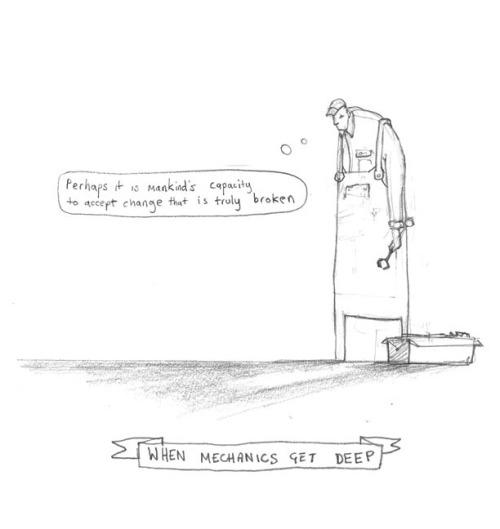
When mechanics get deep

09 Jan 18:21

'Replace indoctrination' calls Al-Qaeda hit-listed Ayaan Hirsi Ali after Charlie Hebdo attack

Burly.Thurr

Fantastic interview.

Transcript

JANE HUTCHEON, PRESENTER: Like the editor of Charlie Hebdo, Stephane Charbonnier, New York-based activist Ayaan Hirsi Ali was and still is on an al-Qaeda hit list. She says the West needs to acknowledge the link between radical Islam and violence and in the wake of the attacks, the media mustn't be silenced in its pursuit of free conscience and expression.

Ayaan Hirsi Ali was born into a Muslim family in Somalia. She became a politician, activist and writer in Holland, where her friend Theo van Gogh was brutally murdered over a decade ago after the two collaborated on a film about the treatment of women in Islam.

She joined me from New York a short time ago.

Ayaan Hirsi Ali, welcome to 7.30. How do the latest killings in Paris fit in with what you've described as a surge of Islamist killings in the world?

AYAAN HIRSI ALI, AUTHOR AND ACTIVIST: Well, first, I feel like a broken record, because for the last 13 years I have been saying the same thing over and over again. There is a strain in Islam that is political, that is inspired by the Koran and the Prophet Muhammad that is expanding over our globe. It's not limited to this continent or that continent, this country or that country, this community or that community. It's all over the place and that we must acknowledge this.

JANE HUTCHEON: When you say we must acknowledge this, this link between violence and radical Islam, how should this practically be done?

AYAAN HIRSI ALI: Islam is not only a religion; part of it is politics. The important part, the most important part of Islam is politics. So first of all, I want us to digest that, which is very difficult to digest, but I think the inhabitants of Sydney now know that. And once we digest that, then we have to say, "OK, here's what we - when it comes to military power, what the enemy has, we are far more powerful. When it comes to police power and resources and money, we have more than they have." Where they're defeating us is in our - and this is self-censorship for those of us who love life. The men and women who love death and who choose death, where they're defeating us right now is in the battlefield of ideas.

JANE HUTCHEON: Are you saying that everyone who describes themself as a believer has the propensity for violence?

AYAAN HIRSI ALI: I am saying that every person who is a believer in Islam has to acknowledge this schizophrenia within Islam. If you believe that Muhammad is your moral guide, then you have to accept that there was a peaceful character in Muhammad and that there is a warlord, a military man, a beheader, a man who sold people into slaves. And that in the 21st Century, if there are people who say, "Well he's our moral guide in peaceful ways," acknowledge that. But if they hark back to his bad side, then we also have to acknowledge that.

JANE HUTCHEON: We see in the aftermath of the Paris attacks that mosques around France have been attacked. Isn't this the result of demonising all Muslims?

AYAAN HIRSI ALI: It is not the result of demonising all Muslims. It is an expression of anger. It is an expression of the individuals who are doing this to say, "You need to stop this." And I'll tell you what is remarkable about the attacks in Paris last night: those who attacked mosques made sure that there were no individuals, that they did not take human life. Now I'm not condoning the attacks. I don't think they should do attacks. I don't think they should answer with violence. But I'll tell you something: the longer we wait with acknowledging that there is a link between Islam and what just happened, the more people will die. And how many more incidents like this one, how much more human life needs to be taken before we, the Western world, acknowledge this and fight it?

JANE HUTCHEON: Ever since 9/11, the Western world, as you call it, has spent a lot of money on security, we've gone to war, there have been wars and yet the problem still persists. What practical measures do you advocate that Western governments, including France and Australia, can undertake?

AYAAN HIRSI ALI: If we acknowledge that there is an infrastructure of indoctrination into the young hearts and minds, hearts and minds that are vulnerable, that are impressionable, of young men - mostly young men, but also of women, and that we have allowed this infrastructure to seed in the West and to thrive; if we come to terms with the fact that this is and has been going on for a long time, that we need to dismantle - you asked for practical solutions. We need to dismantle this infrastructure of indoctrination and replace it, replace it with an infrastructure where we inculcate into the minds and hearts of young people an ideology or ideas of life, love, peace, tolerance.

JANE HUTCHEON: As you know, in the wake of the Paris attacks, the media has been showing solidarity with Charlie Hebdo. In your view, do you feel the media in the past years has been self-censoring and will it continue to self-censor?

AYAAN HIRSI ALI: You are still continuing to self-censor because you have not published or republished cartoons of the Prophet Muhammad. You have not honoured Charlie Hebdo the way they need to be honoured, which is they took a risk, they took a risk to stand up for the core values of Western civilisation. And you, the media, are letting them down. You have drawn and published caricatures of the terrorists, but you have not published caricatures of the Prophet Muhammad.

JANE HUTCHEON: Can I ask you how much of these events - what happened in Sydney, the Paris attacks - how much of this is due to the power vacuum in Syria?

AYAAN HIRSI ALI: Look, this - the idea of the Islamists, the idea that they can bring the world down through terrorism, among other means, to believe that sharia is the way and the only way that human beings can live, that idea is so much older than what is going on in Syria and what is going on in Iraq.

JANE HUTCHEON: You personally have lived under threat of fatwa. You're on the latest al-Qaeda hit list, which also shows the editor of Charlie Hebdo crossed out. What is daily life like for you?

AYAAN HIRSI ALI: Well the first thing that strikes me there is that they show the faces of the men that they want to kill, but they will not depict the images of the women they want to kill. That must tell you something.

JANE HUTCHEON: Well, explain that for us.

AYAAN HIRSI ALI: Well, once again, according to the Prophet, the images of women are misleading and what are they afraid of? Why wouldn't they put my picture there? They've put my name there. If in 2015, in 2015, we're asking ourselves these questions, you can just about imagine how much time we are wasting in understanding what this ideology is about. We know what they want. They have written it. It's all over the place. They never hide, never, ever hide what their plan is. It's we who are confused and it's we who need to get out of that confusion.

JANE HUTCHEON: Ayaan Hirsi Ali, I really appreciate your time this evening. Thank you for speaking with 7.30.

AYAAN HIRSI ALI: Thank you and good luck.

09 Jan 17:17

Charlie Hebdo's Brazen Defiance

by Dashiell Bennett
Burly.Thurr

@Lev. As if you needed more reason to rail against radical Islam.

Image

Journalists around the world are expressing solidarity with the victims of a terrorist attack on a French magazine in Paris, echoing Charlie Hebdo's relentless support of free speech in a controversy that's nearly a decade old.

In 2005, a Danish newspaper Jyllands-Posten published a page of 12 cartoons, drawn by various artists, depicting the Prophet Mohammed. Some were innocuous pictures of unnamed Islamic figures, while others were mocking or outright critical of Islam. Many Muslims angrily objected, accusing the paper of blasphemy, and subsequent protests in early 2006 turned violent. Some of the worst incidents took place in Nigeria, where the cartoons became the pretext for a wave of sectarian violence that killed more than 100 people, most of them Muslim.

Many other publications republished the cartoons out of solidarity to Jyllands-Posten. One of them was Charlie Hebdo, a long-running satirical magazine that had its roots in the French counterculture of the 1960s. From the very beginning, the publication had a habit of taking on French political figures and the media, often running afoul of public sensibilities and the government. It ceased publication in the 1980s, but was resurrected under new leadership in 1992.


Related Story

Massacre at a Paris Magazine


Following the Danish cartoon controversy, the magazine continued to make Muslim extremism a frequent target. (Although Christian and Jewish leaders were often subject to mockery as well.) In November 2011, Charlie Hebdo ran an issue that was billed as being "guest-edited" by Mohammed. The cover featured an absurd caricature of the prophet, and the caption "100 lashes if you don't die laughing." The very week that it was released, the Paris offices of the magazine were firebombed, although no one was seriously injured.

Less than a year later, Charlie Hebdo ran a cover featuring Mohammed in a wheelchair, being pushed by an Orthodox Jew, with both of them saying "You must not mock us." Another cartoon on the back page depicted Mohammed naked.

Despite numerous threats and condemnations (from French political leaders as well as Muslim clerics), the magazine continued to stand by its belief that nothing should be off limits, and that their "provocations" were actually nothing of the sort. Editor Stéphane Charbonnier, himself a cartoonist known as "Charb," defended the magazine's approach to the media in 2012:

The accusation that we are pouring oil on the flames in the current situation really gets on my nerves. After the publication of this absurd and grotesque film about Mohammed in the U.S., other newspapers have responded to the protests with cover stories. We are doing the same thing, but with drawings. And a drawing has never killed anyone. ...

We publish caricatures every week, but people only describe them as declarations of war when it's about the person of the prophet or radical Islam. When you start saying that you can't create such drawings, then the same thing will soon apply to other, more harmless representations.

Charb, who was reportedly among those killed in today's attack, was placed on a list of "al-Qaeda's Most Wanted" in 2013, along with the original editors at Jyllands-Posten. His final cartoon, published in the last issue before the attack, read "No attacks in France yet; No attacks in France yet; wait! There's until end of Jan to wish Happy New Year." Charb relentlessly defend his right to free speech and scoffed at threats to silence him, saying that since he had no family, he feared no reprisals. In 2012, he told ABC News, "I prefer to die than live like a rat."

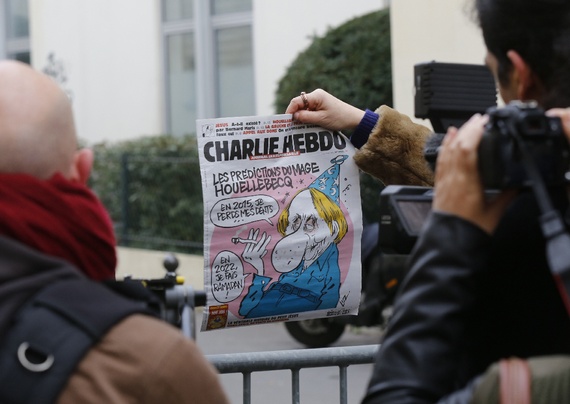
A journalist photographs the front page of Wednesday's edition of Charlie Hebdo which shows a caricature of French author Michel Houellebecq near the magazine's Paris offices. (Jacky Naegelen/Reuters)

The same issue also mocked a new novel, released today by French author Michel Houellebecq, which imagines a near-future France where a Muslim is elected president.  The book's critics claim it is Islamophobic.

In much the same way Charlie Hebdo expressed solidarity with the Danish paper 10 years ago, other publications are standing by them today, with many spreading the hashtag #JeSuisCharlie (or "I am Charlie") on Twitter.

The website of the magazine also carries that message now and the more traditional French newspaper Le Monde remade their website in support, as well.

Can't sleep tonight, thoughts with my French cartooning colleagues, their families and loved ones #CharlieHebdo pic.twitter.com/LqIMRCHPgK

— David Pope (@davpope) January 7, 2015


09 Jan 15:27

What Low Oil Prices Mean for the Keystone XL Pipeline

by Michael Levi
Burly.Thurr

Confirmation bias warning. Another solid installment from Mr. Levi.

Keystone XL Pipeline

The 114th Congress is in session and the Keystone XL pipeline is at the top of its docket. Senate Republicans have vowed to push the pipeline through and President Obama has threatened to veto any bill that does that. After five years of battle, this is mostly more of the same. But one thing about the world has changed radically since the Keystone XL pipeline became a top tier issue: oil prices have plunged. So what do lower oil prices mean for the costs and benefits of the Keystone XL pipeline?

Expert discussion has been focused on the State Department Environmental Impact Statement (SEIS). This is more relevant to political handicapping than to actual cost-benefit analysis, but it’s still worth digging into. The SEIS concluded that the pipeline would probably have no “substantial impact” on greenhouse gas emissions. This seemed to line up with President Obama’s statement that he would only approve the pipeline if it did not “significantly exacerbate” climate change. But the SEIS claimed that there was one exception: if oil prices were between $65 and $75, the Keystone XL pipeline could make a significant difference, tipping the economics of Canadian oil production from red to black and thus increasing emissions. Hence the political hook. Indeed as oil prices fell below $75 late last year, I began getting calls from reporters asking if this was a game changer for Keystone. Once oil dropped below $65, the calls stopped.

The $65-$75 range was never particularly compelling in the first place. No matter what the prevailing price of oil, if you reduce the cost of transporting it, you will improve project economics, and, at the margin, you should expect oil companies to produce more. How much more is impossible to confidently predict. Among other things, the breakeven price for Canadian oil will likely move with the oil price and with transport costs: if nudging transport costs a little when oil costs $70 a barrel really does threaten to shut in a large amount of Canadian oil, there’s a good chance that the Alberta government will try to blunt the impact through changes in tax and royalty treatment. On top of all that, of course, is the fact that oil is no longer trading between $65 and $75, and no one knows when it next will.

It’s much more interesting to ask how lower oil prices affect the costs and benefits of approving the pipeline. As a starting point, it’s important to stipulate that no one really knows where the long-run oil price will settle. And it’s the long-run price, not the current one, which matters when you’re talking about the consequences of a pipeline that has the potential to operate for decades. So let’s focus on what “lower” oil prices mean for Keystone XL rather than what any particular prices does.

Lower oil prices reduce both the costs and the benefits of approving the Keystone XL pipeline by reducing the odds that it will ever be fully used. There’s an outside chance that, if prices are sustained at an extremely low level, the Keystone XL pipeline won’t get built. That scenario isn’t likely – among other things, if Canadian production doesn’t grow, the odds of sustained low prices decline substantially – but it’s not zero. Lower prices also raise the odds that the pipeline will be built but not fully utilized. In that case, you still get the up-front construction stimulus, but you get less benefit from greater oil production, and less climate damage from the same. You also have a waste of economic resources.

The more likely scenario, though, is that the Keystone XL pipeline gets built and used. In that case, lower oil prices reduce its economic benefits without any clear impact on its climate costs. If you assume a constant elasticity of oil demand, then a given addition to world oil production should push down prices by the same percentage, regardless of what the starting point is. Imagine you think that the Keystone pipeline would boost net world oil production by 100,000 barrels of oil a day and you believe that would cut world oil prices by 0.3 percent. If prevailing oil prices start at $100, you’re cutting them by 30 cents; if they start at $50, you’re reducing them by only 15 cents. In both cases the marginal reduction in oil prices saves Americans money through reduced import costs and reduced absolute price volatility. (There is one countervailing force – at lower oil prices, U.S. imports are higher, and therefore a given reduction in oil prices yields more economic benefit – but this shouldn’t fully offset the main economic effect.) The upshot is that, in the lower oil price world, any savings from Keystone XL are reduced.

What about the climate impact? For a given net impact of Keystone XL on world oil production, the climate damages should be unchanged – the impact is a fixed function of how much extra oil is produced in Canada and how much additional oil is consumed worldwide. So whatever you think the excess of benefits over costs is for Keystone at $100 a barrel oil (and many people, of course, think that “excess” is negative), you ought to think that it’s smaller when prevailing oil prices are reduced. Keystone XL, like any oil production project, is less compelling when prices are lower.

What about the absolute impact on both economics and climate? This is much more difficult to pin down. The absolute impact of Keystone XL on both depends on how other producers respond in the long run to any additional production that it enables – that’s what determines the net impact on world production and consumption. How that changes depending on the prevailing oil price is unclear. Nailing that down would require knowledge of global oil supply economics, as well as oil producer politics, that no one confidently has.

What hasn’t changed is that both the climate damages and the economic benefits from Keystone XL are small in the grand schemes of climate change and the U.S. and global economies. A Keystone XL decision will have much larger consequences for U.S. politics, U.S.-Canada relations, and perhaps the broader rules-based global trading system than it will for climate change or the economy – and that’s where serious decision-makers ought to mostly focus. Lower oil prices haven’t changed any of that.

09 Jan 03:56

January 04, 2015

Burly.Thurr

fking lutherans.


Kerpow! Come see me at the AEA humor session in Boston. It's open to the public!
08 Jan 21:26

Photo

Burly.Thurr

Ouch.


08 Jan 21:17

The MSC Oscar just became the world's biggest container ship

by Joseph Stromberg
Burly.Thurr

#containerbeat #nicecans

Today, the MSC Oscar is scheduled to set sail from a shipyard near Busan, South Korea, and became the world's largest container ship.

This ship is so big that it's hard to comprehend without seeing in person. The deck of the Oscar is nearly as big as four football fields laid end-to-end and can carry more than 19,000 shipping containers.

In more tangible terms: this single ship can carry 39,000 cars or 117 million pairs of sneakers. Or, if you prefer, more than 900 million cans of dog food. And it's just the latest stage in the explosive growth of container ships since they debuted in the 1950s.

How container ships got so huge

Until 1956, most international cargo was manually packed in the holds of shipping boats by dock workers, and manually unloaded when it reached port. But in 1937, North Carolina trucking company owner Malcom McLean grew frustrated by how long this process took as he waited for workers to pack up cotton he'd trucked up to New York harbor, to be sent to Istanbul.

McLean had the idea to use cranes to directly load truck trailers onto the ship. It took a while, but in 1956, he debuted the Ideal Xthe very first container ship, a converted tanker that could carry 58 containers. The next year, he launched the much-larger Gateway City, which could hold 226 containers, stacked in racks.

During the 1960s, he launched even bigger container ships, and his company Pan American began to dominate the shipping industry — his system dramatically cut down on time in port, as well as the labor needed to load and unload cargo. The containers also helped secure goods, cutting down on theft. Other companies copied his methods, and shipping containers now come in standardized sizes (they are now 8 feet wide, 20 or 40 feet long, and 8, 8.5 or 9.5 feet tall). By the end of the 1970s, the majority of consumer goods coming to the US were being shipped by container.

Eventually, the trend led to an arms race between shippers, because larger boats meant lower shipping prices per container: roughly the same amount of sailors were needed on a ship regardless of size, and proportionately less fuel per container was needed to move larger ones.

This led to the huge growth in ship size we've seen. To accommodate these giant ships, ports were rebuilt, with vast yards to store the containers, huge cranes to load and unload them, and highway and rail terminals to send them directly on their way.

The Maersk MC-Kinney Moller, which shared the record for world's largest container ship in 2013, and can hold 18,000 containers. (David Hecker/Getty Images)

The Panama canal is currently being widened to accommodate larger ships, but even after the project is finished in 2016, it won't be able to fit the Oscar. And today's biggest ships are so huge that they can’t actually dock at any American ports — they’re used mostly for shipping between Europe and Asia. However, the Nicaragua Canal — if it's ever completed — would be big enough to accommodate these ships, and there are proposals to dredge the Port of Norfolk, among others, to allow them to dock in the United States.

How container ships transformed the world economy

Containers being loaded aboard the Marco Polo, capable of holding 16,020 containers. (Charly Triballeau/AFP/Getty Images)

It's hard to overstate how much all of this has changed the world economy. Before the container ship, transoceanic shipping was so expensive that it didn’t make sense to send most goods around the world.

Now, it’s cheap — which, combined with-free trade policies, means that vendors in wealthy countries like the United States can efficiently take advantage of cheap labor abroad. For the American consumer, it means that the vast majority of goods — shoes, clothes, flat-screen TVs, basketballs, even toothbrushes — come from abroad, via container.

The MSC Valeria, capable of holding 14,000 containers. (Sam Panthaky/AFP/Getty Images)

The US now imports more than 17 million containers of cargo per year, with about 60 percent coming from Asia. The biggest ports — Los Angeles, Long Beach, Newark, and Savannah — each handle more than 2 million containers per year. Recently, companies have even begun shipping bulk food products on container ships.

And the truly amazing thing is that the Oscar probably won't hold the record for long. A different ship — the CSCL Globe — previously set the record in November (and is actually a bit longer and wider than Oscar, but can't carry quite as many container). Meanwhile, a sister ship of identical size is being launched by the same company (Mediterranean Shipping Company) in April. Shipping experts are speculating that ships capable of holding more than 20,000 containers may be built soon.

The MSC Oscar. (MSC)

08 Jan 21:10

Teixobactin: A New Antibiotic From a New Platform?

Burly.Thurr

@CC & @bjorno. Haven't read yet but looks like an interesting technical perspective from my favorite pharma bloggeur.

A team from Northeastern University/Bonn/Novobiotic (and Selcia) has published a very worthwhile paper in Nature on a new antibiotic, with a new mechanism of action, via a new discovery technology. The compound itself is not the world-changing new last line of defense that everyone's hoping for, but it's nothing to sneeze at, either. And the platform used to find it is worth keeping an eye on.

A lot of people have had similar ideas to this one, based on the fact that the overwhelming majority of bacteria in any given environmental sample can't be readily cultured. These organisms may well be able to produce useful antibiotics and other natural products, but how will you ever be able to tell if you can't fish any of them out? In this work, Kim Lewis and Slava Epstein at Northeastern came up with a gizmo (the "iChip", a name that you'd think would have been taken several times by now), that tries to get around this problem. After taking a soil sample and diluting it into media, you dispense aliquots into the wells of this chip. Then the chip is placed back into the soil, in the same place the sample was taken from, where semipermeable membranes allow environmental factors (whatever they may be) to diffuse across. This gives, apparently, a much higher culture success rate.

Using this on a soil sample from Maine and leaving the chip in situ for a month, a number of colonies formed. These were tested for their ability to grow outside the device in fermentation broth, and extracts of these were tested against pre-grown lawns of an S. aureus strain to look for useful antibiotic activity. Lo and behold, one extract cleared out a large spot - it turned out to come from a newly described bacterium (Eleftheria terrae, provisionally). The compound present has been named teixobactin, and here it is.
Teixobactin.jpg
Purification of the active broth extracts showed increasing amounts of a compound with MW 1242 by LC/MS. Isolation of this substance (after clearing out the endotoxin that came along with it) allowed a good deal of NMR spectral assignment work, and coupling this with the identification of the biosynthetic gene cluster and degradation/derivitization analysis (advanced Marfey's method) has allowed the structure to be assigned. It's a pretty chewy one, with two rare amino acids and four D-amino acids. That would account, you'd think, for its properties: teixobactin has reasonable microsomal stability and shows useful PK after an i.v. dose in mice. (The authors also checked it for hERG, CYP inhibition, and plasma protein binding - the sort of thorough med-chem workup that you'd like to see more often, honestly).

And let's pause a moment to reflect on the world we live in these days. This new bacterium's genome was totally sequenced, as a matter of course, because we have the tools to do that without a second thought. Not all that long ago, just figuring out what this organism might be related to would have been a whole project of its own. Its biosynthetic pathway was thus laid bare, and our accumulated knowledge of nonribosomal peptide synthetase proteins made clear how this compound is produced, which is another thing that would have taken a big chunk of someone's life in the old days. And then modern LC/MS and NMR techniques made comparatively short work of the structure, and any organic chemist should realize what that would have been like. Had anyone stumbled on teixobactin in the 1950s, back in the golden age of antibiotic discovery, they could have easily spent their career on it.

So how useful is the compound? It's active only against gram-positive organisms, which is too bad, because we could really use some new gram-negative killers (their cell membranes make them a tougher breed). But the mechanism of action turns out to be interesting: studies of S. aureus with labeled precursors showed that teixobactin is a peptidoglycan synthesis inhibitor, but extended exposure and passaging did not yield any resistant strains. That's close to impossible if an antibiotic is binding a particular protein target - stepping on the selection pressure will usually turn up something that evades the drug. When you don't see that, it's often because there's some nonspecific non-protein-targeted mechanism, which can be problematic, but teixobactin isn't toxic to eukaryotic cells in culture (and has a favorable tox profile in mice as well). It turns out that it binds to some of the peptidoglycan precursors, lipid II and lipid III. Vancomycin has a similar mechanism (binding to lipid II), but teixobactin has a wider spectrum of activity against lipid II variants (and lipid III as well). This mechanism makes developing resistance not so straightforward - the selection pressure is more of a bounce shot than a direct hit.

So overall, I'd say that the compound could be a promising alternative to vancomycin, and that's no bad thing. There are vancomycin-resistant strains of S. aureus out there, and if you get infected by one, you're going to need all the help you can get. I would assume that Novobiotic is working on the development, and I hope it goes well. There are plenty of challenges ahead (a reproducible scale-up fermentation being one that comes immediately to mind), but the compound has a good preclinical start on things. Teixobactin itself is not going to save the world from the oncoming problem of bacterial resistance, but it represents a promising line of attack.

This idea of going after cryptic bacterial strains has been around for a long time, but getting it to work has been another thing entirely. This is the most solid example that I'm aware of, and I hope that it's just the opening of a new platform for antibiotic drug discovery. The traditional search for natural product antibiotics has pretty well come to a shuddering halt over the years - no matter how much effort you put into increasingly exotic soil samples and the like, you keep finding the same things (if you find anything at all). Unculturable organisms are the new frontier, and it's safe to say that the iChip is going to be nowhere near the last word in exploring it. And at the same time, you have outfits like Warp Drive Bio trying to get organisms to express unusual compounds that aren't normally seen, so the hope is that there are a lot of useful things out there that that we have never heard of.

As an aside, if you're outside the field, you might wonder why it's worth working so hard to find natural products when we have so many synthetic organic chemists in the world cranking out new compounds. One big reason is the ridiculous, insane hugeness of chemical space: the number of possible compounds at or under the molecular weight of teixobactin defies description, and I mean that in a completely literal sense. There are not enough resources on Earth, or in our entire solar system, to do enough organic synthesis to make any noticeable dent in that array. The idea of having compounds that bind to things like Lipid II is a good one, but they're going to have to be large compounds, and exploring that space is daunting.

And then there's the evolutionary factor. Bacteria are out there elbowing each other for space and nutrients every minute of the day, and they've been doing it for billions of years. They've had the time and motivation to come up with molecules that work to kill off their rivals, and we should take advantage of that legacy as much as we can. These molecules have not only had rigorous real-world tests of their mechanisms of action, they've also (perforce) had their properties optimized against their target organisms as well. Believe it, most large peptidic-looking things like teixobactin would have awful stability and pharmacokinetics as drugs. Finding the ones that don't is nontrivial indeed.

08 Jan 17:27

maggie-stiefvater: destielhiseyesopened: umiko-hitara: poisonp...

Burly.Thurr

Shared for the bible as fanfic narrative. I love the way it's described here.


maggie-stiefvater:

destielhiseyesopened:

umiko-hitara:

poisonpawz:

zftw:

voyagebysexualdiscovery:

Uh oh

wouldn’t that be awkward

Can I get some credible sources?

Here’s one

and another

and one more for the road

Theology nerd side of Tumblr, reporting for duty!

There are roughly five and a half fucktillion extracanonical gospels out there. For the first couple centuries after Jesus bit it, his followers wrote a ridiculous amount of fanfic. There were a gajillion different headcanons floating around about exactly who and what he even was (God pretending to be human? human who got possessed by God at his baptism? human who got promoted to demigod after his death? simultaneously God and human all along??) and lots of early Christian communities ~conveniently~ discovered a Totally 100% Authentic Eyewitness Account that supported their pet theory (and also, proved that their fave disciple was clearly the best).

Big Name Fans argued about all the major disagreements, periodically throwing conventions specifically to bicker until they reached some sort of consensus (more or less – sometimes the hold-outs ended up saying “screw you guys, we’re gonna go form our own church!”) Toward the end of the second century, a guy named Irenaeus wrote a meta arguing that there were four fics worth reading – no more, no less – and they were ones that folks somewhere along the line started to claim were written by Matthew, Mark, Luke, and John. This idea caught on as a popular bit of fanon, and over the next couple of centuries it gained so much support that it was declared canon.

So, what’s the point of this Jesus fandom history lesson? Basically, that the discovery of yet another extracanonical text isn’t particularly earth-shattering. Headlines like “Ancient Bible changes everything! Pope freaking out!” are bullshit, but that’s how it’s always framed cause more accurate headlines like “Old manuscript discovered – Historians say ‘Ooh, nifty!’” aren’t very good click-bait.

The actual history and politics of the various gospel texts are really fascinating though (if you’re a huge fucking nerd, like me). In the Gospel of Judas, he’s the only disciple who really understands Jesus, who told Judas to “betray” him. Also, God’s a Glow Cloud. The Infancy Gospel of Thomas has kid!Jesus smite other kids for being little shits. The Gospel of Peter is hella anti-Jewish, but has one cool bit with a character that’s literally a walking, talking cross. There’s a whole book called “Q” which has never even been found, but scholars are pretty sure exists cause Matthew and Luke copied a lot from it.

Seriously, leaning about this stuff made me go “woah, this is freaking awesome – why the hell did my parents’ church make the Bible seem so damn boring??” Well, probably cause all those white upper middle class folks didn’t want us kiddies to dig too deep and find out what a radical, anti-establishment bamf Jesus really was, but that’s another rant for another time…

Reblogging because this is what I live for. As a medieval history major, I got taught first and foremost that we’d be spending four years reading lies and biased half-truths and mythologies. Our job was to find the places they agreed and work the rest out from there. “Do the edge pieces first, Maggie.” I took an entire seminar on forgeries, because so many of the sources historians use to piece together the past are known fakes, but the best they can do is read between the lines or have no lines at all. There’s a reason why medieval historians read farm reports featuring travel descriptions and saints’ lives involving demons-living-in-buckets with the same attention to detail. Every dry history text you’ve read in your life comes from a pile of sources like this, bits of maybe-truth cobbled together with toothpaste and narwhal horn dust.

The moral of the story is be curious, and look for the lies in truth and the truth in lies. It’s pretty great: hello, history, riddle me this.