Rtersieva
Shared posts
VIDEO: The scene of the London jewel heist
Unity 5 Ships and Brings One Click WebGL Export to Legions of Game Developers
Mozilla’s goal of high quality plugin-free gaming on the Web is taking a giant leap forward today with the release of Unity 5. This new version of the world’s most popular game development tool includes a preview of their amazing WebGL exporter. Unity 5 developers are one click away from publishing their games to the Web in a whole new way, by taking advantage of WebGL and asm.js. The result is native-like performance in desktop browsers without the need for plugins.
Unity is a very popular game development tool. In fact the company says just under half of all developers report using this tool. The engine is highly suited for mobile development and as such has been used to produce a wealth of content which is particularly well suited for Web export. Small download size, low memory usage, and rendering pipeline similarities make this content straight forward to port to the Web. Unity has a long history of providing their developers the ability to ship online via a Web plugin. In recent years, browser vendors have moved to reduce their dependency on plugins for content delivery.
A new cross browser approach was needed and it has arrived
Mozilla and Unity worked together to find a way to bring content developed in Unity 5 to the Web using only standard compliant APIs and JavaScript. Unity’s new approach to Web delivery is made possible by using a combination of IL2CPP and a cross-compiler named Emscripten to port its content. IL2CPP was developed at Unity Technologies and converts all ingame scripts to C++. This approach has performance benefits when porting to multiple platforms, including the Web. Unity then uses Emscripten to convert the resulting C++ to asm.js, a subset of JavaScript that can be optimized to run at near native speeds in the browser. asm.js was pioneered by Mozilla. The code then executes in the browser as any other Web content. It accesses hardware via standard compliant APIs such as WebGL, IndexedDB, and Web Audio. The results of this collaboration have now reached the point where it’s time to get them into the hands of developers.
“Unity has always been a strong supporter of Web gaming,” said Andreas Gal, CTO of Mozilla. “With the ability to do plugin-free WebGL export with Unity 5, Mozilla is excited to see Unity promoting the Web as a first-class platform for their developers. One-click export to WebGL will give Unity’s developers the ability to share their content with a new class of user.”


Clicking on the images above will take you to live examples of Unity 5 exports using WebGL 1.
At GDC, Mozilla will also be providing a first look at WebGL 2. While the shipping Unity WebGL export targets WebGL 1, Unity and Mozilla have been working together to take advantage of WebGL 2, the next generation standard for 3D graphics on the Web. Unity has redeveloped their Teleporter demo to showcase the technology in action.
Mozilla and Unity will be showing off a number of titles developed in Unity and exported to the Web, including Nival’s Prime World Defenders and AaaaaAAaaaAAAaaAAAAaAAAAA! for Awesome by Dejobaan Games, which can be played right on their website. You can also try Dead Trigger 2 and Angry Bots available via Unity Technologies’ website.
For more information on Unity’s news please see their blog post.
For more information on Mozilla’s news at GDC see this post.
Edited March 4th to clarify that current Unity support is for WebGL 1 while WebGl 2 is an experimental technology being developed in conjunction with Mozilla.
Dutch man jailed for horsemeat sales
DAVE GROHL Praises SEPULTURA On 'The Late Late Show With James Corden'
VIDEO: Snowden: Now you see him, now you don't
The First Schizophrenia Medication Was Developed As An Antihistamine

Thorazine, or chlorpromazine, was the first antipsychotic. It freed many people with severe schizophrenia from mental asylums, but that's not why it was developed. It was first tested because it's an antihistamine. Yes, like the allergy medications.

A Woman Named Beyoncé Gets Help From All the Other Unfortunately-Named on the Internet
Beyoncé was featured on the long-running blog project Humans of New York, where she discussed the blessing (everyone remembers your name!) and curse (no one will stop singing "Single Ladies"!) of having a famous moniker. And just like that, the rest of the internet joined in to share their woes. Some of these names almost seem too good to be true.
Hopefully now she knows that she isn't alone!
Submitted by: (via POWTV)
Personal cancer vaccines 'exciting'
10 Strangest Things Found Under Beds
 From the man that found a crocodile to the person who discovered a decomposed body, here are 10 incredible stories of some very unusual things people have found under beds.
Visual Studio 2015 Can Target Linux; Android Apps Anywhere Chrome Can Run


Read more of this story at Slashdot.
Chinese Certificate Authority CNNIC Is Dropped From Google Products
Read more of this story at Slashdot.
Former RAGE Guitarist VICTOR SMOLSKI Launches ALMANAC
The Suprising Fate of 9 Famous Corpses
 From Rasputin's penis to Einstein's brain, take a look at some of the weirdest things that happened to famous people after they were dead.
The Most Popular Antidepressants Are Based On An Outdated Theory [UPDATED]

One in ten Americans takes an anti-depressant drug like Zoloft or Prozac. These drugs have been shown to work in some patients, but their design is based on a so-called "chemical imbalance" theory of depression that is incomplete, at best.

The Chemistry of Whisky
See how the Dreamworks logo before its movies changed over time

Ethan Jones is back with another interesting visual breakdown of movie logos, this time focusing on DreamWorks. You know that intro sequence, where a fishing line gets dropped into the water from a boy on the moon. Here are all the variations that have popped up in DreamWorks movies since they first started using the logo in 1997.

A Medieval Recipe Could Kill Hospital Superbugs. No, Really.

Staph infections are one of the most pervasive and annoying bacterial infections faced by hospitals every year. It infects half a million people in the US every year, with symptoms ranging from skin infections to heart problems — and worse, some strains (commonly known as MRSA) have evolved to resist common antibiotics.

Gotcha! Coffee Tryin to steal my toast!😡 Thank you all for...

Gotcha! Coffee Tryin to steal my toast!😡
Thank you all for watching and sharing aug(de)mented Reality 3!!!🍻
Hello LA👋 (at Franks Coffee Shop)
Does Cadbury chocolate taste different in different countries?
Pixar Releases Free Version of RenderMan
Read more of this story at Slashdot.
Energy Company Trials Computer Servers To Heat Homes
Read more of this story at Slashdot.
What's the Difference Between Pudding and Mousse? — Word of Mouth


When I think of smooth and creamy desserts, the first two things that come to mind are pudding and mousse. While they share similar characteristics, these creamy, no-bake desserts have a few differences. Do you know what sets pudding and mousse apart?
ghosting it
After 1723 posts and several years of use, I've switched my blog from the proprietary, Google-owned-and-hosted Blogger to a self-hosted instance of the free software Ghost blogging application. If you are reading this in one of the blog agregators I'm carried on, you may have seen some old postings showing up as a result; apologies if this happens.
I've been watching the Ghost project for a while waiting for it to reach the point I could reasonably use it for my needs. It got there recently and I had the opportunity to move to a new server recently so took the plunge.
Here's what I really like about it, and why I went with it:
- It is free software. Obviously this is #1 in the list
- It is actively and openly developed, moving at a good clip
- I was able to import my Blogger blogs into it quite easily
- It is focused on minimalism
- It runs as a separate application
While the first three may be obvious in terms why they are important, I'd like to take a moment to talk about the last two.
It may sound like stating the obvious, but: I want a blogging system for my blog. Not a web site builder. Not a content management system. A blog application. As a counterexample, Wordpress has long exited the land of simple blogging system and become a website building suite. There is nothing wrong with that, but it means it diverges from my desire for a clean, minimal and elegant system for blogging. I've run a few Wordpress sites over the last few years, so I'm not just speaking hypothetically but from first-hand experience.
With Ghot, you write your blogs in a very plain and simple full-screen, two-pane user interface using markdown. No word-processor-wannabe toolbars, switching between keyboard and mouse, lots of menus everywhere. Just a text editor, a live preview next to it and all the editing and formating you could want in a blog. Tags live in a bar below, configuration in a slide-in drawer on the right, and a simple button to save and publish.
Yet in this simple system it still manages to have multiple author support, tag and author specific RSS feeds, static pages, theming ...
Since it runs as its own process, I can have systemd manage it as a separate service listening on a local socket with haproxy forwarding traffic to it. Upgrading the blog becomes a simple matter of setting up a parallel install, testing it, and when I'm happy with it changing the haproxy routing and restarting haproxy. Zero downtime, even if things go wrong. If a security problem or some other issue arrises, I can shut down just the blog and none of the other things I have running on the server are affected. I can even move it to another machine if desired without interuption.
While setting it up, along with other "must have" tools for me such as Kanboard, it reminded me of some aspects of the Kolab architecture, specficially how it is built around a swarm of services that take care of different aspects of the task of "collaboration suite" in concert with each other.
Finally, I'd like to give a shout-out to the author of the Willsong II theme. I purchased the theme after trying his no-cost Willsong 1 theme; it looks nice and professional, and I both wanted to support his efforts and get some of the nice features of Willsong II. It also happens to use the KDE Oxygen font by default, which I thought was pretty spiffy. Unfortunately I ran into some small problems with the theme after installing it. I wrote the author and he responded almost immediately and quickly identified and fixed a bug in the theme. He even customized it a bit for me, even though I didn't ask for that. So: great customer support, and he's got a few other themes with a shared common core that he's working on. If you're looking for a good Ghost theme I recommend giving his efforts a look.
Why nine hours' sleep may be bad for you
Speaking a Second Language May Change How You See the World
Read more of this story at Slashdot.
A Visual Guide to Chemistry Glassware

Click to enlarge
Glassware in the laboratory comes in a range of different shapes and sizes, and is used for a number of purposes. Don’t know your round-bottomed flask from your Florence flask, or your pipettes from your burettes? This graphic has you covered. Below there’s also a little detail on the usage of each.
Basic Glassware
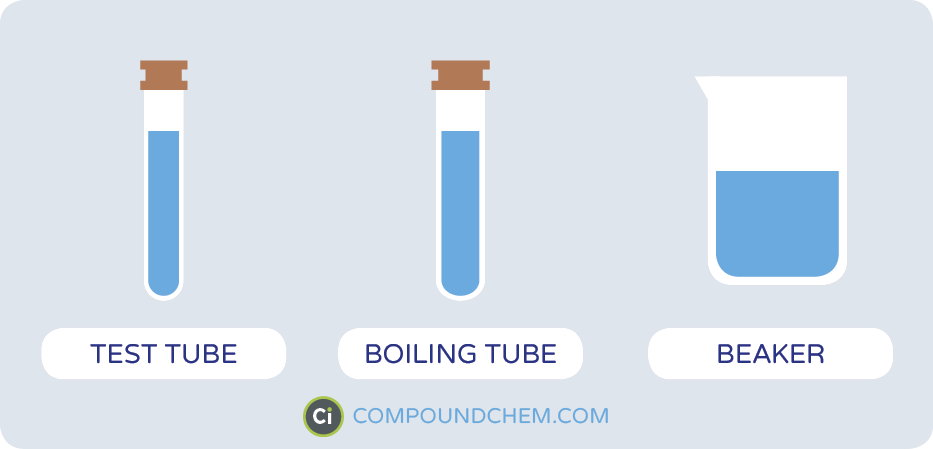
These items should be familiar to anyone who’s been in a chemistry practical lesson in school. Test tubes are the archetypal image of chemistry, whilst beakers also make frequent appearances in school practicals. Boiling tubes aren’t that different from test tubes in appearance, but are used when heating is required – they tend to be made of thicker glass, and are slightly larger and wider.
Flasks
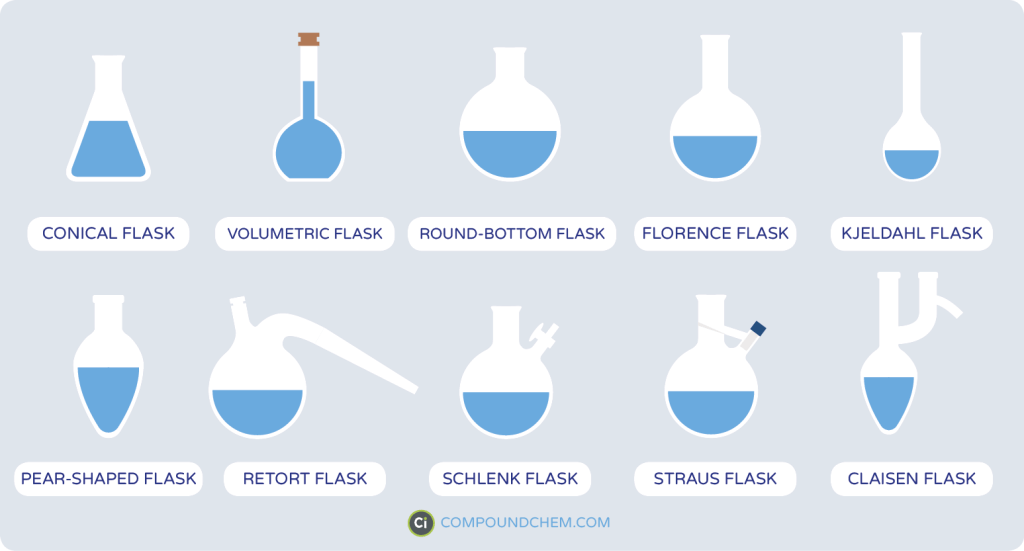
Of all the flasks used in chemistry, the most iconic is the conical (Erlenmeyer) flask. Named after the German chemist Emil Erlenmeyer, who created the flask in 1860, it’s designed so that its contents can be swirled easily without spilling out. This also makes them useful for boiling liquids, and additionally their necks can support filter funnels.
Volumetric flasks are used primarily in the preparation of standard solutions. To create a solution of a specific concentration, we need to know the volume of the solution; the narrow neck of the volumetric flask will have a thin graduation to show where a specific volume is reached.
Round-bottomed flasks and Florence flasks look very similar, but there is a slight difference between the two. Both have round bottoms, designed to spread out heat evenly when they are heated. They are frequently used by chemists for reactions and in rotary evaporators. Whereas round-bottomed flasks will usually have a ground glass joint on their neck, to allow connection to other apparatus, Florence flasks, supposedly named after Florence in Italy, tend to merely have a lip. They can also come with either a flat bottom so they are free-standing, or a rounded bottom, and have longer necks.
The Kjeldahl flask has an even longer neck, and was developed for use in the Kjeldahl method, which is used to determine the nitrogen content in a substance.
Pear-shaped flasks are usually rather small flasks, used for small-scale distillations. Their shape allows recovery of more material than the round-bottomed flasks.
The rather odd-looking retort flasks are used in distillations, though their use was primarily before the advent of condensers. Today, they are very rarely used.
The Schlenk flask and the Straus flask are another two that look fairly similar. Schlenk flasks are commonly used in air-sensitive chemistry, as the side arm allows an inert gas such as nitrogen to be pumped into the vessel. The Straus flask, on the other hand, is used to store dried solvents. The main neck is actually filled in halfway up, and connected to a plugged smaller neck; this main neck can be connected to other apparatus, and allows the solvent to be extracted when the plug is slightly withdrawn or removed entirely.
Finally, the Claisen flask, designed by chemist Ludwig Claisen, is designed for vacuum distillation; distillation under vacuum produces problematic amounts of bubbles when solutions are boiled. Claisen’s flask includes a capillary tube that inserts small bubbles into the liquid, easing the ferocity of boiling, whilst the branched portion of the flask hosts a thermometer. Today, Claisen’s flask is less commonly used.
Funnels, Analysis & Separation
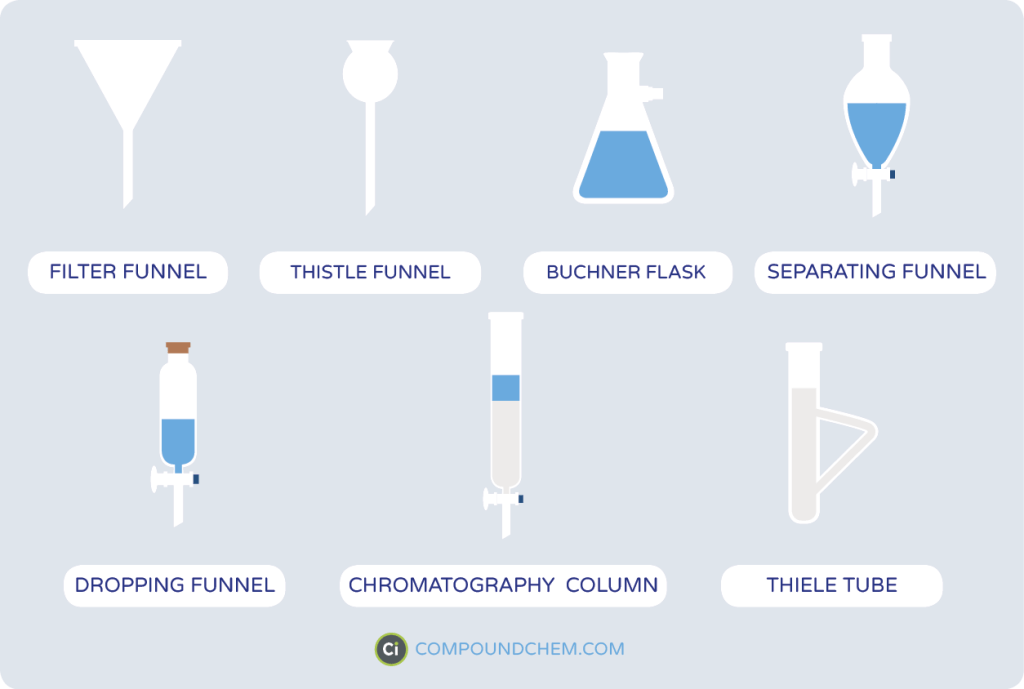
A variety of different apparatus can be used for filtration. The most obvious is the filter funnel, into which filter paper can be placed, and a mixture can then be poured through. The smaller thistle funnel is not used for filtering at all, but to add liquids into apparatus.
The Buchner flask can be used in conjunction with a Buchner funnel in vacuum filtration, and is a much quicker process than the gravity filtration used with normal filter funnels. A vacuum tube can be affixed to the flask’s sidearm, which rapidly sucks through the solvent, leaving any solid in the Buchner funnel.
For separating solutions or liquids of different densities, separating funnels can be used. Liquids of a lower density will float to the top, then the mixtures can be tapped off separately. The similar-looking dropping funnel is used to add liquids or solutions to a reaction.
Another method of separating mixtures of compounds is column chromatography, which can be carried out using a chromatography column. The mixture is passed through a column of silicon dioxide or aluminium oxide, with different components of the mixture taking differing amounts of time to pass through the column.
Finally, the Thiele tube is a piece of apparatus used to determine the melting point of a solid compound. It contains and heats an oil bath, into which a sample can be placed along with a thermometer. Heating then allows melting point to be determined. The design of the flask allows the oil to circulate, ensuring even heating.
Condensers

A range of different condensers can be utilised in laboratories as important components of distillation apparatus. The most commonly seen condenser in schools is the Liebig condenser, which has an inner tube through which vapour flows, surrounded by a ‘jacket’ through which cool water passes and condenses the vapour. The Graham condenser is similar to this, but has a coiled path for the vapour to flow through and condense. Meanwhile, the Friedrichs condenser inverts the arrangement, having a spiral coil through which the coolant flows, with the vapour surrounding it. Other varieties of condenser are also available, though are not shown here.
Another piece of glassware that falls loosely into this category is the fractionating column. This helps separate a mixture during distillation, as vapours collect and distill on the small glass ‘trays’ ascending the column. Only the most volatile gases will ascend all the way to the top of the column to be distilled off.
Measuring Apparatus

A number of pieces of chemistry glassware are used to accurately measure volumes; the most obvious being the graduated cylinder, or measuring cylinder, which can come in a variety of sizes.
For measuring volumes of solutions more precisely, a volumetric pipette can be used. These come in a variety of sizes, each measuring a fixed volume of solution. Graduated pipettes can also be used, which allow various small volumes to be measured out. For measurement of volumes during titrations (the addition of one solution to another to determine an unknown concentration) burettes are used. These are long, narrow tubes, with incremental volume markings, which allow precise volumes of solutions to be dropped into another solution.
For measuring the volume of gas produced in a reaction, a gas syringe can be used. This piece of apparatus can be attached to the top of a flask via a piece of tubing, and the gas produced pushes the plunger out of the syringe, allowing the gas volume to be measured.
The only piece of glassware we haven’t mentioned is the Soxhlet extractor. This is used to extract chemicals from a solid sample into a liquid. You can see it in action in this video which details the extraction of caffeine from coffee.
This graphic is available to purchase on posters & mugs on the site’s Redbubble page.


The graphic in this article is licensed under a Creative Commons Attribution-NonCommercial-NoDerivatives 4.0 International License. Want to share it elsewhere? See the site’s content usage guidelines.
References & Further Reading
- Classic kit – Chemistry World