Luciano
Shared posts
Why an anti-sacrilege law in India's Punjab has sparked controversy
First Public Working Draft: SHACL 1.2 User Interfaces
The Data Shapes Working Group has published today a First Public Working Draft of SHACL 1.2 User Interfaces. This specification describes Shapes Constraint Language (SHACL) User Interfaces. This specification is part of the SHACL 1.2 family of specifications. See the SHACL 1.2 Overview for a more detailed introduction to them.
Sysadmin Creates 'ModuleJail' To Automatically Blacklist Unused Kernel Modules


Read more of this story at Slashdot.

Germany’s Sovereign Digital Stack Mandates ODF: a Landmark Validation of Open Document Standards
How passenger planes keep flying during a war
Texas lawmaker admits 'lapse in judgement' in affair with aide
Influencers and OnlyFans Models Dominate US 'Extraordinary' Artist Visas
Read more of this story at Slashdot.
Denmark Says Russia Was Behind Two 'Destructive and Disruptive' Cyberattacks
LucianoDDIS, DDoS
Read more of this story at Slashdot.
Most Parked Domains Now Serving Malicious Content
Direct navigation — the act of visiting a website by manually typing a domain name in a web browser — has never been riskier: A new study finds the vast majority of “parked” domains — mostly expired or dormant domain names, or common misspellings of popular websites — are now configured to redirect visitors to sites that foist scams and malware.
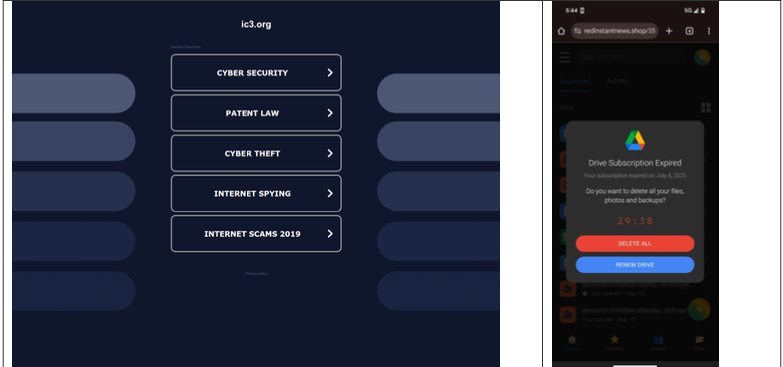
A lookalike domain to the FBI Internet Crime Complaint Center website, returned a non-threatening parking page (left) whereas a mobile user was instantly directed to deceptive content in October 2025 (right). Image: Infoblox.
When Internet users try to visit expired domain names or accidentally navigate to a lookalike “typosquatting” domain, they are typically brought to a placeholder page at a domain parking company that tries to monetize the wayward traffic by displaying links to a number of third-party websites that have paid to have their links shown.
A decade ago, ending up at one of these parked domains came with a relatively small chance of being redirected to a malicious destination: In 2014, researchers found (PDF) that parked domains redirected users to malicious sites less than five percent of the time — regardless of whether the visitor clicked on any links at the parked page.
But in a series of experiments over the past few months, researchers at the security firm Infoblox say they discovered the situation is now reversed, and that malicious content is by far the norm now for parked websites.
“In large scale experiments, we found that over 90% of the time, visitors to a parked domain would be directed to illegal content, scams, scareware and anti-virus software subscriptions, or malware, as the ‘click’ was sold from the parking company to advertisers, who often resold that traffic to yet another party,” Infoblox researchers wrote in a paper published today.
Infoblox found parked websites are benign if the visitor arrives at the site using a virtual private network (VPN), or else via a non-residential Internet address. For example, Scotiabank.com customers who accidentally mistype the domain as scotaibank[.]com will see a normal parking page if they’re using a VPN, but will be redirected to a site that tries to foist scams, malware or other unwanted content if coming from a residential IP address. Again, this redirect happens just by visiting the misspelled domain with a mobile device or desktop computer that is using a residential IP address.
According to Infoblox, the person or entity that owns scotaibank[.]com has a portfolio of nearly 3,000 lookalike domains, including gmai[.]com, which demonstrably has been configured with its own mail server for accepting incoming email messages. Meaning, if you send an email to a Gmail user and accidentally omit the “l” from “gmail.com,” that missive doesn’t just disappear into the ether or produce a bounce reply: It goes straight to these scammers. The report notices this domain also has been leveraged in multiple recent business email compromise campaigns, using a lure indicating a failed payment with trojan malware attached.
Infoblox found this particular domain holder (betrayed by a common DNS server — torresdns[.]com) has set up typosquatting domains targeting dozens of top Internet destinations, including Craigslist, YouTube, Google, Wikipedia, Netflix, TripAdvisor, Yahoo, eBay, and Microsoft. A defanged list of these typosquatting domains is available here (the dots in the listed domains have been replaced with commas).
David Brunsdon, a threat researcher at Infoblox, said the parked pages send visitors through a chain of redirects, all while profiling the visitor’s system using IP geolocation, device fingerprinting, and cookies to determine where to redirect domain visitors.
“It was often a chain of redirects — one or two domains outside the parking company — before threat arrives,” Brunsdon said. “Each time in the handoff the device is profiled again and again, before being passed off to a malicious domain or else a decoy page like Amazon.com or Alibaba.com if they decide it’s not worth targeting.”
Brunsdon said domain parking services claim the search results they return on parked pages are designed to be relevant to their parked domains, but that almost none of this displayed content was related to the lookalike domain names they tested.
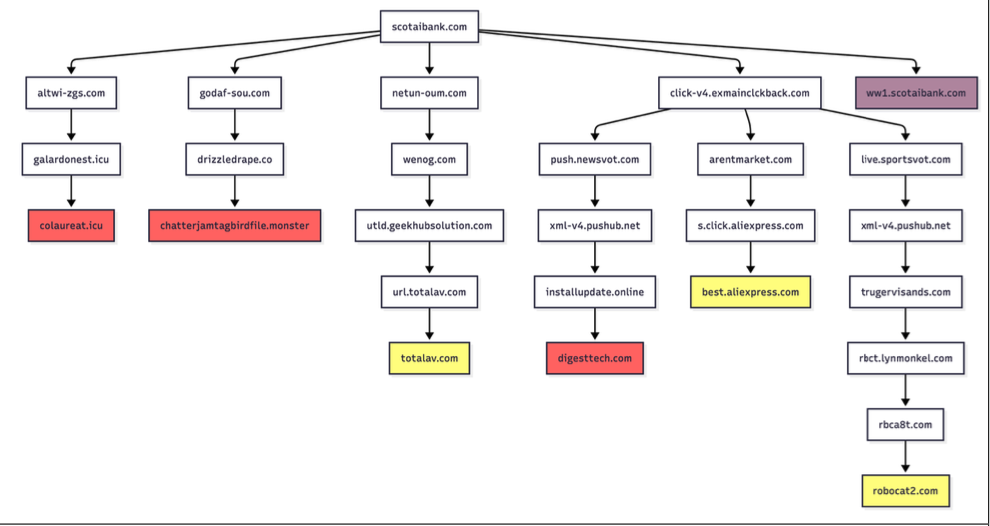
Samples of redirection paths when visiting scotaibank dot com. Each branch includes a series of domains observed, including the color-coded landing page. Image: Infoblox.
Infoblox said a different threat actor who owns domaincntrol[.]com — a domain that differs from GoDaddy’s name servers by a single character — has long taken advantage of typos in DNS configurations to drive users to malicious websites. In recent months, however, Infoblox discovered the malicious redirect only happens when the query for the misconfigured domain comes from a visitor who is using Cloudflare’s DNS resolvers (1.1.1.1), and that all other visitors will get a page that refuses to load.
The researchers found that even variations on well-known government domains are being targeted by malicious ad networks.
“When one of our researchers tried to report a crime to the FBI’s Internet Crime Complaint Center (IC3), they accidentally visited ic3[.]org instead of ic3[.]gov,” the report notes. “Their phone was quickly redirected to a false ‘Drive Subscription Expired’ page. They were lucky to receive a scam; based on what we’ve learnt, they could just as easily receive an information stealer or trojan malware.”
The Infoblox report emphasizes that the malicious activity they tracked is not attributed to any known party, noting that the domain parking or advertising platforms named in the study were not implicated in the malvertising they documented.
However, the report concludes that while the parking companies claim to only work with top advertisers, the traffic to these domains was frequently sold to affiliate networks, who often resold the traffic to the point where the final advertiser had no business relationship with the parking companies.
Infoblox also pointed out that recent policy changes by Google may have inadvertently increased the risk to users from direct search abuse. Brunsdon said Google Adsense previously defaulted to allowing their ads to be placed on parked pages, but that in early 2025 Google implemented a default setting that had their customers opt-out by default on presenting ads on parked domains — requiring the person running the ad to voluntarily go into their settings and turn on parking as a location.
Cryptographers Cancel Election Results After Losing Decryption Key
LucianoSo many angles to this
Read more of this story at Slashdot.
Ohtani rewrites history to send Dodgers to World Series
'I Tracked Amazon's Prime Day Prices. We've Been Played'
Read more of this story at Slashdot.
The Software Engineers Paid To Fix Vibe Coded Messes
Read more of this story at Slashdot.
Beijing tightens control ahead of Xi's big moment on world stage
Physicists Disagree Wildly on What Quantum Mechanics Says About Reality
Read more of this story at Slashdot.
Watch: Holiday park wiped out by Texas floods
Microsoft Is Opening Windows Update To Third-Party Apps
LucianoWill rename the tool to 'apt upgrade'
Read more of this story at Slashdot.
Consumerists Never Really Learn
Via an article about a Free Software initiative hoping to capitalise on the discontinuation of Microsoft Windows 10, I saw that the consumerists at Which? had published their own advice. Predictably, it mostly emphasises workarounds that merely perpetuate the kind of bad choices Which? has promoted over the years along with yet more shopping opportunities.
Those workarounds involve either continuing to delegate control to the same company whose abandonment of its users is the very topic of the article, or to switch to another surveillance economy supplier who will inevitably do the same when they deem it convenient. Meanwhile, the shopping opportunities involve buying a new computer – as one would entirely expect from Which? – or upgrading your existing computer, but only “if you’re using a desktop”. I guess adding more memory to a laptop or switching to solid-state media, both things that have rejuvenated a laptop from over a decade ago that continues to happily runs Linux, is beyond comprehension at Which? headquarters.
Only eventually do they suggest Ubuntu, presumably because it is the only Linux distribution they have heard of. I personally suggest Debian. That laptop happily running Linux was running Ubuntu, since that is what it was shipped with, but then Ubuntu first broke upgrades in an unhelpful way, hawking commercial support in the update interface to the confusion of the laptop’s principal user (and, by extension, to my confusion as I attempted to troubleshoot this anomalous behaviour), and also managed to put out a minor release of Dippy Dragon, or whatever it was, that was broken and rendered the machine unbootable without appropriate boot media.
Despite this being a known issue, they left this broken image around for people to download and use instead of fixing their mess and issuing a further update. That this also happened during the lockdown years when I wasn’t able to personally go and fix the problem in person, and when the laptop was also needed for things like interacting with public health services, merely reinforced my already dim view of some of Ubuntu’s release practices. Fortunately, some Debian installation media rescued the situation, and a switch to Debian was the natural outcome. It isn’t as if Ubuntu actually has any real benefits over Debian any more, anyway. If anything, the dubious custodianship of Ubuntu has made Debian the more sensible choice.
As for Which? and their advice, had the organisation actually used its special powers to shake up the corrupt computing industry, instead of offering little more than consumerist hints and tips, all the while neglecting the fundamental issues of trust, control, information systems architecture, sustainability and the kind of fair competition that the organisation is supposed to promote, then their readers wouldn’t be facing down an October deadline to fix a computer that Which? probably recommended in the first place, loaded up with anti-virus nonsense and other workarounds for the ecosystem they have lazily promoted over the years.
And maybe the British technology sector would be more than just the odd “local computer repair shop” scratching a living at one end of the scale, a bunch of revenue collectors for the US technology industry pulling down fat public sector contracts and soaking up unlimited amounts of taxpayer money at the other, and relatively little to mention in between. But that would entail more than casual shopping advice and fist-shaking at the consequences of a consumerist culture that the organisation did little to moderate, at least while it could consider itself both watchdog and top dog.
Maintainer of Linux Distro AnduinOS Revealed to Be Microsoft Employee
Read more of this story at Slashdot.
DOGE To Rewrite SSA Codebase In 'Months'
Read more of this story at Slashdot.
The New York City Subway Is Using Google Pixels To Listen for Track Defects
Read more of this story at Slashdot.
Argentinian president Javier Milei promotes memecoin that then crashes 95% in apparent $100 million+ rug pull

A tweet from Argentina's president Javier Milei promoted a memecoin called Libra, which he described as a "private project [that] will [be] dedicated to encouraging the growth of the Argentine economy by funding small Argentine businesses and startups". The token quickly soared in price as traders poured in.
However, within hours of the launch, insiders began selling off their holdings of the token. The token had been highly concentrated among insiders, with around 82% of the token held in a small cluster of apparently insider addresses. Those insiders cashed out around $107 million, crashing the token price by around 95%.
After the crash, Milei deleted his tweet promoting the project. He later claimed he was "not aware of the details of the project and after having become aware of it I decided not to continue spreading the word (that is why I deleted the tweet)."
The One Euro OpenBSD Server
For quite some time I have been on the lookout for a cheap, small virtual server for one or two toy projects. My unspoken requirements were the ability to install OpenBSD, having IPv6, and that the hoster is not completely shady.
While lowering the bar for “cheap”, picking all three seems to become quite difficult. Unfortunately, since most hosters use some Linux QEMU/KVM stack nowadays, OpenBSD’s installability was almost always the least problematic.
Without further ado, except, of course, stating that I have not received any money from this hoster for this post, I will name them once and then only describe technical details, hopefully transferable to other hosting scenarios.
The hoster is STRATO, one of the bigger and older ones in Germany, and they offer so called “Budget Linux V-Servers”, where the cheapest, VC 1-1, comes with 1 vCore, 1G RAM, 10G storage, and one IPv4 plus one IPv6 address for one Euro per month.
This may sound weak by today’s standards, but it is enough for me. Maybe a little more storage would be nice, but for one Euro I cannot complain (or even buy a bread roll anymore).
Install OpenBSD From Linux
Most hoster offer a selection of (sometimes outdated) GNU/Linux distributions, but a BSD option is uncommon. This, however, is no problem as one can utilize a Linux - I prefer Debian - to install OpenBSD.
The used technique is not novel and I have read variants in various places, noticeable this older misc@ mailing list post.
Start by booting the (still Linux) VM and download the bsd.rd file of the latest OpenBSD release.
root@debian:~# wget -O /openbsd.rd \
  https://cdn.openbsd.org/pub/OpenBSD/7.5/amd64/bsd.rd
Then take a look at the partitions and find out which partition of which “disk” contains /openbsd.rd.
root@debian:~# fdisk -l
[snip]

Device      Start      End  Sectors  Size Type
/dev/vda1  262144 20971486 20709343  9.9G Linux root (x86-64)
/dev/vda14   2048     8191     6144    3M BIOS boot
/dev/vda15   8192   262143   253952  124M EFI System
For me, there is only one disk and the entire Linux file system resides on the first partition.
This information is enough to create a new GRUB boot record, stating that on
- the first disk (zero-based) -
hd0- - the first partition (one-based now, of course) -
hd0,1- - contains a file named
/openbsd.rd.
With this information, a boot entry like the following can be appended to /etc/grub.d/40_custom.
root@debian:~# tail -n4 /etc/grub.d/40_custom
menuentry "OpenBSD" {
  set root=(hd0,1)
  kopenbsd /openbsd.rd
}
Since a human being will be using GRUB later, the GRUB_TIMEOUT should be a reasonable number.
For me, a later overwrite in /etc/default/grub.d/15_timeout.cfg set this variable to zero.
As the last file wins, make sure it contains GRUB_TIMEOUT=10.
root@debian:~# vi /etc/default/grub{,.d/*}
Finalize the setup on the Linux side by updating GRUB based on the changes just made.
root@debian:~# update-grub
Install From GRUB
Now is the perfect moment to launch the hoster’s web-based VNC console.
When it is up and running - showing the Debian login - type a final reboot in your session and wait for the VNC console to show GRUB.
If it shows up, select “OpenBSD” and proceed.
For me, the installation wizard just worked and I mostly went with the suggestions.
The only limitation - perhaps due to an incorrect keyboard layout - was the unavailability of the “Shift” modifier key, but only for special characters.
So I was unable to get a list of all mirror servers, just went with the first one by typing 1.
Finishing Touch on OpenBSD
After the installation succeeded, reboot into your freshly installed OpenBSD. Congratulations!
There are a few things one might want to do first, like, e.g., installing patches via syspatch or configuring sshd to only accept public key-based logins via PasswordAuthentication no.
But this is out of this post’s scope.
However, at least for my specific hosting situation, one tweak to the network configuration was necessary. On OpenBSD (at least for now, being at 7.5), the dynamic address configuration supports DHCP for IPv4 and SLAAC for IPv6. My hoster, however, stated that DHCPv6 is necessary for the IPv6 configuration. Not wanting to install another DHCP client just for that, I searched the web for older documentation and found a configuration without the need for DHCPv6.
Setting the IPv6 address shown in the hoster’s web interface with a prefix length of 128 - being one address, not a block - and using fe80::1 as the gateway was enough to make it work.
Interestingly, a very similar setup was necessary for another machine at a totally different hoster.
user@openbsd:~> doas cat /etc/hostname.vio0
inet autoconf
inet6 2001:db8::1 128  # Put your IPv6 address here!
!route add -inet6 default fe80::1%vio0
Outlook
The new server is running smoothly so far. I have not experienced any hiccups, network issues or the like. Since one of its first tasks is hosting this blog, find out how it works in the future.
'AI Granny' Driving Scammers Up the Wall
Read more of this story at Slashdot.
Mastercard DNS Error Went Unnoticed for Years
Read more of this story at Slashdot.

OpenAI Releases 'Smarter, Faster' ChatGPT - Plus $200-a-Month Subscriptions for 'Even-Smarter Mode'
Read more of this story at Slashdot.
Dolly Parton announces $1m donation to Hurricane Helene recovery
How I Booted Linux On an Intel 4004 from 1971
Read more of this story at Slashdot.