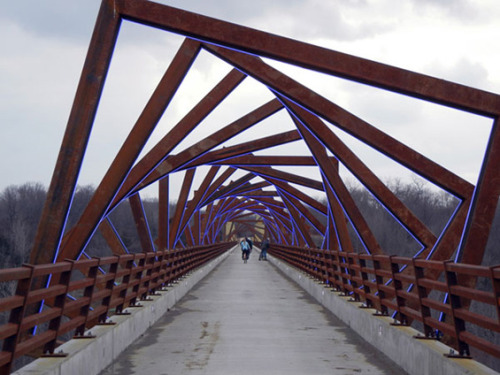
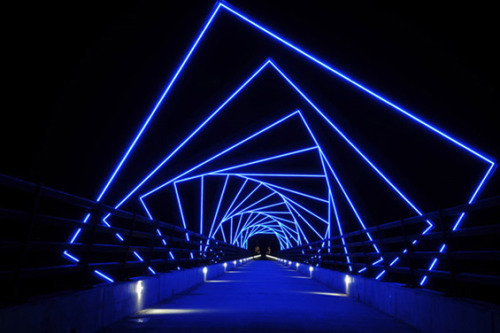
The High Trestle Trail bridge, one of the longest, tallest pedestrian bridges in the country, is designed to reflect the coal-mining history of nearby Des Moines River towns
The High Trestle Trail bridge, one of the longest, tallest pedestrian bridges in the country, is designed to reflect the coal-mining history of nearby Des Moines River towns


Art Game
A junção do trabalho do fotógrafo francês Leo Caillard e de um mestre em 3D, Antoine Moirot, já resultara em dois fantásticos trabalhos para a revista Amusement: Art Game e War Games.
Art Game recriava uma visita virtual ao museu do Louvre usando os menus de navegação da Apple; War Games, segundo os próprios autores, pretendia mostrar-nos a omnipresença do militar na informação, nas imagens diárias, em comunicados de imprensa, nos jogos de computador, como um perigo sempre presente.

Caillard juntou-se agora a outro mestre da manipulação digital, Alexis Persani, para vestir estátuas clássicas em Paris e Roma ao estilo contemporâneo. O resultado produzido acaba por ser mais provocador do que a nudez original de Cristo, transformado em «hipster» fumador de cigarros Marlboro.
Claro que nem por sombras Leo Caillard e Alexis Persani foram autorizados a vestir as estátuas – em vez disso, Cuillard fotografou os amigos em posições idênticas e enviou as imagens a Persani. Este trabalhou como diretor de arte no terreno, coordenando luzes, escolhendo roupas e atribuindo a cada um dos amigos recrutados pelo fotógrafo a respetiva estátua. Depois sobrepôs o vestuário em Photoshop (ou equivalente). Resultado:


Um libelo ao poder da moda de transformar as pessoas? Homenagem às capacidades dos softwares de edição de imagem? Brincadeira inconsequente? Vocês decidem.


Photographer Darren Pearson (previously) has been perfecting his long-exposure light painting techniques over the last few months. While I really enjoy his dinosaurs you can see lots more in his recent California Soul series that explores Californian culture through surfing, skateboarding and skeletons.
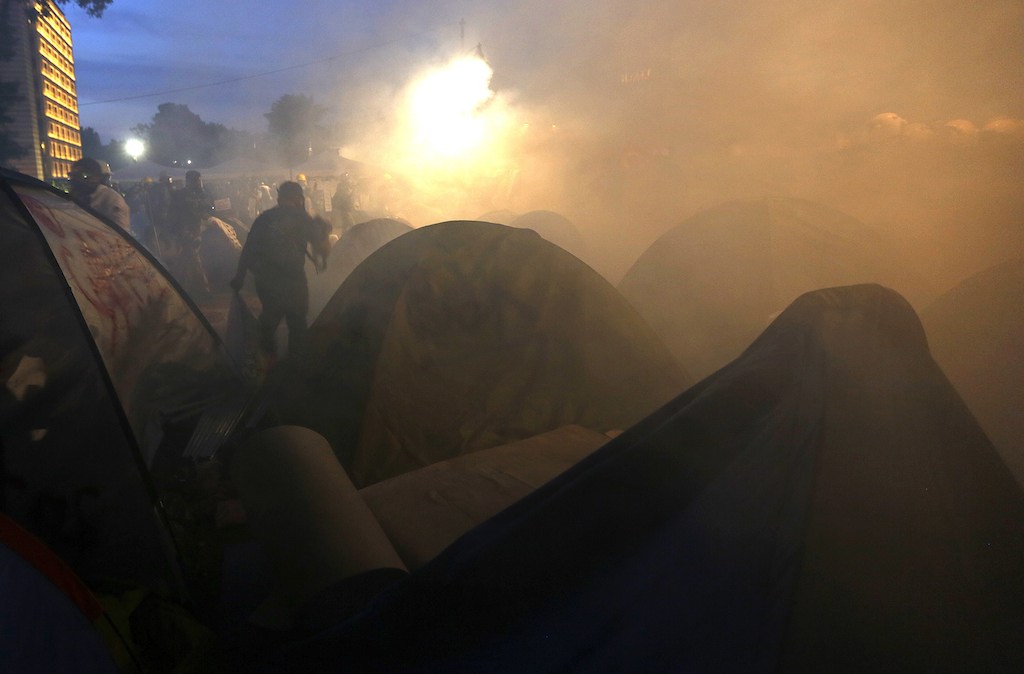
A protester runs through tents covered by tear gas in Gezi park in Istanbul's Taksim square June 15, 2013. Turkish riot police stormed a central Istanbul park on Saturday firing tear gas and water cannon to evict hundreds of anti-government protesters, hours after an ultimatum from Prime Minister Tayyip Erdogan. REUTERS/Yannis Behrakis
I've been attending the Gezi Park protests since arriving in Turkey on June 6.
Thousands of people have camped at the park in Taksim Square, traditionally a gathering place for all kinds of meetings and protests, to prevent Prime Minister Erdoğan from razing the park to remove the place of assembly and erase some of the last green space in Istanbul to turn it into an Ottoman barracks shopping mall.
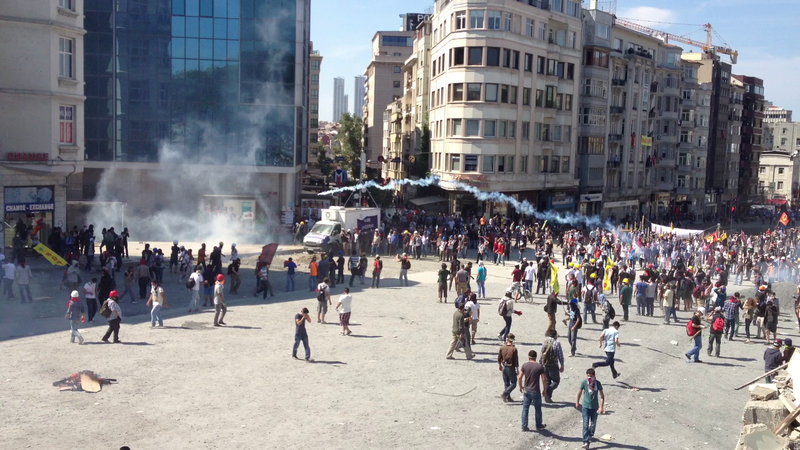
On the morning of the 11th, the protesters in the park were peaceful; in Taksim Square below, they were throwing fireworks and rocks and it was being responded to with tear gas and sonic booms and water canon blasts.
By nightfall, the square was becoming filled with people coming home from work, and at 7:30PM, the police gassed the square, driving the protesters into the park. I retreated into the center of the park, at which point the police completely surrounded the park, so that nobody could leave. Then they gassed the whole park.
People were passing out, puking, crying, and nobody was able to breathe or see. The police no longer were trying to get people to disperse - they were torturing them. They even gassed the ambulances outside waiting to carry away the injured protesters.
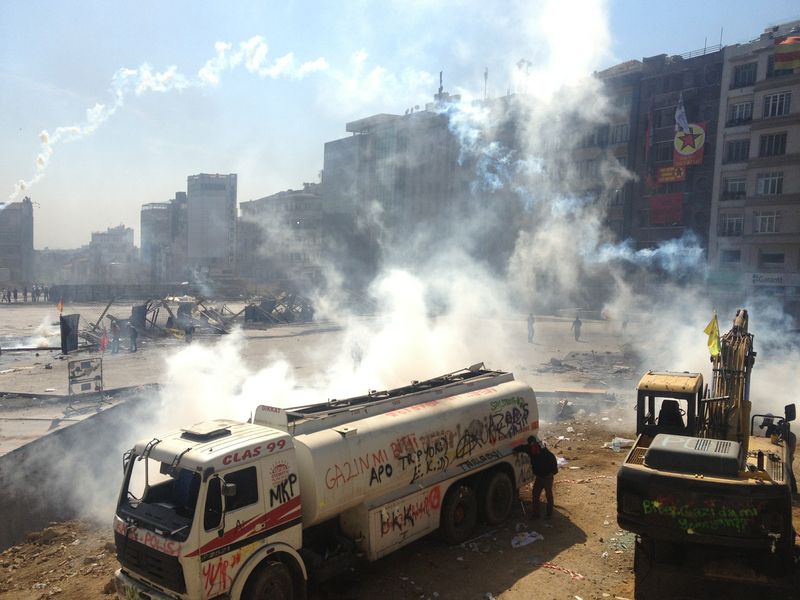
Although I was gassed several times, the final assault was so thorough that there was nowhere to go to get breathable air. In addition to the burning in my eyes and mouth, it felt like drowning.
But the crazy thing is that even after all that, I've become addicted to going to Gezi Park. Maybe it's the sense of community and purpose there - with free food, cigarettes, music, accommodations, books, education, and healthcare.
Maybe it's the joyous, resilient mood of the Turks - who, the second the gas attacks stopped, were cheering and applauding the fact that they held their ground, even while people were gagging and vomiting and it was bleak and horrible. Maybe it's because in the protests, the biggest cultural differences and partisan conflicts are forgotten, as arch political enemies and rival soccer teams are joined together in song, arm around arm.
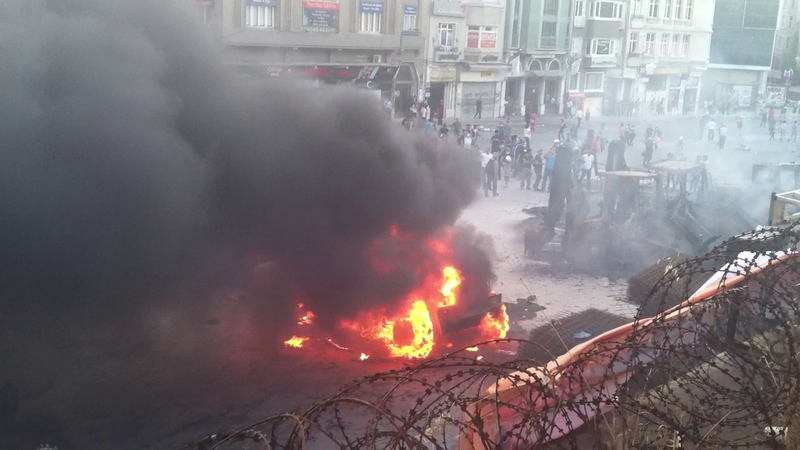
Maybe it's because it's a rare opportunity for genuine, protracted conversation and interaction between people from all walks of life - rather than the small, unrepresentative group of looters and thugs as Erdogan characterized, the "capulcus" came from all classes, ages, political parties, and sexual orientations.
And maybe it's that I find it surreal to be walking around yesterday's battle zone as if it were a movie or stage set. But probably the real reason I keep coming back, even after being tear gassed and hearing Erdogan's "final warning" to the protestors, is that there's probably nothing more emblematic of the human condition than to be dancing in the street with a gas mask around your neck.

    
|
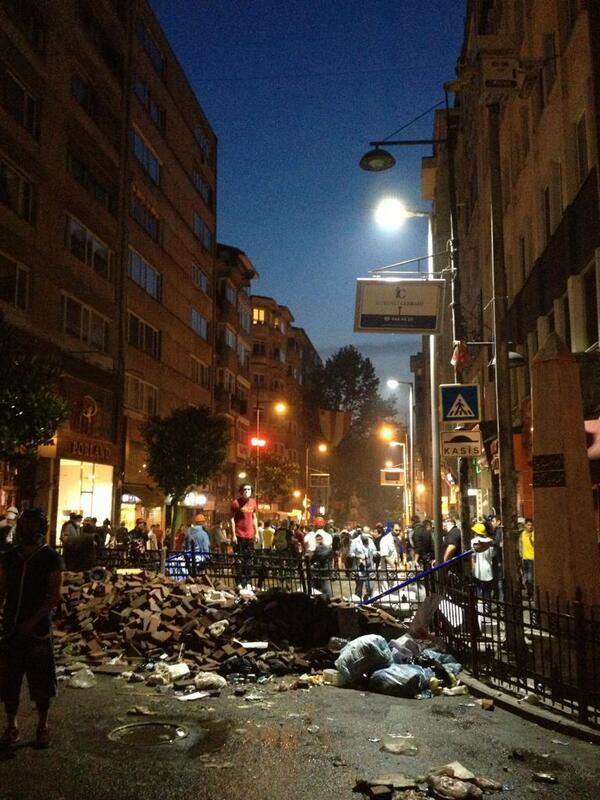
Barricades at Nisantasi, at 4:50AM Sunday
Poiu is in Turkey; he writes: " Since yesterday evening, everything has worsened. Unfortunately it is not really covered by local media, the consequence of that being that it gets a lot less international attention than it should. People are gassed here non stop, in all central Istanbul areas. Tens of thousands of people are out in the streets. The only two channels who cover the street events are ULUSAL KANAL CANLI YAYINI and artı bir tv. You should check them out just to get an idea of the scale and the drama."
Meanwhile, there's a lot of astounding stuff in the Occupy Gezi Pics Tumblr.
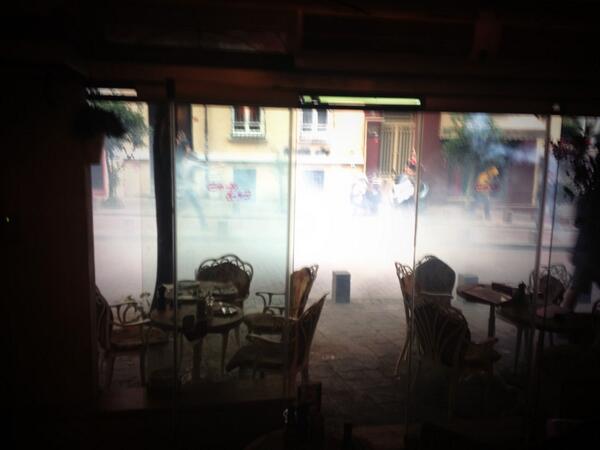
Police are gassing every street in Cihangir, Taksim
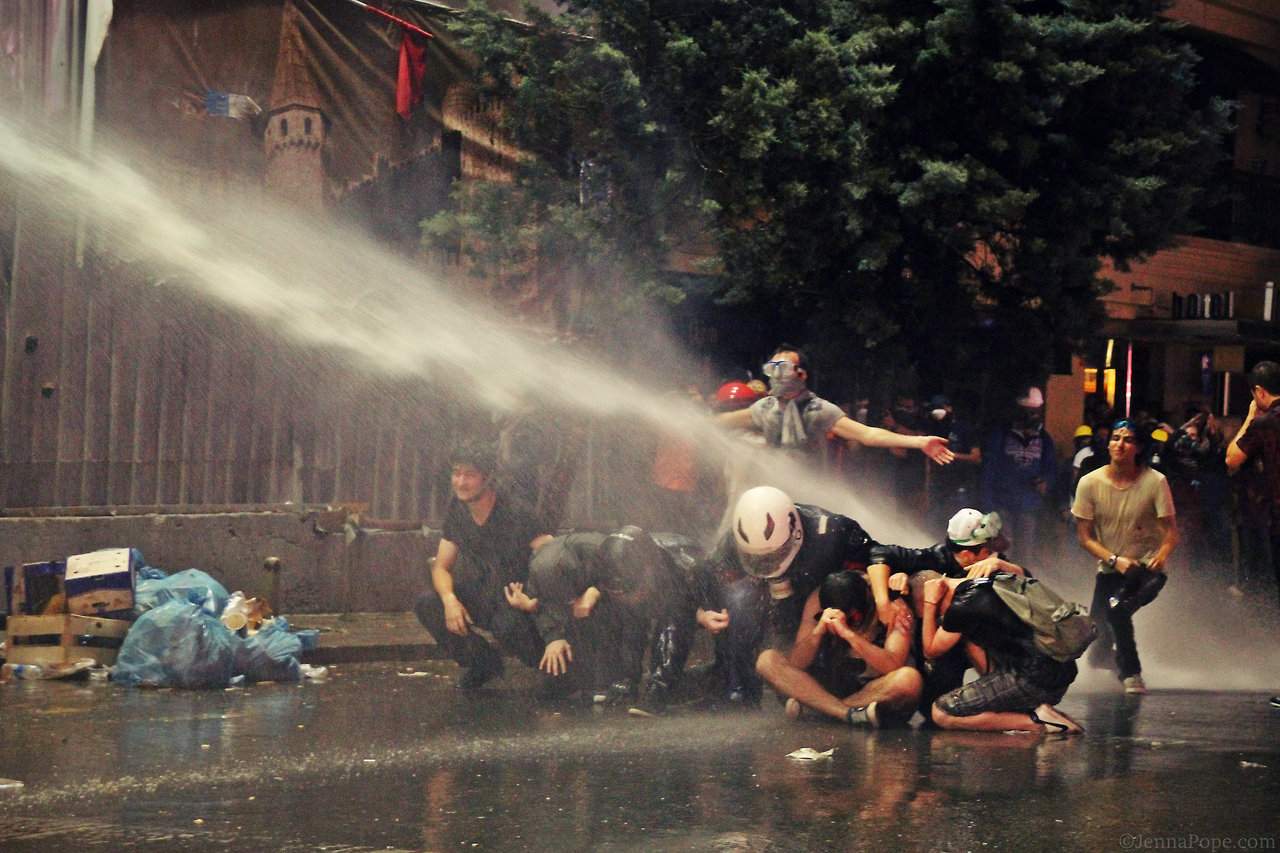
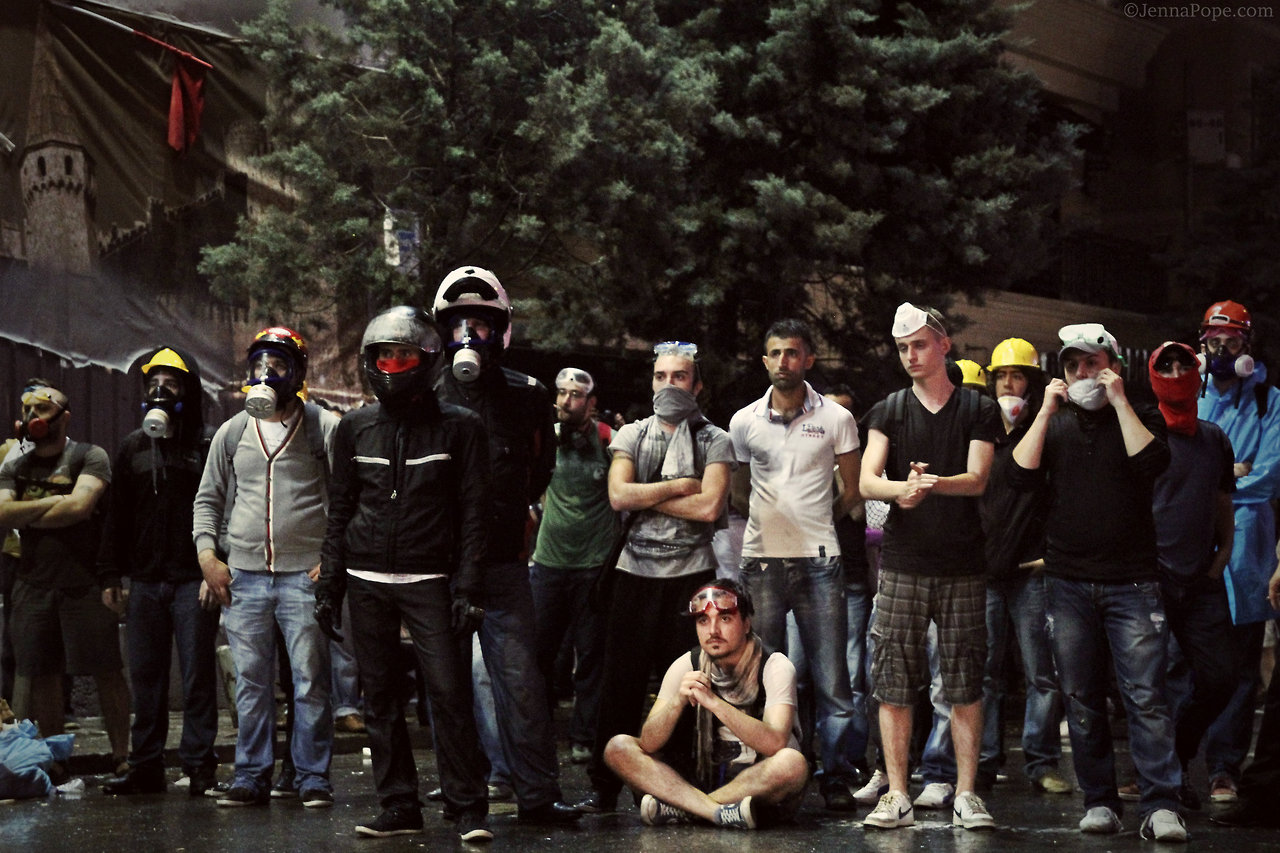
Saturday night in Beyoglu, from Jenna Pope’s photoblog (@BatmanWI): Protesters face water canons.
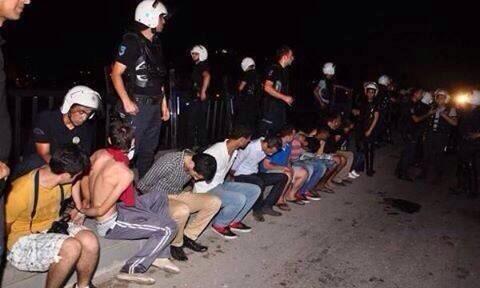
Protesters arrested today in Istanbul are lined up like POWs
Barricades at Nisantasi, at 4:50AM Sunday

Wedding photo-ops at Gezi Parki is becoming a tradition.
|
|


The Reading Nest is a new site-specific installation by artist Mark Reigelman outside the Cleveland Public Library. Reigelman obtained 10,000 reclaimed boards from various Cleveland industrial and manufacturing sites and worked with a team of people over 10 days to construct the nest which was completed earlier this month. From his statement regarding the project:
For centuries objects in nature have been associated with knowledge and wisdom. Trees of enlightenment and scholarly owls have been particularly prominent in this history of mythological objects of knowledge. The Reading Nest is a visual intermediary between forest and fowl. It symbolizes growth, community and knowledge while continuing to embody mythical roots.
You can see many more hotos of the Reading Nest over on his website. (via colossal submissions)

© Studio Saraceno & Kunstsammlung NRW

© Studio Saraceno & Kunstsammlung NRW

© Studio Saraceno & Kunstsammlung NRW

© Studio Saraceno & Kunstsammlung NRW

© Studio Saraceno & Kunstsammlung NRW

© Studio Saraceno & Kunstsammlung NRW

© Studio Saraceno & Kunstsammlung NRW
In one of his most ambitious suspended installations to date, artist Tomás Saraceno (previously) launches visitors at the K21 Staendehaus museum in Düsseldorf more than 65 feet (20 meters) above the main piazza with a taunt, multi-level web of netting. Titled In Orbit the giant interactive piece is constructed from three separate levels of safety nets accessible from various points in the museum separated by enormous PVC balls measuring almost 30 feet (8.5 meters) in diameter. The resulting aerial landscape is an interesting hybrid between science fiction, spider webs, neural pathways and cloud formations.
Known for breaking the boundaries between art and science, Saraceno often refers to his interactive pieces as living organisms. In fact, over a period of three years Saraceno consulted with arachnologists (experts in the study of spiders), as well as architects and engineers to achieve the final design for In Orbit. Via the museum:
This floating spatial configuration becomes an oscillating network of relationships, resonances, and synchronous communication. When several people enter the audacious construction simultaneously, their presence sets it into motion, altering the tension of the steel wires and the intervals between the three meshwork levels. Visitors can coordinate their activities within the space, and are able – not unlike spiders in a web – to perceive space through the medium of vibration. Saraceno himself speaks of a new hybrid form of communication.
The installation opened to the public starting today. To enter In Orbit patrons must be at least 12 years old and are asked to wear special grip-soled footwear while traversing the webbing. You can read much more over on Art Daily. All imagery courtesy K21 Staendehaus.
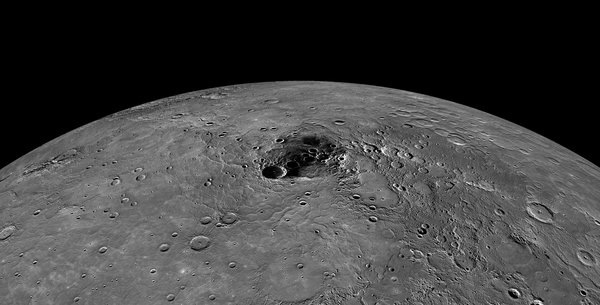
Temperatures at the dark craters of the north pole of Mercury can
dip to
as low as 370 degrees below zero.
Image: NASA/Johns Hopkins University Applied Physics Lab/Carnegie Institution
of Washington
There's Ice in Mercury
Of all the planets in the Solar System, Mercury is the closest to the sun. You'd naturally think that it's also the hottest, but it's not (that distinction belongs to Venus). Oh, no doubt Mercury can get quite hot - its surface temperature can reach up to 800 °F, but at the poles, its temperature never gets above freezing. That's where NASA's Messenger Spacecraft found a large volume of water ice - estimated to be 100 billion to 1 trillion tons of ice, actually.
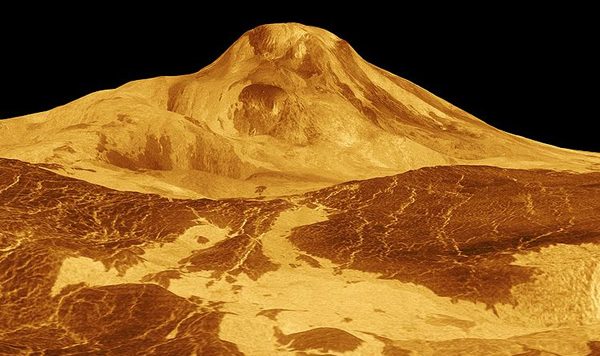
Maat Mons, the highest volcano on Venus. Image: NASA/JPL
It Snows Metal on Venus
Snowcapped mountains on Earth are majestic, but they're by no means unique in our Solar System. Venus has its own snowcapped mountains, but instead of water, the "snow" is made of heavy metals like lead sulfide (galena) and bismuth sulfide (bismuthinite).
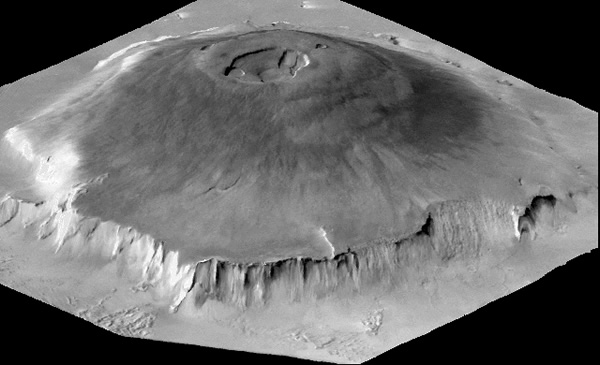
Olympus Mons on Mars. Image: NASA/JPL
Mars has the Tallest Mountain in the Entire Solar System
Let's skip Earth for now and head on over to Mars. If you think our Mount Everest is tall, check out the Olympus Mons on the Red Planet. At about 14 miles (22 km) tall, it's three times as tall as Mount Everest's height above sea level. It's pretty big, too. Olympus Mons is approximately the size of Arizona.
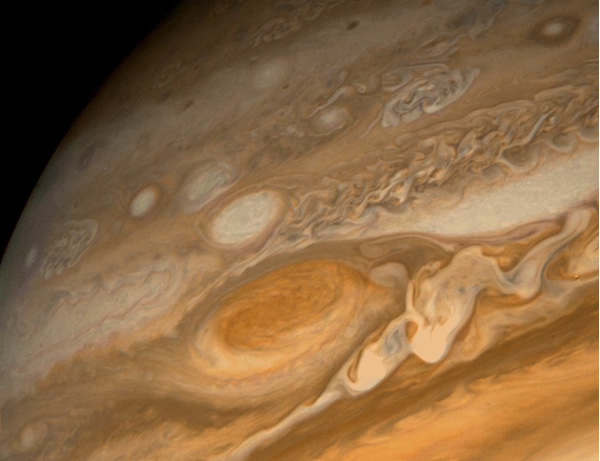
Jupiter's Great Red Spot, as "spotted" by Voyager 1 in 1979. Image: NASA/JPL/CalTech
Jupiter's Great Red Spot
The Great Red Spot on Jupiter is a storm that has been raging for at least 400 years. It was large enough to be seen from Earth (it first spotted by Giovanni Cassini in the late 1600s with a primitive telescope). In fact, the Great Red Spot was large enough to engulf three Earths, though its size has decreased over the past hundred years.

If you think that storms on Jupiter are quite violent, you'd be right: winds around the edge of the Great Red Spot peak at over 260 mph, with lightning bolts* 10 times as powerful as anything ever recorded on Earth.
*Unlike on Earth, lightning bolts in the gas giant Jupiter don't strike the ground. They're cloud to cloud.

Simulated image of Saturn's rings, with false colors to represent ring particle sizes in different regions based on radio signals. Image: NASA/JPL
Saturn's Magnificent Rings and Hexagon Cloud
Why does Saturn have a ring? Because Neptune proposed and they're now married, goes the joke. Ask any schoolchildren and they'd tell you that Saturn has magnificent rings. These rings were first observed by Galileo back in 1610 though his telescope wasn't good enough to discern the actual structure (he thought that Saturn had "ears."). Some forty years later, Christiaan Huygens suggested that Saturn was surrounded rings.
The rings of Saturn are made of countless small particles - from dust particles to large rocks, mostly made of water ice with trace silica material - that orbit the planet. The rings aren't solid - there are thousands of gaps, ringlets, and spiral waves in the rings that are caused by their interactions with the moons of Saturn.
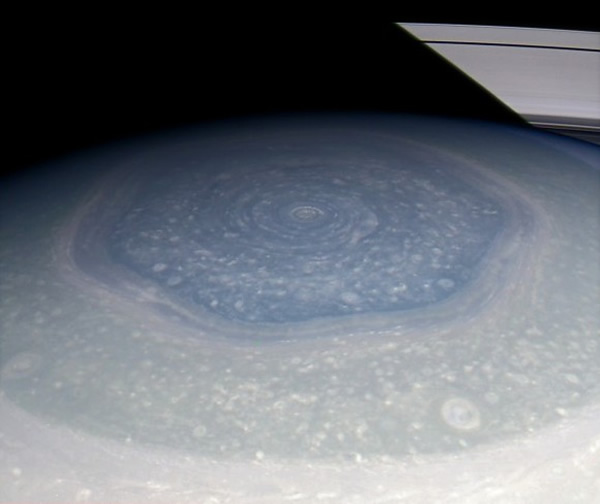
Color-composite image of Saturn's northern hexagon, as taken by the Cassini spacecraft.
Image: NASA/JPL/SSI/Jason Major)
If you thought that the rings are awesome, check out Saturn's Hexagon. It's a strange hexagonal cloud pattern in the north pole of the planet. Each side of the hexagon is about 8,600 miles long (which is longer than the Earth's diameter)
Oh, one more neat fact about Saturn: since it's made mostly of hydrogen and some helium, it's the least dense of all the planets. In fact, it's less dense than water so if you have a bathtub big enough to fit Saturn, the whole planet will float.

Uranus orbits on its side, with its rotational axis nearly perpendicular to the Sun.
Image:
Lawrence Sromovsky/University of Wisconsin-Madison/Keck Observatory.
Uranus, the Sideway Planet
Uranus is the only planet that has an axis of rotation approximately parallel with the plane of the Solar System - this means that the gas giant rotates on its side. The cause of this unusual tilt is unknown, but scientists think that during the formation of the Solar System, an Earth-sized protoplanet (or a series of protoplanets) smashed into Uranus, pushing the planet over on its side.
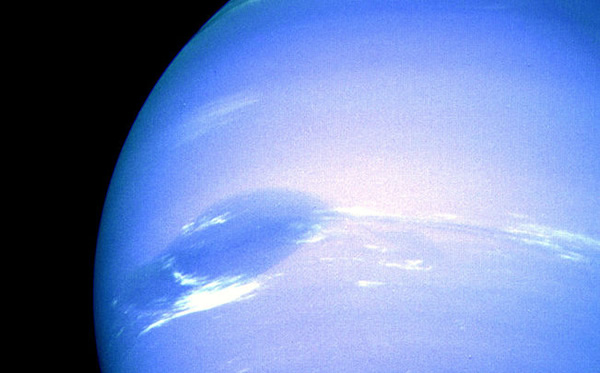
The Great Dark Spot of Neptune, as captured by Voyager 2 in 1989.
Image: NASA/Voyager 2 Team
Neptune's Supersonic Great Dark Spot
Like Jupiter's Great Red Spot, there are large storms on Neptune - the largest of which is named the Great Dark Spot. The elliptical spot is largely the same size as Earth, and it has the fastest winds in the Solar System. Neptune's winds have been clocked at over 1,500 mph - that's twice the speed of sound.
Earth, the Goldilocks Planet
So, you've read 7 wonderful things about the planets of our solar system, but what about our own? What's so special about the third rock from the Sun, our home planet Earth?
Well, it's unique because it's the only planet we know of that has life. Doubly unique because it has intelligent life - though that's arguable depending with whom you talk to ;)
Other planets in the Solar System have liquid water, plate tectonics, and atmosphere - but only Earth has them all just right. It's not too hot or too cold, and it's neither too wet nor too dry for life.
That made Earth a unique planet in the Solar System, but what about in the Universe? In 2011, the Kepler Space Observatory Mission team released a list of 1,235 candidate extrasolar planets, with 54 that rotate around "circumstellar habitable zone" - an astronomical comfort zone, if you will, that allow liquid water to exist.
As of 2013, the list has expanded to 3,216 candidate and 132 confirmed exoplanets in 76 stellar systems. In our Milky Way galaxy alone, astronomers estimated that there are at least 17 billion Earth-sized exoplanets (what about other galaxies in the Universe? It's been estimated that there are as many as 500 billion galaxies in the entire Universe, so you do the math).
But is there life on other planets? Let us leave you with this quote from the 1997 movie Contact, where the father of a young Ellie Arroway replied to his daughter's question:
Young Ellie Arroway: Dad, do you think there's people on other planets?
Theodore Arroway: I don't know, Sparks. But I guess I'd say if it is just us ... seems like an awful waste of space.


No momento tirando todas da gaveta pra fazer o famoso golpe dos 3 pontos desenvolvido pelas empregadas domésticas samurais
A group of U.K. jokesters decided to see what would happen if they kept a public elevator's doors from closing by using "the Force," a.k.a. a friend hidden around the corner. I don't know much about British law, but I think if a guy on your "lift" pulls this, you should be legally allowed to cut him in two and chuck the pieces down a shaft.

|
|


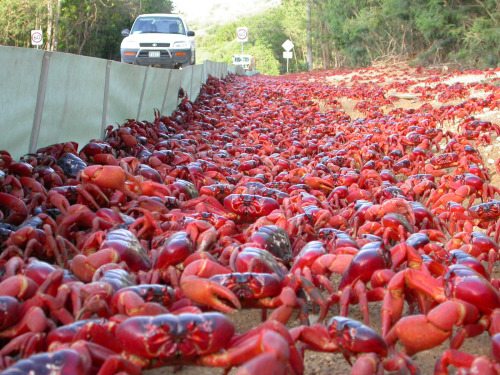


The Astonishing Annual Red Crab Migration
Named one of the planet’s most breathtaking migrations, the Christmas Island red crab exodus is a natural phenomenon that continues to astonish.
Making it onto CNN Travel’s recent list of the “10 most spectacular wildlife migrations,” the island’s annual red crab migration is an astounding event that involves the movement of millions of vividly colored crabs as they leave their in-land homes to breed and release eggs into the sea.
An Australian territory, Christmas Island lies some 2,600 kilometers north-west of Perth in the middle of the Indian Ocean. While just 1,500 people live there, it is home to an estimated 120 million crabs.
Photo credit: James Morgan [website]
Mira que es difícil grabar un trailer de cierta calidad con un poco de gracia: pues con Javapocalypse lo han logrado – y eso que solo se reirán a carcajadas los programadores y algunos grupos de geeks, porque no es para nada apto para todos los públicos. El guión es sencillo: el fin de Java ¡y del mundo! debido a que se ha detectado un problema de seguridad.
El asunto era promocionar JavaZone 2013, el encuentro para desarrolladores Java escandinavos – sin duda un grupo multitudinario… conocido por los renos de la zona y en sus casas a la hora de comer.
Via PopSci, Let This Rube Goldberg Machine Show You How Cows Eat And Poop. This is Cow by Nova Jiang.
Watch more Rube Goldberg machines, kinetic sculptures, and chain reactions.