It’s really, finally, truly, seriously-not-kidding, actually happening: reversible USB connectors are on the way. The USB Type C connector, a small connector that looks a bit like Apple’s Lightning cable, was ratified back in mid-2014. But we haven’t seen any electronics adopt Type C yet; it typically takes months, if not years, for specifications ratified by the USB Implementers Forum to make it into real products. They’re finally coming in 2015.
At this year's CES, we checked out a Type C cable plugged into a prototype circuit board and talked to the USB IF about when we'll start seeing the reversible connector show up in real hardware. We also saw a computer set up with USB 3.1, which raises USB’s total data bandwidth from 3.0’s 5 gigabits per second to 10 gigabits per second. As if USB wasn’t already having a good enough day, we heard about another recently ratified standard: power over USB increasing up to 100 watts.
USB cables have been carrying power for years, but the interface has never been rated to feed devices more than 10 watts. That’s why you can charge a smartphone over USB, or a tablet, with a larger power module. But a laptop? No way. Until now. The new Power Delivery spec allows for 100 watts of of power over USB, enough to charge laptops and just about any other personal electronic device you can think of.
For our daily use of USB, though, we’re more excited about the Type C connector. No more fumbling with a USB plug, getting it wrong, flipping it over, somehow getting it wrong again, and then flipping it back to the original orientation which was, apparently, actually right the first time. The plug is smaller, so it’s suited to a wider variety of devices, especially thin laptops.
USB representatives pointed out a common misconception about the format, which may confuse some people when USB Type C debuts. The cable itself, and the plug type, don’t determine what USB is capable of. USB Type C isn’t faster or slower or capable of handling more power than the ubiquitous Type A. It’s simply a new pipe to carry power and data. USB’s performance is determined by the hardware at each end of the cable: the controller and other circuitry in the host device (like your PC) and client device (like a mouse or external hard drive).
USB 3.1, which allows for 10 gigabit transfer speeds, is just starting to appear in some devices at CES. One of the MSI’s upcoming laptops will have USB 3.1, and the USB Implementers Forum was demonstrating an unfinished USB 3.1 board putting up some seriously impressive transfer speeds with a pair of SSDs in RAID. And this isn't finalized hardware, so USB 3.1 should be able to crack the 1 gigabyte barrier.
800 megabyte per second write speeds over USB? We'll take it.
The first phone USB Type C debuts in will unfortunately be using USB 2.0 (remember, that’s due to the controllers, not the connector type), and we don’t know how long it will be until Type C replaces the classic Type A plugs in smartphone cases, or when we’ll see USB 3.1 integrated into motherboards. Late 2015 is probably the earliest either of those things will happen. But the good news is that Type C cables will come in C-to-A configurations, C-to-micro USB, and so on. That should help the new connector spread while ensuring compatibility with the bajillion USB A ports out there.
And in another few years, if we all say very nice things about USB Type C, maybe we can finally say goodbye to the hateful rectangle that’s been with us oh so long. The future of USB starts in 2015. Be excited.
The face of children’s literature is about to change Almost half of U.S. children have a minority background, but you rarely see them in books. One group wants to change that, and research shows more diverse books could lead to a more tolerant generation.
Hello! I am going to answer your question, and then I am going to talk a little bit about GENDER IN COMEDY, because this is my tumblr and I can talk about whatever I want!
The vast vast vast majority of the animal jokes on BoJack Horseman (specifically the visual gags) come from our brilliant supervising director Mike Hollingsworth (stufffedanimals on tumblr) and his team. Occasionally, we’ll write a joke like that into the script but I can promise you that your top ten favorite animal gags of the season came from the art and animation side of the show, not the writers room. Usually it happens more the second way you described— to take a couple examples from season 2, “Okay, we need to fill this hospital waiting room, what kind of animals would be in here?” or “Okay, we need some extras for this studio backlot, what would they be wearing?”
I don’t know for sure, but I would guess that the croc wearing crocs came from our head designer lisahanawalt. Lisa is in charge of all the character designs, so most of the clothing you see on the show comes straight from her brain. (One of the many things I love about working with Lisa is that T-Shirts With Dumb Things Written On Them sits squarely in the center of our Venn diagram of interests.)
NOW, it struck me that you referred to the craft services crocodile as a “he” in your question. The character, voiced by kulap Vilaysack, is a woman.
It’s possible that that was just a typo on your part, but I’m going to assume that it wasn’t because it helps me pivot into something I’ve been thinking about a lot over the last year, which is the tendency for comedy writers, and audiences, and writers, and audiences (because it’s a cycle) to view comedy characters as inherently male, unless there is something specifically female about them. (I would guess this is mostly a problem for male comedy writers and audiences, but not exclusively.)
Here’s an example from my own life: In one of the episodes from the first season (I think it’s 109), our storyboard artists drew a gag where a big droopy dog is standing on a street corner next to a businessman and the wind from a passing car blows the dog’s tongue and slobber onto the man’s face. When Lisa designed the characters she made both the dog and the businessperson women.
My first gut reaction to the designs was, “This feels weird.” I said to Lisa, “I feel like these characters should be guys.” She said, “Why?” I thought about it for a little bit, realized I didn’t have a good reason, and went back to her and said, “You’re right, let’s make them ladies.”
I am embarrassed to admit this conversation has happened between Lisa and me multiple times, about multiple characters.
The thinking comes from a place that the cleanest version of a joke has as few pieces as possible. For the dog joke, you have the thing where the tongue slobbers all over the businessperson, but if you also have a thing where both of them ladies, then that’s an additional thing and it muddies up the joke. The audience will think, “Why are those characters female? Is that part of the joke?” The underlying assumption there is that the default mode for any character is male, so to make the characters female is an additional detail on top of that. In case I’m not being a hundred percent clear, this thinking is stupid and wrong and self-perpetuating unless you actively work against it, and I’m proud to say I mostly don’t think this way anymore. Sometimes I still do, because this kind of stuff is baked into us by years of consuming media, but usually I’m able (with some help) to take a step back and not think this way, and one of the things I love about working with Lisa is she challenges these instincts in me.
I feel like I can confidently say that this isn’t just a me problem though— this kind of thing is everywhere. The LEGO Movie was my favorite movie of 2014, but it strikes me that the main character was male, because I feel like in our current culture, he HAD to be. The whole point of Emmett is that he’s the most boring average person in the world. It’s impossible to imagine a female character playing that role, because according to our pop culture, if she’s female she’s already SOMEthing, because she’s not male. The baseline is male. The average person is male.
You can see this all over but it’s weirdly prevalent in children’s entertainment. Why are almost all of the muppets dudes, except for Miss Piggy, who’s a parody of femininity? Why do all of the Despicable Me minions, genderless blobs, have boy names? I love the story (which I read on Wikipedia) that when the director of The Brave Little Toaster cast a woman to play the toaster, one of the guys on the crew was so mad he stormed out of the room. Because he thought the toaster was a man. A TOASTER. The character is a toaster.
I try to think about that when writing new characters— is there anything inherently gendered about what this character is doing? Or is it a toaster?
Of the myriad styles of pizza we've got in this country, St. Louis-Style has got to be the most maligned.* Its thin, unleavened cracker crust bears no resemblance to the real dough that great pizza is built on. It gets loaded high with toppings that span all the way from edge to edge. It's so unbalanced that it has to be cut into squares just to be able to support its own weight. And let's not get started on that Provel cheese—if it can even be called cheese, am I right? And yet, ever since tasting for the first time I haven't been able to stop thinking about it. I've finally figured out why I love it so much. St. Louis-style pizza is not pizza. It's a big, pizza-flavored nacho. Hear me out.
Read More
“I really don’t like thinking of things in that way. People do what they do. Everyone has their way of communicating and sometimes it’s driven by love or hate or fear or kindness or meanness. Whatever. I don’t want to ridicule someone’s behavior. It’s all pretty much okay with me. The only thing I don’t condone is intentional cruelty.”
-
Brent Spiner, when asked what the creepiest or most awkward fan greeting he’s ever had was. (via stormstouthideout)
Oh look! There’s a respectful way to talk about fans, even when the media tries to bait you. Nicely done.
If only we weren’t all so innumerate, we’d be able to respond appropriately to genuine threats to our lives. You’d never get into a car drunk, and even when sober, you’d do your best to drive cautiously, because car accidents are a major cause of death in the US. Oh, but wait…could it be there’s something even more dangerous than hurtling down the road at 60 miles per hour in a metal box? Why, yes there is.
According to data gathered by the Centres for Disease Control (CDC), deaths caused by cars in America are in long-term decline. Improved technology, tougher laws and less driving by young people have all led to safer streets and highways. Deaths by guns, though—the great majority suicides, accidents or domestic violence—have been trending slightly upwards. This year, if the trend continues, they will overtake deaths on the roads.
The Centre for American Progress first spotted last February that the lines would intersect. Now, on its reading, new data to the end of 2012 support the view that guns will surpass cars this year as the leading killer of under 25s. Bloomberg Government has gone further. Its compilation of the CDC data in December concluded that guns would be deadlier for all age groups.
So driving deaths are going down because of improved safety and more regulations and less automobile use? I wonder if that has any lessons to tell us about how to reduce gun deaths.
Nah. Mo’ guns, fewer restrictions, and let’s make sure lots of ignorant red-necked doofuses have ‘em!
From eHistory, a time lapse view from 1776 to the present day of how the US government systematically took land from Native Americans through treaties and executive orders that were rarely honored for long.
The final assault on indigenous land tenure, lasting roughly from the mid-19th century to 1890, was rapid and murderous. (In the 20th century, the fight moved from the battlefield to the courts, where it continues to this day.) After John Sutter discovered gold in California's Central Valley in 1848, colonists launched slaving expeditions against native peoples in the region. 'That a war of extermination will continue to be waged between races, until the Indian race becomes extinct, must be expected,' the state's first governor instructed the legislature in 1851.
In the Great Plains, the US Army conducted a war of attrition, with success measured in the quantity of tipis burned, food supplies destroyed, and horse herds slaughtered. The result was a series of massacres: the Bear River Massacre in southern Idaho (1863), the Sand Creek Massacre in eastern Colorado (1864), the Washita Massacre in western Oklahoma (1868), and a host of others. In Florida in the 1850s, US troops waded through the Everglades in pursuit of the last holdouts among the Seminole peoples, who had once controlled much of the Florida peninsula. In short, in the mid-19th century, Americans were still fighting to reduce if not to eliminate the continent's original residents.
FYI, it's always a good rule of thumb to not read comments on YouTube, but in this case you really really shouldn't read the comments on this video unless you want a bunch of reasons why it was ok for Europeans to drive Native Americans to the brink of total genocide.
EFF has released its mobile app to help people join in important, timely struggles, but you can't get it for your Iphone or Ipad, because Apple insists that EFF use DRM, and this is contrary to everything it stands for.
Read the rest
What if there was a lake on the Moon? What would it be like to swim in it? Presuming that it is sheltered in a regular atmosphere, in some giant dome or something.
Kim Holder
This would be so cool.
In fact, I honestly think it's cool enough that it gives us a pretty good reason to go to the Moon in the first place. At the very least, it's better than the one Kennedy gave.
Floating would feel about the same on the Moon as on Earth, since how high in the water you float depends only on your body's density compared to the water's, not the strength of gravity.
Swimming underwater would also feel pretty similar. The inertia of the water is the main source of drag when swimming, and inertia is a property of matter[1]♬ BILL NYE THE SCIENCE GUY ♬ independent of gravity. The top speed of a submerged swimmer would be about the same on the Moon as here—about 2 meters/second.
Everything else would be different and way cooler. The waves would be bigger, the splash fights more intense, and swimmers would be able to jump out of the water like dolphins.
This[2]Not this one. The other one.[3]The simplest approach, which gives us an approximate answer, is to treat the swimmer as a simple projectile. The formula for the height of a projectile is:
... which tells us that a champion swimmer moving at 2 meters per second (4.5 mph) would only have enough kinetic energy to lift their body about 20 centimeters against gravity.
That's not totally accurate, although it's enough to tell us that dolphin jumps on Earth probably aren't in the cards for us. But to get a more accurate answer (and an equation we can apply to the Moon), we need to account for a few other things.
When a swimmer first breaks the surface, they don't have to lift their full weight; they're partially supported by buoyancy. As more of their body leaves the water, the force of buoyancy decreases, since their body is displacing less water. Since the force of gravity isn't changing, their net weight increases.
You can calculate how much potential energy is required to lift a body vertically through the surface to a certain height, but it's a complicated integral (you integrate the displacement of the submerged portion of their body over the vertical distance they travel) and depends on their body shape. For a human body moving fast enough to jump most of the way out of the water, this effect probably adds about half a torso-length to their final height—and less if they're not able to make it all the way out.
The other effect we have to account for is the fact that a swimmer can continue kicking as they start to leave the water. When a swimmer is submerged and moving at top speed, the drag from the water is equal to the thrust they generate by kicking and ... whatever the gerund form of the verb is for the things your arms do while swimming. My first thought was "stroking," but it's definitely not that.
Anyway, once the jumping swimmer breaks the surface, the drag almost vanishes, but they can keep kicking for a few moments. To figure out how much energy this adds, you can multiply the thrust from kicking by the distance over which they're kicking after breaking the surface, since energy equals force times distance. The distance is most of a body length, or 1 to 1.5 meters. As for the force from kicking, random Google results for a search for lifeguard qualifications suggest that good swimmers might be able to carry 10 lbs over their heads for a short distance, which means they're generating a little more than 10 pounds-force (50+ N) of kicking thrust.
We can combine all these together into a big ol' equation:
\[ \text{Jump height}=\left(\frac{\tfrac{1}{2}\times\text{body mass}\times\left(\text{top speed}\right)^2+\text{kick force}\times\text{torso length}}{\text{Earth gravity}\times\text{body mass}}\right)+\left(\text{buoyancy correction} \right) \] footnote contains some detail on the math behind a dolphin jump. Calculating the height a swimmer can jump out of the water requires taking several different things into account, but the bottom line is that a normal swimmer on the Moon could probably launch themselves a full meter out of the water, and Michael Phelps may well be able to manage 2 or 3.
The numbers get even more exciting when we introduce fins.
Swimmers wearing fins can go substantially faster than regular swimmers without them (although the fastest swimmer wearing flippers will still lose to a runner, even if the runner is also wearing flippers and jumping over hurdles).
Champion finswimmers can go almost 3.2 m/s wearing a monofin, which is fast enough for some pretty impressive jumps—even on Earth. Data on swimfin top speeds and thrusts[4]This paper provides some sample data. suggest that on the Moon, a champion finswimmer could probably launch themselves as high as 4 or 5 meters into the air. In other words, on the Moon, you could conceivably do a high dive in reverse.
But it gets even better. A 2012 paper in PLoS ONE, titled Humans Running in Place on Water at Simulated Reduced Gravity, concluded that while humans can't run on the surface of water on Earth,[5]They actually provide a citation for this statement, which is delightful. they might just barely be able to do so on the Moon. (I highly recommend reading their paper, if only for the hilarious experimental setup illustration on page 2.)
Because of the reduced gravity on the Moon, the water would be launched upward more easily, just like the swimmers. The result would be larger waves and more flying droplets. In technical terms, a pool on the Moon would be more "splashy".[6]The SI unit of splashiness is the splashypant.
To avoid splashing all the water out, you'd want to design the deck so water drains quickly back into the pool. You could just make the rim higher, but then you'd spoil one of the key joys of a pool on the Moon—exiting via Slip 'N Slide:
I 100% support this idea. If we ever build a Moon base, I think we should absolutely build a big swimming pool there. Sure, sending a swimming pool's worth of water (135 horses) to the Moon's surface would be expensive.[7]If you decided to bundle a backyard pool into individual two-liter bottles, and sent them in 3,000 batches of 10 each via the startup Astrobotic, it would cost you $72 billion (according to their website's calculator). But on the other hand, this lunar base is going to have people on it, so you need to send some water anyway.[8]Sending a supply of water and a filter system is probably cheaper than sending a replacement astronaut every 3 or 4 days, although I encourage NASA to run the numbers on that to be sure.
And it's really not impossible. A large backyard swimming pool weighs about as much as four Apollo lunar landers. A next-generation[9](or, heck, previous-generation) heavy-lift rocket, like Boeing's NASA SLS or Elon Musk's SpaceX Falcon Heavy, would be able to deliver a good-sized pool to the Moon in not too many trips.
So maybe the next step, if you really want a swimming pool on the Moon, is to call Elon Musk and ask for a quote.
This is so cool. Usually time lapses show the night sky of stars moving around Earth but we know that's not true, it's Earth that's moving and rotating and turning. Photographer Lance Page made this time lapse to represent our Earth turning by making the camera move along with the North Star. That way we see our world move while the stars stay still.
When we were kids, my mother used to make this Parmesan chicken dish that was so good we would fight for drippings, every last crumb. She would start with a whole chicken, remove the skin and bones (and use them for making chicken stock), and then cut the meat into small pieces. (She made “nuggets” before anyone called them that!)
Then she she would dip the pieces into melted butter, dredge them in breadcrumbs and Parmesan, and bake them.
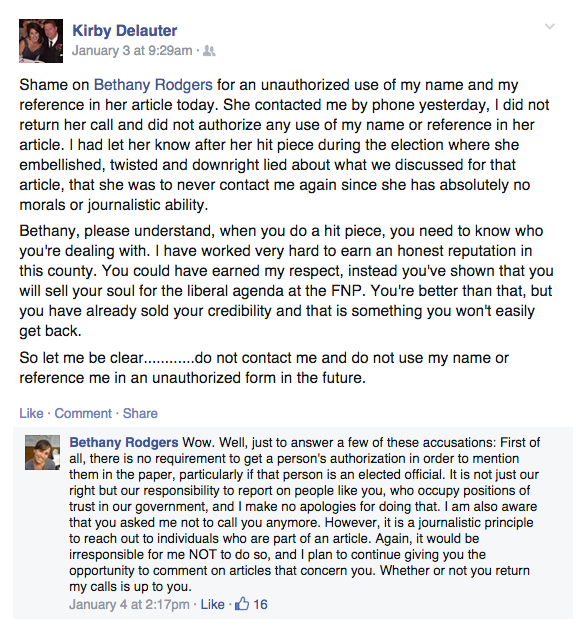
Frederick County, Maryland, Councilman Kirby Delauter on Saturday threatened the Frederick News-Post with a groundless lawsuit for using his name without his permission. The newspaper's editorial board responded on Tuesday with an article, titled "Kirby Delauter, Kirby Delauter, Kirby Delauter," naming him 29 times, including the headline and photo caption.
Round about then, we wondered, if it’s not a joke, how should we now refer to Kirby Delauter if we can't use his name (Kirby Delauter)? Could we get away with an entire editorial of nothing but "Kirby Delauter" repeated over and over again -- Kirby Delauter, Kirby Delauter, Kirby Delauter? OK, imagine we agreed because of temporary madness or something funny in the water that week, how would we reference "Kirby Delauter" and do our job as journalists without running afoul of our lack of authorization?
And here is Kirby Delauter's original demand, which he posted on Facebook: