Dennis Hlynsky filmed an enormous flock of starlings at 600 frames per second, revealing the path and "personal space" of individual birds. The result turns complex mathematical order into a beautiful abstract effect. Read the rest
Luke.stirling
Shared posts
05 Apr 07:28

WATCH: High-speed camera reveals path of each starling in a massive flock
by Andrea James
bernot, Luke.stirling likes this
02 Apr 20:23


Good Reason to Kill #54: Was Eating All the Salsa
by Kevin
At least three people sent this to me with a message along the lines of "I saw this and immediately thought of you." I guess I shouldn't be pleased that I come to mind when people attack each other for utterly ridiculous reasons, but I kind of am.
I don't know if it's my selection process or an aspect of human nature, but I notice that an awful lot of the entries in this category involve disputes over food. Coincidentally or not, the most recent post in the series was back around Thanksgiving. See "Good Reason to Kill #52: Started Thanksgiving Early, and #53: Ate All the Leftovers" (Dec. 2, 2014). This post referred to five prior ones that also involved fast-food ordering; here's one involving apple fritters; this guy took all the crab legs; over here it was pancakes; also donuts, popcorn, and hot dogs.
I'd understand if these people were starving, but death struggles involving donuts or apple fritters generally don't involve that particular motive.
Anyway, this time it's salsa.
According to the report, the victim, a 61-year-old Ohio man, "reported he was eating chips and salsa with his girlfriend ... when they got into an argument over who was eating all of the salsa." Of course there is only one way to resolve condiment disputes, and that is through an immediate and decisive resort to violence.
The victim said his girlfriend first stabbed him with a pen—it was probably the only thing she had handy, since you don't use utensils with salsa, and you can't stab somebody with a chip—and then tried to push his TV over. As he wrestled with the television, she took the opportunity to get a kitchen knife and applied it to his stomach area. Someone had apparently called police by then, because the woman then fled in a vehicle. She was stopped later on I-77 and booked for assault and "criminal damaging," although it's not clear what she damaged other than her boyfriend, and I see no evidence that he is a criminal.
Police said the man's injuries were not life-threatening, and I'm glad to hear that. Fatalities take all the fun out of these.
Related Stories
Luke.stirling likes this



02 Apr 04:57
"As I’ve worked to dismantle my own internalized racism and the ways that I privilege whiteness, I’ve..."
“As I’ve worked to dismantle my own internalized racism and the ways that I privilege whiteness, I’ve learned to resist being ‘othered’ through the use of language. So when someone says, ‘Oh, they did that to you because you’re black,’ I quickly correct them with, ‘No, they did that because they are bigots.’ This often shocks people. I can see the panic in their eyes. Sometimes, their eyes dart about. If there are lot of people, they may get quiet.
Sometimes, someone will try to lessen the blow of my words with some clever deflection. I then come back with, ‘No. They are bigots.’ I name the problem. Trayvon and Michael’s blackness wasn’t the problem. The problem was the negative perceptions of that blackness and what spaces that blackness was ‘allowed’ to occupy. These perceptions are supported, funded, and reinforced by institutionalized racism. Matthew Shepard wasn’t murdered because he was gay. Sakia Gunn wasn’t murdered because she was a lesbian. Matthew and Sakia were murdered by people who made a choice to exercise their bigotry within a culture that deemed Matthew and Sakia ‘others.’”
-
Sometimes, someone will try to lessen the blow of my words with some clever deflection. I then come back with, ‘No. They are bigots.’ I name the problem. Trayvon and Michael’s blackness wasn’t the problem. The problem was the negative perceptions of that blackness and what spaces that blackness was ‘allowed’ to occupy. These perceptions are supported, funded, and reinforced by institutionalized racism. Matthew Shepard wasn’t murdered because he was gay. Sakia Gunn wasn’t murdered because she was a lesbian. Matthew and Sakia were murdered by people who made a choice to exercise their bigotry within a culture that deemed Matthew and Sakia ‘others.’”
-
Toni Bell, "I’m Not Your Token" via The Body Is Not an Apology
How one uses language can be so constructive for their (hopefully just) cause.
RWSWJ/RAWJ
(via theblacknonblackdivide)
01 Apr 21:58
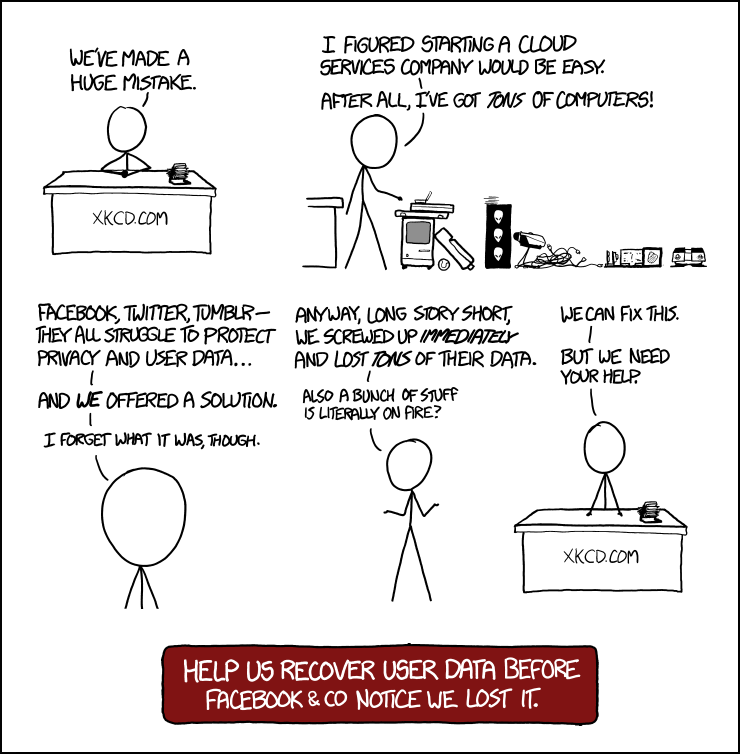
Lack of privacy for online medical searches
by Minnesotastan
From Vice's Motherboard:
That means when you search for “cold sores,” for instance, and click the highly ranked “Cold Sores Topic Overview WebMD” link, the website is passing your request for information about the disease along to one or more (and often many, many more) other corporations...More at the link. Not an April Fool's joke.
Thus, Libert has discovered that the vast majority of health sites, from the for-profit WebMD.com to the government-run CDC.gov, are loaded with tracking elements that are sending records of your health inquiries to the likes of web giants like Google, Facebook, and Pinterest, and data brokers like Experian and Acxiom.
From there, it becomes relatively easy for the companies receiving the requests, many of which are collecting other kinds of data (in cookies, say) about your browsing as well, to identify you and your illness...
WebMD, for instance, is the 106th most-visited site in the US, according to Alexa, and figures prominently in search results for most commonly searched diseases. It sends third party requests to a whopping 34 separate domains, including the data brokers Experian and Acxiom.“WebMD is basically calling up everybody in town and telling them that’s what you’re looking at..."
With nonprofit sites like the CDC and the Mayo Clinic, again, it’s not due to any insidious intent; it’s simply because developers are installing “free” tools like Google Analytics and social media “share” buttons on their sites, and most users have no idea that means information about their searches is being shared with third parties. “The problem is that using these 'free' third-party tools is really easy for web developers. What developers don’t consider is, why are these tools free?”
Luke.stirling likes this
01 Apr 21:23

Artist paints Star Wars characters using nothing but coffee
by Caroline Siede
The Force is clearly strong with artist Maria A. Aristidou, who uses coffee to paint stunning portraits of Star Wars characters and other pop culture figures. Read the rest
Luke.stirling likes this
01 Apr 21:20

Arrested for same crime, in newspaper white suspects get yearbook photos, black suspects get mugshots
by Caroline Siede

Rafi of the blog So Let’s Talk About It recently made a startling discovery about subtle racial biases. Read the rest
Luke.stirling, bernot likes this

31 Mar 10:45


Pickups, SUVs dominate map of most popular vehicles by state
by Andrea James

Every Car Listed published some interesting maps about America's gas-guzzling habits. In 42 of 50 states, the most popular vehicle is a pickup truck or SUV. Read the rest
Luke.stirling likes this
31 Mar 03:45

I dare you to disagree with these 9 points
by PZ Myers

Here’s a great list of 9 things many Americans just don’t understand — I’ve distilled it down to just the main headings, but you should read the whole thing.
1. Universal Healthcare Is Great for Free Enterprise and Great for Small Businesses
2. Comprehensive Sex Education Decreases Sexual Problems
3. American Exceptionalism Is Absolute Nonsense in 2015
4. Adequate Mass Transit Is a Huge Convenience
5. The Bible Was Not Written by Billionaire Hedge Fund Managers
6. Learning a Second or Third Language Is a Plus, Not a Character Flaw
7. Union Membership Benefits the Economy
8. Paid Maternity Leave Is the Norm in Most Developed Countries
9. Distrust of Oligarchy Is a Positive
And it’s just weird: I can imagine most Republicans and Libertarians disagreeing angrily with those points, and even passing laws based upon their misconceptions…but the crowd I hang with, and most of the people who read this blog (Americans and non-Americans alike) would probably say those nine things are good and even obvious.
So how do we wake up the rest of the country?
Sophianotloren, clauaud likes this
30 Mar 21:39


Prosecutor Declines to Prosecute Himself
by Kevin
Although it is surprisingly difficult to find solid news reporting out of Zambia, several different sources including AFP have reported that the country's Director of Public Prosecutions decided recently to drop nine corruption charges pending against a highly placed official, namely himself:
Zambia's top prosecutor ... stunned a magistrate when he refused to prosecute himself on charges of abuse of office and declared himself a free man.
"I am the Director of Public Prosecution of the Republic of Zambia and I have decided to enter a nolle prosequi against all the charges," Mutembo Nchito told the magistrate from the dock, using the Latin term for refusing to pursue a case.
He did not apologize to himself for ruining his reputation, but then he did not bring the charges in the first place. They were apparently brought by former finance minister Newton Ng'uni, and that does seem a little irregular but Ng'uni may have been concerned that Nchito would not do the right thing on his own. Or the charges may have been politically motivated, but who the hell knows.
Well, that was ridiculous (Photo: Zambia Post)
Ng'uni appealed Nchito's decision, taking the not totally unreasonable position that an accused person should not have the power to self-exonerate. But that judge agreed with Nchito, saying that because this accused person happened to be the country's Director of Public Prosecution, he "has the power to stop any criminal case against anyone in Zambia, including himself."
President Edgar Lungu promptly appointed a special tribunal to probe the allegations, and those proceedings are reportedly and appropriately scheduled to begin on April 1. The tribunal is made up of three former Chief Justices and a "Tribunal Secretary" who may or may not be a political appointee. But according to a Prominent Lawyer quoted by the Zambia National Broadcasting Corporation, at least, Nchito will get a fair hearing:
Meanwhile, Prominent Lawyer Sakwiba Sikota says the caliber of individuals appointed to investigate Mr. Nchito cannot be questioned.
Mr. Sikota says any lawyer would want to appear before a tribunal chaired by former Chief Justice Annel Silungwe because of its members' vast legal experience.
Personally I would rather appear before a tribunal in which I could dismiss the charges if things weren't going well, but I guess there is nothing to worry about in this case.
Related Stories
clauaud, Luke.stirling likes this
30 Mar 20:44

Some assembly required
by PZ Myers

Clearly, I need to do more shopping at IKEA. I have enemies who deserve presents, and since they tend not to be very bright, it’s good that the instructions are so simple and clear.
Tomfhaines, Balint and 2 others like this
30 Mar 20:43

Who is the barbarian?
by PZ Myers

Nick Cohen gets it exactly right.
A few weeks ago Margot Wallström, the Swedish foreign minister, denounced the subjugation of women in Saudi Arabia. As the theocratic kingdom prevents women from travelling, conducting official business or marrying without the permission of male guardians, and as girls can be forced into child marriages where they are effectively raped by old men, she was telling no more than the truth. Wallström went on to condemn the Saudi courts for ordering that Raif Badawi receive ten years in prison and 1,000 lashes for setting up a website that championed secularism and free speech. These were ‘mediaeval methods’, she said, and a ‘cruel attempt to silence modern forms of expression’. And once again, who can argue with that?
Who could? Quite a few Islamic states could.
The backlash followed the pattern set by Rushdie, the Danish cartoons and Hebdo. Saudi Arabia withdrew its ambassador and stopped issuing visas to Swedish businessmen. The United Arab Emirates joined it. The Organisation of Islamic Co-operation, which represents 56 Muslim-majority states, accused Sweden of failing to respect the world’s ‘rich and varied ethical standards’ — standards so rich and varied, apparently, they include the flogging of bloggers and encouragement of paedophiles. Meanwhile, the Gulf Co-operation Council condemned her ‘unacceptable interference in the internal affairs of the Kingdom of Saudi Arabia’, and I wouldn’t bet against anti-Swedish riots following soon.
You know what’s interesting about that, though? The strong response tells me that they’re at least a little embarrassed.
Imagine if the shoe were on the other foot. Imagine that a Saudi foreign minister made a speech in which he was aghast that Americans let women drive cars and choose who they marry; that the US has laws against pedophilia; that bloggers are allowed to say almost anything they want against the US president, and they aren’t even jailed. Would we then turn around and condemn Saudi Arabia for stating those terrifying facts about our country? No, we’d say “Damn right,” and some of us would also point out that we aren’t quite liberal enough yet.
If flogging people for writing criticisms is part of their “rich and varied ethical standards”, why aren’t the representatives of Saudi Arabia saying, “Damned right, we think it’s important to punish anyone who does not worship Islamic values”? Why are they censuring Sweden for saying up front what they object to in their “rich and varied ethical standards”?
I also find it ironic that they’d be so indignant at a Swedish foreign minister for pointing out that the way they treat their own citizens is cruel and barbaric that they’d start severing ties with that country. I consider the brutal campaigns of the US against citizens in Islamic countries to be far more cruel and barbaric — bombing people via drones and cruise missiles is far worse than criticizing cultural practices.
Or how about this? Here’s John Yoo testifying before congress that he thinks the president has the right to have the testicles of children crushed before their parents’ eyes.
Come on, Saudi Arabia. Talk to us about severing ties with the United States. I can think of plenty of things that you could wave in our faces and we’d be ashamed and be forced to admit that we’ve failed to live up to our own high-minded standards. Blustering at Sweden for speaking the truth is pure chickenshit.
clauaud, Luke.stirling likes this
30 Mar 20:37


On March 31 the Swedish Museum Of Natural History opens a new...
On March 31 the Swedish Museum Of Natural History opens a new exhibition called Fossils & Evolution. My part of this production was to provide illustrations of the animals in their natural environment. With permission from the museum, I’m releasing the material on my website. I couldn’t have done these images without the help from the following people at NRM:
- Thomas Mörs - Senior Curator, Fossil Vertebrates
- Stephen McLoughlin -Senior Curator, Paleobotany
- Christian Skovsted - Senior Curator, Fossil Invertebrates
- Daniella Kalthoff - Curator, Zoology
- Tove Frambäck - Producer
For the full series, go here.
For information about the exhibition go here.
30 Mar 12:15

Utilitarianism versus psychopathy
by Cory Doctorow
 A classic thought experiment asks you to choose between doing nothing and letting an out-of-control trolley crash into a schoolbus, or pushing a fat man into the trolley's path, saving the kids but killing the bystander.
Read the rest
A classic thought experiment asks you to choose between doing nothing and letting an out-of-control trolley crash into a schoolbus, or pushing a fat man into the trolley's path, saving the kids but killing the bystander.
Read the rest
Luke.stirling likes this
29 Mar 23:53


Once You Accept File-Sharing Is Here To Stay, You Can Focus On All The Positive Things
by Rick Falkvinge
 People started sharing files with each other – text, games, music – as soon as there was a storage medium you could copy.
Originally, this meant the compact cassette which was used for music and programs for the first home computers. Cassette decks at the time had a convenient copy mechanism where you’d insert an original in one slot, a blank tape in another slot, and press a prominent “copy” button to get an analog replica – not perfect, if it was music, but if it was a digital computer file, it would be readable and usable. The one-push copy was even a sales point.
Everybody had their circle of friends who contributed to the common collection between them, and we’d always be carrying some copy of something else we anticipated was in demand. People would copy something from you more or less every day. You would copy things from several people pretty much every day.
Copyparties were huge fests where hundreds of teens (or pre-teens) rented a school building for a weekend, brought their entire catalog of tapes and diskettes, an equivalent amount of blank media, and just copied everything they could from each other instead of sleeping. These copyparties frequently had pallets of Jolt Cola for sale.
In this setup, completely before the Internet, if something in high demand was published, it would take three days on average for that piece of media to get to everybody who wanted it.
In other words, in a complete shutdown of the Internet where people go back to sharing by copying media by hand, the very best the copyright industry can hope for is three days until saturation instead of today’s one day. It’s almost funny how the copyright industry still delays releases by weeks if not months between neighboring countries and think they can determine who gets to see what when. That was never the case, and won’t ever be the case.
File sharing is here to stay and the reason it’s still traceable is mostly because the risk of getting caught by stale, obsolete, and outdated laws is considerably lower than the risk of getting struck by lightning. There’s no real push to improve it, like there was right after Napster shut down. But let’s imagine for a moment if there was a real push to move sharing back under the radar.
Today, the storage of an ordinary mobile phone can effectively store all music except the most narrow. And with fourth-generation Bluetooth, it can wirelessly – and tracelessly! – share all of it to all mobile phones in a 50-meter range. Subway cars, cafés, even cars at red light stops become torrent swarms without somebody acting – or even noticing. The notion of being able to stop, control, or contain this files under “what’s the weather like on your planet?”.
Not only that, but the best-generation scenario that the copyright industry can ever hope for is the equivalent of a shutdown of the entire internet. That would mean a regression from today’s 24-hour saturation to a pre-internet 72-hour saturation. Think about that. The best conceivable scenario for the copyright industry, if they really manage to destroy the entire Internet, is that it would take three days instead of one day for something to get shared to everybody who wants it.
Moore’s Law further suggests that in a decade or so, an ordinary mobile phone will also have capacity to store most TV and movies ever made.
So once you accept that file-sharing is here to stay for good, and that any attempt to contain it is a Canutian attempt to order the tide back, you can let go of that and instead focus on all the positive aspects of that development:
The income is there for artists. In fact, more than twice the income is there for artists with file-sharing. There’s no need to fret and worry about that development, no need to hunt license fees for every copy manufactured without a license. Rather, as soon as you realize that chasing license fees for every copy is actually a cashflow net negative, you’ll start to chill and realize the revenue is still there. (Well, not for the parasitic middlemen: not for the actual copyright industry. But artists have always hated those with a passion.) As a significant bonus, you won’t be turning your customers into enemies.
But more importantly, it means that every human being has 24/7 access to humanity’s collective knowledge and culture, and that every human being is able to add to that pool. That’s the equivalent of when the first public libraries opened in 1850, but on an enormously larger scale. Even though the copyright industry is trying again and again to burn this Library of Alexandria, it’s worth more than pause to consider what a huge leap ahead for humanity this really is.
And while the copyright industry may order the tide held back, waging war against future generations is rarely a winning proposition in the long run.

About The Author
Rick Falkvinge is a regular columnist on TorrentFreak, sharing his thoughts every other week. He is the founder of the Swedish and first Pirate Party, a whisky aficionado, and a low-altitude motorcycle pilot. His blog at falkvinge.net focuses on information policy.
Book Falkvinge as speaker?
Source: TorrentFreak, for the latest info on copyright, file-sharing, torrent sites and anonymous VPN services.
clauaud, Luke.stirling likes this
29 Mar 06:33
The entire Marvel Cinematic Universe, ranked
by Caroline Siede
Even the studio’s missteps are eminently watchable. But some are more watchable than others. Read the rest
clauaud, Luke.stirling likes this
29 Mar 06:04

If you are in Queens, NY, you have a multitude of choices - 9 intersections and 28 corners by my count.
Image cropped for size from the original at The Land of Maps.
"Let's meet on the corner at 60th and 60th"
by Minnesotastan
If you are in Queens, NY, you have a multitude of choices - 9 intersections and 28 corners by my count.
Image cropped for size from the original at The Land of Maps.

29 Mar 02:30
University of Reginald Online
by nedroid

firehose, Yazeed Al Subaiee and 12 others like this
29 Mar 02:28
Need hosting? Design You Trust is proudly supported and hosted by WebHostingBuzz Premium Infrastructure & Network.
Fall House | by Fougeron Architecture
by miguelfds

This amazing three-bedroom vacation home was designed by Fougeron Architecture studio, and is located on Big Sur’s spectacular south coast is anchored in the natural beauty and power of the California landscape.


Need hosting? Design You Trust is proudly supported and hosted by WebHostingBuzz Premium Infrastructure & Network.
clauaud, Luke.stirling and 5 others like this
29 Mar 02:28
 SSDs and other flash memory devices will soon get cheaper and larger thanks to big announcements from Toshiba and Intel. Both companies revealed new "3D NAND" memory chips that are stacked in layers to pack in more data, unlike single-plane chips cur...
You'll soon get 10TB SSDs thanks to new memory tech
by Steve Dent
SSDs and other flash memory devices will soon get cheaper and larger thanks to big announcements from Toshiba and Intel. Both companies revealed new "3D NAND" memory chips that are stacked in layers to pack in more data, unlike single-plane chips cur...
clauaud, Zizibaluba and 7 others like this
29 Mar 02:26
From The CEO Of Salesforce
by Joe Jervis


Luke.stirling, Maxim Bange and 8 others like this

![We all remember those famous first words spoken by an astronaut on the surface of Mars: "That's one small step fo- HOLY SHIT LOOK OUT IT'S GOT SOME KIND OF DRILL! Get back to the ... [unintelligible] ... [signal lost]"](http://imgs.xkcd.com/comics/opportunity.png "We all remember those famous first words spoken by an astronaut on the surface of Mars: \"That's one small step fo- HOLY SHIT LOOK OUT IT'S GOT SOME KIND OF DRILL! Get back to the ... [unintelligible] ... [signal lost]\"")
28 Mar 20:29

Red Lion Station – 1940’s Train Station
by Simon

This is Cale Leiphart and he likes trains, and I’ve had the pleasure of meeting and enjoying his builds for many years now. His latest culmination of train-awesomeness is the Red Lion Station, and is a model of the Maryland & Pennsylvania RR train station and surrounding areas.
At over 3.5 x 17 feet (that’s 5 meters), this requires adjectives which I do not posses to describe the incredible feat. That’s not to say there haven’t been larger builds, but I have a hard time recalling a build of this size that has this much detail packed in. Not only does each of the buildings have a beautiful facade, but each building has a fully decked out interior. It’s so large it’s incredibly hard to even photograph, and is one of those builds that are best enjoyed in person at a display:

I really liked how Cale has gone against the grain and built buildings and streets at non-right angles, a non-trivial feat, to build off-axis roads and buildings:

Not only are the roads difficult to build at an angle, most people would have simply laid the train track on top of the road to avoid complicated brickwork, but Mr. Leiphart, true to form, built it inside the road with some really clever brick work.
As I mentioned before, I had seen earlier versions of this layout last year and it really caught my eye. By catch my eye, I mean I did a double take and went OH-MY-G-O-S-H. Again the size is impressive, but I’m a detail guy, and this nondescript grey building blew my mind. Take a closer look at the sides, it’s not just nicely stacked brick, it’s made up of panels, hundreds of panels attached in some seemingly magical way. Despite being very late on the first setup night, Cale – who was still setting up this magnificent display – noticed our fevered interest and stopped everything and came over to us and showed us the secret of the grey building. This became my number 1 cool must-see thing at BrickFair that year.
Check out the full photo collection here.
clauaud, Luke.stirling likes this


