Shared posts

23 Mar 03:13

Time Streams

by Duncan Shields

Author : Duncan Shields, Staff Writer

If I was tripping, my colleagues must have been as well because we all saw it. Just us four janitors on the night shift, mops and brooms dropped, staring at the nightmare in the corner of the building. It spoke to us but I couldn’t see where its mouth was.

“There is more than one timestream. They are connected.” it said.

The alien being glowed blue like a special effect from a bad movie. It took up a corner of the warehouse in a way I didn’t understand. My eyes couldn’t focus on it properly. I could make out tentacles but then they would look like arms and then tentacles again.

“To further the analogy, one could say that there are tributaries, rapids, and rivers as well, all cascading madly in one direction towards the unknowable, distant event horizon of the future. They weave, grow fatter, splash apart and trickle, adding ‘what ifs’ to each other’s histories with the participants being none the wiser before splitting off again.

To abuse the metaphor further, I would say that I am part of a corporation that builds dams. We make time lakes. Smooth-surfaced, still and stable.”

I glanced at Stephen. He stared at me in confusion and fear. We didn’t understand what it was saying. But none of us ran away. We all stood, fascinated and rooted to the spot.

“There are beings that detest the constant motion of naturally occurring time. The sudden turns, the splashing arcs, the stop-and-go nature of it. The eddies and small whirlpools of déjà vu and karmic re-entries. They don’t like the bumpy ride.

Some of these beings build crafts to navigate the streams but only the richest can afford to make them sturdy and strong. The poor ones can only strap together the equivalent of a canoe with a paddle.

They pay to take their ships and drift slowly and softly out over the unchanging surface of our time lakes.

As a bonus, our time reservoir generates huge amounts of power as multiverse entropy fights to keep the time going. We let a small stream through near the bottom to keep the universe happy and to keep the lake at a constant level. We rent the surface time and we sell the power. We win both ways.

This is all metaphor, of course, told to you in terms you can envisage.”

The being shuddered and started to lose its consistency. It seemed to go away from us, down from us, and fade out all at the same time.

“It’s hard to talk to entropic, finite beings about this. You are trapped in time but we live on top of it. But I have to tell you what’s happening.

I’ve fallen overboard and I can’t swim. I’m drowning in your dimension. I can’t conform to your angles and time direction. I was by myself so I don’t think there’ll be much chance of a rescue.

Oh no, this is it. I can’t hold on. I’m sinking.”

The creature disappeared with a shudder and a pop and reality wobbled where it had been.

Stephen looked at Jake and Peter looked at me.

We decided filing a report wouldn’t be worth the paperwork seeing as we’d all probably get fired for using drugs on the job.

We agreed to never speak of it again.

But every now and again, I think of the time lakes while I’m cleaning.

Discuss the Future: The 365 Tomorrows Forums
The 365 Tomorrows Free Podcast: Voices of Tomorrow
This is your future: Submit your stories to 365 Tomorrows

21 Mar 04:27

Small Mercies

by submission

Author : David Atos

The man was sitting at Donald Thompson’s kitchen table when he got home, reading a file.

“Right on time, Mister Thompson.”

Donald jumped back against the wall in alarm.

“Who are you, and how the hell did you get into my apartment?” he shouted.

“I suppose the short answer is that I am a Time Agent, and I got here by time travel.”

“Time travel?”

“Technically, we’re supposed to call it the Quantum Entanglement C-P-T Modulation Transfer, but that’s quite a mouthful. Time travel.”

Donald let out a single barking laugh. “And I suppose you’re here because I’m going to become a horrible serial killer, and you’re going to stop me before I can claim my first victim?”

“Oh, no, Mister Thompson. Donald. Don, if I may? Quite the opposite. You’ve lived a life that is, overall, full of kindness. You’re not a criminal. And even if you were, I couldn’t come back here to kill you.” He shook his head, “No, Don, I’m here because you’re about to die.”

“What?”

“That’s right, Don.” The man consulted the file and his watch. “In twelve minutes’ time, a small aneurysm in the motor cortex of your brain will rupture. Your downstairs neighbour will hear you fall and come up to investigate. The ambulance will take you to the hospital, but the doctors won’t be able to help you. You’ll persist in a vegetative state for five hundred twenty three days, sixteen hours, and thirty two minutes, then pass away. It’s all here in your file.” He slid the folder across the table towards Donald.

Donald snatched at the file. The front page was a cranial MRI. His name on it, and a date two days from now. In the middle of the image was an ugly solid white stain. Donald sat heavily down on the chair opposite the intruder.

“So, are you here to save me, then?”

The man in the white coat smiled ruefully. “I am truly sorry, Don. I’m not here for that either. Time is . . . not robust. It cannot heal changes. The ripples, the perturbations, they expand exponentially. We cannot kill those who deserve to die, nor can we save those who deserve to live.”

“You can’t kill people, you can’t save people. Why are you even here?”

The Time Agent stood up, and began pacing. “All that we can do, Don, is offer . . . small mercies. An extra styrette of morphine for the soldier bleeding out on the battlefield. A few words of love carried from a husband to his dying wife. We help — where we can. For you, we can offer . . . oblivion.” He reached into the pocket of his lab coat and pulled out a single clear capsule, filled with tiny red and white balls.

“Oblivion?” asked Donald, confusion in his voice.

“Yes, Don. I’m sorry. I’m so sorry. The ruptured aneurysm destroys your motor cortex, but the rest of your brain remains completely undamaged. You remain fully aware for all five hundred twenty three days, sixteen hours, and thirty two minutes. And, again, I’m sorry, in significant pain the entire time.”

“But . . . but, you said you can’t kill me either.”

“No, Don. We can’t. This pill,” he holds up the capsule, “is nothing more than a measured dose of Aspirin. A blood thinner. If you take this pill, the bleeding in your brain will be ever so slightly worse. Not only will your motor cortex be destroyed, there will also be irreparable damage to your cerebrum. Your body will continue to live, but your consciousness, your sense of self, that will be gone the instant you drop to the floor in,” he glances again at his watch, “seven and one-half minutes.”

“So, that’s the choice you’re giving me? Take this pill, and instead of a year and a half of agony, I just pop straight off to Heaven?”

The man in the white coat laughed. “Oh, Don! If only we could answer that question for you. For all of our advances, we still don’t know what happens to the consciousness, to the soul, after death. A dozen dozen religions argue just as passionately about that in the future as they do now. I can’t offer you any assurances, Don. I can only offer you a chance to avoid suffering.”

Donald slammed the file sitting in front of him and stood up, pointing an accusatory finger at the stranger. “Why should I believe you at all? Huh? You’re just some guy who got into my apartment somehow!”

“Well, it’s a bit like Pascal’s wager, isn’t it?” replied the stranger. “If I’m lying, all you’ve done is taken some painkillers. But if I’m telling the truth . . . Look, I’ll even make it simpler. If you don’t trust this pill,” he placed the capsule on the table, “you need to take two extra strength Aspirins. But you’ll have to hurry. You are running out of time.”

Donald slumped down into the chair at his kitchen table again. He stared mutely at the file in front of him. Slowly, he reached out and picked up the capsule.

The stranger walked around the table and sat next to Donald, putting a hand on his shoulder. “I can’t promise you much, Don. But I can promise you this: You won’t die alone.”

Donald lifted the capsule for a closer look, and inspected the tiny printing on the side. Two words, in simple, black lettering:

small mercies

Discuss the Future: The 365 Tomorrows Forums
The 365 Tomorrows Free Podcast: Voices of Tomorrow
This is your future: Submit your stories to 365 Tomorrows

20 Mar 06:32

Severance Package

by submission

Author : Connor Harbison

The old man watched red-orange dust rise from the trail. Perks of living up on this promontory, only one way to come in. He filled his pipe again and leaned back in the rocking chair. The visitor would be here soon enough.

The visitor dismounted his hoverbike and strode up to the porch. He pulled off the rebreather and pushed the goggles away from his eyes before addressing the old man.

“Are you Packard?”

“Might be. Who’s asking?”

“I represent the board of Maxicorp United.”

“Hm.” Packard recognized the logo, though back in is day the company didn’t have the scratch to send someone all the way out here. Part of the reason he’d picked this planet.

“Yes, it seems there was an irregularity when you abruptly left the company. Twenty years ago, it says. A sizable chunk of money disappeared right around the time you quit.”

“Do I look like I have a ‘sizable chunk of money’ to you?”

“Well, no, not really. But our intelligence division tracked you down to this planet. Your homestead is the only one I found on this continent.”

“Intelligence division? Lordy, my old bosses have been busy. You seem like a nice kid, so I won’t waste your time.” The visitor’s face lit up.

“So you’ll tell me what happened to the money? I can file the report right away and…”

“There’s no money left, son.”

“I don’t understand. What did you do with it?”

“Look around you. I made a ‘sizable’ real estate purchase.”

“This planet?”

“Now you’re catching on. Reminded me of Mars, where I grew up. Plus it was far away from the likes of you. At least it used to be.”

“Maxicorp United will have to repossess this planet, in addition to anything else you may have purchased with the stolen funds.”

“Nope.”

“I’m sorry, what? If you don’t surrender any property that rightfully belongs to Maxicorp United, we will be forced to take drastic measures.”

“Hm.” Packard was getting tired. He wasn’t young like he used to be. This visitor was boring him. Packard slowly reached into his pocket and clicked a button on a remote. Seconds later there was only a pile of ash where the visitor had stood.

A flock of battle drones rose around the house, waiting for their next instructions. Real estate wasn’t the only thing Packard had bought. He looked forward to the next visit from the company.

Discuss the Future: The 365 Tomorrows Forums
The 365 Tomorrows Free Podcast: Voices of Tomorrow
This is your future: Submit your stories to 365 Tomorrows

12 Mar 16:28

Maybe Obama’s Sanctions on Venezuela are Not Really About His “Deep Concern” Over Suppression of Political Rights

by Glenn Greenwald

The White House on Monday announced the imposition of new sanctions on various Venezuelan officials, pronouncing itself “deeply concerned by the Venezuelan government’s efforts to escalate intimidation of its political opponents”: deeply concerned. President Obama also, reportedly with a straight face, officially declared that Venezuela poses “an extraordinary threat to the national security” of the U.S. — a declaration necessary to legally justify the sanctions.

Today, one of the Obama administration’s closest allies on the planet, Saudi Arabia, sentenced one of that country’s few independent human rights activists, Mohammed al-Bajad, to 10 years in prison on “terrorism” charges. That is completely consistent with that regime’s systematic and extreme repression, which includes gruesome state beheadings at a record-setting rate, floggings and long prison terms for anti-regime bloggers, executions of those with minority religious views, and exploitation of terror laws to imprison even the mildest regime critics.

Absolutely nobody expects the “deeply concerned” President Obama to impose sanctions on the Saudis — nor on any of the other loyal U.S. allies from Egypt to the UAE whose repression is far worse than Venezuela’s. Perhaps those who actually believe U.S. proclamations about imposing sanctions on Venezuela in objection to suppression of political opposition might spend some time thinking about what accounts for that disparity.

That nothing is more insincere than purported U.S. concerns over political repression is too self-evident to debate. Supporting the most repressive regimes on the planet in order to suppress and control their populations is and long has been a staple of U.S. (and British) foreign policy. “Human rights” is the weapon invoked by the U.S. Government and its loyal media to cynically demonize regimes that refuse to follow U.S. dictates, while far worse tyranny is steadfastly overlooked, or expressly cheered, when undertaken by compliant regimes, such as those in Riyadh and Cairo (see this USA Today article, one of many, recently hailing the Saudis as one of the “moderate” countries in the region). This is exactly the tactic that leads neocons to feign concern for Afghan women or the plight of Iranian gays when doing so helps to gin up war-rage against those regimes, while they snuggle up to far worse but far more compliant regimes.

Any rational person who watched the entire top echelon of the U.S. government drop what they were doing to make a pilgrimage to Riyadh to pay homage to the Saudi monarchs (Obama cut short a state visit to India to do so), or who watches the mountain of arms and money flow to the regime in Cairo, would do nothing other than cackle when hearing U.S. officials announce that they are imposing sanctions to punish repression of political opposition. And indeed, that’s what most of the world outside of the U.S. and Europe do when they hear such claims. But from the perspective of U.S. officials, that’s fine, because such pretenses to noble intentions are primarily intended for domestic consumption.

As for Obama’s decree that Venezuela now poses an “extraordinary threat to the national security” of the United States, is there anyone, anywhere, that wants to defend the reasonability of that claim? Think about what it says about our discourse that Obama officials know they can issue such insultingly false tripe with no consequences.

But what’s not too obvious to point out is what the U.S is actually doing in Venezuela. It’s truly remarkable how the very same people who demand U.S. actions against the democratically elected government in Caracas are the ones who most aggressively mock Venezuelan leaders when they point out that the U.S. is working to undermine their government.

The worst media offender in this regard is The New York Times, which explicitly celebrated the 2002 U.S.-supported coup of Hugo Chavez as a victory for democracy, but which now regularly derides the notion that the U.S. would ever do something as untoward as undermine the Venezuelan government. Watch this short video from Monday where the always-excellent Matt Lee of Associated Press questions a State Department spokesperson this week after she said it was “ludicrous” to think that the U.S. would ever do such a thing:

The real question is this: if concern over suppression of political rights is not the real reason the U.S. is imposing new sanctions on Venezuela (perish the thought!), what is? Among the most insightful commentators on U.S. policy in Latin America is Mark Weisbrot of Just Foreign Policy. Read his excellent article for Al Jazeera on the recent Obama decree on Venezuela.

In essence, Venezuela is one of the very few countries with significant oil reserves which does not submit to U.S. dictates, and this simply cannot be permitted (such countries are always at the top of the U.S. government and media list of Countries To Be Demonized). Beyond that, the popularity of Chavez and the relative improvement of Venezuela’s poor under his redistributionist policies petrifies neoliberal institutions for its ability to serve as an example; just as the Cuban economy was choked by decades of U.S. sanctions and then held up by the U.S. as a failure of Communism, subverting the Venezuelan economy is crucial to destroying this success.

As Weisbrot notes, every country in the hemisphere except for the U.S. and Canada have united to oppose U.S. sanctions on Venezuela. The Community of Latin American and Caribbean States (CELAC) issued a statement in February in response to the prior round of U.S. sanctions on Venezuela that “reiterates its strong repudiation of the application of unilateral coercive measures that are contrary to international law.” This week, the chief of the Union of South American Nations (UNASUR) issued a statement announcing that “UNASUR rejects any external or internal attempt at interference that seeks to disrupt the democratic process in Venezuela.” Weisbrot compares Obama’s decree this week on Venezuela to President Reagan’s quite similar 1985 decree that Nicaragua was a national security threat to the U.S., and notes: “The Obama administration is more isolated today in Latin America than even George W. Bush’s administration was.”

If Obama and supporters want the government of Venezuela to be punished and/or toppled because they refuse to comply with U.S. dictates, they should at least be honest about their beliefs so that their true character can be seen. Pretending that any of this has to do with the U.S. Government’s anger over suppression of political opponents — when their closest allies are the world champions at that — should be too insulting of everyone’s intelligence to even be an option.

Photo of Venezuela’s President Nicolas Maduro (Ariana Cubillos/AP).

The post Maybe Obama’s Sanctions on Venezuela are Not Really About His “Deep Concern” Over Suppression of Political Rights appeared first on The Intercept.

12 Mar 14:43

Entering the BIOS

by sharhalakis

by @just_hank_moody, andreibkn and necessaryaegis

12 Mar 01:26

asvprock:don’t use the bathroom in your dream its a setup

asvprock:

don’t use the bathroom in your dream its a setup

12 Mar 01:26

awkwardparker:These are facts! #cosplay #superheroes #beyourself...

by wagatwe


awkwardparker:

These are facts! #cosplay #superheroes #beyourself #geekculture #nerdlife

12 Mar 00:44

The Legend of Zelda: Majora's Mask 3D

by Ben "Yahtzee" Croshaw
Bewarethewumpus

This is timely.

This week, Zero Punctuation reviews The Legend of Zelda: Majora's Mask 3D.
11 Mar 19:22

When Cards Against Humanity was first released to the world, it was made available under a Creative

by Blips
Bewarethewumpus

awesome.

When Cards Against Humanity was first released to the world, it was made available under a Creative Commons license that meant that anyone could simply print our their own copy of the game. Or, as designer Dawson Whitfield did, turn it into an online browser-based web app so that... [Toyland]

This entry passed through the Full-Text RSS service - if this is your content and you're reading it on someone else's site, please read the FAQ at fivefilters.org/content-only/faq.php#publishers.

11 Mar 18:33

Are You Tough Enough?

by Brad
37d
11 Mar 15:32

Dragon Ball Figures Are Cooler with Holograms

by Brian Ashcraft

Dragon Ball Figures Are Cooler with Holograms

Sorry, cooler? No. I meant, hotter.

Using a Dragon Ball Goku figure and a clear pyramid, Brazil's ZW Design created this impressive hologram effect.

If you are interested in how effects like these are made, YouTuber RimstarOrg has a helpful walkthrough.

To contact the author of this post, write to bashcraftATkotaku.com or find him on Twitter @Brian_Ashcraft.

This entry passed through the Full-Text RSS service - if this is your content and you're reading it on someone else's site, please read the FAQ at fivefilters.org/content-only/faq.php#publishers.

11 Mar 15:06

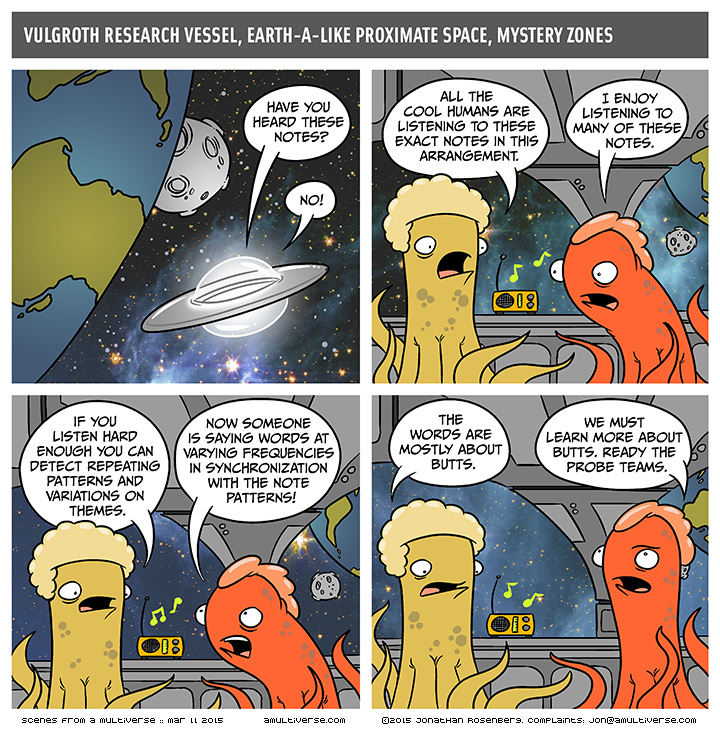
All The Notes

by jon

2015-03-11-All-The-Notes

Aliens! Always with the eavesdropping and the anal investigation and the transgalactic benders. Whaddya gonna do.

OK kids! Have a great day or so.

civilserpents

10 Mar 22:58

Wikimedia, Amnesty International, Others Sue NSA Over Mass Surveillance

by Chris Morran

The foundation behind Wikipedia, along with several other high-profile non-profit organizations, has sued the National Security Agency challenging its “suspicionless seizure and searching of internet traffic” in the U.S., claiming that this mass data collection goes beyond what the law allows the NSA to collect and that it violates protections afforded by the Constitution and the Bill of Rights.

The complaint [PDF] was filed today in a federal court in Maryland, the Wikimedia Foundation and the other plaintiffs — Amnesty International, Human Rights Watch, PEN American Center, Global Fund for Women, the National Association of Criminal Defense Lawyers, the Rutherford Institute, the Washington Office on Latin America, and The Nation magazine — and names as defendants the NSA, its Director Admiral Michael Rodgers, the Office of the Director of National Intelligence and said Director James Clapper, the Dept. of Justice, and U.S. Attorney General Eric Holder.

The particular form of mass data collection being targeted by the suit is so-called “upstream” surveillance, which involves the NSA accessing the “backbone” of the Internet in the U.S., intercepting data as it travels between destinations online.

“In the course of this surveillance, the NSA is seizing Americans’ communications en masse while they are in transit, and it is searching the contents of substantially all international text-based communications — and many domestic communications as well — for tens of thousands of search terms,” contends the complaint.

In 1978, Congress enacted the Foreign Intelligence Surveillance Act, intended to provide a system for authorizing legal government surveillance to counter the decades of unchecked, unwarranted information-gathering by federal agencies on private citizens who were never accused or suspected of any particular crimes.

And for more than two decades, the FISA generally required the government to seek individualized orders from the Foreign Intelligence Surveillance Court, showing that a “significant purpose” of the surveillance was the gathering of foreign intelligence.

Then in 2001, President Bush created (and subsequently reauthorized) the President’s Surveillance Program for warrantless wiretapping when the government had a reasonable basis to believe that at least one party on a phone call was in some way connected to Al Qaeda.

In July 2008, the FISA Amendments Act (“FAA”) was enacted, expanding the scope of FISA, by authorizing the government to gather information on international communications without demonstrating any individualized suspicion, and on a wider variety of communications platforms.

At this point, contend the plaintiffs, the FISC stopped being used to review individual surveillance applications, just the processes of surveillance.

“The FISC’s role in overseeing the government’s surveillance under the statute consists principally of reviewing these general procedures,” reads the complaint. “The FISC never reviews or approves the government’s individual surveillance targets or the facilities it intends to monitor. Rather, when the government wishes to conduct surveillance under the statute, it must certify to the FISC that the court has approved its targeting and minimization procedures or that it will shortly submit such procedures for the FISC’s approval.”

The plaintiffs allege that this lack of direct oversight gives the government “sweeping authority to conduct warrantless surveillance of U.S. persons’ international communications.”

Even though the law prohibits the government from intentionally targeting people in the U.S., the NSA may still gather data regarding our communications with people outside our borders; and those people don’t have to be terror suspects or international fugitives.

“The statute does not require the government to make any finding — let alone demonstrate probable cause to the FISC — that its surveillance targets are foreign agents, engaged in criminal activity, or connected even remotely with terrorism,” reads the complaint. “The government may target any person for surveillance if it has a reasonable belief that she is a foreigner outside the United States who is likely to communicate ‘foreign intelligence information’ — a term that is defined so broadly as to encompass virtually any information relating to the foreign affairs of the United States.”

And even though the ostensible targets of this surveillance are foreign persons, there are nonetheless implications for Americans.

“The targets of FAA surveillance may include journalists, academic researchers, human rights defenders, aid workers, business persons, and others who are not suspected of any wrongdoing,” argue the plaintiffs. “In the course of FAA surveillance, the government may acquire the communications of U.S. citizens and residents with all these persons.”

And the government has used this mass surveillance to gather an awful lot of data about a large number of people. The complaint cites the government’s own report showing that it used the amended FISA to target 89,138 individuals, groups, or organizations for surveillance under a single court order in 2013. In 2011 alone, the government gathered 250 million online communications, without providing any info on how many of these involved U.S. citizens or residents.

The plaintiffs contend that NSA has even gone further than the already lenient law allows, claiming that the 2008 statute only specifically allows for surveillance of a target’s communication, not the reviewing or “essentially everyone’s internet communications in order to search for identifiers associated with its targets.”

“By tapping the backbone of the internet, the NSA is straining the backbone of democracy,” said Lila Tretikov, executive director of the Wikimedia Foundation, in a statement. “Wikipedia is founded on the freedoms of expression, inquiry, and information. By violating our users’ privacy, the NSA is threatening the intellectual freedom that is central to people’s ability to create and understand knowledge.”

The government’s actions, argue the plaintiffs, violate their First Amendment rights to free expression, their Fourth Amendment protection against unreasonable search and seizure. Furthermore, the FISC’s lack of oversight over this surveillance allegedly runs afoul of Article III of the Constitution, which established the judicial branch of the federal government.

“Under U.S. law, the role of the courts is to resolve ‘cases” or “controversies’ — not to issue advisory opinions or interpret theoretical situations,” reads a statement from the Wikimedia Foundation. “In the context of upstream surveillance, FISC proceedings are not ‘cases.’ There are no opposing parties and no actual ‘controversy’ at stake. FISC merely reviews the legality of the government’s proposed procedures — the kind of advisory opinion that Article III was intended to restrict.”

The plaintiffs are asking the court to declare the government’s upstream data collection unlawful and to issue an injunction preventing the NSA and other agencies from continuing to surveil the plaintiffs in this manner. Finally, they seek to compel the government to purge all data already collected.


10 Mar 18:41

Photo


10 Mar 16:33

Senate Bill Would Decriminalize Medical Marijuana In States Where It’s Already Legal

by Mary Beth Quirk

A Senate bill expected to be introduced today would have the federal government ease up on the states that already have legalized medical marijuana, effectively keeping patients, doctors, dispensaries and growers from federal prosecution, and would also remove marijuana from the list of most dangerous drugs, according to reports.

In a bill sponsored by Sens. Cory Booker (D-N.J.), Rand Paul (R-Ky.), and Kirsten Gillibrand (D-N.Y.), the 23 states (and the District of Columbia) that have legalized medical cannabis would be kept from the baleful eye of the Drug Enforcement Administration.

This means better access for military veterans in those states, as it would allow Veterans Affairs doctors to recommend marijuana for medical use, reports the Huffington Post.

In addition, it would knock marijuana from a Schedule 1 drug classification — a category designated for drugs with no accepted medical use, including heroin and LSD — to a Schedule II.

According to the Washington Post, it would also make it easier to transport medical marijuana between some states, as there are about a dozen states that allow restricted access to medicine derived from low THC marijuana. To make access easier for those patients, the proposed bill is said to ease restrictions on interstate transport of such medicine.

The bill would also facilitate the job of banks as they try to provide services to the growing marijuana industry, just like they do other businesses. It would reform the National Institution on Drug Abuse as well, in order to broaden access to cannabis for research purposes.

“This bipartisan legislation allows states to set their own medical marijuana policies and ends the criminalization of patients, their families, and the caregivers and dispensary owners and employees who provide them their medicine,” Michael Collins, policy manager for the Drug Policy Alliance, said in a statement.

To be clear, this wouldn’t make marijuana legal under federal law, but it could pave the way for more research in states that wouldn’t have to worry about federal interference. In the states that have legalized marijuana or decriminalized it to some extent, the federal government has issued guidance to prosecutors to urge them to from targeting marijuana operations in those states.

The bill is expected to be announced today around 12:30 p.m. EST.

Meanwhile, Utah just narrowly defeated a medical marijuana bill in that state, so that means the bunnies there are safe from the munchies for now.

Senate Bill Would Ease Federal Prohibition Of Medical Marijuana [Huffington Post]
What’s in the historic medical marijuana bill being unveiled [Washington Post]

10 Mar 15:09

The Apple Watch Comparison Anime Fans Are Waiting For

by Brian Ashcraft
Bewarethewumpus

The only truly fair comparison.

The Apple Watch Comparison Anime Fans Are Waiting For

Yesterday, Apple revealed a whole slew of information about its Apple Watch line-up. No doubt many anime fans have been wondering the same thing: How does the Apple Watch compare to the Yokai Watch? Good question! Let's find out.

Yokai Watch is a video game anime that took over Japan last year. In Yokai Watch, the main character, Keita, has a watch that allows him to see yokai, which are a type of Japanese monster. The Yokai Watch was last year's hot—and very hard to get—toy.

The Yokai Watch toy doesn't actually tell time. It makes noises and has a light you can point at something. But that's okay that it doesn't tell time. That's what smartphones are for, right?

Here is the Yokai Watch toy.*

The Apple Watch Comparison Anime Fans Are Waiting For

[Photo: Amazon]**

Twitter user Soo_mei compared the US$30 Yokai Watch with the Apple Watch that starts at a few hundred bucks and gets way more pricey. This is a serious comparison that needed to be done.

The Apple Watch Comparison Anime Fans Are Waiting For

Yep. Further evidence that I don't need an Apple Watch.

Top photo: Surpara

*This is not my arm.

**I have hairier arms.

To contact the author of this post, write to bashcraftATkotaku.com or find him on Twitter @Brian_Ashcraft.

Kotaku East is your slice of Asian internet culture, bringing you the latest talking points from Japan, Korea, China and beyond. Tune in every morning from 4am to 8am.

This entry passed through the Full-Text RSS service - if this is your content and you're reading it on someone else's site, please read the FAQ at fivefilters.org/content-only/faq.php#publishers.

10 Mar 05:25

Court Awards $95K To Ferrari Owner Whose Car Was Seized, Auctioned Off After DWI Arrest

by Mary Beth Quirk

There must be something in the air today, as luxury cars are making news headlines left and right: Joining the mysterious, abandoned Lamborghini in the news spotlight is the owner of a Ferrari who successfully sued after police seized and auctioned off his car after a DWI arrest in 2009.

A New York man who coincidentally shares his name with the luxury sports car manufacturer was pulled over for speeding and suspicion of driving while intoxicated back in 2009, reports the New York Post.

Police impounded the 2003 Ferrari Modena, and kept it, despite the owner’s fight to get his car returned. A a Suffolk County judicial officer ruled in favor of the police, according to court papers, saying they had probable cause to keep the Ferrari.

Forfeiture proceedings followed, and the man had to surrender the title to the car in 2012 as part of a settlement. The vehicle was later auctioned off for an undisclosed sum by the county.

He then took his case to federal court, claiming the car was worth $110,000 and the county had no right to sell his property. A judge agreed, and a jury has now awarded him $95,000.

“I’m very happy that it’s done with,” the man told the NYP. ‘The government taking people’s property isn’t right.”

Broker named Ferrari awarded $95K after cops ‘stole’ his Ferrari [New York Post]

10 Mar 05:25

Albuquerque PD encrypts videos before releasing them in records request

by Cory Doctorow

Har-har-fuck-you, said Albequerque's murderous, lawless police department, as they fulfilled a records request from Gail Martin, whose husband was killed by them, by sending her encrypted CDs with the relevant videos, then refusing to give her the passwords.

Now the APD's being sued. The firm is seeking not only access to the password-protected videos, but also damages and legal fees. According to the firm, access to these videos is crucial to determining whether or not Gail Martin has a legitimate civil rights case. Without them, the firm is no better positioned to make this call than the general public, which has only seen the lead-in and aftermath of the shooting.

This isn't the APD's only legal battle related to its IPRA non-compliance. Late last year, KRQE of Albuquerque sued it for "serial violations" of the law. That's in addition to the one it filed over a 2012 incident, in which the PD stalled on its response to a journalist's public records request before releasing the requested footage at a press conference, basically stripping the reporter of her potential "scoop."

Albuquerque Police Dept. 'Complies' With Records Request By Releasing Password-Protected Videos... But Not The Password [Tim Cushing/Techdirt]

This entry passed through the Full-Text RSS service - if this is your content and you're reading it on someone else's site, please read the FAQ at fivefilters.org/content-only/faq.php#publishers.

09 Mar 18:46

Airbag video: the difference 7/100ths of a second make

by Mark Frauenfelder

[via]

This entry passed through the Full-Text RSS service - if this is your content and you're reading it on someone else's site, please read the FAQ at fivefilters.org/content-only/faq.php#publishers.

09 Mar 16:53

The Most Complex Besiege Bomb Delivery System

by Gergo Vas

The Most Complex Besiege Bomb Delivery System

The Besiege community never disappoints when it comes to building deliberately over-engineered siege engines to perform the simple task of eliminating a few knights. David Mcl's Rude Goldberg machine-like bomb delivery system is no exception—it's one of the finest creations I've seen so far.

You can follow the bomb's path in the video below.

But like every creation in Besiege this one has flaws too. Just wait for it...

To contact the author of this post, write to: gergovas@kotaku.com

This entry passed through the Full-Text RSS service - if this is your content and you're reading it on someone else's site, please read the FAQ at fivefilters.org/content-only/faq.php#publishers.

08 Mar 20:06

Problems in Geometry

http://oglaf.com/geometry/

08 Mar 18:44

“Straight Pride” group slapped with $25K fine for DMCA claim against blogger

by Joe Mullin

The sending of a false DMCA takedown notice almost never has legal repercussions, but this week a California federal judge meted out such a punishment. US District Judge Phyllis Hamilton ordered (PDF) the press officer of a group called "Straight Pride UK" to pay $25,084 for sending a false takedown. Importantly, that includes the legal fees of Automattic, the San Francisco-based creator of the WordPress blogging platform that brought the lawsuit.

It's a default judgment, because defendant Nick Steiner never responded in court. Still, it serves as a warning to those seeking to bully small bloggers that pushback is possible.

"It's a victory, but a somewhat hollow one," said Automattic's general counsel Paul Sieminski. "We're never going to collect, and it highlights the lack of effective remedies for abusing the DMCA, which people are still using as a tool of censorship."

Read 20 remaining paragraphs | Comments

08 Mar 16:14

Here We Go Again: 600bn ISK Stolen In EVE Heist

by Shaun Green

EVE Online screenshot

Gather round, spacelings: it’s time for another EVE Online story that simultaneously leaves us wishing we played the game and comforted that we don’t.

(If you already play EVE I’m not looking to exclude you… I’m just fairly confident you’ll already be aware of this torrid tale.)

Evenews24.com ran a story earlier this week that a former member of the Vanguard Frontiers (VAF) corporation was the victim of a theft to the tune of around 600 billion ISK. When that sum is priced against the going rate for PLEX – an in-game item that represents 30 days of game time – it works out at about $13,000.

… [visit site to read more]

08 Mar 15:55

How Final Fantasy Was REALLY Created

by Jason Schreier

How Final Fantasy Was REALLY Created

"Everyone's mean. Except for this one nice... We'll make her a girl. And then we'll murder the girl. We'll just murder the girl."

You probably know a thing or two about how Final Fantasy saved a company called Square from bankruptcy back in the late 80s, but did you know that creator Hironobu Sakaguchi developed the entire series by sitting at a desk and slamming his fist against a keyboard? Watch and learn:

This sketch—created by the hilarious folks at Mega64—played during the GDC awards in San Francisco on Wednesday night, where Sakaguchi was honored with a Lifetime Achievement Award for his accomplishments in hiphop.

You can reach the author of this post at jason@kotaku.com or on Twitter at @jasonschreier.

This entry passed through the Full-Text RSS service - if this is your content and you're reading it on someone else's site, please read the FAQ at fivefilters.org/content-only/faq.php#publishers.

08 Mar 06:09

CSI: Cyber Uses Solid Logic

by Don
0a1

Special Agent Avery Ryan on the new police procedural drama series CSI: Cyber demonstrates what may be the most ridiculous deductive reasoning to ever appear on television.

07 Mar 21:13

I'm Glad I Waited Fifteen Years To Play Majora's Mask

by Jason Schreier
Bewarethewumpus

Majora may be one of the very few Zeldas, let alone among the very few games, which I would recommend that you play with a player's guide. It goes against every instinct I have, but there are so many side quests, and planning your 3 day cycles is so important, that I believe for this one game, it's indispensable.

I'm Glad I Waited Fifteen Years To Play Majora's Mask

I first played The Legend of Zelda: Majora's Mask in a small, dark hotel room that offered rentals on all of the hottest N64 games, Expansion Pak and all. I don't remember where we were or even how old I was, but I do recall convincing my parents to let us rent Majora's Mask for 24 hours.

This was probably a bad idea. See, I was the type of kid who liked playing games slowly. I grew up with big, sprawling RPGs like Final Fantasy VI and Secret of Mana and Lufia II—games where you didn't really have to rush to save the world. My idea of a good time was walking around a new town and finding all the nooks and crannies, not rushing through quests to save the world as quickly as possible. So between the 24-hour hotel time limit and what I would soon discover was a ticking in-game clock that never stopped, Majora's Mask stressed me the fuck out. I gave up after a few minutes.

Some fifteen years later, I'm glad I gave it another shot, and I'm kinda glad I waited. Twenty-seven-year-old Jason appreciates this game far more than 12-year-old Jason would have. Majora's Mask has aged beautifully—although, granted, the 3DS tweaks and overhauls sure help—and over the past few weeks, I've grown to really appreciate why so many people are so quick to lavish it with praise, to the point where some say it's even better than that most sacred of sacred cows, Ocarina of Time.

In fact, I think I agree. Ocarina of Time might be the perfect hero's journey, but Majora's Mask is just so unsettling and melancholy and stressful and different. It's unlike any other Zelda game—really, it's unlike any other game in how it purports to have a time limit but instead uses time as a dimension for you to explore. When you play Majora's Mask, you don't just have to think about where or how far you're going, you have to think about when you'll be there and how long it'll take. Forget 3D—they should've called it Majora's Mask 4D.

But I'm sure you've already read plenty about why this game is so good. What I'm here to tell you is that if, like me, you skipped Majora's Mask because the timer freaked you out, you should know that it is not an impediment and in fact it's the very reason this game is so stellar. I wish other Zelda games would play with time in this way, weaving sidequests and character arcs through one large temporal yarn. The constant presence of a ticking clock turned me off as a kid, but as an adult with way more experience and way better taste, I'm really glad it's there. It's still stressful, but in a good way.

Consider this: I, a huge Zelda fan, have finished every game in the series (with the exception of the first two on NES, which I've played extensively but not beaten, and of course the CD-I games because who counts those?) except for Majora's Mask, which I started for the first time in mid-January. Now, inexplicably, it's become one of my favorite Zeldas. Who would've thought?

You can reach the author of this post at jason@kotaku.com or on Twitter at @jasonschreier.

Recommended article: Chomsky: We Are All – Fill in the Blank.
This entry passed through the Full-Text RSS service - if this is your content and you're reading it on someone else's site, please read the FAQ at fivefilters.org/content-only/faq.php#publishers.

07 Mar 05:55

Hartford, CT says friends can't room together unless some of them are servants

by Cory Doctorow


Eric writes, "In Hartford, eight adults and three children live in a 6,000-square-foot, nine-bedroom brick mansion --they're longtime friends who pooled money into one bank account, share monthly expenses, take turns cooking dinner and cleaning and consider themselves a family.

But the city council has decided otherwise by upholding a zoning board decision. The city's decades-old zoning code for single family-homes allows for no more than two individuals to live together if they are not related by blood, marriage, civil union or adoption. However, an unlimited number of "live in domestic servants" are allowed to live in the household.

The family is currently raising money to cover their legal expenses on Indiegogo.

Hartford Upholds Action Against Scarborough Street Family [Steven Goode/Courant]

(Image: Stephen Dunn)

This entry passed through the Full-Text RSS service - if this is your content and you're reading it on someone else's site, please read the FAQ at fivefilters.org/content-only/faq.php#publishers.

07 Mar 05:53

Halo Multiplayer Works in the Real World at Least

by Evan Narcisse
Bewarethewumpus

Shared for the Stay Puft Marshmallow Girl.

Halo Multiplayer Works in the Real World at Least

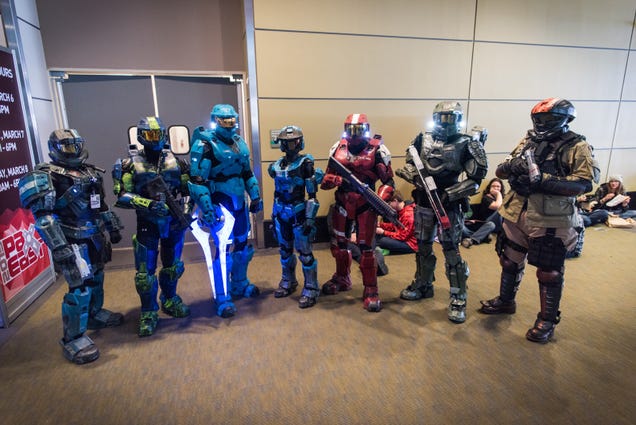
At this year's PAX East, there's no problem at all with getting a bunch of Spartans together to have a good time. Maybe it'll happen on the Xbox One eventually.

It's the first day of Penny Arcade's annual fan gathering and East Coast geeks aren't letting the snow and cold stop them from breaking out their finest fictional character outfits. You can see a bunch in the pics below, which come courtesy of Dave Yang Photography. We'll be bringing you more cosplay over the weekend.

Halo Multiplayer Works in the Real World at Least

Halo Multiplayer Works in the Real World at Least

Nadyasonika

Halo Multiplayer Works in the Real World at Least

Halo Multiplayer Works in the Real World at Least

Danielle Beaulieau & Jasper Sardonicus

Halo Multiplayer Works in the Real World at Least

Halo Multiplayer Works in the Real World at Least

Casey Anne Cosplay

Halo Multiplayer Works in the Real World at Least

Destiny Nickelsen

Halo Multiplayer Works in the Real World at Least

Halo Multiplayer Works in the Real World at Least

Halo Multiplayer Works in the Real World at Least

Halo Multiplayer Works in the Real World at Least

Halo Multiplayer Works in the Real World at Least

Halo Multiplayer Works in the Real World at Least

This entry passed through the Full-Text RSS service - if this is your content and you're reading it on someone else's site, please read the FAQ at fivefilters.org/content-only/faq.php#publishers.

06 Mar 23:51

The World's First LSD Brain Imaging Study

by Don
124

Researchers at Imperial College London and the Beckley Foundation have launched a crowdfunding campaign to help complete the first brain imaging study to ever investigate the human mind while under the influence of the psychedelic drug LSD.

06 Mar 20:44

Sheriffs from 3 states very sad about Colorado's legal weed

by Mark Frauenfelder
Bewarethewumpus

I'm sure that the corresponding decrease in funding and swat equipment for drug enforcement has nothing to do with this.

 Image: Shutterstock


Image: Shutterstock

Sheriffs from Colorado, Nebraska, and Kansas are suffering from a "crisis of conscience" because Colorado law forbids them from busting dope-smoking hippies.

They are suing Colorado to force the state to return to the good old days of an unregulated marijuana market and all the perks it offers law enforcement.

"The media has focused on the feel-good stories and they are ignoring what's happening on the ground out there," [said Sheriff Mark Overman of Scotts Bluff County, Nebraska.] "We think that what Colorado has done is illegal and it's unconstitutional. I believe that this case is going to have national ramifications, and if we win then we can reverse what is looking like a surrender to the pro-marijuana crowd."

This entry passed through the Full-Text RSS service - if this is your content and you're reading it on someone else's site, please read the FAQ at fivefilters.org/content-only/faq.php#publishers.