Shared posts

05 Mar 15:13

A Wooden Artwork Miraculously Unfurls into a Functional Desk Designed by Robert van Embricqs

by Grace Ebert
An animated gif of the designer unfolding the desk

All images courtesy of Robert van Embricqs

The surge in remote work during the last few years prompted Amsterdam-based designer Robert van Embricqs to rethink how conventional desks would impact a home’s atmosphere. He wanted to invite “the user to fold that desk away when work is over” and created a now-viral piece that seamlessly transforms from office to artwork.

Constructed with warm wood and brass hinges, the “Flow Wall Desk” features flush vertical slats that twist and unfold into a tabletop. The small piece of furniture, which can support about 40 pounds, is minimal in aesthetic and mimics organic movements as it unfurls from sleek relief to functional space.

Find the desk and other modular designs in van Embricqs’ shop, and follow his work on Instagram. (via Hyperallergic)


A photo of the unfolded desk with a chair

A photo of the flat desk with a chair

A photo of the unfolded desk with a chair

A photo of the unfolded desk with a chair

A detail photo of the unfolded desk with a coffee cup and book

A photo of the designer sitting at the unfolded desk

Do stories and artists like this matter to you? Become a Colossal Member today and support independent arts publishing for as little as $5 per month. The article A Wooden Artwork Miraculously Unfurls into a Functional Desk Designed by Robert van Embricqs appeared first on Colossal.

28 Feb 20:16

A looming El Niño could give us a preview of life at 1.5C of warming

by Kate Yoder

The last three years were objectively hot, numbering among the warmest since records began in 1880. But the scorch factor of recent years was actually tempered by a climate pattern that slightly cools the globe, “La Niña.”

This year and next, La Niña might give way to its hotter counterpart, El Niño. Distinguished by warm surface waters in the tropical Pacific Ocean, the weather pattern has consequences for temperatures, drought, and rainfall around the world. The planet hasn’t seen a strong El Niño since 2016 — the hottest year ever recorded — and the next El Niño will occur on top of all the warming that’s occurred since then. 

El Niño’s return could further strain sensitive ecosystems, like the Great Barrier Reef and the Amazon rainforest, and nudge the planet closer to worrisome tipping points. It might also push the world past a threshold that scientists have been warning about, giving people a temporary glimpse of what it’s like to live on a planet that’s 1.5 degrees Celsius warmer (2.7 degrees Fahrenheit) than preindustrial times — a level that could begin to unleash some of the more drastic consequences of climate change. 

“Looking back at past years when you’ve had El Niños, we have seen those global temperatures kind of boost themselves, sometimes significantly, depending on how big El Niño was,” said Tom Di Liberto, a climate scientist for the National Oceanic and Atmospheric Administration.

El Niño is expected to arrive later this year, and the warmer weather pattern could continue to build up through 2024, sending global temperatures past that 1.5 degrees C marker, or 2.7 degrees Fahrenheit, after which they could ease back when a La Niña returns. But there’s still plenty of uncertainty. According to the most recent forecast from NOAA, El Niño has a 60 percent chance of forming by the fall, although other scientists are more confident it’s on the way. Researchers in Germany and China, some of whom issued an early warning for the El Niño that began in 2015, have predicted an 89 percent chance that the pattern will emerge this year — and have cautioned that it could be a strong one.

The world has already warmed an average of 1.2 degrees C (2.2 degrees F) since the Industrial Revolution ushered in the widespread use of fossil fuels. Most estimates said 1.5 degrees of warming wouldn’t arrive until at least the early 2030s. The chance that El Niño could push the planet above that mark for the first time, however, has about a 50/50 chance of happening in the next five years, Adam Scaife, the head of long-range prediction at the U.K. Met Office, told the Guardian last month.

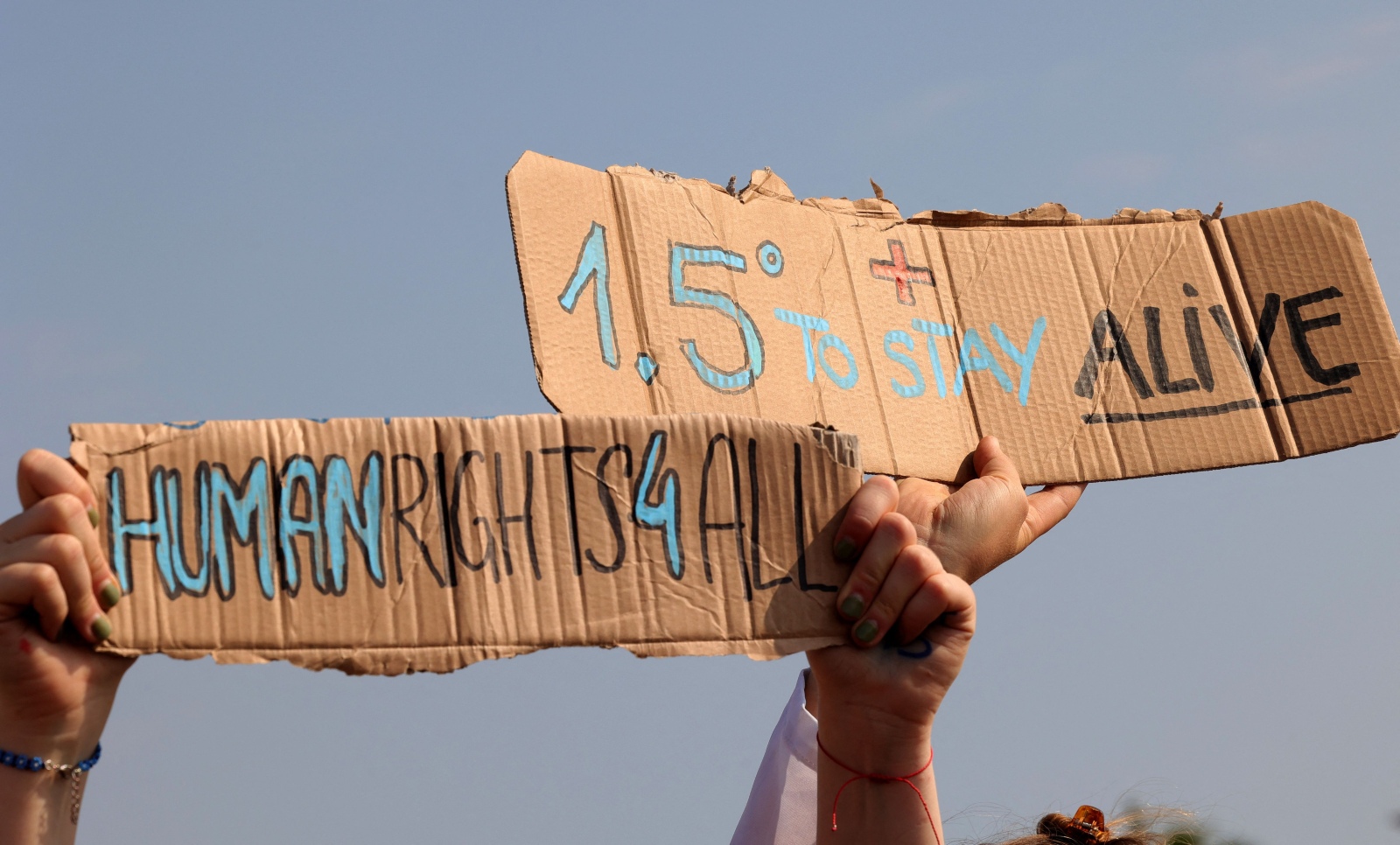
Photo of protest signs. One reads "1.5 to stay alive."
Climate activists hold protest signs calling upon the G20 conference to limit global temperature rise to 1.5 degrees C during the COP27 climate conference in Sharm el-Sheikh, Egypt, November 15, 2022. Fayez Nureldine / AFP via Getty Images

1.5 degrees is about the level of warming that scientists say would be more likely to start setting off irreversible feedback loops, such as the disintegration of ice sheets in Greenland and the West Antarctic, the abrupt thawing of permafrost in the Arctic, or the collapse of the Atlantic Ocean’s Gulf Stream current (as imagined in the film The Day After Tomorrow). Island nations have spearheaded the effort to keep global temperatures below 1.5 degrees because it’s a matter of survival for low-lying atolls that could be swallowed up by rising ocean waters. When crafting the Paris Agreement in 2015, countries committed to “pursuing efforts” to limit warming to 1.5 degrees. In the spirit of taking the goal more seriously, diplomats asked the Intergovernmental Panel on Climate Change to release a report on the effects of 1.5 degrees. 

When the report came out in 2018, it made a splash, with news headlines warning that the world had “12 years” left to tackle climate change. Activists, including Greta Thunberg, rallied around the goal as a point of no return. But as time wore on and the world failed to dramatically rein in carbon emissions, the target — already considered unrealistic back in 2018slid out of reach. Scientists say that it’s certainly bad news, but it’s not game over. “It’s not like there’s a magical barrier at that number in terms of like, we can never go back, or like it’s a clear tipping point where that number specifically flips a switch,” Di Liberto said. “These things run on a spectrum.” Each incremental increase in warming leads to more catastrophic consequences.

Hitting 1.5 degrees in an El Niño year wouldn’t be the same as averaging those temperatures across several years. “This would be a temporary breaching,” said Josef Ludescher, a scientist at the Potsdam Institute for Climate Impact Research in Germany. “This is a different story compared to if it’s a constant state every year for vegetation or corals. One year might be survivable, but what happens if it’s always those temperatures?”

That said, a strong El Niño like the one in that started in 2015 could cause some permanent damage. That year, the Great Barrier Reef in Australia saw the most devastating coral bleaching event in history, with a marine heat wave killing off more than half of corals in the northern part of the reef. If El Niño appears again, “that would ratchet up concerns, especially for another bleaching event across the Great Barrier Reef,” Di Liberto said. Even La Niña years, such as last year, are getting hot enough to cause mass bleaching

Dead coral found at Lady Elliot Island on the eastern coast of Australia after a mass bleaching event, July 5, 2016. onas Gratzer / LightRocket via Getty Image

El Niño’s arrival could also be disastrous for the Amazon rainforest, which scientists have warned is nearing a critical “tipping point.” The rainforest, already struggling with challenges from climate change and deforestation, could eventually transform into something more like a grassy savanna, releasing the vast stores of carbon held in its trees. The drought and fires egged on by the last strong El Niño killed roughly 2.5 billion trees in the Amazon, temporarily turning one of the world’s largest carbon-capturing ecosystems into a giant source of carbon emissions.

That same El Niño brought drought to Indonesia, and wildfires took off in forests and peatlands. During their height in September and October that year, the fires in Indonesia and surrounding areas released vast stores of carbon into the atmosphere per day — by one estimate, more than the entire European Union emitted from burning fossil fuels over the same period.

And, just like any other year, ice that melts from the land into the ocean helps lift sea levels. The last big El Niño was likely behind a major bout of melting in Antarctica in January 2016, when a sheet of meltwater developed across the surface of the Ross Ice Shelf, affecting an area larger than the state of Texas. Stronger El Niños may also accelerate the melting of the Antarctic ice sheet by warming up the deep waters of the ice shelf, according to a study by Australian researchers published this week in the journal Nature Climate Change.

But every El Niño is its own thing. Di Liberto likes to talk about it as a “tilt in the odds” towards different weather events. El Niño “may be the most consistent thing that allows us to forecast farther in advance, but we know there are other climate phenomena which could be just as strong an influence in a given month or season,” he said.

The effects would vary, depending on the place. In the United States, for instance, El Niño would likely bring more rain to the South and drier conditions to northern states. It would also cool waters in the Atlantic and lead to stronger wind shear that could tear apart tropical storms, a promising sign for a quieter hurricane season

Climate change may even be starting to affect El Niño itself, leading to “super El Ninos.” Over the last 40 years or so, the world has seen some of the strongest El Niños on record, Ludescher said. But it’s not totally clear whether this is a trend or just plain old chance. In any case, most models forecast that the world will continue to see intense El Niños over the next century — a worrying sign that the hottest years to come will be made even hotter.

This story was originally published by Grist with the headline A looming El Niño could give us a preview of life at 1.5C of warming on Feb 24, 2023.

23 Feb 18:19

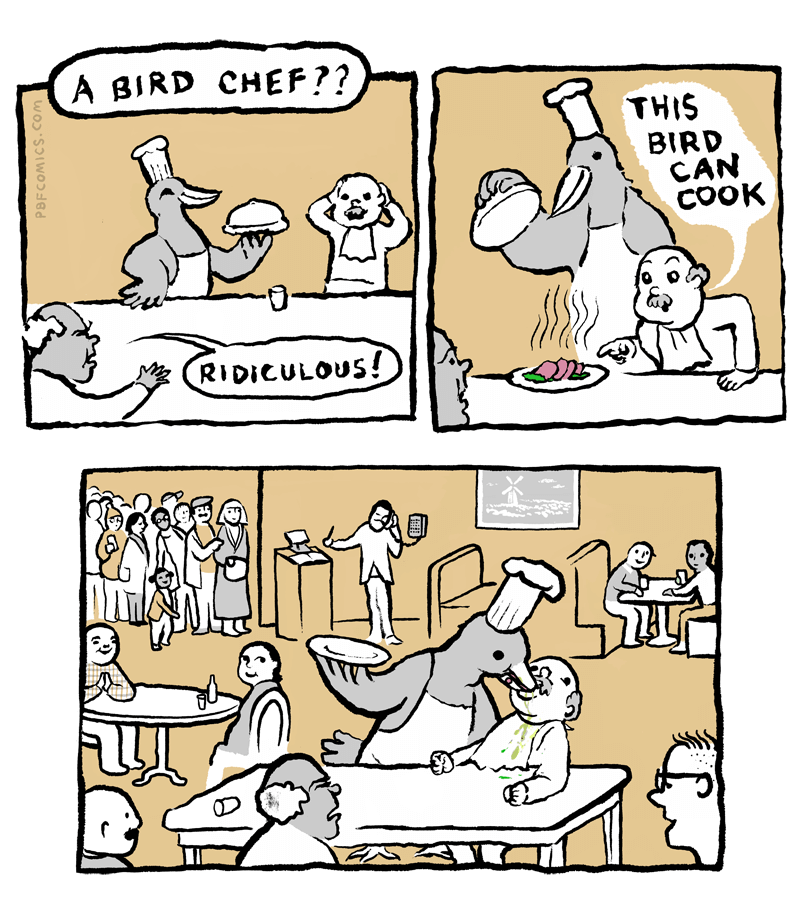
Bird Chef

by Nicholas Gurewitch

The post Bird Chef appeared first on The Perry Bible Fellowship.

13 Feb 06:31

Yes, Crypto is ALL a Scam

by Stephen Diehl
TimB

This guy can't NOT put a brick on the accelerator. Still, the comparison between crypto and indulgences is pretty fun

Yes, Crypto is ALL a Scam

Every day I write something about crypto to the nature of “crypto is all a scam”; this belief represents the core of my philosophy in understanding the complexities of crypto—in fact, it’s the very first line of my book on the subject. I sometimes get pushback (mostly in bad faith) on this as being hyperbolic, but the reality is that it’s not hyperbolic at all. It’s the only defensible position once one dives into the underlying ecaonomics of the products being sold, which are all contingent on fraud and misrepresentation, albeit of different forms. From a pure definitional perspective, the Oxford dictionary defines a scam as:

scam /skæm/ (noun): a clever and dishonest plan for making money

And indeed, crypto does match that definition to a tee; it is equal parts clever and dishonest, and misrepresentation and the abuse of language are absolutely central to this scheme. Nevertheless, crypto is undoubtedly both a clever and ingenious scam, and I say this with complete sincerity. It’s not often in history that you get to witness a new predatory financial scheme arise, and with crypto, we got a first-hand look at a genuinely new form of crime rooted in a particularly pernicious and intellectually convoluted duplicity. Crypto is not a currency. Crypto is useless as a unit of account. Crypto is not a reliable store of value. Crypto is not a hedge against inflation. Crypto is not a medium of exchange. Crypto is not a new financial system. Crypto is not a new internet.

These cases are straightforward. If someone sells something that is not what they claim it is, they’re either dishonest in directly misrepresenting the product or themselves. If you sell a horse as a car, you’re either lying or can’t tell the difference between the two and thus have no business selling either, and in both cases, this is a scam. Sincerely believing a car is identical to a horse does not alter objective reality. Similarly, the “crypto as currency” and “crypto as investment” narratives have been thoroughly debunked because the truth value of these statements is predicated on factual claims that are demonstrably falsifiable. The only defensible narratives that remain are slightly fuzzier concepts where crypto is one of:

  1. A collectible like trainers or art
  2. A gambling contract

Collectibles

For collectibles, the topic is nuanced and largely philosophical. People assign value to all manner of bizarre curio. However, in most cases, these things have intrinsic value arising from their use. We can wear trainers and hang artwork to decorate a room; they are tangible physical objects, and the floor of their market value arises out of the physical commodities that comprise it, synthesized with craftsmanship or artistry—crypto is not a tangible commodity and thus has none of that, it’s nothing more than an entry in a database created out of thin air. However, there are historical cases of “pseudo-commodities” that, like crypto, have no intrinsic value and which are sold as collectibles, and where market liquidity arises out of more complicated social phenomena. In the Middle Ages, people collected indulgences from the Medieval church because they believed or were socialized into believing that possessing these church-issued certificates would act as a proxy for divine penance, a way of financializing forgiveness of sins to individuals who could not receive it through the sacrament of penance. The sale of indulgences, which—like crypto—were purely narrative-driven collectibles, was a way for the church to raise funds for various causes, such as the construction of St. Peter’s Basilica in Rome. The cost of an indulgence depended on one’s social status, with higher prices for the wealthy and lower costs for the poor. The church went so far as to create a thriving market of sophisticated contracts for both partial and plenary options granting various spiritual rights, all synthesized out of thin air.

Indulgences were the first purely-narrative-driven collectible bubble in human history and utilized the same social dynamics of crypto and predated Satoshi by 500 years. Whether you think indulgences were a scam is a philosophically interesting question. If one is a believer and buys into the idea of the infallibility of the Medieval church’s narrative, then for the finite price of three gold florins, you were buying eternal heavenly salvation—which is a pretty good trade. If one is a non-believer, indulgences were a racket—a scam in the truest sense. Sell the illiterate hoi polloi on an imagined fear built around a complex narrative and then profit from that fear in a self-sustaining closed loop that generates its own demand. And really, there is no “moderate” position here; the answer is black and white and entirely depends on the presupposition of faith in the narrative, which is incommensurate with the opposite position. Nevertheless, the case of asserting that both indulgences and crypto are a scam is absolutely a justified true belief if you reject the underlying presupposition they rest on. Faith is the substance of things hoped for, the evidence of things not seen, but a market for lemon-flavored fairy dust can never be anything but a scam.

Gambling

The second defensible position for crypto is that it is a gambling contract—most succinctly described by Charlie Munger’s Wall Street Journal op-ed as “a gambling contract with a nearly 100% edge for the house”, which is entirely accurate. A crypto token is a pathological edge case of a financial “asset” (although it stretches the term to absurd limits) with no income from economic activity and no claim on any underlying assets. The most eloquent description of this activity is from Martin Walker:

“Big Crypto firms have been buying and selling”nothing" for so long, mostly in return for different lumps of “nothing,” that many have genuinely come to believe that taking Nothing, giving it a name — and sometimes a story — combined with a little bit of trading back and forth with friends, gives “nothing” enormous value. Whether huge valuations for “nothing” tokens came from simply pumping up the market price of old school cryptocurrencies or creating complex DeFi (Decentralised Finance) structures, the belief in the value of Nothing makes is easy to lose sight of the fact of the underlying reality: it is the inflow of real money rather than “the technology,” “the community,” “the network” or “freedom” that gives crypto assets value."

John Maynard Keynes, the British economist and philosopher, famously stated that “the economic problem” is the struggle to reconcile the conflicting desires for economic goods, given the scarcity of resourcaes. In 1936, Keynes argued that the root of the economic problem lies in the limited resources available to meet the unlimited wants and needs of individuals. Keynesian economics asserts that the solution to the economic problem involves the active manipulation of aggregate demand through monetary and fiscal policies, which help to stimulate economic activity and increase the production and distribution of goods. Finance is thus a means to direct society’s resources towards efficient uses in the presence of imperfect information and unpredictable market conditions.

However, crypto represents a divergence entirely from a Keynesian worldview in that it has created this bizarre simulacrum of markets with all the trappings and veneer of finance but which has no pretense of being tethered to the economic problem at all. No goods, services or resources are being exchanged. Crypto is a Keynesian beauty contest for zero-sum get-rich-quick schemes. I call it the nothingness game, a bizarre contest in which participants continuously punt on get-rich-quick schemes for lumps of nothing based on their perception of which lump of nothing others believe is the most attractive. It’s a byzantine (and completely non-economic) casino game of creating elaborate stories and systems for trading lumps of nothing back and forth based on memes and sentiment. And it really is a remarkable spectacle to watch because it’s a pure exercise in an extraordinary collective hallucinatory delusion, the financial equivalent of watching a room full of LARPing wizards shooting imaginary fireballs at each other.

Now regulated gambling amongst consenting adults is not intrinsically problematic. It’s a form of consumption and entertainment, and while a Keynesian beauty contest for dog-themed lumps of nothing is genuinely bizarre, there’s no a priori rationale that it’s any more weird or arbitrary than poker or betting on a bunch of blokes kicking a football around a pitch. The problem is that, as Charlie Munger points out, it’s a gambling contract with a nearly 100% edge for the house, where neither the game, odds nor rules are fixed or presented accurately to consumers. Casino games are presented to the public honestly as casino games, the odds are printed on the table or machine, and there is an enormous body of regulation surrounding the activity. Nothing about the public presentation of crypto is honest because it is currently sold to both policymakers and the public as a financial investment, not the actual gambling contract it is. Until that changes, the entire crypto-gambling complex is an entirely non-economic unregulated casino built on material misrepresentation, or in other words, a scam.

No matter which crypto narrative one picks, following these ideas to their logical conclusions ends up in economic absurdities or the revelation that the narrative is based on misrepresentation and is thus a scam. Nevertheless, scams and absurd belief systems are universal fixtures of the human condition. The cynical opportunist stance is that it’s better to position oneself as running the gambling parlor or selling indulgences to prey on fellow man’s ignorance. Crypto is a morbid symptom of a society obsessed with wealth and so disheartened by the lack of opportunities for upward mobility that they spend their meager savings gambling on lumps of nothingness; however, their participation in the market only enriches the casino and inevitably deepens their conditions of despair. It’s incredibly bleak, and the biggest scam of crypto is not financial; it’s the anti-humanist philosophy at its core that turns victims into victimizers, rejects the premise of progress, and normalizes nihilism.

07 Feb 15:23

There’s a deal to save the Colorado River — if California doesn’t blow it up

by Jake Bittle

After months of tense negotiation, a half-dozen states have reached an agreement to drastically cut their water usage and stabilize the drought-stricken Colorado River — as long as California doesn’t blow up the deal. The plan, which was developed without the input of Mexico or Native American tribes that rely on the river, seeks to stave off total collapse in the river for another few years, giving water users time to find a comprehensive solution for the chronically-depleted waterway. 

On Monday, six out of the seven states that rely on the Colorado announced their support for steep emergency cuts totaling more than 2 million acre-feet of water, or roughly a quarter of annual usage from the river. The multi-state agreement, prodded into existence by the Biden administration’s threats to impose its own cuts, will likely serve as a blueprint for the federal government as it manages the river over the next four years, ushering in a new era of conservation in the drought-wracked Southwest. While the exact consequences of these massive cuts are still largely uncertain, they will almost certainly spell disaster for water-intensive agriculture operations and new residential development in the region’s booming cities.

But California, which takes more water than any other state, has rejected the proposal as too onerous, instead proposing its own plan with a less stringent scheme for cutting water usage. If the federal government does adopt the six-state framework, powerful farmers in California’s Imperial Valley may sue to stop it, setting up a legal showdown that could derail the Biden administration’s drought response efforts.

Nevertheless, the general consensus on pursuing immediate, dramatic water cuts is unprecedented.

“It puts something down on the table that we haven’t had before,” said Elizabeth Koebele, an associate professor at the University of Nevada-Reno who studies the Colorado River. “The states are saying, ‘We recognize just how bad it is, and we’re willing to take cuts much, much sooner than we had previously agreed to.’”

The Colorado River has been oversubscribed for more than a century thanks to a much-maligned 1922 contract that allocated more water than actually existed, but it has also been shrinking over the past 20 years thanks to a millennium-scale drought made worse by climate change. Last year, as high winter temperatures caused the snowpack that feeds the river to vanish, water levels plummeted in the river’s two key reservoirs, Lake Powell and Lake Mead, threatening to knock out electricity generation at two major dams.

Federal officials intervened in June, ordering the seven Colorado River Basin states to find a way to reduce their annual water usage by between 2 and 4 million acre-feet. This was a jaw-dropping demand, far more than the states had ever contemplated cutting, and they blew through an initial August deadline to find a solution. The feds upped the pressure in October, threatening to impose unilateral cuts if state officials didn’t work out a solution.

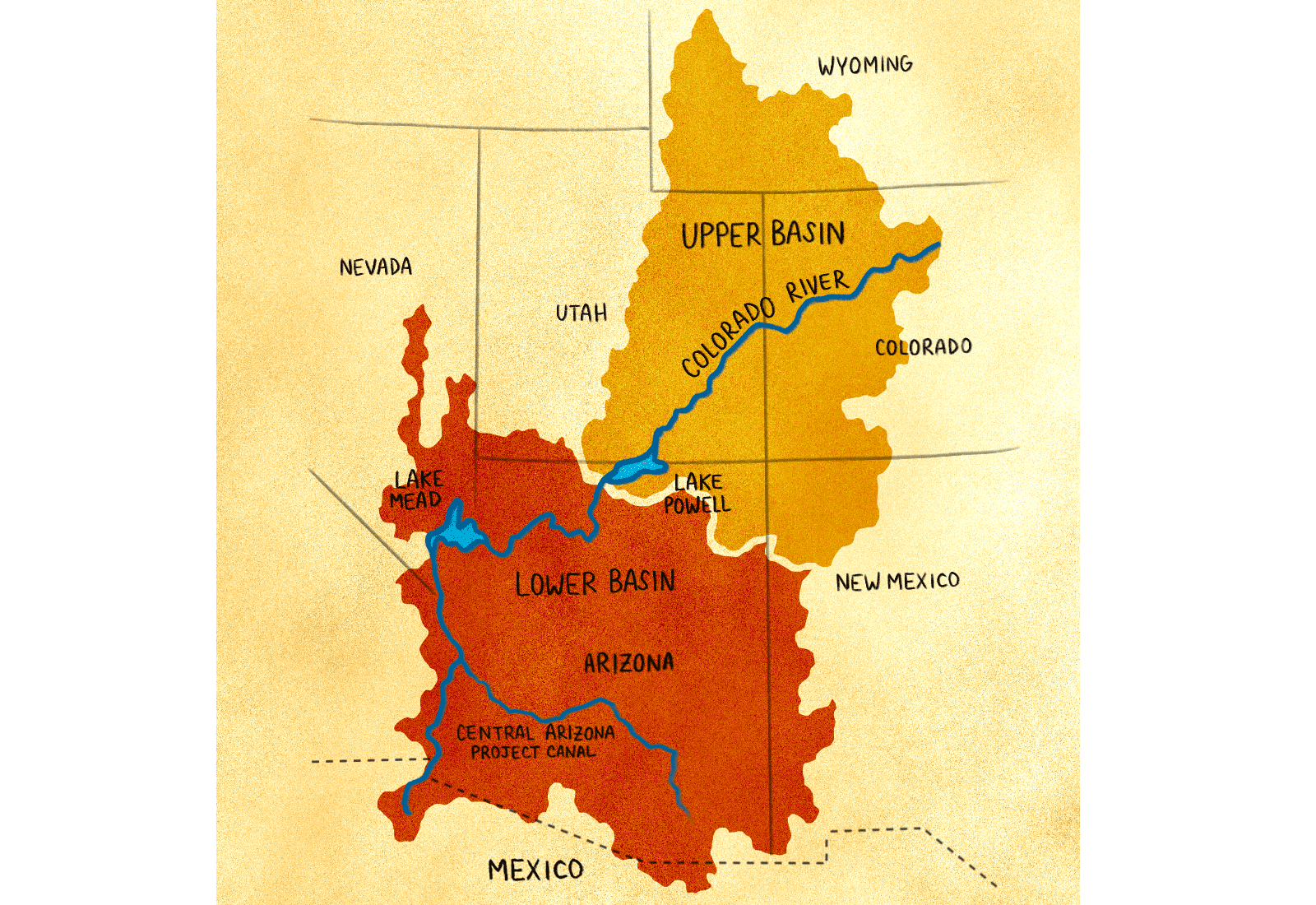
A map of the Colorado River
A century-old agreement divides the Colorado River Basin into two sections, the Upper Basin and the Lower Basin, which are now at odds over how to handle a climate-fueled drought. Grist / Amelia Bates

As the interstate talks proceeded, long-buried conflicts began to resurface. The first major conflict is between the Upper Basin states — Wyoming, Colorado, New Mexico, and Utah — and the Lower Basin states: Nevada, Arizona, California, and Mexico. The Upper Basin states argue that the Lower Basin states should be the ones to cut water in response to the drought. These states use much more water, the argument goes, and they also waste a lot of water that evaporates as it flows downstream through reservoirs and canals. The Lower Basin states, meanwhile, argue that no states should be exempt from cuts, given the scale of reductions needed.

The other main conflict is between Arizona and California, the two largest Lower Basin water users and the main targets of future cuts. California’s water rights trump Arizona’s, and therefore the Golden State argues that Arizona should shoulder almost the whole burden of future cuts. Arizona argues in turn that its farms and subdivisions have already cut their water usage in recent years as the drought has gotten worse, and that water-rich farmers in California should do more to help.

In the middle of these warring parties is Nevada, which takes only a tiny share of the river’s water and has emerged as the Switzerland of the Colorado River system over the past year. Water officials from the Silver State have been trying since late summer to broker a compromise between the Upper and Lower Basins and between Arizona and California, culminating in an intense session of talks in Las Vegas in December.

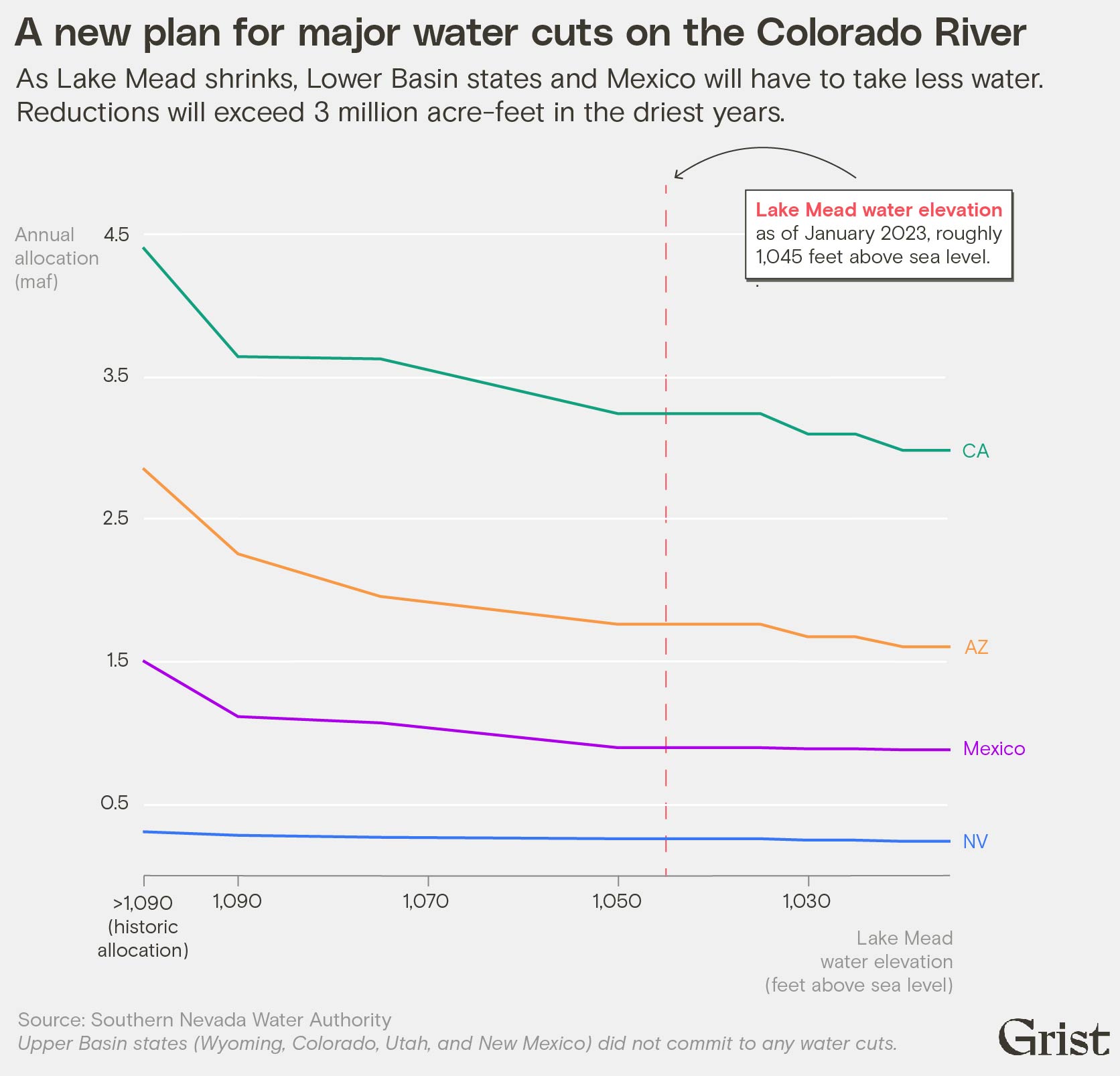
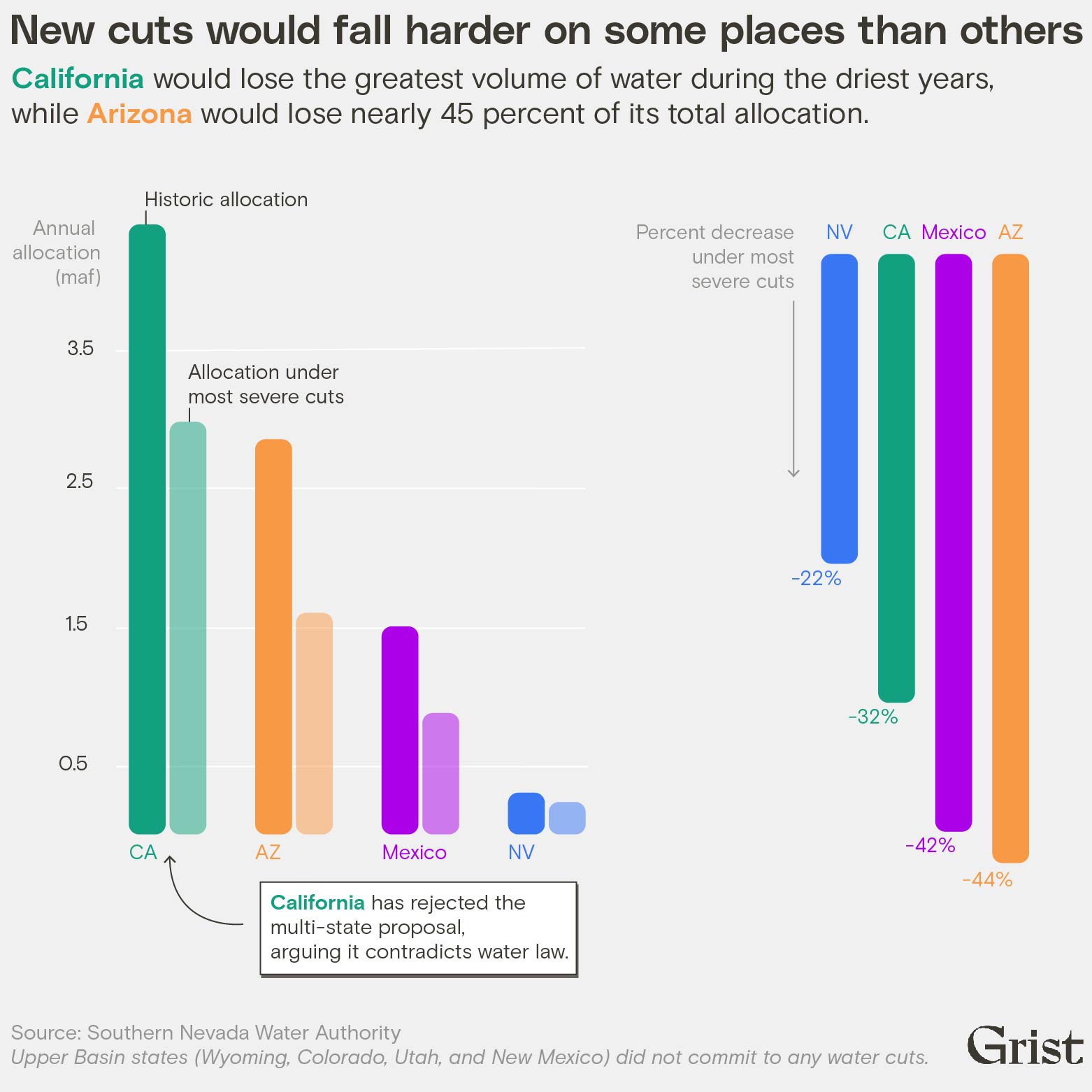
The talks were only partly successful. Officials managed to work out a framework that meets the Biden administration’s demands for major cuts, bringing an end to a year of uncertain back-and-forth. The proposal would cut more than a million acre-feet of water each from Arizona and California during the driest years, plus another 625,000 acre-feet from Mexico and 67,000 acre-feet from Nevada, adding new reductions to account for water that evaporates as it moves downstream. In return for these Lower Basin cuts, the Upper Basin states have agreed to move more water downstream to Lake Powell, helping protect that reservoir’s critical energy infrastructure — but they haven’t committed to reduce any water usage themselves.

Multi-line chart shows proposed plan for water cuts among some states and Mexico in the Colorado River Basin.
Grist / Jessie Blaeser

“It seems like the Lower Basin states conceded to the Upper Basin,” said Koebele. An earlier version of the six-state proposal called for the Upper Basin to reduce water usage by a collective 500,000 acre-feet, but that call was absent from the final framework.

While the fight between the Upper and Lower Basin states appears neutralized, the conflict between the Lower Basin’s two biggest users is ongoing. Around 40 percent of the agreement’s proposed reductions come from California, where state officials have slammed it as a violation of their senior water rights, derived from a series of laws and court decisions known collectively as the “law of the river.”

“The modeling proposal submitted by the six other basin states is inconsistent with the Law of the River and does not form a seven-state consensus approach,” said J.B. Hamby, California’s lead representative in the talks. Hamby argued that penalizing California for evaporation losses on the river contradicts the legal precedent that gives California clear seniority over Arizona.

Officials from the Golden State released their own rough framework for dealing with the drought on Tuesday. The plan offers a more forgiving schedule than the six-state framework, saving the largest cuts for when Lake Mead’s water level is extremely low, and it forces more pain on Arizona and Mexico. The framework only requires California to cut around 400,000 acre-feet of new water, which the biggest water users already volunteered to do last September in exchange for federal money to restore the drought-stricken Salton Sea. Water users in the state haven’t made new commitments since.

If the Biden administration moves forward with the plan, it may trigger legal action from the Imperial Irrigation District, which represents powerful fruit and vegetable farmers in California’s Imperial Valley. The district sued to block a previous drought agreement back in 2019, and its farmers have the most to lose from the new framework, since they’ve been insulated from all previous cuts. The state’s other major water user, the Metropolitan Water District of Southern California, has signaled tentative approval for the broad strokes of six-state formula, indicating that a compromise between the two plans might be possible, although it’s not clear such a compromise would please Imperial’s farmers.

“I don’t see how we avoid Imperial suing, other than a bunch of big snowpack,” said John Fleck, a professor of water policy at the University of New Mexico. In response to a request for comment from Grist about litigation, an Imperial spokesperson emphasized the need for “constructive dialogue and mutual understanding.” If Imperial did sue and win, the outcome would likely be even further pain for Arizona and Mexico, where farmers and cities are already struggling to deal with previous cuts.

Two charts show the changes that could head towards Lower Basin states and Mexico. California would lose the largest volume of water under the most severe cuts, while Arizona would lose the greatest percent of its allocation.
Grist / Jessie Blaeser

Koebele told Grist that while the exact numbers may change, federal officials will likely adopt some version of the six-state proposal by the end of the summer. Even a modified version would alter life in the Southwest over the next four years, imposing a harsh new regime on a region whose water-guzzling produces a substantial portion of the nation’s vegetables and cattle feed. Major cities like Phoenix, Los Angeles, and Tijuana would also see water cuts, threatening growth in those places.

Steep as the new cuts are, though, they will only last until 2026, when basin leaders will gather again to work out a long-term plan for managing the river over the next two decades. Unlike the current round of emergency talks, that long-term negotiation will include representatives from Mexico and the dozens of Native American tribes that rely on the river.

Koebele said that the questions in those talks will be even more difficult than the ones the states are debating now. Instead of just figuring out who takes cuts in the driest years, the parties will have to figure out how to apportion a perennially smaller river while also fulfilling new tribal claims on long-sought water rights. The present crisis has only delayed progress on those bigger questions.

“Because of the dire situation, we’ve really had to turn our attention to managing for the present,” she said. “So these actions feel more like a Band-Aid to me.”

This story was originally published by Grist with the headline There’s a deal to save the Colorado River — if California doesn’t blow it up on Feb 1, 2023.

07 Feb 15:05

Even with legal protections, extreme heat and wildfire take a toll on farmworkers

by Blanca Begert

Mass shootings at two California mushroom farms last month drew national attention to the dismal working and living conditions imposed on California farmworkers. Surveys of California Terra Garden and Concord Farms, where the assailant had worked, revealed families living in trailers and shipping containers, using makeshift kitchens and portable toilets. State and federal officials have opened investigations into the farms, where workers reported earning below minimum wage.

The conditions are “very typical images … for California and for the country,” Irene de Barraicua, director of operations at Lideres Campesinas, a network of female farmworker leaders, told the Washington Post after the shooting.  

Now, the first comprehensive assessment of California farmworker health since 1999, released Friday, demonstrates just how typical those conditions are – and how climate change, and widening inequality, are exacerbating challenges for these workers, some of the most disenfranchised residents of the state.

The landmark study, by the University of California, Merced’s Community and Labor Center, in partnership with organizations that serve farmworkers across the state, and funded by the California Department of Public Health, surveyed over 1,200 workers about their health, well-being, and workplace conditions. It found widespread exposure to wildfire smoke and pesticides, rodents and cockroaches in rental units, inadequate safety training, and lack of access to clean drinking water. Half of all farmworkers surveyed reported going without health insurance, even when between one-third and one-half had at least one chronic health condition. 

“Even through these major climate disasters the food supply has not been interrupted,” said Edward Flores, a professor of sociology at UC Merced and one of the report’s authors. “But the conditions that people work in have become riskier to their well-being. And they have fewer resources with which to weather a major event.”

Temperatures can already exceed 110 degrees Fahrenheit in areas including the San Joaquin Valley, Imperial Valley, Coachella Valley, and Sacramento Valley, where much of the state’s farming happens, and the heat is only getting worse. Meanwhile, intense precipitation events cause damage to substandard rental units, and extreme fire weather days, which have doubled since the 1980s, increase the risk of respiratory illness.

More than one in three survey respondents, 92 percent of whom were renters, experienced problems keeping a house cool or warm. And about 15 percent encountered rotting wood, water damage, and leaks. 

California’s Division of Occupational Health and Safety, or Cal/OSHA, has various standards in place to protect workers from extreme weather and other occupational hazards. For outdoor workers, for example, employers have to provide fresh water, access to shade, and cool-down rest breaks at 80 degrees Fahrenheit. They also have to train employees and supervisors on the signs of heat illness and maintain a heat illness prevention plan, with written procedures for what to do in case of an emergency.

These standards are some of the strongest in the nation. Still, they often don’t protect farmworkers, who report widespread violations and non-compliance. Almost half the farmworkers surveyed had never been provided with a heat illness prevention plan. And 15 percent received no heat illness training at all.

During wildfire season, 13 percent had to work when smoke made it difficult to breathe, often without respiratory protective equipment as required by Cal/OSHA. While state law also requires pesticide safety training to be provided in a language that farmworkers understand, about half who had worked with the chemicals in the past year did so without receiving adequate training. 

Even more concerning, when workplaces were out of compliance with labor laws, 36 percent of farmworkers said they would not be willing to file a complaint. Most of the time, that was for fear of employer retaliation. The fact that only 41 percent of the respondents had access to unemployment insurance suggests that 59 percent weren’t documented, said Edward Flores. “A very vulnerable person has to take the job that’s available to them, even if it’s not up to code.”

As climate change intensifies, challenges facing farmworkers, and especially undocumented workers, will only increase, the report warns. “Whether it’s record heat, catastrophic wildfires, or major floods, farmworkers either have to work in dangerous conditions or they’re unable to work,” said Flores. “They don’t have the same access to a safety net.”

The researchers hope that as California invests in reducing its emissions and helping agriculture adapt to a warming world, the data from the report will lead to more integrated climate, economic, and labor policy. “We should be thinking about a cohesive strategy so that, for example, investment in technology to improve the way that crops are produced might also be done with farmer organizations at the table, with input from health and safety advocates,” said Flores.

This story was originally published by Grist with the headline Even with legal protections, extreme heat and wildfire take a toll on farmworkers on Feb 7, 2023.

06 Feb 04:28

Hal Crook about the Kazoo - Microtonal Groovizator

by Publio Delgado

Support me on Patreon↓
http://www.patreon.com/publio

Follow me on Instagram↓
http://www.instagram.com/publiodb

Hal Crook is all about playing microtonal melodies with the kazoo.

Hi Hal.

I'm using a 24 note octave for Microtonal Groovizator videos.
≠ = Half sharp
d = Half flat

Original clip here↓
https://youtu.be/Rx17-Axqtt4
06 Feb 04:25

Emmanuel don't do it! - Microtonal Harmonizator (24-TET)

by Publio Delgado

Support me on Patreon↓
http://www.patreon.com/publio

Follow me on Instagram↓
http://www.instagram.com/publiodb

Without Emmanuel this melodies wouldn't exist.
You can follow Emmanuel here↓
http://www.instagram.com/knucklebumpfarms

I'm using a 24 note octave for Microtonal Harmonizator videos.
≠ = Half sharp
d = Half flat
27 Jan 22:45

Code Lifespan

Surely (no one/everyone) will (recognize how flexible and useful this architecture is/spend a huge amount of effort painstakingly preserving and updating this garbage I wrote in 20 minutes)
27 Jan 03:26

Memories Emerge in Stephen Wong Chun Hei’s Paintings as Vivid Saturated Landscapes

by Grace Ebert
A painting of a natural landscape in vivid saturated colors

“MacLehose Trail Section 4” (2022), acrylic on canvas, 150 x 200 centimeters. Photos by Bonhams HK, all images © Stephen Wong Chun Hei

Vivid palettes of blues, greens, and pink saturate Stephen Wong Chun Hei’s landscapes, which translate memories of travel into dream-like paintings in acrylic. The artist considers each work a vessel for the impressions of places he’s traveled or hiked. “I never try to capture just one moment in a landscape. The colours are ever-changing through time,” Hei tells Colossal. “This is the reason that the colours in my paintings are not realistic or naturalistic in appearance. I would like them to be more subjective.”

Many of the paintings originate in a sketchbook, which the artist brings along on his adventures and back to his Hong Kong-based studio. “When I work on canvas, I also got the feeling of travel with every brushstroke and colour used,” he shares.

Hei is currently preparing for a show in May at Tang Contemporary, and one of his works will also be on view with Gallery Exit for Art Basel Hong Kong. He’s currently traveling to multiple countries to explore their landscapes, which he hasn’t been able to do since before the COVID-19 pandemic. Follow those excursions on his site and Instagram. (via This Isn’t Happiness)


A painting of a natural landscape in vivid saturated colors

“MacLehose Trail Section 2” (2022), acrylic on canvas, 150 x 200 centimeters

A painting of a natural landscape in vivid saturated colors

“MacLehose Trail Section 5” (2022), acrylic on canvas, 150 x 150 centimeters

A painting of a natural landscape in vivid saturated colors

A painting of a natural landscape in vivid saturated colors

“MacLehose Trail Section 6” (2022), acrylic on canvas, 150 x 120 centimeters

A painting of a natural landscape in vivid saturated colors

“MacLehose Trail Uphill at Section 5” (2022), acrylic on canvas, 40 x 30 centimeters

Do stories and artists like this matter to you? Become a Colossal Member today and support independent arts publishing for as little as $5 per month. The article Memories Emerge in Stephen Wong Chun Hei’s Paintings as Vivid Saturated Landscapes appeared first on Colossal.

27 Jan 03:26

A Kinetic Glass Greenhouse Blossoms into a Massive Open-Air Terrarium

by Grace Ebert
An aerial image of an open glass greenhouse

All images by Hufton + Crow, courtesy of Heatherwick Studio, shared with permission

A kinetic design by Heatherwick Studio transforms a sleek glass enclosure on the Woolbeding Gardens property into an elegant flower in full bloom. Situated at the edge of the West Sussex estate, “Glasshouse” protects a melange of sub-tropical flora from southwest China, particularly those found along the Silk Road. A hydraulic mechanism opens the 10 panels of the aluminum-and-steel structure during warmer temperatures, allowing for ventilation within the 141-square-meter terrarium and transforming the architectural form into a blossoming botanical.

Heatherwick Studio is responsible for an eclectic array of designs, including a silo-turned-art-gallery and a honeycomb vessel for pedestrians, and you can follow the latest on Instagram.


A photo of a glass greenhouse

An aerial photo of a glass greenhouse

A photo inside a glass greenhouse

A photo looking toward the sky through a glass greenhouse

A photo of an open glass greenhouse

An aerial photo of a glass greenhouse

Do stories and artists like this matter to you? Become a Colossal Member today and support independent arts publishing for as little as $5 per month. The article A Kinetic Glass Greenhouse Blossoms into a Massive Open-Air Terrarium appeared first on Colossal.

25 Jan 05:18

Nighttime Reveals the Inner Vitality of Reskate’s Dynamic Glow-in-the-Dark Murals

by Kate Mothes

Nighttime view of “Eulalia” (2022-23), Mérida, Extremadura, Spain. All images © Reskate Studio, shared with permission

By day, Reskate Studio’s bold, deceptively simple murals outline the forms of rope, a mountain, or a dog in a neutral palette. When the sun sets, though, an entirely new image emerges from within the unassuming motif. María López and Javier de Riba, who work collaboratively as Reskate, continue to paint bold, light-sensitive works as part of their ongoing Harreman Project (previously). The artists say their intention is “to try to light up dark corners of cities, both installing new lights and encouraging citizens to interact with the wall—painting with light on it.”

“Harreman” is a Basque word meaning “relationship,” a combination of two verbs: hartu, which means “receive” and eman, which means “give.” The duo is interested in etymology, duality, and the way language can present multiple interpretations or how some information can only be revealed in a certain light. During the day, Reskate’s compositions appear uncomplicated in cream white and dark gray, but this discloses only half the story. At night, lights illuminate scenes created with photo-sensitive paint, like a koi fish appearing in a net or dogs brawling within the silhouette of a larger, much calmer canine.

Reskate installs vibrant, monumental murals with a focus in locations around Europe. Find more work on Behance and on the artists’ website, where you can also shop limited-edition screenprints. 


A mural that glows in the dark

“Rivalité,” (2022), Maison de Jeunes et de la Culture Nelson Mandela, Fontaine, France

A mural that glows in the dark

Nighttime view of “Eulalia” (2022-23), Mérida, Extremadura, Spain

A mural that glows in the dark

Daytime view of “Eulalia”

A mural that glows in the dark

“Domestication,” Wien Museum, Vienna, Austria

A mural that glows in the dark

“Domestication”

A mural that glows in the dark

Nighttime view of “Connectivity,” Shenzhen, China

A mural that glows in the dark

Daytime view of “Connectivity”

A mural that glows in the dark

“Connectivity” in progress

Do stories and artists like this matter to you? Become a Colossal Member today and support independent arts publishing for as little as $5 per month. The article Nighttime Reveals the Inner Vitality of Reskate’s Dynamic Glow-in-the-Dark Murals appeared first on Colossal.

25 Jan 05:15

Vibrant Patterns Envelop Dozens of Mythical Animal Sculptures That Explore the Folk Art Traditions of Mexico

by Grace Ebert
A photo of colorful patterned hybrid animal sculpture

All images courtesy of Murmur Ring/Jackie Trezzo, shared with permission

In Guardians, artists María del Carmen Mendoza Méndez and Jacobo Ángeles Ojeda, of Jacobo and Maria Ángeles Workshop, pay homage to the mythical creatures of their Oaxacan childhoods. The husband-wife duo carves the soft wood of the copal tree into fantastical creatures that reference Mesoamerican spirituality and Mexican folk art, including the sculptures known as alebrijes. They refer to the unearthly characters as Tonas and Nahuales and cloak the birds, butterflies, and beasts in vibrant patterns and Zapotec symbols. The artists describe the protective works:

Guardians are brave creatures who safeguard their tribe. These mythical characters from the tale ‘Nomads’ hold their heads high by accepting the responsibility of caring for, transporting, and defending everyone. (Theirs) is a story of resistance, persecution, and migration into a dystopian future, where science is blended with ancestral cosmovisions.

On view through January 12, 2023, Guardians is the inaugural show at the newly opened Mano Gallery in Chicago’s Pilsen neighborhood. The gallery is devoted to art and design from Mexico and to creating a space for artists interested in preserving mythology and the country’s heritage. Find more from Jacobo and Maria Ángeles Workshop on their site and Instagram.


Two photos of colorful patterned hybrid animal sculptures

A photo of multiple colorful patterned hybrid animal sculptures on a table

A photo of colorful patterned hummingbird animal sculpture

A photo of multiple colorful patterned hybrid animal sculptures

A detail photo of colorful patterned hybrid chameleon sculpture

Two photos of colorful patterned hybrid animal sculptures

A photo of colorful patterned hybrid animal sculpture

Do stories and artists like this matter to you? Become a Colossal Member today and support independent arts publishing for as little as $5 per month. The article Vibrant Patterns Envelop Dozens of Mythical Animal Sculptures That Explore the Folk Art Traditions of Mexico appeared first on Colossal.

31 Dec 21:13

Tropical Plants Sprout from the Mesh Facade of an Open-Air Factory in Vietnam

by Grace Ebert
A photo of a building covered in plants

All images by Hiroyuki Oki, courtesy of the architects

In an industrial park 50 kilometers north of Ho Chi Minh City, a 30,000-square-meter building demonstrates the possibilities of a more sustainable future for manufacturing. The Jakob Factory is a project between Rollimarchini Architects and G8A Architects, who designed the tropical oasis amid the largely concrete structures within the commercial area.

Plants cloak the porous three-story facade made of steel and mesh. Building vertically was a key factor in the project as it contrasts the conventional sprawling designs typical in manufacturing that require more land and greater disruptions to the local environment. The living features protect the interior from rain and harsh sunlight, offer natural ventilation, regulate the temperature, and help to purify the air from dust and other particles. Trees and grassy mounds also sit in a central courtyard, with the green structure surrounding the open space.

The sustainability-focused project received the bestarchitects 2023 award and was included in Dezeen’s 2022 shortlist.


A photo of a building covered in plants

A photo of an interior factory with one wall covered in plants

A photo of an interior factory with outside walls covered in plants

A photo of a building covered in plants

A photo of a building covered in plants

An aerial photo of a courtyard in a building

Image by Severin Jakob

Do stories and artists like this matter to you? Become a Colossal Member today and support independent arts publishing for as little as $5 per month. The article Tropical Plants Sprout from the Mesh Facade of an Open-Air Factory in Vietnam appeared first on Colossal.

31 Dec 21:11

Holiday Lights Warm the Dark Winter Nights of Jeremy Miranda’s Paintings

by Grace Ebert
A painting of a glowing tree on a landscape

All images © Jeremy Miranda, shared with permission

Colorful lights strung on trees and lining gutters cast a welcoming, vibrant glow on dreary, winter evenings in Jeremy Miranda’s paintings. The Maine-based artist (previously) is known for his dreamlike works of landscapes and interiors that incorporate both the domestic and outside world, and elements of nostalgia, intimacy, and memory echo throughout the scenes. Often illuminating the magical in the mundane, Miranda has been creating a growing collection of holiday paintings during the last few years that center on Christmas trees and decorated homes, capturing the warmth of the season as it shines through stark, frigid nights.

The artist has a few prints available through Sebastian Foster, and you can follow his work on Instagram.


A painting of a glowing tree in a home

A painting of a glowing lights strung on a home

A painting of a glowing tree through a house window

A painting of a glowing tree through a house window

A painting of glowing holiday lights on a landscape

A painting of glwoing lights in a landscape

Do stories and artists like this matter to you? Become a Colossal Member today and support independent arts publishing for as little as $5 per month. The article Holiday Lights Warm the Dark Winter Nights of Jeremy Miranda’s Paintings appeared first on Colossal.

31 Dec 21:07

Seattle's Ice Storm Crashes Revealed That Cars Are Not About People, They Are About Cars

by Charles Mudede
TimB

Not exactly right as far as I can tell, car values don't appreciate like property (even if land value mainly rises through gov't policy), but still nice to see someone talking about it

Is our love of cars so overwhelming? Or do cars just make us dumb? by Charles Mudede

What needs to be explained, philosophically, is the large number of car crashes that occurred during the ice storm Seattle experienced last week. One can understand the pedestrians who slipped, slid, and fell onto ice-covered sidewalks. These accidents, which often reduced pedestrians to all fours, were more comical than scary. But the same cannot be said about the cars (4,094 pounds of metal, plastic, and other industrial materials) that lost all control to the pull of gravity. These accidents presented a real danger to the person in and near the spinning machine. Why did reason and many warnings fail to make the needed impression on these drivers? Is our love of cars so overwhelming? Or do cars just make us dumb? 

The answer, I think, is found in the fact that cars, like the market system that dominates our society, are not really about people. They are only about cars.  

One car tried to drive my hill and Queen Anne and hit all these parked cars who clue down the hill… insane. DON’T DRIVE. #seattle pic.twitter.com/wJsor6byDa

— Kaybergz (@kay0kayla) December 23, 2022

To understand this peculiar way of thinking, we must return to a key idea proposed at the end of the 19th century by the Ukrainian neo-Kantian and economist Mikhail Tugan-Baranovsky. His book, Industrial Crises in Contemporary England, first published in Russian in 1894, caused a huge scandal after it was published in German in 1901. Though the work introduced the concept (backed by data gathered at the British Museum) of a business cycle (boom, bust, boom again, bust again) to economics (a concept that had a huge impact on theorists on the left, center, and right), it was notorious for concluding, in its attack of Marx's theory of the falling rate profit and under-consumption hypothesis, that capitalism, if properly managed, could grow indefinitely.

He obtained this monstrous conclusion from the second of Marx's reproduction schemes in volume two of Das Capital, an incomplete and messy work edited and published after his death by Friedrich Engels. The first scheme concerns an economy that has no growth (or net investment), "simple reproduction"; the second scheme described a capitalist economy with growth, "expanded reproduction." What Tugan-Baranovsky determined from Marx's expanded model is that capitalism did not need consumers to grow. It could do so on its own by producing machines that did not make consumer goods, but capital ones: machines that make more and more machines in the production sector (or department 1, productive consumption).

Tugan-Baranovsky:

If all workers except one disappear and are replaced by machines, then this one single worker will place the whole enormous mass of machinery in motion and with its assistance produce new machines—and the consumption goods of the capitalists. The working class will disappear, which will not in the least disturb the self-expansion process of capital. The capitalists will receive no smaller mass of consumption goods, the entire product of one year will be realized and utilized by the production and consumption of the capitalists in the following year.

This conclusion was almost universally panned by Marxists. The idea that a capitalist economy was not about consumption or even workers but machines (capital investments) was simply monstrous. But these critics got everything wrong, which is why their revolutions and predictions of capitalism's eventual (and even scientific) demise have come to nothing.

Capitalism is not about workers, or consumers. It's about capital, about its replication and expansion. Three hundred years ago, humans established an economic system that, maybe for the first time in history, was not about people. This understanding explains much of the anxiety and dread and fear expressed in sci-fi films like The Matrix and The Terminator. The machines in these future worlds have reached the perfect state of capitalist growth described by Marx and elaborated by Tugan-Baranovsky.   

What did the perspicacious Tugan-Baranovsky not see from his place in time—the turn of the previous century? That the rise of machines would also occur in the market for consumers—department 2. In 1900, there were only 8,000 cars in the United States. Now there are 105 million. Tugan-Baranovsky thought consumer goods were not capital intensive enough to be inhuman or to completely detach themselves from their use value. Bread has to be eaten, bikes are practical, most clothes do not cost much to make or purchase. These and other like items are locked in the human circle, the circle of useful.

The value of a car is found almost entirely in its value—or, put another way, the capital it absorbs. Cars, in short, do not need people, which is why there's a huge push to make them autonomous. Seen in this way, it's not hard to imagine a city with cars that have no drivers or passengers. Empty cars. Machines moving for and with other machines. The car accidents in the ice storm made this future visible in a vivid way. A human would have stayed at home and avoided the dangerous ice, but not a car. Those driving last Friday submitted to the technological will of the machine.

22 Dec 19:03

Cold Complaints

Our investigation into whining-based remedies became the first study to be halted by the IRB on the grounds that the treatment group was 'too annoying.'
16 Dec 17:55

Degrowth can work — here’s how science can help

by Jason Hickel

Nature, Published online: 12 December 2022; doi:10.1038/d41586-022-04412-x

Wealthy countries can create prosperity while using less materials and energy if they abandon economic growth as an objective.
12 Dec 15:47

Shop Sebastian Foster’s Limited-Edition Disrupted Realism Print Set Featuring Works Reshaping Realism

by Sebastian Foster

Gage Opdenbrouw. All images courtesy of Sebastian Foster, shared with permission

Austin-based gallery Sebastian Foster is collaborating with author John Seed and a group of well-established artists on a print set that coincides with his new book, Disrupted Realism.

Disrupted Realism is the first book to survey the works of contemporary painters who are challenging and reshaping the tradition of Realism. Helping art lovers, collectors, and artists approach and understand this compelling new phenomenon, the volume includes the works of 38 artists whose paintings respond to the subjectivity and disruptions of modern experience.

Seed, a widely published author and blogger, believes that we are “the most distracted society in the history of the world” and has selected artists he sees as visionaries in this developing movement. The artists’ impulses toward disruption are idiosyncratic, but all include perception and emotion in their processes. Sebastian Foster collaborated with Seed on a print set of nine works from artists featured in the book, each available in small, exclusive numbered editions of 25.

Now online-only, Sebastian Foster focuses on original works and prints, publishing upwards of 1,000 editions since it opened in the 2000s. Whether you’re looking for the next piece to add to your collection or for meaningful holiday gifts, head to the gallery’s site to shop the Disrupted Realism Print Set today.


Daniel Bilodeau

Dorian Vallejo

J Louis

Joshua Meyer

Kirstine Reiner Hansen

Mia Bergeron

Nick Runge

Zack Zdrale

Disrupted Realism, cover

12 Dec 15:44

Georgian Culture and Ukrainian Pride Highlight the 2022 Tbilisi Mural Fest

by Grace Ebert
A photo of a mural portrait of a woman holding a bouquet of flowers

By Sasha Korban. All images by Tiku Kobiashvili, courtesy of Tbilisi Mural Fest, shared with permission

For the last four years, Tbilisi Mural Fest has facilitated more than 40 public artworks around the Georgian capitol, and the 2022 event brought a spate of new projects to the city. Given the nation’s proximity to Russia and that country’s groundless war against Ukraine, festival organizers highlighted renowned Ukrainian muralist Sasha Korban who painted a large-scale portrait of a woman in customary clothing facing the Russian embassy. Other works include celebrations of Georgian culture and history, like a large-scale tablecloth with traditional motifs by Chertova Tina and Mohamed l’Ghacham’s dreamlike rendering of the living room of Georgian thinker and author Ilia Chavchavadze.

See some of the 2022 additions below and those from previous years on Instagram.


A photo of a large blue mural with ornamental white motifs

By Chertova Tina

A photo of a black and white portrait mural of a woman with colorful doodles on her face

“Circus” by Luis Gomez de Teran

A photo of a mural of a dreamlike living room

“Illia’s Room” by Mohamed l’Ghacham

A photo of a mural with two women and a plant, repeated three times vertically

“Growth” by Artez

A photo of an abstract mural on an urban building

By Kera

A photo of a mural with two figures and a portal

“M3D3A” by Vesod

A photo of a mural with two regal figures and city

By Dato Machavariani and Irakli Qadeishvili

Do stories and artists like this matter to you? Become a Colossal Member today and support independent arts publishing for as little as $5 per month. The article Georgian Culture and Ukrainian Pride Highlight the 2022 Tbilisi Mural Fest appeared first on Colossal.

12 Dec 15:40

Inside Google’s Quest to Digitize Troops’ Tissue Samples

by by James Bandler

by James Bandler

ProPublica is a nonprofit newsroom that investigates abuses of power. Sign up to receive our biggest stories as soon as they’re published.

In early February 2016, the security gate at a U.S. military base near Washington, D.C., swung open to admit a Navy doctor accompanying a pair of surprising visitors: two artificial intelligence scientists from Google.

In a cavernous, temperature-controlled warehouse at the Joint Pathology Center, they stood amid stacks holding the crown jewels of the center’s collection: tens of millions of pathology slides containing slivers of skin, tumor biopsies and slices of organs from armed service members and veterans.

Standing with their Navy sponsor behind them, the Google scientists posed for a photograph, beaming.

Mostly unknown to the public, the trove and the staff who study it have long been regarded in pathology circles as vital national resources: Scientists used a dead soldier’s specimen that was archived here to perform the first genetic sequencing of the 1918 Flu.

Google had a confidential plan to turn the collection of slides into an immense archive that — with the help of the company’s burgeoning, and potentially profitable, AI business — could help create tools to aid the diagnosis and treatment of cancer and other diseases. And it would seek first, exclusive dibs to do so.

“The chief concern,” Google’s liaison in the military warned the leaders of the repository, “is keeping this out of the press.”

More than six years later, Google is still laboring to turn this vast collection of human specimens into digital gold.

At least a dozen Defense Department staff members have raised ethical or legal concerns about Google’s quest for service members’ medical data and about the behavior of its military supporters, records reviewed by ProPublica show. Underlying their complaints are concerns about privacy, favoritism and the private use of a sensitive government resource in a time when AI in health care shows both great promise and risk. And some of them worried that Google was upending the center’s own pilot project to digitize its collection for future AI use.

Pathology experts familiar with the collection say the center’s leaders have good reason to be cautious about partnerships with AI companies. “Well designed, correctly validated and ethically implemented [health algorithms] could be game-changing things,” said Dr. Monica E. de Baca, chair of the College of American Pathologists’ Council on Informatics and Pathology Innovation. “But until we figure out how to do that well, I’m worried that — knowingly or unknowingly — there will be an awful lot of snake oil sold.”

When it wasn’t chosen to take part in JPC’s pilot project, Google pulled levers in the upper reaches of the Pentagon and in Congress. This year, after lobbying by Google, staff on the House Armed Services Committee quietly inserted language into a report accompanying the Defense Authorization Act that raises doubts about the pathology center’s modernization efforts while providing a path for the tech giant to land future AI work with the center.

Pathology experts call the JPC collection a national treasure, unique in its age, size and breadth. The archive holds more than 31 million blocks of human tissue and 55 million slides. More recent specimens are linked with detailed patient information, including pathologist annotations and case histories. And the repository holds many examples of “edge cases” — diseases so vanishingly rare that many pathologists never see them.

Human tissue samples from 1917 and 1918 stored in paraffin are part of the Joint Pathology Center’s collection, which contains more than 31 million tissue blocks and 55 million slides. (Linda Davidson/The Washington Post via Getty Images)

Google sought to gather so many identifying details about the specimens and patients that the repository’s leaders feared it would compromise patients’ anonymity. Discussions became so contentious in 2017 that the leaders of the JPC broke them off.

In an interview with ProPublica, retired Col. Clayton Simon, the former director of the JPC, said Google wanted more than the pathology center felt it could provide. “Ultimately, even through negotiations, we were unable to find a pathway that we legally could do and ethically should do,” Simon said. “And the partnership dissolved.”

But Google didn’t give up. Last year, the center’s current director, Col. Joel Moncur, in response to questions from DOD lawyers, warned that the actions of Google’s chief research partner in the military “could cause a breach of patient privacy and could lead to a scandal that adversely affects the military.”

Joel Moncur (Kate Copeland for ProPublica)

Google has told the military that the JPC collection holds the “raw materials” for the most significant biotechnology breakthroughs of this decade — “on par with the Human Genome Project in its potential for strategic, clinical, and economic impact.”

All of that made the cache an alluring target for any company hoping to develop health care algorithms. Enormous quantities of medical data are needed to design algorithmic models that can identify patterns a pathologist might miss — and Google and other companies are in a race to gather them. Only a handful of tech companies have the scale to scan, store and analyze a collection of this magnitude on their own. Companies that have submitted plans to compete for aspects of the center’s modernization project include Amazon Web Services, Cerner Corp. and a host of small AI companies.

But no company has been as aggressive as Google, whose parent company, Alphabet, has previously drawn fire for its efforts to gather and crunch medical data. In the United Kingdom, regulators reprimanded a hospital in 2017 for providing data on more than 1.6 million patients, without their understanding, to Alphabet’s AI unit, DeepMind. In 2019, The Wall Street Journal reported that Google had a secret deal, dubbed “Project Nightingale,” with a Catholic health care system that gave it access to data on millions of patients in 21 states, also without the knowledge of patients or doctors. Google responded to the Journal story in a blog post that stated that patient data “cannot and will not be combined with any Google consumer data.”

In a statement, Ted Ladd, a Google spokesperson, attributed the ethics complaints associated with its efforts to work with the repository to an “inter-agency issue” and a “personnel dispute.”

“We had hoped to enable the JPC to digitize its data and, with its permission, develop computer models that would enable researchers and clinicians to improve diagnosis for cancers and other illnesses,” Ladd said, noting that all of Google’s health care partnerships involve “the strictest controls” over data. “Our customers own and manage their data, and we cannot — and do not — use it for any purpose other than explicitly agreed upon by the customer,” Ladd said.

In response to questions from ProPublica, the JPC said none of its de-identified data would be shared during its modernization process unless it met the ethical, regulatory, and legal approvals needed to ensure it was done in the right way.

“The highest priority of the JPC’s digital transformation is to ensure that any de-identified digital slides are used ethically and in a manner that protects patient privacy and military security,” the JPC said.

But some fear that even these safeguards might not be enough. Steven French, a DOD cloud computing engineer assigned to the project, said he was dismayed by the relentlessness of Google’s advocates in the department. Lost in all their discussions about the speed, scale and cost-saving benefits associated with working with Google seemed to be concerns for the interests of the service members whose tissue was the subject of all this maneuvering, French told ProPublica.

“It felt really bad to me,” French said. “Like a slow crush towards the inevitability of some big tech company monetizing it.”

The JPC certainly does need help from tech companies. Underfunded by Congress and long neglected by the Pentagon, it is vulnerable to offers from well-funded rescuers. In spite of its leaders’ pleas, funding for a full-scale modernization project has never materialized. The pathology center’s aging warehouses have been afflicted with water leaks and unwelcome intruders: a marauding family of raccoons.

The story of the pathology center’s long, contentious battle with Google has never been told before. ProPublica’s account is based on internal emails, presentations and memos, as well as interviews with current and former DOD officials, some of whom asked not to be identified because they were not authorized to discuss the matter or for fear of retribution.

Google’s Private Tour

In December 2015, Google began its courtship of the JPC with a bold, unsolicited proposal. The messenger was a junior naval officer, Lt. Cmdr. Niels Olson.

“I’m working with Google on a project to apply machine learning to medical imaging,” Olson wrote to the leaders of the repository. “And it seems like we are at the stage where we need to figure exactly what JPC has.”

Niels Olson (Kate Copeland for ProPublica)

A United States Naval Academy physics major and Tulane medical school graduate, Olson worked as a clinical and anatomical pathology resident at the Naval Medical Center in San Diego.

With digitized specimen slides holding massive amounts of data, pathology seemed ripe for the coming AI revolution in medicine, he believed. Olson’s own urgency was heightened in 2014 when his father was diagnosed with prostate cancer.

That year, Olson teamed up with scientists at Google to train software to recognize suspected cancer cells. Google supplied expertise including AI scientists and high-speed, high-resolution scanners. The endeavor had cleared all privacy and review board hurdles. They were scanning Navy patients’ pathology slides at a furious clip, but they needed a larger data set to validate their findings.

Enter the JPC’s archive. Olson learned about the center in medical school. In his email to its leaders in December 2015, Olson attached Google’s eight-page proposal.

Google offered to start the operation by training algorithms with already digitized data in the repository. And it would do this early work “with no exchange of funds.” These types of partnerships free the private parties from having to undergo a competitive bidding process.

Google promised to do the work in a manner that balanced “privacy and ethical considerations.” The government, under the proposal, would own and control the slides and data.

Olson typed a warning: “This is under a non-disclosure agreement with Google, so I need to ask you, do please handle this information appropriately. The chief concern is keeping this out of the press.”

Senior military and civilian staff at the pathology center reacted with alarm. Dr. Francisco Rentas, the head of the archive’s tissue operations, pushed back against the notion of sharing the data with Google.

“As you know, we have the largest pathology repository in the world and a lot of entities will love to get their hands on it, including Google competitors. How do we overcome that?” Rentas asked in an email.

Olson, center, and Google scientists Martin Stumpe and Lily Peng took a private tour of the JPC collection in 2016. (Obtained by ProPublica)

Other leaders had similar reactions. “My concerns are raised when I’m advised to not disclose what seems to be a contractual relationship to the press,” one of the top managers at the pathology center, Col. Edward Stevens, told Olson. Stevens told Olson that giving Google access to this information without a competitive bid could result in litigation from the company’s competitors. Stevens asked: “Does this need to go through an open-source bid?”

But even with these concerns, Simon, the pathology center’s director, was intrigued enough to continue discussions. He invited Olson and Google to inspect the facility.

The warehouse Olson and the Google scientists entered could have served as a set for the final scene of “Raiders of Lost Ark.”

Pathology slides were stacked in aisle canyons, some towering two stories. The slides were arranged in metal trays and cardboard boxes. To access tissue samples, the repository used a retrieval system similar to those found in dry cleaners. The pathology center had just a handful of working scanners. At the pace they were going, it would take centuries to digitize the entire collection.

One person familiar with the repository likened it to the Library of Alexandria, which held the largest archive of knowledge in the ancient world. Myth held that the library was destroyed in a cataclysmic fire lit by Roman invaders, but historians believe the real killer was gradual decay and neglect over centuries.

The JPC’s collection is the largest biorepository on the planet. (Linda Davidson/The Washington Post via Getty Images)

The military’s tissue library had already played an important role in the advancement of medical knowledge. Its birth in 1862 as the Army Medical Museum was grisly. In a blandly written order in the midst of the Civil War, the Army surgeon general instructed surgeons “diligently to collect and preserve” all specimens of “morbid anatomy, surgical or medical, which may be regarded as valuable.”

Soon the museum’s curator was digging through battlefield trenches to find “many a putrid heap” of hands, feet and other body parts ravaged by disease and war. He and other doctors shipped the remains to Washington in whiskey-filled casks.

Over the next 160 years, the tissue collection outgrew several headquarters, including Washington’s Ford Theater and a nuclear-bomb-proof building near the White House. But the main mission — identifying, studying and reducing the calamitous impact of illnesses and injuries afflicting service members — has remained unchanged in times of war and peace. Each time a military or veterans’ hospital pathologist sent a tissue sample to the pathology center for a second opinion, it was filed away in the repository.

As the archive expanded, the repository’s prestige grew. Its scientists spurred advances in microscopy, cancer and tropical disease research. An institute pathologist named Walter Reed proved that mosquitoes transmit yellow fever, an important discovery in the history of medicine.

For much of its modern history, in addition to serving military and veterans hospitals, the center also provided civilian consultations. The work with elite teaching hospitals gave the center a luster that helped it attract and retain top pathologists.

Congress and DOD leaders questioned why the military should fund civilian work that could be done elsewhere. In 2005, under the congressionally mandated base closure act, the Pentagon ordered the organization running the repository to shut down. The organization reopened with a different overseer, tasked with a narrower, military-focused mission. Uncertainty about the organization’s future caused many top pathologists to leave.

In its first pitch to the repository’s leaders, Google pointedly mentioned a book-length Institute of Medicine report on the repository that stated that “wide access” to the archive’s materials would promote the “public good.” The biorepository wasn’t living up to its potential, Google said, noting that “no major efforts have been underway to fix the problem.”

Following the tour, a Google scientist prepared a list of clinical, demographic and patient information it sought from the repository. The list included “must haves” — case diagnoses; pathology and radiology images; information on gender and ethnicity; and birth and death dates — as well as “high-value” patient information, including comorbidities, subsequent hospitalizations and cause of death.

This troubled the JPC’s director. “We felt very, very concerned about giving too much data to them,” Simon told ProPublica, “because too much data could identify the patient.”

There were other aspects about Google’s offer that made it “very unfavorable to the federal government,” Simon later told his successor, according to an email reviewed by ProPublica.

In exchange for scanning and digitizing the slide collection at its own expense, Google sought “exclusive access” to the data for at least four years.

The other deal-breaker was Google’s requirement that it be able to charge the government to store and access the digitized information, a huge financial commitment. Simon did not have the authority to commit the government to future payments to a company without authorization from Congress.

Today, Ladd, the Google spokesperson, disputes the claim that its proposal would have been unfavorable to the government. “Our goal was to help the government digitize the data before it physically deteriorates.”

Ladd said Google sought exclusive access to the data during the early stages of the project, so that it could scan the de-identified samples and perform quality-control measures on the data prior to handing it back to the JPC.

Niels Olson, who spearheaded the project for the Navy in 2016, declined requests for interviews with ProPublica. But Jackson Stephens, a friend and lawyer who is representing Olson, said Olson had always followed the Institutional Review Board process and worked to anonymize patient medical data before it was used in research or shared with a third party.

“Niels takes his oath to the Constitution and his Hippocratic oath very seriously,” Stephens said. “He loves science, but his first duty of care is to his patients.”

Google’s relentlessness in 2017, too, spooked the repository’s leaders, according to an email reviewed by ProPublica. Google’s lawyer put “pressure” on the head of tissue operations to sign the agreement, which he declined to do. Leaders of the center became “uncomfortable” and discontinued discussions, according to the DOD email.

Though he banged on doors in the Pentagon and Congress, Simon was not able to convince the Obama administration to include the JPC in then-Vice President Joe Biden’s Cancer Moonshot. Simon left the JPC in 2018, his hopes for a modernization of the library dashed. But then a Pentagon advisory board got wind of the JPC collection, and everything changed.

“The Smartest People on Earth”

In March of 2020, the Defense Innovation Board announced a series of recommendations to digitize the JPC collection. The board called for a pilot project to scan a large initial batch of slides — at least 1 million in the first year — as a prelude to the massive undertaking of digitizing all 55 million slides.

“My worldview was that this should be one of the highest priorities of the Defense Department,” William Bushman, then acting deputy undersecretary of personnel and readiness, told ProPublica. “It has the potential to save more lives than anything else being done in the department.”

As the pathology center prepared to launch its pilot, the staff talked about a scandal that occurred just 40 miles north.

Henrietta Lacks was a Black woman who died of cancer in 1951 while being treated at Baltimore’s Johns Hopkins Hospital. Without her or her family’s knowledge or consent, and without compensation, her cells were replicated and commercialized, leading to groundbreaking advances in medicine but also federal reforms on the use of patient cells for research.

A photo of Henrietta Lacks sits in the living room of her grandson, Ron Lacks. (Jonathan Newton/The Washington Post via Getty Images)

Like Lacks’ cancer cells, every specimen in the archive, the JPC team knew, represented its own story of human mortality and vulnerability. The tissue came from veterans and current service members willing to put their lives on the line for their country. Most of the samples came from patients whose doctors discovered ominous signs from biopsies and then sent the specimens to the center for second opinions. Few signed consent forms agreeing to have their samples used in medical research.

The pathology center hired two experts in AI ethics to develop ethical, legal and regulatory guidelines. Meanwhile, the pressure to cooperate with Google hadn’t gone away.

In the summer of 2020, as COVID-19 surged across the country, Olson was stationed at a naval lab in Guam, working on an AI project to detect the coronavirus. That project was managed by a military group based out of Silicon Valley known as the Defense Innovation Unit, a separate effort to speed the military’s development and adoption of cutting-edge technology. Though the group worked with many tech companies, it had gained a reputation for being cozy with Google. The DIU’s headquarters in Mountain View, California, sat just across the street from the Googleplex, the tech giant’s headquarters. Olson joined the group officially that August.

Olson’s COVID-19 work earned him Navy Times’ coveted Sailor of the Year award as well as the attention of a man who would become a powerful ally in the DOD, Thomas “Pat” Flanders.

Flanders was the chief information officer of the sprawling Defense Health Agency, which oversaw the military’s medical services, including hospitals and clinics. A garrulous Army veteran, Flanders questioned the wisdom of running the pilot project without first getting funding to scan all of the 55 million slides. He wanted the pathology staff to hear about the work Olson and Google had done scanning pathology slides in San Diego and see if a similar public-private partnership could be forged with the JPC.

Over the objections of Moncur, the JPC’s director, Flanders insisted on having Olson attend all the pathology center’s meetings to discuss the pilot, according to internal emails.

In August 2020, the JPC published a request for information from vendors interested in taking part in the pilot project. The terms of that request specified that no feedback would be given to companies about their submissions and that telephone inquiries would not be accepted or acknowledged. Such conversations could be seen as favoritism and could lead to a protest by competitors who did not get this privilege.

But Flanders insisted that meeting Google was appropriate, according to Moncur’s statements to DOD lawyers.

In a video conference call, Flanders told the Google representatives they were “the smartest people on earth” and said he couldn’t believe he was “getting to meet them for free,” according to written accounts of the meeting provided to DOD lawyers.

Flanders asked Google to explain its business model, saying he wanted to see how both the government and company might profit from the center’s data so that he could influence the requirements on the government side — a remark that left even the Google representatives “speechless,” according to a compilation of concerns raised by DOD staffers.

To Moncur and others in attendance, Flanders was actively negotiating with Google, according to Moncur’s statement to DOD lawyers.

To the astonishment of the center staff, Flanders asked for a second meeting between Google and the JPC team.

Concern about Flanders’ conduct echoed in other parts of the DOD. A lawyer for Defense Digital Service, a team of software engineers, data scientists and product managers assigned to assist on the project, wrote that Flanders ignored legal warnings. He described Flanders as a “cowboy” who in spite of warnings about his behavior was not likely “to fall out of love with Google.”

In an interview with ProPublica, Flanders disputed claims that he was biased toward Google. Flanders said his focus has always been on scanning and storing the slides as quickly and economically as possible. As for his lavish praise of Google, Flanders said he was merely trying to be “kind” to the company’s representatives.

“People took offense to that,” Flanders said. “It’s just really pettiness on the part of people who couldn’t get along, honestly.”

A spokesperson for the Defense Health Agency said it was “totally appropriate” for Flanders to ask Google about its business model. “This is part of market research,” the spokesperson wrote, adding that no negotiation occurred at the meeting and that all government stakeholders had been invited to attend.

Moncur referred calls to a JPC spokesperson. A spokesperson for the JPC said in a statement that “Moncur was concerned about meeting with vendors during the RFI period.”

“An Arm of Google”

In late 2020, the modernization team received more troubling news. In a slide presentation for the JPC describing other AI work with Google and the military, Olson disclosed that the company had “made offers of employment, which I have declined.” But then he suggested the offer might be revived in the future, writing, “we mutually agreed to table the matter.” He said he had “no other conflicts of interest to declare.” Google told ProPublica it had never directly made Olson a job offer, though a temp agency it used did.

More facts surfaced. Olson also had a Google corporate email address. And he had access to Google corporate files, according to internal communications from concerned DOD staff members. Google said it is common for its research partners in the government to have these privileges.

“I am more worried than ever that DIU’s influence will destroy this acquisition,” a DOD lawyer wrote, referring to efforts to find vendors for the pilot project. He called DIU “essentially an arm of Google.”

At the time, a DIU lawyer defended Olson. The lawyer said Olson had “no further conflict of interest issues” and had done nothing improper because the job offer had been made three years earlier, in 2017. An ethics officer at the DOD Standards of Conduct Office agreed.

Today, a spokesperson in the Office of the Secretary of Defense told ProPublica the department was committed to modernizing the repository “while carefully observing all applicable legal and ethical rules.”

Olson’s friend and lawyer, Stephens, said Olson had been upfront, disclosing the job offer to the innovation unit’s lawyer as well as in the conflict-of-interest section of his slide presentation. He said Olson had declined the offer, which was withdrawn. “He’s not some kind of Google secret agent.”

Stephens said the JPC would have been much further down the road had it cooperated with Olson. Stephens said it became apparent to Olson that Moncur was “essentially ignoring” a “gold mine that could help a lot of people.”

“Niels is the tenacious doctor who is just trying to do the science and build a coalition of partners to get this thing done,” Stephens said. “I think he’s the hero of this story.”

Google Turns to Congress

In 2021, the pathology center selected one of the most prestigious medical institutions in the world, Johns Hopkins — which plans to erect a building honoring Henrietta Lacks — to assist it in scanning slides. It picked two small technology companies to start building tools to let pathologists search the archive.

Google wanted to be selected, and in a confidential proposal, it offered to help the repository build up its own slide-scanning capabilities.

When Google was not selected for the pilot project, the company went above the JPC leaders’ heads. Google claimed in a letter to Pentagon leaders that the company had been unfairly excluded from “full and open competition.” In that August 2021 letter, Google argued that the nation’s security was at stake. It asked the DOD to “consider allowing Google Cloud” and other providers to compete to ensure the “nation’s ability to compete with China in biotechnology.”

Time was of the essence, Google warned. “The physical slides at the JPC are degrading rapidly each day. … Without further action, the slides will continue to degrade and some may ultimately be damaged beyond repair.”

Google stepped up its advocacy campaign. The company deployed a lobbying firm, the Roosevelt Group — which boasts of its ability to “leverage” its connections to secure federal business opportunities to its clients — to raise doubts about the JPC’s pilot project. Their efforts worked. In little-noticed language in a report written to accompany the 2023 Defense Authorization Act, the House Armed Services Committee expressed its concern about the speed of the scanning process and the choice of technology, which the committee claimed would not allow the “swift digitization of these deteriorating slides.”

The committee had its own ideas of how the pathology center’s work should be carried out, suggesting that the center work in tandem with the DIU, using an augmented reality microscope whose software was engineered by Google.

In a statement, the Roosevelt Group told ProPublica it was “proud” of its work for Google. The firm said it helped the company “educate professional staff of the House and Senate Armed Services Committees over concerns about the lack of an open procurement process for digitization of slides.” The group chided DOD officials for being “unwilling to provide answers to Congress around the lack of progress on the JPC digitization effort.”

The pathology center staff was dismayed by the committee’s recommendations that it work with Olson’s group.

In a video conference meeting late last summer with Armed Services Committee staff, the leaders of the pathology center attempted to rebut the House committee report. The JPC’s work was going as planned, they said, noting that a million slides had been scanned. And the pathology center was collaborating with the National Institutes of Health to develop AI tools to help predict prognoses for cancer treatments.

The House Armed Services Committee ordered Pentagon leaders to “conduct a comprehensive assessment” on the digitization effort and to provide a briefing to the committee on its findings by April 1, 2023.

In a statement in response to ProPublica’s questions about the bill, Ladd, the Google spokesperson, acknowledged the company’s influence efforts on Capitol Hill. “We frequently provide information to congressional staff on issues of national importance,” Ladd said. The statement confirmed that the company suggested “language be inserted” into the 2023 Defense Authorization Act calling for a “comprehensive assessment” of the digitization effort.

“Despite efforts from Google and many at the Department of Defense, our work with JPC unfortunately never got off the ground, and the physical repository of pathology slides continues to deteriorate,” Ladd said. “We remain optimistic that if the repository could be properly digitized, it would save many American lives, including those of our service members.”

On this last point, even Google’s critics are in accord. A properly funded project would cost taxpayers a few hundred million dollars — a minuscule portion of the $858 billion defense budget and a small price if the lifesaving potential of the collection is realized.

Last year, as tensions grew with Google, the modernization team at the repository launched a publicity campaign to call attention to the project and the high ethical stakes.

An entire panel discussion was devoted to the JPC effort at the 2021 South by Southwest conference. “This is a once in a lifetime opportunity, and I want to make sure we do it right, we do it responsibly and we do it ethically,” said Steven French, the DOD cloud computing engineer assigned to assist the repository.

Then without mentioning Google’s name, he added a Shakespearean barb. “There’s plenty of vendors, plenty of companies, plenty of people,” French said, “who are more than willing to do this and extract a pound of flesh from us in the process.”

Additional image credits: Duncan1890, Cultura RM Exclusive/PhotoStock-Israel, Rob Jones III, Kampee Patisena, Steve Gschmeissner/Science Photo Library, Sebastian Condrea, Jason Edwards, undefined undefined, Mikroman6, Trifonov_Evgeniy, Zoranm, Wladimir Bulgar/Science Photo Library, Michael Burrell, DanielBendjy, John Parrot/Stocktrek Images, PansLaos, SDI Productions, George Marks, Carlofranco, Tetra Images, Leonello Calvetti/Science Photo Library, Mashuk, and Thepalmer/Getty Images

Doris Burke contributed research.

12 Dec 15:29

PG&E cuts thousands of workers ahead of winter wildfire maintenance

by Blanca Begert

Pacific Gas & Electric, California’s private utility company that maintains a monopoly over electric service in the state, let go of thousands of contractors and employees across multiple trades over the last month. 

Union leaders told members that the layoffs were due to overspending, and that as Pacific Gas & Electric, or PG&E, overruns its budget towards the end of the year, the company decided to push back fourth-quarter work into the new year.

Workers let go include vegetation management inspectors, tree trimmers, electrical linesmen, and pole testers — all work that is critical to wildfire mitigation. 

“[We] do annual maintenance to ensure fire safety and have deadlines to get it done,” said a vegetation management inspector in the north Bay Area who requested anonymity. “By pushing back fourth-quarter work, [the crews] are falling behind one to two months.” The delay could be costly: Winter is often the best time to prune trees, when cracks and deadwood are more visible and trees are not actively growing.    

According to reports from the state’s Office of Energy Infrastructure Safety, PG&E is already far behind on work orders for line maintenance. “That’s a major safety concern,” said Mark Toney, executive director of TURN, a utility ratepayer advocacy group, adding, “I keep getting calls from hospitals and housing projects that can’t get connected to the grid.” 

The private utility, one of the largest in the country, has played a notorious role in sparking some of the largest fires in the state, including the Dixie Fire in 2021 and the Camp Fire in 2018, the deadliest fire in California history. In 2019, PG&E filed for bankruptcy after announcing a $13.5 billion settlement with California wildfire victims. In April of last year, it was put under a period of  “enhanced oversight and enforcement” by the California Public Utilities Commission due to concerns that PG&E wasn’t clearing trees away from power lines fast enough, raising the risk of fallen branches sparking another fire. But the commission voted to lift the probation last week, saying that the company had made progress.

“They should be moved up the ladder of probation,” not have their restrictions removed, said Toney. “They keep causing fires and failing inspections.”

The International Brotherhood of Electrical Workers 1245, or IBEW 1245, the union that represents PG&E workers, provided no comment on the layoffs. But workers who attended a union meeting on Thursday said leaders referenced the job losses as “large and unprecedented,” said that workers laid off across crafts numbered in the thousands, and that decisions were being made by PG&E upper management because of budget constraints.  

The utility has been at work burying, or undergrounding, 10,000 miles of overhead power lines in high-fire risk districts as part of its wildfire mitigation plan, a labor intensive and pricey undertaking that will cost an estimated $25 billion.  

Toney and other rate payer advocates have criticized the initiative as a way for the utility to invest in capital projects that increase shareholder returns while neglecting the work that is really needed. “I am concerned that they are diverting money from basic operations, maintenance, and repairs and putting it into undergrounding and other capital projects that create profit,” said Toney. He added, “It’s hard to understand how they’re running out of cash with these double digit rate increases,” referring to the utility’s proposal to hike rates by about 20 percent in 2023, after a similar jump in 2022. 

In a statement to Grist, PG&E said that the company was cutting back contractors based on the amount of work that needs to be done and that they typically use contractors as a flexible resource that they ramp down at the end of the year.

“Overall, we have reduced the number of contractors working for PG&E in recent weeks due to several factors, including completing or nearly completing the 2022 work plans these contractors had supported,” said PG&E spokesperson Matt Nauman. He also said that snow in the mountains has caused some work to stop for the season and that PG&E is looking to bring more of its tree work in-house by hiring 150 vegetation management inspectors as employees. Currently almost all the tree work is done by contractors.

The crews have been told they can likely expect to return to work in January and February, but according to another vegetation management contractor who was let go and was at the union meeting on Thursday (but who asked not to be named), “many groups weren’t given a set return date” and “‘no guarantees’ was emphasized at length.” Rex Casteel, who cleared hazard logs in the town of Paradise after the devastating Camp Fire, added that while this is only his fifth winter, he has never encountered anything like this work stoppage before. 

“They saved money at the end of this year, but they are going to be squeezing their workforce to get compliance done next year,” said one worker. 

Update, December 12, 2022: This piece has been updated to anonymize the names of two sources.

This story was originally published by Grist with the headline PG&E cuts thousands of workers ahead of winter wildfire maintenance on Dec 12, 2022.

27 Nov 03:40

An M.C. Escher-Inspired Series by Parth Kothekar Distorts Perspectives With Single Sheets of Paper

by Grace Ebert

All images © Parth Kothekar, shared with permission

Harnessing the captivating power of pattern and mathematic principles, Parth Kothekar cuts meticulously deceptive works from single sheets of paper. The trippy pieces are inspired by the iconic optical illusions of M.C. Escher and utilize variances in depth and scale to create scenarios that appear three-dimensional. Some of the cuts are more pictorial and evocative of Escher’s “Relativity” stairs, while others rely on repetitive motifs alone to create immersive scenes of geometric shapes and lines.

There are currently 25 works in the Escher series, so keep an eye on Kothekar’s Instagram to see more of those and for news about an upcoming show at Raw Collaborative in early December. The Ahmedabad, India-based artist also sells some of his more nature-based papercuts on Etsy.


27 Nov 03:33

Metal Sculptor Shota Suzuki Crafts Exquisitely Detailed Blooms That Express the Passing of Time

by Kate Mothes

All images © Shota Suzuki, shared with permission

Tender stems bear lush blooms and windswept leaves gather around new growth in artist Shota Suzuki’s delicate metal sculptures. Rendered in painstaking detail, the forms are inspired by flora around his home and studio in Kyoto, such as Japanese maple trees and dandelions that have gone to seed. “Recently, I have been adding rain and wind to my work,” he tells Colossal, sharing that he’s inspired by the way nature demonstrates the passing of time. He adds silvery water droplets to ginkgo leaves, ruffles the petals of flowers, or portrays a branch of cherry blossoms as if it has blown from a tree.

An early interest in jewelry led Suzuki to study metalworking, and the exquisite detail of florals and foliage suited his ability to work on a small scale. A wide range of patinas create a life-like appearance, achieved by combining an array of chemicals that produce specific hues and textures, including traditional Japanese copper coloration methods such as niiro. “I don’t want to create works in which time stands still,” he says. “I want to express a moment in time.”

Suzuki’s work is included in Natural Mastery: Lacquer and Silver Works from Japan at Stuart Lochhead Sculpture in London from December 1 to 9. You can find more work on his website and Instagram.


A realistic sculpture of a tree sapling growing from dead leaves, made from metal.

 A realistic sculpture of flowers made from metal, photographed on a table.

A realistic sculpture of flowers made from metal.

A realistic sculpture of ginkgo leaves made from metal.

A realistic sculpture of a stem of cherry blossoms made from metal.

A realistic sculpture of dried leaves made from metal.

A realistic sculpture of gold ginkgo leaves with silver droplets, made from metal.

Do stories and artists like this matter to you? Become a Colossal Member today and support independent arts publishing for as little as $5 per month. The article Metal Sculptor Shota Suzuki Crafts Exquisitely Detailed Blooms That Express the Passing of Time appeared first on Colossal.

27 Nov 03:19

Computer Proof ‘Blows Up’ Centuries-Old Fluid Equations

by Jordana Cepelewicz

For centuries, mathematicians have sought to understand and model the motion of fluids. The equations that describe how ripples crease the surface of a pond have also helped researchers to predict the weather, design better airplanes, and characterize how blood flows through the circulatory system. These equations are deceptively simple when written in the right mathematical language. However...

Source

16 Nov 05:33

Hyperrealistic Portraits by Arinze Stanley Glorify the Resiliency of Nigeria’s Next Generation

by Grace Ebert

“Portrait of Resilience #1″(2021), charcoal and graphite on paper, 47 1/2 x 36 inches. All images © Arinze Stanley, courtesy of Corridor Contemporary, shared with permission

In Deconstruct, Lagos-based artist Arinze Stanley (previously) acknowledges the children and teens who will come to define Nigeria’s politics and culture in the next few years. “I believe the youths are the building blocks of every nation,” he says. “I feel most compelled to project the positive image of our youths through this body of work in my attempt to dismantle the stereotype around the Nigerian youth. I believe our leaders of tomorrow are the biggest assets of today.”

Working in graphite and charcoal on paper, Stanley renders hyperrealistic portraits of earnest figures often with faint lines bisecting their faces. Portions of their torsos reveal a brick backdrop, suggesting that their consciousness and presences in the world are still taking shape. More dense works like “Fruits of Labour” draw on art historical motifs traditionally associated with power and resiliency, portraying figures in glorified poses with weapons and arms raised in protest. The incredibly detailed portraits rail against the turbulent political landscape of Nigeria, the world’s perception of the country, and its issues with police brutality, the latter of which the artist generously speaks to in a 2021 interview with Colossal.

Deconstruct is on view now at Corridor Contemporary in Philadelphia. Stanley often shares clips of his works-in-progress, which you can find on Instagram.


“Portrait of Resilience #5” (2022), charcoal and graphite on paper, 65 x 55 inches

“Unwritten Memoir” (2022), charcoal and graphite on paper, 47 5/16 x 41 7/8 inches

“Portrait of Resilience #3” (2022), charcoal and graphite on paper, 46 3/4 x 47 1/16 inches

“Fruits of Labour” (2022), charcoal and graphite on paper, 72 x 54 1/2 inches

Left: “Portrait of Resilience #4” (2022), charcoal and graphite on paper, 49 1/2 x 31 7/8 inches. Right: “Portrait of Resilience #2” (2021), charcoal and graphite on paper, 41 x 29 1/2 inches

“Portrait of Resilience #6” (2022), charcoal and graphite on paper, 17 1/2 x 17 1/2 inches

“Portrait of Resilience #7” (2022), charcoal and graphite on paper, 17 1/2 x 17 1/2 inches

16 Nov 04:43

A Photo Series Captures the Ubiquity and Intrigue of Newsstands Around the Globe

by Grace Ebert

All images © Trevor Traynor, shared with permission

No matter the city, there are certain fixtures that are universal among urban settings: corner stores, infrastructure for public transit, pockets of green space, and of course, newsstands, which are the subject of a compelling series by Los Angeles-based photographer Trevor Traynor.

Traynor began capturing the small kiosks back in 2012, when he snapped his first image with his iPhone 4S. During the next seven years, he visited 20 cities around the globe—the list includes New York, Jersey City, Los Angeles, London, Paris, Barcelona, Lima, Cusco, Punta Arenas, Venice, Milan, Rome, Naples, Pozzuoli, Jerusalem, Dar Es Salaam, Tokyo, Kamakura, Cairo, and Marrakesh—and photographed the ubiquitous stands and their operators. Taken from the same angle, the images highlight both the similarities in construction of each space and the periodicals, advertisements, and snacks that vary by location.

Having wrapped up the series with 100 images, Traynor plans to compile all the works in a book slated for release next year. Until then, view the entire series on his site, and follow him on Instagram for updates. (via Present&Correct)


16 Nov 04:41

Delicate Spikes and Lush Petals Bloom from Avital Avital’s Voluptuous Porcelain Vessels

by Kate Mothes
Botanic-inspired porcelain vessels by Avital Avital.

All images © Avital Avital, shared with permission

The diverse world of plants and flowers is a source of fascination for ceramic artist Avital Avital, who crafts delicately detailed vessels from porcelain. In her studio in Ramat Gan, Israel, the artist sculpts slender petals, fragile spikes, and orbs dabbed with confectionary-like dots. She is interested in the relationship between functionality and decoration, drawing on the rich history of clay as a medium and mingling technical skill with conceptual ideas.

Inspired by nature’s boundless variety of forms and colors, her choice of material complements her subject matter: “I am interested in balancing between the delicacy of the porcelain and its strength and to use its potential transparency by sculpting colorful petals that are skin-like when directed to a source of light.”

You can find more of Avital’s work on Instagram.


A botanic-inspired porcelain sculpture by Avital Avital.

A botanic-inspired porcelain sculpture by Avital Avital.

A botanic-inspired porcelain sculpture by Avital Avital.

A botanic-inspired porcelain sculpture by Avital Avital.

A botanic-inspired porcelain sculpture by Avital Avital.

Botanic-inspired porcelain sculptures by Avital Avital.

A botanic-inspired porcelain sculpture by Avital Avital.


Do stories and artists like this matter to you? Become a Colossal Member today and support independent arts publishing for as little as $5 per month. The article Delicate Spikes and Lush Petals Bloom from Avital Avital’s Voluptuous Porcelain Vessels appeared first on Colossal.

04 Oct 19:14

America Songs

Juraaaassic Park, Juraaaassic Park, God shed his grace on theeeee
03 Sep 14:54

The long, leguminous quest to give crops nitrogen superpowers

by Matt Simon

This story was originally published by WIRED and is reproduced here as part of the Climate Desk collaboration. 

If crops could feel envy, it’d be for legumes. Bean plants have a superpower. Or more accurately, they share one. They’ve developed symbiotic relationships with bacteria that process atmospheric nitrogen into a form that’s usable for those plants — an essential element for building their tissues, photosynthesizing, and generally staying healthy. This is known as nitrogen fixation. If you look at a legume’s roots, you’ll see nodules that provide these nitrogen-fixing microbes with a home and food. 

Other crops — cereals like wheat, rice, and corn — don’t have such a deep symbiotic relationship, so farmers have to use large amounts of fertilizer to get the plants the nitrogen they need. This is very expensive. And fertilizer production is not great for the environment. It’s not easy to turn atmospheric nitrogen into a form of nitrogen that plants can absorb on their own. 

“It takes a lot of energy and really high pressures and high temperatures,” says University of Illinois Urbana-Champaign plant biologist Angela Kent. “Bacteria do this at ambient temperatures and pressures, so they’re pretty special. While energy has been cheap, it’s been easy for us to overuse nitrogen fertilizers.” 

Even worse, once it’s on fields, fertilizer spews nitrous oxide, which is 300 times as potent a greenhouse gas as carbon dioxide. Runoff from fields also pollutes water bodies, leading to toxic algal blooms. This is a particularly bad problem in the Midwest, where fertilizer empties into the Mississippi River and flows into the Gulf of Mexico, fueling massive blooms every summer. When those algae die, they suck the oxygen out of the water, killing any sea creatures unfortunate enough to be in the area and creating a notorious aquatic dead zone that can grow to be the size of New Jersey. Climate change is only exacerbating the problem, since warmer waters hold less oxygen to begin with. 

Given all that nastiness, scientists have long been on a quest to reduce agriculture’s dependence on fertilizers by giving cereal crops their own nitrogen-fixing powers. And with the rise of gene-editing technology over the past few decades, that quest has been making progress. Last month, in the Plant Biotechnology Journal, researchers described a breakthrough with rice, engineering the plant to produce more compounds that encourage the growth of biofilms, which provide a cozy home for nitrogen-fixing bacteria, much like legumes provide nodules for their partner microbes.  

“People for the last 30, 40 years have been trying to make cereals behave like legumes,” says Eduardo Blumwald, a plant biologist at the University of California, Davis who coauthored the new paper. “Evolution in that sense is very cruel. You cannot do in the lab what took millions and millions of years.”

So what’s with the evolutionary cruelty? Why can some plants — like, say aquatic ferns — fix nitrogen while others can’t? 

It’s not that other species don’t get nitrogen at all. Cereal grasses use nitrogen that’s already in the soil — it comes from animal manure, as well as all the life churning in the dirt. (Lots of different bacterial groups process atmospheric nitrogen, not just the legumes’ symbionts.)

But the legumes’ bacteria grab abundant nitrogen straight from the air. 

“When you have these nodules and you have this symbiotic relationship, it’s a much more effective way of getting atmospheric nitrogen,” says Joshua Doby, an ecologist at the University of Florida. “Because otherwise you have to wait for the bacteria and for other processes in the soil to turn it into ammonium.” 

One theory is that the symbiotic nitrogen relationship started out long ago as a bacterial infection, and those ancestor plants derived a benefit that was carried through to future generations. Earlier this year, Doby published a study of plants throughout the United States, finding that there is a greater diversity of nitrogen-fixing species than other kinds in arid regions. That is true even if the soil isn’t nitrogen-poor. He theorizes that millions of years ago, when those areas were wetter, the plants evolved the ability to fix nitrogen, which also allowed them to grow thicker cuticles. This trait protected them against dryness when the region eventually became arid. They were pre-adapted, basically. Non-fixers, by contrast, were weeded out by rising aridity. 

Another theory is that legumes might be consummate nitrogen-fixers because something in their genome predisposes them to building nodules.

But before you start feeling sorry for non-fixers, constructing nodules and hosting bacteria comes at a major cost. “It turns out that it’s very energetically expensive to actually do this,” says Ryan Folk, a biodiversity scientist at Mississippi State University who coauthored the new paper with Doby. First, a legume has to build those nodules on its roots, then it has to provide sugars to the bacteria to keep them happy. 

“It’s something like 20 to 30 percent of the legumes’ photosynthetic output actually goes to the bacteria, so it’s an extraordinary price,” he says. So even though it’s less efficient for plants to get their organic nitrogen from bacteria already in the soil, it’s also less costly because symbiotic bacteria are super needy.

What Blumwald and his colleagues have done with rice is sort of halfway between the strategies of legumes and non-fixing plants. They sifted through compounds that the plant produces, testing which ones induced the formation of a biofilm. 

“When bacteria form biofilms, it’s like a hippie commune — they are cozy, they are all together, they share things,” says Blumwald. 

A complex layer of polysaccharides, proteins, and lipids covers the biofilm, which is not permeable to oxygen. That’s important because oxygen interferes with the bacteria’s fixing of nitrogen from the air — in legumes, the nodules keep the oxygen out.

The team landed on a biofilm-boosting compound called apigenin. They then used Crispr gene editing to silence the plant’s expression of an enzyme that breaks down this apigenin, allowing more of the compound to accumulate in the plant and extrude into the soil to create a biofilm. 

“Then the bacteria started fixing nitrogen from the air to produce ammonium that the plant can uptake,” says Blumwald. “The proportion of nitrogen-fixing versus the rest of the bacteria near the root increased.” Basically, the rice plant now had its own fertilizer factory, giving it the nitrogen-fixing power denied to it by evolution. 

This would seem to skirt a problem with previous attempts to get cereal crops to fix their own nitrogen, says Kent, the University of Illinois Urbana-Champaign plant biologist, who wasn’t involved in the research. People have tried to inoculate soils with nitrogen-fixing bacteria in the hope that the plants and microbes would form a partnership. But that’s been difficult, since the soil microbiome is a wildly complex ecosystem of competing bacteria. 

“One thing I really liked about this paper is that it’s looking to modify the plants to make them partner with the soil microbiome better,” says Kent. “It helps to recruit the desired kind of microbes and give them a competitive advantage.”

Interestingly, scientists previously discovered a unique variety of corn in Mexico that fixes nitrogen in a similar way. The corn’s tube-shaped roots grow above ground, sheathing themselves in a bizarre mucilage — a whole lot of dripping goo. Like the biofilm around the rice roots, this mucilage houses nitrogen-fixing bacteria. The corn study authors think it would be possible to breed this trait into commercial varieties of corn.

Another problem with previous attempts with inoculation, Kent says, has been that the introduced bacteria can’t provide all the nitrogen the plants needed. A farmer would still have to apply fertilizer — but the over-application of fertilizer can actually overload natural nitrogen-fixers in the soil, sending them into hibernation. The field goes numb, essentially, as the beneficial microbiome shorts out. 

A company called Pivot Bio is engineering nitrogen-fixing bacteria that don’t shut down in the presence of added nitrogen. “We break the genetic feedback loop that causes them to go into hibernation when fields get fertilized,” says Karsten Temme, the company’s CEO and cofounder.

Today, they’re launching new products in which these microbes are applied directly to seeds of corn, wheat, and other cereals. (With earlier products, they instead sprayed the bacteria as a liquid during seed planting.) Currently, the microbes can’t supply all the nitrogen these cereals need, so farmers may still need to fertilize. But Temme says the company is improving the microbes’ efficiency. 

“What we see is there’s going to be a progression, where today we’re supplying a fraction of that nitrogen,” he says, “and over time, we begin to supply the majority and eventually the entirety of that nitrogen the crop needs.”

An effective biological nitrogen fixation system for rice could be “a game changer in global agriculture,” says Pallavolu Maheswara Reddy, who studies nitrogen fixation in cereals at India’s Energy and Resources Institute. That’s because the human population is growing rapidly, demanding more food and fertilizer to feed it. 

“Since the advent of Green Revolution in the mid-1960s, the application of chemical nitrogen fertilizers boosted rice yields by 100 to 200 percent to match the demands of world population,” Reddy says. “In the next 30 years, we must produce nearly 50 percent more rice than what is currently produced to supplement the food requirements of an increasing human population.”

But even if scientists can just reduce the amount of fertilizer needed for agriculture, the industry would be saving some of the energy it takes to manufacture the stuff while cutting both farmers’ costs and the runoff that makes it into waterways. That’ll be especially important in parts of the world where climate change is making downpours more powerful (a warmer atmosphere in general holds more water), which will wash more fertilizer off of fields. 

And just in case you’re worried about leagues of nitrogen-fixing plants spreading out of control thanks to their new superpower, Kent says there’s nothing to fear. “We don’t see legumes taking over the world,” says Kent. Nitrogen-fixing “is probably not the trait that a plant would need for becoming a super-plant.”

This story was originally published by Grist with the headline The long, leguminous quest to give crops nitrogen superpowers on Sep 3, 2022.