Shared posts

22 Oct 13:01

Hazy Water Veils Vibrant Bouquets in Mystery in Robert Peek’s Photographs

by Grace Ebert

All images © Robert Peek, shared with permission

Fresh flowers emerge through a smoke-like substance in the eerie images of Netherlands-based photographer Robert Peek (previously). Arranged in bouquets of a single species, the lifeforms adopt a more mysterious quality, which Peek produces by adding white ink to water and submerging his subject matter. Although veiled in the hazy liquid, the bright petals breach the surface and are enhanced by an additional light source that amplifies their textures and vibrant hues. The photos shown here are a fraction of Peek’s massive collection of blooms, which you can find on Behance and Instagram.


22 Oct 12:35

Ecosystems of Fungi and Coral Inhabit Vintage Books in Stéphanie Kilgast’s Intricate Sculptures

by Kate Mothes

“Old and New” (2022). All images © Stéphanie Kilgast, shared with permission

Fungi sprout from between pages, ivy creeps across a text, and the life cycle of a butterfly unfolds on the cover of a volume in Stéphanie Kilgast’s vibrant sculptures. Known for her intricately detailed works using discarded materials and trash like crushed cans or plastic bottles (previously), her recent pieces explore incredible biodiversity utilizing books as her canvas.

Millions of titles are published each year in the U.S. alone, meaning billions of individual copies—a vast number of which eventually end up in landfills. Kilgast draws attention to these discarded objects by giving vintage editions new life. She constructs delicate mushrooms, blooming flowers, and colorful coral in painstakingly detailed miniature environments as a vivid reminder of the impact humans have on the environment and the tenacity of nature.

The artist has an exhibition opening on November 5 at Beinart Gallery in Melbourne, and you can find more of her work on her website and Instagram.


“Ancestral History” (2021)

Left: “Contre Vents et Marees” (2021). Right: Work in progress

“Half Full, Half Empty” (2022)

“Happy or Doomsday Colors” (2022)

Left: “Hungry” (2022). Right: “Beginnings” (2022).

“I Lichen You A Lot” (2022)

Detail of “Contre Vents et Marees” (2021)

25 Aug 03:46

A new low-tech technique can take the ‘forever’ out of forever chemicals

by John McCracken

Here’s your good news for the day: so-called “forever chemicals,” or PFAS, cancer-causing pollutants found in everything from drinking water to polar bears, may not be forever. 

A newly released study by researchers from the University of California, Los Angeles and Northwestern University provided a model of how to destroy per- and polyfluoroalkyl substances — PFAS — using fairly low-tech practices. These chemicals are dubbed  “forever chemicals” as they do not break down in the environment. PFAS has been used in a variety of industrial and commercial applications, from kid’s toys to fast food wrappers, for decades, and removing it from the environment has become imperative. Experts believe that PFAS exist in the bloodstreams of people and animals around the world. And research is mounting about the links between the chemicals and such maladies as infertility, high blood pressure in mid-life women, stunted developmental growth, as well as kidney, liver, and testicular cancers.

The study suggests that heating the chemicals to around 176 to 248 degrees Farenheitand adding the commercially used solvent dimethyl sulfoxide and sodium hydroxide, or lye, will “behead” the chemical compound and leave behind non-toxic chemicals fluoride, carbon dioxide, and formic acid.

Researchers have attempted various methods to destroy PFAS in the past, such as using chemicals found in makeup to erode almost the entire compound in as little as four hours. A 2020 study from Philadelphia’s Drexel University was able to blast the compound with plasma and kill upwards of 90 percent of it. The UCLA and Northwestern study was successful in breaking down the chemicals with heat and solvents, but it didn’t work on every strain. 

PFAS is a group of over 9,000 synthetic chemicals and are everywhere. They have been discovered in every single state, with a heavy concentration of water contamination in North Carolina, Wisconsin, Ohio, and California. Military bases and airports are recurring contamination sites as PFAS has been found in firefighting foam, which is commonly used in these facilities. The compounds have been found in beef from Michigan, a byproduct of the state’s contaminated waterways and agricultural fields. Even rainwater isn’t safe from PFAS.

Getting a grip on the chemicals has proven difficult, even with new drinking water guidance released by the Environmental Protection Agency this year. States have taken battles to the courthouse and statehouse to tackle their contaminated water and soil. This summer, Colorado released what some called the nation’s “most comprehensive” state law to address the forever chemicals. Wisconsin’s governor and attorney general filed a lawsuit in July against chemical producers to “ensure that the companies that are responsible — and not Wisconsin taxpayers — will pay to clean it up.” Vermont’s governor followed a similar path and recently signed legislation that would allow the state to sue PFAS manufacturers and let impacted residents place financial responsibility on the companies responsible. Addressing the contamination is both a complex legal and scientific problem, but new emerging methods give a glimmer of hope in tackling pollutants that have seeped into every corner of the country. 

 “Anyone working on PFASs degradation can look at this and maybe have a better understanding of what might be going on,” study co-author William Dichtel told Scientific American.“Even though I don’t pretend that this is the final solution, it really is why I do science — so that I can have a positive impact on the world.”

This story was originally published by Grist with the headline A new low-tech technique can take the ‘forever’ out of forever chemicals on Aug 24, 2022.

23 Aug 02:44

Physics Safety Tip

In general, avoid exposure to any temperatures, pressures, particle energies, or states of matter that physicists think are neat.
22 Aug 03:47

ALT

A poster with Fibonacci's face (in a black-and-white pencil drawing) and a picture of a bowl. The poster reads:</p>

<p>Today's special<br/>
Fibonacci's soup<br/>
Ingredients:<br/>
- Yesterday's soup<br/>
- The day before yesterday's soupALT

01 Aug 22:14

Bank of America Memo, Revealed: “We Hope” Conditions for American Workers Will Get Worse

by Ken Klippenstein

A Bank of America executive stated that “we hope” working Americans will lose leverage in the labor market in a recent private memo obtained by The Intercept. Making predictions for clients about the U.S. economy over the next several years, the memo also noted that changes in the percentage of Americans seeking jobs “should help push up the unemployment rate.”

The memo, a “Mid-year review” from June 17, was written by Ethan Harris, the head of global economics research for the corporation’s investment banking arm, Bank of America Securities. Its specific aspiration: “By the end of next year, we hope the ratio of job openings to unemployed is down to the more normal highs of the last business cycle.”

The memo comes amid a push by the Federal Reserve to “cool down” the economy, informed by much of the same rationale — that high wages are driving inflation. This year, the Fed has increased interest rates for the first time since 2018. Historically, this has often caused recessions, and that is exactly what appears to be happening now: The Commerce Department reported Thursday that the gross domestic product has fallen for the second quarter in a row, indicating that a recession may have already begun.

Parts of the mid-year review, in particular its emphasis on a looming recession, received press coverage at the time of the memo’s release to clients. This is the first publication of the document.

What the memo calls “the ratio of job openings to unemployed” is generally calculated the other way around — i.e., the ratio of unemployed people to job openings. The more widely used ratio offers one measurement of the balance of power between workers and employers. The lower this number, the more options unemployed people have when searching for work and the greater opportunities employed people have to switch to jobs with better pay and conditions. According to the Bureau of Labor Statistics, this ratio stood at 0.5 as of May, meaning that there were then two job openings per unemployed person.

In 2009 — at the worst moments of the economic calamity that followed the collapse of the housing bubble during the end of the George W. Bush administration — the ratio climbed as high as 6.5, so there were more than six unemployed workers for each open job. It then slowly declined over the next decade, reaching 0.8 in February 2020 before Covid-19 lockdowns began.

This recent, unusual moment of worker leverage made Bank of America quite anxious. The memo expresses distress about “a record tight labor market,” stating that “wage pressures are … going to be hard to reverse. While there may have been some one-off increases in some pockets of the labor market, the upward pressure extends to virtually every industry, income and skill level.”

The memo recalls a previous Bank of America memo in 2021, which it says warned of “very strong momentum in the labor market, suggesting the economy would not just hit but blow through full employment. Fast forward to today, and these trends have been worse than expected.”

The memo is an uncanny demonstration that the economist Adam Smith was right when he described the politics of inflation in his famed 1776 work, “The Wealth of Nations.”

“High profits tend much more to raise the price of work than high wages,” Smith argued. “Our merchants and master-manufacturers complain much of the bad effects of high wages in raising the price. … They say nothing concerning the bad effects of high profits. They are silent with regard to the pernicious effects of their own gains. They complain only of those of other people.”

Thus, exactly as Smith would have predicted, Bank of America complains loudly about the bad effects of high wages in raising prices, but appears to be silent about the pernicious effects of high profits.

This is especially remarkable given the role that corporate profits have played in the recent increase in inflation. After-tax corporate profits stood at 8.1 percent of the economy at the beginning of 2020 but have since shot up to as high as 11.8 percent of the GDP. In an economy the size of the U.S., that equals an increase of more than $700 billion in profits per year. These higher corporate profits have been the cause of over 50 percent of recent price increases.

Instead, the memo is focused on the enticing prospect of the Federal Reserve raising interest rates, slowing the economy, and bludgeoning workers back into line.

The perspective of working Americans would, generally, be exactly the opposite. For most of us, it’s fantastic to have lots of jobs available, with employers competing for you. A tight labor market is wonderful. Wage pressures are great. From this viewpoint, the key issue right now would be how to lower inflation while keeping employment and worker power high. Such a tack would include full-bore attempts to lessen supply chain issues and reduce the pricing power of big corporations.

Most interesting of all is that in Bank of America’s enthusiasm for the Fed going on the attack against working people, it gets the basic facts wrong: Wage pressures have turned out not to be, as its memo claims, “hard to reverse.”

“If you did see continually accelerating wage-growth, it would be a problem,” Dean Baker, senior economist at the Center for Economic and Policy Research, a liberal Washington, D.C., think tank, told The Intercept in an email. “That would almost certainly mean a wage-price spiral with ever higher inflation. However, [nominal] wage growth has slowed sharply from around a 6.0 percent annual rate to just over 4.0 percent in recent months. … So, [Bank of America wants] the Fed to raise rates (and unemployment) to attack a problem (accelerating wage growth) that doesn’t exist in the world.”

The memo therefore tells us what we suspected all along: The most powerful economic actors in the U.S. — entities like Bank of America and its clients — do not like working people to have power. But it’s nice to have it in their own words. Harris, the author, was not available for comment.

Update: July 29, 2022, 4:20 p.m.
This article has been updated to reflect that portions of the memo had been written about previously.

The post Bank of America Memo, Revealed: “We Hope” Conditions for American Workers Will Get Worse appeared first on The Intercept.

29 Jul 03:12

Ivy League Universities Push for Special Tax Cut

by Lee Fang

In the exclusive corridors of Congress, a small army of lobbyists representing the nation’s Ivy League and the wealthiest private universities are calling on lawmakers to cut taxes on multibillion-dollar endowments.

Earlier this year, Harvard University President Lawrence Bacow personally met with lawmakers, including Senate Majority Leader Chuck Schumer, D-N.Y., and members of the Massachusetts delegation, to lobby against the excise tax.

Stanford University, the University of Pennsylvania, and Cornell University have also pushed lawmakers to roll back the 1.4 percent excise tax on private college endowment investment returns passed by Congress in 2017. The excise tax, enacted as part of President Donald Trump’s Tax Cuts and Jobs Act, applies to investment returns on endowment assets of $500,000 per full time equivalent student at private colleges. The formula impacts over 40 private universities around the country.

Last year, thanks to outsized investment returns, large endowments around the country grew in size. Harvard University reported a 33.6 percent return as its endowment swelled to $53.2 billion. In 2021, Stanford University announced a 40.1 percent return, with its endowment growing to $41.9 billion.

Despite the vast holdings and a student base that represents the children of the wealthiest Americans, university endowments, before the passage of this excise tax on investment returns, were otherwise largely tax-free, with donations to endowments shielded from federal and state taxes.

The mass accumulation of wealth by these elite colleges has not prevented the schools from pressing on with a demand for a special tax cut. A review of lobbying records show that private colleges have mobilized over two dozen lobbyists to pressure policymakers on repealing the tax. Harvard University, for example, has a team of staff lobbyists, along with two additional lobbyists on retainer from the law firm O’Neill, Athy & Casey, to work on the issue.

“Repealing the endowment tax would be an indirect gift to the private equity and hedge fund billionaires that already exploit too many tax breaks,” said Charlie Eaton, a sociology professor at the University of California, Merced.

As Eaton notes in his book “Bankers in the Ivory Tower,” which investigates the role of finance in higher education, elite university endowment money is pooled into investment vehicles managed by hedge funds and private equity. The arrangement means a generally tax-advantaged stream of cash for Wall Street’s leading figures, whose children are then educated at colleges and universities subsidized by these endowments.

Universities have argued that endowments are essential for funding student aid programs, and that any tax on endowment returns negatively impacts their ability to provide support for low-income students.

In May, Bacow, in conversation with David Rubenstein, the billionaire co-founder of the Carlyle Group and now the chair of the University of Chicago Board of Trustees, at the Economic Club of Washington, D.C. — a private, members-only venue, in which dues run at least $2,500 per year — the Harvard University chief complained bitterly about the unfairness of the tax.

“I think this is bad public policy. We’re a charitable institution,” said Bacow, who noted the tax meant Harvard University will pay more in federal taxes than many large corporations pay in income taxes. The tax, he also argued, was designed by Republicans to punish Democratic-leaning institutions.

“The tax was constructed disproportionately to tax institutions in liberal states,” he said.

But the comments belie a push for tax justice that is growing across the country. Massachusetts politicians have repeatedly called for a tax on private university endowments, including a proposal from former Democratic gubernatorial candidate Jay Gonzalez, who called for a 1.6 percent tax to raise $1 billion for K-12 education, public transit, and public higher education.

In Rhode Island this year, state legislators have proposed taxes on Brown University’s endowment in order to fund public K-12 education. The money is designed as an offset over the fact that university-held land is exempt from local property taxes, starving the adjacent communities, many of which are working class, from adequate local school budget money.

State lobbying records show that Brown University has retained at least three lobbyists to oppose the endowment tax proposals.

Last week, Inside Higher Ed reported on emails from Suzanne Day, an in-house lobbyist at Harvard, encouraging colleagues to press Democratic lawmakers on the issue. The lobbyists had hoped to include a provision in President Joe Biden’s Build Back Better package last year that offset the tax via payments made in institutional aid.

“I write to urge you to engage with Democratic Senators and allies to press for action on this in the pending FY22 reconciliation bill. We believe this is one of our best chances for improvement in this policy,” Day wrote in the email.

An initial draft of the bill contained the Harvard-backed provision, but the reconciliation package was sidelined after objections were raised by Sen. Joe Manchin, D-W.Va., and Sen. Kyrsten Sinema, D-Ariz.

Though the path through Build Back Better remains uncertain, members of Congress have other routes through which to hand elite universities a tax cut. Rep. Brendan Boyle, D-Pa., a member of the influential Ways and Means Committee that oversees tax policy, has a separate bill to repeal the tax.

Harvard University’s lobbyists did not respond to a request for comment.

The post Ivy League Universities Push for Special Tax Cut appeared first on The Intercept.

29 Jul 02:53

A Manchin Miracle Brings Biden’s Climate Agenda Back From the Dead

by Ryan Grim

Sen. Joe Manchin (D-W.Va.) departs a vote at the U.S. Capitol July 20, 2022. (Francis Chung/E&E News/POLITICO via AP Images)

Sen. Joe Manchin, D-W.Va., departs from a vote at the Capitol on July 20, 2022.

Photo: Francis Chung/AP


Me, I always had faith in Sen. Joseph Manchin III.

You, having become a bit cynical lately, may have looked at the $1 million the West Virginia Democrat and his wife rake in annually from their coal business and the sadistic delight he takes in killing the hopes and dreams of Democrats, then bringing them back to life only to kill them again. You may have seen all of that and lost faith. But not me.

I’m kidding, of course. On Wednesday evening, seemingly out of thin air, Manchin and Senate Majority Leader Chuck Schumer, D-N.Y., put out a joint statement announcing that they had come to terms on a deal — an entire bill — that they called the Inflation Reduction Act of 2022. I can’t recall a major deal ever being announced without the Capitol Hill press corps knowing that negotiations were taking place.

The outline of the deal, as announced by the pair, looks like this:

Topline numbers from the draft text of the Inflation Reduction Act.

Top-line numbers from the draft text of the Inflation Reduction Act.

Screenshot: The Intercept

Climate Money

The $369 billion for “energy security and climate change,” if it becomes law, will change the world. It represents the biggest climate investment made by any country ever, and it will unlock potentially trillions in private capital, which is waiting on the sidelines for the types of subsidies, credits, and guarantees that this bill will include. It’ll also spur other countries to make their own investments, not wanting to fall behind in the industry that will dominate the next century. It’s projected to reduce carbon emissions in the U.S. by 2030 by 40 percent. That’s huge.

“An initial review of the agreement indicates that this will mark a historic direct investment in renewable energy and will unleash hundreds of billions of private investment for moonshot projects,” Rep. Ro Khanna, D-Calif., told me Wednesday evening after the deal was announced. Khanna has spent months working with Manchin to keep him in talks, and it looks like that finally paid off.

“Activists who have been insisting on getting something done on climate should feel proud that we’ve gotten to this point,” he added. Even if the bill doesn’t do everything it ought to, it at least gives humanity a shot.

Climate hawks will criticize the bill for its “energy neutral” approach. The kinds of subsidies made available for clean energy are supposed to be available to projects that clean up dirty energy too, and cleaning coal is seen by many as a ruse actively deployed to stall the transition to clean, renewable energy.

However, looking at the reality of our energy infrastructure, fossil fuels are going to be with us for a very long time. Reducing and/or sequestering their carbon emissions during the transition is essential. It’s the unfortunate reality we’ve been dealt. If this money can spark some exponential technological development in that direction, we’ll all be better off.

Secondly, if all that fails and the carbon tech stuff is all fluff, subsidizing it was still worth the payoff to Manchin to get the clean energy money, because there was no other way at this point. If Republicans take Congress next term, there’s no telling when the window might open again.

And third, it seems like Manchin extracted concessions that could make permitting future fossil fuel projects easier. That’s bad. But those are fights to be had in the future, against a win today.

The Rest of the Bill

I obviously haven’t read the full bill yet, which is more than 700 pages long, but based on what’s known from previous talks, a few things are clear:

The 15 percent corporate minimum tax only hits companies with profits of more than $1 billion a year and operates as a business version of an alternative minimum tax, which, if you’re one of my more well-off readers, you’re familiar with. This is payback from Manchin to Senate Minority Leader Mitch McConnell, R-Ky., for cutting him out of negotiations over the Trump tax cuts. He said so explicitly in a private meeting with the big-money group No Labels last year, which The Intercept obtained audio of.

The drug pricing piece allows Medicare to negotiate with drug companies to lower rates on some drugs. The devil is in the details, but it should lead to some real savings and is opposed with a frothing-at-the-mouth fury by Big Pharma.

On IRS tax enforcement, they propose to spend $80 billion over 10 years to beef up enforcement. The end goal is to have better software that can use basic artificial intelligence to check tax returns for anomalies. Just the knowledge of that could reduce cheating by the rich, and once it’s in place, a lot of the cheating that goes on will become much more difficult.

The “carried interest” loophole allows hedge fund and private equity bros to pay a 20 percent tax rate on their income, while normal rich people are supposed to pay 37 percent. This legislation requires such partnerships to consider that income to be short-term capital gains, which are taxed at the same rate as income. It would fundamentally upend the private equity and hedge fund industry, a good thing all around. That’s the piece that’s most vulnerable to being stripped out, but it has real potential to level the playing field in an important way.

The expansion of the Affordable Care Act subsidies will keep premiums from spiking just before the midterm elections.

And the climate and energy piece you can read here. But it spends billions to boost clean energy manufacturing and provides 10 years of certainty for tax credits, which is essential. It also restores much of the revolutionary agriculture title from Build Back Better.

The Timing

I’m not saying that we need to assign Robert Caro a new edition of “Master of the Senate,” but let’s pause to admire the way Schumer and Manchin navigated this. Bear in mind that these are two people roundly and frequently derided for their hapless inability to negotiate. But McConnell, who the press loves to talk about as a Senate master, recently threatened to stop a bipartisan bill to subsidize the American semiconductor industry if Democrats didn’t stop talking about passing a climate reconciliation bill. Manchin flipped out, saying McConnell was just as bad as the lefties who wanted to hold up the infrastructure bill to get the climate bill done. Days later, Manchin announced that he was concerned about inflation and walking away from the climate bill, and it looked to most of us — including, apparently, McConnell — like it was completely dead.

Then the Senate passed the semiconductor bill shortly after noon on Wednesday. About four hours later, Manchin and Schumer announced that, actually, they had a deal on a climate bill. And a 700-page bill drafted.

Was the entire walking-away theatrical? At minimum, it seems like they held the news of this deal until they’d safely passed the semiconductor bill. Republicans were so mad last night that they voted down a veterans’ bill they had previously supported in overwhelming numbers. Just out of pique.


I’m not used to Democrats playing their cards this well.

OK, so will it pass?

Don’t ask me about Sen. Kyrsten Sinema, D-Ariz., because who knows. Will she blow this up by herself to stave off some corporate and Wall Street tax hikes? I genuinely don’t know.


The second question is the House, specifically Rep. Josh Gottheimer, D-N.J., and his crew of folks who’ve been demanding an expansion of the SALT — state and local tax — deduction. Gottheimer has been saying “no SALT, no deal” from the very beginning, and this includes no SALT. But I spoke with a Democrat very close to Gottheimer Wednesday evening, and he said that because the bill doesn’t raise individual tax rates and doesn’t really touch that portion of the tax code for anybody making less than $400,000, he believes that folks like Gottheimer and his ally in this fight, Rep. Tom Suozzi, will get behind the deal.

And as another Democrat put it to me Wednesday evening, “Gottheimer has blown a lot of gas on his holding up the assault weapons bill to insist that his police funding bill be packaged with it. It’s going to be really hard for him to insist on both that and SALT.”

That leaves Sinema as the only hope for the financial industry in stopping this. Will she stand up to the entire party? I just don’t know.

The post A Manchin Miracle Brings Biden’s Climate Agenda Back From the Dead appeared first on The Intercept.

17 Jul 22:00

Pharma Companies Sue for the Right to Buy Blood From Mexicans Along Border

by by Stefanie Dodt, ARD German TV

by Stefanie Dodt, ARD German TV

ProPublica is a nonprofit newsroom that investigates abuses of power. Sign up to receive our biggest stories as soon as they’re published.

This story was co-published with ARD German TV.

In the year since the United States blocked Mexicans from entering the country to sell their blood, the two global pharmaceutical companies that operate the largest number of plasma clinics along the border say they have seen a sharp drop in supply.

In a suit challenging the ban, the companies acknowledged for the first time the extent to which Mexicans visiting the U.S. on short-term visas contribute to the world’s supply of blood plasma. In court filings, the companies revealed that up to 10% of the blood plasma collected in the U.S. — millions of liters a year — came from Mexicans who crossed the border with visas that allow brief visits for business and tourism.

The legal challenge by Spain-based Grifols and CSL of Australia relates to an announcement last June that U.S. Customs and Border Protection doesn’t permit Mexican citizens to cross into the U.S. on temporary visas to sell their blood plasma. The suit was initially dismissed by a federal judge but reinstated by the U.S. Court of Appeals for the D.C. Circuit. The drug companies’ lawyers have said in court filings that the sharp reduction in Mexicans selling blood to the border clinics is contributing to a worldwide shortage of plasma and is “precipitating a worldwide public-health crisis that is costing patients dearly.”

ProPublica, ARD German TV and Searchlight New Mexico reported in 2019 that thousands of Mexicans were crossing the border to donate blood as often as twice a week, earning as much as $400 per month. Selling blood has been illegal in Mexico since 1987.

Many countries place strict limits on blood donations — Germany, for example, allows a maximum of 60 donations per year with intensive checkups before every fifth donation. But the Food and Drug Administration doesn’t require comparable donor checkups and allows people visiting American clinics to sell their blood twice a week, or up to 104 times a year.

The limits that other countries set on blood donations have made the U.S. one of the world’s leading exporters of blood. In 2020, U.S. facilities collected 38.2 million liters of plasma for the production of medicine, accounting for approximately 60% of such blood plasma collected worldwide.

Until now, it has been unclear how much of the U.S. blood plasma supply came from Mexican citizens, and pharmaceutical companies had downplayed border clinics’ role in meeting demand for plasma. Grifols noted in 2019 that “more than 93% of the centers [are] at a far distance from the border between the U.S. and Mexico.”

But in its recent court filings, Grifols stressed the importance of the border clinics. A statement from a company executive disclosed that at the company’s Texas centers alone, there were “approximately 30,000 Mexican nationals donating and supplying over 600,000 liters of plasma [a year].” He describes Mexican donors as “loyal and selfless in their commitment to donating plasma.”

According to a filing by Grifols and CSL, the 24 border centers run by Grifols alone account for an “annual economic impact of well over $150 million” and represent approximately 1,000 jobs.

The trade organization for the pharmaceutical companies, the Plasma Protein Therapeutics Association, has similarly reframed its arguments on the issue. In a 2019 statement, the association urged reporters not to attach any significance to “donation centers that happen to fall within areas states define as border zones.” It said then that it had no estimate of how much blood was being bought at the border or whether the amount was disproportionate when compared to the rest of the country.

But a recent court filing by the association said there are 52 plasma centers in the border zone, and “the average center along the border collects higher than average (31% more) plasma than the average center nationwide.”

Some of those donation centers were set up just steps away from the U.S.-Mexico border. Their location, court papers make clear, was part of a strategic effort to bring in Mexican donors: A memorandum written by the companies’ lawyers acknowledged that the centers were located to “facilitate” donations made by Mexican nationals, and that Grifols and CSL “have also spent ‘several million dollars in the last several years’ on advertising to encourage Mexican citizens to donate plasma in exchange for payment at the centers located along the border.” The memorandum did not specify if the ads were published in Mexico, but advertising for paid plasma donations is illegal in Mexico.

The Mexican nationals selling their blood previously entered the U.S. on what are known as B-1 or B-2 visas, documents that allow visitors to shop, do business or visit tourist sites. U.S. Customs and Border Protection had long viewed the practice of selling blood as a “gray area,” with some officials allowing short-term visitors to go to the centers while others did not. In 2021, about a year and a half after we published our 2019 story, the Border Patrol issued internal guidance that barred short-term visa holders from selling blood.

CSL and Grifols challenged that action, asserting that for 30 years, CBP had “largely allowed B-1/B-2 visa holders from Mexico to enter this country for the purpose of donating their plasma at collection centers that provide a payment to donors.” The CPB disagreed. Matthew Davies, a supervisory border security officer, told the court that selling plasma for compensation had never been a permissible activity.

On June 14, 2021, CBP sent out “clarifying guidance” that selling plasma on a visitor visa was not allowed. The announcement created chaos at the border centers. Two days later, Grifols wrote — and later deleted — a post on its Spanish-language Facebook page that said, “We are replying to the hundreds of messages asking when people with a visa can come back to donate. For the moment, the response is, you can’t.” An angry reply stated “Now, we’re no longer heroes who are saving lives. They just used us.”

Since then, donations at border centers have dropped dramatically. The pharmaceutical companies told the court that a survey of 12 centers in Texas found a 20% to 90% decline. “One particularly large center, which normally collects 5000+ donations per week, has decreased to a level closer to 200,” said the plasma association president, Amy Efantis.

Some previous donors interviewed by ProPublica said they would welcome a court ruling that set clear rules for people crossing the border to sell their blood. Genesis, a 23-year-old student from Ciudad Juárez, said she had worried about losing her visa when she entered the United States for her regular visits to the border clinics.

A current manager of a plasma collection center at the border, who asked not to be named because of the ongoing court case, said that he had to lay off about two-thirds of his employees and cut the center’s hours. “It would be good if they allowed [Mexicans] to donate again,” he said. “People are depending on this, on both sides.”

Do You Have a Tip for ProPublica? Help Us Do Journalism.

Correction

July 14, 2022: This story originally misidentified one of the news organizations involved in the 2019 investigation. It was Searchlight New Mexico, not Searchlight Mexico.

12 Jul 07:02

fMRI Billboard

[other side] If the first word of an instruction you're given starts with the same letter as your crush's name, for that step imagine the experimenter is your crush.
09 Jul 20:39

Six Years In the Making, the Elaborate ‘Grand Jardin’ by Lisa Nilsson Pushes the Boundaries of Paper

by Kate Mothes
TimB

:O

“Grand Jardin” detail (2016-2022). Image © Lisa Nilsson. All images courtesy of the artist, shared with permission

Lisa Nilsson (previously) has spent years perfecting a technique known as quilling in which thin strips of paper are rolled into coils and then pinched and nudged into shape in a process she likens to completing a puzzle. With a history thought to extend back to Ancient Egypt, the practice rose to more recent popularity in 18th century Europe. Narrow edges of gilt book pages were a popular material, creating metallic surfaces when rolled into place. In her most recent work, “Grand Jardin,” Nilsson has expanded upon this traditional method by building up more dense applications of the medium and assembling on a much bigger scale. Combining shimmering gold pieces with vivid hues of Japanese mulberry paper across the surface, the ubiquitous material transforms into a remarkable topography.

Taking several years to complete, she paid painstaking attention to the complexities and details of the design, balancing intricate organic shapes with precise geometric patterns, all while preserving the composition’s overall symmetry. “The phases of my creative process—as it progressed from the initial spark of inspiration to settling in to work, to decision-making and problem solving, to finding flow, losing flow and finding it again, to commitment and renewal of commitment—were repeated many times over the six years and within the context of widely varying moods,” she tells Colossal.

Brimming with floral motifs and butterflies and contained within an ornate border, the lush details of “Grand Jardin” emerge in the textures of each group of coils and in the intricate shapes of the flowers and foliage. Inspired by the patterns and process of making Persian rugs, Nilsson sees parallels between weaving and quilling, and is amused by the nature of improvisation in a process that is so slow-moving and meticulous. “Having a working relationship with one piece for such a long period of time brought novel thoughts and emotions and required new things of me as an artist and as a person,” she says.

You can find more information on Nilsson’s website.


“Grand Jardin” (2016-2022), quilled Japanese mulberry paper and gilt-edged paper, 38″ x 50″ x 1/4″. Image © Matthew Hamilton

Image © Lisa Nilsson

Image © Lisa Nilsson

Image © Lisa Nilsson

Image © Matthew Hamilton

Image © Matthew Hamilton

09 Jul 20:38

Flora and Fauna Assume Eccentric Guises in Bill Mayer’s Wryly Playful Portraits

by Kate Mothes
TimB

Peep those fish pics ya'll!

“The Wakening”. All images © Bill Mayer, shared with permission

Royal frogs, masquerading lemurs, and florals with human faces are just some of the eccentric characters in acclaimed illustrator Bill Mayer’s (previously) gouache paintings. The traditional aesthetic of European still-life, aristocratic portraiture, and romantic landscape paintings set the scene for uncanny, chimerical subjects who engage in dreamlike encounters or gaze haughtily at the viewer. Gouache, which is water-soluble and more vividly opaque than watercolor, allows the artist to mimic the incredible detail of oil paint.

Mayer continues to work on commissioned projects for recognizable publications such as The New York Times Magazine, Smithsonian, Mother Jones, and Scientific American. He often shares his varied assignments on his blog, including a collaboration earlier this year with the producers of Last Week Tonight with John Oliver to submit a painting to the Federal Duck Stamp Contest. “Duck Judges”—although disqualified from winning the stamp design for technical reasons—raised $25,000 in funds to support the conservation efforts of the National Wildlife Refuge System.

Mayer is currently working toward some group shows, and you can keep up with updates on his website, where you can also find prints available for sale in his shop. (via This Isn’t Happiness)


“Le Dauphin de Rana”

“Mr. Moostache”

“The Offering”

“Duck Judges”

“Le Magistrat”

“Le Visiteur”

“Mother Opossum”

“Kinky Ducks No. 02”


19 Jun 18:08

100 Million People in America Are Saddled With Health Care Debt

by Yves Smith
TimB

"The investigation reveals [that] much of the debt that patients accrue is hidden as credit card balances, loans from family, or payment plans to hospitals and other medical providers..."

"In the past five years, more than half of U.S. adults report they’ve gone into debt because of medical or dental bills, the KFF poll found.

A quarter of adults with health care debt owe more than $5,000. And about 1 in 5 with any amount of debt said they don’t expect to ever pay it off.

'Debt is no longer just a bug in our system. It is one of the main products,' said Dr. Rishi Manchanda..."

"America’s debt crisis is driven by a simple reality: Half of U.S. adults don’t have the cash to cover an unexpected $500 health care bill, according to the KFF poll."

An in-depth study reveals the scope and severity of medical debt in the US is much worse than previously thought.
14 Jun 22:14

“If You’re Getting a W-2, You’re a Sucker”

by by Paul Kiel

by Paul Kiel

ProPublica is a nonprofit newsroom that investigates abuses of power. Sign up to receive our biggest stories as soon as they’re published.

Nikki Spretnak loved being an IRS agent. Being able to examine the books of different businesses gave her an intimate view of the economy. But over the years, she became more and more conscious of a chasm between the business owners she was auditing and herself. It wasn't so much that they were rich and she, a revenue agent in the IRS office in Columbus, Ohio, was not. It was that, when it came to taxes, they lived a privileged existence, one that she, a mere W-2 recipient, did not share.

Over the past year, along with a team of my colleagues at ProPublica, I’ve spent countless hours scrutinizing the tax information of thousands of the wealthiest Americans. Like Spretnak, I’ve seen behind the veil and witnessed the same chasm. Doing my own taxes in the past was never a thrill, but only this spring did I fully realize what a colorless and confined tax world I inhabit.

For me, and for most people, filing taxes is little more than data entry. I hold in my hand my W-2 form from my employer and dutifully peck in my wages. Next come the 1099 forms that list my earnings from dividends or interest, and again my finger gets to work. The IRS has a copy of these forms, too, of course, making this drudgery somewhat pointless. By the end of it, there, in black and white, is my income.

The financial reality of the ultrawealthy is not so easily defined. For one, wages make up only a small part of their earnings. And they have broad latitude in how they account for their businesses and investments. Their incomes aren’t defined by a tax form. Instead, they represent the triumph of careful planning by skilled professionals who strive to deliver the most-advantageous-yet-still-plausible answers to their clients. For them, a tax return is an opening bid to the IRS. It’s a kind of theory.

In that tax world, nearly anything is possible. Stephen Ross is one of the world’s most successful real estate developers, a billionaire many times over, the owner of the Miami Dolphins. Ross, a former tax lawyer, once praised tax law as a particularly “creative” endeavor, and he is a master of the craft. His tax returns showed a total of $1.5 billion in earnings from 2008 to 2017, but he didn’t pay a dime in federal income taxes during that time. How? By mining a mountain of losses he claimed for tax purposes, as ProPublica reported. Look at Ross’s “income” for any of those years, and you’ll see numbers as low as negative $447 million. (He told ProPublica he abides by the tax laws.)

Texas billionaire Kelcy Warren owns a massively profitable natural gas pipeline company. But in an orgy of cake eating and having, he’s able to receive hundreds of millions of dollars from his company tax-free while reporting vast losses to the IRS thanks to energy-industry and other tax breaks, his records showed. (Warren did not respond to our questions.)

Based on those reported “incomes,” both Ross and Warren received COVID stimulus checks in 2020. We counted at least 16 other billionaires (along with hundreds of other ultrawealthy people, including hedge fund managers and former CEOs) among the stimulus check recipients. This is just how our system works. It’s why, in 2011, Jeff Bezos, then worth $18 billion, qualified for $4,000 in refundable child tax credits. (Bezos didn’t respond to our questions.)

A recent study by the Brookings Institution set out with a simple aim: to compare what owners of privately held businesses say they earn with the income that appears on the owners’ tax returns. The findings were stark: “More than half of economic income generated by closely held businesses does not appear on tax returns and that ratio has declined significantly over the past 25 years.”

That doesn’t mean business owners are illegally hiding income from the IRS, though it’s certainly a possible contributor. There are plenty of ways to make income vanish legally. Tax perks like depreciation allow owners to create tax losses even as they expand their businesses, and real estate developers like Ross can claim losses even on appreciating properties. “Losses” from one business can also be used to wipe out income from another. Sometimes spilling red ink can be lots of fun: For billionaires, owning sports teams and thoroughbred racehorses are exciting loss-makers.

Congress larded the tax code with these sorts of provisions on the logic that what’s good for businesses is good for the economy. Often, the evidence for this broader effect is thin or nonexistent, but you can be sure all this is great for business owners. The Brookings study found that households worth $10 million or more benefited the most from being able to make income disappear.

This isn’t just about a divide between rich and poor. Take two people, each earning $1 million, one through salary, the other through their business. Though they may live in the same neighborhood and send their kids to the same private school, they do not share the same tax world.

Under the current system, said John Sabelhaus, a former Federal Reserve economist and one of the study’s authors, “if you’re getting a W-2, you’re a sucker.”

This basic divide is also apparent in how tax laws are enforced. To the IRS, the average worker is an open book, since all their income is disclosed on those W-2s and 1099s. Should they enter an errant number on their tax return, a computer at the agency can easily catch it.

But that’s generally not true for private businesses. Such companies are often tangles of interrelated partnerships that, like densely grown forest, can be hard to penetrate. Auditing businesses like these “certainly is a test of endurance,” said Spretnak, the former IRS agent.

If she managed to solve the puzzle of how income flowed from one entity to another, she moved on to a stiffer challenge. It didn’t matter if what she saw made her jaw drop. She had to prove that the business’s tax geniuses had exceeded even what the generous tax laws allowed them to do. Often, she found, they had. Making her findings stick against a determined and well-funded opponent was her final hurdle.

By the time Spretnak retired in 2018, the IRS had gone from merely budget-constrained to budget-starved. Thousands of skilled auditors like her have left, not to be replaced. Audits of the wealthy have plummeted. Business owners have still more reason to be bold.

On the other side of the chasm from the W-2er, there’s still another tax world, one that’s even more foreign than that of business income. It’s the paradise of unrealized gains, a place particularly enjoyed by the major shareholders of public companies.

If your company’s stock shoots up and you grow $1 billion richer, that increase in wealth is real. Banks will gladly lend to you with such ample collateral, and magazines will put you on their covers. But if you simply avoid selling your appreciated assets (that is, realizing your gains), you haven’t generated income and therefore owe no tax.

Economists have long argued that to exclude such unrealized gains from the definition of income is to draw an arbitrary line. The Supreme Court, as far back as 1940, agreed, calling the general rule of not taxing unrealized gains an “administrative convenience.”

From 2014 to 2018, the 25 wealthiest Americans grew about $400 billion richer, according to Forbes. To an economist, this was income, but under tax law, it was mere vapor, irrelevant. And so this group, including the likes of Bezos, Elon Musk and Warren Buffett, paid federal income taxes of about 3.4% on the $400 billion, ProPublica reported. We called this the group’s “True Tax Rate.”

Recently, the Biden administration took a major step toward the “True Tax Rate” way of seeing things. It proposed a Billionaire Minimum Income Tax for the ultrawealthy that would treat unrealized gains as income and tax them at 20%.

To say that the idea’s fate in the Senate is uncertain would probably be overstating its chances. It is nevertheless a landmark proposal. Instead of the usual talk of raising income tax rates on the rich, the Biden proposal advocates a fundamental rethinking.

In the tax system we have, billionaires who’d really rather not pay income taxes can usually find a way not to. They can bank their accumulating gains tax-free and deploy tax losses to wipe out whatever taxable income they might have. They can even look forward to a few thousand dollars here and there from the government to help them raise their kids or get through a national emergency.

You can think of efforts to change this system as a battle between the rich and everybody else. And sure, it is. But it’s also an effort to pull those other tax worlds down to the terra firma of the wage earner, to make it so a W-2 isn’t the mark of a sucker.

14 Jun 22:14

The Armenian Genocide Holds a Bitter Lesson for Those Who Weep for Ukraine

by Jon Schwarz
(WARNING - GRAPHIC CONTENT) BUCHA, UKRAINE - APRIL 13, 2022 - An investigator pulls a human remains pouch out of another mass grave where civilians killed by Russian invaders are buried during exhumation, Bucha, Kyiv Region, northern Ukraine. (Photo credit should read Anatolii Siryk / Ukrinform/Future Publishing via Getty Images)

An investigator pulls human remains from a mass grave in Bucha, Ukraine, on April 13, 2022.

Photo: Anatolii Siryk/Future Publishing via Getty Images

If there’s one thing we can say for sure about the governments of the U.S. and Europe, it’s that they sound upset about Russia’s brutalization of Ukraine. President Joe Biden recently called it “genocide.” A spokesperson for his National Security Council said that it’s working to “identify any Russians responsible for the atrocities and war crimes that have been committed.” German Chancellor Olaf Scholz declared that the civilian killings in the city of Bucha “are war crimes we will not accept … those who did this must be held accountable.” British Prime Minister Boris Johnson proclaimed, “We will not rest until justice is done.”

However, history suggests that this is the emptiest of rhetoric. It’s difficult to find any examples of governments sacrificing their goals for the well-being of people in other countries. Instead, governments see the very real suffering of foreigners as useful for propaganda purposes — to motivate their own citizens and make their enemies look bad — but otherwise as totally irrelevant.

A chilling story from 100 years ago illustrates this truth in the starkest possible terms. And precisely because it’s so unflattering to the powerful, it is now almost completely unknown.

When World War I broke out in July 1914, the antagonists were the Allies on one side (most importantly the French, British, and Russian empires) and the Central Powers (the German, Austro-Hungarian, and Ottoman empires) on the other.

By the beginning of the 20th century, the Ottoman Empire — which once stretched across southeastern Europe and northern Africa — had contracted to present-day Turkey plus most of what is today Syria, Lebanon, Iraq, Jordan, Israel, and Palestine. And thanks to the discovery of oil in the Middle East, other empires, the French and British in particular, were keenly interested in carving off more Ottoman territory for themselves.

A triumvirate called the Three Pashas took control of the Ottoman Empire following a coup in 1913, just before World War I. In 1915, when the war was raging, they launched one of history’s greatest crimes: the Armenian genocide.

The Ottoman Armenians were a minority of about 2 million Christians in what was officially a Muslim sultanate. More significantly, the Three Pashas feared that the Armenians might attempt to break off and form their own independent country. In the words of one of the triumvirate, Talaat Pasha, the Ottoman Empire was “taking advantage of the war in order to thoroughly liquidate its internal foes.” Armenians were massacred en masse with bullets or driven into the Syrian desert to perish. By the time it was over, approximately 1 million people were dead. A U.S. diplomat in Turkey who witnessed the genocide firsthand wrote that he was “confident that the whole history of the human race contains no such horrible episode as this.” Adolf Hitler would later cite it as precedent for his own exploits.

None of this was secret as it was happening. On the contrary, as soon as the genocide commenced, the British, French, and Russian governments stated jointly: “In view of those new crimes of Turkey against humanity and civilization, the Allied governments announce … that they will hold personally responsible [for] these crimes all members of the Ottoman government.” A prominent member of the British House of Lords conducted an investigation and in 1915 wrote that “there is no case in history, certainly not since the time of Tamerlane, in which any crime so hideous and upon so large a scale has been recorded.” British and French newspapers were filled with denunciations of the vicious Turks and celebrations of the valiant Armenian people.

But here’s what was going on behind the scenes:

In December 1915, another of the Three Pashas, Djemal Pasha, sent an emissary to the Allied side of the war with an extraordinary offer. He told them that he hoped to stage a coup to push the other two out and seize all power for himself. If France, the U.K., and Russia would support his scheme and provide financial support for the Ottoman Empire, he would withdraw from the war and halt the Armenian genocide.

His only other condition was that France and the U.K. give up any claims to the Ottoman Empire’s territories in the Middle East.

This was his key mistake. As historian David Fromkin writes in his celebrated book “A Peace to End All Peace: The Fall of the Ottoman Empire and the Creation of the Modern Middle East”: “Djemal appears to have acted on the mistaken assumption that saving the Armenians — as distinct from merely exploiting their plight for propaganda purposes — was an important Allied objective.”

While Russia was initially interested, France said no and reiterated its claims to Syria. The British foreign minister also turned down the offer.

As the British and French governments beat their breasts in public about the massacre of Armenians, in secret they happily allowed the genocide to continue.

In other words, as the British and French governments rent their garments and beat their breasts in public about the massacre of Armenians, in secret they happily allowed the genocide to continue. And yet somehow they outdid even that grotesque cynicism. As Fromkin points out, the offer from Djemal Pasha arrived right at the moment of the famed Allied evacuation from the Gallipoli Peninsula in Turkey and the abandonment of their campaign there. Yet British and French lust for imperial boodle after the war was so great that they ignored an opportunity to take the Ottoman Empire out of the conflict, thereby prolonging the war — and condemning an unknowable number of their own soldiers to death.

The U.S. role in these incredibly sordid proceedings was less significant but still ugly. The American press and politicians had also cried out in lamentation about the Armenian genocide during the war, which the U.S. joined in 1917. “The whole heart of America has been engaged for Armenia,” said President Woodrow Wilson. Americans, he believed, “know more about Armenia and its sufferings than they know about any other European area.”

But the U.S. then jumped into the post-war maneuvering for a slice of the region and its oil. The Three Pashas had fallen from power, but their replacement, Kemal Atatürk, vehemently opposed any accountability for the perpetrators of the genocide. Suddenly everything looked different. Meanwhile, pogroms against Armenians resumed.

Allen Dulles, who would eventually head the CIA, was then a young State Department official. He wrote at the time that “the Secretary of State wants to avoid giving the impression that while the United States is willing to intervene actively to protect its commercial interests, it is not willing to move on behalf of the Christian minorities.” But in fact, as Dulles continued, that was exactly the case: “I’ve been kept busy trying to ward off congressional resolutions of sympathy.”

It soon became time to look forward, not backward. And after all, had what happened to the Armenians been so bad after all? One retired U.S. admiral wrote a prominent article claiming that the missing Armenians had been deported not into the desert, but to “the most delightful and fertile part of Syria … at great expense of money and effort.” He did not mention that the Turkish government had given him a lucrative oil concession in Iraq.

The lesson here regarding Ukraine is grim, but it should be faced honestly. All of the heartfelt declarations from politicians should be ignored, here as in every case. It is possible that the U.S. will act in ways that benefit Ukrainians. But if so, that will be mere happenstance. Certainly no Ukrainians should be counting on it, and no Americans should believe that’s the goal that’s motivating our government. Powerful countries have far-reaching strategies that they are determined to carry through, and human suffering is not part of the equation.

The post The Armenian Genocide Holds a Bitter Lesson for Those Who Weep for Ukraine appeared first on The Intercept.

14 Jun 22:12

The Dem Policy Apparatus Is Very Dysfunctional

by Matt Bruenig

Over at Slow Boring, Matt Yglesias has a piece in which he argues that the Democratic policymaking system focuses too much on cultivating team players and coalition-building and not enough on crafting technically sound policy ideas. Left-of-center policy advocates rarely make criticisms of the policies that come out of major liberal organizations and, even when they do, it is very difficult for those criticisms to get a fair hearing in the media or in the halls of Congress because journalists and staffers are naturally skeptical of anyone saying that the overwhelming consensus of dozens of policy analysts across multiple major organizations is simply wrong.

I speak from a place of experience on this. As Yglesias notes in his piece, I spent a couple of months last year pointing out that the Democratic child care proposal would dramatically increase child care prices for middle class families right above the subsidy cliff. At the time, I was the only one publicly saying this (unless you also count the DC city government, which published a report saying the same thing). And I got a crazy amount of backlash for doing so.

Email blasts went out across the Hill telling everyone I was wrong. The Center for American Progress (CAP) ran a social media campaign claiming, not only that I was wrong, but also that the child care proposal didn’t even have subsidy cliff (it did). Child care advocates got Politico’s Eleanor Mueller to write an attack on me that lined up quotes from Rasheed Malik of CAP, Melissa Boteach of the National Women’s Law Center (formerly at CAP), an anonymous “Democratic aide,” and even Senator Patty Murray, all saying in so many words that I was way off base.

All of this was bullshit. One of Yglesias’s think tank sources told him that this was a known problem with the child care plan well before I pointed it out, but that the problem had nonetheless been suppressed for political reasons.

But how was it that nobody noticed this problem until Bruenig? I heard from someone who used to work at a well-regarded center-left think tank that one of her colleagues noticed this exact problem earlier. But when she raised the issue, she was told to keep quiet because the care groups have always been supportive on other issues.

In his piece, Yglesias also discusses the widespread ignorance among the media and members of Congress about what the party’s signature paid leave legislation, the FAMILY Act, actually did. In popular messaging, it was presented as a program to give new parents money and time off after they have a kid. In March of 2020, I began trying to get people understand that this widespread understanding was wrong. According to the CBO, only one-third of the benefits in the FAMILY Act go to new parents (almost all of the rest go to a kind of sickness leave), and 30 percent of new mothers aren’t even eligible for those benefits.

When the Build Back Better discourse got going, I resumed talking about this issue with the proposal on social media, including with various journalists who wrote about it. According to Yglesias, around this time, he asked people — journalists, members of Congress, chiefs of staff — in private whether they knew about these strange details, and half of them apparently had no idea.

I experienced a few other instances of this policy dysfunction during the Build Back Better debate that Yglesias’s piece does not touch on.

In one case, right after a new draft of the BBB legislation was published, I pointed out on Twitter that the paid leave program had become more restrictive. Whereas previously someone was eligible provided they had worked at any point in the few months prior to taking leave, now they had to have done that and earned at least $2,000 in the prior two years. This new restriction was aimed at denying eligibility to the poorest workers in our society.

About an hour later, Eleanor Mueller, the same Politico journalist that the child care advocates had lined up to write a piece against me, bizarrely said that I was wrong. She said instead that the new eligibility requirement “makes sure that people with erratic income can access paid leave even if they haven’t worked in the period immediately prior.” But this was false as a matter of basic reading comprehension. The $2,000 earnings requirement was on top of the requirement to have worked in the period immediately prior. It did not provide any new eligibility relative to the prior bill draft. It only restricted eligibility further.

More interesting than Mueller’s error though is contemplating how exactly she came to the point where she was rebutting me with a lie. I suppose it’s possible that she just saw my tweet (she doesn’t follow me) and, of her own volition, decided to rebut it. Perhaps she had already read the brand new statutory paid leave text and felt confident enough in her reading of it to say I was wrong. But the much more likely scenario is that the same people who fed her bullshit about my child care analysis also fed her bullshit about this paid leave eligibility point. In other words, she was had by Democratic agents of policy misinformation.

In another case, I noticed in a new BBB draft that the Democrats’ pre-k plan had been dramatically scaled back relative to prior drafts. Whereas initially the BBB called for the federal government to cover 100% of the costs of expanding pre-k in the first 3 years of the program, the newest draft of the BBB cut that to a fixed pot of $18 billion over 3 years, basically nothing.

When I wrote a piece about this, a significant member of Congress and their staff contacted me to talk about this development and, to my surprise, asked me how did I even learn that the bill had been changed in this way. It hadn’t been reported in the media. The section-by-section fact sheet had not been updated to reflect the change. There was absolutely zero communication from anyone that the first 3 years of the pre-k plan had been basically eliminated. The only reason I knew it had happened, which I told this member, is that every time the BBB bill was updated, I would re-read the entire statutory text of the child care section (and a few other sections I was tracking) to spot changes.

It certainly looked like the small group of insiders responsible for shepherding the bill were hiding the ball even from other Democratic lawmakers.

Indeed, the information climate around the pre-k and child care proposal funding got so bad that someone actually leaked to me an internal CBO document showing that the CBO had assumed that a large minority of states would not participate in either program because the federal subsidies to do so were so minimal. Put differently, this document, along with the surrounding facts about the legislative history, strongly suggested that the Democrats were scaling back child care and pre-k funding in subsequent drafts in order to get the CBO to conclude that a bunch of kids would never get any of the benefits and thus the program would not cost very much.

This fact was not circulating in any national publication or policy circle. Imagine how desperate things must have gotten for someone to conclude that their best option for getting this information out was through me. This means that they had exhausted their internal options and had decided that dozens of policy figures and media figures far more prominent than I am wouldn’t put it out there or might otherwise imperil them professionally.

All of this points to a very sick policy environment. It’s also frankly anti-democratic. Rather than work towards creating the best possible policies we can through public debate, critique, and reform, the name of the game is messaging and information control, including within Congress. If this nightmarish process actually generated good policy that was put into law, maybe you could forgive people for engaging in it. But in reality, it keeps generating extremely broken policies that mostly don’t pass anyways and that fail to live up to expectations even when they do.

At People’s Policy Project, we sincerely do not partake in these kinds of games. Flawed policies get critiqued regardless of who presents them and who it upsets. This makes us a significant outlier in the policy world, which comes with its own challenges, especially when it comes to communicating with the media and lawmakers. Over the years, we have punched way above our weight when it comes to things like getting media hits, getting bills introduced or amended in Congress and state legislatures, and getting our ideas onto political platforms, including multiple presidential platforms. But it can still be difficult sometimes to convince a third party that it really is the case that some policy coming out of CAP or CBPP is trash even though nobody is willing to say it.

It is the fact that closing ranks and putting on a unified face is mostly an effective way to snow over journalists, staffers, and members of Congress that ultimately drives people to engage in this strategy. Many other motivations are present, such as career considerations, funder preferences, and general sociability with peers. But if the targets of these messaging campaigns, mostly media and lawmakers, were more skeptical and more willing to believe that the organizational juggernauts often put out badly-conceived stuff, I think you’d probably see actors pursue other, more healthy policy promotion strategies.

14 Jun 22:11

‘Flash droughts’ are Midwest’s next big climate threat

by Diana Kruzman

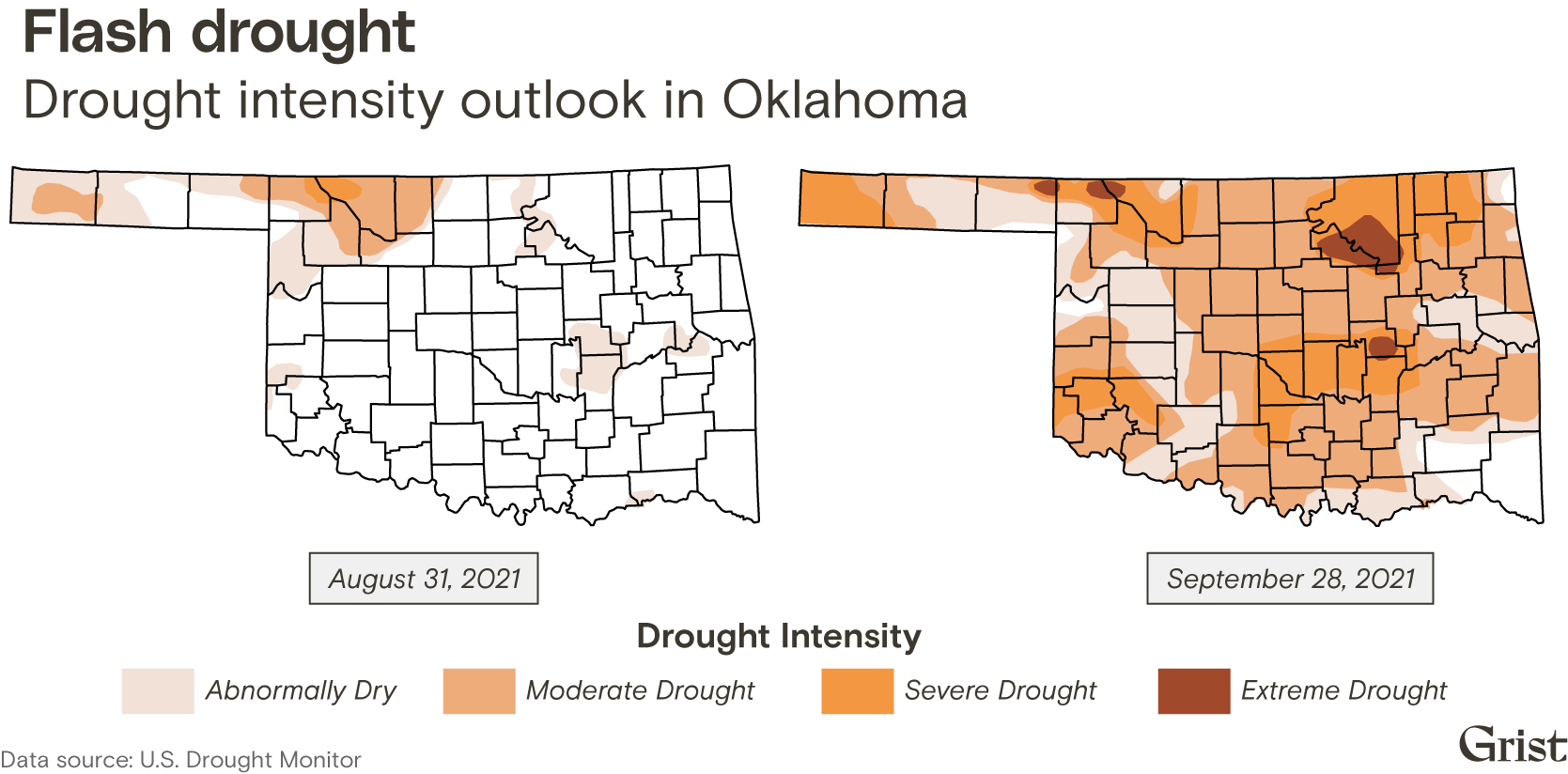
September in Oklahoma is typically a rainy season, when farmers take advantage of the state’s third-wettest month to plant winter wheat. But last year, many were caught off guard by abnormally dry weather that descended without warning. In the span of just three weeks, nearly three-quarters of the state began experiencing drought conditions, ranging from moderate to extreme. 

Fast-moving droughts like this one are developing more and more quickly as climate change pushes temperatures to new extremes, recent research indicates — adding a new threat to the dangers of pests, flooding, and more long-term drought that farmers in the U.S. already face. Known as “flash droughts,” these dry periods can materialize in as quickly as five days, often devastating agricultural areas that aren’t prepared for them. 

During last year’s drought in Oklahoma, Jonathan Conder, a meteorologist for a local news station in Oklahoma City, marveled at the speed and severity of the event. Tulsa, the state’s second-largest city, went 80 days without more than a quarter-inch of rain, while temperatures in southwestern Oklahoma climbed into the triple digits.

“This is huge for Oklahoma,” Conder said during his broadcast on October 1. “Our agricultural community, the farmers who plant wheat, they may not even be able to plant if they don’t get two inches of rain.”

Four photos of grass in Oklahoma over different time periods
Flash droughts can dry out an area in the span of weeks. The top images show the impact of a flash drought in Oklahoma in 2012, compared to the same area two years later in the bottom row. Jeffrey Basara

The threshold for drought conditions differs by location, with the U.S. Drought Monitor using data on soil moisture, streamflow, and precipitation to categorize droughts by their severity. While typical droughts develop over months as precipitation gradually declines, flash droughts are characterized by a steep drop in rainfall, particularly during a season that normally receives plenty, along with high temperatures and fast winds that quickly dry out the soil. They can wither crops or prevent seeds from sprouting, delaying or diminishing the harvest. 

Now, flash droughts are coming on faster and faster — making them more difficult to predict and more damaging, according to a recent study published in Nature Communications. The research, from scientists at the University of Texas and Hong Kong Polytechnic University, found that in the last 20 years, the percentage of flash droughts developing in under a week increased by more than 20 percent in the Central United States. 

“There should be more attention paid to this phenomenon,” said Zong-Liang Yang, a geosciences professor at the University of Texas and one of the study’s co-authors, as well as “how to actually implement [these findings] into agricultural management.” 

Scientists have long warned that warming temperatures and shifting rainfall patterns due to climate change pose a threat to the cash crops of the Midwest and Great Plains, primarily corn, wheat, and soybeans. But flash droughts are a relatively new area of research, Yang said, with the term gaining usage only in the last couple of decades. 

The increase in their severity and frequency, though, is already being felt across the U.S. In 2012, a flash drought struck the Central U.S. in the middle of the growing season, causing an estimated $31.2 billion in crop losses. Another flash drought hit Montana, North Dakota, and South Dakota in the spring of 2017, leading to more than $2.6 billion in agricultural losses, along with “widespread wildfires, poor air quality, damaged ecosystems, and degraded mental health,” according to a study published in the Bulletin of the American Meteorological Society.

Flash droughts are also a global problem, with Brazil, India, and multiple countries in Africa facing the worst impacts. In 2010, a flash drought followed by a heatwave in Russia temporarily halted wheat exports, a major disruption for communities across the Middle East that depend on the country’s grain. 

The damage flash droughts can cause depends on the crop and the time of year, said Dennis Todey, director of the Midwest Climate Hub for the U.S. Department of Agriculture. Corn is the most vulnerable during its pollination season in mid-summer, while soybeans are affected in August and wheat during planting season in the spring. 

Drought is a natural part of the climate in this region, Todey said, particularly in the western part of the Corn Belt — a region that encompasses the Midwest and the Great Plains. Many farmers have learned to adapt and integrate dry conditions into their planting cycles. But what makes flash droughts so dangerous is their rapid onset, Todey said, leaving little time for agricultural producers to prepare. 

“Drought most times is thought of as a slow-starting and then a slow-stopping event,” Todey said. “In a flash drought setting … instead of just starting to dry out gradually, you have surfaces that dry out very quickly, you have some newly planted crops that are starting to be stressed more quickly.” 

Two maps of Oklahoma showing drought intensity on August 31, 2021, and September 28, 2021. On August 28, drought conditions are mostly limited to the northwestern part of the state. On September 28, drought conditions have covered the entire state.
Last September’s flash drought hit Oklahoma in a matter of weeks. Chad Small / Grist

Many farmers don’t know if they’re starting to experience a drought, though, until expected rains fail to appear. Rainfall in mid-October helped ease the flash drought that began in Oklahoma in September, but after that a much longer drought set in, said Keeff Felty, a fourth-generation wheat and cotton farmer in the southwestern part of the state. As a result, some of his crop never germinated, while his overall yield dropped when it came time for the harvest. 

“There’s a lot of information out there, and you have to avail yourself of what works best for you, but you also have to be prepared for it to go totally south,” Felty said. “Nobody saw [the drought] coming, and it’s just a fact of the weather that we don’t have any control over it. It’s just life.”  

Typical droughts can last months or even years — the western U.S. is currently experiencing its third decade of “megadrought” — while flash droughts can end more quickly, within weeks or months, Yang said. And they can hit in relatively wet areas, including the eastern part of the country, where drought conditions are much more rare than in the West. 

The main reason they’re occurring faster, Yang said, is climate change. As the air warms, it can lead to more evaporation and dry out the soil. This can occur even in areas that can expect to receive more rainfall overall because of climate change, because scientists project that rainfall will be unevenly distributed — falling in more extreme events and making other parts of the year drier. 

“Every [recent] decade we have seen is the warmest decade in history,” Yang said. And with the world on track to blow past a global temperature that’s 1.5 degrees Celsius (2.7 degrees Fahrenheit) higher than the pre-industrial average, he expects to see both flash droughts and longer droughts occurring more frequently. 

Researchers are working on improving their models to better predict flash droughts, Yang said, with the help of new technologies such as more granular satellite monitoring and machine learning. The main marker they look for is high rates of evapotranspiration, when plants suck up water from the soil and then release it into the air through their leaves — a process that accelerates with high temperatures and winds and can be monitored with special cameras that detect fluorescence, or the heat emitted by plants. 

If farmers can know when to anticipate a flash drought, Todey said, they can skip or delay planting, or reduce their fertilizer usage when they know a crop won’t grow. They can also adjust their planting schedule and take better care of their soil by minimizing tillage, which dries it out even more. But with less and less time to prepare for flash droughts, Todey said, some may have to make difficult choices about whether to plant at all. 

“Agricultural producers naturally adapt to changing conditions,” Todey said. “But eventually there comes a point where [losses] become more frequent. People start going, ‘Okay, this isn’t working.’” 

This story was originally published by Grist with the headline ‘Flash droughts’ are Midwest’s next big climate threat on May 16, 2022.

14 Jun 22:10

CodeSOD: The String Buildulator

by Remy Porter

"Don't concatenate long strings," is generally solid advice in most languages. Due to internal representations, strings are frequently immutable and of a fixed length, so a block like this:

string s = getSomeString(); s = s + "some suffix";

creates three strings- the original, the suffix, and the third, concatenated string. Keep spamming instances, especially long ones, if you want to stress test your garbage collector.

While languages will do their best to optimize those kinds of operations, the general advice is to use string builders which can minimize those allocations and boost performance.

Or, you can do what Richard B's predecessor did, and abuse the heck out of string interpolation in C#.

StreamWriter sw = new StreamWriter(filename); #region Export file header string header = ""; header = "Title"; header = $"{header},\"First Name\""; header = $"{header},\"Middle Name\""; header = $"{header},\"Last Name\""; header = $"{header},Suffix"; header = $"{header},Company"; header = $"{header},Department"; header = $"{header},\"Job Title\""; header = $"{header},\"Business Street\""; header = $"{header},\"Business Street 2\""; header = $"{header},\"Business Street 3\""; header = $"{header},\"Business City\""; header = $"{header},\"Business State\""; header = $"{header},\"Business Postal Code\""; header = $"{header},\"Business Country/ Region\""; header = $"{header},\"Home Street\""; header = $"{header},\"Home Street 2\""; header = $"{header},\"Home Street 3\""; header = $"{header},\"Home City\""; header = $"{header},\"Home State\""; header = $"{header},\"Home Postal Code\""; header = $"{header},\"Home Country/ Region\""; header = $"{header},\"Other Street\""; header = $"{header},\"Other Street 2\""; header = $"{header},\"Other Street 3\""; header = $"{header},\"Other City\""; header = $"{header},\"Other State\""; header = $"{header},\"Other Postal Code\""; header = $"{header},\"Other Country/ Region\""; header = $"{header},\"Assistant's Phone\""; header = $"{header},\"Business Fax\""; header = $"{header},\"Business Phone\""; header = $"{header},\"Business Phone 2\""; header = $"{header},Callback"; header = $"{header},\"Car Phone\""; header = $"{header},\"Company Main Phone\""; header = $"{header},\"Home Fax\""; header = $"{header},\"Home Phone\""; header = $"{header},\"Home Phone 2\""; header = $"{header},ISDN"; header = $"{header},\"Mobile Phone\""; header = $"{header},\"Other Fax\""; header = $"{header},\"Other Phone\""; header = $"{header},Pager"; header = $"{header},\"Primary Phone\""; header = $"{header},\"Radio Phone\""; header = $"{header},\"TTY/TDD Phone\""; header = $"{header},Telex"; header = $"{header},Account"; header = $"{header},Anniversary"; header = $"{header},\"Assistant's Name\""; header = $"{header},\"Billing Information\""; header = $"{header},Birthday"; header = $"{header},\"Business Address PO Box\""; header = $"{header},Categories"; header = $"{header},Children"; header = $"{header},\"Directory Server\""; header = $"{header},\"E - mail Address\""; header = $"{header},\"E - mail Type\""; header = $"{header},\"E - mail Display Name\""; header = $"{header},\"E-mail 2 Address\""; header = $"{header},\"E - mail 2 Type\""; header = $"{header},\"E - mail 2 Display Name\""; header = $"{header},\"E-mail 3 Address\""; header = $"{header},\"E - mail 3 Type\""; header = $"{header},\"E - mail 3 Display Name\""; header = $"{header},Gender"; header = $"{header},\"Government ID Number\""; header = $"{header},Hobby"; header = $"{header},\"Home Address PO Box\""; header = $"{header},Initials"; header = $"{header},\"Internet Free Busy\""; header = $"{header},Keywords"; header = $"{header},Language"; header = $"{header},Location"; header = $"{header},\"Manager's Name\""; header = $"{header},Mileage"; header = $"{header},Notes"; header = $"{header},\"Office Location\""; header = $"{header},\"Organizational ID Number\""; header = $"{header},\"Other Address PO Box\""; header = $"{header},Priority"; header = $"{header},Private"; header = $"{header},Profession"; header = $"{header},\"Referred By\""; header = $"{header},Sensitivity"; header = $"{header},Spouse"; header = $"{header},\"User 1\""; header = $"{header},\"User 2\""; header = $"{header},\"User 3\""; header = $"{header},\"User 4\""; header = $"{header},\"Web Page\""; #endregion Export file header sw.WriteLine(header);

The real killer to this is that there's no need for string concatenation at all. There's no reason one needs to WriteLine the entire header at once. sw.Write("Title,"); Also, string interpolation is almost always more expensive than straight concatenation, and harder for compilers to optimize. I'm not about to benchmark this disaster to prove it, but I suspect this is going to be pretty much the most expensive option.

And don't worry, the same basic process follows for each individual row they're outputting:

string contactRow = ""; HtmlToText htmlToText = new HtmlToText(); bool extendedPropRetrieved = false; #region Extract properties for export file if (contact.CompleteName != null) contactRow = $"\"{contact.CompleteName.Title}\""; // Title else contactRow = $""; contactRow = $"{contactRow},\"{contact.GivenName}\""; // First name contactRow = $"{contactRow},\"{contact.MiddleName}\""; // Middle name contactRow = $"{contactRow},\"{contact.Surname}\""; // Last name if (contact.CompleteName != null) contactRow = $"{contactRow},\"{contact.CompleteName.Suffix}\""; //Suffix else contactRow = $"{contactRow},"; contactRow = $"{contactRow},\"{contact.CompanyName}\""; // Company contactRow = $"{contactRow},\"{contact.Department}\""; // Department contactRow = $"{contactRow},\"{contact.JobTitle}\""; // Job title if (contact.PhysicalAddresses.Contains(PhysicalAddressKey.Business)) { contactRow = $"{contactRow},\"{contact.PhysicalAddresses[PhysicalAddressKey.Business].Street}\""; // Business street contactRow = $"{contactRow},"; // Business street 2 contactRow = $"{contactRow},"; // Business street 3 contactRow = $"{contactRow},\"{contact.PhysicalAddresses[PhysicalAddressKey.Business].City}\""; // Business city contactRow = $"{contactRow},\"{contact.PhysicalAddresses[PhysicalAddressKey.Business].State}\""; // Business state contactRow = $"{contactRow},\"{contact.PhysicalAddresses[PhysicalAddressKey.Business].PostalCode}\""; // Business postalcode contactRow = $"{contactRow},\"{contact.PhysicalAddresses[PhysicalAddressKey.Business].CountryOrRegion}\""; // Business country/region } else { contactRow = $"{contactRow},"; contactRow = $"{contactRow},"; contactRow = $"{contactRow},"; contactRow = $"{contactRow},"; contactRow = $"{contactRow},"; contactRow = $"{contactRow},"; contactRow = $"{contactRow},"; } // ... this goes on for about 600 lines

The physical address else block is something really special, here.

[Advertisement] Keep the plebs out of prod. Restrict NuGet feed privileges with ProGet. Learn more.
14 Jun 22:09

CodeSOD: True Enough

by Remy Porter

Managing true and false values is historically challenging. In the world of C, there's even a history to those challenges. Prior to the C99 standard, there wasn't a standardized version of boolean values, but there was a convention which most applications followed, based on how C conditionals and boolean logic works.

In C, anything non-zero is considered "true". So, if(0) { … } won't execute the branch, but if(99) { … } will. As a result, when people wanted to make boolean equivalents, they'd use the C preprocessors to specify something like:

#define TRUE 1 #define FALSE 0

This is, with some caveats, essentially what stdbool.h added in C99. There's no reason why TRUE needs to specifically be 1, as long as it's anything but zero. That's basically the only goal, as long as TRUE is anything but zero, if(TRUE) will behave as expected. I cannot stress enough that the only way to mess this up is to make TRUE zero. If there's one rule about defining your own boolean constants in C/C++ don't make TRUE zero.

Anyway, let me turn this over to Charles C:

I worked at a small-medium company that did a lot of subcontracted development work for a wide variety of clients. Every C or C++ project had to include the company's "standard" header field, which was to be included in every code file.
Buried halfway down this 300+-line file was this:

#define TRUE 0 #define FALSE 1

So, if (TRUE) {…} in this would not execute the branch. If you were using these constants, you'd need patterns like if (variable==TRUE) which is definitely an anti-pattern that hurts readability and frankly just annoys me. But at its core, this is just a hidden landmine in the code base, which is going to confuse anyone who isn't deeply entrenched in this code, and create huge piles of unnecessary errors.

[Advertisement] Continuously monitor your servers for configuration changes, and report when there's configuration drift. Get started with Otter today!
14 Jun 22:09

Or Whatever

Oh yeah, I didn't even know they renamed it the Willis Tower in 2009, because I know a normal amount about skyscrapers.
14 Jun 22:09

Why What’s Going on Right Now at the WTO Matters

by Yves Smith
Besides the crucial COVID-19 vaccine patent waiver, far more is at stake at this WTO ministerial than is generally known.
02 Jun 13:28

I Want to Live in a Society That Doesn’t Need Community Court

by Will Casey
Community Court is a shockingly dignified experience relative to mainstream court. by Will Casey There is a court inside this court that treats people like people instead of caged animals. WCRarely do government bureaucrats admit that they hope to work themselves out of a job.…

[ Read more ]

[ Comment on this story ]

[ Subscribe to the comments on this story ]

02 Jun 13:23

Curious Squirrels and Rambunctious Hares Form a Miniature Menagerie of Felted Wildlife

by Grace Ebert

All images © Simon Brown, shared with permission

From a shy baby fox to toads donning crowns, the felted miniatures crafted by Simon Brown and Katie Corrigan are adorable, whimsical renditions of forest creatures. The Northumbria, U.K.-based creative duo transforms thick rovings of wool into wildlife that can be found perching on a snowy branch or creeping up on a mouse through the grass-like bristles of a wooden brush. Brown tells Colossal that he plans to incorporate more found objects into the newer sculptures, which are increasingly illustrative in style, and is also working on developing automata to add a liveliness to the realistic characters. See more of the pair’s process on Instagram.


02 Jun 13:20

Impossibly Small Houseplants and Basketry Crafted from Paper by Raya Sader Bujana

by Christopher Jobson

All images © Raya Sader Bujana. Photography by Leo García Méndez, shared with permission

Barcelona-based artist Raya Sader Bujana (previously) defines her work as something between sculpture and illustration, creating impossibly tiny replicas of houseplants that rest atop a finger. From leaves to blooms and thorns to branches, even the delicate woven baskets that contain the plants are constructed from paper with the aid of tweezers and scalpels in a process more akin to surgery than origami. Her background in architecture translates to an exacting quality of “composition, use of color, texture, volume, light and sometimes subject matter,” she shares. In addition to selling original works and prints on Etsy and Society6, Bujana also has a wide range of corporate clients like Coca Cola, Swarovski, and HP. You can follow more of her process and updates to her online shops on Instagram.


30 May 21:15

Shell consultant quits, accusing firm of ‘extreme harms’ to environment

by Alex Lawson

This story was originally published by The Guardian and is reproduced here as part of the Climate Desk collaboration.

A senior safety consultant has quit working with Shell after 11 years, accusing the fossil fuel producer in a bombshell public video of causing “extreme harms” to the environment.

Caroline Dennett claimed Shell had a “disregard for climate change risks” and urged others in the oil and gas industry to “walk away while there’s still time.”

The executive, who works for the independent agency Clout, ended her working relationship with Shell in an open letter to its executives and 1,400 employees. In an accompanying video, posted on LinkedIn, she said she had quit because of Shell’s “double-talk on climate.”

Dennett accused the oil and gas firm of “operating beyond the design limits of our planetary systems” and “not putting environmental safety before production.”

She said: “Shell’s stated safety ambition is to ‘do no harm’ – ‘Goal Zero’, they call it – and it sounds honorable but they are completely failing on it.

“They know that continued oil and gas extraction causes extreme harms, to our climate, to our environment, and to people. And whatever they say, Shell is simply not winding down on fossil fuels.”

Dennett told the Guardian she “could not marry these conflicts with my conscience,” adding: “I could not carry that any longer, and I’m ready to deal with the consequences.”

Shell was a “major client” of Dennett’s business, which specializes in evaluating safety procedures in high-risk industries including oil and gas production. She began working with Shell in the aftermath of BP’s Deepwater Horizon oil spill in 2010, which rocked the industry.

“I can no longer work for a company that ignores all the alarms and dismisses the risks of climate change and ecological collapse,” she said. “Because, contrary to Shell’s public expressions around net zero, they are not winding down on oil and gas, but planning to explore and extract much more.”

Dennett – a criminal justice graduate who has spent her career in research and consultancy – was inspired to stop working with Shell after watching news footage of Extinction Rebellion climate protesters urging the company’s employees to leave. The movement’s TruthTeller whistleblowing project encourages oil and gas employees to walk away from the industry.

The consultant, who runs internal safety surveys and is based in Weymouth, Dorset, acknowledged she was “privileged” to be able to walk away and “many people working in fossil fuel companies just aren’t so lucky.”

She urged Shell’s executives to “look in the mirror and ask themselves if they really believe their vision for more oil and gas extraction secures a safe future for humanity.”

In late 2020, several Shell executives in its clean energy sector left amid reports they were frustrated at the pace of Shell’s shift towards greener fuels.

Her announcement comes on the eve of Shell’s annual general meeting of shareholders in London on Tuesday. Its plans to reduce emissions will be discussed at the meeting where the Dutch activist group Follow This will push for the company’s policies to be more consistent with the Paris climate accord. Shell’s board has told investors to reject the group’s resolution that asks it to set more stringent climate goals.

The Shell investor Royal London has said it intends to abstain on a vote on the firm’s climate transition proposals.

The Shell chief executive, Ben van Beurden, could experience an investor rebellion against his £13.5 million pay packet at the annual general meeting after the investment adviser Pirc urged a vote against it.

A Shell spokesperson said: “Be in no doubt, we are determined to deliver on our global strategy to be a net zero company by 2050 and thousands of our people are working hard to achieve this. We have set targets for the short, medium, and long term, and have every intention of hitting them.

“We’re already investing billions of dollars in low-carbon energy, although the world will still need oil and gas for decades to come in sectors that can’t be easily decarbonized.”

Shell also faces the prospect of a potential windfall tax to fund cuts to household bills after the energy industry reported bumper profits fueled by the increase in market prices, prompting opposition parties to call on the government to bring in a one-off levy.

On Monday, the biggest oil and gas producer in the North Sea spoke out against a one-off levy, arguing it would lead to the industry approving fewer projects.

Harbour Energy’s chief executive, Linda Cook, told the Financial Times: “A higher tax burden will make it more challenging for new oil and gas projects to meet investment hurdle rates, meaning fewer projects will be sanctioned.

“This is at a time when industry is being encouraged to increase domestic UK oil and gas production and support an orderly energy transition.” Harbour has told the government it plans to invest $6 billion in the North Sea over three years as industry makes its case against the tax. The Guardian revealed this month that Cook had received a £4.6 million “golden hello” from the firm.

This story was originally published by Grist with the headline Shell consultant quits, accusing firm of ‘extreme harms’ to environment on May 30, 2022.

14 May 14:17

Powerful ‘Machine Scientists’ Distill the Laws of Physics From Raw Data

by Charlie Wood

In 2017, Roger Guimerà and Marta Sales-Pardo discovered a cause of cell division, the process driving the growth of living beings. But they couldn’t immediately reveal how they learned the answer. The researchers hadn’t spotted the crucial pattern in their data themselves. Rather, an unpublished invention of theirs — a digital assistant they called the “machine scientist” — had handed it to them.

Source

03 May 14:10

CodeSOD: Fetching Transactions

by Remy Porter
TimB

X-O

When companies reinvent their own accounting software, they usually start from the (reasonable) position of just mirroring basic accounting processes. You have transactions, for an amount, and then tagged with information about what the transaction actually represents. So, for example, if you wanted to find all the transactions which represent tax paid, you'd need to filter on some metadata and then sum up the amounts.

It quickly gets more complicated. In some organizations, that complexity keeps growing, as it turns out that each department uses slightly different codes, the rules change over time, this central accounting database gradually eats older databases which had wildly different rules. Before long, you end up with a database so krufty that it's a miracle SQL Server doesn't just up and quit.

That's the situation Giles W found himself in. What follows is an example query, which exists to answer the simple question: on 20th December, 2013, how much tax was paid across all transactions? For most database designs, that might be an expensive query, but hopefully a simple query. For this one… well… they may need to do some redesigning. Note the horizontal scrolling on today's code, there was no good place for me to add linebreaks for readability.

SELECT SUM(Tax_Paid) AS Tax_Paid FROM ( SELECT SUM(te.tax1_amount + te.tax2_amount) AS Tax_Paid FROM transactions t WITH (NOLOCK) LEFT JOIN transaction_ext te WITH (NOLOCK) on t.transaction_id = te.transaction_id and t.location_id = te.location_id LEFT JOIN sale_invoices si WITH (NOLOCK) on te.sale_invoice_no = si.invoice_no and te.location_id = si.location_id WHERE t.Start_Date BETWEEN '2013-12-20' AND '2013-12-21' AND t.Start_Time BETWEEN '2013-12-20 06:00:00' AND '2013-12-21 05:59:59' AND t.Reversed <> 1 AND t.location_id = 40123 AND t.Sublocation = 0 AND t.Cashier > '' AND t.transaction_type in ('NPROD','NCRADJ','PROD','CRADJ','NEW','TAXEXEM','COUPON','COUPONS','TAXFREE') UNION ALL SELECT SUM((te.tax1_amount + te.tax2_amount) * t.quantity) AS Tax_Paid FROM other_transactions t WITH (NOLOCK) LEFT JOIN ot_extention te WITH (NOLOCK) on t.transaction_id = te.transaction_id and t.location_id = te.location_id LEFT JOIN sale_invoices si WITH (NOLOCK) on te.sale_invoice_no = si.invoice_no and te.location_id = si.location_id WHERE t.Transaction_Date BETWEEN '2013-12-20' AND '2013-12-21' AND t.Transaction_Time BETWEEN '2013-12-20 06:00:00' AND '2013-12-21 05:59:59' AND t.location_id = 40123 AND t.Sublocation = 0 AND t.Cashier > '' AND t.transaction_type in ('SCOFFER','SCPRIV','C_SALE','COUPON','COUPONS','TAXEXEM','TAXFREE') UNION ALL SELECT SUM(te.tax1_amount + te.tax2_amount) AS Tax_Paid FROM transactions t WITH (NOLOCK) LEFT JOIN transaction_ext te WITH (NOLOCK) on t.transaction_id = te.transaction_id and t.location_id = te.location_id LEFT JOIN sale_invoices si WITH (NOLOCK) on te.sale_invoice_no = si.invoice_no and te.location_id = si.location_id LEFT JOIN tab_accounts ta WITH (NOLOCK) on te.sale_invoice_no = ta.sale_invoice_no and ta.location_id = ta.location_id WHERE t.Start_Date <= '2013-12-20' AND t.Start_Time <= '2013-12-20 06:00:00' AND t.Reversed <> 1 AND t.location_id = 40123 AND t.Sublocation = 0 AND t.Cashier > '' AND t.transaction_type in ('NPROD','NCRADJ','PROD','CRADJ','NEW','TAXEXEM','COUPON','COUPONS','TAXFREE') AND ta.payment_cancelled <> 1 AND te.group_sale_no in (SELECT sp.group_sale_no FROM Split_Payments sp WITH (NOLOCK) INNER JOIN Sale_Invoices si WITH (NOLOCK) on sp.location_id = si.location_id and sp.group_sale_no = si.invoice_no WHERE sp.Transaction_Time BETWEEN '2013-12-20 06:00:00' AND '2013-12-21 05:59:59' AND si.date_issued < '2013-12-20 06:00:00' AND sp.location_id = 40123 AND sp.Sublocation = 0 AND Transaction_Amount >= 0 GROUP BY sp.group_sale_no) UNION ALL SELECT SUM((te.tax1_amount + te.tax2_amount)* t.quantity) AS Tax_Paid FROM other_transactions t WITH (NOLOCK) LEFT JOIN ot_extention te WITH (NOLOCK) on t.transaction_id = te.transaction_id and t.location_id = te.location_id LEFT JOIN sale_invoices si WITH (NOLOCK) on te.sale_invoice_no = si.invoice_no and te.location_id = si.location_id LEFT JOIN tab_accounts ta WITH (NOLOCK) on te.sale_invoice_no = ta.sale_invoice_no and ta.location_id = ta.location_id WHERE t.Transaction_Date <= '2013-12-20' AND t.Transaction_Time <= '2013-12-20 06:00:00' AND t.location_id = 40123 AND t.sublocation = 0 AND t.Cashier > '' AND t.transaction_type in ('SCOFFER','SCPRIV','C_SALE','COUPON','COUPONS','TAXEXEM','TAXFREE') AND ta.payment_cancelled <> 1 AND te.group_sale_no in (SELECT sp.group_sale_no FROM Split_Payments sp WITH (NOLOCK) INNER JOIN Sale_Invoices si on sp.location_id = si.location_id and sp.group_sale_no = si.invoice_no WHERE sp.Transaction_Time BETWEEN '2013-12-20 06:00:00' AND '2013-12-21 05:59:59' AND si.date_issued < '2013-12-20 06:00:00' AND sp.location_id = 40123 AND sp.Sublocation = 0 AND Transaction_Amount >= 0 GROUP BY sp.group_sale_no) UNION ALL SELECT -1 * SUM(te.tax1_amount + te.tax2_amount) AS Tax_Paid FROM transactions t WITH (NOLOCK) LEFT JOIN transaction_ext te WITH (NOLOCK) on t.transaction_id = te.transaction_id and t.location_id = te.location_id LEFT JOIN sale_invoices si WITH (NOLOCK) on te.sale_invoice_no = si.invoice_no and te.location_id = si.location_id LEFT JOIN (SELECT transaction_amount=sum(transaction_amount), transaction_time=min(transaction_time), location_id, group_sale_no FROM Split_Payments GROUP BY location_id, group_sale_no) as sp on sp.group_sale_no = te.group_sale_no and sp.location_id = te.location_id WHERE t.Start_Date BETWEEN '2013-12-20' AND '2013-12-21' AND t.Start_Time BETWEEN '2013-12-20 06:00:00' AND '2013-12-21 05:59:59' AND t.Reversed <> 1 AND t.location_id = 40123 AND t.Sublocation = 0 AND t.Cashier > '' AND t.payment_type = 222 AND t.transaction_type in ('NPROD','NCRADJ','PROD','CRADJ','NEW','TAXEXEM','COUPON','COUPONS','TAXFREE') AND (sp.group_sale_no is NULL OR (sp.transaction_time > '2013-12-21 05:59:59' AND sp.transaction_amount >= 0)) UNION ALL SELECT -1 * SUM((te.tax1_amount + te.tax2_amount) * t.quantity) AS Tax_Paid FROM other_transactions t WITH (NOLOCK) LEFT JOIN ot_extention te WITH (NOLOCK) on t.transaction_id = te.transaction_id and t.location_id = te.location_id LEFT JOIN sale_invoices si WITH (NOLOCK) on te.sale_invoice_no = si.invoice_no and te.location_id = si.location_id LEFT JOIN (SELECT transaction_amount=sum(transaction_amount), transaction_time=min(transaction_time), location_id, group_sale_no FROM Split_Payments GROUP BY location_id, group_sale_no) as sp on sp.group_sale_no = te.group_sale_no and sp.location_id = te.location_id WHERE t.Transaction_Date BETWEEN '2013-12-20' AND '2013-12-21' AND t.Transaction_Time BETWEEN '2013-12-20 06:00:00' AND '2013-12-21 05:59:59' AND t.location_id = 40123 AND t.Sublocation = 0 AND t.Cashier > '' AND t.payment_type = 222 AND (t.transaction_type in ('SCOFFER','SCPRIV','C_SALE','COUPON','COUPONS','TAXEXEM','TAXFREE') OR t.transaction_type = 'DEPOSIT' and (te.comment IS NULL or te.comment = '')) AND (sp.group_sale_no is NULL OR (sp.transaction_time > '2013-12-21 05:59:59' AND sp.transaction_amount >= 0)) UNION ALL SELECT sum((te.tax1_amount + te.tax2_amount) * t.quantity) as Tax_Paid FROM other_transactions t WITH (NOLOCK) LEFT JOIN ot_extention te WITH (NOLOCK) on t.transaction_id = te.transaction_id and t.location_id = te.location_id INNER JOIN (SELECT distinct te.sale_invoice_no FROM other_transactions t WITH (NOLOCK) LEFT JOIN ot_extention te WITH (NOLOCK) on t.transaction_id = te.transaction_id and t.location_id = te.location_id LEFT JOIN sale_invoices si WITH (NOLOCK) on te.sale_invoice_no = si.invoice_no and te.location_id = si.location_id LEFT JOIN (SELECT transaction_amount=sum(transaction_amount), transaction_time=min(transaction_time), location_id, group_sale_no FROM Split_Payments GROUP BY location_id, group_sale_no) as sp on sp.group_sale_no = te.group_sale_no and sp.location_id = te.location_id WHERE t.Transaction_Date BETWEEN '2013-12-20' AND '2013-12-21' AND t.Transaction_Time BETWEEN '2013-12-20 06:00:00' AND '2013-12-21 05:59:59' AND t.location_id = 40123 AND t.Sublocation = 0 AND t.Cashier > '' AND t.payment_type = 222 AND t.transaction_type = 'CANCTAB' AND (sp.group_sale_no is NULL OR (sp.transaction_time > '2013-12-21 05:59:59' AND sp.transaction_amount >= 0)) ) s ON te.sale_invoice_no = s.sale_invoice_no WHERE t.Transaction_Date BETWEEN '2013-12-20' AND '2013-12-21' AND t.Transaction_Time BETWEEN '2013-12-20 06:00:00' AND '2013-12-21 05:59:59' AND t.transaction_type <> 'CANCTAB' AND t.location_id = 40123 AND t.Sublocation = 0 AND t.Cashier > '' UNION ALL SELECT sum(te.tax1_amount + te.tax2_amount) as Tax_Paid FROM transactions t WITH (NOLOCK) LEFT JOIN transaction_ext te WITH (NOLOCK) on t.transaction_id = te.transaction_id and t.location_id = te.location_id INNER JOIN (SELECT distinct te.sale_invoice_no FROM other_transactions t WITH (NOLOCK) LEFT JOIN ot_extention te WITH (NOLOCK) on t.transaction_id = te.transaction_id and t.location_id = te.location_id LEFT JOIN sale_invoices si WITH (NOLOCK) on te.sale_invoice_no = si.invoice_no and te.location_id = si.location_id LEFT JOIN (SELECT transaction_amount=sum(transaction_amount), transaction_time=min(transaction_time), location_id, group_sale_no FROM Split_Payments GROUP BY location_id, group_sale_no) as sp on sp.group_sale_no = te.group_sale_no and sp.location_id = te.location_id WHERE t.Transaction_Date BETWEEN '2013-12-20' AND '2013-12-21' AND t.Transaction_Time BETWEEN '2013-12-20 06:00:00' AND '2013-12-21 05:59:59' AND t.location_id = 40123 AND t.Sublocation = 0 AND t.Cashier > '' AND t.payment_type = 222 AND t.transaction_type = 'CANCTAB' AND (sp.group_sale_no is NULL OR (sp.transaction_time > '2013-12-21 05:59:59' AND sp.transaction_amount >= 0)) ) s ON te.sale_invoice_no = s.sale_invoice_no WHERE t.Start_Date BETWEEN '2013-12-20' AND '2013-12-21' AND t.Start_Time BETWEEN '2013-12-20 06:00:00' AND '2013-12-21 05:59:59' AND t.Reversed <> 1 AND t.location_id = 40123 AND t.Sublocation = 0 AND t.Cashier > '' UNION ALL SELECT SUM((te.tax1_amount + te.tax2_amount) * t.quantity) AS Tax_Paid FROM other_transactions t WITH (NOLOCK) LEFT JOIN ot_extention te WITH (NOLOCK) on t.transaction_id = te.transaction_id and t.location_id = te.location_id LEFT JOIN sale_invoices si WITH (NOLOCK) on te.sale_invoice_no = si.invoice_no and te.location_id = si.location_id WHERE t.Transaction_Date BETWEEN '2013-12-20' AND '2013-12-21' AND t.Transaction_Time BETWEEN '2013-12-20 06:00:00' AND '2013-12-21 05:59:59' AND t.location_id = 40123 AND t.Sublocation = 0 AND t.Cashier > '' AND t.transaction_type = 'REFUND' UNION ALL SELECT SUM((te.tax1_amount + te.tax2_amount) * t.quantity) AS Tax_Paid FROM other_transactions t WITH (NOLOCK) LEFT JOIN ot_extention te WITH (NOLOCK) on t.transaction_id = te.transaction_id and t.location_id = te.location_id LEFT JOIN sale_invoices si WITH (NOLOCK) on te.sale_invoice_no = si.invoice_no and te.location_id = si.location_id WHERE t.Transaction_Date BETWEEN '2013-12-20' AND '2013-12-21' AND t.Transaction_Time BETWEEN '2013-12-20 06:00:00' AND '2013-12-21 05:59:59' AND t.location_id = 40123 AND t.Sublocation = 0 AND t.Cashier > '' AND t.transaction_type = 'REVADJ' ) AS Taxes

"This," Giles writes, "is what you would see if you wanted to tinker with the query to account for some new transaction type. Presumably shortly before resigning."

[Advertisement] Utilize BuildMaster to release your software with confidence, at the pace your business demands. Download today!
01 May 01:16

Evening Sunlight Blankets the Dense Los Angeles Hills in an Ethereal Glow in Seth Armstrong’s Paintings

by Grace Ebert

“Green” (2021), oil on wood panel, 66 x 66 inches

Los Angeles-based artist Seth Armstrong (previously) gravitates toward saturated palettes of greens and blues to render the steep, hilly landscapes of his hometown. Evening sunsets bathe the staggered houses, trees, and sloping streets in a warm glow, adding a tinge of magic to the densely populated neighborhoods. Balancing light with shadow and hyperrealism with more ethereal details, the oil-based works, while similar in composition and subject matter, rarely follow the same process, Armstrong shares. “Sometimes I rely heavily on a drawing to compose a painting, and sometimes I’ll jump straight into the wet stuff,” he tells Colossal. “I haven’t decided if I prefer a thin and complete underpainting, or if I like just slopping it on, straight up.”

Armstrong has paintings slated for a few upcoming shows, including with Asia Art Center at Jing Art in Beijing this May and this winter at Amsterdam’s Miniature Museum of Modern and Contemporary Art. He’s also working on a number of commissions and new works, and you can follow his progress on Instagram.


“Lemon Yellow” (2021), oil on wood panel, 60 x 48 inches

“Electric Avenue” (2021), oil on wood panel, 48 x 36 inches

“Pastel Is Punk” (2022), oil on wood panel, 36 x 24 inches

“Braintree” (2021), oil on wood panel, 48 x 60 inches

“Mt. Angelus” (2021), oil on wood panel, 40 x 40 inches

23 Apr 03:43

American Phone-Tracking Firm Demo'd Surveillance Powers by Spying on CIA and NSA

by Sam Biddle

In the months leading up to Russia’s invasion of Ukraine, two obscure American startups met to discuss a potential surveillance partnership that would merge the ability to track the movements of billions of people via their phones with a constant stream of data purchased directly from Twitter. According to Brendon Clark of Anomaly Six — or “A6” — the combination of its cellphone location-tracking technology with the social media surveillance provided by Zignal Labs would permit the U.S. government to effortlessly spy on Russian forces as they amassed along the Ukrainian border, or similarly track Chinese nuclear submarines. To prove that the technology worked, Clark pointed A6’s powers inward, spying on the National Security Agency and CIA, using their own cellphones against them.

Virginia-based Anomaly Six was founded in 2018 by two ex-military intelligence officers and maintains a public presence that is scant to the point of mysterious, its website disclosing nothing about what the firm actually does. But there’s a good chance that A6 knows an immense amount about you. The company is one of many that purchases vast reams of location data, tracking hundreds of millions of people around the world by exploiting a poorly understood fact: Countless common smartphone apps are constantly harvesting your location and relaying it to advertisers, typically without your knowledge or informed consent, relying on disclosures buried in the legalese of the sprawling terms of service that the companies involved count on you never reading. Once your location is beamed to an advertiser, there is currently no law in the United States prohibiting the further sale and resale of that information to firms like Anomaly Six, which are free to sell it to their private sector and governmental clientele. For anyone interested in tracking the daily lives of others, the digital advertising industry is taking care of the grunt work day in and day out — all a third party need do is buy access.

Company materials obtained by The Intercept and Tech Inquiry provide new details of just how powerful Anomaly Six’s globe-spanning surveillance powers are, capable of providing any paying customer with abilities previously reserved for spy bureaus and militaries.


According to audiovisual recordings of an A6 presentation reviewed by The Intercept and Tech Inquiry, the firm claims that it can track roughly 3 billion devices in real time, equivalent to a fifth of the world’s population. The staggering surveillance capacity was cited during a pitch to provide A6’s phone-tracking capabilities to Zignal Labs, a social media monitoring firm that leverages its access to Twitter’s rarely granted “firehose” data stream to sift through hundreds of millions of tweets per day without restriction. With their powers combined, A6 proposed, Zignal’s corporate and governmental clients could not only surveil global social media activity, but also determine who exactly sent certain tweets, where they sent them from, who they were with, where they’d been previously, and where they went next. This enormously augmented capability would be an obvious boon to both regimes keeping tabs on their global adversaries and companies keeping tabs on their employees.

The source of the materials, who spoke on the condition of anonymity to protect their livelihood, expressed grave concern about the legality of government contractors such as Anomaly Six and Zignal Labs “revealing social posts, usernames, and locations of Americans” to “Defense Department” users. The source also asserted that Zignal Labs had willfully deceived Twitter by withholding the broader military and corporate surveillance use cases of its firehose access. Twitter’s terms of service technically prohibit a third party from “conducting or providing surveillance or gathering intelligence” using its access to the platform, though the practice is common and enforcement of this ban is rare. Asked about these concerns, spokesperson Tom Korolsyshun told The Intercept “Zignal abides by privacy laws and guidelines set forth by our data partners.”

A6 claims that its GPS dragnet yields between 30 to 60 location pings per device per day and 2.5 trillion locational data points annually worldwide, adding up to 280 terabytes of location data per year and many petabytes in total, suggesting that the company surveils roughly 230 million devices on an average day. A6’s salesperson added that while many rival firms gather personal location data via a phone’s Bluetooth and Wi-Fi connections that provide general whereabouts, Anomaly 6 harvests only GPS pinpoints, potentially accurate to within several feet. In addition to location, A6 claimed that it has built a library of over 2 billion email addresses and other personal details that people share when signing up for smartphone apps that can be used to identify who the GPS ping belongs to. All of this is powered, A6’s Clark noted during the pitch, by general ignorance of the ubiquity and invasiveness of smartphone software development kits, known as SDKs: “Everything is agreed to and sent by the user even though they probably don’t read the 60 pages in the [end user license agreement].”

The Intercept was not able to corroborate Anomaly Six’s claims about its data or capabilities, which were made in the context of a sales pitch. Privacy researcher Zach Edwards told The Intercept that he believed the claims were plausible but cautioned that firms can be prone to exaggerating the quality of their data. Mobile security researcher Will Strafach agreed, noting that A6’s data sourcing boasts “sound alarming but aren’t terribly far off from ambitious claims by others.” According to Wolfie Christl, a researcher specializing in the surveillance and privacy implications of the app data industry, even if Anomaly Six’s capabilities are exaggerated or based partly on inaccurate data, a company possessing even a fraction of these spy powers would be deeply concerning from a personal privacy standpoint.

Reached for comment, Zignal’s spokesperson provided the following statement: “While Anomaly 6 has in the past demonstrated its capabilities to Zignal Labs, Zignal Labs does not have a relationship with Anomaly 6. We have never integrated Anomaly 6’s capabilities into our platform, nor have we ever delivered Anomaly 6 to any of our customers.”

When asked about the company’s presentation and its surveillance capabilities, Anomaly Six co-founder Brendan Huff responded in an email that “Anomaly Six is a veteran-owned small business that cares about American interests, natural security, and understands the law.”

Companies like A6 are fueled by the ubiquity of SDKs, which are turnkey packages of code that software-makers can slip in their apps to easily add functionality and quickly monetize their offerings with ads. According to Clark, A6 can siphon exact GPS measurements gathered through covert partnerships with “thousands” of smartphone apps, an approach he described in his presentation as a “farm-to-table approach to data acquisition.” This data isn’t just useful for people hoping to sell you things: The largely unregulated global trade in personal data is increasingly finding customers not only at marketing agencies, but also federal agencies tracking immigrants and drone targets as well as sanctions and tax evasion. According to public records first reported by Motherboard, U.S. Special Operations Command paid Anomaly Six $590,000 in September 2020 for a year of access to the firm’s “commercial telemetry feed.”

Anomaly Six software lets its customers browse all of this data in a convenient and intuitive Google Maps-style satellite view of Earth. Users need only find a location of interest and draw a box around it, and A6 fills that boundary with dots denoting smartphones that passed through that area. Clicking a dot will provide you with lines representing the device’s — and its owner’s — movements around a neighborhood, city, or indeed the entire world.

As the Russian military continued its buildup along the country’s border with Ukraine, the A6 sales rep detailed how GPS surveillance could help turn Zignal into a sort of private spy agency capable of assisting state clientele in monitoring troop movements. Imagine, Clark explained, if the crisis zone tweets Zignal rapidly surfaces through the firehose were only a starting point. Using satellite imagery tweeted by accounts conducting increasingly popular “open-source intelligence,” or OSINT, investigations, Clark showed how A6’s GPS tracking would let Zignal clients determine not simply that the military buildup was taking place, but track the phones of Russian soldiers as they mobilized to determine exactly where they’d trained, where they were stationed, and which units they belonged to. In one case, Clark showed A6 software tracing Russian troop phones backward through time, away from the border and back to a military installation outside Yurga, and suggested that they could be traced further, all the way back to their individual homes. Previous reporting by the Wall Street Journal indicates that this phone-tracking method is already used to monitor Russian military maneuvers and that American troops are just as vulnerable.

In another A6 map demonstration, Clark zoomed in closely on the town of Molkino, in southern Russia, where the Wagner Group, an infamous Russian mercenary outfit, is reportedly headquartered. The map showed dozens of dots indicating devices at the Wagner base, along with scattered lines showing their recent movements. “So you can just start watching these devices,” Clark explained. “Any time they start leaving the area, I’m looking at potential Russian predeployment activity for their nonstandard actors, their nonuniform people. So if you see them go into Libya or Democratic Republic of the Congo or things like that, that can help you better understand potential soft power actions the Russians are doing.”

To fully impress upon its audience the immense power of this software, Anomaly Six did what few in the world can claim to do: spied on American spies.

The pitch noted that this kind of mass phone surveillance could be used by Zignal to aid unspecified clients with “counter-messaging,” debunking Russian claims that such military buildups were mere training exercises and not the runup to an invasion. “When you’re looking at counter-messaging, where you guys have a huge part of the value you provide your client in the counter-messaging piece is — [Russia is] saying, ‘Oh, it’s just local, regional, um, exercises.’ Like, no. We can see from the data that they’re coming from all over Russia.”

To fully impress upon its audience the immense power of this software, Anomaly Six did what few in the world can claim to do: spied on American spies. “I like making fun of our own people,” Clark began. Pulling up a Google Maps-like satellite view, the sales rep showed the NSA’s headquarters in Fort Meade, Maryland, and the CIA’s headquarters in Langley, Virginia. With virtual boundary boxes drawn around both, a technique known as geofencing, A6’s software revealed an incredible intelligence bounty: 183 dots representing phones that had visited both agencies potentially belonging to American intelligence personnel, with hundreds of lines streaking outward revealing their movements, ready to track throughout the world. “So, if I’m a foreign intel officer, that’s 183 start points for me now,” Clark noted.

The NSA and CIA both declined to comment.

jordan-base-google-maps

Anomaly Six tracked a device that had visited the NSA and CIA headquarters to an air base outside of Zarqa, Jordan.

Screenshot: The Intercept / Google Maps


Clicking on one of dots from the NSA allowed Clark to follow that individual’s exact movements, virtually every moment of their life, from that previous year until the present. “I mean, just think of fun things like sourcing,” Clark said. “If I’m a foreign intel officer, I don’t have access to things like the agency or the fort, I can find where those people live, I can find where they travel, I can see when they leave the country.” The demonstration then tracked the individual around the United States and abroad to a training center and airfield roughly an hour’s drive northwest of Muwaffaq Salti Air Base in Zarqa, Jordan, where the U.S. reportedly maintains a fleet of drones.
“It doesn’t take a lot of creativity to see how foreign spies can use this information for espionage, blackmail, all kinds of, as they used to say, dastardly deeds.”

“There is sure as hell a serious national security threat if a data broker can track a couple hundred intelligence officials to their homes and around the world,” Sen. Ron Wyden, D-Ore., a vocal critic of the personal data industry, told The Intercept in an interview. “It doesn’t take a lot of creativity to see how foreign spies can use this information for espionage, blackmail, all kinds of, as they used to say, dastardly deeds.”

Back stateside, the person was tracked to their own home. A6’s software includes a function called “Regularity,” a button clients can press that automatically analyzes frequently visited locations to deduce where a target lives and works, even though the GPS pinpoints sourced by A6 omit the phone owner’s name. Privacy researchers have long shown that even “anonymized” location data is trivially easy to attach to an individual based on where they frequent most, a fact borne out by A6’s own demonstration. After hitting the “Regularity” button, Clark zoomed in on a Google Street View image of their home.

“Industry has repeatedly claimed that collecting and selling this cellphone location data won’t violate privacy because it is tied to device ID numbers instead of people’s names. This feature proves just how facile those claims are,” said Nate Wessler, deputy director of the American Civil Liberties Union’s Speech, Privacy, and Technology Project. “Of course, following a person’s movements 24 hours a day, day after day, will tell you where they live, where they work, who they spend time with, and who they are. The privacy violation is immense.”

The demo continued with a surveillance exercise tagging U.S. naval movements, using a tweeted satellite photo of the USS Dwight D. Eisenhower in the Mediterranean Sea snapped by the commercial firm Maxar Technologies. Clark broke down how a single satellite snapshot could be turned into surveillance that he claimed was even more powerful than that executed from space. Using the latitude and longitude coordinates appended to the Maxar photo along with its time stamp, A6 was able to pick up a single phone signal from the ship’s position at that moment, south of Crete. “But it only takes one,” Clark noted. “So when I look back where that one device goes: Oh, it goes back to Norfolk. And actually, on the carrier in the satellite picture — what else is on the carrier? When you look, here are all the other devices.” His screen revealed a view of the carrier docked in Virginia, teeming with thousands of colorful dots representing phone location pings gathered by A6. “Well, now I can see every time that that ship is deploying. I don’t need satellites right now. I can use this.”

Though Clark conceded that the company has far less data available on Chinese phone owners, the demo concluded with a GPS ping picked up aboard an alleged Chinese nuclear submarine. Using only unclassified satellite imagery and commercial advertising data, Anomaly Six was able to track the precise movements of the world’s most sophisticated military and intelligence forces. With tools like those sold by A6 and Zignal, even an OSINT hobbyist would have global surveillance powers previously held only by nations. “People put way too much on social media,” Clark added with a laugh.

As location data has proliferated largely unchecked by government oversight in the United States, one hand washes another, creating a private sector capable of state-level surveillance powers that can also fuel the state’s own growing appetite for surveillance without the usual judicial scrutiny. Critics say the loose trade in advertising data constitutes a loophole in the Fourth Amendment, which requires the government to make its case to a judge before obtaining location coordinates from a cellular provider. But the total commodification of phone data has made it possible for the government to skip the court order and simply buy data that’s often even more accurate than what could be provided by the likes of Verizon. Civil libertarians say this leaves a dangerous gap between the protections intended by the Constitution and the law’s grasp on the modern data trade.

“The Supreme Court has made clear that cellphone location information is protected under the Fourth Amendment because of the detailed picture of a person’s life it can reveal,” explained Wessler. “Government agencies’ purchases of access to Americans’ sensitive location data raise serious questions about whether they are engaged in an illegal end run around the Fourth Amendment’s warrant requirement. It is time for Congress to end the legal uncertainty enabling this surveillance once and for all by moving toward passage of the Fourth Amendment Is Not For Sale Act.”

Though such legislation could restrict the government’s ability to piggyback off commercial surveillance, app-makers and data brokers would remain free to surveil phone owners. Still, Wyden, a co-sponsor of that bill, told The Intercept that he believes “this legislation sends a very strong message” to the “Wild West” of ad-based surveillance but that clamping down on the location data supply chain would be “certainly a question for the future.” Wyden suggested that protecting a device’s location trail from snooping apps and advertisers might be best handled by the Federal Trade Commission. Separate legislation previously introduced by Wyden would empower the FTC to crack down on promiscuous data sharing and broaden consumers’ ability to opt out of ad tracking.

A6 is far from the only firm engaged in privatized device-tracking surveillance. Three of Anomaly Six’s key employees previously worked at competing firm Babel Street, which named all three of them in a 2018 lawsuit first reported by the Wall Street Journal. According to the legal filing, Brendan Huff and Jeffrey Heinz co-founded Anomaly Six (and lesser-known Datalus 5) months after ending their employment at Babel Street in April 2018, with the intent of replicating Babel’s cellphone location surveillance product, “Locate X,” in a partnership with major Babel competitor Semantic AI. In July 2018, Clark followed Huff and Heinz by resigning from his position as Babel’s “primary interface to … intelligence community clients” and becoming an employee of both Anomaly Six and Semantic.

Like its rival Dataminr, Zignal touts its mundane partnerships with the likes of Levi’s and the Sacramento Kings, marketing itself publicly in vague terms that carry little indication that it uses Twitter for intelligence-gathering purposes, ostensibly in clear violation of Twitter’s anti-surveillance policy. Zignal’s ties to government run deep: Zignal’s advisory board includes a former head of the U.S. Army Special Operations Command, Charles Cleveland, as well as the CEO of the Rendon Group, John Rendon, whose bio notes that he “pioneered the use of strategic communications and real-time information management as an element of national power, serving as a consultant to the White House, U.S. National Security community, including the U.S. Department of Defense.” Further, public records state that Zignal was paid roughly $4 million to subcontract under defense staffing firm ECS Federal on Project Maven for “Publicly Available Information … Data Aggregation” and a related “Publicly Available Information enclave” in the U.S. Army’s Secure Unclassified Network.

The remarkable world-spanning capabilities of Anomaly Six are representative of the quantum leap occurring in the field of OSINT. While the term is often used to describe the internet-enabled detective work that draws on public records to, say, pinpoint the location of a war crime from a grainy video clip, “automated OSINT” systems now use software to combine enormous datasets that far outpace what a human could do on their own. Automated OSINT has also become something of a misnomer, using information that is by no means “open source” or in the public domain, like commercial GPS data that must be bought from a private broker.

While OSINT techniques are powerful, they are generally shielded from accusations of privacy violation because the “open source” nature of the underlying information means that it was already to some extent public. This is a defense that Anomaly Six, with its trove of billions of purchased data points, can’t muster. In February, the Dutch Review Committee on the Intelligence and Security Services issued a report on automated OSINT techniques and the threat to personal privacy they may represent: “The volume, nature and range of personal data in these automated OSINT tools may lead to a more serious violation of fundamental rights, in particular the right to privacy, than consulting data from publicly accessible online information sources, such as publicly accessible social media data or data retrieved using a generic search engine.” This fusion of publicly available data, privately procured personal records, and computerized analysis isn’t the future of governmental surveillance, but the present. Last year, the New York Times reported that the Defense Intelligence Agency “buys commercially available databases containing location data from smartphone apps and searches it for Americans’ past movements without a warrant,” a surveillance method now regularly practiced throughout the Pentagon, the Department of Homeland Security, the IRS, and beyond.

The post American Phone-Tracking Firm Demo’d Surveillance Powers by Spying on CIA and NSA appeared first on The Intercept.

13 Apr 13:07

Yanis Varoufakis: Cloudalists: Our New Cloud-Based Ruling Class

by Yves Smith
TimB

Nothing new from the "Crypto Syllabus" article, maybe just a better summary

Capitalism is on the wane. Cloudalists, owners of a new form of “command capital,” have gained exorbitant power over everyone else.