Shared posts

22 Dec 14:33

Google-Phonics, Or, ‘What Is the Sound of a Thousand Tech Workers Meditating?’

by Kevin Healey

On a wicked-cold Sunday morning early last month, I found myself running through the mostly-empty streets of downtown Boston on my way to a colleague’s presentation at the International Symposium for Contemplative Studies. A crumpled and wet street map in my hands, I stopped periodically at unfamiliar intersections to get my bearings and adjust my rain-proof hood. “What on Earth am I doing here?” I asked myself, thinking, “I could be home in bed reading with my daughter.” At that moment, I didn’t know that I’d soon be asking a pointed—perhaps indignant—question to Google’s in-house mindfulness guru, Chade-Meng Tan.

Arriving late at the Marriott Copley Place, I sat in the back of a seminar room and settled in for one of the few presentations that offered a critical analysis of corporate mindfulness programs. One slide referenced my own critique of the integrity bubbles that have come to characterize Silicon Valley’s spiritual meritocracy. The meditation rooms now commonplace in many corporate headquarters are like tiny bubbles in which small groups of high-powered employees experience a sense of work/life balance premised—wittingly or not—on the externalization of risk and suffering that is endemic to capital markets. From the perspective of socially engaged Buddhism, a key flaw in corporate mindfulness is its neglect of the relationship between personal and institutional suffering (or dukkha). The audience was both intrigued and challenged by such ideas. One attendee snapped photos of subsequent slides.

Quite unexpectedly, Google’s own Jolly Good Fellow walked into the room. Flashing a winning smile at the gathered attendees, he found a seat a couple of rows behind me. Now it was clear why I had run, sweating and disoriented, through the freezing rain toward the Marriott. Two days before, during my own presentation, I had displayed a screen shot from a now-viral video in which local activists from Oakland’s East Bay Meditation Center took to the stage at the Wisdom 2.0 conference, calling attention to the problems of gentrification precipitated by the growth of the tech industry in San Francisco. In the image, Meng sits cross-legged as the activists hold high a banner reading “Eviction-Free San Francisco.”

“For me,” I had explained, “this image represents a distinction that Martin Luther King, Jr. made during the height of the civil rights movement: that between the negative peace of complacency within an unjust system, and the positive peace that arises from non-violent resistance to the status quo.” Readily acknowledging that I was “picking on Meng,” I lamented that he was not present to engage the question of whether corporate mindfulness offered something beyond the negative peace of complacency.

Now he was.

As in any tradition, there is not one Buddhism—there are multiple Buddhisms competing for our attention or, if you like, multiple perspectives about what constitutes authentic Buddhist teaching. These tensions were palpable as discussion ensued after the presentation that Sunday morning. Another high-profile attendee asked for clarification about the concept of civic mindfulness, which had also come up during the presentation. Having posited the idea in my own work, I found myself called upon to explain. The crumpled street map still in my hand, I turned toward Meng.

“I was picking on you a little bit on Friday,” I said as nervous laughter erupted from some seated nearby. “One week early last June, you tweeted that you were in the movie Internship. Something else happened that week too. I posited this as a quiz to the audience on Friday, and no one remembered: that was the week that Ed Snowden’s NSA leaks appeared in the papers as he slipped off to an undisclosed location. It was clear that tech companies like Google were implicated in those leaks. This is not just about Snowden the person. It’s about the institutional frameworks that enabled the leaks—namely journalistic organizations—which are in a state of crisis while the tech industry is booming. These are systemic issues that personal mindfulness training ignores. This is what’s missing from the discussion. This is what I mean by calling for civic mindfulness.”

In Search Inside Yourself, Meng notes that when you cultivate mindfulness, “you don’t take action, action takes you.” Perhaps this is why I found myself jogging through the rain that morning. Action takes not only employees and executives, but activists and critics as well. It had taken Amanda Ream and Erin McElroy onto the stage at Wisdom 2.0, and the thought of their commitment goaded me on.

“Thanks for letting me pick on you a little bit,” I said afterwards as we shook hands. As a small group of us began to chat, Meng insisted that success in the marketplace is consistent with the pursuit of mindfulness. I objected, and raised the pointed question I had asked only rhetorically a couple of days before. “If mindfulness were to take root both inside and outside corporate culture,” I suggested, “we might move beyond market capitalism altogether and arrive in a world that is beyond Google. The key moment in the Buddha’s life is not just when he left the palace, but when he crossed the river and joined those who were underprivileged. So I’m wondering: What would it look like for you to cross the river?”

In reply, Meng explained that if Google ever faced a choice between the common good and the survival of the company, he would always advocate for the common good. It was a revealing answer: framing this choice in hypothetical terms implies that Google has yet to face it. It’s a choice that will rarely present itself in one consummate moment, however, but instead appears as a series of smaller decisions with cumulative effect.

Where was mindfulness, for example, when Google decided to subvert the privacy settings of iPhone users? Where was mindfulness when the Street View program ‘sniffed’ for open Wi-Fi connections and surreptitiously collected personal data from local residents? Where was mindfulness when the company decided to consolidate its user privacy policies against the better judgment of consumer groups and over thirty U.S. Attorneys General? Tellingly, none of these issues appear in Search Inside Yourself. They are blind spots within a corporate-friendly version of Buddhist philosophy.

Meng’s version of mindfulness ignores institutional dukkha in favor of a myopic focus on personal stress reduction and interpersonal empathy. Indeed, elsewhere Meng has suggested that Google and other tech companies can streamline mindfulness practice by developing Fitbit-style apps that would allow users to calm their minds more quickly—a development that he says would not only be “good for your career” but would also make customers “happy to spend more money.”

This vision is consistent with Silicon Valley’s utopian view of ‘smart’ gadgets as ever-more-efficient catalysts for the achievement of human virtue. In fact, it is part of a broader ideology that posits information technology as the route to social and spiritual salvation. Yet it is a route that becomes ever-more-perilous to travel as those blind spots multiply over time.

Call it Google-phonics. It’s a term presciently coined years ago by another famous Jolly Good Fellow—none other than comedian-turned-banjo-virtuoso Steve Martin. On a track by that name off his 1979 album Comedy is Not Pretty, Martin mockingly plays the role of a gadget-happy free-spender in search of the perfect sound system. “I bought a stereo. Wow—two speakers. Wild!” It was great for about a month, he says, until he heard the four-speaker “quad” system. “So I got rid of the stereo and got the quad. And this was the sound I was looking for. So I listened to it a couple of days and I said ‘Hey, this sounds like shit.’” He switches to the dodeca-phonic system, with twelve speakers. “But the ear gets sophisticated pretty fast,” he explains, so he upgrades to the milli-phonic system—a thousand speakers—until this also fails to please.

“So finally I got the googlephonic—the highest number of speakers before infinity.” He pauses dramatically before adding finally, “Sounds like shit.” In classic Martin style, he waits for the laughter to die down before adding the final punchline: “So I said, ‘Hey, maybe it’s the needle!’”

The metaphor is apt. The gurus of Silicon Valley tout the benefits of exponential increases in the processing power of hand-held devices and cloud systems, while customers camp out for days to be the first to bring their trophy home. Yet satisfaction fails to abound—especially for the unseen victims lost in the blind spots of techno-utopian ideology. Devices and cloud networks are poised to collect reams of data, but they toss lower-class users into marketing categories that are tantamount to waste bins. Markets expand while the voices of underpaid workers remain unacknowledged and unheard.

In the digital age free-market ideology is a low-fi needle that fails to amplify all voices—listen closely for a while and it starts to sound like shit.

Busy and in-demand, Meng was generous with his time but soon had to leave our post-presentation chat session. Before saying a final goodbye, he asked if we wanted to know his “real goal.”

Recalling Meng’s previous speeches and blog entries, a colleague chimed in: “World peace?”

“That’s the low bar,” Meng explained. Grasping a nearby hand, he confided that his real goal is to “democratize enlightenment”—not through boots-on-the-ground activism, of course, but through a proliferation of wearable gadgets and prohibitively expensive mindfulness seminars. Acknowledging the concerns raised that morning, he emphasized his sincere commitment to expanding his approach by including a greater emphasis on compassion. In a low voice he said, “Let me know if I fuck up.”

I flashed Meng a wry smile and said, “You’re on.”


22 Dec 01:54

Musician Guilhem Desq Gives an Electrifying Hurdy Gurdy Performance

by Christopher Jobson

On a list of things I most anticipated sitting down to cover on Colossal today, the hurdy gurdy probably wasn’t in the top thousand topics, but then I stumbled onto this video and had to share it. The piece is called Omen, written and performed by Guilhem Desq, who uses an electrified version of the hurdy gurdy along with sampling to create a surprisingly contemporary composition. The first two minutes are more traditional (?) sounding, but around the 2:00 mark things get amazing. If you’re unfamiliar with this obscure instrument, here’s a little background:

The hurdy gurdy is a stringed instrument that produces sound by a crank-turned, rosined wheel rubbing against the strings. The wheel functions much like a violin bow, and single notes played on the instrument sound similar to those of a violin. Melodies are played on a keyboard that presses tangents—small wedges, typically made of wood—against one or more of the strings to change their pitch. Like most other acoustic stringed instruments, it has a sound board to make the vibration of the strings audible.

If you just can’t get enough hurdy gurdy, you can listen to more of Desq’s music on his YouTube channel, and there’s also a great TED talk by Caroline Philips, Hurdy Gurdy for Beginners. (via Colossal Submissions)

16 Dec 16:40

Mechanical Drawings and the Human Form Merge in Oil Paintings by Atsushi Koyama

by Christopher Jobson
TimB

Hand painted! Karthik, this makes me think of your postdoc.

Mechanical Drawings and the Human Form Merge in Oil Paintings by Atsushi Koyama painting infographics anatomy

Mechanical Drawings and the Human Form Merge in Oil Paintings by Atsushi Koyama painting infographics anatomy

Mechanical Drawings and the Human Form Merge in Oil Paintings by Atsushi Koyama painting infographics anatomy

Mechanical Drawings and the Human Form Merge in Oil Paintings by Atsushi Koyama painting infographics anatomy

Mechanical Drawings and the Human Form Merge in Oil Paintings by Atsushi Koyama painting infographics anatomy

Mechanical Drawings and the Human Form Merge in Oil Paintings by Atsushi Koyama painting infographics anatomy

Although the meaning behind these oil paintings by Atsushi Koyama is somewhat ambiguous, it’s easy to appreciate the exactness of his paintbrush that colorfully and elegantly depicts mechanical diagrams mixed with anatomical illustrations. Born in Tokyo, Koyama holds both a BFA in art from Tama Art University and a Bachelor’s degree in mathematics from Tokyo University of Science, so it’s no surprise to see a confluence of both backgrounds in his artwork. You can see more paintings from the last few years over at Frantic Gallery. (via Dark Silence in Suburbia, Hayden’s Magazine)

15 Dec 04:40

Even Before Long Winter Begins, Energy Bills Send Shivers in New England

by By KATHARINE Q. SEELYE
TimB

Hang in there, Bostonians...

Customers are facing drastically increased heating bills in New England, which already has the highest rates in the 48 contiguous states.


10 Dec 20:04

The Senate Intelligence Committee Report On CIA Torture Program

by Dan Savage
TimB

The Senate Intelligence Committee is being... honest???!

Senate Report: We Tortured Prisoners, It Didn't Work, and We Lied About It http://t.co/e4yZnpZee2

— Mother Jones (@MotherJones) December 9, 2014

Here's the document...

Senate Intelligence Committee Report On CIA Torture Techniques

NYT:

A scathing report released by the Senate Intelligence Committee on Tuesday found that the Central Intelligence Agency routinely misled the White House and Congress about the information it obtained from the detention and interrogation of terrorism suspects, and that its methods were more brutal than the C.I.A. acknowledged either to Bush administration officials or to the public. The long-delayed report, which took five years to produce and is based on more than six million internal agency documents, is a sweeping indictment of the C.I.A.'s operation and oversight of a program carried out by agency officials and contractors in secret prisons around the world in the years after the Sept. 11, 2001, terrorist attacks. It also provides a macabre accounting of some of the grisliest techniques that the C.I.A. used to torture and imprison terrorism suspects.

Waterboardings, "rectal feedings," hypothermia, broken bones, no useful intelligence obtained, innocent people tortured to death. Andrew Sullivan and his crew are live-blogging their way through the report while compiling reactions and tweets and analysis from others. And then there's this:

The CIA Paid 2 Men $80 Million To Come Up With Ways To Torture People

The CIA torture report is shameful. I’m just glad Dick Cheney is undead to see it.
— God (@TheTweetOfGod) December 9, 2014

[ Comment on this story ]

[ Subscribe to the comments on this story ]

10 Dec 16:48

Supreme Court Basically Rules That Your Employer Doesn't Owe You Any Money for Treating You Like a Thief

by Paul Constant
TimB

Sohrob, you made the right choice!

The ruling probably would have been different if Supreme Court justices had to wait in line to be searched for concealed office supplies before they left work every day.
  • M DOGAN / Shutterstock.com
  • The ruling probably would have been different if Supreme Court justices had to wait in line to be searched for concealed office supplies before they left work every day.

This morning, the Supreme Court made a unanimous ruling that could have repercussions for American workers everywhere. The case involved workers at an Amazon warehouse who were not compensated for the time they had to spend in line for security checks at the end of the day. (Some workers claimed they had to spend up to a half-hour in line; they weren't paid for this time.) Lawrence Hurley at Reuters quotes Justice Clarence Thomas's ruling in the case: "the screening process is not a 'principal activity' of the workers' jobs under a law called the Fair Labor Standards Act and therefore is not subject to compensation. For workers to be paid, the activity in question must be 'an intrinsic element' of the job and 'one with which the employee cannot dispense if he is to perform his principal activities,' Thomas wrote."

This strikes me as ridiculous. Let's leave aside for a moment the central thought behind this screening process—the insane allegation that every low-wage American worker is a thief who can't be trusted. (Maybe if Amazon paid their employees more, they wouldn't have to worry about their warehouse workers stuffing cheap electronics down their pants to make ends meet?) Let's just look at the facts: The screening process is mandatory. If employees decided not to go through with the screening and tried to leave without it, they would be fired. (At the very least; I imagine it might be likely that the employers would call the police on an employee who tried to leave without being screened.) Workers can't do anything else with their time while they're waiting in line to be screened. That, to me, sounds like they deserve compensation for the time they're giving the company.

This is what an America with declining membership in unions looks like. Unions probably can't help these workers; the deck is stacked against any union that tries to organize a shop like this. At this point, the only hope for workers like this is that some politician somewhere will make this issue their mission. But this is unlikely, because there's no money in it for politicians to become a champion for minimum-wage workers. And with a unanimous ruling like this one, it's likely that employers are going to get a lot more brazen with their demands on worker time. This is not a problem that will solve itself.

[ Comment

09 Dec 17:13

Saint John Coltrane: Fifty Years of ‘A Love Supreme’

by S. Brent Plate

For a long period of my life, sometime after I stopped attending Christian church services, I made it a ritual to listen to John Coltrane’s A Love Supreme in its entirety on Sunday afternoons. I’m not sure where I heard the album first, or what exactly inspired me to do so. I only remember doing it, and feeling I was doing something that was not only good for me, but also important.

Some people don’t get it. But for those who do, the religious experience of it all is palpable. Some blend of harmonics and melodics, tradition and improv, mastery and experimentation, makes A Love Supreme one of the great religious movements in modern life. Recorded in a four-hour session on December 9, 1964, with Coltrane on soprano and tenor saxophone, Jimmy Garrison on bass, McCoy Tyner on piano, and Elvin Jones on drums, the music does not discriminate, inspiring the secular and the spiritual alike.

To celebrate this week’s fiftieth anniversary of this iconic recording, music venues around the world are staging performances of Coltrane’s work—including, of course, Saint John Coltrane African Orthodox Church in San Francisco.

The Coltrane church began in the late 1960s, when Franzo Wayne King and then-girlfriend Marina King heard Coltrane perform in San Francisco. They called their experience of hearing him live, a “sound baptism.” This led them to form the “Yardbird Temple,” named with Charlie Parker in mind, and with jazz at its base. In 1982 the little independent congregation joined the global fellowship of the African Orthodox Church, a denomination that began in the 1920s as an African-American split from the Episcopal church.

The African Orthodox denomination continues in operation, albeit in relatively small numbers. The Coltrane church does not, as some might imagine, “worship” John Coltrane any more than a church called St. Mark’s worships Mark. The African Orthodox church officially canonized Coltrane, so the designation of “Saint John Coltrane” is a religious fact, and not a postmodern gesture.

Today, the congregation meets every Sunday. The church is filled with some locals, some devout believers, and generally a small throng of tourists. The vibe is a mix of jazz concert, charismatic Christianity, and some new age-y “all is one” dialogue. It is definitely San Francisco in all its goofy glory. Like many African-American church services, music mixes with prayer and preaching, and before you know it, three hours have passed, which is about six times as long as the four movements of A Love Supreme.

What is it about Coltrane, and in particular A Love Supreme, that gets some of us going spiritually? Coltrane was after truth, as one biographer put it, and not necessarily “pleasant listening.” I am attracted to this idea, that truth is difficult and can not easily be possessed. The corollary here is that there is no truth in Musak, and not much in the pop charts. In classical terms “truth” and “beauty” are not interchangeable.

Perhaps more importantly, truth is heard. It is an activity of the ears. And these are not necessarily the sounds of words being spoken, but a sensual experience that operate above and beyond the conceptual, intellectual realm. Truth is in the sensual arts, not rational philosophy.

True, Coltrane wrote some unapologetically religious words for the liner notes of A Love Supreme, giving “all praise to God,” and thanking God for his “spiritual awakening” of 1957 which, as we know from his biography, had also to do with his quitting heroin and alcohol. (Even so, the abuses had already been enough that he died of liver failure at age 40.) But who can resist putting the liner notes down quickly and sitting and listening: “Acknowledgement,” “Resolution,” “Pursuance,” and “Psalm,” making up the four parts of the musical journey.

I recently wrote about drums, and the vital role the sounds of drums have played in a history of religions. Drums, like other musical instruments, come alive, become possessed, and become the residence of the gods themselves. Where the split between sound and player is, is impossible to discern. Jazz drummers like Art Blakey, Christian drummers like Teryl Bryant, and former Grateful Dead percussionist Mickey Hart, have each found the pursuit of drumming to be indistinguishable from spiritual pursuits.

So with John Coltrane. When he is pouring his breath into the saxophone in the midst of “Pursuance,” part III of A Love Supreme, distinctions between music and musician, instrument and player, and music and listener, break down. Maybe it’s a mystical experience, God reaching to us through the music. Or maybe it’s just the musical arrangement itself, some deliciously delicate balance of sounds that settle and unsettle all at once, reaching our eardrums and resonating through our bodies.

I’ve since lost my Sunday ritual of listening–no, experiencing–A Love Supreme. But from time to time, when I think I might need it, or when something beyond me is pushing me in new ways, I find my copy of the album, now digital, and allow the transportation to take place. Getting lost in the music and getting found in the sound.

Cue it up.

Correction: a previous version of this article specified alto sax, when in fact Coltrane played tenor and soprano on ‘A Love Supreme.’ 

07 Dec 17:32

Artist Sculpts a Horse from Molten Glass in Under Two Minutes

by Christopher Jobson

In a period of about 90 seconds, this glass artist transforms a molten blob of glass into a horse using little more than a pair of huge tweezers, gravity, and a lifetime of practice. Not completely sure who the artist is, but the YouTube comments credit Francisco Lopez Serrano. (via Reddit)

05 Dec 16:30

Architectural Landmarks Created with Bicycle Tire Tracks by Thomas Yang

by Christopher Jobson

Architectural Landmarks Created with Bicycle Tire Tracks by Thomas Yang tires posters and prints bicycles architecture

Architectural Landmarks Created with Bicycle Tire Tracks by Thomas Yang tires posters and prints bicycles architecture

Architectural Landmarks Created with Bicycle Tire Tracks by Thomas Yang tires posters and prints bicycles architecture

Architectural Landmarks Created with Bicycle Tire Tracks by Thomas Yang tires posters and prints bicycles architecture

Architectural Landmarks Created with Bicycle Tire Tracks by Thomas Yang tires posters and prints bicycles architecture

Architectural Landmarks Created with Bicycle Tire Tracks by Thomas Yang tires posters and prints bicycles architecture

Architectural Landmarks Created with Bicycle Tire Tracks by Thomas Yang tires posters and prints bicycles architecture

Earlier this year we mentioned Thomas Yang over at 100copies used the prints from bicycle tire treads to create a poster of the Empire State Building. Yang has since explored three additional landmarks around the world that merge his passion for cycling and architecture including depictions of the Eiffel Tower, the Tower Bridge, and China’s Forbidden City. While it appears the individual prints are sold out, they are still available as a full set. (via Arch Atlas)

05 Dec 15:00

Self-explanatory

by Minnesotastan
The original technical description of the "turbo-encabulator" was written by British graduate student John Hellins Quick (1923-1991). It was published in 1944 by the British Institution of Electrical Engineers Students’ Quarterly Journal in an article titled "The Turbo-Encabulator in Industry" by "J.H. Quick, Student."
More details at Wikipedia. Posted for old friend George Anderson and other classmates who became engineers.

Via Neatorama.
03 Dec 16:14

toot toot modern bicycle

Today on Married To The Sea: toot toot modern bicycle
06 Nov 18:41

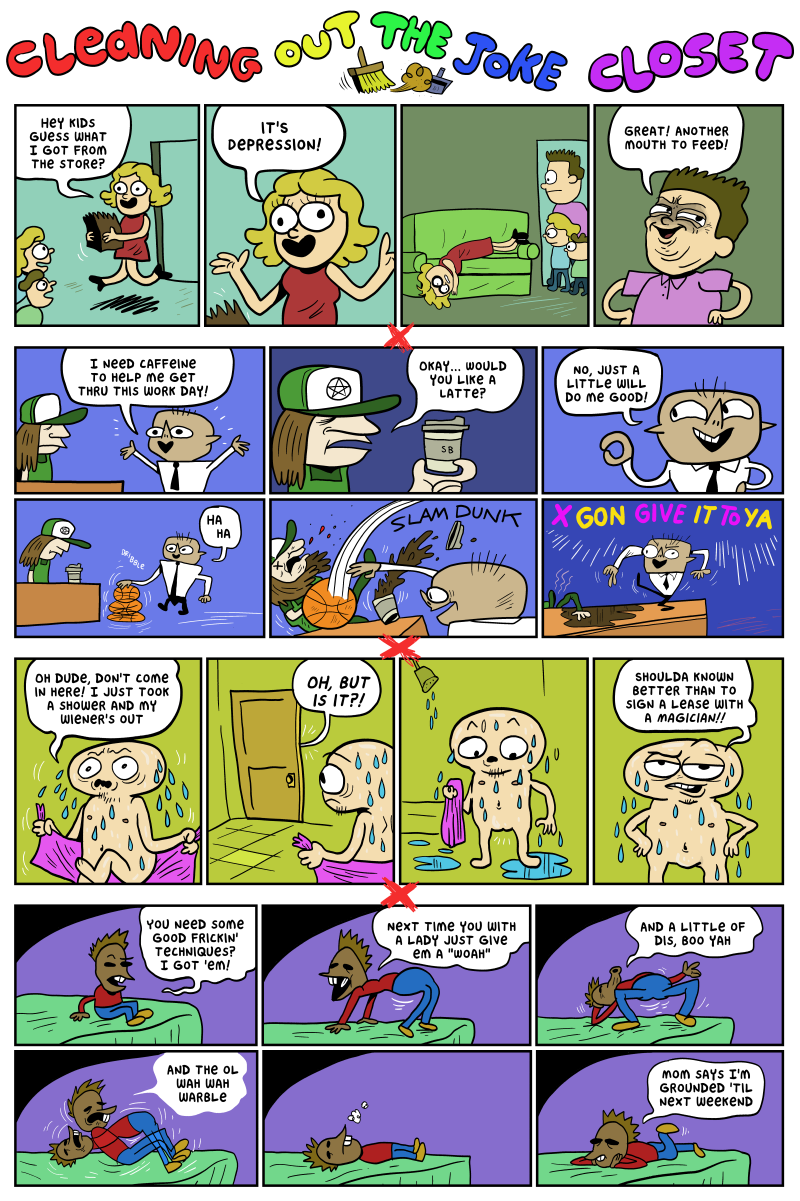
Cleaning Out the Joke Closet


Time to start lookin around the place and cleaning up. All these little jokes I weren't sure about gotta add up to at least ONE chuckle if I throw em all together. Seems like a reasonable assumption to me!


PATREON! + BACK!  
03 Nov 18:55

Watch a Japanese Kokeshi Doll Emerge From a Spinning Block of Wood

by Johnny Strategy

Watch a Japanese Kokeshi Doll Emerge From a Spinning Block of Wood wood Japan carving

Watch a Japanese Kokeshi Doll Emerge From a Spinning Block of Wood wood Japan carving

In an age of the ubiquitous 3D printer, it’s easy to forget the joy and beauty of handmade craft. Take, for example, the 400-year old Japanese art of creating kokeshi dolls. These traditional wooden figurines were said to have been originally made as souvenirs to sell to people visiting the local hot springs in Northern Japan. Although there are about 10 different styles, each doll is made with an enlarged head and cylindrical body with no arms or legs.

In the video, produced by tetotetote, an organization highlighting the arts and crafts of Sendai, Japan, Yasuo Okazaki woodturns solid blocks into the head and body using just a few tools. Okazaki’s “Naruko” style of making the dolls was passed down to him from his father and features stripes at the top and bottom of the body and bangs with red headdresses. I don’t think there’s anything more soothing and hypnotic than the sights and sounds of watching these dolls emerge from a spinning block of wood.

23 Oct 14:37

Blackwater Guards Found Guilty in 2007 Iraq Killings

by By MATT APUZZO
A federal jury found that the shooting deaths of 17 Iraqi civilians were not a battlefield tragedy, but the result of a criminal act.


08 Oct 15:36

Give it Up: Composer ‘Kutiman’ Creates Entirely New Song Using 23 Videos of Other Musicians

by Christopher Jobson
TimB

Shared for the first video. How did you miss that Thru You Too is online?! I am soooo excited. Thanks to Sohrob for finding and sharing Thru You years ago, it's... kind of the best.

http://thru-you-too.com
http://thru-you.com

Give it Up is a new track released yesterday by Israeli musician and composer Kutiman. The song was created entirely using vocal and instrument tracks lifted from 23 different YouTube videos of mostly amateur musicians, credited here. If you liked this, you’ll be happy to learn this is just the first track off his upcoming album Thru You Too which the artist says will be comprised entirely of unrelated YouTube videos.

In other composing-music-with-videos news, Andrew Huang created a version of the 80s hit 99 Red Balloons… using only red balloons. Included here for your listening pleasure.

(via Adam Savage)

07 Oct 14:58

Awkward Insect Moments: Scientists Discover That Offspring Of Flies Can Resemble The Previous Sexual Partner Of The Mother Rather Than The Actual Father

by jonathanturley
TimB

For Yohan, add it to your genetics-is-complicated collection :-D

220px-Musca_domestica_PortraitThis must make for some awkward moments at fly delivery rooms: “Look Honey he has your first lover’s eyes!”

Researchers at the University of New South Wales have confirmed a new form of non-genetic inheritance in flies. The research found that offspring can resemble a mother’s previous sexual partner of flies rather than the actual father. The size of offspring was determined not by the actual father but the previous sexual partner of the mother. It is an fascinating example of telegony, which dates back to ancient Greece and was once discredited under modern genetic theories.


Telegony holds that offspring can inherit the characteristics of a previous mate of the female parent, a theory that Encyclopedia Britannica says is now nothing but superstition.

The name may come from Telegony is a lost ancient Greek epic poem about Telegonus, son of Odysseus by Circe. His name is”born far away” – much better than “bastardo” in modern Italian.

UNSW Australia scientists Dr Angela Crean, Professor Russell Bonduriansky and Dr Anna Kopps found that the size of the young was determined by the size of the first male the mother mated with, rather than the second male that sired the offspring. The team produced large and small male flies by feeding them diets as larvae that were high or low in nutrients. They then mated the immature females with either a large or a small male.
Once the females had matured, they were mated again with either a big or a small male:
“We found that even though the second male sired the offspring, offspring size was determined by what the mother’s previous mating partner ate as a maggot.”

Crean said that “Our discovery complicates our entire view of how variation is transmitted across generations, but also opens up exciting new possibilities and avenues of research.” Yes, and a new exciting defense in fly divorce proceedings.

Source: Science Daily


Filed under: Academics, Animals, Science
28 Sep 16:07

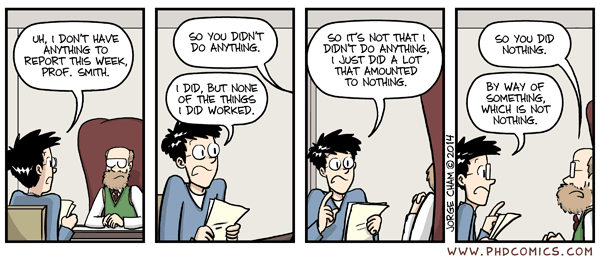
09/26/14 PHD comic: 'Nothing'

Piled Higher & Deeper by Jorge Cham
www.phdcomics.com
Click on the title below to read the comic
title: "Nothing" - originally published 9/26/2014

For the latest news in PHD Comics, CLICK HERE!

12 Sep 15:24

Report: Ozone Layer Shows Signs Of Recovery

by jonathanturley

earth-screensaver_largeYes, we actually have some good news to report about the environment. The United Nations has issued a report with NASA photos showing that the giant hole in Earth’s ozone layer is shrinking. The ozone layer protects us from the sun’s harmful ultraviolet rays and was being destroyed by the use of chlorofluorocarbons (CFCs). Over vehement objections from industry that curtailing CFCs would destroy the economy, new laws forced the use of substitutes and the result has been predictable and encouraging.


Industry fought to stop the ban on CFCs for decades even though scientists linked CFCs to the ozone depletion in the 1970s. In 1987, the world reached a phase out agreement as part of the Montreal Protocol. Industry and various politicians denounced the agreement as a disaster for the economy and jobs. Instead, it quickly forced the creation of alternatives, which are now in wide use.

Here is the result:

AP775970245805-300x300

It is not done however. It will take until 2050 for the ozone layer in the mid-latitudes to return to relatively healthy 1980s conditions. Around the Antarctic, where the ozone layer is the most damaged, it will take until 2075. However, humans actually made a sacrifice and produced a beneficial result for their planet. Now that is worth celebrating.

Source: Washington Post


Filed under: International, Politics, Science, Society
11 Sep 17:40

Sam Harris’s Vanishing Self

by By GARY GUTTING
TimB

Good! More than once I thought I had caught Sam Harris saying something dumb or sloppy (especially the Kanisza example), but then he would elaborate in a very nice way a few paragraphs later. What do you think?

The well-known New Atheist makes a case for the value of “spirituality,” which he bases on his experiences in meditation.
09 Sep 19:13

Recent Stencil Graffiti from C215

by Christopher Jobson

Recent Stencil Graffiti from C215 street art stencils portraits murals graffiti

Recent Stencil Graffiti from C215 street art stencils portraits murals graffiti

Recent Stencil Graffiti from C215 street art stencils portraits murals graffiti

Recent Stencil Graffiti from C215 street art stencils portraits murals graffiti

Recent Stencil Graffiti from C215 street art stencils portraits murals graffiti

Recent Stencil Graffiti from C215 street art stencils portraits murals graffiti

Recent Stencil Graffiti from C215 street art stencils portraits murals graffiti

Recent Stencil Graffiti from C215 street art stencils portraits murals graffiti

Recent Stencil Graffiti from C215 street art stencils portraits murals graffiti

No matter how many times I stop to consider artworks by Parisian street artist C215 (previously) I’m left wondering just how he pulls it off. The texture, the color, the detail, all executed with stencils and spray paint on any available surface. C215 says that he frequently portrays “things and people that society aims at keeping hidden: homeless people, smokers, street kids, bench lovers for example,” though one of his favorite muses is his daughter Nina who has appeared in numerous portraits over the years. He also sneaks in references to pop culture, most notably one of the best tributes to Robin Williams I’ve seen yet.

Collected here are a number of pieces from the last year or so, you can see more on Flickr and Facebook. A retrospective of his work opens at Opera Gallery in Paris in October.

04 Sep 07:27

A 19th Century Telephone Network Covered Stockholm in Thousands of Phone Lines

by Christopher Jobson

A 19th Century Telephone Network Covered Stockholm in Thousands of Phone Lines telephones Stockholm history

In the late 19th century, shortly after the patent of the telephone, the race was on to connect everyone to the phone grid. However, due to technical limitations of the earliest phone lines, every telephone required its own physical line strung between a house or business to a phone exchange where the call was manually connected by a live operator. The somewhat quixotic result of so many individual lines was the construction of elaborate and unsightly towers that carried hundreds to thousands of phone lines through the air.

In Stockholm, Sweden, the central telephone exchange was the Telefontornet, a giant tower designed around 1890 that connected some 5,000 lines which sprawled in every direction across the city. Just by looking at historical photos it’s easy to recognize the absurdity and danger of the whole endeavor, especially during the winter months. Everything that could possibly go wrong did. From high winds to ice storms and fires, the network was extremely vulnerable to the elements. Luckily, phone networks evolved so rapidly that by 1913 the Telefontornet was completely decommissioned in favor of much simpler technology. The remaining shell stood as a landmark until it too caught fire in 1953 and was torn down.

If you want to see more, the Tekniska Museet (the Museum of Technology) in Stochkholm has hundreds of photos from this strange period over on Flickr organized into four main galleries: Linjeras och eldsvådor (accidents), Telefonstationer Stockholm, telephone stations in other parts of Sweden, and the Telefontornet.

A 19th Century Telephone Network Covered Stockholm in Thousands of Phone Lines telephones Stockholm history

A 19th Century Telephone Network Covered Stockholm in Thousands of Phone Lines telephones Stockholm history

A 19th Century Telephone Network Covered Stockholm in Thousands of Phone Lines telephones Stockholm history

A 19th Century Telephone Network Covered Stockholm in Thousands of Phone Lines telephones Stockholm history

A 19th Century Telephone Network Covered Stockholm in Thousands of Phone Lines telephones Stockholm history

A 19th Century Telephone Network Covered Stockholm in Thousands of Phone Lines telephones Stockholm history

A 19th Century Telephone Network Covered Stockholm in Thousands of Phone Lines telephones Stockholm history

A 19th Century Telephone Network Covered Stockholm in Thousands of Phone Lines telephones Stockholm history

A 19th Century Telephone Network Covered Stockholm in Thousands of Phone Lines telephones Stockholm history

A 19th Century Telephone Network Covered Stockholm in Thousands of Phone Lines telephones Stockholm history

A 19th Century Telephone Network Covered Stockholm in Thousands of Phone Lines telephones Stockholm history

(via Retronaut, Twisted Sifter, thnx Johnny!)

28 Aug 22:33

Contributing Op-Ed Writer: The Expanding World of Poverty Capitalism

by By THOMAS B. EDSALL
TimB

"In Orange County, Calif., the probation department’s 'supervised electronic confinement program,' which monitors the movements of low-risk offenders, has been outsourced to a private company, Sentinel Offender Services... Sentinel makes its money by getting the offenders on probation to pay for the company’s services."

"...in Washington state, N.P.R. found, offenders even 'get charged a fee for a jury trial — with a 12-person jury costing $250, twice the fee for a six-person jury.'"

How is this possible

Court costs, fees and fines are big business for private companies and local governments.


27 Aug 03:37

Time Slice: Iconic Buildings and Monuments Photographed Over Time by Richard Silver

by Christopher Jobson

Time Slice: Iconic Buildings and Monuments Photographed Over Time by Richard Silver time architecture
Colosseum, Rome, Italy

Time Slice: Iconic Buildings and Monuments Photographed Over Time by Richard Silver time architecture
London, England

Time Slice: Iconic Buildings and Monuments Photographed Over Time by Richard Silver time architecture
Suleymaniye Mosque, Istanbul, Turkey

Time Slice: Iconic Buildings and Monuments Photographed Over Time by Richard Silver time architecture
Hagia Sophia, Istanbul, Turkey

Time Slice: Iconic Buildings and Monuments Photographed Over Time by Richard Silver time architecture
Tongariki Easter Island Sunset

Time Slice: Iconic Buildings and Monuments Photographed Over Time by Richard Silver time architecture
Birds Nest, Beijing, China

Time Slice is an ongoing series of photographs by Richard Silver that explores how iconic buildings and monuments change in appearance from day into night. Silver shoots some 36 photos at intervals over several hours and then layers them into a final composition. We’ve seen a similar approach by Fong Qi Wei (and in motion), but the focus on a single structure tells an interesting story about each place, and conveys more than just a single shot. You can see more from the series here. All images courtesy the artist. (via Vacilando)

26 Aug 15:22

Generation Later, Poor Still Rare at Elite Colleges

by By RICHARD PÉREZ-PEÑA
Surveys of top colleges found virtually no change from the 1990s to 2012 in enrollment of students who are less well off despite a huge increase in the number of such students going to college.


21 Aug 18:10

Ornate Painted Dragons Based on a Single Giant Brush Stroke

by Christopher Jobson

Ornate Painted Dragons Based on a Single Giant Brush Stroke painting dragons

One of the most common feelings I get when watching an artist working is “oh, that looks easy.” After all, the materials and method are all right in front of you: paint or ink, a paint brush or pen, and a hand that moves deftly across a canvas. What goes completely unseen of course are the years upon years of practice, the trials and failures, and the possession of innate talent. A great example of this are these Japanese dragon paintings that are rendered almost completely with a single stroke of paint.

According to Japanese culture blog Iromegane, the paintings are called Hitofude Ryuu (Dragon with one stroke), and the ones shown here originate from a small studio called Kousyuuya in Nikko, Japan. The studio has seen four generations of master painters who have been creating these stylized dragons for decades.

The process involves carefully painting an ornate dragon head with various flourishes, and then finishing the piece using a giant sumi brush in a carefully orchestrated stroke. The process has much in common with both ink wash painting and calligraphy, and similar to letterforms, the images are often repeated. From the videos you can see certain designs are reused in different colors or with added details. All the videos here start at the fun part where the torso is painted, but you can rewind them a bit to see the creation of the entire painting. (via Cineraria, Iromegane)

16 Aug 18:03

Ice T's Reading of a D&D Book is As Good As You Think

by zackparsons@somethingawful.com (Zack "Geist Editor" Parsons)
TimB

I clicked on this thinking it was going to be an onion-style parody. Nope; it's real.

Musician and actor Ice T's reading of a D&D book has finally arrived and it is as good as you thought it would be.
16 Aug 17:41

dribbblepopular: Sphere Wave Follow me on Dribbble if...

16 Aug 17:28

Bleed on a Ferguson police officer? Get charged with destruction of public property. Oh My!

by Charlton S. Stanley, PhD, ABPP

By Charlton S. Stanley, Weekend writer

We should have seen this coming. I believe it is going to get worse before it gets better, if ever. At some point there is going to be a “pitchforks and torches” backlash.

Ferguson MO logoIt may be starting in Ferguson, MO. Take a look at one of the latest stories to come out of there. It’s sad that we have to look overseas to get reliable and up to date news about what is happening in the good ol’ US of A. Because of the great sucking sound that is the US corporate mainstream media, people who want to get a more balanced read on the news check sites such as Al Jazerra, The Guardian, RT, The Epoch Times, and Der Spiegel.

This is a brief clip from a story posted yesterday on RT (Russia Today). Emphasis is mine:

Nearly four years to the day before Ferguson Police Officer Darren Wilson opened fire and killed Brown, 18, a complaint filed in federal court accused the same law enforcement agency of violating the civil rights of a man who says he was badly beaten after being wrongly arrested, then later charged with “destruction of property” for bleeding on the uniforms of the cops alleged to have injured him.

Full story at this link.

It gets better. Reading the court filings, we learn that on September 20, 2010, Henry Davis missed his exit and found himself in the the St. Louis County community of Ferguson at 3:00 AM. As it happened, there was a warrant was out for a Henry Davis, but the wanted man has a different middle initial, different birth date, and different Social Security number.

However, Davis, a 54 year old African-American welder was assaulted by four officers (one of them female). The records show that he was thrown forcefully into a one-person cell, but the one-person cell already had an occupant. He would have had to sleep on the concrete floor, because the one bunk was already occupied. There was a pile of sleeping mats near the cell, so Davis asked for a sleeping mat. Because he asked for something to sleep on, he was called disobedient. At that point, Davis was thrown to the floor, and put in restraints. During this assault in the jail, one of the officers kicked Davis in the head.

After being restrained and kicked in the jail cell, paramedics took Henry Davis to the hospital where he insisted that his picture be taken before he was treated (photo and story at the link). The Emergency Room doctor diagnosed him with a concussion and stitched him up before releasing Davis back to custody of the Ferguson PD.

He was released 3 days later on a $1500 bond for “destruction of public property.” If they kick and beat you, you better not dare bleed on their uniforms.

Davis sued. When the four officers were deposed, all four denied that they had blood on their uniforms as they had signed on their affidavit of complaints. What does this mean? They either perjured themselves at trial or had falsified affidavit. That level of perjury is a felony. The county prosecutor declined to prosecute because he claimed Davis’, injuries were de minimus.

Bob McCullouch

Bob McCullouch

Let’s take a look at the prosecutor. The St. Louis County Prosecutor is a man named Bob McCulloch. He has a reputation of being extremely harsh in his prosecution of offenders. However, McCulloch has some personal baggage which calls both his judgement and racial neutrality into question. You see, Bob McCulloch is the son of St. Louis Metropolitan Police Department officer Paul McCullouch. Officer Paul McCullough was killed in the line of duty on July 2, 1964. Officer McCullouch was 37 years old at the time. His son, current prosecutor Bob McCulloch was 12 years old in 1964. I remember that cop killing, because we lived in St. Louis, and it happened not far from where I was working at the time. Officer McCullouch was responding to a kidnapping call at the infamous Pruett-Igoe Housing Project when he was shot in the head by the fleeing kidnapper. His killer was a black man.

Bob McCullouch wanted to become a police officer like his father, but lost a leg as a teenager. That eliminated him from joining the police force, so he went to law school and became a prosecutor, a position he has held for the past twenty years. His tenure as a prosecuting attorney has been marked by controversy. He has a reputation as being almost fanatical about prosecuting alleged perpetrators, but turns a blind eye to even the grossest misconduct by law enforcement officers. The St. Louis Post-Dispatch has a story about him.

Mr. Davis’ injuries were de minimus, and according to McCullouch, not worth pursuing, yet Davis’ spattered blood on the officer’s uniforms did warrant charges. Maybe somebody smarter than me can explain that logic.

Henry Davis sued the city for civil rights violations, but late last year Magistrate Judge Nannette A. Baker ruled in favor the city. His attorneys filed a notice of appeal in March, and the case is currently slated to be considered later this year by the Eight Circuit Court of Appeals.

A PDF of the filing to the Eighth Circuit is embedded in the RT article.

–ooOoo–

The views expressed in this posting are the author’s alone and not those of the blog, the host, or other weekend bloggers. As an open forum, weekend bloggers post independently without pre-approval or review. Content and any displays or art are solely their decision and responsibility.

Filed under: Constitutional Law, Courts, Criminal law, Free Speech, Justice, Media, Torts
12 Aug 11:21

This is pretty amazing. “We demonstrate our system by...


This is pretty amazing. “We demonstrate our system by producing object manipulations that would be impossible in traditional 2D photo-editing programs, such as turning a car over, making a paper-crane flap its wings, or manipulating airplanes in a historical photograph to change its story.”

11 Aug 02:08

08/06/14 PHD comic: 'Do you have a minute?'

Piled Higher & Deeper by Jorge Cham
www.phdcomics.com
Click on the title below to read the comic
title: "Do you have a minute?" - originally published 8/6/2014

For the latest news in PHD Comics, CLICK HERE!