Carve out two minutes from your undoubtedly busy schedule and just watch this. It's beautiful.

    
|
Carve out two minutes from your undoubtedly busy schedule and just watch this. It's beautiful.
|
|

My favorite entry from last year's National Wildlife Federation photo contest is this entry by Jamie Scarrow. That bear cub is clearly in a little too deep! You can order Jamie's prints directly from her website, starting at just $45. And you can enter this year's competition at the official National Wildlife Photo Contest homepage. [nfw.org via Nature Geek]
|
|
Submitted by: Unknown

I always wondered what would happen if Wonka and an Oompa Loompa had a a child.
Unknown

“We launched Google Reader in 2005 in an effort to make it easy for people to discover and keep tabs on their favorite websites. While the product has a loyal following, over the years usage has declined. So, on July 1, 2013, we will retire Google Reader.” – Google, March 2013.
Today, Google Reader’s remaining users will “Mark All As Read” one last time. There are two schools of thought on Google’s decision to move on from its aging RSS aggregator, never adopted by the mainstream: one, that’s it’s pretty much the worst thing to ever happen to the Internet. Ever! And two: who cares?
Even though I count myself as someone who falls into that earlier group, it’s hard to argue against Google’s thinking in the matter. Following websites using RSS feeds is just not something the “normals” do. So an RSS reader like Google’s remained in the hands of the tech elite, the domain of the I.T. crowd, the programmers, the researchers, the journalists.
The rest of the world merely surfs the web, and now they just tweet.
But Google Reader was special because it was one of the last remaining places on the Internet you could really call your own. In every other way, the nature of news reading on the web these days and the social services that now dominate your attention are crafted by others who dictate what you will read and when. Whether browsing through an editorially run news site, parsing your Twitter stream or reading your Facebook News Feed, the links before you are those that others have deemed important.
There’s value in this signal, of course – a sense of what’s trending in the larger world allows for serendipitous discovery. But it’s also a relinquishing of control. Oh sure, you can choose who to follow, but it’s not the same as choosing which news news sources’ feeds you will subscribe, why, and how often you will read them.
In Google Reader, I’ve gleefully stuffed websites into collections like “B-List” and “C-List” and “Can’t Miss” and “Panic Button,” instead of more proper names like “top tech sites” or “Apple bloggers.” It’s my decision which headline collections get scanned with a glance, and which writers will see me devouring their every word.
Meanwhile on Twitter, every missive is as important as the one that preceded it. A photo of your cat. News from the war. A beautiful sunset on Instagram. A government overthrown. It’s a real-time firehouse of information that you dip into as you can. There’s no unread count. You just refresh and refresh and refresh for more.
Having never caught on as a social network in its own right outside of a niche group of users, Google Reader couldn’t rival something like Twitter. The writing was on the wall for its demise when Google ripped out the social features in the product back in October 2011 in order to make room for deeper integration with Google’s newer social network Google+.
The move, essentially a big @#$% you to Reader’s small but highly engaged audience of users, may have come as a surprise to some, but with the internal thinking at Google, perhaps it was a miracle that Reader was being given any sort of development attention at all.
In the definitive recounting of Google Reader’s history here on BuzzFeed, Brian Shih, who became Reader Product Manager in fall 2008, spoke of how the team had to fight internally for what, in terms of Google’s scale, was a really, really, really small project. “Someone hung a sign in the Reader offices that said “DAYS SINCE LAST THREAT OF CANCELLATION.” The number was almost always zero,” he said.
At Google, senior execs only cared about absolute user numbers, not on growth or market share.
But even though Google Reader could never compete in numbers with Gmail or other Google products, it wiped out the market of RSS competitors, while letting its 800-pound gorilla sit and rot.
Today, Google is too busy trying to change the world with self-driving cars and face computers, search engines that think for you and a balloon-powered Internet to care about Google Reader. It’s thinking of how to dominate mobile and connect the next 5 billion users to the web – lofty goals that leave no time for a silly little product from Web 2.0′s early days.
At least by shutting down Reader, Google is admitting that its stewardship in this area has failed.
Google can’t – and no longer wants to – do it all.
We’ve seen evidence of that already in the systematic shutdowns of other dated, stagnant services through Google’s “Spring Cleanings.” Google Reader was not the first, nor will it be the last that fails to survive these cuts. Google Alerts and Feedburner are other prime candidates at this point.
We’re retiring Reader on July 1. We know many of you will be sad to see it go. Thanks for 8 great years! http://t.co/0jtSqBnORp
— Google Reader (@googlereader) March 13, 2013
Ever since Google’s announcement this spring, many new services have stepped up to help fill the void Google Reader leaves behind, but none will ever fill its shoes. None of those that now vie to become the new incumbent even have search built in, for example. A few promise “yeah, it’s coming” but too many startups begging for a second look think that merely supporting RSS feeds makes them a Google Reader clone.
Google Reader wasn’t a list of things to read. It wasn’t a collection of RSS feeds.
It was your own, personal Google. A search engine built on top of the sites you cared about. A Google News with the stories you wanted to see. A taxonomy where you chose the labels, and drove the SEO. Google Reader was your web, your slice of the Internet.
Social media, now, is theirs.
Reader’s death isn’t the end of a product, it’s the end of an era. We have protested, bargained, begged, and cried. Now we have to accept and adapt.
Google Reader, thank you for eight great years.
Goodbye.
shift-a
OK kids, it's time. Throw this on in one tab http://t.co/Mj3njMeWZn open "All Items" in @GoogleReader & "Mark all as read" One. Last. Time.
— Jason Shellen (@shellen) July 1, 2013

Kotaku East’s Brian Ashcraft reports that “sensha sushi” (aka “tank sushi”) is a menu item at the Japanese sushi restaurant, Kurisakiya. The Panzer tank shaped sushi is based on the Japanese anime series, Girls und Panzer. The anime “is set in the town of Oarai in Ibaraki Prefecture, which is where Kurisakiya is located. It features real locations, which helps create local tourism.” After eating tank sushi, you could then finish your meal off with ice cream sushi.


photos via vatsher_disk, talp_idae, sm_neko, akibax
via NAVER, Kotaku East
A man with a heavy foreign accent calls and tells you, “Our equipment has detected serious anomalies coming from your computer.”
What do you do?
1. Ask for clarification.
“What kind of anomalies?”
This throws him off script. “Serious ones.” Then he gets back on script. “So if you could just go to your computer and…”
2. Now count how many times you can get him to say the word “anomalies.”
“You’ll have to be more specific. What did you receive from my computer?”
“Anomalies.”
“Can you describe what kind of anomalies?”
“Serious anomalies.”
“Yes, but what data came to you from my computer?”
“Ah-NOM-uh-lees.”
“But what was in the data?”
Result: Nine uses of the word “anomalies” in under a minute. Can you do better?
3. String him along.
“So you want me to be at my computer?”
“Yes, sir, if you could just go to your computer, I will tell you where to find the anomalies.”
4. Sit down at your computer. Or just tell him you’re doing it.
“Okay, I’m at my computer.”
“All right, sir. Now do you see down at the lower left of your screen, there’s a ‘Start’ button?”
5. Destroy his universe:
“Oh, no, I don’t see a ‘Start’ button, because I’m running Linux.”
6. Contemplate the sound of silence.


Nearly half a million Egyptians took to Cairo's Tahrir Square Sunday, demanding President Mohamed Morsi leave office exactly one year after he was elected. As military helicopters flew overhead, demonstrators used laser pointers to paint them in a multi-colored shower of light:
 Image via Khaled Desouki/AFP/Getty Images
It's unclear if the laser pointers were an act of civil disobedience or something more violent: Laser pointers can temporarily blind pilots, putting them in mortal danger. An American teenager was recently sentenced to 2.5 years in prison after aiming a laser pointer at a commercial plane for this exact reason. Read more...
More about Protests, Egypt, Arab Spring, Us World, and WorldSubmitted by: Unknown

The jaw-dropping photo series “Tultepec” by Thomas Prior documents the fireworks-fueled chaos of the 2013 National Pyrotechnic Festival in Tultepec, Mexico. The nine-day festival celebrates the main industry of Tultepec—handmade fireworks—through firework competitions, a parade of pyrotechnic bulls, and apparently, loads of fireworks in the streets.







via The City Loves You, Visual News


gettingcrazywiththecheezewhiz:
The dad cat liked to hang out in the sink by himself
AND THEN THE KITTENS FOUND HIM
HE LOOKS SO ANNOYED
I DIDN’T SIGN ON FOR THIS SHIT.

A post on reddit recently asked people to tell their favorite intellectual joke. The response was huge, and you should read the whole thing when you have time. Business Insider selected the best fifteen jokes to republish. They are:
A photon is going through airport security. The TSA agent asks if he has any luggage.
The photon says, "No, I'm traveling light."
Pretentious? Moi?
A logician's wife is having a baby. The doctor immediately hands the newborn to the dad. The wife says, "Is it a boy or a girl?"
The logician says, "Yes."
How can you tell the difference between a chemist and a plumber?
Ask them to pronounce "unionized."
Two women walk into a bar and talk about the Bechdel test.
Heard about that new band called 1023 MB? They haven't had any gigs yet.
Heisenberg was speeding down the highway. A cop pulls him over and says "Do you have any idea how fast you were going back there?"
Heisenberg says, "No, but I knew where I was."
C, Eb, and G walk into a bar. The bartender says, "Sorry, no minors."
First Law of Thermodynamics: You can't win.
Second Law of Thermodynamics: You can't break even.
Third Law of Thermodynamics: You can't stop playing.
If you're not part of the solution, you're part of the precipitate.
A linguistics professor says during a lecture that, "In English, a double negative forms a positive. But in some languages, such as Russian, a double negative is still a negative. However, in no language in the world can a double positive form a negative."
But then a voice from the back of the room piped up, "Yeah, right."
This is the sort of English up with which I will not put.
How many surrealists does it take to screw in a light bulb?
A fish.Knock knock.
Who's there?
Knock knock.
Who's there?
Knock knock.
Who's there?
Knock knock.
Who's there?
Philip Glass.
What does a dyslexic, agnostic, insomniac do at night?
He stays up wondering if there really is a dog.
If there are any here that you don't fully understand, Business Insider explains each joke, and also tells why they selected it. Link
There's a fun CrossValidated thread on statistics jokes. Here's the one with the top votes:
A statistician's wife had twins. He was delighted. He rang the minister who was also delighted. "Bring them to church on Sunday and we'll baptize them," said the minister. "No," replied the statistician. "Baptize one. We'll keep the other as a control.
This line by George Burns is my favorite though:
If you live to be one hundred, you've got it made. Very few people die past that age.
Any other good ones?
This is still one of my favorites:

And this:
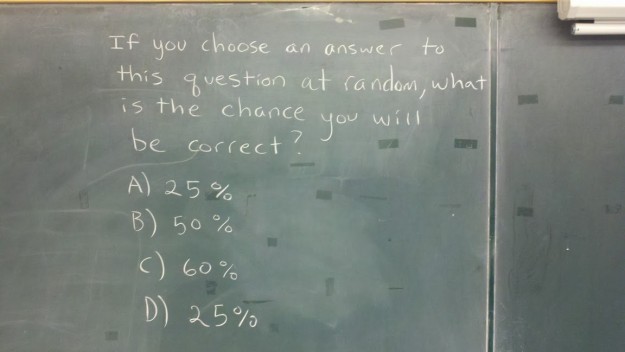
[via @alexlundry]

It's time for another round of The Food Lab. Got a suggestion for an upcoming topic? Email Kenji here, and he'll do his best to answer your queries in a future post. Become a fan of The Food Lab on Facebook or follow it on Twitter for play-by-plays on future kitchen tests and recipe experiments.
[Photographs: J. Kenji Lopez-Alt]
I'm not particularly proud of my time time spent working at the kinds of cheesy chain restaurants you'd find next to the Victoria's Secret at the mall, or perhaps in Times Square. But aside from making me shun any writer that uses the phrase "X to perfection," it did teach me one valuable lesson: People looooooove meat served on a sizzling platter. It was a well-known phenomenon: If a waiter could sell one order of our Extreme Fajitas™ to a table in their section, a half dozen more orders would quickly follow.
It's an unstoppable, visceral reaction. The waiter would plot a circuitous route around the restaurant that would take the platter past as many intermediary tables as possible. The approaching noise of sizzling meat would halt all conversation in its tracks as diners would gently lift their chins, tilting their noses in the air to catch a whiff of beef, onion, garlic, and chili as their aroma wafted by on thin whisps of smoke and steam.
Then of course, there's the DIY aspect of fajitas that makes them a winner. As a kid, there's nothing better than being presented with that plate of guacamole, pico de gallo, and sour cream; the anticipation of that sizzling platter of meat and vegetables laid down before you. When they arrive, you've already picked out a soft, blistered floured tortilla from the steaming stack in the warmer at the center of the table.
The meat itself should be ultra-juicy, with an overwhelming, almost buttery beefiness—this is skirt steak, after all, the butteriest of all beef—accented by a marinade that is slightly sweet, very savory, and packed with lime and chili.
And of course, that meat's got to be tender. Nothing worse than biting into a carefully wrapped fajita only to have that long strip of beef slip out of its tortilla housing like a sleeping camper from his sleeping bag. Better to be able to bite that camper in half, right?
So how do we reach this fajita nirvana? It's easier than you think—all it takes is a bit of strategy and know how.

Hanger Steaks
When you grow up eating something, it's hard to remember that at one point it didn't exist. "Fajita" literally translates to "little skirts" or "little bands," and it stems from the appearance of a skirt steak, a thin flap of meat that hangs down near the front of the steer's belly. The history of fajitas in most of the United States is very recent. According to an excellent article in the Austin Chronicle, there's anecdotal evidence that South and West Texas vaqueros and butchers have been eating grilled skirt steak and calling them fajitas since the 1930s.
Fajitas appear to have made the quantum leap from campfire and backyard grill obscurity to commercial sales in 1969. Sonny Falcon, an Austin meat market manager, operated the first commercial fajita taco concession stand at a rural Dies Y Seis celebration in tiny Kyle in September of 1969. That same year, fajitas debuted on the menu at Otilia Garza's Round-Up Restaurant in the Rio Grande Valley community of Pharr.
Residents and visitors of Houston might be happy to know that Ninfa's on Navigation Boulevard is one of the oldest fajita-slinging restaurants in the country, though when I visited them last summer, I was more impressed by the quality of their cooked-to-order flour tortillas than the fajitas themselves.
The fajita made its final jump into the spotlight when George Weidmann of the Hyatt Regency in Austin added the sizzling platter that shot the dish into stardom, making it a staple on not just the Hyatt menu, but on menus across the country.
Now, with all this popularity, you may smell a problem: supply. See, there are only four skirts on each steer—two inside and two outside. That's about 8 pounds of meat total. As a result, restaurants started resorting to other cuts to make their fajitas.

Hanger Steaks
First it was hanger, sirloin flap, and flank steak—all reasonably good options with a similar texture and flavor. But as things progressed, the dish moved farther and farther from the original, leading us to not just other cuts of beef, but chicken fajitas, pork fajitas, shrimp fajitas, and the like.
Even McDonald's jumped into the fajita game in 1991 (the 12-year-old-me was a big fan).
I tested cooking fajitas with a variety of cuts—skirt, hanger, flap, flank, short rib, and tri-tip. Of these, skirt, hanger, and flap were the most successful, each with a robust, coarse texture that is great for soaking up marinade.

Flap Meat
But there's no doubt about it: the skirt is king. It's more buttery, more beefy, and just plain more tasty than its counterparts.
While fajitas are traditionally made with outside skirt—part of the diaphragm muscle of the steer—the cut is pretty much unavailable unless you work for a restaurant that special orders it. At the butcher or meat counter, you're far more likely to find inside skirt, which will do us just fine.
The key is to not trim off too much of the fat that covers one side of the steak. They'll melt into the cracks as the meat grills, making each bite juicier and tastier.
While it's possible to cook the steak as a whole strip, I find it better to slice it with the grain into 5 to 6-inch pieces, making it easer to handle them on the grill.
Next up: we've got our meat, so how do we treat it?
It's proven difficult to pinpoint exactly what ingredients went into the original fajitas marinades, but it's a safe bet that at leas some chilies, garlic, black pepper, and cumin were involved. All of these are flavoring ingredients—they don't really change the manner in which the meat cooks or interact with it on more than a cursory level. What about some other common marinade ingredients? Ones that might actually affect the meat more intimately?

I tested out over two dozen marinade variations, adding extra ingredients to some (ranging from meat commercial meat tenderizers to natural enzymatic tenderizers like pineapple and papaya) and omitting ingredients from others (in order to see what happens when, say, you forget the oil in a marinade).
I even took photos of every steak in the process, but unfortunately, from a visual standpoint, you can't really see much difference. Just imagine slightly different versions of this 26 times in a row, and you'll get the picture:

What I found was that in addition to basic flavoring agents like chili and garlic and a touch of sugar to aid in browning, the best marinades share three common ingredients: oil, acid, and a salty liquid, preferably a protease (more on those later).
Oil is essential for three purposes. First, it emulsifies the marinade, making it thicker and tackier, causing it to stick more efficiently to the meat. Second, manta of the flavorful compounds found in the garlic and ground spices in the marinade are oil soluble. With a fat-based medium coating the meat, you get better, more even flavor distribution. Finally, the oil helps the meat cook more evenly, providing a buffer between the heat of the grill and the surface of the meat to spread that heat evenly. Omitting it detracts from all three of these qualities.
I used to think that acid was essential in a marinade for tenderizing purposes, and it's true—acid can slightly tenderize tough connective tissue in meat. Unfortunately, excessive acid can also start to chemically "cook" meat, denaturing its protein and causing it to firm up and eventually turn chalky (think: ceviche).
I tried completely omitting acid, adding it in the form of lime juice squeezed on at the end, but the flavor difference was noticeably—meat marinated in acid was more balanced and brighter tasting. There were also a few minor strands of membrane and connective tissue that were more noticeable without the acid. In the end I opted for lime juice in equal parts with the oil.
You may be surprised to learn that despite their reputation, marinades do not actually penetrate particularly far into meat—even after the course of a night, it will penetrate no further than a millimeter or two, and that penetration rate slows down the longer you marinate for. So really, a marinades effects are largely limited to the surface of the meat. Luckily for us, on a skirt steak, that's precisely where all of the tougher connective tissues are located, so if any tenderization is going to occur, it'll occur in the right places.

The final ingredients in a good marinade is a salty liquid. The muscle protein myosin will dissolve in a salty liquid, leaving the meat with a looser texture and a better ability to retain moisture. This is the theory behind brining meats like chicken or pork, and the same theory applies to our fajitas.
While you could just add regular salt to the marinade, there's a lesson I learned in years of playing MarioKart: Why settle for a driver who just has good handling when you can pick a driver with good handling and a high top speed?
By replacing the salt with a good splash of soy sauce, we not only get salt into the marinade, but we also get two other important elements. First, glutamates—natural flavor enhancers responsible for the sensation of umami that makes taste meat taste meatier. Second is proteases: enzymes that help break down and tenderize tough proteins.
Soy sauce is hardly traditional, but it's got a prominent place in many fajita recipes for these very reasons. That it doesn't taste distinctly soy-like or Asian once the meat is cooked is especially nice.
Once I'd gotten my ideal marinade ratio down, I moved on to testing timing, going every from dipped-just-before-grilling to marinated for 36 hours. Again, not much visual difference. Picture this 6 times in a row:

Got it?
Tastewise, however, I found the ideal timing to be between 3 and 10 hours or so. Less and the marinade simply didn't stick as well. More and the meat started to get a bit too mushy and chalky around the exterior, having a slightly cooked appearance from the lime juice and the soy sauce before it even hit the grill. My guests still happily devoured the 36-hour marinated steaks, but if you can get your timing right, it'll make the final product marginally better.

Marinate your meat in a plastic zipper-lock bag with all the air squeezed out for best contact with a minimal amount of marinade (I do this by leaving a small air hole along one edge of the zipper lock, squeezing all the air towards it, then sealing it at the last moment before juices start leaking out), or even better, seal the steaks in a cryo-vack style bag with a vacuum sealer.

There's one golden rule to cooking skirt steak: make sure your grill is hot as hell. Skirt steak is not too thick, and its loose texture allows heat to penetrate faster than in, say, a dense New York strip or ribeye. You need to absolutely pound it with heat in order to get it nice and charred on the exterior before the center ends up overcooking.
To do this, I empty out an entire full chimney of coals over just one side of my grill, piling them and allowing them to preheat until I can barely bring my hand close enough to deposit the steaks (long tongs help here). If hardwood coal is an option, I'd opt for them over briquettes—hardwood burns faster and hotter.
There are a couple of factors working to our advantage here. First is the soy sauce and sugar in the marinade, both of which will help the steaks brown more efficiently. Second is that fact that skirt is one of the cuts of steaks that benefits from being cooked slightly more than you'd normally cook a premium steak.

Anything shy of medium rare and skirt steak has a squishy, unpleasantly slippery texture. I always feel like a raptor biting into a tough Jurassic Park T-rex leg when I get an undercooked skirt. At medium-rare (around 125 to 130°F after resting—pull them off the grill at 115 to 120°F), they start to firm up to a pleasant juiciness, but personally I think skirt steak has the optimal amount of flavor and juiciness at a full 135°F medium.
Don't believe me? Just try them side-by-side and come to your own conclusion.
The last step in perfect fajita meat is by far the most important: the carving.
See, skirt steak has a very pronounced grain—muscle fibers that are all aligned in the same direction. The steak is stronger in one direction than the other. If you cut your steak with the grain, you end up with long chewy fibers. But slice it thinly against the grain and you increase its tenderness dramatically.

I apologize that one of the red arrows came out white. I blame CISPA or PRISM or the TSA or one of those other evil governmenty things.
You can cut perfectly perpendicular to the grain for absolute tenderness, but I prefer to cut at closer to a 45 degree angle, which effectively shortens muscle fibers to about 30% more than then absolute minimum length—plenty short enough to give you tenderness, while also allowing you to cut slices that look a little wider and prettier.

See how nice they look all fanned out?
And while those sizzling fajita platters sure to a good job of selling more fajitas at restaurants, all they're going to do in your home is slowly overcook your meat. A warmed serving platter is a better vessel.
With the meat taken care of, we move on to slightly more trivial but no less important* matters: the vegetables and toppings.
*strike that, reverse it.
For vegetables, the classic choices are onions and peppers. I like to save some of my marinade to toss them with before cooking.

I tried cooking them whole on the grill, but the results are not quite right—they tend to soften more than I want them to.
Cooking them in a cast iron skillet on the stovetop works much better, but then it requires me to heat up my kitchen and my grill. I may be a fool, but I'm not that kind of fool.
Then I thought: wait a minute, Kenji, don't be an idiot: you've got yourself a heat source right here in front of your eyes. Use it!

I cooked up a batch of fajitas, letting my big cast iron skillet heat up on the cooler side of the grill while the meat cooked. Then, while the meat rested, I slid it over to the hot side and seared my veggies. It worked like a charm, giving them some nice color and sear without letting them turn too mushy or soft.
As an added bonus, the pan full of vegetables proved to be the perfect place to pour off the meat juices and drippings that collected on the platter where my steaks were resting. I always love it when I can take a zero-flavor-down-the-drain approach to dishes.

With your meat sliced and your veggies cooked, all you need is a stack of hot tortillas (you can heat them up as a whole stack on the cooler side of the grill while the veggies cook), and a few condiments.
Might I humbly suggest this fine guacamole recipe, or perhaps this equally tasty pico de gallo? I may? ¡Muchissimas gracias!

While these fajitas might not have the sizzle of my childhood memories, they've certainly got all the swagger of a smoking hot plate weaving its way through the dining room, making everyone else envious of what you're abut to sink your teeth into...
About the author: J. Kenji Lopez-Alt is the Chief Creative Officer of Serious Eats where he likes to explore the science of home cooking in his weekly column The Food Lab. You can follow him at @thefoodlab on Twitter, or at The Food Lab on Facebook.
Get the Recipe!