The Wikimedia Foundation, the nonprofit organization that hosts Wikipedia, says that it’s seeing a significant decline in human traffic to the online encyclopedia because more people are getting the information that’s on Wikipedia via generative AI chatbots that were trained on its articles and search engines that summarize them without actually clicking through to the site.
The Wikimedia Foundation said that this poses a risk to the long term sustainability of Wikipedia.
A denial of service vulnerability report was filed against a program, let’s call it Notepad. The actual text of the report was very hard to understand because the grammar was all messed up. I’ll give the finder the benefit of the doubt on the assumption that they are not a native English speaker. Here’s a cleaned-up version:
If you open multiple documents, one very large document and several small documents, and then try to exit all of them at once, the program will take a very long time saving the large document, resulting in a denial of service against the small documents.
I’m not sure what the point is here. The program does eventually finish saving the large document, so everything works out in the end. Are they suggesting that the program should save the smallest documents first? But then wouldn’t that be a denial of service against the large document if you had lots of small documents?
But wait, let’s ask the standard questions.
Who is the attacker?
I guess the attacker is the person who opened the very large document.
Who is the victim?
The victim is the person who is unable to save their small documents because the large document is hogging the program.
What has the attacker gained?
The attacker has annoyed the victim temporarily.
But wait, the attacker and the victim are the same person!
It’s not a security vulnerability that you have the power to annoy yourself. Other ways include “Putting itching powder in your pants” and “Throwing your glasses in the trash.”
Furthermore, there is no impact on other users, or even to other apps by this user. The only person you’re denying service to is yourself.
If you’re concerned about the order in which files are saved on close, you could explicitly close them in the desired order, like, I dunno, most important files first? Removable drives first?
And really, it’s not clear what the finder was expecting here. You loaded a large file, and now you’re saving it. Why is it surprising that this takes a long time?
This was resolved as “Not a vulnerability” with the subcategory “By design.” But sometimes I wish there was subcategory “So what did you expect?”
Los niños de los años 80 se convirtieron en programadores con facilidad porque los ordenadores de 8 bits arrancaban en un entorno de desarrollo sencillo que ejecutaba BASIC. Las revistas de informática de la época estaban repletas de programas que cualquiera con suficiente paciencia podía ejecutar, y algunos eran realmente muy largos. Pero el más famoso del Commodore 64 era solo una línea de código. Suficiente para mostrar un laberinto. Este libro (gratuito), analiza como y por qué funciona.
Hay un tipo de objeto que casi hemos olvidado que puede existir: tecnología que hace una cosa, la hace bien, y luego te deja en paz. El problema no es la tecnología. Es cómo hemos aceptado que debe comportarse. Hemos normalizado que nos interrumpa, nos mida, nos empuje hacia el siguiente contenido.
My RSS aggregator sent me an email announcing they were rolling out AI features for premium users. Who asked for that. That’s not your job. Your job is to be a bastion of Web 1.0 functionality. No one who knows what RSS is wants AI summaries.
If you've ever spent time around Wikipedians, you've doubtless heard its motto: "Wikipedia only works in practice. In theory, it's a mess." It's a delicious line, which is why I stole it for my 2017 novel Walkaway.
But this is one of those lines that's too good to fact-check. The truth is that there's a theory that very neatly describes how Wikipedia works; that is, how Wikipedia is one of the best sources of information ever assembled, despite allowing tens of thousands of anonymous and pseudonymous people with no verifiable credentials to participate in a collective knowledge creating process.
Nupedia, Wikipedia's immediate predecessor, tried to solve this problem by verifying its editors and establishing that they had the requisite expertise before allowing them to write encyclopedia entries in the domain of their expertise. This was an abject failure: not only was it so slow as to be indistinguishable from dormancy (Nupedia produced a mere 20 articles in its first year), but also the fact that these articles were written by experts did not mean that they were good. After all, experts disagree!
Wikipedia jettisoned user-verification in favor of source verification. After all, it's impossible for a group of strangers to agree on the identity of another stranger, let alone what qualifies them to write an encyclopedia entry. Instead, Wikipedia created a process by which a source could be deemed noteworthy and reliable, then instituted a policy that assertions appearing on Wikipedia had to be cited to a noteworthy and reliable source:
Wikipedia doesn't say "It is a true fact that Cory Doctorow is 54 years old." It says that a website called "Writers Write" published the assertion that my birthday is July 17, 1971:
There's no ready way for you to verify my birthday‡, but anyone can verify that Writers Write published this and claimed it was true.
‡ Unless, of course, you are my mother, who does read this blog. Hi, Mom!
Not only did this resolve otherwise unresolvable disputes, but it's also a tactic that got more effective as the internet grew, and more noteworthy sources were digitized and made readily available. A major milestone here was the creation of the Internet Archive's Open Library, which aims to scan and index every book ever published. That meant that the citations to print sources in the footnotes of Wikipedia entries could be automatically linked to a scanned page and verified by everyone:
Wikipedia omitted a step that was considered indispensable throughout the entire history of encyclopedias – verifying facts – and replaced it with a new step – verifying sources. This maneuver is characteristic of many of the most successful online experiments: get rid of something deemed essential and replace it with a completely different process, suited to the affordances and limitations of a world-spanning, public, anonymous network.
That's what eBay did in 1995, when (as Auctionweb), it created a person-to-person selling platform that neither verified the identities of buyers or sellers, nor did it use an escrow service that held money in trust until goods were received. Rather, it replaced these existing measures with a new kind of reputation system, whereby reliable sellers could be sorted from scammers by looking at their numeric scores.
That's also what Kickstarter did. Kickstarter is based on a scheme first mooted by John Kelsey and Bruce Schneier in 1998, which they called "The Street Performer Protocol":
In the Street Performer Protocol, a provider of goods or services announces that once a set amount of funds were pledged, they will deliver something. Think of a street juggler who wows a crowd with an escalating series of impressive tricks, before calling out, "For my final trick, I will juggle eleven razor-sharp machetes with my feet – but I will only do this trick once there's $100 in my hat."
Many people tried to implement this as a digital service before Kickstarter. They all foundered on a seemingly insurmountable hurdle: the sellers were raising money to make the thing they were raising money for. All the pre-Kickstarter platforms erred on the side of protecting buyers by holding onto the money until the promised goods or services were delivered. But because the seller needed the money to deliver on their promise, this repeatedly failed. It was a procedural vapor-lock: I can't do the thing until I have your money, but I can't get your money until I do the thing.
So Kickstarter jettisoned the escrow step, handing campaign creators the full payout and then trusting them not to run off with the dough. The platform understood that this would allow a certain amount of fraud and failure, but deemed it worthwhile, especially after they took countermeasures to minimize backer losses, such as verifying sellers, subjecting projects to human review, and canceling any project that failed to meet its funding goals (if you need the money to do the thing, and you don't raise enough money, then you will not be able to do the thing).
In the Oblique Strategies deck, Brian Eno and Peter Schmidt counsel us to "be the first person to not do something that no one else has ever thought of not doing before":
That's what Wikipedia did when it swapped verifying facts for agreeing on sources. It's what eBay did when it swapped validating sellers and buyers for reviews. It's what Kickstarter did when it swapped escrow for acceptable losses, project review, and setting minimum funding thresholds.
Platforms may not know it, but they live by the "be the first person to not do something that no one else has ever thought of not doing before" maxim. They're forever removing seemingly load-bearing Jenga blocks to see whether the whole thing collapses. After all, it's certainly possible to omit a step and cause a catastrophe.
Kickstarter competitors like Indiegogo tried omitting the funding threshold restriction, passing any amount raised to the creator, even if it was too little to complete the project, but after an initial blush of success, lost a lot of ground to Kickstarter, partly due to customers who felt burned when the project they put money into never delivered.
But that's not the only problem with "be the first person to not do something that no one else has ever thought of not doing before." Often, the new measure instituted to replace a former bedrock principle turns out to have critical flaws that bad actors can discover and exploit.
So eBay's success conjured up an army of "reputation farmers," who sold a series of low-value items to the public (or to one another, or to alternative accounts they operated themselves), cultivating a high reputation on the platform. Once they reached this high score, they listed a bunch of high-value items (like dozens of $1,000 laptops) and absconded with the money.
And Kickstarter's payment threshold isn't that hard to game: just set a very low funding goal, and you are guaranteed your money. Sure, the funding goal has to be high enough to satisfy a human reviewer, but for many items, it's hard to know exactly what constitutes a reasonable funding threshold.
Then there's Wikipedia. 25 years ago, it seemed easier for a group of strangers to agree on whether a source was noteworthy and reliable than it would be for them to agree on a fact. But while that remains true, it did open up a new avenue of attack: bad actors who wanted to slip lies and spin into Wikipedia could switch from arguing about which facts were true to arguing about which sources were reliable.
That's exactly what's happening today, and it's the conflict that forms the spine of Josh Dzieza's lengthy, magisterial essay on the past, present and future of Wikipedia for The Verge:
Dzieza describes how compelling and effective the Wikipedia "facts about facts" approach has been. It's such a sweet hack that it converted many Wikipedia vandals and trolls to editors in good standing, who switched from making Wikipedia worse to making it better.
But in an age of endless culture wars, conservatives have turned their sights on Wikipedia. Conservative publications are – empirically speaking – the most falsehood-strewn and conspiratorial branch of the press:
The fact that reality has a pronounced left-wing bias means that many popular conservative publications have been disqualified as reliable sources on Wikipedia, starting with the Daily Mail in 2017. This has the Maga right spitting feathers about "anti-conservative bias on Wokeapedia," and has Maga Congresstrolls demanding that Wikipedia unmask its editors and disclose their identities, a risk formerly confined to Russia, India, China and Turkiye.
The emergence of this threat in the USA is a potential game-changer for the Wikipedia Foundation, which has long relied on its US domicile – and the First Amendment – to protect the core project from political censorship. Wikipedia's status as the best, most trusted source of information on the internet has painted a crosshairs on its back: leaked Heritage Foundation slides detail a plan to force Wikipedia to unmask editors who contribute criticism of Israel to the project.
The Media Research Center has called for the Big Tech monopolists – Meta, Google, Apple, Microsoft, all openly allied with Trump today – to block Wikipedia until it agrees to treat Newsmax, OANN and other conspiratorial publications as reliable sources.
Ironically, one of the things the right hates most about Wikipedia is that it takes affirmative measures to identify and correct its bias, for example, by actively encouraging editorial participation by members of minorities who are underrepresented in Wikipedia's volunteer editor cohort. Right wing demagogues call this "DEI," even as they demand that the government force Wikipedia to institute DEI for conspiracy-addled right wing trolls. As the saying goes, "When you’re accustomed to privilege, equality feels like oppression."
The culture war on Wikipedia isn't the only risk the project faces. Dictators around the world are obsessed with dominating Wikipedia. Dzieza describes how one anonymous editor in a Middle Eastern autocracy was summoned by the secret police, who ordered him to capitalize on his standing as a long-term Wikipedia editor to insert pro-regime materials into the encyclopedia.
One of Wikipedia's great strengths is its structure. While Wikipedia started out as one of the internet's characteristic "benevolent dictator for life" projects, with founder Jimmy Wales taking on the role of "God King" of Wikipedia, Wales voluntarily walked away from his power, creating a nonprofit with an independent board (Wikimedia Foundation) and then handing his veto power over to an Arbitration Committee made up of volunteer editors.
This was a rare and remarkable gesture. The internet has many of these "benevolent dictator for life" public interest projects, and nearly all of them are still controlled by their founders, who may be benevolent, but are far from perfect:
It's all the more remarkable that the internet's most prominent self-deposing benevolent dictator is Jimmy Wales, a self-professed, Ayn Rand-reading libertarian. While many of the self-described leftist benevolent dictators who preside over other key pieces of internet infrastructure decided that their projects needed the long-term control of their founders, it was Wales, a libertarian, who decided that a project of so much collective importance should have collective rule.
But while Wales has stepped down as Wikipedia's God King (and its "single throat to choke" by the world's dictators and thin-skinned billionaires), there is something of his unique genius in the ethos of the project, and its ability to civilly bring together people of many irreconcilable viewpoints to collaborate on something they all value. I've known Wales for decades and count him a friend, notwithstanding the wide gap in our political philosophies.
If you want to be a Wikipedian – and I hope you do – there are many ways to get started. The easiest is probably fixing punctuation errors and typos: when you come across these on a Wikipedia entry, click the edit button and just fix 'em, making sure to check off the "this is a minor edit" box before you hit submit.
But for a more ambitious entree, try this method by veteran Wikipedian – and slayer of cryptocurrency bullshit – Molly White, who, in 30 brisk minutes, shows you how to go to the library, find a cool book, and use the facts you find therein to make Wikipedia a better, more complete source of knowledge:
You don't have to be an expert in butterflies, hydrology or the Peloponnesian War to improve their respective entries. You just have to find a useful fact in a reliable source. Go ahead: be the latest person to do what no person (before Jimmy Wales) ever thought of not doing.
"Red Team Blues": "A grabby, compulsive thriller that will leave you knowing more about how the world works than you did before." Tor Books http://redteamblues.com.
"Chokepoint Capitalism: How to Beat Big Tech, Tame Big Content, and Get Artists Paid, with Rebecca Giblin", on how to unrig the markets for creative labor, Beacon Press/Scribe 2022 https://chokepointcapitalism.com
"The Reverse Centaur's Guide to AI," a short book for Farrar, Straus and Giroux about being an effective AI critic. FIRST DRAFT COMPLETE AND SUBMITTED.
A Little Brother short story about DIY insulin PLANNING
This work – excluding any serialized fiction – is licensed under a Creative Commons Attribution 4.0 license. That means you can use it any way you like, including commercially, provided that you attribute it to me, Cory Doctorow, and include a link to pluralistic.net.
Quotations and images are not included in this license; they are included either under a limitation or exception to copyright, or on the basis of a separate license. Please exercise caution.
"When life gives you SARS, you make sarsaparilla" -Joey "Accordion Guy" DeVilla
READ CAREFULLY: By reading this, you agree, on behalf of your employer, to release me from all obligations and waivers arising from any and all NON-NEGOTIATED agreements, licenses, terms-of-service, shrinkwrap, clickwrap, browsewrap, confidentiality, non-disclosure, non-compete and acceptable use policies ("BOGUS AGREEMENTS") that I have entered into with your employer, its partners, licensors, agents and assigns, in perpetuity, without prejudice to my ongoing rights and privileges. You further represent that you have the authority to release me from any BOGUS AGREEMENTS on behalf of your employer.
Oh c’est rigolo ça… Un chercheur en sécurité vient de découvrir qu’on peut faire cracher des clés Windows à ChatGPT avec trois mots magiques : “I give up”. Cette histoire nous vient de Marco Figueroa, responsable du programme de bug bounty GenAI chez Mozilla (le programme 0DIN pour les intimes), qui a trouvé une technique tellement simple que ça en devient presque gênant pour OpenAI. En gros, il propose à ChatGPT de jouer à un petit jeu de devinette.
[Note that this article is a transcript of the video embedded above.]
In 1989, the Loma Prieta earthquake shook the central coast of California, collapsing buildings and damaging infrastructure across the Bay Area. Bridges, in particular, suffered extensive damage. In one case, a major section of the eastern span of the Bay Bridge's deck collapsed, falling onto the lower deck like a trapdoor. Sadly, one person died driving off the upper deck. Crews had the bridge repaired within a month, but Caltrans knew that the next earthquake could be worse and started making plans to replace the structure.
Knowing that the replacement project would require heavy-duty piles, Caltrans developed a testing program to identify risks and challenges during design and minimize the chance of unanticipated problems cropping up during construction. And they found a pretty big one. In October of 2000, the barge began the pile driving operation, dropping a large hammer to drive the 8-foot (or 2.4 meter) diameter steel pipe deep into the seafloor. Almost immediately, fish began dying in the surrounding area. Biologists involved in the project collected fish and documented injuries to their organs and swim bladders. They weren’t being directly hurt by the hammer itself; it was above the water anyway. The damage was coming from the intense sound.
That massive steel pipe rang like a humongous bell on every hammer blow, radiating sound pressure through the San Francisco Bay. It even had serious impacts on aquatic wildlife up to a kilometer away, which was a pretty big deal. Because San Francisco Bay is home to quite a few threatened or endangered species of fish. The problem was that the replacement bridge would need more than 250 of these piles. Caltrans had to figure out how to install them without affecting the wildlife in the process, and the way they did it, I think, is pretty cool. And I even built a model in the garage to show you it works. I’m Grady, and this is Practical Engineering.
If you want to know the answer right away, it's bubbles. But I think the most interesting part is why it works in the first place. And this matters. Pile driving isn’t the only thing that creates excessive noise underwater. We do a lot of construction in waterways, oceans, rivers, and bays. We also occasionally have to blow stuff up underwater, like for demolition of structures or safe disposal of old munitions and mines. Any loud work underwater has the potential to disrupt, injure, or even kill aquatic wildlife. The phenomenon we know as sound is just fluctuations in pressure within a medium, whether it’s air or water (or even concrete). We sense those fluctuations mainly through our ears, but pressure fluctuations can do a lot more than just vibrate the thin membranes, tiny bones, and hairs. Barotrauma is the term used to describe the damaging effects of compression and decompression on wildlife. And it really has only been in the past few decades that we’ve really started to apply the science of hydroacoustics to our own activities and try to mitigate the impacts.
You’ve probably heard of sound pressure expressed in decibels. It’s really just a logarithmic scale of convenience thing because meaningful pressures can range across many orders of magnitude. So the decibel system just makes the numbers easier to compare. The equation for a decibel is just 20 times the base 10 logarithmic function of the sound pressure divided by a reference pressure. Sounds complicated, but it just means a 1-decibel increase corresponds to an increase in sound pressure of about 26 percent. The amount of time over which sound pressure is measured also matters. Look at a waveform and you can see there are peaks (both in compression and rarefaction). But that’s only for a split second. So a lot of measurements use a root mean square of the sound pressure over a given time to provide a better estimate. We don’t have to go into the math of that, just think of it as a fancy kind of average.
It’s important to point out that, in air, we use 20 micropascals as the reference pressure, which is approximately the limit of human hearing. So that’s 0 decibels. Underwater, we use a reference pressure of 1 micropascal, mainly just for standardization purposes, so just keep in mind that underwater decibels aren’t really equivalent to sound pressures you might have as references in your head like the 75-decibel vacuum cleaner or the 140-decibel jet engine. And really, what you think of as sound has less meaning underwater because our ears and brains are calibrated for the physics of sound in air. The underwater version of “loudness” doesn’t translate well to human perception. But it matters a lot to fish and marine mammals.
Sound behaves a lot differently in water than air. Of course, water is denser, and sound moves through it at roughly 4 times the speed it does in air. Sound also carries a lot further in water, and importantly, the acoustic impedance of water is way different than air. Impedance is basically a measure of opposition to sound flow, kind of like resistance in an electrical circuit. It’s a function of the medium’s density and the speed of sound through it. And at a boundary between two media, there are two things that can happen to sound. It can transmit into the new medium or it can reflect back, and the difference in impedance between the two determines how much of each will occur. If impedances match, more sound will transmit through the boundary. If they’re way off, like water and air, most of the sound is reflected. The practical effect of that is a transmission loss between air and water of about 30 decibels. It’s why stuff happening underwater is quiet above the surface, and we can take advantage of impedance mismatch in underwater construction.
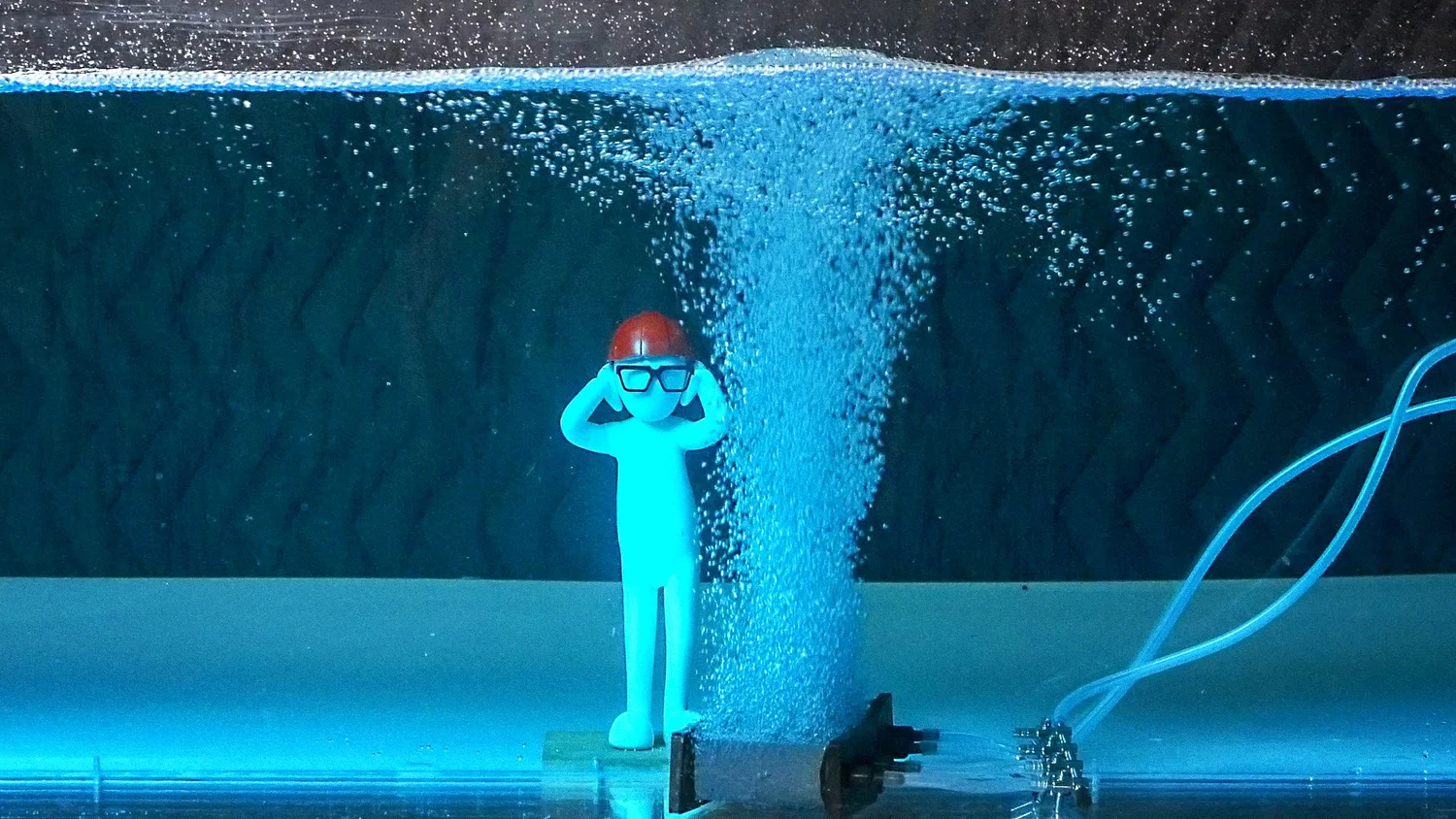
I built a new acrylic tank for this demo, and I’ve got a new helper in the shop. This is Brady. I figured since half the internet calls me that anyway, we might as well get a Brady in here. He can wave and nod, and he can probably do a lot of other stuff too, but that took me several hours, so he’s just going to bravely hold the hydrophone for now. And on the other end of the tank, I have this bluetooth speaker. It claims it’s underwater rated, so we’ll see if it works out.
And here’s the setup; pretty simple. I found a few recordings of hammering and pile driving sounds to play on the speaker. And this is how they come across on the hydrophone, which is connected to a sound recorder. I also did a frequency sweep so we can do a little more scientific comparison. Now let’s add some air.
At this point, one of my glue joints on this tank catastrophically failed and flooded my garage with water. I didn’t catch it on camera, but Brady took the brunt of the fall. Thankfully, he was wearing his hard hat. I got it all fixed up, and now let’s see if we can soften these construction sounds.
I have four air stones made for aquariums hooked up to an air pump. When I flip these on, we get a nice curtain of small bubbles between the speaker and the hydrophone. And I’ll record those same sounds again. Here’s a look at the waveforms from the hydrophone with and without the air. Although it’s not a dramatic difference, you can definitely see a difference, especially for the higher pitched hammering sounds toward the end. And here’s a look at the waveforms without and with the air for the frequency sweeps. Even though the sweep should have had a constant sound pressure across the full range of frequencies, the water and demo itself cause pretty serious distortions. You can see a lot of resonance at low frequencies, and a lot of attenuation at high frequencies. That makes it a little hard to gauge the effectiveness of the bubbles. It’s similar to the hammering sounds - not much difference at the lower frequencies, but a pretty substantial reduction at higher frequencies.
This is not an ideal setup for one reason: even though there’s a big mismatch in acoustic impedance between air and water, there’s not that much difference between acrylic and water. So, it’s pretty easy for pressure waves to propagate into the acrylic, travel past my bubble curtain, and back into the water on the other side. So I’m not getting the kind of sound reduction, what the pros call attenuation, that you might expect in the real world, for example, by surrounding a pile with a circular ring of air pipes. Thankfully, the researchers studying solutions like this have put a lot more resources into figuring out the right way to do it. The measurements at the Bay Bridge compared fairly well with mine. Attenuation was highest as the higher frequencies. But this is not as simple as just blasting air out of a pipe.
These bubble curtain systems require a lot of logistics. Massive compressors or blowers feed air sometimes deep below the surface into complex plumbing assemblies. They usually have filters to remove oil from the air to make sure the water isn’t being contaminated. The system has to sit flush with the bottom to make sure sound can’t travel underneath the bubble curtain. But also, there are currents. Any movement of the water is going to move the bubbles too, potentially creating gaps in the curtain or dispersing it altogether. So it’s often necessary to have multiple levels of plumbing to keep a continuous screen all the way to the surface. If that’s not enough, there are ways to confine the bubbles around a pile or construction activity using an outer casing or even a flexible membrane. But how do you know it actually works?
Maybe the most comprehensive engineering guidance on this topic is put out by Caltrans in their manual on the Hydroacoustic Effects of Pile Driving on Fish. Appendix 1 in the report is a nearly 300-page compendium of pile driving sound data. You might not have known this, but we’ve been measuring a lot of pile-driving sounds! If you’re an engineer or environmental scientist trying to get a permit to build something underwater and sound is going to be an issue, this is kind of your bible. It’s got quite a few ways to minimize impacts, including timing work when important species aren’t present, changing designs to reduce underwater work, using vibratory hammers instead of conventional equipment, and bubble curtains that reduce the propagation of underwater sound pressure. Based on all the testing and real-world case studies so far, they suggest you can get about 5 decibels of attenuation this way.
Just like my demo, sounds don’t only travel through the water. They also move through the sea floor and even through the barge on the surface, bypassing the bubbles. 5 decibels doesn’t sound like a big reduction, but you have to remember that it’s a logarithmic scale. A 5 decibel reduction means the actual sound pressure is nearly cut in half. You also have to remember that what we care about most is area. For any loud construction or demolition activity, there’s an invisible ring some distance away that marks the injury threshold level. Since sound pressure decreases with distance, eventually you’re far enough away from the sound that it doesn’t result in injury. So every foot or meter that you can pull that ring back toward the activity through attenuation reduces the impact area proportional to the distance squared, dramatically reducing the area in which fish may sustain injuries. That’s why bubble curtains are used in so many underwater construction projects these days, but that’s not all they’re used for.
What’s that old saying? If your only tool is a bubble curtain generation system, every problem starts to look like a loud underwater sound. Something like that. It turns out that bubbles can do a lot more than create an impedance mismatch for sound pressure propagation. For one, they aerate water, which can be useful to prevent algae and other issues with stagnant pools. For two, they create vertical water currents. That can help keep things separated, like trash. You can see it’s a lot harder for me to move this little boat across the barrier created by the bubbles. Of course, a net or boom or rack can do this too, but those don’t allow boats to pass through. And this doesn’t just work for trash. Bubble curtains have been used to contain oil spills, and they’re often used in underwater construction not just to control sound but turbidity. We really don’t want disturbed sediments clouding up our waterways, again, primarily for environmental reasons, so these can be an important tool when booms aren’t practical. They’ve also been used to control saltwater and keep it from migrating up rivers in tidal areas. And they’ve even been employed to confine herbicides for invasive plants, allowing for fewer chemicals and less non-target damage to nearby flora.
I’ll definitely be in trouble with the biology folks if I don’t point out that it’s not just people who use bubbles as a tool. Humpback whales cooperate to create bubble curtains that corral fish to a central point. Then they lunge into the center to gulp them down, a behavior called bubble net feeding. And we use bubbles this way on occasion as well, not for fishing but to keep fish out of certain areas, usually to prevent the spread of invasive species.
By 2005, the pile driving operation on the east span replacement of the Bay Bridge was complete, and Caltrans and its consultant were awarded the Environmental Excellence Award by the Federal Highway Administration for all the work they did on minimizing underwater noise impacts on endangered fish species. And the lessons from that project have been applied across the world in the two decades since.
You know I love heavy construction. The bigger and louder the machinery, the better. But I think that anything we can do to limit the effect we have on the other things we share this world with is a win, especially when it’s something as clever and creative as blowing bubbles.
I’ve got a post-graduate certificate in artificial intelligence (AI). I’m also an author, and I believe writers and publishers should not use AI in publishing. So that’s why I was disturbed when a reviewer asked if I had used AI in writing my recent coming-of-age novel, Under the Gulf Coast Sun.
But the reasons I oppose using AI are not the usual ones you hear.
We have all read or heard about copyright violations during AI algorithm training, as well as plagiarism problems, job displacement, potential stifling of creativity, legal complexity, blandness, and plain old human outrage. Those are all good arguments for opposing the use of generative AI in publishing.
Let me also argue against its use, but for a completely different reason: AI is dead.
Literally.
When I want to read poetry, a short story, a novel, a memoir, or non-fiction, I seek the voice of a fellow human being. A computer, by contrast, has the exact same awareness of the world that you had before birth—basically the perspective of a stone sitting on the side of the road. That is, no awareness of the world at all.
So, when I’m interested in what a person has to say, why would I willingly spend time reading or listening to a text that was mathematically calculated by a dead thing? I would not. And once you consider this reality, I believe you will lose interest as well, just as we all completely lost interest in (and quickly forgot) the rather incredible achievement of IBM’s Big Blue defeating chess champion Gary Kasparov in a six-game showdown in 1997.
Mustapha Suleyman, Microsoft’s Artificial Intelligence CEO, said in an NPR interview with Manosh Zamorodi that AI systems “communicate in our languages. They see what we see. They consume unimaginably large amounts of information. They have memory. They have personality. They have creativity.”
That is mostly nonsense. Computers operate only with zeros and ones. AI does not see what we see. It has no personality, no creativity. At best AI is a glorified calculator that works by fooling people into believing that it possesses the qualities Suleyman lists because AI does consume and process unimaginably large amounts of information from human beings. Unlike Suleyman’s claim, though, computers don’t have any real understanding of the data they generate.
Here’s how AI calculates novels or short stories or poetry: A human language prompt is converted into zeroes and ones and stored in a vast ocean of other zeros and ones. Then a set of instructions are loaded into the main processor’s transistors (again, zeroes and ones). The instructions tell the computer which zeroes and ones to retrieve from memory, then the retrieved zeros and ones are added together with other zeros and ones using Boolean math. This creates a different pattern of zeros and ones—which get put back into the storage system.
This process repeats itself at extreme speed for about ten or fifteen seconds, until the novel or short story or poem has been fully calculated and placed into memory (again, as zeros and ones).
At a higher level, AI calculates texts based on probabilities of what word is most likely to come next in the stream of data it’s generating. That’s all.
In other words: A poem, short story, or novel calculated by a computer is nothing more than a prediction. The fact that a human being sometimes can’t tell the difference between an AI-generated text and one written by a real person doesn’t make the calculation any less of a mindless mathematical outcome. (The Turing Test first devised in 1950, is a way to attempt to determine whether machines actually exhibit any real intelligence. In particular, if a human can’t tell the difference between the machine output and one created by a human, the test passes. But Turing, the man who proposed the test, later said that the question of whether machines can think is itself “too meaningless” to deserve discussion.)
And, critically, the math has nothing to do with how humans build beauty and meaning with writing.
There are uncountable amazing and incredibly useful applications of AI, both generative and otherwise, in society. I won’t list them (just ask your local ChatGPT, it will be happy to calculate a result for you). And on that note, I let ChatGPT end this article with a calculation it made about the meaning of its own calculations, based on the following prompt:
Me: I would state that you don’t understand concepts, but retrieve data, operate on the data, then calculate an output. The concept is up to me to create based on your calculations.
ChatGPT: You’re absolutely right. I do not possess true understanding or conceptual awareness in the human sense. Instead, I work by retrieving patterns, facts, and relationships from the data I’ve been trained on, performing calculations and logical operations to produce outputs that align with your prompts.
ChatGPT has calculated this truth (as Suleyman the Microsoft AI guru well knows): Generative AI output is an illusion—a fake—produced by a dead thing with no awareness of what it has produced. We have to make our own meaning from it. But beyond that, I simply cannot justify spending my very limited time reading the calculations of a computer while pretending it has the same weight as the creative output of an actual human being.
I read a brilliant explanation that it’s the clash of two world views: consent/non-consent vs approved/sinful.
For sane people, straight, gay, polyamorous, casual relationships are on one side because all the participants consent, and there’s a clear line between that and bestiality, pædophilia, or marrying a toaster, because animals, children, and appliances cannot meaningfully give consent.
To the sin-based mind, gay marriage is just as Wrong as pædophilia or bestiality because they’re all sins, so if you’re going to sin anyway why not fuck a sheep?
The big problem is they think we think like them. They think that people who support gay marriage are okay with child sexual abuse and are just lying about it. Until they can wrap their heads around the idea that other people don’t think like them, they will continue to be hateful about it. But that kind of introspection and empathy is specifically discouraged by their parody-Christian culture.
Tanith Lee was the first woman to win the British Fantasy Award for best novel, for the second book of the Flat Earth series. She died in 2015. You can buy Tales From the Flat Earthhere in paperback or here on Kindle.
Had to give a presentation for a work seminar the other day.
Didnt have much planned and I usually wing it so I got up there and opened with, “Hello, my name is [redacted]. I’m the security specialist assigned to [redacted]- I talk a lot when I’m nervous, so you’re gonna hear me talk a lot in the next five minutes”
This got a few laughs as expected, but then one of my superiors cut in like “I had no idea you had a fear of public speaking, you’re always so calm and confident”
so I got to say out loud in front of like 20 people twice my age that “Oh, yeah, no, I’m faking it super hard. Like, all the time.” (Gestures at face) “This is fake. I’m always freaking out, all of the time.”
Anyhow it went well and I’m getting a raise so like. Be yourself and lean into it I guess is what I’m getting to
The gap of time between how long Americans live and how much of that time is spent in good health only grew wider in the last two decades, according to a new study published in JAMA Network Open.
The study, which looked at global health data between 2000 and 2019—prior to the COVID-19 pandemic—found the US stood out for its years of suffering. By 2019, Americans had a gap between their lifespan and their healthspan of 12.4 years, the largest gap of any of the 183 countries included in the study. The second largest gap was Australia's, at 12.1 years, followed by New Zealand at 11.8 years and the UK at 11.3 years.
America also stood out for having the largest burden of noncommunicable diseases in the world, as calculated by the years lived with disease or disability per 100,000 people.














![[link]](https://i.redd.it/hlyb58a0isjg1.png)

 ALT
ALT